PART 2: HOA Sold My 62-Acre Forest Behind My Back—Then Three Board Members Learned the Corporate Shield Wouldn’t Save Them
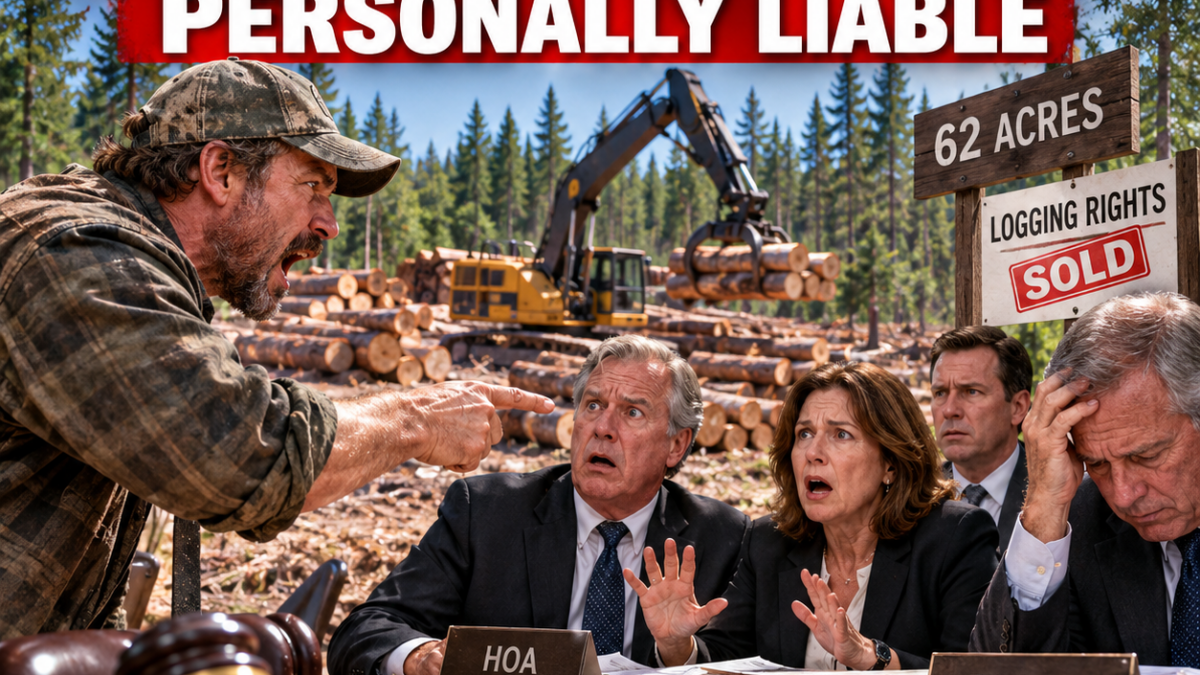
PART 2
Diane stepped out of her SUV wearing a navy rain jacket and boots that looked almost new.
Behind her came Greg Paxton, the HOA’s finance director.
Neither looked surprised to see the logging crew.
Neither looked surprised to see me.
That told me almost everything I needed to know.
“What the hell is this?” I asked.
Diane didn’t flinch.
“Owen, we need to keep this civil.”
“You sold my trees.”
“That isn’t an accurate description.”
I laughed once.
It wasn’t because anything was funny.
I held out my hand toward the superintendent.
“Give her the contract.”
He didn’t move.
Diane said, “I’m familiar with the contract.”
“I’m sure you are. Your association is listed as the seller.”
“The board approved a vegetation-management program under the declaration.”
“You approved removing dangerous trees near the roads.”
“We approved reducing hazardous fuel loads and storm exposure affecting common access.”
I pointed toward the north ridge.
“The road is a quarter mile that way.”
“The declaration gives the association entry rights where vegetation conditions affect community safety.”
“Then show me the part that gives you title to my white oak.”
“We did not claim title to your land.”
“I didn’t say land.”
That stopped her.
I stepped closer.
“I said timber.”
Greg joined in.
“The removed material has value, Owen. The contractor is compensating the association for material generated by necessary management work.”
I looked at him.
“That might be the most expensive sentence you’ve ever said to me.”
He frowned.
“You’re being dramatic.”
“No, Greg. I’m being very precise.”
I pointed to the contract.
“That isn’t a debris-removal agreement. It is a timber sale.”
The superintendent stayed silent.
He knew it too.
The document didn’t say the buyer was being paid to remove slash.
It priced merchantable timber.
It described harvest volumes.
It covered sixty-two acres.
And the blue paint spread through healthy commercial trees well beyond any road, ditch, culvert, house, or utility corridor.
Diane folded her arms.
“You agreed last fall that the fuel buildup was becoming a problem.”
“Yes.”
“And you agreed trees along the access road should be removed.”
“Yes.”
“We’ve been discussing safety for months.”
“Yes.”
“Then you cannot pretend this came out of nowhere.”
I stared at her.
“I agreed you could remove deadfall and dangerous trees beside the roads.”
“We believed broader management was necessary.”
“Believed?”
“Our forestry concerns were documented.”
“That still doesn’t answer the question.”
“What question?”
“Who gave you permission to sell healthy standing timber across my entire woodlot?”
Her expression changed.
Not much.
But enough.
She didn’t have an answer she wanted to say out loud.
So she gave me another one.
“The association acted under the recorded declaration.”
I nodded slowly.
“Then I guess somebody is going to have to read that declaration very carefully.”
Another saw started somewhere down the ridge.
I spun around.
“SHUT IT DOWN!”
The superintendent grabbed his radio.
The noise stopped again.
Diane stepped toward me.
“Owen, you cannot interfere with a contract simply because you disagree with the board’s interpretation.”
“My interpretation?”
“Yes.”
“You sold something with my name on the deed.”
“The association has rights.”
“Then show me where those rights become ownership.”
She said nothing.
I looked at the superintendent.
“Three trucks already left?”
He nodded.
“That’s what dispatch confirmed.”
I felt physically sick.
Not because I knew exactly which trees were gone.
Because I didn’t.
Sixty-two acres is large enough that you can hear a machine working and still not see the damage from another ridge.
“How long have you been cutting?”
“This morning.”
“How many trees?”
“We haven’t completed tally sheets.”
“Give me the landing map.”
“I can’t release project documents without authorization.”
“Then mark this moment down.”
Diane said, “Owen—”
“No. You wanted a safety project? Fine. I’ll listen to any competent forester who tells me a tree threatens a road, a house, a culvert, a power line, or the community.”
I pointed into the woods.
“But the moment you started pricing healthy oak by the thousand board feet, this stopped being hazard management.”
Greg’s face tightened.
“You don’t know the financial structure.”
“I know enough.”
“No, you don’t.”
“Then explain it.”
He glanced at Diane.
That glance mattered.
At the time I didn’t understand why.
Later, I would.
For now, Diane simply said, “This conversation needs counsel.”
“Finally, something we agree on.”
—
My attorney, Rachel Sloan, arrived at my house that afternoon.
I had worked with Rachel twice before, once on a boundary adjustment and once when a neighboring developer tried to place a drainage easement farther onto my land than the recorded plat allowed.
She wasn’t the kind of lawyer who told clients what they wanted to hear.
That was why I trusted her.
I put the deed, the HOA declaration, every notice I had received, and photographs of the logging operation across my dining table.
Rachel spent fifteen minutes reading before she spoke.
“The deed is straightforward.”
“All sixty-two acres?”
“In your name.”
“Timber reservation?”
“None that I see.”
“So they had no right.”
She held up one finger.
“Slow down.”
I hated when she did that.
“Owen, an HOA can have legitimate entry rights on private property if covenants grant them.”
“I know.”
“And a recorded declaration can authorize removal of vegetation under certain conditions.”
“I know.”
“So we don’t start by pretending they invented every ounce of authority.”
“They sold my timber.”
“That may be where they crossed the line. But I want to know exactly where that line is.”
I leaned back.
“They keep citing the safety clause.”
Rachel opened the declaration.
We found it.
The language allowed the association, after notice and under specified circumstances, to enter private lots to address vegetation conditions presenting hazards to common roadways, drainage facilities, access, and certain shared infrastructure.
Rachel read it twice.
Then she set it beside the deed.
“This gives them remedial authority.”
“What does that mean?”
“If a dead tree is leaning over a shared road and the owner refuses to deal with it, this may let the HOA enter and remove the hazard.”
“That’s what I thought.”
“If brush creates a defined fire or access problem, they may have management authority.”
“Fine.”
“But I don’t see anything here that transfers ownership of standing merchantable timber to the association.”
“Exactly.”
“Don’t celebrate yet.”
“Why not?”
“Because we still need every notice, every forestry report, every board packet, every map, the sale contract, payment records, and the buyer’s marking instructions.”
“Why?”
“Because the difference between legitimate hazard work and commercial harvest is going to show up in what they actually planned and what they actually cut.”
I showed her photographs of the blue paint.
She zoomed in.
“How far is this from the nearest road?”
“More than a thousand feet in some places.”
“Houses?”
“None on that ridge.”
“Utilities?”
“No.”
“Common drainage?”
“No.”
She put the phone down.
“Get a forester.”
“I know one.”
“Not a friend who hunts your land.”
“I know a consulting forester.”
“Good. Have him map the stumps and remaining marked trees.”
I looked toward the window.
“What about tomorrow?”
“What about it?”
“They could restart.”
Rachel closed the declaration.
“Then tonight we send notice to the HOA, the logger, the timber buyer, and the mill.”
“To stop?”
“To cease further cutting pending review.”
“And if they refuse?”
“Then tomorrow morning we ask a judge to stop them before another tree leaves.”
—
Marcus Vale arrived before sunset.
He had spent twenty-eight years doing timber inventories and forest-management plans.
He didn’t care about HOA politics.
That became obvious within ten minutes.
He walked past Diane’s orange ribbons without comment.
He ignored my angry explanations.
He carried a diameter tape, GPS unit, flagging, and a clipboard.
At the first stump, he measured.
At the second, he measured again.
By the tenth, he looked toward me.
“Healthy stand.”
“That’s what I said.”
“I don’t care what you said.”
I almost smiled.
“Good.”
He walked another skid trail.
“This one was merchantable oak.”
“Hazard?”
“Not from what remains of the stump and crown position.”
Another.
“Poplar.”
Another.
“Hickory.”
Another.
White oak.
We moved farther from the road.
Marcus checked his GPS.
“Eleven hundred thirty feet from the nearest common roadway.”
I looked back down the slope.
“You can barely see the road from here.”
“That doesn’t automatically mean there’s no legitimate management concern.”
“I know.”
He looked at me.
“You have a lawyer, don’t you?”
“Yes.”
“Good. Let her argue. I’m mapping trees.”
We spent three hours walking the harvest boundary.
By the time the light started fading, the pattern was impossible to ignore.
The blue paint did not hug roads.
It did not trace defensible-space corridors around homes.
It did not focus on deadfall pockets.
It followed timber.
Good timber.
Straight stems.
Marketable diameter.
Healthy oak.
Tulip poplar.
Hickory.
Marcus stopped beside a blue-marked white oak.
“This is telling.”
“What?”
“If the primary goal is hazard mitigation, you expect condition and location to dominate selection.”
“And this?”
“This looks like value selection.”
I stared up through the crown.
Dad would have kept that tree.
I knew it without checking the notebook.
Strong crown.
Good spacing.
Useful seed source.
Marcus saw my expression.
“You manage for regeneration?”
“My father did. I kept his system.”
“Records?”
“Thirty years.”
“Bring them.”
—
Rachel’s cease-and-desist notice went out that evening.
The logger stopped active felling temporarily.
The mill already had the three loads.
The next morning I drove to the landing.
Several trunks sat stacked with mill tags.
One was a white oak so wide I recognized its bark before I ever found the number.
I walked along the pile.
The trunks looked strangely anonymous after cutting.
Trees that had stood in specific soil for decades were now products.
Lengths.
Grades.
Volumes.
Dollar values.
I put my hand on one.
Rachel came up behind me.
“Don’t disturb anything.”
“I’m not.”
“The buyer has counsel now.”
“Good.”
“Owen.”
“What?”
“You need to understand something.”
I turned.
“A judge can sort out money later.”
She nodded.
“Yes.”
“But nobody can put growth rings back into that tree.”
“No.”
“That’s why I’m angry.”
“I know.”
“I don’t care if they write a check three years from now.”
“I know.”
“I care about what leaves today.”
“That is exactly why we’re asking for emergency relief.”
—
The HOA called an emergency board meeting that night.
Rachel and I attended remotely because she didn’t want me walking into a room angry enough to make somebody else’s case for them.
Five directors sat on the board.
Diane Mercer, president.
Greg Paxton, finance director.
Victor Hale, secretary.
Lisa Morrow.
Paul Fenwick.
The association attorney attended.
So did dozens of homeowners.
Diane opened with a prepared statement.
“The board authorized vegetation management after documented concerns involving storm damage, fuel buildup, access, and infrastructure protection.”
I waited.
Then came the second part.
“The timber contract was intended to offset management expense and help address urgent community capital needs.”
There it was.
Rachel leaned closer to the screen.
“Did you hear that?”
“Every word.”
Greg presented financial slides.
Blue Ridge Reserve had an aging bridge.
A retaining wall required major repair.
Reserves were low.
Without another source of money, homeowners could face a substantial special assessment.
Then Greg showed projected timber revenue.
I actually stopped breathing for a second.
Estimated gross proceeds:
Between **$230,000 and $260,000** depending on final volume and grade.
I looked at Rachel.
She was already writing.
Greg said, “This revenue could significantly reduce or possibly eliminate the need for an immediate special assessment.”
I unmuted.
“Then this isn’t hazard removal.”
Diane frowned.
“Owen, please wait until public comment.”
“No.”
Rachel touched my arm.
I kept going.
“A safety project identifies dangerous conditions. Your spreadsheet identifies revenue per thousand board feet.”
Greg answered.
“Those concepts are not mutually exclusive.”
“They are when the valuable trees you’re selling belong to me.”
Diane’s voice became sharp.
“The declaration authorizes removal.”
“Removal.”
“Yes.”
“Not sale.”
“We disagree.”
“Do you?”
“We do.”
“Then read the sentence that gives Blue Ridge Reserve ownership of the wood.”
She looked toward association counsel.
He didn’t rescue her.
Lisa Morrow spoke.
“I have a question for counsel.”
Diane looked irritated.
Lisa continued.
“Does the vegetation clause transfer title to merchantable timber?”
Counsel paused.
“The clause provides substantial management rights. Ownership of removed material is less explicit.”
Less explicit.
Rachel underlined something.
Paul Fenwick spoke next.
“Shouldn’t we suspend the sale until counsel gives a complete opinion?”
Greg shook his head.
“We already have a contract and advance payment.”
Lisa said, “That wasn’t my question.”
Diane interrupted.
“Canceling now could create breach exposure and leave the association with no timber proceeds after funds have already been committed toward bridge planning.”
There it was again.
Not trees.
Money.
The board voted.
Three to one to continue defending the timber contract while counsel reviewed the dispute.
Diane: yes.
Greg: yes.
Victor: yes.
Lisa: no.
Paul: abstain.
Rachel closed her laptop after the meeting.
“Remember that vote.”
“I will.”
“No. Really remember it.”
“Why?”
“Because people like to talk about a board as though it is one person.”
“It isn’t.”
“No.”
She looked at me.
“And before this is over, what each person did may matter very much.”
—
We filed for emergency relief the next morning.
Rachel’s argument was deliberately narrow.
She didn’t ask the judge to decide the entire case in one hearing.
She asked for one thing.
Stop irreversible cutting while ownership and authority were examined.
The HOA argued that the declaration gave it broad vegetation-management authority.
Rachel agreed that some authority existed.
That surprised Diane’s attorney.
Then Rachel drew the line.
“Your Honor, my client is not claiming the association can never enter his land under any circumstances. If a diseased tree threatens a shared road and the declaration authorizes removal, that issue can be addressed under the covenant.”
She placed the timber contract in front of the judge.
“But this agreement is not limited to identified hazard trees.”
Next came Marcus’s map.
Blue dots represented cut or marked commercial timber.
The pattern spread across the slope.
Far beyond roads.
Far beyond homes.
Far beyond culverts.
Rachel continued.
“This contract covers merchantable timber on approximately sixty-two privately owned acres. The deed contains no timber reservation in favor of the association. The court can decide damages later. It cannot regrow a seventy-year-old oak if cutting continues tomorrow.”
The judge looked at the HOA’s counsel.
“Does the declaration specifically vest ownership of removed timber in the association?”
Counsel answered carefully.
“It authorizes removal and management under specified conditions.”
“That wasn’t my question.”
Another pause.
“No explicit timber-title provision appears in the clause.”
I looked at Diane.
Her eyes stayed forward.
The judge issued the temporary order.
Harvesting stopped.
Not forever.
Not yet.
But long enough to examine the documents properly.
Outside the courthouse, a reporter from a local community paper asked whether I felt I had won.
“No.”
She looked surprised.
“The chainsaws stopped.”
“For now.”
“Isn’t that what you wanted?”
“I wanted them never to start.”
—
Marcus’s full inventory took days.
The damage covered roughly 14.6 acres where partial harvesting had already occurred.
That number sounded small when compared with sixty-two acres.
It didn’t feel small when I walked it.
Selective harvest damage can be deceptive.
A clearcut announces itself.
Everything is gone.
Selective removal leaves enough trees standing that a stranger might think the forest is fine.
But if somebody removes the exact trees you kept for structure, seed production, future quality, and spacing, the consequences can last decades.
Marcus stopped on the north ridge.
He bent near a stump.
Something metallic lay half buried beneath crushed leaves.
I reached down.
An aluminum tag.
Bent.
Scratched.
But readable.
**17.**
My knees nearly gave out.
Marcus looked at me.
“You know this tree.”
“My father marked it.”
I turned the tag over.
Dad had punched the number himself.
I could see the uneven spacing between the one and the seven.
For years, every January, I measured that white oak.
Dad had chosen it because it sat in the right place on the ridge, produced reliable acorns, and had a wide enough crown to matter to regeneration.
I found the old notebook entry that evening.
**Plot 17 — retain. Strong crown. Good mast. Do not remove unless declining.**
I read the sentence five times.
Rachel sat across the kitchen table.
“I’m sorry.”
I shook my head.
“You know what makes me angry?”
“What?”
“They’ll call it timber value.”
“Part of the claim will involve timber value.”
“That’s not what it was.”
“I know.”
“It wasn’t just a log.”
“I know.”
“Dad marked that tree before I owned this property.”
Rachel let me talk.
“That tree was older than half the houses in Blue Ridge Reserve.”
She said nothing.
“I measured it every winter after he died.”
I put the bent tag on the table.
“You can plant another oak there.”
“Yes.”
“You can even grow a good one.”
“Yes.”
“But I’ll be dead before it looks like that.”
Probably.
That word hurt more than I expected.
Probably.
The forest would recover.
I might never see the part that mattered most.
—
Diane called me two days later.
Rachel had advised me not to discuss the merits alone, so I put the call on speaker with her listening.
Diane sounded tired.
“Owen, I heard about your father’s tree.”
I didn’t answer.
“I’m sorry.”
“Thank you.”
“We did not target it because it belonged to your father.”
“I know.”
“The crew followed the harvest markings.”
“I know.”
“I hope you understand nobody intended to erase your family history.”
I looked at Rachel.
She nodded for me to answer honestly.
“I believe you.”
Silence.
Then Diane said, “You do?”
“Yes.”
She exhaled.
“I don’t think you woke up hoping to cut my father’s tree.”
“Thank you.”
“But intention doesn’t give you ownership.”
Her voice changed.
“I understand your position.”
“That isn’t a position.”
“We still disagree about the declaration.”
“Then let the court decide.”
“We will.”
I almost ended the call.
Then she said, “Owen, do you know what our special assessment would have been?”
“No.”
“Potentially more than $2,500 per household depending on the final repair package.”
“That’s painful.”
“We have retirees here.”
“I know.”
“Families already struggling with insurance increases.”
“I know.”
“The bridge needs work.”
“I believe you.”
“The retaining wall needs work.”
“I believe you.”
“Then surely you understand why we were trying to find another solution.”
I closed my eyes.
“Yes.”
She sounded surprised again.
Then I said, “And that makes this worse.”
“How?”
“Because you took a legitimate community problem and decided my property was the solution.”
“We believed the declaration gave us authority.”
“To cut hazards.”
“To manage vegetation.”
“Management is not ownership.”
“That will be decided.”
“Yes.”
I picked up Plot 17’s bent tag.
“And when it is, that stump will still be there.”
—
The HOA’s insurer entered the case.
That changed the tone immediately.
The first major defense was what Rachel had expected.
Board members are protected when they act for the association.
Volunteer directors cannot be personally exposed every time a court later disagrees with their interpretation.
And on a general level, that argument made sense.
Nobody would serve on a board if one incorrect vote automatically meant losing their house.
Diane had not pocketed timber money.
Greg had not received a secret commission.
Victor had not taken a kickback.
The planned proceeds were designated for community repairs and safety needs.
At first, that looked like the strongest part of their case.
The HOA might be liable.
The contract might fail.
The timber claims might be resolved.
But the individual directors could remain protected behind the association.
I asked Rachel about it.
“So they can sign away somebody else’s property and just say they were volunteering?”
“That’s not what the law says.”
“It sounds like it.”
“It says ordinary board service gets protection in many situations.”
“This wasn’t ordinary.”
“Then we prove that through conduct.”
“What does that mean?”
“It means we stop talking about the board as one block.”
She pulled out five folders.
One for each director.
Diane.
Greg.
Victor.
Lisa.
Paul.
“What are those?”
“Individual records.”
“What are we looking for?”
“Knowledge.”
“Of what?”
“Where the authority stopped.”
“And then?”
“What each person did after they knew there was a serious problem.”
I looked at the folders.
“So a yes vote isn’t enough?”
“Not necessarily.”
“What is?”
“That depends on the facts.”
She pushed Diane’s folder toward me.
“We start before the sale.”
—
Discovery produced the first important document from a forestry consultant hired months before the timber contract.
I expected something dramatic.
It wasn’t.
That made it more powerful.
The report recommended deadfall removal.
Fuel-break work.
Selective hazard treatment near access corridors.
Storm-damaged-tree evaluation.
It did not recommend commercial harvest across all sixty-two acres.
Marcus read it.
“This is normal hazard-management language.”
“And the sale?”
“Not the same plan.”
Then came the email from HOA counsel.
Rachel called me before sending it.
“Read this slowly.”
The email had gone to Diane, Greg, and Victor before the timber contract was approved.
The attorney wrote that the declaration gave Blue Ridge Reserve vegetation-management rights but **did not clearly vest ownership of merchantable timber** in the association.
He recommended obtaining owner consent or seeking judicial clarification before entering a commercial sale.
I stared at the screen.
“They were warned.”
“Yes.”
“Before the vote?”
“Yes.”
“Diane got it?”
“Yes.”
“Greg?”
“Yes.”
“Victor?”
“Yes.”
“What about Lisa?”
“She received it too.”
“Paul?”
“Yes.”
“Then why aren’t they all responsible?”
Rachel looked at me.
“Because receiving advice isn’t the end of the analysis.”
“Lisa voted no.”
“Correct.”
“Paul abstained.”
“And requested clarification.”
I understood.
“Diane, Greg, and Victor voted yes.”
“Still not the whole story.”
“What else?”
Rachel opened another document.
“After you confronted the logger.”
The superintendent had sent a message to the HOA.
**Owner disputes association authority to sell. Recommend suspend cutting pending confirmation.**
The reply came from Diane.
**Proceed under executed contract. Counsel reviewing.**
I felt heat rise into my face.
“She told them to keep cutting.”
“Yes.”
“After I stood there?”
“Yes.”
“After their own attorney had already warned them?”
“Yes.”
I sat back.
The next record involved Greg.
The buyer had called asking whether the advance payment and harvest remained authorized.
Greg confirmed that the association still stood behind the sale and expected performance.
Then Victor sent the declaration clause and a certified copy of the board resolution to the contractor as proof of authority.
Three people.
Three actions.
Diane instructed.
Greg confirmed.
Victor certified.
Rachel closed the file.
“Those verbs matter.”
—
The depositions were brutal, but not in the loud way people imagine legal drama.
Nobody slammed a fist on the table.
Nobody shouted “Gotcha.”
Rachel just asked questions until there was nowhere left for the answers to hide.
Diane went first.
“Did you receive counsel’s email before the timber vote?”
“Yes.”
“Did the email state that the declaration did not clearly vest timber ownership in the association?”
“It identified uncertainty.”
“That wasn’t my question.”
“Yes.”
“Did counsel recommend owner consent or judicial clarification?”
“Yes.”
“Did you obtain Mr. Barrett’s consent?”
“No.”
“Did you seek judicial clarification before signing?”
“No.”
“Why?”
“We faced urgent safety and infrastructure needs.”
“Did urgency create timber ownership?”
Diane’s attorney objected.
Rachel rephrased.
“Did any document you possessed state that urgency transferred title to Mr. Barrett’s timber?”
“No.”
“After Mr. Barrett confronted the logging crew, did the superintendent recommend suspension?”
“Yes.”
“Did you tell him to proceed?”
“I confirmed the association’s position under the executed agreement.”
“Is that a yes?”
“Yes.”
Diane stayed composed.
That almost made it harder to watch.
She wasn’t a cartoon villain.
She was a woman who had made a chain of decisions and could now hear every link being read back to her.
Greg’s deposition followed.
Rachel showed him the revenue spreadsheet.
“You prepared this?”
“Yes.”
“Projected gross proceeds up to approximately $260,000?”
“Depending on volume and grade.”
“And you calculated how those proceeds could reduce a special assessment?”
“Yes.”
“Was this spreadsheet about road-hazard removal?”
“It concerned the financial impact of the vegetation-management project.”
“Did the projected revenue increase when more healthy merchantable timber was harvested?”
Greg hesitated.
“Yes.”
“Then the financial benefit depended on timber volume.”
“Yes.”
“After Mr. Barrett disputed the association’s authority, did the buyer ask whether the contract remained active?”
“Yes.”
“Did you confirm that payment and performance remained authorized?”
“Yes.”
“Why?”
“I believed the board resolution controlled unless revoked.”
“Even after counsel’s warning?”
“I understood the warning as litigation risk, not a definitive conclusion.”
“Even after the owner objected?”
“Yes.”
Victor was more defensive.
He had certified the board resolution.
Sent the declaration clause.
Provided documents to the contractor.
His attorney repeatedly emphasized that Victor had simply performed secretarial functions.
Rachel kept returning to one point.
“Did you know there was a title dispute when you certified authority to the contractor?”
“Yes.”
“Had counsel warned that the declaration did not clearly vest timber ownership?”
“Yes.”
“Did your certification explain that limitation?”
“No.”
Lisa’s deposition was short.
She had read counsel’s warning.
Voted no.
Refused to sign additional authorization.
Took no step to encourage continued cutting.
Paul had abstained.
Asked for a full legal opinion.
And did not participate in later instructions.
When we left Rachel’s office that evening, she said, “This is why individual liability must stay individual.”
I nodded.
“I don’t want Lisa dragged into it.”
“Good.”
“Or Paul.”
“Good.”
“They were in the room, but they didn’t keep it moving.”
“Exactly.”
“I want the record to follow what people actually did.”
Rachel smiled.
“That is the strongest thing you’ve said since this started.”
—
The HOA tried to settle before the main hearing.
The first offer focused heavily on stumpage value.
Rachel read it to me.
“They’ll pay for the commercial value of the timber removed, contribute to erosion repair, and cover a portion of professional fees.”
“What about restoration?”
“Limited.”
“What about the north ridge?”
“Not enough.”
“What about Plot 17?”
She looked at me.
“You know no settlement can value that the way you do.”
“I know.”
“They’re asking for a release.”
“Of the directors too?”
“Yes.”
“No.”
Rachel didn’t immediately agree.
Instead, she asked, “What outcome are you actually seeking?”
“I want my forest restored.”
“That part is possible, within ecological limits.”
“I want the timber value paid.”
“Possible.”
“I want the skid trails stabilized.”
“Possible.”
“I want replanting.”
“Possible.”
“I want Diane, Greg, and Victor held responsible for what they personally did.”
Rachel folded her hands.
“Do you want revenge?”
I thought about it.
“Yes.”
She waited.
Then I shook my head.
“No.”
“Which answer is true?”
“Both.”
“That’s normal.”
“I don’t want to destroy their families.”
“Good.”
“But I want them to understand that putting ‘HOA’ above your signature doesn’t make another person’s property become community money.”
“That’s different.”
“Is it?”
“Yes.”
“How?”
“Revenge wants suffering because you suffered.”
“And accountability?”
“Accountability wants the consequence attached to the decision.”
I stared out the window.
“Then accountability.”
“Hold onto that.”
“Why?”
“Because the closer we get to trial, the easier it is to forget.”
—
Winter exposed every wound in the woodlot.
Without leaves, the skid trails looked wider.
Stumps stood out.
Slash piles created dark lines across the snow.
I walked to Plot 17 almost every Sunday.
I don’t know why.
Maybe I wanted to force myself not to pretend it hadn’t happened.
Dad’s tag sat on my desk.
The stump stayed where it was.
Marcus developed a rehabilitation plan.
Close unnecessary skid trails.
Install water bars.
Control erosion.
Protect regeneration.
Replant selected hardwoods.
Monitor invasive species.
Rebuild inventory plots.
“Will it recover?” I asked.
“Yes.”
“How long?”
“That depends what you mean by recover.”
“Look like it did.”
He looked toward the ridge.
“Decades.”
I laughed without humor.
“I knew you were going to say that.”
“If you want me to lie, hire somebody else.”
“No.”
He crouched near one of the stumps.
“You can restore function faster than you restore age.”
“What does that mean?”
“Stabilize soil in a season. Establish seedlings over years. Rebuild structure over decades. Mature oak? That’s lifetime work.”
“Dad used to say forestry was optimism with a measuring tape.”
Marcus smiled.
“He was right.”
—
The main court rulings came in stages.
That made them less dramatic than people later told the story.
First came ownership.
The deed controlled.
The land was mine.
No timber rights had been transferred to Blue Ridge Reserve.
No reservation gave the HOA merchantable timber.
Then came authority.
The declaration did give the HOA real vegetation-management rights for specified hazards affecting roads, access, and shared infrastructure.
The judge said that clearly.
Diane’s side had not invented the safety clause.
But the court drew the boundary just as Rachel had argued.
A limited power to remove hazards did not convert the HOA into owner of healthy commercial timber.
Management was not title.
Removal authority was not sale authority.
A safety right was not a revenue right.
I sat beside Rachel when the judge said it.
My hands were shaking.
Not because I had learned something new.
Because for months I had heard Diane repeat the same phrase.
**The declaration gives us authority.**
Now someone with actual authority had finished the sentence.
Yes.
But not that authority.
—
The court then turned to what happened on the ground.
Marcus testified.
He showed the road network.
The homes.
The common infrastructure.
Then the stump map.
The commercial pattern was obvious.
Marketable trees had been selected deep into the woodlot.
Healthy oak and poplar were removed outside practical hazard corridors.
The 14.6 acres already affected weren’t destroyed completely, but they had been altered.
“Selective cutting can create long-term silvicultural impact,” Marcus explained, “especially when retained seed trees and structural trees are removed contrary to the owner’s management plan.”
The HOA attorney asked, “The property remains forested, correct?”
“Yes.”
“It was not clearcut.”
“Correct.”
“Trees remain.”
“Yes.”
“So describing the parcel as destroyed would be inaccurate.”
Marcus nodded.
“Yes.”
I felt angry for half a second.
Then he continued.
“But describing the loss as insignificant would also be inaccurate.”
The attorney stopped smiling.
Marcus explained how selective removal of the wrong trees changes future composition.
How the best seed producers matter.
How crown spacing matters.
How a mature white oak isn’t interchangeable with a nursery sapling.
Then Rachel showed the photograph of Plot 17’s tag.
She asked me about Dad.
I told the court what he had taught me.
I didn’t cry.
I thought I would.
Instead, my voice became almost painfully calm.
“He marked that tree before I owned the property.”
“Why?”
“Seed production. Structure. It was a reference point.”
“Did you maintain records?”
“Yes.”
“How often?”
“Every winter.”
“After your father died?”
“Yes.”
“Why?”
I looked toward the judge.
“Because that was how he taught me to manage the forest. You don’t make every decision for yourself. Some decisions are for the person who comes after you.”
Rachel let the silence sit.
Then she asked, “Can money replace Plot 17?”
“No.”
“Can you plant another white oak?”
“Yes.”
“Will it be the same tree?”
“No.”
“Will you live long enough to see it reach the same age?”
I swallowed.
“I don’t know.”
That was the first moment Diane looked down.
—
Then came the part everybody had been waiting for.
Personal liability.
The HOA’s insurer argued that board members were volunteers acting for association purposes.
No one had personally profited.
The timber money was intended for bridge work, retaining-wall work, and community safety.
Diane had not bought a vacation home.
Greg had not skimmed the sale proceeds.
Victor had not accepted a secret payment.
The motives mattered.
But they did not end the analysis.
Rachel stood.
“We are not arguing that every director becomes personally liable whenever a board makes a legally incorrect decision.”
She glanced toward Lisa and Paul.
“The evidence proves why that would be wrong.”
Lisa voted no after reviewing counsel’s warning.
Paul abstained and demanded clarification.
Neither directed the logger.
Neither confirmed the contract after the dispute.
Neither certified disputed authority to induce continued performance.
Then Rachel turned toward the other three.
“This case is about individual conduct after specific warnings.”
The sequence appeared on the screen.
Counsel warns timber ownership is unclear.
Contract proceeds.
Owner objects.
Logger recommends suspension.
Diane directs continuation.
Buyer requests confirmation.
Greg confirms performance and advance payment remain authorized.
Contractor requests proof.
Victor certifies and transmits authority without disclosing the known limitation.
Rachel looked at the judge.
“The corporate form protects board service. It does not automatically erase a person’s own active participation in a wrongful act.”
Diane’s attorney argued that every action had been taken in official capacity.
Rachel agreed.
Then said the sentence I remembered more than anything else from that hearing.
“An official title explains why a person acted. It does not necessarily erase what that person did.”
—
The rulings were quiet.
No courtroom gasps.
No shouting.
No dramatic handcuffs.
This was a civil case about property, authority, conduct, and loss.
The judge separated everything carefully.
Lisa was not personally liable.
Paul was not personally liable.
Their records did not show active participation in advancing the timber sale after the warnings.
Then the judge addressed Diane.
Her role was not based merely on being president or voting yes.
It was tied to her instruction to continue after counsel’s warning, after the owner’s objection, and after the logger asked to suspend cutting.
Greg’s exposure was not based merely on preparing a budget or casting a vote.
It followed his active confirmation to the buyer that payment and performance should continue after the dispute had become explicit.
Victor’s exposure was not based merely on being secretary.
It followed his certification and transmission of disputed authority after warning.
Three names.
Diane.
Greg.
Victor.
Personally tied to findings arising from their own conduct.
I closed my eyes.
For almost a year, people had accused me of trying to bankrupt volunteers because I hated the HOA.
That had never been the point.
I looked across at Lisa.
Then Paul.
Neither had been dragged into the judgment simply because they sat at the table.
The line followed conduct.
Exactly as I wanted.
Rachel whispered, “You okay?”
“Yes.”
“You don’t look happy.”
“I don’t think this was ever going to feel happy.”
—
Outside, Diane stood near the courthouse steps.
Reporters had gathered.
She didn’t speak to them.
Neither did I.
As I walked toward the parking lot, she called my name.
“Owen.”
Rachel slowed.
I looked at her.
“It’s okay.”
Diane approached alone.
She looked older than she had the morning I found the logging crew.
“I still believe we were trying to solve real problems,” she said.
“I know.”
“The bridge was underfunded.”
“I know.”
“The retaining wall still needs work.”
“I know.”
“Families are still going to pay an assessment.”
“I know.”
She looked frustrated.
“Then what exactly did all of this accomplish?”
I thought about Plot 17.
The three trucks.
The blue paint.
The revenue sheet.
The email warning.
Then I said, “Now they’ll pay for their bridge with money that belongs to them.”
She stared at me.
I continued.
“That’s what changed.”
Her eyes filled, but she didn’t cry.
“I never thought of it as stealing.”
“I believe you.”
She shook her head.
“You keep saying that.”
“Because I do.”
“Then why does that make me feel worse?”
“Because if you had been trying to hurt me, you could tell yourself the problem was your motive.”
She looked away.
“But you thought you were helping people.”
“Yes.”
“And that made it easier to ignore who was paying.”
She didn’t answer.
For a long moment, we stood in the cold.
Then she said, “I’m sorry about Tree 17.”
“Plot 17.”
She nodded.
“Plot 17.”
“Thank you.”
That was all.
There was nothing left worth saying.
—
The financial remedy covered several categories.
Timber value.
Professional costs.
Remediation.
Restoration.
Erosion control.
Legal expenses where recoverable.
Other proven losses associated with the unauthorized harvest.
I never treated the numbers like a jackpot.
Most of the money had somewhere to go before it ever reached me.
Marcus’s restoration plan.
Skid-trail closure.
Drainage correction.
Soil stabilization.
Replanting.
Monitoring.
Professional forestry work.
The forest had become more expensive precisely because somebody had tried to turn it into easy money.
Blue Ridge Reserve still had its bridge problem.
That problem didn’t disappear.
Homeowners eventually approved a special assessment smaller than some early projections but still painful.
A few residents blamed me.
One sent a letter saying I should have “donated” the timber because the bridge served the entire neighborhood.
I read it twice.
Then I put it in a drawer.
Rachel asked why I didn’t respond.
“What would I say?”
“The truth.”
“The truth is they’re allowed to ask.”
“And?”
“I’m allowed to say no.”
That was the entire case in one sentence.
Community need does not automatically erase individual ownership.
—
In early spring, Marcus and I returned to the north ridge with seedlings.
White oak.
A few hickories.
Native species selected for the site.
The stump of Plot 17 was still there.
Weathered now.
Darker around the edges.
I had decided not to grind it out.
Marcus handed me a white oak seedling.
“This one?”
I nodded.
We planted it several feet from the old stump.
Not on top of it.
Beside it.
That mattered.
I didn’t want the new tree pretending to be the old one.
When we finished, I drove a stake into the soil.
Then I pulled an aluminum tag from my pocket.
Marcus read it.
**PLOT 17B**
He smiled.
“Not seventeen?”
“No.”
“Why B?”
“Because it isn’t a replacement.”
He nodded.
“It starts a new record.”
“Exactly.”
I attached the tag.
Under the number, I added the year.
Then I opened Dad’s old inventory notebook.
For the first time in decades, I wrote a new entry beneath his handwriting.
**Plot 17B — white oak. Established beside original Plot 17 stump. Retain. Monitor.**
I stopped.
Marcus waited.
I added one more line.
**For whoever measures it after me.**
That was when I finally cried.
Not in court.
Not when I found the stump.
Not when the judgment came down.
There, kneeling beside a tree barely taller than my knee, with Dad’s notebook open in the leaves.
—
The forest changed slowly.
That was one of the lessons this fight forced me to remember.
Courts move in months.
Contracts move in days.
Chainsaws move in seconds.
Forests move in generations.
You can sign away a century of growth before lunch.
You cannot sign it back.
That difference became the part of the story that mattered most to me.
People focused on the board being held personally liable.
They liked that part.
It sounded like revenge.
A powerful HOA crosses the wrong landowner.
Three directors discover the corporate shield has limits.
That makes a good headline.
But standing beside Plot 17B, revenge felt too small.
What mattered was the boundary.
Blue Ridge Reserve had legitimate powers.
Real ones.
If a dead oak threatened the road, the declaration could matter.
If brush blocked common access, the HOA could act within its authority.
If dangerous conditions affected shared infrastructure, management rights could be real.
But authority has edges.
That is what people forget when they get used to having it.
A board can start believing that because it has power to solve one problem, it has power to solve every problem.
Because it can enter, it thinks it can own.
Because it can remove, it thinks it can sell.
Because the money would help eighty-six households, it decides one owner should absorb the cost.
That is how lines disappear.
Not always through greed.
Sometimes through good intentions moving too fast.
—
A year after the judgment, Blue Ridge Reserve replaced the bridge.
I drove across it one morning.
The work was good.
New deck.
Reinforced approaches.
Drainage improved.
For a moment I thought about all the arguments Diane had made.
The bridge really had needed repair.
She hadn’t lied about that.
The retaining wall had also been unstable.
The fire concern had been real.
That complexity no longer bothered me.
Early in the case, I wanted everything simple.
I wanted them wrong about everything.
Me right about everything.
Life rarely gives you that kind of convenience.
Diane had been right that Blue Ridge Reserve faced serious infrastructure problems.
She had been wrong to solve them with timber the association didn’t own.
Both could be true.
Understanding that didn’t weaken my case.
It made the lesson stronger.
—
Lisa Morrow visited my woodlot that summer.
She had left the board after her term ended.
We walked part of the north ridge.
She stopped at Plot 17’s stump.
“So this is the tree.”
“Yes.”
“And that’s 17B?”
“Yes.”
She smiled.
“Tiny.”
“Trees usually start that way.”
She laughed.
Then her expression became serious.
“I should have pushed harder.”
“You voted no.”
“After the contract was already negotiated.”
“You asked counsel questions.”
“Not early enough.”
“You didn’t tell them to keep cutting.”
“No.”
“That mattered.”
She looked toward the young oak.
“I used to think voting no was enough.”
“Sometimes it is.”
“And sometimes?”
“You have to ask why you’re the only one uncomfortable.”
She nodded.
“I remember Greg’s revenue spreadsheet.”
“So do I.”
“The room changed after that.”
“Yes.”
“We were talking about safety, and suddenly everyone started talking about how much assessment money we could avoid.”
“That was the moment.”
“I think so too.”
She crouched beside Plot 17B.
“Will this really become a tree like the old one?”
“Maybe.”
“When?”
I smiled.
“Ask somebody else in seventy years.”
—
Paul came once too.
He brought a folder.
“What’s this?”
“Copies of the board minutes and revised policies.”
“Why do I need them?”
“I thought you might want them for your records.”
That sounded like something Dad would have appreciated.
Blue Ridge Reserve had changed its procedures.
Property-affecting projects now required clearer legal review.
Any sale or transfer involving materials originating from privately owned lots needed documented ownership authority.
Material legal warnings had to be included in board packets.
Directors had to acknowledge when counsel identified unresolved property rights.
Contractors were given a stop-work escalation procedure if an owner raised a credible title dispute.
I read the policy twice.
“This is good.”
Paul nodded.
“We learned.”
“Expensively.”
“Yes.”
“Those lessons tend to stick.”
He looked toward the forest.
“I’m sorry we learned on your land.”
“Me too.”
—
Greg never visited.
Neither did Victor.
I saw them occasionally at meetings or around town.
We were civil.
That was enough.
Diane eventually moved out of Blue Ridge Reserve.
I heard she wanted to be closer to her daughter.
I never asked whether the lawsuit influenced the decision.
People expected me to enjoy hearing she had left.
I didn’t.
By then, I no longer needed her to lose anything else.
The consequence had already attached to the decision.
That was enough.
—
Three years after the cutting, Plot 17B reached shoulder height.
I measured it.
Ridiculously small diameter compared with Dad’s old tree.
I wrote the number anyway.
That was the point of a record.
You don’t only record impressive things.
You record beginnings too.
The original stump had softened around one edge.
Moss grew over part of it.
I left the metal tag from Plot 17 in the house because I didn’t trust weather or visitors with it.
Sometimes I took it out.
The uneven punched digits still looked like Dad’s hands.
That might sound sentimental for a piece of aluminum.
I don’t care.
Land carries memory through ordinary objects.
A tag.
A fence post.
A scar on a maple.
A line in a notebook.
A badly repaired gate.
That doesn’t mean you freeze everything forever.
Dad never wanted that.
He harvested timber.
He thinned.
He cut firewood.
He opened canopy where regeneration needed light.
He believed working forests should work.
The insult wasn’t that a tree had been cut.
The insult was that somebody else decided which tree, for whose benefit, without owning the choice.
That distinction became clearer every year.
—
One fall morning, I took my nephew Eli into the woods.
He was twelve.
The same age I had been when Dad first handed me a diameter tape.
I gave him one.
He looked at it.
“What do I do?”
“Measure the tree.”
“Which one?”
I pointed toward 17B.
“That tiny thing?”
“Yep.”
“That’s boring.”
I laughed.
“What?”
“Nothing.”
He wrapped the tape wrong.
I corrected him.
He wrote the measurement in a new notebook.
Then he pointed at the old stump.
“What happened to that one?”
I could have told him the whole legal story.
The HOA.
The contract.
The lawsuit.
The directors.
Instead I said, “Some people thought they had the right to make a decision they didn’t actually own.”
He frowned.
“About a tree?”
“About a lot of trees.”
“Did you stop them?”
“Eventually.”
“Did you win?”
I looked at Plot 17B.
“That depends what you mean.”
He groaned.
“That sounds like something Grandpa would say.”
I smiled.
“Good.”
—
Five years after the dispute, the north ridge no longer looked wounded from the road.
Vegetation had reclaimed the closed skid trails.
Young hardwoods filled openings.
The worst erosion areas stabilized.
A casual visitor might never notice what happened.
I noticed.
Marcus noticed.
Anyone who compared inventory plots noticed.
Recovery can hide damage without erasing history.
That was why I kept the old stump.
Not as a monument to anger.
As context.
Plot 17B made more sense beside Plot 17.
The future beside the consequence.
—
I eventually wrote a letter and placed it inside Dad’s notebook.
Not to the HOA.
Not to the court.
To whoever owns Barrett Wood after me.
It said:
**If you are reading this, you are responsible for choices somebody before you preserved. That does not mean you must make the same choices I made. Harvest if the forest needs harvesting. Thin if it needs thinning. Sell timber if that is the right decision. But know what belongs to you, know what rights others hold, document what you do, and never let urgency make you give away a decision that is yours to make.**
Then I added:
**Plot 17B is on the north ridge beside the old stump. Measure it if it is still there.**
I closed the notebook.
For the first time since the day the oak fell, the whole thing felt finished.
Not erased.
Finished.
—
People still ask me about the three board members.
They usually phrase it the same way.
“Did they really have to pay personally?”
I tell them what matters.
They weren’t held responsible simply because they served on an HOA board.
Lisa served too.
Paul served too.
They were not personally liable.
The important distinction was conduct.
The legal warnings.
The owner’s objection.
The instruction to proceed.
The confirmation to keep the contract alive.
The certification of disputed authority.
That sequence separated ordinary board service from active participation in the conduct the court found wrongful.
That detail matters because otherwise the story becomes a fantasy about crushing HOA volunteers.
It wasn’t.
It was about limits.
I never wanted five people punished because they sat at one table.
I wanted the consequences to follow the people who crossed the line.
They did.
—
I also tell people something they usually don’t expect.
The HOA wasn’t wrong to care about safety.
That bridge mattered.
The retaining wall mattered.
Fuel management mattered.
Deadfall management mattered.
If Blue Ridge Reserve had come to me with a legitimate forestry plan, I probably would have worked with them.
If a dangerous tree threatened their road, I would have removed it.
If a fuel break made sense, Marcus could have designed one.
If they wanted to purchase timber rights voluntarily, they could have asked.
Maybe I would have said yes to some harvest.
Maybe not.
But there would have been a negotiation.
A price.
A map.
A plan.
A decision.
Mine.
That single missing step was the difference between cooperation and taking.
—
One evening, years later, I walked up the ridge just before dark.
Plot 17B had finally started looking like a real young tree.
Not a seedling.
Not yet mature.
Something in between.
The old stump sat beside it, low and gray.
I ran my hand over the young bark.
Dad used to say every forest contains three versions of time.
Trees you inherited.
Trees you manage.
Trees you will never see mature.
Plot 17 had been the first.
17B was the third.
I was responsible for the middle.
Maybe that was the real ending.
Not the judgment.
Not the money.
Not the three directors learning that a corporate title did not automatically protect their own actions.
Those things mattered.
But they were temporary.
The forest was longer than all of us.
Diane’s presidency ended.
Greg’s spreadsheets disappeared into case files.
Victor’s certifications became exhibits.
Rachel closed the litigation folder.
Marcus moved on to other clients.
The homeowners repaired their bridge.
Life kept moving.
And on the north ridge, a young white oak kept growing beside the stump of a tree somebody once believed was just another line of revenue.
Every winter, I measured it.
Every winter, I wrote the number down.
Some years the growth was good.
Some years it barely changed.
I never stopped recording it.
Because my father had been right from the beginning.
A working forest is not something you preserve by refusing to touch it.
You protect it by preserving the right to make careful choices.
The HOA didn’t hurt me because they cut trees.
Trees are cut every day.
They hurt me because they took that choice from me and tried to turn my family’s land into a solution for a problem that belonged to their association.
The court gave that choice back.
The judgment restored the legal boundary.
The restoration work repaired what could be repaired.
The money covered what money could cover.
And Plot 17B took care of the part no judgment could reach.
It gave me something to measure again.
Something to leave behind.
Something that wasn’t pretending the old tree never fell.
One cold January morning, nearly a decade after the first chainsaw came across the ridge, I opened Dad’s notebook beside the young oak and added another measurement.
The trunk was thick enough now that my hand no longer wrapped around it.
I smiled.
Then I looked at the original stump.
For years, I thought that stump represented what the HOA had taken.
That morning, it looked different.
It represented the line they had crossed.
And the tree beside it represented the line they would never cross again.
I closed the notebook.
Down below, through the bare winter branches, I could see the repaired bridge leading into Blue Ridge Reserve.
Cars moved across it.
Families went home.
Nobody was ruined.
Nobody lost their house.
The community survived.
So did the forest.
That was the ending I wanted.
Not destruction.
Not humiliation.
A boundary restored.
A lesson expensive enough to be remembered.
And a young white oak growing where the future still had room to make its own choices.

