PART 2: HOA Sent Fake “Police” Through My Ranch 23 Times—So I Put Steel Bollards Across the Road 260 Homes Thought Was Theirs
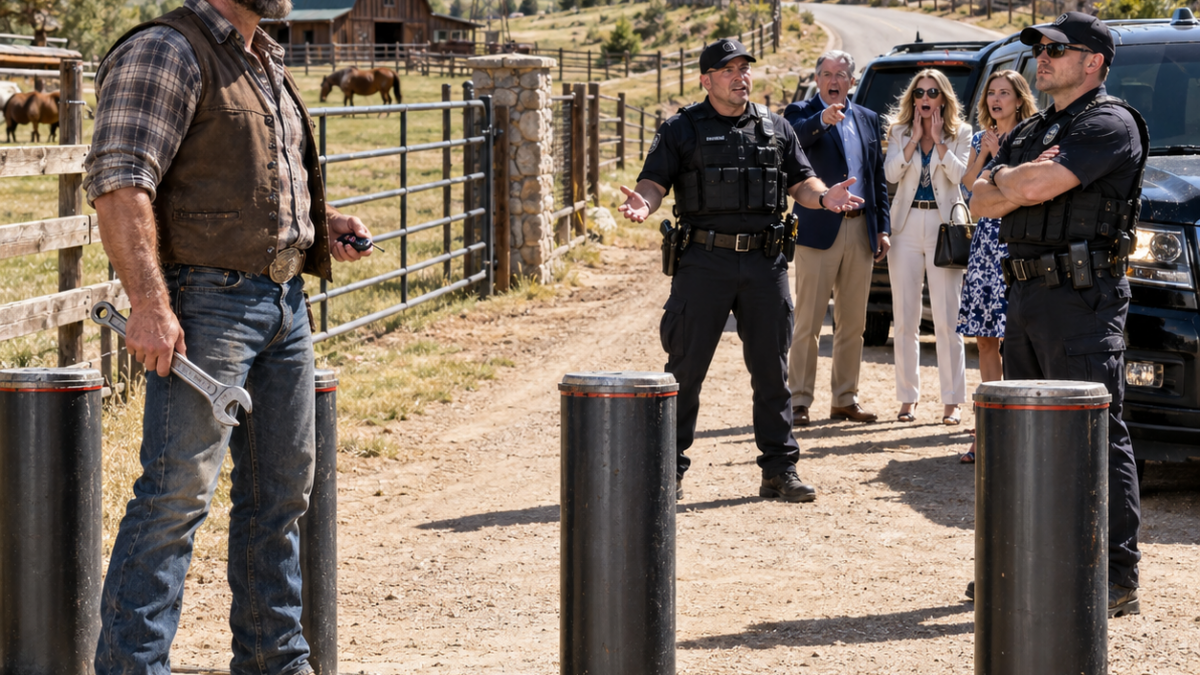
PART 2
I have never been a man who enjoys confrontation for the sake of confrontation.
That surprises people when they hear what happened next, because steel bollards across a road serving 260 households tends to sound like the work of someone who wakes up looking for a fight.
I don’t.
Running cattle cures you of unnecessary drama.
Animals do not care who won an argument.
A broken water line does not pause because you are angry.
A winter storm does not reconsider because you believe it is being unreasonable.
On a ranch, facts usually win before personalities get a vote.
That was how my father, Raymond Pruitt, raised me.
“Know what happened before you decide what it means,” he used to say.
That was why we kept logbooks.
Every calf.
Every fence repair.
Every contractor.
Every unusual vehicle.
Weather.
Equipment.
Water.
Access.
Dad believed memory was useful right up until two people remembered the same event differently.
Then paper mattered.
So when Lois told me the road itself might cross my land, I did not drive to Pinnacle Estates and wave my deed around.
I did not call Renata Voss.
I did not tell Earl.
Not immediately.
I asked one question.
“How certain are you?”
“Preliminary county records are clear,” Lois said. “I want a litigation-grade title analysis and a certified survey before you touch anything.”
“How long?”
“A few weeks.”
“Do it.”
“You’re not surprised?”
“I’m surprised.”
“You don’t sound surprised.”
“I’m trying not to get attached to a fact until it becomes a fact.”
She laughed once.
“That’s why I like ranch clients.”
I hung up and went back to feeding cattle.
Thursday, the white Sentinel SUV came through again.
I was by the equipment shed.
Same route.
Same slow confidence.
I photographed it.
Logged it.
Twenty-fourth visit.
The driver had no idea that the road he used to reach my gate, the road his employer probably considered part of Pinnacle Estates’ operational access, was now being traced through fifty years of county title records by a lawyer twenty miles away.
That image stayed with me.
A man in a uniform.
A light bar.
A patrol route.
All the appearance of authority.
Meanwhile, an iron pin buried beside the county road had more legal meaning than every patch on his jacket.
The patrol program itself had not begun as some criminal conspiracy.
That mattered to me later.
Pinnacle Estates had experienced real security concerns.
Vehicles entering at night.
A storage break-in.
Landscaping equipment stolen.
Residents were nervous.
Renata Voss had been HOA president for four years, and by most accounts she had been energetic and organized.
She liked visible projects.
Entrance landscaping.
Common-area resurfacing.
Clubhouse upgrades.
Then security.
The board hired Sentinel Perimeter Services for about $67,000 a year.
Two marked vehicles.
Uniformed personnel.
Twice-weekly patrols.
Residents approved the special assessment funding it.
The mistake sat inside paragraph fourteen of a nineteen-page contract.
“Adjacent corridor access as operationally necessary.”
Beautiful language if you like phrases that sound powerful without answering the one question that matters.
Adjacent to what?
And whose land?
Sentinel had apparently interpreted the language broadly.
Renata had apparently done the same.
No attorney had reviewed what “adjacent corridor access” meant against actual property ownership.
They simply created a patrol route and sent it through my ranch.
And because nobody stopped the first SUV, the second SUV came.
Then the third.
Then the twenty-third.
That is how overreach often becomes routine.
Not with somebody announcing:
Today I will violate a property boundary.
It becomes routine because the first violation produces no immediate consequence.
Then familiarity starts dressing itself up as permission.
Lois called Carson Webb.
Carson was a licensed surveyor she trusted on boundary litigation.
He came out in November.
No dramatic entrance.
Pickup truck.
Tripod.
Total station.
Field book.
Two assistants.
He spent days working the eastern boundary.
I left him alone.
When he needed access, he asked.
That detail was not lost on me.
A man whose job literally required him to walk my boundary still asked permission before entering.
The HOA’s fake patrol had never done it once.
Carson found the county road terminus monument exactly where the records placed it.
An iron pin set in concrete.
From that point east, the road continued approximately 340.3 feet before reaching the entrance to Pinnacle Estates.
Carson measured it.
Checked the centerline.
Checked the deed monuments.
Checked old survey references.
Looked for right-of-way indicators.
Easement markers.
County extension monuments.
Anything suggesting the road had a lawful access history outside my deed.
Nothing.
When he finished, his certified plat said what Lois’s preliminary search had already suggested.
The county road ended at the boundary.
The next 340.3 feet belonged to me.
The access road had been constructed across Pruitt property.
No recorded easement.
No right-of-way marker.
No evidence of recorded authorization.
Meanwhile, Lois hired title specialist Marcus Cole to trace the strip from the beginning.
That analysis came back just as clean.
My father purchased the strip with the ranch in 1973.
No encumbrance.
He transferred the ranch to me in 1995.
Still no encumbrance.
No easement had been granted before the Pinnacle development.
No easement after.
No recorded road dedication.
No access agreement.
Nothing.
Then Marcus found the document that explained how it happened.
The Pinnacle Estates developer filed for permission to connect the subdivision road to the county system.
In the permit paperwork, the developer described those final 340 feet as an:
Existing right-of-way connection.
That phrase was false.
Not a complicated misunderstanding.
Not an obscure boundary discrepancy requiring competing experts.
The Pruitt deed had been recorded twenty-six years earlier.
The strip was private property.
The developer had simply described it as an existing right-of-way.
County staff approved the road connection without pulling the underlying deed.
Then asphalt and gravel did what asphalt and gravel do.
They made the assumption look permanent.
Twenty-five years passed.
People bought homes.
Lenders financed them.
School buses drove through.
Delivery trucks.
Emergency services.
Residents.
No one asked who owned those 340 feet because roads have a way of looking more official than dirt.
But appearance does not rewrite title.
Lois called me after Marcus’s report came in.
“It’s confirmed.”
“All of it?”
“All of it.”
“The road strip is mine.”
“Yes.”
“No easement.”
“No.”
“No right-of-way.”
“No.”
“What about twenty-five years of use?”
“That will be argued if necessary. That’s why timing, documentation, and filing matter. We’re not improvising this.”
I looked toward the eastern boundary from my kitchen window.
The road was visible between bare November trees.
Cars moved over it.
Normal traffic.
People going to work.
Taking children to school.
Living ordinary lives on top of a legal problem they did not know existed.
“What do you recommend?”
“First, complete the record.”
“What’s missing?”
“Carson’s final sealed plat. Earl’s statement. Certified county copies. Then we file.”
“And the patrol?”
“Twenty-three entries are already enough for the trespass claim.”
“Twenty-four now.”
There was a pause.
“You kept logging.”
“You told me to.”
“Good.”
“Lois.”
“Yes?”
“What if I put bollards at the road strip?”
She did not answer immediately.
Not because she was shocked.
Because lawyers who are good at their jobs do not answer emotionally satisfying questions before thinking through consequences.
“On your side of the county terminus?”
“Yes.”
“Entirely within your deed?”
“Yes.”
“After survey confirmation?”
“Yes.”
“You can control access on your property.”
“How would you time it?”
“Not today.”
“I figured.”
“If you close first and file later, the HOA has time to race into court asking for emergency relief before a judge sees the complete record.”
“So file first?”
“Simultaneously.”
“With installation.”
“Yes.”
“Complaint, notice, bollards.”
“Same morning.”
I understood why.
They had spent months relying on appearance.
Uniforms that looked official.
A map that looked official.
A road that looked public.
A contract provision that sounded authoritative.
If we were going to challenge that, paper and physical reality needed to arrive together.
Lois’s complaint eventually reached forty-three pages with eight exhibits.
Deed.
Title analysis.
Certified survey.
Developer permit application.
Twenty-three documented patrol entries with photographs.
Sentinel contract.
HOA correspondence.
Earl’s notarized statement.
Earl wrote four pages.
He included his twenty-two years with the sheriff’s department.
His observation that Sentinel had no law-enforcement authority.
The conversation we had on August 26.
Three patrol entries he personally saw from his property.
He even included his old badge number.
When I teased him about that, he shrugged.
“Habit.”
“Retired fifteen years and you’re still writing reports.”
“Bad habits keep lawyers happy.”
“They’re usually expensive habits.”
“That too.”
By the final week of November, Lois told me the file was ready.
That afternoon I drove to the county road terminus.
Parked.
Got out.
Found Carson’s monument reference.
Then stood in the road.
Three hundred forty feet.
That was all.
You could walk it in a few minutes.
For twenty-five years, it had carried nearly every vehicle in and out of Pinnacle Estates.
I imagined the developer in 1999.
Maybe somebody knew.
Maybe somebody assumed.
Maybe nobody cared enough to check.
It no longer mattered.
The record in front of me mattered.
I called a fabrication supplier.
“Need three steel posts.”
“What size?”
“Four inch.”
“Finish?”
“Dark green powder coat.”
“Fixed or removable?”
“One eventually may need to come out. Build them heavy.”
Ten days.
I ordered them.
When they arrived, I stored them in the equipment barn beside concrete bags and the post-hole equipment.
Then I chose Tuesday.
Sentinel day.
December 4.
I set my alarm for 5:30.
I was at the road strip before six.
Dark.
Cold.
Headlamp.
Truck work lights.
No audience.
No television camera.
No shouting HOA residents.
Just me, dirt, steel, concrete, and Carson’s survey.
The county-road terminus monument sat exactly where it had sat while twenty-five years of cars passed it without understanding what it meant.
I marked the post positions several feet inside my property so there could be no argument that I had touched the county road.
Three bollards across the vehicle path.
Space for pedestrians.
No vehicle access.
I dug the first hole.
Then the second.
Then the third.
People later described the bollards like some dramatic revenge trap.
They weren’t.
They were ranch posts.
Heavy, yes.
Permanent enough to matter.
But what made them powerful was not steel.
It was placement.
Eight feet one direction and they would have been a nuisance.
At that surveyed line, they were a boundary.
First post set.
Level.
Concrete.
Second.
Third.
By 8:40, all three were standing.
Nine bags of concrete.
Dark green steel against a gray December morning.
At 9:05, I attached the notice to the center post.
PRIVATE PROPERTY — PRUITT RANCH
ROAD ACCESS BEYOND THIS POINT SUBJECT TO OWNER AUTHORIZATION.
CONTACT FABER PROPERTY LAW FOR INQUIRIES.
No insults.
No “HOW DO YOU LIKE IT?”
No accusations.
No HOA jokes.
A boundary notice and a lawyer’s phone number.
I photographed everything.
County monument visible.
Bollards visible.
Notice visible.
Sent the picture to Lois.
One word:
Done.
She answered four minutes later.
Filing now.
At 9:30, the complaint went to the county courthouse.
By ten, it had a case number.
At almost the same time, certified notice left Lois’s office for Pinnacle Estates.
Then I waited for the white SUV.
After months of Tuesday and Thursday entries, I knew the pattern.
Around 10:43, it came around the curve.
White.
Clean.
Light bar.
Gray uniform visible through the windshield.
The driver continued until the bollards came into view.
I watched his brake lights.
For the first time since August, Sentinel slowed because something on my property required its attention.
The SUV stopped about four feet from the center post.
Driver read the notice.
Read it again.
Picked up his radio.
I took a photograph.
Then opened the logbook.
December 4.
10:47 a.m.
Sentinel unit stopped at bollard line.
Driver read notice.
Radioed dispatcher.
Did not proceed.
Fourteen minutes later, he backed up, turned around, and left.
No confrontation.
No threats.
No fake arrest.
The uniform went home because steel attached to a deed outranked a decorative light bar.
I closed the book.
That should have been the dramatic moment.
It wasn’t.
The real explosion started after four in the afternoon.
Commuters began returning.
First car.
Then another.
Then seven.
Fourteen.
Eighteen.
The line grew.
People got out.
Read the notice.
Called neighbors.
Called the HOA.
Photographed the bollards.
Some stood in the cold staring at the development entrance only 340 feet away.
Imagine being able to see your neighborhood but not drive into it because three posts have revealed a title defect older than some of the residents.
I understood their anger.
That did not make the deed disappear.
Earl parked at a county-road pull-off and watched the evening traffic collect.
At 5:45 he called.
“They’re stacking up.”
“How many?”
“Eighteen I can see.”
“Anyone touching the posts?”
“No.”
“Good.”
“Couple people look like they want to.”
“They shouldn’t.”
“They’re mostly reading.”
“Even better.”
There was a pause.
“You okay?”
“Yes.”
“You sound too calm.”
“I still have cattle to feed.”
He laughed.
That night residents used whatever alternatives they could.
Some parked and walked the final distance.
Some coordinated rides.
Pinnacle had a northern ridge trail normally used by ATVs, and the HOA temporarily opened it for limited vehicle traffic.
It was inconvenient.
Very inconvenient.
But not impossible.
I need to make that distinction because people later accused me of trapping 260 households.
I didn’t.
The closure demonstrated the legal problem.
It did not imprison anyone.
By Wednesday morning, the community had done something Renata’s board apparently had not done in twenty-five years.
It read the records.
A Pinnacle homeowner named Dennis Cho changed the conversation.
Dennis was a civil engineer.
He had lived there since 2006.
Tuesday evening he parked near the bollards, walked home, opened his laptop, and started searching county databases.
He pulled my father’s deed.
The county-road terminus record.
The 1999 permit.
The road description.
He cross-referenced them.
At 5:30 Wednesday morning, he posted a detailed explanation on the resident forum.
Title:
THE ROAD STRIP — WHAT THE COUNTY RECORDS ACTUALLY SHOW.
No rant.
No accusation.
Just documents.
County road ends here.
Pruitt deed begins here.
Developer called the strip an existing right-of-way.
No recorded easement found.
No access grant.
No dedication.
By six, dozens of replies.
By seven, more than a hundred.
By nine, hundreds.
Other residents repeated Dennis’s research.
Same result.
The road was mine.
Then someone started reading the lawsuit.
Twenty-three patrol entries.
Photographs.
Dates.
Sentinel contract paragraph fourteen.
The HOA’s “access corridor” letter.
The framed development map suddenly became a topic too.
That map had hung in the clubhouse lobby for years.
A developer marketing sketch from 1999.
My ranch labeled as an:
Undeveloped adjacent buffer zone.
That phrase had helped shape how Renata thought about the land.
Buffer zone.
As though my 380-acre cattle ranch existed as scenery between Pinnacle and somewhere else.
As though “adjacent” meant available.
A resident posted a photograph of the framed map.
Another posted Carson’s certified survey.
Placed side by side, they told the whole story.
One was marketing.
One was property.
They did not match.
Residents began asking the board questions.
Who reviewed the Sentinel contract?
Did an attorney approve patrol access across the ranch?
Did the board ever verify the road easement?
Did the HOA know the final 340 feet were private?
What exactly were residents paying $67,000 a year for?
By Wednesday afternoon, the HOA announced an emergency meeting.
Closed board session at 6:30.
General membership at 7:30.
The board hired or consulted Patrick Swell, a land-use attorney.
Patrick read our entire complaint.
Every exhibit.
Then walked into the closed meeting carrying a briefcase and what I later learned was a two-page legal assessment.
He did not sugarcoat it.
The road-strip deed was clean.
Carson’s survey was defensible.
Marcus’s title chain confirmed ownership.
The county road ended where we said it ended.
The 340 feet belonged to me.
Sentinel’s twenty-three entries were well documented.
Paragraph fourteen of the security contract did not give a private company permission to enter land owned by a third party.
And the bollards were on my property.
According to the account that later reached me, the room became very quiet.
Patrick gave them three recommendations.
Terminate Sentinel.
Negotiate an easement.
Settle the trespass claim.
Not fight.
Not accuse.
Not send another letter explaining community necessity.
Fix the problem.
One board member, Iris Tamboli, had worked as a land-use planner for twenty-two years.
She asked the question that should have been asked long before.
“Who reviewed the developer’s access documents?”
Nobody had a good answer.
The board had inherited assumptions.
The association had inherited infrastructure.
People assumed that because the road existed, whatever legal instrument needed to exist beneath it also existed.
That assumption had survived until three steel posts forced somebody to pull the deed.
At 7:30, residents entered the general meeting.
I wasn’t there.
Lois advised me not to attend.
“Your documents are already in the room,” she said.
“Probably louder than I’d be anyway.”
“Much.”
Dennis Cho’s forum post had reached practically every household.
Patrick’s assessment could not honestly be presented as uncertainty.
So Renata stood in front of her community and explained that the primary road crossed private land.
The HOA did not have a recorded easement.
The Sentinel patrol had entered the Pruitt ranch repeatedly without permission.
The road closure was lawful enough that their attorney was recommending negotiation rather than emergency litigation.
Residents were angry.
Some at me.
Many at the developer.
A growing number at the board.
One resident reportedly stood and asked:
“Why did we pay for a patrol service that was trespassing?”
Another:
“Why were security contractors driving through somebody else’s ranch?”
Another:
“Did anyone read the contract before approving sixty-seven thousand dollars a year?”
Then Dennis asked the question that changed the room.
“Why did nobody verify the road?”
Renata tried explaining twenty-five years of established use.
He answered:
“I’m not asking how long we drove it. I’m asking whether the HOA ever had a document giving us permission.”
No answer.
Someone asked why the developer map called my land a buffer zone.
Iris explained that a marketing or planning graphic was not a survey or deed.
Someone else asked whether the HOA had treated that map as legal.
Nobody wanted to answer.
By Friday morning, Renata Voss resigned.
One paragraph.
No dramatic confession.
No fight.
She thanked the community for four years of service and expressed confidence in the remaining board.
The framed developer map disappeared from the clubhouse wall around the same time.
A pale rectangle remained where it had hung.
I liked that detail when Earl told me.
Twenty-five years of assumption removed in five minutes.
Iris Tamboli became interim president before noon.
Then she did the smartest thing anybody in Pinnacle leadership had done since the situation started.
She called Lois.
No posturing.
No accusation.
No threats.
“The board is not contesting Mr. Pruitt’s deed.”
That was the first thing she said.
Lois later repeated it to me almost word for word.
“We are not contesting the survey. We are not contesting the title analysis. We want to negotiate a recorded easement, resolve the trespass claim, and permanently terminate the Sentinel patrol program.”
Permanent termination was Iris’s addition.
Not mine.
When Lois called me, I was repairing a feeder.
“New board contacted us.”
“And?”
“They accept the record.”
“All of it?”
“Road strip, survey, deed.”
“Patrol?”
“They want Sentinel permanently terminated as part of the resolution.”
I set down the wrench.
“That fast.”
“It’s Friday.”
“The bollards went in Tuesday.”
“Yes.”
“That feels fast.”
“It’s amazing how quickly legal analysis improves when 260 people have to use an ATV trail.”
I laughed.
Then Lois said:
“They want to negotiate next week.”
I looked toward the eastern road.
“Open it.”
There was silence.
“You sure?”
“Yes.”
“The center bollard?”
“Pull it.”
“You have leverage right now.”
“I’ll still own the strip tomorrow.”
“That isn’t what I mean.”
“I know.”
“Decker, if you reopen before the settlement is signed, you give up physical pressure.”
“The residents didn’t hire Sentinel.”
“The HOA did.”
“Residents didn’t lie on the 1999 permit.”
“The developer did.”
“They didn’t send me the access-corridor letter.”
“No.”
“They bought houses and drove a road everybody told them they could drive.”
“Yes.”
“Then I’ve made the point.”
Lois was quiet.
“What do you want me to tell Iris?”
“Saturday morning, center post comes out. Two outside bollards stay.”
“As boundary markers?”
“Yes.”
“I like that.”
“I figured you would.”
The following morning I went out with my truck and a post puller.
The center bollard had been in place four days.
Long enough.
I broke out the top concrete.
Attached the puller.
Worked slowly.
Twenty minutes later the center was clear.
The two outer green posts remained.
Not blocking vehicles.
Framing the passage.
Boundary markers.
I took another picture.
Sent it to Lois.
Road open.
Within an hour a Pinnacle resident posted a photograph on the forum.
The road visible between the two remaining bollards.
Three words:
IT’S OPEN. THANK YOU.
That affected me more than I expected.
I didn’t want gratitude.
I wasn’t doing them a favor.
I was separating innocent residents from the institution that had created the dispute.
There is a difference between enforcing your property rights and enjoying somebody else’s inconvenience.
I never wanted the second.
Settlement negotiations began the following Wednesday.
Two full days.
Lois for me.
Patrick for the HOA.
Iris represented the board.
Dennis attended part of the second day because Iris believed having a civil engineer in the room while defining an access corridor made more sense than relying entirely on lawyers.
The irony was not lost on anyone.
For months, Pinnacle had used the phrase “access corridor requirements” to justify patrol vehicles on my ranch.
Now they were sitting in a conference room asking me for an actual access corridor.
A recorded one.
One based on a survey.
One supported by consideration.
One everybody could find in the county records fifty years from now.
That was what should have existed in 1999.
The easement covered the 340-foot strip.
Carson’s survey became part of the legal description.
The remaining bollards were identified as physical boundary reference points.
Maintenance obligations were defined.
Vehicle access.
Normal residential use.
Emergency access.
No interpretation that expanded HOA authority into the surrounding ranch.
No security-patrol rights over other parts of my property.
Nothing vague.
Nothing called “adjacent corridor access.”
If they wanted a right, the right had a location.
If it had a location, it had coordinates.
If it had coordinates, it went in the document.
Dennis caught one issue near a culvert where the road narrowed.
Fifteen minutes of discussion followed.
Carson joined by phone.
Language changed.
Problem solved.
That was what competent process looked like.
Boring.
Specific.
Recorded.
The payment amount was negotiated between the parties.
It was not symbolic.
Twenty-five years of uncompensated road use across private land has value.
So does permanent access serving 260 households.
I also had a strong lawsuit and a record that gave me little reason to settle cheaply.
But I did not ask for a number designed to destroy the community.
I wanted the road legalized.
The past acknowledged.
The future clear.
The final settlement had several parts.
First:
Permanent recorded road easement.
Pinnacle Estates finally received the access right the developer should have secured before building a single house.
Second:
Formal acknowledgement that the road strip remained Pruitt property.
The easement gave access.
It did not transfer ownership.
Third:
Formal written acknowledgement that Sentinel’s twenty-three entries onto the ranch were unauthorized trespass.
No language pretending paragraph fourteen created some misunderstood right.
It didn’t.
Fourth:
Permanent termination of the Sentinel Perimeter Services patrol program.
Contract terminated.
Vehicles gone.
Gray uniforms gone.
Light bars gone.
Any future security proposal would require new board review and actual legal analysis.
Fifth:
The HOA recorded the acknowledgment so the next board, the next lawyer, the next developer, and the next resident would not have to reconstruct the truth from a twenty-five-year-old planning sketch.
The final documents were ready during the last week of December.
I went to Lois’s office Thursday afternoon.
Her office had never impressed anyone.
Books everywhere.
Files stacked too high.
Coffee cups that appeared old enough to vote.
Perfect place to sign a settlement worth more to me than any polished conference room.
She put the package in front of me.
“Read.”
“You know I will.”
“I know.”
I read every page.
Road easement.
Survey reference.
Maintenance.
Trespass acknowledgment.
Patrol termination.
Recorded title statement.
Signature pages.
Lois waited.
At one point she answered email.
She knew rushing me would have been useless.
Finally I reached the last page.
“What do you think?”
“It says what we agreed.”
“That’s the goal.”
“Anything you’re worried about?”
“No.”
I picked up the pen.
Signed.
One page.
Then another.
Then another.
When I finished, Lois gathered the documents.
“You realize,” she said, “this whole thing began with a security SUV.”
“No.”
She looked at me.
“It began in 1999.”
She smiled.
“Fair.”
“Sentinel just gave us a reason to look.”
“That’s more accurate.”
I stood.
“How long until recording?”
“Immediately.”
“Case dismissal after performance?”
“Yes.”
“Good.”
She held out her hand.
“You were patient.”
“I was angry.”
“You can be both.”
“I preferred patient.”
“That’s why you won.”
“I didn’t win.”
“Decker.”
“Pinnacle got permanent road access.”
“You got compensation, acknowledgement, and your title confirmed.”
“Exactly.”
“That’s called winning.”
“No. That’s called fixing what should have been fixed twenty-five years ago.”
She shook her head.
“You ranchers are exhausting.”
“You charge by the hour. You’re welcome.”
That got a laugh.
I drove home.
On the way, I passed the eastern strip.
Two dark-green bollards stood on either side of the road.
Center open.
Cars moving through normally.
Nobody stopping.
Nobody photographing.
Nobody calling lawyers.
The remaining posts looked almost unremarkable now.
But their coordinates were in a recorded instrument.
They marked the line.
County road ended there.
Pruitt property began.
Pinnacle’s new easement crossed between them.
For twenty-five years, everyone had driven that road based on assumption.
Now they drove it based on a right.
That mattered.
I didn’t stop.
Went home.
Fed cattle.
Checked water.
Finished the afternoon like any other December day.
Then I walked into the tack room.
The green logbook was still on its shelf.
I took it outside to the porch.
Cold evening.
Clear.
Pinnacle’s rooftops visible above the tree line.
I opened to the section that started August 26.
White SUV.
8:40.
Eleven minutes.
No communication.
Twenty-three patrol entries followed.
Then attorney notes.
Title confirmation.
Survey.
Bollard order.
December 4 installation.
Road closure.
I turned to the next blank lines.
Then wrote four sentences.
Easement recorded.
Trespass acknowledged.
Patrol terminated.
Deed confirmed.
Four lines.
Months of trouble reduced to four lines.
Then, smaller in the margin:
23 unauthorized entries documented and acknowledged. Matter closed.
I capped the pen.
Closed the book.
A few minutes later my phone rang.
Earl.
“Done?”
“Done.”
“All signed?”
“Yes.”
“Road?”
“Permanent easement recorded.”
“Patrol?”
“Terminated.”
“Renata?”
“Not my problem.”
He laughed.
“That might be my favorite part.”
We sat in silence for a moment.
Then Earl said:
“You know what I keep thinking about?”
“What?”
“Those uniforms.”
I looked east.
“What about them?”
“First day, those guys drove through like the patch made the road theirs.”
“Not their road.”
“Like the light bar made them official.”
“It didn’t.”
“Like ‘authorized patrol’ meant somebody had authorized everything.”
I looked at the two dark shapes of the bollards in the fading light.
“The gear never made any of it legal.”
Earl chuckled.
“What did?”
“The deed.”
Short silence.
Then his quiet laugh.
“That’s about right.”
We said good night.
I remained on the porch.
People later asked why I waited three months before confronting Pinnacle Estates.
Why not lock the ranch gate the first day?
Why let Sentinel drive through twenty-three times?
Why not storm into an HOA meeting?
Why photograph instead of argue?
Because the first SUV gave me suspicion.
Twenty-three entries gave me evidence.
Renata’s letter gave me their position in writing.
The survey gave me geography.
The title report gave me history.
The developer permit gave me the mistake.
The bollards only came after everything else.
Steel gets attention.
Paper survives attention.
That difference is important.
If I had blocked Sentinel on day one, Pinnacle might have argued about patrol access for months.
Instead, their own repeated conduct built my record.
If I had closed the road before verifying title, I would have been exactly what Renata had been.
Confident before careful.
I refused to make that mistake.
The ranch had belonged to my family since 1973.
My father transferred it to me in 1995.
Those facts had existed whether I knew about the road strip or not.
The developer’s map could call my property a buffer zone.
The Sentinel contract could call it an adjacent corridor.
Renata could call access necessary for community safety.
Residents could call the road theirs because they used it every day.
None of those descriptions changed the deed.
That became the part of the story I remembered most.
Not the traffic line.
Not Renata resigning.
Not the fake police SUV turning around.
Not even the bollards.
The part I remembered was how many people had looked at something for years without asking the simplest question.
Who owns it?
A road feels public.
A uniform feels official.
A letterhead feels authoritative.
A framed map feels historical.
An HOA board vote feels legitimate.
A contract feels legal.
Sometimes all of those things are exactly what they look like.
Sometimes they aren’t.
There is only one way to know.
Check.
Pinnacle changed after December.
Iris remained president through the next election.
The board hired counsel to review old development documents.
Not only my road.
Everything.
Drainage.
Utility corridors.
Common-area boundaries.
Maintenance agreements.
Emergency routes.
They found smaller problems.
Nothing like the road strip.
But enough that people stopped making jokes about paperwork.
Sentinel disappeared entirely.
Residents who had originally supported the patrol program were not blamed for that.
They had wanted safer streets.
Reasonable goal.
The mistake was believing safety gave the association authority outside its property.
Iris created a rule that any future vendor contract affecting land access had to include parcel verification and legal review.
Apparently, “adjacent corridor access” became something of a joke at meetings.
Someone would propose moving a picnic table and another resident would ask:
“Have we checked our adjacent corridor requirements?”
I heard that from Dennis.
I appreciated it more than I admitted.
Dennis stopped by the ranch several months later.
First time we met in person.
He pulled up at the gate.
Stopped.
Got out.
Walked toward me.
That alone made me like him.
“Decker?”
“Dennis.”
“Thought I’d introduce myself.”
We shook hands.
“I read your forum post.”
“I read your lawsuit.”
“Mine was longer.”
“Mine had better diagrams.”
“Fair.”
We talked beside the gate.
He apologized for the community’s assumptions.
I told him he didn’t owe me one.
“I drove your road ten thousand times,” he said.
“My strip.”
“You’re going to correct me forever?”
“For at least another minute.”
He smiled.
“Your strip. I never wondered who owned it.”
“Neither did I.”
That surprised him.
“You didn’t know?”
“Not specifically.”
“You owned it.”
“Three hundred eighty acres. You’d be surprised how many legal descriptions you can own without standing on each one thinking about title.”
He considered that.
“So Sentinel accidentally discovered your own road problem.”
“Basically.”
“That’s incredible.”
“It’s inconvenient.”
He looked toward the bollards.
“Those staying forever?”
“The two outside ones.”
“Because of the easement?”
“Boundary references.”
“Carson did good work.”
“He did.”
Dennis ran his hand along one green post.
“You know, Tuesday night people hated these.”
“I figured.”
“By Friday most understood.”
“That fast?”
“Having to park at the county road was educational.”
“I’m sorry about that part.”
He looked at me.
“You mean that?”
“Yes.”
“You closed it.”
“I needed the claim established.”
“You could’ve left it closed longer.”
“Yes.”
“You reopened before signing.”
“Yes.”
“Why?”
I gave him the same answer I gave Lois.
“Residents didn’t create the 1999 permit.”
Dennis nodded.
“That mattered.”
“It mattered to me.”
He looked east toward the development.
“People noticed.”
We stood there awhile.
Then he said:
“Can I tell you what I think the weirdest part is?”
“Go ahead.”
“We had a $67,000 security program.”
“Right.”
“Uniforms. Vehicles. Patrol logs.”
“Right.”
“And the rancher with a feed bucket had the better surveillance record.”
I laughed.
“Cheaper too.”
He shook my hand again.
Then left.
Years passed.
The bollards weathered.
Dark green faded slightly under sun and snow.
I repainted them once.
Not because the HOA requested it.
Because rust is real and steel does not maintain itself.
Earl came over while I worked.
“Look at you.”
“What?”
“Meeting community aesthetic standards.”
“Go home.”
He laughed.
I painted the second post.
Earl was older by then.
So was I.
He sat on the truck tailgate.
“You still have that logbook?”
“Of course.”
“Which volume?”
“Same one from the patrol.”
“Going to keep it?”
“My father’s books go back decades.”
“Somebody should archive them someday.”
“Why?”
“History.”
“It’s cattle counts and broken fences.”
“That case wasn’t.”
“No.”
He looked at the road.
“Did you ever think Renata meant harm?”
I considered.
“No.”
“That surprise you?”
“No.”
“She overstepped.”
“Absolutely.”
“Then why not call her malicious?”
“Because I don’t know that she was.”
Earl nodded.
“Retired cop answer.”
“Rancher answer.”
“She made a lot of assumptions.”
“That was the problem.”
That distinction mattered too.
Renata had not set out to steal my ranch.
She did something more ordinary.
She believed her responsibility to Pinewood—Pinnacle—sorry, Pinnacle Estates, gave her enough reason to stop checking where her authority ended.
She saw the development map.
Buffer zone.
She saw paragraph fourteen.
Adjacent corridor.
She saw security concern.
She connected them.
Then she authorized action.
The danger was not evil.
The danger was confidence without verification.
Those mistakes can cause just as much damage because the person making them believes they are being responsible.
Renata resigned.
I never spoke with her afterward.
I did not sue her personally.
The settlement was with the HOA and Sentinel.
Sometimes residents expected me to hate her.
I didn’t.
I would not have trusted her to manage another access issue without legal review.
That was different.
I heard she moved within a few years.
Maybe true.
Maybe not.
Not my business.
The framed developer map never returned to the clubhouse wall.
Iris replaced it with something more useful.
A certified community boundary map.
Survey information.
Recorded easements.
Actual parcel lines.
Dennis sent me a photograph.
At the western side, the Pruitt Ranch was labeled exactly as the county records labeled it.
PRIVATE PROPERTY — PRUITT RANCH.
No “buffer.”
No implication that the land existed to serve Pinnacle.
Just ownership.
I stared at that photograph longer than I expected.
Dad would have liked it.
Not because he disliked the subdivision.
He didn’t.
When Pinnacle was built, Dad was already older and mostly retired from daily operations.
He used to sit on the porch and complain that the new houses ruined the stars.
Then he would admit the grocery delivery options improved.
He could hold both thoughts at once.
What he cared about was boundaries.
Once, when I was a teenager, a neighboring rancher accidentally fenced about twelve feet across our line.
Dad found it.
Walked over.
No lawyers.
No threats.
They pulled the survey.
Fence moved.
Done.
Dad told me afterward:
“Good neighbors are easier when everybody knows where the line is.”
That was the entire Pinnacle dispute in one sentence.
For twenty-five years, nobody knew where the line was.
Or nobody cared enough to check.
Once the line became visible, the solution became possible.
That was what the bollards really did.
They didn’t create my ownership.
They revealed it.
Years later, a young property lawyer came to the ranch with Lois.
Her name was Megan.
New associate.
Lois was showing her several old files as training.
Apparently mine had become one of the office examples for documentation.
Megan looked embarrassed admitting she had read the whole case.
“Forty-three pages?”
“Plus exhibits.”
“You read fast.”
She smiled.
“Can I see the logbook?”
I brought it out.
She turned pages carefully.
“Handwritten.”
“That surprises lawyers?”
“Everything is digital now.”
“Cattle aren’t.”
She found August 26.
Read the first entry.
Then the second.
Third.
“This is extremely detailed.”
“It’s normal.”
“No, Mr. Pruitt. It isn’t.”
“For me it is.”
She looked at Lois.
“This won the trespass case.”
Lois corrected her.
“It made the trespass claim very difficult to dispute.”
“Same thing.”
“No.”
I smiled.
Lois had not changed.
Megan kept reading.
“Why didn’t you photograph the drivers’ faces closer?”
“Didn’t need to.”
“Why not confront them?”
“Didn’t need to.”
“Why no warning sign earlier?”
“Didn’t need one to prove they hadn’t asked permission.”
She looked up.
“You were building a record before you knew you’d litigate.”
“I was understanding what was happening.”
“That’s basically what record-building is.”
“Then yes.”
She reached the December entry.
Easement recorded.
Trespass acknowledged.
Patrol terminated.
Deed confirmed.
“That’s it?”
“That’s it.”
“Four lines?”
“The lawyers wrote enough.”
Lois laughed.
Before leaving, Megan stopped near the bollards.
“These are the famous ones?”
“They’re posts.”
“Every lawyer in Lois’s office calls them the famous bollards.”
“That sounds like an office problem.”
She took a photograph.
Asked first.
I noticed.
Maybe that was the legacy.
Ask first.
Years after the road settlement, Pinnacle homeowners still drove through every day.
Hundreds of vehicles.
Morning commuters.
School buses.
Delivery vans.
Visitors.
Emergency vehicles.
They crossed between the two outer bollards and over the recorded easement.
Most new residents probably had no idea why the green posts existed.
That was fine.
Their closing documents now referenced the access rights properly.
Title companies could find the instrument.
Lenders could find it.
Future boards could find it.
Nobody had to rely on institutional memory.
Because institutional memory is just another word for an assumption waiting to be forgotten.
Recorded documents last longer.
One autumn evening I sat with Earl on my porch.
He was seventy-something by then and moved slower.
The old Sentinel story came up because a delivery vehicle had mistakenly turned down my interior ranch road.
Driver stopped at the barn.
Got out.
Apologized.
Asked directions.
Normal.
Earl watched him leave.
“That easy.”
“What?”
“He asked.”
“Revolutionary.”
“Could’ve saved sixty-seven grand.”
“And legal fees.”
“And a board president.”
“And three bags of concrete per bollard.”
He laughed.
Then coughed.
When he settled, he looked east.
“You ever think what would’ve happened if those Sentinel boys stopped that first morning?”
“All the time.”
“Say they pulled up.”
“Morning, Mr. Pruitt.”
“HOA hired us to patrol. Mind if we check the creek road?”
“I’d have said no.”
Earl smiled.
“Story over.”
“Story over.”
“No road discovery?”
“Maybe not for years.”
“No bollards.”
“No.”
“No lawsuit.”
“No.”
“No Renata resignation.”
“Probably not.”
He shook his head.
“All because nobody asked.”
“That’s usually how boundaries work.”
We sat in the evening silence.
Then Earl said:
“Still like my line better.”
“What line?”
“Uniform is clothes. Light bar is decoration.”
“That was good.”
“Yours got the ending.”
“The deed did.”
“Exactly.”
After Earl died several years later, his daughter gave me a box from his study.
Inside were old photographs.
Retirement papers.
A copy of his notarized statement from my case.
Four pages.
Former badge number at the end.
There was a sticky note on top.
Decker — thought you should keep this. Dad was proud he helped.
I sat at the kitchen table holding it longer than I expected.
Earl had been the first person I called.
Before Lois.
Before Carson.
Before Marcus.
Before anyone knew about the road strip.
He gave me a simple answer.
They have no law-enforcement authority.
That answer kept me from being intimidated by appearance.
His second instruction mattered even more.
Document everything.
So I placed his statement in the ranch records beside the old logbook.
My father taught me to write things down.
Earl reminded me why.
Those two lessons had protected more than land.
They protected perspective.
When somebody arrives looking official, slow down.
Ask what gives them authority.
When somebody sends a letter filled with administrative language, read every word.
When a map labels your property, check the survey.
When a road has existed for twenty-five years, do not assume age equals legality.
When someone tells you “everybody knows,” find the instrument.
And when you finally act, act from verified ground.
That is what I tried to do.
People still like the bollard part best.
I understand.
Three steel posts make a better photograph than a chain-of-title report.
A white patrol SUV facing an unexpected barrier makes a better story than an iron county monument beside a road.
But if I had to choose between steel and paper, I would choose paper every time.
The steel worked because the paper was right.
Without that, the bollards would have been nothing but anger set in concrete.
With the deed, survey, and filing behind them, they became a boundary.
That is the difference between retaliation and enforcement.
One feels powerful in the moment.
The other survives review.
The last time I replaced the ranch logbook, I moved the December settlement volume onto the shelf beside my father’s older books.
Green covers.
Different years.
Same handwriting getting older.
Thirty years of weather and cattle and repairs.
Somewhere in the middle:
Twenty-three unauthorized patrol entries.
One road dispute.
Three bollards.
One settlement.
An entire HOA crisis compressed between calving records and a tractor repair.
That perspective made me smile.
At the time, Pinnacle felt enormous.
Two hundred sixty households.
Lawyers.
Forums.
Emergency meetings.
Traffic lines.
Survey crews.
Court filings.
Years later, it was a few dozen pages in a ranch book.
The cattle still needed water.
Fences still failed.
Snow still came.
Life had a way of putting human authority back into proportion.
One December evening, almost exactly an anniversary of the settlement, I walked down to the road strip.
The sun was already low.
Two green bollards stood where I had set them.
Cars passed between them.
One driver lifted a hand.
I waved back.
A school bus followed.
Then a delivery van.
Nobody stopped.
Nobody needed to.
The road now worked the way everyone had always assumed it worked.
Except this time the assumption had a document behind it.
I stood beside the county monument.
One side:
County road.
Other side:
Pruitt land.
Across my land:
Recorded Pinnacle easement.
Clear.
Simple.
Boring.
Perfect.
I thought about Renata’s phrase.
Access corridor requirements.
At the time it had irritated me.
Now it almost made me smile.
She had been right about one thing.
Pinnacle needed an access corridor.
They just needed to ask the man who owned it.
I walked back toward my truck.
Passed one of the bollards.
Ran my hand over the cold steel.
Not a trophy.
Not revenge.
A marker.
That was all.
Sometimes the most satisfying ending is not watching the other side lose.
It is watching everybody finally understand where the line is.
Pinnacle kept its road.
I kept my land.
Residents got permanent access.
Sentinel stopped trespassing.
The HOA learned to verify before authorizing.
The developer’s twenty-five-year mistake finally received the document it should have had from the beginning.
And my ranch went back to being a ranch.
No patrol SUV.
No decorative light bar.
No gray uniforms rolling toward my creek.
The gate stayed open during working hours.
Feed trucks stopped and waved.
Veterinarians called ahead.
Neighbors asked.
Life returned to normal.
Which is what I wanted from the beginning.
The first white SUV had driven past me because its occupants believed authority came from the uniform, the contract, and the organization paying them.
Renata believed authority came from a board vote, a framed map, and the phrase “community safety.”
The developer in 1999 believed calling private property an “existing right-of-way” was enough to build through it.
Twenty-five years of residents believed a road became theirs because they had always used it.
None of those people were stupid.
Most were not malicious.
They were simply standing on assumptions nobody had forced them to examine.
Then three steel bollards appeared.
And everyone examined everything.
That is why, when people ask whether I installed the bollards to punish Pinnacle Estates, my answer is no.
I installed them because sometimes a boundary nobody can see gets ignored until somebody makes it visible.
The bollards were visible.
The deed was permanent.
And the final line in that old logbook still says exactly what I needed it to say:
Matter closed.
Because after all the uniforms, letters, meetings, lawyers, maps, contracts, complaints, and arguments, Earl had been right on the first morning.
A light bar was decoration.
A uniform was clothing.
And when the dust settled, the only thing that had ever actually decided where their authority ended and my ranch began was the same thing that had been sitting quietly in the county records all along.
The deed.
[END OF FULL STORY]

