PART 2: HOA Seized My Warehouse and Had Me Detained—Then U.S. Marshals Asked Why Their Commander Was in Restraints
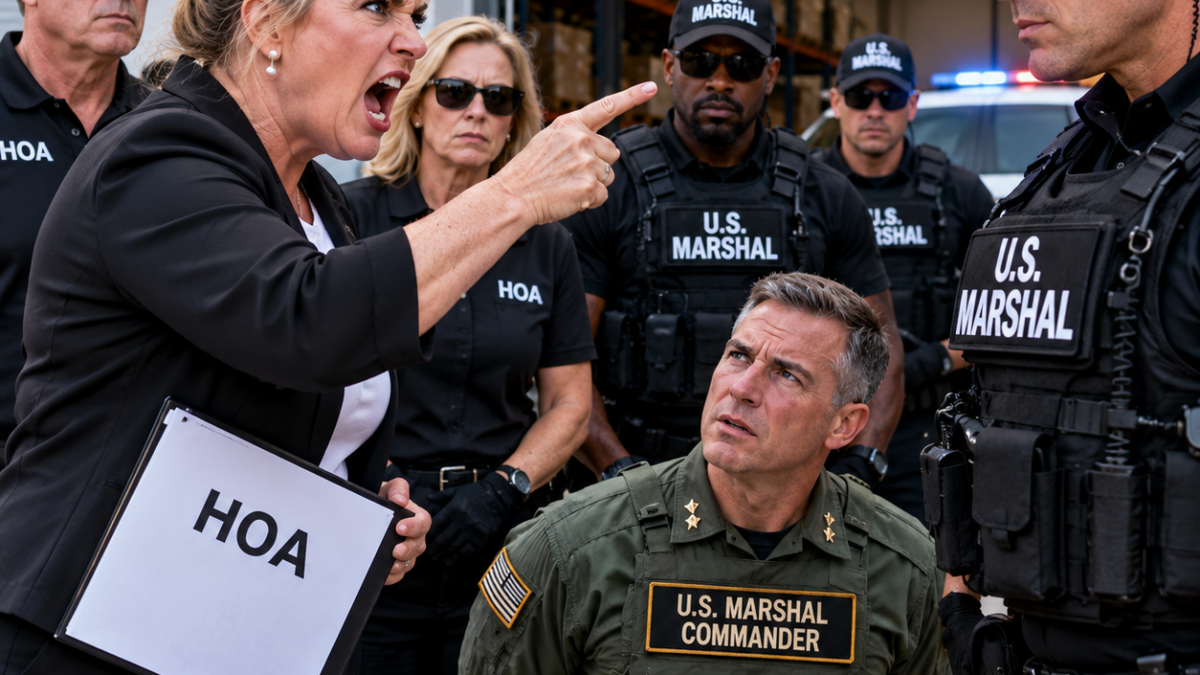
PART 2
Three months earlier, I had almost laughed at the first letter.
That was how harmless it seemed.
A white envelope arrived at the warehouse with the Stonebridge Ridge logo in the corner and a red line across the top:
**NOTICE OF ARCHITECTURAL VIOLATION**
The alleged offense was my fence.
The same steel perimeter fence that had surrounded the property years before Stonebridge Ridge existed.
The letter informed me that the fence lacked architectural approval and assessed a five-hundred-dollar penalty.
I read it twice.
Then I walked outside, looked across the road toward the distant roofs of Stonebridge Ridge, and actually shook my head.
My warehouse predated their subdivision by nearly twenty years.
County records showed their boundary ending roughly 140 feet before my fence.
There was no covenant attached to my parcel.
No HOA membership.
No architectural committee.
No agreement.
Nothing.
I copied the county plat, circled the boundary line, attached it to a short letter, and mailed everything back.
I assumed that would be the end of it.
A week later, another notice arrived.
Twelve hundred dollars for parking a commercial vehicle on property supposedly governed by residential restrictions.
The “commercial vehicle” was one of my delivery trucks.
At my commercial warehouse.
I sent another copy of the survey.
Two weeks later:
Twenty-four hundred dollars for an “unauthorized commercial sign.”
The sign had been hanging above my loading bay for years.
I called the number at the bottom of the notice.
Marissa answered personally.
“Stonebridge Ridge,” she said.
“This is Duncan Vale.”
A pause.
Then her voice warmed artificially.
“Mr. Vale. I’ve been expecting your call.”
“You keep sending assessments to property you don’t govern.”
“That matter has already been reviewed.”
“By whom?”
“Our board.”
“Your board cannot vote my land into your subdivision.”
Her voice cooled.
“We have jurisdictional concerns involving the access corridor.”
“There is no jurisdictional concern.”
“You may want to let our attorneys determine that.”
“I already let the county determine it. Decades ago.”
“You’re being unnecessarily difficult.”
“No. I’m being accurate.”
That was our first real conversation.
I remember it because of the silence that followed.
Marissa was accustomed to people becoming defensive.
She expected bargaining.
Apologies.
Fear.
What she didn’t know how to handle was someone calmly saying no.
Before ending the call, I told her something very simple.
“Send me whatever recorded document you believe gives your association authority over this parcel.”
“I don’t answer to you.”
“You’re demanding money from me. That means you do.”
Then I hung up.
The notices continued.
Five hundred became eighteen thousand.
Eighteen thousand became forty-six thousand.
Every envelope contained a new invention.
Road maintenance.
Administrative penalties.
Security assessments.
Attorney charges.
Emergency-access costs.
Late fees stacked on late fees for invoices that had never been legitimate in the first place.
Eventually I hired an independent surveyor.
Not because I doubted where my property ended.
I wanted fresh documentation.
He walked the boundary, reviewed the recorded plat, checked the title, and gave me the same answer I already knew.
My property was completely outside Stonebridge Ridge.
When I asked whether there was any recorded easement giving them authority over my service road, he looked again.
Nothing.
I sent the report by certified mail to Marissa and to the HOA attorney listed on her correspondence, Gareth Puit.
Gareth never replied.
Marissa did.
She sent another bill.
That was the moment I stopped treating the problem as bureaucratic stupidity.
Something else was happening.
The explanation arrived indirectly.
My neighbor across the road, Calvin Drayton, owned a machine shop and had known me nearly as long as I had owned the warehouse.
One afternoon he walked into my office holding two coffees.
“Got something you might want to hear.”
I took one.
“That sentence usually costs me money.”
He sat down.
“You know the land behind Stonebridge Ridge?”
“Sure.”
“Developer’s been sniffing around.”
I leaned back.
“What kind?”
“Distribution center. Big one.”
That caught my attention.
The undeveloped property behind Stonebridge Ridge was valuable, but difficult to access.
Most approaches crossed residential streets too narrow for heavy truck traffic.
There was one obvious route.
My service road.
Calvin saw the realization hit me.
“Exactly,” he said.
A few days later, Marissa came to see me.
No violation notices.
No threatening letters.
Just Marissa, smiling as she entered my office with a leather portfolio.
She complimented the business.
Asked how long I had owned the warehouse.
Pretended to be interested in expansion plans.
Then she slid an offer across my desk.
She wanted to buy the property.
The number was insulting.
Not merely low.
Strategically low.
The kind of offer someone makes when they believe the owner is already under pressure.
I looked at the page.
Then at her.
“No.”
“You haven’t considered it.”
“I considered it.”
“For six seconds?”
“Five.”
She folded her hands.
“You may find the property becoming more difficult to operate.”
There it was.
Not a threat strong enough to quote in court.
But clear enough that neither of us misunderstood.
“I’ve operated here eleven years.”
“Neighborhoods change.”
“Property lines don’t change because a board president wants them to.”
She gave me a thin smile.
“You’re very sure of yourself.”
“I’m very sure of the deed.”
She gathered her portfolio.
At the door she stopped.
“You should think carefully about opportunities when they’re offered.”
“I do.”
“And?”
“I thought carefully.”
Then she left.
I later learned the part she never mentioned.
The development company had discussed paying Marissa a substantial consulting fee if the corridor deal closed.
Her personal financial future had become connected to my road.
Suddenly, the escalating assessments made sense.
She didn’t need me to believe I owed the HOA money.
She needed paperwork showing that I did.
If she could manufacture enough debt, create enough pressure, and make the ownership issue appear complicated enough, she could push me toward selling.
Or worse.
Create a supposed lien large enough to justify taking control.
The problem was that I didn’t scare easily.
That doesn’t mean I was fearless.
People confuse those two things.
Fearlessness is mostly fiction.
I understood exactly how much damage a determined person could cause with forged documents, aggressive attorneys, hired contractors, and enough confidence.
I also understood that getting angry too early helps the person provoking you.
So I documented.
Every letter.
Every envelope.
Every certified-mail receipt.
Every survey.
Every phone call I could lawfully preserve.
Then, before leaving town for four days on work, I upgraded the warehouse cameras.
The old system had become unreliable.
I installed a new set connected to independent cloud storage.
I almost postponed the installation.
It was expensive.
The technician had been running late.
I remember standing beneath the loading bay camera as he adjusted the angle and thinking I probably didn’t need half the features he was selling me.
That decision ended up saving my business.
While I was away, Marissa came to the property.
The cameras captured her outside the fence with Trent.
They stood there nearly twenty minutes.
Pointing.
Talking.
Studying the gate.
The next day a locksmith’s van arrived.
My chain was cut.
The lock disappeared.
Trent walked through the opening.
Marissa followed him.
The next day, a truck delivered approximately thirty boxes of HOA documents and equipment.
By the fourth day, they had mounted the Stonebridge Ridge sign on my property.
I didn’t see the footage in real time.
The movement alerts were focused around the office windows instead of the loading bay.
Calvin, however, saw everything from across the street.
He walked over.
“What’s going on?”
Marissa told him the HOA had acquired my warehouse.
Calvin knew immediately that something was wrong.
I had known that man for years.
We borrowed tools from each other.
Shared parking during busy deliveries.
Once, after a storm knocked out part of his roof, I let him store equipment in my warehouse for three weeks without charging him a dollar.
He knew I would never sell the place without saying something.
Instead of confronting Marissa, he started documenting.
License plates.
Vehicles.
Photographs.
He found my cut padlock in a dumpster and photographed it.
He filmed part of the entry from across the road.
I wouldn’t know any of that until later.
Back inside the warehouse, Trent stepped toward me.
“You heard her.”
“I heard her.”
“Then move.”
“No.”
He stopped inches away.
“You’re trespassing.”
“This parcel is owned by Duncan Vale.”
Marissa folded her arms.
“The ownership status is under legal review.”
“I am Duncan Vale.”
“You are interfering with association operations.”
“Inside my warehouse.”
“You were notified.”
“Letters don’t transfer title.”
Trent reached for my arm.
I stepped back once.
Not aggressively.
Just enough to make the next decision entirely his.
“Don’t touch me.”
He smiled.
“You threatening me?”
“No.”
I looked directly at him.
“I’m warning you that you’ve been told who owns this property. Whatever you do next, you’ll be doing knowingly.”
Marissa snapped, “Remove him.”
Trent grabbed me.
His partner moved in from the other side.
I could have resisted.
I chose not to.
Years of law-enforcement work had taught me something that pride hates hearing:
Sometimes the strongest thing you can do is nothing.
If I fought, Marissa would get the confrontation she wanted.
She could call me violent.
Claim her guards had acted defensively.
Turn a clean property dispute into a messy story about competing behavior.
So I kept my hands open.
Trent took my phone.
Then Marissa gave the order.
“Detain him until the police get here.”
Plastic restraints tightened around my wrists.
The pressure stung.
I looked at her.
She looked satisfied.
That was the moment I stopped thinking of Marissa Crowley as an overreaching HOA president.
She had now ordered private guards to restrain a man inside his own building based on documents she could not explain.
Trent pushed me into a folding chair.
Someone placed a paper on the table.
“Sign.”
I looked down.
It was a statement admitting I had attempted unauthorized entry onto association property.
I laughed once.
Not loudly.
More disbelief than humor.
“I’m not signing that.”
“It makes this easier,” Marissa said.
“For whom?”
“For everyone.”
“No. It makes it easier for you.”
She leaned closer.
“You’re turning a manageable dispute into something much larger.”
“That happened when you cut my chain.”
Her expression flickered.
I noticed it.
“You don’t know who cut anything.”
Interesting.
She wasn’t claiming lawful entry anymore.
Now she was distancing herself.
I looked around.
My office door had marks near the latch.
One filing cabinet stood partially open.
The cameras had been nudged away from their original angles.
Someone had gone through drawers.
That hurt more than I expected.
There are objects inside a business that have almost no monetary value but contain years of a person’s life.
Receipts from the first year.
Old handwritten supplier notes.
Photographs from the day we installed the first shelving.
A coffee mug an employee gave me before retiring.
Watching strangers treat those things as clutter made the warehouse feel violated in a way broken locks never could.
A younger security guard stood by the bay door.
He looked uncomfortable.
Finally, he approached Marissa.
“Ma’am?”
“What?”
“Do we actually have the paperwork for possession?”
Her eyes flashed.
“I told you it’s being finalized.”
He glanced toward me.
“Being finalized?”
“Do your job.”
The young man stepped back.
But the damage was done.
I had heard it.
So had everyone else.
Trent decided to search my jacket.
Maybe he wanted identification.
Maybe he wanted to find something useful.
Instead, he pulled out a slim leather credential case.
He opened it.
Everything stopped.
Inside was my badge and identification.
United States Marshals Service.
Trent stared at it.
Then at me.
Marissa walked closer.
For the first time since I had arrived, uncertainty crossed her face.
She recovered quickly.
Too quickly.
“This could be fake.”
I said nothing.
Trent gave a short laugh.
“You expect us to believe you’re a U.S. Marshal?”
“Put the credential down.”
Marissa’s mind was moving fast.
I could see it.
The badge should have made her reconsider everything.
Instead, she treated it like a lifeline.
If I was impersonating a federal officer, she could transform herself from the woman occupying my warehouse into the brave HOA president who had uncovered a dangerous fraud.
“Keep it,” she told Trent.
That got my attention.
“Do not keep federal identification.”
She looked at me.
“Why? Nervous?”
“No.”
I kept my voice even.
“I’m giving you another opportunity to make a better decision.”
She took out her phone and called Gareth Puit.
I could hear only her side at first.
Then she put him on speaker.
Gareth sounded concerned.
“Marissa, did you obtain a court order?”
“We have documentation.”
“That is not what I asked. Did a judge sign an order authorizing possession?”
“We’ve established authority through the easement.”
“Did anyone enter the building without the owner’s permission?”
She hesitated.
“Gareth, he’s being extremely aggressive.”
I almost admired the speed of the pivot.
Gareth didn’t take the bait.
“Is Duncan Vale physically there?”
“Yes.”
“Has anyone touched his property?”
“He is interfering.”
“Marissa.”
His voice sharpened.
“Stop touching anything until I arrive.”
She disconnected the call.
Trent looked at the credential again.
There was a contact number inside the case for the local Marshals office.
He smiled.
“I’m calling this.”
I nodded.
“Please do.”
He expected hesitation.
That clearly bothered him.
He dialed.
Someone answered.
“This is private security at Stonebridge Ridge. We have a man here claiming to be one of your people.”
Pause.
“Name?”
Trent looked at me.
“Duncan Vale.”
The silence on the other end lasted several seconds.
Then Trent straightened.
“Yes.”
Another pause.
“He is restrained.”
His face changed.
The call ended.
“What did they say?” Marissa asked.
Trent didn’t answer immediately.
“They’re sending someone.”
Marissa smiled.
“Good.”
I looked at my watch.
That was all.
About twelve minutes later, engines rolled through the broken gate.
One federal SUV.
Then another.
Then a third.
Conversation inside the loading bay died immediately.
Marissa stepped toward the entrance.
She adjusted her jacket.
Actually adjusted it.
Like she was preparing to meet officials who were about to congratulate her.
I stood slowly.
My hands were still restrained.
Deputy Jonah Greer stepped from the first vehicle.
I had worked with Jonah long enough to recognize the expression on his face when he entered an uncertain situation.
Calm.
Controlled.
Observing before speaking.
His eyes went from Marissa…
to Trent…
to the temporary tables…
to the Stonebridge Ridge sign…
and finally to my wrists.
The calm vanished.
“Who restrained him?”
Trent raised a hand slightly.
“We detained him for trespassing.”
Jonah stared.
“Trespassing where?”
“Association-controlled property.”
Jonah looked at me.
Then at the warehouse.
Then back at Trent.
“His warehouse?”
Marissa moved forward.
“Ownership is under dispute.”
Jonah wasn’t listening to her anymore.
He looked directly at Trent.
And asked the question Marissa would probably hear in her sleep for years afterward.
“Why are you detaining our commander?”
Nobody moved.
The silence lasted maybe three seconds.
It felt like thirty.
Marissa turned slowly toward me.
Everything she believed about the balance of power inside that warehouse changed at once.
Not because I suddenly had rights I hadn’t possessed ten seconds earlier.
I had always had those rights.
The difference was that she finally understood I knew how to protect them.
Trent stepped away from me.
His fingers loosened around my credential case.
I held out my hand.
“Badge.”
He gave it back.
Jonah pulled out a cutter.
I stopped him for half a second.
“Document the restraints first.”
He understood immediately.
Photographs were taken.
Then the plastic restraints came off.
My wrists were red and sore.
I rubbed one hand over the other.
Marissa looked terrified now.
But I knew what she was thinking.
Federal officers.
Federal authority.
Career ruined in one dramatic moment.
I needed to shut that down immediately.
I looked at Jonah.
“This property dispute is personal. It is not a Marshals Service matter.”
Marissa looked surprised.
So did Trent.
“I’m not using federal authority to settle it,” I continued. “County handles the property issue.”
Jonah nodded.
“Understood.”
That decision mattered to me.
Not because Marissa deserved generosity.
She didn’t.
But if I used my position to crush her, she could spend the rest of her life telling people the outcome had been unfair.
I wanted something cleaner.
I wanted the deed to defeat her.
I wanted the cameras to defeat her.
I wanted her own emails to defeat her.
I wanted the truth to do the work.
Marissa apparently mistook restraint for forgiveness.
She stepped closer.
“Duncan, obviously there has been a terrible misunderstanding.”
I stared at her.
“Twenty minutes ago I was a trespasser.”
“We were acting on information available to us.”
“You ordered men to restrain me.”
“We should reset this conversation.”
She actually extended her hand.
I looked at it.
Then looked at her.
I didn’t shake it.
She lowered it slowly.
Behind her, Jonah kept staring at Trent.
Something bothered him.
I saw it before Trent did.
Jonah said quietly to another deputy, “Run him.”
Trent stiffened.
“What?”
“Identification.”
“You don’t need—”
“Name.”
The younger security guard had already stepped away from him.
Trent gave his information.
A deputy returned to the vehicle.
Two minutes later, he came back looking at Jonah.
Then at Trent.
“Confirmed.”
Jonah’s posture changed.
“Trent Barlo?”
Trent took one step backward.
I saw it instantly.
So did Jonah.
“Don’t.”
Trent stopped.
Jonah continued.
“There’s an outstanding federal warrant associated with a cargo-theft and obstruction case.”
Marissa’s mouth opened.
“What?”
Trent turned toward his SUV.
That was as far as he got.
Within moments, he was in lawful custody beside his own vehicle.
The irony wasn’t lost on anyone.
But I kept the issues separate.
His warrant had nothing to do with my warehouse.
That mattered.
I wasn’t interested in turning coincidence into mythology.
I called county law enforcement.
When the dispatcher answered, I said exactly what happened.
“My name is Duncan Vale. I need to report an unlawful entry into my commercial property, property damage, and an unauthorized detention. I have recorded video.”
Marissa stared at me.
Not the badge.
Not Jonah.
Me.
Because she finally understood what actually threatened her.
Not my job.
Evidence.
County investigators arrived later that afternoon.
Detective Elena Ruiz took the lead.
She had the kind of patient expression that made nervous people talk too much.
Marissa immediately began explaining.
Ruiz stopped her.
“Before we get into conclusions, I need documents.”
Marissa produced the supposed easement paperwork.
Ruiz took it.
“Court order?”
“This establishes authority.”
“That wasn’t my question.”
Marissa hesitated.
Ruiz repeated it.
“Do you have an order signed by a judge authorizing entry and possession?”
“We were advised—”
“By whom?”
“Our legal counsel.”
I knew that wasn’t true.
Gareth had sounded horrified on the phone.
Ruiz wrote something down.
Then she turned to me.
“Video?”
I opened my laptop.
Logged into the cloud server.
The first clip showed Marissa and Trent outside the gate before the entry.
Marissa’s face lost color.
The second showed Trent cutting my chain.
The third showed Marissa following him onto the property.
Ruiz leaned closer to the screen.
The fourth clip showed Marissa pointing at one camera and telling Trent to angle it away.
She had no idea about the higher camera.
That one captured everything.
Ruiz paused the footage.
“Why move the camera?”
Marissa said nothing.
The fifth recording had audio.
Her voice came through clearly.
“Get everything moved before Vale gets back.”
Nobody in the room spoke when the clip ended.
Ruiz looked at Marissa.
“If you believed you legally controlled the property, why did it matter whether Mr. Vale returned before you finished?”
Marissa’s lawyer still hadn’t arrived.
For once, she seemed to realize silence was useful.
Then Calvin walked through the gate.
He held a folder.
“I think you’re going to want this.”
Inside were photographs.
My broken lock.
License plates.
The box truck.
A short video of the chain being cut.
I looked at him.
He shrugged.
“Figured you’d want a backup.”
There are moments when loyalty looks dramatic.
Someone running into danger.
Someone making a speech.
That afternoon, loyalty looked like a sixty-year-old machinist who had quietly taken photographs because he knew his neighbor was being wronged.
“Thank you,” I said.
He nodded.
“That’s what neighbors are supposed to do.”
Marissa heard him.
She looked away.
The irony was almost too sharp.
The woman who claimed she was protecting a neighborhood had forgotten what being a neighbor actually meant.
Detective Ruiz pulled up the county property database.
Owner:
**DUNCAN VALE.**
No deed transfer.
No foreclosure.
No recorded association lien.
No court order.
No legitimate transfer of possession.
Nothing.
Gareth arrived twenty minutes later.
Marissa rushed toward him.
“Tell them about the easement.”
He held up one hand.
“Let me see everything.”
She gave him the document she had been calling court authorization.
He read it.
Ten seconds.
Twenty.
Thirty.
Then he looked up.
His face had gone pale.
“Where did you get this?”
“It came from the legal packet.”
“What legal packet?”
“The filing.”
“Marissa.”
His voice dropped.
“This isn’t a court order.”
She said nothing.
“This is a draft notice.”
He looked closer.
“And this signature block is from another filing.”
Detective Ruiz stepped forward.
“You’re saying it was altered?”
“I’m saying I did not prepare this in its current form.”
Marissa’s confidence finally cracked.
“Everyone is acting like I did this alone.”
Nobody answered.
Gareth looked genuinely angry now.
“You told me the ownership question was unresolved.”
“It was.”
“You had the survey.”
She froze.
Ruiz caught it immediately.
“What survey?”
Gareth looked at Marissa.
Then at the detective.
“I sent the board a written analysis after reviewing the independent boundary materials. My understanding was that they would not proceed without recorded authority.”
Marissa snapped, “You’re supposed to represent us.”
“I represent the association. I do not manufacture authority that doesn’t exist.”
That sentence ended their relationship.
Later that evening, another person made a decision that changed the entire case.
Laurel Fenwick.
Stonebridge Ridge treasurer.
She had spent nine years on the board.
For months, she had watched Marissa’s campaign against me become more aggressive.
She had questioned the assessments.
Marissa told her not to worry about strategy.
Just keep the books balanced.
Laurel complied.
Partly from loyalty.
Mostly from fear.
Marissa had a pattern.
Board members who challenged her found themselves isolated.
Committee assignments disappeared.
Friends suddenly became distant.
Small disagreements became personal campaigns.
Laurel later told me she hated herself for remaining quiet.
But fear works precisely because it rarely feels dramatic while you are experiencing it.
It feels practical.
Don’t make trouble.
Don’t get involved.
Maybe someone else will speak.
Maybe things will calm down.
Then she heard what happened at the warehouse.
She heard I had been restrained.
She heard the Marshals had arrived.
She went home, sat at her kitchen table, and began printing emails.
Not saving them to the board system.
Printing them.
Page after page.
She hired her own attorney and turned everything over.
Those emails destroyed Marissa’s last plausible defense.
Months earlier, the surveying company had written:
**The Vale parcel is not subject to Stonebridge Ridge covenants.**
Clear.
Unambiguous.
No uncertainty.
Marissa knew.
She had always known.
And yet the assessments continued.
The internal ledger showed how the numbers grew.
Five hundred dollars.
Eighteen thousand.
Forty-six thousand.
Then more.
Invented road charges.
Artificial legal costs.
Security assessments.
Emergency-access fees.
Penalties attached to penalties.
By the time investigators finished reconstructing the ledger, the supposed debt had reached approximately $214,000.
That number wasn’t accidental.
According to Laurel, Marissa had discussed making the burden large enough that I would have no practical option except to settle or sell.
Then investigators found the email that explained everything.
The development deal.
Millions of dollars for the property behind Stonebridge Ridge.
Conditional upon guaranteed truck access.
Through my road.
One message from Marissa stated:
They would control Vale’s parcel before closing.
When Detective Ruiz showed me the email, I read the sentence three times.
There is a strange feeling that comes with discovering someone has been planning around your life without your knowledge.
For months I had believed I was responding to harassment.
I hadn’t understood the scale.
My warehouse wasn’t the target.
My road was.
The building was leverage.
The fines were leverage.
The supposed lien was leverage.
The fake authority was leverage.
Even restraining me had been intended as leverage.
They needed me to become afraid enough to surrender.
Instead, every step they took created another piece of evidence.
The county investigation expanded.
I filed for an emergency injunction preventing Stonebridge Ridge from entering the property or claiming authority over it.
The hearing came quickly.
Marissa arrived at the courthouse in a dark suit.
Perfect hair.
Controlled expression.
New attorney.
She looked nothing like the woman who had stood inside my warehouse.
But I knew that version of her was still there.
Her attorney presented the defense exactly as expected.
Boundary confusion.
Historic easement.
Good-faith belief.
Administrative overreach.
Mistakes made while protecting community interests.
It sounded reasonable.
That was the dangerous part.
Bad conduct rarely walks into court introducing itself as bad conduct.
It arrives dressed as misunderstanding.
My attorney started with the plat.
Then the title report.
Then the independent survey.
Then certified letters proving Marissa had received the information.
Then Gareth’s warnings.
Then Laurel’s emails.
Then the footage.
The courtroom watched Trent cut the chain.
They watched Marissa enter.
They watched her direct the camera away.
Then came the recording.
“Get everything moved before Vale gets back.”
Judge Miriam Oaks watched it without expression.
When the screen went dark, she looked over her glasses.
“If the association genuinely believed it possessed lawful authority to enter this property, why was it necessary to cut the owner’s chain rather than seek access through proper channels?”
Marissa’s attorney stood.
“Your Honor, the board believed time was—”
“I asked why the chain was cut.”
He tried again.
“There was an urgency associated with—”
“The development transaction?”
The room went silent.
Her attorney looked toward Marissa.
The judge continued.
“And why was a camera redirected?”
No answer.
“If the association believed its conduct was authorized, why would recording that conduct be a problem?”
Still nothing.
Marissa sat beside her attorney staring straight ahead.
For three months she had buried me under paper.
Now paper was burying her.
Judge Oaks ruled decisively.
Stonebridge Ridge had no ownership interest in my property.
No valid easement controlling the parcel.
No authority to assess it.
No authority to enter.
The $214,000 balance was void.
Any claimed lien based on those assessments was barred.
The HOA and anyone acting on its behalf were prohibited from entering my property without permission or a legitimate court order.
I thought I would feel triumphant.
Instead, I felt tired.
Deeply tired.
Because victory doesn’t automatically return the months someone took from you.
It doesn’t give back the nights spent wondering what fabricated document might appear next.
It doesn’t erase the image of strangers walking through your office.
It doesn’t remove the memory of sitting in a folding chair with restraints around your wrists while another person claims ownership of the floor beneath your feet.
Outside the courthouse, reporters waited.
I walked past them.
One called out:
“Mr. Vale, do you consider this revenge?”
I stopped.
That word bothered me.
Revenge.
People imagine revenge as anger finally being allowed to act.
That wasn’t what I wanted.
I turned toward the reporter.
“No.”
“What would you call it?”
“Documentation.”
Then I left.
The criminal investigation continued separately.
County prosecutors reviewed potential charges related to unlawful entry, detention, falsified documents, and coordinated conduct surrounding the warehouse takeover.
I requested no favors.
No special handling.
No shortcuts.
I told every investigator the same thing.
Treat me like the owner of a warehouse.
Not like a federal officer.
That infuriated Marissa more than anything.
She could not claim I had destroyed her through my position.
The evidence had done it.
Then came the insurance letter.
Marissa had convinced several board members that even if the HOA lost in court, insurance would absorb the financial consequences.
Governance errors happened.
Associations carried coverage.
Everything would eventually become someone else’s bill.
Then the insurer issued a reservation-of-rights notice.
Ordinary mistakes might be covered.
Intentional fraudulent acts and knowingly unauthorized entry were another matter.
Coverage could be denied.
Panic spread through Stonebridge Ridge.
Homeowners who had trusted Marissa began asking questions.
Why had they never been told about the survey?
Why had money been spent on private security?
Why had sixty-eight thousand dollars reportedly gone to a company under an “asset recovery security” contract?
What asset?
Recovered from whom?
Why had residents been exposed financially for a parcel the HOA never controlled?
An emergency meeting was called.
I didn’t attend.
I didn’t need to.
Laurel later told me what happened.
The clubhouse was packed.
People stood along the walls.
Some residents were angry.
Others embarrassed.
Many were frightened their dues would rise because of litigation.
Marissa entered the room and tried to speak as though she was still in control.
“I acted to protect the long-term economic interests of Stonebridge Ridge.”
Someone shouted from the back:
“You knew the warehouse wasn’t ours.”
She continued.
“The boundary question was complicated.”
Laurel stood.
For nine years, Laurel had spoken softly at board meetings.
That night she did not.
“No, Marissa. It wasn’t complicated.”
The room went quiet.
“You had the survey.”
Marissa stared at her.
Laurel placed a printed email on the table.
“I sent this to investigators. You knew.”
Marissa’s expression hardened.
“You violated board confidentiality.”
Laurel shook her head.
“That stopped mattering when people were sent onto property we didn’t own.”
Applause broke out.
Not huge.
Not celebratory.
The exhausted applause of people realizing someone had finally said the sentence everyone needed to hear.
The board voted to remove Marissa as president.
Only one member opposed the motion.
Six years of power ended in one evening.
No dramatic police scene.
No shouting match.
Just hands raised around a clubhouse table.
There was something fitting about that.
Marissa had built her authority through procedure.
Procedure took it away.
The new board president was a retired schoolteacher named Howard Bell.
He had never wanted the job.
Apparently that was one reason residents trusted him with it.
His first official letter to me was only two paragraphs.
Stonebridge Ridge acknowledged it possessed no legal claim to my warehouse or road.
All assessments were permanently withdrawn.
The association would cooperate with investigators.
At the bottom, Howard added a handwritten note.
**Mr. Vale, I’m sorry our community allowed this to happen.**
I stared at that sentence longer than I expected.
It was the first apology I had received.
Not from Marissa.
From the people left cleaning up what she had done.
I wrote Howard back.
**Thank you. Let’s make sure nobody has to go through it again.**
Then came the civil case.
Broken locks were easy to price.
Gate repairs were easy.
Office damage could be inventoried.
Lost business income could be calculated.
But some losses were harder.
My employees had arrived after the incident and found investigators inside the warehouse.
Rumors spread among customers.
Was the business being seized?
Were we bankrupt?
Had federal agents raided us?
I spent weeks explaining that no, the company was stable.
No, we hadn’t done anything wrong.
No, the warehouse wasn’t closing.
Every false impression Marissa created had to be corrected one conversation at a time.
My attorney documented all of it.
Repair costs.
Lost revenue.
Operational interruption.
Professional fees.
The damage to business relationships.
The impact of months of fraudulent claims.
The unlawful detention.
And the deliberate nature of the conduct.
Marissa’s attorneys tried to negotiate.
The first offer was laughable.
My lawyer slid the page across the conference table.
“What do you think?”
I read it.
“They still believe this is about the gate.”
“It isn’t.”
“No.”
I pushed the paper back.
“It’s about eleven years.”
He nodded.
That was the heart of it.
Marissa had looked at something I spent eleven years building and treated it like an obstacle in her development deal.
A road.
A parcel.
A number.
She had never cared how many mornings I unlocked that gate before sunrise.
How many payroll weeks depended on those loading docks.
How many contractors relied on deliveries.
How many employees had built their own lives around that business.
To her, ownership was just a weakness that could be overwhelmed with paperwork.
So we kept going.
As depositions began, the internal correspondence became even worse for her.
There were discussions about increasing assessments specifically because I had ignored earlier notices.
References to making the financial burden “unsustainable.”
Messages about taking control before the developer’s deadline.
And repeated acknowledgment that actual title authority had not yet been secured.
One board member testified:
“I assumed Marissa’s lawyer had approved everything.”
Gareth testified he had not.
He produced correspondence warning that the alleged easement was legally unsound.
That mattered.
Because Marissa could no longer say she acted because professionals gave her bad advice.
Professionals had warned her.
She ignored them.
Eventually, settlements were reached with several parties.
A substantial judgment remained against Marissa personally.
That was the part people later called revenge.
I didn’t.
But I understood why they did.
For years, Marissa had reportedly threatened homeowners with liens over far smaller debts.
Late assessments.
Fines.
Penalties.
Now judgment enforcement reached her assets.
Commercial holdings became subject to liens.
Her luxury vehicle entered the enforcement process.
Even her lake property was no longer comfortably beyond reach if the judgment remained unsatisfied.
When my attorney told me, I didn’t smile.
He noticed.
“You okay?”
“Yes.”
“You don’t seem happy.”
“I didn’t want her lake house.”
“You didn’t take her lake house.”
“I know.”
“She created the judgment.”
“I know that too.”
He studied me.
“So what did you want?”
I thought for a moment.
“I wanted her to stop.”
That was the truth.
People expected me to enjoy watching her lose things.
I didn’t.
What satisfied me was simpler.
She couldn’t do it again.
Not to me.
Not through Stonebridge Ridge.
Not with the same authority.
The development company withdrew.
Without lawful access through my road, the economics changed.
The multi-million-dollar deal that had motivated the entire scheme disappeared.
Representatives issued a carefully worded statement saying they had relied on assurances from Stonebridge Ridge leadership regarding access.
Translation:
Marissa had promised something she never controlled.
The irony was complete.
She had risked her position, finances, reputation, and freedom of action to gain control of my road.
At the end of it all, the road remained exactly where it had always been.
Mine.
Months passed.
The warehouse returned to normal.
That phrase—returned to normal—sounds simple.
It wasn’t.
The first morning after all the temporary legal restrictions and evidence work were finished, I arrived before sunrise.
For a while, I sat in my truck outside the gate.
No strange SUVs.
No association sign.
No hired guards.
Just my warehouse under yellow security lights.
I got out.
Unlocked the gate.
Walked inside.
The building smelled like cardboard and oil again.
A forklift beeped as one of my employees backed it toward a pallet.
Someone had already started coffee.
I stood there listening.
Normal sounds.
Sounds I had barely noticed before.
They meant something different now.
Calvin came over around eight carrying two coffees.
He inspected the new lock.
“Looks expensive.”
“It is.”
“Camera?”
I pointed upward.
He looked at the new unit.
“Another one?”
I pointed farther back.
He laughed.
“Paranoid now?”
“Educated.”
He handed me a coffee.
We stood outside looking toward Stonebridge Ridge.
“Ever hear from her?” he asked.
“No.”
“You want to?”
“No.”
He nodded.
“Probably better.”
I looked at him.
“I never properly thanked you.”
“You did.”
“No. I said thank you. Different thing.”
He shrugged.
“You would’ve done the same.”
I knew he was right.
But that didn’t make gratitude unnecessary.
“If you hadn’t documented the first day—”
“You had cameras.”
“I didn’t know that footage existed yet.”
He smiled.
“Then buy lunch.”
“Done.”
That was Calvin.
No speech.
No heroism.
Just lunch.
Laurel visited a few weeks later.
She stood near the loading bay awkwardly.
“I wasn’t sure whether coming here was appropriate.”
“It’s fine.”
She looked around.
“So this is what all of that was about.”
“Apparently.”
Her eyes filled with regret.
“I should’ve spoken sooner.”
I didn’t answer immediately.
She looked at the floor.
“I saw things I knew were wrong. Maybe not criminal. I didn’t know that. But wrong.”
“Why didn’t you?”
“You know why.”
“Yes.”
“She made people afraid.”
“I know.”
“I keep thinking if I’d challenged her when the first fake assessment appeared…”
“You eventually did.”
“After you were restrained.”
“Yes.”
She flinched.
I hadn’t meant it cruelly.
But I wasn’t going to lie to make either of us feel better.
She nodded.
“I deserve that.”
“No.”
I leaned against the table.
“You deserve the truth. There’s a difference.”
She looked up.
“I could have spoken earlier.”
“Yes.”
“And I didn’t.”
“Yes.”
Her eyes watered.
“But you spoke when it mattered most.”
She wiped at one eye.
“That doesn’t erase the rest.”
“No.”
I paused.
“But accountability isn’t supposed to erase the past. It’s supposed to change what happens next.”
She gave a small, tired smile.
“That sounds like something you tell your deputies.”
“Sometimes I tell myself.”
Before she left, Laurel handed me a folder.
Inside were copies of the final financial audit findings related to the fabricated warehouse charges.
“I thought you should have these.”
I accepted them.
“Thank you.”
At the door, she stopped.
“For what it’s worth, Howard changed everything.”
“How?”
“Open meetings. Outside legal review. No assessments without recorded authority. No security contracts without board vote.”
“That’s good.”
“It should’ve always been that way.”
“Yes.”
She left.
I stored the folder in the repaired filing cabinet.
Then I locked it.
Not because I feared Marissa returning.
Because some lessons become habits.
Trent’s case continued separately.
People occasionally asked whether I felt responsible for his arrest.
I didn’t.
He had an outstanding warrant before he ever stepped inside my warehouse.
The warehouse didn’t create that history.
The phone call simply brought it into view.
The younger guard who had questioned Marissa cooperated with investigators.
He admitted he had been told the HOA possessed legal authority and became suspicious only when Marissa said the paperwork was still “being finalized.”
I didn’t pursue him personally.
He had made bad choices.
But there is a difference between being deceived and designing the deception.
I cared about that difference.
The same principle applied to Stonebridge Ridge residents.
A few people wrote me angry messages during the first weeks.
They blamed me for the association’s legal costs.
One letter said:
**You could have settled instead of destroying our community.**
I almost threw it away.
Instead, I wrote back.
**I did not enter Stonebridge Ridge property. Stonebridge Ridge entered mine.**
Nothing else.
Months later, another letter arrived from the same person.
**I attended the document review meeting. I didn’t know the full story. I apologize.**
I kept that one.
Not because I needed the apology.
Because changing your mind after seeing evidence is something worth respecting.
Marissa never apologized.
Not to me.
Not publicly.
Not in any meaningful way.
Her position seemed to remain that she had been aggressive in pursuit of community interests and that events had spiraled beyond what she intended.
Maybe she believed that.
People are capable of rewriting their own motives until they can live comfortably beside them.
But intention became less important to me over time.
The documents existed.
The footage existed.
The judgment existed.
The new boundary acknowledgment existed.
Reality no longer depended on Marissa admitting it.
That freedom mattered.
For months, I had felt as though I needed her to understand what she had done.
Eventually, I realized I didn’t.
Consequences don’t require confession.
One afternoon, Jonah Greer stopped by the warehouse.
He was headed to another assignment and had time to kill.
He walked through the loading bay, looked around, and pointed toward the spot where the folding chair had been.
“Still can’t believe it.”
“What?”
“You.”
“What about me?”
“Getting detained for trespassing inside your own building.”
I smiled.
“I’ve seen stranger.”
“No, you haven’t.”
“Fair.”
He looked at the new camera above the gate.
“Better system?”
“Much.”
He nodded toward the lock.
“Better lock?”
“Also much.”
We stood quietly for a moment.
Then he said, “You know what gets me?”
“What?”
“They had your deed problem completely backward.”
“How so?”
“They acted like their paperwork created reality.”
I looked out toward the road.
“That’s not unusual.”
“No?”
“No. People see a logo, a letterhead, an official-sounding title, and they assume authority automatically follows.”
Jonah smiled.
“You should put that on a sign.”
“I already have a sign.”
Outside the gate was a simple metal plaque.
No mention of my federal job.
No badge.
No threat.
No warning about what happened.
Just:
**PRIVATE PROPERTY — ENTRY BY PERMISSION ONLY**
Jonah read it.
“That’s all?”
“That’s all.”
He laughed.
“After everything?”
“That’s enough.”
He glanced at me.
“And if another HOA decides otherwise?”
I looked at the cameras.
“Then they’ll understand the difference between a logo and a deed.”
He laughed again.
Then he became more serious.
“You handled it better than I would have.”
“No.”
“I mean it.”
“You saw me after the fact.”
“You could’ve used the badge.”
“That would’ve made her story easier.”
“What story?”
“That I won because of who I worked for.”
Jonah nodded slowly.
“So you wanted the property records to win.”
“I wanted the truth to be boring.”
He laughed.
“That might be the most Duncan Vale sentence I’ve ever heard.”
But that was exactly what I meant.
Truth shouldn’t require drama.
My deed should have been enough.
The survey should have been enough.
The county line should have been enough.
A simple no should have been enough.
Marissa turned everything into a war because she believed persistence could replace permission.
What ultimately defeated her wasn’t power.
It was consistency.
The same boundary line.
The same ownership record.
The same certified letters.
The same unanswered questions.
Again.
And again.
And again.
That is something I thought about often afterward.
People imagine abusive authority as loud.
Sometimes it is.
But sometimes it arrives politely.
An envelope.
A fee.
A warning.
A new deadline.
A letter saying you have seven days to comply with an obligation that never existed.
Then another.
Then another.
Each one designed to make resistance feel more exhausting than surrender.
That was Marissa’s real strategy.
Not taking the warehouse by force.
Exhausting me until giving up seemed easier than proving I was right.
She misunderstood something fundamental about me.
I had spent years working cases where patience mattered more than volume.
I knew that when someone keeps manufacturing paperwork, you don’t always need to create more noise.
Sometimes you simply preserve every page.
Let them continue.
Let the contradictions accumulate.
Give the truth somewhere safe to wait.
My cameras gave it somewhere safe to wait.
Laurel’s emails gave it somewhere safe to wait.
Calvin’s photographs gave it somewhere safe to wait.
The county records had been waiting for decades.
In the end, Marissa’s downfall wasn’t caused by one dramatic discovery.
It came from dozens of small facts agreeing with each other.
The warehouse was mine.
The road was mine.
The HOA boundary ended before my fence.
The survey said so.
The title said so.
The county said so.
Marissa knew.
She entered anyway.
Everything after that was consequence.
About a year after the first violation notice arrived, Stonebridge Ridge held its annual community meeting.
I wasn’t there.
Howard later sent me a copy of the new governance rules.
Independent review for boundary disputes.
Mandatory disclosure of conflicts of interest.
No private security deployment without full board approval.
No lien action without attorney certification of jurisdiction.
All board members required to receive the same legal opinions.
A rule prohibiting individual officers from negotiating private compensation related to association-controlled development arrangements.
That final rule had Marissa’s shadow all over it.
I read the document.
Then placed it in the same cabinet as the original five-hundred-dollar fence violation.
Sometimes I still pull that first notice out.
Not because I’m angry.
Because it reminds me how these things begin.
Five hundred dollars.
One envelope.
One person assuming another person will surrender because defending himself looks inconvenient.
If I had paid it, perhaps the next assessment would have followed.
If I had negotiated the eighteen thousand, perhaps Marissa would have smelled weakness.
If I had accepted the buyout, she would have gotten the road.
If I had resisted Trent physically, perhaps the story would have become something else entirely.
If Calvin hadn’t taken photographs…
If Laurel hadn’t printed emails…
If the cameras hadn’t uploaded to the cloud…
Cases like this look inevitable after they end.
They aren’t.
They are collections of small decisions.
Some made well.
Some made poorly.
Marissa made hers.
I made mine.
The final legal paperwork arrived on a rainy Thursday morning.
My attorney called first.
“It’s done.”
“What’s done?”
“The final property acknowledgment. Recorded.”
I looked through my office window toward the road.
“Meaning?”
“Stonebridge Ridge formally acknowledges no current or future claim to your parcel. Service-road ownership clarified in the title record. Everything is clean.”
I didn’t say anything for several seconds.
“You there?”
“Yeah.”
“How does it feel?”
I looked around the office.
The repaired cabinet.
The window I still hadn’t fixed.
The coffee machine back where it belonged.
“Quiet.”
“That’s it?”
“That’s exactly what I wanted.”
After we hung up, I walked outside.
Rain tapped against the metal roof.
Trucks were lined up for morning deliveries.
One driver waved.
I waved back.
Across the road, Calvin’s machine shop door was open.
A grinder sparked somewhere inside.
Beyond that, the rooftops of Stonebridge Ridge were barely visible through the gray weather.
For almost a year, I had associated those rooftops with letters, accusations, lawyers, cameras, courtrooms, and Marissa Crowley.
That morning they were just houses again.
Families.
People going to work.
Kids waiting for buses.
Residents who had mostly known nothing about the scheme unfolding in their association’s name.
That mattered too.
I had no desire to turn an entire neighborhood into an enemy because one president abused her position.
Marissa had spent years dividing the world into people who obeyed her and people who caused problems.
I refused to do the same.
My fight had never been against Stonebridge Ridge residents.
It had been against a lie.
Once the lie was gone, I had no reason to keep fighting.
A few weeks later, Howard called.
“We’re replacing landscaping along the edge of the subdivision.”
“Okay.”
“One contractor asked whether he could temporarily use part of your service road while they unload.”
I smiled.
“Did you just call and ask permission?”
There was a pause.
“Yes.”
“That’s new.”
He laughed nervously.
“I figured after everything…”
“When?”
“Tuesday. Maybe two hours.”
“Tell them to stay clear of the loading dock.”
“So that’s a yes?”
“That’s a yes.”
“Thank you.”
“Howard?”
“Yes?”
“That’s how it was always supposed to work.”
“I know.”
The contractor came Tuesday.
Used the road.
Finished early.
No letters.
No fines.
No lawyers.
No private guards.
No court orders.
Someone asked permission.
The owner said yes.
Sometimes the happiest endings are boring.
That one felt perfect.
I never learned exactly when Marissa realized the development deal was dead.
I imagine someone called her.
Maybe an attorney.
Maybe the developer.
Maybe she received a formal letter.
I don’t know.
I don’t need to.
What I know is that she had walked into my warehouse believing the road to a multi-million-dollar transaction passed through intimidation.
She had believed enough paperwork could turn my property into hers.
Instead, the chain she ordered cut became evidence.
The camera she tried to redirect recorded her.
The false assessments became a financial trail.
The emails became proof of knowledge.
The guards became witnesses.
The treasurer she intimidated became the person who exposed the internal records.
The attorney she misled became another source of documentation.
Even Trent’s attempt to prove my credential was fake ended with him dialing the very office that knew exactly who I was.
Every shortcut became another locked door.
People later described what happened as poetic justice.
Maybe it was.
But there was nothing poetic about sitting restrained in my own warehouse.
Nothing poetic about months of legal bills.
Nothing poetic about watching employees worry whether their jobs were safe.
Nothing poetic about Laurel crying because she regretted staying silent.
Consequences can be satisfying without being entertaining.
That distinction matters to me.
I never wanted Marissa harmed.
I wanted her stopped.
I wanted my property protected.
I wanted the documents corrected.
I wanted the fraudulent debt erased.
I wanted everyone involved to answer for the decisions they actually made.
And that is what happened.
She lost the presidency she had held for six years.
The development transaction collapsed.
Her personal financial exposure became real.
Assets she once assumed were untouchable became vulnerable to judgment enforcement.
The association publicly acknowledged my rights.
The board changed its rules.
The warehouse stayed mine.
The road stayed mine.
And I stayed exactly where I had been from the beginning.
On my own land.
Sometimes people ask what sentence I remember most.
They expect me to say something the judge said.
Or something from the ruling.
Maybe the moment the $214,000 claim disappeared.
It isn’t.
I remember standing in the loading bay with my hands restrained while Trent held my credential.
I remember Marissa looking at the federal SUVs rolling through the gate and smiling because she believed help had arrived for her.
I remember her straightening her jacket.
I remember Jonah stepping out.
I remember his eyes moving toward my wrists.
And then I remember his voice.
Calm.
Almost confused.
“Why are you detaining our commander?”
That was the instant Marissa understood how badly she had miscalculated.
But it wasn’t the moment she lost.
She had already lost days earlier when the first camera uploaded the first recording.
She had lost when the survey reached her office and she ignored it.
She had lost when she invented a debt against property outside her jurisdiction.
She had lost when she believed fear could rewrite a deed.
She just didn’t know it yet.
That may be the most important lesson I carried away from the entire ordeal.
People who abuse authority often believe the consequences begin when someone powerful finally confronts them.
They don’t.
Consequences begin the moment they choose to cross the line.
Everything afterward is simply the evidence catching up.
Today, when I arrive before sunrise, I unlock the same gate.
I walk beneath the same warehouse lights.
I hear forklifts.
Phones.
Truck engines.
Employees arguing about football.
Coffee brewing.
Normal life.
Above the entrance, one camera watches the loading bay.
Another watches the gate.
A third covers the road.
Some people might call that paranoia.
I call it memory.
And beside the gate remains the only sign I ever needed:
**PRIVATE PROPERTY — ENTRY BY PERMISSION ONLY.**
No HOA logo.
No badge.
No title.
No threat.
Just the truth.
Because after everything Marissa Crowley tried to manufacture, that was the one thing she could never replace.
The warehouse was mine before she arrived.
It was mine while she stood inside pretending otherwise.
And when every false assessment, altered document, invented fee, closed-door promise, and million-dollar scheme finally collapsed under its own weight…
it was still mine.
That was enough.
More than enough.
Because the most satisfying part of watching someone’s scheme fall apart isn’t seeing what they lose.
It’s realizing they never had the power they pretended to have in the first place.

