PART 2: HOA Refused Their Share of My $49,500 Road Repair—The Next Morning, 58 Lake Homes Had No Road In
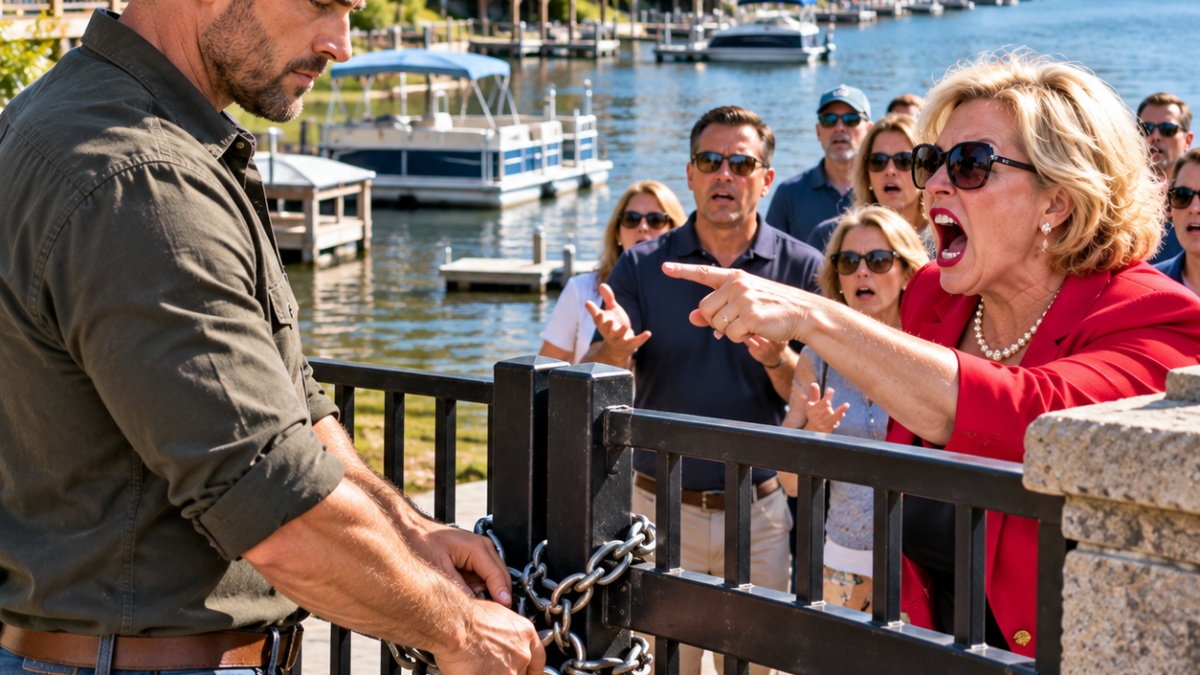
At six o’clock Tuesday morning, I hung a steel gate across the only road leading to fifty-eight lake houses—and clicked a padlock shut.
The HOA president had been warned twice that their half of my $49,500 road repair was due, but she was convinced I would never dare close a road that crossed my own property.
By sunrise, my phone started ringing, and before that day was over, the people behind that gate were asking questions their board had spent two months avoiding.
My name is Leonard Coss.
I’ve been a heavy-equipment contractor for thirty-five years, and since 2004 I’ve owned three acres at the entrance to Harden Cove, a private lake community of fifty-eight homes.
I didn’t buy the parcel because of Harden Cove.
I bought it because I needed ground for equipment storage.
The road was simply there.
Three hundred forty feet of it crossed the southern edge of my land before reaching the HOA’s community gate.
It had been there since 1974.
And since 1989, a recorded maintenance agreement had governed who paid for repairs.
The arrangement was simple.
Fifty-fifty.
If one party discovered necessary work, that party gave written notice before starting.
After the repair, they provided photographs, invoices, and documentation.
The other party reimbursed half within forty-five days.
I had read that agreement before I bought the property.
In the margin beside Section 3, I had written five words:
Notice required. Approval not required.
For nineteen years, nobody argued about that.
Then came the winter of 2022–2023.
It was brutal on roads.
Freeze.
Thaw.
Rain.
Freeze again.
By March, I walked the Harden Cove entrance and knew immediately we had a structural failure.
The western section showed map cracking.
The center had heaved.
But the worst damage was over the old drainage crossing.
A forty-nine-year-old corrugated culvert had partially collapsed.
The pavement above it had dropped nearly four inches.
I stood there with one boot on the depression and knew exactly what would happen if we ignored it.
Garbage trucks.
Fuel deliveries.
Construction vehicles.
Summer lake traffic.
Every axle would make the failure worse.
A $49,500 repair in April could easily become a six-figure reconstruction by fall.
So I documented everything.
Forty-seven photographs.
Measurements.
Condition notes.
Then I sent HOA president Sylvia Trent written notice.
Certified mail.
Email.
Photographs attached.
Her own property manager, Dale Morrow, had already inspected the damage independently.
His conclusion matched mine.
The culvert was failing.
The repair was necessary.
I obtained three bids.
$52,400.
$49,500.
$61,800.
I selected Cascade Site Services at $49,500 because they were properly licensed, bonded, insured, and experienced.
Then I sent Sylvia another certified letter showing the bids, contractor information, and start date.
She never objected.
The crew arrived April 4.
We removed the collapsed twenty-four-inch pipe.
Installed a larger drainage culvert.
Excavated the failed base.
Recompacted it correctly.
Rebuilt the damaged section.
Laid fresh asphalt.
By April 12, Harden Cove had a sound entrance road again.
Cars drove across it without bouncing.
Water moved through the culvert instead of under the pavement.
The repair worked exactly as designed.
I compiled the documentation.
Before photographs.
During photographs.
After photographs.
Contractor license.
Bonding certificate.
Invoice.
Repair summary.
Then I sent the HOA its share.
Total project: $49,500.
Their half: $24,750.
Payment due within forty-five days.
I expected a check.
Instead, Sylvia sent me a refusal letter.
The board had voted four to one against paying.
Their reason?
I had supposedly failed to obtain “prior board approval.”
I went to my filing cabinet.
Pulled the 1989 agreement.
Put it beside Sylvia’s letter.
Then I read Section 3 again.
Notice before work.
Documentation after work.
Reimbursement within forty-five days.
I read the entire agreement twice.
The word approval wasn’t there.
Not once.
I called my attorney, Vera Okafor.
She read the agreement.
Then she called me.
“There’s no prior approval requirement, Leonard.”
“I know.”
“The HOA invented one.”
I looked through my window toward the road I had just spent $49,500 repairing.
“What happens if they still refuse to pay?”
There was a pause.
Then Vera said something that changed the entire fight.
“Leonard, do you understand that the road they use every day crosses your property?”
“Yes.”
“And do you understand there is no separate recorded access easement giving Harden Cove an unconditional right across that three hundred forty feet?”
I stopped speaking.
Vera continued.
“Give them the full forty-five days.”
“And after that?”
“If they deliberately breach the agreement, we discuss what rights you stop extending under that agreement.”
I looked toward the entrance.
Toward the only road connecting fifty-eight lake houses to the county highway.
Then I looked at the calendar.
Thirty-nine days remained.
I picked up my contractor’s notebook and wrote:
June 6.
Then underneath it:
If they don’t honor the agreement, neither do I.
PART 2
For the next thirty-nine days, I did exactly what Vera told me to do.
Nothing dramatic.
Nothing impulsive.
That was important.
People assume disputes like mine are won by whoever gets angriest first.
That has never been my experience.
I had spent thirty-five years working construction contracts, equipment rentals, municipal bids, road specifications, change orders, site plans, insurance requirements, and payment schedules.
Anger is expensive.
Paperwork is cheaper.
So I waited.
But I documented the waiting.
On May 5, Vera sent Harden Cove a formal demand letter.
Nine pages.
I read every word before she mailed it.
She quoted the maintenance agreement directly.
Written notice before commencement.
Satisfied.
Documentation following completion.
Satisfied.
Fifty-percent reimbursement within forty-five days.
Still pending.
Then she addressed Sylvia’s argument.
There was no prior approval clause.
There was no sentence that could reasonably be mistaken for one.
There wasn’t even an approval procedure.
No form.
No timeline.
No board-review mechanism.
No language telling the initiating party what happened if approval was denied.
Nothing.
Vera called me after sending it.
“I want to make sure you understand what happens now.”
“I understand.”
“Tell me.”
“The payment clock keeps running.”
“Correct.”
“And if they pay before the deadline?”
“Everything ends.”
I looked at the road from my office window.
“That simple?”
“That simple.”
“And if they don’t?”
“Then they will have chosen the harder version.”
That was Vera.
She never wasted ten words when six would do.
The HOA received her letter.
Sylvia called their attorney, Frank Citro.
I didn’t know that immediately.
Later, board minutes and legal correspondence filled in what happened behind the scenes.
Frank read the maintenance agreement.
Then he read Vera’s letter.
Then he did something lawyers don’t always enjoy doing.
He told his own client she was wrong.
He investigated every possible defense.
Maybe the repair wasn’t covered by the agreement.
It was.
Maybe $49,500 was unreasonable.
It wasn’t.
Maybe I had chosen an unnecessarily expensive contractor.
I hadn’t.
Maybe structural culvert replacement fell outside ordinary maintenance.
The agreement covered repair and maintenance without making that distinction.
Eventually Frank called Sylvia.
His recommendation was simple.
“Pay Leonard.”
Sylvia didn’t.
Instead, she called another board meeting.
May 16.
Five board members.
Frank on speakerphone.
Dale Morrow, their property manager, in the room.
One member named Phil Caruso had already voted against refusing me the first time.
He had read the agreement himself.
According to the minutes, Phil opened with:
“I said this in April. Prior approval isn’t in the agreement.”
Frank agreed.
“The board’s legal position is weak.”
That should have ended it.
It didn’t.
Sylvia said the board had taken a principled position.
Dale asked the obvious question.
“What principle?”
Sylvia’s answer was that major repairs should require board approval.
Dale said, “Maybe they should. But this agreement doesn’t say they do.”
That sentence became important later.
Should.
Does.
Those are two different things.
A board cannot rewrite a recorded contract by voting that it wishes the contract had said something else.
Frank told them again:
“I recommend payment before the deadline.”
Then Sylvia called the vote.
Four to one.
Against payment.
Again.
When I learned about that vote, I was standing beside one of my excavators changing a hydraulic hose.
Vera called.
“They voted.”
“I’m guessing I’m not buying dinner to celebrate.”
“Four to one against.”
“After their attorney told them to pay?”
“Yes.”
I tightened the fitting.
“Okay.”
“That’s all you have to say?”
“What else is there?”
“Leonard, Sylvia appears to believe you won’t follow through.”
That made me stop.
“Follow through on what?”
“She thinks the road is too important for you to close.”
I wiped hydraulic fluid from my hand with a rag.
“I haven’t said I’m closing anything.”
“No.”
“But she thinks I won’t.”
“That’s my impression.”
I looked toward Harden Cove.
The entrance road disappeared behind a stand of trees.
Fifty-eight homes beyond it.
Lakefront cabins.
Retirees.
Families.
People who had nothing to do with the vote.
That mattered to me.
“I don’t want innocent residents dragged into this.”
“I know.”
“Then tell me there’s another way.”
“There is.”
“What?”
“Wait.”
So I waited.
June moved closer.
The invoice remained unpaid.
Nine days before the deadline, I bought a gate.
Heavy commercial steel.
Fourteen feet wide.
Not decorative.
Not symbolic.
The kind of gate designed to survive years of trucks, weather, vibration, and bad decisions.
I set two posts three feet inside my property line.
Concrete.
Deep.
Square.
I didn’t hang the gate.
Not yet.
A Harden Cove resident driving home slowed when he saw me working.
“What are you building?”
“Gate posts.”
“For what?”
“A gate.”
He laughed.
I didn’t.
That wiped the smile off his face.
“HOA know?”
“They know what they need to know.”
He drove away.
By evening, I had already received one call.
Sylvia.
“I’ve been told you’re installing a gate.”
“I installed posts.”
“Why?”
“Because they’re on my property.”
“That road is the entrance to Harden Cove.”
“I’m familiar with it.”
“You cannot interfere with community access.”
“I haven’t.”
“Then why are the posts there?”
“Ask me again after June 6.”
She was silent.
“You’re threatening fifty-eight homeowners over twenty-four thousand dollars?”
“No, Sylvia.”
I kept my voice calm.
“You’re risking access for fifty-eight homeowners because you refuse to honor a contract over twenty-four thousand dollars.”
“That is your interpretation.”
“No. That’s the invoice.”
She hung up.
I wrote the call in my log.
Date.
Time.
Summary.
No adjectives.
Contractors learn that adjectives rarely win disputes.
Facts do.
June 5 was a Sunday.
No check.
No transfer.
No email.
No settlement proposal.
Nothing.
At four that afternoon, I drove down to the entrance.
The gate posts stood where I had set them.
Concrete cured.
Hardware ready.
For several minutes, I stayed in the truck.
I thought about what would happen the next morning.
People would miss work.
Kids might miss school.
Deliveries would be disrupted.
Someone might be furious enough to confront me.
The HOA would probably threaten litigation.
I wondered whether I should give Sylvia one more phone call.
Then I remembered March.
Notice.
No response.
March 24.
Bid package.
No response.
April.
Invoice.
Refusal.
May.
Demand letter.
Refusal.
Their attorney’s advice.
Ignored.
Second vote.
Refusal.
There are moments when giving one more chance stops being generosity and starts teaching people that deadlines have no meaning.
I opened my job log.
June 5. No payment received.
Then:
Tomorrow is day 46.
I closed the book.
At six the next morning, I drove down with the gate in the truck bed.
The sky was overcast.
No wind.
No traffic.
I worked alone.
Hinges first.
Then the steel frame.
Then the drop bar.
I swung it twice to make sure it moved freely.
It did.
I installed two simple signs.
PRIVATE PROPERTY.
ROAD CLOSED.
CONTACT LEONARD COSS.
My number.
Nothing insulting.
Nothing about Sylvia.
Nothing about revenge.
At 6:47 a.m., I closed the gate.
Dropped the steel bar.
Threaded the padlock through.
Clicked it shut.
The sound was small.
Almost disappointing.
After everything the board had done, after two votes and two months of letters, the moment came down to one metallic click.
I photographed it.
Then drove home.
My coffee had barely finished brewing when the first call came.
7:22.
“Mr. Coss?”
“Yes.”
“My name is Gary Pelham. I live in Harden Cove.”
“Morning.”
“Your gate is locked.”
“Yes.”
There was a pause.
“I can’t get out.”
“That’s correct.”
“Why?”
So I explained.
The road repair.
The $49,500 cost.
The HOA’s contractual half.
The forty-five-day deadline.
The two refusal votes.
Gary said nothing for several seconds.
Then:
“The board refused to pay for the road?”
“Twice.”
“The road we all use?”
“Yes.”
“The road you just repaired?”
“Yes.”
“How much do they owe?”
“Twenty-four thousand seven hundred fifty.”
Another pause.
“Who do I call?”
“Sylvia Trent.”
The calls kept coming.
Every ten minutes.
Then every five.
A woman who needed to get to work.
A man with a contractor scheduled.
A retired couple expecting family.
A resident trying to leave for a doctor’s appointment.
I gave every caller the same explanation.
I never yelled.
Never insulted Sylvia.
Never told anyone how to vote.
I simply told them why the gate was locked and who had voted against payment.
By 8:30, I had answered eleven calls.
At 8:54, Sylvia called.
No greeting.
“Open the gate.”
“Pay the invoice.”
“You have locked fifty-eight families inside their neighborhood.”
“You had forty-five days.”
“You cannot hold residents hostage over a contract dispute.”
“That road is on my parcel.”
“We have used it for forty-nine years.”
“And for thirty-four of those years there has been a written maintenance agreement governing the relationship.”
“You’re exposing yourself to enormous liability.”
“Then file whatever you think is appropriate.”
“I will.”
“Okay.”
“I’m serious.”
“So am I.”
She took a breath.
“Open it now.”
“The gate opens when the HOA pays the invoice or a court orders me to open it.”
“We’re filing for an emergency injunction.”
“Call Vera.”
“I don’t need your attorney’s permission.”
“No. But you might want to ask Frank what ‘likelihood of success on the merits’ means before you spend the association’s money.”
Silence.
I knew I had hit the right nerve.
Their own lawyer had already told them their contract position was weak.
Sylvia hung up.
The neighborhood forum exploded before nine.
I didn’t see it until later.
Harden Cove residents discovered the entire dispute in about two hours.
Most had never known there was a 1989 agreement.
Many had assumed the HOA owned the entrance road.
They didn’t.
A retired attorney named Marcus Webb pulled the recorded agreement himself.
By ten that morning, he posted publicly:
I have read the maintenance agreement. There is no prior approval requirement.
That sentence changed the fight.
Because suddenly this was no longer Leonard Coss’s interpretation against Sylvia Trent’s interpretation.
A resident had obtained the same four-page document.
He had read it.
And he had found the same thing every lawyer had found.
Nothing.
No approval clause.
The emergency board meeting was called for two that afternoon.
Frank participated by phone.
Dale attended.
Residents demanded answers.
Phil Caruso opened the discussion exactly as he had in April and May.
“Pay Leonard.”
Sylvia refused.
Marcus spoke during public comment.
He asked Frank directly:
“What is the likelihood that the HOA wins on the prior approval argument?”
I would have paid money to see Sylvia’s face.
Frank answered:
“Weak.”
That word landed harder than anything I could have said.
Weak.
Their own attorney.
On the record.
Sylvia tried to redirect.
Dale wouldn’t let her.
He reminded the board that he had inspected the road before I did.
He had documented the culvert failure in February.
He had recommended repair.
He had reviewed my contractor package.
The price was competitive.
The work was necessary.
The documentation was complete.
Then he said:
“The board created this situation.”
For the first time, Sylvia lost control of the room.
The board voted again.
This time, four members voted to pay.
Sylvia voted no.
I got a call after the meeting.
Dale.
“They authorized payment.”
“Good.”
“Open the gate?”
“When the money clears.”
“We can issue the check tomorrow.”
“When it clears.”
“Leonard, people need access.”
“I understand.”
“Then can you open it pending payment?”
“No.”
He sighed.
I didn’t blame him.
“Dale, three times I relied on people telling me what they were going to do.”
Silence.
“I relied on the original notice process.”
No answer.
“I relied on the contract.”
Still silence.
“I relied on Frank telling the board what it should do.”
“I know.”
“So this time I’m relying on cleared funds.”
He understood.
“Fair enough.”
But Sylvia wasn’t finished.
Despite the payment vote, she had already ordered Frank to file the emergency injunction.
He did.
Fourteen pages.
Fifty-eight households.
Medical appointments.
Work.
School.
Emergency access.
The argument about harm was powerful because the harm was real.
Vera never pretended otherwise.
When she called that evening, she said:
“Frank’s strongest argument is not the contract.”
“I know.”
“It’s the residents.”
“I know.”
“A judge may hate what this gate is doing.”
“I know.”
“But disliking the consequences is different from finding that Harden Cove is legally entitled to what it wants.”
“When’s the hearing?”
“Friday.”
Three days.
The gate remained locked.
People found another route.
Barely.
A farmer named Bob Deats owned land south of Harden Cove.
He knew one of the residents and agreed to let people use an old farm track through his property temporarily.
It was rough.
Packed clay.
Gravel.
Narrow enough that cars had to move single file.
But it gave residents a way out.
That reduced some pressure.
Then the rain came.
By Thursday evening, the field path was turning soft.
Friday morning, while I was putting on a clean shirt for court, a sedan got stuck in Bob’s drainage ditch.
He pulled it out with a tractor.
By noon, two more vehicles had needed help.
The hearing began at 9:02.
Judge Carol Menton walked in carrying the one thing Sylvia should have respected from the beginning.
The maintenance agreement.
Not a summary.
Not Frank’s motion.
Not Vera’s interpretation.
The actual recorded agreement.
Judge Menton looked at Frank.
“Mr. Citro, show me where this agreement requires prior approval.”
Frank stood.
I almost felt sorry for him.
He hadn’t created the argument.
He was simply the attorney whose client insisted he present it.
“Your Honor, the association contends the documentation requirement implies an approval process.”
The judge nodded.
“I understand the implication theory.”
She looked down.
“I am asking for the language.”
Frank turned pages.
Everyone knew what he was looking for.
Everyone knew he wasn’t going to find it.
Finally he said:
“There is no explicit prior approval provision.”
Judge Menton looked at him.
“The agreement expressly requires notice before work begins.”
“Yes.”
“So the drafters knew how to create a pre-work obligation.”
“Yes.”
“They created notice.”
“Yes.”
“They did not create approval.”
Frank tried once more.
“The association’s position is that approval should be implied to give practical effect to the documentation procedure.”
Judge Menton’s expression didn’t change.
“Can the agreement function without a prior approval term?”
“Yes, Your Honor.”
“Then the implied-term doctrine does not help you.”
That was essentially the hearing.
Vera spoke afterward.
Eight minutes.
Calm.
Precise.
She explained that I had followed every written step.
Notice.
Documentation.
Forty-five days.
Then she introduced the board minutes.
Frank’s own recommendation.
Prior approval argument weak.
Judge Menton read that portion.
Then she ruled.
“The motion for emergency injunction is denied.”
Sylvia shifted behind Frank.
The judge continued.
“The HOA has not demonstrated likelihood of success on the merits. The maintenance agreement contains no prior approval requirement.”
Then the line I remember most:
“The court will not rewrite a negotiated agreement because one party now prefers different terms.”
I looked down at my hands.
Thirty-five years as a contractor.
Hundreds of agreements.
That sentence could have hung on the wall of every job trailer I ever worked from.
The court denied the injunction.
The gate stayed.
Outside, Sylvia walked past me without speaking.
Vera gathered her files.
“You okay?”
“I’m fine.”
“You don’t look happy.”
“I didn’t come here to be happy.”
“That might be the healthiest thing you’ve said during this case.”
I looked at Sylvia getting into her car.
“What happens now?”
“They pay.”
“When?”
“That depends on how stubborn she still is.”
We found out quickly.
Friday afternoon, the rain kept coming.
Bob’s farm path deteriorated.
Saturday morning, he closed it.
Not because Sylvia asked.
Not because I asked.
Because it had become unsafe.
Water stood across the lowest section.
Cars were sinking into clay.
One vehicle had already slid toward the drainage ditch.
At 7:15 Saturday morning, a Harden Cove resident posted:
The farm route is closed. We currently have no vehicle access.
Then the situation became something I had never wanted.
Sandra Olson’s husband needed dialysis.
His transport van couldn’t reach the house.
Another resident was waiting for medical supplies.
People missed shifts.
Appointments were canceled.
I read those posts with a sick feeling.
Vera called around eleven.
“You’ve seen the forum?”
“Yes.”
“Don’t respond.”
“I wasn’t going to.”
“We need to be careful now.”
“Vera, I never wanted this.”
“I know.”
“Should I open the gate?”
There was a pause.
That was the first time I had asked.
“I can’t make that decision for you solely as your lawyer.”
“That’s not an answer.”
“Then here’s the answer as a human being. If emergency services need access, you open it. Immediately.”
“Obviously.”
“For ordinary access, the board has a clear way to end this.”
“The payment.”
“Yes.”
I looked at the gate key sitting on my desk.
One small brass key.
Fifty-eight houses.
One stubborn board president.
Twenty-four thousand seven hundred fifty dollars.
It all felt ridiculous.
“Leonard?”
“I’m here.”
“You followed the contract.”
“Doesn’t make Sandra’s husband less sick.”
“No.”
“That’s the part nobody puts in agreements.”
“What?”
“What innocent people pay when leadership refuses to admit it’s wrong.”
Vera was quiet.
Then she said:
“You’re right.”
By noon Saturday, thirty-one residents had signed a petition demanding a special meeting.
Their bylaws required one within forty-eight hours.
Meanwhile Dale did something that probably cost him any remaining relationship with Sylvia.
He posted my repair photographs.
Before.
Collapsed culvert.
Cracked asphalt.
Four-inch subsidence.
After.
Fresh base.
Level asphalt.
New drainage pipe.
The road everyone was angry about losing was visibly a better road because I had spent the money Sylvia refused to reimburse.
She deleted Dale’s post.
Then sent him a written warning.
Dale forwarded both the post and the warning to Vera.
When Vera called me, she sounded different.
“What?”
“Your HOA president just made my weekend interesting.”
“She’s not my HOA president.”
“You know what I mean.”
“What happened?”
“Dale posted the repair records. Sylvia removed them and formally warned him.”
“So?”
“So she is now suppressing evidence that directly contradicts the board position while residents are suffering consequences from that position.”
“That bad?”
“It’s not helpful.”
“For her.”
“No.”
Then Vera did what lawyers do when a conflict starts producing consequences.
She calculated exposure.
Missed dialysis.
Lost wages.
Medical-delivery failures.
Vehicle damage from the temporary route.
Potential costs related to accommodations and transport.
She sent Frank a letter Saturday afternoon warning that individual board members might face personal exposure if the board continued refusing to resolve a breach after losing the injunction.
That got everyone’s attention.
Sunday afternoon, the special meeting began.
Before residents entered, Frank asked for a private session with the board.
Later, I received the minutes.
He did not soften his words.
“The prior approval argument failed.”
Nobody interrupted.
“I recommended payment before the deadline.”
Still silence.
“The judge confirmed Friday that the association is unlikely to succeed on the underlying contract interpretation.”
Carol Finch asked:
“What about personal liability?”
Frank answered carefully.
“Possible.”
Tom Graves—the same man who had twice voted against me—said:
“We should have paid in April.”
Frank looked at him.
“Yes.”
Then Sylvia gave the sentence that probably ended her presidency.
“We voted on principle.”
Frank replied:
“The principle is not in the agreement.”
That was it.
Not dramatic.
No shouting.
No table pounding.
One sentence.
The principle is not in the agreement.
Frank continued.
“I recommend payment today.”
Phil Caruso voted first.
“Yes.”
Carol:
“Yes.”
Tom:
“Yes.”
Janet:
“Yes.”
Sylvia:
“No.”
Four to one.
The invoice was finally approved.
Again.
This time by wire.
Dale called me after the meeting.
“It’s done.”
“Funds sent?”
“Processing.”
“Call me when they clear.”
“Leonard.”
“Yes?”
“Sandra’s husband has dialysis tomorrow.”
I closed my eyes.
“What time?”
“Eleven.”
“If the wire isn’t cleared by nine, call me.”
“What happens then?”
“I’ll make sure his transport gets through.”
Dale was quiet.
“Thank you.”
“Don’t thank me.”
“Why?”
“Because none of this should have happened.”
Monday morning, I sat at my desk with the phone beside me.
9:15.
Nothing.
9:30.
Nothing.
9:47.
Vera called.
“The wire cleared.”
I stood before she finished.
“Confirmation?”
“Sending now.”
My computer chimed.
$24,750.
Received.
I grabbed my truck keys.
The drive to the gate took less than three minutes.
It felt longer.
Rain had stopped.
Sunlight was beginning to break through the clouds.
The steel gate looked exactly as it had nine days earlier.
Padlock.
Drop bar.
Two signs.
Beyond it, the road I had repaired lay clean and level.
The new culvert had carried the weekend rain perfectly.
That mattered to me.
More than the lawsuit.
More than Sylvia.
More than the board votes.
I had said the road needed repair.
Now a week of heavy rain had proven it.
I took the key from my pocket.
Put it in the lock.
Turned.
Click.
Same sound.
Different meaning.
I removed the padlock.
Lifted the drop bar.
Swung the gate open.
Hooked it against the post.
Then unscrewed both signs.
At 10:12 a.m., I wrote in my job log:
Wire transfer confirmed. $24,750 received. Gate open. Road open. Invoice paid.
I stood there another minute.
A car appeared at the Harden Cove gate.
It drove toward me.
A woman was behind the wheel.
She slowed as she reached the entrance.
Rolled down the window.
“Leonard?”
“Yes.”
She looked exhausted.
“Thank you.”
I shook my head.
“You don’t owe me thanks.”
“My husband is Sandra Olson’s brother.”
That caught me off guard.
“He’s okay?”
“He is. Sandra’s husband is getting to dialysis too.”
I nodded.
She started to drive away.
Then stopped.
“For what it’s worth, most of us didn’t know.”
“Know what?”
“About the invoice.”
I looked toward Harden Cove.
“I figured.”
“We were told you refused to cooperate.”
That hurt more than I expected.
“I sent two notices before the work.”
“I know that now.”
“Your property manager knew.”
“I know.”
“Your attorney knew.”
“I know.”
She looked embarrassed.
“I’m sorry.”
“You didn’t make the decision.”
“No.”
Then she said something I remembered long after she drove away.
“But we elected the people who did.”
She left.
The road was open.
But the story wasn’t finished.
A week later, Vera called.
“The HOA wants to amend the maintenance agreement.”
I laughed.
“Let me guess. Prior approval.”
“Actually, no.”
That surprised me.
“They hired new counsel.”
“What happened to Frank?”
“Nothing. He finished the dispute. They want a property specialist for the amendment.”
“Smart.”
“The new attorney has identified four gaps.”
I leaned back.
“Go ahead.”
First, a defined review period.
Ten business days between notice and nonemergency work.
Not approval.
Review.
If the other party had a legitimate objection to cost or scope, it had to be stated in writing.
No response?
The work could proceed.
Second, joint inspections.
Every March, before spring deterioration season, I and an HOA representative would walk the full road together.
Same road.
Same defects.
Same written report.
No more pretending one party had never been told.
Third, a maintenance reserve.
Both sides would contribute annually.
Road repairs would be funded from the reserve before anyone received a surprise five-figure invoice.
I liked that one.
The fourth provision was Vera’s idea.
Every current HOA board member had to sign an acknowledgment confirming they had read the road agreement and understood the reimbursement deadline.
Not a personal guarantee.
Just proof that no future board member could claim:
“I didn’t know.”
I told Vera:
“Put one more sentence in.”
“What?”
“Notice is not approval.”
She laughed.
“You really want that in there?”
“Yes.”
“It’s redundant.”
“So was this entire lawsuit.”
She put it in.
The amendment took three weeks.
It was recorded in July.
Five pages.
Clear.
Specific.
Boring.
Exactly what contracts should be.
Sylvia never signed the board acknowledgment.
She resigned.
Her letter cited personal reasons.
No apology.
No explanation.
No admission.
I didn’t need one.
People sometimes ask whether that disappointed me.
It didn’t.
An apology from Sylvia would have lasted five minutes.
The recorded amendment would last decades.
Harden Cove held a community meeting three weeks after the gate opened.
Forty-one of the fifty-eight households attended.
Their highest turnout ever.
The person elected interim president wasn’t Phil.
Wasn’t Marcus.
It was Dale Morrow.
The property manager Sylvia had kept dismissing.
The man who inspected the culvert before I repaired it.
The man who told her the repair was necessary.
The man who told her the agreement didn’t require approval.
The man she warned for showing residents the photographs.
Forty votes to one.
Dale called me after the meeting.
“I guess we’re neighbors officially now.”
“We were always neighbors.”
“Feels different.”
“It shouldn’t.”
“What do you mean?”
I looked toward the road.
“A contract shouldn’t require people to like each other.”
He laughed.
“That might be the most contractor thing you’ve ever said.”
“It requires us to do what we agreed to.”
“Fair.”
He asked if I would attend their October meeting.
“No.”
“Why?”
“Because I’m not in your HOA.”
“That hasn’t stopped you from being the most discussed person in it.”
“Still not coming.”
“Coffee?”
“Maybe.”
The next morning, I walked the road.
Same route I had walked in March.
Started at the county entrance.
The gate stood open.
No signs.
No padlock.
The new asphalt had survived the rain without a single visible crack.
I pressed my boot against the western section where the old surface had flexed.
Solid.
I walked to the former frost-heave ridge.
Gone.
Water drained evenly.
Then I reached the culvert.
That was where I stopped.
The old pipe had been forty-nine years old.
Partially collapsed.
Undersized.
Buried beneath failing material.
The new thirty-inch pipe sat clean in its bedding.
Rainwater flowed through without backing up.
Above it, the road remained flat.
No subsidence.
No ponding.
Cars passed without slowing.
I crouched near the inlet.
Construction teaches you something politics rarely does.
Things either work or they don’t.
A culvert doesn’t care who voted four to one.
Asphalt doesn’t care what Sylvia believed.
Compacted stone doesn’t become sound because someone writes a letter calling it sound.
Reality has specifications.
Meet them, and things hold.
Ignore them, and eventually something fails.
I stood.
A truck came through from Harden Cove.
Gary Pelham was driving.
The first person who had called me the morning I locked the gate.
He slowed.
Rolled down his window.
“Morning, Leonard.”
“Gary.”
“Road looks good.”
“Should.”
“What did it cost again?”
I stared at him.
He smiled.
“Kidding.”
“Drive carefully.”
He started forward.
Then stopped.
“One question.”
“What?”
“You ever regret locking it?”
I looked at the road behind him.
Fifty-eight houses.
Nine days.
Court.
Rain.
Medical problems.
Angry residents.
“Sometimes.”
He looked surprised.
“I thought you’d say no.”
“I regret what it did to people who didn’t make the decision.”
“But would you do it again?”
That was harder.
“I’d make damn sure every other option was exhausted first.”
“And then?”
I looked at the gate.
“If somebody expects me to keep honoring an agreement after they decide their obligations are optional, eventually we have a problem.”
Gary nodded.
“Fair enough.”
He drove away.
I continued walking.
At the eastern property line, the road became Harden Cove’s.
I turned around.
Three hundred forty feet.
That was all.
Three hundred forty feet of asphalt had caused months of fighting because people had forgotten what governed those feet.
Not Sylvia.
Not me.
The agreement.
In October, Dale met me for the first annual joint inspection practice walk even though the amended agreement didn’t require the formal inspection until the following March.
He brought a clipboard.
I laughed.
“What?”
“You brought a clipboard.”
“I manage an HOA.”
“That explains the condition.”
He rolled his eyes.
We walked.
At the culvert he crouched near the inlet.
“Looks clean.”
“Write it.”
“You serious?”
“Yes.”
He wrote:
Inlet clear.
We checked the outlet.
“Flow unrestricted.”
“Write it.”
He wrote.
We checked the asphalt.
“No cracks.”
“Write it.”
Finally he said:
“Leonard, I understand why Sylvia hated dealing with you.”
I smiled.
“She didn’t deal with me. That was the problem.”
Dale laughed.
When we finished, we both signed the inspection sheet.
One copy for me.
One for Harden Cove.
That simple.
Twenty minutes.
No lawyer.
No judge.
No gate.
No injunction.
No stranded cars.
No medical crisis.
Just two people looking at the same road and writing down what was actually there.
I held up the signed paper.
“This would’ve saved you about thirty thousand dollars in legal fees.”
Dale winced.
“Please don’t remind me.”
“Plus court filing.”
“I know.”
“Plus emergency meetings.”
“Leonard.”
“Plus—”
“I get it.”
I smiled.
“See you in March.”
Winter came.
The new culvert handled snowmelt.
Spring arrived.
Dale and I performed the official inspection.
A small edge crack had appeared near the eastern approach.
Nothing serious.
We photographed it.
Wrote it down.
Agreed to seal it before water entered the base.
Cost: $680.
Dale looked at me.
“You giving notice?”
I handed him the written notice.
He laughed.
“Of course you already printed it.”
“Ten-business-day review period.”
“I have no objection.”
“Put it in writing.”
“You don’t trust me?”
“I do.”
“Then why—”
“Because someday you won’t be president.”
He stopped smiling.
That was the point.
Good agreements are not written for the reasonable people currently in the room.
They are written for whoever sits in that chair ten years later.
Dale signed.
Repair completed.
Invoice divided.
Paid.
No drama.
That was the ending I wanted.
Not Sylvia humiliated.
Not Harden Cove punished.
Not fifty-eight homeowners afraid of losing access again.
A road.
Maintained.
A bill.
Paid.
A contract.
Followed.
A year after the lockout, Marcus Webb stopped by.
The retired attorney who had pulled the agreement the morning the gate went up.
He brought beer.
“You working?”
“Always.”
“Then stop.”
We sat outside my equipment shed.
Marcus looked toward the entrance.
“Can I tell you something?”
“You’re going to anyway.”
“You scared the hell out of that neighborhood.”
“I know.”
“Some people still think what you did was wrong.”
“I know.”
“Some think you saved us from a terrible board.”
“I didn’t.”
“No?”
“You saved yourselves.”
He frowned.
“You had the gate.”
“You had the agreement.”
Marcus considered that.
“Most people had never read it.”
“That was your problem.”
He laughed.
“You’re not very sentimental.”
“I build roads.”
He took a drink.
“Still. If the gate hadn’t gone up, nothing changes.”
Maybe.
That thought stayed with me.
For thirty-four years, the agreement had worked.
Then one person decided it meant something different.
Four board members followed her.
Their property manager warned them.
One director warned them.
Their attorney warned them.
My attorney warned them.
They still voted no.
Twice.
Sometimes consequences are the only language left when every ordinary sentence has been ignored.
But consequences should have a purpose.
Mine did.
The gate was never supposed to stay closed forever.
I never wanted Harden Cove landlocked.
I wanted one thing.
The agreement honored.
When payment arrived, the gate opened within twenty-five minutes.
No punishment period.
No additional fee.
No demand for an apology.
No victory lap.
Payment in.
Padlock off.
That was the deal.
Marcus finished his beer.
“Sylvia moved, you know.”
I looked at him.
“No.”
“Sold the lake house.”
“When?”
“Last month.”
“Okay.”
“That’s it?”
“What do you want me to say?”
“I thought you’d have a reaction.”
“I don’t.”
“After everything?”
I thought about it.
Then I realized it was true.
Sylvia had occupied a ridiculous amount of my attention for months.
Now she was simply someone who used to live beyond my gate.
“That’s the nice thing about closed files,” I said.
Marcus smiled.
“You contractors are strange.”
“We charge extra for normal.”
He left before sunset.
I went inside.
The original 1989 agreement still sat in my filing cabinet.
I pulled it out.
Four pages.
Yellowed slightly.
My 2004 margin note beside Section 3 remained visible.
Notice required, not approval.
I ran my thumb over the handwriting.
Nineteen years earlier, I had written those words because I wanted to remember how the clause worked.
I never imagined a judge would one day spend a Friday morning explaining the same distinction to an HOA attorney.
I placed the original agreement beside the 2023 amendment.
Old document.
New document.
Same principle.
Be specific.
Say what you mean.
Mean what you sign.
Then follow it.
I returned both to the cabinet.
My job log was thicker.
March 3.
Road failure documented.
March 9.
Notice mailed.
March 24.
Bid package.
April 12.
Repair complete.
April 20.
Documentation submitted.
April 28.
Refusal.
May 5.
Demand.
May 16.
Second refusal.
June 6.
Gate closed.
June 9.
Injunction denied.
June 15.
Payment received.
Gate open.
July 19.
Amendment recorded.
I turned to the last page.
There was one line I hadn’t written yet.
So I wrote it.
Road relationship normalized. No outstanding dispute.
Then I stopped.
Crossed out normalized.
Too lawyerly.
Instead I wrote:
Road works. Agreement works. Matter closed.
Better.
I shut the book.
Outside, a vehicle drove through the entrance.
I heard its tires cross the repaired asphalt.
No slowing.
No bump.
No scraping.
Exactly what I had spent $49,500 to achieve.
That was justice to me.
Not that Sylvia lost.
Not that I won.
That the thing I repaired still worked.
And the people using it were finally paying their share of keeping it that way.
Two years later, we replaced another drainage inlet farther east.
Smaller project.
$8,200.
I sent notice.
Dale responded three days later.
Reviewed. No objection. Proceed.
I almost framed the email.
Work completed.
Documentation submitted.
Harden Cove’s half arrived twelve days later.
No gate.
No lawyers.
No emergency meetings.
No residents calling me before breakfast.
Just a check.
I called Dale.
“You feeling all right?”
“Why?”
“You paid early.”
“Thought I’d surprise you.”
“You did.”
“Also, the reserve fund covered it.”
“Even better.”
He paused.
“Leonard?”
“Yeah?”
“I finally understand why Garrett created the agreement in 1989.”
“Why?”
“Because shared infrastructure makes people think somebody else should pay for it.”
I smiled.
“Now you’re learning.”
We hung up.
That afternoon, I walked down to the road.
The steel gate was still there.
Open.
I had never removed it.
Some people asked why.
The answer was simple.
It belonged there.
A gate isn’t automatically hostile.
Neither is a fence.
Neither is a contract.
They simply mark boundaries.
The gate said:
This is private property.
The open position said:
The relationship is working.
I ran my hand across the steel.
A little surface rust had formed near one hinge.
I made a note to clean and coat it.
Old habit.
Maintain things before they fail.
Roads.
Culverts.
Equipment.
Agreements.
Even relationships.
The sun was dropping beyond the trees.
Harden Cove’s lake flashed between the houses in the distance.
Beautiful place.
Always had been.
A resident drove out.
Then another drove in.
Nobody stopped.
Nobody looked at me.
Nobody cared who owned the three hundred forty feet beneath their tires.
That was fine.
Infrastructure is at its best when people don’t have to think about it.
The new culvert moved water.
The road carried traffic.
The agreement allocated cost.
The gate remained open.
Everything doing the job it had been built to do.
I took out my notebook.
Not the dispute log anymore.
Just my regular maintenance book.
I wrote:
Western gate hinge—surface rust. Clean and coat Saturday.
Then beneath it:
Drainage inlet clear.
I almost wrote something about Sylvia.
About the lawsuit.
About the nine days.
Then I stopped.
None of it belonged on that page anymore.
The fight was over.
Saturday morning, I cleaned the hinge.
Brushed the rust.
Applied coating.
Worked the gate back and forth twice.
Smooth.
I left it secured open against the post.
As I packed my tools, a boy on a bicycle came down from Harden Cove.
Maybe twelve.
He stopped.
“Are you the guy who locked everybody in?”
Kids have a gift for reducing complicated legal disputes to one sentence.
“I’m Leonard.”
“My dad says you locked the whole neighborhood.”
“Your dad exaggerates.”
“He says the HOA wouldn’t pay you.”
“That part’s true.”
“Why?”
“You’d have to ask them.”
“Did you win?”
I looked at the road.
Then at the lake houses beyond it.
Then at the open gate.
“No.”
The boy frowned.
“Did they win?”
“No.”
“Then what happened?”
I pointed at the asphalt.
“See that road?”
“Yeah.”
“It got fixed.”
I pointed toward the neighborhood.
“They paid their half.”
Then at the gate.
“It’s open.”
He waited.
“That’s it?”
“That’s enough.”
He looked disappointed.
Children prefer endings with winners.
Adults often do too.
But after enough years building things, I had learned that a good outcome does not always need somebody standing on top of somebody else.
Sometimes the best ending is simply that everybody knows where they stand.
The boy pedaled toward the county road.
I watched him go.
Then I walked the repaired section one more time.
Solid beneath my boots.
The culvert carried clear water beneath the pavement.
No cracks.
No subsidence.
No argument.
At the western entrance, I stopped beside the gate.
Nine days closed.
Years open.
That was the proportion I hoped would matter.
I had never wanted the gate to become the story.
The road was the story.
The agreement was the story.
A $49,500 repair that needed doing.
A $24,750 obligation that needed paying.
Thirty-four-year-old words that remained true whether a board liked them or not.
Notice before.
Documentation after.
Reimbursement within forty-five days.
That was all.
It had always been all.
The expensive part came from pretending otherwise.
I walked back toward my truck.
Behind me, another car came through Harden Cove.
Its tires crossed the repaired culvert without slowing.
Passed through the open gate.
Turned onto the county road.
Gone.
The road held.
The gate stayed open.
And nobody had to call me.
That was how I knew the fight was finally over.
The morning after the money cleared, I woke before my alarm.
That almost never happened anymore.
Thirty-five years in construction had trained my body to wake at the same time whether there was a job waiting or not, but that morning I opened my eyes at 4:38 and knew immediately I wasn’t going back to sleep.
The house was silent.
Rain tapped lightly against the kitchen window.
I made coffee and sat at the table with my job log open in front of me.
For nine days, every page had been full.
Phone calls.
Board votes.
Court filings.
Resident complaints.
Weather conditions.
Vehicle access.
The farm-track closure.
The emergency hearing.
The wire confirmation.
Then, finally:
Gate open. Road open. Invoice paid.
I read the line twice.
It should have felt bigger.
Instead, it felt almost painfully ordinary.
That surprised me.
For two months, the dispute had occupied every corner of my life.
I had woken thinking about it.
Gone to sleep thinking about it.
Every time a truck crossed the entrance road, I wondered how many board members understood what that road actually cost to maintain.
Every time Sylvia’s name appeared on my phone, my shoulders tightened before I even answered.
Now the money was in my account.
The gate was open.
The injunction was dead.
The road was being used again.
And there was nothing left for me to do that morning except drink coffee.
I closed the job log.
Then I opened it again.
Contractors are bad at leaving things unfinished.
Even emotional things.
I turned to a fresh page and wrote:
Post-dispute priorities.
Then I made four lines.
- Confirm amendment to maintenance agreement.
- Establish annual joint inspection.
- Establish reserve account.
- Prevent same dispute from recurring.
I stared at the list.
That was when I understood what I wanted from the ending.
Not Sylvia punished.
Not the board embarrassed.
Not residents thanking me.
I wanted the problem structurally impossible to repeat.
That was different from revenge.
Revenge is personal.
Systems are not.
A good system doesn’t require the next Leonard Coss to be as stubborn as I was.
It doesn’t require the next property owner to have a lawyer.
It doesn’t require fifty-eight families to lose access before somebody reads the contract.
It should work even when everyone involved is tired, rushed, busy, or wrong.
At seven thirty, Vera called.
“You’re awake.”
“I’ve been awake for three hours.”
“That’s unhealthy.”
“I made a list.”
“That’s worse.”
I read it to her.
She was quiet after number four.
Then she said, “You’re not finished.”
“No.”
“The case is over.”
“The case is.”
“That’s lawyer language.”
“You’re a lawyer.”
“Exactly.”
She sighed.
“What do you want?”
“I want the maintenance agreement fixed.”
“Clarified.”
“No. Fixed.”
“It worked for thirty-four years.”
“Until somebody decided it meant something it didn’t.”
“Any contract can be misread.”
“Then we make this one harder to misread.”
She was quiet again.
“You want prior approval language excluded explicitly.”
“Yes.”
“You want a reserve mechanism.”
“Yes.”
“Inspection schedule.”
“Yes.”
“Response deadlines.”
“Yes.”
“And some kind of escalation procedure before anybody shuts a road or runs to court.”
I thought about that.
“Yes.”
She laughed softly.
“Look at you.”
“What?”
“You’re writing governance.”
“I’m writing common sense.”
“Governance is common sense with page numbers.”
That afternoon, Vera sent Frank a proposal.
By then, Frank had become less of an opponent and more of a man trying to end the mess his client had insisted on creating.
He responded within two hours.
Agreed in principle. Recommend full restatement rather than amendment.
I called Vera.
“What does that mean?”
“He wants to replace the old agreement instead of attaching another layer to it.”
“Why?”
“Cleaner drafting.”
I thought about the four-page 1989 document.
It had served everyone well until one person tried to read new obligations into old language.
“How long?”
“Probably six pages.”
“Too long.”
“Leonard.”
“Four pages worked.”
“Four pages almost got you sued.”
“Six pages won’t stop somebody determined to be stupid.”
She laughed.
“No contract can.”
“Then make it five.”
“Goodbye, Leonard.”
She hung up.
Three days later, Dale Morrow came to see me.
Not as Sylvia’s property manager.
Not really.
He had resigned from his management contract the morning after the board approved payment.
I hadn’t known.
He told me while standing beside my equipment yard.
“You quit?”
“I resigned.”
“Why?”
“I got tired of being told my job was to manage consequences instead of prevent them.”
“That sounds expensive.”
“It was.”
“You have another job?”
“Two offers.”
“Good.”
He looked toward the road.
“I wanted to tell you before you heard it from someone else.”
“Why?”
“Because I owe you an apology.”
I leaned against the side of my loader.
“For what?”
“I knew the road needed repair.”
“Yes.”
“I told Sylvia.”
“Yes.”
“I knew the agreement didn’t require approval.”
“Yes.”
“I said that too.”
“You did.”
“But I stayed.”
I looked at him.
“What does staying have to do with anything?”
“I kept carrying out board decisions I knew were bad.”
“That was your job.”
“That’s what I told myself.”
His expression told me he had been thinking about this for a while.
“Dale, you didn’t vote.”
“No.”
“You didn’t refuse the invoice.”
“No.”
“You didn’t tell Frank to file an injunction.”
“No.”
“You documented the road failure before I did.”
“Yes.”
“You told them to pay.”
“Yes.”
“Then stop borrowing guilt from people who earned their own.”
He looked down.
“That’s easy for you to say.”
“No, it isn’t.”
I thought about the residents stranded by my gate.
Sandra Olson’s husband.
Medical deliveries.
People trying to get to work.
“I’ve got my own part to think about.”
“You followed your attorney’s advice.”
“So did you.”
That silenced him.
For a moment we stood there listening to a dump truck on the county road.
Then Dale said, “Sylvia is going to resign.”
“I assumed.”
“Board meeting Thursday.”
“Good.”
“You want to come?”
“No.”
“I figured.”
“You going?”
“Yes.”
“Why?”
He looked toward Harden Cove.
“Because I want to hear her say it.”
I understood that.
Some endings need witnesses.
Others don’t.
Mine didn’t.
Thursday night, I was greasing an excavator when Dale called.
“She resigned.”
I wiped my hands.
“That quick?”
“Meeting lasted forty-three minutes.”
“What did she say?”
“Personal reasons. Increased demands. Hostile environment.”
I laughed once.
“Hostile?”
“That was her wording.”
“Did she mention the invoice?”
“No.”
“The judge?”
“No.”
“Residents?”
“No.”
“The road?”
“No.”
“Then she resigned from a different story.”
Dale laughed despite himself.
“That’s basically what Marcus said afterward.”
“Who’s interim president?”
“Phil Caruso.”
That surprised me.
“The one who voted to pay from the beginning?”
“Yes.”
“Good.”
“He wants to meet with you.”
“No.”
“You don’t even know why.”
“If it involves me attending an HOA meeting, still no.”
“He wants coffee.”
I paused.
“That’s different.”
Phil arrived at my house Saturday morning carrying a folder.
He was in his early sixties, gray hair, soft voice, the kind of man who looked as if he had spent his life reading instructions before assembling anything.
He sat across from me at the kitchen table.
“I brought the original agreement.”
“I have one.”
“I know.”
“I have a certified copy too.”
“I know.”
“You talked to Marcus.”
“He warned me.”
Phil smiled.
Then he slid the folder across.
“This is the board’s proposal.”
I opened it.
The first page was not legal language.
It was a list.
What went wrong.
- The board interpreted an unrecorded requirement into the agreement.
- The board ignored the property manager’s written road-condition assessment.
- The board ignored legal counsel’s recommendation.
- The board failed to communicate the dispute to residents.
- The board had no reserve sufficient for shared-road obligations.
- The board had no process for time-sensitive infrastructure decisions.
I looked at Phil.
“Who wrote this?”
“I did.”
“Board approve it?”
“Unanimously.”
“Sylvia?”
“She resigned before the vote.”
I read the list again.
“You’re admitting fault?”
“We’re identifying failure.”
“That’s close enough.”
“I don’t want the next board pretending this happened because of personalities.”
That got my attention.
“Go on.”
“If we reduce this to Sylvia versus Leonard, we learn nothing.”
I sat back.
Phil continued.
“The real failure was that one person’s interpretation controlled the board even after contradictory evidence accumulated.”
“That sounds right.”
“The board didn’t require written legal review before rejecting a contractual payment obligation.”
“No.”
“We didn’t have a second-level review when the property manager and counsel both disagreed with the president.”
“No.”
“And residents didn’t know any of this until there was a gate.”
“No.”
Phil folded his hands.
“I don’t want another gate.”
“Neither do I.”
“So help us write something better.”
That was the first time a Harden Cove board member had asked me for help instead of compliance.
I agreed.
Not because I wanted involvement.
Because if I refused, I would be making the same mistake Sylvia made.
Treating the relationship as a contest instead of infrastructure.
The first drafting meeting happened in Vera’s office.
Frank attended for the HOA.
Phil came.
Dale came as a technical witness even though he had resigned.
I came because my parcel was half the agreement.
For three hours, we talked about one road.
Three hundred forty feet.
It was ridiculous how much governance could fit inside three hundred forty feet.
Emergency repairs.
Routine maintenance.
Competitive bids.
Notice.
Objections.
Disputes.
Inspection standards.
Payment deadlines.
Insurance.
Contractor qualifications.
Emergency vehicle access.
Temporary access during a dispute.
I insisted on one clause above all others.
No party could close the road for nonpayment until three steps occurred.
Written default notice.
Ten-day cure period.
Mandatory conference between both parties and counsel.
Frank looked at me.
“That protects Harden Cove more than it protects you.”
“I know.”
Vera looked over her glasses.
“Leonard, are you sure?”
“Yes.”
“You had the right to close after breach under the current interpretation.”
“I had an argument.”
“Strong one.”
“And it almost trapped people who had nothing to do with the board decision.”
Phil nodded.
Frank said nothing.
I continued.
“I don’t want somebody using my gate as a shortcut because they’re angry over an invoice.”
Vera asked, “Including you?”
“Especially me.”
That line became part of the new agreement.
Not those words.
Lawyers ruin good sentences.
But the idea survived.
Then we created an emergency-access provision.
Even if the road were lawfully restricted during a future dispute, emergency services, medical transport, school buses, utilities, and essential deliveries could not be blocked.
That clause mattered to me more than anything else in the document.
Because Sandra Olson’s husband stayed in my mind.
I never met him.
But I imagined him looking at the clock on dialysis morning while adults argued over a contract.
I didn’t want that image attached to my gate ever again.
The reserve account was easier.
Each party contributed annually based on a five-year maintenance forecast.
Large repairs would be anticipated.
Money would already exist.
No surprise invoices.
No emergency board debates over whether asphalt counted as “approved.”
Dale produced the maintenance projections.
I reviewed them.
He had overestimated resurfacing frequency.
I crossed it out.
“You’re trying to spend too much.”
He laughed.
“You’re complaining because Harden Cove wants to save money for your road?”
“I’m complaining because bad estimates produce bad reserves.”
“You really can’t stop being a contractor.”
“No.”
We finished the draft in three sessions.
The final agreement ran eight pages.
I lost that argument.
Vera looked entirely too pleased.
On the final page, just above the signatures, appeared one sentence I had insisted on:
Written notice shall not be construed as a request for approval unless this Agreement expressly requires approval for the specific action described.
I stared at it.
Phil noticed.
“Happy?”
“Almost.”
“What’s missing?”
“Nothing.”
“That’s the nicest thing you’ve said about any document.”
We signed.
The instrument was recorded the following Monday.
Vera sent me the recording confirmation.
I printed it.
Then I placed it behind the 1989 agreement in my filing cabinet.
Old rules.
New rules.
Same road.
A month later, Harden Cove held its annual community picnic.
I had no intention of attending.
Phil called me three times.
No.
Marcus called.
No.
Dale called.
“No.”
Then Sandra Olson called.
That changed things.
“Mr. Coss?”
“Yes.”
“This is Sandra Olson.”
I knew the name immediately.
“How’s your husband?”
There was a pause.
“He’s okay.”
“Good.”
“He wants to meet you.”
I looked at the phone.
“Why?”
“Because he thinks you’re the reason he nearly missed dialysis.”
That wasn’t the answer I expected.
Sandra continued.
“And because he also thinks the board is the reason you had a gate to lock.”
I didn’t know what to say.
She laughed gently.
“He has complicated feelings.”
“So do I.”
“Come to the picnic.”
“I don’t belong to Harden Cove.”
“It’s a picnic, Leonard. Not a covenant.”
I went.
I parked outside the community gate and walked in.
That was deliberate.
For nine days, people had stared at my locked gate.
I wanted to enter their neighborhood on foot.
Not as the man who controlled the road.
Just as a neighbor.
The picnic was beside the lake.
Families.
Folding tables.
Kids throwing water balloons.
The smell of hamburgers.
Nobody looked angry.
That felt strange.
Phil spotted me first.
He shook my hand.
“You actually came.”
“Temporary lapse in judgment.”
Then Sandra approached with her husband.
His name was Michael.
He was thin.
Older than I expected.
He held out his hand.
“You’re Leonard.”
“Yes.”
“The gate guy.”
I winced.
“That nickname staying?”
“Probably.”
We shook hands.
Michael looked at me for several seconds.
Then said, “I was furious with you.”
“I understand.”
“I still think locking the road was dangerous.”
“I understand that too.”
“You disagree?”
“No.”
That surprised him.
I continued.
“I think letting a contract dispute reach the point where anyone believed locking the road was the only remaining leverage was dangerous.”
Michael nodded slowly.
“That sounds rehearsed.”
“It isn’t.”
He pointed toward a chair.
We sat.
Sandra left us alone.
Michael looked at the lake.
“When I learned the farm path was closed, I panicked.”
“I’m sorry.”
“I had treatment the next morning.”
“I know.”
“You thought about opening the gate?”
“Yes.”
“Why didn’t you?”
That question had followed me for months.
“Because the HOA had already voted to pay and the wire was moving.”
“That’s not what I asked.”
He was right.
I looked at him.
“I didn’t open it because I was still trying to hold the board to the consequence of its decision.”
Michael waited.
“And I’m not sure that was completely fair to you.”
He looked down at his hands.
That was hard to say.
But it was true.
I had been right about the contract.
Right about the invoice.
Right about the board’s breach.
Being legally right did not make every consequence morally comfortable.
Michael nodded.
“That’s what I wanted to hear.”
“What?”
“That you thought about us.”
“I did.”
“I thought you were some angry landowner who didn’t care.”
“No.”
“You know what changed my mind?”
“What?”
“The gate opened the minute payment cleared.”
I waited.
“You didn’t leave it closed another day.”
“No reason.”
“You didn’t demand Sylvia resign first.”
“No.”
“You didn’t demand damages from us.”
“No.”
“You wanted the bill paid.”
“Yes.”
He smiled slightly.
“That helped.”
I looked toward the road.
“I still wish it had ended earlier.”
“So do I.”
Then Michael lifted his paper cup.
“To boring contracts.”
I laughed.
“To boring contracts.”
We tapped cups.
That conversation mattered more to me than winning in court.
A judge had confirmed my legal position.
Michael confirmed that the people affected by my decision could still see me as human.
Those are different victories.
Only one helped me sleep better.
By fall, life had settled.
Phil remained president.
Not because he enjoyed it.
Because nobody else wanted the job.
He called me whenever road questions came up.
Sometimes too often.
“Leonard, slight edge cracking near station 2+40.”
“Seal it.”
“We need board authorization?”
“Read the agreement.”
“You helped write it.”
“Exactly.”
He laughed.
The reserve account accumulated.
Annual inspections happened.
Residents could access the maintenance reports online.
No hidden votes.
No mystery legal theories.
If the board intended to reject a cost-sharing request, outside counsel had to issue a written opinion.
That clause was Marcus’s idea.
He called it the Sylvia Rule.
Phil refused to use that name officially.
Privately, everyone did.
The steel gate stayed installed.
That became the most debated object in Harden Cove.
Some residents wanted it removed.
Others wanted it permanently open.
A few wanted the HOA to buy it.
I refused every suggestion.
“It’s my gate.”
Phil asked, “Why keep it?”
“Because it’s useful.”
“For what?”
“Closing my yard during equipment deliveries.”
“You know what I mean.”
I did.
The gate had become a symbol.
I hated symbols.
They make people stop thinking about function.
So one Saturday, I repainted it.
Gray.
Plain.
No sign.
No lettering.
No reminder.
Just a gate.
When I finished, Michael happened to drive by.
He stopped.
“You painting history?”
“I’m painting rust.”
“Same thing around here.”
I laughed.
Over the next year, the story shrank.
That was healthy.
New families moved into Harden Cove who had never experienced the lockout.
To them, the road was simply a road.
They didn’t know the asphalt had once cost $49,500.
They didn’t know four board members had twice voted not to pay half.
They didn’t know a judge had spent a Friday morning explaining the difference between notice and approval.
Good.
People shouldn’t have to inherit every old fight.
The road remained smooth.
The culvert worked.
That was inheritance enough.
Two years after the dispute, a storm damaged another section near the eastern property line.
A tree root undermined the shoulder and runoff cut a channel beneath the pavement edge.
Dale—now consulting for Harden Cove again under a new contract—called me.
“We have a problem.”
“How bad?”
“Maybe six thousand.”
I drove down.
He was close.
I estimated seven.
We photographed it together.
Same angles.
Same measuring tape.
Same written condition notes.
Harden Cove sent written notice that afternoon.
Three bids arrived.
We reviewed them jointly.
Selected the middle one.
Work started ten days later.
Total invoice:
$8,420.
My share:
$4,210.
Harden Cove’s share:
$4,210.
I sent my check before the documentation package arrived.
Phil called.
“You know you technically had thirty days.”
“I know.”
“You paid early.”
“I had the money.”
“I should record this date.”
“Don’t.”
“Historic event.”
I hung up.
The repair finished.
No lawyers.
No forum meltdown.
No judge.
No gate.
That small job gave me more satisfaction than the $49,500 dispute ever had.
Because it proved the new system worked.
The lesson survived the people who caused it.
That was the whole point.
Sylvia sold her lake house about a year later.
I learned from Marcus.
He stopped by my equipment yard with coffee.
“She’s moving.”
“Okay.”
“That’s all?”
“Yes.”
“You don’t want to know where?”
“No.”
“Why not?”
“Because she’s not part of the road anymore.”
Marcus studied me.
“You really mean that.”
“Yes.”
“You were furious at her.”
“I was.”
“What happened?”
“She became irrelevant.”
He laughed.
“That might be harsher than anger.”
It wasn’t.
I didn’t wish Sylvia harm.
I didn’t hope her next neighborhood had a worse HOA.
I didn’t want an apology.
I simply didn’t want her decisions controlling my life anymore.
Once they stopped, so did my interest.
That was freedom.
Not watching someone lose.
Not needing to watch them at all.
The fifth anniversary of the repair came quietly.
I remembered the date only because my maintenance software flagged the culvert inspection.
March 3.
I drove to the entrance.
Same place I had stood five years earlier when the old pavement flexed beneath my boot.
The new surface had aged.
Minor oxidation.
A few sealed cracks.
Nothing serious.
I walked to the culvert.
Clear inlet.
Clear outlet.
No settlement.
No erosion.
Water flowing clean.
I crouched beside it.
Five years.
Still working.
My phone rang.
Phil.
“You at the road?”
“How do you know?”
“Inspection day.”
“You’re becoming obsessive.”
“You trained us.”
I looked toward Harden Cove.
“Coming down?”
“Already walking.”
I saw him in the distance carrying a clipboard.
I shook my head.
When he reached me, he said, “Happy anniversary.”
“Don’t call it that.”
“Five years since the gate.”
“Five years since the repair.”
“Same week.”
“Different event.”
Phil smiled.
We inspected the road together.
At the western section, he said:
“You know people still tell the story.”
“What story?”
“HOA refused a repair bill. Angry contractor locked out fifty-eight lake houses.”
“That’s shorter than the real version.”
“Stories get shorter.”
“And worse.”
“Usually.”
I looked at him.
“What version do you tell?”
Phil thought.
Then he said:
“Board ignored a contract. Contractor forced everyone to read it.”
That was better.
“What version do you tell?” he asked.
I looked down at the asphalt.
“Road failed.”
He laughed.
“That’s it?”
“Road failed. I fixed it. Somebody didn’t want to pay. We eventually fixed that too.”
“You remove yourself from your own story.”
“No.”
“I remove the drama.”
“Why?”
“Because drama makes people think conflict was the important part.”
“What was?”
“The maintenance.”
Phil nodded.
We reached the gate.
Still open.
Gray paint weathered slightly.
Hinge clean.
Padlock hanging unused inside my storage shed.
Phil stopped.
“You ever going to remove it?”
“No.”
“Why?”
I touched the steel.
“Because boundaries aren’t bad things.”
“You really love that line.”
“It keeps proving itself.”
A fence says where land ends.
A gate says access is conditional.
A contract says obligations are mutual.
None of those things are hostile when everyone respects them.
They become hostile only when one side assumes boundaries apply to someone else but not to them.
That was what Harden Cove had forgotten.
Not permanently.
Just long enough to make the lesson expensive.
We finished the inspection.
No defects requiring immediate work.
Phil signed.
I signed.
He folded his copy.
“Coffee?”
“I have work.”
“You’re seventy now.”
“So?”
“So maybe stop saying that like you’re twenty-five.”
“You walking back?”
“Yes.”
“Good.”
I started my truck.
He called through the window:
“Leonard?”
“What?”
“Thanks.”
“For what?”
He pointed at the road.
I looked at it.
Then at him.
“Maintain it.”
“I will.”
“That’s thanks.”
I drove home.
That evening, I pulled the old job log from the cabinet.
The pages smelled faintly of oil and paper.
I found the original entry:
Repair now or pay significantly more later.
I smiled.
That sentence had applied to more than the culvert.
It applied to the contract.
To the board.
To the relationship between neighbors.
Small problems become expensive when pride delays maintenance.
A crack becomes base failure.
A misunderstanding becomes a lawsuit.
A bad vote becomes a locked gate.
A refusal to admit error becomes nine days of consequences for fifty-eight families.
Maintenance is cheaper.
Always.
I turned to the final page.
Years earlier, I had written:
Road works. Agreement works. Matter closed.
I considered adding something.
Then I didn’t.
It was still true.
Outside, headlights passed through the trees.
A car leaving Harden Cove.
Another entering.
The gate stayed open.
No one slowed.
No one called me.
No one argued about permission.
The culvert carried water beneath them.
The asphalt carried their weight.
The recorded agreement carried the relationship.
Each thing doing exactly what it was supposed to do.
That was the ending.
Not Sylvia’s resignation.
Not the judge’s ruling.
Not the money.
Not the gate.
The ending was that years later, a resident could drive home across those three hundred forty feet without knowing any of our names.
They didn’t need to know Leonard Coss.
They didn’t need to know Sylvia Trent.
They didn’t need to know Vera Okafor or Frank Citro or Judge Menton.
They didn’t need to know what Section 3 once almost cost them.
They only needed the road to work.
And it did.
I closed the logbook.
Put it back in the cabinet.
Turned off the office light.
Then I walked outside.
The evening air smelled like wet soil and pine.
Beyond my equipment yard, I could see a narrow piece of Harden Cove Lake through the trees.
Calm water.
Porch lights reflected along the shoreline.
A beautiful place connected to the county road by three hundred forty feet of asphalt crossing my land.
I had never wanted to own leverage over those homes.
I had wanted my agreement honored.
Once it was, the leverage disappeared.
That was something Sylvia never understood.
Authority is not about how long you can force somebody to obey you.
Real authority is knowing when you are entitled to insist—and when you are required to stop.
The HOA had crossed that line.
So eventually, I drew it for them.
With a steel gate.
A judge.
And one invoice that should have been paid the first time.
But five years later, the part I remembered most was not the sound of the padlock closing.
It was the sound of it opening.
One small click.
Money cleared.
Gate open.
Traffic moving again.
Problem over.
I smiled at the memory.
Then I went inside.
The road was fine.
And for a contractor, that was as close to a perfect ending as I could ask for.
[END OF FULL STORY]

