PART 2: HOA PRESIDENT TORE DOWN THE BRIDGE I BUILT ON MY LAND—SO I CLOSED THE ONLY ROAD THEIR 38 HOMES RELIED ON
PART 2
I called Margaret Yu at 8:15 that morning.
Margaret had handled my purchase of the 180 acres in 2011 and had answered enough property questions for me over the years that she recognized my number.
“Earl,” she said. “What’s happening?”
“I need you to pull an easement.”
“That sounds cheerful.”
“Book 44, page 178. Ridge Road.”
Her tone changed.
“Give me a minute.”
While she searched the county records, I started sending her the photographs.
The first one showed the excavator sitting on the bridge.
The second showed the missing deck planks.
Then the exposed steel.
The disturbed bearing connection.
Pete Ferris.
His truck.
The company name.
The contractor number.
The time stamp.
Margaret stopped talking while they came through.
Finally she said, “This is happening right now?”
“Yes.”
“They’re still there?”
“As far as I know.”
“You didn’t confront them?”
“No.”
There was a pause.
“Good.”
Some people would find that strange.
But Margaret understood what I understood.
A shouting match beside a creek wouldn’t change what had already happened.
Documentation might.
“Who authorized this?” she asked.
“I don’t know.”
“The HOA?”
“That’s my assumption.”
“Did they notify you?”
“No.”
“Call?”
“No.”
“Letter?”
“No.”
“Email?”
“No.”
“Certified notice?”
“Nothing.”
I heard her keyboard clicking.
Then she said, “I’m looking at the easement.”
“So am I.”
“Page three.”
“Yes.”
She read silently.
I already knew the language.
The easement granted the subdivision non-exclusive private-road access across a 340-foot corridor.
But the grant was conditioned on the easement holders maintaining the Tanner Creek crossing structure at their expense and to the satisfaction of the property owner.
That property owner was me.
Margaret finally said, “How long have you owned the parcel?”
“Eleven years.”
“Has the HOA ever maintained the bridge?”
“No.”
“Inspection?”
“No.”
“Submitted an engineering report?”
“No.”
“Asked you about its condition?”
“Never.”
“Anything?”
“They’ve driven across it.”
Margaret almost laughed.
“That does not qualify as maintenance.”
“I’ve done the maintenance myself.”
“You have records?”
I looked toward the shelf beside my desk.
“Thirty-five years.”
Silence.
“Thirty-five?”
“From the day I completed it.”
“What kind of records?”
“Annual inspection entries. Repairs. Deck treatment. Steel painting. Plank replacements. Bearing conditions. Footings. Every October.”
“And since the HOA easement was created?”
“I started noting their lack of maintenance contact specifically in 2015.”
Margaret exhaled slowly.
“Earl, don’t lose those notebooks.”
“I wasn’t planning to.”
“I’m serious.”
“So am I.”
Then she said something that changed the entire dispute.
“The HOA was required to maintain the crossing structure.”
“Yes.”
“They didn’t merely fail to maintain it.”
“No.”
“They destroyed it.”
I looked out my office window toward the woods.
The excavator was too far away to see.
But I could still hear it.
“Yes.”
Margaret continued.
“And they destroyed it on your property without authorization.”
“Yes.”
“I’m checking permits.”
More keyboard sounds.
Then:
“I don’t see one.”
“For the creek crossing?”
“No demolition permit. No land-disturbance permit for that location. Nothing.”
I leaned back.
“So where does that leave the easement?”
Margaret was quiet for several seconds.
Then she answered carefully.
“In trouble.”
I smiled for the first time that morning.
“Explain.”
“The maintenance requirement isn’t incidental, Earl. It is a condition of the access grant. The whole reason the subdivision received this roadway easement was because the developer agreed to maintain the crossing structure that made the road usable.”
“I know.”
“You knew because you were involved in the original negotiation.”
“Yes.”
“If the holder of an easement materially breaches a condition on which that easement was granted, the property owner can have grounds to terminate the easement.”
I looked back down at page three.
“They demolished the thing they were required to maintain.”
“Exactly.”
The words sat between us.
Not maintain.
Not repair badly.
Not miss an inspection.
Destroy.
The HOA had destroyed the physical structure their legal access depended on.
I asked, “What do we do?”
“We don’t rush.”
That wasn’t the answer revenge stories usually give you.
But it was the correct answer.
Margaret continued.
“We document everything. We send formal notice. We give them an opportunity to cure.”
“How long?”
“The easement doesn’t specify a cure period. Thirty days is defensible as reasonable notice.”
“They can’t design, permit and build a bridge in thirty days.”
“That is a consequence of what they did.”
“So after thirty days?”
“If there is no cure, we formally exercise your termination position.”
“And the road?”
“Once the easement is terminated, the portion across your property returns to your exclusive control.”
I knew exactly what that meant.
Ridge Road was the subdivision’s shortest connection to the county highway.
Thirty-eight households used it.
The alternate county-road loop around the north side of the valley added about twenty-two minutes each way.
Forty-four minutes to a round trip.
I had never considered closing Ridge Road.
Not once in eleven years of owning the property.
The residents hadn’t caused me trouble.
Kids rode school buses across my bridge.
Nurses drove across it before sunrise.
Tradesmen.
Teachers.
Retirees.
Families.
I didn’t know most of them.
But I saw their headlights every morning and evening.
They were neighbors, even if we didn’t share an HOA.
I asked Margaret, “What happens during the cure period?”
“The easement technically remains in force.”
“But there’s no bridge.”
“Correct.”
“So they can’t use the road anyway.”
“Physically, the road is already closed because their contractor removed the crossing.”
I stared at the file.
“They closed their own road.”
Margaret didn’t answer immediately.
Then:
“Physically, yes.”
That distinction would matter later.
A lot.
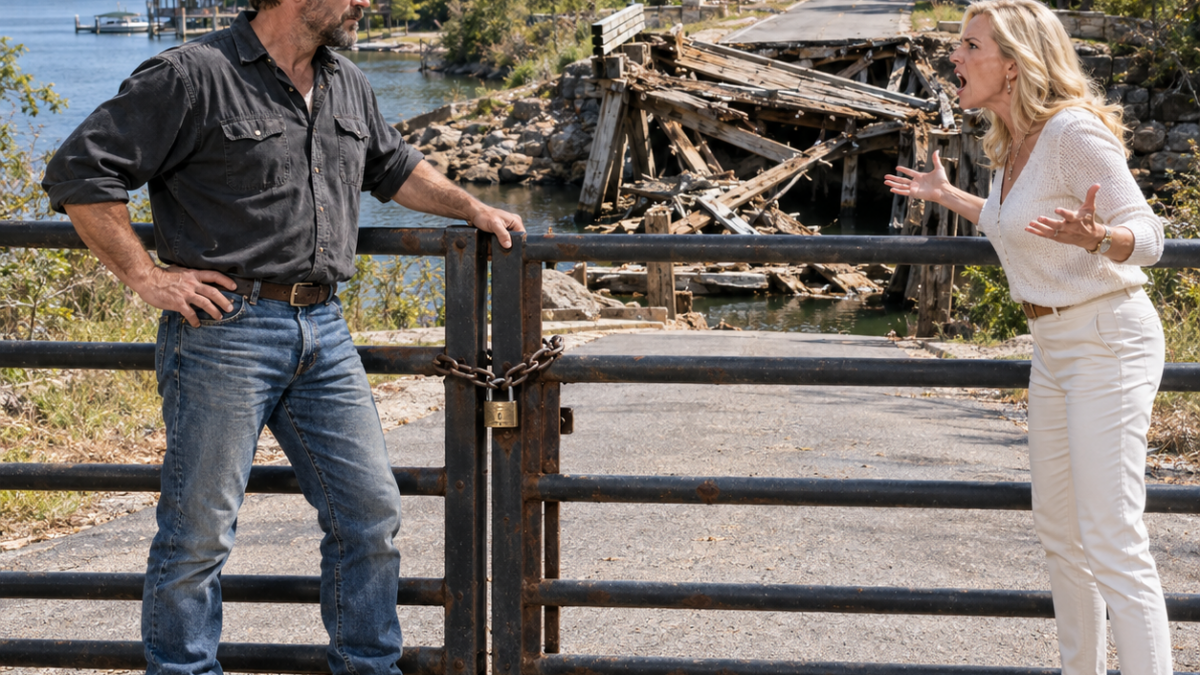
Because Sandra Pruitt would eventually accuse me of trapping her neighborhood.
But I wasn’t the person who had made Ridge Road impassable.
Sandra had.
She just hadn’t understood it yet.
I had known Sandra Pruitt in the distant way rural property owners know HOA presidents.
I knew her vehicle.
I knew she lived in Ridgeline Estates.
I knew she’d become president a few years earlier.
We weren’t friends.
We weren’t enemies either.
At least not before that morning.
It took me several days to understand how she had managed to turn a perfectly sound bridge into a legal disaster.
The story came out piece by piece.
Back in March, Sandra had driven across Tanner Creek and felt the bridge flex beneath her SUV.
That alone wasn’t alarming.
Bridges move.
They are designed to.
Steel flexes under load.
Wood responds.
A perfectly rigid bridge would have its own problems.
But Sandra didn’t know bridge engineering.
She knew only that she’d felt movement.
So she posted on the Ridgeline Estates community portal.
Had anyone else noticed the bridge seemed unstable?
Several residents replied.
Yes.
They had felt movement.
One said the planks seemed loose.
Another said her husband thought the bridge had always moved a little.
Somebody suggested slowing down while crossing.
That was enough to convince Sandra there was a safety issue.
She called Pete Ferris.
Pete was not a structural bridge engineer.
He was a competent excavation and site contractor.
Foundations.
Grading.
Demolition.
Residential site preparation.
He walked the bridge.
Looked at the deck.
Looked at the visible steel.
Then gave Sandra what I later considered a fairly cautious answer.
The bridge was old.
The planks showed normal weathering.
The steel he could see looked intact.
He couldn’t see the bearing ends adequately.
He asked when it had last been professionally inspected.
Sandra told him she didn’t know.
Pete said she ought to find out.
Then, when Sandra asked what he would recommend from a contractor’s perspective, he mentioned that replacing an older bridge with a culvert could reduce long-term maintenance.
That was not an engineering condemnation.
It was not a statement that the bridge was unsafe.
But Sandra heard what she wanted to hear.
She asked Pete for a quote.
Thirty-four thousand five hundred dollars.
Demolition.
Culvert.
Grading.
Road restoration.
Then she called a board meeting.
Carl Owens, one of the five board members, asked the question that should have stopped everything.
“Who owns the bridge?”
Sandra answered that it was on their access road.
Carl asked again.
“Do we own it?”
Sandra shifted to safety.
The HOA had authority to address safety problems.
Carl told her they should read the easement.
Sandra said she’d review it.
Then she asked for a vote concerning further assessment and an engineering opinion.
Four voted to proceed.
Carl voted against.
What happened next would become one of the ugliest parts of the eventual HOA meeting.
Sandra did not hire the structural engineer the board had discussed.
She treated that four-to-one vote as authorization to demolish the bridge.
She called Pete.
Scheduled the work.
Approved a culvert specification developed from field measurements and mapping.
She didn’t obtain the required creek-crossing permit.
She didn’t call me.
And she didn’t read page three of the easement.
The only notice she sent went to the private community portal the night before demolition.
I wasn’t a member.
I couldn’t see it.
At 7:40 the next morning, the excavator arrived.
By the time I reached Tanner Creek, they were already dismantling my bridge.
By afternoon, it was gone.
Thirty-five years of service ended in a few hours.
The timber deck disappeared.
The steel stringers were hauled away.
Bearing plates removed.
Anchor bolts cut.
All that remained were the concrete footings I had poured in 1987.
And a twenty-two-foot gap across Tanner Creek.
Pete Ferris had been hired to remove the bridge first and install the culvert afterward.
But the county stopped the second phase.
No permit.
No property-owner authorization.
No approved legal access for creek work.
Suddenly Sandra had paid to destroy the bridge without gaining permission to replace it.
The neighborhood’s road ended at one bank.
My road ended at the other.
Between them was Tanner Creek.
Sandra hadn’t solved a safety problem.
She had physically cut her own subdivision off from Ridge Road.
Margaret came to the farm two days later.
We walked the creek crossing together.
She photographed everything.
The cut anchor bolts.
The remaining footings.
The gravel road ending at the bank.
The same road continuing on the opposite side.
She stood there for a while.
“Twenty-two feet.”
“Twenty-two.”
“A twenty-two-foot legal problem.”
“More expensive than it looks.”
She smiled.
Then we went to my office.
I brought out the four maintenance notebooks.
Margaret put on reading glasses and started with 1987.
Initial load test.
Eight-ton hay wagon.
No measurable deflection.
Connections sound.
Footings stable.
Then 1988.
She skipped forward.
2008: steel cleaned and repainted.
2009: three deck planks replaced.
2014: preservative treatment.
2016: steel coating renewed.
2019: deck treated again.
October 2021: structure sound, deck planks serviceable, steel clean, connections tight, footings undisturbed, twelve-ton rating confirmed.
Margaret looked at me.
“This was ten months before demolition.”
“Yes.”
“They’re going to claim safety.”
“I know.”
“And you have a thirty-five-year engineering record saying the bridge was maintained.”
“Yes.”
“Who performed the inspections?”
“I did.”
“You’re a licensed civil engineer?”
“Retired, but yes.”
“You spent fourteen years doing county bridge work?”
“Yes.”
“And the HOA used an excavation contractor instead of a bridge engineer.”
“Yes.”
She closed the fourth notebook.
“Well.”
“Well what?”
“If I were representing them, I would be having a very bad week.”
The formal notice went out Friday.
Four pages.
Certified mail.
Margaret quoted the easement language.
She documented eighteen years of HOA nonperformance.
She documented the demolition.
She included photographs.
She explained the breach.
Then she gave them thirty days to cure.
Reconstruct the Tanner Creek crossing.
Match or exceed the original structural requirements.
Obtain proper engineering certification.
Complete the work to my satisfaction as property owner.
If they failed, I would exercise my right to terminate the easement.
Margaret ended the letter with one sentence that sounded less like a lawyer and more like somebody who had sat at my desk reading thirty-five years of my handwriting.
Mr. Dunning has maintained this crossing structure at his own expense for thirty-five years in the absence of any performance by the easement holders. He did not build this structure so that others could destroy it without consequence.
Sandra signed for the notice the following Monday at 9:17 a.m.
The clock started.
Sandra called Margaret within three days.
Margaret later told me how it went.
Sandra insisted the board had acted because of a safety concern.
Margaret asked why no structural engineer had inspected the bridge.
Sandra returned to the resident complaints.
Margaret asked why I wasn’t contacted.
Sandra said the HOA had posted notice.
“Where?”
“On the community portal.”
“Is Mr. Dunning a member of your HOA?”
“No.”
“Can he access your community portal?”
“No.”
“Then how exactly did you notify him?”
There was apparently a long silence.
Sandra finally said, “We believed the bridge was part of our road.”
Margaret answered, “You should have read the easement governing your road.”
Sandra told her they could not rebuild a bridge within thirty days.
Margaret said the cure period stood.
Then Sandra said the sentence that defined the next month.
“This is unreasonable.”
When Margaret told me that, I had only one question.
“Did she think demolishing it without calling me was reasonable?”
Margaret gave me a look.
“I didn’t ask.”
“You should have.”
“No, Earl. That’s why you’re the client and I’m the attorney.”
At first, the thirty-eight families treated the detour like a temporary nuisance.
Twenty-two extra minutes in.
Twenty-two extra minutes out.
People complain about road work.
Then they adjust.
But after a week, forty-four minutes a day starts becoming something else.
Frank Gallo worked at the regional hospital.
His twenty-three-minute drive became forty-five.
He had to leave before sunrise.
His wife had to alter school pickup around her work schedule.
Karen Finch lived with her seventy-nine-year-old mother and worried about the additional time to her cardiologist.
Dorothy Marsh, a retired teacher who had lived in Ridgeline Estates since 2006, asked the question Sandra could not answer.
How did the board demolish a bridge on somebody else’s property without asking the owner?
Then Carl Owens posted publicly.
He told the neighborhood that he had asked who owned the bridge.
He told them he had asked to read the easement.
Sandra responded that the board had made a safety decision in good faith.
Carl responded:
Please share the easement.
Sandra didn’t.
That silence lasted two days.
Then Greg Talbott, who worked in title processing, pulled the document from the county records himself.
Book 44.
Page 178.
He posted page three to the neighborhood portal.
Thirty-eight households finally saw the sentence that Sandra had failed to read before hiring an excavator.
The HOA was responsible for maintaining the crossing structure at its expense and to the satisfaction of the property owner.
Dorothy replied:
So we demolished a bridge we were supposed to maintain, on land we don’t own, without telling the owner?
Greg’s response was simple.
That appears to be what happened.
From that point on, Sandra’s problem wasn’t me.
It was her own neighborhood.
She finally hired an attorney.
Cliff Basham.
Experienced local real-estate lawyer.
He asked for the easement.
The board minutes.
Margaret’s notice.
Pete’s quote.
Inspection records.
Sandra sent everything she had.
The problem was what she didn’t have.
No HOA bridge inspection reports.
No engineering studies.
No maintenance invoices.
No annual records.
No correspondence with me.
Eighteen years of an obligation.
Eighteen years of nothing.
When Cliff spoke at the emergency HOA meeting, he did something Sandra had refused to do.
He told the truth.
Twenty-six residents attended.
Sandra opened by describing my response as aggressive overreach.
Carl immediately asked whether she had read the easement before authorizing demolition.
She tried to redirect.
Then she handed the floor to Cliff.
He looked at the homeowners.
“The maintenance requirement on page three is a condition of the easement.”
Nobody spoke.
Cliff continued.
“The HOA’s records contain no evidence that this maintenance obligation was performed.”
Sandra shifted in her seat.
“For eighteen years.”
People began looking at one another.
Then Cliff said:
“The HOA hired a contractor to demolish the crossing structure the easement required it to maintain.”
Frank Gallo raised his hand.
“Can Earl legally close Ridge Road?”
Cliff answered carefully.
“If the easement terminates because of material breach, the road corridor across Mr. Dunning’s property reverts to his exclusive use.”
Another resident asked, “What about the safety issue?”
Cliff shook his head.
“That defense is weak.”
Sandra interrupted.
“Pete said the bridge was unsafe.”
Cliff turned to her.
“No. Based on the documentation you gave me, Pete Ferris said the bridge was old, showed normal timber weathering, and should have its inspection history reviewed. He recommended engineering evaluation.”
Sandra went still.
Cliff continued.
“Mr. Dunning has that inspection history.”
“How much?”
“Thirty-five years.”
The room changed.
You could feel it.
Thirty-five years.
Not one convenient letter written after the dispute.
Four worn notebooks dating back to 1987.
Cliff explained that the most recent entry, from October 2021, documented a sound bridge.
Carl leaned forward.
“So what do we do?”
“Negotiate.”
Sandra said immediately, “We’re not admitting breach.”
Carl looked at her.
“Sandra, you hired someone to tear down the bridge.”
“I acted for safety.”
“You didn’t hire an engineer.”
“I acted on the information available.”
“You didn’t read the easement.”
She stared at him.
Carl continued.
“You didn’t call Earl.”
Silence.
“You didn’t get a permit.”
Sandra’s expression hardened.
“We’re not going to conduct this meeting like a trial.”
Frank Gallo said from the audience, “Maybe somebody should have conducted the demolition like one.”
A few people laughed.
Sandra slammed her palm against the table.
“That is enough.”
Cliff didn’t laugh.
He simply said:
“The path to restoring Ridge Road is negotiation with Mr. Dunning.”
Sandra looked at him.
“Find another path.”
“I’ve looked.”
“Look harder.”
“There isn’t one that I can recommend as likely to succeed.”
That was the first moment, I later learned, when Sandra finally seemed frightened.
Not angry.
Not defensive.
Frightened.
Because lawyers can argue about language.
They cannot manufacture a bridge that has already been hauled away.
The thirty days passed.
No cure.
No new bridge.
No engineering design.
No permit.
No reconstruction.
No serious proposal.
Sandra authorized Cliff to send Margaret a challenge letter on day twenty-two.
Margaret read it once.
Filed it.
Didn’t respond.
“They’re preserving their argument,” she told me.
“Do we need to answer?”
“No.”
“Why?”
“Because page three is still page three.”
I liked Margaret.
On day thirty-one, I got up before sunrise.
The gate had been waiting in my equipment barn.
Fourteen-foot galvanized farm gate.
Nothing dramatic.
Nothing decorative.
The same type I used at my field entrances.
The previous weekend, I had set a four-inch steel post in concrete at the county-highway end of Ridge Road.
Everything was on my property.
Everything had been photographed.
Everything had been reviewed with Margaret first.
At 7:45 that morning, I hung the gate.
It swung level.
I installed the latch.
Ran a chain through it.
Then I clicked the padlock shut.
That sound was quieter than the excavator had been.
Much quieter.
But it carried more weight.
I attached NO TRESPASSING signs.
Photographed the gate.
The posts.
The latch.
The chain.
The time.
Then I delivered the formal closure notice to the HOA’s registered office.
The prior easement was terminated for uncured material breach.
Ridge Road across my parcel was closed effective immediately.
I went home before nine.
Sandra received the notice fifteen minutes later.
At 9:22, she called the sheriff.
Deputy Roy Hatch arrived at my gate around ten.
I watched from a distance.
I had no reason to walk down.
Sandra was already there.
Hands moving.
Pointing at the gate.
Pointing toward the subdivision.
The conversation lasted a while.
Later, Roy told Margaret what had happened.
Sandra demanded that he remove the gate.
Roy asked whose property it stood on.
Sandra said Ridge Road was the HOA’s access road.
He asked whose land the road crossed.
She admitted it crossed mine.
“But we have an easement.”
Roy asked to see it.
Sandra had Cliff email the document to her phone.
Roy stood on the shoulder and read all three pages.
Then he reached page three.
Apparently he read that one twice.
He looked at Sandra.
“This says the HOA maintains the Tanner Creek crossing.”
“We had to remove it for safety.”
“Where is it now?”
“Gone.”
“And Mr. Dunning authorized that?”
“No.”
“Did you call him?”
“We notified the community.”
“Is he in the community?”
“No.”
Roy handed the phone back.
Then he gave Sandra an answer that would travel through Ridgeline Estates before lunchtime.
“This is a civil property dispute. I am not cutting a lock off a gate located on private property based on an easement that appears to be disputed.”
Sandra told him thirty-eight families depended on the road.
He said he understood.
She said I was trapping people.
He pointed north.
“There is another public route.”
“It adds twenty-two minutes.”
“I understand.”
“You’re going to let him do this?”
Roy shook his head.
“Ma’am, I don’t decide easement law on the roadside.”
She stared at him.
“If your HOA believes the gate is unlawful, your attorney can ask a judge.”
Then he got into his cruiser.
And left.
Sandra remained beside the gate.
Locked outside the shortcut she had taken for granted for years.
I didn’t celebrate.
But I won’t pretend I felt sorry for her either.
She had destroyed my bridge without asking me.
Now she was standing in front of a gate on my road asking why ownership mattered.
The emergency HOA meeting that night was worse than the first.
Twenty-six residents.
Cliff at the front table.
Sandra trying to hold the room together.
She called my closure “aggressive.”
Carl Owens interrupted.
“No.”
Sandra looked at him.
“No what?”
“This isn’t where the story starts.”
“What are you talking about?”
“The gate isn’t where the story starts.”
The room went quiet.
Carl continued.
“It starts when we demolished the bridge.”
Sandra’s jaw tightened.
“We’ve already discussed that.”
“No. You’ve explained it. We haven’t discussed it.”
Then Cliff presented the legal position in plain terms.
The prior easement was conditioned on bridge maintenance.
The HOA had failed to perform that obligation.
Then the HOA destroyed the bridge.
They had been given thirty days to cure.
They had not.
The termination claim was substantial.
Frank asked, “Can we win in court?”
Cliff paused.
Lawyers rarely like one-word answers.
But eventually he said:
“Our position is weak.”
“How weak?”
“I would not advise the community to plan on Ridge Road reopening through litigation.”
Sandra stared at him.
“What are you saying?”
“I’m saying Mr. Dunning holds the stronger legal position.”
“Then challenge him.”
“We can.”
“Do it.”
“It could take twelve to eighteen months.”
A murmur spread across the room.
“And during that time?” Dorothy asked.
Cliff looked around.
“You use the alternate route.”
That changed everything.
Forty-four extra minutes for a week is aggravating.
Forty-four extra minutes every day for eighteen months becomes hundreds of hours.
Frank stood.
“My family has already lost more than twenty hours to this detour.”
Karen raised her hand.
“My mother is seventy-nine.”
Another resident said, “My kid’s school bus schedule changed.”
Another:
“My wife works nights.”
Another:
“This is costing us gas every day.”
Then Carl asked Sandra the question nobody had asked publicly yet.
“Why didn’t you stop after I told you to read the easement?”
Sandra flushed.
“I did what I believed was necessary.”
“That isn’t an answer.”
“I made a judgment call.”
“You made it with whose property?”
“Carl—”
“With whose bridge?”
“I was protecting the community.”
“You protected us by destroying our only direct crossing?”
Sandra stood.
“This meeting is getting out of control.”
Frank answered from the back.
“No, Sandra. Your decision got out of control.”
There was a long silence.
Then Dorothy Marsh, who was usually one of the quietest people in the neighborhood, spoke.
“I would like the minutes to reflect that I am requesting Sandra Pruitt’s resignation.”
Nineteen people supported Frank’s similar post online later.
Twenty-two supported Dorothy.
Sandra didn’t resign that night.
She didn’t agree to negotiate either.
Pride is an expensive thing when thirty-eight families are buying the fuel.
Three more weeks passed.
The gate stayed locked.
I worked my farm.
Hay doesn’t care about HOA politics.
Neither does rain.
Every morning I’d see traffic moving along the distant northern county road.
Vehicles that used to cross Tanner Creek now taking the long way around.
I never enjoyed that part.
This mattered to me.
It would be easy to turn those thirty-eight families into villains because they lived in an HOA.
They weren’t.
Most had never attended a board meeting before this.
Most didn’t know what page three said.
They trusted the people elected to manage shared affairs.
That wasn’t a crime.
Sandra had made the decision.
The board majority had allowed it.
The residents were living with it.
One afternoon, Carl Owens came to the farm.
He parked near my barn.
I walked out.
We had never had a real conversation before.
“Mr. Dunning.”
“Earl is fine.”
“Carl.”
“I know.”
He looked embarrassed.
“I suppose you would.”
“What can I do for you?”
He looked toward the south, where the gate was hidden beyond the woodlot.
“I owe you an apology.”
“You didn’t demolish my bridge.”
“I was on the board.”
“You told them to read the easement.”
“I should have done more.”
I studied him.
There are apologies people give because they want something.
And apologies people give because they’ve been thinking.
Carl’s sounded like the second kind.
“You were one vote.”
“I let it go after the meeting.”
“You lost the vote.”
“I still let it go.”
I nodded.
“What do you want?”
“To get thirty-eight families their road back.”
“That isn’t entirely up to me.”
He looked surprised.
“You own it.”
“Yes.”
“So it is.”
“No. I can grant an easement. Your HOA has to accept the conditions.”
He smiled faintly.
“I think most of us would accept almost anything reasonable now.”
“Reasonable is an interesting word.”
“I know.”
We stood quietly.
Then he said, “Sandra won’t authorize Cliff to call Margaret.”
“Then you’re stuck.”
“I’m a board member.”
“Yes.”
“Can I ask Cliff to request a meeting?”
“You can ask whoever you want.”
“Would you attend?”
“If Margaret tells me to.”
Carl laughed.
“That sounds like the smartest answer anyone has given in this entire mess.”
The next morning, he called Cliff without Sandra’s approval.
Cliff called Margaret.
Margaret called me.
“They want to negotiate.”
“Who?”
“Cliff Basham on behalf of the HOA. Carl pushed it.”
“Sandra?”
“She’s going to be there.”
“Does she know yet?”
“Probably by now.”
I thought for a moment.
“Set the date.”
We met in Margaret’s conference room in Knoxville.
Two hours from home.
I arrived early.
Sandra arrived three minutes late.
Of course she did.
She sat at the far end of the HOA’s side of the table.
Cliff beside her.
Carl beside Cliff.
Margaret and I sat opposite them.
Nobody offered coffee.
Margaret opened.
“We’re here to discuss a new easement.”
Sandra immediately said, “We dispute that the old easement was properly terminated.”
Cliff closed his eyes for half a second.
Margaret didn’t react.
“Your dispute can be preserved.”
Sandra leaned forward.
“We’re not admitting liability.”
“You don’t need to use that phrase.”
“What phrase?”
“Liability.”
Margaret slid a one-page term sheet to the center of the table.
“Mr. Dunning has four terms.”
Sandra gave me a look.
Not fear.
Not anymore.
Something closer to resentment.
I had taken away the advantage she thought she possessed.
Margaret read the first term.
“The HOA will execute a recorded acknowledgment confirming that its demolition of the Tanner Creek crossing constituted a breach of the maintenance condition in the prior easement.”
Sandra almost laughed.
“No.”
Margaret continued as though she hadn’t spoken.
“The acknowledgment will be recorded against the HOA common parcel and each of the thirty-eight residential lots.”
Sandra pushed back from the table.
“Absolutely not.”
Cliff spoke quietly.
“Sandra.”
“No. You’re asking us to permanently record an admission against every property in the neighborhood.”
Margaret shook her head.
“An acknowledgment of breach.”
“That’s semantics.”
“No. It’s title history.”
Sandra looked at me.
“This is revenge.”
For the first time, I spoke.
“No.”
“It doesn’t help rebuild the bridge.”
“It keeps the next HOA president from pretending none of this happened.”
Her face tightened.
I continued.
“You destroyed a bridge because nobody bothered to read three pages.”
She said nothing.
“I want the next board to find the answer before they start the excavator.”
Carl looked down to hide what might have been a smile.
Cliff whispered something to Sandra.
Finally she said, “Continue.”
Margaret moved to term two.
“The HOA funds the complete design and construction of a new engineered bridge over Tanner Creek.”
Sandra nodded impatiently.
“We already agreed to replacement.”
“Not a culvert.”
Her expression changed.
Margaret continued.
“A bridge. Minimum fifteen-ton load rating. Designed by a licensed structural engineer chosen from three qualified engineers supplied by Mr. Dunning.”
Sandra looked at me.
“You choose the engineer?”
“I give you three.”
“You choose all three.”
“Yes.”
“Convenient.”
I leaned forward.
“The last time you chose who evaluated my bridge, you hired the man you also hired to demolish it.”
Pete Ferris hadn’t done anything criminal as far as I knew.
He had followed the HOA’s instructions.
But the conflict in Sandra’s process was obvious.
She had asked a demolition contractor how to solve an old-bridge problem.
He had offered demolition.
This time, an actual bridge engineer would design the crossing.
Margaret continued.
“The design comes to Earl for review. County permits obtained. Engineer certifies completion and load rating.”
“And the gate?” Cliff asked.
“Opened when the new easement is recorded.”
That surprised me.
We had discussed it earlier.
Margaret and I had agreed that once the HOA executed the settlement, paid compensation and signed the new easement, access could legally reopen even if the bridge reconstruction itself took longer.
Physically, of course, nobody could cross Tanner Creek until the new structure existed.
But the legal gate could open.
Sandra asked, “How long do we get to build?”
“One hundred eighty days.”
Cliff nodded.
“Reasonable.”
Sandra didn’t argue.
Margaret read term three.
“Twenty-eight thousand five hundred dollars compensation to Mr. Dunning for destruction of the 1987 bridge.”
Sandra’s eyes widened.
“For that old bridge?”
I stared at her.
Thirty-five years.
Hundreds of inspections.
Thousands of crossings.
Hay wagons.
Fuel trucks.
School buses.
Families.
Rain.
Snow.
Summer heat.
And she called it that old bridge.
“Yes,” I said.
“It was more than thirty years old.”
“And functioning.”
“It needed replacement.”
“According to which engineer?”
She stopped.
I continued.
“My October inspection said it was sound.”
“You inspected your own bridge.”
“I’m a civil engineer.”
“Retired.”
“I didn’t retire from understanding steel.”
Cliff stepped in.
“The appraisal supports the figure.”
Sandra turned toward him.
“You’re supposed to represent us.”
“I am.”
“Then negotiate.”
“I am.”
He pointed at the term sheet.
“If this becomes a trespass-and-destruction claim in court, twenty-eight five may not be the high number.”
Sandra looked at Margaret.
Then me.
Then Carl.
Carl said nothing.
Finally:
“Fine.”
Margaret moved to the fourth term.
This was the one I cared about most.
“The new easement will contain an enhanced maintenance requirement.”
Sandra folded her arms.
“What does that mean?”
“Annual inspection by a licensed structural engineer.”
Cliff started taking notes.
“Written report to Mr. Dunning within thirty days.”
“Okay.”
“Any maintenance identified in that report completed within sixty days.”
“Reasonable.”
“And a penalty provision.”
Sandra’s eyes narrowed.
“There it is.”
Margaret didn’t blink.
“If the HOA fails to conduct the inspection, fails to provide the report or fails to complete required maintenance, Earl issues a thirty-day cure notice.”
“And then?”
“If the breach remains uncured, five thousand dollars per month.”
Sandra stared at her.
“Five thousand?”
“Per month.”
“That’s ridiculous.”
I spoke.
“Eighteen years.”
She looked at me.
“You had eighteen years under the old agreement.”
“We didn’t know.”
“You didn’t read it.”
“That isn’t the same as deliberately refusing.”
“It’s exactly why the penalty exists.”
Cliff asked, “Termination?”
Margaret answered.
“After six months of uncured breach, Earl retains the right to terminate the easement.”
Cliff thought for a moment.
“Thirty-day notice before penalties start?”
“Yes.”
“Then five thousand monthly?”
“Yes.”
“And six months before termination right?”
“Yes.”
Cliff nodded.
“I can recommend that.”
Sandra looked at him like he’d betrayed her.
Carl finally spoke.
“I’ll vote for it.”
Sandra turned on him.
“You’ve already done enough without authority.”
“I’ve done enough to get us into this room.”
“You undermined the president.”
“You demolished the bridge.”
Silence.
Margaret closed the folder.
“These are Earl’s terms.”
Sandra looked at me.
“You’re enjoying this.”
That was the easiest accusation to make.
It was also wrong.
I thought about standing beside Tanner Creek watching an excavator pull apart something I had built with my own hands.
I thought about Frank leaving home before sunrise.
Karen worrying about her mother.
School routes.
Forty-four extra minutes.
Carl carrying guilt for a vote he couldn’t stop.
Pete Ferris getting dragged into a mess because somebody with authority didn’t understand its limits.
“No,” I said.
She didn’t believe me.
So I explained.
“If I were enjoying this, the gate would stay closed.”
Sandra said nothing.
“I could sue.”
Still nothing.
“I could spend eighteen months asking a judge to declare what page three already says.”
I pointed to the term sheet.
“Instead, I’m offering thirty-eight families their road back.”
Her eyes dropped.
“But I’m not giving the HOA the same easement it ignored for eighteen years.”
That finally landed.
The room became quiet.
Cliff looked at Sandra.
“Take the deal.”
She whispered, “I’ll need a board vote.”
“Then hold one.”
The community approved the settlement.
Not unanimously.
But overwhelmingly.
People were tired.
Forty-three days had passed since I locked the gate.
The HOA wired the $28,500 compensation to Margaret’s trust account.
Sandra signed the recorded acknowledgment as HOA president.
That part mattered to me more than the check.
Her signature sat under a document confirming that the HOA’s demolition had breached the maintenance condition of the prior easement.
The acknowledgment went into county records.
Against the common parcel.
Against all thirty-eight residential lots.
Future buyers would be able to find it.
Future board members would have no excuse.
Then we signed the new easement.
Book 44, page 312.
Annual engineering inspection.
Written report.
Mandatory maintenance.
Penalty clause.
Termination rights.
Everything plain.
Everything recorded.
At 2:15 that afternoon Margaret called.
“Both instruments are recorded.”
“Reference numbers?”
She read them to me.
I wrote them in a fresh composition notebook.
The fifth one.
At 3:00, I drove to Ridge Road.
The same fourteen-foot gate stood across it.
The same chain.
The same padlock.
I unlocked it.
Pulled the chain free.
Lifted the latch.
Then swung the gate open.
It moved smoothly until it rested beside the fence.
Forty-three days after I had locked it.
I didn’t remove the gate.
That was intentional.
It stayed.
Open.
A reminder.
The road legally existed because I had granted access.
That access was not ownership.
I drove home.
The bridge was still gone, so nobody could yet cross Tanner Creek.
But for the first time since the demolition, the neighborhood had a lawful route back.
All they had to do was rebuild the twenty-two feet Sandra had destroyed.
Properly.
I gave the HOA three engineers.
They selected Carol Taft.
I was pleased.
Carol had twenty-two years of small-span bridge experience.
County crossings.
Farm-access bridges.
Creek structures.
Her drawings were clean.
Her calculations were complete.
She came to Tanner Creek in November.
We walked the banks.
She examined what remained of my original concrete footings.
Tapped them.
Measured them.
Checked the bearing areas.
Then she looked at me.
“These are good.”
“I know.”
“You poured them?”
“1987.”
She smiled.
“Concrete was apparently tougher when you were younger.”
“So were engineers.”
She laughed.
Then she became serious.
“I can reuse these.”
That stopped me.
“The original footings?”
“They’re sitting on limestone. No significant deterioration. Bearing is excellent.”
I looked down at the concrete.
My hands had built those forms.
I had set those anchor bolts.
Thirty-five years later, the bridge was gone.
But its foundation remained.
“What would you put on them?”
“Steel I-beams. Reinforced concrete deck.”
“Instead of timber.”
“Lower maintenance. No deck planks to replace. Better long-term fit for the HOA’s traffic.”
“Load?”
“Fifteen tons.”
“Drainage?”
“One percent.”
“No.”
Carol looked at me.
“No?”
“Two.”
“Why?”
“Thirty-five years of Tennessee rain.”
She stared at me for a moment.
Then smiled.
“Two percent.”
Three weeks later, she sent the plans.
Six pages.
I reviewed every one.
Not because I distrusted her.
Because that was the agreement.
And because I was Earl Dunning.
I had spent my life checking things other people assumed were fine.
The HOA hired Ridge Span Construction.
A real bridge contractor.
Dale Womack ran the project.
Permits first.
Engineering first.
Then equipment.
It was amazing how smoothly construction proceeded when everybody asked permission before digging.
The work started in February.
Footings prepared.
New bearing plates installed over my original concrete.
Steel erected.
Deck formed.
Reinforcement tied.
Concrete poured.
Cured.
Rails installed.
Drainage finished.
Six weeks.
Nobody shouted.
Nobody called the sheriff.
Nobody tore up anything they didn’t own.
Imagine that.
Carol performed the final inspection in late March 2023.
I stood off to the side.
Her inspection.
Her bridge certification.
Not mine.
She checked the steel.
Connections.
Concrete.
Deck.
Bearings.
Drainage.
Rails.
Load placard.
Forty minutes.
Then she signed and sealed the report.
“The bridge meets design.”
“Fifteen tons?”
“Confirmed.”
“Drainage?”
“Two percent. Just the way the old man ordered.”
I raised an eyebrow.
She laughed.
“I ran water over it this morning. Sheets off clean.”
“Good.”
She handed me the report.
I thanked her.
Then she left.
The contractor left.
And for the first time all morning, Tanner Creek was quiet.
I walked onto the bridge alone.
The new concrete deck felt different beneath my boots.
Solid.
Cool.
Permanent.
Steel rails on both sides.
New beams.
New hardware.
But when I reached the end, I looked down.
There they were.
My footings.
1987 concrete supporting a 2023 bridge.
I don’t know why that hit me as hard as it did.
Maybe because I’m old enough now to understand that rebuilding doesn’t always mean starting over.
Sometimes the strongest thing left after somebody tears apart what you made is the part they couldn’t easily see.
The foundation.
I walked back toward the middle.
A metal placard had been mounted to the downstream rail.
PRIVATE CROSSING — RIDGE ROAD — TANNER CREEK
LOAD RATING: 15 TONS
DESIGN ENGINEER: C. TAFT, P.E.
CONSTRUCTION COMPLETED: MARCH 2023
Then one more line:
ANNUAL INSPECTION REQUIRED PER RECORDED EASEMENT BOOK 44, PAGE 312.
I read it twice.
Carol had added that line herself.
Nobody asked her.
She simply understood.
The bridge would carry vehicles.
The plaque would carry memory.
I took a photograph.
Then another.
Full span.
Steel.
Deck.
Old footings.
New structure.
8:23 a.m.
Some habits are worth keeping.
I went back to the farmhouse.
Opened the fifth notebook.
And wrote:
March 2023.
Bridge construction complete.
Steel I-beam structure.
Concrete deck.
Twenty-two-foot span.
Fifteen-ton load rating.
Design engineer Carol Taft, P.E.
Final inspection complete and certified.
Bearing connections sound.
Drainage performing.
Original 1987 footings incorporated.
Structure performing to design.
Then I wrote the line that mattered most.
HOA maintenance obligation in effect.
Annual engineering inspection required.
First HOA inspection due October 2023.
I closed the notebook.
For thirty-five years, I had maintained the old bridge because I built it and because somebody needed to care enough to make sure it stayed safe.
Now the people whose traffic depended on the new bridge finally had a legal obligation they couldn’t pretend not to understand.
Not buried in forgotten paperwork.
Not implied.
Not informal.
Recorded.
Enforced.
And written on the bridge itself.
The first vehicles began crossing later that morning.
I watched from the hay field.
A pickup first.
Then an SUV.
Then a woman in a small sedan.
Each slowed slightly at the new structure.
The tires moved over the concrete.
No drama.
No celebration.
They simply crossed.
That’s what a bridge is supposed to do.
Carry people across a place they otherwise couldn’t pass.
I thought about the previous seven months.
Sandra hearing a normal bridge flex and convincing herself it was dangerous.
Pete’s inspection.
Carl’s unanswered question.
The board vote.
The excavator.
My twenty-one photographs.
Page three.
Margaret’s notice.
Thirty days.
The gate.
The sheriff.
Hundreds of angry neighborhood posts.
The negotiation.
Sandra signing an acknowledgment she had once sworn she’d never sign.
And finally this.
A new bridge.
Fifteen-ton capacity.
Annual professional inspection.
Mandatory maintenance.
A penalty strong enough that no future board could shrug at the obligation for eighteen years.
People like to call what I did revenge.
Maybe part of it was.
I’d be lying if I said I felt nothing when Sandra discovered she couldn’t order the sheriff to remove my gate.
I’d be lying if I said there wasn’t satisfaction in watching her sit across Margaret’s conference table and accept terms she had once dismissed as impossible.
But revenge wasn’t why the gate eventually opened.
If revenge had been the point, I could have left it locked.
I could have sued.
I could have asked a court to permanently extinguish access and let Ridgeline Estates use the long route forever.
I didn’t.
Thirty-eight families didn’t tear down my bridge.
One board made a reckless decision.
One president pushed it forward without understanding what she controlled.
The neighborhood deserved a road.
But I deserved something too.
Respect for the line between access and ownership.
That’s what Sandra had never understood.
An easement did not make my road hers.
A board position did not make my bridge hers.
A safety concern did not give her the right to destroy private property without notice.
And good intentions—if that was really what she had—did not erase consequences.
That afternoon, Carl stopped by.
He parked beside my barn.
“You saw it?”
“I saw traffic.”
“People are happy.”
“Good.”
He leaned against his truck.
“Sandra isn’t.”
“That wasn’t one of the settlement terms.”
Carl laughed.
Then shook his head.
“She still thinks you went too far.”
“Does she?”
“Yeah.”
“What do you think?”
He took his time.
“I think she went too far first.”
Fair answer.
Then he said, “Can I ask you something?”
“Sure.”
“Were you always planning to give us another easement?”
I looked toward Tanner Creek.
The new bridge was hidden behind the woodlot.
“No.”
His eyebrows rose.
“What changed?”
“You did.”
“Me?”
“You came to my farm.”
“So?”
“You apologized.”
He looked surprised.
“That’s all it took?”
“No.”
I smiled.
“But it helped.”
I thought about Frank.
Karen.
Dorothy.
Thirty-eight households.
People who had finally read the document that governed the road they crossed every day.
“I needed to know the neighborhood understood what happened.”
Carl nodded.
“We do now.”
“I know.”
Then he laughed.
“No HOA in Tennessee is ever going to tear down one of your bridges again.”
“I only have one.”
“Probably safer for everybody.”
October came.
The HOA’s first annual inspection was due.
I wondered whether they’d remember.
They did.
Carol Taft returned.
Inspected the structure.
Prepared her written report.
No deficiencies.
No maintenance required.
Thirty days later, I received a copy exactly as the easement required.
I opened the fifth notebook.
October 2023.
Annual HOA engineering inspection received.
No deficiencies.
No maintenance required.
Obligation satisfied.
That entry gave me more satisfaction than the gate ever had.
Because that was what I had wanted in 2003.
Not money.
Not punishment.
Not control.
Maintenance.
Take care of the thing you depend on.
Simple.
The old developer agreed to it.
The HOA ignored it.
Sandra destroyed it.
And after thirty-five years, forty-three days behind a locked gate and seven months of rebuilding, everybody finally understood the arrangement.
The bridge was mine to inspect.
The HOA’s to maintain.
The road was theirs to use.
The land remained mine.
A year after the demolition, I was repairing fence near the county highway when Sandra’s SUV slowed beside the open gate.
For a second, I thought she might keep going.
Instead, she stopped.
The window came down.
“Earl.”
“Sandra.”
We hadn’t spoken alone since the settlement.
She looked older.
Or maybe just less certain.
She nodded toward the bridge.
“It’s a good bridge.”
“Carol designed it well.”
She hesitated.
“I still think the old one needed attention.”
“It always needed attention.”
“I mean replacement.”
“Maybe someday.”
She looked irritated.
Then caught herself.
“I didn’t come here to argue.”
“Good.”
Another pause.
“I should have called you.”
There it was.
Not a grand apology.
No tears.
No dramatic admission.
Just one sentence that should have existed before the excavator ever started.
I nodded.
“Yes.”
“I thought I had authority.”
“I know.”
“I was trying to protect people.”
“I know.”
“You don’t believe that.”
“I believe you convinced yourself of it.”
She looked away.
That probably hurt more than if I’d accused her of acting maliciously.
Because malicious people are easy to dismiss.
Confident people making decisions outside their knowledge can do enormous damage while still thinking they’re the responsible person in the room.
Sandra looked toward Tanner Creek.
“The whole neighborhood blamed me.”
I didn’t answer.
“Some still do.”
“I imagine.”
“Carl almost replaced me.”
“Almost?”
She gave me a thin smile.
“I finished the term.”
That surprised me.
Maybe she stayed because leaving would have looked like running.
Maybe because she still believed she was right.
People are complicated.
Finally she said, “That acknowledgment is going to follow these properties forever.”
“Yes.”
“You really needed that?”
“Yes.”
“Why?”
“Because memory fades.”
She frowned.
I pointed toward the bridge.
“In twenty years, somebody else will be HOA president.”
She listened.
“They’ll see a road they’ve always used. A bridge that’s always been there. They’ll assume both belong to them because that’s how people think.”
I looked at her.
“They’ll search the deed records.”
Then I nodded toward the crossing.
“And they’ll find your signature.”
Sandra didn’t speak.
“That’s why.”
She looked toward the gate.
Open.
Still open.
Then she nodded once.
“I understand.”
Maybe she did.
She drove away.
I’m older now than my grandfather was when he first taught me how to pour a footing.
Older than my father was when he first trusted me with farm equipment.
Certainly older than I was in August 1987, standing beside Tanner Creek with bridge drawings rolled under one arm and more confidence than sense.
But I still walk the crossing.
I still look at steel.
Concrete.
Bearings.
Water.
Scour.
Drainage.
A bridge does not stay safe because somebody once called it safe.
Property rights don’t survive because somebody once recorded them.
Agreements matter only when people remember what they agreed to.
That’s the real lesson Sandra taught me.
Not that HOA presidents are evil.
Not that neighbors are enemies.
Not even that revenge feels good.
It’s that authority has edges.
A title gives you authority inside those edges.
Step beyond them and the world eventually pushes back.
Sandra believed being HOA president gave her the power to solve a perceived problem on Ridge Road.
She never stopped to ask where Ridge Road crossed.
Whose land.
Whose bridge.
What document gave thirty-eight homes the right to pass through.
She tore down a twenty-two-foot bridge.
And in doing so, she almost lost a 340-foot easement serving an entire neighborhood.
The irony couldn’t have been designed better by an engineer.
Sometimes people ask what I felt when I locked that gate.
They expect me to say triumph.
I don’t.
What I remember is the click of the padlock.
And the silence afterward.
A road that had carried families for eighteen years suddenly ending at galvanized steel.
I knew people would be inconvenienced.
I knew Sandra would be furious.
I knew the neighborhood would blame me before they understood the documents.
But I also knew something else.
If I ignored what had happened, the easement condition would never mean anything again.
If the HOA could destroy the structure it was required to maintain and suffer no consequence, then page three was just ink.
And if page three was just ink, so was every other protection attached to my land.
So I closed the gate.
Not forever.
Long enough for everyone involved to learn the difference between permission and ownership.
Forty-three days later, I opened it again.
That part matters.
The revenge wasn’t leaving thirty-eight families trapped on a detour.
The revenge was making the organization that ignored its obligation come back to the table and accept a better one.
They paid for what they destroyed.
They recorded what they had done.
They agreed to inspections.
They accepted maintenance deadlines.
They accepted financial penalties.
They built a stronger bridge.
And the person who had insisted she would never acknowledge the breach signed the document herself.
Then I opened the gate.
That’s the ending people sometimes leave out when they tell the story around town.
They remember the excavator.
They remember the locked road.
They remember the sheriff telling Sandra he couldn’t cut my chain.
But when I think about it, I remember a March morning in 2023.
Cold air.
Tanner Creek running under new steel.
A concrete deck above the same footings I poured thirty-six years earlier.
Cars crossing toward the county highway.
And a little metal plaque on the rail.
Annual inspection required.
Book 44.
Page 312.
That was enough for me.
Sandra had torn down my bridge without warning.
I shut the road she assumed would always be hers.
But when it was over, I didn’t leave her neighborhood without a way home.
I made them build the way home correctly.
And every October since, somebody from Ridgeline Estates pays a licensed engineer to walk that bridge, inspect every connection and send me a written report.
Exactly the way it should have been from the beginning.
The old bridge is gone.
I still miss it sometimes.
I built it with younger hands.
My wife used to bring lunch down while I worked.
My father crossed it in his truck.
School buses carried a generation of children over those timbers.
Thirty-five winters.
Thirty-five summers.
Thousands upon thousands of tires.
You can’t replace that history with concrete.
But Carol was right about the footings.
The foundation survived.
Sometimes that’s enough.
The morning after that first annual HOA inspection arrived, I walked down to Tanner Creek just after sunrise.
Fog hung low over the water.
The gate stood open behind me.
A car approached from Ridgeline Estates.
It crossed the bridge smoothly.
The driver lifted one hand from the steering wheel and waved.
I waved back.
Then another vehicle crossed.
And another.
Nobody slowed much anymore.
They trusted the bridge.
They were supposed to.
It had been designed properly.
Permitted properly.
Built properly.
Inspected properly.
Maintained under an agreement nobody could pretend not to know.
I stood there until the morning traffic faded.
Then I walked home through the hay field.
No lawyers.
No excavators.
No deputies.
No angry meetings.
Just another workday.
That was all I ever wanted.
Sandra thought tearing down my bridge would solve her problem.
Instead, it exposed one she hadn’t known existed.
She thought Ridge Road belonged to her neighborhood because they had used it for eighteen years.
It didn’t.
She thought the bridge belonged to the road.
It didn’t.
She thought an HOA vote could give her authority over private property.
It couldn’t.
And she thought I would stand beside Tanner Creek, watch thirty-five years of my work disappear into the back of a demolition truck, then quietly let everyone continue as if nothing had happened.
That was her biggest mistake.
I never needed to shout.
I never needed to threaten anybody.
I never touched one of their homes.
I never blocked their public roads.
I never damaged their property.
I took twenty-one photographs.
I opened a filing cabinet.
I read page three.
And I let the document Sandra never bothered to read do the rest.
In the end, the bridge came back stronger.
The road reopened.
The families got their shortcut.
The HOA finally accepted its responsibility.
And I got something better than revenge.
I got certainty.
The next president will know.
The next board will know.
Every homeowner who pulls the deed record will know.
Ridge Road crosses private land.
Its continued access has a price.
Not money.
Responsibility.
Maintain the bridge.
Respect the property.
Honor the agreement.
That’s it.
And if anyone ever forgets?
The gate is still there.
Standing open beside the road.
Exactly where I left it.

