PART 2: HOA President Poured Concrete Into My Dam Drain to Save Her Golf Resort—She Had No Idea What Was About to Happen
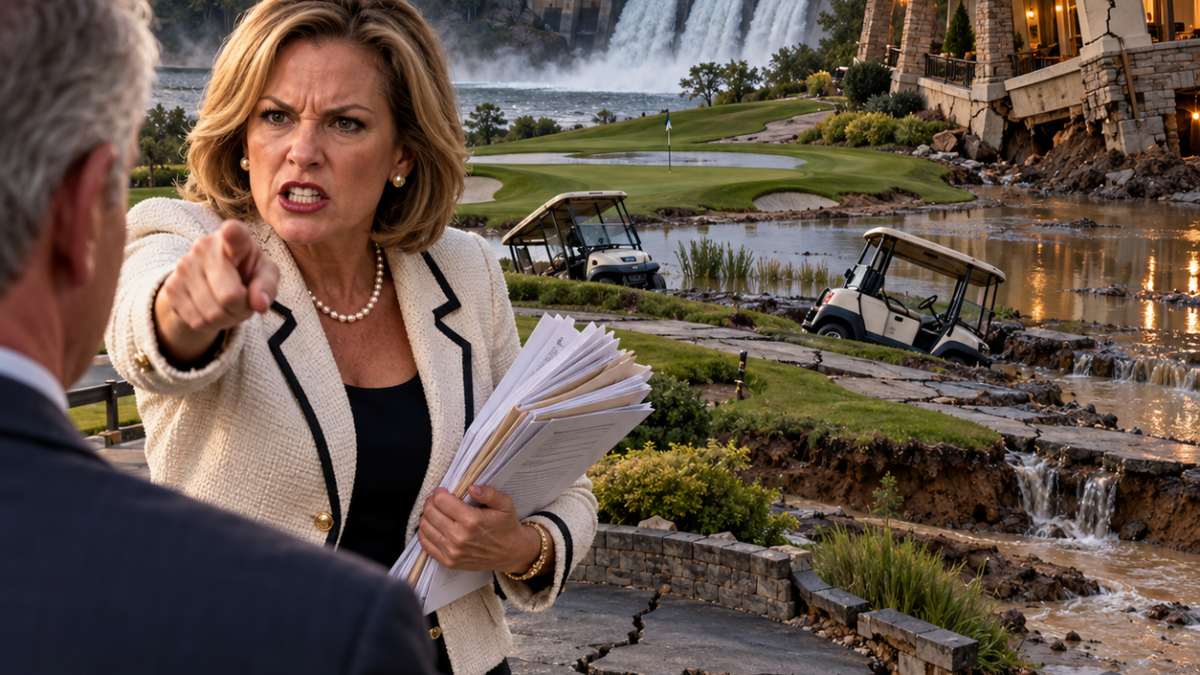
PART 2
My father learned that lesson before I was born.
In 1956, the creek rose during a hard overnight storm and spread across the valley floor before anyone understood how bad it was going to get.
It took the barn.
It took six heifers.
It came through the lower part of the house.
And it carried away my grandmother’s piano.
Dad told me about that piano more than he told me about the cattle.
Maybe because livestock losses were something a farmer knew how to count.
A piano was different.
It was family.
It had belonged to his mother.
He remembered standing in muddy water inside the house while pieces of their life floated around his knees.
He was still a young man then.
He made a promise that night.
The valley would never surprise him like that again.
Six years later, in 1962, he borrowed against the herd and hired an engineer.
Dad wasn’t one of those men who pretended to know everything.
If he didn’t understand electricity, he called an electrician.
If he didn’t understand a legal description, he paid a surveyor.
And if he was going to put thousands of tons of earth across the throat of a valley and hold eleven acres of water behind it, he hired someone who understood dams.
They built an earth embankment.
They cut an emergency spillway into the western side.
And through the bottom of the dam, they installed that thirty-six-inch concrete outlet pipe.
While the headwall concrete was still wet, my father scratched two letters and four numbers into it.
**WD 1962.**
Then he pressed his right hand beside them.
All five fingers.
Flat.
When I was a little boy, I used to put my hand inside his print.
My fingers came nowhere close to the ends.
When I was twelve, they reached farther.
At seventeen, almost.
After he died, I stopped measuring.
Some things hurt more after the person who made them is gone.
People looked at the pond and saw water.
My father saw a system.
The normal pool sat around elevation 1204.
The emergency spillway began around 1206.
The top of the dam was 1210.
That meant there were roughly four feet between a controlled pond and the kind of situation that brought state engineers, emergency equipment and sleepless nights.
The outlet pipe maintained the normal level.
There was no button.
No electric pump.
No motor.
No person standing there opening and closing a valve every afternoon.
Gravity did the work.
Water came in.
Water went out.
That simple balance had worked for more than sixty years.
When my father died, I became the operator of record with the state dam safety division.
That sounded more impressive than it was.
Mostly it meant responsibility.
I inspected the embankment.
I kept vegetation under control.
I watched for seepage.
I maintained the staff gauge.
Every day or two, I recorded the pond elevation in the same binder my father had started.
His handwriting filled the early pages.
Mine filled the later ones.
That binder sat on a shelf in my kitchen.
I never thought of it as evidence.
It was just what we did.
Downstream, the land changed.
Stillwater Ridge came in during the early 2000s.
Twenty-two nice houses.
Curving streets.
Stone entrance signs.
Landscaped common areas.
The developers built over land my father remembered as swampy bottom.
But they knew the drainage channel existed.
Everybody knew.
My outlet crossed about three hundred feet of what later became association common area before continuing toward the creek.
And it crossed legally.
My father had recorded a perpetual drainage easement in November 1962.
That mattered.
The ditch was there before the subdivision.
The easement was there before the subdivision.
It was shown on the plat.
For nearly twenty years, nobody argued about it.
Why would they?
It was a drainage channel with cattails.
Then Marlene Vance became association president.
Calling her merely an “HOA Karen” would almost undersell her.
Marlene was not disorganized.
She was not foolish.
She was sharp.
Prepared.
Confident.
She knew how to run a meeting.
She knew how to pressure contractors.
She knew how to make a board resolution sound like federal law.
And she had a financial interest in Ridgemont Hospitality Partners, the company developing the new golf resort.
Stillwater Ridge had contributed roughly sixty acres of common property to the deal.
Homeowners were promised equity participation and golf privileges.
Marlene sat on both sides of the arrangement.
When she talked about protecting association property, she was protecting land involved in a project she personally wanted completed.
My drainage channel cut diagonally across the proposed course.
At first, I didn’t know exactly how badly that interfered with their plans.
I was about to find out.
Ten days before the contractors arrived, I received a letter from the association.
It called my drainage channel an “unpermitted encroachment.”
I actually laughed when I read that phrase.
My father’s ditch had been draining that ground when Marlene was probably still in school.
The letter cited an association board vote to restore the common area to its “design intent.”
Then it ordered me to cease discharging water onto association property.
I called their office.
A woman answered.
“I received a letter regarding my drainage easement.”
She hesitated.
“The president is aware of the matter.”
“Then she knows there’s a recorded easement.”
“I can’t speak for her.”
“I have a certified copy.”
“You can present it at the next board meeting.”
“When is that?”
“April sixteenth.”
“That’s six weeks away.”
“That is the next scheduled meeting.”
“I have an eleven-acre pond discharging through that channel every day.”
Silence.
Then she repeated, “You can present it at the next scheduled meeting.”
On March 4, they came with the excavator.
That night, after the contractors left, I walked down to the pond carrying a flashlight.
The staff gauge was a brass rod painted white with black elevation marks.
I had looked at that gauge thousands of times.
That night it frightened me.
March 2: 1204.0.
Now: approximately 1204.25.
Three inches.
Three days.
I stood there with my flashlight beam shaking across the numbers and started doing arithmetic.
Spring rains had not really started yet.
An inch a day would be bad.
More than an inch during rainy periods was likely.
Two feet put the water at the emergency spillway.
Four feet put it uncomfortably close to the top.
I wrote the reading on the back of a feed receipt.
Then another thought hit me.
The pond had been releasing water through that pipe every hour of every day for more than sixty years.
If that water was no longer leaving through the outlet, where was it going?
The next morning, I drove to the county courthouse.
Four dollars bought me a certified copy of the easement.
Book 214.
Page 88.
Recorded November 1962.
One page.
Plain language.
A perpetual right for the owner of my parcel to convey drainage across the affected strip of land.
There was even a hand-drawn plat on the back.
I highlighted the operative language and drove straight to the association office.
Marlene came out holding a coffee.
She did not invite me to sit.
I put the certified document on the counter.
“Here.”
She glanced down.
“Recorded easement. November 1962. It runs with the land. Your association bought that strip subject to this right.”
She studied the page.
Not the language.
The date.
Then she pushed it toward me with two fingers.
“Our covenants were amended in 2011.”
I waited.
She continued.
“The amendment governs common-area use and supersedes legacy uses.”
I stared at her.
“Your association bylaws cannot erase a recorded property easement.”
“That’s your interpretation.”
“It isn’t an interpretation.”
“You are welcome to present your position to the board.”
“When?”
“April sixteenth.”
“My pond may be two feet higher by April sixteenth.”
“Then it sounds like you have a maintenance problem.”
She turned and walked away.
The receptionist stared at her desk.
I gathered the easement and went outside.
Then I sat in my truck without starting it.
For the first time, I understood something important.
Marlene was not confused.
She had not misunderstood what an easement was.
She was not waiting for somebody to explain it better.
She simply believed her schedule mattered more.
That raised a new question.
Why?
Why was finishing the golf course important enough to risk a property dispute with a regulated dam operator?
So I drove to the resort site.
The construction gate stood open.
I parked on the county shoulder and walked along the outside fence.
Survey stakes covered the low ground.
I had spent my life around fencing, grading and property lines. You learn to read land differently when your income depends on it.
The stakes showed the plan almost as clearly as a drawing.
A huge oval in the lower ground.
Their signature lake.
Past that, the eighteenth fairway running toward the clubhouse.
And my father’s drainage channel crossed directly through both.
Not beside them.
Not close to them.
Through them.
Straight across the future lake and diagonally through the fairway.
There was no realistic way to build that design while leaving the existing channel open.
I stood there feeling the cold wind against my face.
“This was never about an HOA rule,” I said quietly.
It was about money.
I walked toward the site trailer.
Marlene was inside with two men wearing hard hats.
Plans covered a table.
She saw me through the window and came outside, closing the door behind her.
“You’re on an active construction site.”
“The gate was open.”
“That isn’t an invitation.”
I pointed toward the stakes.
“Your lake is sitting on my drainage route.”
Her face did not change.
“You knew that.”
Nothing.
“You knew it when you ordered my outlet closed.”
Still nothing.
“That ditch has been there since 1962.”
She folded her arms.
“The design accounts for the water.”
“How?”
“Our engineers accounted for it.”
That stopped me.
Not because I trusted her.
Because engineers really had worked on the project.
A development that size required geotechnical reports, drainage plans, structural plans, permits and inspections.
Maybe there was a replacement system.
Maybe I was missing part of the picture.
I looked toward the two men through the trailer window.
One had stopped writing.
“How did your engineers account for my water?”
Marlene’s expression flattened.
“Have a good day, Mr. Doyle.”
She went inside.
The door shut.
So I stopped trying to get answers from her.
I started building a record.
I mailed a formal demand that the outlet be reopened.
One page.
No insults.
No threats.
No dramatic language.
I sent it certified.
I copied the county engineer.
Every morning after that, I walked to the same fence post and photographed the staff gauge from the same angle.
Date.
Time.
Elevation.
Day after day.
Eleven days later, Marlene responded.
Not with an engineering report.
Not with a drainage plan.
With an HOA violation notice.
**Unauthorized discharge onto association property.**
**Trespass upon common area.**
Fine: $250 per day.
Retroactive to March 4.
I read it twice.
Then a third time.
She had blocked the outlet, causing water to back up onto my land, and then fined me for the water that had historically crossed the property through a recorded easement.
It would have been funny if I hadn’t been watching the pond rise.
Then her contractor returned.
They added more riprap.
They keyed stone over the steel plate.
Then they poured a concrete collar around the headwall.
That changed everything.
The first plug might have been removed with equipment in an afternoon.
Now they were making it permanent.
I stood behind my fence taking photographs.
Marlene saw me.
She didn’t wave.
I didn’t either.
By the first week of April, spring rain arrived.
My lower hay field disappeared under brown water.
Forty acres.
Six-inch new growth.
Gone beneath a shallow inland lake.
I walked along the edge of it in rubber boots.
That ground had not flooded like that in my lifetime.
Dad built the drainage system specifically to prevent it.
I crouched and pulled a blade of young hay through my fingers.
Months of feed were disappearing.
No first cutting.
Probably no second.
I would have to buy feed later.
And buying feed for forty cattle was not something you casually added to a farm budget.
The gauge read approximately 1205.4.
Less than a foot below the emergency spillway.
I had spent weeks angry.
That morning, anger gave way to fear.
Then my phone rang.
A woman said, “Mr. Doyle?”
“Yes.”
“My name is Naen Rutherford.”
I knew the name.
Association secretary.
“I’m calling from my car.”
“All right.”
There was a pause.
Then she said, “I voted no.”
“On what?”
“On all of it.”
I leaned against the truck.
She continued.
“I’m sending you the March board packet.”
“Why?”
Another pause.
“My husband says I should stay out of it.”
“Then why are you calling?”
Her voice changed.
“I’ve driven past your hay field twice this week.”
That night, forty pages arrived in my email.
I printed them and sat at the kitchen table.
Coffee went cold beside me.
Six pages in, I found the board motion.
It did not authorize permanent elimination of my drainage.
The language described a **temporary closure of the existing outlet channel for lake-bed grading pending installation of a replacement storm line.**
I read it again.
Temporary.
Pending replacement.
That made engineering sense.
They wanted to close the existing ditch long enough to grade the resort’s lake, then route my drainage underneath the new course through a replacement storm system.
I still would have objected.
I would have demanded proper sizing and state review.
But at least it would have been a plan.
Then I found an attachment.
**Change Order 12.**
Signed two weeks before the board vote.
It deleted the replacement storm line from the project.
The explanation was short.
Removing the storm line kept grading on schedule and avoided approximately $18,500 per month in dewatering-equipment rental.
I sat back.
There was no replacement.
They had removed it from the project before voting to temporarily close my outlet “pending installation” of that very system.
And Marlene had signed the paperwork.
My hands went cold.
This wasn’t carelessness anymore.
She knew there would be no replacement drainage.
She knew the board minutes still described one.
And she had sent equipment to permanently seal my father’s pipe anyway.
That night I barely slept.
Around five in the morning, I got dressed and drove toward the resort.
One question kept turning over in my mind.
If the water wasn’t leaving through my outlet, and the replacement storm line didn’t exist, where was it going?
At first light, I saw it.
Standing water at the toe of the resort fill.
Not a puddle.
A line of water.
Long.
Shallow.
Persistent.
Along a newly laid cart path, cattails were beginning to appear.
That got my attention.
Cattails don’t care about construction schedules.
They grow where the ground stays wet.
I got out and walked along the fence.
Then I looked up at the clubhouse pad.
Twenty-two feet of engineered fill.
That was what they had placed over the old valley bottom.
And I knew the soil underneath.
My father called it “the soup.”
Gray marl.
Black muck.
Soft alluvial deposits.
In a wet year, Dad wouldn’t drive a tractor across portions of it.
Even in late summer, you could sometimes feel the ground move beneath your heel.
And suddenly I understood what my father’s outlet had really been doing.
It wasn’t only draining the pond.
For sixty-four years, that continuous discharge had been lowering the groundwater across the valley floor.
The entire flat had adjusted to that drainage.
Stillwater Ridge existed above it.
Now a golf resort with twenty-two feet of new fill sat above it.
My father’s pipe was effectively part of the valley’s groundwater-control system.
Marlene had shut it off.
I drove home.
Then I wrote her another letter.
Four sentences.
No accusation.
No threat.
I stated the pond level was rising.
I stated that the historic outlet appeared to have been lowering the valley groundwater table.
I stated that the resort fill rested over soft alluvial material.
And I warned that if the outlet remained sealed, water had nowhere to go except into the surrounding subgrade.
Certified mail.
Green card returned.
Marlene forwarded it to the association attorney.
They logged it as harassment.
That was the day I stopped expecting reason from her.
On April 9, I called the state dam safety division.
“I need to report an obstruction of permitted outlet works.”
The woman on the phone immediately became serious.
She asked for my permit number.
I gave it.
She read it back.
“Who obstructed the outlet?”
“Stillwater Ridge Community Association.”
“How?”
“Steel plate, concrete and riprap.”
“How long?”
“Since March fourth.”
She was quiet for a moment.
“An engineer will contact you.”
“How soon?”
“Within the week.”
Then she said something I remember clearly.
“We take outlet obstruction seriously.”
For the first time in more than a month, I felt something close to relief.
Maybe this was over.
Maybe the state would arrive, look at the concrete, order it removed and everybody would go home.
Six days later, Ellen Prescott drove onto my property.
State truck.
Laser level.
Mud-covered boots.
Within ten minutes, I liked her.
Not because she agreed with me.
Because she didn’t pretend.
She inspected everything.
Abutment to abutment.
Gauge.
Binder.
Spillway.
Pipe.
Then we stood above the plugged headwall.
She stared down at the concrete collar.
“Who installed that?”
“Stillwater Ridge.”
“Who directed it?”
“The association president. I have photographs.”
She exhaled through her nose.
“That is an obstruction of permitted outlet works.”
“That’s what I’ve been saying.”
“I know.”
“Then order them to remove it.”
She looked at me.
And I knew from her face that I wasn’t going to like the next sentence.
“Mr. Doyle, I regulate the dam.”
“Yes.”
“I don’t regulate property disputes.”
“It isn’t a property dispute. They blocked my outlet.”
“The obstruction is on land owned by another private party.”
“I have an easement.”
“That may ultimately matter. But I cannot authorize myself onto private association property and demolish a structure without the required finding.”
“You’re looking at the structure.”
“I’m looking at a plug. I still need a legally supportable determination establishing responsibility.”
“Look at the pictures.”
“I will.”
She picked up the laser.
“First I need another reading.”
We walked to the gauge.
She stared at it longer than I wanted her to.
1206.2.
The emergency spillway had begun flowing.
We climbed the west side.
Water was moving through the grass-lined notch.
It had already cut several inches into the ground.
Prescott stepped into the flow.
Then she became very quiet.
“How many houses downstream?”
“Twenty-two.”
She walked back to her truck.
She wrote for almost forty minutes.
Then she handed me a paper.
Notice of deficiency.
Addressed to me.
**Bennett Doyle, operator of record.**
I was ordered to lower the pool below 1204 within twenty-one days.
If I failed, the state could breach the dam itself, release the water under controlled conditions and charge the work to the owner.
Me.
I looked up.
“You’re citing me?”
“I’m citing the dam.”
“She caused this.”
“I understand what you’re telling me.”
“She plugged the pipe.”
“And your name is currently on the permit.”
I felt something close to panic.
“You’re going to make me pay for what she did?”
Prescott’s voice remained calm.
“I have twenty-two households downstream and water crossing an unarmored emergency spillway. I am using the authority the statute gives me.”
“Then let me remove the plug.”
“Do you have lawful access?”
“I have an easement.”
“Then establish that access and I’ll supervise the removal.”
I found a contractor with a hydraulic hammer.
He could be there Thursday.
Wednesday afternoon, a process server came down my driveway.
Stillwater Ridge had obtained a temporary restraining order.
I was barred from entering the common-area strip.
Their exhibits included Marlene’s trespass notices against me.
The same fines I had dismissed as petty harassment had now become evidence submitted to a judge.
I sat at my kitchen table reading the order.
The state said I had to lower the pond.
The court said I could not enter the property containing the plugged outlet.
The HOA was charging me $250 a day.
The pond was over the emergency spillway.
Twenty-two families lived downstream.
And I had less than two weeks.
There is a particular kind of exhaustion that comes from being able to prove you are right while watching every system around you treat you as wrong.
I learned that feeling well.
Two days later, Marlene came looking for me.
I was checking the mailbox when her SUV slowed beside the road.
Her window came down.
“Bennett.”
That was the first time she had called me by my first name.
“I heard about the state notice.”
“I’m sure you did.”
“That puts you in a difficult position.”
“It does.”
“The board might reconsider the outlet closure.”
I looked at her.
“What do you want?”
She smiled slightly.
“Certainty regarding future resort access.”
“What kind of access?”
“A permanent cart-path easement across your lower forty.”
For several seconds, I said nothing.
She had sealed my outlet.
Flooded my hay field.
Fined me.
Obtained a restraining order that prevented me from fixing the condition.
And now she wanted a strip of my farm in exchange for reconsidering the obstruction she had created.
“No.”
“Think about it.”
“No.”
“You have what? Eleven days left?”
She put her sunglasses down over her eyes.
“I’d think carefully.”
Then she drove away.
I watched the SUV disappear.
I could feel my heartbeat in my throat.
That night, I spread everything across the kitchen table.
The state notice.
The restraining order.
The fines.
The certified easement.
The board packet.
Change Order 12.
And beneath all of it, my father’s old pond binder.
Three generations of handwriting if you counted the years my mother occasionally recorded readings for Dad.
I stared at the pages.
Then I realized what I had been doing wrong.
I had spent six weeks trying to defeat Marlene on her ground.
HOA rules.
Common-area control.
Board votes.
Access.
Trespass.
She controlled all of those mechanisms.
But Ellen Prescott had told me exactly what she needed.
A finding.
Proof of responsibility.
If I could establish that Stillwater Ridge knowingly obstructed a dam outlet that its own project depended upon, this would stop being Bennett Doyle versus an HOA.
It would become a regulated dam-safety violation committed by a named party.
Where would that proof exist?
Their engineers.
A project that size had been studied before construction.
The county permit office opened at eight.
I was standing outside at 7:45.
The Bellcourt golf-resort permit record filled nine banker boxes.
I spent two days reading them.
Traffic studies.
Wetland reports.
Planting plans.
Drainage maps.
Foundation calculations.
By the second afternoon, the woman at the records counter silently brought me a cup of water.
That small act of kindness nearly undid me.
Then I opened Box Six.
Third folder from the back.
**Geotechnical Investigation and Foundation Recommendations.**
Prepared for Ridgemont Hospitality Partners.
I am not an engineer.
Fortunately, engineers write executive summaries for people who are not engineers.
The third paragraph made my entire body go still.
The clubhouse and parking pads rested on approximately twenty-two feet of engineered fill over compressible alluvial deposits.
Design bearing capacity depended upon maintaining valley groundwater below elevation 1188.
Then came the sentence that changed everything.
That groundwater condition was currently maintained by the existing outlet works of the upstream impoundment.
My dam.
My father’s pipe.
And the report required any alteration to that discharge to be offset by an equivalent engineered drainage system **before** structural fill was placed.
I read it again.
Then again.
Then I found the grading sheet.
Clubhouse pad elevation: approximately 1192.
Only four feet above the groundwater level their engineers had identified as critical.
Their own engineers had warned them.
Before construction.
I flipped to the transmittal page.
Someone had received the report on behalf of Ridgemont.
Someone had acknowledged it.
**M. Vance.**
Blue ink.
Marlene’s signature.
Dated eleven months before she stood on my father’s headwall and ordered contractors to seal the pipe.
I ran my thumb across the page.
The pen pressure was heavy enough to feel through the paper.
I sat in that hallway holding the file.
I expected to feel victorious.
I didn’t.
I felt cold.
Up until then, part of me had still wanted to believe Marlene was arrogant rather than deliberate.
Maybe she didn’t understand hydrology.
Maybe she trusted the wrong contractor.
Maybe nobody had explained the soil risk.
But she had received the report.
Her project had deleted the required replacement drainage system.
Then she had personally authorized the closure of the existing system.
She had not misunderstood the danger.
She had transferred the danger onto me because the dam permit had my name on it.
I bought certified copies.
The geotechnical report.
The transmittal.
Change Order 12.
The relevant plans.
I overnighted everything to Ellen Prescott.
My cover letter requested a formal obstruction finding.
Then I asked for one additional test.
A dye tracer.
Put a harmless fluorescent tracer into the pond.
Sample the monitoring wells beneath the resort.
If the dye appeared under the clubhouse, nobody could argue about where the groundwater was coming from.
I mailed the package April 28.
Two days later, the resort began to move.
It started at the driving range.
A shallow depression formed.
Thirty feet across.
Maybe eight inches low in the center.
The hitting mats tilted inward.
The next morning, a crack appeared across the cart path.
Long.
Curving.
One side lower than the other.
Then the eighteenth tee dropped several inches overnight.
New sod split along a seam.
I did not go onto their property.
Not once.
I stayed on my farm.
I read my gauge.
I took photographs.
I waited.
Marlene did not wait.
On May 1, she appeared on local television wearing a hard hat.
She stood beside the settling driving range and blamed an “upstream farm pond.”
She said the pond had been negligently maintained.
She said the association had raised concerns about it.
Then she said the state had already cited its owner.
Technically, that part was true.
The state had cited me.
Context did not fit into the television clip.
Neighbors began looking at me differently.
That hurt more than the HOA fines.
Lorraine Beckett lived downstream.
She and her husband had two children.
Every summer she brought me tomatoes.
Eleven years running.
That week, I saw her at the farm cooperative.
She saw me.
Then she turned her cart and went down another aisle.
I stood there holding a bag of mineral salt.
I understood why she did it.
Marlene had told people my dam might endanger their homes.
If I had two children sleeping below an earth dam, I might avoid the man on television too.
Understanding it did not make it hurt less.
My fine balance passed fifteen thousand dollars.
The restraining order remained active.
The state deadline approached.
Five days.
Then four.
On May 2, Ellen Prescott called.
“I’ve reviewed your submission.”
I put down the wrench I was holding.
“And?”
“I’ve scheduled an evidentiary inspection at the resort for May fifth.”
“Who’s attending?”
“State engineering. Hydrology. County engineer. Association representatives. Counsel. Lender. Insurer.”
“May fifth.”
“Yes.”
“The day before your breach deadline.”
“Yes.”
I closed my eyes.
“Say the other part.”
There was a pause.
“The tracer goes into your pond tomorrow morning.”
“And if it reaches the resort wells?”
“I have causation.”
“And if it doesn’t?”
“Then I still have a rising regulated impoundment over an emergency spillway and twenty-two homes downstream.”
“So you breach my dam.”
“Yes.”
Her voice softened.
“I won’t enjoy doing it.”
“That doesn’t change what happens.”
“No.”
The night of May 4, I walked the dam crest with a flashlight.
Water ran several inches deep through the emergency spillway.
The channel had cut through the grass roots and into yellow clay.
I shined the light toward the headwall.
My father’s handprint was partly underwater because the downstream channel had backed up.
In sixty-four years, I had never seen standing water there.
I sat on the embankment.
The farm was quiet.
Somewhere below, water moved through the emergency notch with a sound that did not belong there.
I thought about Dad.
About him borrowing against his cattle.
About the 1956 flood.
About his mother’s piano.
About a young farmer spending money he didn’t have because he wanted his children to inherit land that worked.
I put my hands together.
Mine were bigger than his had looked in the concrete.
“Tell me I didn’t mess this up,” I whispered.
Of course, the pasture did not answer.
I went home around midnight.
I barely slept.
At eight the next morning, everybody met on the resort lawn.
Nobody wanted to hold the meeting inside the clubhouse.
A crack had appeared along the terrace.
Folding tables stood beneath a temporary canopy.
Ellen Prescott sat with two state engineers.
Wade Coleman, the county engineer, had several folders.
The state hydrologist brought sample containers and reports.
Marlene arrived with four board members.
Ridgemont’s attorney wore a suit that looked absurd on wet grass.
A lender representative had flown in.
An insurance adjuster appeared too.
Naen Rutherford sat at the far end.
By herself.
I carried my father’s binder and one folder.
Marlene spoke first.
She did not use notes.
She was good.
I’ll give her that.
She described a neglected upstream impoundment.
She mentioned my state citation twice.
She referred to millions of dollars in damaged improvements.
She demanded the state immediately breach my dam and hold me personally responsible for the resort losses.
When she finished, several board members actually applauded.
Ellen Prescott waited until they stopped.
Then she looked at me.
“Mr. Doyle. Your obstruction record.”
I stood.
I did not make a speech.
I laid out paper.
First, the 1962 recorded easement.
Then photographs showing the outlet before and after March 4.
Then daily gauge photographs.
Same fence post.
Same angle.
Every morning.
Then discharge records showing decades of continuous drainage and an abrupt stop after the plug.
Then the board minutes.
“Temporary closure,” I said.
Marlene leaned back.
I placed Change Order 12 beside them.
“The replacement storm line referred to in those minutes had already been deleted.”
Ridgemont’s attorney began writing.
Marlene barely reacted.
“None of that is disputed,” she said.
Everyone turned toward her.
“The association owns the common parcel. The board voted. If Mr. Doyle believes the closure violated an easement, his remedy is civil litigation. That has no relevance to whether the state should breach a dangerous dam.”
Prescott reached into her case.
“Mrs. Vance, are you familiar with the geotechnical investigation prepared for Ridgemont Hospitality Partners?”
“Our project has many technical reports.”
Prescott opened the document.
She read the relevant paragraph.
Twenty-two feet of engineered fill.
Compressible alluvium.
Groundwater below 1188.
Condition maintained by the upstream outlet works.
Equivalent engineered drainage required before alteration.
Then Prescott looked toward the clubhouse.
“Your finished pad is approximately elevation 1192.”
Silence.
“Four feet,” she continued. “That is your design margin.”
Marlene shifted in her chair.
“And the system identified by your own engineers as maintaining groundwater below that critical elevation is the outlet your association sealed with concrete.”
Marlene replied quickly.
“I’m not an engineer.”
Prescott nodded.
“No.”
Then she turned to the transmittal.
“But you signed for the report.”
She slid the page across the table.
Marlene looked down.
I watched her recognize her own signature.
Blue ink.
She stared for three seconds.
“I don’t recall that attachment.”
County Engineer Wade Coleman opened his folder.
“It’s the four-paragraph summary on the first page.”
Marlene looked at him.
Coleman slid another document across.
“And this is Change Order 12.”
The lender representative leaned closer.
Coleman continued.
“The replacement drainage your engineers required was deleted for schedule and dewatering-cost savings.”
Marlene’s attorney stopped writing.
Coleman tapped the signature block.
“Same project approval chain.”
Ridgemont’s attorney stood.
He walked several steps away from the table.
He never sat down again.
The lender representative took out his phone.
The insurance adjuster wrote continuously.
Marlene looked around.
Then she found the only argument she had left.
“We had an unusually wet spring.”
Nobody answered.
“There is no proof that groundwater beneath our property originated from Mr. Doyle’s impoundment. It could be seepage through his dam. It could be regional groundwater.”
Prescott nodded toward the hydrologist.
He opened one sheet.
“Fluorescent tracer was introduced into the upstream impoundment May third.”
My mouth went dry.
“Six monitoring wells beneath the resort pad were sampled May fourth and again this morning.”
He looked around the table.
“Tracer detected in all six wells.”
Nobody moved.
“Concentrations are increasing. Travel time is consistent with subsurface flow through the valley alluvium.”
Marlene said nothing.
Then the hydrologist delivered the most important sentence.
“There is no surface pathway.”
He pointed toward the lower ground.
“No overtopping toward the resort. No breach. No surface flow connecting the pond to these wells. The water arrived underground.”
That was it.
My father’s pond water was under their clubhouse.
Not because the dam had failed.
Because the drainage system that had controlled the valley for sixty-four years had been deliberately shut.
Marlene looked toward her attorney.
He would not look back.
She whispered, “Then the engineers should have designed for it.”
Even her board members looked away.
And then the ground moved.
There was no explosion.
No dramatic crash.
At first, it sounded like a heavy building settling.
Low.
Long.
Deep enough that I felt it through the table.
Everyone turned toward the eighteenth fairway.
The turf dropped.
Not into one hole.
The entire low section settled in a slow ripple.
Maybe two feet in the deepest area.
Fresh sod opened along several long seams.
Someone shouted for everyone to move away from the structures.
Then the liner beneath the resort’s signature lake tore.
The sound reminded me of heavy canvas ripping.
Water shifted beneath the exposed area.
The lake edge slumped.
One cart bridge twisted enough that its deck moved off its normal bearing.
A section of the parking structure settled unevenly.
A visible crack opened along one corner.
The clubhouse terrace separated where the engineered fill met the old valley bottom.
Inside the pro shop, shelving tipped.
Nobody applauded now.
Nobody argued about bylaws.
For roughly eleven minutes, different areas of that 240-acre development moved at different rates.
Some inches.
Some more.
Enough to make everybody there understand that the argument we had been having on paper was happening physically beneath our boots.
I looked at Marlene.
She stood with her arms hanging at her sides.
For the first time since I met her, she had nothing to say.
I did not smile.
People have asked me since whether that moment felt good.
It didn’t.
Not then.
Twenty-two families still lived below my dam.
My west spillway was eroding.
My fields were flooded.
And I was watching millions of dollars of construction deform because people with authority had ignored the one system holding the valley together.
There was nothing funny about it.
Ellen Prescott took out her clipboard.
She wrote while standing on the lawn.
Then she read the finding.
A named party had obstructed the permitted outlet works of a regulated dam.
Documentary evidence established knowledge of the drainage requirement.
Tracer testing established hydraulic connection.
Responsibility was assigned to Stillwater Ridge Community Association.
My notice of deficiency was vacated.
I actually had to ask her to repeat that part.
“The deficiency against you is vacated,” she said.
Then she continued.
An emergency order required Stillwater Ridge to remove the obstruction immediately, at its expense, under state supervision.
Prescott looked at the board.
“Whose contractor is currently on site?”
Nobody answered.
Naen Rutherford raised her hand slightly.
“Ours.”
At one that afternoon, the same company that had sealed my father’s pipe came back up my pasture.
Same style of vests.
Same machines.
Different mood.
They brought a hammer attachment.
Marlene had to attend because an authorized association representative was required to acknowledge compliance.
Prescott made sure she remained.
The crew broke apart the concrete collar.
Piece by piece.
They removed the riprap.
Then they exposed the steel plate.
A chain went around it.
The excavator lifted.
The plate moved.
For one second, almost nothing happened.
Then water hit it.
The outlet had been holding back months of head pressure.
Water surged through the thirty-six-inch pipe with a roar I felt in my chest.
I stepped forward instinctively.
Prescott caught my arm.
“Not yet.”
She was right.
Opening it completely could have caused another problem.
The pool sat roughly two feet above normal.
A sudden uncontrolled release could scour the outlet area and destabilize the toe.
So the engineers rigged temporary control equipment.
We reduced the pond slowly.
Thirty hours of staged release.
State personnel stayed.
Contractors stayed.
I stayed.
We used radios.
Lights ran all night.
At four in the afternoon, Prescott finally let me put my hand on the temporary control.
For sixty-two days, I had been legally prevented from touching the drainage system my father built.
Now I adjusted it under state supervision.
Water moved through the pipe.
I stood in wet grass listening.
That sound nearly broke me.
I had spent weeks thinking revenge would feel like seeing Marlene lose an argument.
It didn’t.
The closest thing to revenge I ever wanted was that sound.
Water going where it was supposed to go.
Nobody hurt.
No houses flooded.
No dam breached.
Just gravity finally being allowed to work again.
The valley took eleven days to come back down.
On May 16, the pond dropped below elevation 1204.
I wrote the number in Dad’s binder.
My handwriting shook.
Then I closed it.
Downstream, the groundwater slowly began receding.
By August, the seep line near the resort fill had dropped several feet.
Almost exactly where the original geotechnical report said it needed to be.
But lowering the groundwater did not reverse what had already happened.
The soft underlying deposits had compressed.
The engineered fill had settled unevenly.
Once compressed, that ground did not simply rise back into position.
The resort continued moving through the summer.
Slowly.
Quarter inch here.
More there.
Enough that engineers installed monitoring equipment everywhere.
By June, another problem arrived for Ridgemont.
Insurance.
The carrier reviewed the claim.
Then it reviewed the geotechnical report.
Then the transmittal.
Then Marlene’s signature.
The policy contained an exclusion relating to known conditions.
The insurer concluded the project had documented notice of the groundwater dependency before the loss.
Coverage was denied.
The page that mattered most was the same one I had found in Box Six.
M. Vance.
Received.
Acknowledged.
Eleven months before the outlet was sealed.
Without insurance coverage, Ridgemont could not simply repair the resort and continue.
The lender acted.
The construction loan—approximately eighty-six million dollars—was called.
By September, the county red-tagged the clubhouse and parking structure.
Later, the entire development was condemned for occupancy.
The eighteen-hole resort Marlene had been unwilling to delay for my “ditch” never opened.
The property became fenced land filled with monitoring wells, survey markers and engineering equipment.
Stillwater Ridge held an emergency meeting.
For the first time in months, I had no reason to attend.
Naen told me what happened afterward.
The vote to remove Marlene Vance as president was six to one.
Naen made the motion.
Ridgemont later removed Marlene from its management structure under its conduct provisions.
The promised homeowner equity was effectively worthless.
The golf privileges disappeared with the golf course.
Then the civil cases began.
My attorney did not have to invent anything dramatic.
The paperwork already existed.
Crop losses.
Dam repairs.
Engineering costs.
Legal expenses.
Costs associated with responding to the restraining order.
The fines.
Everything had dates.
Photographs.
Letters.
Certified receipts.
Board minutes.
Signatures.
Marlene’s biggest problem was not that I was angry.
It was that I had kept records.
The association’s insurer took the position that intentional conduct fell outside portions of its protection.
That left Marlene exposed to consequences she had probably never imagined when she snapped her fingers at me beside the pipe.
The state also pursued charges relating to unlawful obstruction of regulated outlet works and the risk created for downstream households.
The most damaging evidence was not my testimony.
It was her own paper trail.
She had been warned.
Her project engineers had explained the groundwater requirement.
The replacement drainage had been deleted to protect schedule and rental costs.
I had warned her again in writing.
And she had left the obstruction in place.
She chose to take the case to trial.
The jury deliberated for less than three hours.
Financial restitution followed.
So did restrictions preventing her from holding positions involving authority over water infrastructure.
Every HOA fine against me was vacated.
All sixty-two days.
The restraining order disappeared.
The easement was re-recorded with a court notation clarifying its enforceability so that no future board could pretend the drainage right was some informal arrangement left over from the past.
Stillwater Ridge also adopted a conflict-of-interest rule preventing an officer from voting on matters involving recorded easements in which that officer had a financial interest.
When Naen told me that, I laughed for the first time in months.
“Seems like something you shouldn’t need to put in writing.”
She smiled.
“Apparently we did.”
The association ultimately paid for repairs to the dam.
The damaged west abutment was rebuilt.
The emergency spillway was armored.
The outlet area was repaired.
Contractors fixed damage caused both by the prolonged high water and by removal of their own obstruction.
I checked the work every day.
Not because I distrusted every contractor.
Because my father had taught me that important things deserved attention.
That July, Lorraine Beckett drove up my lane.
I saw her truck from the barn.
She got out carrying a flat of tomatoes.
Just like every other summer.
When she came into the kitchen, she put them on the counter.
Then she started crying.
“I’m sorry.”
I shook my head.
“You don’t owe me an apology.”
“I avoided you.”
“Lorraine.”
“I believed her.”
“You were told a dam above your children might fail.”
She wiped her face.
“I should’ve asked you.”
“Maybe. But if somebody told me a dam above my family was dangerous, I’d be scared too.”
She looked toward the window.
“I saw the news after the hearing.”
I nodded.
“They made it sound like you caused everything.”
“That was the point.”
She touched one of the tomatoes.
“I’m still sorry.”
I picked it up.
“You brought tomatoes.”
A small laugh came through her tears.
“You always say mine are better than yours.”
“They are.”
“They are not.”
“They absolutely are.”
That was enough.
Some things do not need a courtroom ending.
Sometimes a neighbor standing in your kitchen with tomatoes is enough.
In October, I repaired part of the wing wall myself.
The hammer equipment had chewed it up while removing the concrete.
I mixed a new section.
Smoothed it.
Checked it.
Then I looked at the old headwall.
I never touched that part.
I never will.
My father’s initials are still there.
**WD 1962.**
His handprint remains beside them.
Five fingers.
Palm.
The waterline now sits where it should.
For years, I had treated that print almost like a photograph.
Something he left behind.
That October, while the new concrete beside the repaired wall was still soft, I stared at it for a long time.
Then I put my hand into it.
Flat.
Five fingers spread.
Right beside his.
Mine is bigger.
I laughed when I noticed.
It had taken fifty-four years for my hand to finally outgrow the one I used to measure myself against as a boy.
But standing there, I didn’t feel bigger than him.
I felt like the same kid.
The same six-year-old trying to reach the ends of his father’s fingers.
For most of my life, I thought Dad built a pond.
That is what we called it.
The pond.
The dam.
The outlet.
Farm things.
Ordinary things.
It took Marlene Vance sealing that pipe, forty acres of flooded hay, a state citation, a restraining order, two months of fear and a golf resort sinking into saturated ground for me to understand what he had actually built.
My father built a place for the water to go.
That was the whole genius of it.
He didn’t fight the valley.
He didn’t pretend he could order water to behave.
He respected it.
He gave it a path.
Marlene made the opposite mistake.
She looked at a sixty-four-year-old drainage channel and saw wasted land.
She looked at an easement and saw an obstacle.
She looked at my warnings and saw a man she thought she could pressure.
She looked at an engineering requirement and saw eighteen thousand five hundred dollars a month in equipment rental.
She believed enough authority could make inconvenient facts disappear.
But paper does not disappear because you refuse to read it.
Recorded rights do not disappear because a board votes.
Soft ground does not become strong because a resort brochure calls it premium property.
And water does not stop moving because somebody pours concrete in front of it.
It finds another route.
Every time.
People sometimes ask whether I’m happy the resort failed.
That isn’t quite the right question.
I’m happy nobody downstream was hurt.
I’m happy those twenty-two families still have their homes.
I’m happy my dam survived.
I’m happy my easement is now protected so clearly that no future association president should ever have to learn this lesson again.
I’m happy Naen found the courage to send me those board records.
I’m happy Ellen Prescott cared more about evidence than personalities.
I’m happy Lorraine still brings tomatoes.
And yes, there is one part of the ending that satisfies me more than I probably should admit.
For sixty-two days, Marlene’s fines said I was the problem.
Her lawyer said I was trespassing.
Her television interview said I was negligent.
Her restraining order said I could not touch the outlet.
Then, on May fifth, she had to stand beside my father’s dam while her own contractor broke apart the concrete she had ordered them to pour.
She had to watch them expose the steel plate.
She had to watch the chain tighten.
She had to watch the plate rise.
And she had to hear thirty-six inches of water roar through that pipe again.
I never said anything to her.
I didn’t need to.
The water said enough.
Today, the old resort property is still monitored.
There is fencing where expensive landscaping was supposed to be.
Survey equipment stands where golfers were supposed to line up their shots.
The signature lake never became the postcard centerpiece Marlene imagined.
Most days, I barely think about it.
I have cattle to feed.
Fence to maintain.
Hay to cut.
A farm does not care how famous your dispute becomes.
Morning still arrives.
Things still need doing.
But most evenings, before I go inside, I walk down the pasture.
Sometimes the light is already dropping behind the ridge.
Sometimes cattle follow me halfway before losing interest.
I stop at the headwall.
Dad’s handprint is on one side.
Mine is beside it.
Between us, the pipe runs.
Thirty-six inches of concrete.
Nothing glamorous.
Nothing a luxury developer would ever put on the cover of a brochure.
Just water moving downhill through the path somebody smart enough left open for it.
I put my fingers against Dad’s print sometimes.
Not to see whether mine are bigger anymore.
I already know they are.
I do it because that old handprint reminds me of what he understood sixty-four years before I finally did.
You do not protect land by pretending water isn’t there.
You protect it by respecting where the water needs to go.
And every evening, from the top of my pasture, I can still hear my father’s outlet running.
Exactly the way he intended.

