PART 2: HOA President Declared My Parents Gone and Took Their Property—Then Their Moving Truck Stopped at Her House
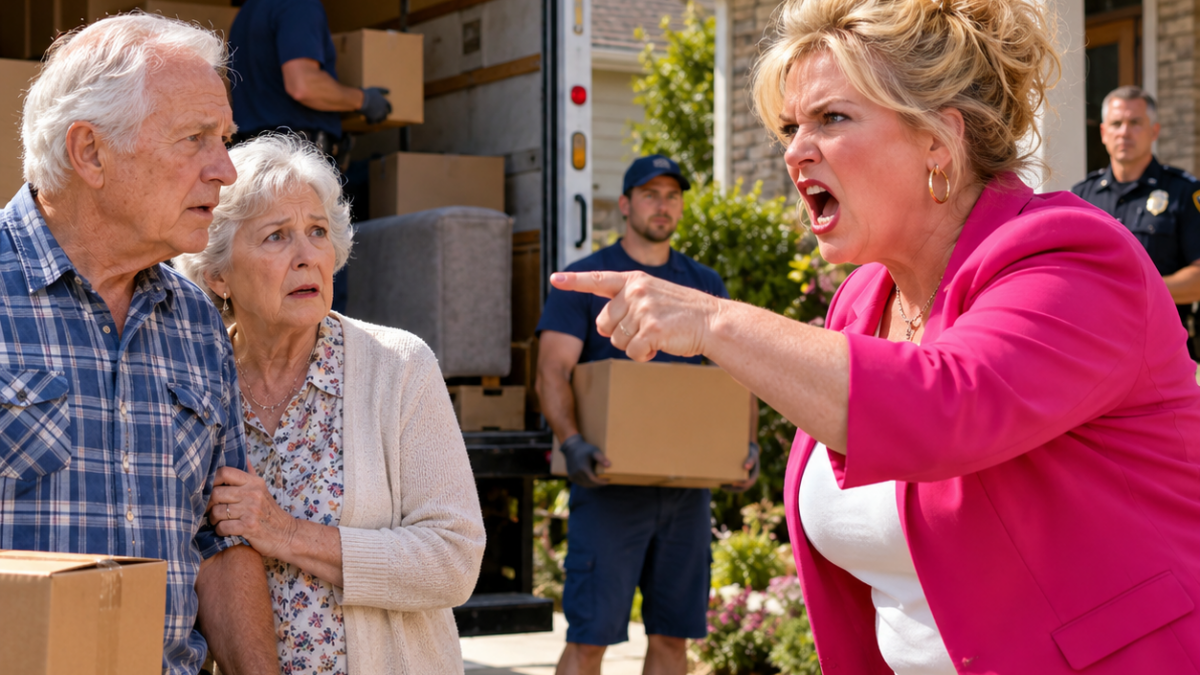
For nine months, the HOA president spoke about my living parents as though they were never coming home.
She fined their empty house, authorized people to remove my father’s belongings, and built an entire paper trail around the idea that nobody would ever challenge her version of events.
Then, on a cold Monday morning, one routine police verification put all of us on the same driveway—and for the first time, Karen Hollister had nowhere left to move the story.
At exactly 8:40 a.m., a twenty-six-foot rental truck turned onto Cedar Hollow Lane.
Every neighbor standing at the curb assumed it was headed for Number 12.
My parents’ house.
It made sense.
The house had been empty for nine months.
People knew my father had been sick.
They knew my mother had been in Texas with him.
What they didn’t know was why Deputy Lawrence Boyd was standing in Karen Hollister’s front yard at Number 20 with a folder tucked under his arm.
Or why my attorney, Colleen Reese, was parked fifty yards away with me.
Or why Karen had come outside wearing a robe over her clothes, holding her phone as if she expected something worth recording.
The truck rolled slowly down the street.
Past Number 8.
Past Number 10.
Then past my parents’ house.
Number 12.
It didn’t even tap the brakes.
Someone near the curb said, “That’s the Walker house.”
Another voice answered, “Then where’s it going?”
The truck kept moving.
Number 14.
Number 16.
Number 18.
Then the air brakes released directly in front of Number 20.
Karen’s house.
I watched the color change in her face.
Not fear.
Not yet.
Confusion.
The kind of confusion people get when something they believed they controlled suddenly moves one step outside the plan.
The truck stopped.
The driver set the parking brake.
The loading ramp began to lower onto Karen’s driveway.
She was moving before it hit the concrete.
“Absolutely not.”
She came across the lawn fast, phone already raised.
“Travis, get that truck off my property.”
I didn’t move.
Deputy Boyd looked at her.
“Mrs. Hollister—”
“No. He has no right to be here.”
She pointed at me.
“He does not own property on this street. He is not on a deed. He is not on the HOA board. He is a visitor who has spent months harassing this association.”
Colleen stood beside me without saying anything.
That was deliberate.
We had learned something about Karen during the previous nine months.
Silence made her fill the space.
And when Karen filled space, she usually gave you more than you asked for.
She looked at the deputy.
“I want him removed from my property.”
Boyd stayed calm.
“We’re here for a scheduled ownership verification.”
“There is nothing to verify.”
His eyes dropped to the folder.
“The complaint you filed says Mr. Walker is attempting to claim property belonging to a deceased homeowner.”
“He is.”
“My father is not deceased,” I said.
Karen turned toward me.
Her expression hardened.
“Stop.”
Just that.
Like I was an employee who had interrupted a meeting.
“You have been producing documents for months. None of that changes what happened here.”
Boyd looked at her.
“Mrs. Hollister, the complaint specifically states Raymond Walker died in March.”
“He did.”
The words came quickly.
Too quickly.
“He did, and whatever stunt is happening with this truck doesn’t change that.”
There were maybe eighteen neighbors outside by then.
Monday was trash day.
Bins lined the curb.
Gus Anderson stood beside his mailbox three houses down, arms folded against the cold.
Nobody pretended not to listen anymore.
Karen raised her voice.
“That man is dead. Whoever is in that truck is participating in a fraud, and I want it documented.”
For nine months, Karen had been the most certain person in every room.
She had signed violation notices.
Work orders.
An abandonment determination.
A lien.
An affidavit.
Eventually, she had signed a sworn complaint accusing me of trying to exploit the estate of a dead man.
She had put my father’s death in writing.
Now she was saying it again in front of a sworn deputy.
Boyd asked the only question he needed.
“Is the person claiming ownership available to identify themselves?”
The passenger door of the truck opened.
Karen looked toward it.
So did every neighbor on Cedar Hollow Lane.
And for the first time since I had come back to North Carolina, I saw Karen Hollister stop talking.
PART 2
Nine months earlier, I wasn’t thinking about Karen Hollister.
I was thinking about my father’s heart.
March 4.
Houston.
Valve replacement.
The surgeon had described it as complicated but routine enough that everyone in the room understood the same basic plan.
Procedure.
Recovery.
Six days in the hospital if things went well.
Then a few weeks of complaining about bland food and nurses telling my father what he was not allowed to lift.
My father, Raymond Walker, had spent his adult life as a cabinetmaker.
He didn’t enjoy being told what he couldn’t lift.
I called him the night before surgery.
“You nervous?”
“No.”
“Mom says you’re nervous.”
“Your mother has confused irritation with fear for forty-four years.”
I could hear her in the background.
“I heard that.”
Dad lowered his voice.
“You see what I live with?”
I laughed.
“Six days.”
“Five if I behave.”
“You won’t.”
“Exactly.”
That was the last normal conversation we had for a long time.
On the third day after surgery, Dad had a stroke.
Everything after that became measured differently.
Not in days.
In functions.
Could he move his left hand?
Could he sit upright?
Could he swallow safely?
Could he stand?
Could he recognize us immediately when he woke?
The first six days became three weeks.
Three weeks became inpatient rehab.
Then another facility off the Katy Freeway.
My mother, Diane, refused to leave him.
I offered to fly her home.
More than once.
“Mom, come home for four days. I’ll stay with him.”
“No.”
“You need sleep.”
“I sleep.”
“In a recliner.”
“It reclines.”
“Mom.”
“He wakes up at night.”
“I know.”
“He needs to see somebody he knows.”
That ended every argument.
My mother was sixty-nine years old.
She spent most nights in a chair beside a man relearning how to move one leg.
There wasn’t much room in her head for North Carolina.
Bills still came.
Grass still grew.
Insurance forms still arrived.
The house on Cedar Hollow Lane still existed.
So on March 20, she signed a durable power of attorney giving me authority to handle property and financial matters for both of them when necessary.
It was recorded with the Guilford County Register of Deeds four days later.
I put my copy in a drawer at home in Denver.
And forgot about it.
At the time, it was housekeeping.
Nothing more.
Somebody had to be able to pay a utility bill.
Call a repairman.
Sign something if Mom was sitting in a hospital hallway and couldn’t get to a computer.
I had no idea that document would eventually be the first thing standing between my parents and a woman who had decided their absence meant opportunity.
My parents bought Number 12 Cedar Hollow Lane in 1988.
I grew up there.
Dad remodeled almost every room himself.
Not because the house needed it.
Because he was incapable of living around wood without improving it.
The kitchen was his favorite.
He built the upper cabinet doors for my parents’ tenth anniversary.
Maple frames.
Leaded glass.
Diamond pattern.
Every piece cut by hand.
Every joint fitted in his workshop.
There were four doors on the left side that had a particular pattern.
The third one never sat correctly.
One pane stood about a quarter inch proud.
Any other cabinetmaker would have taken it down and fixed it.
Dad refused.
“That’s how you know a man made it.”
“You mean that’s how you know you made a mistake.”
“That too.”
For thirty years, that door closed with the same small flat knock.
Wrong.
Distinct.
Ours.
Behind the house stood a detached one-car workshop.
Dad had built most of the interior himself.
Bench along the back wall.
Pegboard.
Clamps.
Hand planes.
Chisels.
Old Stanley tool chest from the 1940s that had belonged to his father.
That chest had been in the same place since before I was born.
It wasn’t valuable because it was antique.
It was valuable because three generations of Walker hands had opened those drawers.
On April 9, Mom emailed the Cedar Hollow Estates HOA.
She gave them her temporary Houston mailing address.
Explained that Dad had suffered complications after surgery.
Said they expected to return in the fall.
Asked the office to make sure HOA mail was sent to Texas rather than left sitting in the box.
Karen Hollister replied personally.
One line.
Received. Take care of Ray.
That mattered later.
A lot.
Karen knew three things.
My parents were alive.
They were in Houston.
And they intended to come home.
Karen had been president of the Cedar Hollow board for eleven years.
Two hundred twelve homes.
Four board members under her.
A management company that processed paperwork.
And one old bylaw nobody had bothered to update.
The president could sign vendor work orders without a second board signature.
Karen’s pen.
Karen’s decision.
Growing up, I’d met her twice.
She had always been warm.
Remembered names.
Asked about school.
She was also the most certain person I have ever known.
Not confident.
Certain.
There’s a difference.
A confident person can hear new information.
A certain person experiences new information as an inconvenience.
By June, Karen started referring to my parents differently.
I learned that later from board minutes and witnesses.
At one meeting she said:
“The situation over at Number 12 appears to have resolved itself.”
Someone corrected her.
“The Walkers are in Texas. Ray had surgery.”
“Of course.”
She smiled.
“Absolutely.”
Then the next month, she used almost the same phrase again.
At the time, nobody thought much of it.
Why would they?
Here’s the part nobody in that room knew.
The previous fall, Karen had been remodeling her kitchen.
She came to my parents’ house one afternoon while Dad was working in the shop.
She wanted those four leaded-glass cabinet doors.
Not similar doors.
Those doors.
She said her designer loved them.
Dad said no.
A week later, she came back with money.
Dad said no again.
My mother told me the second conversation was short.
Karen offered a number.
Dad looked at the doors.
Then at her.
“Those leave this house when I do.”
Karen laughed like he was joking.
He wasn’t.
She also wanted the Stanley chest.
She thought it would make a beautiful bar cabinet.
That answer was an even harder no.
By May, while my parents were in Houston, Karen opened what the HOA file called an “abandonment determination.”
Uncut grass.
Mail accumulation.
No observed occupancy.
The language sounded official.
It also ignored the forwarding address sitting in the same office.
Violation notices began.
Fifty dollars a day.
The letters went to a mailbox nobody was checking because the HOA had been specifically asked to forward them.
Ninety-six days.
$4,800.
My father was learning how to stand between parallel bars while Karen’s office fined his house for looking empty.
Then came August 12.
Karen signed a work order to Ridgeline Hauling and Salvage.
No second board signature.
No owner signature.
No court order.
Karen’s signature.
A crew went into my parents’ property.
They emptied the workshop.
Then entered the kitchen.
Four upper cabinet doors came down.
Hardware removed.
Hinges damaged.
They finished before lunch.
I knew none of this.
Not in March.
Not in April.
Not in August.
I found out in October because a lien notice finally made its way to me in Denver.
$18,600 against my parents’ house.
I stood in my kitchen reading the breakdown.
HOA fines.
Administrative charges.
Abatement.
Then one line near the bottom.
CONTENTS REMOVAL / DISPOSAL / LANDFILL.
I read it four times.
Contents?
What contents?
I called the HOA office.
Voicemail.
Called again.
No answer.
I booked a flight that night.
Somewhere over Kansas, I kept thinking about my mother’s April email.
Forwarding address.
Houston.
Return expected in the fall.
Karen’s response.
Take care of Ray.
You cannot honestly believe a house has been abandoned when the owners told you exactly where they went.
Unless you need the house to be abandoned.
I landed the next morning.
Rented a car.
Drove straight to Cedar Hollow.
The workshop told me first.
Dad’s roll-up door had always rattled halfway up.
He shimmed the track badly in the 1990s and never fixed it.
I pulled the handle.
Same rattle.
Same vibration.
The door rose.
Nothing.
That’s what I remember.
Nothing.
The pegboard was still there.
But the outlines of tools were visible in faded paint where hooks had been.
The bench had a layer of dust.
Except for one clean rectangle.
Four sharp sides.
Exactly where the Stanley chest had sat for decades.
Whatever removed it had lifted it straight up.
I stood there so long that the rental car began chiming because I had left the driver’s door open.
The kitchen was worse.
Four cabinet frames on the left wall were bare.
No doors.
No hinges.
Some screws removed.
Others pulled out badly enough to tear wood.
The remaining six cabinets were untouched.
That detail stayed with me.
Whoever did it hadn’t “cleared debris.”
They had selected things.
My phone rang.
Mom.
“Travis?”
I walked outside before answering.
“Hey.”
Hospital noise behind her.
A paging system.
Footsteps.
“Your father walked today.”
“What?”
“Forty feet.”
“Forty?”
“Twenty down and twenty back.”
“That’s huge.”
“He thinks the walker is insulting him.”
In the background, Dad said something that proved he still had strong opinions.
Mom laughed.
Then:
“How’s the house?”
I looked through the front window.
Bare cabinet frames.
Screw damage.
A kitchen my father had built with his hands.
“The furnace is loud.”
The lie came out easily.
“I’m having somebody look at it.”
“Anything else?”
“No.”
She believed me.
That was the first lie I told during those months.
I’m not proud of it.
But my mother had spent seven months sleeping beside a rehab bed.
My father had walked forty feet for the first time since March.
I wasn’t going to make her picture an empty workshop that night.
I work commercial insurance claims for a living.
Fifteen years.
Fire.
Water.
Theft.
Storm loss.
When I walk into a damaged building, my body knows what to do before my emotions catch up.
Wide shot.
Medium shot.
Detail.
Scale.
Timestamp.
I took eighty-one photographs.
Every empty cabinet frame.
Every damaged screw hole.
The bench.
The pegboard.
The dust rectangle.
Workshop door.
Locks.
Windows.
Exterior.
I photographed everything before allowing myself to be angry.
The next morning I went to the HOA office.
Karen was there at nine.
Coffee brewing.
Oatmeal-colored cardigan.
She smiled when I entered.
“Travis.”
Like we were old friends.
“I’m so glad you came in person.”
She already had a folder out.
My parents’ address typed on the tab.
That bothered me immediately.
I had not told her I was coming.
Yet the file was waiting.
“Sit down.”
I stayed standing.
“This has been difficult for everyone.”
“For everyone?”
She ignored that.
“Nobody wants to inherit a complicated property situation.”
Inherit.
My father was alive.
My mother was alive.
Karen opened the folder.
“We followed procedure.”
She turned papers toward me.
“Uncut grass.”
Next page.
“Uncollected mail.”
Next.
“No observed occupancy.”
Next.
“Repeated notice.”
She spoke patiently.
Like I was slow.
“Ninety-six days of violations. The association eventually had an obligation to abate.”
“Abate what?”
“The hazard.”
“What hazard?”
“An unattended structure.”
“It was locked.”
“An abandoned property creates liability.”
“It wasn’t abandoned.”
She smiled.
“That’s the determination the board made based on conditions.”
“My parents told you they were in Houston.”
“Travis, I understand that this is emotional.”
I almost laughed.
“You emailed my mother.”
“I communicate with hundreds of residents.”
“You used my father’s name.”
“Again, that doesn’t change what the property looked like.”
Then she slid a payment sheet toward me.
“The fines may be negotiable. The vendor costs are not.”
I looked at her.
“You haven’t asked how my father is.”
Her face stayed neutral.
“I hope he is comfortable.”
Comfortable.
He was relearning how to walk.
I took two documents from my bag.
Placed them on her counter.
Certified deed.
Raymond and Diane Walker.
Joint ownership.
Then the recorded durable power of attorney.
My name.
County stamp.
“Both owners are alive.”
I tapped the deed.
“Neither has transferred title.”
Then the POA.
“And I am authorized to act for them.”
Karen looked down.
The change in her was tiny.
But I see tiny changes for a living.
People lie during insurance claims.
Not all the time.
Enough.
Her face didn’t change.
Her language did.
Before those documents, she had twice said:
“Your parents’ estate.”
After reading them, she never used “estate” again.
It became:
“Your parents’ file.”
That fast.
One word removed.
Story repaired.
She called the HOA attorney.
Curtis Sloan.
He was in his sixties and sounded tired before we even met.
That afternoon, he reviewed the deed and POA.
Then sent the board a written recommendation to suspend further enforcement while ownership and authority were reviewed.
The fines froze at $4,800.
For maybe an hour, I thought we had finally reached solid ground.
Then I asked Karen:
“Where is my father’s property?”
She didn’t ask what I meant.
She pulled out a single page immediately.
Too immediately.
Ridgeline Hauling and Salvage.
August 12.
Disposal manifest.
6,800 pounds.
Destination:
TRANSFER STATION / LANDFILL.
She placed it face-up.
“It’s gone, Travis.”
“The tool chest?”
“Disposed.”
“The cabinet doors?”
“Disposed.”
“You threw away hand-built doors?”
“The crew removed material deemed part of the abatement.”
“My grandfather’s tool chest?”
“It was treated as contents.”
“Where?”
She tapped the manifest.
“Landfill.”
Then she said:
“I’m sorry.”
It sounded like someone apologizing for rain.
Sloan’s suspension lasted nine days.
On day ten, Karen brought enforcement back to the board.
The cleanout invoice had been added.
Total:
$18,600.
The vote passed four to two.
I stood at the back of the clubhouse.
One board member, Peggy Sutton, voted no.
Afterward, she kept looking toward Karen.
Not toward me.
Toward Karen.
Like something about the vote bothered her personally.
I didn’t know why.
Yet.
Driving home, one number bothered me.
6,800 pounds.
My father’s workshop wasn’t full of industrial machinery.
A wooden chest.
Hand tools.
Clamps.
Four cabinet doors.
Even if the crew removed other minor items, 6,800 pounds felt wrong.
Three doors down from my parents lived Gus Anderson.
Eighty-one years old.
Gus observed Cedar Hollow the way some men watch sports.
Every car.
Every contractor.
Every package truck.
Two years earlier, his daughter installed a doorbell camera.
Gus barely understood the app.
But the camera pointed toward the road.
I knocked.
He opened the door before I finished.
“Travis.”
“Hey, Gus.”
“Your dad?”
“Improving.”
He nodded.
“Slow?”
“Very.”
“Slow counts.”
That sounded like him.
“Gus, can your camera go back to August?”
“I don’t know.”
“Does Suzanne control it?”
“Unfortunately.”
We called his daughter.
She pulled the archive.
August 12.
A ninety-second clip.
Mostly mailbox.
Wind.
Empty street.
Then at 11:06 a.m., a Ridgeline box truck entered frame.
Moving slowly.
Riding low.
It had just come from Number 12.
The county transfer station was easy.
Right turn at the end of Cedar Hollow.
Two minutes to the highway.
Twenty minutes straight out.
The truck reached the intersection.
Then turned left.
I watched again.
Left.
Away from the highway.
Deeper into Cedar Hollow.
One entrance.
One exit.
Nothing commercial inside.
I had Suzanne replay it four times.
Gus finally said:
“Sit down.”
I realized my legs felt weak.
The truck did not go directly to the landfill.
The manifest Karen had pushed toward me so confidently was not telling the whole story.
The camera lost the truck around the bend.
I walked the route.
Past Number 16.
Number 18.
Then the cul-de-sac.
Four homes.
Number 20 had a flag bracket and seasonal wreath.
Karen Hollister’s house.
That gave me direction.
Not proof.
I couldn’t walk inside her house.
Couldn’t search the garage.
Couldn’t create my own legal problem trying to solve hers.
So I went home and started reading HOA newsletters.
Cedar Hollow published one monthly.
Karen wrote most of it.
September.
Page four.
NEIGHBOR SPOTLIGHT.
Karen Hollister.
Topic:
Her newly completed kitchen remodel.
Three photographs.
I almost missed it.
Second photograph.
Karen standing behind her kitchen island.
On the wall behind her were four leaded-glass cabinet doors.
Maple.
Diamond pattern.
And third from the left—
the middle pane sat slightly proud.
One quarter inch.
I enlarged the image.
Zoomed.
There it was.
Dad’s mistake.
The flaw he refused to repair for thirty years.
That door existed in one kitchen.
Now it was photographed in another.
Karen hadn’t hidden it.
She had published it.
Mailed it to 212 homes.
Including my parents’ house, where the newsletter sat inside held mail while Karen’s office possessed a Texas forwarding address.
You only do that when you are absolutely convinced the owner will never walk into your kitchen.
That night, Mom called.
“He did forty feet again.”
“Twice?”
“Twice.”
Dad muttered in the background.
“What’d he say?”
“That the therapist measures distance like a prison guard.”
I laughed.
“That sounds promising.”
Mom said:
“How’s the furnace?”
“Handled.”
Still lying.
After the call, I sat alone in my parents’ half-empty kitchen.
Looked at the holes where Dad’s doors had been.
And made a promise.
Those doors would be back on that wall before Dad came home.
The next morning, I put the newsletter in front of Curtis Sloan.
He stared at the photograph.
Long time.
Then:
“That’s her kitchen.”
“Yes.”
“And those are your parents’ doors.”
“Yes.”
“Can you prove that?”
“The third pane.”
“I believe you.”
He rubbed his forehead.
“That isn’t the same thing.”
I hated that sentence.
He pointed toward the photograph.
“This proves she possesses doors that appear to belong to your parents.”
“She signed the cleanout order.”
“Yes.”
“The truck went toward her house.”
“You have video of it turning left.”
“Yes.”
“Not entering her garage.”
“No.”
“And there is a written manifest saying the contents were taken for disposal.”
“So what are you telling me?”
“I’m telling you what her defense will be.”
He leaned back.
“She’ll say the crew offered salvage from a load going to the landfill. She accepted items that had already been abandoned.”
“She chose the exact four doors she wanted a year ago.”
“You know that. Your mother knows that.”
He tapped the paper.
“But if she says somebody offered her discarded material, taking trash is not the same as stealing property.”
I stared at him.
“What do I need?”
“The paper between the truck leaving Number 12 and those doors reaching Number 20.”
I knew exactly where that paper would be.
Ridgeline’s job file.
Private company.
HOA client.
Karen authorized the work.
At four that afternoon, I returned to Number 12.
An envelope was taped to the storm door.
Cedar Hollow Estates letterhead.
Signed by Karen.
Effective immediately, I was prohibited from entering the clubhouse, HOA office, pool building and other association common facilities due to what she called a “pattern of hostile contact.”
Every office record I might want was now behind a door I was formally told not to enter.
Karen wasn’t improvising.
She was closing doors ahead of me.
I hired Colleen Reese.
Property attorney.
Second-floor office in Greensboro.
Window air conditioner still running in October.
I gave her everything.
Eighty-one photographs.
Deed.
POA.
Lien.
Manifest.
Newsletter.
Gus’s video.
Mom’s email.
Karen’s reply.
She listened for ninety minutes without writing a note.
Then:
“You are right about almost everything.”
“Good.”
“Being right is going to be the least useful thing you own for a while.”
I liked her immediately.
Colleen demanded Ridgeline’s full August 12 job file.
Four business days later, Ridgeline refused.
Politely.
Their client was the Cedar Hollow Estates HOA.
Records would be released only to the client, the signing authority, or under subpoena.
The signing authority was Karen.
“So the person who can voluntarily give us evidence is the person the evidence hurts.”
“Yes.”
“Subpoena?”
“We file suit.”
“How long?”
“Four to six months before a judge deals with the records issue.”
I stared at her.
“The lien hearing is December 16.”
“That’s our problem.”
“What happens if we lose?”
“The court validates the $18,600 lien.”
“And then?”
“The HOA can begin foreclosure proceedings if the balance remains unpaid.”
My father was walking forty feet down a rehab hallway.
And Karen had his house on a December court calendar.
The board met on the fourth Tuesday.
I was barred from the clubhouse, so I joined by speakerphone.
Eleven people breathing in a room I couldn’t enter.
I had six minutes.
I laid everything out.
Recorded deed.
Recorded POA.
April forwarding address.
Karen’s own reply using Dad’s name.
The newsletter photo.
The doors.
The work order.
Then silence.
Through the speaker, I could hear papers moving.
For the first time, I thought I had turned the room.
Karen spoke.
“May I distribute something?”
More paper.
Long pause.
Then:
“I have an affidavit.”
Colleen received it the next morning.
She placed it on her desk.
VOLUNTARY STATEMENT OF ABANDONMENT.
Dated May 22.
The document authorized Cedar Hollow Estates to enter Number 12, secure the property, remove personal belongings, and correct conditions without further notice.
At the bottom:
Diane E. Walker.
My mother’s signature.
Or what looked exactly like it.
The long loop on the W.
The slightly open E.
I felt cold.
If the affidavit was valid, everything changed.
The cleanout became authorized.
Property removal became owner-approved.
The doors in Karen’s kitchen became items my mother had signed away.
Curtis Sloan withdrew his recommendation to suspend enforcement.
Peggy Sutton stopped returning calls.
That night, I called Houston.
Ten o’clock.
We never called that late.
Mom answered.
“Travis?”
“I need to ask you something.”
“What happened?”
“I have a document.”
I read it.
Silence.
“I didn’t sign that.”
“You sure?”
“Yes.”
“Mom.”
Another silence.
Then her voice changed.
“Travis, I sign everything.”
“What?”
“Medical forms. Pharmacy forms. Insurance. Rehab paperwork. They put stacks in front of me.”
“Mom—”
“May was terrible.”
I could hear her breathing.
“What if I signed it and don’t remember?”
Then my mother started apologizing.
“I’m sorry.”
“Stop.”
“I should have read—”
“Mom.”
“I’ve been so tired.”
“You didn’t do anything.”
“What if I did?”
“Stop apologizing.”
She said sorry four times in ninety seconds.
And I’m going to admit something I still hate admitting.
For maybe four seconds, I wondered.
What if she had signed it?
What if exhaustion had made her careless?
May was the month Dad had a setback.
Different facility.
New insurance authorizations.
Medication changes.
Maybe somebody emailed something.
Maybe Mom signed without understanding.
Four seconds.
Then I felt ashamed.
Because I knew my mother.
And I knew that signature.
I had forty years of birthday cards with it.
The handwriting looked right.
That didn’t mean she had signed the document.
I looked lower.
Notary block.
That was when everything changed.
A notary does not merely say:
Yes, this looks like Diane Walker’s signature.
The notary certifies that Diane Walker personally appeared.
Presented identification.
Signed in front of the notary.
The document said my mother personally appeared in Guilford County, North Carolina on May 22.
Mom had not left Houston since March 3.
I called Colleen at eleven that night.
She answered on the second ring.
“Stop fighting the HOA.”
“What?”
“We’ve been arguing whether Karen had authority.”
“Right.”
“She keeps producing paper.”
“Yes.”
“So we follow the paper.”
Silence.
I continued.
“She controls HOA records.”
“Yes.”
“Vendor relationship.”
“Yes.”
“But she doesn’t control every record behind her paper.”
Colleen understood.
“The affidavit has a notary log.”
“The landfill manifest has scale tickets.”
“The cleanout has internal company routing.”
“She wrote the story.”
I said:
“She didn’t write the receipts.”
Colleen was quiet.
Then:
“That’s the right instinct.”
I felt relief.
Then she added:
“And probably our last chance.”
Karen had amended the lien enforcement filing.
Added legal costs.
Requested immediate relief.
Twenty-two days.
We started with the county transfer station.
Every inbound truck was weighed.
Truck identification.
Hauler.
Ticket.
Tonnage.
Public record.
Nine-dollar request.
Six days later, the report arrived.
August 12.
Ridgeline Hauling and Salvage.
2,140 pounds.
Karen’s manifest said:
6,800 pounds.
Difference:
4,660 pounds.
Two-thirds of the claimed load never crossed the county scale.
Colleen put both sheets beside each other.
“That’s not a typo.”
“No.”
“That document describes a disposal event that did not happen the way it says it happened.”
Next:
Notary log.
Public record.
The commission number matched the affidavit.
May 22.
Diane E. Walker.
Identification verified.
The notary was a bookkeeper employed by Cedar Hollow’s management company.
Her office was eleven feet from Karen’s.
Now we needed to prove Mom could not have appeared there.
Houston Methodist had records.
Therapy schedule.
Visitor logs.
Check-in.
My mother had attended Dad’s therapy sessions almost obsessively.
May 22.
9:15 a.m.
Diane Walker signed into occupational therapy in Houston.
More than a thousand miles from Guilford County.
Same morning.
Same time window.
I sat in Colleen’s office looking at the two documents.
Notary block:
Diane Walker personally appeared in North Carolina.
Hospital record:
Diane Walker physically present in Houston.
Both could not be true.
Three days earlier, I had listened to my mother apologize for maybe signing something she didn’t remember.
Now a timestamped medical record proved she had not stood before that notary.
The affidavit stopped being Karen’s strongest defense.
It became something else entirely.
Colleen looked at me.
“Now we subpoena Ridgeline.”
The subpoena went Monday.
Records came Wednesday.
Fast.
Ridgeline’s compliance officer, Nadine Pruitt, called personally.
Colleen put her on speaker.
“I’ve been waiting for somebody to ask about that job.”
I looked at Colleen.
“What do you mean?”
Nadine explained.
“If our crew takes a disposal load directly to the transfer station, that’s a standard route.”
“Okay.”
“If there is any stop in between—donation center, resale, secondary property, customer redirect—the crew cannot remove anything from the truck without written authorization.”
“Why?”
“Insurance.”
Of course.
Insurance.
My language.
Documentation.
“Was there a redirect on August 12?”
Pages turning.
Then:
“Yes.”
An hour later, the scan arrived.
RIDGELINE HAULING & SALVAGE.
August 12.
Crew of three.
Stop One:
12 Cedar Hollow Lane.
Stop Two:
20 Cedar Hollow Lane.
DELIVER TO GARAGE.
Authorizing party:
Karen Hollister.
Her handwriting.
Her signature.
Her address.
Karen had not been offered random salvage.
She had instructed the truck to stop at her home.
Attached was the crew photo log.
Twelve timestamped photographs.
Workers carrying items across Karen’s driveway.
Image four:
Two men carrying the Stanley chest.
Image nine:
One of Dad’s cabinet doors under a moving blanket.
Glass side visible.
Diamond pattern.
Driver statement.
The crew had been told the homeowners were deceased and the family had released the contents.
Karen met the truck at Number 20.
Directed which items went into her garage.
Allowed the rest to continue to the transfer station.
That explained the weight difference.
4,660 pounds never reached the dump because much of it was diverted.
We hired an appraiser.
Cabinet doors.
Stanley chest.
Hand tools.
Associated custom woodwork.
Estimated value:
$58,000.
Colleen wrote the number on her legal pad.
Circled it.
“This isn’t an HOA fine dispute anymore.”
I knew.
“She took property from a house she knew had living owners.”
“Yes.”
“Had it delivered to herself.”
“Yes.”
“Then produced a disposal manifest saying it went to a landfill.”
“Yes.”
I sat back.
“What happens now?”
“I take this to the district attorney.”
She closed the folder.
“And if they agree with what we have, this stops being something you solve.”
That was Friday.
Karen knew none of it.
And during that same week, she made the decision that finished the story for her.
She went first.
Monday morning, Karen swore out a criminal complaint against me.
Forgery of the durable power of attorney.
Attempted fraud involving the estate of a deceased homeowner.
She claimed I had fabricated the POA in order to interfere with lawful HOA enforcement.
The same POA she had personally held in October.
County-recorded.
She wrote a narrative.
Second paragraph:
Ray Walker died in March. There is no living father.
I have read that sentence more times than any other sentence in my life.
She signed it.
Swore to it.
Gave it to law enforcement.
Deputy Lawrence Boyd got the file.
Boyd did something that turned out to be the best possible response.
Nothing dramatic.
No assumptions.
No taking sides.
He scheduled a supervised verification.
December 15.
8:40 a.m.
Location:
20 Cedar Hollow Lane.
Why Karen’s house?
Because according to the complaint, disputed property connected to the supposed deceased owners had been identified there.
All parties present.
Identification verified.
Ownership established.
Karen welcomed the meeting.
She emailed Boyd thanking him for his diligence.
Said she was pleased the issue would finally be resolved in front of witnesses.
She believed she had scheduled my collapse.
December 13, my father’s cardiologist cleared him to travel.
Nine months.
He was going home.
I booked a twenty-six-foot rental truck.
Hospital bed.
Recliner.
Clothes.
Medical supplies.
Mom’s music boxes.
Everything they had accumulated during nine months of not going home.
Then I called Mom.
“You’re coming in Monday?”
“Yes.”
“Don’t go to the house first.”
“What?”
“I need you to stop somewhere.”
“Where?”
I gave her the address.
Silence.
“Karen Hollister?”
“Yes.”
“Why?”
“Because I need you and Dad to identify some property.”
“What property?”
I finally told her.
Not everything.
Enough.
The doors.
The chest.
The workshop.
Mom went completely quiet.
Then:
“Your father cannot know until we’re there.”
“Why?”
“Because he’ll try to drive the truck himself.”
That was my mother.
December 15 was trash day.
That’s why so many neighbors were outside.
Nothing staged about that.
Monday.
Bins at curb.
Cold morning.
Maybe eighteen people.
Gus standing at his mailbox because Gus always stood at his mailbox.
Deputy Boyd arrived at 8:30.
Colleen and I at 8:35.
Karen stepped outside.
Robe over clothes.
Phone in hand.
The moving truck entered Cedar Hollow at 8:40.
And now we were back at the moment where this story began.
The passenger door opened.
My mother climbed down.
Good coat.
Purse over her arm.
Five foot two.
Perfectly composed.
Karen’s expression changed.
“Mrs. Walker.”
Mom looked at her.
“Karen.”
Karen recovered fast.
“Diane, I don’t know what Travis has told you—”
Then the rear driver-side door opened.
I went around.
Lowered the ramp.
My father appeared.
Thinner than he had been in March.
Cane in one hand.
Other hand on the rail.
He hated the cane.
Hated the ramp.
Hated anyone offering help.
He came down slowly.
One step.
Pause.
Another.
For nine months, people in Cedar Hollow had been hearing versions of him.
Gone.
Resolved.
Deceased.
Estate.
Abandoned.
Then Raymond Walker put both shoes on Karen Hollister’s driveway.
The street went silent.
Dad didn’t look at Karen first.
He looked at Deputy Boyd.
“Officer.”
“Yes, sir.”
“I built the doors in her kitchen.”
That was all.
Karen broke.
Not screaming.
Not anything dramatic like television.
Her words simply started coming faster than her ability to control them.
“That’s not—”
She looked at Dad.
Then me.
Then Boyd.
“Anyone can say they’re anyone.”
From the curb, Gus Anderson said:
“That’s Ray.”
Karen turned.
“This is staged.”
Gus frowned.
“I’ve known that man thirty-eight years.”
“They staged this.”
Boyd raised a hand.
“Mrs. Hollister, stop talking for a moment.”
She didn’t.
“I filed the complaint because the documents are fraudulent. This is obviously an attempt—”
“Ma’am.”
“I want the truck moved.”
“Ma’am.”
Finally she stopped.
For maybe three seconds.
Then Karen changed strategy.
“Fine.”
Both hands up.
“Fine. Yes. There are items from Number 12 in my home.”
Boyd watched.
“The hauling crew told me the property was being discarded.”
There it was.
The defense Curtis Sloan had predicted in October.
“I accepted salvage.”
Karen steadied herself.
“It was going to the landfill. The owners had abandoned it. You cannot steal garbage.”
Clean.
Simple.
Plausible.
Colleen waited.
Then removed one page.
“Deputy Boyd.”
He took it.
“Ridgeline redirect authorization.”
He read.
Colleen explained:
“The company requires a signed redirect whenever a disposal load stops anywhere other than the transfer station.”
Boyd looked at the page.
“Stop two. Twenty Cedar Hollow Lane. Delivered to garage.”
Karen said immediately:
“The crew wrote that.”
Colleen pointed.
“Authorized by Karen Hollister.”
Karen looked down.
“That’s not enough to prove—”
Second document.
County transfer-station ticket.
Same truck.
Same date.
2,140 pounds.
“Her disposal manifest says 6,800 pounds.”
Colleen spoke quietly.
“4,660 pounds did not arrive at the landfill.”
“Weights can be wrong.”
Third document.
Crew photographs.
Timestamped.
Karen’s driveway.
Workers.
Chest.
Cabinet doors.
“I’ve never seen those pictures.”
Fourth document.
Affidavit.
My mother’s supposed signature.
Notary certification.
Then Houston therapy attendance.
May 22.
9:15 a.m.
“Mrs. Walker was physically present in Houston at the time this notarized document says she appeared in Guilford County.”
Karen said nothing.
Not:
That’s wrong.
Not:
There must be an explanation.
Nothing.
For four straight minutes, Karen had filled every silence.
Then the documents reached the one place where she couldn’t improvise quickly enough.
Boyd squared the pages.
Looked at Dad.
“Mr. Walker, can you identify the items inside?”
Dad nodded.
“The chest.”
“Anything else?”
“The cabinet doors.”
“How can you identify them?”
Dad looked toward Karen’s house.
“Open the third door from the left.”
Boyd waited.
Dad added:
“And let it close.”
Karen’s husband, Dale, had appeared in the doorway.
He looked less angry than stunned.
Boyd asked permission to inspect the disputed property.
Dale opened the garage.
The Stanley chest sat four feet from his bumper.
Moving blanket partly over it.
Dad’s chest.
Same scratches.
Same handles.
Same repaired corner.
Two people went inside toward the kitchen.
The street waited.
Eighteen people.
Cold air.
Trash bins.
Then through Karen’s open front door, we heard it.
Knock.
Small.
Flat.
Wrong.
That cabinet door.
The same sound it had made in my parents’ kitchen for thirty years.
My mother covered her mouth.
Dad closed his eyes for half a second.
Boyd came back outside.
His tone changed.
He asked Karen to remain with him while the matter was referred for further investigation.
She kept repeating one word.
“Salvage.”
Again.
Then again.
Peggy Sutton stood near the curb.
Phone already in hand.
“I’m calling an emergency board meeting.”
Nobody answered.
The movers who had driven from Houston had been watching everything.
They knew none of the backstory when we hired them.
One finally looked at me.
“Sir?”
“Yeah?”
He pointed toward the garage.
“You want that loaded?”
I looked at Boyd.
He confirmed the items could be returned after documentation.
I looked at Dad.
Dad looked at the chest.
“Put it on the truck.”
The two movers walked into Karen’s garage.
Came back carrying my grandfather’s Stanley chest.
One piece at a time, my parents’ property left Number 20.
Down Karen’s driveway.
Onto our truck.
Cabinet doors.
Chest.
Tools.
Items Dad had spent his life touching.
Mom stood beside him.
Dad never looked at Karen.
Not once.
The lien hearing was the next morning.
Eleven minutes.
Colleen put three categories of evidence before the court.
Ridgeline redirect authorization.
County scale ticket.
Notary documentation and Houston records.
Then the recorded POA.
The judge reviewed everything.
The $18,600 lien was voided.
The $4,800 in fines struck.
The abandonment determination reversed.
Cleanout authorization invalidated.
Every enforcement document Karen had signed against my parents’ property fell with it.
Mom sat in the second row.
Same coat.
Didn’t speak during the hearing.
Outside, she looked at me.
“Nine months.”
“What?”
“She couldn’t wait nine months.”
I knew what she meant.
Dad had almost died.
Mom had spent every night beside him.
They had told the HOA where they were.
All Karen needed to do was wait.
Instead, she treated absence as permission.
The district attorney filed charges in January.
Property offenses related to the approximately $58,000 in redirected belongings.
False pretenses.
Falsified records.
The affidavit.
The disposal paperwork.
And the false police report built around the claim that my father had died.
That last one mattered because Karen filed it after personally reviewing the recorded POA identifying both owners as living.
Dale Hollister was not charged.
I want to be clear about that.
He didn’t know.
A week after Christmas, he came to Number 12.
Alone.
Mom answered.
He stood on the porch.
Tried to speak.
Couldn’t get through the first sentence.
Mom said:
“Come inside.”
Then made him coffee.
I stared at her.
After everything.
She made him coffee.
That was the most Diane Walker thing that happened that year.
Dale sat at our kitchen table under the bare cabinet frames.
“I thought she bought them.”
Dad looked at him.
“From who?”
Dale closed his eyes.
“I don’t know.”
He stayed twenty minutes.
Apologized three times.
Dad accepted none of them dramatically.
Just said:
“You didn’t take them.”
“No.”
“Then stop apologizing for what you didn’t do.”
I looked at Mom.
That sounded familiar.
Karen entered a plea in April.
Fourteen months active custody.
Five years probation.
Restitution.
Approximately $58,000 tied to the property.
Additional costs for restoring the cabinet structures damaged during removal.
Permanent prohibition from serving on the board of a community association in North Carolina.
The notary lost her commission.
Ridgeline changed company policy.
Before that case, a redirect could be signed by the customer who ordered the haul.
Afterward, a stop delivering property anywhere other than the declared disposal or donation destination required direct property-owner authorization.
Nadine Pruitt sent Colleen the revised form.
No note.
Just the new policy.
Cedar Hollow held elections.
Peggy Sutton became president.
First rule she changed:
No vendor work order could be signed by one board officer.
Two signatures required.
Second change:
Abandonment determinations involving occupied or temporarily vacant homes required independent management review and verified owner contact.
Third:
No property could be removed without clear legal authority.
The association settled with my parents.
Some residents resented that.
I understood.
Two hundred twelve households ended up paying part of the cost of decisions most of them never approved.
But there was another side.
Karen had been president eleven years.
People corrected her sometimes.
Then stopped.
People questioned her.
Then let things go.
Board members trusted her pen.
Residents trusted her certainty.
Eventually, one person was making decisions nobody had the habit of challenging.
That wasn’t the same as saying Cedar Hollow caused what she did.
It was saying systems get weak when everybody assumes somebody else is checking.
We put Dad’s tool chest back on December 18.
Gus came down to help.
Dad couldn’t lift it anymore.
That hurt him.
I could tell.
He tried once.
I stopped him.
“Dad.”
“I’ve got it.”
“You don’t.”
“Travis.”
“You have a cane.”
“I’m aware.”
“You had a stroke.”
“So people keep telling me.”
Gus stepped between us.
“Ray, shut up and tell us where it goes.”
Dad immediately became foreman.
“Left.”
We shifted.
“No, your other left.”
Gus said:
“I know which direction left is.”
“Evidence says otherwise.”
The workshop still had the dust outline.
Nine months.
Clean rectangle.
Nobody had touched it.
Gus and I lowered the Stanley chest into the exact shape where it had lived for decades.
It fit perfectly.
Like a key.
Dad stood in the doorway.
One hand on his cane.
He touched the top after we were done.
Didn’t say anything.
Neither did we.
Some moments become smaller if you explain them.
That was one.
The cabinet doors took longer.
The frames had been damaged during removal.
A shop on Battleground Avenue rebuilt parts of the boxes.
March.
Almost one year after Dad’s surgery.
A young cabinetmaker came to install the doors.
Dad sat in a kitchen chair supervising.
He hated supervising.
He wanted tools.
Mom refused.
The installer reached the third door.
Hung it.
Closed it.
Knock.
He frowned.
“Pane’s sitting proud.”
Dad smiled.
“I know.”
“I can shim it.”
“No.”
“It’ll take ten minutes.”
“No.”
The kid looked at me.
I shrugged.
Dad pointed toward the door.
“Leave it.”
“Sir, it isn’t flush.”
“That’s how you know it’s mine.”
The kid laughed.
Then left it.
That week, Mom had the piano tuned.
She hadn’t touched it in a year.
The tuner complained it was badly out.
Mom told him:
“So am I.”
That evening she sat down.
Played for forty minutes.
Badly.
Missed notes.
Stopped.
Started again.
Dad sat in his chair with his eyes closed.
For the first time since Houston, they looked like my parents again.
Not patient and caregiver.
Not homeowner and power-of-attorney holder.
Not victims in a court file.
Just Mom playing piano badly.
Dad pretending not to listen.
I eventually told her about the four seconds.
We were washing dishes.
“What four seconds?”
“The night you said maybe you signed the affidavit and forgot.”
She stopped.
“I wondered if you did.”
Mom looked at me.
Then started laughing.
Not offended.
Laughing.
Hard.
“Thanks.”
“Sorry.”
“Four whole seconds?”
“Maybe five.”
She laughed harder.
“Travis.”
“What?”
“If I had signed away your father’s cabinet doors, you would have found me halfway to another country before I admitted it.”
Dad yelled from the living room:
“What cabinet doors?”
Mom yelled back:
“None of your business.”
I smiled.
That was the last time the affidavit hurt.
I flew back to Denver in April.
Work had piled up.
My own life had been suspended for months without me noticing.
For the first week, I kept expecting the phone to ring.
Attorney.
HOA.
Detective.
Court clerk.
It didn’t.
One Tuesday afternoon, my phone buzzed.
Mom.
No words.
Just a photograph.
The third cabinet door.
Half open.
Morning light shining through Dad’s leaded glass.
Diamond shapes across the countertop.
I sat at my desk for a long time.
Because even from Colorado, looking at a still photograph, I knew exactly what that door sounded like when it closed.
Knock.
That small wrong sound.
Dad’s sound.
Home.
People asked later whether the moving truck was planned as some kind of revenge.
It wasn’t.
That’s the part everybody wanted to turn into something theatrical.
“Did you deliberately stop at Karen’s house so your parents could humiliate her?”
No.
Deputy Boyd scheduled verification at Number 20 because Number 20 was where the disputed property had gone.
My parents were returning from Houston that same weekend.
Dad was alive.
Mom was alive.
They were the owners.
Their property was inside Karen’s house.
The cleanest possible verification was to bring the owners to the property.
That was it.
The fact that Karen stood in her driveway and declared my father dead seconds before he stepped out of the truck?
That was her timing.
Not mine.
The fact that eighteen neighbors were outside?
Trash day.
The fact that her own complaint required a deputy to be standing there?
Her complaint.
The fact that the moving truck stopped in front of her house instead of my parents’ house?
Her address was written on Ridgeline’s redirect form.
Karen had spent months constructing a world where every document pointed away from her.
In the end, almost every document pointed back.
She signed the work order.
She signed the redirect.
Her office produced the false abandonment paperwork.
Her file included the disposal manifest.
Her complaint said Dad was dead.
Her own house contained the property.
I didn’t beat her by becoming better at intimidation.
I beat her by refusing to give her the one thing she wanted most.
A mistake.
She barred me from the office.
I stayed out.
She filed a complaint.
I showed up.
She accused me of forgery.
I brought the county record.
She said the contents went to the dump.
We pulled the scale ticket.
She produced an affidavit.
We pulled the notary log.
She said my mother signed it in North Carolina.
We pulled the Houston therapy record.
She said the doors were salvage.
Ridgeline produced the redirect order.
Every claim she made required some independent record to be true.
Those independent records were where her story failed.
Dad once told me cabinetmaking worked the same way.
“You can lie to your eye.”
I was twelve.
Holding a level against a bookshelf.
“What?”
“You can look at something crooked long enough and convince yourself it’s fine.”
He tapped the bubble.
“But the level doesn’t care.”
I thought he was talking about shelves.
Years later, sitting in Colleen’s office with a county scale ticket and a hospital attendance record, I finally understood the larger version.
Paper can be manipulated.
People can be pressured.
Meetings can be controlled.
Neighborhood gossip can become certainty.
But sooner or later, something objective has to line up.
A weight.
A timestamp.
An address.
A signature.
A door that closes wrong.
The truth does not need to be loud.
It just needs to remain the same every time someone checks it.
That was what Karen never understood.
She thought authority meant being the person who spoke last.
My father thought authority meant building something well enough that it still worked thirty years later.
I know which one lasted.
That summer, Dad started walking without the cane inside the house.
Mom still made him use it outdoors.
They argued about that daily.
He returned to the workshop in short sessions.
At first, fifteen minutes.
Then half an hour.
One afternoon, I called.
“What are you doing?”
“Nothing.”
I heard a hand plane.
“That sounds like nothing.”
“Your hearing is getting worse.”
“Mom says you’re working.”
“Your mother says a lot.”
“What are you making?”
Pause.
“A box.”
“For what?”
“Don’t know yet.”
That was Dad.
Build first.
Purpose later.
By fall, he was strong enough to drive short distances.
Not the truck.
Mom hid those keys.
At Thanksgiving, I flew home.
Number 12 looked exactly the way I remembered.
Not perfect.
Better.
Because the repairs remained visible if you knew where to look.
A few cabinet-frame sections were newer.
Workshop pegboard had different hooks.
The Stanley chest had one fresh scratch from the move.
The third cabinet door still sat proud.
I stood in the kitchen staring at it.
Dad noticed.
“You planning to buy it?”
“No.”
“Then quit looking.”
“I was thinking.”
“Dangerous.”
Mom handed me coffee.
From the living room window, I could see Number 20 down the street.
Different owner.
Dale had sold the house after the case.
Not because anybody forced him.
He said staying there felt impossible.
I understood.
Karen’s remodeled kitchen was dismantled before sale.
The doors came home.
The rest didn’t matter.
Cedar Hollow itself changed.
Not dramatically.
HOAs don’t become different planets because one president leaves.
People still complained about landscaping.
Somebody still hated somebody else’s fence.
There were still arguments about pool hours.
But meetings became slower.
Board members asked:
“Where is that authority written?”
Vendor invoices got two signatures.
Owners received certified contact before serious enforcement.
Peggy once told me:
“We became annoying.”
I said:
“Good.”
She laughed.
“I mean paperwork-annoying.”
“Even better.”
My parents stayed.
That surprised some people.
“Why not move after everything?”
Mom gave the same answer every time.
“Because this is our house.”
Dad gave a different answer.
“Moving is work.”
Both were true.
The neighbors gradually apologized.
Not everybody.
Some avoided the subject.
Gus never apologized because Gus had never believed Karen in the first place.
When I thanked him for the camera footage, he shrugged.
“I’ve been telling people for years to pay attention.”
“You didn’t know what the camera was recording.”
“Details.”
One woman came over with a pie.
Mom accepted it.
Another sent flowers.
Dad asked why.
Mom said:
“Because people feel bad.”
Dad said:
“They should bring lumber.”
At Christmas, Peggy stopped by.
She brought a small framed copy of the board resolution voiding the abandonment determination.
Dad stared at it.
“What am I supposed to do with this?”
“I thought you might want it.”
He looked at Mom.
“Do we have a wall for paperwork?”
Mom took it.
“We do now.”
She hung it in the hallway.
Dad complained for six months.
Never took it down.
I never wanted pictures from Karen’s sentencing.
Didn’t attend.
Colleen did.
She called afterward.
“It’s finished.”
“Okay.”
“You want details?”
“No.”
“You sure?”
“Yeah.”
I was surprised how true that felt.
Months earlier, I had imagined needing to see every consequence.
By April, I didn’t.
Consequences were already visible.
Dad’s chest was home.
Doors were home.
Lien gone.
Records corrected.
Parents safe.
Karen was no longer the center of our decisions.
That mattered more than watching her lose.
The most satisfying day wasn’t the driveway.
It wasn’t court.
It wasn’t the plea.
It came later.
I was visiting in spring.
Dad had started a small project in the workshop.
A walnut keepsake box.
Nothing elaborate.
I stood in the doorway.
He was sitting now rather than standing at the bench.
Stroke had changed his balance.
His left hand moved slower.
Some things he could no longer do exactly the way he had.
He hated that.
But the tool chest was open.
One drawer pulled out.
His father’s tools inside.
I watched him measure a board twice.
Mark.
Cut.
Then he looked up.
“What?”
“Nothing.”
“You’re staring.”
“You’re working.”
“Observant.”
I stepped inside.
He handed me the square.
“Check that.”
I checked.
“Good.”
“Obviously.”
“You asked me.”
“I was testing you.”
Same man.
Not the same body.
Same man.
I thought about Karen telling Deputy Boyd:
That man is dead.
There is no father.
And here he was complaining that I held a square incorrectly.
Life rarely gives you a cleaner answer than that.
Before I left, Dad handed me the finished box.
“What’s this?”
“Yours.”
“You said you didn’t know what it was for.”
“I figured it out.”
I opened it.
Inside was nothing.
“Very useful.”
“Put documents in it.”
“What documents?”
“Important ones.”
I laughed.
“I have a filing cabinet.”
“That thing is ugly.”
“True.”
He looked toward the house.
“Put the power of attorney in it.”
I stopped smiling.
Dad knew more than we had discussed.
He pointed the pencil at me.
“And your mother’s ridiculous framed board paper if she’ll let you steal it.”
From the house, Mom yelled:
“I can hear you.”
Dad looked pleased.
I took the box home to Denver.
The POA is in it.
So is a copy of the corrected HOA order.
And one photograph.
Not Karen.
Not the driveway.
Not the moving truck.
The photograph Mom sent me.
Morning light through the third cabinet door.
I kept that one because the entire story is in it if you know what you’re looking at.
My father’s hands built the frame.
My mother chose the glass.
Karen wanted it.
Dad refused.
Months later, while he was fighting his way through rehab, someone removed it.
Karen put it into her own kitchen.
Photographed it.
Published it.
Then built documents explaining why nobody would ever come back to ask.
But they did come back.
Mom came back.
Dad came back.
The doors came back.
The tool chest came back.
And eventually, the house became boring again.
That’s the part people underestimate.
After something like this, boring is a gift.
One Saturday morning, Mom called me.
“What are you doing?”
“Laundry.”
“How exciting.”
“What are you doing?”
“Your father is arguing with a cabinet.”
Dad shouted in the background:
“I’m not arguing.”
Mom lowered her voice.
“He’s arguing.”
“What cabinet?”
“The third one.”
I sat up.
“Why?”
“He says the hinge is finally wearing out.”
I started laughing.
Mom did too.
Then Dad took the phone.
“It’s not funny.”
“You’re fixing it?”
“No.”
“Why not?”
“Because then it won’t close right.”
“You understand how insane that sounds.”
“Yes.”
“Good.”
We talked for ten minutes.
Weather.
Physical therapy.
A neighbor’s dog.
Nothing important.
After the call, I looked at the little walnut box on my desk.
For nine months, my life had revolved around proving my parents existed to people who already knew they existed.
That sounds ridiculous when I say it now.
But systems can make ridiculous things dangerous when enough official-looking paper accumulates.
One wrong document becomes two.
Two become a file.
A file becomes a board vote.
A board vote becomes a lien.
A lien becomes a court date.
And suddenly a living man is treated like an estate because the person controlling the folder says he is.
That’s why I tell this story differently now than I did at first.
At first, I thought it was about a corrupt HOA president.
Then I thought it was about stolen property.
Then forged documents.
Now I think it was about certainty.
Karen was certain nobody would challenge her.
Certain my parents wouldn’t return.
Certain a son living in Denver would eventually pay rather than fight.
Certain the neighborhood would trust a folder before a family.
Certain vendors wouldn’t contradict a customer.
Certain a notary stamp made paper true.
Certain my father would remain an abstraction.
Sick man.
Absent owner.
Dead man.
Estate.
Then a moving truck stopped at her house.
And an abstraction stepped out holding a cane.
I don’t know whether Karen ever understood that moment.
Maybe she thought we embarrassed her.
Maybe she thought she got unlucky.
Maybe she convinced herself we engineered everything.
People who build their lives around certainty can be very creative when reality refuses to cooperate.
It doesn’t matter anymore.
My father lived three more good years after that December.
Not perfect years.
Good.
He never regained full strength.
He used the cane outside.
Complained about it every day.
Built smaller things.
Boxes.
Picture frames.
One little stool for Gus’s granddaughter that was far too heavy because Dad believed furniture should survive weather events.
He sat on the porch with Mom in the evenings.
He made coffee.
He opened the Stanley chest.
He closed the third cabinet door thousands of times.
Knock.
Mom told me that after the HOA mess, she started loving that sound.
Dad thought that was sentimental nonsense.
But Mom was right.
Before, it was a flaw.
Afterward, it became proof.
Years later, when Dad finally died, he died at home.
Not Houston.
Not rehab.
Number 12 Cedar Hollow Lane.
Mom was beside him.
So was I.
After the funeral, I walked into the kitchen alone.
Opened the third door.
Closed it.
Knock.
Same sound.
I stood there with one hand on the counter.
For a while, I couldn’t move.
Not because of Karen.
She didn’t enter my mind until much later.
I thought about 1988.
Dad standing in an unfinished kitchen.
Me as a kid holding something wrong.
Mom choosing glass.
Dad refusing to fix a quarter-inch mistake.
Thirty years later, that mistake helped bring his property home.
Life has a strange sense of proportion.
After Dad died for real, I had to deal with the estate.
For real.
Probate.
Accounts.
Property.
All the paperwork Karen had pretended existed years before.
One afternoon, a clerk asked:
“Date of death?”
I gave it.
She typed.
Then asked:
“Any prior estate filings?”
I almost laughed.
“No.”
The clerk looked up.
“Something funny?”
“Long story.”
I signed the form.
And for the first time, writing Dad’s name beside the word deceased didn’t make me angry.
Because this time it was true.
And truth, even painful truth, feels different from something manufactured for convenience.
Mom remained in the house.
She refused to leave Cedar Hollow.
Still does.
Peggy is no longer board president.
Term limits.
Imagine that.
The HOA survived.
Of course it did.
Organizations usually survive individuals.
That may be another lesson.
Cedar Hollow isn’t evil.
The people there aren’t foolish.
They were ordinary people who let one person become too difficult to question.
Then they learned.
Painfully.
Now every major vendor contract gets reviewed.
Board minutes are public.
Homeowners can access records electronically.
No president can unilaterally order property removal.
No abandonment action can proceed without certified attempts to reach deeded owners at every known address.
It is much harder to do what Karen did today.
That matters.
Not because it fixes what happened.
Because the next family deserves not to need a moving truck, a county scale ticket, a doorbell camera, a hospital attendance sheet, a vendor redirect authorization and one stubborn cabinet door just to prove their home still belongs to them.
People still tell me the driveway scene must have been satisfying.
And yes.
There was something almost unreal about watching Karen stand ten feet from a man she had declared dead.
But the moment that stays with me isn’t her face.
It’s Dad coming down that ramp.
Slow.
Cane in hand.
He had worked for nine months to walk that far.
Nobody on Cedar Hollow knew what those steps cost him.
They saw maybe fifteen feet of driveway.
I saw March.
Hospital monitors.
My mother sleeping in a chair.
Physical therapy.
Frustration.
Falls.
Forty-foot walks.
The cane he hated.
All of it.
And then he reached the bottom.
Looked at Deputy Boyd.
Didn’t complain.
Didn’t accuse.
Didn’t insult Karen.
He said:
“Officer, I built the doors in her kitchen.”
Six words.
My whole case had hundreds of pages.
Those six words explained more.
The doors weren’t inventory.
They weren’t “contents.”
They weren’t “salvage.”
They were part of a life.
A marriage.
A house.
A man’s work.
That’s why the ending never felt like revenge to me.
Revenge would’ve been making Karen feel what we felt.
I never wanted my parents to become people who needed that.
Justice was simpler.
Put the property back.
Clear the lien.
Correct the records.
Hold the person who made the decisions responsible.
Let Mom play piano.
Let Dad complain about the cabinet installer.
Let the house become theirs again.
A year after everything ended, I was sitting at my desk in Denver when Mom sent another photo.
No caption.
Dad asleep in his chair.
Morning light.
Behind him, the cabinet doors.
The third one slightly open.
I called her.
“Why did you send me this?”
“He fell asleep.”
“I can see that.”
“He said he was going to fix the hinge.”
My heart jumped.
“What?”
She laughed.
“I told him he’d better not.”
“Good.”
“He said nobody respects craftsmanship.”
“Also good.”
Mom became quiet.
Then:
“He’s happy, Travis.”
That was all.
I looked at the photograph.
For months, I had believed I needed Karen to admit what she did before any of us could be finished.
I didn’t.
Dad being happy in the room she had tried to empty was enough.
Mom sitting at her piano was enough.
The Stanley chest back inside its dust outline was enough.
And that ridiculous cabinet door closing wrong was more than enough.
Sometimes the most satisfying revenge is not destroying the person who tried to take something from you.
It is putting everything they tried to erase back exactly where it belongs.
That is what we did.
The house is still Number 12.
The workshop is still out back.
The chest is still on the bench.
And the third cabinet door still doesn’t sit flush.
If you push it shut, it gives one small, stubborn knock.
My father used to say that was how you knew a man made it instead of a factory.
For years, I thought he was defending a mistake.
Now I think he was telling me something else.
Perfect things are easy to replace.
The imperfect ones carry fingerprints.
Stories.
Memory.
Proof.
Karen Hollister thought my parents were gone forever.
She thought their empty driveway meant there would be nobody left to recognize what she had taken.
She was wrong.
And on the morning their moving truck stopped at her house, the truth didn’t arrive with shouting or threats.
It came down a metal ramp slowly, leaning on a cane.
Then it walked straight into the house she had built her story around—
and asked for its doors back.

