PART 2: HOA President Called 911 to Force My Truck Off My Own Driveway—Then the Deputy Said, “Morning, Chief.”
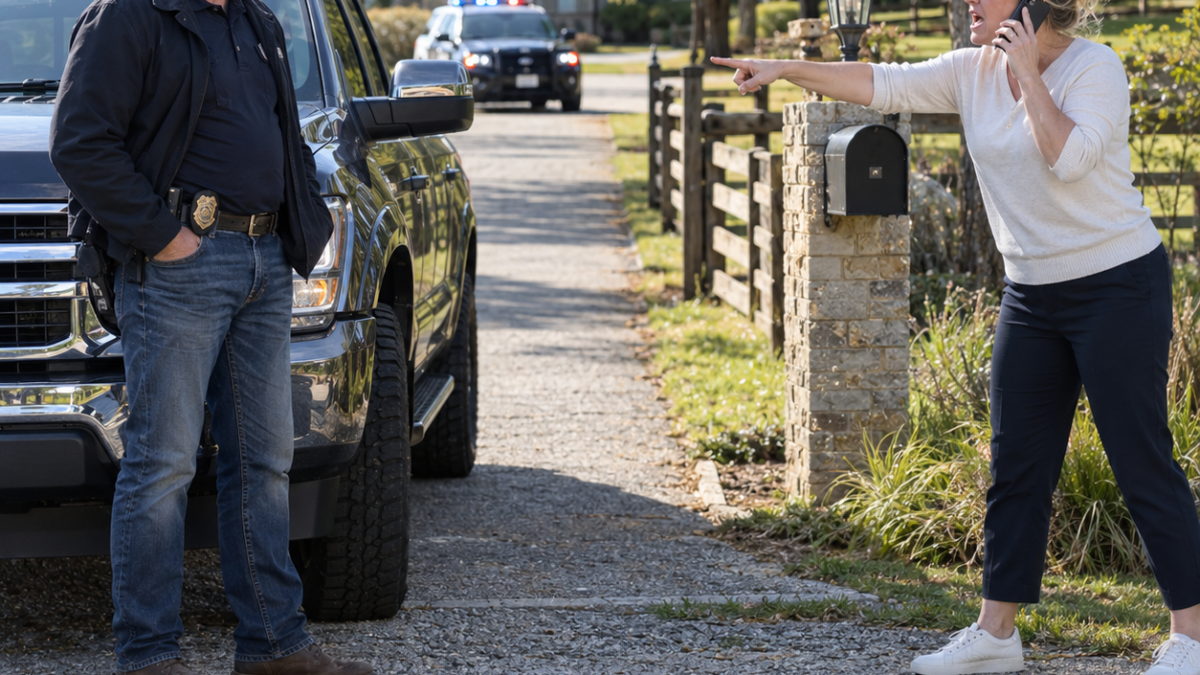
PART 2
I leaned against the front fender of my truck and looked toward the end of the driveway where Donna had been standing.
For thirty-four years, that phone number had usually worked the other way around. I had called into the department from patrol cars, accident scenes, county commission meetings, midnight searches, flooded roads, domestic calls, command meetings, and more emergencies than I could count.
Now the department was calling me.
I had retired only a couple of months earlier.
My name is Ray Dunbar. I entered law enforcement at twenty-two and spent most of my adult life with the Hale County Sheriff’s Office. I started when we were a small operation working out of a building that had once been a feed store. I spent eight years in patrol, made sergeant, then lieutenant, captain, and eventually became the department’s chief administrative officer.
For eleven years, I ran that agency.
I never cared much for titles outside work, but inside the department everybody called me Chief. Apparently retirement had not erased the habit.
The deputy on the phone was Carl Tatum.
Carl had joined seven years earlier. I had been there when his class took the oath. I had shaken his hand afterward and told him what I told every new deputy who came through our doors.
“Know the statute. Know the boundary. Never step one inch farther than the law authorizes you to go.”
Carl remembered.
More important, he lived that way.
“I’m about four minutes out,” he told me. “Just wanted you to know I’m responding.”
“Come on down,” I said. “Run the call exactly the way you would any other.”
“Yes, sir.”
“And Carl?”
“Yes, Chief?”
“Don’t take my word for anything. Check it.”
There was a small pause.
“Understood.”
I hung up.
That mattered to me.
I did not want a favor.
I did not want a former employee arriving and telling Donna she was wrong because I used to be his boss.
That would have defeated the entire point.
If my truck was illegally parked, I wanted Carl to say so. If my permit was defective, I wanted him to find it. If I had overlooked some easement or county restriction, I wanted the same enforcement any other landowner would receive.
The law had to mean the same thing whether the person standing in the driveway was a retired police chief, a plumber, a schoolteacher, a mechanic, or an eighty-year-old widow who had never met a deputy in her life.
Otherwise it was not law.
It was privilege.
And I had spent too many years wearing a badge to confuse the two.
I pulled my glove back on and climbed into the trench.
I had four minutes.
There was no reason to waste them.
I finished measuring the clay depth at the sixty-foot mark, recorded it in my field notebook, then added another entry beneath the one I had made after Donna left.
“9:09 a.m. HCSO unit responding to complaint. Road obstruction/uncooperative driver alleged. Actual conditions: permitted drainage work on private property. Caldwell Road unobstructed. Permit flags visible.”
Then I put the notebook on the tailgate beside the folder containing every document that mattered.
My drainage permit.
The approved engineering plan.
My deed.
The 2014 driveway-access permit.
A copy of the Pinecrest Ridge covenant.
The plat map.
I had learned a long time ago that memory wins arguments for about five minutes.
Paper wins them for decades.
At 9:13, I heard tires crunch onto the gravel shoulder.
Carl’s patrol unit stopped behind Donna’s car.
She had returned.
That did not surprise me.
What surprised me slightly was the way she stood when Carl stepped from the cruiser.
Her shoulders straightened.
The clipboard came back up.
Her whole posture changed.
I had seen it thousands of times.
People often became more confident when a uniform arrived because they assumed the uniform had come to confirm what they already believed.
Carl adjusted his campaign cover and walked to Donna first.
Exactly right.
She was the complainant.
He needed her version before mine.
I remained beside the truck.
I could not hear every word from sixty feet away, but I did not need to. I knew what a field contact looked like.
Donna pointed toward my truck.
Then toward my driveway.
Then toward the subdivision entrance.
Carl listened.
He wrote.
She spoke longer.
He continued writing.
He did not nod in agreement. He did not shake his head. He simply collected her statement.
Then he looked down Caldwell Road.
North.
South.
Clear in both directions.
He looked at my cones.
He looked at the orange permit flags.
He looked at where the truck sat in relation to the road shoulder.
Then he looked back at Donna.
She said something else.
Carl wrote one final line, closed the notebook, and turned toward me.
He walked up the driveway slowly.
When he reached about ten feet from me, he removed his campaign cover.
Then he extended his hand.
“Morning, Chief.”
I shook it.
“Morning, Carl.”
Behind him, Donna Marsh stopped moving.
Completely.
I did not look directly at her.
Not yet.
“How are you doing?” I asked him.
“Doing fine, sir.”
He glanced at the trench.
“You’ve been busy.”
“It keeps me out of trouble.”
The corner of his mouth moved.
Then his professional expression returned.
“I’ve got a complaint of a road obstruction and a safety hazard.”
“I figured.”
“You have documentation?”
“On the tailgate.”
I handed him the folder.
He did not skim it.
That was one of the things I had always liked about Carl.
He read.
First the drainage permit.
He checked the permit number.
Then he walked to the orange flags and compared the number printed on them.
Match.
He read the authorized scope of work.
Subsurface drainage installation.
South side of driveway.
Parcel 04-2013-0017.
He looked into the trench.
Perforated pipe.
Filter fabric.
Clean aggregate.
Exactly what the document authorized.
Then he turned to my deed.
“Book forty-four, page twelve?”
“That’s right.”
“Recorded March fifteenth, 2013?”
“Yes.”
He checked the property description.
Then the plat map.
Then the Pinecrest Ridge covenant.
I watched him work and felt something unexpectedly emotional rise in my chest.
It was not pride in being recognized.
It was pride in him.
Seven years earlier, Carl had been one of a row of young deputies standing stiffly at their swearing-in ceremony, new uniforms looking too clean, badges brighter than experience had yet earned.
Now he was standing on my driveway doing exactly what I had spent decades telling officers to do.
Document first.
Opinion second.
Authority only where authority actually existed.
He activated his body camera and began photographing the scene.
The permit.
The deed.
The orange flags.
The open trench.
The pipe.
The truck.
The truck’s position relative to Caldwell Road.
Then he walked to the edge of the drive and captured the road in both directions.
No obstruction.
No backed-up traffic.
No emergency.
Not even a passing vehicle at that moment.
He returned to me and handed back the folder.
“Everything’s in order, Chief.”
I waited.
“Permit is current. Work matches the approved scope. Truck is on your property. Road is clear.”
Another pause.
“I don’t have a violation.”
“I didn’t expect you to.”
“I know.”
That was when we heard Donna’s footsteps.
Fast.
She crossed from the shoulder onto my driveway and headed toward us.
This time, she stepped past the property line without hesitation.
Her face had changed.
Not embarrassed yet.
Angry.
There is a specific kind of anger people feel when an authority they summoned fails to validate them.
I had seen it countless times.
She stopped beside Carl.
“Well?”
Carl put his campaign cover back on.
That tiny gesture changed the entire tone of the conversation.
He was no longer talking to a former colleague.
He was the responding deputy addressing the complainant.
“Ma’am, I’ve inspected the location and reviewed the relevant documentation. Mr. Dunbar’s vehicle is on private property. The drainage work has a valid county permit, and Caldwell Road is unobstructed in both directions. I cannot identify a violation requiring the vehicle to be moved.”
Donna looked at my truck as though it had personally betrayed her.
“It’s still obstructing the entrance visually.”
Carl remained calm.
“Visually?”
“Yes. The HOA has standards.”
“What you’re describing sounds like a covenant issue.”
“It is.”
Carl glanced at the map.
“The covenant applies to property within the recorded Pinecrest Ridge plat.”
Donna’s jaw tightened.
“This property affects Pinecrest Ridge.”
“That isn’t the same thing as being part of Pinecrest Ridge.”
She looked at me.
Then at him.
Then back at me.
And finally the question she had been holding escaped.
“Why did you call him Chief?”
Silence.
Carl could have ignored the question.
He had no obligation to answer it.
Instead, he gave her the simplest possible truth.
“Mr. Dunbar served as chief of the Hale County Sheriff’s Office for eleven years. He retired in August. Most of us still call him Chief.”
Donna’s clipboard lowered.
Not dramatically.
Her arm simply lost some of its stiffness.
She stared at me.
I had seen that expression before.
It was the face of someone mentally replaying the last half hour and hearing their own words differently the second time.
Move your truck.
Now.
Uncooperative driver.
Safety hazard.
Send a unit.
I said nothing.
She looked at Carl.
“So he was your boss?”
“He led the department, yes.”
“And this department covers Pinecrest Ridge?”
Carl’s face did not change.
“Yes, ma’am.”
“All of it?”
“Pinecrest Ridge is unincorporated Hale County. Our office has primary law-enforcement jurisdiction over the subdivision, its roads where applicable, common areas, and surrounding unincorporated property.”
Donna looked toward the brick entrance sign.
Then at me again.
It was important that Carl’s next words carried no threat, and they did not.
He simply explained the jurisdiction because she had asked.
“The agency you called today is the same agency that responds to law-enforcement calls inside Pinecrest Ridge.”
She swallowed.
“I didn’t know.”
I finally spoke.
“I figured you didn’t.”
She stared at me for another few seconds.
Then her eyes moved toward the documents on the tailgate.
The surprise of my former position was dramatic, but I knew something she did not yet understand.
My old title was not the strongest thing sitting on that driveway.
The strongest thing was paper.
And Carl was about to show her.
Instead of leaving, he returned to his patrol vehicle.
He opened the driver’s door, sat down, and brought up the mobile data terminal.
I knew exactly what he was doing.
Years earlier, during my tenure, we had upgraded those units to access the county GIS database from patrol vehicles. Boundary disputes happened constantly in rural law enforcement—fences, hunting land, driveways, easements, farm lanes, drainage ditches.
A deputy needed more than two angry people pointing in different directions and yelling, “My property starts there.”
The county map did not settle every legal dispute, but it gave officers a reliable starting point.
Carl entered my parcel number.
04-2013-0017.
My four acres appeared.
Then he activated the Pinecrest Ridge subdivision layer.
Two boundary lines appeared on the screen.
My parcel.
Their subdivision.
Separate.
Carl measured the closest point.
Fourteen feet.
There was actually a fourteen-foot strip between the eastern edge of my driveway area and the nearest portion of the HOA plat boundary.
My truck was another sixty feet west from there.
In other words, even at the closest practical measurement, the truck Donna wanted moved was roughly seventy-four feet from the subdivision’s legal boundary.
Not inches.
Not an ambiguous fence line.
Not an overlapping easement.
Seventy-four feet.
Carl printed the map from the small unit printer.
Then he got out.
Donna had remained beside her car.
He walked over and unfolded the page.
I stayed near my trench.
Carl pointed at one line.
“This is the Pinecrest Ridge recorded boundary.”
His pen moved.
“This is Mr. Dunbar’s parcel.”
Then farther west.
“This is his driveway.”
Then farther again.
“This is approximately where the truck is parked.”
Donna stared at the map.
Carl gave it to her.
She held it with both hands.
For the first time since she arrived that morning, she had nothing immediate to say.
I walked toward them carrying my document folder.
Then I removed two papers.
The first was the Pinecrest Ridge covenant.
I laid it on the hood of Donna’s car.
I pointed at the date.
November 14, 2017.
Then I placed my deed beside it.
March 15, 2013.
Four years and eight months earlier.
I opened the covenant to the applicability clause.
“All parcels within the Pinecrest Ridge subdivision as recorded in Hale County Plat Book 22, pages 14 through 19.”
“Find my parcel number,” I said.
Donna read it.
Her eyes moved once.
Then again.
She turned the page.
Then looked at the GIS map.
She could not find my parcel number because it was not there.
It had never been there.
“My property existed before your HOA,” I said. “My driveway existed before your HOA. My garage permit existed before your HOA.”
She looked up.
“But it still affects the appearance of our entrance.”
Her voice was quieter now.
The legal claim had collapsed, so she had retreated to the emotional one.
I understood that.
“The appearance of your entrance is your responsibility,” I said. “My property is not an aesthetic buffer for your subdivision.”
Her mouth tightened.
“Is there no HOA procedure for adjacent properties?”
Carl answered that one.
“No, ma’am. Not unless there is a recorded agreement connecting the outside parcel to the association.”
“What kind of agreement?”
“An annexation, covenant agreement, easement, maintenance agreement—something legally executed and recorded against the property.”
He looked toward me.
“Something Mr. Dunbar would have had to sign.”
I shook my head.
“I never signed one.”
Donna looked back at the papers.
“You’re sure?”
I almost smiled.
Instead, I pointed at the deed.
“You can search the county index yourself.”
She stood quietly for several seconds.
Then she walked about thirty feet away toward the Pinecrest Ridge entrance and took out her phone.
Carl and I could hear only her side of the conversation.
“I have a property question.”
Pause.
“Adjacent parcel.”
Pause.
“The parcel predates the subdivision covenant.”
Longer pause.
Her posture changed.
“Even if it’s visible from the entrance?”
Another pause.
“Does the covenant cover property that predates it if the property is next to the plat?”
Longer silence.
Then the question that mattered.
“Is there any mechanism at all?”
The person on the other end spoke for a while.
Donna did not interrupt.
Finally she said, “Thank you.”
She ended the call.
When she walked back toward us, the anger was gone.
She stopped in front of me.
“I may have been working from incorrect information.”
I looked at her.
There were a dozen things I could have said.
You think?
That is what I could have said.
After thirty-four years dealing with people at their worst, I had learned that the line between winning a conflict and solving one was often a single unnecessary sentence.
So I chose the useful response.
“I appreciate you saying that.”
Carl made a final notation in his field book.
No violation found.
Complainant advised of property boundaries.
Permit verified.
GIS map provided.
That should have ended it.
For the moment, it did.
Carl closed the folder and looked at me.
“Anything else you need, Chief?”
I glanced back at the open trench.
“About four more hours of daylight and a sandwich.”
He smiled.
“Can’t help you with the daylight.”
“Government service isn’t what it used to be.”
That earned a slightly bigger smile.
Then he straightened.
“I’ll close the call as no violation found.”
“Sounds right.”
He shook my hand.
Then he walked toward his cruiser.
Donna remained on the shoulder.
Carl stopped before getting in, apparently deciding the situation deserved another minute of stability. A good deputy does that. The report may be finished, but the job is not over until the temperature comes down.
Finally he keyed his radio.
I heard fragments.
Call number.
Disposition.
“No violation found. Complainant advised.”
Then he drove north.
I went back to my trench.
For the next several minutes, Donna did not leave.
I tamped the filter fabric against the sidewall.
Measured.
Logged.
Moved another five feet.
Still there.
Eventually I heard footsteps behind me.
I turned.
Donna was walking up my driveway again.
But something was missing.
The clipboard.
She had left it on the hood of her car.
That interested me.
People reveal themselves not only by what they carry, but by what they finally decide to put down.
She stopped several feet away.
“Can I ask you something?”
“You’re already here.”
“Why didn’t you tell me?”
“Tell you what?”
“That you were the chief.”
“Former chief.”
“You know what I mean.”
I set the tamping rod against the trench.
“Because it wasn’t relevant.”
She blinked.
“You didn’t think that was relevant?”
“No.”
Her expression suggested she did not believe me.
I wiped dirt from my gloves.
“My truck was legal because it was on my property. The permit was valid because the county issued it. Your covenant didn’t apply because my parcel isn’t in your plat. None of those facts change because of what job I used to have.”
She looked toward Caldwell Road.
“I would have handled this differently.”
And there it was.
The sentence that mattered more to me than anything else she had said all morning.
“I know,” I told her.
She looked back.
“That’s the part that bothers me.”
Her face hardened defensively.
“I’m saying I would have been more careful.”
“I understand exactly what you’re saying.”
She folded her arms.
“Then what’s the problem?”
“The problem is that I should not have needed to be somebody important before you became careful.”
Silence.
The wind moved through the sweet gum trees behind my garage.
I continued.
“If the person standing in this driveway had been a twenty-five-year-old mechanic, would you have ordered him to move the truck?”
She said nothing.
“If it had been an elderly woman?”
Still nothing.
“If it had been somebody who didn’t know how to pull a deed, read a plat, or cite a recording date, would you have told that person the HOA controlled property it doesn’t control?”
“That’s not fair.”
“I’m not accusing you of what you might have done. I’m asking you to think about what you did do.”
Her arms slowly loosened.
I had no desire to humiliate her.
But this part could not be softened into meaninglessness.
“You came here with no document establishing authority. I gave you the recording dates. I told you where to find my deed. I told you the truck was on private property. Then you called 911.”
“It looked like a hazard.”
“No.”
I kept my voice level.
“You told dispatch it was a hazard.”
She stared at me.
“There’s a difference.”
“What are you implying?”
“I’m not implying anything.”
I walked to the tailgate and picked up my field notebook.
“Your call was made at 9:02. You reported a vehicle obstructing Caldwell Road.”
I pointed toward the road.
“My truck was never on Caldwell Road.”
She started to answer.
I raised one finger—not aggressively, simply asking her to let me finish.
“You reported the driver as uncooperative. I answered your questions, told you where the legal records were, showed you the permit, and declined to obey a demand you had no authority to make.”
Her face had lost color.
“Declining an unlawful demand is not the same thing as being uncooperative.”
“I believed—”
“I know what you believed.”
I closed the notebook.
“But emergency dispatch is not an extension of an HOA enforcement process.”
That landed.
She looked toward the road where Carl’s cruiser had disappeared.
I lowered my voice.
“Filing a knowingly false report with emergency dispatch can have consequences.”
I did not need to say anything more.
She knew what I meant.
And because she now knew who I was, she also understood something else.
The dispatch audio existed.
The call time existed.
Carl’s body-camera footage existed.
His photographs of an empty Caldwell Road existed.
My permit existed.
The GIS map existed.
The field notebook existed.
Her own words existed.
Everything had been documented before either of us knew how far the argument would go.
Donna went still.
For the first time that morning, I saw something in her face that was not irritation, authority, calculation, or embarrassment.
Fear.
And that was precisely when I made the decision that defined everything that happened afterward.
“I’m not filing a complaint against you.”
She stared at me.
“What?”
“I’m not asking the department to charge you. I’m not filing an administrative complaint. I’m not calling the county attorney.”
She studied my face as though looking for a trap.
“Why?”
“Because I don’t want revenge from a badge.”
Her eyebrows pulled together.
“I want a boundary.”
I walked to my document folder.
“There’s a difference.”
Two months before that morning, after Donna’s first visit to my house concerning the orange permit markers, I had called an attorney named Patricia Gaines.
Patricia had practiced property law in Hale County for twenty-eight years.
She knew deeds.
Easements.
Subdivision plats.
Covenant annexations.
Boundary disputes.
More importantly, she understood the permanent value of getting an obvious fact written into the public record before someone turned that fact into an expensive argument.
When I had explained Pinecrest Ridge, she had pulled the same documents I had.
My deed.
Their plat.
Their covenant.
Her conclusion took about fifteen minutes.
“They have nothing on your parcel, Ray.”
“I know.”
“So why are you calling me?”
“Because knowing something and preventing the next argument are two different jobs.”
She had laughed once.
“That sounds like thirty-four years of police work talking.”
“Probably.”
Patricia drafted a one-page document.
Boundary Acknowledgement and Covenant Non-Applicability Statement.
Parcel 04-2013-0017.
Simple.
No insults.
No accusations.
No threats.
It said that the Pinecrest Ridge Homeowners Association acknowledged that my parcel was outside its recorded plat and that the association held no covenant, aesthetic, maintenance, access, or use authority over my property.
It referenced the deed.
The plat.
The applicable recording information.
It had a signature line for the HOA president.
Two witness lines for board members.
A notary block.
Once signed and recorded, it would become part of my parcel’s title history.
Permanent.
Searchable.
Future board members would not be able to pretend the question had never been answered.
I removed the form from my folder and handed it to Donna.
She read the title.
Then the first paragraph.
Then the operative language.
Her eyes slowed.
“This says we have no authority of any kind.”
“Over my parcel. Correct.”
“You want me to sign this?”
“I want your board to review it.”
“And if we don’t?”
I looked at her.
“There’s no threat attached to the document.”
She waited.
I continued.
“You have your attorney. I have mine. The county records are public. Your board can take as much time as it needs.”
She glanced toward the road.
“So you’re not demanding a deadline?”
“No.”
“No lawsuit?”
“Not unless somebody gives me a reason to file one.”
That made her look up.
I kept my voice even.
“What I want is simple. Your organization stays inside its recorded boundary. I stay on my land. Nobody needs deputies, courtrooms, lawyers, or headlines.”
She looked at the paper again.
“My attorney’s contact information is attached,” I said. “If your board has questions, call her.”
Donna folded the document carefully.
Not angrily.
Not casually.
She placed it in the pocket of her HOA polo.
“I’ll bring it to the board.”
“Thank you.”
She turned to leave.
Then stopped.
“Ray?”
“Yes?”
“I really did think the covenant applied.”
I believed her.
That was the uncomfortable part.
People can cause enormous problems without believing they are doing anything wrong.
“I know,” I said. “Read it next time before you enforce it.”
She nodded once.
Then she walked back to her car.
The clipboard remained on the hood until she reached it.
She picked it up.
Got inside.
Drove away.
I watched her turn into Pinecrest Ridge.
Then I looked at the unfinished trench.
Sixty feet remaining.
I climbed back in.
Three days later, the Pinecrest Ridge board met in executive session at the clubhouse.
I was not there.
I learned the details later from Patricia and from the documents that came out of that meeting.
Donna placed everything on the table.
The GIS map.
My deed date.
The covenant date.
The applicability clause.
Patricia’s letter.
The proposed acknowledgement.
The board consisted of Donna, vice president Greg Holt, treasurer Sandra Lewin, and at-large member Phil Carey.
Greg worked in commercial real estate.
That mattered.
People could argue opinions all evening.
Greg worked with recorded instruments for a living.
He read the covenant.
Then he read the plat reference.
Then he traced the Pinecrest Ridge boundary on the GIS map.
Then he found my parcel.
Outside.
He reportedly sat back and said five words.
“He’s right. He’s not in this.”
Sandra asked whether he was certain.
Greg slid the covenant toward her.
“Find his parcel.”
She could not.
Because, again, it was not there.
Phil was a retired civil engineer.
He read Patricia’s letter from the first line to the last.
Then the acknowledgement.
Then the map.
When he finished, he reportedly said, “We should sign it.”
Donna did not immediately respond.
Sandra looked at her.
Then she asked the question none of them had apparently wanted to ask.
“What about the 911 call?”
The room went quiet.
Donna said she had called as a private resident.
Sandra asked whether she had been wearing the HOA polo.
Donna said yes.
“Were you carrying the association clipboard?”
“Yes.”
“Did you identify the problem as an HOA standards issue?”
Donna did not answer immediately.
Sandra leaned back.
Then she asked something even more uncomfortable.
“If his attorney claims you were acting as HOA president, what exactly are we going to use to prove you weren’t?”
Nobody had a good answer.
Greg returned his eyes to the boundary statement.
“We should sign this.”
Phil nodded.
“I said that ten minutes ago.”
Donna looked at the line containing her title.
President, Pinecrest Ridge Homeowners Association.
Everything had reached the place I had wanted it to reach.
Not a shouting match.
Not a police station.
Not a courtroom.
A table.
Four adults.
A deed.
A plat.
A map.
And a pen.
Donna called the vote.
“All in favor?”
Four hands.
Four to zero.
Unanimous.
She signed first.
Greg signed as witness.
Sandra signed as second witness.
A licensed notary came to the clubhouse later that evening, verified the signatures, administered the affirmation, and applied his seal.
The paper Donna had carried away from my driveway as a proposal left the clubhouse as an executed legal instrument.
She mailed it certified to Patricia.
Friday morning, my phone rang while I was working at the 110-foot station of the French drain.
I climbed out of the trench.
“Ray?”
“Morning, Patricia.”
“I have something you’re going to enjoy.”
“That sounds expensive.”
She laughed.
“Not this time.”
I could hear paper moving.
“The Pinecrest Ridge acknowledgement arrived.”
I stopped.
“Signed?”
“President, two board witnesses, properly notarized. Execution is clean.”
For several seconds I said nothing.
Not because I was shocked.
Because I felt something I had not expected.
Relief.
My wife used to tease me that I could turn any emotional problem into a filing system if given enough time.
She had died years before my retirement, and there were still mornings when I reached for a second coffee mug before remembering there was nobody sitting across from me.
She had watched me buy those four acres.
She had walked the ridge with me.
She had stood beside me when the gravel driveway first went in and laughed because I spent an entire weekend spreading stone by hand rather than paying another crew to finish it.
She understood why that land mattered.
After decades of carrying other people’s emergencies home inside my head, Caldwell Road had been the place I intended to make quiet.
Not grand.
Not impressive.
Mine.
Hearing Patricia say that the boundary was finally going into the permanent county record felt like protecting something larger than gravel and acreage.
It felt like protecting the life I had built after the uniform.
“Record it,” I said.
“I’ll send it over today.”
“Thank you.”
“You’re welcome.”
She paused.
“And Ray?”
“Yes?”
“You handled this better than most clients would have.”
“I had thirty-four years of practice watching people handle things worse.”
She laughed again.
“I’ll send you the recording information.”
We hung up.
I put the phone away.
There were fifty feet of trench left.
I picked up the tamping rod and went back to work.
The following Tuesday, the document entered the Hale County deed index.
Book 58, page 31.
That number meant more to me than any insult, fine, apology, or public embarrassment ever could.
My original deed was Book 44, page 12.
That document said I owned the land.
Now Book 58, page 31 said something else.
The HOA itself acknowledged that it did not.
That was my revenge.
Not getting Donna arrested.
Not humiliating her at a community meeting.
Not using former colleagues to frighten her.
Not putting her name in the newspaper.
I took the very authority she had tried to extend across my driveway and made her organization permanently sign its own limit.
A future HOA president could not show up ten years later and say nobody knew where the boundary was.
A future board could not rewrite the story.
A management company could not inherit incomplete files and send me a violation notice because somebody decided my truck offended the entrance.
A title search would find the answer.
A lawyer would find it.
A buyer would find it.
A judge, if it ever came to that, would find it.
The HOA’s own signature would be waiting.
That was stronger than revenge that lasted an afternoon.
It lasted with the land.
By the end of October, I finished the French drain.
The county inspector came out, walked the entire 140 feet, checked the grade, checked the outlet protection, compared the installation to the approved plan, and signed the permit closed.
“No corrections required.”
Those three words made me happier than they probably should have.
I returned the equipment trailer.
Stacked the cones in the garage.
Filed the closed permit beside my deed and the certified boundary acknowledgement.
Then I parked my truck in my driveway.
Same place.
Same angle.
Nothing dramatic happened.
That was exactly what I wanted.
Donna did not resign as HOA president.
I had never asked her to.
The board continued meeting.
Pinecrest Ridge continued collecting dues.
Lawns were still mowed.
Fence heights were still measured.
The newsletter still arrived.
The entrance landscaping remained immaculate.
But something changed.
Donna stopped coming down Caldwell Road with a clipboard.
She stopped slowing when she passed my property.
She stopped asking about cones.
She stopped asking about equipment.
She stopped treating everything visible from the Pinecrest Ridge entrance as if visibility created jurisdiction.
Our properties existed beside each other exactly the way the county records said they did.
Theirs on one side.
Mine on the other.
Peace, I learned long ago, is often nothing more mysterious than two people finally respecting the same line.
A couple of weeks later, I ran into Carl Tatum at a gas station.
He was coming off night shift.
I was headed to the hardware store.
He leaned against his cruiser while the pump ran.
“How’s retirement treating you, Chief?”
“I spend more money at the hardware store than I expected.”
“That sounds like retirement.”
“How’s the department?”
“Busy.”
“Good busy or bad busy?”
“County busy.”
I knew exactly what that meant.
We talked about staffing.
A couple of young deputies.
A road project.
Nothing confidential.
Then Carl smiled.
“That call got around.”
I sighed.
“I figured.”
“Nobody made anything official out of it.”
“I wouldn’t expect them to.”
“But some of the guys thought it was funny.”
“I bet they did.”
He hesitated.
“Lieutenant Barrow didn’t.”
That sounded like Elise.
“What did she say?”
Carl shook his head.
“I’m not repeating it.”
I laughed.
“That bad?”
“Professional courtesy says I should leave it there.”
“Smart man.”
The pump clicked off.
Carl removed the nozzle.
Then he looked at me.
“For what it’s worth, Chief, I was glad it was straightforward.”
“So was I.”
He replaced the nozzle.
“Permit. Deed. Boundary. Done.”
I nodded.
“Best calls are the ones where the facts do the talking.”
He smiled.
“You used to say that.”
“I used to say a lot of things.”
“You still do.”
We shook hands.
He returned to his cruiser.
I drove to the hardware store.
November settled over Hale County.
The trees went bare.
Mornings got colder.
I kept waking before six because thirty-four years of shift schedules had apparently rewired something permanent in my body.
I would make coffee and take it to the porch while the sky brightened over the ridge.
From there, I could see the roofs of Pinecrest Ridge.
One hundred eighty homes.
Families getting kids onto school buses.
People leaving for work.
Garage doors rising.
Dogs being walked.
Ordinary lives.
I never hated those people.
That part matters.
Most of them had nothing to do with Donna’s visit.
They had purchased homes in a covenant community because they wanted what covenant communities offer.
Standards.
Maintenance.
Predictability.
Shared amenities.
There is nothing inherently wrong with that.
The problem begins when a rule meant for people who agreed to it is pointed at somebody who never did.
I had spent a career around authority.
Real authority.
The kind backed by law.
The kind that can put a person in handcuffs, enter property under certain circumstances, stop vehicles, execute warrants, and use force when the law permits.
That kind of authority teaches you something if you hold it long enough.
The more power you have, the more important the boundary becomes.
A badge is not permission to do whatever feels right.
Neither is a clipboard.
The same principle applies.
Know what authorizes you.
Know where it stops.
One morning, a man came jogging along Caldwell Road from the Pinecrest Ridge entrance.
Mid-forties, maybe.
Earbuds.
Running gear.
I recognized him as somebody from the subdivision, though I did not know his name.
My truck sat in the driveway.
Exactly where it had sat the morning Donna called 911.
The jogger slowed.
He looked at the truck.
Then at me sitting on the porch with coffee.
For half a second, I wondered whether somebody had told him the story.
He pulled one earbud out.
We looked at each other.
Then he nodded.
I lifted my coffee mug.
He put the earbud back in and kept running.
That was all.
No clipboard.
No accusation.
No phone call.
No cruiser.
A truck sat in a man’s driveway, and another man jogged past it.
The ordinary nature of that moment felt almost beautiful.
I finished my coffee and went inside.
On the kitchen table were plans for my next project.
A workshop addition behind the garage.
I had framing dimensions spread over graph paper, an electrical rough-in diagram, and a materials list I had rewritten three times because apparently retirement had not cured my need to organize everything.
I sat down.
Picked up my pencil.
Before starting, I glanced toward the filing cabinet.
Inside was the original deed.
Book 44, page 12.
March 15, 2013.
My land.
And beside it was a certified copy of another document.
Book 58, page 31.
The Pinecrest Ridge Homeowners Association’s written acknowledgement that its authority stopped where my property began.
Donna had called 911 because I refused to move a truck from my own driveway.
She believed the uniform coming down Caldwell Road would force me to obey her.
Instead, the deputy inspected my permit, photographed the clear road, pulled the county map, and showed her that the HOA boundary stopped seventy-four feet before it ever reached my truck.
She discovered who I was.
But that was never the real lesson.
The real lesson was that I should not have needed to be anybody.
My rights did not come from an old title.
They did not come from Carl calling me Chief.
They came from the same place every property owner’s rights came from—the law, the deed, and the boundary written on the page.
That was why I never filed the complaint that could have turned Donna’s 911 call into something uglier.
I did not want her afraid of me.
I wanted her organization unable to make the same mistake again.
So I asked for one signature.
Then another.
Then another.
I put their own acknowledgement into the permanent record.
Years from now, somebody may buy Donna’s house.
Another board president may sit at the head of the clubhouse table.
Carl may retire.
Patricia may close her practice.
I may be gone.
But the county index will still have Book 58, page 31.
And if someone ever decides the HOA owns the view beyond its entrance sign, they can pull that page and read exactly where the authority ends.
I put the pencil against my workshop drawing and measured the next wall.
Outside, my truck remained in my driveway.
Nobody called 911.
Nobody told me to move it.
The drain beneath the gravel carried groundwater quietly toward the outlet, invisible now that the trench had been filled.
The road remained clear.
Pinecrest Ridge remained on its side of the boundary.
I remained on mine.
For thirty-four years, I had told young deputies the same thing: know the statute, know the boundary, and never take one step beyond what the paper authorizes.
It turned out retirement had given me one final chance to watch that lesson work.
Donna came to my property believing authority was something you could enlarge simply by speaking with enough confidence.
She left understanding that authority is the opposite.
It is measured by its limits.
My deed had always said where mine began.
Her covenant had always said where hers ended.
All I did was make her sign underneath it.
And somehow, after all the shouting she could have caused, all the legal threats she could have made, all the police reports and hearings and lawsuits the situation might have become, the most satisfying ending was one quiet sheet of paper sitting in a county filing cabinet.
My name was on the first recorded document.
The HOA’s signature was on the second.
The truck was still exactly where I had parked it.
And this time, nobody mistook my silence for permission.
Three days after Donna Marsh stood in my driveway and discovered that calling the sheriff’s office had not magically extended her HOA’s authority by seventy-four feet, the Pinecrest Ridge board met behind closed doors at the clubhouse.
I was not invited.
I did not ask to attend.
Patricia Gaines, my attorney, was not there either.
That was intentional.
If the board was going to sign the boundary acknowledgement, I wanted them to do it because the deed, plat, and covenant forced them to the same conclusion I had reached years ago—not because a retired police chief was sitting across the table making four nervous volunteers feel cornered.
By then, Donna had everything she needed.
The county GIS map Carl Tatum had printed beside my driveway.
My deed, recorded in March of 2013.
The Pinecrest Ridge covenant, recorded years later.
The applicability clause limiting that covenant to parcels inside the recorded subdivision plat.
And Patricia’s one-page acknowledgement stating in plain language that the HOA held no covenant, maintenance, aesthetic, access, or enforcement authority over my property.
From what I later learned, the meeting lasted a little over an hour.
The important part took less than fifteen minutes.
Greg Holt, the vice president, worked in commercial real estate. He was the first one to stop treating the issue as an HOA disagreement and start treating it like what it actually was—a recorded-property question.
He read the covenant once.
Then he read it again.
He opened the plat.
He found the Pinecrest Ridge boundary.
Then he found my parcel.
Separate.
Outside.
No overlap.
No annexation.
No easement.
No agreement.
Nothing.
“He’s right,” Greg reportedly said.
Donna sat at the head of the table.
Sandra Lewin, the treasurer, looked at the map.
“What exactly do you mean?”
Greg pushed the plat toward her.
“He’s not in the association.”
“We know he’s not a member.”
“No,” Greg said. “I mean legally. He’s not in this. At all.”
That distinction mattered.
Donna had spent months behaving as though I was a difficult neighbor who technically lived outside the subdivision but could still be pressured because my property was visible from the entrance.
Greg understood that visibility meant nothing.
The HOA’s authority did not fade gradually as it moved toward my land.
It stopped.
At a line.
One side belonged to Pinecrest Ridge.
The other did not.
Phil Carey, the retired civil engineer on the board, had been reading Patricia’s proposed acknowledgement while Greg spoke.
Finally he looked up.
“We should sign it.”
Donna’s eyes went to him.
“Immediately?”
“What are we waiting for?”
“I’d like counsel to review it.”
“That’s fine,” Phil said. “But unless counsel finds a document that none of us have found, the conclusion isn’t changing.”
Sandra turned toward Donna.
Then she asked the question that changed the mood in the room.
“What about the 911 call?”
Nobody answered.
Donna sat back.
“I called because I believed there was a safety problem.”
Sandra looked at the GIS map.
“The truck was on his driveway.”
“I know that now.”
“The deputy documented that the road was clear.”
“Yes.”
“And you were there as HOA president?”
Donna’s shoulders stiffened.
“I was also there as a resident.”
Sandra did not argue.
She simply asked another question.
“Which shirt were you wearing?”
Donna glanced down at the table.
Nobody needed the answer.
The navy Pinecrest Ridge polo.
“And the clipboard?” Sandra asked.
Donna exhaled.
“Yes.”
Phil folded his hands.
Greg looked toward the proposed acknowledgement again.
The discussion was no longer about whether my truck looked ugly from their entrance.
It was about exposure.
Not some giant multimillion-dollar lawsuit.
Not criminal charges.
Something simpler.
The board had a president who had attempted to enforce HOA standards outside the HOA boundary and then called emergency dispatch after the property owner refused.
That was enough to make sensible people uncomfortable.
Donna could insist all night that the 911 call had been personal.
But the facts around it did not look personal.
HOA shirt.
HOA clipboard.
HOA complaint.
HOA president.
Property outside HOA authority.
Emergency call after refusal.
That sequence spoke for itself.
Greg tapped Patricia’s document.
“This solves the property issue.”
Sandra nodded.
“And it shows we corrected it.”
Phil added, “Which is exactly what we should do.”
Donna looked around the table.
There are moments when leadership stops being about winning and becomes about deciding how gracefully you are willing to acknowledge that you already lost.
That Wednesday night was Donna’s moment.
She could have dragged it out.
She could have hired a lawyer to write ten pages explaining why the HOA was misunderstood.
She could have forced me to send demand letters.
She could have tried to rewrite the morning.
Instead, maybe because Carl’s map had removed every inch of uncertainty, she did something I respected.
She called the vote.
“All in favor of executing the boundary acknowledgement?”
Greg raised his hand.
Sandra raised hers.
Phil raised his.
Donna waited about two seconds.
Then she raised hers too.
Four to zero.
Unanimous.
She signed first.
Donna Marsh.
President.
Pinecrest Ridge Homeowners Association.
Greg signed as witness.
Sandra signed as the second witness.
A licensed notary came later that evening and completed the acknowledgment.
By the time Donna drove home, the piece of paper she had taken from my driveway was no longer an argument.
It was an agreement.
Two mornings later, Patricia called me.
I was standing at the 110-foot mark of the drainage trench with dirt on both knees and filter fabric hanging over the edge like a folded blanket.
My phone rang from the tailgate.
I climbed out.
“Ray?”
“Morning.”
“I have your document.”
For a second I did not respond.
“Signed?”
“Everywhere it needs to be.”
I wiped one hand against my work pants.
“And notarized?”
“Clean execution.”
I looked toward the Pinecrest Ridge entrance.
The landscaping crew was there that morning trimming shrubs along the brick columns.
Ordinary scene.
Ordinary day.
Yet something had changed.
“Record it,” I said.
Patricia laughed softly.
“I thought you might say that.”
“When?”
“I can have it at the recorder’s office this afternoon.”
“Do it.”
“I’ll send you the certified copy when it comes back.”
“Thanks, Patricia.”
Before she hung up, she paused.
“You know, most people would have demanded an apology.”
“I got something better.”
“What’s that?”
“Their signature.”
She laughed again.
“That you did.”
I put the phone back on the tailgate and stood there for a minute.
There are victories that make noise.
Courtroom verdicts.
Arrests.
News cameras.
People resigning.
Crowds applauding.
This one made no noise at all.
It arrived in a certified envelope.
A few days later, the acknowledgement entered the Hale County deed index.
Book 58, page 31.
I read the recording stamp twice.
Not because I doubted it.
Because I understood what it meant.
The first important document connected to that land was my deed.
Book 44, page 12.
That document said I owned the parcel.
Now the county had another recorded instrument.
Book 58, page 31.
That document said the Pinecrest Ridge HOA itself acknowledged that its authority stopped before my property began.
That was permanent in a way an argument could never be.
Donna could eventually leave the board.
The other board members could move.
The management company could change.
The subdivision could have twenty different presidents over the next thirty years.
None of it mattered.
A future board could search the parcel and find the acknowledgement.
A title attorney would find it.
A buyer would find it.
A court would find it.
The HOA’s own signature would be waiting there.
I had spent thirty-four years working in a profession built around documentation.
Reports.
Evidence logs.
Warrants.
Statements.
Property sheets.
Chain-of-custody forms.
I had watched excellent police work collapse because somebody failed to document one important fact.
I had also watched simple cases survive every challenge because a careful officer had written exactly what happened, when it happened, and where.
Paper lasts.
Memory does not.
People tell stories differently as years pass.
Paper does not care.
Book 58, page 31 would not remember Donna angrily.
It would not remember me proudly.
It would not remember Carl saying, “Morning, Chief.”
It would not remember the clipboard.
It would not remember the expression on Donna’s face when she realized who I was.
It did not need any of that.
It contained something stronger.
A boundary.
The French drain was finished near the end of October.
I laid the last section of pipe myself.
Covered it with clean aggregate.
Folded the filter fabric.
Backfilled the trench.
Raked the gravel until the driveway looked almost exactly the way it had before I started.
That pleased me.
Good drainage work is supposed to disappear.
The county inspector arrived the following week.
Dennis Pratt.
I had dealt with him twice during my career on property-related calls.
He walked the installation from one end to the other.
Checked the grade.
Checked the outlet.
Reviewed my measurements.
Then he signed the permit card.
“Looks good.”
“That official terminology?”
He smiled.
“Want something longer?”
“I spent eleven days digging that thing. Give me something impressive.”
Dennis looked at the card, pretending to think.
Then he wrote:
Installation consistent with approved plan. No corrections required.
He handed it back.
“There.”
“Much better.”
He laughed.
I filed the closed permit in the same property folder as my deed and the boundary acknowledgement.
Then I returned the equipment trailer.
Stacked the cones in the garage.
Cleaned my tools.
And parked my truck in the driveway.
Same location.
Same angle.
Same truck.
Nothing happened.
No phone call.
No HOA visit.
No deputy.
That silence was one of the most satisfying parts of the entire experience.
Donna did not resign.
Some people might find that disappointing.
I did not.
I had never wanted her position.
I did not want her publicly humiliated.
I did not want residents turning a property dispute into a neighborhood war.
I wanted the behavior to stop.
It stopped.
Donna no longer slowed down when driving past my property.
She no longer appeared beside my driveway holding a clipboard.
She never asked about my drainage equipment again.
She never questioned my truck.
The HOA never mailed me a violation notice.
Never sent me an architectural-review form.
Never requested landscaping changes.
Never claimed my property affected community standards.
They stayed where the plat said they belonged.
So did I.
For me, that was enough.
About two weeks after the acknowledgement was recorded, I stopped for gas on the county road and saw Carl Tatum at the next pump.
He had just finished a night shift.
His eyes looked tired, but he smiled when he saw me.
“Morning, Chief.”
“Carl.”
“How’s civilian life?”
“Expensive.”
He raised an eyebrow.
“Expensive?”
“I know everybody working at the hardware store by first name now.”
“That bad?”
“I retired from law enforcement and accidentally became a full-time customer.”
Carl laughed.
We talked while the pumps ran.
Staffing.
Road construction.
A deputy I had hired who had recently made sergeant.
Then Carl became quieter.
“That call got talked about.”
I groaned.
“Of course it did.”
“Nothing official.”
“I know.”
“Just station talk.”
“What version?”
“The one where the HOA president calls us on our former chief because he parked his truck in his own driveway.”
I closed my eyes for half a second.
“Great.”
“The guys thought it was pretty funny.”
“I’m sure they did.”
Carl hesitated.
“Lieutenant Barrow didn’t.”
I looked at him.
“Elise?”
He nodded.
“What did she say?”
Carl smiled.
“I’m not repeating it.”
“That means it was good.”
“It means I enjoy being employed.”
I laughed.
Elise Barrow had worked under me for years.
She was one of the best lieutenants I had promoted.
Precise.
Calm.
Protective of her officers.
Protective of the public too.
There was a difference, and she understood it.
“She was more upset about the 911 part,” Carl said.
“That part bothered me too.”
“She said emergency dispatch isn’t a customer service line for people who lose arguments.”
“That sounds like Elise.”
Carl nodded.
Then he looked at me seriously.
“You really weren’t going to file anything?”
“No.”
“Why?”
The gas pump clicked.
I removed the nozzle.
“Because if I filed something just because I knew everybody in the department, what lesson would that teach?”
“You had grounds to complain.”
“Maybe.”
“You definitely had grounds to document it.”
“I did.”
He smiled slightly.
“Book 58?”
I looked at him.
“How do you know about that?”
“Small county.”
I shook my head.
Carl grinned.
“You always told us documentation matters.”
“It does.”
“So I guess you documented it.”
“Permanently.”
He put his gas cap back on.
Then he said something I remembered later.
“You know what the funny part is?”
“What?”
“She probably thought the worst thing that could happen was discovering you used to run the sheriff’s office.”
I waited.
Carl nodded toward my truck.
“That wasn’t the worst thing.”
“No?”
“The worst thing was discovering you kept paperwork.”
I laughed harder than I had all week.
“Get some sleep, Deputy.”
“Yes, Chief.”
We shook hands and drove away in opposite directions.
By November, the ridge behind my property had lost most of its leaves.
Cold mornings returned.
I still woke before six.
Thirty-four years of early shifts had trained my body better than any alarm clock ever could.
I would make coffee in the dark and take it onto the porch.
From there I could see the Pinecrest Ridge entrance through the trees.
Cars would begin leaving around six-thirty.
Garage doors opening.
Headlights moving.
Parents heading to work.
School buses arriving.
Dog walkers.
Joggers.
Life.
I never blamed the residents of Pinecrest Ridge for Donna’s mistake.
Most of them had no idea what happened.
They had bought homes in an HOA community because they wanted that kind of structure.
Some people like consistent fences.
Some like strict landscaping.
Some like knowing a neighbor cannot park a broken RV in the front yard for three years.
Fine.
People are allowed to choose rules for themselves.
What they are not allowed to do is choose rules for someone who never agreed to them.
That distinction is where the whole story lived.
One cold Tuesday morning, a jogger came down Caldwell Road.
I had seen him before.
Probably lived somewhere near the western side of Pinecrest Ridge.
He slowed near my driveway.
My truck was parked there.
Exactly where it had been parked on the morning Donna called 911.
I was sitting on the porch drinking coffee.
The jogger looked at the truck.
Then he looked at me.
He pulled out one earbud.
For a second, neither of us spoke.
Then he nodded.
I raised my coffee mug.
He put the earbud back.
And kept running.
That was it.
A man ran past another man’s driveway.
A truck sat on private property.
The world continued.
For reasons I cannot fully explain, that tiny moment gave me more satisfaction than seeing Donna’s signature.
Because ordinary was what I had wanted from the beginning.
I did not buy four acres so I could fight an HOA.
I bought them because after decades of walking into other people’s worst days, I wanted somewhere quiet.
Somewhere I could build things with my hands.
Somewhere a light in the garage at eleven o’clock meant I was working on a project, not preparing for another call.
My wife had understood that.
She had walked the property with me before we bought it.
She stood beside me at the back ridge one February afternoon when the trees were bare and the ground was cold enough to crunch under our boots.
“You like it,” she said.
“I do.”
“You’ve been standing in the same spot for ten minutes.”
“I’m thinking.”
“That’s what you call it?”
“What do you call it?”
“Already owning the place in your head.”
She had been right.
I could see the garage before it existed.
The driveway.
The workshop.
A porch.
A place to sit after retirement when nobody needed me to answer a radio.
She never got as many years there as we had planned.
That remains one of the unfair things life never explains.
But when Donna tried to stretch her HOA authority over those four acres, that history was part of why I refused to move an inch.
Not because of pride.
Because some lines matter.
The property was mine before Pinecrest Ridge existed.
The memories were mine.
The work was mine.
The quiet was mine.
I had no intention of surrendering any piece of it because somebody with a clipboard thought the subdivision entrance deserved a prettier view.
I also had no intention of becoming the kind of man who used an old badge to win a private argument.
That would have dishonored everything the badge was supposed to mean.
The law did not protect my driveway because I was Chief Ray Dunbar.
The law protected it because it was my driveway.
That was why Donna’s sentence stayed with me.
“I would have handled it differently if I had known.”
She meant it as an explanation.
Maybe even an apology.
But it revealed the real problem.
Nobody should have to be important before authority treats them carefully.
Nobody should need thirty-four years in law enforcement to ask, “What document gives you jurisdiction?”
Nobody should need to personally know the responding deputy.
The twenty-five-year-old mechanic deserves the same boundary.
The retired teacher deserves the same boundary.
The widow deserves it.
The immigrant family deserves it.
The guy who gets nervous talking to police deserves it.
Paper should mean the same thing for all of them.
That was what I had tried to teach deputies.
Authority is not proven by how confidently you exercise it.
Authority is proven by how carefully you limit it.
A badge has boundaries.
A warrant has boundaries.
A search has boundaries.
A property line has boundaries.
And yes, an HOA covenant has boundaries.
Years later, people might forget the morning Donna came to my driveway.
Carl might retire.
The dispatch recording would eventually age out of the system.
The body-camera footage would pass its retention period.
The orange permit flags would rust.
The French drain would continue working underground without anyone remembering who installed it.
Maybe somebody else would eventually own my four acres.
But Book 58, page 31 would remain.
That was the beauty of it.
Donna tried to use temporary power.
I answered with permanent documentation.
She had a clipboard.
I had a deed.
She had an interpretation.
I had a plat.
She made a phone call.
I made a public record.
And in the end, she signed it herself.
That is why I never thought of the outcome as letting her off easy.
People asked me later whether I regretted not pushing harder.
I did not.
An arrest would have ended.
A citation would have been paid.
An angry HOA meeting would have become old gossip.
Even a resignation would eventually have been forgotten.
But the board’s signature followed the land.
If Pinecrest Ridge ever hired a new management company, the record remained.
If a new president decided my workshop offended community aesthetics, the record remained.
If somebody twenty years later claimed my parcel was subject to association control, the answer was already sitting in the courthouse.
Not my answer.
Theirs.
That mattered.
One evening near Thanksgiving, I was sitting at my kitchen table working on plans for the workshop addition.
Pencil.
Graph paper.
Tape measure.
Coffee that had gone cold because I had forgotten about it.
Outside, my truck sat in the driveway.
I could see part of it through the kitchen window.
For a moment I thought about that October morning.
Donna at the property line.
“Move your truck now.”
Me climbing back into the trench.
Her calling 911.
Carl arriving.
“Morning, Chief.”
The map.
The seventy-four feet.
The board meeting.
The signatures.
Book 58.
All because one person had confused visibility with authority.
I opened the property folder beside me.
The documents were organized chronologically.
2013 deed.
2014 driveway permit.
Garage records.
Drainage permit.
Inspection closure.
Then the certified acknowledgement.
I slid it out.
Four signatures.
One notary seal.
Plain paper.
No drama.
I read the operative paragraph once more.
Then I smiled.
Not because Donna lost.
Because the line won.
I put the document back in the folder.
Closed the drawer.
Returned to the workshop plans.
Outside, headlights from Pinecrest Ridge moved along the county road.
Nobody turned into my driveway.
Nobody stopped.
Nobody knocked.
Nobody called the sheriff.
The drain beneath the gravel carried water away exactly as designed.
My truck remained exactly where I had parked it.
My property remained outside the subdivision.
Their HOA remained inside it.
And for the first time since Donna had begun showing up around my land, nobody seemed confused about any of those facts.
I drew the next line on the workshop plan.
Measured it.
Erased it.
Drew it again.
Then I thought about the sentence I had repeated to young deputies for most of my career.
Know the statute.
Know the boundary.
Do exactly what the paper authorizes.
Not one step farther.
I had spent thirty-four years teaching that lesson while wearing a badge.
It took retirement, four acres, one work truck, and an angry HOA president for me to see it taught back to me from the other side.
Donna believed power meant being able to tell somebody what to do.
Carl understood something better.
Power meant knowing when you had no right to tell them anything.
That was the difference.
The next morning I took my coffee onto the porch before sunrise.
The sky above the ridge slowly turned blue.
A pickup left Pinecrest Ridge.
Then another.
The school bus arrived.
Somewhere inside the subdivision, a dog barked.
Cold air moved through the bare trees.
I looked down toward my driveway.
My truck sat there quietly.
Same land.
Same road.
Same view.
Nothing about the landscape had changed.
Only the understanding had.
And sometimes that is the most complete victory a person can get.
Donna had come to my driveway believing my silence meant she could push farther.
She discovered my silence meant I was waiting for the facts to catch up.
She called the police expecting authority to arrive on her side.
Instead, authority measured the road, checked the permit, opened the map, and stopped exactly where the law told it to stop.
Then her own board did the same.
I never needed her apology.
I never needed her resignation.
I never needed revenge that made noise.
What I needed was one clear sentence in the permanent record.
The HOA has no authority here.
They signed it.
They notarized it.
The county recorded it.
My truck stayed where it was.
And from that day forward, so did the boundary.

