PART 2: HOA Poured an $11.4M Road Across My Ranch—Then Its President Ripped Up a Judge’s Order on Camera
PART 2
I drove directly to the county records office.
Russell Fenwick, the county surveyor, had known my father.
He remembered our southeast boundary because he had helped replace two monuments after a flood in 2006.
When I told him Stonebridge Crest claimed an access easement, he pulled three things.
Our original plats.
The legal descriptions for every Hollister parcel.
The subdivision plat for Stonebridge Crest.
Then he overlaid them on current aerial imagery.
He stared at the screen for maybe thirty seconds.
“That’s not close.”
“How not close?”
He zoomed in.
“The proposed road crosses your property for about six hundred eighty feet.”
He clicked another point.
“At the widest location, their construction corridor is sixty-three feet inside your recorded line.”
“What about the guardhouse?”
Russell leaned toward the monitor.
“That’s entirely on you.”
I felt anger rise.
Then he pointed toward a thin dashed line farther south.
“They may be confusing this with something.”
“What?”
“A drainage easement recorded in 1989.”
“Through my parcel?”
“No.”
He zoomed out.
“Half a mile south. Parcel fourteen.”
“Can you certify all this?”
He nodded.
“Give me three days.”
That afternoon I sent Veronica, Travis, Stonebridge management, and the county planning department a copy of the recorded plat.
My email was simple.
Ownership disputed.
Stop work until licensed survey confirms boundary.
Travis replied within twenty minutes.
**Bellamy Civil will hold work in disputed area pending direction from project owner.**
Veronica replied eleven minutes later.
**Stonebridge Crest rejects your interpretation. Any interference with approved community infrastructure will be documented.**
No easement attached.
No survey.
Just confidence.
Monday morning, the excavators returned.
They did not push as deep as they had Friday.
But they widened the opening.
Removed more fence.
Delivered drainage pipe inside my property.
I stood far enough away that nobody could accuse me of interfering.
Filmed.
Photographed.
Then sent a second written notice.
Two days later, Stonebridge mailed me a formal letter.
**NOTICE OF INTERFERENCE WITH COMMUNITY INFRASTRUCTURE.**
According to the HOA, I was obstructing an approved project.
They threatened to seek damages for delay.
This time, the letter cited a specific recording number.
An easement.
Finally.
I took it to Russell.
He entered the number.
The document appeared.
Real.
Properly recorded.
Dated 1989.
For a moment, my stomach tightened.
Then Russell opened the legal description.
Parcel fourteen.
Red Basin Forestry.
Half a mile south.
Not my ranch.
Then he noticed something.
The street address on Stonebridge’s copy had been covered by a white label.
Printed on the label was my address.
Russell leaned closer.
“The legal description under this hasn’t changed.”
“So somebody changed the address page.”
“The cover reference.”
“Could that be an innocent indexing issue?”
“Maybe.”
He scrolled farther.
“But anyone who reads the legal description knows this instrument doesn’t touch your land.”
That was the first moment I understood the dispute might be more serious than a bad site plan.
They weren’t simply saying:
We think the boundary is here.
They were presenting a genuine easement from somewhere else as though it belonged to me.
I called Reed Vaughn.
Reed was a property attorney in Helena who had spent almost twenty years handling right-of-way and easement litigation.
He listened.
Rare skill in a lawyer.
Then said:
“Send me original electronic files where possible. Not screenshots.”
“Why?”
“Metadata.”
Then:
“What do you want?”
“Them off my property.”
“Compensation?”
“If they damaged something, sure. But mostly I want them off.”
“Good.”
“Why good?”
“Because we build the case around possession and restoration. Not a fantasy damage number.”
That line stuck with me.
A lot of people imagine lawsuits as revenge.
Reed treated them like engineering.
Define the problem.
Preserve evidence.
Ask for relief a judge can actually give.
Russell finished the certified boundary retracement on Thursday.
Three original monuments were intact.
A fourth had been disturbed.
His measurements placed Stonebridge’s orange stakes between forty-eight and sixty-three feet inside my parcel.
Then he found something I didn’t expect.
A fresh steel pin.
Driven beside one of the older monuments.
Painted orange.
The original capped iron rod from 2006 had been bent nearly flat and covered with loose soil.
I stared at both.
“Could the bulldozer have hit the old one?”
Russell crouched.
“Sure.”
“And the new pin?”
He looked at me.
“A bulldozer doesn’t accidentally install a new survey pin three feet west and paint it to match project stakes.”
That changed the temperature of the whole case.
A boundary mistake is one thing.
A new marker placed near a damaged original is another.
Russell photographed both.
Recorded coordinates.
Then called the county planning director from the field.
The director confirmed Stonebridge’s road permit had been approved based on the developer’s representation that all necessary private property rights were already secured.
The county had never approved construction on my land.
It had never independently verified the private easements.
Reed sent a formal cease-and-desist that afternoon.
Veronica.
Every Stonebridge board member.
Management company.
Bellamy Civil.
Developer.
Title insurer.
Everyone got the certified survey.
Everyone got notice.
Travis stopped his crew.
Again.
Veronica called me that evening.
“You’re holding an entire community hostage over a strip of unused grass.”
I put the call on speaker.
Reed listened silently from another line.
“It’s pasture.”
“Unused pasture.”
“Cattle cross it. Water access depends on it. You removed fence.”
“Every property has a price.”
“Not this corridor.”
“Give me a number.”
“There isn’t one.”
She went silent.
Then:
“The board will proceed under the easement.”
“The easement is for parcel fourteen.”
“Our professionals disagree.”
“Name one.”
Four seconds.
Maybe slightly less.
Long enough.
Then she hung up.
Reed said:
“Save the recording.”
“I thought Montana requires—”
“Don’t assume anything. I’ll handle admissibility. Preserve it and make a contemporaneous note.”
So I did.
Date.
Time.
Participants.
What was said.
We still didn’t rush straight to court.
Reed requested the complete county permit file.
Sent preservation demands for:
Emails.
Texts.
Survey drafts.
Board minutes.
Invoices.
Project correspondence.
Then he contacted the title company tied to the development.
The response was short.
And devastating.
Sixty-two days before I found the first stake, the title insurer had issued a written exception.
It could not verify any access easement across Hollister property.
The recommendation:
Obtain a new grant of easement.
Or reroute.
Recipients included:
Developer.
HOA management.
Veronica Ashford.
She had been warned before I ever knew the road existed.
That was when Reed filed.
District court.
Temporary restraining relief.
Preliminary injunction.
Preservation of the disputed corridor.
The complaint attached:
My deed.
Russell’s certified survey.
Original plats.
Photographs of both survey pins.
Title insurer warning.
Our notices.
Judge Lenora Witcomb did not grant some secret ex parte order based only on my anger.
Bellamy Civil had already paused work.
She set an expedited hearing.
Stonebridge, the developer, and contractor received formal notice.
For eleven days, the site stayed quiet.
I spent that time repairing temporary fence around the excavation.
The road cut had split the lower pasture from the creek.
I had to move troughs.
Run nearly nine hundred feet of temporary hose.
Re-route cattle.
That was what bothered me more than the $11.4 million number.
Stonebridge spoke in millions.
My problem was a cow standing on the wrong side of an open fence at six in the morning.
Mud in a water line.
Topsoil stripped before rain.
A gate I couldn’t use.
People kept calling the corridor unused.
I grew to hate that word.
Unused.
People say unused when what they really mean is:
Not used by me.
A pasture does not become vacant because there isn’t a house on it.
A creek route doesn’t become surplus because nobody paved it.
During those eleven days, Stonebridge’s board held a closed meeting.
I learned the details later.
Veronica told directors there was a minor mapping discrepancy.
According to her, I was using it to demand an unreasonable payout.
That was false.
I had already told her the land was not for sale.
She didn’t show that email.
She didn’t show Russell’s survey.
She didn’t show the title insurer’s warning.
Brooke Danner, HOA treasurer, asked whether the easement had been verified.
Veronica replied:
“Counsel is comfortable with it.”
Later records showed that was misleading.
Stonebridge’s attorney, Paige Wexler, had said the 1989 easement might support an argument only if its legal description matched the construction corridor.
After seeing Russell’s survey, Paige wrote Veronica that the match was doubtful and recommended no further work without a title opinion.
Veronica summarized doubt as comfort.
Brooke wrote the statement in her handwritten notes.
That small habit became important later.
The preliminary injunction hearing happened Friday morning.
I arrived with Reed and two boxes of documents.
Veronica entered with Paige and three board members.
Travis Bellamy sat behind them under subpoena.
Judge Witcomb began with one question.
“What recorded instrument gives Stonebridge Crest the right to construct this road across the Hollister parcel?”
Paige offered the 1989 easement.
Reed put the certified copy beside the original plat.
Russell testified.
He traced the legal description from its point of beginning.
Parcel fourteen.
Red Basin Forestry tract.
Half a mile south.
Reed asked:
“Does this easement touch Mr. Hollister’s land?”
“No.”
“Could a reasonable surveyor place it where Stonebridge has placed its road?”
“Not using this legal description.”
Paige moved to the developer’s site plan.
Russell remained calm.
“A site plan can depict proposed construction. It cannot create a real-property interest.”
Then Reed introduced the title insurer warning.
Paige asked for a recess.
She hadn’t received it from Veronica before the hearing.
That detail mattered.
The judge looked toward Veronica.
“Ms. Ashford, did the association receive this warning sixty-two days before construction?”
Paige stood immediately.
“Your Honor, may I confer with my client?”
The judge allowed it.
Whispering.
Paige returned.
“For purposes of this hearing, the association will not dispute receipt.”
That sentence wasn’t surrender.
It was a lawyer preventing her client from saying something worse.
Then Travis testified.
Bellamy Civil’s plan set had a handwritten note on Sheet C7.
**Easement confirmation pending. Proceed per V.A.**
Veronica Ashford.
Her initials.
She argued the note meant paperwork was progressing normally.
Travis testified he had asked for confirmation twice.
Veronica told him the board accepted the risk.
Brooke turned in her seat.
I saw it.
Small movement.
But it was the moment she realized Veronica had been speaking for the board without necessarily having the board behind her.
Judge Witcomb granted a preliminary injunction.
Limited to the disputed corridor.
No grading.
No deliveries.
No concrete.
No fence alteration.
No survey marker removal.
No destruction of project records.
Stonebridge had to maintain temporary erosion controls.
I could continue normal ranch access outside the marked construction zone.
The judge required me to post a bond.
Then she looked directly at Veronica.
“This order is not a suggestion.”
Veronica sat still.
“If the association believes it is wrong, the remedy is a motion or appeal.”
“Yes, Your Honor.”
“The remedy is not self-help. Do you understand?”
“Yes.”
The judge leaned slightly forward.
“Completely?”
“Completely.”
Deputy Everett Sloan served the order.
A protected copy was posted near my gate.
Yellow tape marked the restricted corridor.
Everett was careful.
“This isn’t a crime scene.”
“I know.”
“We’re documenting service. Enforcement depends on the judge’s order.”
He looked toward the equipment.
“Keep your cameras running.”
“I plan to.”
“Don’t touch their machinery.”
“I won’t.”
“Don’t give anybody a physical confrontation they can use against you.”
That advice probably saved me from doing something stupid two days later.
Leaving the courthouse, I overheard Veronica speaking to Travis.
“We only need forty-eight hours.”
He didn’t answer.
That sentence bothered me enough that I upgraded camera storage when I got home.
That night, one of my trail cameras caught a Stonebridge security SUV.
11:47 p.m.
It slowed at the court notice.
Returned at 12:09.
Then again at 12:31.
Always slowing.
Never entering.
I sent the clips to Reed.
His answer:
“Save originals. Check all cameras. Do not confront.”
Saturday passed.
Sunday passed.
Nothing.
Behind the silence, Veronica had a problem I knew nothing about.
Stonebridge’s expansion financing depended on milestones.
To release the next loan draw, the East Access Road needed to reach its concrete-base stage by Friday.
If Stonebridge missed the milestone, the lender could suspend the draw.
Order a risk review.
Increase reserve requirements.
The board knew the project had financing milestones.
It did not know Veronica had signed an amendment promising completion of the east access corridor regardless of private title exceptions.
It also didn’t know about another number.
$420,000.
An acceleration payment Veronica negotiated to keep crews moving.
Brooke discovered it Sunday afternoon in the HOA bank portal.
Description:
**Emergency infrastructure protection.**
$420,000 exceeded Veronica’s ordinary spending authority unless an immediate safety emergency existed.
Brooke called.
“What emergency?”
“The east gate.”
“The east gate is under injunction.”
“Temporarily.”
“The board never approved four hundred twenty thousand dollars.”
“I have emergency authority.”
“Not for a construction bonus.”
Veronica’s voice hardened.
“Brooke, I need a treasurer who understands the difference between governance and obstruction.”
“Send me the invoice and legal opinion.”
Veronica hung up.
At 9:18 that night, the management company used a secondary authorization previously established for emergency repairs.
The transfer went through without Brooke.
She downloaded:
Transaction.
Account permissions.
Board minutes.
Then printed copies at home.
Good thing.
Because the signed board minutes contained no approval for the $420,000 payment.
But the HOA portal version suddenly did.
A new sentence claimed unanimous board approval.
Brooke checked metadata.
The altered version had been uploaded at 8:52 p.m.
From Veronica’s account.
That was happening while I was home watching a quiet gate.
I knew none of it.
At 5:54 Monday morning, my phone vibrated.
Camera alert.
Headlights in fog.
I opened the feed.
Two concrete trucks.
Excavator.
Bulldozer.
Pump truck.
Several pickups.
More than twenty workers.
I called Reed.
“They’re back.”
“Inside restricted area?”
“Not yet.”
“Veronica there?”
“Yes.”
“Record everything.”
“I’m going down.”
“Stay on your side. I’m calling civil enforcement and preparing an emergency motion.”
I dressed.
Boots.
Jacket.
Phone.
Backup battery.
At 6:07, Travis Bellamy arrived.
He walked straight to Veronica.
My gate microphone caught most of it.
“My crew isn’t crossing that order.”
Veronica pointed toward the posted injunction.
“The association accepts responsibility.”
“You cannot accept contempt for Bellamy Civil.”
“The order is based on the wrong map.”
“Show me the dissolution.”
“Paige is getting it.”
“Then show me when you have it.”
Travis stepped away.
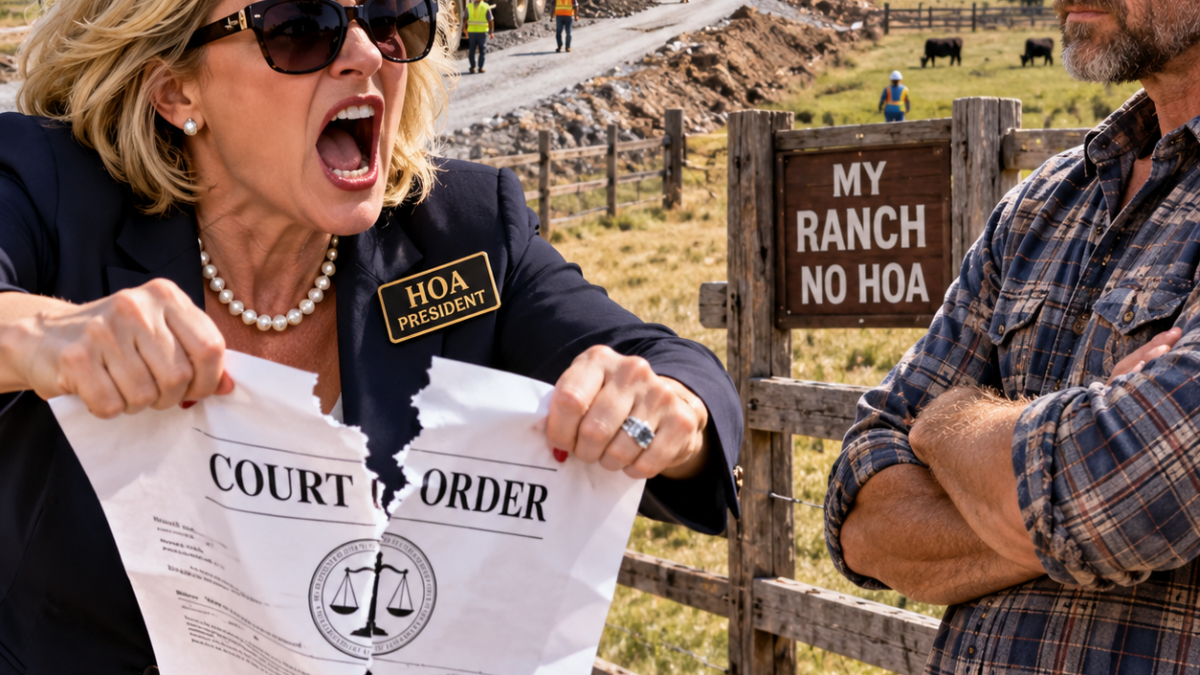
At 6:12 and eighteen seconds, Veronica opened the weather cover protecting the court notice.
Pulled it out.
Read the first page.
Then tore it in half.
Once.
Again.
Dropped the pieces into mud.
Then ripped the yellow boundary tape from the gate.
“There.”
She turned toward the equipment.
“Now move.”
I watched through the lens.
There are moments when anger feels physically hot.
That was one.
Every instinct told me:
Drive your truck down.
Block the dozer.
Stand in front of it.
Make them stop.
Instead, I remembered Everett.
Remembered Reed.
And did nothing physical.
Travis told his crew:
“Bellamy Civil is standing down.”
Veronica turned to a smaller subcontractor.
Miguel Cruz.
“Start the dozer.”
Miguel stared at the torn notice.
“You said the court cleared this.”
“It will be cleared today.”
“That’s not what you said.”
“Start the machine.”
At 6:18, the bulldozer crossed the marked line.
I was about seventy yards away.
I put my phone on a tripod.
Recorded.
That restraint became one of the most important decisions I made during the entire conflict.
If I had driven into the site, Veronica could claim obstruction.
Threats.
Danger to workers.
Maybe use my anger to confuse the issue.
Instead, the record stayed clean.
Court order.
Actual notice.
Machine crossing.
Me standing outside.
At 6:26, Reed filed an emergency motion.
Still images from the gate camera.
My declaration.
Proof of the injunction.
The filing reached Paige through the court system.
At 6:41, she called Veronica.
I learned what she said later.
“Stop the work now.”
Veronica replied:
“Reed is bluffing.”
“I have his filing on my screen.”
“The injunction is being dissolved.”
“It is active.”
“Did you remove the posted notice?”
“No. It fell.”
At 6:48, Paige followed up in writing.
**All construction must cease immediately. Do not alter or remove any court posting. Preserve all communications and site records.**
Veronica replied:
**Noted.**
Then ordered the concrete trucks forward.
At 7:03, the first concrete entered the forms.
Wet gray material poured across my pasture.
Travis was already leaving.
But before he left, he preserved screenshots.
One message from Veronica offered Bellamy Civil an extra $100,000 if the base pour was completed before noon.
He sent the screenshots to Reed.
At 7:32, Judge Witcomb convened an emergency telephone conference.
Reed.
Paige.
The judge.
Paige confirmed her client had actual notice.
Confirmed she had advised immediate compliance.
The judge issued a supplemental order.
All work stopped.
Sheriff authorized to enforce the restricted corridor.
Neutral construction inspector appointed.
Records preserved.
The supplemental order did not decide punishment.
It secured the land and evidence until a contempt hearing.
At 8:14, Paige served Veronica by email and text.
A process server also handed her a copy at the gate.
Veronica signed acknowledgment.
Then kept going.
That became the detail I struggled to understand later.
Once is arrogance.
Twice is strategy.
Her reasoning was simple enough.
Pour enough concrete.
Let it harden.
Make removal expensive.
Then argue the economic waste is too great.
Create a fact the court won’t want to reverse.
She was trying to make cost become permission.
At 8:37, Miguel Cruz shut down his bulldozer.
He had called his attorney.
Whatever Veronica promised to assume, it wouldn’t protect his license or insurance.
“We’re done.”
“I’ll sue you for delay.”
Miguel looked at her.
“Put it in writing.”
Then moved his equipment to the edge of the site.
At 9:02, another subcontractor arrived.
Veronica had found a grading company from the next county.
Their dispatcher had been told the original equipment suffered a mechanical problem.
The operator unloaded.
He hadn’t seen the original court notice.
I photographed the company name.
Sent it to Reed.
Reed called dispatch.
Gave the case number.
Sixteen minutes later, the operator climbed down.
Refused to continue.
Machines were beginning to disappear.
The concrete pump kept working.
Meanwhile, Brooke received Paige’s email to all board members.
Attached:
Emergency motion.
Photographs.
Veronica’s **Noted** response.
Brooke called Paige.
“The board never approved this work after the injunction.”
“Can you document that?”
“Yes.”
“And the $420,000?”
“Not approved.”
“Bring copies.”
“Are you representing Veronica?”
Paige answered:
“I represent the association.”
Pause.
“Those interests may no longer be identical.”
That answer told Brooke everything.
At 10:36, five vehicles from the county sheriff’s office turned onto the access road.
No sirens.
No dramatic weapons.
Deputy Everett Sloan got out carrying the supplemental order.
Two civil deputies followed.
Neutral construction inspector.
Evidence technician.
Everett walked straight to the pump operator.
Handed him the court order.
“Shut down safely. No more concrete enters the restricted corridor.”
The operator looked at Veronica.
Everett said:
“The instruction is from the court, not Ms. Ashford.”
The pump stopped.
Veronica approached him.
“This is private HOA construction. The sheriff has no authority to take over our project.”
“We aren’t taking over your project.”
Everett pointed toward my property.
“We are enforcing a district court order.”
“My attorney said the injunction was being dissolved.”
At that exact moment, Paige’s car arrived.
She got out with her phone.
“I said no such thing.”
Everyone turned.
Paige continued:
“I told you to stop. Repeatedly.”
Veronica’s face changed.
No shouting.
No threat.
Her own lawyer had simply removed the last excuse.
Everett served a show-cause notice.
Contempt hearing.
Nine o’clock next morning.
By 11:18, every machine was off.
I stayed outside the restricted area until the neutral inspector released the safe part of my access lane.
I looked at the wet concrete.
Forms.
Compacted base.
Drainage trench.
Then asked Reed:
“Can they make me keep it because it’s already here?”
He watched the last pump truck leave.
“No one can promise what a judge will do.”
“Then what was all this for?”
“Every yard they poured after notice made their position worse.”
That night, I barely slept.
The hearing began at nine.
Veronica sat with separate contempt counsel.
Paige appeared for Stonebridge Crest.
Not Veronica personally.
That distinction hadn’t existed the previous morning.
Judge Witcomb began with the injunction.
Proof of service.
Timeline.
Not the underlying boundary dispute.
“Did Ms. Ashford know the order was active when she directed construction to continue?”
Veronica’s lawyer argued confusion.
Multiple contractors.
Emergency motions.
Belief that Paige was seeking relief.
The judge turned to Paige.
“Did you tell Ms. Ashford the injunction had been dissolved or suspended?”
“No, Your Honor.”
“Did you advise her to continue construction?”
“No.”
“What did you advise?”
“That all work cease immediately.”
Because Veronica had put Paige’s advice at issue, Stonebridge waived privilege narrowly as to those compliance communications.
Paige produced:
6:48 email.
Delivery confirmation.
Veronica’s reply.
**Noted.**
One word.
That word destroyed an entire defense.
Travis testified next.
He identified the gate footage.
Veronica reading the notice.
Tearing it.
He produced the extra $100,000 offer.
Reed asked:
“Why did Bellamy Civil refuse to work?”
Travis answered:
“The injunction identified the restricted corridor by survey coordinates. There was no honest way to claim we didn’t know where it applied.”
Miguel Cruz testified.
Veronica told him the order had already been cleared.
When he asked for proof, she said paperwork would follow.
My testimony lasted less than fifteen minutes.
I described camera locations.
Timestamps.
Where I stood.
What I recorded.
I did not call Veronica a liar.
I did not call her a thief.
I explained what the footage showed.
Then Brooke entered.
She carried financial records.
First:
Signed board minutes.
Second:
Altered portal version.
Side by side.
The portal version contained a sentence claiming unanimous approval of the $420,000 emergency expenditure.
The signed version didn’t.
Metadata showed the portal version was created from Veronica’s account at 8:52 Sunday night.
Veronica’s lawyer suggested another employee could have used her login.
Brooke produced the security log.
The change required a verification code.
Code sent to Veronica’s personal phone.
That defense died.
Then Brooke produced the invoice.
Not emergency safety work.
**Accelerated completion bonus.**
Payable if concrete entered the east corridor before noon Monday.
The judge looked at Veronica.
“Why noon?”
Her lawyer objected to forcing her to testify.
The judge didn’t.
Reed answered through the lender representative by video.
Stonebridge’s financing agreement required photographic proof that the concrete-base milestone had been reached by 12:00.
Miss it?
Lender could freeze the next draw.
Review the project.
Potentially increase reserve requirements.
There it was.
Noon wasn’t a fire deadline.
Not an ambulance deadline.
Money.
Then came the fire marshal memorandum.
For months, Veronica had described the East Road as necessary for public safety.
But six weeks before construction, the county fire marshal determined Stonebridge’s existing west entrance satisfied current emergency-access requirements during the next phase.
East Road was useful.
Desirable.
Potentially valuable.
It was not an emergency road required by the county.
Another justification disappeared.
Then Paige produced the document I had never seen.
After the title insurer warned that no Hollister easement could be verified, Paige drafted a proposed purchase offer.
Buy the corridor.
Negotiate.
Veronica refused to send it.
Her email to the developer said:
**Do not invite him to price land. We can establish through use. Once the road is operating, removal will be commercially impossible.**
Written fifty-eight days before I found the stakes.
I read the sentence on the courtroom screen.
That was the moment everything changed emotionally for me.
Up until then, some part of me still wanted to believe Veronica had gotten trapped by momentum.
Bad map.
Big project.
Pressure.
Then stubbornness.
That email was different.
Build first.
Make removal too expensive.
Pressure owner afterward.
It had been considered in advance.
Paige then traced the wrong easement.
Management archive.
Instruction from Veronica to place my ranch address over the cover-page address so the contractor could index the corridor.
Legal description untouched.
Because the legal description didn’t match.
Judge Witcomb listened.
No theatrics.
Then ruled.
Clear and convincing evidence that Veronica and Stonebridge knowingly violated the injunction.
The immediate remedy was civil.
Stop violation.
Preserve land.
Compensate enforcement costs.
Potential punitive issues, if any, required proper later process.
Stonebridge had to:
Fund independent engineering assessment.
Deposit estimated restoration costs into a court-controlled account.
Pay reasonable attorney and expert fees caused by the contempt violation, subject to review.
Stop construction.
Preserve project records.
Veronica lost control of compliance decisions.
Future site instructions had to go through counsel and the court-appointed monitor.
Then the judge addressed the argument that removing concrete would waste HOA money.
Her words were the ones I remember best:
“The association cannot manufacture hardship through violation of an order and then offer that hardship as the reason the violation should remain.”
That was it.
The core of the entire strategy destroyed in one sentence.
Spend enough money.
Create enough damage.
Then call restoration wasteful.
The court wasn’t buying it.
Judge Witcomb asked what temporary relief I wanted.
I said:
“Safe access to my lower pasture. Protection for the creek. No more construction until the boundary is resolved.”
That was all.
I didn’t ask her to bankrupt Stonebridge.
I didn’t ask for every homeowner to suffer.
Most of them didn’t even know what Veronica had done.
That mattered.
Back at Stonebridge Crest, the board called an emergency meeting.
This time homeowners attended.
Brooke laid out the record.
Title insurer warning.
Wrong easement.
Altered minutes.
$420,000 transfer.
Court findings.
For the first time, ordinary residents saw the full sequence.
Veronica tried to frame me as an outsider attacking the community.
Carol Jensen, a board member who had served with her for four years, interrupted.
“He didn’t alter our minutes.”
Veronica stared at her.
Carol continued.
“He didn’t ignore our lawyer.”
Silence.
“He didn’t order concrete onto someone else’s deed.”
Then:
“We did—or you did in our name.”
Nobody spoke.
The board voted to remove Veronica as president.
Her authority was suspended pending an independent audit.
Brooke became interim president.
She accepted on one condition.
Any emergency expenditure required review by two officers.
Homeowners notified within seventy-two hours.
Paige recommended Stonebridge stop defending a corridor its own title insurer wouldn’t cover.
The board ordered another independent title examination.
Another survey.
Same result I gave them on day one.
No Stonebridge easement across Hollister land.
The HOA finally stipulated to the boundary.
Released any claimed access right.
Agreed to a permanent injunction.
That avoided months of additional trial.
It did not erase the contempt consequences.
The independent engineer examined what had been built.
One hundred forty-six cubic yards of concrete and compacted base inside the disputed corridor.
Drainage trench redirecting runoff toward my creek.
Temporary slope needing stabilization before summer storms.
The restoration plan was exact.
Saw-cut concrete.
Remove it.
Excavate imported base.
Remove drainage pipes.
Replace native topsoil.
Reseed pasture.
Inspect creek buffer after the first two heavy rains.
Then came the irony I never expected to enjoy as much as I did.
Bellamy Civil was selected to perform part of the restoration.
Why?
Because Travis had preserved records.
Refused to violate the injunction.
Stopped when the property dispute became clear.
Miguel Cruz’s company helped remove equipment.
His people had also stopped once the order was accurately explained.
Six weeks later, excavators returned to my ranch.
This time, they were taking the road apart.
I stood near the fence.
A saw cut the concrete into manageable sections.
An excavator bucket slid beneath the first piece.
Lifted.
Gray slab rose from my pasture.
Mud beneath it.
Base rock.
Then native soil farther down.
Veronica had told herself poured concrete would become permanent because removing it would cost too much.
Now the same expense she had tried to use as leverage was riding away in dump trucks.
Piece by piece.
I wish I could tell you I felt some huge rush of revenge.
Mostly I felt relief.
My cattle lane reopened.
The drainage trench disappeared.
Creek flow began following its natural grade again.
Russell reset the monument.
New fence went up entirely on my side of the line.
One morning Travis stood beside me watching his crew remove compacted base.
“I should’ve stopped the first day.”
“You did stop.”
“After three hundred feet of fence came out.”
“You weren’t the one claiming the easement existed.”
“Still my machines.”
That accountability mattered.
“You also refused to pour after the judge’s order.”
He looked toward the concrete pile.
“Best decision I made on this job.”
I laughed.
“Probably.”
He said:
“I’ve worked for clients who push schedule. Never had one tear down an injunction.”
“First for me too.”
We watched in silence.
After a while, Travis asked:
“What are you doing with this section when we’re finished?”
“Putting cattle back on it.”
“That’s it?”
“That’s enough.”
People kept expecting the land to need some more impressive future.
Stonebridge wanted a boulevard.
Developer wanted a gate.
Veronica saw financing.
I saw cattle moving to water.
The land did not need to justify itself beyond that.
The court entered its final contempt order after reviewing invoices and fee records.
Stonebridge remained responsible for property restoration and reasonable costs caused by the injunction violation.
Veronica received separate monetary sanctions tied to conduct the judge found personally attributable to her.
Residents faced an assessment.
That was painful.
Brooke handled it differently.
She published every figure.
Open meeting.
Explained what was association responsibility.
What was restoration.
What was legal expense.
What was tied to contempt.
No vague “community infrastructure” language.
A few homeowners came to see me.
One older man named Peter stopped at my gate.
“Mr. Hollister?”
“Grant.”
“I owe you an apology.”
“You don’t.”
“I believed you were trying to extort the HOA.”
“Who told you that?”
He laughed bitterly.
“You know.”
“I figured.”
“We were told you discovered a mapping discrepancy and wanted a big payout.”
“I told them the land wasn’t for sale.”
“I saw the email at the meeting.”
He looked toward the restored corridor.
“Why didn’t you just sell?”
“Because I didn’t want a road there.”
“Even for a lot?”
“Even for a lot.”
He nodded slowly.
“That was hard for people to understand.”
“Money isn’t authority.”
He looked embarrassed.
“We’re learning that.”
Another group of homeowners volunteered to help replace windbreak trees damaged near the construction opening.
I almost refused.
Then my wife said:
“They’re trying to fix something.”
So I let them.
Not all Stonebridge residents were villains.
Most were people who trusted leadership.
The abuse came from leadership operating without honest oversight.
Once the documents became public, a lot of those same residents helped correct it.
That distinction mattered.
It would have been easy for me to hate the entire neighborhood.
Easy.
And wrong.
On the day the court-appointed monitor released the restored corridor, Everett Sloan met me at the gate.
He handed me a filed notice.
“Enforcement phase is closed.”
I looked across the pasture.
“That’s really it?”
“That’s usually what enforcement looks like once people finally follow the order.”
“Less dramatic than Monday.”
“Most good endings are.”
Russell reset the final survey cap.
Filed an updated monument certificate.
I installed a cedar gate several feet inside my own property.
A small metal sign:
**PRIVATE PROPERTY — ACCESS BY WRITTEN PERMISSION ONLY**
Not huge.
Not aggressive.
Clear.
I kept one copy of Judge Witcomb’s original injunction in my office.
Not framed.
Not mounted.
Not a trophy.
Just filed.
Sometimes people asked why.
Because I wanted to remember something.
Restraint had protected me.
There were a dozen moments when anger would have felt better.
Rip out stakes.
Block excavators.
Grab Veronica’s papers.
Stop the concrete truck physically.
Shout.
Threaten.
Do something.
Instead:
Photograph.
Survey.
Email.
Preserve.
File.
Wait.
Let every document arrive in sequence.
That was harder than rage.
It also worked.
Three months earlier, Veronica believed authority came from money.
Then from a board title.
Then from a colored developer plan.
Then from an unrelated easement.
Then from momentum.
Finally, she convinced herself that a court order only mattered when deputies physically stood beside it.
For four hours and twenty-four minutes, nobody in uniform was there.
She thought that meant she had four hours and twenty-four minutes of freedom.
What she actually had was four hours and twenty-four minutes of evidence.
Years later, that distinction still stays with me.
Construction people talk about irreversible work.
Concrete poured.
Steel placed.
Trench opened.
Road built.
The phrase sounds powerful.
Irreversible.
Veronica believed if enough physical work happened fast enough, legal rights would have to bend around it.
She was wrong.
Nothing about the road became more lawful because it hardened.
It just became more expensive to remove.
And the court refused to reward the expense she had created herself.
That was probably the most satisfying part.
Not punishment.
Correction.
The road came out.
A few months after restoration, we had the first major summer storm.
Dark clouds stacked against the ridge.
Rain came hard.
I put on a jacket and walked down toward the creek.
Old habit.
The restored soil was wet but stable.
Runoff moved the way it had before Stonebridge cut the corridor.
The creek stayed inside its banks.
No drainage trench forcing water sideways.
No concrete barrier.
No construction runoff.
I stood there maybe ten minutes.
Then cattle came down behind me.
One of the cows walked through the reopened lane like nothing had ever happened.
That made me smile.
Animals do not care about title litigation.
They care whether gates open.
Whether water exists.
Whether ground supports them.
Months of court proceedings had finally translated back into something simple.
A cow could walk to the creek again.
The next spring, grass covered most of the restored strip.
You could still see subtle differences if you knew where to look.
Regraded soil.
Younger growth.
New fence line.
But the raw brown scar was gone.
Stonebridge’s expansion continued without the east road crossing my ranch.
That detail mattered.
The entire development did not collapse because I defended sixty-three feet.
The developer revised circulation.
Worked within land it controlled.
The second gate concept was abandoned or redesigned.
Stonebridge still existed.
Homes still sold.
People still lived there.
The supposed catastrophe never arrived.
That is another thing property disputes teach you.
People describe their preferred option as essential because it makes negotiation easier.
If you say:
“This route is convenient,”
the owner can say:
“Use another route.”
If you say:
“This route is necessary for safety, financing, and the future of one hundred eighty families,”
suddenly resistance sounds immoral.
But necessity has to survive documents.
Fire marshal said the west entrance met current emergency requirements.
Title insurer said no easement.
Lawyer recommended caution.
Survey said my land.
The East Road wasn’t necessity.
It was preference backed by financial pressure.
Brooke remained president for a while.
She wasn’t charismatic like Veronica.
That was probably good.
She published boring reports.
Budgets.
Votes.
Legal updates.
Two-signature approvals.
Residents complained that meetings took longer.
I considered that progress.
One afternoon she called me.
“Grant, we’re replacing fencing near the south common area.”
“Okay.”
“No work on you.”
“Okay.”
She laughed.
“I thought you’d want to know.”
“I appreciate it.”
“We also adopted a title-verification policy.”
“Sounds exciting.”
“It’s painfully boring.”
“Even better.”
Before ending the call, she said:
“I’m sorry.”
“For what?”
“The board should’ve known.”
“You were lied to too.”
“We still should’ve known.”
That was fair.
Boards have a duty to ask questions.
But there is a limit to how much ordinary volunteers can uncover when one person controls information.
Stonebridge eventually commissioned a governance audit.
I never read every page.
Didn’t need to.
Homeowners later told me it recommended:
Two-officer approval for major emergency expenses.
Independent title verification before permanent construction outside known common property.
Direct legal reporting to the full board on disputed land rights.
Version controls for minutes.
Better project document retention.
Again:
Boring.
Good.
I ran into Paige Wexler at the courthouse months later.
She recognized me.
“How’s the ranch?”
“Quieter.”
“That’s good.”
I hesitated.
Then asked:
“Why didn’t you quit when Veronica ignored you?”
Paige gave me the look lawyers give when a simple question has an ugly answer.
“I represented the association.”
“Not her.”
“Correct.”
“So you stayed to protect the association.”
“And to create a record of advice.”
“Did you know she was going to tear down the order?”
“No.”
“Continue after you told her to stop?”
“I hoped she wouldn’t.”
I laughed.
“That sounds lawyerly.”
“It is.”
Then she said something I remembered.
“People assume lawyers can control clients.”
“They can’t?”
“We advise. Courts order. People choose.”
Veronica chose.
Repeatedly.
That was why the consequences became personal.
Not because one bad legal interpretation ruined her.
Because she kept receiving opportunities to stop.
Title warning.
My deed.
Russell’s survey.
Paige’s email.
Court hearing.
Injunction.
Travis’s refusal.
Paige’s 6:48 message.
Supplemental order.
Each one was an off-ramp.
She accelerated past all of them.
That difference mattered to me because I didn’t want the story reduced to:
HOA makes boundary mistake and gets destroyed.
That wasn’t the story.
Boundary mistakes happen.
Old records are confusing.
Easements get misread.
Fences drift.
Survey caps disappear.
The line between mistake and misconduct is what somebody does when credible evidence appears.
Travis stopped.
Russell verified.
Paige warned.
Miguel quit.
The second grading company refused once it learned the truth.
Veronica kept going.
That was the difference.
About a year later, a reporter called asking if I’d discuss “the $11.4 million road case.”
I told him:
“The road wasn’t worth $11.4 million. The expansion was.”
He laughed.
“Less dramatic.”
“More accurate.”
“Did Veronica go to jail?”
“No.”
“Was she criminally charged?”
“Not as part of what I’m describing.”
“So the big consequence was civil contempt?”
“And removal from leadership, sanctions, restoration, fees, audit.”
He sounded almost disappointed.
People want spectacular punishments.
Reality has its own version of satisfaction.
Veronica’s plan depended on permanence.
She wanted enough concrete in the ground that removal became commercially impossible.
The court made them remove it anyway.
That was enough drama for me.
The reporter asked:
“What was it like watching the road come out?”
I looked toward the pasture.
“Quieter than watching it go in.”
That was true.
The first construction felt violent.
Fence dropping.
Excavators.
Scraped soil.
Concrete.
Restoration felt methodical.
Saw.
Lift.
Load.
Haul.
Grade.
Seed.
Repair.
Damage is fast.
Restoration is patient.
I learned to respect patience.
One day during restoration, I found one piece of torn yellow boundary tape near a fence post.
Probably from the morning Veronica ripped down the injunction.
I picked it up.
For a moment I considered keeping it.
Then threw it away.
I didn’t need relics.
The documents were enough.
The land mattered more.
That autumn, we moved cattle through the lower pasture without rerouting them for the first time since construction started.
My nephew helped.
He had followed the dispute from a distance.
At the reopened lane he said:
“This is what all that was about?”
I looked around.
Fence.
Grass.
Creek.
“Yep.”
“It doesn’t look like much.”
“That’s why people thought they could take it.”
He frowned.
“You’re serious.”
“Completely.”
He leaned on the gate.
“If somebody offered you a million now?”
“For the corridor?”
“Yeah.”
“No.”
“Two million?”
“No.”
“Everybody has a number.”
“That’s what Veronica said.”
He laughed.
Then saw I wasn’t joking.
“Why not?”
I pointed down the lane.
“Because deciding it isn’t for sale is part of owning it.”
That answer took me years to understand fully.
Property value isn’t only price.
It’s choice.
The right to say yes.
The right to say no.
A road might be worth more economically than a cattle lane.
That doesn’t automatically transfer control.
If society truly needs private land for a public purpose, there are legal processes.
Compensation.
Condemnation.
Hearings.
Due process.
Stonebridge was not the government.
It couldn’t manufacture public necessity from a private financing schedule.
Another winter passed.
Snow covered the restored corridor.
The new fence line disappeared under drifts.
I walked down one morning and found deer tracks crossing where the concrete base had once been.
That gave me a strange sense of peace.
No one looking at the snow would know a guardhouse was supposed to sit there.
The next spring, Russell came out to check a nearby monument for another survey.
He stopped by.
“How’s my favorite boundary dispute?”
“Still a boundary.”
“Best kind.”
We walked to the reset cap.
Still visible.
Undisturbed.
I said:
“You know, Veronica’s map had this line sixty feet over.”
“Sixty-three.”
“You surveyors never let anything become approximate.”
“That’s why you hired me.”
He knelt and brushed dirt from the cap.
“Boundaries aren’t emotional. That’s the beauty of them.”
I laughed.
“You weren’t in court.”
“The people are emotional.”
He tapped the monument.
“This isn’t.”
Coordinates.
Description.
Monument.
Deed.
I understood what he meant.
There was comfort in something that did not care about budget, urgency, or status.
The line existed.
People either respected it or they didn’t.
I kept working the ranch.
Fence repair.
Hay.
Stock water.
Timber thinning.
Ordinary work slowly replaced litigation in my mind.
Then I received a letter from a Stonebridge homeowner named Carol Jensen.
The board member who had confronted Veronica.
She wrote that the neighborhood had completed repayment planning for the contempt-related costs.
Homeowners were angry.
Some sold.
Most stayed.
She said the hardest part wasn’t the assessment.
It was trust.
Residents had approved an expansion believing major property rights had been verified.
Finding out they hadn’t changed the way people viewed leadership.
One line stood out.
**We thought your resistance was creating the crisis. The records showed your resistance exposed a crisis that already existed.**
I filed that letter beside Brooke’s apology.
Not because I needed validation.
Because it captured something important.
By saying no, I hadn’t created Stonebridge’s title problem.
The title problem existed the day the project was designed across land they didn’t control.
My refusal merely made it visible.
That distinction matters far beyond HOAs.
A person who points out a defect often gets blamed for the delay.
Inspector.
Engineer.
Landowner.
Accountant.
Anybody who says:
Stop.
Something is wrong.
The schedule pressure already exists.
The budget problem already exists.
The missing right already exists.
The objection simply prevents everyone from pretending otherwise.
Veronica’s greatest mistake may have been treating every stop signal as an enemy.
Title warning?
Obstacle.
Survey?
Obstacle.
Lawyer caution?
Obstacle.
Court order?
Obstacle.
Treasurer?
Obstacle.
Contractor refusing?
Obstacle.
She never allowed herself to consider that the obstacles were information.
Eventually information won.
I heard Veronica moved away from Stonebridge a few years later.
I didn’t ask where.
Didn’t care.
There was no pleasure in imagining her ruined.
She had made serious choices.
The court addressed them.
The board addressed them.
My interest ended at the property line.
That boundary applied emotionally too.
Her life beyond it wasn’t mine to manage.
One summer afternoon, a Stonebridge resident stopped by with his teenage son.
The boy was working on a school civics project about property rights.
His father asked if I would show him the survey monument.
I almost said no.
Then decided maybe the whole mess could do one more useful thing.
We walked out.
I showed him the old plat.
Russell’s survey.
The reset cap.
The boy asked:
“So the HOA thought this line was somewhere else?”
“At first, maybe.”
“And then they found out?”
“Yes.”
“Why didn’t they stop?”
“That’s the important question.”
He waited.
I said:
“Because stopping had become expensive.”
He looked confused.
“So they kept spending more money?”
“Exactly.”
“That doesn’t make sense.”
“Adults are capable of very sophisticated ways of not making sense.”
His father laughed.
The boy pointed toward the pasture.
“What happened to the road?”
“Removed.”
“All of it?”
“Inside my land.”
“Because of the court order?”
“Because they never had the right to keep it.”
He thought for a moment.
“So the concrete didn’t matter.”
“It mattered financially.”
“But not legally.”
“Now you’re getting it.”
I watched them leave.
Maybe that was another ending.
A teenager understanding something Veronica had refused to understand.
Cost does not create title.
A few years after the dispute, Stonebridge repaved part of its internal road.
Nothing to do with me.
Still, I got a courtesy notice.
**No work proposed on Hollister property.**
I smiled.
Then threw the letter into my ranch file.
Boring.
Good.
The old East Access rendering eventually disappeared from Stonebridge marketing.
The expansion used different traffic circulation.
The second gate either moved or died depending on which version of the plan you looked at.
Either way, not my problem.
County Highway 9 remained where it had always been.
My ranch remained where it had always been.
One evening, my wife and I sat near the stock pond.
The windbreak my father planted was tall enough to block most of the western wind.
She asked:
“Do you ever think about what would’ve happened if you weren’t a right-of-way guy?”
“All the time.”
“What if somebody else owned this place?”
I knew what she meant.
Someone without survey experience.
Someone intimidated by an $11.4 million project.
Someone who sees orange stakes and assumes authority.
Maybe they sell under pressure.
Maybe they accept a road after concrete goes down.
Maybe they spend years unsure whether they were wrong.
That thought bothered me more than anything Veronica said.
“What would you tell them?” she asked.
“Don’t touch the equipment.”
“That’s your big lesson?”
“One of them.”
“What else?”
“Get the deed.”
She laughed.
“Romantic.”
“Survey.”
“Very romantic.”
“Preserve everything.”
She shook her head.
“You’re impossible.”
Then I added:
“And don’t let somebody else’s deadline become proof of their right.”
She looked at me.
“That one’s better.”
It was.
Because that had been the entire conflict.
Stonebridge had deadlines.
Construction milestones.
Loan draws.
Contractors.
Future homeowners.
$420,000 acceleration payment.
All real.
None of them transferred sixty-three feet of my ranch.
Urgency is not ownership.
One fall morning, I moved cattle through the restored corridor.
The sun was low.
Frost on the grass.
A young steer stopped near the survey cap.
Sniffed it.
Then walked on.
I laughed.
Twenty-six years managing construction taught me people can spend millions arguing over a point in the ground.
A steer recognizes it only as something to walk around.
Maybe that’s healthy.
The final physical reminder of the road disappeared after several growing seasons.
Grass thickened.
Minor settlement was reworked.
Creek buffer stabilized.
Windbreak replacements took hold.
The new gate weathered from bright cedar to gray.
One morning I realized I could no longer see the old road corridor immediately from the house.
I had to remember where it had been.
That felt like recovery.
The court papers stayed in my office.
One day my nephew saw the injunction.
“You kept this?”
“Yes.”
“Because she tore one up?”
“No.”
“Then why?”
I looked at the stamped copy.
“Because I didn’t.”
He frowned.
“You didn’t what?”
“Tear anything up.”
I explained.
Veronica treated documents as obstacles she could destroy.
Wrong easement cover.
Altered minutes.
Court notice.
I treated documents as limits on my own anger too.
The injunction didn’t only stop Stonebridge.
It told me what process existed.
Stay back.
Document.
Let court enforce.
I followed it.
That restraint kept me credible.
“That’s boring,” he said.
“Most useful things are.”
He rolled his eyes.
I put the order away.
The last chapter happened years later after a hard spring rain.
The creek rose.
Not dangerously.
Enough to fill the lower bends.
I walked down after sunrise.
Water moved past willow roots.
Past the place where Stonebridge’s drainage trench had once pointed runoff toward it.
The restored pasture was wet but stable.
My cedar gate stood closed.
Survey cap visible beyond it.
Stonebridge roofs in the distance.
I remembered Monday morning.
Fog.
Concrete trucks.
Veronica tearing paper.
Her words:
“By the time Hollister gets another hearing, this road will be permanent.”
She had believed permanence came from speed.
Four hours.
Concrete.
Money.
Once it hardened, done.
But permanence had existed before her road.
The deed.
The boundary.
The creek.
The pasture.
My family’s recorded ownership.
Those things had survived because they were backed by something stronger than her schedule.
Not power.
Process.
That is less cinematic.
Also more durable.
I leaned against the gate.
For a moment, I imagined the road still there.
Stone columns.
Guardhouse.
Cars crossing every day.
Cattle cut off from the creek.
Maybe Stonebridge offering me money after the fact because removal seemed impossible.
That future had been exactly what Veronica wanted.
Instead, wind moved through grass.
A cow called from the lower pasture.
Water ran where it should.
There was no road.
No pump truck.
No red blazer.
No torn notice.
Just ranch.
I thought about the homeowners who had paid for part of the consequences.
That never made me happy.
Most hadn’t approved the deception.
Some had trusted the wrong leader.
That was why I never wanted revenge against Stonebridge as a community.
Restoration against the association.
Sanctions against the conduct the judge found personally attributable.
Transparency.
Oversight.
That was enough.
A neighborhood doesn’t become evil because its president acts badly.
But a neighborhood can become responsible if it refuses to correct leadership once the truth appears.
Stonebridge eventually corrected.
Late.
Expensively.
But it did.
Before walking back to the house, I checked the sign on the cedar gate.
**PRIVATE PROPERTY — ACCESS BY WRITTEN PERMISSION ONLY.**
Still straight.
Still legible.
I touched the top rail.
My grandfather bought this land when there was barely a paved road nearby.
My father spent years improving it.
I had almost watched a private boulevard cut across it because one person decided money already spent would become permission.
That didn’t happen.
Not because I was powerful.
I wasn’t.
Not because I had some secret connection.
I didn’t.
Not because I outspent Stonebridge.
I couldn’t.
I had a deed.
A survey.
Photographs.
A title record.
Contractors willing to preserve what they received.
A treasurer willing to preserve financial records.
A lawyer who told me not to turn anger into evidence for the other side.
A judge whose order meant exactly what it said.
And enough patience to let those things work.
Veronica tore down the notice because she believed nobody was coming.
For four hours and twenty-four minutes, nobody was.
But the camera was running.
The emails were preserved.
The contractors were saving messages.
The treasurer was downloading records.
The court was reading Reed’s motion.
The sheriff was getting the next order.
She thought she was racing against people.
She was really racing against a record.
And records don’t get tired.
They don’t panic.
They don’t care how expensive your road is.
They wait.
By the time the sheriff arrived, the road she believed was becoming permanent had become evidence instead.
And six weeks later, an excavator lifted the first piece of that “permanent” concrete out of my pasture.
I watched it swing through the air and drop into a truck.
Then another piece.
Then another.
Until the road was gone.
Years later, if you stood at my southeast boundary, you wouldn’t know an $11.4 million development once tried to cross there.
You’d see pasture.
Fence.
Creek.
A cedar gate.
That is exactly the way I wanted it.
The road was supposed to become permanent.
The boundary already was.


