PART 2: HOA Paved a “Private Road” Across My Lakefront—So I Opened the Dam Gates and Let Spring Expose Everything
PART 2
I didn’t drive home angry.
That surprised me.
I should have been furious.
A private HOA had paved almost a mile across land my family had owned longer than Summit Ridge Estates had existed as an idea.
Their president had dismissed my deed, my surveys, and my memory before learning anything about me.
Yet what occupied my thoughts on the drive back wasn’t Preston’s arrogance.
It was the little maintenance sign.
MONTHLY ASSESSMENT ACTIVE.
Money changes a property dispute.
A person can make an honest survey mistake.
A contractor can cross a boundary.
A developer can misunderstand a plat.
Those things can become expensive, but they can still be mistakes.
Charging hundreds of families every month to maintain something you do not own is different.
Especially when the road itself should never have been built.
I parked beside the house and carried my folder into my father’s study.
Dad had died in 2018.
I had changed very little in that room.
His engineering books still filled the shelves.
His drafting table still sat beside the north window.
Original blueprints for Voss Dam hung on the wall in simple wooden frames.
And in the lowest drawer of his desk was the operations manual.
He had written much of it himself.
The leather cover was worn almost smooth.
I turned to the winter section.
February 15.
Partial gate adjustment for ice management and seasonal flow control.
Monitor continuously through snowmelt.
My father had followed essentially the same procedure for decades.
I had continued it after taking over.
Every February.
Same date.
Same sequence.
Same reporting.
Same result.
The northern shelf flooded.
Not occasionally.
Not during exceptional weather.
Every year.
Some years lightly.
Some years deep enough that only the tops of the larger rocks remained visible.
I sat in my father’s chair and stared at the page.
Preston had paved a road twelve feet above the October lake level.
To somebody unfamiliar with the land, that probably looked safe.
To me, it looked temporary.
My phone rang.
It was Nathan Chen.
Nathan had clerked for me during my final years on the Ninth Circuit.
He was younger than my daughter and twice as relentless as most attorneys I had known.
He now worked on federal environmental enforcement matters.
“Judge,” he said, “you’re finally back in Montana?”
“I got home today.”
“And you’re already calling me. That doesn’t sound promising.”
“I found a road.”
There was a pause.
“A road?”
“On my lake shelf.”
I told him everything.
The asphalt.
The culverts.
No county permits.
No easement.
The road-maintenance assessment.
When I finished, Nathan was quiet.
“What does Lake Voss drain into?”
“Outlet creek, then the Clark Fork system.”
Another pause.
“So the road is in a seasonal inundation zone connected to downstream waters.”
“Yes.”
“And nobody pulled a federal fill permit?”
“Not that I can find.”
“Judge…”
“I know.”
“This could become a Clean Water Act issue.”
“I know.”
“And if they altered drainage with those culverts—”
“I know.”
Nathan laughed quietly.
“I forgot how annoying it is when you already know where I’m going.”
“I trained you.”
“That explains it.”
I told him I didn’t want any calls made yet.
No favors.
No pressure.
No federal intervention based on who I used to be.
First, I wanted a complete record.
He respected that.
“What are you doing about the road?”
“Nothing.”
“Nothing?”
“February maintenance is in four months.”
Silence.
Then I heard him inhale.
“Does the shelf flood when you run the normal winter schedule?”
“Every year.”
“How much?”
“Depending on snowpack and inflow, the lake rises eighteen to twenty-two feet from autumn levels.”
“And the pavement is twelve feet above current water.”
“Yes.”
“Judge Voss…”
“I am not changing anything.”
“You’re going to follow the existing maintenance plan.”
“Exactly.”
Another quiet laugh.
“That may be worse.”
“It’s routine.”
“I didn’t say illegal.”
I closed the operations manual.
“Let spring happen, Nathan.”
For the next four months, that was exactly what I did.
Nothing dramatic.
My attorney, David Marsh, verified the title records.
The entire northern shelf belonged to me.
No easement had ever been recorded.
He sent Preston’s attorney a letter requesting documentation supporting Summit Ridge’s claim.
They replied with a survey summary.
Not the survey.
A summary.
It described the road corridor as “county wetland buffer adjacent to private lake property.”
David read that sentence twice.
Then looked at me.
“Adjacent?”
“Apparently.”
“We have four surveys showing it isn’t.”
“I know.”
“They’re either working from a bad map or somebody deliberately changed the description.”
“That’s what I’m wondering.”
David requested the underlying survey.
They refused.
Claimed attorney-client privilege.
A land survey is not magically privileged because an attorney reads it.
That refusal told me more than cooperation would have.
Meanwhile, I quietly researched Summit Ridge.
The development had 180 occupied homes, eventually planned for more than a hundred additional residences.
The road Preston built shortened the trip between two sections of the community by nearly twenty minutes.
Without it, residents had to use the original mountain access road.
Inconvenient.
But legal.
The HOA had begun charging each occupied household two hundred dollars per month for what it called the Summit Ridge Road Maintenance District.
Two hundred dollars.
Every month.
One hundred eighty households.
Thirty-six thousand dollars a month.
I did the math at my kitchen table.
Four hundred thirty-two thousand dollars a year.
The road had existed for roughly two years.
That meant the HOA had collected somewhere near eight hundred thousand dollars.
For maintaining a three-hundred-forty-thousand-dollar road.
I wrote the number on a yellow legal pad.
Then circled it.
By December, Preston’s attorney stopped responding to David’s requests for the survey.
By January, snow covered the northern shelf.
The road remained open.
SUVs crossed it every day.
The green PRIVATE ROAD sign stood above the snowbank like a monument to confidence.
I never blocked it.
Never damaged it.
Never threatened anyone.
I simply kept records.
Then February 15 arrived.
The morning was eighteen degrees.
Six inches of snow covered the property.
I reached the dam control house shortly before seven.
The lake was dark in the middle and frozen around the edges.
Mountains rose behind it under a pale blue sky.
My father had built Voss Dam in 1958.
Seventy-five feet of reinforced concrete.
Nothing decorative.
Nothing flashy.
Just durable engineering.
He believed structures should do their work quietly.
So did I.
Inside the control house, I opened the operations log.
February 15.
Annual winter procedure.
I wrote the weather.
Water level.
Gate position.
Time.
Then called the county water office.
“Sanders County Water Management.”
“This is Eleanor Voss at Voss Dam. I’m giving annual notice of the February ice-management procedure.”
The woman recognized my name.
“Morning, Judge Voss.”
“Morning.”
“Same operation as last year?”
“Exactly.”
She recorded it.
I wrote her name and the time in the log.
Then I approached the control wheel.
For a moment, my hand rested on the steel.
I thought of Preston.
Not because I was hesitating.
Because I wanted to be certain about my own motives.
Was I opening the system because I wanted revenge?
No.
Would I enjoy watching an illegally built road encounter the floodplain its builders had ignored?
I was human.
Probably.
But the gates were opening whether Preston existed or not.
That mattered.
If Summit Ridge had never been built, I would still have been standing there that morning.
If the road had never existed, the same entry would still have gone into the logbook.
I turned the wheel.
Once.
Twice.
Sixteen rotations.
The machinery groaned.
Water thundered through the spillway system.
I checked the gauges.
Normal.
Logged the new position.
Then went home and made eggs.
Two days later, the lake had risen fourteen inches.
By February 19, it was up nearly three feet.
Water began saturating the gravel beneath Summit Ridge Road.
I drove to the overlook with binoculars.
The pavement still looked intact.
But dark patches were spreading across its shoulders.
The culverts had begun carrying water.
Badly.
Some discharged into places the natural shelf had never drained.
Others seemed to be backing water under the road base.
I photographed everything from my side of the property.
The next morning, my phone rang at 8:17.
“Judge Voss?”
“Yes.”
“Deputy Marcus Webb, Sanders County Sheriff’s Office. We have vehicles stranded in water near Summit Ridge. I understand the road may be on your parcel.”
I set down my coffee.
“I’ll be there in fifteen minutes.”
When I arrived, two vehicles were stranded near the lowest section.
A black SUV.
A silver sedan.
Water reached their door panels.
Firefighters in waders were attaching a tow line to the SUV.
No one appeared injured.
That was the first thing I checked.
Then I found Deputy Webb.
“Judge Voss?”
“Yes.”
“This your land?”
“All of it.”
I gave him the folder I had brought.
Deed.
2019 survey.
Dam permit.
Property map.
He studied them.
“You didn’t build this road?”
“No.”
“You authorize it?”
“No.”
“You know when it appeared?”
“I discovered it October 18 after returning from Washington.”
“Have photos?”
“Yes.”
“Permits?”
“None that I could locate.”
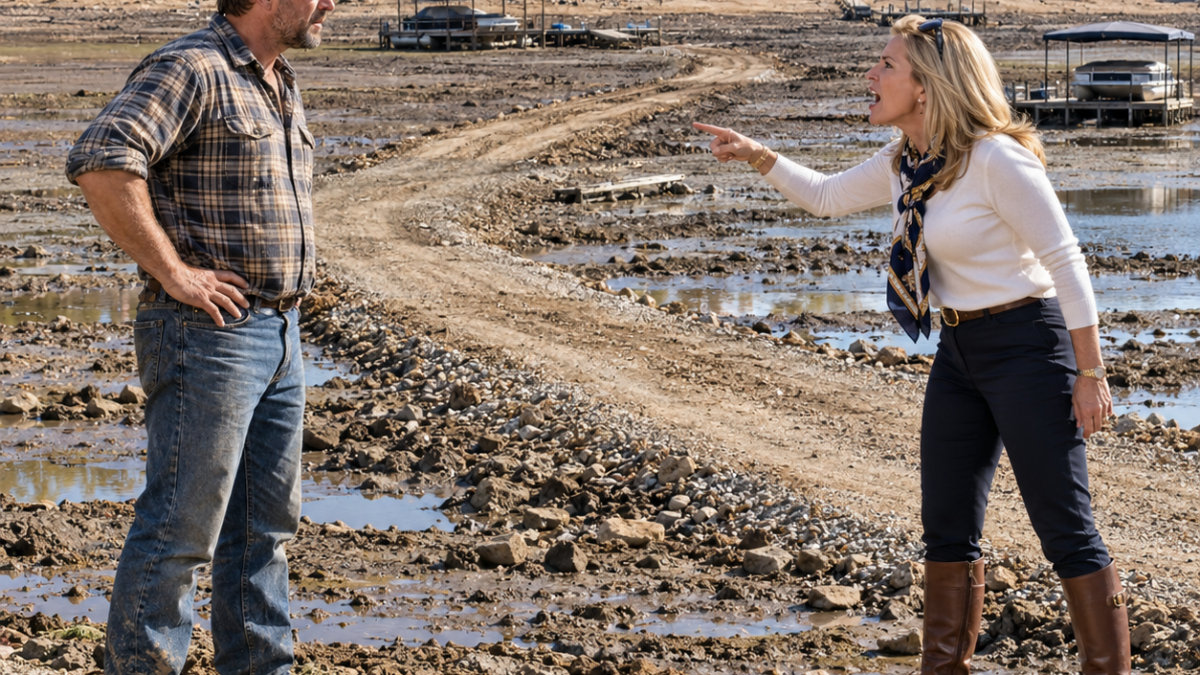
A voice exploded behind us.
“What the hell is going on?”
Preston.
He wore a wool coat over a suit, as if he had been called away from an important breakfast.
His leather shoes were covered with wet gravel.
He looked at the stranded cars.
Then at me.
His face changed.
“You.”
“Good morning, Mr. Callaway.”
“You flooded this road.”
Deputy Webb raised one hand.
“Sir, I’m speaking to the property owner.”
“I’m the HOA president.”
“Then I’ll speak to you next.”
Preston ignored him.
“You deliberately flooded our road.”
I looked at him.
“I performed annual dam maintenance.”
“Don’t play games.”
“February fifteenth. Same procedure every year.”
“You knew this would happen.”
“I knew the shelf floods.”
His jaw tightened.
“And you said nothing?”
“I told you the road was on my property in October.”
“That’s not what I mean.”
“I know.”
He took a step toward me.
“Those people could have been killed.”
That angered me.
Not because he accused me.
Because he was using his residents as a shield.
“Those people were driving on a road your HOA built inside a known seasonal flood zone.”
His eyes narrowed.
“You waited.”
“No. You ignored me.”
Deputy Webb stepped between us slightly.
“Mr. Callaway, does your HOA have a county construction permit for this road?”
Preston turned.
“Our engineers handled permitting.”
“That wasn’t my question.”
“Our legal position—”
“Do you have the permit?”
Preston hesitated.
“The situation is under review.”
The deputy wrote something.
Then asked, “Floodplain development authorization?”
“Our attorneys—”
“Yes or no?”
Preston’s face reddened.
“I don’t have those documents with me.”
I spoke quietly.
“I checked the county database in October. There weren’t any.”
Preston pointed at me.
“She planned this.”
I looked at Deputy Webb.
“County Water Management was notified at 7:04 a.m. on February 15.”
I showed him my call log.
“I have six years of operations logs showing the same procedure.”
Deputy Webb examined the screen.
Then my records.
One of the firefighters shouted that the SUV was clear.
Everyone turned.
The vehicle came slowly out of the water, dripping from the doors.
A woman climbed from the passenger side crying.
That image stayed with me.
Not because I felt responsible.
Because I knew those residents had not been told the truth.
Preston had built them a shortcut across land he didn’t own.
Then he had apparently failed to tell them the shortcut became part of the lake every spring.
When the second car was safely removed, I approached the couple who had been inside.
“You okay?”
The driver nodded.
“Cold. Embarrassed.”
“You don’t need to be embarrassed.”
He looked at the flooded pavement.
“Is this really your property?”
“Yes.”
“We were told the HOA owns the road corridor.”
“Who told you?”
“Preston.”
I glanced toward him.
He was arguing with another deputy.
“Did they tell you it floods?”
The man looked confused.
“Floods?”
“Every spring.”
His expression changed.
“No.”
That was the moment the dispute stopped being about me.
Within forty-eight hours, a county inspector arrived.
Gary Whitfield.
He reviewed the road.
Then reviewed the county database.
No permits.
None.
No grading permit.
No road permit.
No drainage alteration authorization.
No floodplain approval.
No recorded property interest.
On February 24, the county issued a formal violation notice.
Use of the road was prohibited immediately.
Summit Ridge had thirty days to provide engineering documents.
Forty-five days to appear before the county review board.
And they were ordered to prove they had a legal right to occupy the land.
They couldn’t.
Then the county made the referral that changed everything.
Because the road had been constructed on a periodically flooded shelf hydraulically connected to a larger river system, federal regulators were notified.
That was when Nathan called me.
“It’s moving.”
“How fast?”
“Faster than normal.”
“Nathan.”
“I didn’t order anybody to do anything.”
“You made calls.”
“I answered questions.”
“That is not the same sentence.”
He laughed.
Then his voice became serious.
“Judge, the culverts may have caused downstream erosion.”
That wiped the humor from me.
“Where?”
“Outlet creek.”
My father had spent years stabilizing that bank.
“What kind?”
“Subsurface flow appears to have been redirected beneath the road base. They’re seeing erosion farther downstream.”
“How bad?”
“Still being assessed.”
I looked toward the lake.
Now I was angry.
A road could be removed.
Asphalt replaced with grass.
But changing water movement on an old watershed can create damage far beyond where construction occurred.
“Make whatever lawful referrals need to be made.”
“You sure?”
“Yes.”
“Then the EPA gets involved.”
“So be it.”
The federal investigation began in March.
Preston responded the way people like Preston often do when facts begin narrowing around them.
He became louder.
He held a press conference.
Called it government overreach.
Claimed the road sat on private community land.
Said retroactive permits were common.
Then a reporter asked whether retired federal judge Eleanor Voss actually owned the road corridor.
I watched his face on television.
For one second, the smile vanished.
“That matter is under review.”
I turned off the television.
My attorney sent a formal trespass demand the next morning.
Stop using my property.
Acknowledge ownership.
Begin remediation planning.
Three days later, Preston came to my house.
This time he brought lawyers.
He stood at the foot of my porch.
“Judge Voss, we’d like to resolve this.”
“Then resolve it.”
One attorney stepped forward.
“We may be able to negotiate a retroactive easement.”
“No.”
Preston stared at me.
“No discussion?”
“You have an environmental cease-and-desist order involving the structure.”
“That’s temporary.”
“It may be.”
“We could pay you.”
“I’m not selling an easement for an illegal road.”
His attorney tried again.
“What would you consider?”
“Removal.”
Preston’s face hardened.
“Our residents need that connection.”
“They have another road.”
“It adds twenty minutes.”
“That’s unfortunate.”
“You’re willing to destabilize an entire community over twenty minutes?”
I looked at him.
“You built the shortcut on somebody else’s land.”
He stepped closer.
“You know exactly what you’re doing.”
“So do you.”
He left angry.
Then the money began talking.
Nathan had quietly checked whether residents had complained about the monthly road fee.
Three already had.
Before the flooding.
Before federal regulators.
Before me.
Three homeowners had requested financial records from Preston.
Each had been denied.
The HOA claimed road-maintenance accounting was proprietary.
That word bothered me.
David filed my civil action on March 10.
Trespass.
Property damage.
Unjust enrichment.
And a demand for every financial record connected to the Summit Ridge Road Maintenance District.
That discovery request turned Preston’s bad month into something much worse.
A group of homeowners hired their own forensic accountant.
Patricia Drummond.
She called me after receiving the HOA records.
“Judge Voss, do you have a minute?”
“What did you find?”
“The residents paid eight hundred sixty-four thousand dollars in road assessments.”
“That matches my rough calculation.”
“The construction invoice was three hundred forty thousand.”
“Yes.”
“Paid to Callaway Construction LLC.”
I already knew.
I just didn’t want to say it.
“Who owns it?”
“Preston Callaway.”
I closed my eyes.
Patricia continued.
“The company was organized shortly before road construction.”
“And the rest?”
“Five hundred twenty-four thousand dollars moved through invoices from something called PCL Consulting Group.”
“Preston Callaway Law?”
“Yes.”
“For what services?”
“Road Maintenance District administration and legal consulting.”
“How much?”
“Approximately twenty-one thousand eight hundred dollars per month.”
I said nothing.
Patricia did.
“He paid himself.”
“All of it?”
“It appears so.”
I walked to my window.
The lake was gray beneath March clouds.
The road had disappeared completely under the water.
“Patricia, what did the road actually cost?”
“I’m still reviewing construction records.”
Two days later, she called again.
Her tone was different.
“Two hundred eighteen thousand.”
“What?”
“Actual construction cost.”
“But his company invoiced the HOA three hundred forty thousand.”
“Yes.”
“Markup?”
“One hundred twenty-two thousand.”
“So he received that plus the consulting fees.”
“Total personal enrichment tied to this road appears to be approximately six hundred forty-six thousand dollars.”
I sat down.
One hundred eighty families.
Two hundred dollars every month.
Some wealthy.
Some not.
All told the same story.
Maintenance.
Safety.
Infrastructure.
Future improvements.
And Preston had used their money to build an illegal road across my lake shelf while paying his own companies.
I called Nathan.
“This isn’t an environmental case anymore.”
“No.”
“Financial transfers?”
“Mostly electronic.”
“So federal wire activity.”
“Yes.”
I heard him exhale.
“I’m calling Missoula.”
The FBI entered quietly.
No press conference.
No dramatic raid.
Just requests.
Records.
Bank transfers.
Invoices.
Corporate documents.
Emails.
Meanwhile, the state attorney general demanded HOA financial records.
The state bar began reviewing Preston’s conduct.
Homeowners called an emergency meeting.
One hundred forty-two people packed the clubhouse.
I didn’t attend.
David did.
He called afterward.
“You should have seen it.”
“I’m glad I didn’t.”
“Patricia presented everything.”
“How did they react?”
“People cried.”
That hurt more than I expected.
David continued.
“One man said he reduced contributions to his daughter’s college account because of the two-hundred-dollar assessment.”
I closed my eyes.
“A woman said Preston told her the extra money was being saved for future road expansion.”
“Expansion where?”
“That question got asked.”
“And?”
“No answer.”
The homeowners voted.
Every Preston-aligned board member was removed.
Unanimously.
A new emergency board was elected.
Their first action was to retain Patricia as the association’s forensic accountant.
Their second was to sue Preston.
So by late March, Preston was being sued by me.
Sued by his own HOA.
Investigated by environmental regulators.
Investigated by the state.
Reviewed by the bar.
And contacted by federal law enforcement.
Then his attorney called David.
Settlement.
“What’s he offering?” I asked.
“One hundred fifty thousand.”
I actually laughed.
David didn’t.
“He’ll acknowledge trespass.”
“Six hundred thousand.”
David looked at me.
“That’s your counter?”
“Yes.”
“Reasoning?”
“The physical damage. Unauthorized use. Restoration. His profit linked to the trespass. And because I want enough money available to repair what he damaged.”
David nodded.
“Anything else?”
“Full cooperation with regulators and law enforcement.”
“He’ll never agree.”
“Then we litigate.”
The answer came the next morning.
He agreed.
Six hundred thousand dollars.
Formal admission that the road had been built on my land without my permission.
Full cooperation.
No provision interfering with criminal investigation.
I signed March 28.
People later assumed that was the moment I felt victorious.
It wasn’t.
I felt tired.
The road was still under water.
My father’s creek bank was damaged.
One hundred eighty families had been cheated.
There was nothing satisfying about those facts.
Then April 14 came.
Preston was indicted.
Federal wire-fraud counts.
Embezzlement.
False statements.
The indictment described how residents’ payments moved into accounts connected to his companies.
It described the construction markup.
The consulting invoices.
The misleading representations surrounding the road.
Preston’s attorney released a statement blaming political retaliation by a retired judge.
I read it at the kitchen table.
Then placed it beside my father’s operations log.
Political retaliation.
The road had been illegal before I returned home.
The drainage damage had begun before I met Preston.
The money had moved before I ever opened the dam gates.
I hadn’t created his problem.
I had discovered it.
His law license was suspended pending the criminal case.
His firm dissolved.
Environmental regulators finalized their penalties.
The road had to come out.
Every piece.
Asphalt.
Aggregate.
Culverts.
Guardrails.
The entire shelf had to be restored.
The estimated removal and ecological repair costs were hundreds of thousands of dollars.
Summit Ridge suddenly faced more obligations than its reserves could handle.
That created a problem I had not wanted.
The residents.
Preston had stolen from them.
Now they were expected to pay for fixing what he had done.
A new board president named Thomas Ericson called me.
He sounded exhausted.
“Judge Voss, we’re in trouble.”
“I know.”
“We can cover some of the environmental obligations.”
“And the rest?”
“We may need receivership.”
“What about my settlement?”
A pause.
“That’s why I’m calling.”
“I’ll move behind the environmental obligations.”
He went silent.
“Judge—”
“The shoreline gets repaired first.”
“That could delay your payment substantially.”
“I understand.”
“You don’t have to do this.”
“Yes, I do.”
“Why?”
I looked toward the lake.
“Because your residents already paid Preston once.”
Thomas didn’t speak for several seconds.
Then he said quietly, “Thank you.”
“I’m not forgiving the debt.”
“I understand.”
“I’m prioritizing the land.”
“That’s more than fair.”
Summit Ridge entered financial restructuring in May.
The accounts were audited.
A receiver took control.
And in June, crews finally began removing the road.
By then, the lake had returned closer to normal seasonal elevation.
The pavement emerged.
It looked nothing like the smooth black surface I had first seen in October.
Months underwater had cracked it.
Sections had buckled.
Some culverts had partially collapsed.
Guardrails leaned at strange angles.
Nature had not been gentle.
For eleven weeks, excavators worked from east to west.
Asphalt came out by the truckload.
Then crushed aggregate.
Then concrete.
Then culverts.
I visited the overlook often.
Never interfered.
Never celebrated.
I simply watched.
On August 19, the final piece of asphalt was loaded onto a flatbed.
The truck drove away.
For the first time since I came home, the northern shelf was mine again.
Not beautiful.
Not yet.
The land looked wounded.
But empty.
Sometimes empty is where healing starts.
A few weeks later, Preston pleaded guilty to wire fraud and embezzlement.
His sentencing came in December.
Four years in federal prison.
Full restitution to the homeowners.
I did not attend.
That surprised some people.
David texted me after the hearing.
FOUR YEARS. FULL RESTITUTION. FINISHED.
I was sitting on my porch.
Snow was falling over Lake Voss.
I slipped the phone back into my pocket.
Inside a courtroom, Preston’s story had ended with a sentence.
Outside my house, mine still had work to do.
I used the settlement money for restoration.
Not all of it was immediately available because of the HOA’s financial restructuring, but enough eventually reached the project to begin properly.
We hired a shoreline restoration firm.
Dr. Sarah Okafor led the ecological work.
She walked the shelf with me in September.
Where the road had been, compacted earth stretched unnaturally straight along the water.
“You have old photographs?” she asked.
“Lots.”
“How old?”
“Seventies. Eighties.”
Her face lit up.
“Bring everything.”
That night I opened my father’s albums.
There it was.
The northern shelf before Summit Ridge.
Native grasses.
Sedges near the water.
Serviceberry higher up.
Rock outcrops partly buried by the road base.
In one photograph, Dad stood beside a truck wearing the same canvas jacket I still kept in the mudroom.
He looked young.
Younger than I remembered him.
Behind him, the shelf curved naturally toward the lake.
I touched the photograph.
For the first time since the conflict began, I cried.
Not much.
Just enough.
All those months I had talked about ownership.
Permits.
Fraud.
Jurisdiction.
Trespass.
But this was why it mattered.
Someone had paved over a place where my father had once stood.
A place he had built his life around.
A place he trusted me to protect.
Dr. Okafor used those photographs as a restoration reference.
The crews broke apart compacted soil.
Removed leftover aggregate.
Rebuilt the natural grade.
Repaired the downstream creek bank.
Then replanted native species.
Blue-stem grasses.
Wild rye.
Sedges.
Dogwood.
Serviceberry.
The work continued into November.
On the final day, I walked the shelf alone.
There was no PRIVATE ROAD sign.
No center line.
No guardrail.
No maintenance-district notice.
Just straw mulch protecting dormant seed.
Rock.
Water.
Cold air.
I stood where Preston’s sign had once been.
Then I remembered the first conversation in his office.
Ma’am.
You’re confused.
Older properties are complicated.
Have your attorney call mine.
I smiled.
Not because prison pleased me.
It didn’t.
Not because an HOA had nearly collapsed.
That didn’t please me either.
I smiled because the ground beneath my boots finally looked like land again.
A week later, Thomas Ericson called.
The remaining homeowners had reorganized their association with new financial controls.
Multiple-signature requirements.
Independent audits.
Mandatory disclosure of board conflicts.
No officer could award association contracts to a company in which that officer had a financial interest.
Then Thomas told me something else.
“The new governing documents contain a Voss-property clause.”
“A what?”
“No board may assert access, easement, improvement, construction, or maintenance rights over your property without a recorded agreement signed by the Voss owner.”
“That seems unusually specific.”
“We learn slowly.”
I laughed.
“There’s more,” he said.
“Go on.”
“The homeowners took up a collection.”
“I don’t need money.”
“It isn’t for you.”
That interested me.
“Twelve thousand dollars. We voted to donate it to watershed restoration in the Clark Fork system.”
I became quiet.
“Why?”
“Because the damage didn’t stop at your property line.”
That was the first time I understood how much the community had changed.
A year earlier, their president had treated my property line as something inconvenient enough to ignore.
Now the residents were thinking about water downstream from land they didn’t own.
“That’s a good use for it,” I said.
“We thought so.”
“Thank them.”
“I will.”
Nathan visited in December.
We sat on the porch with coffee while snow fell over the lake.
“You never yelled at him,” he said.
“At Preston?”
“Not once.”
“Would yelling have changed the survey?”
“No.”
“The permit records?”
“No.”
“The bank transfers?”
“No.”
“Then why yell?”
He smiled.
“I missed working for you.”
“You complained constantly.”
“I was young.”
“You complained professionally.”
He laughed.
Then he looked toward the northern shelf.
Snow covered everything.
“Was it worth it?”
I knew what he meant.
Months of documentation.
Lawyers.
Government agencies.
Financial records.
Hearings.
Restoration.
The easy answer was yes.
The truthful answer was more complicated.
“I wish the residents hadn’t been hurt.”
“So do I.”
“I wish the creek bank hadn’t been damaged.”
“Of course.”
“I wish Preston had listened the first day.”
Nathan nodded.
“But?”
I watched a Canada goose settle onto the dark water.
“But I’m glad I didn’t surrender because confrontation was inconvenient.”
He looked at me.
“You think he ever understood that?”
“I think prison gives a person time to reconsider boundaries.”
Nathan laughed.
Then we sat quietly.
February came again.
Same cold.
Same mountains.
Same control house.
Same operations book.
I opened to a fresh page.
February 15.
Annual winter maintenance.
My handwriting had grown slightly shakier than the year before.
Not enough to worry me.
Enough to notice.
I called county water management.
“Same procedure, Judge?”
“Same procedure.”
I logged the call.
Then placed both hands on the control wheel.
For a strange moment, I expected to feel something dramatic.
This was the same action that had begun everything the year before.
The same metal.
Same sixteen turns.
Same deep rumble of water.
But this time there was no road waiting on the shelf.
No SUVs.
No guards.
No private-road sign.
Only dormant native grasses beneath snow.
I opened the gates.
The lake began its seasonal rise.
Five days later, I drove to the overlook.
Water spread gently across the northern shelf.
It covered the low grasses first.
Then moved among the rock outcrops.
Exactly as it had when I was a child.
Exactly as it had before Summit Ridge existed.
No rescue trucks arrived.
No angry HOA president.
No accusations.
The water simply occupied the place water had occupied for sixty-seven years.
I parked.
Got out.
And stood in the cold.
Behind me, another vehicle stopped.
Thomas Ericson stepped out.
“I hope you don’t mind.”
“Public county road.”
He smiled.
We stood side by side watching the shelf disappear beneath the lake.
“So this is what Preston should have checked.”
“Yes.”
“It seems obvious now.”
“Most things do after they become expensive.”
He laughed.
Then became quiet.
“My wife and I nearly sold.”
“Why didn’t you?”
“We realized we liked the neighborhood more after everything fell apart.”
“That seems backward.”
“We finally met everybody.”
I looked at him.
He shrugged.
“Before the scandal, we waved from cars. Afterward, we sat through six-hour meetings together.”
“Trauma builds community.”
“Apparently.”
He stared at the water.
“I owe you something.”
“No.”
“An apology.”
“You already apologized.”
“Not personally.”
I let him continue.
“We benefited from that road.”
“So did everyone else.”
“I drove it every day.”
“You didn’t build it.”
“I also never questioned it.”
“Why would you?”
He frowned.
“Because maybe somebody should have.”
That sounded familiar.
People looking backward often assign themselves knowledge they did not possess at the time.
I had seen witnesses do it.
Attorneys.
Judges.
Families.
“Thomas.”
“Yes?”
“Responsibility has boundaries too.”
He looked at me.
“You didn’t know.”
“I should have.”
“No. Preston should have.”
He nodded slowly.
“The important part is what you did after you knew.”
That seemed to relieve something in him.
We watched another foot of shoreline disappear.
Then he asked, “Do you hate Summit Ridge?”
I answered immediately.
“No.”
“Really?”
“I hated what Preston did.”
“Not the same thing?”
“No.”
That distinction would matter more than I knew.
In April, I received a letter from a Summit Ridge resident named Rachel Meyers.
She taught fifth grade.
Her class was studying watersheds.
She asked whether I would allow twenty-three students to visit the restored northern shelf after the spring water receded.
My first instinct was no.
Not because of the children.
Because I had spent the better part of a year defending that property against unauthorized use.
The thought of opening it to a group made me strangely protective.
I set the letter aside.
That evening, I opened my father’s journal.
He had written about school groups visiting the dam in the 1970s.
I had forgotten.
Dad believed children should understand where water came from.
He used to say people protect things better once they understand how they work.
The next morning, I called Rachel.
“Twenty-three?”
“Yes.”
“How many adults?”
“Four.”
“Liability waivers?”
“Absolutely.”
“No one goes near the control house without me.”
“Of course.”
“No climbing rock faces.”
“Understood.”
“No litter.”
She laughed.
“They’re terrified of disappointing a federal judge.”
“Retired federal judge.”
“I’m not correcting them.”
The students arrived in May.
Bright backpacks.
Too much energy.
A thousand questions.
The lake had receded from the shelf by then, revealing new grass pushing through the restored soil.
One boy raised his hand.
“Is this where the road was?”
“Yes.”
“It was really underwater?”
“Every year.”
“Why would somebody build a road here?”
I looked at twenty-three faces.
How do you explain arrogance to ten-year-olds?
“They looked at the land during the wrong season.”
Rachel gave me a knowing smile.
Another girl asked, “Did they know it was yours?”
“Eventually.”
“What happened?”
“That is a much longer lesson.”
The children laughed.
I showed them the waterline marks.
The culvert locations.
The restored bank.
We talked about snowmelt.
Drainage.
How changing water in one place affects land somewhere else.
At the end, the class gave me a folder.
Inside were drawings.
Mountains.
Water.
Birds.
One had a badly drawn dam with a tiny woman standing on it.
Underneath, in crooked pencil, the child had written:
MRS VOSS SAVED THE LAKE.
I stared at it.
Rachel waited.
Finally I said, “That’s not exactly what happened.”
“No?”
“The lake saved itself.”
She smiled.
I kept that drawing.
It went into the filing cabinet.
Of course it did.
That summer, the northern shelf changed faster than Dr. Okafor predicted.
Native grass thickened.
Sedges returned near the edge.
Birds nested where asphalt had been.
The restoration crew came twice to monitor erosion.
Both visits showed good results.
The downstream creek bank stabilized.
For the first time since the road appeared, there was nothing urgent to document.
I didn’t know what to do with that.
Judges become addicted to unresolved questions.
Land is more patient.
One evening, I walked to the shelf alone.
The sun was low.
I found the place where the maintenance sign had once stood.
I could still identify it from memory.
Two hundred dollars a month.
One hundred eighty families.
Twenty-four months.
That little sign had exposed more than the road itself ever did.
I wondered how many people had driven past it every day without asking where their money went.
Then I wondered how many things in my own life I had accepted because somebody official-looking had said they were normal.
Probably more than I wanted to admit.
Preston’s arrogance had been obvious.
The dangerous part was how many systems had allowed it.
Board members who never asked for invoices.
Residents who trusted confident explanations.
Contractors who accepted ownership claims.
People who assumed permits existed because asphalt existed.
Even county officials only learned about the road after two cars were stranded.
That bothered me more than Preston.
One man can lie.
A functioning system should eventually force him to prove it.
That fall, Thomas asked whether I would attend the Summit Ridge annual meeting.
“No.”
“Please.”
“No.”
“We want to thank you.”
“That is exactly why I’m not going.”
He laughed.
“Come for twenty minutes.”
“I spent thirty years sitting through meetings.”
“Twenty.”
“Ten.”
“Fifteen.”
I went.
The clubhouse looked different without Preston.
Same timber beams.
Same fireplace.
Same mountain view.
Different atmosphere.
No brass plaque outside the president’s office.
Nearly one hundred residents attended.
Some recognized me.
Some looked uncomfortable.
One woman hugged me without warning.
I tolerated it.
Thomas stood at the front.
He did not give a dramatic speech.
Thank God.
He simply explained the association’s new financial controls.
Independent audit.
Transparent contracting.
Open records.
Conflict-of-interest disclosures.
Then he said, “There’s one last item.”
A slide appeared behind him.
A photograph of the restored northern shelf.
No road.
Just native grass beside blue water.
Thomas looked at me.
“The association voted to rename our internal north trail.”
I narrowed my eyes.
“No.”
Everyone laughed.
“It isn’t named after you.”
“Good.”
“We learned that lesson.”
Another laugh.
He clicked.
The screen read:
BOUNDARY TRAIL.
I laughed despite myself.
Thomas said, “Because apparently boundaries matter.”
This time I laughed harder.
So did the room.
It was the first time I had been inside Summit Ridge without feeling like an adversary.
Afterward, a man approached.
I recognized him.
The driver of the black SUV stranded the year before.
His name was Michael.
“Judge Voss.”
“Michael.”
“You remember me?”
“I remember your vehicle.”
He smiled nervously.
“My wife hates when I tell that story.”
“She was frightened.”
“So was I.”
He looked toward the crowd.
“Preston told us you caused the flood intentionally.”
“I remember.”
“I believed him.”
“I know.”
“For months.”
I waited.
“Then the financial records came out.”
He shook his head.
“I wanted somebody to blame.”
“That’s common.”
“You ever blame yourself?”
The question surprised me.
“For opening the gates?”
“Yes.”
I thought carefully.
“No.”
He nodded.
“But I do wish I had closed the road sooner after discovering it.”
He looked surprised.
“Really?”
“I knew the shelf flooded.”
“You warned Preston.”
“I did.”
“You documented everything.”
“Yes.”
“But?”
“Two cars still went into water.”
Michael looked down.
“That was his responsibility.”
“Mostly.”
“Mostly?”
“There’s enough responsibility in most disasters to spread around.”
I looked at him.
“I chose the legally cautious path. It was defensible. But defensible and perfect are not the same thing.”
He considered that.
“Would you do anything differently?”
“Yes.”
“What?”
“I would have notified the county about the unpermitted road immediately instead of waiting.”
He looked at me for a long moment.
“That actually makes me feel better.”
“Why?”
“Because I thought judges never admitted mistakes.”
“Then you’ve never met enough judges.”
He laughed.
That conversation stayed with me.
It changed how I remembered the whole thing.
For months, the story people told was simple.
Arrogant HOA president builds road.
Retired federal judge opens dam.
Road floods.
Fraud exposed.
Bad man goes to prison.
Good ending.
Real life is less tidy.
I had been right about the boundary.
Right about the permits.
Right about the flood cycle.
Right about Preston.
But I had also enjoyed letting him discover the truth through consequences.
More than I liked admitting.
Nobody was hurt.
Thank God.
But two families had been frightened.
That mattered.
So when people later called what I did revenge, I stopped denying every part of the word.
Was the annual gate operation legitimate?
Absolutely.
Would I have opened it anyway?
Yes.
Had Preston been warned the road was on my property?
Yes.
Was the flood predictable?
Completely.
Did a part of me know exactly what his face would look like when the lake reached the pavement?
Yes.
Human beings are complicated.
The law asks what you did.
Conscience also asks why.
By the following winter, my relationship with Summit Ridge had changed completely.
They never asked for an easement.
Never requested another road.
Never tried to claim the shore.
Instead, Thomas called once before every community project near my property boundary.
“Survey attached.”
“Permit number?”
“In the email.”
“Contractor insurance?”
“Also attached.”
“You’re learning.”
“You traumatized us.”
“I educated you.”
“Same thing.”
In February, I opened the gates again.
The shelf flooded.
Native sedges bent beneath the water.
No pavement cracked.
No cars stalled.
By April, the lake reached high spring elevation.
Then slowly receded.
By June, grass returned.
Natural systems know how to recover when humans stop interfering.
I was beginning to learn the same thing.
Nathan came again that summer.
We walked the shelf.
He carried his shoes because part of the ground was muddy.
“You realize,” he said, “that this story has become legendary in the Seattle office.”
“That worries me.”
“They call you the dam judge.”
“I hate that.”
“I know.”
“Then stop smiling.”
He didn’t.
At the western end of the shelf, we found one rusted bolt left from the old guardrail system.
Nathan picked it up.
“Souvenir?”
“Evidence.”
“The case is over.”
“Evidence can outlive cases.”
He handed it to me.
I took it home.
Then, after thinking about it, threw it away.
That was new for me.
Not every remnant needed to be preserved.
Some things are allowed to end.
Preston eventually finished his sentence.
I learned through David.
No announcement.
No call.
No letter.
He had paid restitution through liquidation of personal assets and structured payments.
His legal career was over.
His construction company dissolved.
His name disappeared from Summit Ridge’s documents except where old minutes required it.
I wondered whether he ever thought about me.
Probably.
I wondered whether he hated me.
Possibly.
I didn’t hate him.
That surprised me most.
I hated what he did.
I hated the arrogance.
The theft.
The damage.
The way he used his residents’ trust as a source of money.
But prison has always seemed to me less meaningful when treated as emotional revenge.
Thirty years on the bench taught me that punishment has purpose only when connected to accountability.
Four years would not regrow grass.
It would not repair the creek.
It would not return two hundred dollars a month to families who struggled to pay.
Restitution helped.
Restoration helped.
New governance helped.
Prison alone did not finish the work.
People did.
The final chapter came three years after I found the road.
Thomas called on an October morning.
“Do you have plans Saturday?”
“Yes.”
“What?”
“Not attending HOA meetings.”
He laughed.
“Not a meeting.”
“What?”
“Walk with me.”
“Where?”
“The northern shelf.”
I almost refused.
Then curiosity won.
Saturday morning, I arrived at the overlook.
About forty Summit Ridge residents were there.
No microphones.
No reporters.
No ceremony.
Just families.
Children.
Coffee.
Thomas stood beside a newly installed wooden marker at the legal edge of Summit Ridge property.
Not mine.
Theirs.
I checked.
He saw me checking.
“Surveyed twice.”
“Good.”
The marker contained a small bronze plaque.
It said:
PRIVATE VOSS PROPERTY BEGINS BEYOND THIS POINT.
PLEASE RESPECT THE LAND, WATER, AND BOUNDARY.
Below that:
DEDICATED BY THE SUMMIT RIDGE COMMUNITY ASSOCIATION IN GRATITUDE FOR THE RESTORATION OF THE NORTHERN SHORE.
I stared at it.
“Too much?” Thomas asked.
“Yes.”
“Can we leave it?”
I looked around.
Michael was there.
Rachel and several former students.
Some residents I remembered from the courthouse records.
Some I had never met.
Nobody was trying to cross the line.
Nobody was claiming the lake.
They were standing on their side.
I nodded.
“Leave it.”
Thomas smiled.
Then one little girl walked toward me.
She held a small pot.
Inside was a serviceberry sapling.
“Mr. Ericson says this kind used to grow here.”
“It still does.”
“Can we plant this one?”
“Where?”
She pointed.
My side.
Of course.
I almost laughed.
“What’s your name?”
“Emma.”
“Emma, do you know what permission means?”
She nodded seriously.
“It means you have to ask.”
“And you’re asking?”
“Yes.”
I looked at Thomas.
He raised both hands.
“Not my idea.”
I looked back at Emma.
“Yes.”
We crossed onto my property together.
Only the two of us.
She chose a place near the upper edge of the shelf.
I dug the hole.
She put the sapling in.
We packed soil around it.
When we finished, she asked, “Is it yours now?”
“The tree?”
“Yes.”
“No.”
She frowned.
“Whose is it?”
I looked at the tiny leaves moving in the wind.
“Right now it belongs where we planted it.”
That answer seemed to satisfy her.
The group left around noon.
I stayed.
The lake was low in the October light.
The shelf stretched open and green.
Three years earlier, I had stood there looking at black asphalt and a NO TRESPASSING sign somebody else had installed on my own land.
Now a serviceberry sapling stood a few yards from the restored waterline.
I thought about my father.
He would have appreciated the irony.
He also would have complained that I planted the tree too close to the prevailing winter wind.
Engineers.
Always one more correction.
I walked to the rock face.
The old waterline stains were still there.
Twenty-two feet above autumn level.
They had been there before Preston.
They would remain after me.
That humbled me.
We talk about owning land.
Legally, yes.
Ownership matters.
Boundaries matter.
Deeds matter.
I had spent half my life defending exactly those principles.
But standing there, I understood something my father probably knew long before I did.
Land outlives arguments.
Water outlives pride.
A road can feel permanent when fresh asphalt is poured.
A president can believe his title makes him powerful.
A lawyer can think confidence is evidence.
A judge can believe documentation controls everything.
Then spring comes.
Snow melts.
Water returns to the path gravity chose thousands of years earlier.
And every human assumption gets tested.
Preston’s road failed that test.
But the story did not end when the asphalt disappeared.
It ended when the people who had benefited from his mistake learned enough not to repeat it.
It ended when the residents stopped seeing my property as an obstacle.
When I stopped seeing every Summit Ridge homeowner as part of Preston’s wrongdoing.
When the creek healed.
When native grass returned.
When a child asked permission before planting a tree.
That evening, I returned to the house.
My father’s operations manual sat on the study desk.
Beside it was my maintenance log.
I opened to the page from February 15, 2025.
Annual winter maintenance.
Standard gate adjustment.
County notified.
Everything ordinary.
Five days later, two cars had been stranded.
Weeks later, regulators arrived.
Months later, fraud surfaced.
By year’s end, Preston was headed to prison.
All of that history began beside an entry that looked almost boring.
I turned several pages forward.
Then wrote:
October 18.
Northern shelf fully restored.
Native cover established.
Creek bank stable.
Summit Ridge boundary marker installed outside Voss property.
One serviceberry planted with permission.
I read the last three words again.
With permission.
Then I closed the book.
Outside, the evening light moved across Lake Voss.
The water was calm.
No road.
No guardrails.
No signs claiming it for somebody else.
Just my father’s dam.
My family’s shoreline.
And a northern shelf waiting, patiently, for February.
People sometimes ask whether I destroyed Summit Ridge’s road.
I always tell them no.
Preston destroyed that road the day he chose to build it without permission, without permits, and without understanding the land beneath it.
The federal agencies didn’t destroy him either.
His own invoices did that.
His bank transfers.
His contracts.
His lies.
His refusal to stop after being given every opportunity.
I did something much simpler.
I documented what I found.
I protected my property.
And on February 15, just as my father had done for forty years before me, I opened the dam gates according to schedule.
Then I stood back.
Because sometimes the most satisfying justice doesn’t arrive with shouting, threats, or revenge.
Sometimes it arrives quietly.
In melting snow.
In rising water.
In a record nobody bothered to read.
And in a lake that remembers exactly where it has always belonged.

