PART 2: HOA Ordered Me to Tear Down My “Shed”—Then Federal Agents Showed Up at Her Door
PART 2
I didn’t run outside.
That probably surprised them more than anything.
Twenty-five years around communications equipment, emergency operations, military bureaucracy, and people who occasionally made very dangerous decisions had taught me something simple: panic rarely improves a situation.
So I activated the exterior cameras first.
Then the audio recording.
Then I picked up the identification card I kept beside my desk.
Only after that did I walk outside.
The demolition crew had already lowered the ramps from the flatbed.
One man was unfastening the compact excavator.
Another had several heavy tools laid out beside the truck.
The foreman was standing at the edge of my driveway studying a work order.
“Morning,” I said.
He turned.
“You Mark Turner?”
“I am.”
He lifted his clipboard.
“We’re here for the HOA.”
“For what purpose?”
He pointed toward the backyard.
“Structure removal.”
The words sounded absurdly ordinary.
Like he had been hired to haul away an old swing set.
I stepped closer.
“Have you been told what that structure contains?”
He shrugged.
“Lady from the association says it’s an unapproved shed.”
“What lady?”
He glanced down.
“Karen Albright.”
Of course.
I nodded.
“And what exactly did she authorize you to do?”
“Remove the structure and dispose of it.”
“Disconnect utilities?”
“If necessary.”
“Cut cables?”
He looked uncomfortable.
“If necessary.”
That was enough.
I held out my identification card.
“Before you move another piece of equipment, I suggest you read this.”
He frowned and took it.
His expression changed almost immediately.
The card identified the facility as part of a federally contracted emergency communications system and warned against unauthorized tampering.
He read it twice.
Then he looked behind me toward the gray building.
“That?”
“Yes.”
He looked back at the card.
“That little shed?”
“It’s not a shed.”
One of his workers had stopped unloading.
The second was listening too.
The foreman lowered his voice.
“Look, man, I’m not trying to get involved in whatever fight you’ve got with your HOA.”
“Good. Then don’t.”
“I have a signed work order.”
“And I’m informing you that the party who issued it has no authority to give you access to that facility.”
He scratched the back of his neck.
“Federal?”
“Yes.”
“For real?”
“Yes.”
He looked at the card again.
I didn’t threaten him with dramatic prison sentences.
I didn’t need to.
I simply said, “If you proceed after being notified, you may expose yourself and your company to federal investigation, civil liability, and potentially criminal consequences. I suggest you call your office before doing anything.”
That got his attention.
He pulled out his phone.
The conversation lasted about three minutes.
He walked away from me while talking, but I could hear fragments.
“…yes, it looks official…”
“…no, nobody told us…”
“…I’m not touching it until legal checks this…”
Then he called Karen.
That conversation was louder.
“Ms. Albright, we have a problem.”
A pause.
“No, ma’am.”
Another pause.
“No, I understand the work order.”
He looked at me.
“The homeowner has federal identification for the structure.”
Whatever she said next made him pull the phone away from his ear.
“No.”
Longer pause.
“I said no.”
He glanced toward his workers.
“We’re not demolishing anything until our office verifies this.”
Apparently, Karen did not appreciate hearing no.
The foreman’s face tightened.
“Then you can discuss the contract with my boss.”
He hung up.
“She’s coming here,” he said.
“I assumed she would.”
He actually laughed.
“You two do this often?”
“She does.”
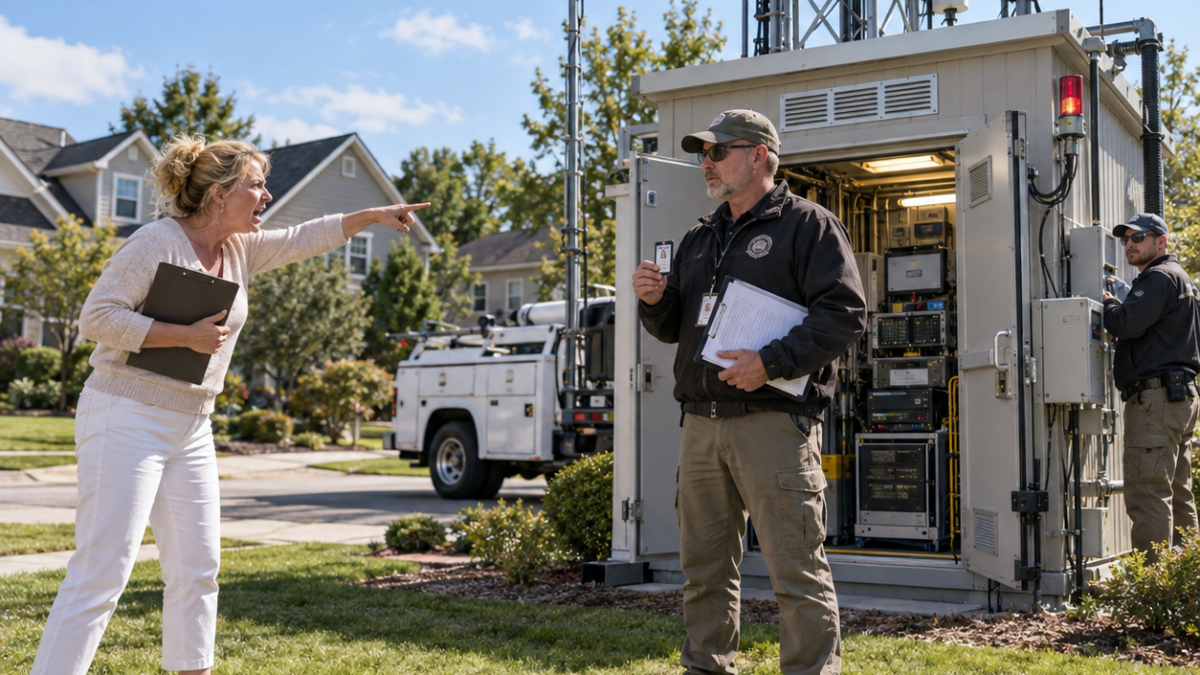
Less than five minutes later, the purple flag appeared at the end of the street.
Karen drove faster than anyone should drive a golf cart.
She stopped so hard that one front tire bumped the curb.
“What are you doing?” she shouted before she was even fully out of the seat.
The foreman raised both hands.
“I’m stopping work.”
“I hired you to remove an illegal structure.”
“He says it’s federal.”
“He lies.”
The foreman looked at me.
Then at Karen.
Then back at me.
I remained silent.
Karen marched toward us.
“Show me this supposed proof.”
“You’ve received it twice,” I said.
“I’ve received letters full of nonsense.”
“You received documentation.”
“From you.”
“And from the agencies named in those documents.”
She jabbed one finger toward the building.
“This is Oak Haven Estates. Our covenants clearly prohibit detached structures without architectural approval.”
“You’re still talking about architectural approval.”
“Because that is the issue.”
“No, Karen. That stopped being the issue the moment you hired people to physically interfere with federally protected equipment.”
Several front doors had opened along the street.
Neighbors stood on porches.
Curtains moved.
Dave, the software engineer next door, had stepped into his yard holding a coffee mug.
Karen noticed the audience.
That made things worse.
She had always performed authority better when people were watching.
“Mr. Turner,” she said loudly, “you were given repeated opportunities to comply with the same rules everyone else follows.”
I matched her volume but not her anger.
“And you were given repeated written notice that those rules do not authorize this demolition.”
Her face reddened.
“You forged those documents.”
The foreman took two steps backward.
That accusation changed the atmosphere.
“Be careful,” I said quietly.
“I know people like you.”
“What kind of people?”
“Men who think because they worked for the government, ordinary rules don’t apply.”
For the first time, I felt anger.
Not because she insulted me.
I had been insulted by people with far more impressive résumés than Karen.
What angered me was how completely she misunderstood the situation.
I had spent most of my adult life learning that authority came with responsibility.
Karen believed authority meant the ability to make other people obey.
There was a difference.
A dangerous one.
I pointed toward the trucks.
“Tell them to leave.”
“You don’t give orders here.”
“On my property, regarding that facility, I do.”
She turned toward the foreman.
“You have a contract.”
He folded his arms.
“And I’m not touching that building.”
“I’ll sue you.”
“Talk to my boss.”
“I’ll make sure nobody in this community hires you again.”
He stared at her for a second.
Then he smiled.
“Lady, you’re one HOA.”
He turned toward his men.
“Load up.”
That may have been the first time I saw Karen genuinely lose control.
She followed them toward the truck.
“You cannot just leave!”
Nobody answered.
“You signed an agreement!”
The compact excavator was secured again.
Tools disappeared into the pickup.
The foreman climbed behind the wheel, lowered his window, and looked at me.
“You might want cameras.”
“I have them.”
“Good.”
Then he drove away.
Karen stood in the street.
Alone.
Dozens of neighbors had watched her arrive like a general and leave without an army.
She turned toward me.
“This isn’t over.”
“No,” I said.
“It isn’t.”
For the first time, she seemed uncertain about what I meant.
Then she got into her golf cart.
The purple flag looked less impressive when she drove away that afternoon.
The neighborhood changed after that.
Not dramatically.
Not at first.
Oak Haven had spent years learning to remain quiet around Karen.
She had a violation for everything.
Garbage cans visible six minutes too long.
Grass half an inch too tall.
A basketball hoop placed four feet from an approved position.
Flowerpots painted the wrong shade of blue.
Most people didn’t challenge her because fighting an HOA over fifty or a hundred dollars took more energy than simply paying.
That was how her authority had grown.
Not through one enormous act.
Through hundreds of tiny surrenders.
Dave caught me at the fence the following evening.
“So,” he said, “federal shed?”
I laughed despite myself.
“Something like that.”
He leaned on the fence.
“Half the neighborhood thinks you’re secretly running NORAD back there.”
“I’m not.”
“Good. Because my Wi-Fi is already terrible.”
That got another laugh out of me.
Then his expression became serious.
“Karen’s been telling people you’re dangerous.”
“I expected that.”
“She told Mrs. Henderson you’re running an illegal commercial operation.”
“Document it if you hear it again.”
“You keeping records?”
“Of everything.”
He studied me.
“Can I ask something?”
“Sure.”
“Why aren’t you furious?”
“I am.”
“You don’t look furious.”
“That’s because fury is useful information and terrible strategy.”
He nodded slowly.
“Army?”
“Partly.”
He looked down the street toward Karen’s house.
“You know, a lot of people are tired of her.”
“I’ve noticed.”
“No. I mean really tired.”
That conversation introduced me to Maria Santos.
Maria was sixty-eight, retired, and had spent most of her career as a paralegal.
She came to my house carrying a three-ring binder thicker than Karen’s ego.
“I heard you like documentation,” she said.
I looked at the binder.
“I think we’re going to get along.”
Inside were years of correspondence with the HOA.
Violation notices.
Appeals.
Meeting minutes.
Photographs.
Maria had once received a fine because two rose bushes in her front yard were allegedly “inconsistent with the approved community floral palette.”
“There is no floral palette,” she told me.
“You’re sure?”
“I helped draft the original amendment that Karen claims created it.”
I stared at her.
“She fined the woman who helped draft the rule?”
“She counted on me being too tired to fight.”
“Were you?”
“For a while.”
She looked toward my backyard.
“Then somebody brought an excavator to your house.”
That night, four of us sat around my kitchen table.
Dave.
Maria.
Tom Bennett, a retired accountant.
And me.
I opened my files.
I showed them the original construction notifications.
The delivery confirmations.
The HOA violations.
My replies.
The certified-mail receipts.
The escalating fines.
The newsletter.
Then I played the security footage from the demolition attempt.
When Karen shouted that my federal documentation was forged, Maria stopped the video.
“Play that again.”
I did.
She watched twice.
Then she leaned back.
“She actually accused you of forging federal credentials in front of witnesses?”
“Yes.”
Maria smiled without humor.
“She may be the most cooperative adversary I’ve ever seen.”
Tom hadn’t said much.
He was staring at the stack of HOA fine notices.
“How much has she assessed?”
“A little over a thousand so far.”
He rubbed his chin.
“Where does fine revenue go?”
I looked at him.
“You’re the accountant.”
“No, I mean according to our HOA financial statements.”
Maria understood first.
“Tom.”
“I’ve looked at the annual reports,” he continued. “They’re useless. Thousands under ‘community enhancement.’ Thousands under ‘administrative consulting.’ No detailed invoices.”
Dave sat forward.
“You think she’s stealing?”
“I think I don’t know where the money is going.”
Maria smiled.
“And homeowners are entitled to know.”
That changed everything.
Until then, my fight had been about one structure.
One president.
One terrible decision.
But as we compared files, it became obvious that Karen’s behavior wasn’t isolated.
She had constructed a system.
She controlled the board agenda.
She influenced the management company.
She interpreted vague covenants however she wanted.
Two board members—Carol and Bob—almost always voted with her.
And because attendance at HOA meetings was usually pathetic, a small group effectively governed hundreds of residents.
Maria tapped the table.
“Your federal issue can defeat her attack on you.”
She pointed toward the neighborhood outside.
“But it won’t fix this.”
I knew she was right.
“So what fixes it?”
“Sunlight.”
Dave created a private online form where residents could anonymously describe their experiences with the board.
We expected maybe ten responses.
We received forty-three in the first three days.
Some were petty.
Some were ridiculous.
Some made me angry.
One young couple had been fined repeatedly because their children’s play structure was considered the wrong color.
An elderly widow named Helen Henderson had been threatened with a lien after wind tore shingles from her roof.
She had been waiting for insurance approval.
Karen gave her ten days.
Another family requested permission to build a wheelchair ramp for their teenage son.
The request was delayed for months because Karen complained the ramp would alter the “visual continuity” of the front elevation.
The father, Ben Wallace, eventually hired an attorney.
Only then did the board back down.
When Maria and I visited him, Ben opened a drawer and handed us every letter.
“I kept them because someday I wanted somebody to know.”
“Why didn’t you bring this to the neighborhood?” I asked.
He gave me a tired smile.
“Because everybody already knew what Karen was like.”
That sentence stayed with me.
Everybody knew.
And nothing changed.
That is how abusive systems survive.
Not because nobody recognizes them.
Because everybody assumes somebody else will eventually do something.
Tom formally requested five years of HOA financial records.
Karen denied him.
He requested again.
She allowed him one hour to inspect selected documents while supervised.
Maria responded with a letter citing our state’s property-association records requirements and advising the board to consult independent counsel.
Three days later, the management company changed its position.
Boxes of documents became available.
Tom spent an entire weekend in my dining room with a calculator, a laptop, and more coffee than any physician would recommend.
Sunday evening, he called us together.
“I found something.”
He turned his laptop around.
There were payments to a consulting company I didn’t recognize.
“What is Albright Community Solutions?” I asked.
Maria stared.
“No.”
Tom nodded.
“I checked the registration.”
“Who owns it?”
“Karen’s brother.”
Dave whistled.
“How much?”
“Over five years? Forty-seven thousand dollars.”
“For what?”
“That’s the problem.”
He opened several invoices.
The descriptions were vague.
Landscape planning.
Vendor coordination.
Community consulting.
Resident compliance support.
Some months contained multiple payments.
Then Tom showed us travel expenses.
An HOA-funded trip to a property-management conference in Orlando.
Hotel upgrades.
Meals.
Transportation.
Entertainment expenses categorized as “board development.”
And the fine records were equally interesting.
Karen’s close friends frequently received warnings that disappeared.
Other residents accumulated penalties aggressively.
Tom had color-coded the pattern.
Red for households Karen had publicly argued with.
Green for families known to socialize with her.
The chart looked less like accounting and more like retaliation.
“Can we prove criminal conduct?” Dave asked.
Maria immediately shook her head.
“That’s not our job.”
She pointed toward the spreadsheet.
“We can prove homeowners deserve answers.”
I appreciated that distinction.
Evidence mattered.
So did restraint.
Karen had already made the mistake of treating suspicion as certainty.
We weren’t going to become her.
We scheduled a special community meeting.
The agenda was deliberately plain:
HOA GOVERNANCE, FINANCIAL TRANSPARENCY, AND LEGAL COMPLIANCE.
Karen responded by calling it an unauthorized political gathering.
Maria framed the email.
Meanwhile, my own situation escalated.
I sent the board another formal notice.
This one was shorter.
I summarized the timeline.
Attached proof of delivery.
Included photographs from the attempted demolition.
Noted that the contractor had been dispatched after the board had already received documentation identifying the nature of the facility.
Then I gave them an opportunity to end the matter.
Withdraw every violation.
Cancel the fines.
Confirm in writing that neither the HOA nor its contractors would enter or interfere with the protected installation.
Issue a correction regarding false statements circulated to residents.
I copied Director Evans and the appropriate federal legal contacts.
I hoped someone sensible would finally take control.
Two weeks later, a letter arrived from the HOA’s attorney.
I read it twice.
Then a third time.
The association rejected my claims.
The fines would remain.
A lien would be pursued.
If the violation was not cured, the association reserved whatever collection and enforcement remedies were available under the governing documents and state law.
I scanned the letter.
Then I sent it to Director Evans.
The subject line said:
HOA ESCALATING AFTER ATTEMPTED INTERFERENCE
Her reply arrived minutes later.
Received. Preserve everything. We’re handling further contact.
That was all.
But the tone told me the argument had moved beyond me.
The following Monday, an assistant U.S. attorney called.
He didn’t make dramatic promises.
He asked questions.
Dates.
Names.
Who received which documents?
Who signed for certified mail?
Who authorized the contractor?
Was the contractor aware of the facility’s status beforehand?
Had anybody entered the restricted area?
Had systems been damaged?
Were emergency operations interrupted?
I answered everything as precisely as I could.
At the end, he said, “Mr. Turner, your records are unusually complete.”
“Habit.”
“It’s a useful habit.”
Then he asked me not to discuss the details of their review publicly.
I agreed.
Tuesday morning, the federal government came to Oak Haven.
Two dark sedans turned onto our street just after nine.
A third vehicle followed.
They didn’t stop at my house.
They stopped at Karen’s.
Dave texted me before I even reached the window.
PLEASE TELL ME YOU SEE THIS.
I saw it.
Four officials walked toward Karen’s front door.
One wore a jacket identifying the FCC.
Another appeared to be an investigator.
A woman carried a document folder.
The fourth man remained near the driveway for several minutes before joining them.
Karen opened the door.
At first, she wore the same irritated expression she wore whenever a delivery driver blocked her mailbox.
Then the woman showed identification.
Karen’s posture changed.
I couldn’t hear anything from my house.
That didn’t matter.
Her face told the story.
She glanced toward my property.
Then back at the officials.
One handed her documents.
She shook her head.
He said something.
She shook her head again.
The woman pointed to something on the page.
Karen stopped moving.
They were inside almost an hour.
By then, Oak Haven had become the quietest neighborhood in America.
Nobody wanted to appear to be watching.
Everybody was watching.
When the officials finally came out, their expressions gave nothing away.
Karen remained on the porch.
She looked smaller.
Not defeated.
Not yet.
But frightened.
The FCC representative glanced toward my house and gave me a brief nod.
Then the vehicles drove away.
Ten minutes later, Carol arrived.
Five minutes after that, Bob.
By noon, Karen’s driveway looked like an emergency board meeting.
By evening, rumors had evolved into fantasy.
The FBI had arrested Karen.
Homeland Security had seized the clubhouse.
The CIA was monitoring everybody’s Ring cameras.
One resident somehow decided my little building controlled military satellites.
I corrected none of it publicly.
I posted one message in Dave’s neighborhood group.
Please do not speculate. Accurate information and supporting documents will be presented at Thursday’s community meeting.
That single sentence guaranteed everyone would attend.
Thursday evening, the library meeting room was packed.
More than one hundred residents showed up.
Some stood along the walls.
Others filled the hallway.
Karen sat in the first row between Carol and Bob.
For once, she didn’t have her clipboard.
Maria opened the meeting.
“We’re not here for rumors,” she said. “We’re here for records.”
Perfect.
I spoke first.
“My name is Mark Turner. Most of you know me as the man with the illegal shed.”
Laughter rolled through the room.
Even I smiled.
I clicked the remote.
A photograph of my backyard appeared on the screen.
“There it is.”
More laughter.
Then I became serious.
“For several months, the HOA board has demanded that I remove that structure. I want you to understand what happened, because many claims have been made about me, the facility, and this dispute.”
I started at the beginning.
I showed the original notification package.
The proof that the HOA management company had received it.
The first violation notice.
My response.
The certified-mail receipt.
The fines.
The newsletter.
Then the demolition contractor.
I played the video.
Nobody laughed during that part.
When the foreman said he had been hired to remove the structure, several people gasped.
When Karen arrived and accused me of forging federal credentials, somebody behind me whispered, “Oh, my God.”
I stopped the video.
“The structure is part of an emergency communications network operated under federal authority. The HOA was repeatedly notified before it attempted physical removal.”
Karen stood.
“That is your interpretation!”
Maria raised one hand.
“You’ll have an opportunity to respond.”
Karen ignored her.
“He has manipulated all of you! This man has been threatening this community with federal agencies for months!”
I looked at her.
“No, Karen.”
She turned toward me.
“I kept asking you to stop.”
The room went still.
“You could have stopped after the first letter. Or the second. Or after your contractor refused to proceed. You had every opportunity.”
“You think you can humiliate me?”
“This meeting isn’t about humiliation.”
I clicked to the next slide.
It showed the HOA attorney’s letter threatening additional enforcement.
“This is about accountability.”
Karen sat down.
Her face had gone pale.
I did not discuss details the federal officials had asked me to keep confidential.
I simply confirmed that government representatives had contacted the association regarding interference with the facility and that the matter was under official review.
Then Tom stood.
If my presentation shocked people, his enraged them.
He began with one question.
“Does anybody here know exactly where your HOA dues go?”
Nobody answered.
“Neither did I.”
He showed five years of financial summaries.
Then he showed the underlying transactions.
Consulting payments.
Travel expenses.
Unexplained reimbursements.
Vendor relationships.
Selective fine enforcement.
When the name Albright Community Solutions appeared on the screen, somebody called out, “Is that her family?”
Tom remained careful.
“The company is registered to a relative of our current HOA president. The records available to us contain limited detail regarding the services provided. We are asking for a full independent audit.”
That phrasing mattered.
We had evidence.
But we weren’t prosecutors.
Tom continued.
“The issue tonight is not whether anyone committed a crime. The issue is whether homeowners were given transparent information about how their money was spent.”
People began shouting questions.
Karen stood again.
“Those expenses were approved!”
“By whom?” someone yelled.
“The board!”
Carol stared at the floor.
Bob suddenly found the ceiling fascinating.
Then Maria stepped forward.
“What you have seen tonight involves Mark’s dispute and HOA finances. But neither is the reason many of us are here.”
She picked up a folder.
“This is.”
She looked around the room.
“How many homeowners have felt intimidated by enforcement practices?”
Hands rose.
Dozens.
Maria nodded toward Helen Henderson.
“Helen?”
The elderly widow walked slowly toward the microphone.
Her hands trembled.
“Last spring,” she began, “a storm damaged my roof.”
Karen shifted in her chair.
Helen continued.
“I reported it to my insurance company the next morning. They told me an adjuster would need to inspect the house.”
Her voice cracked slightly.
“Three days later, I got an HOA violation.”
She held up a letter.
“I explained the situation.”
Another letter.
“I was told the damaged shingles affected property values and that fines would begin if repairs were not completed.”
She looked toward Karen.
“My husband had died six months earlier.”
Nobody moved.
“I was still trying to figure out how to live alone.”
Her eyes filled with tears.
“I asked for more time.”
She swallowed.
“I received another notice.”
A woman in the audience stood and hugged her when she returned to her seat.
Then Ben Wallace approached the microphone.
He spoke about the wheelchair ramp.
Not angrily.
That made it worse.
“My son doesn’t care about architectural harmony,” he said. “He cares whether he can get into his own house.”
Silence.
“We submitted drawings.”
He held up the correspondence.
“We submitted revised drawings.”
Another packet.
“We changed materials.”
Another packet.
“We changed railing design.”
He looked at the board.
“Every delay meant my wife and I were carrying a growing teenager up the front steps.”
Karen whispered something to Carol.
Ben heard it.
“No.”
His voice sharpened.
“You don’t get to explain this away tonight.”
Applause exploded.
Then one story became ten.
Ten became twenty.
People who had been silent for years suddenly realized their experiences were not isolated.
The young family with the play structure.
A widower fined for leaving his trash cans visible while recovering from surgery.
A couple cited because their visiting daughter parked an RV in the driveway during an emergency.
A veteran threatened over a flagpole placement.
A woman fined over holiday lights installed two days before Karen’s preferred calendar window.
Some complaints were serious.
Some were absurd.
Together they revealed the same pattern.
Rules had become weapons.
At 9:14 p.m., Tom made a motion for a vote of no confidence in the board.
The room erupted.
Maria restored order.
“We must follow the governing documents,” she said.
That sentence was important.
We were not going to defeat abuse of rules by ignoring rules ourselves.
The bylaws provided a mechanism for removal and recall.
Petitions circulated that night.
By the following morning, we had far more signatures than required.
A formal recall meeting was scheduled.
Karen had spent years teaching Oak Haven to fear procedure.
Now procedure belonged to everybody.
The board began collapsing before the vote happened.
Bob resigned first.
His letter was four sentences.
Carol followed two days later.
Hers was longer and included one sentence that told me more than she probably intended:
I deeply regret allowing loyalty to individuals to replace my responsibility to the membership.
Karen refused to resign.
Instead, she distributed a letter claiming she was the victim of a coordinated campaign by “disgruntled residents and outside government interests.”
It might have worked months earlier.
Now people had seen the documents.
The recall vote wasn’t close.
Karen was removed.
Maria became interim president.
Tom became treasurer.
Dave became secretary.
Their first resolution addressed my property.
Every fine was rescinded.
Every violation was withdrawn.
The association formally acknowledged that it would not interfere with the communications facility.
The second resolution ordered an independent financial audit.
The third suspended aggressive collection activity on disputed violations until every pending case could be reviewed.
Then Maria did something I never expected.
She knocked on my door one Saturday morning carrying a folder.
“What now?” I asked.
“Good news for once.”
Inside was a formal apology.
Not from Karen.
From Oak Haven Estates.
It acknowledged the association’s improper handling of the dispute.
It apologized for the attempted removal.
It confirmed the rescission of all fines.
I read it slowly.
Then I handed it back.
“You can keep that copy,” Maria said.
“I intend to frame it beside the first violation.”
She laughed.
“I knew you were petty underneath all that military discipline.”
“Strategically petty.”
“There’s a difference?”
“Documentation.”
The federal matter continued quietly.
Months passed.
Investigators interviewed people.
The demolition contractor provided his work order and communications.
Board records were requested.
The independent HOA audit was shared with appropriate authorities where legally required.
I was interviewed twice more.
The eventual outcome was far less cinematic than neighborhood rumors had predicted.
There was no midnight raid.
No helicopter.
No handcuffs on the golf course.
There were lawyers.
Agreements.
Formal findings.
Restitution discussions.
And consequences.
Karen ultimately entered into a resolution of the federal interference matter that required her to accept responsibility for her role, pay substantial penalties and restitution associated with the broader disputes, and comply with restrictions connected to future association governance.
Separately, the financial audit documented serious conflicts of interest, unsupported reimbursements, selective enforcement, and expenditures that should never have passed without far greater disclosure.
The HOA pursued recovery.
Several homeowners joined a civil action seeking reimbursement for improperly collected fines and other damages.
Karen eventually settled.
The amount was confidential.
The moving truck was not.
I watched it arrive on a cold gray morning almost a year after she first stood on my porch.
Her Yard of the Month sign was still beside the driveway.
That almost felt poetic.
Two movers carried boxes from the house.
Karen stood near her car.
For the first time since I had known her, she wore no bright tracksuit.
No clipboard.
No HOA badge.
Just jeans and a dark sweater.
I hadn’t planned to speak to her.
Then she saw me.
For several seconds, neither of us moved.
Finally, she crossed the street.
I remained beside my mailbox.
“You’re happy,” she said.
It wasn’t a question.
“No.”
She gave a bitter laugh.
“Please.”
“I wanted you to stop.”
“You destroyed my life.”
I looked at her.
“I sent you the documentation before any of this started.”
“You embarrassed me.”
“I asked you privately.”
“You went after the board.”
“After you tried to demolish the facility.”
Her mouth tightened.
“You turned everyone against me.”
“No.”
I thought about Helen.
Ben.
The forty-three anonymous reports.
Tom’s spreadsheets.
Maria’s binder.
“People were already against what you were doing. They just didn’t know how many other people felt the same way.”
She looked toward my backyard.
“You could have just gotten approval for the shed.”
Despite everything, I nearly laughed.
“It still isn’t a shed, Karen.”
For one second, the old fire returned to her face.
Then it disappeared.
She looked tired.
Older.
Human.
And strangely, that made the moment less satisfying than I once imagined it might be.
Victory looks cleaner from far away.
Up close, it often looks like two people standing beside a mailbox wondering how something so stupid became something so destructive.
Karen glanced toward her house.
“I worked for years for this community.”
“I believe you probably started that way.”
She looked back at me.
That surprised her.
“I mean it,” I said. “I don’t think you woke up one morning and decided to become this person.”
She said nothing.
“But somewhere along the way, you stopped believing the rules applied to you too.”
Her eyes narrowed.
“You think you’re better?”
“No.”
I shook my head.
“I think that’s exactly the trap.”
The movers closed the rear door of the truck.
Karen walked away without another word.
She drove out of Oak Haven that afternoon.
I never saw her again.
The neighborhood didn’t magically become perfect afterward.
That would have been another kind of lie.
People still argued.
HOA meetings still ran too long.
Someone always complained about parking.
Someone else always believed the annual landscaping budget was excessive.
Maria occasionally called me after meetings and announced she was resigning immediately.
She never did.
But something fundamental changed.
People participated.
Financial statements were published clearly.
Contracts above a certain value required multiple bids.
Potential conflicts of interest had to be disclosed.
Board meetings were streamed online.
Enforcement decisions required written justification.
Homeowners had meaningful appeal rights.
No president could interpret vague restrictions alone.
The architectural committee expanded to include rotating members.
The rules themselves were reviewed.
Some were eliminated entirely.
Others were rewritten.
The objective became preserving shared property and basic community standards—not controlling every harmless detail of private life.
Helen’s roof was repaired.
The HOA refunded the fines she should never have paid.
Ben Wallace was invited to serve on the accessibility committee Maria created.
He accepted.
The first project they reviewed was a proposal to establish clear, accelerated approval procedures for disability-related modifications.
“Funny,” he told me one afternoon, “how fast things move when the people making decisions have actually had to live with them.”
The playset stayed.
So did Maria’s allegedly illegal roses.
Tom recovered enough questionable expenditures through settlements and negotiated repayments that annual dues did not increase the following year.
That made him more popular than any HOA treasurer has a right to be.
Dave rebuilt the community website.
He added a page called KNOW YOUR HOA containing governing documents, meeting schedules, budgets, contracts, audit reports, and appeal instructions.
Then, without telling me, he added another page.
EMERGENCY PREPAREDNESS RESOURCES
At the bottom was a photograph of my gray building.
The caption read:
No, it is still not a shed.
I called him.
“Take it down.”
He laughed for twenty straight seconds.
It stayed.
Something changed in me too.
When I moved to Oak Haven, I hadn’t been searching for community.
I had been searching for quiet.
After Sarah died, quiet became the thing I thought I needed most.
We had been married thirty-one years.
You don’t realize how much sound another person makes until they are gone.
Her footsteps upstairs.
Cabinet doors opening.
The dryer running because she could never tolerate leaving laundry overnight.
Her laugh from another room.
Her habit of humming while reading recipes.
After she died, our old house didn’t feel peaceful.
It felt empty.
That was why I sold it.
Oak Haven was supposed to be my smaller life.
Half an acre.
A manageable house.
Close enough to our daughter that she could visit without turning it into an expedition.
Enough space in the backyard for the emergency communications contract.
I planned to maintain the station, read, fish occasionally, and bother nobody.
Then Karen arrived with a clipboard.
For months, I thought the entire conflict was an interruption of the life I wanted.
Eventually I understood it had become the doorway into another one.
People started stopping by.
Dave invited me to barbecues.
Tom asked me to help install shelving.
Helen occasionally brought cookies that could probably have been used as tactical weapons but tasted wonderful if you dipped them in coffee.
Ben’s son taught me more about adaptive technology in two afternoons than several Pentagon briefings ever had.
Maria became one of my closest friends.
She never stopped reminding me that her roses had technically defeated Karen before I did.
“You just had federal backup,” she’d say.
“You had flowers.”
“Exactly. Much more elegant.”
The station itself became less mysterious.
I couldn’t show people the sensitive equipment, obviously.
But I could explain its purpose in broad terms.
Emergency communication is one of those things nobody thinks about until ordinary systems disappear.
Storms.
Grid failures.
Wildfires.
Major disasters.
When everything works, infrastructure is invisible.
When it stops working, it becomes the only thing anyone cares about.
One Saturday, Oak Haven held its first community emergency-preparedness day.
Firefighters came.
County emergency managers set up information tables.
Residents learned about backup power, evacuation routes, weather alerts, medication planning, and checking on vulnerable neighbors during storms.
I stood beside a display about communications resilience.
Helen walked up and studied the little diagram.
“So your shed talks to satellites?”
I looked at her.
“Et tu, Helen?”
She smiled.
“Dave told us calling it a shed bothers you.”
“Dave is no longer welcome in my yard.”
Dave shouted from twenty feet away, “He says that every week!”
For the first time in years, I laughed hard enough that my eyes watered.
And unexpectedly, I thought of Sarah.
She would have loved this.
Not the conflict.
Certainly not Karen.
But this.
Neighbors standing together.
Children running between picnic tables.
People exchanging phone numbers so they could check on one another during emergencies.
Sarah believed communities were built from small acts.
Soup for a sick neighbor.
Remembering a birthday.
Helping somebody carry groceries.
She would have looked at all of us and said, See? This is why people need people.
I missed her fiercely in that moment.
Maria must have noticed.
“You okay?”
I nodded.
“Thinking about my wife.”
“She would’ve liked today?”
“She would’ve organized it better.”
Maria smiled.
“Then I would have liked her.”
“You would have terrified each other.”
“Even better.”
That winter, Oak Haven got hit by the kind of storm that turns weather reports from entertainment into instructions.
Freezing rain came first.
Then snow.
Then wind.
Power lines failed across parts of the county.
Cell service became intermittent.
A transformer blew near the highway.
By midnight, thousands of residents in surrounding areas had lost electricity.
ECR-7 switched to backup power automatically.
I was awake before the alarm completed its first cycle.
The station came alive exactly as designed.
Systems checked themselves.
Backup communications channels authenticated.
Satellite links stabilized.
Emergency traffic began moving.
Outside, snow crossed the backyard sideways.
The little gray building Karen once tried to destroy sat in the darkness, humming.
My phone buzzed.
Director Evans.
“Status?”
“Operational.”
“Backup?”
“Stable.”
“Any local issues?”
I looked through the window.
Several houses were dark.
“Neighborhood power is down.”
“Facility?”
“Unaffected.”
“Good. We may need relay support overnight.”
“Understood.”
I worked until sunrise.
The emergency itself never became catastrophic.
But ECR-7 carried traffic exactly when it was supposed to.
County warnings.
Backup coordination.
Regional communications.
Nothing dramatic enough for television.
Exactly the sort of quiet success emergency planners prefer.
Around seven, I stepped outside.
The storm had weakened.
Oak Haven looked buried.
Snow covered roofs, mailboxes, driveways, hedges.
I was exhausted.
Then I noticed lights near the clubhouse.
Portable lanterns.
The new HOA had opened it as a warming center for residents whose houses were cold.
Dave was running extension cables from approved backup equipment.
Tom was pouring coffee.
Ben was helping an elderly neighbor through the door.
Maria stood outside wearing a winter coat over pajamas.
She saw me.
“Mark!”
“What?”
“Station survive?”
“Yes.”
She pointed around the neighborhood.
“Good. Now stop being federal for five minutes and help us move tables.”
I stared at her.
Then I laughed.
“Yes, ma’am.”
Inside the clubhouse, maybe thirty people had gathered.
Some had blankets.
Some brought pets.
Children slept across folding chairs.
Helen handed me coffee.
“Busy night?”
“You could say that.”
She looked toward the window.
“That building of yours doing something important?”
“Yes.”
She nodded.
“Good.”
No joke this time.
Just that.
Good.
I looked around the room.
A year earlier, many of these people barely spoke to one another.
Now they were sharing generators, charging phones, moving food from warming refrigerators, checking medications, calling relatives, and making lists of neighbors who might need help.
The storm eventually passed.
Power returned.
The roads reopened.
Life resumed.
A week later, Director Evans sent me a short operational review praising the station’s performance.
The message included a sentence I read several times:
The relay functioned exactly as intended during regional infrastructure disruption.
Exactly as intended.
I printed it.
Then I walked into my kitchen.
On one wall hung the original HOA violation notice.
Beside it was the association’s apology.
And beside those, I placed the operational review.
Three pieces of paper.
The threat.
The correction.
The reason the fight had mattered.
Almost two years after Karen first came to my porch, Maria visited carrying a potted orchid.
“What’s this?”
“A gift.”
“For what?”
“The station.”
“The station does not need flowers.”
“Neither do you, apparently, yet somehow people keep tolerating you.”
She walked past me toward the backyard.
I followed.
The gray structure looked almost exactly as it had on the morning Karen first saw it.
Same siding.
Same roofline.
Same quiet appearance.
But everything around it felt different.
Dave’s children were throwing a football next door.
Helen was walking her ridiculous little terrier.
Ben and his son were adjusting something on their accessible van.
Two neighbors talked beside a mailbox without lowering their voices when an HOA board member passed.
Maria placed the orchid on my patio table.
“You know,” she said, “Karen was right about one thing.”
I stared at her.
“I’m going to regret asking.”
“She said nobody was above the rules.”
I laughed.
“That wasn’t her problem.”
“No.”
Maria looked toward the station.
“Her problem was believing she got to decide which rules mattered and whom they protected.”
That was exactly it.
Authority without accountability becomes ego.
Rules without humanity become weapons.
And silence, when people are being treated unfairly, becomes permission.
I had spent most of the conflict believing I was defending a federal installation.
In the narrowest sense, I was.
But Karen’s demolition attempt exposed something larger.
Helen needed somebody to challenge the system.
Ben needed somebody to challenge it.
Families who had paid unfair fines needed somebody to challenge it.
Tom needed access to records.
Maria needed allies.
Dave needed proof that the neighborhood could change.
And apparently, whether I knew it or not, I needed them too.
After Sarah died, I thought purpose meant continuing the work I already knew.
Maintain the equipment.
Answer when called.
Protect the mission.
I had forgotten that service was never really about equipment.
It was about people.
The station in my backyard existed because someday strangers might need a warning to reach them when ordinary systems failed.
Oak Haven had experienced a different kind of failure.
Not technical.
Human.
People had stopped believing their voices mattered.
And repairing that required another kind of communication.
One neighbor saying, “This happened to me.”
Another saying, “Me too.”
Another saying, “Enough.”
That was the message that finally got through.
Maria touched the orchid.
“So where should we put it?”
“Not inside.”
“I know.”
“No soil near the equipment.”
“I know.”
“No water.”
“Mark.”
“What?”
“It’s a flower.”
“I’ve seen flowers create problems.”
“You fought an HOA president for a year and somehow became more afraid of orchids.”
“I understand HOA presidents.”
She shook her head.
“Impossible man.”
We stood there quietly.
The afternoon sun reflected off the station’s gray siding.
A lawn mower hummed somewhere down the street.
Someone laughed.
A dog barked.
Ordinary sounds.
For years after leaving the Army, I thought ordinary meant unimportant.
Now I knew better.
Ordinary life was what all the emergency plans were designed to protect.
The barbecues.
The children on bicycles.
The old woman walking her dog.
The father helping his son into a van.
The neighbor who brings an orchid nobody asked for.
That was the mission.
Karen once stood on my porch and told me the building had seven days to disappear.
Instead, her threat exposed her misuse of power, united a neighborhood that had forgotten how to stand together, and forced Oak Haven to rebuild itself into the community it had always pretended to be.
The federal station remained exactly where it had always been.
Karen’s fines disappeared.
Her board disappeared.
Her private little system of fear disappeared.
But the thing that mattered most wasn’t that I won.
It was that afterward, people no longer needed me to fight for them.
They had learned how to fight for one another.
And every evening when I walked past that little gray building in my backyard, I remembered the same lesson.
Some structures are reinforced with concrete.
Some with law.
But the strongest communities are reinforced by people who finally decide they will no longer be afraid to stand beside each other.
Karen had looked at my backyard and seen a shed she believed she could tear down.
She never understood that the most powerful thing standing in her way wasn’t the federal government.
It was the moment an entire neighborhood stopped being silent.


