PART 2: HOA Ordered a Crew to Cut Power to My House—They Had No Idea I Owned the Utility Serving Their Entire Neighborhood
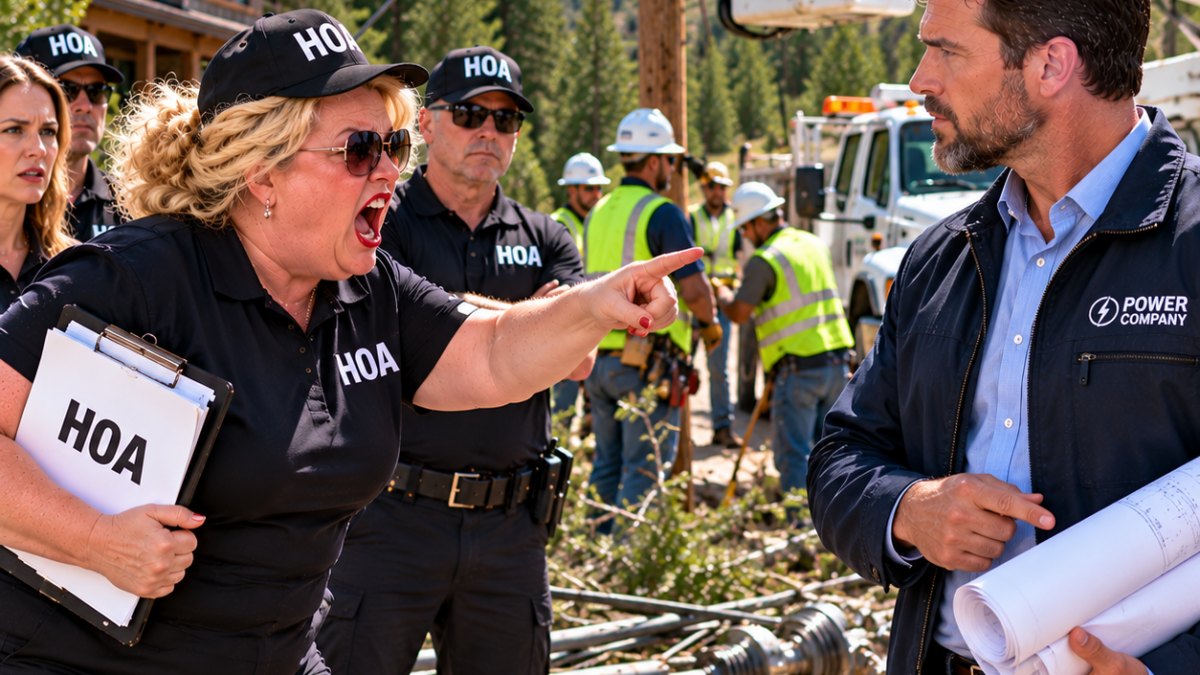
The morning Sandra Pierce ordered a contractor to cut the underground power line feeding my house, she stood beside an open trench with her HOA clipboard tucked against her chest and smiled like she had finally found the one punishment that would force my family to obey her.
What she did not understand was that the black conduit her crew had exposed did not belong to me, did not belong to Ridgeline Estates, and did not carry electricity to only one house—it was part of a live distribution system serving dozens of her own neighbors, and putting metal tools anywhere near it could turn a petty HOA dispute into a genuine utility emergency.
I had spent six months quietly letting Sandra believe I was just another homeowner she could pressure with notices and fines, but when my wife texted me a photograph of two workers digging beside a transformer I recognized instantly, I realized Sandra had crossed into territory where one more bad decision could put far more than my own lights at risk.
My name is Derek Sandborn, and six months earlier my wife, Claire, and I had moved into Ridgeline Estates because we wanted something simple.
Mountain air.
Good schools.
A quiet street.
I intentionally did not tell anyone what I did for a living.
When neighbors asked, I usually said I worked in energy.
That was true.
What I left out was that I owned Cascade Summit Power, the regional utility company supplying electricity to much of the county—including every home in Ridgeline Estates.
I wasn’t hiding it because I was ashamed.
I was tired of being introduced as “the power guy.”
I wanted to grill in my backyard, wave at neighbors, and complain about snow removal like everyone else.
For the first few weeks, that seemed possible.
Then I met Sandra Pierce.
Sandra had been HOA president for seven years and carried a clipboard the way some people carry authority in their voice.
The rules themselves were mostly ordinary.
Mailbox colors.
Grass height.
Holiday lights removed by January 5.
But Sandra seemed less interested in the rules than in being the person who decided what they meant.
Our trouble started when she noticed the backup-energy unit and EV charging equipment inside my garage.
The system was permitted, inspected, and designed for residential use. Part of it also let me securely monitor grid conditions when I worked from home.
Sandra saw equipment she did not recognize and immediately decided it was commercial.
Two days later, a notice appeared on our door.
**UNAUTHORIZED COMMERCIAL UTILITY EQUIPMENT.**
Remove immediately or face daily fines.
I emailed the board.
I attached the permit.
Electrical inspection.
Residential equipment specifications.
Sandra replied with one sentence.
**Rules apply to everyone. No exceptions.**
I could have answered with my full title and ended the argument.
Instead, I made a mistake.
I became curious.
I wanted to see whether the board would actually review the evidence or simply follow Sandra.
The first fine was fifty dollars a day.
Then one hundred.
Then five hundred.
Linda Marsh, the treasurer, objected during a board meeting.
Sandra’s answer later reached me through meeting notes.
**He thinks the rules don’t apply to him. We need to make an example.**
That sentence should have warned me.
Instead, I paid every invoice while formally disputing them.
The payments did not calm Sandra.
They irritated her.
Pressure only works when the other person starts bending.
I wasn’t bending.
So she changed tactics.
One Thursday morning, the board held what it called an emergency vote authorizing removal of an “unauthorized utility connection” serving my property.
Three board members voted yes.
Linda voted no.
The next morning, while I was on a video conference with my operations director, Claire texted me.
**Derek, there are men digging by the transformer. Sandra is outside with them. Is this normal?**
Below the message was a photograph.
Orange cones.
A trench.
A contractor holding digging tools.
And the number stamped on the transformer cabinet.
I knew that number.
I had approved maintenance on that exact circuit two months earlier.
It served roughly forty homes.
My chair rolled backward so fast it hit the wall.
I called Claire.
“Stay inside.”
“What’s happening?”
“Do not go near that trench.”
“Derek—”
“I’m coming home.”
I ended the work call, grabbed my keys, and ran for the truck.
By the time I turned onto Ridgeline Drive, the trench was already two feet deep.
And the black utility conduit was exposed.
PART 2
Sandra saw my truck before I had fully stopped.
She stood at the edge of the trench wearing a dark blue coat over her usual business clothes, clipboard tucked beneath one arm, looking more like someone supervising landscaping than an excavation beside energized utility equipment.
Bobby Finch, the contractor she had hired, stood inside the work area with two employees.
One worker had a shovel.
The other was kneeling beside the exposed conduit.
I parked on the opposite side of the street and got out.
“Stop.”
Sandra smiled.
Not friendly.
Satisfied.
“Good morning, Derek.”
“Get everybody out of that trench.”
Bobby looked up.
Sandra didn’t move.
“Maybe now you’ll understand that HOA decisions have consequences.”
I stared at her.
“Bobby, stop digging.”
He looked at Sandra.
She said, “Continue.”
I stepped closer but stayed outside the cones.
“That conduit does not belong to the HOA.”
Sandra rolled her eyes.
“We’ve already discussed your unauthorized line.”
“No, you’ve discussed equipment you don’t understand.”
“The board voted.”
“The board cannot vote itself authority over utility infrastructure.”
Sandra held up a sheet of paper.
“I have authorization.”
“From who?”
“The association.”
“That is not utility authorization.”
Bobby climbed out of the trench.
He was about forty-five, stocky, wearing a faded work jacket with FINCH PROPERTY SERVICES embroidered over the pocket.
“Mr. Sandborn,” he said cautiously, “Mrs. Pierce told us this is an abandoned private connection.”
“It isn’t.”
Sandra snapped, “Bobby.”
He looked at her.
She continued.
“You were hired to remove it.”
I pointed toward the transformer cabinet.
“Did anyone from the utility mark this excavation?”
Bobby hesitated.
That was answer enough.
“No utility locate?” I asked.
“We had the HOA map.”
I stared at him.
“The HOA map.”
Sandra said, “The easement belongs to Ridgeline.”
“The land may be subject to an easement. The electrical infrastructure does not belong to Ridgeline.”
She gave me that same expression I had seen every time I challenged a violation notice.
Mild contempt.
Absolute certainty.
“Derek, you are not an electrician.”
“No.”
“Then stop pretending you know more than the contractor.”
Bobby actually looked uncomfortable.
I almost laughed.
Instead, I said:
“I know exactly what that conduit is.”
Sandra stepped closer.
“You have ignored board orders for weeks.”
“I disputed them.”
“You paid the fines.”
“Under protest.”
“You refused removal.”
“Because the equipment is permitted.”
“It is commercial.”
“No.”
“It has monitoring equipment.”
“Yes.”
“Commercial.”
“No.”
She tightened her grip on the clipboard.
“This ends today.”
Then she turned toward Bobby.
“Cut his power.”
The street seemed to go silent.
A garage door was open across from us.
A neighbor stood inside it.
Another woman had stopped walking her dog.
Bobby stared at Sandra.
“What?”
“You heard me.”
“Ma’am, I thought we were removing an abandoned secondary connection.”
“That’s what this is.”
I shook my head.
“No.”
Bobby looked at me.
I pointed toward the transformer.
“That unit feeds approximately forty homes on this section of Ridgeline.”
Sandra laughed.
Actually laughed.
“You expect us to believe you know what every transformer in the neighborhood does?”
“Yes.”
“Why?”
“Because Cascade Summit Power owns it.”
She spread her hands.
“Exactly. The power company owns it, not you.”
I looked at her.
“I own Cascade Summit Power.”
Silence.
The woman with the dog stopped moving.
Bobby blinked.
Sandra laughed again.
This time louder.
“Oh, please.”
I didn’t answer.
She looked toward the contractor.
“Bobby, finish the job.”
He did not move.
“Bobby.”
He looked at me.
Something in his expression had changed.
Maybe my tone.
Maybe the transformer number I had quoted.
Maybe simple common sense.
“I think we need to verify this.”
Sandra’s face hardened.
“You have a signed HOA work authorization.”
“Yes.”
“Then do the work.”
“Not if this is utility property.”
“It runs to his house.”
“That doesn’t mean he owns the line.”
Exactly.
Sandra exhaled dramatically.
“You people are unbelievable.”
Then she stepped toward the trench.
Bobby moved in front of her.
“Ma’am.”
“What?”
“Let’s call the utility.”
“I am not calling the utility because Derek invented another excuse.”
“I didn’t invent the name printed on the equipment.”
That finally made her look.
She walked to the transformer cabinet.
The identification plate was mounted on the inside of the service door, but the exterior carried a smaller asset label.
CASCADE SUMMIT POWER.
Equipment ID.
Circuit designation.
Emergency number.
Sandra read it.
Then looked at me.
“That proves nothing.”
I almost admired the determination.
“Call the number.”
“I don’t need to.”
“Bobby should.”
She snapped:
“Bobby is working for me.”
“No.”
He looked at her.
“I’m working for the association.”
“That’s what I meant.”
Bobby took his phone out.
Sandra reached for it.
“Put that away.”
He stepped back.
“Mrs. Pierce, I’m not touching a live utility conduit without confirmation.”
“It’s residential voltage.”
I stared at her.
“How do you know?”
She hesitated.
“I was told.”
“By who?”
“The board.”
“The board does not determine voltage.”
Her face reddened.
“You are intentionally embarrassing me.”
“No, Sandra. I’m trying to keep everybody safe.”
She turned toward the neighbors who had gathered.
“This homeowner has violated the covenants for more than a month. The board followed procedure.”
Linda Marsh appeared at the edge of the crowd.
I had met her only twice.
Late fifties.
Quiet.
Usually carrying financial folders.
She looked from the trench to Sandra.
“Oh my God.”
Sandra saw her.
“Linda, good. Tell them about the vote.”
Linda didn’t answer.
“Linda?”
She walked closer.
“You actually did it.”
Sandra’s eyes narrowed.
“We authorized enforcement.”
“I voted no.”
“Yes. We know.”
“I told you this wasn’t HOA equipment.”
“You said you weren’t sure.”
“I said we needed legal advice.”
“And the majority disagreed.”
Linda looked into the trench.
“How deep did they dig?”
“About two feet,” Bobby said.
She covered her mouth.
Sandra scoffed.
“Everyone is being ridiculous.”
I took out my phone.
Called Cascade Summit’s operations center.
Marcus Bell answered.
“Operations.”
“Marcus, Derek.”
Pause.
“Morning.”
“I need an emergency safety response at Ridgeline Estates.”
His tone changed instantly.
“What happened?”
“Unlicensed excavation adjacent to transformer RS-4187. Primary conduit exposed.”
“Any contact?”
“Not yet.”
“Workers clear?”
“They are now.”
“Energized?”
“Yes.”
“We’re dispatching.”
“Lock out any nonessential switching on that circuit until inspection.”
“Understood.”
Sandra stared.
“You can’t order the power company around.”
I ended the call.
“I just did.”
She opened her mouth.
Closed it.
Then recovered.
“Anyone can make a phone call.”
I nodded.
“Yes.”
That was when Claire came out of our house.
I immediately said:
“Stay back.”
“I am back.”
She stood thirty feet away.
Her face was pale.
She looked at Sandra.
“You brought people here to cut our electricity?”
Sandra answered:
“Your husband has had weeks to comply.”
Claire stared.
“Do you hear yourself?”
Sandra’s composure slipped.
“Mrs. Sandborn, this has nothing to do with you.”
“It’s my house.”
“It concerns HOA enforcement.”
“It concerns whether my refrigerator turns off because you’re angry about a charger.”
Sandra shook her head.
“You people keep oversimplifying.”
Claire looked at me.
“Am I oversimplifying?”
“No.”
Bobby stepped closer to the transformer.
Not into the trench.
He leaned enough to see the conduit.
“Mr. Sandborn, what voltage are we dealing with?”
“The primary distribution system on that section is in the kilovolt range. Nobody touches anything until my safety crew verifies exactly what you exposed.”
His face changed.
“What?”
Sandra said:
“He’s trying to scare you.”
Bobby looked at her.
“No, ma’am. That’s exactly what I needed to know before you asked me to dig.”
“I gave you plans.”
“You gave me an HOA site sketch.”
“You said that was enough.”
“I said it was enough for landscaping excavation.”
“This is landscaping.”
Bobby pointed toward the conduit.
“No.”
The argument was unraveling faster than Sandra could redirect it.
She looked down.
Near the trench lay a large pair of insulated-looking cutters Bobby’s crew had brought as part of their tools.
Sandra reached toward them.
Bobby stepped forward.
“Don’t.”
She stared at him.
“You work for me.”
“No.”
He shook his head.
“Not anymore.”
That was the first time anyone publicly said no to her.
It hit harder than my ownership claim.
Her face flushed.
“Fine.”
She reached again.
I moved between her and the work area.
“Sandra, stay outside the cones.”
“You cannot order me around on HOA property.”
“This is an active electrical hazard.”
“Created by your illegal equipment.”
“No.”
She moved one step.
Bobby said sharply:
“Ma’am, stop.”
That finally worked.
Not because of me.
Because the man she had hired sounded genuinely afraid.
Sandra froze.
Fifteen minutes later, the first Cascade Summit truck turned onto Ridgeline Drive.
White utility body.
Blue-and-silver mountain logo.
Then another.
Marcus stepped from the passenger side wearing a hard hat and safety vest.
He walked straight toward me.
“Derek.”
Sandra heard it.
Not Mr. Sandborn.
Not sir.
Derek.
Marcus looked at the trench.
“Everybody clear?”
“Yes.”
He turned to his crew.
“Establish exclusion zone. Verify conduit condition. Nobody enters until test confirms no damage.”
The crew moved quickly.
Cones expanded.
Neighbors were moved farther back.
Bobby pulled his employees away voluntarily.
Sandra watched the Cascade Summit logos.
Then me.
Then Marcus.
Her face slowly changed.
Marcus asked:
“Who authorized excavation?”
Bobby pointed toward Sandra.
She immediately said:
“The board did.”
Marcus looked at me.
I said:
“HOA enforcement action.”
Marcus stared at her.
“Against utility equipment?”
“It serves his residence.”
“That’s irrelevant.”
Sandra frowned.
“Excuse me?”
“The service configuration may supply his property, but the company owns and controls infrastructure on our side of the service boundary.”
She said:
“The HOA owns the easement.”
Marcus shook his head.
“That is not the same as owning the electrical system.”
Linda whispered:
“I told you.”
Sandra turned.
“Oh, stop.”
A patrol car arrived behind the utility trucks.
Deputy Alan Cortez stepped out.
I knew Alan professionally through utility-emergency coordination, not socially.
He looked at the trench.
Then at the growing crowd.
Then at me.
“What happened?”
I explained.
Briefly.
No speeches.
No legal conclusions.
HOA contractor excavated near company-owned energized infrastructure.
No utility locate.
No utility authorization.
Conduit exposed.
Work stopped before physical contact with the cable.
Alan looked toward Bobby.
“That accurate?”
Bobby nodded immediately.
“Yes.”
“Who told you to dig?”
“HOA president.”
Sandra stepped forward.
“The board approved removal of an unauthorized line.”
Alan looked at her.
“Did you confirm ownership with the utility?”
“We confirmed the property easement.”
“That’s not what I asked.”
She stiffened.
“We believed it was homeowner equipment.”
Marcus said:
“Transformer and conduit are clearly identified utility assets.”
Sandra turned toward him.
“Clearly to you.”
Marcus raised an eyebrow.
“The company name is physically on the transformer.”
Several neighbors looked down.
Someone coughed.
Sandra’s face reddened again.
“This is becoming a circus.”
Alan said:
“No, ma’am. This is becoming an investigation.”
That shut down the noise.
Not her anger.
But the noise.
My compliance counsel, Grace Holloway, arrived about forty-five minutes later.
I had called her while the safety crew was inspecting.
Grace was the person I trusted when an operational problem became a regulatory one.
She stepped out carrying a tablet and a document folder.
No rush.
No drama.
She had the most dangerous professional habit in the world if you were wrong:
She stayed calm.
“Derek.”
“Grace.”
She looked toward the trench.
“Damage?”
Marcus answered.
“Outer conduit scarred. No conductor contact.”
Grace exhaled.
“So we got lucky.”
Sandra interrupted.
“Nobody got lucky. Nothing happened.”
Grace looked at her.
“Who are you?”
“Sandra Pierce. HOA president.”
Grace nodded.
“I’m Grace Holloway, general compliance counsel for Cascade Summit Power.”
Sandra’s eyes shifted toward me again.
Grace noticed.
“You know Mr. Sandborn?”
“He lives here.”
“Yes.”
Sandra waited.
Grace added:
“He is Cascade Summit’s owner and chief executive.”
That was the moment the last bit of disbelief left Sandra’s face.
Neighbors murmured.
Bobby looked almost relieved.
Linda closed her eyes.
Claire stood with her arms folded.
Sandra looked at me.
“You let us fine you.”
“Yes.”
“Why?”
“You never asked what I did.”
“You intentionally concealed material information.”
I almost laughed.
“My employer is not HOA business.”
“You watched us enforce this.”
“I repeatedly gave you code and permit documentation.”
“You could have told me.”
“I told you the equipment was legal.”
“You didn’t tell me who you were.”
“That shouldn’t have mattered.”
The street went quiet again.
That was the point.
If Sandra needed to know I was wealthy, connected, or professionally powerful before she treated my permit documents honestly, then the problem was bigger than one charger.
Grace opened the folder.
“These are recorded utility easements and asset maps predating Ridgeline Estates.”
She handed copies to Alan.
“Our infrastructure rights existed before this HOA.”
Sandra crossed her arms.
“We have architectural authority.”
Grace nodded.
“Over certain homeowner improvements.”
“So—”
“Not over utility-owned distribution infrastructure.”
“The equipment in his garage—”
“Was inspected and compliant before installation.”
“It looks commercial.”
“Appearance does not transfer jurisdiction.”
Sandra stared.
Grace continued.
“And even if the homeowner had a covenant violation, that would not authorize an HOA to excavate near energized utility infrastructure or direct a private contractor to disconnect it.”
Alan reviewed the documents.
“Was a locate request filed?”
Marcus answered:
“No.”
“Permit?”
“No utility excavation permit.”
Bobby looked sick.
“I asked her.”
Everybody looked at him.
Sandra snapped:
“Bobby.”
He continued.
“I asked if this was legal.”
“You asked whether the HOA authorized it.”
“I asked whether we needed the utility.”
“You were told the association controlled the easement.”
“That’s not the same answer.”
His voice was shaking now.
“Mrs. Pierce, you gave me a document that looked like a permit.”
Alan looked at him.
“What document?”
Bobby walked to his truck.
Returned with a sheet.
HOA letterhead.
**EMERGENCY UTILITY COMPLIANCE WORK AUTHORIZATION**
Sandra’s signature.
Three board initials.
No municipal permit number.
No utility mark.
No excavation-ticket reference.
Grace read it.
Then handed it to Alan.
“This is not a utility authorization.”
Sandra said:
“It never claimed to be.”
Bobby stared.
“You told me it was enough.”
“Because you were working for the HOA.”
“You almost got my guys hurt.”
That landed harder than any legal term.
Sandra’s face changed.
“I would never put anybody in danger.”
Bobby pointed at the trench.
“You didn’t even know what was in there.”
Nobody spoke.
Alan asked Sandra to step aside with him.
She resisted verbally but eventually went.
At that stage, there was no theatrical instant punishment.
There were statements.
Photographs.
Utility reports.
Evidence preservation.
A safety shutdown around the work zone.
The company inspected the damaged conduit and restored the excavation properly.
Bobby and his crew cooperated.
So did Linda.
Sandra did not.
At least not immediately.
She insisted the HOA had acted under emergency enforcement authority.
Grace asked for the exact bylaw provision.
Sandra promised to provide it.
She couldn’t.
By evening, the trench was safely backfilled.
No outage occurred.
That mattered to me more than anything else.
Forty homes remained powered.
No worker was injured.
Claire finally pulled me inside after sunset.
The moment the front door closed, she turned on me.
“You knew she was escalating.”
“Yes.”
“And you let this keep going.”
I leaned against the wall.
“I didn’t think she would touch utility infrastructure.”
“That is not an answer.”
“I know.”
“Why didn’t you tell her who you were?”
“Because it shouldn’t matter.”
Claire stared at me.
“That’s very principled.”
I waited.
“And incredibly stupid.”
Fair.
“I wanted the board to evaluate the permit instead of my title.”
“And instead Sandra brought people with shovels.”
“Yes.”
“You paid thousands in fines because you wanted to prove a point.”
“They’re recoverable.”
“I don’t care about recoverable.”
Her eyes filled.
“I watched strangers dig outside our house while you were on a work call.”
That hurt.
“I’m sorry.”
“You told me it was just HOA nonsense.”
“I believed that.”
“You were wrong.”
“Yes.”
Claire folded her arms.
“Say it again.”
“I was wrong.”
She nodded.
“Good.”
Then she sat on the stairs.
The anger left her face.
Fear replaced it.
“What if they had hit it?”
I sat beside her.
“Protection systems would likely have operated.”
“That is not what I asked.”
“No.”
I looked at the floor.
“If the wrong energized equipment had been contacted, somebody could have been badly hurt.”
Claire covered her face.
“I hate her.”
I put my arm around her.
“I know.”
“No, Derek. I hate that woman.”
“I know.”
“And I’m mad at you too.”
“I know.”
She leaned into me anyway.
That night, neither of us slept much.
At 1:14 a.m., my phone buzzed.
Linda Marsh.
I hesitated before answering.
“Hello?”
“Derek?”
“Yes.”
“I’m sorry.”
Her voice trembled.
“For what?”
“I should’ve stopped the vote.”
“You voted no.”
“I stayed on the board.”
“That’s different.”
“No.”
She took a breath.
“Sandra has been getting worse.”
“How long?”
“Years.”
I sat up.
Claire opened her eyes.
“What do you mean?”
“Rules used to be rules.”
Linda continued.
“Then they became personal.”
“Who she likes?”
“Who questions her.”
That sounded familiar.
“She called you arrogant after the first equipment appeal.”
“I never attended the appeal.”
“I know.”
“What evidence did the board review?”
Silence.
“Linda?”
“Your email.”
“The permit?”
“Yes.”
“Inspection?”
“Yes.”
“Equipment documentation?”
“Yes.”
“And?”
“Sandra said you were manipulating technical language.”
I laughed once.
Bitterly.
“The electrical inspector was manipulating technical language?”
“I argued.”
“What did the others say?”
“They didn’t understand it.”
“So they voted with her.”
“Yes.”
I rubbed my forehead.
“Why are you telling me now?”
“Because today I watched Bobby holding tools over a line Sandra didn’t understand.”
She started crying.
“I kept thinking: what if I had voted yes?”
“But you didn’t.”
“I kept sitting beside her anyway.”
“Linda.”
“I’m going to resign.”
“Don’t.”
Silence.
“What?”
“Not yet.”
“Why?”
“Because if the board needs someone willing to produce records, I’d rather it be you.”
She understood immediately.
“You want minutes.”
“I want everything relating to the equipment enforcement and excavation authorization preserved.”
“I can do that.”
“Do it legally. Don’t take anything you aren’t entitled to.”
“I know.”
“And talk to independent counsel.”
She laughed weakly.
“You really do own the power company.”
“Unfortunately.”
The next morning, Cascade Summit issued a formal incident report.
It was deliberately boring.
That’s what good safety documentation looks like.
Date.
Location.
Transformer.
Circuit.
Unauthorized excavation.
Conduit exposed.
Surface abrasion.
No conductor contact.
No outage.
No injury.
Corrective measures.
Estimated company response cost.
Grace sent a preservation letter to the HOA.
Not revenge.
Procedure.
Preserve emails.
Texts.
Meeting minutes.
Work authorizations.
Contractor communications.
Violation records.
Insurance notices.
Sandra responded through an attorney named Malcolm Reyes.
His first letter accused me of using my corporate position to intimidate a volunteer community association.
Grace read it in my office.
Then looked at me.
“You intimidate them?”
“No.”
“Good.”
“She authorized digging beside our primary line.”
“I noticed.”
“What do we do?”
“Nothing emotionally satisfying.”
“I hate when you say that.”
“You hired me because I say that.”
The company filed a claim for response costs and infrastructure damage.
We also notified the appropriate utility-safety and regulatory channels.
The county reviewed the excavation issue.
Law enforcement continued reviewing Sandra’s authorization and statements.
I stayed out of charging decisions.
That was important.
Owning a utility does not make me a prosecutor.
It does not make me a police officer.
And it certainly does not give me permission to retaliate against an entire neighborhood because its president made a reckless decision.
That last point became more important two days later.
Marcus walked into my office.
“We have a billing question from Ridgeline.”
“What kind?”
“People are calling customer service asking if we’re going to shut off the HOA.”
I stared.
“Why would they think that?”
“Facebook.”
Of course.
Someone had posted:
**HOA PRESIDENT PICKS FIGHT WITH POWER COMPANY OWNER — NEIGHBORHOOD MAY LOSE ELECTRICITY**
I closed my eyes.
“Tell customer service standard message. Residential service continues normally.”
“Already did.”
“No retaliation.”
“Obviously.”
“No special treatment either.”
“Derek.”
“I know you know.”
He smiled.
“You’re a little sensitive.”
“My wife told me I was incredibly stupid yesterday.”
“Claire usually has good judgment.”
“Get out.”
Ridgeline residents started emailing me directly.
Some apologized.
They had nothing to apologize for.
Some demanded Sandra resign.
Some accused me of setting a trap.
One man named Paul Emerson wrote:
**You deliberately let fines build so you could embarrass the HOA.**
He wasn’t entirely wrong.
That bothered me.
I replied once.
**I disputed the fines using permits and inspection records. I did not expect the board to authorize excavation of utility infrastructure. Your electrical service will not be affected by this dispute.**
No argument.
No threat.
Nothing else.
Linda delivered the meeting records through the association’s newly retained independent counsel.
The emergency vote had been exactly as she described.
Sandra:
**We have exhausted conventional enforcement.**
Board member Gary Nolan:
**Can we even disconnect power?**
Sandra:
**We aren’t disconnecting utility service. We’re removing an unauthorized homeowner line.**
Linda:
**Has the utility confirmed that?**
Sandra:
**The infrastructure is within HOA easement.**
Linda:
**That does not answer the question.**
Sandra:
**We cannot allow one resident to undermine authority indefinitely.**
That sentence became central.
Not because it proved every legal issue.
Because it exposed motive.
This was not about electrical safety.
Sandra wanted compliance.
At any cost.
Then came an email to Bobby.
**Treat connection as private homeowner equipment. HOA accepts responsibility for access authorization.**
Bobby replied:
**Need utility locate?**
Sandra:
**Not necessary. Line is being removed.**
Grace read it twice.
Then said:
“Well.”
“What?”
“She should have listened to the contractor.”
Bobby’s insurance carrier agreed.
Bobby himself came to my office voluntarily.
He brought an attorney.
I insisted Grace attend.
I did not want any conversation later portrayed as the utility owner pressuring a small contractor.
Bobby sat across from me.
“I’m sorry.”
“I believe you.”
“I should’ve walked away before digging.”
“Yes.”
He nodded.
“Fair.”
“What did Sandra tell you?”
“She said your garage equipment was illegally feeding power back into the community.”
I stared.
“What?”
“That’s what she said.”
“Feeding power?”
“Yes.”
“Did she show you engineering documentation?”
“No.”
“She said the board had an expert?”
“Her words were ‘we’ve reviewed it.’”
Grace asked:
“Who was the expert?”
“No idea.”
“There wasn’t one,” I said.
Bobby rubbed his hands together.
“I thought I was removing a small residential feed.”
“And when did you become uncomfortable?”
“When we hit utility warning tape.”
I looked at him sharply.
“You hit warning tape?”
“Yes.”
“Why did you continue?”
He looked ashamed.
“Sandra said it had been placed by the homeowner to scare people away.”
I leaned back.
That was worse.
Utility warning tape exists for a reason.
Grace asked:
“Did you photograph it?”
Bobby pulled out his phone.
“Yes.”
Orange underground warning tape.
**CAUTION ELECTRIC LINE BELOW**
Clear.
He showed Sandra in the background.
Clipboard.
Watching.
I asked:
“You showed her?”
“Yes.”
“What did she say?”
“Keep going.”
Claire’s voice echoed in my head.
What if they had hit it?
I stood and walked to the window.
Grace waited.
Then:
“Derek.”
“I’m fine.”
“You don’t look fine.”
“I am.”
I turned toward Bobby.
“Why did you stop when I arrived?”
He looked at me.
“Because you sounded like you knew exactly what was down there.”
“And Sandra didn’t.”
“No.”
He swallowed.
“And because once I saw the transformer plate, I realized I’d been stupid.”
“You weren’t the only one.”
That evening, Claire and I attended the next HOA meeting.
Not because I wanted to.
Because Linda asked.
The clubhouse was packed.
Ridgeline usually got maybe twelve people.
That night there were more than sixty.
Sandra sat at the board table with Malcolm Reyes beside her.
Linda sat at the opposite end.
Gary Nolan and James Price, the two members who had voted with Sandra, looked miserable.
The fifth board seat had been vacant for months.
Sandra called the meeting to order.
Immediately, someone shouted:
“Resign.”
Malcolm leaned toward the microphone.
“Please allow the board to conduct business.”
A woman in the second row stood.
“My children were home when they were digging.”
Sandra said:
“No service interruption occurred.”
“That’s not the point.”
Another man:
“You authorized people to dig beside a power transformer without calling the power company?”
Sandra looked toward Malcolm.
He whispered to her.
She answered:
“The board acted on information available at the time.”
Linda moved her microphone.
“I object to that characterization.”
Sandra stared at her.
“Linda.”
“No.”
The room went silent.
Linda continued.
“I asked during the emergency meeting whether the utility had confirmed ownership.”
Sandra said:
“And I answered.”
“You avoided the question.”
“I relied on the easement.”
“You told the contractor no utility locate was necessary.”
Malcolm put his hand up.
“We should not litigate disputed facts in a community meeting.”
A resident shouted:
“They’re in the emails.”
Applause.
Sandra’s face tightened.
She looked toward me.
“This has turned into a campaign.”
I remained seated.
Claire squeezed my hand.
Sandra continued.
“Certain residents have resources that ordinary associations cannot match.”
Someone shouted:
“He sent you the permit!”
Another voice:
“You fined him anyway!”
Sandra raised the gavel.
People laughed.
That made her angrier.
“Order!”
Linda closed her binder.
“I am making a motion.”
Sandra froze.
“For what?”
“To remove the president from enforcement authority pending investigation.”
The room erupted.
Sandra stared.
“You cannot.”
Gary Nolan looked at the bylaws.
“I think we can.”
Sandra turned.
“Gary.”
He wouldn’t meet her eyes.
Linda continued.
“Second?”
James Price slowly raised his hand.
“Second.”
Sandra’s face went white.
“You voted for the excavation.”
James looked miserable.
“I did.”
“So now you blame me?”
“No.”
He finally looked at her.
“I blame myself too.”
That changed the room.
He continued.
“I didn’t understand what we were authorizing.”
“You had the same packet.”
“The packet said unauthorized homeowner line.”
“That’s what it was.”
“No.”
James shook his head.
“That’s what you told us it was.”
Gary spoke next.
“I should’ve asked more questions.”
Sandra stood.
“So this is what we’re doing?”
Linda replied:
“Yes.”
“You all let him frighten you.”
I finally stood.
“No.”
Every face turned.
“I haven’t asked anyone to remove you.”
Sandra laughed bitterly.
“Of course not.”
“I haven’t threatened anyone’s electric service.”
“You didn’t need to.”
“I haven’t asked the board for money personally.”
“Your company filed a claim.”
“For company response costs caused by unauthorized excavation.”
“You see?”
She turned toward the room.
“He’s using his company against us.”
I shook my head.
“You still think this is about me.”
Her eyes narrowed.
“It is.”
“No.”
I pointed toward Linda.
“She asked whether the utility had been contacted.”
Then Bobby, who was sitting in the back.
“He asked whether he needed a locate.”
Then toward Claire.
“My wife showed you people digging outside our home.”
Then the residents.
“The problem is that every time someone asked a question, you treated the question as disobedience.”
Nobody spoke.
I continued.
“You didn’t need to know I owned Cascade Summit.”
Sandra stared.
“That’s easy for you to say now.”
“No. It’s the entire point.”
I held up the permit packet I had originally emailed.
“You had this before the first major fine.”
Electrical permit.
Inspection.
Residential classification.
“The equipment was legal before you knew my job title. The transformer belonged to the utility before you knew my job title. The contractor needed a proper locate whether I was a CEO or a schoolteacher.”
Sandra’s face changed.
Not surrender.
But uncertainty.
I finished.
“If knowing who I am is the only reason you would have stopped, then this board was already in trouble.”
I sat.
Claire whispered:
“That was better than being stupid.”
“Thank you.”
The vote proceeded.
Linda:
Yes.
James:
Yes.
Gary hesitated.
Then:
“Yes.”
Sandra was removed from enforcement authority three to zero, with Sandra not voting on the motion affecting herself under advice of counsel.
She stood.
“I resign.”
Nobody reacted at first.
Maybe people didn’t believe her.
She looked toward Linda.
“You wanted it.”
“No.”
“You’ve wanted my position for years.”
Linda shook her head.
“I wanted you to stop.”
“That is the same thing.”
“No.”
Sandra grabbed her purse.
Malcolm whispered something.
She ignored him.
At the door she turned.
“This neighborhood will regret this.”
Then she left.
The room stayed quiet.
Linda exhaled.
Gary put his head in his hands.
James looked toward me.
“I’m sorry.”
I believed him.
That was the strange thing.
The board members who had voted with Sandra weren’t cartoon villains.
They had trusted her summary.
They had become lazy.
They had accepted “Sandra checked” as a substitute for checking themselves.
That was dangerous.
But human.
The board formally voided my fines that night.
Every one.
Total refunds and credits were calculated.
I declined any special payment beyond what was legitimately owed.
The association also suspended enforcement of the garage-equipment violation pending independent review.
Grace had already told them the answer.
But I wanted the process completed properly.
An outside electrical consultant reviewed the equipment.
Permitted.
Residential.
Code compliant.
No HOA safety issue.
Exactly what I had sent them in the first place.
When the consultant finished, Linda called.
“You’re going to enjoy this.”
“What?”
“The report is four pages.”
“So?”
“It says the same thing your original email said.”
I laughed.
“Good.”
“No, not good. We paid $1,850 to learn how to read.”
“That may be the cheapest lesson the board gets.”
She groaned.
The utility claim was more complicated.
Cascade Summit incurred emergency response costs.
Inspection.
Conduit repair.
Safety deployment.
Legal and compliance review.
The association’s insurer initially questioned coverage because the board had authorized work outside normal HOA authority.
That created panic in Ridgeline.
Residents worried about a huge assessment.
I didn’t want that.
Neither did Grace.
We negotiated.
Not because Sandra deserved leniency.
Because the homeowners paying dues had not stood beside that trench holding the clipboard.
Eventually, the utility recovered its direct costs through a combination of association funds, contractor coverage where applicable, and negotiated payments.
No household lost power.
No retaliatory service changes.
No punitive rate increase.
I made sure that was explicit.
Paul Emerson—the man who accused me of setting a trap—came to my door afterward.
I almost didn’t answer.
Claire said:
“Be nice.”
“I am nice.”
“You’re professionally nice.”
“Still counts.”
Paul stood on the porch holding nothing.
No casserole.
No documents.
Just uncomfortable.
“Can we talk?”
“Sure.”
He looked toward the street.
“I was wrong about you threatening service.”
“Okay.”
“I thought because you owned the utility…”
“You thought I’d use it.”
“Yes.”
“That would be illegal and unethical.”
“I know now.”
“Good.”
He hesitated.
“But I still think you should’ve told Sandra earlier.”
I leaned against the doorframe.
“Maybe.”
He looked surprised.
“I expected you to argue.”
“Claire agrees with you.”
Claire shouted from inside:
“Correct.”
Paul laughed.
I continued.
“I should have recognized the escalation sooner. But my job title shouldn’t be required for the board to read permits.”
“No.”
“Both can be true.”
He nodded.
“That’s fair.”
Then:
“My daughter was home that morning.”
“I’m sorry.”
“She’s eleven.”
I understood why he had been angry.
He wasn’t defending Sandra.
He was scared.
That changed something in me.
This wasn’t only my family’s story.
Forty homes sat on that circuit.
Dozens of families saw a utility crew arrive because their HOA president had turned covenant enforcement into excavation.
I had spent too much time thinking about being targeted.
Not enough about the wider risk.
Sandra’s legal case took months.
The final outcome was less theatrical than neighborhood rumors.
Investigators reviewed the unauthorized excavation, her representations to the contractor, the warning tape, the board records, and other evidence.
She eventually resolved the case through a plea arrangement on reduced charges related to unlawful tampering and reckless conduct, with fines, probation, and restrictions that prevented her from serving in HOA leadership for a significant period.
I attended no hearing except the final one.
Claire came with me.
Sandra looked smaller in court.
Not physically.
The clipboard was gone.
The HOA title was gone.
No neighbors waiting for her interpretation.
Just a defendant beside counsel.
When given an opportunity to speak, she said:
“I believed I was protecting the community.”
I felt Claire’s hand tighten around mine.
Sandra continued.
“I thought Mr. Sandborn had installed equipment that could affect property values and electrical safety.”
The judge asked:
“Did you consult the utility?”
“No.”
“Electrical inspector?”
“No.”
“Licensed engineer?”
“No.”
“Then what was the basis for your belief?”
Long pause.
“The board’s concern.”
The judge looked down at the file.
“Concern is not expertise.”
That sentence stayed with me.
Sandra apologized to Bobby and his crew.
Not to me initially.
Then she turned slightly.
“And to the Sandborn family.”
Claire whispered:
“That sounded painful.”
“Probably was.”
Outside the courtroom, Sandra approached.
Her attorney stayed nearby.
Grace stood with us.
Sandra looked at me.
“I still think you should have told me.”
I almost smiled.
“You still think that’s the problem?”
“No.”
She rubbed her hands together.
“I think if I’d known, I would’ve stopped.”
“That’s why it’s the problem.”
She looked confused.
I continued.
“You would have respected my permit because I was powerful enough to scare you.”
She didn’t answer.
“What about the next homeowner?”
Her eyes dropped.
“The teacher?”
Silence.
“The retired couple?”
Nothing.
“The single mother who doesn’t own a utility?”
Sandra swallowed.
“I understand.”
“I hope you do.”
That was all.
No devastating final line.
No cheering.
No need.
She walked away.
Bobby kept working in the area.
For months, he refused any HOA job involving electrical or underground infrastructure unless utility locates were documented.
He came by our house one afternoon when Claire was planting flowers.
“I owe you something.”
He handed me a small orange strip.
Utility warning tape.
From the excavation.
I stared.
“You kept this?”
“Yeah.”
“Why?”
“To remind myself.”
“Of Sandra?”
“No.”
He shook his head.
“Of me.”
That answer surprised me.
“I knew enough to stop when I saw that tape.”
“But you didn’t.”
“No.”
“Why?”
“Because somebody with a clipboard sounded confident.”
Claire looked up from the flower bed.
“That’s terrifying.”
Bobby laughed without humor.
“Yeah.”
He continued.
“I’ve been doing property work twenty years. I let confidence substitute for verification.”
I handed the strip back.
“Keep it.”
“You sure?”
“You need it more.”
He smiled.
“Fair.”
Linda became interim HOA president.
She hated it.
That made her surprisingly good.
At her first meeting, she opened with:
“I do not want this job.”
Everyone laughed.
She continued:
“That means I have no intention of keeping it longer than necessary.”
Ridgeline adopted new policies.
No emergency board vote affecting utility infrastructure without outside legal and technical review.
Vendor permits verified.
Utility locate documentation required for excavation.
Conflict and enforcement appeals reviewed by someone other than the person who initiated them.
Major fines required clear written evidence.
The HOA hired a management professional to train the board on actual limits of association authority.
Linda called me after the training.
“You know how much we didn’t know?”
“Probably a lot.”
“All of it.”
“That seems excessive.”
“We had three hours on easements.”
“Useful.”
“I never want to hear the word easement again.”
“You’re HOA president.”
She groaned.
A year after the incident, Claire and I hosted a backyard cookout.
Nothing fancy.
Neighbors.
Kids.
Burgers.
Paul came.
Linda.
Gary and James.
Even Bobby stopped by with his wife.
The garage was open.
My EV charger sat on the wall.
Same equipment.
Same backup unit.
Nobody cared.
Linda stood in front of it holding a drink.
“This thing caused all that.”
“No.”
I said it immediately.
She looked at me.
“Sandra caused all that.”
Linda nodded.
“Fair.”
Claire added:
“And Derek’s curiosity helped.”
I stared.
“Still?”
“Forever.”
Everybody laughed.
I deserved it.
Marcus Bell from Cascade Summit came later.
Paul recognized him.
“You’re the guy who arrived with the utility trucks.”
Marcus nodded.
Paul pointed at me.
“Does he really own the whole company?”
Marcus looked at me.
“Unfortunately.”
“Why does everyone say unfortunately?”
“Management style.”
I threw a napkin at him.
The neighborhood slowly returned to normal.
That might sound anticlimactic.
It wasn’t.
Normal was the victory.
Kids rode bicycles.
Snowplows came.
Holiday lights stayed up until January 5.
Linda sent polite reminders on January 6 instead of fines at midnight.
The HOA still enforced rules.
Grass still had limits.
Architectural requests still existed.
People still argued.
One resident painted his garage door a color best described as emergency mustard and created a six-week controversy.
But nobody treated disagreement like rebellion.
That mattered.
My own relationship with Ridgeline changed too.
For months, neighbors introduced me as:
“The guy who owns the power company.”
I hated it.
Eventually they stopped.
I became Derek again.
The man who forgot trash day twice.
The husband whose dog—after Claire talked me into adopting one—escaped through a side gate and spent an afternoon sleeping on Paul’s porch.
The neighbor who burned burgers at the summer block party.
That was what I had wanted when we moved there.
Ordinary.
One winter storm nearly knocked power out across the mountain.
Ice loaded the lines.
Trees came down.
Crews worked through the night.
Ridgeline lost service for forty-three minutes after a branch damaged a separate feeder.
Nobody called my house.
That made me laugh.
Six months earlier, everybody would have.
Claire asked:
“Shouldn’t you be working?”
“I am.”
I was monitoring operations from the same garage system Sandra once called unauthorized commercial equipment.
The backup unit kept our critical circuits stable.
The EV charger sat beside it.
Claire brought coffee.
She looked at the screens.
“This is the evil equipment?”
“Yes.”
“Very threatening.”
“Terrifying.”
The lights flickered back on across the street.
I watched circuits stabilize.
Then shut the monitoring laptop.
Claire leaned against the workbench.
“You know what I remember?”
“What?”
“That text.”
“The trench?”
“Yes.”
She looked toward the garage door.
“I thought you were going to say the utility was doing maintenance.”
“I wish.”
“You sounded scared.”
“I was.”
“I’d never heard you sound like that.”
I thought about it.
“I knew the transformer number.”
“That’s what scared you?”
“I knew what it fed.”
She nodded.
“Forty houses.”
“Yes.”
“And workers.”
“Yes.”
She squeezed my hand.
“I’m still mad you let Sandra push as far as she did.”
“I know.”
“But…”
She waited.
“I’m also glad you stopped her before somebody paid for her pride.”
So was I.
That became the real lesson for me.
Not that I owned the power company.
That part made the story sound satisfying in a headline.
HOA president targets homeowner.
Homeowner turns out to own utility.
Tables turn.
But ownership wasn’t the reason Sandra was wrong.
The infrastructure would have been protected if I were unemployed.
The permit would still have been valid if I worked at a grocery store.
Bobby would still have needed a utility locate.
Sandra would still have exceeded HOA authority.
My title changed how quickly people believed me.
That should make everybody uncomfortable.
It made me uncomfortable.
So I asked Linda if I could help build one more policy.
She sighed.
“What now?”
“Plain-language appeals.”
“What does that mean?”
“If a resident provides a government permit or licensed inspection that contradicts an HOA violation, enforcement pauses automatically while an independent review happens.”
Linda looked at me.
“That sounds obvious.”
“Yes.”
“Which means we probably need it in writing.”
“Exactly.”
The board adopted it unanimously.
Six months later, it helped someone who had nothing to do with me.
A widow named Marlene Shaw installed a wheelchair ramp for her brother.
Architectural committee issued a violation over slope and appearance.
Marlene submitted a city permit and accessibility documentation.
Under the new policy, fines paused.
Independent review.
Ramp approved with minor cosmetic changes.
No months of harassment.
No confrontation.
No trench.
Linda called me afterward.
“That policy worked.”
“That’s the idea.”
“I expected you to sound smug.”
“I’m saving it.”
“For what?”
“When you make a mistake.”
She hung up on me.
Two years after Sandra’s resignation, Ridgeline held elections.
Linda refused another term.
People begged.
She said:
“I have grandchildren and hobbies.”
Someone asked:
“What hobbies?”
She replied:
“Anything not involving bylaws.”
The room laughed.
A younger board took over.
Two parents.
An engineer.
A retired nurse.
One accountant.
No monarch.
No kingdom.
Just neighbors.
Sandra’s old nameplate remained in a storage drawer for years.
Linda found it during clubhouse cleanup.
She called.
“What do I do with this?”
“Throw it away.”
“Too boring.”
“Recycle?”
“Still boring.”
“Linda.”
“I was thinking of putting it beside the excavation policy.”
“No.”
“Why?”
“Because then she stays the center of the story.”
Linda became quiet.
“You’re right.”
She threw it away.
That mattered too.
Consequences should teach.
They shouldn’t become a permanent shrine.
Cascade Summit continued serving Ridgeline.
Reliably.
Quietly.
Exactly like before.
My rates did not change because of Sandra.
Service decisions remained operational.
Outages remained outages.
The company did its job.
I did mine.
That separation became important to me.
Power is dangerous when personal anger can redirect institutional authority.
Sandra taught me that from the opposite side.
She used HOA authority to settle a personal conflict.
I had no intention of repeating the mistake with a utility company.
Years later, a new neighbor named Ben moved into the house across from us.
He came over while I was washing the truck.
“Are you Derek?”
“Depends.”
He laughed.
“I heard you own the power company.”
“Unfortunately.”
“There it is again.”
“What?”
“Everybody says unfortunately.”
I smiled.
“Neighborhood tradition.”
He pointed toward the transformer.
“Is that the one?”
I knew exactly what he meant.
“The trench incident?”
“Yes.”
“Yep.”
He walked closer but stayed on the sidewalk.
“So Sandra actually tried to cut your power?”
“More complicated than that.”
“That’s not how people tell it.”
“People like short stories.”
“What really happened?”
“She misunderstood infrastructure, ignored evidence, hired a contractor, and kept escalating because she wanted compliance.”
Ben nodded.
“Less dramatic.”
“More dangerous.”
He looked at the transformer.
“You really could have shut off the whole HOA after?”
“No.”
“Why not?”
“Because utilities don’t work that way.”
“But you own it.”
“That makes it even more important not to work that way.”
He seemed to think about that.
“People say she learned what real power was.”
I shook my head.
“That isn’t what I learned.”
“What did you learn?”
I looked toward our house.
Claire was on the porch talking to Linda.
Children rode bikes down the cul-de-sac.
The same black utility conduit ran invisibly beneath the street.
“Real power needs limits.”
Ben nodded slowly.
“That’s not as catchy.”
“No.”
“But probably healthier.”
“Yes.”
That evening, Claire and I sat on the back deck.
Sunset over the mountains.
Ridgeline lights flickering on one house at a time.
Each one drawing power through a system most residents never thought about.
That is how infrastructure is supposed to feel.
Invisible when it works.
Safe because somebody did the boring parts correctly.
Permits.
Locates.
Easements.
Inspection.
Maintenance.
Training.
Boundaries.
Sandra thought authority came from holding office.
For a while, I thought the satisfying answer was that I had more authority than she did.
I owned the company.
I knew the system.
My lawyers had better documentation.
But that wasn’t the real reversal.
The real reversal was simpler.
She believed a title gave her permission to cross lines.
I had spent my career learning that important systems work only because people respect them.
Property lines.
Utility easements.
Safety zones.
Professional authority.
Legal jurisdiction.
Personal boundaries.
The line Sandra ordered Bobby to cut was underground.
But the more important line had been visible for weeks.
Her authority ended before my utility equipment began.
Linda saw it.
Bobby eventually saw it.
The board should have seen it.
Sandra didn’t.
Or wouldn’t.
Claire leaned against my shoulder.
“You’re thinking too hard.”
“Probably.”
“About Sandra?”
“A little.”
“Still angry?”
“No.”
“Really?”
I thought about it.
“Not the way I was.”
“What changed?”
“The neighborhood changed.”
She nodded.
“And you?”
I smiled.
“I stopped paying HOA fines for entertainment.”
She laughed.
“That was the stupidest part.”
“I know.”
“Promise me something.”
“What?”
“Next time somebody is about to excavate a fourteen-thousand-volt line because you’re curious how far they’ll go—”
“I know.”
“Tell them who you are.”
“I promise.”
“Earlier.”
“Yes.”
“Much earlier.”
“Yes, Claire.”
She kissed my cheek.
The next morning, I left for work before sunrise.
As I backed out, I passed the transformer.
New grass covered the area where the trench had been.
No scar in the street.
No cones.
No tools.
Just a small utility marker standing beside the easement.
I stopped the truck.
Got out.
The marker read:
**UNDERGROUND ELECTRIC — CALL BEFORE DIGGING**
Nothing dramatic.
A warning people pass every day without noticing.
I stood there for a moment.
Then laughed.
Sandra had spent weeks insisting rules applied to everyone.
In the end, she had been right about one thing.
They did.
Board presidents.
Contractors.
Utility owners.
Me.
Everyone.
I got back into the truck and drove toward Cascade Summit headquarters.
Behind me, Ridgeline Estates was waking up.
Coffee makers.
Furnaces.
Chargers.
Kitchen lights.
Forty homes on that circuit drawing power exactly as designed.
Nobody thinking about me.
Nobody needing to.
And that was exactly the way I wanted it.
[END OF STORY]

