PART 2: HOA Locked Me Out of My Family’s Land—When I Pulled Their Gate Down, Police Found What They’d Buried Beneath It
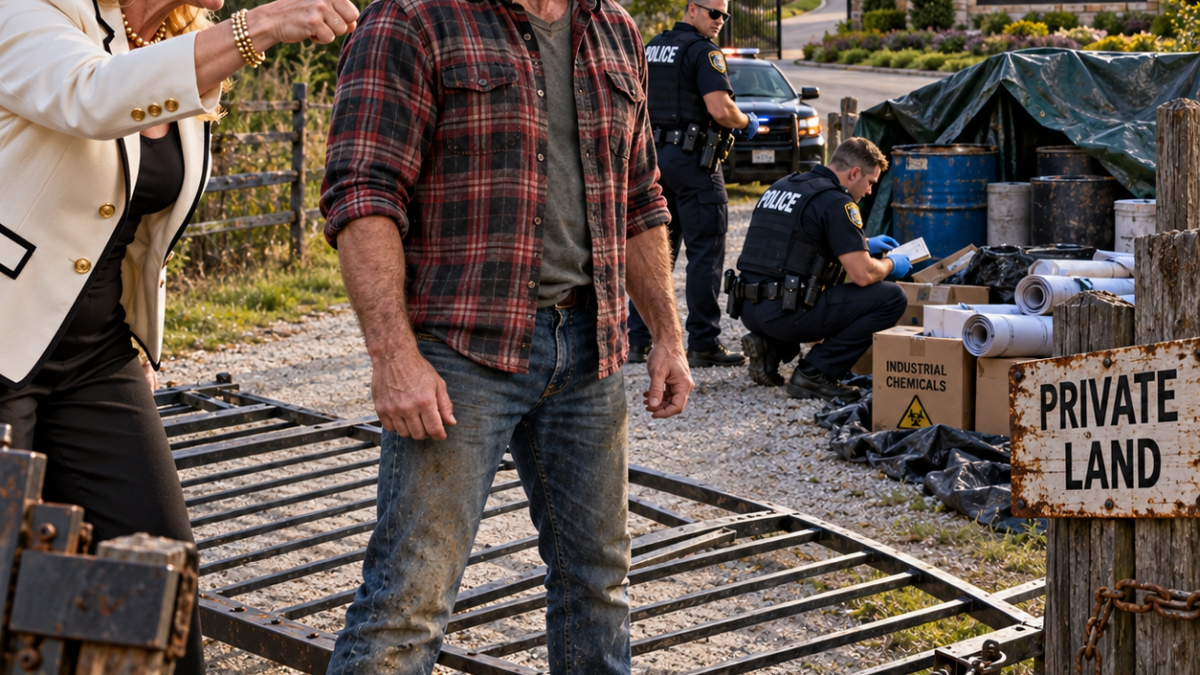
PART 2
Fourteen months earlier, I still believed Diane Kesler was just another overconfident HOA president.
Difficult?
Absolutely.
Controlling?
No question.
Dangerous?
I wouldn’t have used that word.
Not then.
To understand how I ended up with a tractor chained to a steel gate while the HOA president called the sheriff, you have to understand that I owned two very different pieces of property in Sable Creek.
The first was Lot 22.
That was my home.
A brick ranch house on a quarter acre.
Lot 22 was inside Sable Creek Estates.
No argument there.
I paid HOA dues.
I trimmed the hedges.
I kept the grass within whatever height the board considered morally acceptable that month.
When they changed mailbox colors, I painted mine.
When they sent out reminders about garbage cans being visible from the street, I moved mine behind the fence.
I didn’t love HOA living.
But I’d signed the documents when I bought the house, so I followed them.
Parcel 1104-B was different.
Six-point-two acres.
Hay ground.
A narrow gravel lane running from County Road 9 all the way to the field.
Separate deed.
Separate tax parcel.
Separate history.
My father had owned that land before Sable Creek existed.
When developers started buying property in the area, he sold enough ground for the subdivision but refused to sell the field.
The recorded plat showed it clearly.
ACCEPTED PARCEL — NOT INCLUDED IN SABLE CREEK ESTATES.
There was nothing ambiguous about it.
Sable Creek grew around our field.
My father kept cutting hay.
The houses got bigger.
The SUVs got newer.
The clubhouse got renovated.
The field stayed a field.
When Dad died three years before the gate went up, Parcel 1104-B passed to me.
He’d been seventy-nine and still climbing onto that old tractor.
I told him it was ridiculous.
He told me minding other people’s business would shorten my life.
We had that conversation more than once.
The last summer he was alive, I found him standing at the edge of the field in August with his hands on his hips, looking across windrows.
“You going to sell this someday?” I asked.
“No.”
“Why not?”
He shrugged.
“Because I don’t need to.”
That was Dad.
I laughed.
“I’m serious.”
“So am I.”
He looked toward the row of Sable Creek houses behind the trees.
“People sell everything that doesn’t pay enough.”
He kicked at a clump of cut hay.
“Then one day they wonder why every square foot has somebody else’s name on it.”
After he died, I found that sentence coming back to me.
The field didn’t make real money.
I cut twice a year.
June and August.
Two horse barns off County Road 9 bought most of it.
After fuel, maintenance, twine, equipment repairs and the occasional tire, I wasn’t exactly building a retirement fund.
But every June and August I climbed onto my father’s tractor.
For a few hours, I could almost imagine he was running the next row.
That mattered.
Ashford Lane was the only practical access.
Three hundred eighty yards from the county road to the field.
Most of it was narrow enough that tree branches brushed a truck on both sides.
At the road, however, there was a wide gravel apron.
It was the one place where I could park a trailer, unload the tractor and turn around safely.
One place.
Remember that.
Because everything Diane did later centered on those few yards.
The first thing I missed happened in April.
Sable Creek demolished its aging clubhouse and the maintenance shed behind it.
The buildings had been there for decades.
Everybody knew they were due for replacement.
The clubhouse had cracked floor tile, old mechanical equipment, faded pool-storage cabinets and years of accumulated maintenance supplies.
The shed was worse.
Buckets of old motor oil.
Pool chemicals.
Paint.
Cleaning products.
Everything a neighborhood maintenance crew collects when nobody wants to decide what to do with it.
Diane personally managed the demolition project.
At the spring HOA meeting, she stood in front of about thirty residents with a spreadsheet projected behind her.
“I am pleased to report,” she said, “that we have found substantial savings on demolition and disposal.”
People applauded.
I did too.
I had coffee in one hand and was thinking about whether the field would be dry enough for an early June cutting.
Diane smiled.
“Good management doesn’t mean spending less on safety. It means refusing to overpay simply because contractors assume HOAs won’t question invoices.”
More applause.
She loved being good at things in public.
That isn’t necessarily a criticism.
Some people are built that way.
What I didn’t understand was how important it had become for Diane to never be seen making a bad decision.
On May 6, I left the state.
My sister and I had an aunt who died without children, and somebody had to empty her house.
I was gone almost four weeks.
When I returned on June 2, something surprised me.
The gravel apron at Ashford Lane looked brand new.
Not patched.
Not topped in one place.
Completely resurfaced.
Smooth.
Graded.
Fresh stone from ditch to ditch.
It looked better than it had in twenty years.
I stood beside my truck trying to figure out who had done it.
That afternoon I saw Diane at the mailboxes.
“Did the county redo Ashford Lane?”
She smiled.
“No. We did.”
“The HOA?”
“The board authorized some grading while equipment was already in the area.”
“On my parcel?”
“Only the apron.”
I stared at her.
She gave a little wave.
“Consider it a gift.”
And do you know what I said?
“Thank you.”
That’s the part that still bothers me.
I thanked her.
I had no reason not to.
At the time, it looked like somebody had spent money improving my property.
A few months later, August came wet.
Three solid days of rain.
Afterward, I drove past Ashford Lane and noticed water sitting in the ditch near the new gravel.
It had an orange color.
Thin film floated across the surface.
I got out.
There was a smell.
Faint.
Unfamiliar.
Not sewage.
Not gasoline.
Something chemical, maybe.
But I’ve worked dirt most of my life.
Iron-heavy soil can turn runoff orange.
Organic material can create strange smells.
I told myself it was probably nothing.
That’s one of those decisions you relive afterward.
Why didn’t I call somebody?
Why didn’t I test it immediately?
Why didn’t I dig?
But hindsight makes every warning sign look like a flashing red light.
Real life doesn’t.
Real life gives you wet weather, orange dirt and a dozen other things to do.
I did one thing right.
On September 2, I sent the HOA a certified letter.
It said:
Orange discharge observed in roadside ditch at head of Ashford Lane. Unidentified odor present following rainfall. Please advise whether any recent HOA grading or utility work could be related.
Diane signed for it September 5.
I still have the green receipt.
Nobody called.
Nobody inspected anything.
Nobody sent me an explanation.
Seventeen days later, the board held an emergency meeting.
I wasn’t invited.
When I asked Diane later why, she gave me an answer that would become almost funny considering everything that followed.
“Parcel 1104-B isn’t part of the association, Brad. We don’t notify you about every board matter.”
Correct.
Parcel 1104-B wasn’t part of the association.
On September 22, the Sable Creek board approved a “community access control gate” at the entrance to Ashford Lane.
Diane claimed the HOA possessed something called a safety easement.
She referenced architectural authority.
She referenced community liability.
She referenced child safety.
Nobody asked her to produce the easement.
The vote passed.
The gate went up October 14.
I arrived while the contractor was finishing.
Two steel posts.
Fresh concrete.
Heavy gate.
U-lock.
I asked the foreman for a key.
He shook his head.
“Association has the keys.”
“This is my lane.”
He gave me the exhausted expression of a man who knew he was standing in a dispute he wasn’t being paid enough to understand.
“You’ll have to talk to the customer.”
Diane came by that evening.
“I need a key.”
“No.”
I thought I had misheard.
“What?”
“This is controlled access.”
“To my field.”
“Access is a privilege here, Brad.”
“I own the lane.”
“You own property beyond the gate.”
“I own the ground under the gate.”
She smiled.
“Then you and the board disagree.”
The next morning I tried to drive around it.
No room.
The ditch was too deep on one side.
Trees and a slope blocked the other.
I couldn’t unload a tractor.
Couldn’t turn the trailer.
Couldn’t get mowing equipment through safely.
October passed.
Then November.
By then the hay was brown.
Flattened.
Worthless.
Every time I drove past the lane, I heard the U-lock.
Two metallic clicks.
I hated that sound.
Not because it was loud.
Because it sounded permanent.
All winter, something bothered me.
Diane had never once asked to see my deed.
Not once.
This was a woman who could quote a bylaw paragraph about shutter colors from memory.
She knew the setback requirement for backyard sheds.
She knew which fence materials were permitted on corner lots.
Yet when I told her the gate sat on a parcel outside the HOA, she never said:
Show me.
She didn’t check.
She didn’t challenge my deed description.
She didn’t ask for the plat.
There were only two explanations.
Either she didn’t want to know.
Or she already knew.
In February, I pulled out my father’s property file.
I spent an evening going through old surveys, tax statements and deed copies.
The next morning, I went to the Marberry County Recorder’s Office.
The records department was in the courthouse basement.
Old paper.
Printer toner.
Fluorescent lights.
A clerk pulled the original subdivision plat.
She laid it flat.
There was Parcel 1104-B.
And beside it:
ACCEPTED PARCEL — NOT INCLUDED IN SABLE CREEK ESTATES.
Next came the deed chain.
Unbroken.
1961 to the present.
Then we searched every recorded easement.
There were two.
A utility easement for a power line from 1964.
A drainage easement along the back boundary.
That was all.
No HOA access easement.
No safety easement.
No gate rights.
No Sable Creek name anywhere.
“You want certified copies?” the clerk asked.
“Every page.”
She stamped them.
For four hours afterward, I thought the fight was over.
How could it not be?
I mailed certified copies to every board member.
Then I walked to Diane’s house and handed her another set.
On top, I placed one typed page.
REMOVE THE GATE FROM PARCEL 1104-B WITHIN TEN DAYS.
No insults.
No threats.
No lawyer language.
Ten days.
The following Tuesday, Diane put me on the HOA meeting agenda.
I expected ten ugly minutes.
Maybe twenty.
I assumed she’d argue.
Save face.
Complain that the property description had been misunderstood.
Then quietly authorize removal.
Instead, she stood in front of the room holding my certified plat.
“Nobody disputes Mr. Ashford’s ownership.”
I actually relaxed.
Then she placed the plat face-down.
“The gate is not an ownership measure.”
I looked at her.
“It’s a safety measure.”
A few residents nodded.
She continued.
“There is a documented discharge hazard at the head of Ashford Lane.”
It took me a second.
Then I understood.
My letter.
Orange discharge.
Unidentified odor.
She had taken my warning and turned it into her justification.
“This board has an obligation to protect residents, particularly children, from potential hazards.”
I stood.
“Who’s tested it?”
She paused.
“Excuse me?”
“The discharge. Who tested it?”
“We have received notice—”
“From me.”
The room got quieter.
“I wrote the notice.”
Diane didn’t answer.
I continued.
“If there’s a real hazard, call the county. Test it. Publish the results.”
Her eyes stayed on mine for a second longer than normal.
“We’ll take that under advisement.”
“Why didn’t you take it under advisement when you signed for my letter?”
She called the vote.
Gate stays.
Five to one.
I watched Curt Halloway, the board treasurer.
Curt was the kind of man who had spent thirty years selling insurance and learning how to make every handshake feel personal.
When Diane called his name, he said:
“Aye.”
But he said it while looking down at the table.
On the way out, he walked around three rows of folding chairs rather than pass me.
I noticed.
I didn’t understand it yet.
Nine days later, I got certified mail.
The HOA had recorded a lien against Lot 22.
My house.
Not Parcel 1104-B.
They couldn’t legally reach the field, so they reached the one thing I owned that was inside the HOA.
The claimed debt was $3,600 in “access assessments,” plus a continuing $150 daily penalty for “unauthorized approach to controlled association infrastructure.”
Unauthorized approach.
Meaning every time I walked toward the gate on my own land, Diane counted it as a violation.
I was refinancing my mortgage.
The lien stopped the refinance immediately.
The bank representative was polite.
“Any unresolved recorded claim against title has to be cleared before underwriting can proceed.”
“Even if the claim is wrong?”
“You can dispute it.”
“How long does that take?”
“I can’t answer that.”
“Can the refinance stay open?”
“Not indefinitely.”
I hung up.
Sat at my kitchen table.
Did the math.
A hundred fifty dollars every day.
I drove to Diane’s house that evening.
She opened the door wearing an apron.
A dish towel over one shoulder.
Domestic normality.
“You put a lien on my house.”
“The association secured an outstanding obligation.”
“For walking toward my own field.”
“You violated controlled access.”
“On land you don’t own.”
“You have options.”
Her tone was almost kind.
“You can pay the amount.”
I stared at her.
“Or?”
“You can appeal to the board.”
She let the sentence sit between us.
She was the board president.
“Or?”
“You can litigate.”
She tilted her head.
“You’ll probably spend more than that field is worth proving your point.”
I finally understood.
“This isn’t enforcement.”
She said nothing.
“You’re pricing me out.”
“Brad, you’re learning something everybody else in this community already understands.”
“What?”
“The rules apply to you.”
“Your rules don’t apply to that parcel.”
She smiled.
“Then go prove it.”
I turned to leave.
“One more thing.”
I stopped.
“I filed a standing complaint with the sheriff’s office.”
I faced her again.
“For what?”
“Potential damage to HOA property.”
She nodded toward Ashford Lane.
“If you’re considering cutting the lock or damaging that gate, don’t. Your name is already in their system.”
Then she closed the door.
I stood on the porch for several seconds.
That was the moment I finally understood what she’d built.
Not a gate.
A box.
If I paid, she won.
If I sued, I spent money.
If I touched the gate, a deputy arrived.
If I walked toward it, fines increased.
Every direction had a price tag.
I saw an attorney that Friday.
He looked through the deeds and surveys.
“You’ll win.”
“Good.”
He slid the documents back.
“Eventually.”
“What does eventually mean?”
“Months if they fight.”
“And cost?”
He gave me a range.
I stared at him.
“That’s more than the field makes in years.”
“I’m not telling you you’re wrong.”
He leaned back.
“I’m telling you what winning costs.”
I drove home after dark.
Instead of going inside, I walked around the far end of the gate.
Carefully.
Still on my ground.
I went down Ashford Lane and stood in the field.
Dead hay moved in the winter wind.
Dad would’ve hated it.
Coming back, I stepped onto the new gravel apron.
My boot dropped.
Only an inch or two.
But enough to make me stop.
Gravel slid under my heel.
It made a strange whispering sound.
Like sand slipping down a funnel.
I crouched.
Pressed my palm against the surface.
Moved slowly across it.
There was a depression.
Not a pothole.
Not erosion.
A rectangle.
At the road behind me, Diane’s motion light came on.
Then off.
Then on again.
A week later, my coffee tasted strange.
Flat.
Metallic.
I blamed the coffee maker.
Cleaned it.
The taste stayed.
I changed beans.
Still there.
Then I noticed a gray ring forming inside my kettle.
My well had never done that.
I filled two proper sample containers.
Drove them to a private laboratory.
Paid for expedited testing.
Then I returned to Ashford Lane with a measuring tape.
In low afternoon sunlight, the depression was obvious.
About ninety feet long.
Twelve feet wide.
Straight sides.
Square corners.
Several inches of settlement.
I had worked for the county road department for thirty years.
Heavy equipment.
Drainage.
Grading.
Fill.
One thing I knew better than HOA bylaws was dirt.
Natural soil doesn’t settle into a perfect rectangle.
Fill does.
Something had been excavated.
Something had been put back.
I looked at two maple trees beside the lane.
My grandfather had planted them.
One was almost completely dead.
Gray branches.
Bark peeling in damp sheets.
The second had lost half its crown on the lane side.
Their roots ran under the apron.
Trees don’t understand politics.
They don’t read newsletters.
They don’t care who wins board votes.
They just respond to whatever is in the soil.
Four days later, the laboratory called.
The report included chlorinated solvents.
Lead.
Cadmium.
Several readings above action levels.
My well sat downhill.
About three hundred feet away.
I had been drinking from that well.
My father had drunk from it for fifty years.
Suddenly, the gate didn’t matter anymore.
The hay didn’t matter.
The lien almost didn’t matter.
I sat at my kitchen table with a legal pad and wrote dates.
April 18 — clubhouse and maintenance shed demolition begins.
May 6 — I leave the state.
June 2 — I return. Ashford Lane apron freshly resurfaced.
August — orange discharge following rain.
September 2 — certified letter sent.
September 5 — Diane signs for letter.
September 22 — emergency HOA meeting.
October 14 — gate installed.
I stared at those dates.
For almost a year, I had assumed Diane built the gate because she disliked my tractor.
Or the lane.
Or the appearance of farmland beside her carefully managed subdivision.
But nothing about my behavior changed in September.
I hadn’t complained.
I hadn’t started running equipment at night.
I hadn’t threatened anyone.
One thing changed.
I sent a letter containing the word discharge.
Diane received it.
Seventeen days later, she called an emergency meeting to block access to that exact location.
The gate hadn’t been designed to keep me out of six acres.
It was designed to keep me away from ninety feet.
And the concrete footings had been poured directly into the settled fill.
I sat back.
“Jesus.”
The word came out quietly.
If the HOA truly believed the ground was hazardous, no competent person would drill permanent gate footings into it.
Unless the gate had another purpose.
Unless burying those footings made it harder to disturb the ground later.
Anybody trying to excavate would first have to destroy “association property.”
And Diane had already placed a standing complaint with law enforcement under my name.
I called the county environmental office.
I gave them the laboratory report.
The well location.
The orange discharge.
The rectangular settlement.
The dead trees.
The dates.
The man who took the call became serious quickly.
A field crew came Thursday.
They stayed outside the gate.
My property.
No confrontation with Diane required.
They used a hand auger along the ditch and shoulder.
The crew leader pulled up a soil core.
He smelled it.
Looked at me.
“You’ve been smelling this since August?”
“On wet mornings.”
He capped the sample jar.
“We’ll run it.”
Eleven days later, the county scheduled a responsibility conference.
Environmental staff.
County attorney.
HOA representatives.
Me.
I arrived fifteen minutes early.
Diane had arrived thirty minutes early.
She sat with a black accordion folder open.
Curt Halloway beside her.
HOA attorney on her other side.
She stood when I entered.
“Brad. I’m glad you came.”
I didn’t answer.
The county attorney began.
The contamination was confirmed.
Diane didn’t dispute that.
In fact, she embraced it.
“Sable Creek has been deeply concerned about this issue.”
I almost laughed.
She opened her folder.
“We also believe the historical use of Parcel 1104-B must be considered.”
She slid a copy across the table.
A 1998 county inspection card.
AGRICULTURAL CHEMICAL STORAGE
ASHFORD FARM
PARCEL 1104-B
My father’s name.
I read it.
It was legitimate.
Dad had kept legal herbicide products in a locked agricultural shed.
The county had inspected it.
And passed it.
“This says he complied,” I said.
Diane nodded sympathetically.
“Nobody is accusing anyone.”
“That’s exactly what you’re doing.”
“I’m establishing history.”
Then came written declarations.
Two board members claimed there had been “general community knowledge” that the Ashford field had historically been used for dumping.
No date.
No firsthand observation.
No photographs.
No report.
Just something “everybody knew.”
Curt’s signature was on one.
I looked at him.
His hand shook when he reached for his water glass.
He wouldn’t meet my eyes.
Then the county attorney explained the law.
He wasn’t cruel.
That almost made it worse.
“The contaminated material is located on property deeded to you, Mr. Ashford.”
“Yes.”
“Under state environmental law, the present owner can be designated as a responsible party for remediation.”
“I didn’t put it there.”
“That may allow you to pursue other responsible parties.”
“After I clean it?”
“Potentially.”
He slid a formal notice across the table.
Twenty-one days to submit a remediation plan.
Daily penalties afterward.
I asked for an estimated cost.
He hesitated.
“Based on preliminary dimensions and constituents?”
“Yes.”
“Likely six figures.”
Six figures.
For a hole somebody else dug.
On land somebody else had blocked me from entering.
Diane folded her hands.
“Sable Creek will cooperate however we can.”
I looked at her.
That’s when I saw how complete the plan was.
My deed had protected me against the gate.
Now the same deed made the contamination legally mine to address.
She had taken the fact I trusted most—
My land.
—and turned it into the thing crushing me.
The HOA newsletter arrived Friday.
“HISTORICAL CONTAMINATION IDENTIFIED ON ADJACENT PRIVATE PROPERTY.”
The article praised the association’s “proactive safety measures.”
The gate was described as having limited resident exposure.
Diane was thanked for her leadership.
Within days, neighbors stopped talking to me normally.
A man whose driveway I had plowed after three winter storms crossed the street rather than pass me.
At a gas station, a woman approached carefully.
“Brad?”
“Yeah.”
“I hope you don’t mind me asking.”
I already knew.
“Was your father really burying chemicals out there?”
That was the moment that broke something in me.
Not the lien.
Not the money.
Not the dead hay.
My father.
A man who saved bent nails in coffee cans because he hated waste.
A man who hauled scrap steel twenty miles to a recycling yard because throwing usable metal into a landfill offended him.
He was dead.
He couldn’t answer.
And Diane had figured that out before I had.
I went home.
Sat in Dad’s old equipment shed on an overturned bucket.
One of his mower blades hung on the wall.
He had sharpened it himself.
There was still dark oil on the wooden handle of the file beside it.
I sat there until the overhead fan clicked with every slow rotation.
I wasn’t angry anymore.
I was tired.
All the way through.
I had spent months trying to prove something was buried under the apron.
Now everyone agreed.
And somehow proving it had made my life worse.
My well was compromised.
My house had a lien.
The county wanted a six-figure cleanup plan.
My father’s name had been dragged into the story.
Then something occurred to me.
I had been asking:
What is buried there?
Wrong question.
The right question was:
When was it buried?
Soil doesn’t put dates on itself.
Work does.
Work gets scheduled.
Equipment gets rented.
Workers get paid.
Invoices get generated.
Photographs get taken.
Job numbers get assigned.
Money leaves a trail.
And dates were the one thing Diane’s story about my father couldn’t survive.
I stopped chasing chemistry.
I started chasing the calendar.
First stop was Ruth Anne.
She was eighty-one.
Lived near the mouth of the road longer than anybody I knew.
Ruth Anne kept a spiral notebook near her front window because, in her words, “people remember whatever makes them look smartest.”
Before answering a single question, she made me eat a cookie.
Then I asked:
“Do you remember trucks on Ashford Lane while I was away last May?”
She frowned.
“The mud.”
“What mud?”
She got up.
Returned with her notebook.
Opened it.
May 6.
DUMP TRAILERS UP ASHFORD LANE. 6:40 A.M. MUD TRACKED ON ROAD. CALLED ASSOCIATION. NO ANSWER.
May 7 had another entry.
Same thing.
“You wrote this?”
“I write everything.”
“Did you see what they were doing?”
“No.”
“How many loads?”
She sniffed.
“I stopped counting.”
My pulse picked up.
“You take any pictures?”
“Of course.”
She had an old digital camera.
The photographs were still there.
Date stamped.
A tandem dump trailer backing into my apron.
A compact excavator.
A white contractor pickup.
Green lettering.
RENER FENCE & GRADING.
May 6.
The exact morning I left the state.
I gripped the edge of her kitchen table.
Ruth Anne looked at me.
“You all right?”
“Yeah.”
I wasn’t.
The ground had been opened while I was four states away.
But Diane had an answer ready.
The HOA already admitted grading my apron.
She had called it a gift.
Pictures of earthmoving equipment proved earthmoving.
Not illegal dumping.
I needed paperwork.
I drove to Rener Fence & Grading.
Asked for Dale Rener.
He came from the shop wiping his hands.
When I said my name, something changed in his face.
Recognition.
He knew.
“I need copies of every work order related to Ashford Lane.”
“Can’t help you.”
“You installed a gate on property the customer didn’t own.”
“We installed where we were directed.”
“I need the May work.”
He shook his head.
“Sable Creek is one of my biggest clients.”
“I have twenty-one days on an environmental order.”
“You need records, have your lawyer subpoena them.”
“By then I may be in daily penalties.”
He looked toward his shop.
“I have nine employees, Brad.”
“I understand.”
“You understand what you’re asking me to do?”
“Yeah.”
He escorted me outside.
At my truck, he stopped.
Looked back toward the building.
Then said quietly:
“For what it’s worth, everything out there went on one job number.”
He walked inside.
I stood beside my truck.
One job number.
That mattered.
If grading in May and gate construction in October were truly unrelated jobs, they’d normally have separate job numbers.
Separate authorization.
Separate billing.
One job number meant one customer file.
Possibly one continuous scope.
The evidence existed.
Forty minutes away.
Inside a filing cabinet I had no legal right to open.
At home, I laid out my certified September letter.
Beside it, Diane’s signed return receipt.
Whatever happened next, she could never truthfully say she had no notice of an unusual discharge.
Then an HOA notice arrived.
Special meeting scheduled for the 12th.
Three agenda items.
One:
Ratify and record a permanent safety easement across Ashford Lane.
Two:
Replace the gate with reinforced construction.
Three:
Assess Lot 22 eighteen thousand dollars for reconstruction costs.
I read it until midnight.
Then I understood the real danger.
Diane wasn’t trying to defend the old gate anymore.
She was about to legalize the next one.
Once an easement was recorded, my ownership argument became harder.
New construction meant new footings.
Deeper.
Wider.
More concrete over the same ground.
I couldn’t wait months for litigation.
I called my attorney.
“I need one answer.”
“Go ahead.”
“What am I legally allowed to do with a structure somebody put on my deeded property without an easement?”
He was silent for a while.
“Generally, a property owner may remove an unauthorized encroachment.”
“With equipment?”
“If you’re entirely on your property, use no more force than reasonably necessary to remove the encroachment, and damage nothing beyond the encroachment itself.”
“So I can take the gate out.”
“I’m not telling you there is zero civil risk.”
“I understand.”
Then his voice changed.
“Brad.”
“Yeah?”
“Whatever you believe is beneath that apron, do not excavate it yourself.”
“Why?”
“Because the moment you start digging, Diane gets to argue you disturbed, moved or introduced whatever anybody later finds.”
That landed.
“Remove the gate.”
“Correct.”
“Don’t dig.”
“Exactly.”
I called the county environmental office.
Told them I planned to remove an unauthorized structure obstructing access to the site they had ordered me to remediate.
The officer logged the call.
I wrote down the exact time.
Then I borrowed my son’s dash camera.
Bolted it to the tractor fender.
Powered it directly from the battery.
Set the timestamp.
Checked the view.
Chain.
Gate.
Ground.
Everything visible.
I slept maybe two hours.
At 6:40 the next morning, I drove to Ashford Lane.
Diane arrived minutes later.
And that brings us back to the steel post.
The chain.
The concrete.
The black plastic.
The smell.
The moment the footing came free, I shut down the tractor.
I climbed off.
Walked close enough to look.
Then stopped.
Didn’t touch the plastic.
Didn’t touch the soil.
Didn’t reach into the hole.
My father’s rule had always been simple:
If somebody else needs to see something, leave it exactly the way you found it.
Behind me, Diane put her phone to her ear.
Eleven minutes later, a sheriff’s cruiser came down the road.
Deputy Owen Bellamy stepped out.
Mid-thirties.
Calm.
Methodical.
Diane reached him first.
“He destroyed association property.”
“Ma’am, give me a minute.”
“I want charges filed.”
“Give me a minute.”
She held up her phone.
“I recorded everything.”
Bellamy looked at the tractor.
Chain still attached.
Gate lying partly on the gravel.
Then he looked at me.
“Sir, tell me what happened.”
I didn’t argue.
Didn’t explain Diane’s personality.
Didn’t discuss my father.
I handed him a folder.
Certified deed.
Certified plat.
Recorded easement search.
County environmental notice.
He read standing beside his cruiser.
Then looked toward the gate.
“This is Parcel 1104-B?”
“Yes.”
“Owned by you?”
“Yes.”
“Not part of Sable Creek?”
“Correct.”
He flipped a page.
“No access easement.”
“Correct.”
Diane stepped closer.
“Deputy, that’s irrelevant. It is a board-approved safety installation.”
Bellamy looked at her.
“On his property?”
“It’s community access.”
He held up the certified plat.
“This says otherwise.”
I watched Diane make a decision.
She could have stopped.
Called her attorney.
Accepted that the dispute was civil.
Instead, she wanted a stronger police report.
“Document everything.”
Bellamy frowned.
“What?”
“The damage.”
She pointed.
“The posts. The latch. The concrete. The gate frame. I want the full condition documented because we will seek restitution.”
Bellamy sighed.
Took out his camera.
He photographed the gate.
The latch.
The bent steel.
Then he walked toward the uprooted footing.
Crouched.
Stopped.
I saw his body become still.
He moved a flap of black plastic slightly with the back of his knuckle.
Pulled out a flashlight even though the morning sun was up.
The beam went into the hole.
Orange-stained soil.
The curved edge of something metallic.
Then a printed label.
Bellamy stood.
“Everybody step away from the hole.”
Diane started.
“Deputy—”
“Ma’am. Back toward the road.”
His voice had changed.
No longer neighbor-dispute calm.
He keyed his radio.
Requested a supervisor.
Then environmental response.
Then I heard:
“Possible hazardous material. Possible unlawful disposal.”
I looked toward Diane.
Her face had gone pale.
Within an hour, the lane looked like an incident scene.
County environmental truck.
Supervisor.
State response contractor.
Protective equipment.
Caution tape running from my grandfather’s dying maple to a roadside post.
Diane stood beyond the tape.
Watching.
She had called law enforcement to document my destruction of the gate.
Instead, her call had brought the first official witness to what the gate was sitting on.
Then Diane made one last attempt to control the story.
“That’s historical farm dumping.”
She spoke loudly enough for everyone to hear.
“That’s exactly why the HOA installed the safety barrier.”
Bellamy turned.
He pointed toward the concrete footing lying on the gravel.
“If that’s an old disposal site, ma’am, why is your relatively new concrete poured into it?”
Silence.
For fourteen months, I had never seen Diane without an immediate answer.
Now she opened her mouth.
Closed it.
Bellamy continued photographing.
Still treating it as the property-damage complaint Diane had demanded.
He turned the gate frame over.
Under the upper rail was a small contractor plate.
RENER FENCE & GRADING.
JOB 3084.
Bellamy read it aloud.
Diane took two steps backward.
A job number isn’t an opinion.
It isn’t neighborhood gossip.
It isn’t something a dead farmer can be blamed for.
A job number is a file.
By two that afternoon, an investigator stood inside Dale Rener’s office asking for Job 3084.
Dale handed it over.
I didn’t see that file until later.
By then, it had changed everything.
One job number.
Two major line items.
MAY 6 — EXCAVATE/BACKFILL TRENCH APPROX. 90 FT.
OCTOBER 14 — ACCESS GATE INSTALLATION.
Same customer.
Sable Creek Estates HOA.
Same file.
And both authorizations bore Diane Kesler’s initials and signature.
But the photographs were worse.
Contractors photograph work.
Not because they’re expecting investigators.
Because customers argue about invoices.
Job 3084 contained progress photographs from May 6.
The trench was open.
Ninety feet.
Clean edges.
In the bottom were drums.
Buckets.
Broken material from the old clubhouse.
Bulk bags of demolished floor tile.
Maintenance debris.
Containers.
The contents of the demolished maintenance shed.
All sitting in a trench on my property while I was out of state.
The photographs were timestamped.
My father’s name disappeared from the case almost immediately.
There was no way to keep blaming a man who had died years before when contractor photographs showed a fresh trench open in May.
Diane’s attorney tried another argument.
Brad Ashford had removed the gate.
Brad Ashford was alone with a tractor.
Brad Ashford had every incentive to make incriminating material appear beneath that footing.
On another morning, that argument might have created doubt.
Except my dash camera had recorded continuously.
The video began before the chain touched the gate.
It showed the tractor moving.
The post tilting.
The concrete coming free.
The black plastic already caught around the footing.
It showed me shut down the engine.
Climb off.
Walk toward the opening.
Stop.
Step back.
My hands never entered the hole.
For four and a half minutes, I stood several feet away until Bellamy’s cruiser arrived.
Fourteen months of Diane insisting that cameras and documentation would protect the HOA ended with one camera protecting me.
Mine.
The investigation expanded.
The trench wasn’t only on Parcel 1104-B.
It continued approximately forty feet past my boundary onto Sable Creek common land.
Downhill.
Toward the association irrigation well serving entrance landscaping and the pool-house area.
That changed the mood inside Sable Creek overnight.
Until then, many residents could convince themselves the contamination was Brad Ashford’s private problem.
My dirt.
My well.
My expense.
Now the same buried material extended beneath HOA property.
Near an HOA-controlled water source.
The board hired independent counsel.
Then investigators reviewed the clubhouse demolition budget.
One line item drew immediate attention:
HAZARDOUS MATERIAL ABATEMENT AND APPROVED DISPOSAL — $61,200.
Paid.
Approved.
Budgeted.
Then came the contractor’s actual trenching and hauling invoice.
Approximately $9,400.
The question was no longer merely:
Who buried this?
It became:
Why did the association collect and approve more than sixty thousand dollars for proper disposal when the material was instead placed into a trench at a fraction of the cost?
And where did the difference go?
The complaint Diane had filed against me disappeared quickly.
The prosecutor reviewed my deed.
The plat.
The absence of any HOA easement.
My advance call to the county.
My lawyer’s advice.
The dash-camera footage.
No charge was filed against me.
I wasn’t a man randomly destroying neighborhood property.
I was a landowner removing an unauthorized gate from my parcel while preserving the ground beneath it for inspection.
Curt Halloway lasted nine days.
Then he hired his own attorney.
He gave investigators a long statement.
I didn’t read all of it.
I only needed two lines.
Diane made the decision to bury the material.
Proper disposal would have exceeded the clubhouse renovation budget she had publicly promised the community.
She didn’t want to stand at the next HOA meeting and admit she’d been wrong.
That was it.
That’s what my father’s reputation had been sacrificed for.
A budget presentation.
A number on a projector.
Applause.
Curt admitted he knew enough to understand what had happened.
He had signed the declaration suggesting our family field was historically used for dumping because he was afraid of his own exposure.
When I saw him later at the courthouse, he started toward me.
“Brad—”
I walked past him.
I’m not proud of every moment of that year.
But I had nothing to say.
The criminal case against Diane moved forward.
The charges involved unlawful hazardous-waste disposal, conspiracy and theft-related allegations connected to the $61,200 disposal allocation.
Eventually, there was no trial.
She entered a plea.
Thirty months in state custody, followed by probation.
She was permanently barred from serving on the board of a homeowners association in the state.
At sentencing, Diane’s attorney talked about her volunteer work.
Her years of service.
The hours she had spent organizing the community.
Her personal health.
Her belief that she had always acted in Sable Creek’s interests.
Then the prosecutor stood.
He didn’t display the trench photographs.
He didn’t talk about the gate.
He didn’t show the budget spreadsheet.
He read my certified letter.
September 2.
Orange discharge observed in ditch at head of Ashford Lane.
Unidentified odor.
Please advise.
Then he held up the return receipt.
Signed September 5.
D. Kesler.
He put it down.
Sat.
That was enough.
Because whatever somebody believed before September 5, Diane knew afterward that there was a reported discharge.
And instead of calling environmental authorities, she called an emergency HOA meeting.
Then built a gate.
The two board members who signed false statements about historical dumping faced consequences of their own.
Curt cooperated and received a reduced outcome.
Dale Rener lost his contractor’s license and paid a major penalty.
His position had been that he simply followed customer directions.
Investigators didn’t accept that completely.
He saw what went into the trench.
He still took the job.
Sable Creek’s directors-and-officers insurance refused coverage for intentional misconduct.
That mattered.
Insurance can protect boards against negligence.
It isn’t designed to erase deliberate decisions.
The final remediation cost was roughly $610,000.
Responsibility was divided among the parties the investigation identified.
The contractor.
The association.
Diane personally.
She eventually sold her house in Sable Creek.
I never went to see it.
People assumed I would.
I didn’t.
By that point, I didn’t need to watch another gate close behind her.
Everything she’d used against me came apart over the following four months.
The lien against Lot 22 was released.
Every access fine was cancelled.
The proposed $18,000 gate-reconstruction assessment never reached a vote.
The meeting scheduled for the 12th didn’t happen.
By then, the remaining board members were meeting with lawyers instead of residents.
The supposed “safety easement” was formally documented as nonexistent.
There’s something strange about receiving an official record confirming that a legal right somebody quoted for a year had never existed in the first place.
The new HOA board adopted one property rule almost immediately.
No association structure could be installed outside the platted boundaries of association-owned property without a valid recorded legal interest and written owner authorization.
Nobody needed an explanation for why.
My environmental responsible-party notice was withdrawn.
New notices went to the parties connected to the disposal.
That piece of paper mattered almost as much as the lien release.
For weeks, I had slept knowing the county considered me financially responsible for a trench I didn’t dig.
Then came my settlement.
$284,000.
People hear a number like that and assume somebody got rich.
They don’t understand what money is replacing.
A contaminated well.
Lost hay production.
Property damage.
Legal costs.
Survey costs.
Testing.
The destruction of land.
Time.
A year of being unable to use property my family had owned since 1961.
A new well had to be drilled.
Farther from the contamination zone.
Deeper.
The first time clean water came from it, I filled a glass at the kitchen sink.
Held it up.
Clear.
No smell.
I drank half.
Then set the glass down.
Laura—my sister, who happened to be visiting—looked at me.
“How is it?”
“Water.”
She laughed.
“That’s good.”
“Best thing it’s tasted like in a year.”
But the most important part of the settlement wasn’t money.
It was a correction filed in the county record.
Formal language.
Dry language.
The kind nobody reads unless they’re searching titles twenty years later.
It stated that no evidence supported attributing the disposal to the Ashford agricultural operation.
My father’s name was cleared.
I kept that page in the house.
Not the settlement check.
Not photographs of Diane leaving court.
Not newspaper articles.
That correction.
Because someday I will be gone.
And if somebody pulls the record for Parcel 1104-B after that, they won’t find a dead farmer quietly blamed for something he didn’t do.
They’ll find the correction.
The near maple didn’t survive.
Its roots had been too badly damaged.
When remediation crews excavated the contaminated fill, they removed the tree.
I stood there while they cut it.
That morning hurt more than Diane’s sentencing.
The tree had been planted by my grandfather.
It stood at the lane while Dad was a boy.
It stood there when he bought his first tractor.
It stood there when Sable Creek was still fields.
And because somebody wanted to save money on disposal, it died.
The second maple survived.
Barely.
The first spring after remediation, a few weak leaves appeared.
The next spring, more.
That April, I bought another young maple.
Planted it six feet from the old stump.
A neighbor who stopped by watched me measure the hole.
“Isn’t that a little close to the other tree?”
“Yeah.”
“They’ll crowd each other someday.”
“Probably.”
He looked confused.
I smiled.
“That’s how my grandfather would’ve planted it.”
Two summers after the gate came down, I cut hay again.
I woke before sunrise.
Made coffee with water from the new well.
No metallic taste.
No ring in the kettle.
I walked to the equipment shed.
The tractor started on the second attempt.
That was normal.
Dad’s tractors never started on the first try.
If one had, he would’ve assumed something was wrong.
I drove toward Ashford Lane.
There was no gate.
No steel posts.
No U-lock.
No PRIVATE ACCESS sign.
The contaminated trench had been excavated.
Clean fill brought in.
Compacted.
Graded.
The gravel apron was level again.
I knew exactly where that rectangular depression had been.
I stopped the tractor.
Climbed down.
Walked across it.
Tried to find the old edge with my boots.
Couldn’t.
For a year, I had known every inch of that rectangle.
Now I couldn’t feel it.
I stood there longer than necessary.
Then I heard Dad in my memory.
Don’t let it go to brush.
“Yeah, yeah,” I said out loud.
I climbed back onto the tractor.
The first cutting was thin.
The field had been neglected.
Second cutting was better.
I sold both loads to the same horse barns off County Road 9.
After expenses, I made almost nothing.
I didn’t care.
There are things in life you do because they’re profitable.
And there are things you do because stopping would mean surrendering more than money.
One afternoon, Tom Jenkins from Sable Creek walked down the lane while I was greasing the mower.
Tom had supported Diane during most of the dispute.
Not aggressively.
But enough.
He stopped several yards away.
“Brad.”
“Tom.”
He shoved his hands into his pockets.
“I owe you an apology.”
I kept working.
He waited.
Finally I looked up.
“For what part?”
He winced.
“Fair question.”
I wiped my hands.
He continued.
“When the newsletter said it was old farm contamination, I believed it.”
“Most people did.”
“I told my wife your dad probably dumped things out there years ago.”
That hurt.
Still.
Even after the correction.
Tom looked toward the field.
“I didn’t know him.”
“No.”
“I shouldn’t have said it.”
“No.”
He swallowed.
“I’m sorry.”
I nodded.
“Thank you.”
He seemed surprised.
“That’s all?”
“What did you expect?”
“I don’t know. I figured you’d tell me to get off your property.”
I looked toward the lane entrance.
“I spent enough time arguing about who could stand on this land.”
He gave a small laugh.
Then pointed toward the tractor.
“Same one your dad used?”
“Same one.”
“Still runs?”
“Depends how generous your definition is.”
Tom came closer.
For twenty minutes, we talked about nothing important.
Engines.
Hay prices.
Weather.
Before leaving, he turned toward the empty head of the lane.
“Feels strange without the gate.”
“Feels normal to me.”
People asked whether I was satisfied with what happened to Diane.
That’s usually how they phrased it.
“You must’ve felt pretty good.”
Or:
“That’s some payback.”
Or:
“I bet seeing her sentenced was worth everything.”
No.
It wasn’t.
Nothing about that year was worth it.
I would have traded every court order, settlement dollar and newspaper headline for the ability to go back to the morning I returned from my aunt’s house and ask one question:
Why is there new gravel on my lane?
Maybe I would have found the trench sooner.
Maybe the maple would’ve survived.
Maybe my well wouldn’t have been affected.
Maybe Dad’s name never would’ve entered the story.
So no.
I don’t think about what happened to Diane as revenge.
Revenge would’ve meant I wanted her to suffer.
What I wanted was my lane back.
My field back.
Safe water.
My father’s name cleared.
I got those things.
What happened to Diane came from the choices she made trying to prevent that.
There is a difference.
The new Sable Creek board eventually invited me to one of their meetings.
I almost declined.
Then Martin Reyes, the new president, called personally.
“We’re trying to clean up more than the soil.”
I went.
The same room where Diane once held my certified plat face-down was packed.
Different atmosphere.
No lectern.
No dramatic projector.
Martin stood at the front.
“Brad, before anything else, there’s something this board owes you publicly.”
I hated where this was going.
Public apologies make me uncomfortable.
Martin continued.
“The association recognizes that Parcel 1104-B is private property outside Sable Creek Estates. The prior gate, assessments and access restrictions were unauthorized.”
Silence.
Then:
“We also acknowledge that statements suggesting historical unlawful disposal by the Ashford family were unsupported and wrong.”
That one reached me.
I looked down.
Martin read the rest.
Then asked:
“Would you like to say anything?”
I stood.
Thirty faces turned toward me.
Some I knew.
Some I didn’t.
I had imagined moments like that during the worst months.
Imagined giving speeches.
Listing every insult.
Every fine.
Every lie.
By the time the opportunity actually arrived, none of it seemed useful.
So I said:
“My father didn’t bury that material.”
Martin nodded.
“We know.”
“That’s all I needed.”
I sat down.
The meeting continued.
Budgets.
Pool repairs.
Roof bids.
Normal boring community business.
I remember thinking boring was underrated.
Afterward, Curt Halloway’s wife approached me.
Curt had moved away following his plea.
She looked exhausted.
“Brad.”
I didn’t know what to say.
She didn’t apologize for him.
Didn’t defend him.
She simply said:
“I’m sorry for what happened to your family.”
I nodded.
“I’m sorry for what happened to yours.”
Her eyes filled.
That was enough.
The following June, I took the first bale from the field and loaded it into my truck.
Not because it was special hay.
It wasn’t.
I drove to the cemetery.
Dad’s stone was near the back under two oaks.
I didn’t carry the bale to the grave.
That would’ve been theatrical.
Dad hated theatrical.
I sat on the tailgate.
Looked toward the marker.
“We cut it.”
Wind moved through the trees.
I laughed at myself.
“What am I doing?”
No answer.
Good.
Dad would’ve hated that too.
I sat there maybe ten minutes.
Then drove the hay to the barn that had bought from us for years.
Life gradually became smaller again.
In a good way.
The county stopped calling.
Lawyers stopped emailing.
Certified letters disappeared from my mailbox.
When an unfamiliar truck came up my driveway, my first thought stopped being:
What now?
One morning I realized three weeks had passed without saying Diane’s name.
That was the beginning of being finished.
Not the sentencing.
Not the settlement.
Not the gate coming down.
The day she stopped occupying space in my head.
Years later, the young maple beside Ashford Lane is taller than I am.
The surviving old tree still leans slightly away from where the contaminated trench used to be.
Its crown never fully recovered.
But every spring it puts out leaves.
The two trees do crowd each other now.
Just like I predicted.
I could move the young one.
I won’t.
At the entrance to Ashford Lane, there’s nothing.
No gate.
No sign.
No lock.
No monument to the lawsuit.
No plaque explaining what happened.
Just gravel.
A lane.
Two maples.
And beyond them, six-point-two acres of hay.
Sometimes people stop me and say:
“Is that where they found everything?”
I usually answer:
“That’s where the gate was.”
Because that’s the part I remember most.
Not what was buried.
The gate.
A structure put in place by somebody who believed enough paperwork, fines and confidence could turn private property into hers.
For fourteen months, it almost worked.
The gate stopped my tractor.
It cost me a season of hay.
It froze my refinance.
It put a lien on my house.
It made neighbors question my father.
It convinced me, more than once, that being right didn’t matter if the other person had more time, more organization and more willingness to push.
Then one morning I wrapped a chain around a post.
I didn’t pull it down because I wanted revenge.
I pulled it down because every legal document I possessed said it had no right to be there.
And when the concrete came out of the ground, so did the truth Diane had spent a year covering with gravel, rules and steel.
The police came because she called them.
The investigation started because she demanded they document her gate.
The contractor file surfaced because her gate carried a job number.
Her September knowledge became undeniable because she had signed my certified letter herself.
And the camera that defeated her final accusation existed because she had spent fourteen months teaching me one lesson:
Document everything.
That’s the irony people like best when I tell the story.
But it isn’t my favorite part.
My favorite part happened two summers later.
Late August.
Second cutting.
Sun going down behind Sable Creek.
I was finishing the last outside row.
The tractor engine was loud enough that I couldn’t hear the neighborhood.
Couldn’t hear traffic.
Couldn’t hear anybody’s opinion.
Just that old diesel engine and the mower working.
For one second, turning at the bottom of the field, I looked toward Ashford Lane.
No gate.
The light fell across both maples.
The new one.
The damaged old one.
And I remembered my father’s last request.
Don’t let it go to brush.
The field hadn’t gone to brush.
His name hadn’t stayed buried beneath somebody else’s story.
And the lane was open.
I turned the tractor into the next row.
That’s the ending people sometimes find disappointing.
No final confrontation.
No speech to Diane.
No moment where she apologized and admitted everything.
I never needed one.
She had spent more than a year making herself the center of my land.
My money.
My house.
My father’s reputation.
The most satisfying thing I could do afterward was stop giving her that position.
Today, when I drive down Ashford Lane, I don’t think:
This is where Diane Kesler lost.
I think:
This is where Dad used to turn the tractor around.
That’s better.
Much better.
Last April, I was repairing a section of fence along the back boundary when a boy from Sable Creek rode up on a bicycle.
Maybe ten years old.
He stopped near the gravel.
“Mr. Ashford?”
“Yeah?”
“My mom says this is your farm.”
“Field.”
“What’s the difference?”
“About two hundred acres and a lot more money.”
He laughed.
Then pointed toward the hay.
“Can I go look?”
That question caught me off guard.
For so long, access to that field had been treated like something hostile.
Controlled.
Restricted.
Punished.
“Stay out of the equipment shed.”
“Okay.”
“And don’t climb on the tractor.”
“Okay.”
“And watch for holes.”
He frowned.
“Are there holes?”
“Not anymore.”
He dropped his bicycle beside the lane and walked toward the field.
I watched him go.
No gate.
No lock.
No clipboard.
Just a kid walking down a gravel road because he asked permission from the person who owned it.
Simple.
The way it should have been all along.
A few minutes later, he shouted:
“Mr. Ashford!”
“What?”
“Why do you keep this if it doesn’t make money?”
I looked across the field.
That question had followed me for most of my adult life.
Dad knew the answer.
I finally did too.
“Because not everything has to.”
He thought about that.
Then went back to chasing grasshoppers.
I returned to the fence.
Later that afternoon, I walked toward the road.
At the place where the gate once stood, I stopped.
Clean gravel.
Packed fill.
Nothing remarkable.
If you didn’t know the story, you would never guess that one of the worst years of my life had begun and ended on that small rectangle of ground.
I pressed my boot into the gravel.
Solid.
Level.
No hollow sound.
No settlement.
No chemical smell.
The young maple moved in the wind above me.
I looked toward the field.
Dad would have been eighty-something by then.
Far too old to be driving a tractor.
Which meant, naturally, he would still have been driving one.
I could hear him arguing already.
“You planning to stand there all day?”
Probably.
I smiled.
Then kept walking.
People sometimes believe winning means the other person loses more than you did.
I don’t.
Winning was drinking clean water from my kitchen again.
Winning was seeing the lien released.
Winning was reading the county correction clearing my father’s name.
Winning was hearing the tractor cross an entrance that belonged to my family long before Sable Creek had a clubhouse, a board or a president.
And winning was realizing that the woman who once controlled my days eventually became irrelevant to them.
That may not sound dramatic enough for some people.
But after fourteen months of gates, fines, lawyers, contamination reports, police reports and court filings, irrelevance felt like freedom.
The field still doesn’t make much money.
The tractor still starts on the second try.
I still cut twice a year.
June.
August.
Same two horse barns.
Same gravel lane.
Same family ground.
The difference is that when I reach Ashford Lane now, there is nothing standing across it telling me I need permission to continue.
And every time the tractor rolls past the two maples and into that open field, I think about the promise I made without ever saying the words out loud.
I didn’t let it go to brush.
I didn’t let them turn my father’s name into their excuse.
And I didn’t let a gate become more permanent than the truth underneath it.
That’s enough for me.

