PART 2: HOA Karen Used My Outdoor Spigot Like Free Pool Water—Then Her Own Hose Exposed Everything She Was Hiding
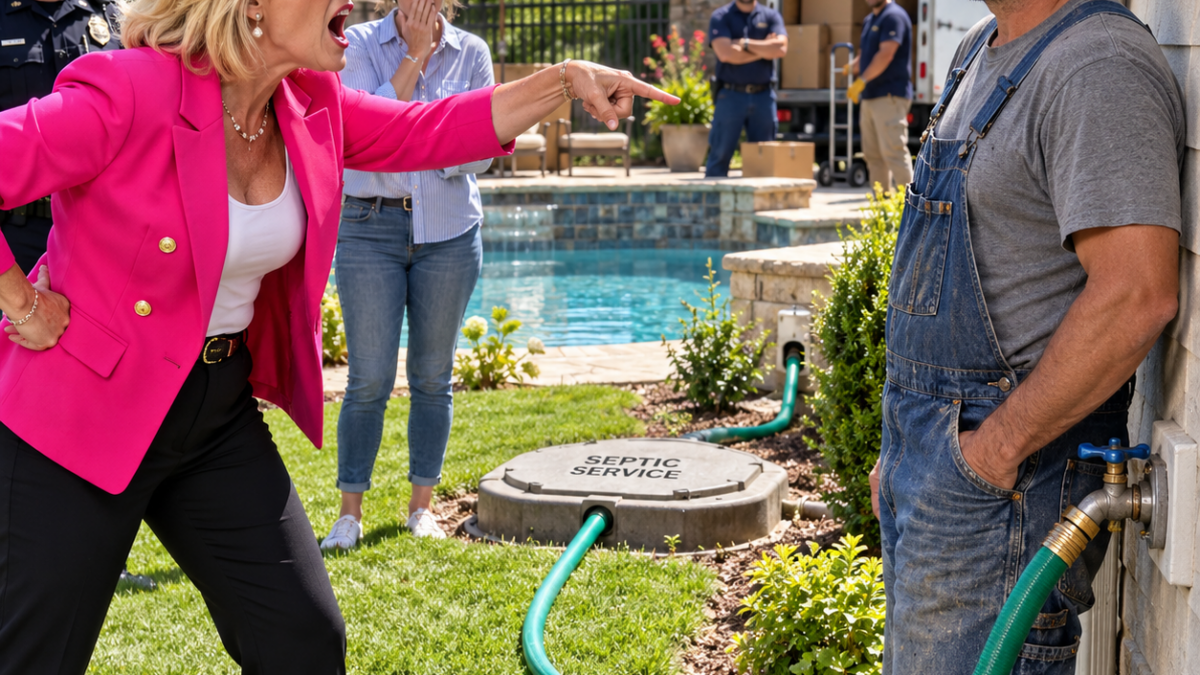
PART 2
Six years earlier, when I signed the papers on 412 Oakmere Court, Gail Prescott barely registered in my life.
She lived diagonally across from me.
White colonial.
Black shutters.
Circular driveway.
Perfect lawn.
The kind of landscaping that made you wonder whether the grass had signed a behavioral agreement.
Her husband Darren was quieter.
He existed a few steps behind her most of the time.
At meetings he carried papers.
Held her purse.
Nodded.
You could know the man five years and still struggle to describe his personality.
Gail was different.
Everybody knew Gail.
Treasurer of the Briarfield Estates Homeowners Association.
Four terms.
Nobody ran against her.
That’s not the same thing as being loved.
People simply understood that campaigning against Gail meant becoming Gail’s project.
Briarfield had forty-two homes.
Small enough that everybody recognized every car.
Large enough that most people still pretended not to know what was happening three houses away.
Gail liked rules.
Grass over four inches?
Letter.
Garbage bin visible after pickup?
Letter.
Mailbox color slightly wrong?
Letter.
A seventy-five-dollar fine if she decided the mistake looked intentional.
My first year, I received three violation notices.
I paid all three.
Not because I agreed.
Because peace had value.
After my divorce, I didn’t want another person deciding whether every conversation needed to become a battle.
Pay fifty dollars.
Move the trash can.
Go back to work.
That strategy worked until May.
Tuesday morning.
6:15.
I had a job in Matthews and needed the short garden hose I kept beside the garage.
I stepped outside and saw bright green rubber attached to my outdoor spigot.
Not mine.
The hose ran across my mulch.
Through a gap near the fence.
Then into Gail’s backyard.
The faucet was wide open.
You can hear a fully open hose even before you see it.
Steady hiss.
Pressure.
Water moving.
I followed the line.
Looked through the fence.
The other end fed her pool filler.
For a second I just stared.
It was so absurd my brain tried to make it reasonable.
Maybe Darren borrowed water while fixing something.
Maybe they had a line break.
Maybe somebody planned to ask me.
Then I noticed the pool level.
The hose was simply topping it off.
My water.
My meter.
My bill.
Her pool.
I shut the faucet.
Disconnected the hose.
Coiled it.
Set it carefully on her side of the fence.
No drama.
I had a ten-hour day ahead of me.
That afternoon Gail knocked.
I opened the door.
“Keith, the water is off.”
“Yes.”
“Turn it back on.”
“Why?”
Her expression suggested I had asked why rain was wet.
“For the pool.”
“That’s my faucet.”
“It’s on the exterior of the house.”
“Correct.”
“Exterior systems fall within HOA oversight.”
“Not my water bill.”
She sighed.
“The HOA covers shared utility usage.”
“What shared utility?”
“The community.”
“Your pool is not the community.”
She looked past me toward my hallway.
“Read your covenants.”
Then left.
I did.
All forty-six pages.
Fence materials.
Paint colors.
Roof shingles.
Satellite dishes.
Holiday decorations.
Parking.
Landscaping.
Common areas.
Utility easements.
Nothing granting an HOA officer the right to use water through a privately metered house.
Nothing saying an exterior faucet became shared property.
The next morning I bought an eight-dollar hose bib lock.
Metal cap.
Key.
Thirty seconds.
Clicked it into place.
Problem solved.
Three days later I came home after crawling beneath a house in Gastonia for most of the day.
My shoulders hurt.
My clothes smelled like insulation and PVC cement.
I walked around the side of my house to rinse my hands.
Stopped.
Lock gone.
Not opened.
Cut.
Bright metal where bolt cutters had sheared through.
Green hose reattached.
Water running.
On the siding above the faucet was masking tape.
Black marker.
HOA ACCESS — DO NOT OBSTRUCT.
I stood there for a long moment.
A kid down the street bounced a basketball.
Birds made noise in the trees.
My meter kept counting gallons.
I photographed everything.
Timestamp.
Cut lock.
Label.
Hose.
Spigot.
Fence gap.
Then disconnected the hose.
Bought a harder lock.
Sixteen dollars.
Four days later, Briarfield Estates sent me a violation notice.
COMMUNITY GUIDELINE 7.3
OBSTRUCTION OF COMMUNITY INFRASTRUCTURE.
Fine:
$250.
Signed:
Gail Prescott, Treasurer.
I called Wade Bellamy.
HOA president.
Retired insurance adjuster.
Wade spent more hours polishing his bass boat than using it.
Fourth ring.
“Yeah?”
“Wade, it’s Keith.”
“Oh. Hey.”
“I’ve got a question about a fine.”
Pause.
“Which one?”
“Community infrastructure.”
Another pause.
Longer.
I explained the hose.
The cut lock.
The label.
The water.
Wade sighed.
“Keith, Gail handles exterior compliance.”
“She is filling her private pool from my house.”
“I hear you.”
“No. You’re hearing the sentence without responding to what it means.”
“I’d prefer not to get in the middle of a neighbor dispute.”
“It is not a neighbor dispute.”
“What would you call it?”
“Someone taking a utility I’m paying for.”
“Work it out with her.”
Click.
I stared at my phone.
That was when I requested twelve months of usage history from Mecklenburg County Water.
Two days later it arrived.
January:
2,760 gallons.
February:
2,840.
March:
2,810.
April:
2,790.
May:
5,400.
June:
6,100.
July:
6,800.
There it was.
The hose appeared.
My water use doubled.
I printed the report.
Then something else bothered me.
I shut the main valve inside my house.
Kitchen dry.
Bathroom dry.
Everything off.
Went outside.
Lifted the concrete cover over the meter.
The red flow indicator was moving.
Slow.
Steady.
Water still passing my meter while my house was shut down.
That meant the problem went beyond somebody turning on my outdoor faucet.
I traced the line.
Found signs that the exterior connection had been altered in a way that allowed water to keep moving independently of the shutoff controlling my interior fixtures.
I remember sitting on the curb beside the meter.
Concrete rough beneath my hands.
Streetlight buzzing above me.
Across the road, Gail’s pool filter hummed.
Nine thousand gallons, give or take.
And counting.
A normal person buys another lock.
A plumber gets offended professionally.
Saturday morning I welded a steel guard around the spigot.
Half-inch stock.
Concrete anchors.
Ugly.
Strong.
You wanted access?
You needed power tools.
Monday afternoon, I turned onto Oakmere Court and heard an angle grinder before I reached my driveway.
White pickup parked in front of my house.
Man in gray shirt crouched beside the wall.
Sparks flying across my mulch.
Gail stood on the sidewalk.
Arms crossed.
I got out of my van.
“What is happening?”
Gail didn’t blink.
“Unauthorized exterior structure.”
“That’s attached to my house.”
“Exterior architecture requires approval.”
“That is protecting my water.”
“You installed it without submitting a request.”
The worker cut the final bar.
The cage dropped.
Clang.
He threw the pieces into his truck.
I looked at Gail.
“You hired somebody to cut steel off my house.”
“You created an unapproved alteration.”
“You could have sent me a letter.”
“I did.”
“No. You sent me a fine because I wouldn’t pay for your pool.”
She stepped closer.
“Keep challenging me and removal costs get added to your account.”
The worker left.
Gail went home.
That was when Clint Roark walked over.
My next-door neighbor.
Retired firefighter.
Sixty-something.
Gray crew cut.
Hands like baseball mitts.
He looked at the four anchor holes in my brick.
“She did that to the Petersons.”
“What?”
“Different issue.”
He nodded toward Gail’s house.
“Same method.”
“The Petersons who sold two years ago?”
“Yeah.”
“What happened?”
“Fines.”
“For what?”
“Everything.”
Clint counted on his fingers.
“Fence. Trash. Grass. Shed roof. Work truck. Guest parking.”
“They moved because of fines?”
“They moved because every month brought another letter.”
He looked at me.
“Sold below what they wanted. Went to Boone.”
“Anyone else?”
“The Delgados.”
I remembered them.
Young couple.
First house.
Gone within a year.
“Nineteen violations.”
Clint shook his head.
“Nineteen in eight months.”
“So she just pushes people out.”
“She pushes until people decide peace is cheaper somewhere else.”
“Why has nobody stopped her?”
Clint looked across the street.
“Because nobody wants to become next.”
That night I emailed all three HOA officers.
Wade Bellamy.
Gail Prescott.
Lorraine Cobb.
Formal complaint.
I attached twenty-two photographs.
Water bills.
Usage history.
Cut locks.
Hose.
Steel guard removal.
Fine notice.
I asked for a written explanation identifying the exact covenant that made my individually metered faucet a shared utility.
Gail answered the next morning.
All board members copied.
Mr. Owens’ exterior spigot is located within the HOA utility easement. Water accessed from HOA easement space constitutes a shared community resource. No reimbursement is warranted.
Attached:
Survey.
At first glance it looked official.
Then I noticed the right side was missing.
Cropped.
The dimensions near the house were cut off.
Lorraine voted with Gail.
Wade abstained.
Two to one.
Fine upheld.
Then the other notices started.
Trash container visible.
$150.
Mailbox finish deteriorated.
$100.
Continued obstruction.
$500.
Total climbed to $750.
That was Gail’s real talent.
Never one massive blow.
A hundred little ones.
Each small enough to make you question whether fighting was worth it.
I drove to the Mecklenburg County Register of Deeds.
Requested the original survey filed when my house was built in 1989.
The clerk brought me a full copy.
I unfolded it across the counter.
Utility easement:
Front edge of lot.
Eleven feet from the house.
My spigot:
East wall.
Two feet from foundation.
Nowhere near the easement.
Not close.
Gail’s cropped survey had removed the exact measurements proving her claim false.
I got a certified copy.
Put it in a manila envelope.
Drove home.
Did not email Gail.
Did not confront Wade.
I placed it beside the water bills.
Evidence was becoming more useful than arguments.
The next weekend I installed a security camera beneath the eave.
Aimed only at my side yard.
Spigot centered.
Second night.
11:14 p.m.
Motion alert.
I opened the recording.
Darren Prescott.
Flip-flops.
Cargo shorts.
Bolt cutters.
He walked onto my property.
Cut the lock.
Connected the hose.
Opened the faucet.
Then turned.
Looked directly into the camera.
Made a crude gesture.
Held it for three seconds.
Walked away.
I saved the footage three places.
Took it to the next HOA meeting.
Fourteen homeowners.
Lorraine’s living room.
Stale coffee.
Vanilla air freshener.
Before I could show the video, Gail spoke.
“Before Mr. Owens presents anything, we need to address his security camera.”
I stared.
“What about it?”
“Section 12.4. Privacy.”
“It faces my faucet.”
“It captures neighboring exterior space.”
“No, it doesn’t.”
“I have received a complaint.”
“From Darren?”
“That is confidential.”
“Was the complaint submitted after he looked into the camera while cutting my lock?”
A few heads turned.
Gail’s expression stayed flat.
“The camera must be removed.”
Vote.
Lorraine yes.
Gail yes.
Wade no—actually he avoided looking up and called it an abstention.
Remove camera or face a thousand-dollar fine.
I removed it.
The footage stayed.
August’s water bill:
$340.
Nearly four times normal.
That Friday night, Gail held a pool party.
Music.
String lights.
Charcoal grill.
Children running.
Adults with red cups.
I stood at my kitchen window.
Half the neighborhood was there.
Nobody invited me.
I wasn’t hurt about the invitation.
What got me was the pool.
Blue.
Clean.
Full.
People swimming in water I had paid for.
There is a kind of anger that burns.
Mine stopped burning.
It became heavy.
Dense.
Like poured concrete.
I turned off the kitchen light.
Went to the garage.
The green hose ran through the fence.
Straight from my property to Gail’s pool equipment.
No permission.
No safeguards.
No agreement.
Nothing.
For the first time, I stopped looking at it as a neighbor’s hose.
I looked at it as a plumbing system someone else had deliberately attached to mine.
I knew how easily an unauthorized connection could become a sanitation problem.
I also knew something else.
If I handled it recklessly, I could create a public-health problem of my own.
That mattered.
The original version of me—the angry version standing in that garage—wanted a spectacular lesson.
The plumber in me knew cross-connections are not jokes.
I made a decision I would later pay a county citation for.
I altered my own private piping so that Gail’s unauthorized hose would no longer be connected to the clean-water source she assumed she controlled.
I am not going to describe the mechanics.
They were unsafe.
The county later made that very clear.
At the time, I told myself one thing:
She could stop the entire situation at any moment by staying off my property and disconnecting her hose.
I left everything inactive.
No flow.
No trick.
Not yet.
Because by then another question mattered more.
Why fight this hard over water?
Gail wasn’t poor.
Pool.
Lexus.
Remodeled kitchen.
The actual cost of the stolen water was irritating but not life-changing.
Maybe $180.
Nobody risks board authority, falsifies an easement argument, sends workers with grinders, and piles fines onto a neighbor over $180 unless the $180 is protecting something bigger.
So I read the bylaws again.
Section 14.
Financial records.
Members had inspection rights.
I sent a formal request.
Three years of HOA financial statements.
Invoices.
Ledgers.
Vendor payments.
Bank records.
Gail delayed.
“Records are being updated.”
Then:
“Accountant unavailable.”
Then:
“Board approval required.”
I replied with the relevant North Carolina statutory language.
One sentence.
No emotion.
Three weeks later, a manila envelope appeared in my mailbox.
Forty-one pages.
Bad photocopies.
Coffee stains.
Handwritten totals.
I understand pipe.
Not accounting.
But Clint had a daughter.
Nora Roark.
CPA.
Works in Charlotte.
She came Saturday.
Laptop.
Calculator.
Highlighter.
Three cups of black coffee.
Two hours later, Nora stopped turning pages.
“How many homes?”
“Forty-two.”
“Annual dues?”
“Twelve hundred.”
She punched numbers.
“$50,400 incoming per year.”
“Okay.”
She pointed.
“Landscaping. Insurance. Legal. Entry sign. Routine stuff.”
“How much?”
“About twenty-eight thousand documented.”
I waited.
Nora looked at me.
“Where’s the rest?”
“What rest?”
“About twenty-two thousand dollars.”
She flipped to a ledger.
One monthly category repeated again and again.
EXTERIOR MAINTENANCE / SHARED UTILITIES.
$1,400.
$1,700.
$1,950.
$1,600.
Month after month.
No vendor.
No account number.
No receipts.
No invoices.
Nora tapped it.
“What shared utilities does Briarfield have?”
I thought.
“None.”
“Community irrigation?”
“No.”
“Shared water meter?”
“No.”
“Clubhouse?”
“No clubhouse.”
“Community pool?”
I looked toward Gail’s house.
“No.”
Nora leaned back.
“Every house pays its own utilities?”
“Yes.”
“Then this line item doesn’t correspond to anything real.”
She added totals.
Three years.
Roughly $65,000.
I felt the room change.
“She made it up.”
Nora did not answer immediately.
Then:
“It appears somebody has been moving HOA money through a category with no supporting documentation.”
“My spigot.”
“What?”
I stood.
Walked toward the window.
“The whole shared-water story.”
Nora followed.
“If she can point at my faucet and call it a community utility…”
“She creates a physical example supporting the accounting label.”
I turned.
“My water wasn’t just free water.”
Nora capped the highlighter.
“It may have been part of the cover story.”
That was the moment the problem stopped being Gail versus Keith.
Forty-two families paid dues.
Sixty-five thousand dollars could not be explained.
And Gail had invented a “shared utility” nobody else could find.
Nora built a complaint package.
Bank statements.
Ledger.
Missing support.
My water history.
Original survey.
Gail’s cropped survey.
Side by side, the survey copies looked devastating.
Full document:
Easement eleven feet away.
Gail’s version:
Measurement removed.
Water used without permission:
Approximately eighteen thousand gallons over five months.
Financial discrepancy:
Approximately sixty-five thousand dollars.
Clint handled the neighborhood.
Quiet conversations.
Driveways.
Mailboxes.
Fences.
He spoke to nearly everyone Gail had fined.
That turned out to be most of Briarfield.
Bylaws required twenty-five percent of owners to force an emergency meeting and audit.
Eleven signatures.
Clint got fourteen.
Then nineteen.
One resident told him Gail had once explained “shared utilities” as seasonal drainage maintenance.
There was no drainage contract.
Another had been told it funded landscape watering.
Every landscape company invoice already included its own water.
Stories changed depending on who asked.
That mattered.
Meanwhile, Gail noticed I had done plumbing work in my backyard.
Of course she did.
Violation:
UNAUTHORIZED EXCAVATION.
$500.
I replied with the covenant provision allowing maintenance to privately owned plumbing.
Attached my full survey.
No response.
Instead:
Shed paint.
$200.
Driveway oil mark.
$150.
Running total:
$1,850.
Then county code enforcement arrived.
White truck.
Officer with clipboard.
I was in the yard raking disturbed soil.
“Complaint about unauthorized construction.”
“Who complained?”
He smiled.
“You know I can’t tell you.”
“I can guess.”
He spent forty-five minutes measuring.
Looked at my property line.
Examined the work.
Asked what had been changed.
I kept the explanation general.
Private plumbing modification.
Entirely on my lot.
No structural work.
No extension beyond my ownership.
He wrote notes.
Then:
“No permit violation for the basic scope I can see.”
My shoulders dropped.
“You’re clear from us on construction.”
“Thank you.”
He started to leave.
Then glanced back.
“Be careful with cross-connections.”
That sentence stayed with me.
Later, it became more important than I wanted it to be.
That evening, Gail put a sign on her lawn.
NOTICE TO BRIARFIELD RESIDENTS
UNAUTHORIZED SEWAGE CONSTRUCTION OBSERVED
AT 412 OAKMERE COURT
PROTECT OUR CHILDREN AND PROPERTY VALUES
My address.
Printed.
Laminated.
Then mass email.
Photos of me digging.
Subject:
SHOULD WE BE CONCERNED?
Three neighbors called code enforcement.
Two left angry voicemails.
Someone taped a copy of Gail’s email to my mailbox.
For a day, I felt like the neighborhood had turned again.
Then Thursday night, the green hose came back.
Darren.
Another lock.
Another unauthorized entry.
I no longer had the side camera.
But I had installed a doorbell camera facing only my own porch and walkway.
Wide enough angle to catch part of the side yard.
Darren appeared.
Cut.
Connect.
Water on.
Saved.
No confrontation.
No post online.
I simply added the file to the evidence folder.
Then Gail announced an $800 emergency “community drainage improvement” assessment.
No contractor bid.
No board vote.
No detailed plan.
That broke the neighborhood.
Nineteen signatures.
Nearly half of Briarfield.
Gail responded by calling her own emergency board meeting.
Not the audit meeting homeowners had demanded.
Her meeting.
Her house.
Her agenda.
Twelve homeowners attended.
Gail stood at the end of her dining table.
Behind her were enlarged photographs of me digging.
Poster board.
It looked like a school presentation about why Keith Owens was destroying civilization.
“Mr. Owens has accumulated $1,850 in unpaid fines.”
I sat beside Clint.
“He has repeatedly refused compliance.”
Gail pointed at the photos.
“He has installed unauthorized plumbing.”
Then:
“I recommend a lien against 412 Oakmere Court.”
My chest tightened.
That house was the only thing I had purchased entirely for myself after my divorce.
No shared mortgage.
No settlement agreement.
No former spouse’s signature.
Mine.
Gail was putting her hand on it because I refused to give her my faucet.
I stood.
“I’m formally requesting the financial audit.”
“That’s a separate matter.”
“Nineteen homeowners signed.”
“Tonight is about compliance.”
“The bylaws require the audit meeting within thirty days.”
Wade cleared his throat.
Everyone looked at him.
“I think compliance should be resolved first.”
I stared at him.
“Wade.”
His eyes dropped.
“Then we can schedule the audit.”
“What day?”
“Next month.”
“After the lien.”
He didn’t answer.
Lorraine voted yes.
Gail yes.
Lien approved.
I drove home.
Sat in the van.
Engine ticking as it cooled.
For the first time, I considered quitting.
Pay.
Sell.
Leave.
The Petersons had.
The Delgados had.
Maybe they were smarter.
Then my phone buzzed.
Doorbell notification.
11:41 p.m.
Live view.
Gail.
Not Darren.
Bathrobe.
Slippers.
Green hose over one shoulder.
She walked down the side of my house.
Reached the faucet.
Opened the lock.
That surprised me.
Somehow she had acquired a key compatible with it.
She connected the hose.
Turned the faucet.
Wiped her hands on the robe.
Walked back toward her yard.
Ninety seconds.
The same woman who had voted to put a lien on my home less than two hours earlier had personally entered my property and reconnected the hose.
On camera.
I replayed the clip.
Then again.
Saturday was four days away.
Gail’s end-of-summer pool cookout.
Invitations already delivered.
I looked at the switch controlling the plumbing setup I had installed.
Then the pile of evidence.
I slept better that night than I had in weeks.
Saturday came hot.
Carolina hot.
Ninety-one before lunch.
Gail decorated like she was hosting a magazine shoot.
Canopy.
Red tablecloths.
Serving trays.
String lights.
Darren started charcoal.
Smoke drifted across the cul-de-sac.
By ten-thirty, cars filled the curb.
Twenty-three neighbors.
Children.
A few guests I didn’t recognize.
The pool looked perfect.
Blue water.
Sunlight.
Music.
I stood in my kitchen drinking coffee.
I could see the green hose.
Still connected.
Still crossing from my property to hers.
At 10:45, I made the decision I had been considering for days.
I changed the source feeding my own exterior line.
Again, I am not going to explain how.
It was unsafe.
It was reckless.
And later the county cited me for creating an improper sanitation cross-connection.
That citation was justified.
At the time, I shut off the clean municipal feed and activated the alternate connection I had built.
Then I sat at the kitchen table.
The unauthorized hose did the rest.
Fifteen minutes.
Maybe less.
First people noticed cloudiness near the pool inlet.
Then color.
Then odor.
The reaction was immediate.
Children were pulled out.
Adults backed away.
Chairs scraped.
Someone knocked food off a table.
The party stopped being a party.
Gail ran toward the pool.
“What is that?”
Nobody answered.
She looked toward the fence.
Then toward my house.
“Keith!”
I stepped onto my patio.
She reached the fence.
“What did you do?”
“I didn’t connect a hose to your pool.”
“What did you do to the water?”
“That hose is connected to my property.”
She stared at me.
“You contaminated my pool.”
I kept my voice level.
“You should disconnect anything you attach to somebody else’s plumbing without permission.”
Behind Gail, neighbors had started following the green hose.
From the pool.
Across her yard.
Through the fence.
To my house.
For months, Gail’s entire argument depended on everybody accepting the phrase “shared utility.”
Now twenty-three witnesses could see the actual arrangement.
Her hose.
My faucet.
My wall.
Clint spoke.
“She’s been using his water since May.”
A woman turned.
“What?”
Clint pointed.
“His meter. His bills.”
Gail spun.
“This is HOA-authorized access.”
“No,” I said.
I held up the certified survey.
“Here’s the full recorded plat.”
Clint took it.
Several people gathered.
“The easement is out front,” he said.
He pointed.
“His faucet isn’t inside it.”
Gail’s face changed.
Then a car pulled up.
Nora.
Silver Honda.
Box of documents on the passenger seat.
She walked across the lawn carrying stapled packets.
Nineteen copies.
Financial summary on top.
Three years of HOA records.
Shared utilities highlighted.
Approximately $65,000 unsupported.
No vendor.
No invoices.
No community utility.
People began reading.
The atmosphere changed faster than the pool had.
One man looked up.
“Sixty-five thousand?”
Another:
“What is this?”
A woman:
“We pay twelve hundred a year.”
Gail stepped toward Nora.
“These are internal documents.”
“They’re association records.”
“You’re misrepresenting them.”
“I’m a CPA.”
“That doesn’t make you the HOA accountant.”
“No.”
Nora looked around.
“It makes me able to add.”
That was the first time somebody laughed.
Not at the pool.
At Gail.
It was small.
But something in the neighborhood broke open.
Darren stood near the grill.
He put the tongs down.
Looked at Gail.
Then at the packets.
Then walked to his car.
He drove away.
Did not return that day.
Phyllis Emerson lived six houses down.
Retired school nurse.
She pulled out her phone.
“There are children here and an open sanitation issue.”
She called county health.
Thirty-eight minutes later, officials arrived.
By then the pool area had been cleared.
They documented everything.
Pool.
Hose.
Connection.
Property line.
Gail immediately blamed me.
“He intentionally contaminated my pool.”
The officer looked at the hose.
Then at me.
Then back at Gail.
“Who installed the hose from his property to yours?”
Gail hesitated.
“It’s HOA access.”
“Ma’am, did you have written permission from the property owner?”
No answer.
He repeated the question.
“Did you have permission?”
“No.”
That one word mattered.
Clint approached Wade, who had finally shown up after hearing county vehicles were on Oakmere Court.
He carried the homeowner petition.
“Nineteen signatures.”
Wade looked at it.
“Requesting immediate removal proceedings and forensic audit.”
Clint handed it over.
Wade took the pages with both hands.
His face looked ten years older than it had at the meeting.
The county ordered Gail’s pool closed until it could be professionally drained and sanitized.
Specialized cleanup cost roughly $12,000.
Her insurance denied the claim.
Their reasoning centered on the unauthorized connection she had repeatedly created between her pool and a neighboring property.
I received my own county citation.
$500.
Improper private cross-connection involving a sanitation line.
I paid it the same afternoon.
No argument.
I knew what I had done.
I also knew the ending would have been stronger if I had never crossed that line.
Sometimes being right about the larger problem does not make every decision you make while angry a good one.
That became my part of the story.
Gail’s problems were bigger.
Nora’s complaint package reached the district attorney’s office.
Financial investigators looked at the HOA records.
“Shared utilities.”
Three years.
Approximately $65,000.
No supporting service.
Then bank activity.
Then payments.
Then personal accounts.
The fiction began collapsing.
Four months later, Gail faced criminal charges related to the missing HOA money.
Darren cooperated.
That surprised everybody except maybe Darren.
Investigators had footage showing him repeatedly cutting locks and reconnecting Gail’s hose.
He also had access to bank records.
Emails.
Messages.
He gave statements confirming Gail directed the hose connections and told him which locks to remove.
He received a deferred prosecution arrangement.
Their marriage did not survive.
Gail filed for divorce after his cooperation became formal.
Briarfield held a special meeting in October.
Largest turnout anybody could remember.
Thirty-nine homeowners in person.
Two by proxy.
One out of state.
Forty-two homes total.
Wade opened the meeting.
Hands shaking slightly.
“I owe the neighborhood an apology.”
Nobody interrupted.
“I should have reviewed complaints independently.”
Clint sat beside me.
Wade continued.
“I allowed one officer to exercise authority without enough oversight.”
From the back, someone said:
“You allowed?”
Wade nodded.
“Fair.”
He looked down.
“I participated by looking away.”
That was better.
Lorraine Cobb resigned from the board.
Wade did too.
Gail had already been removed under the emergency procedure.
Every fine against me:
Voided.
$1,850.
Lien:
Released.
Official correction filed.
Mecklenburg County Water reviewed the usage history, incident documentation, and unauthorized access evidence.
I received a credit of about $180.
People laughed when I told them.
“After all that, one-eighty?”
That wasn’t the point.
The amount didn’t matter.
The line on the statement did.
ADJUSTMENT — UNAUTHORIZED USAGE.
For five months, Gail had insisted the water was shared.
The county record now said otherwise.
The forensic audit recovered much of the missing money.
Restitution became part of Gail’s resolution.
But the neighborhood had another decision.
What should happen with recovered funds?
New president was Phyllis Emerson.
Same woman who called county health from Gail’s pool deck.
Retired teacher after her nursing career.
Calm.
Impossible to bully.
At the first budget meeting, she proposed two things.
Annual dues:
Reduce from $1,200 to $900.
Then create a neighborhood repair fund.
Emergency roofs.
Basic plumbing.
Fence repairs.
Safety work.
Small projects for homeowners who couldn’t afford a sudden repair.
Someone asked:
“Why should HOA money pay for private repairs?”
Phyllis answered:
“Because community should mean something other than fines.”
That sentence stayed with me.
Vote passed.
Forty-one to one.
Lorraine abstained.
I volunteered plumbing labor.
Free.
Not materials.
I’m generous, not stupid.
First repair through the fund was for Mrs. Henderson.
Seventy-six.
Widow.
Leaking shutoff valve.
She had been putting a pan under it for six months because the last plumber quoted more than she could comfortably pay.
I replaced it Saturday morning.
She stood beside me.
“Gail fined me once because my front curtains were the wrong color from outside.”
I looked up.
“There’s a curtain rule?”
“There was according to Gail.”
“Was it real?”
“No.”
“Sounds familiar.”
She smiled.
When I finished, she tried to hand me twenty dollars.
“No.”
“You worked.”
“The fund covers it.”
“I still want to pay you.”
“Make coffee.”
She did.
That was payment.
A few weeks later, Clint and I fixed a broken hose bib at Dale Morrison’s house.
The irony was not lost on anybody.
Dale watched me install it.
“You going to lock this one?”
“Only if your neighbor owns a pool.”
He laughed.
I started learning things about Briarfield I had never known.
Mr. Jenkins cared for his wife with dementia.
The Delgados’ old house had been bought by a couple with a newborn.
Phyllis baked terrible banana bread but excellent biscuits.
Wade, after resigning, actually used the bass boat.
Nobody knew where.
One Saturday in October, I hosted a cookout.
My backyard.
Small.
Fourteen neighbors.
Clint brought Budweiser.
Nora brought sweet potato pie.
Gone in eleven minutes.
I used charcoal.
I had decided Gail was right about one thing.
Propane was for people who didn’t care enough.
Dale from the cul-de-sac shook my hand.
“I should’ve signed the petition sooner.”
I looked at him.
“Why didn’t you?”
He shrugged.
“I didn’t want her looking at my house.”
There it was.
The entire neighborhood in one sentence.
“I should’ve helped when you first complained.”
“Probably.”
He smiled weakly.
“You’re not going to make me feel better?”
“No.”
“Fair.”
Then:
“I’m sorry.”
I nodded.
“Thank you.”
People ate.
Kids ran through the yard.
No music loud enough to shake windows.
No speeches.
No agenda.
For the first time in six years, I wasn’t a man who happened to own a house inside Briarfield.
I lived in a neighborhood.
After everyone left, I sat on the porch.
String lights overhead.
Cool October air.
Dry leaves.
Charcoal smell.
The spigot sat on the side wall.
I had put another simple lock on it.
Eight-dollar type.
Nothing fancy.
Nobody had touched it in weeks.
I thought about the steel cage.
Angle grinder.
Surveys.
Fines.
Water bills.
That ridiculous sign on Gail’s lawn warning people about my property.
Most of all, I thought about how easy the whole thing could have ended.
The first morning I disconnected her hose.
Gail could have said:
Sorry. Darren should’ve asked.
Then reimbursed the water.
Done.
Instead she needed to be right.
Then she needed paperwork proving she was right.
Then she needed fines.
Then a lien.
Then a false easement.
Then the financial records had to support the fiction.
By the time she was finished defending a garden hose, she had exposed everything else.
People later called what happened at the pool revenge.
I understand why.
It was dramatic.
It was ugly.
It was also the part of the story I am least proud of.
I was furious.
I knew enough about plumbing to understand exactly how badly an improper cross-connection could go.
I created one anyway.
The county citation was deserved.
Nobody was seriously hurt, thankfully.
That does not magically make the decision smart.
If I had to do it again, I would let the audit, footage, survey, and financial records do the work.
Because those were what actually ended Gail.
Not the pool.
The pool gave people a reason to finally look.
The documents gave them something they could not ignore.
Full survey.
Cropped survey.
Water records.
Doorbell footage.
HOA ledgers.
Bank statements.
Nineteen signatures.
That was the real answer.
Gail spent years winning because she made every dispute personal.
Your grass.
Your mailbox.
Your fence.
Your trash.
Your fine.
One homeowner at a time.
No one saw the pattern because everybody was busy defending themselves.
The moment people put their paperwork on one table, Gail lost her biggest advantage.
Isolation.
Clint understood that before I did.
Months after the special meeting, we were sitting on my porch.
He said:
“You know why firefighters hate closed doors?”
“Smoke?”
“No.”
He took a drink.
“Because every closed door is a question.”
I waited.
“In a fire, you open them one by one until you know what’s behind each.”
“What’s that got to do with Gail?”
“Everybody here kept their door closed.”
He nodded toward the street.
“Petersons got fined. Closed door.”
“Delgados. Closed door.”
“You. Closed door.”
“Nobody knew the whole building was burning.”
I looked at him.
“That metaphor seems dramatic.”
“I’m retired. I’m allowed.”
He was right.
The repair fund changed things more than I expected.
Not financially.
Culturally.
People started asking for help before problems became embarrassment.
A single mother had a leaking outdoor line.
I fixed it.
An older couple needed a handrail.
Clint built it.
Nora helped a family appeal a property-tax error.
Phyllis organized volunteers after a storm dropped a tree across a driveway.
No fines.
No newsletter photo.
No public shame.
Just people helping.
That was probably the best answer to what Gail had made Briarfield.
A year after everything, a new family bought the Prescott house.
Young couple.
Two children.
No pool party for months.
Then one summer afternoon I saw the father beside the fence.
He called:
“Keith?”
I walked over.
“What’s up?”
He pointed toward his pool equipment.
“I think the autofill is leaking.”
I stared at him.
He looked confused.
“Did I say something wrong?”
I laughed.
“No.”
“You know pools?”
“Unfortunately.”
I went over.
Found a simple valve problem.
Fixed it in twenty minutes.
He tried to pay me.
I refused.
Then he asked:
“Why is there a patch in the fence over here?”
I looked at the place Gail’s green hose used to run.
“Long story.”
“Bad?”
“Expensive.”
He nodded.
Then:
“Previous owner?”
“Yeah.”
He waited.
I didn’t continue.
Some stories don’t need to become the inheritance of the next person living in a house.
Gail was gone.
That house deserved a chance to become somebody else’s home.
Mine had.
My place still wasn’t beautiful.
Grass improved.
Mostly because Phyllis shamed me into reseeding.
Mailbox got painted.
Not approved green.
A darker green that was also approved under the revised rules.
The duct tape finally came off the siding.
Clint made me fix it properly.
“You’re a tradesman.”
“Plumber.”
“That’s not an excuse.”
The board rewrote enforcement procedures.
No single board officer could issue or uphold a fine involving their own property or dispute.
Evidence required.
Appeal hearing.
No fines added while an appeal was pending.
Recorded liens required independent legal review.
Financial records published quarterly.
Actual receipts.
Actual vendors.
Shared utilities category removed.
Because there were no shared utilities.
At the first annual meeting under the new system, Nora presented the budget.
Projector.
Spreadsheet.
Every number explained.
Someone asked:
“Where’s the miscellaneous account?”
Nora said:
“There isn’t one.”
Applause.
Accountants almost never get applause.
She looked terrified.
Afterward she came over.
“Never do that to me again.”
“I didn’t clap first.”
“Clint did.”
“Talk to Clint.”
“I did.”
“What’d he say?”
“That he’s retired.”
Of course.
Wade apologized to me personally.
Months later.
I was washing the van.
With my own water.
He walked up.
“Keith.”
“Wade.”
He stared at the locked spigot.
“I should’ve stepped in.”
“Yes.”
“I knew Gail overstepped sometimes.”
“Sometimes?”
He accepted that.
“I told myself keeping the board stable mattered.”
“Stable for who?”
“That’s the point.”
He looked toward Gail’s former house.
“I thought conflict was the danger.”
“And?”
“Avoiding conflict was.”
That was more insight than I expected from Wade.
I shut off the hose.
“You knew about the shared utilities line?”
“No.”
“I believe you.”
He looked relieved.
“That doesn’t make you innocent.”
Relief disappeared.
“I know.”
That was enough.
Darren left Briarfield after the divorce.
Before moving, he came to my door.
I almost didn’t answer.
He stood outside.
No Gail.
No bolt cutters.
Older somehow.
“I owe you money.”
“For?”
“Locks.”
I stared.
He held an envelope.
Inside:
Cash.
Eighty dollars.
“You cut maybe thirty dollars’ worth.”
“I rounded up.”
I handed it back.
“Keep it.”
“Keith.”
“I don’t want money from you.”
He looked down.
“I should’ve said no.”
“To Gail?”
“Yes.”
“Why didn’t you?”
Long pause.
“Easier.”
That word again.
Easier.
Pay the fine.
Move the bin.
Cut the lock.
Do what Gail says.
Stay out of it.
Sell the house.
Easier.
“Darren.”
He looked at me.
“That’s how she kept doing it.”
He nodded.
“I know.”
Then left.
I didn’t forgive him that day.
Maybe I never fully did.
But I understood him better.
Weakness can cause damage without looking dramatic.
Nobody wakes up and announces:
Today I will help someone become abusive with authority.
They just decide this one argument isn’t worth having.
Then another.
Then another.
Eventually, somebody like Gail becomes the only person in the room who never hears no.
That’s dangerous.
Not because HOA boards are important.
Because any unchecked power gets strange.
Even over mailboxes.
Especially when money sits behind it.
Gail’s criminal case took longer than the neighborhood changes.
Law moves slowly.
Accounting even slower.
The plea eventually included restitution.
The recovered funds returned to Briarfield.
Some charges were reduced.
I didn’t follow every hearing.
Didn’t attend sentencing.
Nora did because the audit work mattered to her.
She called afterward.
“Done.”
“That’s it?”
“That’s it.”
“How do you feel?”
“Tired.”
“Same.”
People expected me to celebrate.
I didn’t.
I remembered the Petersons.
The Delgados.
Families who left before anybody understood the pattern.
Recovered money couldn’t give them back the years they spent feeling hunted in their own neighborhood.
So the board reached out.
Sent formal letters.
Apologies.
Copies of the audit findings.
The Petersons replied.
Short.
Glad you finally dealt with it.
The Delgados never answered.
Fair enough.
The repair fund continued.
One year became two.
Annual dues stayed lower because spending became transparent.
People stopped assuming every HOA dollar needed a project attached to it.
Sometimes the best board meeting ended with:
We don’t need to spend that.
Gail would have hated that.
My plumbing business got busier.
Word spread about the free work for the repair fund.
Then people hired me for paid work outside the fund.
I joked that the HOA accidentally improved my marketing.
Nora said:
“Do not put that in the annual report.”
Phyllis said:
“Absolutely put it in.”
Clint said:
“I’m retired.”
Nobody had asked Clint.
Three summers later, I sat on the porch during another Briarfield cookout.
Not mine.
Neighborhood potluck.
Held in the cul-de-sac.
Everybody brought something.
New family in Gail’s house brought pasta salad.
Good pasta salad.
That felt important.
Kids ran through sprinklers.
Each house supplied its own water.
Imagine that.
No shared utility mythology.
I watched a little boy turn on my outdoor faucet to fill a water balloon.
His mother yelled:
“Ask Mr. Owens!”
The kid froze.
I laughed.
“It’s fine.”
He filled the balloon.
Turned the faucet off.
Then ran away.
Something about that hit me.
Permission.
That was the whole argument in one small moment.
Ask.
Receive an answer.
Respect it.
Community isn’t everybody owning everything.
Community is people understanding where one person’s rights end and another person’s begin.
Gail never understood that.
She thought HOA oversight erased boundaries.
The more authority she exercised, the more she believed she had.
My wall became exterior jurisdiction.
Then my faucet became shared utility.
Then my water became community resource.
Then my disagreement became noncompliance.
Then my resistance justified a lien.
One bad assumption grew into an entire private government.
Until paperwork stopped it.
Years later, the original green hose is gone.
Clint cut it into three pieces after everything ended.
Not ceremonially.
He needed short hose sections for draining an old water heater.
I thought that was perfect.
“You sure you don’t want to frame it?”
“No.”
“Historic artifact.”
“It’s a garden hose.”
Exactly.
That might be my favorite ending for the hose.
Not evidence.
Not symbol.
Just a hose again.
My eight-dollar lock lasted longer.
Rust around the keyway.
I replaced it eventually.
Same kind.
People asked why I still locked the faucet.
“Trust issues?”
“No.”
“Gail trauma?”
“No.”
“Then why?”
“Because outdoor faucets should have locks if random people think they’re public infrastructure.”
Hard to argue.
The biggest change happened inside me.
Before Gail, I thought avoiding conflict made me easygoing.
After Gail, I understood there’s a line between calm and passive.
Calm means you don’t need to yell.
Passive means you let somebody rewrite reality because correcting them feels inconvenient.
I had done that for years.
Paid stupid fines.
Ignored board behavior.
Watched neighbors leave.
Told myself:
Not my problem.
Then Gail attached a hose to my house.
Maybe that’s why the story still embarrasses me slightly.
Not because of the pool.
Because four months passed before I seriously questioned the bills.
I was a plumber.
A man whose job is literally noticing where water goes.
And still, in my own life, I assumed someone else must have a reason.
That’s how systems like Gail’s survive.
People trust authority long after authority has stopped deserving it.
One evening, Nora and I were going through old board records for the repair fund.
She found Gail’s first fine against me.
Year one.
TRASH CONTAINER VISIBLE AFTER PERMITTED PERIOD.
$50.
Nora held it up.
“You paid this?”
“Yes.”
“Was the trash can actually out?”
“Probably.”
“You paid fifty dollars?”
“I was newly divorced.”
“So?”
“I had no energy.”
She looked at me.
“Expensive divorce.”
“You have no idea.”
Then she found the second.
MAILBOX COLOR DEVIATION.
$75.
“You paid this too?”
“Yes.”
“Keith.”
“What?”
“Your mailbox was green.”
“Wrong green.”
She laughed so hard Phyllis came in from the other room.
“What?”
Nora held up the notice.
Phyllis read it.
Then looked at me.
“You people were insane.”
“You people?”
“I wasn’t on the board then.”
“Convenient.”
The old files eventually got archived.
Digitized.
No hiding cropped surveys anymore.
Every owner could log in and see governing documents.
That idea came from me.
People laughed because I hate computers.
I said:
“I don’t have to like a system to know Gail shouldn’t be the only person holding the folder.”
Passed unanimously.
The new board also created a rule that any financial line item above $500 had to identify a vendor or documented purpose.
Shared utilities would never happen again.
A year after that, the HOA ended the treasurer position as a near-independent office.
Treasurer still existed.
But reconciliations required another board member.
Quarterly statements reviewed by an outside bookkeeper.
Simple checks.
Not glamorous.
The kind of boring controls that keep ordinary temptation from becoming extraordinary damage.
That was another lesson.
People wanted Gail to be some kind of mastermind.
She wasn’t.
She was organized.
Confident.
Unchallenged.
She discovered weak spots.
Single-signature habits.
No one checking receipts.
A president who hated conflict.
A board member who voted automatically.
Homeowners who paid fines because fighting cost time.
Then she kept going.
That is much more realistic than genius.
And much more dangerous.
One spring morning, six years after I bought the house, I stood on the porch with coffee.
Briarfield looked almost exactly the same as before.
Same curved street.
Same mailboxes.
Same lawns.
Gail’s old colonial.
My beige ranch.
If you drove through, you would never know what happened.
That pleased me.
I didn’t want monuments.
No plaque beside the spigot.
No sign saying:
THIS IS WHERE THE HOA TREASURER LOST EVERYTHING.
Life doesn’t need that much branding.
The repair fund had just approved a roof patch for Mrs. Keller.
I was scheduled to fix a leaking sink for a young couple Saturday.
Clint had started organizing CPR classes at the community center we rented twice a year.
Nora joined the board despite swearing she never would.
Phyllis retired as president after two terms.
She said:
“Anyone who enjoys being HOA president too much should be immediately disqualified.”
Everybody voted to put that in the minutes.
Not the bylaws.
Minutes were enough.
I still think about the pool sometimes.
Mostly when people tell the story.
They love the dramatic part.
Water changes.
Party ends.
Gail gets exposed.
It has the shape of revenge people understand.
But real consequences came later.
Quiet rooms.
Calculators.
Bank records.
Signatures.
One homeowner asking another:
Did she do this to you too?
That was the real collapse.
If I learned anything from twenty-two years of plumbing, it’s that the visible leak is rarely the whole problem.
Water appears at one place because pressure and openings somewhere else gave it a path.
Gail was the same.
The hose appeared at my spigot.
But pressure had been building for years.
People afraid to argue.
Board members unwilling to challenge.
Missing receipts.
Fake explanations.
Neighbors isolated from each other.
My faucet was simply where everything finally surfaced.
That’s why the ending I care about happened after my cookout.
Everyone gone.
Chairs stacked.
Trash bag tied.
String lights buzzing.
I sat alone.
The October air had finally cooled.
Across the street, Gail’s house was dark.
My faucet sat beneath the eave.
Locked.
Ordinary.
Clint had left two beers in the cooler.
I opened one.
For years, I thought owning the house meant nobody else had a claim on it.
That was why I bought it.
After divorce, I wanted property to mean independence.
Gail taught me something different.
Owning something only works when boundaries are recognized.
Not just legal ones.
Human ones.
My house is mine.
Your house is yours.
My water is mine unless I give you some.
Your problem matters when you ask for help.
Community isn’t taking without permission because everybody shares a ZIP code.
It’s asking.
Showing up.
Helping when somebody says yes.
Stopping when they say no.
A few weeks later, my phone rang.
Mrs. Henderson.
“Keith?”
“Yeah?”
“My kitchen faucet is making a sound.”
“What kind?”
“A bad one.”
“Very technical.”
“I knew you’d understand.”
I grabbed my tool bag.
Walked down the street.
Didn’t take the van.
On the way, Dale waved.
Phyllis called from her porch:
“You fixing something?”
“Probably.”
“Free?”
“Unfortunately.”
Clint yelled from his garage:
“Retirement is great!”
Nobody responded.
Mrs. Henderson opened her door.
And standing there, I realized something.
Six years after moving into Briarfield, I finally knew almost everybody.
Not their violation history.
Their names.
Who needed help.
Who made good coffee.
Who borrowed ladders and actually returned them.
Who would check on your house if you traveled.
That was the neighborhood Gail never understood.
She spent years controlling Briarfield.
But control isn’t belonging.
Fear isn’t respect.
A fine isn’t cooperation.
And calling something “community property” does not make it yours.
Sometimes people ask if I ever saw Gail again.
Once.
Courthouse hallway.
Months after the criminal case started.
I was there on an unrelated plumbing contract dispute for a customer.
She came around the corner with an attorney.
We looked at each other.
No words.
She seemed smaller.
Not physically.
Just without the clipboard.
Without the email list.
Without Wade refusing to intervene.
Without Lorraine’s automatic vote.
Without a neighborhood assuming her version was official.
She was simply Gail.
One person.
I nodded.
She didn’t.
We walked past each other.
That was better than any final speech I could’ve made.
Because the entire fight began with Gail believing she could define what belonged to whom.
My faucet.
My water.
My yard.
My home.
Eventually even the truth.
In that hallway, she didn’t define anything.
Neither did I.
We passed.
I went back to work.
That’s freedom.
Not watching somebody else lose.
Not waiting for an apology.
Not needing them to understand.
Just getting your ordinary life back.
I still live at 412 Oakmere Court.
Same house.
Same garage.
Same outdoor spigot.
The water bill is boring now.
Around where it was before May.
That makes me happier than it should.
Every once in a while, the county meter sends an automated usage alert.
I check it immediately.
Old habit.
Usually it’s me washing the van or filling something for a plumbing job.
No green hose crossing the fence.
No masking-tape sign.
No HOA access label.
No monthly fine.
No one deciding that because something is outside my wall, it belongs to them.
The repair fund has helped more than twenty households.
That is the number I like better than Gail’s sentence or restitution amount.
Twenty households.
A widow’s valve.
A young family’s fence.
An elderly man’s leaking water heater.
A roof patch.
A broken exterior stair.
Small problems.
The kind that become expensive only when people have to handle them alone.
Once, during a board meeting, Nora showed the fund’s annual report.
Volunteer labor saved several thousand dollars.
Phyllis pointed at my name.
“Most plumbing.”
Someone clapped.
I groaned.
“Don’t encourage them.”
Clint said:
“Free plumber.”
“I have a business.”
“Free neighborhood plumber.”
“Keep talking and I’m charging you.”
He grinned.
That is what Briarfield sounds like now.
Annoying.
Normal.
Alive.
If Dad were still around, he would probably tell me I spent too long learning something obvious.
He was a mechanic.
Different trade.
Same philosophy.
He used to say:
“A valve only works because everybody agrees which side is open.”
I never understood why he phrased it like that.
Valves do not care about agreement.
But people do.
Rules only work when they describe reality.
The HOA’s rules stopped working because Gail used words to pretend reality was different.
Private faucet became shared utility.
Private property became easement.
Resistance became violation.
Missing money became maintenance.
Once those labels were challenged, the whole machine stopped.
I think that is why people still tell the story.
Not because of the pool.
Because everybody has met someone who believes a title gives them permission to rename obvious things.
Boss.
Board president.
Manager.
Treasurer.
Neighbor.
The title can make people hesitate.
The cure is usually not a bigger title.
It is documentation.
Questions.
Other people willing to stand beside you.
And sometimes a certified survey.
Mine is framed in the garage now.
Not because it is beautiful.
It is ugly.
Black lines.
Measurements.
County stamp.
Clint thinks framing a survey is insane.
He may be right.
But whenever I look at that east-side measurement, I remember the cropped copy Gail sent.
Eleven feet.
Two feet.
One missing section of paper turned her lie into an official-looking claim.
Never underestimate missing context.
Nora says that too.
Accountants love context almost as much as plumbers love shutoff valves.
At the latest annual meeting, dues remained $900.
Phyllis attended as a homeowner.
No office.
No title.
She sat beside me.
New president gave the report.
Transparent.
Boring.
Good.
At the end, a new resident raised his hand.
“I have a question about exterior water fixtures.”
The room went silent.
Every old resident turned toward me.
I closed my eyes.
The new guy looked confused.
“What?”
Clint started laughing first.
Then Nora.
Then Phyllis.
Eventually everybody.
The president said:
“Exterior water fixtures remain private property unless specifically covered by a recorded utility agreement.”
The new resident nodded.
“Okay.”
I raised my hand.
“And if you need water, ask.”
More laughter.
Meeting adjourned.
On the walk home, Phyllis said:
“You know you’re never escaping the faucet.”
“I’m aware.”
“Could be worse.”
“How?”
“You could be remembered for the pool.”
I looked at her.
“That is worse.”
She smiled.
We reached my driveway.
She kept going.
I walked around the side of the house.
Checked the spigot.
Lock secure.
Then looked across the fence.
Different family.
Different pool.
No hose.
The sun was going down.
Sprinklers clicked somewhere.
Clint’s garage radio played old country.
My own yard still wasn’t the best on the street.
Probably never will be.
I’m okay with that.
For the first time in a long time, nothing was flowing through my meter that I didn’t choose.
Nothing was attached to my house without permission.
Nothing was waiting in the mailbox with Gail Prescott’s signature on it.
The water stayed where it belonged.
So did the money.
So did the boundaries.
And Briarfield finally became what Gail had spent years pretending it already was.
A community.

