PART 2: HOA Karen Tried to Tow the Fire Engine Saving Our Homes—Then She Touched One Hose and Everything Changed
PART 2
The police cruiser arrived several minutes later, moving carefully through the water that covered half the street.
By then, the tow truck driver had parked off to the side and was clearly considering whether getting involved in HOA politics had been the worst professional decision of his week.
The officer stepped out.
He took one look at the broken hydrant.
Then the fire engine.
Then Karen.
She hurried toward him before he had even closed his door.
“Officer!”
He held up one hand.
“Ma’am, stay out of the roadway.”
“They’re trespassing.”
The officer looked past her at the firefighters.
“Who?”
“The fire department.”
He looked back at her.
There are expressions people make when they are searching for the possibility that a sentence means something different from what they heard.
That officer made exactly that expression.
Karen thrust her binder forward.
“This community prohibits large vehicles from blocking streets.”
He didn’t touch the binder.
“This is an active emergency response.”
“That does not suspend our property rights.”
The officer surveyed the scene.
One firefighter was guiding water toward a storm drain.
Two others were working near the damaged hydrant.
Another was helping Henry carry something from his garage.
The tow truck driver stood beside his vehicle wishing invisibility were a purchasable option.
The officer looked at Karen again.
“Ma’am, you need to step back and let them work.”
“No.”
The word came out instantly.
The officer’s expression tightened.
“Excuse me?”
“You need to make them move.”
“I’m not doing that.”
“Then you aren’t doing your job.”
I saw the tow driver slowly turn his head away.
Even he didn’t want to witness what happened next.
The officer spoke calmly.
“This emergency scene is under the fire department’s operational control. You will stay out of the working area.”
Karen stared.
“The HOA owns this neighborhood.”
“No, ma’am.”
“I know our governing documents.”
“That’s fine.”
Her face reddened.
“The truck is illegally parked.”
“It’s an emergency vehicle.”
“That does not make it exempt from everything.”
“Right now, it is legally positioned for emergency operations.”
Karen pointed toward the fire captain.
“He refused a direct request from the HOA president.”
The officer looked at the captain.
Then back at her.
“That isn’t a police matter.”
“It is when someone trespasses.”
“Firefighters responding to an emergency are not trespassing.”
Karen’s voice rose.
“So everyone just gets to ignore me?”
There it was.
The real problem.
Not parking.
Not access.
Not bylaws.
Being ignored.
The officer’s voice remained professional.
“This isn’t about you.”
I watched Karen’s face.
He could not have chosen a more dangerous sentence.
Her whole body stiffened.
“This absolutely is about me because I represent every homeowner here.”
From behind me, Frank muttered:
“Not this one.”
Karen heard.
She turned.
“What did you say?”
The officer stepped forward.
“Ma’am. Focus on me.”
She turned back.
“You don’t get to speak to me like I’m a child.”
“Then please stop stepping into an active emergency scene.”
“I’m trying to protect my community.”
“The firefighters are protecting your community.”
Karen looked toward the engine.
Then toward the hoses.
Then she said something I still remember almost word for word.
“If none of you will enforce the rules, I’ll handle it myself.”
The captain turned sharply.
“Ma’am, don’t touch anything.”
Karen walked toward the engine.
The officer followed.
“Stop.”
She didn’t.
“Ma’am.”
She stepped over one hose.
Then another.
Several firefighters noticed.
One shouted:
“Watch the line!”
Karen ignored him.
I started moving closer.
Not because I intended to interfere.
Because suddenly the scene didn’t feel funny anymore.
The hoses were heavy.
Pressurized.
Equipment was everywhere.
People were moving quickly.
A person who didn’t understand what she was touching could hurt herself or somebody else.
Karen reached down.
The captain yelled.
“Do not touch that!”
She grabbed the hose.
For one second nothing happened.
Then she pulled.
The movement wasn’t dramatic.
Maybe she thought she could drag it aside the way somebody moves a garden hose.
But a charged fire hose is nothing like a garden hose.
The line shifted.
One firefighter lost his footing.
The nozzle twisted.
Water swept sideways.
People screamed and jumped back.
Karen was hit by spray almost immediately.
Her jacket and hair were soaked.
The captain lunged for the line.
“Shut it down!”
Another firefighter grabbed it.
The officer reached Karen.
“That’s enough!”
He took hold of her arm and pulled her away from the equipment.
Karen shrieked.
“Don’t touch me!”
“Step back.”
“Let go of me!”
“Stop pulling away.”
“I know my rights!”
The officer moved her toward the drier section of pavement.
Karen twisted.
“Get your hands off me!”
The tow driver climbed into his cab.
I heard him say:
“Nope. I’m done.”
His truck started.
He reversed carefully.
Within thirty seconds, he was gone.
Karen saw him leaving.
“Where are you going?”
He didn’t stop.
She actually started toward the tow truck.
The officer blocked her.
“You are not going anywhere except away from this emergency zone.”
She pointed at his chest.
“You work for us.”
“No, ma’am.”
“My taxes pay you.”
“That does not make you my supervisor.”
“I am the elected president of this HOA.”
“That does not give you authority over emergency services.”
The captain approached.
He was soaked now too.
His face had changed completely.
The patience was gone.
“Officer, she interfered with a charged line.”
“I saw it.”
Karen stared at him.
“I moved a hose.”
“You interfered with active emergency equipment.”
“Because you refused to move!”
The captain stepped closer.
“You could have injured one of my firefighters.”
“Oh, please.”
Something about those two words made several neighbors react.
Ruth Collins had been standing beside me.
Her face hardened.
Her garage was the one taking water.
Her family photographs had been carried upstairs.
Her husband’s workshop was soaked.
And Karen said:
Oh, please.
Ruth walked forward.
“Karen!”
Karen turned.
Ruth was normally one of the quietest people on our street.
She baked cookies for new neighbors.
She volunteered at the library.
I had never heard her raise her voice.
That afternoon she did.
“My house is flooding!”
Karen stared.
Ruth pointed toward the firefighters.
“These people are trying to save it!”
“I understand that.”
“No, you don’t!”
Karen looked shocked.
Ruth continued.
“You care more about being obeyed than what is happening to anyone around you.”
The street went silent.
Karen’s mouth opened.
Nothing came out.
For one brief moment, I thought Ruth had reached her.
Then Karen pointed toward the fire engine again.
“They could have parked somewhere else.”
Ruth stared at her.
Then simply walked away.
That hurt more than yelling ever could.
The officer radioed for another unit.
Karen noticed.
“Why are you calling more police?”
“Because I’m dealing with an active emergency scene and an individual refusing repeated instructions.”
“Individual?”
“Yes.”
“I’m the HOA president.”
The officer looked exhausted.
“That has no relevance here.”
Karen crossed her arms.
“I want your supervisor.”
“You can request one later.”
“I want him now.”
“My priority right now is public safety.”
Karen stepped toward the engine again.
The officer immediately blocked her.
“Stop.”
“I need photographs.”
“No.”
“I have a legal right to document violations.”
“You may stand behind the safety line and take photographs.”
“I need close-ups.”
“No.”
“You’re obstructing me.”
The officer stared at her.
“Ma’am, I am ordering you to remain outside this scene.”
“You can’t order me around on HOA property.”
“Yes, I can.”
“No, you can’t.”
“Do not cross this line again.”
She stepped over it.
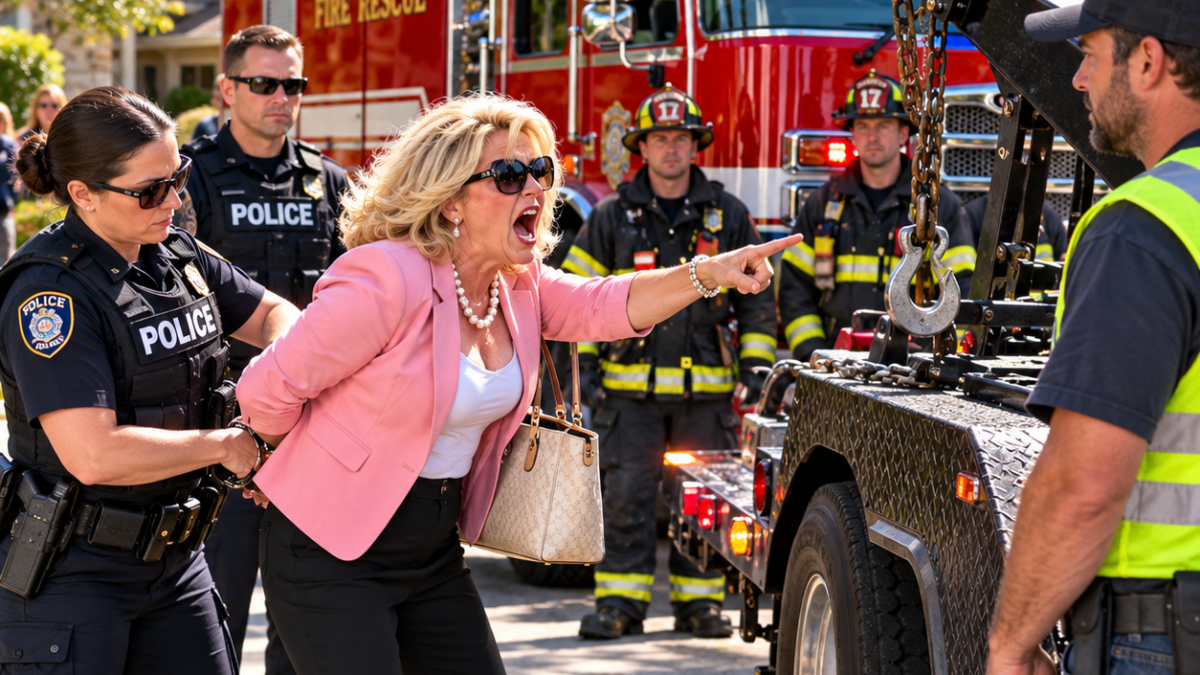
That was the moment everything changed.
The officer caught her arm.
“Turn around.”
Karen froze.
“What?”
“Turn around.”
Her face went pale.
“You cannot be serious.”
“Turn around and place your hands behind your back.”
Half the neighborhood stopped breathing.
Karen looked around.
At me.
At Frank.
At Ruth.
At the firefighters.
At the officer.
“You’re arresting me?”
“Turn around.”
“For defending my neighborhood?”
“For repeatedly interfering with an active emergency response after lawful orders to stop.”
Karen laughed.
A small, nervous sound.
“You have no idea who you’re dealing with.”
The officer didn’t react.
“Hands behind your back.”
“No.”
“Do not make this harder.”
“I want your badge number.”
“You’ll get it.”
“I want an attorney.”
“That’s your right.”
She pulled away.
The officer immediately steadied her.
“Stop resisting my direction.”
“I am not resisting!”
Two more cruisers turned into the street.
Karen saw them.
For the first time all afternoon, fear replaced anger.
She stopped moving.
Another officer approached.
“What do we have?”
The first officer explained quickly.
“Repeated interference with emergency operations, attempted interference with charged fire equipment, refused multiple orders to stay outside the scene.”
The new officer looked at the fire captain.
“Confirmed?”
“Yes.”
Karen shouted:
“They’re lying!”
The captain looked at her.
“We have fifteen phones recording everything.”
Karen looked toward the crowd.
That was when she finally noticed how many neighbors had been filming.
Not celebrating.
Not cheering.
Just documenting.
The same kind of documentation Karen herself loved using against other people.
Except this time, she wasn’t holding the camera.
The second officer spoke.
“Ma’am, turn around.”
Her shoulders dropped.
Slowly, she did.
The cuffs closed around her wrists.
There was no dramatic music.
No shouting from the crowd.
Just the metallic click.
Water rushing.
Radios crackling.
A fire engine idling.
Karen stood there soaked from head to toe.
Mascara running slightly beneath her eyes.
Her HOA binder lying on the wet road several feet away.
I expected to feel satisfaction.
I didn’t.
Not immediately.
Mostly I felt stunned.
This was the same woman who had fined Frank because his trash can had been visible from the road at 6:12 p.m.
The same woman who had sent me a warning because my daughter’s car had remained parked outside overnight during Thanksgiving.
The same woman who had spent three years making everyone feel like the smallest mistake was a personal insult to her authority.
Now actual public safety officials were explaining that she had crossed a line far more serious than mailbox colors or holiday decorations.
And she still looked like she couldn’t understand how.
The officers guided her toward the cruiser.
She turned toward us.
“This is unbelievable!”
Nobody answered.
“You’re all just standing there?”
Frank looked down.
Karen focused on me.
“You think this is funny?”
Earlier, maybe I had.
Not anymore.
“No.”
She seemed surprised.
“You wanted this.”
“No, Karen.”
I looked toward Ruth’s flooded driveway.
“I wanted you to step aside.”
Her expression flickered.
The officer opened the cruiser door.
Karen sat inside.
The door closed.
For several seconds, everybody remained silent.
Then the fire captain clapped his hands once.
“Back to work!”
And just like that, the real emergency became the center of attention again.
Exactly where it should have been from the beginning.
The firefighters stabilized the damaged hydrant.
Utility crews arrived.
Power to the most affected section was temporarily shut down.
Neighbors carried wet boxes from Henry and Ruth’s garage.
We stacked furniture on blocks.
Someone brought towels.
Someone else brought coffee.
By early evening, the water finally began receding.
The street looked terrible.
Mud.
Leaves.
Debris.
Standing water.
But the houses were still standing.
Nobody had been seriously hurt.
The damage to the Collins home was significant, but the firefighters had prevented the water from reaching the main electrical panel.
That mattered.
A lot.
The captain stood near his engine looking exhausted.
I walked over.
“You okay?”
He nodded.
“Long day.”
“I’m sorry about Karen.”
He gave me a tired smile.
“Is she always like that?”
Frank was standing nearby.
“No.”
The captain raised an eyebrow.
Frank continued.
“Sometimes she’s worse.”
The captain laughed despite himself.
Then Ruth approached.
Her clothes were soaked.
Her hair was messy.
Her eyes were red.
She looked at the captain.
“Thank you.”
He immediately became serious.
“Ma’am, we’re glad we could help.”
“My husband’s workshop is damaged.”
“I know.”
“But the house…”
Her voice broke.
The captain nodded.
“We got lucky.”
Ruth shook her head.
“No.”
She looked toward his crew.
“We had you.”
The captain didn’t know what to say.
Neither did I.
Sometimes gratitude makes professionals more uncomfortable than emergencies.
He finally smiled.
“We’re just doing our job.”
Ruth looked toward the wet roadway where Karen’s binder still sat.
“No.”
She said quietly:
“You were trying to do your job while someone made it harder.”
That line stayed with me.
Because it summarized the entire afternoon.
Karen liked saying she was protecting the neighborhood.
But protection is not about being obeyed.
Protection is about understanding what matters when priorities collide.
That afternoon, lives and homes mattered.
Access mattered.
Water pressure mattered.
Electrical hazards mattered.
Karen’s parking policy did not.
The cruiser carrying her left before sunset.
Her shiny SUV remained parked near the curb.
For once, Karen had left a vehicle somewhere without checking the HOA regulations.
Nobody touched it.
That night, videos began circulating.
I had known they would.
But I underestimated how quickly.
By nine o’clock, a clip of Karen telling the captain his fire engine violated HOA regulations had been shared through half the community.
Another showed the tow truck arriving.
Another showed Karen grabbing the hose.
Another showed the police ordering her away.
I didn’t share any of them.
Something about doing that felt wrong.
It was already humiliating enough.
But the internet didn’t need my help.
By morning, the story had spread far outside Hawthorne Circle.
People were calling the management office.
Local reporters emailed residents.
Someone apparently sent footage to a regional news station.
Our HOA board panicked.
An emergency board meeting was scheduled for Sunday evening.
Karen was released before then.
I saw her return Saturday afternoon.
She got out of a car driven by someone I didn’t recognize.
For once, no clipboard.
No phone.
No inspection walk.
She went directly inside.
Her curtains stayed closed.
The emergency HOA meeting drew more residents than any meeting in neighborhood history.
We normally got fifteen people.
That night there were more than sixty.
Some people stood in the hallway.
Others leaned against walls.
The vice president, a mild-mannered accountant named Martin, sat at the front looking like a man who had spent the previous seventy-two hours regretting every decision that had brought him into HOA leadership.
He opened the meeting.
“I think everyone knows why we’re here.”
Frank whispered:
“The landscaping budget.”
I elbowed him.
Martin continued.
“Because President Whitfield is currently dealing with legal matters related to Thursday’s emergency, she will not chair tonight’s meeting.”
Karen sat in the second row.
Her arms were folded.
She looked exhausted.
A lawyer sat beside her.
Martin explained that the board had received a formal incident summary.
They were reviewing Karen’s conduct.
They were also reviewing the association’s towing contract because Karen had apparently used her authority to request a tow without board approval.
That detail mattered.
Karen interrupted.
“I was acting within my responsibilities.”
Her lawyer touched her arm.
She ignored him.
Martin sighed.
“Karen, you will have a chance to speak.”
“I need to correct the record.”
“You will have a chance.”
“That fire engine blocked the entire cul-de-sac.”
From the back of the room, Henry Collins stood.
Everyone turned.
He rarely spoke at HOA meetings.
That night, he walked slowly toward the center aisle.
“My garage was filling with water.”
Karen looked at him.
“I understand, Henry.”
“No.”
His voice was quiet.
“You don’t.”
The room went still.
Henry continued.
“My wife was scared.”
Karen looked down.
“My tools were underwater.”
He paused.
“I had thirty years of things in that garage.”
Nobody moved.
“The fire department stopped the water before it reached the main electrical box.”
Karen opened her mouth.
Henry held up one hand.
“Please.”
She stopped.
“You wanted their truck moved.”
Karen looked uncomfortable.
“It was blocking—”
“My house was flooding.”
Her face changed.
Henry continued.
“That engine could have been parked across my front lawn and I wouldn’t have cared.”
Several people nodded.
He looked around.
“What has happened to us?”
That question landed harder than any accusation.
Henry pointed toward the meeting room.
“We spend hours arguing about garbage cans.”
Nobody laughed.
“Mailbox paint.”
More silence.
“Parking.”
He looked at Karen.
“And while firefighters were trying to keep water out of my house, our president thought the most important thing was whether their truck had permission to park.”
Karen looked like she wanted to disappear.
Henry returned to his seat.
Then Ruth stood.
“I want to say something.”
Martin nodded.
She faced Karen.
“You scared me more than the water did.”
Karen looked stunned.
Ruth continued.
“Because the water was an accident.”
She paused.
“You made a choice.”
Nobody spoke.
“You chose to make the emergency about your authority.”
Karen’s eyes glistened.
Her lawyer whispered something.
She shook her head.
“I was trying to enforce order.”
Ruth looked at her.
“There was already order.”
She pointed toward the windows.
“The firefighters had it.”
That was the beginning of the end of Karen’s presidency.
Resident after resident spoke.
Not only about Thursday.
About years.
Petty fines.
Threatening letters.
Aggressive enforcement.
Warnings that became personal.
Rules selectively applied.
Most stories weren’t dramatic.
That made them more powerful.
There was no conspiracy.
Just exhaustion.
Finally, Martin announced a motion to suspend Karen from all HOA authority pending a formal vote.
Hands went up.
Almost every homeowner supported it.
Karen stood.
“You’re blaming me for everything.”
Martin shook his head.
“No.”
“You are.”
“We’re holding you responsible for Thursday.”
She pointed around the room.
“After everything I’ve done for this community?”
Frank spoke from behind me.
“That’s the problem.”
Karen stared at him.
He stood.
“For years, every time someone disagreed with you, you said we didn’t appreciate what you did.”
He looked around.
“But maybe we never asked you to do half of it.”
Karen’s face changed.
Frank continued.
“We wanted somebody to schedule landscaping and pay the insurance.”
A few people laughed quietly.
“We didn’t ask for a neighborhood commander.”
Even Karen’s lawyer closed his eyes briefly.
Martin called for order.
The motion passed.
Karen was suspended.
Two weeks later, she was removed as HOA president.
The criminal case took longer.
I won’t pretend I followed every detail.
I didn’t want to.
Karen had interfered with emergency responders, refused police instructions, and physically handled active department equipment.
Those facts were documented from multiple cameras.
Her attorney negotiated through the normal process.
There were fines.
Court supervision.
Community service.
Conditions requiring her to stay away from active emergency scenes unless personally involved.
Nothing cinematic.
No dramatic years-long prison story.
Just real consequences.
But the consequence that changed Karen most came from somewhere else.
The judge ordered part of her community service to be completed with a county disaster-preparedness program.
At first, everyone thought the irony was almost too perfect.
Karen Whitfield.
Disaster preparedness.
Frank nearly fell out of his chair when I told him.
But months later, something unexpected happened.
Karen changed.
Not overnight.
And not in some magical way.
At first, she remained bitter.
She avoided everyone.
She rarely attended HOA meetings.
When she did, she sat in the back.
But the community-service program required her to attend emergency-planning sessions.
She learned how evacuation routes worked.
Why fire engines sometimes blocked roads.
Why hydrant access mattered.
Why emergency commanders could temporarily restrict movement.
Why power, gas, flooding, and traffic became interconnected hazards.
She learned the actual complexity behind the chaos she had tried to manage with a binder.
One afternoon, almost six months later, I was outside trimming a hedge when Karen stopped near my driveway.
I hadn’t spoken to her directly since the emergency.
“Can I talk to you?”
I turned off the trimmer.
“Sure.”
She looked uncomfortable.
“I owe you an apology.”
I wasn’t expecting that.
“For what?”
“For a lot.”
She looked toward Henry and Ruth’s house.
“The disaster program showed us footage from actual emergency scenes.”
I waited.
“I didn’t understand.”
“That’s fair.”
“No.”
She shook her head.
“It isn’t.”
Her voice became quieter.
“I thought because I had managed HOA issues for years, I understood how to control a neighborhood.”
I leaned against the fence.
“You liked control.”
She looked at me.
“Yes.”
The honesty surprised me.
She continued.
“I confused control with responsibility.”
That was an important distinction.
“Responsibility sometimes means stepping aside,” she said.
I nodded.
“That afternoon, I couldn’t.”
“No.”
She looked toward the pavement.
“I keep thinking about Ruth.”
I knew exactly what she meant.
The water had been an accident.
Karen’s actions had been choices.
“She forgave you?”
Karen gave a small, sad laugh.
“She said she’s working on it.”
“That sounds like Ruth.”
Karen smiled.
Then became serious.
“I grabbed that hose because I thought I could move it.”
“I know.”
“I had no idea how dangerous it was.”
“That was part of the problem.”
“I know.”
She looked at my hedge.
Then at me.
“I’m sorry.”
I nodded.
“I accept that.”
Her eyes widened.
“Really?”
“Accepting an apology doesn’t mean pretending nothing happened.”
“I understand.”
“It means I don’t want Thursday afternoon living in my head forever.”
She nodded slowly.
“Neither do I.”
Then she did something so ordinary that it almost felt symbolic.
She asked:
“Your hedge trimmer working okay?”
I looked at it.
“Yes.”
She smiled.
“Just checking.”
For the first time, the question didn’t sound like an inspection.
It sounded like a neighbor.
Spring arrived.
Then summer.
Hawthorne Circle changed.
The new HOA board simplified several enforcement policies.
Emergency vehicles were explicitly exempted from every parking provision, although everyone agreed that should never have needed clarification.
Towing requests required two board members instead of one.
Fines couldn’t be issued without photographic evidence and a clearly cited rule.
Residents created an emergency contact list for older homeowners.
Henry volunteered to help.
So did Ruth.
And unexpectedly, so did Karen.
Not as president.
Not as chairperson.
Just a volunteer.
The first neighborhood emergency drill was held almost a year after the hydrant incident.
The fire department came.
That surprised me.
Apparently Karen had contacted the captain and invited his crew.
When the same red engine turned onto Hawthorne Circle, everyone noticed.
So did Karen.
She stood near the clubhouse.
The captain stepped down.
He recognized her immediately.
For several seconds, neither spoke.
Then Karen walked toward him.
Frank leaned toward me.
“This should be interesting.”
“Behave.”
Karen stopped several feet from the captain.
“I owe you something.”
He raised an eyebrow.
“Parking authorization?”
Frank nearly collapsed.
Even the captain laughed.
Karen laughed too.
Then she became serious.
“I owe you an apology.”
The captain nodded.
“I appreciate that.”
“I endangered your crew.”
His face changed.
“Yes.”
She swallowed.
“I didn’t understand that then.”
“I know.”
“I do now.”
The captain looked at her.
“That’s what matters.”
Karen held out her hand.
He shook it.
Nobody applauded.
Nobody needed to.
Some moments become weaker when an audience tries to turn them into entertainment.
That one belonged to them.
During the drill, firefighters demonstrated hose pressure.
They let residents hold an uncharged line first.
Then explained how different it became under pressure.
Karen stood near the front.
The captain looked at her.
“Want to try?”
She laughed nervously.
“I think I’ve had enough experience.”
Everyone laughed.
Including her.
Then she stepped forward.
“With supervision.”
The firefighters helped her hold the line.
When pressure increased, she immediately understood.
Her entire posture changed.
“Wow.”
The captain nodded.
“Exactly.”
She released it.
Then looked at me.
“I really thought I could drag that thing.”
“I know.”
“That may be the stupidest thing I’ve ever done.”
Frank called out:
“Top three.”
Karen pointed at him.
“I can still file complaints.”
The whole crowd laughed.
Even Frank.
Especially Frank.
That day felt like the true ending.
Not the arrest.
Not the removal vote.
Not the videos.
Because humiliation rarely improves anyone.
Understanding sometimes does.
For months after the emergency, people told the story because it was funny.
The HOA president tried to tow a fire engine.
The absurdity was irresistible.
But as time passed, I remembered different parts.
I remembered Henry standing in water trying to save decades of tools.
I remembered Ruth carrying her little dog.
I remembered firefighters working while someone screamed about parking regulations.
I remembered the officer repeating calm instructions until Karen left him no reasonable choice.
And I remembered the moment Karen finally admitted she had confused control with responsibility.
That mattered.
One year after the hydrant break, the neighborhood held a barbecue.
Henry and Ruth hosted part of it in their repaired garage.
The walls had been repainted.
New cabinets replaced the damaged ones.
Henry had rebuilt his workbench.
On one wall, he hung a framed photograph.
I recognized it immediately.
It showed the fire engine parked sideways across Hawthorne Circle.
Water sprayed behind it.
Firefighters moved through the foreground.
In the corner, barely visible, stood Karen holding her HOA binder.
Under the photograph, Henry had installed a small metal plaque.
**AUTHORIZED PARKING**
I laughed so hard I had to put my drink down.
Karen walked over.
“You’ve seen it.”
I pointed.
“You allowed this?”
“No.”
She folded her arms.
“I’ve submitted three complaints.”
For one second, I couldn’t tell whether she was serious.
Then she smiled.
“I’m joking.”
“That’s progress.”
“Don’t push it.”
Henry walked over.
“Karen, you want me to remove it?”
She looked at the photograph.
Then shook her head.
“No.”
She smiled.
“Leave it.”
Ruth handed her a plate.
The four of us stood there.
A year earlier, that would have been impossible.
Then a siren sounded faintly in the distance.
Everyone paused.
A fire engine passed the entrance to our neighborhood on the main road.
Karen looked toward the sound.
Then at us.
“Should I call the towing company?”
Frank yelled from across the yard:
“Don’t you dare!”
The entire garage erupted in laughter.
Karen laughed harder than anyone.
I remember looking around at that moment and realizing something.
Hawthorne Circle felt more like a community after everything than it had before.
Not because conflict disappeared.
Conflict never disappears.
But people stopped treating authority like ownership.
Our new HOA president, Martin, chaired meetings like an accountant.
Which meant they were boring.
We loved him for it.
Budgets.
Road repairs.
Landscaping.
Insurance.
Occasional parking questions.
Nobody wanted drama anymore.
Karen continued volunteering with emergency preparedness.
Eventually, the county invited her to speak at a homeowner-association workshop.
I thought someone was joking when I heard.
Then I saw the flyer.
Her presentation was called:
**WHEN HOA AUTHORITY ENDS AND EMERGENCY AUTHORITY BEGINS**
I called Frank.
“You’re not going to believe this.”
He already knew.
He laughed for a full minute.
But Karen actually did a good job.
I know because she showed me the presentation afterward.
One slide contained a photograph of a fire engine.
Under it:
**DO NOT TOW THIS.**
I stared at her.
“Seriously?”
“People remember humor.”
“Apparently.”
She shrugged.
“If my worst day can keep someone else from doing the same thing, maybe it isn’t completely wasted.”
That was the moment I stopped thinking of Karen as the woman from the viral video.
She had been that person.
But people are more than the worst thing they have done.
That doesn’t erase accountability.
It makes accountability meaningful.
Consequences without the possibility of growth are just punishment.
Karen had consequences.
Legal ones.
Social ones.
Personal ones.
She lost authority.
She lost respect.
For a while, she lost friendships.
Then she rebuilt some of them without a title attached to her name.
That probably taught her more about community than three years as HOA president ever had.
One evening, years later, another hydrant problem occurred.
Nothing as dramatic.
A maintenance failure caused a significant leak near the entrance.
The fire department responded while utilities worked.
I happened to be outside.
Karen was walking her dog.
The fire engine parked partially across the road.
We both looked at it.
Then at each other.
I waited.
She smiled.
“Looks fine to me.”
“Are you sure?”
“Perfectly parked.”
“No written permission?”
She shook her head.
“Absolutely not necessary.”
We laughed.
Then she walked toward the crew.
For one second, old memories flashed through my mind.
But she stopped well outside their working area.
She waited until a firefighter looked toward her.
“Do you need residents to stay farther back?”
The firefighter nodded.
“About another twenty feet would be great.”
Karen turned around.
“You heard him!”
People moved.
No argument.
No clipboard.
No demand.
She helped an elderly neighbor move a car.
Then stood quietly on the sidewalk.
That simple moment affected me more than I expected.
The first time emergency responders entered our neighborhood, Karen had tried to move them.
Years later, she helped move everyone else out of their way.
That is change.
Not dramatic speeches.
Different behavior when the same kind of moment comes around again.
The hydrant was repaired within an hour.
No flooded homes.
No police.
No tow truck.
The fire engine left.
Karen waved as it passed.
Then she looked at me.
“See?”
“What?”
“I behaved.”
I laughed.
“Do you want a certificate?”
“Maybe.”
“I’ll ask the HOA.”
She narrowed her eyes.
“Careful.”
We walked back toward our houses.
The evening sun reflected off the wet pavement.
For a moment, it looked almost exactly like that afternoon years earlier.
Except everything important was different.
That was when I finally understood why the story stayed with me.
It wasn’t really about a fire truck.
Or a tow truck.
Or even an HOA.
It was about what happens when somebody mistakes a little authority for unlimited authority.
Karen had spent years hearing people comply.
Move your garbage can.
Fine.
Repaint your mailbox.
Fine.
Remove your decorations.
Fine.
Eventually, “fine” began sounding like “you’re always right.”
Then an emergency happened.
Real authority entered the street.
Not authority based on neighborhood elections or binders.
Authority based on training, law, responsibility, and immediate danger.
Karen couldn’t accept that distinction.
So she pushed.
Then pushed again.
Until eventually the system pushed back.
People sometimes call what happened to her karma.
Maybe.
But I think that makes it sound too magical.
There was nothing magical about it.
Every consequence came from a choice.
She chose to challenge the firefighters.
She chose to call the tow company.
She chose to ignore the captain.
She chose to argue with police.
She chose to cross the safety line.
She chose to grab the hose.
Then other people made their choices.
The firefighters kept working.
The tow driver refused.
The officer gave instructions.
The HOA board reviewed what happened.
Neighbors finally spoke.
A judge imposed consequences.
There was no mysterious force.
Just cause and effect.
That is why I never saw her arrest as revenge.
Revenge would have required one of us to make it happen because we wanted to hurt her.
Nobody did.
Karen created the circumstances herself.
The rest of us simply stopped protecting her from the consequences.
And maybe that was the most important lesson Hawthorne Circle ever learned.
For years, residents had avoided conflict by giving in.
Karen mistook that silence for respect.
It wasn’t.
Real respect appeared later.
When she apologized.
When she learned.
When she stopped demanding everyone obey.
When she began helping without needing credit.
People slowly respected her again.
Not as president.
As Karen.
That was much harder to earn.
One morning, I saw her sitting outside with Ruth.
Coffee between them.
They were laughing.
I remembered Ruth screaming at her beside the flooded garage.
I wondered how they had reached this point.
Later, Ruth told me.
“She apologized.”
“I know.”
“Then she kept showing up.”
“What do you mean?”
“She helped me reorganize the garage.”
I stared.
“Karen?”
“Karen.”
“You let her?”
Ruth smiled.
“Forgiveness doesn’t mean amnesia.”
That sounded exactly like Ruth.
“She carried boxes. She helped Henry label shelves. She never asked me to tell anybody.”
That surprised me.
Ruth took a sip of coffee.
“People show you they’re sorry by what they do after the words.”
I looked toward Karen’s house.
That sentence became one of my favorites.
Years later, Henry died after a short illness.
The entire street came together for Ruth.
Food.
Transportation.
Yard work.
Paperwork.
Karen handled none of it officially.
She simply showed up.
Every Tuesday she brought Ruth groceries.
Every Friday they had coffee.
At the funeral, Karen sat near the back.
Afterward, Ruth hugged her.
Watching them, I thought again about that flooded afternoon.
Life is strange.
Sometimes the person who causes one of your worst memories becomes part of what helps you survive another.
That doesn’t make the first thing acceptable.
It means human beings are allowed to become different.
One day Ruth showed me something Henry had written behind the framed fire-engine photograph before he died.
I turned it over.
His handwriting was shaky.
It said:
**The people who saved our house parked wherever they needed to.**
Below that:
**The people who became our friends learned when to get out of the way.**
I read it twice.
Ruth smiled.
“He liked that picture.”
“So did Karen eventually.”
Ruth laughed.
“Yes.”
The photograph still hangs in her garage.
So does the plaque.
**AUTHORIZED PARKING.**
Every new person who sees it asks for the story.
We tell them.
Usually Frank exaggerates.
According to him, Karen called six tow trucks.
It was one.
According to Frank, fifteen police cars arrived.
It was three.
According to Frank, the fire captain personally carried Karen to the cruiser.
Definitely not.
Whenever he starts adding details, Karen interrupts.
“That is not what happened.”
Frank always responds:
“You want to tell it?”
She usually does.
And strangely, Karen tells the story better than any of us now.
She doesn’t make herself the victim.
She doesn’t minimize it.
She says:
“I was wrong.”
Those three words matter.
Then she explains why.
She talks about tunnel vision.
Authority.
Ego.
Emergency command.
She tells people that an HOA exists to maintain common property and enforce agreed covenants, not to replace police, fire departments, courts, or common sense.
Then she usually ends with one rule.
“If a fire truck is saving someone’s home, leave the fire truck alone.”
Simple.
Effective.
Nobody forgets it.
Neither do I.
Even now, when I hear the distant sound of a fire engine, I sometimes remember water shooting above the rooftops.
Karen standing in heels in the flooded road.
The tow driver staring at the engine he had been asked to remove.
The captain’s exhausted face.
The officer’s repeated warnings.
Ruth crying beside her garage.
Then that metallic click when the cuffs closed.
At the time, that sound felt like the end of the story.
It wasn’t.
It was the beginning of the part that mattered.
Because anybody can be humbled.
Not everybody learns from it.
Karen did.
Slowly.
Painfully.
Imperfectly.
But she did.
And years later, that is what I remember more than the arrest.
Our neighborhood still has rules.
Garbage cans still have to be stored properly.
Mailboxes still need approved colors.
Cars still can’t block sidewalks.
Karen sometimes points out violations.
Old habits die hard.
But now she says things like:
“Maybe somebody should talk to them first.”
That sentence would have been impossible years ago.
Martin once joked at an HOA meeting:
“Karen, are you becoming reasonable?”
She replied:
“Don’t spread rumors.”
Everybody laughed.
Including her.
That is the Hawthorne Circle I like.
Not a neighborhood without rules.
A neighborhood where rules remember they serve people.
Where authority knows its boundaries.
Where emergencies come before appearances.
Where being president doesn’t make you more important than the person whose house is filling with water.
And where even someone who once tried to tow a fire engine can eventually become the person reminding everyone else to stand back and let firefighters work.
If you had told me that on the afternoon of the hydrant break, I would have laughed.
Actually, I did laugh that afternoon.
That was part of the problem.
But now?
I believe people can change because I watched it happen across the street.
Karen never became perfect.
Neither did any of us.
Frank is still sarcastic.
I still lose patience.
Martin still turns five-minute budget discussions into thirty-minute presentations.
Ruth still gives everybody more food than they ask for.
And Karen still owns an HOA binder.
The difference is that she no longer carries it like a badge.
One evening she was walking past my house when I called out:
“Karen!”
She stopped.
“What?”
“You still have the towing company’s number?”
She stared at me.
“Why?”
I pointed down the street.
A fire engine was passing through on a routine call.
She looked at it.
Then at me.
“You think you’re funny.”
“A little.”
She shook her head.
“I deleted that number.”
“Progress.”
She continued walking.
Then turned around.
“And if you ever tell anyone I admitted that, I’ll fine you.”
“For what?”
She smiled.
“I’ll think of something.”
I laughed.
She laughed too.
And then we went back inside our homes.
No flooded streets.
No police cruisers.
No shouting.
No tow trucks.
Just neighbors teasing one another beneath streetlights on a quiet cul-de-sac.
That was the peace we should have had all along.
Sometimes it takes a disaster to show a community what matters.
Ours began with a broken hydrant.
Water everywhere.
A fire engine doing exactly what it needed to do.
And one woman who could not understand why nobody was asking permission from her.
She tried to tow the engine.
She tried to order firefighters away.
She called the police expecting them to enforce her HOA rules.
Then, in the worst decision of the entire afternoon, she grabbed equipment she did not understand.
That was the moment her little kingdom finally collapsed.
But the most satisfying part wasn’t watching her authority disappear.
It was watching her build something better in its place.
Humility.
Responsibility.
Actual community.
Years later, the fire captain returned for another preparedness event.
Before leaving, he parked his engine directly in front of the clubhouse.
Karen walked toward him.
He smiled.
“Am I okay here?”
Karen studied the engine dramatically.
She looked left.
Then right.
Then pulled an imaginary clipboard from the air.
“I’ll allow it.”
He laughed.
Then she added:
“Stay as long as you need.”
The captain nodded.
“That’s more like it.”
I watched them shake hands.
For a moment, I remembered their first meeting.
Her finger in his face.
His crew fighting floodwater behind him.
What a difference a few years can make.
The engine eventually pulled away.
Karen stood beside me.
“You know everyone still tells this story.”
“I know.”
“They always make me sound completely insane.”
I glanced at her.
“You called a tow truck for a fire engine.”
She sighed.
“Fair.”
“And grabbed a charged hose.”
“Okay.”
“And told the police the fire department was trespassing.”
She held up a hand.
“I understand.”
I smiled.
She looked at me.
“Do you ever get tired of being right?”
“Not yet.”
She laughed.
Then we watched the engine disappear around the corner.
That is where I prefer to leave the story.
Not with Karen in handcuffs.
Not with her soaked and furious beside a police cruiser.
Not with neighbors filming her worst moment.
Those things happened.
She earned consequences for them.
But one humiliating afternoon should not be the only thing a person is allowed to become.
The real ending came years later.
When another fire engine entered Hawthorne Circle.
Karen stepped aside.
Asked what the firefighters needed.
Helped move neighbors back.
And never once mentioned the HOA parking rules.
Sometimes revenge feels satisfying.
Consequences are necessary.
But seeing someone finally understand what they did wrong?
That lasts longer.
Karen once believed being HOA president meant the neighborhood belonged to her.
Eventually, she learned something much more important.
A community doesn’t belong to the loudest person.
It belongs to everyone.
And when the people whose job is to save lives and homes arrive during an emergency, you don’t ask whether their fire engine matches neighborhood regulations.
You open the road.
You step back.
You let them work.
And if there is one lesson Karen Whitfield will never need to learn twice, it is this:
**Never try to tow the fire truck that is saving your neighborhood.**

