PART 2: HOA Karen Tried to Tow My “Illegal” Cars—Then She Learned They Were Diplomatic and I Was the Ambassador
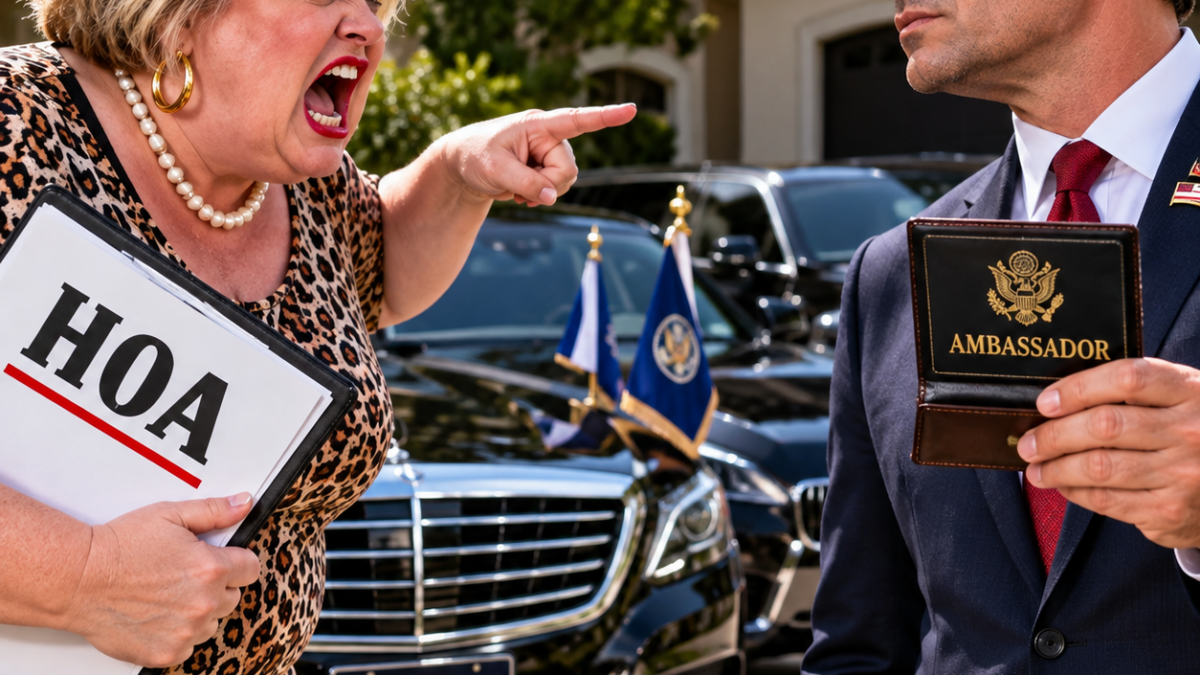
PART 2
The neighbor’s name was Walter Henderson.
Most people called him Mr. Henderson because he carried himself with the quiet dignity of a man who had spent seventy-eight years earning the title.
His house sat three doors down from mine, a neat brick ranch with white shutters and a front garden so carefully maintained that every rosebush looked as though it had been measured before it was planted.
I had seen him outside almost every morning.
That evening he was struggling with a bag of mulch beside his garage.
“Need a hand?”
He looked up.
“I’m stubborn, not stupid. Yes.”
We carried the bag around front together.
His hands shook slightly, but he refused to let me take the entire weight.
Afterward, he offered me iced tea.
We sat on his porch while the light faded across the neighborhood.
For several minutes we talked about nothing important.
Weather.
Roses.
The grocery store that had recently changed owners.
Then I mentioned Karen.
Mr. Henderson went silent.
Not irritated.
Afraid.
That distinction mattered.
“You having trouble with her?” he asked.
“She thinks my cars violate the covenants.”
His eyes moved toward my house.
“The black ones?”
“Yes.”
“They look fine to me.”
“I thought so too.”
He stared into his tea.
Then he said, “She won’t stop with the cars.”
There was no drama in his voice.
That made the sentence worse.
“What happened to you?”
His eyes moved toward the flower bed.
For the first time, I noticed an empty patch of soil between two rosebushes.
“My wife put a little ceramic gnome there.”
He almost smiled.
“Ugliest thing you ever saw. Red hat. Blue jacket. Crooked smile.”
“Sounds terrible.”
“Oh, it was awful.”
His smile finally appeared.
“Mary loved it.”
Then the smile disappeared.
“Granddaughter gave it to her.”
I waited.
Mr. Henderson explained that three years earlier, Karen had issued them a violation notice for displaying an “unauthorized decorative lawn object.”
Twenty-five dollars.
Mary laughed at first.
Then Karen sent another notice.
Fifty dollars.
So Mary removed the gnome.
A week later, another fine arrived claiming the violation remained unresolved.
Walter wrote a letter.
Karen responded that there was no proof the gnome had been removed by the deadline.
Then came administrative fees.
Late fees.
Review fees.
Inspection fees.
By the time Mary became sick, the total exceeded a thousand dollars.
“I paid it,” Walter said.
“Why?”
His answer stayed with me.
“Because I was spending my mornings driving my wife to chemotherapy and my nights helping her get comfortable enough to sleep. Karen knew that. She kept sending letters anyway.”
I felt something tighten behind my ribs.
“Did you challenge the fines?”
“Once.”
“What happened?”
“She scheduled a hearing for ten on a Wednesday morning.”
“During your wife’s treatment?”
He nodded.
“I asked to reschedule. She said board schedules took priority over personal inconvenience.”
He rubbed his thumb along the condensation on his glass.
“Mary told me to pay it. Said she didn’t want the last months of her life spent fighting over a plastic gnome.”
“It was ceramic,” I said quietly.
He laughed once.
Then his eyes filled.
“Yeah. Ceramic.”
We sat without speaking.
That was the moment the dispute changed for me.
Karen’s behavior toward me had been ridiculous.
What she had done to Walter was cruel.
And cruelty wrapped in procedure is often harder to fight than open aggression because the person causing the harm can always point to a form and say, See? I followed the rules.
I asked Walter whether he had kept the letters.
“All of them.”
“Would you mind showing me?”
He studied my face.
“What are you planning?”
“I don’t know yet.”
That was true.
“But I’d like to understand what’s happening here.”
He disappeared inside.
Five minutes later he returned with a shoebox.
Inside were years of HOA notices.
Not just the gnome.
A trash can visible from the road for forty-seven minutes after collection time.
A garden hose temporarily left across the walkway.
A bird feeder Karen classified as an “unapproved hanging structure.”
Each notice used the same language.
Immediate compliance required.
Failure may result in escalating penalties.
Association determination final unless formally appealed.
It was a system designed to make resistance feel more exhausting than surrender.
I photographed nothing.
Copied nothing.
Not yet.
I simply read.
When I stood to leave, Walter touched my arm.
“Colonel?”
He had learned about my Army background from another neighbor.
“Yes?”
“Don’t let her do to you what she did to the rest of us.”
I looked toward my driveway.
The black sedans sat exactly where I had left them.
“Oh,” I said. “I don’t think that’s going to happen.”
The following afternoon, I met Sarah Mitchell.
She lived across the street with her husband and two young children.
I found her trying to steer a stroller through the front door while carrying three grocery bags.
I took the bags.
While we were putting them on her kitchen counter, I noticed a gray rectangle painted over part of her driveway.
The color didn’t quite match the concrete.
“What happened there?”
She glanced toward the window.
“My kids.”
I waited.
“They drew with sidewalk chalk.”
I thought I had misheard her.
“That’s the problem?”
She gave a humorless little laugh.
“Apparently purple dinosaurs and yellow suns are visual vandalism.”
Karen had cited a covenant prohibiting the “defacement of surfaces visible from common areas.”
Sarah had pointed out that the driveway belonged to her property and chalk disappeared in rain.
Karen responded with a fifty-dollar fine.
The next time the children drew, Sarah hosed the driveway down before dinner.
“My daughter asked me if drawing outside was bad,” Sarah said.
Something in her voice broke on the last word.
“She’s six.”
That evening I opened a file on my computer.
I titled it:
SERENITY MEADOWS — HOA ENGAGEMENT.
Elena saw the folder name.
She didn’t even bother pretending to be surprised.
“Neighborhood walk?”
“Still technically true.”
“You’re building a case.”
“I’m keeping records.”
“You have a tab called ‘witness accounts.’”
“Organized records.”
She shook her head.
But she sat beside me.
For the next two hours, we reviewed the covenants.
Karen’s violation notice cited Section 7.4, which prohibited commercial vehicles displaying business markings or carrying exposed commercial equipment.
My sedans had neither.
The rule didn’t prohibit identical vehicles.
It didn’t prohibit dark-colored vehicles.
It didn’t prohibit large sedans.
It certainly didn’t give Karen authority to invent a business simply because she saw multiple drivers.
So I wrote her a letter.
Not an angry one.
Anger would help her.
I wrote the kind of letter bureaucrats hate because it contains no insult to attack and no emotion to dismiss.
Dear Ms. Albright,
I am in receipt of your notice regarding two passenger vehicles parked at my residence.
Section 7.4 defines restricted commercial vehicles by visible commercial identification or permanently mounted equipment associated with commercial use. Neither vehicle meets that definition.
Accordingly, no covenant violation has occurred, and any fines assessed on this basis are disputed.
Please confirm in writing that the matter is closed.
Sincerely,
Marcus Thorne.
I sent it certified mail.
Karen received it Thursday.
Her response arrived Monday.
It was six pages.
She had highlighted entire paragraphs in yellow.
Apparently, the fact that the sedans were black, identical, frequently driven by different individuals, and “unusually substantial in visual presence” created what she called a “de facto commercial fleet.”
I read that phrase twice.
Then I called Elena.
“Do you know what a de facto commercial fleet is?”
“No.”
“Neither does the English language.”
She laughed.
Karen doubled the fines.
Two hundred dollars per car per day.
She also threatened a lien.
That was when I called David Chen.
David served as legal liaison for diplomatic security matters connected to my posting.
He was one of those attorneys who rarely raised his voice because he never needed to.
I explained everything.
When I finished, he was quiet.
Then he asked, “Marcus, are the vehicles currently at your private residence?”
“Yes.”
“And she has threatened to tow them?”
“Yes.”
“Has anyone touched them?”
“Not yet.”
He exhaled.
“Good.”
The sedans were government-assigned armored diplomatic vehicles connected to my official duties.
Their status created legal and security complications far beyond a normal HOA dispute.
David was very clear about one thing.
“If she sends a tow company, do not let anyone hook onto those vehicles.”
“I assumed as much.”
“I’m serious.”
“So am I.”
“And before you say it, no, this is not one of those moments where you get to handle everything like you’re back in the Army.”
“I wasn’t going to say that.”
“You were thinking it.”
I smiled.
“Maybe.”
David recommended a local attorney who specialized in HOA disputes.
His name was Ben Carter.
Ben had previously served as a military lawyer, and we understood each other within ten minutes.
His office looked like paper had reproduced uncontrollably.
Folders covered two chairs and half the conference table.
He read Karen’s letters.
At “de facto commercial fleet,” he stopped.
Then he removed his glasses.
“Did she actually write this?”
“Yes.”
He laughed.
“Please tell me you kept the envelope.”
“I keep everything.”
“I like you already.”
Then I showed him Walter’s notices, Sarah’s case, and several other stories I had gathered.
Ben stopped laughing.
“What else do you know?”
“Not enough.”
“Then start learning.”
So I did.
I reviewed publicly available HOA financial documents.
County records.
Corporate registrations.
Vendor names.
Annual budgets.
Meeting minutes.
The more I looked, the stranger it became.
Dues had almost doubled during Karen’s decade as president.
Yet the community pool had reduced hours.
Landscaping looked worse.
The clubhouse roof had leaked twice.
Streetlights stayed broken for months.
Meanwhile, payments for “administrative consulting” had climbed sharply.
One consulting company shared an address with Karen’s sister.
A landscaping company receiving unusually large contracts belonged to her brother-in-law.
That alone didn’t prove theft.
But it justified questions.
Ben agreed.
“This is where people make mistakes,” he told me. “Don’t accuse her of embezzlement. Not yet. Ask for records. Let the records accuse her.”
So we did.
As a homeowner, I had inspection rights.
Ben sent a formal demand requesting vendor contracts, invoices, board authorizations, reimbursement logs, and meeting records.
Karen had thirty days to respond under the applicable association procedures.
Three days later, she sent a tow truck.
It happened Saturday morning.
I was outside trimming roses.
A bright red heavy-duty tow truck turned into Serenity Meadows and came straight toward my house.
Behind it rolled Karen’s electric golf cart.
I immediately understood what she wanted.
The tow truck stopped.
A thickset driver climbed down.
Karen remained seated in her cart like a queen arriving to observe an execution.
Curtains moved along the street.
Doors cracked open.
She wanted witnesses.
That was important.
“Morning,” I said.
The driver pointed at my driveway.
“Got an order to pick up the two black cars.”
“From whom?”
He nodded toward Karen.
“Association.”
“Those vehicles are on private property.”
“She says you’re in violation.”
“That doesn’t authorize you to enter my driveway.”
Karen drove closer.
“It absolutely does.”
“No, Karen.”
Her smile was almost radiant.
“You had every opportunity, Mr. Thorne.”
I looked at the driver.
“What’s your name?”
“Jerry.”
“Jerry, before you touch either vehicle, I’d recommend calling your dispatcher.”
He frowned.
“Why?”
“Because those are protected government diplomatic vehicles.”
Karen laughed loudly.
“Oh, please.”
I ignored her.
Jerry looked toward the plates.
I took out my identification.
“My name is Marcus Thorne. I’m a United States ambassador. Those vehicles are assigned for official diplomatic use. You have now been specifically informed of that status. Do not attach equipment to them without confirming your legal authority.”
The man’s entire posture changed.
He looked at my ID.
Then the cars.
Then Karen.
“Ambassador?”
Karen’s face flushed.
“He’s lying.”
I looked at her.
That was the first time I saw uncertainty.
Only a flicker.
But it was there.
“Jerry!” she shouted. “Do your job.”
He didn’t move.
Karen climbed out of the golf cart.
“I hired you.”
Jerry held up both hands.
“And I’m making a phone call.”
“You don’t need a phone call!”
“I do now.”
He retreated to his cab.
Karen turned on me.
“You think saying some fancy title makes you above the rules?”
“No.”
“You expect me to believe you’re an ambassador?”
“No.”
That confused her.
“I expect you to verify facts before ordering property seized.”
Two police cruisers entered the street.
I had called the non-emergency line when the tow truck appeared.
One officer approached me.
The other spoke with Jerry.
I showed my identification and explained the situation.
The officer checked the vehicles.
His demeanor became even more formal.
“Sir, we’ll take it from here.”
Karen marched toward him.
“This is private HOA business.”
The officer said something quietly.
I couldn’t hear every word.
I didn’t need to.
Karen’s expression changed.
Red.
Then pale.
Then red again.
She pointed toward me.
“But he’s violating our rules!”
“Ma’am,” the officer said, louder now, “this is not the way to resolve a civil covenant dispute. The towing company is leaving.”
“I authorized them!”
“You cannot authorize unlawful entry onto private property or seizure of protected vehicles.”
Jerry was already retracting his equipment.
Within two minutes, the tow truck was gone.
The police left shortly afterward.
Karen remained in the street.
Everyone was watching her now.
The public humiliation she had planned for me had reversed itself.
I didn’t celebrate.
I simply picked up my pruning shears.
Karen stared at me.
“You did this deliberately.”
“No.”
“You embarrassed me.”
“You brought a tow truck.”
“You could have told me.”
“I told you the vehicles weren’t commercial.”
“You didn’t say you were an ambassador.”
“You never asked.”
Her mouth opened.
Nothing came out.
Then she climbed into her golf cart and drove away.
By dinner, almost everyone in Serenity Meadows knew.
And something remarkable happened.
People started knocking on my door.
First came the Garcias.
Karen had fined them because their garage door remained open while they carried groceries inside.
Then the Parkers.
They had received a warning because their Christmas wreath was allegedly “excessively reflective.”
Then an elderly woman named Mrs. Ellis brought me a folder containing four years of fines.
One was for a trash can visible from the road for fifty-two minutes after collection.
Another was for leaving a portable wheelchair ramp near her front steps.
That one made my jaw tighten.
“My sister couldn’t enter the house without it,” Mrs. Ellis explained.
“Did Karen know?”
“She inspected it herself.”
By Sunday afternoon, my dining table was covered with documents.
Elena stood in the doorway staring at them.
“This is not a neighborhood walk anymore.”
“No.”
“What is it?”
I looked at the folders.
“A pattern.”
We invited a small group to our backyard the following Friday.
I grilled burgers.
Elena made potato salad.
Nobody called it a meeting.
At first.
Walter sat near the rose garden.
Sarah came with her husband.
Mark Lawson, a corporate attorney who lived two streets over, joined reluctantly.
He had avoided every prior conversation about Karen.
“I hate HOA drama,” he said.
“So do I,” I told him.
He looked at the folders.
“This appears to be a lot of drama.”
“It is.”
One by one, people told their stories.
Walter described Mary’s gnome.
His voice shook when he talked about paying fines while she underwent cancer treatment.
Sarah described her daughter’s chalk drawings.
Mrs. Ellis described the wheelchair ramp.
Mark listened.
His reluctance slowly disappeared.
Finally he said, “Has anyone formally challenged the board?”
Walter laughed bitterly.
“Karen is the board.”
“She has two other members.”
“They vote with her.”
“Every time?”
“Every time.”
Mark looked at me.
“You pulled meeting minutes?”
“Some.”
He read them.
Then he frowned.
“These notices are terrible.”
“What do you mean?”
“Meetings at ten on weekday mornings. Short notice. Vague agendas. Decisions recorded without meaningful discussion. She has effectively designed participation out of the system.”
Sarah leaned forward.
“Can she do that?”
“Not indefinitely.”
I placed the financial records in front of him.
“And there’s this.”
Mark read silently for several minutes.
When he looked up, his expression had changed completely.
“Where did you get these?”
“Public filings and association disclosures.”
“These companies are related to her?”
“At least two appear to be.”
“Can you prove it?”
“Corporate registrations.”
He stared at the numbers.
“Do not publicly accuse her of stealing.”
“Ben said the same thing.”
“Who’s Ben?”
“My lawyer.”
Mark looked at me.
“You already hired counsel?”
“Before the barbecue.”
For the first time all night, Mark smiled.
“Good.”
The Serenity Meadows bylaws allowed residents holding ten percent of the voting interests to demand a special meeting.
We needed thirty signatures.
Walter volunteered to collect the first one.
His own.
By Monday evening we had seventy-three.
By Wednesday we had one hundred and twelve.
People who had spent years lowering their voices when Karen’s golf cart passed were walking openly from house to house with clipboards.
The irony pleased Walter enormously.
“Never thought I’d enjoy a clipboard,” he said.
Karen noticed.
Of course she did.
She sent an email accusing an unnamed “small faction” of spreading misinformation and creating division.
That brought us twenty-six more signatures.
Then she made another mistake.
She sent violation notices to three residents involved in the petition.
One for an outdoor flowerpot.
One for a basketball hoop that had stood in the same place for eleven years.
And one for a pickup truck parked overnight.
Selective enforcement during an internal governance dispute was exactly the kind of thing Ben wanted documented.
“She’s doing our work for us,” he said.
At the same time, David Chen and I addressed the diplomatic-security side.
Until now I had deliberately kept the issue local.
I did not want to become the powerful official who crushed an HOA because he had connections.
But Karen had attempted to seize official vehicles despite repeated warnings.
That could no longer be ignored.
So a formal communication was sent through appropriate channels to local officials, documenting the attempted interference with protected diplomatic transportation and requesting assurances that official personnel and property would not be obstructed.
The effect was immediate.
Two days later, the city attorney called me.
“Ambassador Thorne?”
“Speaking.”
“My name is Arthur Vance. I’m calling on behalf of the mayor’s office.”
His tone was polite in the way people become polite when they desperately want a problem to disappear.
“We’ve been made aware of an incident involving your homeowners association.”
“Yes.”
“I want to assure you the city takes security obligations involving accredited diplomatic personnel very seriously.”
“I appreciate that.”
“We’ve also spoken with counsel for the association’s management company.”
I imagined that conversation.
It probably hadn’t been pleasant.
“Mr. Vance,” I said, “I don’t want special treatment on the ordinary HOA issues.”
There was a pause.
“Understood.”
“The residents are addressing governance concerns through the association’s own procedures. My only request from the city is that no one interfere with protected official vehicles or personnel.”
“That is entirely reasonable.”
“And I’d appreciate documentation of that position.”
“You’ll have it.”
The special meeting was scheduled for three weeks later.
Karen tried to cancel it twice.
First she claimed signatures were invalid because several residents used blue ink.
Ben responded with a letter that made Mark laugh for nearly five minutes.
Then she argued that the clubhouse was unavailable.
We discovered she had personally reserved it for something called a “landscape standards workshop.”
Nobody had registered.
The reservation disappeared the next day.
On the night of the meeting, Elena tied my necktie while I stood in our bedroom.
“You’re nervous,” she said.
“I’ve addressed parliament committees with fewer butterflies.”
“Because those people weren’t your neighbors.”
She was right.
This had become personal in a way international diplomacy rarely was.
In foreign capitals, you could eventually board a plane.
Here, I would keep seeing these people at mailboxes and grocery stores.
“What if this tears the neighborhood apart?” I asked.
Elena stopped adjusting my tie.
“Marcus, look at me.”
I did.
“This neighborhood was already torn apart.”
She touched my chest.
“You didn’t create the fear. You just gave people a place to put it.”
The clubhouse was designed to hold one hundred and fifty people.
More than two hundred arrived.
People stood along the walls.
Extra folding chairs filled the hallway.
Karen sat at the head table with the two board members who had supported her for years.
Bob Nelson, the vice president, looked as though he wanted to crawl under the table.
Karen looked furious.
At exactly seven, she struck the table with a small wooden gavel I had never seen before.
“The meeting will come to order.”
Conversation stopped.
Karen began with a prepared statement.
For thirteen minutes she talked about sacrifice.
Community standards.
Property values.
Volunteer service.
She described herself as a woman who had devoted a decade to protecting Serenity Meadows from decline.
Then came the pivot.
“A small group,” she said, “led by a recent arrival who apparently believes his government position exempts him from the same obligations as ordinary residents, has attempted to weaponize misinformation against your elected board.”
Heads turned toward me.
I stayed seated.
Karen continued.
“This campaign began because one resident refused to remove inappropriate vehicles from his property.”
There it was.
After everything, she still thought this was about the cars.
Mark stood.
“Point of order.”
Karen glared.
“I am speaking.”
“The petition defines the purpose of this special meeting. We should proceed to the noticed motions.”
“I decide the agenda.”
“No,” Mark said. “The bylaws do.”
A murmur went through the room.
Karen’s fingers tightened around the gavel.
“You’re out of order.”
Mark opened a binder.
“Article Four, Section Two.”
He read the language.
The membership had the right to introduce the stated motions.
Karen looked toward Bob.
Bob stared at the table.
Mark continued.
“The first motion is a vote of no confidence in President Karen Albright.”
Someone gasped.
Karen’s face changed.
“You cannot do that.”
Walter stood.
“I second.”
I turned.
The old man’s shoulders were trembling.
But he stayed on his feet.
Karen struck the gavel.
“This is improper!”
Mark calmly turned another page.
“When a motion concerns the sitting president, the vice president chairs that portion.”
Every eye moved to Bob.
He swallowed.
“I… suppose that’s correct.”
“Bob!” Karen snapped.
He flinched.
That single flinch told the entire room more about her leadership than any presentation could have.
He moved to the center seat.
Karen remained beside him.
For the first time in ten years, she was no longer controlling the meeting.
Bob opened discussion.
Walter went first.
He carried the old shoebox.
When he reached the front, he removed a photograph.
Mary.
She was standing in the garden beside the ridiculous little gnome.
Walter held the picture with both hands.
“My wife died three years ago.”
Silence.
“When she was undergoing chemotherapy, we were fined because she put this gnome among her roses.”
Karen shifted.
Walter continued.
“She removed it. The fines continued. We appealed. The hearing conflicted with her cancer treatment. We asked to reschedule. The request was denied.”
Someone whispered, “Jesus.”
Walter looked directly at Karen.
“I paid more than a thousand dollars because my dying wife didn’t want to spend her final months fighting you.”
Karen leaned toward the microphone.
“The board followed procedure.”
A sound moved through the room.
Not quite anger.
Something deeper.
Disgust.
Walter nodded slowly.
“That is exactly the problem.”
He returned to his seat.
Sarah spoke next.
She showed photographs of her children’s chalk drawings.
Suns.
Animals.
Stick figures.
A crooked rainbow.
“My daughter asked whether drawing was against the rules.”
Karen interrupted.
“The issue was defacement.”
“She’s six.”
“That is irrelevant.”
Sarah’s eyes filled, but her voice remained steady.
“No. That’s the only part that matters.”
Then Mrs. Ellis described the wheelchair ramp.
The Garcias described their garage-door fines.
A veteran named Tom described being cited for displaying a small service flag two days beyond the approved holiday period.
A widow described being charged administrative fees she never understood.
Story after story.
Then Mark presented the financial records.
No accusations.
Just numbers.
HOA dues nearly doubled over ten years.
Maintenance costs rising without visible improvement.
Large payments to companies connected through corporate records to Karen’s relatives.
Reimbursements with incomplete descriptions.
Consulting expenses without supporting detail.
“We are not here tonight to declare criminal wrongdoing,” Mark said. “We are asking for transparency.”
Karen finally exploded.
“This is character assassination!”
She stood so abruptly her chair rolled backward.
“You people have no idea what it takes to run this community!”
Nobody interrupted.
“I gave ten years of my life to this neighborhood!”
Still silence.
Then she saw me.
Her face hardened.
“This is because of him.”
She pointed across the room.
“There!”
Every head turned.
“That man moved here with his giant black cars, ignored our regulations, threatened us with lawyers and federal agencies, and manipulated frightened residents into attacking me!”
I stood.
I had not planned a speech.
I had prepared notes.
I didn’t use them.
“You’re right about one thing, Karen.”
The room became quiet.
“This started with my cars.”
She folded her arms.
“You saw two black sedans and decided they must be illegal. You never asked what they were. You never checked. When I pointed you toward the actual language of the covenant, you invented a new definition.”
Her mouth tightened.
“You threatened fines.”
I continued.
“Then a lien.”
People were watching Karen now.
“Then you sent a tow truck onto my property.”
I paused.
“For everyone in this room who still doesn’t know the answer, those two sedans are armored vehicles assigned for official diplomatic transportation.”
A wave of whispers spread across the clubhouse.
“I currently serve as a United States ambassador.”
Karen stared at me.
“I did not tell you that during our first conversation because it should not have mattered. I was a homeowner asking you to read the same covenant you expected me to obey.”
Her face had gone pale.
“When the tow company arrived, I disclosed my identity because the situation had crossed from a petty association dispute into interference with protected government property.”
I looked around the room.
“But tonight is not about my title.”
I pointed gently toward Walter.
“It is about a man who spent his wife’s final months choosing between caring for her and fighting paperwork over a garden ornament.”
Then Sarah.
“It is about parents teaching children to erase drawings because an adult with a clipboard decided chalk was a threat.”
Then Mrs. Ellis.
“It is about an elderly resident who needed a wheelchair ramp and was treated as though accessibility were an aesthetic inconvenience.”
I looked back at Karen.
“My job gave me resources most people here didn’t have.”
That sentence mattered.
“I could hire counsel. I knew how to document interactions. I knew when a threat was empty. I knew who to call when official vehicles were endangered.”
Walter watched me.
“Most of your neighbors didn’t have those advantages.”
Karen opened her mouth.
I didn’t raise my voice.
“And that’s why what happened here matters more than two cars.”
Bob cleared his throat.
“We need to vote.”
Karen looked at him.
“You’re seriously going through with this?”
He couldn’t meet her eyes.
“Yes.”
“All those in favor of the motion of no confidence?”
Hands rose.
Dozens.
Then hundreds.
I didn’t count.
I didn’t need to.
“All opposed?”
Karen raised her hand.
One board member slowly joined her.
Bob did not.
The motion passed overwhelmingly.
For several seconds Karen seemed unable to understand what had happened.
Ten years of power had disappeared through a show of hands.
Then applause began.
Walter started crying.
Sarah hugged him.
I remained standing quietly beside Elena.
Karen pushed away from the table.
“You’ll regret this.”
Nobody answered.
The second motion called for an independent forensic audit.
It passed almost unanimously.
The third established an interim board pending new elections.
Mark was nominated for president.
He tried to refuse.
Twenty people shouted variations of “Too late.”
For the first time that evening, laughter filled the clubhouse.
Karen walked out before the meeting ended.
I thought that would be the end of her.
I was wrong.
The audit began three weeks later.
An outside accounting firm requested bank statements, debit card records, vendor invoices, reimbursements, contracts, and electronic communications.
The findings were worse than we had expected.
Some expenses were legitimate.
Many were not.
Association money had paid for personal restaurant bills.
Salon appointments.
Retail purchases.
Travel.
A cruise had been disguised inside a category related to community planning and vendor outreach.
The landscaping contracts were especially troubling.
A company controlled by Karen’s brother-in-law had billed Serenity Meadows far above comparable market rates.
Invoices appeared to describe work residents said had never occurred.
Additional payments moved through consulting entities associated with family members.
By the time the accountants finished their preliminary report, more than one hundred thousand dollars in spending required explanation.
Mark called an emergency board meeting.
I attended as a homeowner.
The room felt different without Karen at the head table.
Almost lighter.
Mark placed the audit summary down.
“We’re legally required to refer this.”
Nobody argued.
The report went to law enforcement and the appropriate authorities.
That should have been the end.
But losing power had not made Karen reflective.
It had made her obsessed.
She blamed me for everything.
Neighbors saw her sitting in her minivan near my street.
Anonymous complaints began arriving about my property.
One claimed my mailbox was one inch too tall.
Another claimed diplomatic security vehicles constituted “excessive nighttime traffic.”
Mark dismissed them.
Then my garage camera recorded Karen walking past my house at 2:14 in the morning.
She never stepped onto the property.
But she stood at the sidewalk for almost three minutes staring toward the driveway.
Elena watched the video twice.
“I don’t like this.”
“Neither do I.”
“You need to tell security.”
“I will.”
“Marcus.”
“I said I will.”
She stared at me.
“That’s what you say when you’re deciding how much not to tell security.”
After thirty years, there were no secrets available to me.
I forwarded the footage.
Diplomatic Security increased awareness around the residence.
Local police were notified about the harassment history.
I hated it.
Serenity Meadows had been the place I chose because I wanted less security, fewer checkpoints, fewer men with radios watching my front door.
I wanted neighbors.
A lawn.
Coffee on a porch.
Normal life.
Instead, Karen had dragged the machinery of my professional world into the one place I had hoped to keep separate.
One night Elena found me standing in the dark kitchen looking at the driveway.
“You regret moving here?”
“Sometimes.”
She stood beside me.
“Do you regret helping Walter?”
“No.”
“Sarah?”
“No.”
“Mrs. Ellis?”
“No.”
“Then you don’t regret moving here.”
I turned toward her.
She smiled faintly.
“You just wish decency had been cheaper.”
That was exactly it.
The criminal investigation continued quietly.
Karen’s former board allies began cooperating.
Vendor records were subpoenaed.
Financial accounts were examined.
Then one Thursday morning, everything finally broke.
I had an early meeting.
Mike, my security driver, was waiting beside one of the sedans.
I came out carrying my briefcase.
At the end of the street, an engine roared.
Karen’s minivan turned the corner too fast.
Mike’s head snapped toward it.
The van stopped sideways across the bottom of my driveway.
Blocking us.
Karen climbed out.
She held a red can of spray paint.
Mike immediately raised his radio.
“Sir, inside.”
Karen screamed my name.
“Marcus!”
“Inside, sir.”
I should have listened.
Instead I stopped near the front door.
Karen stood fifty feet away.
Her hair was disheveled.
Her face looked thinner than it had at the clubhouse.
The woman who once seemed powered by limitless certainty now looked exhausted.
But the anger remained.
“You ruined my life!”
Her voice cracked across the quiet street.
Neighbors began appearing behind curtains.
I kept my hands visible.
“Karen, put the can down.”
“You took everything.”
“No.”
“You turned them against me!”
“The audit did that.”
“You started the audit!”
“Your financial records caused the audit.”
“You think you’re clever.”
She walked closer.
Mike stepped between us.
“Ma’am, stop there.”
She ignored him.
“I built this neighborhood.”
Walter’s front door opened.
He appeared on his porch.
Karen saw him.
“You!”
Walter didn’t move.
“You were happy before he came here!”
Walter’s voice carried farther than I expected.
“No, Karen.”
She froze.
“We were quiet.”
More doors opened.
Sarah came onto her porch.
Then the Garcias.
Then Tom.
Karen looked around.
For perhaps the first time, she saw the difference.
Silence had never been approval.
Fear had simply sounded like agreement.
Her eyes returned to the sedan.
“You think those cars make you important?”
She shook the spray can.
“You think this makes you untouchable?”
Mike spoke into his radio.
Karen raised the can.
“Karen,” I said, “don’t.”
She stepped toward the hood.
Two black SUVs came around the corner.
Fast.
They stopped behind Karen’s van.
Doors opened.
Diplomatic Security agents emerged.
Almost simultaneously, local police units entered from the opposite end of the street.
Karen stood frozen between them.
The can remained lifted in her hand.
An agent approached.
“Ma’am, put the object down.”
She looked at him.
Then at me.
Then at the police.
Her hand began trembling.
“It’s paint.”
“Put it down.”
“I wasn’t going to—”
“Now.”
The can fell.
It hit the pavement with a metallic clatter.
No one cheered.
No one laughed.
A local officer moved forward.
Karen looked around at the neighbors.
“Tell them.”
Nobody spoke.
“Tell them I built this place!”
Walter stepped off his porch.
He did not come close.
“Karen.”
She looked at him.
“My wife was dying.”
Karen’s face changed.
Just slightly.
“You knew.”
For once, she had no answer.
The officer placed her in handcuffs.
As they led her toward the cruiser, she looked at me.
There was hatred there.
But behind it was something smaller.
Fear.
Maybe even the first recognition that rules existed beyond the ones she controlled.
I felt no satisfaction watching her get into the car.
That surprised me.
For months I had imagined the moment her power finally collapsed.
I thought it would feel victorious.
Instead, I thought about how many opportunities she had been given to stop.
The first letter.
The tow truck.
The petition.
The special meeting.
The audit.
Every time, she had chosen escalation.
Revenge can look dramatic from the outside.
In reality, consequences are often quieter.
A door closes.
A signature appears on a report.
A vote is counted.
A bank statement is reviewed.
A person who believed nobody could challenge them finally discovers that everyone they intimidated kept a copy.
Karen’s criminal case moved forward over the following months.
The audit became only one piece of a much larger investigation.
Residents provided testimony.
Former contractors turned over records.
Her former board allies produced emails.
Eventually, faced with extensive documentary evidence, Karen accepted a plea agreement involving financial crimes connected to the association funds.
She received a prison sentence and was ordered to pay restitution.
Her house was sold.
The property where she had once parked her golf cart like a patrol vehicle became just another listing.
I never celebrated that either.
Walter did, however, celebrate something else.
The new HOA board asked him to serve on the architectural and landscape committee.
When Mark announced it, Walter stared at him.
“You want me deciding lawn decorations?”
“Especially lawn decorations.”
Walter laughed so hard he had to remove his glasses.
At his first meeting, he proposed a new rule.
It was one sentence.
“Small decorative garden items are permitted provided they do not create a genuine safety hazard.”
The motion passed unanimously.
The following Saturday, Sarah drove Walter to a garden store.
They returned with a ceramic gnome.
Red hat.
Blue jacket.
Crooked smile.
Almost identical to Mary’s.
Walter placed it between the roses.
I happened to be walking past.
He stood with his hands on his hips, studying it.
“Still ugly,” I said.
“Hideous.”
“Mary would approve?”
He looked at the gnome.
His eyes became wet.
“She would’ve loved him.”
We stood there in silence.
Then Walter said, “You know what bothers me?”
“What?”
“I should’ve fought sooner.”
I shook my head.
“No.”
He looked at me.
“You were taking care of your wife.”
“I still let Karen scare me.”
“You chose Mary.”
He looked back at the roses.
“There are worse things than losing a fight.”
I thought of all the places I had served.
All the men who believed strength meant refusing compromise.
All the officials who mistook obedience for loyalty.
“Sometimes,” I said, “survival is the fight.”
Walter nodded.
The new board changed more than decoration rules.
Financial statements were published every quarter.
Major contracts required competitive bids.
Board members had to disclose family relationships with vendors.
Meeting notices went out weeks in advance.
Residents could attend remotely.
Fine schedules were rewritten.
Warnings came before penalties except in true emergencies.
Appeals were heard by people who had not issued the original citation.
And perhaps most importantly, the board stopped treating every difference as a threat.
Sarah’s children returned to drawing on the driveway.
The first time I saw it, they had created an enormous blue whale surrounded by orange stars.
Her daughter spotted me.
“Mr. Marcus!”
I crossed the street.
“That’s a very impressive whale.”
“It’s a diplomatic whale.”
I blinked.
Sarah covered her face.
“I may have explained your job badly.”
The little girl pointed at the whale.
“He goes to other countries and tells everybody to stop fighting.”
I considered it.
“That’s better than some official descriptions.”
She handed me a piece of chalk.
“Draw something.”
I hadn’t used sidewalk chalk in decades.
I crouched and drew what was supposed to be an eagle.
It looked like an overweight chicken.
The children laughed mercilessly.
Walter came over.
“That’s embarrassing.”
“You own an ugly gnome.”
“Fair.”
Elena took a photograph.
For years, my professional pictures had shown me standing beside ministers, generals, presidents, flags, conference tables, and aircraft.
That picture became my favorite.
Me crouched on a suburban driveway holding blue chalk while two children laughed at my terrible bird.
Because that was what I had been trying to come home to.
Not status.
Not recognition.
Ordinary life.
Months later, a family bought Karen’s former house.
Daniel and Priya Morgan arrived with two children, a Labrador, and a moving truck that stayed parked in the street nearly six hours.
Under the old board, Karen would probably have issued three notices before lunch.
Mark walked past the truck.
Daniel hurried over.
“Sorry. Are we blocking anything?”
Mark looked around.
“Nope.”
“I read something in the packet about commercial vehicles.”
“That’s for permanent storage. You’re moving.”
Daniel relaxed.
“Great.”
Then he glanced toward my driveway.
The two black sedans were parked outside.
“I hope those are allowed.”
Mark looked at me.
I looked at him.
Neither of us could stop laughing.
Daniel appeared confused.
“I’ll explain someday,” I said.
That evening the Morgan children drew a giant dinosaur on the sidewalk.
Nobody complained.
Walter’s gnome remained in the roses.
Mrs. Ellis’s sister visited again, and the portable ramp stayed beside the front steps as long as she needed it.
Tom flew his service flag.
The Garcias unloaded groceries with their garage door wide open.
And something else happened.
People began talking.
Not through official emails.
Not through violation notices.
Across fences.
On sidewalks.
At mailboxes.
During barbecues.
The fear Karen had cultivated for years had isolated everyone, and isolation had been the secret behind her power.
Each resident thought he or she was the only one having problems.
The moment they compared stories, the illusion collapsed.
That lesson mattered to me more than Karen’s sentence.
A bully’s greatest advantage is rarely strength.
It is convincing each target that they are alone.
Karen had succeeded for years because Walter thought his gnome dispute was only about Walter.
Sarah thought the chalk issue was only about Sarah.
Mrs. Ellis thought the ramp notice was only about her family.
The Garcias thought the garage fines were only theirs.
Nobody saw the pattern.
Until two black sedans gave Karen a target who happened to know how to look for patterns.
People still occasionally asked whether I had planned revenge from the beginning.
The answer was no.
When Karen first crossed my lawn with that clipboard, I wanted only to correct her mistake.
When she doubled the fines, I wanted the covenants enforced accurately.
When I met Walter, I wanted accountability.
When I discovered the vendor relationships, I wanted transparency.
When she sent the tow truck, I wanted her to understand that authority had boundaries.
After that, Karen built the rest of her downfall herself.
She wrote the letters.
She invented the rules.
She ordered the tow.
She retaliated against petitioners.
She kept the records.
She approved the expenses.
She blocked the driveway.
She lifted the spray can.
All we did was stop absorbing the consequences for her decisions.
That was the part people misunderstood when they called it revenge.
Real revenge would have been using every ounce of influence I possessed to destroy her immediately.
I could have made calls on the first afternoon.
Instead, we used the same bylaws Karen claimed to defend.
We filed appeals.
Requested documents.
Collected signatures.
Called meetings.
Held votes.
Ordered an audit.
Turned evidence over to investigators.
It was slower.
Less dramatic.
And much more complete.
Because when Karen lost, she could not credibly claim she had been destroyed by one powerful ambassador.
She had been removed by her neighbors.
The people she dismissed.
The people she fined.
The people she frightened.
The people whose silence she mistook for surrender.
One spring morning, almost a year after the first notice appeared on my door, I sat on my porch with coffee.
The neighborhood was waking slowly.
A lawn mower started in the distance.
Someone’s dog barked.
The Morgan children were arguing about whether their chalk dragon needed wings.
Walter was trimming roses.
The gnome watched him from the flower bed.
Elena came outside and sat beside me.
“Big day?”
“Not particularly.”
“No diplomatic crisis?”
“Not before breakfast.”
“No HOA coup?”
“Mark promised to keep those after lunch.”
She smiled.
One of the black sedans gleamed in the driveway.
For months, seeing those vehicles had reminded me of Karen.
That morning, they were simply cars again.
A few minutes later, Walter walked over carrying something.
He climbed the porch steps and handed me a small box.
“What is this?”
“Open it.”
Inside was a miniature ceramic gnome.
Red hat.
Blue jacket.
Crooked smile.
I stared at him.
“You cannot be serious.”
“Put it in your garden.”
“Absolutely not.”
Walter grinned.
“I thought the great Ambassador Marcus Thorne wasn’t afraid of a little garden ornament.”
“I’m afraid of good taste.”
“Mary would’ve liked you.”
That silenced me.
Walter’s smile softened.
“I wish she’d seen all this.”
I looked toward his house.
Toward the roses.
Toward the ridiculous gnome.
“She did the important part.”
“What?”
“She gave you something worth fighting for.”
Walter nodded.
I placed the miniature gnome on the table beside my coffee.
“I’ll keep it here.”
“Coward.”
“Diplomatic compromise.”
He laughed and returned home.
Elena touched the tiny red hat.
“You know you’re never getting rid of that.”
“I know.”
Across the street, Sarah’s daughter shouted my name.
“Mr. Marcus! Come see!”
I walked over.
The children had finished their dragon.
It stretched halfway across the driveway.
Blue body.
Orange flames.
Purple wings.
At the bottom they had drawn several tiny stick figures.
One wore a suit.
One held flowers.
One stood beside something shaped suspiciously like Walter’s gnome.
“Who’s this?” I asked.
Her daughter pointed to the figure in the suit.
“You.”
“And the dragon?”
She looked at me as though the answer should have been obvious.
“Karen.”
Sarah nearly choked trying not to laugh.
I studied the picture.
“I’m not sure that’s historically accurate.”
“She was scary.”
“Fair point.”
“And you beat her.”
I crouched beside the girl.
“No.”
She frowned.
“No?”
I pointed toward all the little people she had drawn around the dragon.
“They did.”
She thought about that.
“Everybody?”
“Everybody.”
Then she smiled.
“I like that better.”
So did I.
By noon, a brief rain shower rolled through Serenity Meadows.
The dragon blurred.
The stick figures disappeared.
Blue and orange chalk ran toward the gutter.
Nobody rushed outside to wash it away.
Nobody photographed it as evidence.
Nobody wrote a violation.
The rain did what rain had always done.
It washed the driveway clean.
Later that afternoon, I went back onto my porch.
The little gnome Walter had given me sat beside the railing.
I left him there.
Maybe some rules are necessary.
Communities need standards.
People need boundaries.
Good governance matters whether you’re running a country, an embassy, a military unit, or a homeowners association.
But rules are supposed to protect people.
The moment rules become tools for humiliation, enrichment, or control, something fundamental has gone wrong.
Karen never understood that.
She believed power came from being the person holding the clipboard.
Walter taught me otherwise.
Power was the old widower finally standing up in a packed clubhouse and telling the truth about his wife.
It was Sarah refusing to teach her children that creativity required permission.
It was Mrs. Ellis insisting that dignity mattered more than appearance.
It was Bob finally refusing to raise his hand beside Karen.
It was two hundred residents realizing they had spent years being frightened separately when they could have been strong together.
And in the end, that was why Serenity Meadows changed.
Not because an ambassador moved in.
Not because police arrived.
Not because federal agents showed up at my driveway.
Those moments merely exposed what had already been happening.
The real change began much earlier.
It began on Walter Henderson’s porch, when an elderly man opened a shoebox and trusted one neighbor enough to say, quietly, “She broke my spirit.”
He thought he was telling me about a garden gnome.
He was really giving me the first piece of a map.
And once the rest of us saw the whole picture, Karen’s kingdom had nowhere left to hide.
The following summer, Serenity Meadows held its first neighborhood picnic under the new board.
There were folding tables across the common lawn.
Children ran through sprinklers.
Someone brought a portable speaker.
Walter entered a homemade pie contest despite openly admitting he had purchased his pie from a bakery.
Sarah caught him removing the label.
“Walter!”
“What?”
“You cheated.”
“I prefer strategic procurement.”
I raised my drink.
“I respect the terminology.”
Mark overheard us.
“As HOA president, I’m opening an investigation.”
Walter pointed at him.
“Don’t become Karen.”
Everyone went silent for half a second.
Then Walter laughed.
We all joined him.
That was another sign the neighborhood had healed.
Her name no longer carried fear.
It had become a warning.
A story.
An example of what happened when ordinary authority operated without transparency for too long.
Near sunset, Mark tapped a spoon against his cup.
“I hate speeches,” he announced.
Someone shouted, “Then don’t give one!”
“Excellent suggestion.”
People laughed.
Mark continued anyway.
“A year ago, most of us didn’t know each other very well. We lived close together, but we weren’t really neighbors.”
He looked toward Walter.
“Some of us were dealing with problems alone because we didn’t realize other people were experiencing the same thing.”
Then he looked at me.
“Marcus gets uncomfortable when people thank him, so I won’t.”
“Good.”
“But I will say he asked the question the rest of us had stopped asking.”
Mark paused.
“Is this actually fair?”
The lawn became quiet.
“That’s a question every board should be terrified of forgetting.”
He lifted his cup.
“To Serenity Meadows.”
People raised theirs.
“To Serenity Meadows.”
I looked around.
At Walter.
At Sarah.
At the children.
At Elena.
For decades, I had participated in ceremonies involving flags, military bands, formal halls, signed treaties, and carefully drafted declarations.
Yet standing there beneath strings of cheap patio lights, holding a paper cup while my neighbors laughed beside me, I felt something I had rarely experienced during any official victory.
Peace.
Not the kind negotiated across a table.
The smaller kind.
The kind built when people know they can disagree without being punished.
The kind that lets a child draw a dinosaur without wondering whether an adult will fine her parents.
The kind that lets an old man put a ridiculous ceramic gnome among his wife’s roses.
The kind that lets two black sedans sit quietly in a driveway without becoming anyone’s business.
As darkness settled, Elena slipped her hand into mine.
“Was this the quiet retirement you had in mind?”
“I’m not retired.”
“You know what I mean.”
I looked at the crowded lawn.
“No.”
“Better or worse?”
A year earlier, I might have said worse.
That night, I understood differently.
“Better.”
She smiled.
“Why?”
“Because now it actually feels like home.”
Later, after everyone had gone, I walked the long way back.
Past Sarah’s driveway.
Past Mrs. Ellis’s house.
Past the Garcias’ open garage.
Past Walter’s roses.
I stopped there.
The gnome stood under a small solar garden light.
Its red hat glowed softly.
“Still ugly,” I whispered.
From Walter’s open window came his voice.
“I heard that!”
I laughed all the way home.
The black sedans were parked in my driveway.
Untouched.
Unremarkable.
Exactly where they belonged.
And for the first time since Karen Albright had marched onto my lawn with her clipboard and forty-eight-hour ultimatum, the name Serenity Meadows finally felt right.
Not because conflict had disappeared.
Not because everyone agreed.
Not because rules no longer existed.
It felt right because the people living there had finally learned the difference between order and control.
Karen had believed leadership meant making people fear the consequences of disobedience.
Walter, Sarah, Mark, and the rest of my neighbors proved something stronger.
A community works when people trust that the rules will protect them as much as they restrict them.
That was the lesson I carried from the whole ordeal.
And strangely enough, it was not so different from what I had learned during decades of military and diplomatic service.
Titles expire.
Offices change hands.
Authority disappears.
Fear eventually breaks.
But the way you treat people when you have power over them becomes the part they remember.
Karen spent ten years making herself impossible to ignore.
In the end, Serenity Meadows became a better place only after everyone realized they no longer needed to be afraid of her.
I went inside.
Elena had left the porch light on.
Walter’s miniature gnome remained beside the railing.
And beyond it, under the soft glow of the streetlights, two diplomatic sedans sat quietly in the driveway that had started everything.
They had never been the real problem.
They had simply been the one thing Karen tried to control that finally refused to move.


