PART 2: HOA Karen Tried to Take the Truck I Spent Years Building for Her Son—Then She Called the Cops and Learned Who Was Standing Behind Me
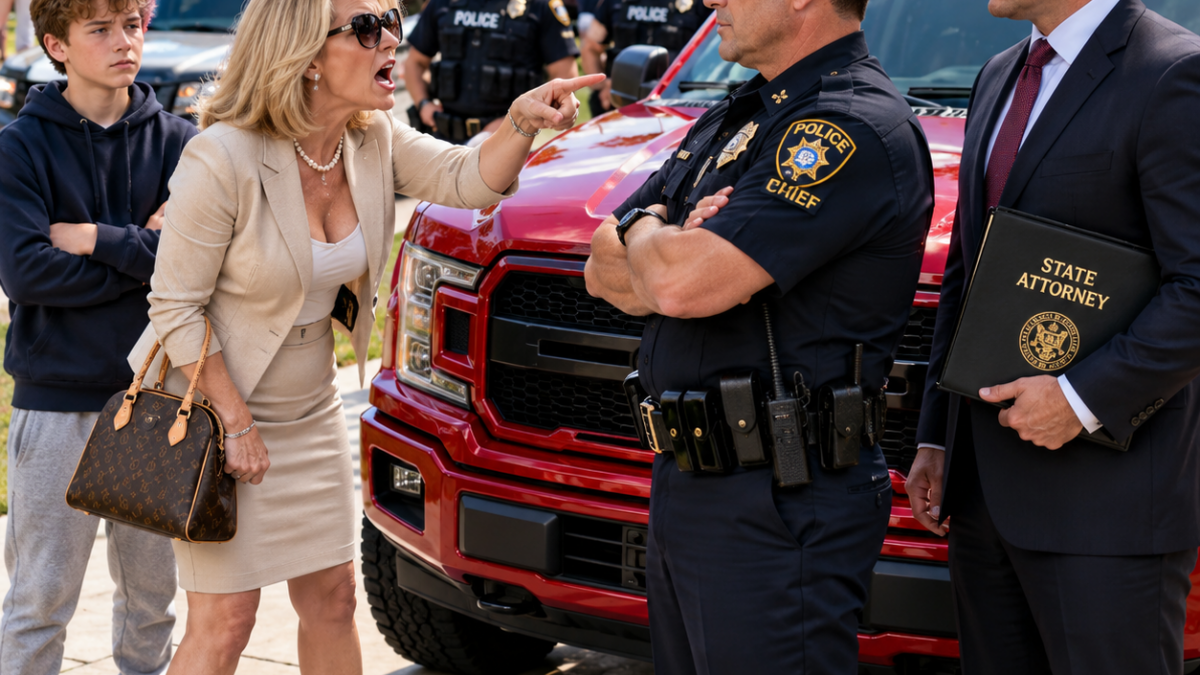
PART 2
I stepped out slowly.
Not because I was afraid of the officers.
Because I knew frustration could make an innocent person look defensive if he wasn’t careful.
The first officer introduced himself.
I nodded.
“I’m happy to cooperate. But somebody needs to explain exactly what’s being alleged.”
Karen didn’t wait for him.
“That truck belongs to my son.”
I turned toward her.
Even after everything she had already said, hearing the lie spoken that plainly shocked me.
“What?”
“You heard me.”
Her son stood behind her.
The cocky smile from Saturday had returned.
Karen pointed toward the Ford.
“That vehicle was promised to him.”
“By who?”
She ignored the question.
“He was supposed to receive it, and this man refuses to surrender it.”
I looked at the officer.
Then at Karen.
Then back at the officer.
“I have no idea what she’s talking about.”
Karen laughed.
“Of course you’d say that.”
The officer raised a hand.
“Everybody needs to stay calm.”
“I am calm.”
Karen immediately said, “He’s not.”
I looked at her.
The officer gave me a look that seemed to say, Please don’t respond.
So I didn’t.
He asked for my identification.
I handed it over.
Then he asked whether I had registration for the truck.
“Yes.”
“Where is it?”
“In the glove compartment, and I have the purchase file inside my house.”
Karen scoffed.
“He’s had plenty of time to manufacture documents.”
That almost broke my composure.
“Manufacture?”
The second officer stepped closer.
“Ma’am, please let us do our job.”
She crossed her arms.
“I’m trying to help.”
Nobody answered.
I opened the passenger door and retrieved the registration and insurance card.
My name.
My address.
Correct VIN.
Everything exactly where it should have been.
The officer compared the numbers.
Then he looked toward Karen.
“Ma’am, the registration lists him as the owner.”
“Because he changed it.”
“When?”
She hesitated.
“That’s what you need to investigate.”
The officer looked tired already.
I said, “I have the original bill of sale in the house.”
“Would you mind getting it?”
“Not at all.”
I went inside.
As I walked toward my office, my hands finally started shaking.
Not from fear.
From anger.
There is something uniquely infuriating about being forced to prove ownership of something you worked years to obtain simply because someone else decided to invent a story.
I opened the filing cabinet.
The folder was exactly where I kept it.
Purchase documents.
Financing records.
Insurance.
Registration renewals.
Receipts from several upgrades.
VIN documentation.
Maintenance history.
Even an old photo from the day I bought the truck.
I carried the entire folder outside.
By then, two neighbors were standing on their porches.
Then three.
Karen loved an audience.
Normally, so did her son.
But his smile weakened when he saw the folder.
I handed the documents to the officer.
“Take your time.”
He began reviewing them.
The second officer checked the VIN plate.
Then the paperwork.
Then my identification.
The longer they looked, the quieter Karen became.
Eventually, the first officer closed the folder.
“Everything here appears consistent.”
Karen exploded.
“They’re fake.”
The officer turned slowly.
“Excuse me?”
“He forged them.”
I almost laughed.
Not because it was funny.
Because the accusation was becoming so ridiculous that laughter felt safer than anger.
The officer remained professional.
“What evidence do you have that these documents are fraudulent?”
“I know what happened.”
“That isn’t evidence.”
“My son was supposed to get that truck.”
Her son finally spoke.
“Mom.”
She ignored him.
“He barely drives it. Look at it. It just sits there.”
The officer glanced toward me.
I could tell he was beginning to understand that this dispute had very little to do with theft.
I folded my arms.
“Karen, tell them who supposedly promised you my truck.”
She stared at me.
“People knew.”
“What people?”
“You know.”
“No. I don’t.”
She looked toward the officers.
“He’s trying to confuse the situation.”
I shook my head.
“I’m asking a simple question.”
The officer nodded.
“Ma’am, who promised your son the truck?”
Silence.
Karen looked toward her own house.
Then at her son.
Then back at the officer.
“He made it clear he would consider selling.”
I stared at her.
That was already different from “promised.”
“No, I didn’t.”
“You did.”
“When?”
“Saturday.”
“I said exactly the opposite.”
“You laughed.”
“Yes. Because the request was ridiculous.”
Her face flushed.
One of the neighbors across the street coughed suspiciously.
Karen heard it.
“This isn’t funny!”
The neighbor immediately looked down at his phone.
I took a slow breath.
Then I remembered Daniel.
My brother-in-law had helped me review the financing and title records when I bought the Ford.
Not because I needed a government official to purchase a truck.
Because Daniel was family, he understood legal paperwork, and I hated paperwork.
He had also told me a thousand times to keep everything.
Originals.
Receipts.
Records.
Never assume a dispute will remain informal.
At the time I thought he was overly cautious.
Standing in my driveway while Karen accused me of stealing my own vehicle, I suddenly appreciated every annoying lecture.
I pulled out my phone.
Karen immediately noticed.
“Who are you calling?”
“My brother-in-law.”
She rolled her eyes.
“Of course.”
I dialed.
Daniel answered on the third ring.
“What’s up?”
“I have a strange problem.”
“How strange?”
“I’m standing in my driveway with two officers and a neighbor claiming my truck belongs to her son.”
Silence.
Then:
“You’re serious?”
“Unfortunately.”
“Do you have the purchase file?”
“In my hand.”
“Registration?”
“Yes.”
“VIN match?”
“Yes.”
Another pause.
“Who made the report?”
I looked at Karen.
“She did.”
Karen’s face changed when she realized we were discussing her.
Daniel sighed.
“I’m nearby. I can come by.”
“I’d appreciate it.”
“I need to be very clear about something.”
“What?”
“If there’s a police complaint, I’m not handling an investigation involving family. I can look at the paperwork and explain the documents, but everything official stays with the responding department.”
That was Daniel.
Careful even when irritated.
“Understood.”
“I’ll be there shortly.”
I hung up.
Karen had been listening closely.
“Who exactly is your brother-in-law?”
“You’ll meet him.”
“That’s very dramatic.”
I almost smiled.
“You’re standing in my driveway accusing me of stealing my own truck.”
Her son looked away.
For the next several minutes, the officers continued checking information through their system.
The VIN came back correctly.
No stolen-vehicle entry.
No conflicting owner.
Nothing supporting Karen’s claim.
One officer finally said, “Ma’am, as of right now, we have no evidence this truck belongs to your son.”
Karen’s face hardened.
“Then you aren’t looking hard enough.”
“Do you have a title?”
“My son was promised one.”
“That isn’t what I asked.”
She looked at her son.
He stared at the pavement.
The officer repeated the question.
“Do you possess a title showing your son as owner?”
“No.”
“Bill of sale?”
“No.”
“Transfer document?”
“No.”
“Receipt?”
“No.”
“Written agreement?”
Karen hesitated.
“No.”
The officer nodded.
“Then what exactly are you basing the stolen vehicle allegation on?”
Her answer stunned even me.
“Common sense.”
The second officer looked away.
Probably to hide his expression.
Then a black SUV turned onto our street.
Daniel.
He parked near the curb and stepped out.
No theatrical entrance.
No dramatic badge flashing.
He wore the dark suit he had been wearing at work, carrying a leather folder.
He walked toward us.
One of the officers recognized him before Karen did.
“Mr. Mercer.”
Daniel shook his hand.
“Officer.”
Karen looked between them.
Then she looked at me.
Her expression shifted.
Daniel approached me first.
“You okay?”
“I’m irritated.”
“That’s probably appropriate.”
I handed him the folder.
He reviewed the purchase documents.
Then he looked at the VIN.
Then the registration.
It took less than two minutes.
“Exactly what I remember,” he said.
Karen stepped forward.
“Who are you?”
Daniel looked at her.
“Daniel Mercer.”
“That doesn’t answer my question.”
“I’m his brother-in-law.”
“I mean what do you do?”
Daniel paused.
“I’m a state attorney.”
The effect was immediate.
Karen’s posture changed.
Not dramatically.
But enough.
Her son’s head came up.
Several neighbors suddenly became much more interested.
Karen recovered quickly.
“Well, good. Then maybe you can explain to these officers that this man took a vehicle intended for my son.”
Daniel looked at her for several seconds.
Then at me.
Then back at her.
“No.”
Karen blinked.
“No?”
“No, because the documents show the opposite.”
“He forged them.”
Daniel’s expression remained neutral.
“Do you have evidence of forgery?”
“I know what happened.”
“That isn’t evidence.”
The exact same answer the officer had given her.
Karen looked furious.
“You’re obviously biased.”
Daniel nodded.
“Yes.”
That seemed to confuse her.
He continued.
“I’m his brother-in-law. Which is why I will not handle any official matter arising from this dispute.”
He turned toward the officers.
“You should follow your normal procedure. I’m only confirming that I personally reviewed these documents when he acquired the vehicle.”
One officer nodded.
“That matches everything we’re seeing.”
Daniel handed the folder back to me.
Then he addressed Karen.
“Ma’am, you need to be very careful about continuing to make factual claims you cannot support.”
She scoffed.
“Are you threatening me?”
“No.”
His tone never changed.
“I’m telling you that reporting a vehicle as stolen when you know you do not own it is serious.”
Karen pointed toward me.
“He told us he might sell it!”
“I did not.”
Daniel looked at her.
“Even if he had considered selling it, that would not transfer ownership.”
“He doesn’t need it!”
Daniel blinked.
For the first time, he looked genuinely surprised.
“That has nothing to do with ownership.”
“My son needs transportation.”
“I’m sorry to hear that.”
Karen stared at him.
“That’s all?”
“What exactly do you expect me to say?”
“He has resources. My son is starting out.”
Daniel glanced at my truck.
Then at her son.
Then back at Karen.
“Need does not create ownership.”
That sentence finally silenced her.
Her son’s posture had changed completely.
The confidence was gone.
He looked embarrassed.
One of the officers closed his notebook.
“Ma’am, unless you have new evidence, we’re done here.”
Karen looked at him.
“You’re just going to let him keep it?”
The officer answered carefully.
“It is his vehicle.”
“You’re taking his side.”
“We’re looking at the records.”
She turned toward Daniel.
“And you’re using your position to intimidate me.”
Daniel shook his head.
“I have taken no official action.”
“Well, I’ll call the HOA.”
A neighbor laughed.
Actually laughed.
Karen spun toward the sound.
“What’s funny?”
Nobody answered.
Daniel calmly said, “You are free to contact your HOA.”
She lifted her chin.
“They’ll deal with this.”
“An HOA cannot transfer ownership of his truck to your son.”
Her face went red.
“You don’t know our bylaws.”
“I don’t need to.”
That was the end of the police visit.
The officers explained that the ownership records supported me and there was no basis to treat the truck as stolen.
They documented the complaint.
Daniel made it clear he would remain outside any official investigation because of our family relationship.
And Karen?
Karen walked home as though she had been personally betrayed by the concept of evidence.
Her son followed her.
Before disappearing inside, he looked back at my truck one last time.
I thought the nightmare was finished.
I was wrong.
It had only changed forms.
Three days later, the first HOA envelope arrived.
**VEHICLE SIZE COMPLIANCE NOTICE.**
I read it twice.
According to the notice, my truck was allegedly “visually disproportionate to residential parking standards.”
I laughed.
Then I checked the HOA rules.
Nothing prohibited my truck.
It fit entirely within my driveway.
It wasn’t commercial.
It wasn’t abandoned.
It wasn’t leaking anything.
There was no violation.
I wrote a short response.
The next morning, another notice appeared.
**AESTHETIC IMPACT CONCERN.**
Apparently the truck’s aftermarket modifications created an “inconsistent neighborhood appearance.”
That was new.
The truck had looked essentially the same for almost three years.
No one had cared until Karen tried to take it for her son.
I called Daniel.
“I think she switched tactics.”
“What happened?”
I read him the notices.
He sighed.
“Save everything.”
“I was planning to.”
“No. I mean everything.”
His voice became more serious.
“Envelope. Date received. Email headers. Photographs of where the truck is parked. Copies of the current HOA rules.”
“You think it’s going somewhere?”
“I think people who fail with one kind of pressure sometimes try another.”
So I started a folder.
At first it was thin.
Then Karen helped it grow.
Parking violation.
Rejected.
Vehicle appearance violation.
Disputed.
Driveway obstruction.
Photographs proved false.
Improper commercial vehicle claim.
The truck wasn’t registered commercially.
Every time one complaint collapsed, another appeared.
It became exhausting.
That was the point.
Karen couldn’t take the truck directly.
So she was trying to make owning it miserable.
A hundred dollars here.
A hearing there.
A warning letter.
A photo.
An accusation.
A new deadline.
Pressure doesn’t always arrive dramatically.
Sometimes it comes in envelopes.
The neighbors began noticing.
One afternoon, Mark from across the street walked over while I was checking the mail.
“You getting HOA letters too?”
“Too?”
“They sent me something about my basketball hoop.”
I looked toward his driveway.
The same basketball hoop had been there for six years.
“When did that start?”
“This week.”
Interesting.
Mark lowered his voice.
“Karen’s been pushing the board hard lately.”
“What do you mean?”
“She’s telling people enforcement has gotten too relaxed.”
I looked at the stack of envelopes in my hand.
“Convenient.”
He followed my eyes.
“That about the truck?”
“Mostly.”
He shook his head.
“She needs to let that go.”
I didn’t answer.
Because by then I understood something important.
This was no longer about Karen wanting the Ford.
It was about her being unable to tolerate losing.
The police had told her no.
The ownership records had told her no.
Daniel had told her no.
Reality had told her no.
So she had moved the battlefield somewhere she believed she had power.
The HOA.
I refused to play emotionally.
Every response I sent was short.
Factual.
Polite.
I attached photographs.
Quoted bylaws.
Asked for specific sections supporting each alleged violation.
Several notices quietly disappeared.
Then came a fine.
Two hundred fifty dollars.
Reason:
**Repeated noncompliance regarding oversized vehicle presentation.**
I stared at the page.
“Vehicle presentation?”
I called the management company.
A woman answered.
I gave her the notice number.
She typed for a moment.
“This appears to be associated with an architectural complaint.”
“Against a truck?”
“Yes.”
“What rule did I violate?”
Another pause.
“I don’t see a specific provision cited.”
“Then why was a fine issued?”
“I’ll have to refer this to the board.”
“Please do.”
That evening I emailed the HOA board.
I attached every notice.
Every response.
Every photograph.
Then I wrote one paragraph:
**Please identify the specific covenant or rule supporting each alleged violation and explain why these concerns began immediately after a personal dispute involving a board-affiliated resident who attempted to claim ownership of this vehicle.**
I didn’t mention Karen by name.
I didn’t have to.
The fine was suspended the next morning.
Karen confronted me that afternoon.
I was unloading groceries.
She stopped on the sidewalk.
“You think you’re clever.”
I kept carrying bags.
“I think I bought too much milk.”
“Don’t joke with me.”
I set the groceries inside the garage and walked back out.
“What do you want?”
“You’re trying to make me look bad.”
“I haven’t mentioned you.”
“You know what you’re doing.”
“I’m responding to notices.”
“Those notices exist because you refuse to respect community standards.”
“What standard?”
She opened her mouth.
I waited.
Nothing.
I nodded toward the truck.
“Karen, this needs to stop.”
“You could stop it.”
“How?”
She looked directly at the Ford.
That was answer enough.
I stared at her.
“You still think I’m selling you the truck?”
“My son needs a vehicle.”
“Then buy him one that’s for sale.”
“He wants this one.”
“Too bad.”
Her face changed.
I immediately regretted the phrase—not because it was wrong, but because I saw how deeply it hit her ego.
She stepped closer.
“You enjoy this.”
“No.”
“Yes, you do.”
“I would love never to discuss my truck with you again.”
“You embarrassed me.”
I almost laughed.
“You called the police.”
“Because you forced me to.”
“No.”
I looked directly at her.
“I did not force you to call anyone. I told you my property wasn’t for sale.”
“You could have handled it differently.”
“So could you.”
She stared at me.
Then walked away.
That night I installed another security camera.
Not because I expected anything.
Because Daniel’s words kept repeating in my head.
Document everything.
Three nights passed.
Nothing.
Four.
Five.
On the sixth evening, I came home later than usual.
I pulled into the driveway.
Turned off the engine.
Stepped out.
Then froze.
A line ran along the passenger side.
At first, I thought it was dirt.
Then the porch light caught it.
A scratch.
Long.
Deep.
Deliberate.
It ran from the front door toward the rear panel.
For several seconds I couldn’t move.
That truck had survived gravel roads, storms, parking lots, long trips, and years of daily life with barely a mark.
And now someone had intentionally dragged something along the paint.
I put my grocery bag down.
My hands clenched.
That was the angriest I had been through the entire ordeal.
Not when Karen demanded the truck.
Not when police arrived.
Not when she lied.
Not when the HOA notices came.
This felt different.
Personal.
Calculated.
I wanted to walk across the street.
I wanted to bang on Karen’s door.
I wanted answers immediately.
Instead, I stood in the driveway until the first wave of anger passed.
Then I remembered the camera.
I went inside.
Opened the security application.
Rewound the footage.
There.
2:13 a.m.
A person walking toward my driveway.
The image sharpened as the motion light activated.
Karen.
I stopped breathing for a second.
She looked toward my house.
Then toward the street.
She approached the passenger side of the Ford.
Her hand moved against the paint as she walked.
Even through a security camera, I could see exactly what was happening.
When she reached the rear of the truck, she turned.
Looked at the line.
Then walked home.
I watched the clip twice.
Then a third time.
The anger disappeared.
Not because I forgave her.
Because evidence changes everything.
I called the non-emergency police number.
Then Daniel.
His first question was simple.
“Do you have the video?”
“Yes.”
“Back it up.”
“I already did.”
“Make two copies.”
“I will.”
“And do not go to her house.”
“I wasn’t going to.”
He was silent.
“You were thinking about it.”
“Maybe.”
“Don’t.”
“I know.”
“And I’m staying out of the official handling.”
“I know.”
“I mean it.”
“I know, Daniel.”
He sighed.
“Good.”
An officer came by.
Not one of the officers from the truck dispute.
That was probably intentional.
I showed him the damage.
Then the footage.
His expression changed.
“You know her?”
“Yes.”
“History?”
I almost laughed.
“You have time?”
He didn’t smile.
So I gave him the short version.
Truck request.
Police complaint.
HOA notices.
Now this.
He took the report.
Photographed the damage.
Saved the footage according to department procedure.
Then he left.
The next morning, I woke to voices outside.
I looked through the window.
Two officers stood at Karen’s door.
I stayed inside.
This wasn’t a neighborhood show.
I didn’t need to stand there.
I didn’t need to watch her reaction.
About twenty minutes later, Daniel called.
“I heard they made contact.”
“Yes.”
“You stay home?”
“Yes.”
“Good.”
“What happens now?”
“The normal process.”
“That’s it?”
“That’s it.”
Part of me wanted something dramatic.
A movie scene.
Karen being confronted with the footage in front of the whole neighborhood.
A perfect speech.
An instant collapse.
Real consequences are usually less cinematic.
There are reports.
Statements.
Insurance estimates.
Hearings.
Evidence.
Deadlines.
Paperwork.
And, in my case, another HOA meeting.
Because the board had finally noticed what it should have noticed much earlier.
My complaints weren’t random.
The notices weren’t random.
They had begun immediately after Karen’s failed attempt to claim my truck.
Several board members contacted me privately.
Then the board president emailed.
**We are conducting a review of recent enforcement actions and would like you to attend a special meeting.**
I forwarded it to Daniel.
His reply:
**Bring the folder. Say less than you want to say.**
That was excellent advice.
The special meeting took place the following Tuesday.
This time the room was full before I arrived.
People knew something had happened.
Rumors had spread about the damage to my truck.
I didn’t confirm anything online.
Karen sat at the front table.
She looked different.
Smaller somehow.
Not physically.
The confidence was gone.
Her son sat in the back.
He wouldn’t look at me.
I felt an unexpected wave of sympathy for him.
He hadn’t scratched my truck.
He hadn’t filed the HOA notices.
But he was living inside the consequences of his mother’s decisions.
The board president opened the meeting.
“We are here to review concerns regarding enforcement procedures and recent complaints.”
Karen immediately raised her hand.
“This meeting is biased.”
The president sighed.
“Karen, you’ll have time to speak.”
“You’ve already decided.”
“No.”
“Yes, you have.”
He stared at her.
“Please allow us to proceed.”
She folded her arms.
The board’s management representative began presenting records.
That was when I learned how much had been happening behind the scenes.
Eleven complaints had been submitted against my truck in less than three weeks.
Nine originated from Karen.
Two were filed anonymously from an email address later associated with her household.
Several notices had been approved without proper board review.
One fine had been issued without a cited rule.
That was bad.
Then it got worse.
The management company had found messages from Karen urging faster action.
One read:
**He needs to learn that living here means following community expectations.**
Another:
**Keep applying pressure. Eventually he will understand.**
The room went silent.
Karen leaned forward.
“Those are being taken out of context.”
The president looked exhausted.
“What context makes ‘keep applying pressure’ appropriate?”
“He was refusing to cooperate.”
“With what?”
That question again.
The same question the officer had asked.
The same question Daniel had asked.
Karen had never developed an answer.
She looked toward me.
I said nothing.
The president continued.
“Did you want him to sell the truck to your son?”
Karen’s face reddened.
“That has nothing to do with HOA enforcement.”
“That’s not what I asked.”
Her son suddenly stood.
“Mom.”
Everyone turned.
Karen looked back at him.
“Sit down.”
“No.”
His voice shook slightly.
She stared.
He continued.
“This needs to stop.”
The room became completely quiet.
I had never heard him speak to her like that.
Karen’s expression hardened.
“You don’t understand what’s happening.”
“Yes, I do.”
“No, you don’t.”
“He told us no.”
Karen froze.
Her son swallowed.
“The truck was never ours.”
Nobody moved.
He looked at me briefly.
Then back at his mother.
“I wanted it. You asked. He said no.”
Karen whispered, “Sit down.”
He shook his head.
“You told me you could make him reconsider.”
Her face drained.
I felt uncomfortable suddenly.
This was becoming more personal than I wanted.
He continued.
“You told me the HOA could make owning it too expensive.”
A murmur spread through the room.
The board president raised his hand.
“Please.”
Karen stood.
“He’s confused.”
Her son laughed bitterly.
“I’m not confused.”
“You don’t know what adults have been dealing with.”
“I’m twenty-two.”
The sentence landed harder than he probably intended.
He looked toward the board.
“I shouldn’t have gone along with it.”
Then he looked at me.
“I’m sorry.”
I hadn’t expected that.
He continued.
“I should have told her to stop after the police came.”
I nodded.
“I appreciate that.”
Karen stared at him like he had betrayed her.
He picked up his jacket.
“I’m done.”
Then he walked out.
For a few seconds, nobody spoke.
The president finally turned back toward Karen.
“Would you like to respond?”
Her eyes were wet.
But the anger remained.
“My son is embarrassed.”
“Understandably.”
“You people have turned him against me.”
“No,” I said.
It was the first time I had spoken.
Karen looked at me.
I kept my voice calm.
“Nobody turned him against you.”
“You stay out of this.”
“I would love to.”
She laughed sharply.
“That’s rich.”
I stood slowly.
“No, Karen. What would have been rich is if I had wanted revenge.”
The room became quiet.
“I could have made every part of this louder.”
She stared at me.
“I could have posted the police report online. I didn’t.”
I placed my folder on the table.
“I could have shared every HOA notice publicly. I didn’t.”
Another document.
“I could have posted the security footage everywhere the night I found the damage.”
Her face changed.
Several people inhaled sharply.
“I didn’t.”
I looked around the room.
“I gave everything to the proper people because I didn’t want a neighborhood feud.”
Then back to Karen.
“You kept trying to turn a simple no into a war.”
Her voice dropped.
“You think you’re better than me.”
“No.”
“Then why are you doing this?”
“I’m not doing this.”
I pointed toward the documents.
“You did.”
That was the hardest truth in the room.
Karen didn’t lose because I had more influence.
She didn’t lose because Daniel was a state attorney.
She didn’t lose because the police believed me.
She lost because every time she had a chance to stop, she chose another escalation.
Ask for the truck.
No.
Pressure me.
No.
Call police.
No.
Use the HOA.
No.
Issue fines.
No.
Damage the truck.
And finally, there was nowhere left for the story to go.
The board president cleared his throat.
“We need to address the HOA portion.”
He explained that Karen would be removed from her enforcement-related committee role pending formal board action.
Several notices against me were voided.
The fine was canceled permanently.
The board also approved an independent review of recent violations to determine whether other residents had been selectively targeted.
Karen stared at the table.
Nobody cheered.
I was glad.
This wasn’t entertainment anymore.
Then the president said something I hadn’t expected.
“We owe you an apology.”
He looked directly at me.
“The association allowed a personal dispute to influence enforcement.”
I nodded.
“Thank you.”
“We’re changing the process. No single member will be able to push a violation through without a cited rule and review.”
That mattered more to me than Karen losing her role.
Systems matter.
If one angry person can misuse a system, removing that person solves only half the problem.
You also have to fix what allowed it.
The meeting ended quietly.
People gathered their things.
Karen remained seated.
I packed my folder.
As I reached the door, I heard her voice.
“Wait.”
I turned.
The room had mostly emptied.
Only the president and two board members remained.
Karen stood near the table.
For the first time since this began, she looked like someone who had run out of arguments.
“What do you want from me?” she asked.
The question surprised me.
“Nothing.”
She laughed.
“Nobody wants nothing.”
“I want you to leave me and my truck alone.”
“That’s it?”
“Yes.”
“What about the damage?”
“That’s being handled separately.”
She looked down.
“I can pay for the repair.”
“That will be addressed through the proper process.”
Her jaw tightened.
“You always have to make everything official.”
I almost laughed.
“Karen, you called the police on me and told them I stole my truck.”
She looked away.
Fair point.
I walked toward the door.
Then she spoke again.
“I really thought you would sell it.”
I stopped.
“Why?”
She was silent for a long time.
Then she said something that made the entire situation feel different.
“My son had been having a hard year.”
I didn’t answer.
“He lost his first job. His car broke down. He moved back home.”
Her voice softened.
“He felt like he was failing.”
For the first time, I heard something underneath the entitlement.
Fear.
A mother watching her adult child struggle.
That didn’t excuse anything.
But it explained something.
“I wanted to give him one thing that made him feel like he was moving forward.”
I looked at the floor.
Then at her.
“So you chose my truck.”
“He loved it.”
“That still didn’t make it yours.”
“I know.”
Those two words came quietly.
Almost painfully.
I waited.
She continued.
“When you laughed, I felt humiliated.”
“I wasn’t laughing at your son.”
“I know that now.”
“I thought you were joking.”
She nodded.
“I should have stopped there.”
“Yes.”
She looked toward the empty doorway where her son had left.
“I kept thinking if I could make you give in, then I wouldn’t have been wrong.”
That was perhaps the most honest thing she had said through the entire ordeal.
People sometimes double down not because they still believe they’re right.
They double down because admitting they were wrong has become more painful than continuing.
But every step makes the eventual fall worse.
I picked up my folder.
“Karen, your son doesn’t need my truck to prove he’s doing okay.”
She looked at me.
“He probably doesn’t need you solving everything for him either.”
That hurt her.
I saw it immediately.
But I didn’t say it cruelly.
She knew it.
“I’m his mother.”
“I know.”
“You don’t understand.”
“Maybe not.”
I paused.
“But eventually helping someone means letting them build something of their own.”
Her eyes moved toward the parking lot.
I thought of my Ford.
Every upgrade.
Every repair.
Every hour I had worked.
Maybe that was why the truck meant so much to me.
Nobody handed it to me.
Nobody pressured someone else into giving it up.
It represented years of my own decisions.
Her son deserved that feeling too.
Just not with my property.
I left the meeting.
The next several weeks were quieter.
The repair estimate for the scratched panel came in.
It wasn’t cheap.
The security footage made the insurance process straightforward.
Karen accepted responsibility through the process instead of continuing to dispute what the camera showed.
That surprised me.
Maybe the HOA meeting had finally exhausted whatever fight remained in her.
The damaged panel was repaired.
The paint matched almost perfectly.
The first afternoon I brought the truck home, I stood in the driveway looking at it.
Mark walked over.
“Good as new?”
“Close.”
He inspected the side.
“I can’t see where it was.”
“I can.”
He laughed.
“Of course you can.”
We stood there for a moment.
Then he said, “You know everyone expected you to absolutely destroy Karen at that meeting.”
I looked at him.
“What would that have accomplished?”
“Would’ve felt good.”
“For five minutes.”
He nodded.
“Probably.”
I ran my hand along the repaired paint.
“I didn’t want revenge.”
Mark looked at me skeptically.
“Not even a little?”
I smiled.
“Maybe a little.”
He laughed.
I became serious.
“But I wanted the truth to win more.”
That distinction mattered.
Revenge would have meant using Daniel’s title to frighten her.
We didn’t.
Revenge would have meant using the security footage to humiliate her online.
I didn’t.
Revenge would have meant demanding that the neighborhood treat her like an enemy forever.
I didn’t want that either.
I wanted boundaries.
Accountability.
Repair.
And an end.
A few days later, Karen’s son knocked on my door.
He looked nervous.
“Can we talk?”
“Sure.”
He stood on the porch.
For several seconds, he struggled to find the words.
Then:
“I’m sorry about everything.”
“You already apologized at the meeting.”
“I mean before that too.”
I waited.
“I knew the truck wasn’t mine.”
“I assumed.”
“I let her tell me she could get it.”
“Why?”
He looked embarrassed.
“Because I wanted it.”
That honesty made me respect him more.
He continued.
“I thought maybe you’d get tired of the HOA stuff and just sell.”
“So you knew about that?”
“Some of it.”
He looked toward his house.
“I didn’t know she was going to damage it.”
“I believe you.”
His shoulders relaxed slightly.
“I should have stopped her.”
“You’re not responsible for every choice your mother makes.”
“But I encouraged it.”
“That’s different.”
He nodded.
“I’m trying to get another job.”
“What kind?”
“There’s a mechanic shop about twenty minutes away.”
“You know engines?”
“A little.”
He smiled weakly.
“Probably more than my mom thinks.”
I looked toward the Ford.
“You like working on trucks?”
“Yeah.”
“Then learn.”
He looked at me.
“What?”
“You want a truck like mine someday?”
“Obviously.”
“Then learn how to build one.”
He glanced toward the driveway.
“I could never afford that.”
“You don’t buy everything at once.”
He looked back.
“You think I bought that truck looking exactly like it does now?”
“I guess not.”
“No.”
I smiled.
“That’s the point.”
He stared at the Ford.
I could see something changing in his expression.
Maybe for the first time, he wasn’t looking at it as an object he wanted someone else to hand him.
He was looking at it as the result of a process.
Years.
Work.
Patience.
I walked toward the garage.
“Come here.”
He followed.
I opened a storage cabinet.
Inside were old parts I had replaced.
Lights.
Trim.
A few tools.
Some packaging from past upgrades.
I pulled out an old headlight assembly.
“This was one of the first things I changed.”
He examined it.
“You did it yourself?”
“Mostly.”
“Was it hard?”
“The first side took three hours.”
He laughed.
“The second?”
“Forty-five minutes.”
He smiled.
“That’s actually pretty cool.”
“You learn by doing.”
He handed it back.
“Thanks.”
“For what?”
“Not hating me.”
I looked at him.
“You made a bad choice.”
“More than one.”
“Probably.”
He laughed quietly.
I continued.
“That doesn’t mean I need to hate you forever.”
He nodded.
Then he looked at the truck again.
“Can I ask something?”
“You can ask.”
He smiled because he caught the wording.
“Can I sit in it?”
I stared at him for a second.
Then laughed.
“You really want to?”
“Yeah.”
“Fine.”
His face lit up.
I unlocked the truck.
He climbed into the driver’s seat.
This was the same person who weeks earlier had stood behind his mother while police questioned ownership of my vehicle.
Now he was sitting there because he had asked.
Permission.
Such a small thing.
Such a massive difference.
He looked around the interior.
“Man.”
I leaned against the open door.
“Still want one?”
“Even more.”
“Then work for one.”
He nodded.
“I will.”
And he did.
Over the next few months, things changed slowly.
Karen disappeared from HOA enforcement.
The board rewrote several procedures.
Complaints required cited provisions.
Fines needed review.
Anonymous accusations carried less weight without supporting evidence.
A few neighbors who had been targeted before came forward.
Some old fines were reversed.
Karen’s behavior had exposed a weakness much larger than my truck dispute.
I hadn’t expected that.
Sometimes one conflict reveals a system that was waiting to fail.
Daniel was pleased.
“You did better than I expected.”
“Thanks?”
“I thought you might lose your temper.”
“I almost did.”
“When?”
“When I saw the scratch.”
He nodded.
“That would have been my moment too.”
We were sitting on my back porch.
I handed him a drink.
“You know what bothered me most?”
“What?”
“The police report wasn’t even the worst part.”
“What was?”
“The idea that because I had something she wanted, she could decide I didn’t deserve it.”
Daniel considered that.
“Entitlement is strange.”
“How?”
“People rarely call it entitlement when they’re feeling it.”
I looked at him.
“They call it fairness.”
He nodded.
“That’s usually how it works.”
We sat quietly for a while.
Then he laughed.
“What?”
“I still can’t believe somebody reported your truck stolen because you wouldn’t sell it.”
I shook my head.
“Please never tell that story at Thanksgiving.”
“No promises.”
Months later, Karen’s son got the mechanic job.
I found out because he crossed the street one Saturday wearing a work shirt with the shop’s logo.
“Got hired.”
“Congratulations.”
“Starting Monday.”
“Good.”
He looked toward my truck.
“I’m saving.”
“For what?”
He gave me a look.
“A truck.”
I smiled.
“Used?”
“Obviously.”
“Smart.”
“My mom wanted to help with the down payment.”
“And?”
“I told her I want to do most of it myself.”
That mattered.
More than he probably realized.
“How’d she take that?”
He laughed.
“Not great.”
I laughed too.
Then he added:
“But she said okay.”
That surprised me.
“Good.”
A few months after that, he pulled into the neighborhood in an older silver pickup.
High mileage.
A little faded.
One dent near the tailgate.
Nothing like mine.
And he looked happier than I had ever seen him.
He parked across the street.
Jumped out.
And almost ran toward my house.
“Come look.”
I walked over.
Karen stood on her porch watching us.
Her son opened the hood.
The engine compartment needed work.
I could hear a minor belt noise.
There was surface corrosion in a few places.
But the truck had potential.
“How much?”
He told me.
I nodded.
“Not bad.”
“You think I got ripped off?”
“No.”
His shoulders relaxed.
“I want to replace the lights first.”
“Don’t.”
He frowned.
“Why?”
“Maintenance first.”
He looked disappointed.
“What maintenance?”
I pointed.
“Belts. Fluids. Brakes. Tires.”
He sighed.
“That’s boring.”
“Welcome to owning a vehicle.”
Karen laughed from the porch.
“Listen to him.”
He looked at her.
“Whose side are you on?”
“For once?”
She smiled.
“His.”
We all laughed.
That was perhaps the strangest part of the entire story.
Life kept moving.
Karen didn’t become my friend.
I didn’t suddenly forget what she had done.
Forgiveness and forgetting are not the same thing.
Trust came back slowly, if at all.
But hostility faded.
She began waving when she walked past.
At first I wasn’t sure what to do.
Then I waved back.
Her HOA messages became shorter.
More professional.
She stopped photographing everybody’s driveways.
Or at least mine.
Her son spent weekends working on his pickup.
Sometimes he asked me questions.
Sometimes I helped.
Sometimes I deliberately refused and told him to figure it out.
One afternoon he came over holding a broken plastic clip.
“What is this?”
I looked at it.
“Something you broke.”
“Very helpful.”
“You’re welcome.”
He laughed.
Eventually he learned.
The truck improved.
New lights.
Fresh tires.
Minor suspension work.
Then wheels.
Nothing expensive all at once.
Piece by piece.
Exactly how I had built mine.
One evening, almost a year after everything began, I found him standing between our two trucks.
Mine deep blue.
His silver.
He looked from one to the other.
“You know what’s weird?”
“What?”
“I like mine better now.”
I smiled.
“Good.”
“It isn’t nicer.”
“Doesn’t matter.”
“It has more problems.”
“Definitely.”
He laughed.
“But I worked for it.”
There it was.
The entire lesson in one sentence.
I nodded.
“That changes things.”
He ran his hand along the dented tailgate.
“I get why you wouldn’t sell yours.”
“I told you why.”
“I know.”
He looked embarrassed.
“But back then I thought you were just being stubborn.”
“And now?”
“Now I’d probably fight somebody who tried to take this thing.”
I raised an eyebrow.
“Let’s use the word ‘argue.’”
He laughed.
“Fine.”
Then he looked toward his house.
“My mom feels bad, you know.”
I didn’t answer immediately.
“I know.”
“She doesn’t know how to talk to you about it.”
“She doesn’t have to.”
“I think she wants to.”
“That’s up to her.”
He nodded.
A week later, she did.
It happened on another Saturday morning.
Almost exactly a year after the first conversation.
I was washing my Ford.
Of course.
Some stories apparently enjoy symmetry.
I saw Karen walking across the street.
For one second, my body remembered everything before my mind did.
The demand.
The police.
The HOA envelopes.
The scratch.
Then I reminded myself that a year had passed.
She stopped several feet away.
“Can we talk?”
I turned off the hose.
“Sure.”
She looked at the truck.
The repaired paint was invisible to almost everyone.
I still knew exactly where the damage had been.
“I owe you an apology.”
I waited.
“A real one.”
I nodded.
She took a breath.
“I was wrong.”
No excuses.
At least not yet.
“I should never have asked the way I did.”
I said nothing.
“I definitely should not have called the police.”
Still nothing.
“I used the HOA because I was angry.”
Her voice shook slightly.
“And what I did to the truck was…”
She stopped.
She looked at the repaired side panel.
“Unacceptable.”
I nodded once.
“Yes.”
She swallowed.
“I’m sorry.”
There are moments when you imagine exactly what you will say if they ever arrive.
For months, I had probably rehearsed a dozen speeches without realizing it.
I could have reminded her of every lie.
Every notice.
Every dollar.
Every hour wasted.
Instead, I looked across the street at her son’s silver truck.
He was underneath it, probably working on something.
“I accept your apology.”
Her eyes widened slightly.
“That easily?”
“No.”
I smiled faintly.
“It wasn’t easy.”
She looked down.
“I understand.”
“I accept the apology because I don’t want to carry this anymore.”
She nodded.
“I don’t either.”
Then she surprised me.
“I thought helping my son meant fixing everything for him.”
I followed her gaze toward his truck.
“He’s happier with that old thing than he would have been with mine.”
She laughed quietly.
“I know.”
“He complains about it constantly.”
“So do I.”
“He spends every spare dollar on parts.”
“So do I.”
She smiled.
Then she became serious.
“I think I was afraid.”
“Of what?”
“That he wasn’t going anywhere.”
I leaned against the truck.
“He’s young.”
“I know.”
“But when he moved back home, I felt like I had failed him.”
There was the truth beneath everything.
Not a justification.
A wound.
Sometimes people hurt others because they’re trying desperately to cover their own fear.
Understanding that does not remove responsibility.
But it can make forgiveness possible.
“He needed time,” I said.
“And I needed to let him have it.”
“Yes.”
She nodded.
“Daniel scared me.”
I laughed.
“He wasn’t trying to.”
“He has a very serious face.”
“That’s unfortunately true.”
She smiled.
Then shook her head.
“I really thought having a state attorney show up meant I was finished.”
“He deliberately stayed out of the official process.”
“I know that now.”
“That mattered to him.”
“I understand.”
She looked at the Ford again.
“Do you know the stupidest part?”
“What?”
“If you had sold us the truck, my son probably wouldn’t appreciate it half as much as he appreciates that silver disaster.”
I laughed.
“Probably not.”
“He calls it Silver Bullet.”
“That’s terrible.”
“I told him.”
We both laughed.
It felt strange.
Good strange.
Not because everything was erased.
Because it no longer controlled us.
A few minutes later, her son emerged from underneath his truck.
He saw us standing together and froze.
“Oh no.”
Karen turned.
“What?”
He pointed between us.
“You two being friendly is terrifying.”
I laughed.
Karen rolled her eyes.
“Go back under your truck.”
He wiped his hands.
“What are you talking about?”
“My truck.”
He looked at me.
“Still not for sale?”
“Never.”
He nodded seriously.
“Good.”
Karen looked at him.
“You used to want it.”
“I still like it.”
He walked over to his silver pickup and slapped the fender.
“But this one’s mine.”
I looked at Karen.
She looked at me.
Neither of us needed to say anything.
That was the ending.
Not Karen losing her HOA influence.
Not the police report collapsing.
Not the fines being canceled.
Not even the camera catching the truth.
Those were consequences.
Necessary ones.
But the real ending was standing in a driveway a year later and watching a young man take pride in something he had earned himself.
That truck taught all three of us something different.
For me, it was proof that boundaries matter.
You don’t have to surrender something simply because somebody else believes their need is greater than yours.
You don’t have to feel guilty for protecting what you built.
And you don’t have to become cruel just because someone treats you unfairly.
For Karen, I think it became a lesson about control.
You can love someone and still damage them by trying to remove every disappointment from their life.
Her son didn’t need her to take my truck.
He needed the chance to struggle.
Save.
Learn.
Fail.
Repair.
Earn.
That ugly silver pickup gave him more confidence than my Ford ever could have.
And for him?
The lesson was perhaps the simplest.
Wanting something doesn’t make it yours.
Someone else saying no isn’t an attack.
And the things you build for yourself often mean far more than the things somebody hands you.
My Ford is still in my driveway.
I still wash it more often than necessary.
I still notice every small mark.
I still keep every maintenance receipt.
Daniel still makes fun of the folder.
Karen’s son still comes over when he needs a tool he doesn’t own.
Usually he asks.
Actually, he always asks.
One Sunday afternoon, he walked over holding a wrench.
“Can I borrow this size socket?”
I handed it to him.
“Bring it back.”
“I will.”
Karen, who happened to be walking past, stopped.
She looked at the tool.
Then at me.
Then at her son.
A smile appeared on her face.
“See?” she said. “He asked.”
Her son groaned.
“Mom.”
I started laughing.
She laughed too.
He walked back across the street muttering something about both of us being annoying.
I watched him go.
Then I looked at my truck.
A year earlier, that driveway had been filled with police lights because somebody believed enough pressure could transform my property into hers.
Now the same driveway was quiet.
No officers.
No accusations.
No HOA letters.
No angry neighbors.
Just a truck.
Exactly where it belonged.
Karen had tried the police.
She had tried the HOA.
She had tried pressure.
She had tried turning frustration into punishment.
And eventually, every one of those tactics collapsed under the same thing.
Truth.
Not because truth always arrives dramatically.
Usually it doesn’t.
Sometimes truth is just a registration document.
A dated photograph.
An email.
A security camera clip.
A witness willing to speak.
A young man finally saying, “The truck was never ours.”
That’s why I never regretted staying calm.
There were so many moments when anger would have felt satisfying.
When the police came.
When the first HOA fine arrived.
When I discovered the damage.
When Karen sat in that meeting insisting everyone was against her.
I could have exploded.
But anger would have given her another story.
Another accusation.
Another distraction.
Instead, I kept records.
I answered questions.
I let the evidence do what anger never could.
Eventually, she had nowhere left to hide from her own decisions.
That was enough.
People sometimes ask whether having Daniel as my brother-in-law saved me.
It helped.
But not in the way people imagine.
He didn’t use his office to punish Karen.
He never interfered with the police.
He never threatened the HOA.
He didn’t make charges disappear or appear.
What he did was much more useful.
He reminded me to slow down.
Document.
Stay inside the process.
Let independent people handle independent matters.
In other words, he reminded me not to become the kind of person Karen believed power allowed you to become.
That lesson mattered.
Because power isn’t proven by how many people you can frighten.
It’s proven by how responsibly you behave when you could make things worse.
Karen had spent weeks trying to prove she had influence.
In the end, her influence disappeared.
I spent those same weeks trying not to use influence I actually had access to.
And somehow that distinction changed everything.
The last time the story came up was at a neighborhood barbecue.
Mark told a new neighbor:
“You see that blue truck?”
I heard him from across the yard.
I immediately knew where this was going.
The new neighbor looked toward my driveway.
“Yeah.”
Mark grinned.
“That truck nearly destroyed the HOA.”
I walked over.
“No.”
Mark laughed.
“Come on.”
“The truck didn’t do anything.”
Karen happened to be standing nearby.
She raised her cup.
“For once, he’s right.”
Everyone looked at her.
She smiled.
“I nearly destroyed the HOA.”
People laughed.
Including Karen.
And that may have been the clearest sign that the story was finally over.
She could say it.
Own it.
Laugh about it without pretending it never happened.
Her son walked up beside us.
“Are we telling the truck story again?”
“No,” I said.
“Yes,” Mark said at the same time.
He groaned.
Karen smiled at him.
“Just remember who taught you to appreciate your own truck.”
He stared at her.
“Definitely not you.”
Everyone laughed again.
She slapped him lightly on the arm.
He hugged her.
That moment stayed with me.
Because for all the anger that story contained, it didn’t end with anyone destroyed.
Karen faced consequences.
The HOA changed.
My truck was repaired.
Her son grew up a little.
And eventually the neighborhood moved on.
That was enough revenge for me.
Actually, it was better than revenge.
Revenge would have left somebody humiliated and bitter.
Accountability left us with something useful.
A stronger HOA process.
Clearer boundaries.
A repaired truck.
A young mechanic with his own beat-up pickup.
And one extremely stubborn neighbor who finally understood that “no” wasn’t a declaration of war.
Sometimes the most satisfying victory isn’t watching someone lose everything.
It’s watching their lies stop working.
It’s watching the pressure fail.
It’s seeing the thing you protected still sitting exactly where it belongs after every attempt to take it from you has ended.
That evening after the barbecue, I walked back home alone.
The sun was dropping behind the houses.
Its light reflected off the Ford’s blue paint.
Across the street, the silver pickup sat in Karen’s driveway.
Two trucks.
Two owners.
Two completely different stories.
I ran my hand across the side panel where the scratch had once been.
The repair was nearly invisible.
But I could still feel where the memory was.
Some damage works that way.
It disappears from everybody else’s view before it disappears from yours.
I didn’t resent that.
The scar reminded me of something important.
Standing your ground doesn’t mean becoming hard.
It doesn’t mean humiliating the other person.
It doesn’t mean using every weapon available.
Sometimes standing your ground means repeating the same calm answer while someone else keeps escalating.
No.
No, I’m not selling it.
No, your son isn’t entitled to it.
No, a police complaint won’t change the title.
No, HOA pressure won’t rewrite ownership.
No, damaging something won’t make it yours.
And eventually, when all the noise is gone, the answer remains.
No.
I unlocked the truck.
Before climbing inside, I heard an engine start across the street.
Karen’s son backed his silver pickup out of the driveway.
He rolled down his window.
“Hey!”
“What?”
He grinned.
“Race you?”
I stared at his old truck.
“No chance.”
“Scared?”
“Of that thing?”
He pretended to look offended.
Karen stepped onto her porch.
“Do not encourage him!”
We both laughed.
Her son waved and drove away.
I watched his taillights disappear around the corner.
Then I climbed into my Ford.
The interior smelled exactly the way it always had.
Leather.
Clean upholstery.
A little trace of whatever air freshener I was using that month.
Familiar.
Mine.
I put my hand on the steering wheel.
For a moment, I remembered the first day I bought it.
I remembered Daniel helping with documents.
I remembered my first upgrade.
The first road trip.
The first scratch I accidentally caused myself.
Then Karen’s demand.
The officers.
The HOA letters.
The security footage.
The meeting.
The apology.
The silver truck across the street.
It was strange how much life could attach itself to one object.
But maybe the truck had never really been the point.
The point was ownership.
Not merely legal ownership.
Ownership of choices.
Ownership of mistakes.
Ownership of consequences.
I owned the Ford because I paid for it.
Karen eventually owned what she had done because she finally stopped blaming everyone else.
Her son began owning his future when he stopped waiting for somebody to hand him the version of success he wanted.
That was why the ending satisfied me.
Not because Karen was defeated.
Because everyone finally took responsibility for something.
I started the engine.
The dashboard lit up.
For years, I had thought the best thing about that truck was everything I had added to it.
The wheels.
The lights.
The suspension.
The details.
But sitting there that night, I realized the best thing about it was much simpler.
I knew exactly what it had cost me.
Not just money.
Time.
Patience.
Work.
Care.
That was why somebody else could look at it and see transportation while I saw something more.
And that was why Karen had never understood my answer at the beginning.
She saw a truck sitting in a driveway.
I saw years.
You cannot demand somebody’s years because you think your need is more important.
You cannot turn another person’s work into your entitlement.
And you certainly cannot rewrite reality simply because the word “no” embarrassed you.
Karen learned that in the most difficult way possible.
But she did learn it.
So did her son.
And maybe I learned something too.
When somebody comes after something you value, your first instinct may be to fight them with the same aggression they bring to you.
Sometimes that is exactly the mistake they need you to make.
Karen needed me angry.
She needed me shouting at the officers.
She needed me threatening the HOA.
She needed me confronting her after the truck was damaged.
Because then the story could become about my behavior.
Instead, I kept giving her the same unbearable thing.
Evidence.
Documents.
Dates.
Video.
Facts.
And eventually, facts left her nowhere to go.
That was the real reason her plan collapsed.
Not because I knew a state attorney.
Not because I had better connections.
Not because the neighborhood liked me more.
Her story collapsed because it could not survive being compared with reality.
The truck was mine before Karen wanted it.
It was mine while she complained.
It was mine when the police arrived.
It was mine during every HOA notice.
It was mine after the damage was repaired.
And years later, when Karen’s son had something of his own that he was proud to protect, I think he finally understood why that mattered.
Sometimes the best ending to a fight is not seeing the person who started it lose everything.
Sometimes it is seeing them finally understand why they were wrong.
Karen once looked at my truck and believed her son deserved it more than I did.
Today, she looks across the street at the battered silver pickup he earned himself and smiles like it is the finest vehicle in the neighborhood.
Maybe to her, it is.
And maybe that is the whole point.
Because the most valuable thing her son ever received was not my Ford.
It was the chance to build something that was actually his.
As for my truck?
It is still deep blue.
Still polished.
Still sitting in my driveway.
And every time I walk past it, I remember the afternoon police lights flashed against its paint because one woman thought enough pressure could turn someone else’s property into hers.
She tried.
She failed.
But the ending became better than I ever expected.
My truck stayed mine.
Her son found his own path.
The HOA became fairer.
Karen eventually apologized.
And the word that started the entire conflict became the word that finally taught all of us where the line was.
No.
Not cruelly.
Not angrily.
Just clearly.
And sometimes, that is the strongest answer a person can give.

