PART 2: HOA Karen Tried to Take the Jeep I Spent Five Years Restoring for Her Son’s Graduation—Then the Police Asked One Question She Couldn’t Answer
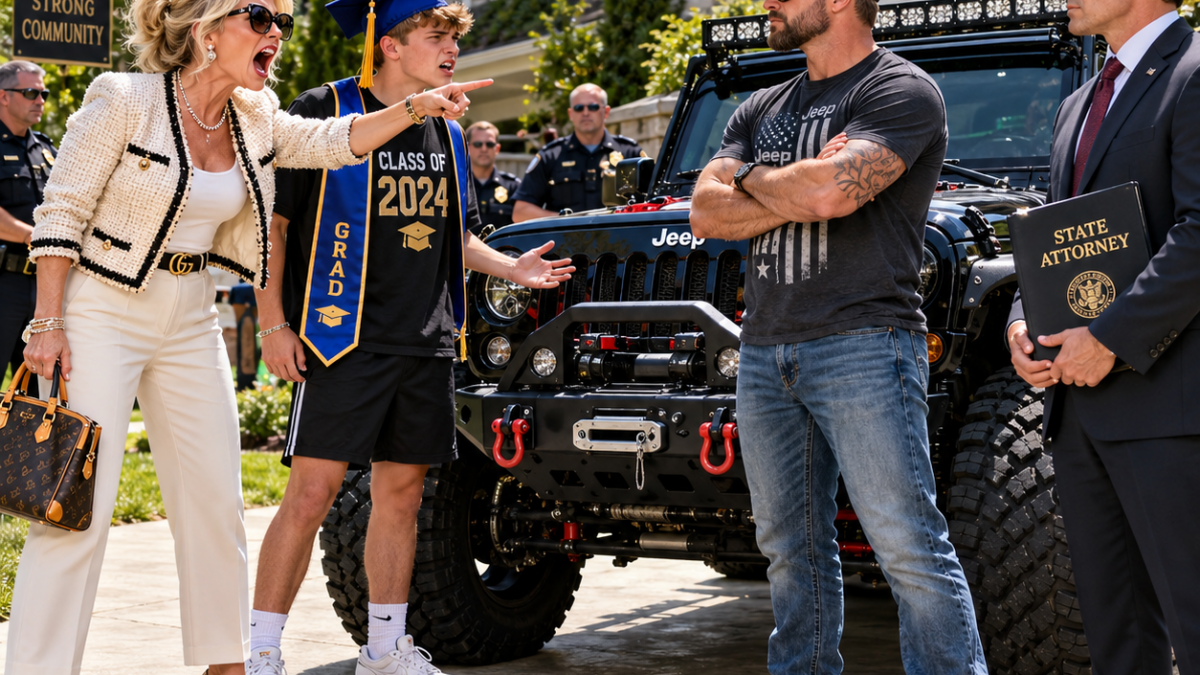
PART 2
I closed the garage door and stood there for a long moment.
The Jeep ticked softly as the engine cooled.
Normally that sound relaxed me.
That morning, it didn’t.
I pulled the note from my pocket again.
**We’ll take it anyway.**
Maybe it was a stupid prank.
Maybe some teenager wrote it.
Maybe Karen had nothing to do with it.
But I had spent enough time around entitled people to know that the moment someone starts treating your “no” like a temporary obstacle, you stop assuming they will behave reasonably.
So I did three things.
First, I photographed the note.
Front and back.
Then I placed it in a plastic sleeve.
Second, I changed the garage keypad code.
Third, I installed a motion-activated camera above the garage.
I already had a doorbell camera at the front entrance, but I wanted a clear view of the driveway.
Then I called my friend Aaron.
Aaron and I had known each other since college.
He worked in the state attorney’s office.
Not the kind of person who could magically arrest neighbors over arguments.
And definitely not someone who would misuse his position because I was irritated.
That was actually why I trusted him.
He answered with:
“You’re calling before nine on a Sunday. Who died?”
“My peace and quiet.”
“That serious?”
“Maybe.”
I told him everything.
Karen’s demand.
The messages.
The note.
He laughed once when I explained the graduation parade.
Then he stopped laughing when I read the note aloud.
“You still have it?”
“Yes.”
“Good.”
“What should I do?”
“Nothing dramatic.”
“That was the plan.”
“Photograph everything. Save every message. Keep the Jeep secured. If anyone enters your garage or tries to take the vehicle, call local police.”
“What about Karen?”
“Don’t argue with her.”
“That may be difficult.”
“Make it easy.”
He paused.
“People who want drama usually need another person participating.”
“That sounds annoyingly wise.”
“I get paid to sound annoyingly wise.”
Before hanging up he added:
“And don’t threaten anyone.”
“I wasn’t planning to.”
“I know. I’m saying it anyway.”
That call helped.
Not because Aaron was going to rescue me.
Because he reminded me that the strongest position was the simplest one.
It was my vehicle.
I had said no.
I didn’t need to win a neighborhood debate.
I only needed to protect my property.
Unfortunately, Karen was busy turning the neighborhood into a courtroom.
By noon, her Facebook post was up.
The video came from my new camera.
I received an alert and opened the feed.
Karen stood directly in front of my garage holding her phone toward herself.
Behind her, my garage door filled half the frame.
She wore sunglasses and had adopted the serious, wounded expression people use when they want an audience to believe they have suffered some profound injustice.
“This,” she said dramatically, “is where our neighbor is hiding the classic Jeep he promised for Tyler’s graduation parade.”
I nearly dropped my phone.
Promised?
She continued.
“Some people talk about community until they’re asked to contribute something meaningful. Tyler has worked hard for twelve years to reach graduation, and one selfish decision is now threatening something the kids have planned for weeks.”
I paused the video.
Took screenshots.
Saved the entire recording.
Then I looked at the comments.
Bad idea.
Some people believed her completely.
**That’s awful.**
**He really promised?**
**Who backs out on a graduate?**
**Let the kid have one nice day.**
Others were more skeptical.
Tom from the corner wrote:
**Did he actually agree to this?**
Karen replied:
**We had an understanding.**
That was a creative way of saying no.
Another neighbor, Lisa, wrote:
**I’ve known him for eight years. He doesn’t let anyone drive that Jeep.**
Karen deleted Lisa’s comment.
That told me everything.
This wasn’t confusion.
She was building a story.
I considered responding publicly.
Then I remembered Aaron.
People who want drama need participants.
I stayed quiet.
That silence irritated Karen more than any argument could have.
That evening, a second video appeared.
This one was filmed at the graduation decorating party.
Tyler stood in the background with several friends.
Karen said:
“Unfortunately, some people have decided not to support our graduates, so we may have to change parts of the parade.”
The camera turned briefly toward Tyler.
He looked annoyed.
Not devastated.
Annoyed.
That mattered.
Karen was presenting him like a child whose once-in-a-lifetime moment had been cruelly destroyed.
Tyler looked like someone angry because the luxury vehicle he expected wasn’t available.
Two very different things.
The next morning, I found shaving cream smeared across my mailbox.
Written through it in black marker was one word.
**GRINCH.**
I stood there staring.
Then Frank from next door walked up with his dog.
“What happened?”
I pointed.
He read it.
“Oh.”
“Yeah.”
“You know who?”
“No proof.”
He looked toward Karen’s house.
“But?”
“But.”
Frank had lived there longer than I had.
He knew Karen well.
“She’s losing people.”
“What do you mean?”
“The Facebook thing.”
He lowered his voice.
“She told everyone you promised Tyler the Jeep.”
“I never did.”
“I know.”
“How?”
Frank looked at me.
“Because I was in my driveway when she asked you.”
That surprised me.
“You heard that?”
“Most of it.”
“Why didn’t you say anything online?”
He smiled.
“You didn’t ask.”
Fair.
Then he became serious.
“You want me to?”
I thought about it.
“No.”
He raised an eyebrow.
“Why?”
“Because I’m not doing neighborhood court.”
Frank nodded approvingly.
“Probably smart.”
He pointed at the mailbox.
“But take pictures.”
“Already did.”
That afternoon, I cleaned it.
The marker never came off completely.
A faint shadow remained.
It bothered me more than it should have.
Not because of the mailbox.
Because someone had crossed from words into my property.
Maybe it was Karen.
Maybe Tyler.
Maybe one of his friends.
I couldn’t prove it.
So I didn’t accuse anyone.
That restraint would matter later.
Graduation was Thursday.
By Wednesday night, the entire neighborhood looked festive.
Blue and silver balloons tied to mailboxes.
Congratulations signs in yards.
Streamers stretched between porches.
I liked it.
Despite everything, I liked seeing the families proud of their kids.
My anger at Karen wasn’t anger at every graduate.
Around eight that evening, my doorbell rang.
Tyler.
Alone.
I considered ignoring it.
Then I opened the door.
He wore shorts and a graduation T-shirt.
His hands were in his pockets.
“What’s up?”
He looked toward my garage.
“Is the Jeep here?”
“Yes.”
“Can I see it?”
I studied him.
“You’ve seen it.”
“I mean for tomorrow.”
“No.”
His jaw tightened.
“My mom said you might change your mind.”
“She shouldn’t have.”
He shifted his weight.
“I already told everyone I’d have it.”
“That was a mistake.”
“Come on, man.”
“No.”
“It’s literally one parade.”
“I understand.”
“I’ve driven old cars before.”
“I’m not questioning your ability.”
“Then why won’t you let me?”
That was the same question his mother kept asking as though my reason had to satisfy him.
“Because I don’t lend it out.”
He looked genuinely offended.
“Not even for graduation?”
“No.”
He scoffed.
“This is ridiculous.”
“No. Disappointing maybe. Not ridiculous.”
He shook his head.
“You know everyone thinks you’re being a jerk.”
“I’m aware.”
“That doesn’t bother you?”
“It bothers me that people were given a story that isn’t true.”
His eyes flickered.
He knew exactly what I meant.
“My mom said you agreed.”
“Your mom lied.”
His face hardened.
“Don’t call my mom a liar.”
“She said I promised something I never promised.”
“You probably made her think you would.”
“No.”
“You laughed.”
“That’s not agreement.”
He looked toward the garage again.
“So that’s it?”
“That’s it.”
He started walking away.
Then turned.
“You care more about that Jeep than people.”
The sentence landed harder than I expected.
Maybe because a small part of me wondered whether there was truth in it.
I looked through the garage wall as if I could see the Jeep inside.
Then I thought of my father.
Five years.
Every weekend.
Every scraped knuckle.
Every old photo I kept in the glove box.
“Tyler.”
He stopped.
“I care about people.”
He looked back.
“But caring about someone doesn’t mean they get to take something important to you.”
He said nothing.
Then walked home.
I barely slept.
Not because I thought someone was definitely coming.
Because uncertainty keeps you awake better than certainty.
At 6:30 the next morning, I checked the camera.
Nothing.
At seven, the street started waking up.
Music.
Parents decorating cars.
Graduates walking around in caps.
By nine, kids were taking photographs in front yards.
The parade was scheduled for noon.
At 10:47, my camera alerted.
I opened the feed.
Karen.
Tyler.
Two of his friends.
Walking up my driveway.
All four were dressed for graduation.
Karen carried a purse.
Tyler had his cap in one hand.
One friend held balloons.
The other was filming on his phone.
I sighed.
Then came three loud knocks.
Not polite knocks.
The kind that announce someone believes you already owe them access.
I opened the door.
Karen smiled.
“Good. You’re home.”
“That’s usually how doors work.”
She ignored the comment.
“We’re here for the Jeep.”
I stared at her.
“No.”
Tyler stepped forward.
“The parade starts soon.”
“I know.”
“My mom said you’d stop being difficult.”
Karen interrupted.
“We are done debating this.”
That sentence almost made me admire the confidence.
“You’re done debating my vehicle?”
“Yes.”
“No.”
Her smile disappeared.
“You are embarrassing this family.”
“I haven’t said anything about your family.”
“You know exactly what you’re doing.”
Tyler’s friend kept filming.
I pointed toward the phone.
“I don’t consent to you coming onto my property to record this.”
The kid lowered it slightly.
Karen rolled her eyes.
“Oh, please.”
I looked at Tyler.
“I told you last night. The answer is no.”
His face reddened.
“I told everybody.”
“That doesn’t create an agreement.”
Karen stepped closer.
“Just give me the keys.”
“No.”
“Three hours.”
“No.”
“We’ll put gas in it.”
“No.”
“We’ll sign something.”
“No.”
“Stop saying no!”
The street seemed to go quiet.
At least in my head.
I looked at her.
“That’s the problem, isn’t it?”
“What?”
“You think if you keep asking, no eventually stops meaning no.”
Her face tightened.
“Don’t lecture me.”
“Then stop demanding my property.”
She pushed past me.
Literally.
Her shoulder brushed mine as she stepped through the doorway.
For half a second, I froze.
Then I moved around her.
“Karen.”
She walked toward the interior door leading to the garage.
“Karen, stop.”
She reached for the handle.
I stepped between her and the door.
“That’s enough.”
She looked shocked.
“What are you doing?”
“Keeping you out of my garage.”
“This is absurd.”
“You just entered my house after I told you no.”
“I’m getting the Jeep.”
“No, you’re not.”
Tyler stepped inside behind her.
His friends stayed near the front door.
I pointed outside.
“Everybody out.”
Karen laughed.
“You’re acting insane.”
“Out.”
“You’re threatening graduates.”
“No.”
I kept my voice level.
“I’m telling four people who entered my property without permission to leave.”
Tyler looked at his mother.
Karen looked at the garage keypad.
“Open it.”
I stared at her.
She looked at Tyler.
“Try the code.”
That was the moment the entire situation changed for me.
Until then, Karen could still pretend this was negotiation.
She could say she misunderstood.
She could claim she thought I would agree.
But telling her son to open my locked garage after I had repeatedly refused?
That wasn’t negotiation.
Tyler stepped toward the keypad.
“Don’t.”
He pressed four numbers.
The panel flashed red.
He tried again.
Red.
“Mom, he changed it.”
Karen turned toward me.
“You changed the code?”
“Yes.”
“Because of us?”
“Yes.”
Her face showed genuine outrage.
As though changing the code to my garage was an aggressive act against her.
She reached into her purse.
“Fine.”
I braced myself.
She pulled out her phone.
“I’m calling the police.”
I almost smiled.
“Please do.”
She hesitated.
Apparently that wasn’t the response she expected.
Then she dialed.
She paced my front walkway while speaking to dispatch.
“Yes, we have a vehicle dispute.”
Pause.
“He’s refusing to release it.”
Pause.
“It was promised for an event.”
Pause.
“Yes, the owner is here.”
I called Aaron.
He answered immediately.
“Graduation day?”
“You remembered.”
“I had a feeling.”
“She’s here with her son. They tried the garage keypad. She’s calling police.”
“Any damage?”
“No.”
“Anyone inside your house?”
“They entered briefly. I got them outside.”
“Good.”
“You nearby?”
“I’m fifteen minutes away.”
“You don’t have to come.”
“I know.”
Pause.
“I’m coming as your friend. Local officers handle everything. Understood?”
“Understood.”
Then:
“Don’t argue.”
“I’m trying.”
“Try harder.”
He hung up.
Ten minutes later, two patrol cars turned onto the street.
The parade decorations made the whole scene bizarre.
Blue balloons.
Congratulations signs.
Police cruisers.
Four angry people.
One locked garage.
The first officer approached.
“Who called?”
Karen raised her hand.
“I did.”
He looked at me.
“Sir, we received a complaint involving a vehicle.”
“My vehicle.”
Karen immediately interrupted.
“Not exactly.”
The officer held up a hand.
“One at a time.”
I went inside and retrieved the Jeep folder.
Registration.
Insurance.
Title copy.
Restoration receipts.
The whole thing.
When I returned, Karen was telling the second officer that I had “withdrawn permission.”
I heard it clearly.
The first officer looked at her.
“So you had permission in writing?”
“No.”
“Text message?”
“No.”
“Email?”
“No.”
“Any document?”
“No, but—”
He turned toward me.
“Did you agree verbally?”
“No.”
Karen threw up her hands.
“Of course he says that!”
I handed the officer the folder.
“This is the vehicle paperwork. The Jeep has been locked in my garage because I received this.”
I showed him the note.
His expression changed.
“Where did this come from?”
“Under my windshield Sunday morning.”
Karen leaned forward.
“I’ve never seen that.”
“I didn’t say you wrote it.”
Tyler looked at the note.
His face changed.
Small change.
But I saw it.
The officer did too.
“Do you know anything about this?”
Tyler shook his head quickly.
“No.”
His friends suddenly became fascinated with the pavement.
The officer looked at them.
“You two know anything?”
Both shook their heads.
Karen snapped:
“This has nothing to do with the issue.”
The officer looked at her.
“It has a lot to do with the issue if someone threatened to take the vehicle without permission.”
She folded her arms.
“Nobody threatened anyone.”
I spoke calmly.
“You entered my house ten minutes ago and told Tyler to open my garage.”
Karen’s face reddened.
“I did not enter your house.”
“You walked through the front door.”
“The door was open.”
“Because I opened it to speak to you.”
“That isn’t trespassing.”
The officer said:
“Ma’am, did he ask you to leave?”
She hesitated.
“He was being unreasonable.”
“That wasn’t the question.”
Silence.
“Did he ask you to leave?”
“Yes.”
“Did you leave immediately?”
“No.”
Tyler looked increasingly uncomfortable.
Then the black sedan pulled up.
Aaron got out.
No dramatic sunglasses.
No theatrical display.
Just a dark suit because he had apparently come from a morning event.
Karen watched him approach.
Aaron nodded to the officers.
One recognized him.
“Mr. Hayes.”
“Officer.”
He looked at me.
“You all right?”
“Yes.”
He turned to the officers.
“I’m here personally. I’m not handling anything official.”
The first officer nodded.
“Understood.”
Karen stared.
“Who is this?”
“A friend,” I said.
Aaron added:
“I work with the state attorney’s office.”
Her expression changed instantly.
Not fear exactly.
Recognition that the story she had built was now being heard by people she couldn’t pressure with an HOA Facebook group.
She immediately smiled.
“Oh, good.”
Aaron’s eyebrows lifted.
“Good?”
“You can explain to him why he can’t make promises and then emotionally torment a graduate by changing his mind.”
Aaron looked at me.
Then the officers.
Then Karen.
“Did he transfer ownership of the Jeep?”
“No.”
“Did he sign a lending agreement?”
“No.”
“Did he give your son keys?”
“No.”
“Then what exactly are you asking law enforcement to do?”
Karen blinked.
“Make him honor his commitment.”
“What commitment?”
“He promised.”
Aaron looked toward me.
“Did you?”
“No.”
Karen snapped:
“He’s lying.”
Aaron remained completely calm.
“That becomes a factual disagreement, not a right to enter his garage and take the vehicle.”
“We weren’t taking it.”
The first officer looked up from his notes.
“You told your son to use the keypad.”
“To open the garage.”
“For what purpose?”
Karen pointed at the closed door.
“To get the Jeep.”
The officer stopped writing.
Aaron said nothing.
I said nothing.
Tyler closed his eyes.
Karen realized too late what she had just admitted.
“I mean with his permission.”
I looked at her.
“When did I give permission?”
She turned toward me.
“You know what I mean.”
“No.”
Her frustration rose.
“This is ridiculous! It’s a graduation parade!”
Aaron finally spoke.
“And that is exactly why this should have stopped with a polite request.”
She stared at him.
He continued.
“Graduation doesn’t create a temporary exception to ownership.”
Tyler’s friends shifted awkwardly.
One whispered something.
Tyler snapped:
“Shut up.”
The officer looked at Tyler.
“You need to stay calm.”
“I am calm.”
He wasn’t.
Karen put a hand on his arm.
Then looked at me.
“Are you happy now?”
That question hit me strangely.
“Happy?”
“You embarrassed him.”
I looked at Tyler.
His face was red.
Graduation cap hanging from one hand.
Neighbors were beginning to watch from yards.
And for the first time, I felt something besides anger.
Sadness.
Because this should have been a good day for him.
Karen had turned a graduation celebration into a public dispute over a vehicle he never owned.
But Karen wasn’t finished.
She turned toward the officers.
“So what happens now?”
The officer answered.
“Your group leaves the property.”
“That’s it?”
“Unless the owner wants to make a formal complaint regarding the attempted unauthorized entry.”
She looked at me.
Her face went pale.
Aaron turned toward me.
“Your decision.”
Karen’s mouth opened.
“Are you serious?”
Aaron looked at her.
“Yes.”
Tyler looked at me.
For the first time since this began, the entitlement vanished.
He looked eighteen.
Just eighteen.
Young.
Embarrassed.
Scared that his graduation morning was about to become something much worse.
The officer asked me:
“Do you want to pursue the trespass complaint?”
I looked at Karen.
Then Tyler.
Then at the graduation decorations covering the street.
I thought about the note.
The mailbox.
The videos.
The insults.
Five days of being treated as though protecting something meaningful made me cruel.
A part of me wanted consequences.
Strong consequences.
Then I remembered my father.
He had been firm.
Sometimes painfully firm.
But he had also taught me that winning an argument and solving a problem were not always the same thing.
I exhaled.
“No.”
Karen stared.
The officer raised an eyebrow.
“You’re sure?”
“I want the incident documented.”
“Absolutely.”
“I want them formally told not to enter my property or touch the Jeep.”
“We can do that.”
“But I’m not trying to turn graduation day into a criminal case.”
Tyler looked up.
Karen said nothing.
Aaron nodded slightly.
The officer addressed Karen and Tyler.
“You heard him.”
Karen folded her arms.
“This is humiliating.”
The officer answered:
“Then I suggest you leave.”
He looked at Tyler.
“And do not return to this property without permission.”
Tyler nodded.
“Yes, sir.”
Karen muttered:
“This neighborhood has lost its mind.”
Frank, who had been watching from next door, spoke for the first time.
“No, Karen.”
Everybody turned.
He stood beside his driveway.
“The neighborhood finally heard the whole story.”
Karen looked furious.
“What are you talking about?”
Frank walked closer.
“I heard you ask him for the Jeep Saturday.”
Her face changed.
“I was right there.”
“You weren’t part of the conversation.”
“Didn’t need to be.”
He looked at the officers.
“She asked. He said he never lends it out. She kept pushing. He said no.”
Then Lisa came out of her house.
“So did I.”
Karen stared.
Lisa held up her phone.
“And I saved screenshots of the comments you deleted.”
Karen’s mouth opened.
Nothing came out.
More neighbors had gathered now.
Not a mob.
Just people who had spent a week hearing one version of events and were finally realizing the foundation wasn’t solid.
Tyler looked at his mother.
“You said he promised.”
Karen snapped:
“Not here.”
“You told me he promised.”
“Tyler.”
“You said he backed out.”
Her face tightened.
“I said we had an understanding.”
“No.”
His voice cracked slightly.
“You said he promised me.”
The street went silent.
Karen looked around.
For the first time, there was nowhere for her story to hide.
She grabbed Tyler’s arm.
“We’re leaving.”
He pulled away.
“Stop.”
Her face changed.
Tyler looked at me.
“Did you ever tell her yes?”
“No.”
He swallowed.
“Not once?”
“Not once.”
He looked toward the garage.
Then back at his mother.
“You made me look like an idiot.”
Karen’s face reddened.
“I was trying to give you a good graduation.”
“I didn’t ask you to do this.”
“You wanted the Jeep!”
“I said it was cool!”
The anger in his voice wasn’t entitlement anymore.
It was betrayal.
Karen looked around at everyone watching.
“This is not the place.”
Tyler laughed bitterly.
“You made it the place.”
That sentence hurt her.
I saw it.
The officer stepped in.
“Everybody needs to separate now.”
Tyler’s friends moved toward the street.
Karen followed.
Tyler stayed for a second.
He looked at me.
“I’m sorry.”
The apology was quiet.
Real.
Not because a cop told him to say it.
“Okay.”
He nodded.
Then left.
Aaron stayed after the cruisers departed.
We sat on my porch.
The graduation parade would start in fifteen minutes.
“You handled that well,” he said.
“I don’t feel like I did.”
“Why?”
“I wanted them to feel consequences.”
“They did.”
“I mean real consequences.”
Aaron looked toward Karen’s house.
“You think embarrassment in front of half the neighborhood isn’t real?”
“That sounds petty.”
“It can be.”
He leaned back.
“But you made the right distinction.”
“What distinction?”
“You protected yourself without trying to ruin an eighteen-year-old’s life.”
I thought about Tyler.
“He participated.”
“Yes.”
“He tried the keypad.”
“Yes.”
“But I think his mom convinced him it was already his.”
Aaron nodded.
“Probably.”
He looked toward my garage.
“You know the funny thing?”
“What?”
“If you had filed a complaint, Karen would have spent the next six months telling everyone you destroyed her son’s graduation.”
“Exactly.”
“Instead, the police record says she was told to leave.”
He smiled.
“And the whole neighborhood heard why.”
I watched families gathering near the street.
Music started.
Graduates climbed into decorated cars.
A convertible rolled past covered in balloons.
Then Tyler appeared.
Not in my Jeep.
In the passenger seat of his friend’s old pickup.
He looked toward my house.
For one second, our eyes met.
I expected anger.
He gave me a small nod.
I nodded back.
Karen rode in another vehicle farther behind.
She didn’t look toward my house.
The parade continued.
Parents cheered.
Kids waved.
For twenty minutes, Hawthorne Circle felt like the neighborhood it should have been all week.
When it ended, I went into the garage.
The Jeep sat beneath the lights.
Safe.
Untouched.
I ran my hand along the front fender.
My father used to say old cars remember the hands that kept them alive.
I never knew whether he meant that literally or emotionally.
That afternoon, I understood it.
The Jeep wasn’t valuable because Karen wanted it.
It wasn’t valuable because neighbors admired it.
It wasn’t even valuable because it was old.
It mattered because I remembered who I had been while rebuilding it.
The year after my father died.
The first engine start.
My brother handing me a beer when the wiring finally worked.
My daughter sitting in the passenger seat while I taught her how to read old dashboard gauges.
All of that was inside the Jeep for me.
Karen saw a parade prop.
That didn’t make her evil.
But it explained why she couldn’t understand my refusal.
She had never asked what the Jeep meant.
She only asked what it could do for her son.
For several days after graduation, the neighborhood became unusually quiet.
Karen deleted the Facebook videos.
Then she deleted most of the comments.
Someone had already saved screenshots.
By Sunday, a new post appeared from the HOA board.
Not from Karen.
From the vice president.
**Reminder: Residents may not represent private property belonging to other homeowners as available for community events without the owner’s explicit consent. Residents should also refrain from entering another homeowner’s property after permission has been denied.**
No names.
No accusations.
Everybody knew what it meant.
I thought the issue was finished.
Then Tuesday evening, I received an email requesting my attendance at an HOA meeting.
The subject:
**COMMUNITY CONDUCT REVIEW**
I laughed when I saw it.
Of course.
Karen had moved the argument somewhere she felt stronger.
The meeting was Thursday.
I considered skipping it.
Then Lisa knocked on my door.
“You’re going.”
I looked at her.
“Excuse me?”
“You’re going.”
“Since when are you my lawyer?”
“Since Karen emailed half the board saying you created a hostile environment for graduates.”
I closed my eyes.
“She did what?”
Lisa handed me printed screenshots.
Karen claimed I had:
“Verbally intimidated graduating students.”
“Used law enforcement connections to threaten a family.”
“Created unnecessary police involvement.”
And, my favorite:
“Undermined neighborhood unity during a once-in-a-lifetime celebration.”
I read them twice.
“This woman called the police.”
“I know.”
“She came onto my property.”
“I know.”
“She tried my garage keypad.”
“I know.”
Lisa smiled.
“That’s why you’re going.”
So I did.
The clubhouse was packed.
Normally an HOA meeting attracted twelve people and one resident who only came to complain about landscaping.
That Thursday, almost forty chairs were filled.
Karen sat at the front.
Tyler wasn’t there.
I sat near the middle.
Aaron did not attend.
I didn’t ask him.
This wasn’t his fight.
The board president, Mr. Reynolds, opened the meeting.
“We have received multiple concerns about events surrounding last week’s graduation parade.”
Karen immediately raised her hand.
“I would like to clarify—”
“You will have time.”
She lowered her hand.
Reluctantly.
Mr. Reynolds explained that the board had received conflicting accounts.
So they would hear from involved residents.
Karen went first.
She described herself as a mother trying to create a memorable graduation.
She said I had initially been “receptive.”
Then “withdrawn cooperation.”
Then “escalated unnecessarily.”
She mentioned Aaron.
Repeatedly.
“He summoned an official from the state attorney’s office.”
I almost interrupted.
Mr. Reynolds did it for me.
“Was this official acting in his government capacity?”
Karen hesitated.
“He identified himself.”
“That isn’t what I asked.”
“No.”
“Did he threaten prosecution?”
She hesitated again.
“He explained legal consequences.”
“Did he initiate any prosecution?”
“No.”
Mr. Reynolds nodded.
“What exactly did the homeowner do that you consider harassment?”
Karen looked toward me.
“He repeatedly refused reasonable compromise.”
The room became very quiet.
One board member frowned.
“Refusing to loan a vehicle is harassment?”
Karen sighed.
“You’re oversimplifying.”
“Then explain.”
She talked for nearly ten minutes.
Community spirit.
Graduation.
Tradition.
Disappointment.
My attitude.
The Jeep.
She never once produced evidence that I had agreed.
Then it was my turn.
I stood.
“I’ll keep this simple.”
Karen crossed her arms.
“I bought the Jeep years ago and spent five years restoring it.”
I placed photographs on the table.
Before.
During.
After.
Rust.
Bare metal.
Engine work.
Finished vehicle.
Several neighbors leaned closer.
“I don’t lend it out.”
I continued.
“Karen asked. I said no.”
I placed the note on the table.
“This appeared on my Jeep the following morning.”
Murmurs moved through the room.
“I don’t know who wrote it, so I am not accusing anyone.”
Then photos of the mailbox.
“I also don’t know who did this.”
Then screenshots.
“These are posts stating I had promised the Jeep. I did not.”
Then the police incident number.
“On graduation morning, Karen and Tyler came to my home with two friends. Karen entered after I repeatedly refused. She told Tyler to use my garage keypad.”
Karen jumped up.
“That is not what happened!”
Mr. Reynolds raised a hand.
“Sit down.”
“You’re letting him lie.”
“Sit down.”
She did.
I continued.
“I declined to pursue a trespass complaint because I did not want graduation morning turned into something worse.”
The room became very quiet.
“I am not asking the HOA to punish Karen.”
That surprised everyone.
Especially Karen.
“I’m asking the board to establish something that should already be obvious.”
I looked around.
“Community spirit does not mean community ownership.”
Nobody spoke.
“You can ask for help.”
I looked toward Karen.
“You can ask to borrow something.”
Then toward the board.
“But when the owner says no, the conversation ends.”
Frank stood.
“I’d like to speak.”
Mr. Reynolds nodded.
Frank described hearing the original conversation.
Then Lisa showed the board screenshots of deleted Facebook comments.
Another neighbor admitted Karen had told parents I had “already committed.”
A woman I barely knew said:
“I repeated that story to someone else because I believed Karen.”
She looked at me.
“I’m sorry.”
“Thank you.”
Then something unexpected happened.
The clubhouse door opened.
Tyler walked in.
Karen froze.
“Tyler?”
He didn’t sit beside her.
He stood near the back.
Mr. Reynolds asked:
“Do you want to speak?”
Tyler nodded.
Karen shook her head.
“You don’t need to.”
He looked at her.
“Yes, I do.”
I felt the room change.
Tyler walked forward.
He looked different than graduation morning.
No cap.
No anger.
Just tired.
He faced the board.
“My mom told me he had agreed to let me use the Jeep.”
Karen said:
“Tyler—”
Mr. Reynolds raised his hand.
“Let him speak.”
Tyler continued.
“I believed her.”
He looked at me.
“When he told me no the night before graduation, I thought he was backing out.”
I nodded slightly.
“That’s why I was angry.”
He looked down.
“But after the police came, I asked my mom when he actually agreed.”
Karen stared at him.
“She couldn’t tell me.”
The silence was brutal.
“She said he should have agreed.”
Karen’s eyes filled.
“Tyler, stop.”
He shook his head.
“No.”
His voice trembled.
“You made me think he took something away from me.”
Karen whispered:
“I was trying to make your graduation special.”
“I know.”
“Then why are you doing this?”
He looked at her.
“Because I acted like an idiot to someone who never promised me anything.”
That sentence hit me harder than I expected.
Tyler turned toward me.
“I’m sorry.”
I stood.
“You already apologized.”
“Not properly.”
He swallowed.
“I shouldn’t have come inside. I shouldn’t have tried the keypad. I shouldn’t have let my friends come over like that.”
He looked toward the floor.
“And the note?”
The room changed again.
Karen looked at him sharply.
I waited.
Tyler shook his head.
“I didn’t write it.”
I believed him.
Then he added:
“But I know who did.”
One of his friends.
Not because Karen ordered it.
Not because Tyler ordered it.
A teenager who thought he was helping his friend “get even.”
Tyler had learned about it after the fact and said nothing.
My anger returned briefly.
Not at the friend.
At the fact that the situation had grown so absurd that kids thought threatening to take someone’s vehicle was normal neighborhood loyalty.
Tyler looked at me.
“I told him what he did was stupid.”
“When?”
“After the police came.”
I nodded.
“Thank you for telling me.”
He looked at Karen.
“This whole thing should’ve stopped Saturday.”
Her face crumpled slightly.
For the first time, Karen didn’t look angry.
She looked hurt.
Mr. Reynolds called a short recess.
People moved around quietly.
I stepped outside.
Tyler followed several minutes later.
He stood beside me.
“Can I ask you something?”
“Sure.”
“Why does that Jeep mean so much?”
The question surprised me.
Nobody in his family had asked.
So I told him.
My father.
The restoration.
The five years.
The parts.
The weekends.
The memories.
Tyler listened.
When I finished, he looked toward the parking lot.
“My mom told me you just liked showing it off.”
I laughed quietly.
“I do like showing it off.”
He smiled.
“But that isn’t why I keep it.”
“I get it.”
He was silent.
“My grandfather had a Camaro.”
“What year?”
“Seventy-two.”
“Nice.”
“My mom sold it after he died.”
Something in his voice made me look at him.
“You wanted it?”
“Yeah.”
“Why’d she sell?”
“She said it was just an old car.”
There it was.
The bridge between us.
Different families.
Different cars.
Same feeling.
I said:
“Then you understand more than you think.”
He nodded.
“I do now.”
The board reconvened.
The final decision was straightforward.
Karen received a formal censure for misrepresenting a private homeowner’s property as committed to an event and for using HOA communication channels to amplify a personal dispute.
More importantly, the board adopted a rule:
No board member could claim, advertise, schedule, or imply availability of private property for HOA functions without written permission from the owner.
It sounded almost ridiculous written out.
But apparently we needed it.
Karen resigned from the graduation committee.
She did not lose her house.
She was not publicly destroyed.
She remained in the neighborhood.
The world kept turning.
That should have been the ending.
It wasn’t.
Two weeks later, Tyler knocked on my door again.
I opened it cautiously.
He held an old photograph.
“My grandfather’s Camaro.”
I took it.
Beautiful car.
Faded red paint.
Black interior.
Him standing beside it as a little kid.
“What happened to it?”
“My mom sold it to a guy in another county.”
“Still around?”
“I looked.”
His eyes brightened.
“I found it.”
That caught me.
“You found the car?”
“I think so.”
He showed me an online listing.
Same VIN range.
Same modifications.
Same unusual dent near the rear quarter panel visible in the old photo.
It needed work.
A lot.
“What do you think?” he asked.
“I think you’re about to develop a very expensive hobby.”
He smiled.
“My summer job starts Monday.”
“You want to buy it?”
“Eventually.”
I looked at him.
Then at the Jeep behind me.
Life has a strange sense of humor.
Two weeks earlier, Tyler wanted to borrow something I built.
Now he was talking about building something himself.
“I’ll help you look at it.”
His eyes widened.
“Seriously?”
“Looking is free.”
“Mostly.”
I laughed.
That Saturday, we drove out together.
In my daily driver.
Not the Jeep.
Tyler noticed.
“Still not letting me ride in it?”
“You can ride in it.”
His eyebrows rose.
“Really?”
“I said I don’t let people drive it.”
“Oh.”
He laughed.
“Fair.”
We inspected the Camaro.
It was rough.
Worse than the listing admitted.
The engine needed work.
Interior torn.
Rust around the lower panels.
Exactly the kind of project most sane people avoided.
Tyler loved it immediately.
I recognized the look.
I had worn it five years earlier.
“You’re in trouble,” I told him.
“Why?”
“Because you already bought it in your head.”
He laughed.
He couldn’t afford it yet.
But the owner was willing to hold it with a deposit.
Tyler started saving.
He worked at an auto-parts store.
Then picked up weekend shifts at a tire shop.
Sometimes he came over while I was working in the garage.
At first, he only asked questions.
Then he started helping.
Not with the Jeep.
I was not that generous.
But with smaller projects.
Lawn mower.
My daily car.
Frank’s old pickup.
Tyler was good with his hands.
Patient.
Curious.
He had spent years thinking he wanted expensive things.
What he really wanted was to build something.
Karen hated the idea of the Camaro.
I learned that when she appeared at my driveway one afternoon.
“You’re encouraging him.”
I set down my wrench.
“Encouraging what?”
“That car.”
“He found it.”
“You went to inspect it.”
“He asked.”
“He’s going to waste all his money.”
“Maybe.”
Her eyes narrowed.
“You think that’s funny?”
“No.”
I wiped my hands.
“I think learning what things cost is useful.”
“He has college.”
“He can decide what he can afford.”
“He’s eighteen.”
“Exactly.”
She looked toward her house.
“You don’t understand.”
I waited.
“He becomes obsessed.”
“With cars?”
“With things.”
She sighed.
“When he wants something, nothing else exists.”
I almost said, Wonder where he learned that.
I didn’t.
Instead I said:
“Then maybe building one slowly is better than being handed one.”
She looked at me.
That landed.
“You’re talking about the Jeep.”
“Yes.”
Her shoulders dropped slightly.
“I really thought I was helping him.”
“I know.”
“You don’t believe me.”
“I do.”
She seemed surprised.
I continued.
“I think you wanted his graduation to feel huge.”
Her eyes softened.
“He had a hard year.”
“I figured.”
“His father barely showed up.”
That was new information.
Karen looked uncomfortable saying it.
“He promised he’d be here for graduation.”
“Was he?”
“For twenty minutes.”
I understood a little more.
Karen hadn’t simply wanted Tyler to have a cool vehicle.
She wanted to fill an emotional hole with spectacle.
A classic Jeep.
A parade.
A perfect day.
Something big enough that he wouldn’t notice who wasn’t there.
That didn’t excuse what she did.
But people make more sense when you understand what they’re trying to fix.
“He needed you,” I said.
“I was there.”
“I know.”
“But?”
“He didn’t need my Jeep.”
She looked at me for a long moment.
Then nodded.
“No.”
That was the first real conversation Karen and I had after the dispute.
Not an apology.
Not yet.
But something had shifted.
By the end of summer, Tyler saved enough for the Camaro deposit.
The seller agreed to a payment arrangement.
Then came the problem.
Transporting it.
The Camaro didn’t run.
Tyler called me.
“I need a favor.”
“What kind?”
“Trailer.”
I had one.
“You need me to tow it?”
There was a pause.
“Yes.”
“With what?”
Another pause.
“The Jeep.”
I laughed.
“You have incredible timing.”
“I knew you’d say that.”
I thought about it.
The Grand Wagoneer could handle the small trailer if loaded properly.
I trusted myself driving it.
Finally:
“I’ll tow it.”
Tyler sounded shocked.
“Really?”
“Yes.”
“But I’m driving.”
“Obviously.”
The day we brought the Camaro home, half the neighborhood came outside.
Not because the car was beautiful.
It absolutely was not.
The faded paint made it look forgotten.
But Tyler stood beside it like he had just bought a Ferrari.
Karen came outside.
She looked at the Camaro.
Then my Jeep.
Then Tyler.
Her face softened.
“You really bought it.”
He grinned.
“Part of it.”
She shook her head.
“You are exactly like your grandfather.”
Tyler looked emotional.
So did Karen.
For the first time, I saw the graduation dispute from a completely different angle.
Karen had wanted to manufacture a memory.
Tyler had just created one himself.
The Jeep had brought home his grandfather’s Camaro.
That meant more than driving it in a parade ever could have.
Over the next year, the Camaro became a neighborhood project.
Not officially.
But everyone got interested.
Frank had bodywork experience.
Lisa’s husband knew upholstery.
I handled a lot of the mechanical guidance.
Tyler did most of the labor.
His hands became permanently dirty.
His weekends disappeared.
His bank account suffered.
I enjoyed every second of watching it.
One afternoon, while we were replacing a damaged component, Tyler looked at my Jeep.
“I finally understand.”
“What?”
“Why you said no.”
I smiled.
“Took you long enough.”
“No, I mean really.”
He pointed at the Camaro.
“If somebody asked me to hand this over for a parade now…”
“You’d say?”
He laughed.
“No chance.”
“Exactly.”
He became serious.
“I thought you were protecting a car.”
“I was.”
“But not just a car.”
“No.”
He nodded.
“I get it.”
That moment made the whole ridiculous saga feel almost worthwhile.
Almost.
A few months later, Karen finally apologized.
Not at an HOA meeting.
Not in front of neighbors.
She came over one evening while Tyler and I were in the garage.
She waited until he left.
Then she stood beside the Jeep.
“You really did all this yourself?”
“Most of it.”
She ran her eyes along the restored woodgrain.
“I didn’t understand.”
I knew immediately what she meant.
“You didn’t ask.”
“No.”
She looked embarrassed.
“I saw an old Jeep.”
“I know.”
“I saw something Tyler wanted.”
“Also true.”
She took a breath.
“And I thought you were choosing a vehicle over making a kid happy.”
I leaned against the workbench.
“Does it look different now?”
“Yes.”
“Why?”
She glanced toward Tyler’s Camaro.
“Because I’ve watched him work on that thing for eight months.”
I smiled.
“He loves it.”
“He talks about bolts at dinner.”
“That happens.”
“He asked for a torque wrench for Christmas.”
“Good choice.”
She laughed.
Then looked at me.
“I’m sorry.”
I didn’t answer immediately.
She continued.
“I lied when I told people you promised.”
There it was.
The thing she had avoided saying directly for months.
“I told myself you were going to agree eventually, so it wasn’t really a lie.”
I raised an eyebrow.
“I know.”
She shook her head.
“It was.”
“Yes.”
“I’m sorry for the posts.”
I nodded.
“And for coming into your house.”
Another nod.
“And telling Tyler to open the garage.”
“That was the big one.”
“I know.”
She looked toward the floor.
“I was angry because you wouldn’t let me control the outcome.”
Honest.
Very honest.
“I thought if I pushed hard enough, you’d eventually say yes.”
“That works on people sometimes.”
Her face changed.
“Yes.”
“I think that’s why you kept doing it.”
She looked uncomfortable.
“You’re probably right.”
I said:
“I accept the apology.”
Her eyes lifted.
“That’s it?”
“No.”
I smiled slightly.
“That’s the apology accepted. Trust takes longer.”
She nodded.
“Fair.”
Before leaving, she looked at the Jeep once more.
“Tyler still thinks it’s cooler than the Camaro.”
From the driveway, Tyler yelled:
“I heard that!”
Karen laughed.
I did too.
Spring came.
Then graduation season again.
Different kids.
Different decorations.
The HOA asked residents whether anyone wanted to volunteer vehicles for the parade.
Written permission forms were included.
I almost laughed when I saw them.
Frank called.
“You going to volunteer the Jeep?”
“No.”
“Heartless.”
“Absolutely.”
Then, two days before the parade, Tyler came over.
His Camaro restoration was nearly complete.
Not show quality.
Not perfect.
But beautiful.
His.
“Guess what.”
“What?”
“They asked me to drive the Camaro in the parade.”
I smiled.
“You doing it?”
“Yeah.”
He paused.
“But I’m driving one of the kids whose family doesn’t have a car available.”
That surprised me.
“Whose idea?”
“Mine.”
I looked at him.
The entitled kid who once believed my Jeep should be his graduation chariot was now voluntarily offering his own rebuilt car to another graduate.
That’s growth.
Not words.
Behavior.
“How do you feel about someone riding in your precious Camaro?”
“Nervous.”
I laughed.
“But I’m driving.”
“Smart.”
Graduation day arrived.
The neighborhood looked almost exactly like the year before.
Balloons.
Signs.
Music.
Families outside.
But everything felt different.
Tyler pulled the Camaro into line.
The red paint had been restored.
The engine sounded strong.
He had kept one tiny dent near the rear quarter panel.
I asked him why.
“That was in the picture with my grandfather.”
Good answer.
A girl named Emily sat in the passenger seat wearing her cap and gown.
Her mother stood nearby crying.
Apparently their family car had broken down that week.
Tyler saw me and waved.
Karen stood beside him.
She looked toward my driveway.
My Jeep was outside.
Not hidden.
No need anymore.
Karen walked over.
“You could join.”
“No.”
“You sure?”
“Very.”
She smiled.
“Had to ask.”
“And what happens when I say no?”
She laughed.
“You mean I’m not supposed to organize an angry Facebook campaign?”
“Progress.”
She shook her head.
“I will never live that down.”
“Probably not.”
She looked toward Tyler.
“He did good.”
“Yes.”
Her eyes became wet.
“His dad isn’t coming.”
I remembered.
“Does Tyler know?”
“Yes.”
“How is he?”
She smiled sadly.
“Better than I am.”
Then the parade started.
Tyler drove slowly.
The Camaro moved past us.
Emily waved.
Her mother cried harder.
Neighbors cheered.
I watched Tyler’s face.
He wasn’t showing off.
Not really.
He was proud.
But there was something else there.
He understood what it meant to share something voluntarily.
That distinction was the whole story.
The year before, he had expected my Jeep because his mother told him he deserved it.
This year, he offered his Camaro because he decided someone else could enjoy it with him.
Permission.
Choice.
Generosity.
None of those things mean much when they are forced.
After the parade, Tyler parked across from my house.
He walked over holding two sodas.
Handed me one.
“Better than last year.”
“Much.”
He sat on the porch step.
“Can I tell you something?”
“Sure.”
“I’m glad you didn’t let me drive the Jeep.”
I stared at him.
“Careful. I may record this.”
He laughed.
“I’m serious.”
“Why?”
“Because if you had just given in, I probably would’ve learned that Mom was right.”
“About what?”
“That if you push people enough, eventually they’ll give you what you want.”
That was more insight than I expected from someone his age.
He continued.
“And I wouldn’t have bought the Camaro.”
“Maybe.”
“No.”
He looked across the street.
“I definitely wouldn’t have.”
We sat quietly.
Then he said:
“Can I drive the Jeep now?”
I slowly turned toward him.
He held the expression for three seconds.
Then burst out laughing.
“Worth a try.”
“You were doing so well.”
We laughed.
Karen came outside.
“What are you two laughing about?”
“Your son asked to drive my Jeep.”
She froze.
Then pointed at him.
“Tyler!”
He laughed harder.
“Relax, Mom. It was a joke.”
She looked at me.
“Did you say no?”
“Immediately.”
She nodded approvingly.
“Good.”
I stared at her.
She realized what she had said.
Then we all started laughing.
That was the moment I knew the conflict was finally over.
Not when the police left.
Not when the HOA censured Karen.
Not when she apologized.
That moment.
Because the word “no” had stopped being an attack.
It was just an answer.
Years passed.
Tyler went to college nearby and continued working part-time at the shop.
The Camaro improved every year.
So did he.
Eventually, he began helping other younger kids learn basic automotive work.
One summer he organized a small weekend workshop at the community center.
Oil changes.
Tire pressure.
Battery maintenance.
How not to get ripped off buying a used car.
He asked me to help.
“What do I get paid?”
“Community spirit.”
I stared at him.
“That phrase has terrible history around here.”
He laughed.
Karen, standing nearby, said:
“I deserve that.”
The workshop became popular.
Parents brought teenagers.
Retired neighbors brought old cars.
The HOA actually funded a set of shared tools.
Frank donated a hydraulic jack.
And my Jeep?
It sometimes sat outside during the workshops.
Kids always asked about it.
Tyler usually told the story before I could.
He had changed the title over the years.
His version was:
**The Jeep My Mom Nearly Got Me Arrested Over.**
Karen hated that.
“I did not nearly get you arrested.”
“You literally called the police.”
“To help!”
“Mom.”
She always gave up at that point.
Eventually, even she laughed.
One afternoon, a sixteen-year-old boy walked around the Jeep.
“Can I drive it?”
Tyler answered before I could.
“No.”
The kid looked at him.
“You don’t own it.”
“Exactly.”
Tyler looked at me.
I smiled.
Lesson learned.
The Jeep aged.
So did I.
A few new scratches appeared.
The woodgrain needed attention again.
Old vehicles never stay finished.
That’s part of loving them.
My back complained more.
Tyler began helping me with repairs.
At first, I supervised everything.
Then one day I realized I was handing him tools without thinking.
Trust had grown quietly.
Years earlier, I wouldn’t let him near the garage keypad.
Now he knew where I kept the spare sockets.
That meant something to both of us.
One Saturday, we were working beneath the hood when Tyler asked:
“You ever going to sell this?”
“No.”
“Ever?”
“Probably not.”
“What happens when you’re too old to drive it?”
I looked at him.
“What are you trying to say?”
“Nothing.”
“You waiting for me to die?”
He laughed.
“No!”
“Sounds suspicious.”
He wiped his hands.
“I was just wondering.”
I looked at the Jeep.
Then at him.
The honest answer surprised even me.
“I don’t know.”
For years, I thought the Jeep was tied to my father.
Then gradually it became tied to other people too.
My daughter.
My brother.
Frank.
Aaron.
Even Karen and Tyler.
Objects collect stories.
Maybe that’s why losing them hurts.
Not because the metal matters more than people.
Because sometimes the metal is where the memories live.
A few years later, I found out I needed back surgery.
Nothing life-threatening.
But enough that crawling under an old Jeep was going to stop for a while.
Tyler came over the night before surgery.
“You nervous?”
“A little.”
He looked at the Jeep.
“Want me to start it every week?”
I stared.
“You volunteering to touch my Jeep?”
“Only with written authorization.”
I laughed.
Then I tossed him the keys.
He caught them.
And froze.
The expression on his face was unforgettable.
“These are…”
“Yes.”
“You’re giving me the keys?”
“To start it.”
“Only start?”
“Maybe drive it around the block once a week.”
His mouth fell open.
“Seriously?”
“Yes.”
He looked like that eighteen-year-old graduate again for half a second.
Except now he didn’t reach.
He didn’t assume.
He held the keys like they were fragile.
“You sure?”
That question was why I trusted him.
Years earlier:
**I deserve it.**
Now:
**You sure?**
“Yes.”
He swallowed.
“I’ll take care of it.”
“I know.”
Karen heard about it.
Naturally.
She called me after surgery.
“You let Tyler drive the Jeep?”
“Yes.”
There was silence.
“Are you on pain medication?”
I laughed so hard my back hurt.
“Ow.”
“I’m serious.”
“He earned my trust.”
She became quiet.
Then said:
“That means more to him than you know.”
“I think I know.”
During recovery, I would sometimes look out the window and see Tyler pull the Jeep slowly from the garage.
Never speeding.
Never showing off.
He drove one loop through the neighborhood.
Returned it.
Checked the doors.
Then texted me:
**Back home safe.**
Every time.
One afternoon, my daughter visited.
She watched Tyler return the Jeep.
“You trust him now?”
“Yes.”
She smiled.
“Dad would’ve liked that.”
She meant my father.
I looked at the old Wagoneer.
Maybe she was right.
The Jeep had started as a connection to him.
But maybe preserving a memory doesn’t mean locking it away forever.
Sometimes you honor something by allowing the right people into the story.
Tyler had tried to force himself into that story once.
Years later, he was invited.
That difference meant everything.
My recovery went well.
I drove again.
Tyler gave the keys back without being asked.
I held them.
“You don’t want them?”
He laughed.
“They’re yours.”
Exactly.
A decade after the graduation disaster, Hawthorne Circle held another large neighborhood celebration.
The HOA’s fiftieth anniversary.
Martin, who eventually became board president, wanted classic vehicles displayed near the clubhouse.
My Jeep.
Tyler’s Camaro.
Frank’s old Ford.
A few others.
Written permission forms were sent.
Naturally.
I agreed.
Karen helped organize the event.
On the morning of the celebration, she walked up my driveway.
I looked at her.
She looked at the Jeep.
We both knew what memory had just entered the conversation.
She smiled.
“Morning.”
“Morning.”
“Beautiful Jeep.”
“Thanks.”
She cleared her throat dramatically.
“So, the community would like to borrow—”
I pointed toward the street.
“Leave.”
She burst out laughing.
“I couldn’t resist.”
Neither could I.
Tyler pulled up in the Camaro.
He got out.
“What did she do?”
“History repeating itself.”
He shook his head.
“Mom.”
Karen smiled.
“I asked politely this time.”
“You didn’t finish the question,” I said.
“Because someone overreacted.”
We drove the cars to the clubhouse.
People took pictures.
Kids asked questions.
One teenager pointed at the Jeep.
“How long did this take?”
“Five years.”
His eyes widened.
“Why?”
I looked at the Wagoneer.
There were a thousand answers.
Because I missed my father.
Because I like fixing things.
Because old machines have character.
Because patience changes broken things.
Then I looked at Karen and Tyler standing near the Camaro.
And another answer occurred to me.
“Because some things are worth taking your time with.”
The kid nodded like he understood.
Maybe he did.
Later that evening, I found Tyler standing beside the Jeep alone.
“What are you thinking?”
He smiled.
“That the first time I ever wanted this thing, I wanted it because everybody would see me driving it.”
“And now?”
“Now I like it because I know what went into it.”
He looked at me.
“That’s a much better reason.”
“Yes.”
We stood there.
Two restored vehicles beside us.
Two stories.
One belonged to my father and me.
The other to Tyler and his grandfather.
Karen walked over.
“I need a picture.”
“Of what?”
“You two.”
Tyler groaned.
“Mom.”
“Stand there.”
We did.
The Jeep behind us.
She took the picture.
Years later, that photograph became one of my favorites.
Not because I looked good.
I didn’t.
But because it captured the ending to a story that could have become ugly forever.
Two people beside the vehicle they once nearly became enemies over.
Smiling.
That night, after everyone left, I drove the Jeep home.
Slowly.
The neighborhood lights reflected off the hood.
I parked in the driveway instead of the garage.
Sat behind the wheel.
And thought about that note from years earlier.
**He deserves it more than you do.**
I still had it.
Filed away.
Not because I held a grudge.
Because I wanted to remember what entitlement sounds like when it convinces itself that desire equals ownership.
Tyler never deserved my Jeep.
That sentence sounds harsh until you understand the point.
Nobody deserves somebody else’s property simply because they want it.
Not a graduate.
Not a neighbor.
Not a friend.
Not a family member.
Generosity only means something when the person giving has a real choice.
Karen tried to remove my choice.
That was what made the situation wrong.
Years later, when I handed Tyler the keys voluntarily, that moment meant more precisely because he finally respected that choice.
People sometimes asked me why I didn’t press charges that graduation morning.
Maybe I should have.
Someone else in the same situation might reasonably choose differently.
But for me, it became the right decision.
Because I wasn’t trying to punish Tyler into becoming better.
I wanted the behavior to stop.
It stopped.
Then something better replaced it.
Understanding.
Work.
Respect.
That was worth more to me.
Karen faced consequences too.
She lost influence in the HOA.
She had to apologize publicly for misrepresenting what happened.
For a while, people stopped trusting her.
She rebuilt that trust slowly.
Not because she demanded it.
Because she began behaving differently.
When someone told her no, she learned to hear it.
That sounds like a tiny accomplishment.
For Karen, it was enormous.
Once, years later, an HOA committee proposed using a neighbor’s classic pickup in a Fourth of July event.
The committee chair said:
“It would be perfect.”
Karen immediately asked:
“Has anyone asked the owner?”
I was sitting in the back.
I smiled.
Nobody noticed.
That was enough.
Because real change is often quiet.
It shows up when the same situation appears and somebody makes a different choice.
Tyler did.
Karen did.
Maybe I did too.
The Jeep is still mine.
Still in my garage.
Still imperfect.
Still worth far more to me emotionally than anyone would ever pay for it.
Every time I drive it, I hear little rattles I swear weren’t there last year.
Every repair takes longer.
Replacement parts get harder to find.
My back complains.
But when that old engine turns over, I still feel something I felt the first day I finally got it running properly.
Pride.
Not because I own something other people want.
Because I kept going when it was easier to quit.
That is what Karen couldn’t see on graduation week.
She saw a beautiful finished Jeep.
She didn’t see the rotted metal.
The failed repairs.
The money saved slowly.
The weekends lost.
The grief tied to my father.
People often envy finished things because they never witnessed the unfinished years.
Tyler eventually understood that because he lived through his own unfinished years with the Camaro.
Maybe that was the lesson underneath everything.
It’s easy to demand someone else’s finished product.
It’s much harder to build your own.
But building your own changes you.
Today, Tyler’s Camaro is worth more financially than when he bought it.
He doesn’t care.
He says he will never sell.
I tease him:
“It’s just a piece of metal.”
He always gives me the same look.
Then we both laugh.
Karen hates that joke.
“Both of you stop.”
We never do.
And every graduation season, someone in the neighborhood eventually retells the story.
The year Karen tried to commandeer the Wagoneer.
Details change.
Frank exaggerates.
According to him, five police cars came.
There were two.
He also claims Aaron arrived with a twenty-person state task force.
Aaron almost fell out of his chair laughing the first time he heard that version.
The truth is less cinematic.
And better.
A woman wanted something for her son.
She handled disappointment terribly.
A teenager believed a story because it gave him what he wanted.
A homeowner refused to surrender something meaningful.
Police came.
Nobody’s life was destroyed.
Then people had to live next to each other afterward.
That last part is where most viral stories stop.
Mine didn’t.
We had to see each other.
At mailboxes.
At meetings.
At barbecues.
At graduation parades.
That forced us to become something more than villains and victims.
Karen had to become more than the worst thing she did.
Tyler had to become more than an entitled teenager.
And I had to decide whether protecting a boundary meant keeping resentment forever.
It didn’t.
One Saturday morning, many years after that first confrontation, I was washing the Jeep again.
Same driveway.
Different decade.
My coffee sat on the workbench.
I heard footsteps.
I looked up.
Karen.
For a second, the scene was so similar that I started laughing before she even spoke.
“What?”
“Nothing.”
She looked at the Jeep.
Then smiled.
“Tyler has a graduation event next weekend.”
I put the towel down.
“No.”
“I haven’t asked anything!”
“Still no.”
She started laughing.
“You are impossible.”
“What were you going to ask?”
“Whether you wanted to come.”
I paused.
“Oh.”
She folded her arms.
“Not everything is about your Jeep.”
“History suggests otherwise.”
She laughed.
Tyler had finished graduate school.
Automotive engineering.
Of course.
At the ceremony, he found me afterward.
Karen hugged him first.
Then me.
I handed him a small box.
“What’s this?”
“Open it later.”
Naturally, he opened it immediately.
Inside was an old metal Jeep keychain.
The one my father had carried for years.
Tyler stared.
“You sure?”
There was that question again.
You sure?
I smiled.
“Yes.”
His eyes became wet.
He hugged me.
Karen saw it.
She cried.
I pretended not to notice.
That little keychain had no enormous monetary value.
But Tyler understood what it meant.
Because by then he knew the difference between receiving something because you demanded it and receiving something because somebody chose you.
That difference is everything.
After the ceremony, we took a photograph.
Tyler in his gown.
Karen beside him.
Me on the other side.
No Jeep.
No Camaro.
No cars at all.
Just people.
I liked that too.
Because objects can carry memories.
But people are still the reason the memories matter.
When I look back now, Karen’s original accusation seems almost funny.
“You care more about a piece of metal than my son’s graduation.”
She was wrong.
But I was wrong about something too.
At the time, I thought the story was entirely about protecting my Jeep.
It wasn’t.
It was about teaching people how you expect to be treated.
Every time we allow someone to turn “no” into negotiation through pressure, humiliation, or intimidation, we teach them that boundaries are temporary.
Every time we hold a boundary calmly, we teach something else.
No does not mean hatred.
No does not mean selfishness.
No does not mean I want you to suffer.
Sometimes no simply means:
This matters to me.
This belongs to me.
You asked.
I answered.
Please respect it.
Karen needed years to understand that.
Tyler needed less.
And I needed time to understand that saying no was only half the lesson.
The other half was knowing when it was safe to say yes.
Years after I refused him on graduation day, I handed Tyler the Jeep keys.
Not because he wore me down.
Not because Karen forced me.
Not because the neighborhood voted.
Because I chose to.
And when he asked, “You sure?” before touching them, I knew he finally understood why that choice mattered.
That was the satisfying ending.
Not police cars.
Not Karen being embarrassed.
Not an HOA ruling.
A set of keys resting in the hands of someone who had once believed he was entitled to them, but had grown into a man who understood they were a gift.
The Jeep stayed mine.
My father’s memory stayed with me.
Karen learned that love for her son did not give her permission to take from someone else.
Tyler learned to build something of his own.
And our neighborhood survived a graduation parade without becoming a permanent battlefield.
Sometimes people imagine justice has to be loud.
It doesn’t.
Sometimes justice looks like a locked garage door.
A documented police report.
A lie finally corrected.
An apology spoken without excuses.
A young man covered in grease rebuilding his grandfather’s car instead of demanding somebody else’s.
And sometimes, many years later, justice looks like handing that same young man your keys because he finally became someone you trust.
My 1986 Grand Wagoneer still sits in my garage.
The paint isn’t as flawless as it once was.
Neither am I.
There is a tiny crack in one section of the woodgrain.
A scratch near the rear bumper.
A spot on the driver’s seat that refuses to clean completely.
I could repair all of it.
Maybe I will.
Maybe I won’t.
Because I no longer need the Jeep perfect.
I need it honest.
Like the story attached to it.
A story that began with Karen marching up my driveway as if my answer had already been decided for me.
A story that almost turned a teenager’s graduation into something ugly.
A story that eventually became about work, respect, family, forgiveness, and the difference between wanting something and earning the right to be trusted with it.
And if Karen walked up my driveway tomorrow and said Tyler needed the Jeep again?
I’d probably smile.
Then I’d give her the same answer that started the whole thing.
“No.”
The difference is that now she’d laugh, accept it, and walk home.
And that, more than anything else, tells me we all finally learned the lesson.

