PART 2: HOA Karen Tried to Put Me Under Citizen’s Arrest Over My Generator—She Had No Idea I Was a U.S. Marshal
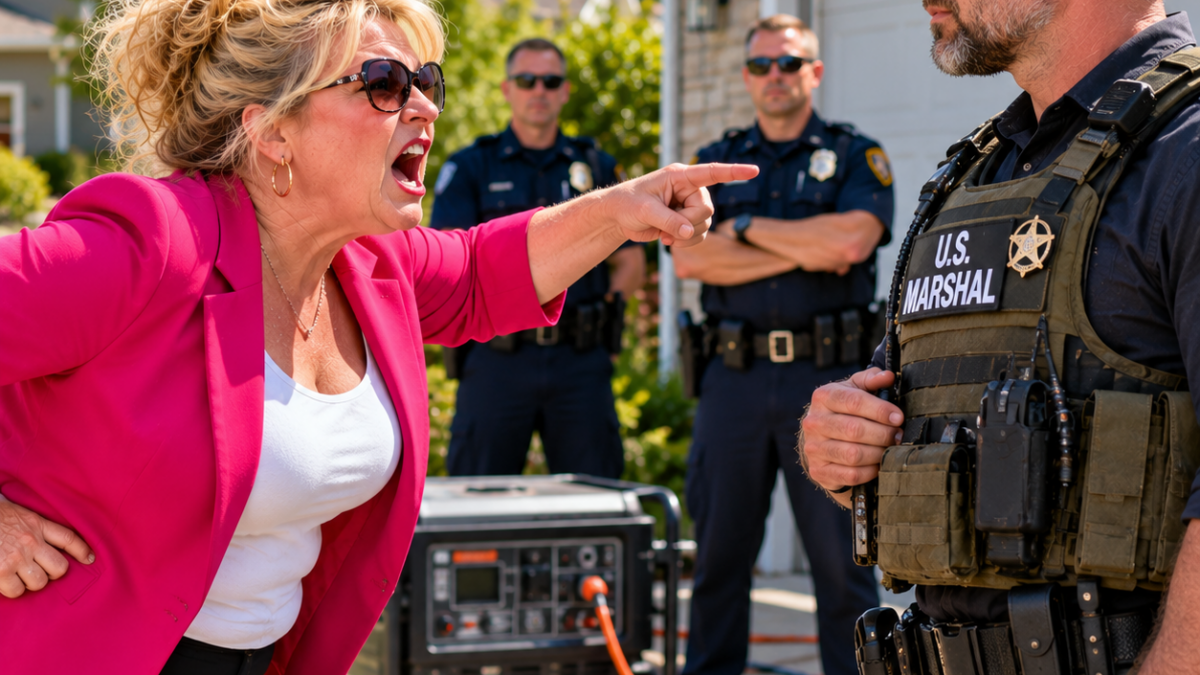
Four years earlier, Ridgefield Estates had seemed perfect for us.
Not perfect in the glossy real-estate sense.
Normal.
That was better.
Sixty-two homes outside Knoxville.
Mostly split-level houses built in the early nineties.
Vinyl siding.
Two-car driveways.
Mailboxes that looked close enough alike that you could miss your own house if you were tired.
Dana worked nights at the county hospital.
Twelve-hour shifts.
Home around seven.
Asleep by eight.
Our daughters had adapted to hospital hours.
Ellie was ten.
Grace was six.
Quiet mornings mattered in our house.
I kept strange hours too.
Federal work.
The kind where you learned early that dinner was not the place to explain everything you had done that day.
We paid $285,000 for the last house at the end of Greenbrier Court.
Biggest lot on the cul-de-sac.
Tree line behind us.
Cedar and pine.
That first summer, I built a six-foot privacy fence myself.
Dana came outside with lemonade.
“You’re burning.”
“I’m fine.”
“You’re red.”
“I’m working.”
“You can be working and red.”
“I’ll survive.”
An hour later she returned.
“Still red.”
I kept building.
That was our marriage.
Not dramatic.
Stable.
A lot of small conversations repeated until somebody eventually listened.
Usually me.
Most mornings, I left at 5:45.
Nobody in Ridgefield knew exactly what I did.
I preferred that.
I didn’t want to be Deputy U.S. Marshal Keith Morrison when I pulled into my driveway.
I wanted to be Dana’s husband.
Ellie and Grace’s dad.
The guy who occasionally forgot trash day.
The neighbor with the crooked cedar fence line.
Then February brought the ice storm.
Power went out across East Tennessee.
First night was almost fun.
Candles.
Flashlights.
Blankets.
Second night wasn’t.
Third night, Ellie started wheezing.
Not an emergency at first.
She had asthma.
We knew the routine.
Nebulizer.
Medication.
Calm voice.
Watch her breathing.
But the battery backup had not been designed for a five-day outage.
At two in the morning, the green light on the machine faded.
Then died.
Dana held a flashlight.
Ellie looked at me.
“Dad?”
“I’ve got it.”
I did not, in fact, have it.
I found a twenty-four-hour Walmart in an area with power.
Thirty-minute drive.
Charged the battery.
Bought every adapter I thought might help.
Drove home through ice.
Ellie was okay.
But I was done trusting the grid as our only option.
The next week I bought a Honda generator.
Propane.
Quality unit.
Not oversized.
Concrete pad beside the garage.
Fourteen feet from the property line.
Clearance met Knox County requirements.
Proper fuel connection.
I tested it every Sunday morning.
Fifteen minutes.
That was it.
For three years, nobody complained.
Then Brenda Caldwell decided it mattered.
Brenda had been president of the Ridgefield Estates HOA for nine years.
Nine.
In an organization where people were theoretically elected.
Nobody seriously challenged her.
She lived four houses down.
Flagpole in front.
WELCOME MAT reading BLESS THIS MESS.
Her Ring camera seemed to notice a squirrel faster than most people noticed the mail.
Gerald, her husband, owned Caldwell Landscape Services.
Three trucks.
Small crew.
He also held the HOA landscaping contract.
$1,800 every month.
I didn’t think anything about that at first.
Most homeowners didn’t.
Gerald had a landscaping company.
HOA needed landscaping.
Fine.
What nobody seemed to ask was how the contract had been awarded.
Brenda ran Ridgefield as if inconvenience were a moral defect.
Trash can outside too late?
$100.
Vehicle facing the wrong direction?
$150.
Front door painted a non-approved blue?
$200.
The notice always came with a photograph.
Date.
Time.
Sometimes a handwritten note.
She had turned suburban rule enforcement into a personal art form.
People paid.
Not because the fines were always valid.
Because fighting Brenda became its own expense.
More letters.
More photographs.
More meetings.
More complaints.
More attention.
That was the culture when my first generator fine arrived.
White envelope.
HOA logo.
UNAPPROVED EXTERIOR EQUIPMENT.
$250.
I called.
Kept it calm.
“Brenda, what provision is this under?”
“The safety provision.”
“Which section?”
“You know what this is about.”
“I know it says generator.”
“Correct.”
“What’s the appeal process?”
“There isn’t one.”
I paused.
“You’re saying there is no appeal.”
“Pay the fine or I’ll place a lien against your property.”
Dana stood behind me while I held the phone.
After I hung up, she read the notice.
“Can she do that?”
“I don’t think so.”
“You don’t think?”
“I’m going to read.”
That night I went through every page of the Ridgefield CC&Rs.
Nothing prohibited my generator.
Nothing came close.
I wrote Brenda.
Certified.
Attached the applicable pages.
Three weeks passed.
No response.
Then fine number two arrived.
Same amount.
$250.
At the bottom, red ink:
LAST WARNING.
I stopped treating it as a personality problem.
I researched Tennessee requirements for HOA enforcement and due process.
Whatever rule an association might enforce, you cannot just manufacture monetary penalties without the notice and hearing procedures required by governing law and the association’s own documents.
So I sent a second certified letter.
This time to the entire board.
I requested a hearing.
Cited the relevant provisions.
Two weeks later, Brenda held what she called an emergency board meeting.
At her kitchen table.
Three members.
No notice to me.
No opportunity to attend.
They increased the fine.
$500.
Then added $50 per day while the generator remained.
Thursday afternoon, I came home and saw neon orange on the front door.
NOTICE OF LIEN.
$1,250 recorded against my house.
I peeled the sticker slowly.
Adhesive smeared across the glass.
It took Goo Gone and twenty minutes to remove.
The paper itself was worse.
Dana and I were refinancing.
We needed cash for a roof before winter.
A lien stopped underwriting.
No refinance.
No roof.
I called the recorder.
Confirmed it was real.
The woman on the phone explained I would likely need legal action to remove a disputed lien if the association refused to release it voluntarily.
I knew that tone.
People who work near legal systems learn it.
It means:
This is fixable.
It is not going to be quick.
Brenda may not have known about our refinance.
But she did know a lien made people uncomfortable.
That was the point.
Then the violation notices expanded.
Dana parked on Greenbrier Court after coming home from a night shift.
Overnight parking violation.
Problem:
Greenbrier Court was county maintained.
HOA didn’t control it.
Ellie left a plastic tricycle near the garage.
$75.
The trampoline in our fenced backyard suddenly became “unapproved recreational equipment.”
$200.
Eleven notices in six weeks.
Total claimed:
$4,800.
No hearings.
No specific covenant citations.
Just Brenda’s signature.
Every time.
Same slanted blue ink.
That was when I started documenting.
Two porch cameras.
One side camera.
Fireproof lockbox.
Every envelope.
Every postmark.
Every notice.
Photographs of the generator.
Tape measure showing setback.
Propane system.
Concrete pad.
CC&Rs printed and highlighted.
I did not confront Brenda.
I did not complain on neighborhood social media.
I did not tell anybody I was a federal officer.
At work, I had learned something useful.
People become careless when they think nobody is seriously watching.
Brenda was becoming careless.
Then she sent the neighborhood email.
URGENT SAFETY CONCERN — RIDGEFIELD ESTATES.
She never used my name.
Didn’t need to.
“One resident is refusing to comply with community safety codes and is storing industrial fuel equipment adjacent to family residences.”
Industrial fuel equipment.
That was my generator.
A machine you could buy at a home-improvement store.
Within a week, two neighbors stopped waving.
A woman who used to talk to Dana crossed the street when she saw her.
Nobody insulted us.
That would have been easier.
Brenda did something more effective.
She made being seen with us feel risky.
Saturday morning, Dale Whitaker knocked.
Retired electrician.
Lived next door.
Two bottles of beer.
Manila folder.
He sat in my garage.
Cracked one open.
“She did it to me too.”
I looked at him.
“What?”
“My shed.”
Dale had an eight-by-ten cedar shed.
Within the size allowed without additional approval.
Brenda fined him $1,600.
“Why’d you pay?”
He shrugged.
“I’m sixty-four.”
“So?”
“I didn’t want to spend retirement arguing with a woman who laminates her own business cards.”
I laughed.
First time any of this had felt funny.
Then he opened the folder.
Not funny anymore.
Fourteen homeowners.
Five years.
Violation notices.
Receipts.
Payments.
No hearings.
No specific covenant provisions.
More than $38,000 in fines.
“Where does it go?” I asked.
Dale took a drink.
“That is the thirty-eight-thousand-dollar question.”
I looked through the records.
Different names.
Same signature.
Same pattern.
Threaten.
Fine.
Escalate.
People pay because the alternative feels exhausting.
Monday I sent a certified request for HOA financial records.
Brenda denied it.
One paragraph.
FINANCIAL RECORDS ARE BOARD-ONLY DOCUMENTS.
REQUEST DENIED.
I saved it.
Three days later, she announced a “community safety forum.”
Dana attended.
I stayed home with the kids.
The featured expert was Gerald.
Brenda’s husband.
He wore his landscaping-company polo.
Not a fire department uniform.
Not an engineering credential.
Not a code enforcement badge.
Landscaping polo.
He gave a slideshow about generators.
Stock images of propane explosions.
Watermarks visible.
Graphs with no sources.
Claims about fumes.
He used the phrase “fire risk” eleven times.
Dana recorded the presentation.
One-party-consent state.
Perfectly lawful for a participant.
Half the room left early.
Nina Dawson stopped beside Dana.
Nina taught high-school biology.
Brenda had fined her $900 over marigolds the board allegedly considered the wrong shade.
Nina whispered:
“This is insane.”
Dana came home.
We listened to the recording together.
Gerald said:
“Any propane-fired equipment could potentially produce a catastrophic event.”
Dana looked at me.
“Do lawnmowers use gasoline?”
“Usually.”
“His company stores those?”
“Yes.”
“Interesting.”
We saved the recording.
Then came the Wednesday night that changed the entire meaning of the generator.
2:00 a.m.
Dana at the hospital.
Grace asleep.
Ellie had mild wheezing before bed.
Nothing unusual.
We’d done her treatment.
She settled.
Then the house went dark.
Instantly.
Not storm flicker.
Not neighborhood outage.
Everything off.
I checked the utility map.
No reported outage.
Called emergency service.
The representative pulled up my address.
Pause.
“Sir, I show a disconnection request.”
“At two in the morning?”
“It was processed overnight.”
“Why?”
“Property listed as vacant.”
I looked upstairs.
“My children are sleeping here.”
“I understand.”
“Who requested it?”
“I can’t provide that information.”
I went outside.
Started the Honda.
First pull.
Ran power safely to the medical equipment we needed.
Fifteen seconds later, Ellie’s nebulizer light came back on.
She never fully woke.
I sat beside her bed.
Watched mist move through the mask.
My hands were shaking.
That generator Brenda called dangerous was the only reason I wasn’t driving through the night again with a sick child.
At eight, I called the utility back.
The disconnection request had been submitted through an online vacancy form.
Somebody claimed we had moved out.
I did not accuse Brenda.
Not yet.
Suspicion is not evidence.
I requested whatever records could lawfully be released.
Timestamps.
Submission information.
Audit trail.
I couldn’t get everything.
But the timing became another piece in the file.
Dale also discovered something through neighborhood camera logs.
Around the submission window, Brenda’s street-facing camera had been manually disabled for approximately forty minutes.
Not proof.
Interesting.
I saved it.
Saturday morning I ran my weekly generator test.
Same routine.
9:00.
Brenda arrived eight minutes later.
That is where this story opened.
She called the generator junk.
Said nobody wanted us there.
Claimed she was placing me under citizen’s arrest.
Then remained on my property after I went inside.
At one point she pressed her face near my sidelight window.
Both cameras recorded her.
Police arrived at 9:36.
Two officers.
I walked outside.
Brenda immediately said:
“This man is operating illegal machinery and threatened me.”
Older officer looked at me.
“Did you threaten her?”
“No.”
“What did you say?”
“That I wasn’t removing the generator.”
Brenda jumped in.
“Exactly.”
The younger officer looked at her.
“That is what you consider the threat?”
“He was aggressive.”
“Did he threaten to harm you?”
“He told me he wasn’t going anywhere.”
The officers exchanged a glance.
I showed them the generator.
Pad.
Fuel.
Setback.
The older officer checked the local noise standard.
Then measured.
The Honda was below the limit.
He looked at Brenda.
“Ma’am, we don’t have a criminal violation here.”
“She’s trespassing,” I said.
Brenda spun.
“You cannot trespass me. I’m the HOA president.”
The younger officer said:
“HOA president does not grant access to private property.”
Brenda looked shocked.
“You’re taking his side.”
“No, ma’am. We’re explaining the law.”
They left without charges.
One officer paused near his cruiser.
Quietly:
“Keep those cameras running.”
Brenda walked away.
At the end of my driveway she turned.
“This is not over.”
Then Grace came outside.
Six years old.
Bare feet.
Pajamas.
She had heard enough.
“Daddy?”
“Yeah?”
“Is that lady going to take our house?”
That was the line that stayed with me.
Not citizen’s arrest.
Not the police.
Not the fines.
My six-year-old daughter believed the woman four houses down might take our home.
I crouched.
“No.”
“Promise?”
“Yes.”
“Can she?”
“No.”
That answer was partly for Grace.
Partly for me.
That afternoon, I sat at the kitchen table.
Opened the file.
For years at Ridgefield, I had been Keith Morrison.
Quiet neighbor.
Odd hours.
Federal work nobody asked about.
I had never mentioned my title.
Never shown Brenda credentials.
Never told a board member.
Never suggested my job made me special.
Because it didn’t.
Not here.
I was a homeowner.
But my job had taught me how systems behaved.
How records connect.
How small lies become bigger when people keep documenting them.
How the strongest cases are often boring collections of dates, signatures, bank entries, and people who independently tell the same story.
I had been a Deputy United States Marshal since I was twenty-six.
Eighteen years.
Serving warrants.
Tracking fugitives.
Court security.
Testifying.
Working cases where consequences were measured in years, not $250 fines.
I did not need my badge.
I needed discipline.
First call:
Colleen Archer.
Private attorney.
West Knoxville.
HOA and nonprofit governance.
$250 an hour.
Dana looked at the fee agreement.
“Ouch.”
“Cheaper than losing the refinance.”
“Fair.”
Colleen filed a motion compelling production of HOA financial records.
Brenda’s denial became Exhibit A.
Judge signed the order in nine days.
Financial records arrived in two banker boxes.
Colleen and I sat in her conference room.
Cold coffee.
Buzzing fluorescent light.
We went through everything.
Six years of dues.
Fines.
Reserve account.
Vendor payments.
Approximate dues and fine collections:
$138,000.
Reserve balance:
$4,100.
I stared.
“That’s it?”
“That’s it.”
Then Gerald’s company.
Caldwell Landscape Services.
$1,800 every month.
Six years.
No competitive bids.
No recorded vote approving a related-party contract.
No disclosure process we could find.
Then Colleen found another stack.
Green Valley Crew.
$600 per month.
Description:
WEEKLY MOWING AND EDGING — RIDGEFIELD ESTATES COMMON AREAS.
I read it twice.
“Isn’t that what Gerald bills eighteen hundred for?”
“Yes.”
“So Gerald gets eighteen.”
“Yes.”
“Pays them six.”
“Yes.”
“Does no actual mowing.”
“That appears to be what the records show.”
Difference:
$1,200 monthly.
Seventy-two months.
$86,400.
I leaned back.
There are cases where a number changes the atmosphere in a room.
That one did.
This wasn’t a cranky HOA president anymore.
It was self-dealing.
Undisclosed related-party payments.
Potential misuse of association funds.
And a reserve account almost empty.
Colleen closed the box.
“We need member signatures.”
“For?”
“Special meeting.”
“How many?”
“Twenty-five percent under your governing documents.”
Sixty-two homes.
Sixteen signatures.
I drove home.
Dana was making pasta.
Garlic.
Red pepper.
Ellie called it spicy noodles.
I kissed Dana.
“I found the money.”
She stopped stirring.
“How bad?”
“Bad.”
“Criminal?”
“Potentially.”
Her eyes changed.
“Keith.”
“I know.”
“Do not turn this into work.”
“I’m not.”
“Promise me.”
“I’m handling everything privately.”
“No badge.”
“No agency resources.”
“No favors.”
She nodded.
“Okay.”
I called Dale.
“I found where the money went.”
“I’ll be there in ten.”
“Bring whatever records you have.”
“I’m bringing Ray.”
Ray Sutton.
Seventy-one.
Retired forensic accountant.
Walked with a slight limp after knee surgery.
Brenda had fined him twice.
Birdbath.
Garage door open too late.
He paid.
Saved receipts.
Two hours in my garage and Ray had transformed six years of chaos into one legal pad.
Dues.
Fines.
Gerald’s payments.
Green Valley payments.
Reserve.
He circled $4,100.
“This HOA is practically insolvent.”
Dale whistled.
Ray looked at him.
“If the clubhouse gets a major plumbing failure tomorrow, they cannot pay for it.”
I asked:
“You confident in these numbers?”
Ray looked offended.
“I audited manufacturing companies for thirty years.”
“I’m asking because we’re going to put your name on this.”
“Good.”
That was Ray.
Three tracks.
Legal.
Financial.
Community.
Colleen prepared the special-meeting petition.
Ray prepared a two-page financial summary.
No jargon.
Money in.
Money out.
Where the difference went.
I handled the third track.
I walked into the Knox County District Attorney’s office during lunch.
Sat in the lobby.
Filled out a citizen complaint.
False police report.
Questionable recorded lien.
Potential misuse of HOA funds.
I attached documentation.
Camera footage.
Fine notices.
Financial summary.
I wrote:
Keith Morrison
Homeowner
Lot 58
Ridgefield Estates.
Nothing else.
No title.
No agency.
No badge.
The DA decides whether a complaint deserves action.
Not me.
Thursday, petitions went out.
Dale took the east side.
Nina took the west.
I handled our cul-de-sac and nearby streets.
Nina was incredible.
She didn’t attack Brenda.
She knocked.
Introduced herself.
Handed people Ray’s summary.
“I’m not here to tell you how to feel.”
Then:
“I’m here to show you where the money went.”
People read.
Some signed immediately.
Some closed the door.
Some whispered.
By Sunday:
Eleven signatures.
Five short.
I locked the signed pages in my fireproof box.
The generator sat three feet away.
Quiet.
I rested a hand on it.
Five signatures.
Monday, Brenda learned.
Wednesday:
Cease-and-desist letter.
Real attorney this time.
Me.
Dale.
Nina.
Colleen.
Accusations of coordinated harassment and defamation.
Threat:
Civil suit seeking more than $50,000 unless petition withdrawn.
Dana read it while Ellie ate cereal.
“Can they sue?”
“Anyone can file something.”
“That is not comforting.”
“It doesn’t mean they win.”
Colleen responded immediately using Tennessee’s protections against lawsuits designed primarily to silence protected participation.
She wasn’t impressed.
Then Thursday afternoon, I came home and found the generator on its side.
Not tipped.
Dragged.
Concrete pad scarred.
Propane disconnected.
Pull-start housing cracked.
I opened the side-camera footage.
2:15 p.m.
Gerald’s landscaping truck.
Gerald entering my side yard.
Gerald moving the generator off the pad.
Four minutes.
Clear.
I called the sheriff.
Deputy watched.
“Want to make a complaint?”
“Yes.”
No drama.
Just a report.
Brenda responded by going door to door.
She told residents signing the petition could expose them personally to lawsuits.
She claimed I was connected to government people and was using taxpayer resources against volunteer board members.
That was false.
But fear works faster than corrections.
Five homeowners withdrew signatures.
Eleven became six.
That night, I sat on the porch.
Fireflies over the tree line.
Dana brought me a beer.
Sat down.
Neither of us spoke.
After a while:
“Want to quit?”
I looked at her.
“Do you?”
“No.”
“Then no.”
Nina didn’t quit either.
Saturday she posted her own story publicly.
Not an attack.
Just facts.
Marigolds.
$900.
Threatened lien.
Photo of the same flowers still growing.
Comments poured in.
“She fined me too.”
“Same thing happened with my fence.”
“She charged me over my kid’s basketball hoop.”
“Never got a hearing.”
Three withdrawn petitioners came back.
Two new signatures.
Eleven again.
Dale knocked doors.
Nina called residents.
Fourteen by Thursday.
Two short.
Then Brenda helped us.
Emergency board meeting.
Her house.
No proper neighborhood notice.
Three loyal votes.
Two new “rules.”
One:
Ban all fuel-powered equipment stored outdoors.
Two:
$1,000 per day for safety violations.
Effective immediately.
She emailed all sixty-two households.
Colleen called me twelve minutes later.
“These rules are void.”
“Why?”
“Your CC&Rs require sixty percent of members for this category of rule change.”
“Thirty-eight votes.”
“Correct.”
“She has three.”
“Correct.”
I wrote one page.
No attorney letterhead.
No threats.
Just the exact CC&R section.
Page number.
Voting requirement.
Dale and Nina delivered it.
Six more signatures in five days.
Fourteen became twenty.
Then twenty-four.
We had more than enough.
Brenda called county code enforcement.
Inspector came.
Measured generator.
Checked pad.
Fuel.
Clearance.
“Compliant.”
Left.
Then she called the fire marshal.
Inspection.
Six minutes.
Everything compliant.
Inspector looked at my Honda.
“Good unit.”
“I like it.”
“I have the same one.”
That almost made me laugh.
By then our file contained:
False police allegation.
Lien without hearing.
Utility vacancy request.
Code complaint.
Fire complaint.
Family fines.
Camera footage.
Financial records.
Landscape payments.
Petition signatures.
Independent inspections.
Everything had dates.
Everything had documents.
Colleen sent formal notice.
Special meeting.
November 9.
Twenty-one days.
One agenda item.
Removal of the current board.
After that, I stopped moving.
Nothing else to do.
Brenda had the next move.
November 9 was a Saturday.
By 9:45, the clubhouse parking lot was full.
Forty-one homeowners attended.
Nobody remembered more than twelve showing up before.
Dale pulled extra folding chairs from storage.
Metal legs scraping tile.
Nina started coffee.
Brenda sat in the front row.
Navy blazer.
Reading glasses on a chain.
Binder.
Tabs.
Color-coded.
Gerald beside her.
Two board loyalists.
She looked ready to preside.
She no longer controlled the meeting.
Colleen stood at the front.
“Petition is valid.”
She explained quorum.
Authority.
Single motion.
Removal of all five board members.
Ray walked up.
Legal pad.
No theatrics.
“In the past six years, this association collected approximately one hundred thirty-eight thousand dollars in dues and fines.”
Room quiet.
“Current reserve balance: four thousand one hundred dollars.”
People shifted.
“Caldwell Landscape Services received approximately one hundred twenty-nine thousand six hundred dollars.”
Gerald looked at Brenda.
Ray continued.
“The records do not show competitive bidding or appropriate disclosure of the president’s relationship to the vendor.”
Then:
“The landscaping work was actually performed by Green Valley Crew for approximately six hundred dollars per month.”
Projector came on.
Two columns.
Caldwell payment.
Green Valley payment.
Difference.
Approximately $86,400 over six years.
Someone whispered:
“Eighty-six thousand?”
Another:
“Where is it?”
Ray stopped.
He didn’t need to answer.
Brenda stood.
“This is outrageous.”
Colleen said:
“You’ll have an opportunity to speak.”
“I will speak now.”
She turned toward the room.
“This man has harassed this board for months.”
She pointed at me.
“He runs hazardous equipment beside family homes.”
I stayed seated.
“He has brought outside lawyers and accountants into internal association matters.”
Ray said quietly:
“I live here.”
Someone laughed.
Brenda ignored it.
“He intimidated me on his property.”
“That sentence is interesting,” Dale muttered.
Brenda’s voice rose.
“He is trying to destroy a volunteer organization that has kept this neighborhood safe for nine years.”
I stood.
Didn’t shout.
“My generator is county compliant.”
Silence.
“Fire compliant.”
A few nods.
“I requested a hearing before every fine.”
I held up the notices.
“None was provided.”
Then:
“I asked for financial records.”
Held up Brenda’s denial.
“She refused.”
Then:
“The only thing I did differently from everyone who paid and stayed quiet was ask where the money went.”
From the back:
“Vote.”
Another voice:
“Vote.”
Then several.
Colleen called the motion.
Ballots counted.
Thirty-eight for removal.
Three against.
Brenda.
Gerald.
One loyal board member.
Motion carried.
No cheering.
That matters.
Nobody celebrated.
The room exhaled.
That is the only way I can describe it.
Forty-one people breathing out at the same time.
Nine years of tension leaving a room.
Then the clubhouse door opened.
Two men stepped inside.
Navy windbreakers.
Gold lettering.
U.S. MARSHALS.
Hector Reese.
Sam Calloway.
I knew both.
Field office.
Behind them came Assistant District Attorney Whitfield carrying a manila folder.
I had known local process was moving.
I had not expected that timing.
Brenda looked at the jackets.
Then at me.
Then back at them.
Her expression changed.
Slowly.
“You…”
She stopped.
That was the first time Brenda learned exactly what I did.
Whitfield stepped forward.
“Brenda Caldwell?”
She looked at him.
“Yes.”
He served her a summons.
Counts related to the false police report and disputed lien filing.
Gerald received a separate summons related to damage to my generator.
Hector didn’t serve either document.
Neither Marshal did.
This was not federal enforcement.
They were there with Whitfield as part of an official courthouse-related coordination that morning and remained by the entrance.
But Hector caught my eye.
Small nod.
Nothing more.
Everyone saw it.
Brenda looked at me again.
“You’re a Marshal?”
I answered:
“Yes.”
Her face went pale.
“You never said—”
“No.”
“You should have disclosed that.”
“To the HOA?”
No answer.
“Why?”
She looked around.
Nobody helped her.
I continued:
“I didn’t use my job in this dispute.”
She held the summons.
“You filed these charges.”
“No.”
“I filed a citizen complaint.”
“With your connections.”
“No federal database. No agency letterhead. No work phone. No badge.”
I pointed toward the financial summary.
“This meeting happened because your neighbors signed a petition.”
Then toward the papers in Whitfield’s hand.
“And whatever happens there is their decision.”
Gerald touched her elbow.
“Brenda.”
She pulled away.
For years, she had been the person who told everyone else when the conversation was finished.
Now she was standing in a room where her authority had ended by vote before the summons even arrived.
She gathered her binder.
Gerald picked up his papers.
They walked toward the door.
Past forty-one neighbors.
Past Hector.
Past Sam.
No booing.
No applause.
Just silence.
Brenda’s heels clicked across tile.
She had walked through that clubhouse door hundreds of times as HOA president.
This was the last time.
Six weeks later, Brenda entered a guilty plea on the false-report charge.
$500 fine.
Twelve months probation.
The lien against my house was removed.
County record corrected.
Credit update followed.
Dana and I closed our refinance in January.
Roof installed by March.
The first night rain hit the new shingles, Dana stood in the hallway listening.
“No drip.”
“Expensive way to achieve dryness.”
“Worth it.”
“Yes.”
Gerald resolved the generator-damage case separately.
Restitution for the broken housing and pad damage.
Community service.
I replaced the damaged pull-start assembly myself.
Eighteen dollars.
The generator looked exactly like it had before.
That felt right.
Civil and association financial consequences took longer.
New board hired an independent attorney and accountant.
Six-year review.
Ray’s findings held.
Then expanded.
Final restitution obligation against Brenda and Gerald was approximately $88,000.
They did not have the amount sitting in cash.
Their house went on the market.
Sold in April.
They moved to a rental outside Ridgefield.
No neighborhood celebration.
No balloons.
No one stood outside watching the moving truck.
By then, people were tired.
The new board was different.
Dale Whitaker became president.
Reluctantly.
Nina threatened to nominate him whether he agreed or not.
He accepted.
Nina became treasurer.
Clint Ackerman joined as secretary.
Clint had finally broken with Brenda after years of silence.
The issue that pushed him?
His fourteen-year-old son’s basketball hoop.
Brenda fined him $800.
Forced him to remove it.
The week Clint joined the new board, the hoop went back up.
Saturday morning, I heard the basketball from my kitchen.
Bounce.
Bounce.
Rim.
Bounce.
Nobody photographing it.
Nobody calculating a fine.
Just a kid shooting.
First action of the new board:
Review every fine issued without a proper hearing.
Fourteen homeowners received refunds.
Nina hand-delivered checks.
Some were small.
Some large.
Two homeowners cried.
Not because $300 or $900 changed their lives.
Because somebody finally said:
You were right to question this.
Second action:
Cancel Gerald’s landscaping contract.
Hire Green Valley Crew directly.
Same mowing.
Same edging.
$600 monthly instead of $1,800.
The $1,200 monthly savings went into reserves.
Within a year, the reserve account actually looked like a reserve account.
Third action was Nina’s.
Ridgefield Emergency Power Fund.
Voluntary.
Ten dollars a month from participating households.
Purpose:
Backup generators and power equipment available to residents during outages.
Priority for elderly homeowners.
Medical equipment.
Refrigerated medicine.
Mobility equipment.
People who would be put at risk by losing electricity.
The vote was almost unanimous.
First borrower was Mrs. Helen Watkins.
Eighty-one.
Birchwood Lane.
She used an oxygen concentrator at night.
When Dale delivered the generator, she stood in the doorway crying.
Not dramatically.
Embarrassed.
“I didn’t know I could ask.”
Dale said:
“That’s what it’s for.”
She wiped her face.
“Brenda would’ve sent me a form.”
Dale smiled.
“I brought no forms.”
That hit me harder than any court result.
The machine Brenda called dangerous became part of a program that made people safer.
That was a better ending than watching her lose.
I started teaching a monthly class at the community center.
Colleen helped with materials.
KNOW YOUR HOA RIGHTS.
Three basics.
Read the recorded governing documents.
Know how to request financial records.
Know how homeowners can petition for meetings and challenge unsupported enforcement.
No federal procedure.
No badge.
No secret law-enforcement trick.
Homeowner stuff.
At the first class, eleven people came.
One drove forty minutes from another subdivision.
She brought a stack of violation letters.
“Does any of this apply where I live?”
“Depends on your documents.”
She looked disappointed.
“You can’t just tell me they’re wrong?”
“No.”
“Why?”
“Because the fastest way to lose a legitimate argument is to skip the paperwork.”
Colleen smiled from the back.
“That’s the whole class.”
The generator never left its concrete pad.
I still test it.
Fifteen minutes.
Sunday mornings now instead of Saturday.
Propane valve.
Start.
Low hum.
Nobody complains.
One summer Dale walked over during a test.
“I’m thinking of buying one.”
“For what?”
“After that ice storm, I’m done taking chances.”
“What size?”
He showed me a brochure.
We talked twenty minutes.
The same neighborhood that once treated my generator like a threat now kept two community units in secured storage.
That irony was not lost on anyone.
July brought the first real block party under the new board.
No mandatory attendance.
No HOA newsletter declaring unity.
People simply showed up.
I smoked brisket.
Nine hours.
Offset smoker I built from an old propane tank.
Dana stared at it.
“Do you realize the HOA once called your generator dangerous because it used propane?”
“I’ve considered that.”
“And now you converted a propane tank into a smoker.”
“Technically it stopped being a propane tank first.”
“That sentence does not help.”
Dale brought homebrew.
Nina brought sheet cake.
Yellow frosting:
WELCOME HOME.
Nobody had moved in.
Everyone understood.
For years, Ridgefield had been sixty-two houses.
After Brenda, it started becoming neighbors.
Grace sat on my shoulders after dark.
Somebody set off fireworks beyond the tree line.
Smoke drifted over my cedar fence.
Pine.
Mesquite.
Summer grass.
Grace leaned down.
“Daddy?”
“Yeah?”
“Is the mean lady coming back?”
Children remember strange things.
“No.”
“She can’t take our house?”
“No.”
“Because you’re a Marshal?”
That caught me.
“No.”
She frowned.
“Then why?”
“Because it was never hers to take.”
She thought about that.
Then pointed toward the sky.
“Look!”
Firework.
Conversation over.
But her question stayed with me.
People assumed Brenda lost because she discovered I was a U.S. Marshal.
That makes the story more entertaining.
It is also wrong.
My badge had nothing to do with the homeowners reading their financial records.
Nothing to do with Nina knocking on doors.
Nothing to do with Dale saving his old fines.
Nothing to do with Ray doing the math.
Nothing to do with Colleen winning access to the books.
Nothing to do with thirty-eight homeowners voting Brenda out.
If I had been a teacher, plumber, mechanic, accountant, or retiree, the documents would have been the same.
That was the point.
Brenda’s mistake wasn’t choosing the wrong person to bully because my job happened to involve federal law enforcement.
Her mistake was believing ordinary homeowners had no power unless somebody important rescued them.
Nobody rescued Ridgefield.
Ridgefield finally organized.
There’s a difference.
Dale learned that.
Nina already knew it.
Wade—one of the former board members—learned it late.
He came to my house months later.
I was washing my truck.
“Keith.”
“Hey.”
He stood awkwardly.
“I owe you an apology.”
“For what part?”
He smiled weakly.
“Fair.”
I shut off the hose.
He continued.
“I knew some of Brenda’s fines were questionable.”
“Did you vote for them?”
“Sometimes.”
“Why?”
“I didn’t want to become a target.”
There it was.
Again.
Same sentence everybody used in different words.
“I thought keeping the board stable was more important than fighting over little things.”
“Were they little?”
“No.”
He looked toward the street.
“I know that now.”
I nodded.
“Okay.”
“That’s it?”
“What do you want?”
“I don’t know.”
“You apologized.”
“Yes.”
“I heard you.”
He seemed almost disappointed that I didn’t punish him.
But I had no interest in becoming Brenda with better motives.
People learn.
Or they don’t.
My job wasn’t to control the learning process.
The refunds changed Ridgefield.
Not financially as much as emotionally.
Nina delivered one check to Ray Sutton.
$350.
Birdbath and garage-door fines.
Ray looked at it.
“This is not enough.”
Nina froze.
“The audit—”
“I don’t mean the amount.”
He took the check.
“I mean this isn’t enough.”
“For what?”
“Rules need to change.”
He was right.
So the board adopted procedures.
Written citation.
Specific covenant section.
Evidence.
Opportunity to respond.
Hearing before monetary penalties.
Board member conflicts disclosed.
No president unilaterally approving a contract involving a spouse.
Competitive bids above a threshold.
Quarterly financial statements.
Member access.
Boring.
Very boring.
Beautifully boring.
Brenda’s board had thrived on ambiguity.
The new one used process.
At one meeting, somebody complained:
“This takes too long.”
Dale answered:
“Good.”
“What?”
“If taking somebody’s money is inconvenient, good.”
I almost applauded.
Almost.
My federal job returned to being invisible at home.
That was how I wanted it.
Neighbors knew after November.
Of course they did.
For a while, people acted differently around me.
Too polite.
A little stiff.
One man asked whether federal marshals could issue speeding tickets.
“No.”
Another asked if I could look up his ex-wife’s boyfriend.
“No.”
“Just checking.”
“Don’t.”
Eventually the novelty wore off.
I became Keith again.
Best possible outcome.
At work one Monday, Hector stopped by.
“You know Brenda thought we were there for her because of you.”
“I know.”
“You could have corrected her.”
“I did.”
“She believe you?”
“No.”
He laughed.
“Probably never will.”
Then:
“You handled it clean.”
That mattered.
I had been careful.
No government resources.
No agency influence.
No implied threat.
No badge on the HOA table.
My workplace never became a weapon in a neighborhood argument.
I was proud of that.
Because authority is easiest to misuse when you can convince yourself you deserve to misuse it.
Brenda had taught me that better than anybody.
The strangest moment came almost a year later.
Ice storm warning.
Not as bad as the one that started everything.
But enough that people got nervous.
The new board sent an email.
Not from a president’s personal account.
Official Ridgefield address.
WEATHER PREPARATION.
Locations of community generators.
Instructions for requesting one.
Priority guidelines.
Emergency contacts.
No panic.
No blame.
No fake safety expert.
Dana read it.
“Look at this.”
I did.
At the bottom:
Residents dependent on powered medical equipment are encouraged to contact the emergency-power coordinator before the storm.
Dana looked toward Ellie.
“She’s older now.”
“Yeah.”
“She still needs it sometimes.”
“Yeah.”
She put the phone down.
“That generator was the best thing you ever bought.”
“I thought marrying you was.”
“Generator is more reliable.”
Fair.
Power went out for three hours that storm.
I started the Honda.
Ellie was reading in bed.
Grace asked if she could plug in her tablet.
“No.”
“Why?”
“Emergency loads.”
“But I’m bored.”
“You’ll survive.”
“This is an emergency.”
“It is not.”
The generator hummed.
Our lights stayed on where needed.
Across the neighborhood, one of the community units went to Mrs. Watkins.
The other went to a family with an infant requiring powered medical equipment.
No arguments.
No forms beyond a simple checkout sheet.
Nobody called the machines dangerous.
Nobody threatened liens.
I stood at the garage door listening.
Three years earlier, that sound meant defiance because Brenda had decided it did.
Now it simply meant power.
That’s how much meaning one person can impose on ordinary things.
A generator.
A basketball hoop.
Marigolds.
A shed.
A garbage can.
None of them were the real issue.
The real issue was whether one person got to decide that disagreement itself was misconduct.
Once Ridgefield stopped accepting that, Brenda’s control vanished fast.
That is the part people miss.
Her power looked enormous right up until everyone stopped lending it to her.
Nina said that better at a board meeting.
A homeowner asked:
“How did she get away with it for nine years?”
Nobody answered.
Then Nina said:
“One household at a time.”
Everyone looked at her.
“She never fought sixty-two houses.”
Nina folded her hands.
“She fought Dale alone. Ray alone. Me alone. Keith alone.”
She paused.
“And we all thought we were the only difficult person.”
That was exactly it.
Isolation had been Brenda’s strongest rule.
Not written in the CC&Rs.
Still effective.
Once people compared letters, the system collapsed.
Ray’s birdbath.
Nina’s flowers.
Clint’s basketball hoop.
My generator.
Different violations.
Same process.
No hearings.
Threats.
Money.
Silence.
When you put the files together, the pattern became undeniable.
A couple of years later, Gerald’s old landscaping subcontractor still mowed Ridgefield.
Green Valley Crew.
Same workers.
Same truck.
One third the old price.
One morning I saw them edging around the entrance sign.
The supervisor waved.
I waved back.
That was it.
Nobody needed to make Gerald’s name part of every mowing day.
That money went back into reserves.
Then the board used part of the healthier reserve to repair clubhouse plumbing.
Ray attended the meeting.
Dale announced the bid.
Ray looked at me.
“Remember?”
“What?”
“I told you if a pipe broke, the old board couldn’t afford it.”
I laughed.
“How much is the repair?”
“Seven thousand.”
“Reserve?”
“Plenty.”
He smiled.
“That is what a reserve is.”
Accountants celebrate differently.
Brenda’s old house eventually sold again.
New family.
The Martins.
Two boys.
One dog that barks at delivery trucks.
They had nothing to do with what happened.
At first, people treated the house strangely.
Like it carried history.
Nina put an end to that.
She brought the Martins a welcome basket.
Then told everyone else:
“They bought a house, not a criminal record.”
Correct.
Within months, it was simply another Ridgefield home.
That mattered to me too.
Justice isn’t permanent suspicion.
People should get to begin again where they had no part in what happened before.
One Saturday, Mr. Martin walked down while my generator ran.
I thought:
Here we go.
He pointed.
“Honda?”
“Yeah.”
“How many watts?”
I told him.
“You like it?”
“Very much.”
“My wife wants backup power.”
“Smart.”
He smiled.
“HOA okay with them?”
I looked at him.
Then laughed.
“What?”
“Long story.”
He eventually bought one.
Placed it correctly.
Had fuel installed correctly.
Registered it with no one because no HOA approval was required.
Perfect.
The monthly rights class continued.
Sometimes nobody came.
Sometimes fifteen people.
Colleen occasionally joined.
I taught people to start with their own documents.
Not internet rage.
Not assumptions.
Not:
The HOA can never do that.
Sometimes an HOA can.
Sometimes it can’t.
The answer lives in statutes, declarations, bylaws, rules, notices, procedures.
Evidence.
Boring things.
One man wanted advice about a fence.
“Board says no vinyl.”
“What do your covenants say?”
“I don’t know.”
“Bring them.”
“But do you think—”
“No.”
He looked annoyed.
“Why won’t you answer?”
“Because Brenda spent nine years answering questions without checking what the documents actually said.”
He came back the next month.
Covenants allowed vinyl.
Board corrected itself.
No war.
No citizen’s arrest.
No federal officers.
Just paperwork.
That was progress.
Ellie turned thirteen.
Asthma better controlled.
Generator still there.
One day she asked why I test it so often.
“Engines need exercise.”
“Like people?”
“Sort of.”
“Is that why you run?”
“I don’t run.”
“You should.”
“Go do homework.”
She smiled.
Then:
“Mom says you bought it because of me.”
“Yes.”
“Would you have fought Brenda if it wasn’t for me?”
I thought.
“Eventually.”
“That means no.”
“Probably slower.”
She looked toward the generator.
“I’m glad you didn’t get rid of it.”
“So am I.”
I never told her how scared I had been that night in the ice storm.
Children don’t need every version of their parents.
They need enough.
The federal part of the story became neighborhood legend.
New residents eventually heard:
“Did you know Keith is a Marshal?”
Somebody always exaggerated.
“He had federal agents arrest the HOA president.”
No.
“He ran a sting operation.”
Definitely no.
“He had the FBI audit the HOA.”
Absolutely not.
Whenever I heard it, I corrected people.
The truth was better.
A homeowner requested records.
An attorney obtained them through court.
A retired accountant read them.
Neighbors petitioned.
Members voted.
Local authorities handled local complaints.
My coworkers showing up during the final meeting was memorable.
It was not the mechanism.
I cared about that distinction because otherwise the lesson becomes:
Hope your HOA bullies the wrong federal agent.
That is a useless lesson.
The real lesson is:
Know the rules.
Keep records.
Compare experiences.
Use the process.
Do not assume the loudest person understands the law.
Most importantly, stop letting people stand alone.
That was what fixed Ridgefield.
Not me.
Us.
Dana understood that before I did.
One night after the meeting, we sat on the porch.
Brenda gone.
Kids asleep.
Dana said:
“You know what changed everything?”
“The audit.”
“No.”
“Dale.”
“The folder?”
“Yes.”
I thought.
“If he hadn’t kept it…”
“You’d still have found something.”
“Maybe.”
“But he was the first person who told you you weren’t crazy.”
That was true.
Brenda had spent months making each complaint sound personal.
Keith hates HOA rules.
Keith has dangerous equipment.
Keith is hostile.
Keith refuses compliance.
Dale opened a folder and proved the pattern existed before me.
Sometimes that is the most important thing one person can give another.
Not evidence.
Perspective.
You’re not imagining it.
It happened to me too.
Years later, I still keep Brenda’s first generator fine.
Not framed.
That would be weird.
It’s in the fireproof box.
$250.
UNAPPROVED EXTERIOR EQUIPMENT.
Blue signature.
Sometimes when I add tax records or insurance papers, I see it.
It reminds me of how small all this started.
One envelope.
I could have paid it.
Probably would have, if she had stopped.
Then she sent another.
Then a lien.
Then my wife.
Then my kids.
Then the utility issue.
Then police.
Then she stood in my driveway and tried to detain me.
People ask which move destroyed her.
There wasn’t one.
That is what Brenda never understood.
She thought every escalation made me more likely to quit.
Actually, every escalation created another record.
Another witness.
Another person uncomfortable with what she was doing.
Another reason to look at the books.
Eventually she had produced more evidence against herself than I ever could have created on my own.
That is why I never yelled at her.
People sometimes interpret calm as weakness.
In my experience, calm gives other people room to show you exactly who they are.
Brenda used every inch.
I saw her one final time about two years after she left Ridgefield.
Grocery store.
Dana and I were buying things for a cookout.
Brenda was at the end of another aisle.
She saw me.
Stopped.
I stopped.
Dana whispered:
“Keep walking.”
I did.
No confrontation.
No “how does it feel?”
No speech.
No reminder that she once tried to put me under citizen’s arrest.
Nothing.
In the parking lot, Dana said:
“Proud of you.”
“For walking past someone?”
“For not being dramatic.”
“I’m never dramatic.”
She stared.
“Federal officer with a smoker made from an old propane tank.”
“Functional design.”
“Sure.”
We loaded groceries.
Went home.
That evening people gathered in our backyard.
Nina.
Dale.
Ray.
Clint.
Mrs. Watkins.
The Martins.
Kids.
Dogs.
Somebody brought terrible potato salad.
Nobody admitted who.
Generator sat beside the garage.
Off.
No need for it.
The power was on.
After sunset, Grace asked me to lift her so she could hang one last string light.
She was older now.
Too heavy for the easy shoulder ride she used to get.
I lifted her anyway.
“Higher.”
“This is as high as you’re getting.”
“Dad.”
“Genetics.”
She clipped the light.
I set her down.
The strand came on.
Warm bulbs along the cedar fence.
The same fence I built our first summer.
The same house Brenda had threatened with liens.
The same driveway where she stood announcing she could detain me.
Nothing looked different.
That’s what I liked.
Our home had never needed to become a symbol.
It just needed to become safe again.
At nine, people started leaving.
Dale stayed last.
He stood beside the generator.
“Funny.”
“What?”
“All this because of that.”
I looked at it.
“No.”
He raised an eyebrow.
“Not because of the generator.”
“Then what?”
“Because everybody kept paying.”
Dale thought about that.
Then nodded.
“Yeah.”
He headed home.
I locked the garage.
Checked the girls.
Dana already asleep.
Before turning off the kitchen light, I looked outside.
Greenbrier Court quiet.
No HOA patrol.
No Brenda.
No headlights crawling past looking for violations.
Just houses.
The generator remained on its pad.
Fourteen feet from the property line.
Exactly where it had always been.
Every Sunday I still test it.
Valve open.
Engine start.
Fifteen minutes.
Low steady hum.
Some mornings Dale walks over with coffee.
Some mornings nobody notices.
That is how it should be.
When the test ends, I shut it down.
The neighborhood gets quiet again.
And every time I do, I think about Brenda Caldwell standing in my driveway telling me she had the authority to stop me.
She thought the surprising part of the story was that the neighbor she targeted happened to be a Deputy U.S. Marshal.
It wasn’t.
The surprising part was that I never needed to be one.
She lost to deeds.
Receipts.
Camera footage.
Bank statements.
Meeting rules.
A retired electrician.
A biology teacher.
A forensic accountant.
An attorney.
Thirty-eight homeowners who finally raised their hands at the same time.
That is what took her power away.
The badge only made her realize, much too late, how badly she had misunderstood the quiet man at the end of Greenbrier Court.
But by then, it didn’t matter who I was.
Ridgefield had remembered who the neighborhood belonged to.
Not Brenda.
Not a five-person board.
Not whoever signed the most violation letters.
It belonged to the sixty-two families who lived there.
And once they remembered that, Brenda’s nine-year presidency ended in one vote.
The generator?
It stayed.
More importantly, so did we.
And the next time the power went out, nobody in Ridgefield had to wonder whether asking for backup electricity would make them somebody else’s target.
That, more than the summons, the refunded fines, or watching Brenda leave the clubhouse for the last time, was the ending I wanted.
A home where my daughters stopped asking whether somebody could take it away.
A neighborhood where an eighty-one-year-old woman could ask for a generator without being afraid.
And a Sunday morning where fifteen minutes of quiet engine noise was exactly what it should have been all along.
Nothing more than a father making sure the lights would stay on when his family needed them.

