PART 2: HOA Karen Tore Open My Private Road in Three Places—She Knew Exactly What Was Buried Under It
PART 2
I didn’t sleep much that night.
Not because I thought Brenda was bluffing.
By then, I knew she wasn’t.
The woman had spent nearly a year turning a private road into the center of her presidency, and every time reality got in her way, she simply created another document suggesting reality had changed.
The road had been part of my property since before I bought the house.
That was not complicated.
My deed said it.
The county records said it.
The subdivision plat said it.
The HOA’s own original documents said it.
But Brenda had never been especially interested in what documents said before she got hold of them.
She liked what she could make them appear to say afterward.
I bought the Ridgecrest house twelve years earlier from a retired couple named Martin and Ellen Farrow.
The place itself wasn’t extravagant.
Three bedrooms.
Brick front.
Two-car garage.
A porch overlooking the dead end.
What made the purchase unusual was the road.
The Farrows had retained ownership when the rest of Ridgecrest was divided years earlier, and that ownership transferred with the house.
The real-estate attorney pointed it out at closing.
“You understand you’re getting the access road too?”
I remember laughing.
“What am I supposed to do with a road?”
“Maintain it.”
“That doesn’t sound like a benefit.”
“It’s property.”
“So is poison ivy.”
He laughed.
Then he made me initial the deed exhibit.
I am glad he did.
For twelve years, I treated that road like any other piece of property.
When a pothole appeared, I patched it.
When rain washed gravel from the shoulder, I replaced it.
Every March, I rented a small grader for half a day and reshaped the drainage edges.
I didn’t charge the neighbors.
Never wanted to.
People needed access.
Mail carrier.
Trash.
Delivery trucks.
Emergency services.
All I asked was that nobody pretend the road belonged to somebody else.
For eleven years, nobody did.
Then Brenda Hollister moved into Number 14.
She drove a white Mercedes SUV that always looked freshly washed.
Gerald, her husband, drove a Tahoe and somehow managed to look irritated even when he was carrying groceries.
Brenda had opinions within her first week.
Mailbox placement.
Street lighting.
Garbage collection.
Tree trimming.
She wasn’t HOA president then.
Ridgecrest barely had an HOA.
The old board had effectively dissolved from lack of interest.
Nobody wanted the job.
Dues were minimal.
Meetings happened only when necessary.
Then Brenda volunteered.
Nobody ran against her.
She nominated herself.
One of the remaining board members shrugged and seconded it.
Brenda voted.
Gerald voted.
Two other people raised their hands.
That was how Ridgecrest suddenly had a president who behaved as if she had been appointed governor.
Her first letter to me came less than a month later.
RIDGECREST ESTATES HOMEOWNERS ASSOCIATION.
Road surface fails neighborhood safety and aesthetic standards.
Immediate upgrading requested.
I read it sitting on my porch.
Then I wrote back.
Polite.
Short.
I enclosed a copy of my deed.
Highlighted the ownership clause.
The road is privately owned and is not an HOA common area.
I remain responsible for routine maintenance.
Please direct any concerns regarding specific defects to me.
Thank you.
I mailed it Monday.
Wednesday afternoon, I saw Brenda at her mailbox.
She opened my letter.
Read it.
Then read the deed page.
Even from a hundred yards away I could see the color move up her neck.
She looked toward my house.
I raised a hand.
She slammed her car door.
That should have been the end of it.
Two weeks later, I came home and found white paint across the asphalt.
NO PARKING — HOA ENFORCEMENT.
Big letters.
Right down the center of my road.
I thought it was temporary marking paint at first.
It wasn’t.
I checked the Ring footage.
11:14 the previous night.
Gerald walking down the road carrying a five-gallon bucket and roller.
Dip.
Roll.
Dip.
Roll.
Like he was painting a warehouse floor.
I saved the clip.
I didn’t call him.
Didn’t confront Brenda.
I created a folder on my laptop.
RIDGECREST.
That folder eventually became a box.
But not yet.
Three weeks later Don Beckett knocked.
He held two pages.
“She held an emergency meeting.”
“When?”
“Tuesday.”
“Nobody told me.”
“Nobody told anybody.”
I read the minutes.
Four attendees.
Brenda.
Gerald.
Two residents.
Resolution:
HOA assumes maintenance authority over all internal roadways for safety purposes.
Signed:
Brenda Hollister, President.
Brenda Hollister, Recording Officer.
Brenda Hollister, Secretary Pro Tem.
I looked at Don.
“She signed it three times.”
“I noticed.”
“Where’s the vote?”
“Four to zero.”
“Four households out of twenty-two.”
“Yep.”
I pulled the original Ridgecrest bylaws from my filing cabinet.
I had kept them since closing because I keep everything that comes with property.
Plumbing teaches you to keep records.
Receipts.
Permits.
Inspection notes.
Warranty numbers.
The one thing you throw away will become the one thing you need six years later.
Page six.
Section four.
Quorum:
Sixty percent of homeowners.
Twenty-two houses.
Thirteen point two.
So fourteen owners were required.
Brenda had four.
Eighteen percent.
I highlighted it.
Photographed it.
Saved it.
Still didn’t respond.
That drove her crazy.
Ten days later came the certified letter.
NOTICE OF NON-COMPLIANCE.
ROAD SURFACE VIOLATION.
Allow HOA contractor access within thirty days or face a $15,000 lien.
I stared at that number.
Fifteen thousand dollars.
For refusing to let an organization with no ownership interest repair property it didn’t own.
Don asked:
“You calling a lawyer?”
“Not yet.”
“Why not?”
“Because she keeps giving me documents.”
He smiled.
“You plumbers are strange.”
“You owned a hardware store.”
“Exactly. I recognize strange.”
Then I discovered the county petition.
Pure accident.
I was at the recorder’s office pulling a permit history for a bathroom remodel.
The clerk recognized my address.
“Are you the Morrison on Ridgecrest Road?”
“Yes.”
She turned toward another monitor.
“There’s a pending access-road reclassification application with your name on the parcel.”
I stopped.
“What application?”
She showed me.
Petitioner:
Brenda Hollister.
HOA President.
Request:
Reclassify private interior roadway as shared community access subject to association maintenance.
“Approved?”
“No.”
“Why?”
“We need the landowner signature.”
“Mine.”
“Yes.”
“Has she submitted one?”
“No. She’s called several times asking whether we can process without it.”
I stared at the screen.
The road wasn’t enough.
She wanted the public record changed so the authority she had been pretending to possess would become real.
“Can I get a copy?”
The clerk printed it.
I added it to the folder.
My father used to say the best time to fix a leak wasn’t when the ceiling turned brown.
It was when you heard the first drip.
Brenda was no longer dripping.
She had opened the valve.
A week later, two men showed up with stakes and measuring equipment.
Colton and Wade Pratt.
Brothers.
Local excavation contractors.
I knew them by reputation.
Not dishonest.
Not exactly careful either.
They did small jobs.
Drainage.
Driveways.
Foundation prep.
Cash when possible.
One was driving a stake through my asphalt when I walked down.
“Afternoon.”
Colton looked up.
“Hey.”
“This is private property.”
“We’re surveying.”
“Who hired you?”
He pointed uphill.
“Lady with the Mercedes.”
“Brenda.”
“HOA.”
“She told you the HOA owns this?”
“Something like that.”
I held up my phone.
It was recording.
“The HOA does not own the road. I do. There’s no authorization for survey or excavation.”
Colton looked at Wade.
Wade stopped measuring.
“Not our fight.”
“Good.”
They packed up.
Left the stakes.
I pulled them myself that evening.
Four days later, a dump truck arrived.
Three tons of crushed gravel dumped directly across the road entrance.
My F-250 could not get through.
Neither could Don.
Neither could mail.
A wooden sign was pushed into the pile.
ROAD CLOSED
HOA SAFETY IMPROVEMENT
Brenda stood beside her Mercedes watching the truck leave.
I walked down.
“Move it.”
“It’s a safety barrier.”
“It’s blocking access.”
“The road is unsafe.”
“You just created the hazard.”
“Once you agree to proper reconstruction, we’ll remove it.”
“I’m removing it now.”
“Touch HOA material and I’ll charge you.”
I looked at the gravel.
Then at her.
“Send me the invoice.”
I borrowed a skid steer.
It took two days.
Tennessee summer.
Ninety degrees.
Dust sticking to sweat.
Diesel exhaust.
I moved every ton.
While I was still working, Brenda emailed the neighborhood.
KYLE MORRISON HAS REMOVED SAFETY BARRIERS INSTALLED BY THE HOA AND ENDANGERED RESIDENTS.
Don replied to everyone.
“Brenda, the youngest resident in Ridgecrest is thirty-four.”
Three people added thumbs-up.
Nobody responded to Brenda.
That was the first tiny crack in her control.
I added cameras.
Two more Ring units.
Dash cam.
Every angle.
Then came Fenwick and Associates.
Lawyer letter.
Immediate unrestricted access demanded.
Authority supposedly based on an “implied easement.”
That was when I finally called Loretta Nash.
Loretta practiced real-estate law part-time and spent the rest of her week fishing.
Her office was a converted garage behind her house.
There were framed trout photographs on one wall and law books on the other.
She read the letter.
Removed her glasses.
“Implied easement.”
“That’s what it says.”
“Your road was built after the subdivision was platted.”
“Yes.”
She slid the letter back.
“Then this is a bluff.”
“Can they sue?”
“Anybody can sue.”
“Can they win?”
“Not on this theory.”
She pulled the plat.
“Implied easements generally arise from conditions existing when property is divided. Your recorded documents show the road was created later and separately owned.”
“So I ignore it?”
“I wouldn’t say ignore.”
“What would you say?”
“Preserve.”
I smiled.
“That I can do.”
I added the letter to the drawer.
Brenda shifted tactics again.
Trash service.
She called county waste management and claimed my road could not safely support commercial collection trucks.
Next Tuesday, garbage truck passed the entrance.
My cans sat untouched.
I called.
“Service suspended pending roadway safety review.”
“Requested by whom?”
“HOA.”
So every week in July I loaded garbage into the F-250 and drove it out.
If you have never transported three days of summer kitchen trash in Tennessee, preserve that innocence.
It’s an experience with layers.
Brenda posted online.
“Concerned resident here…”
The usual language.
Road hostage.
Community safety.
Refusal to cooperate.
People from neighboring subdivisions chimed in.
Sue him.
This is why HOAs exist.
Actual Ridgecrest residents were less enthusiastic.
“Doesn’t Kyle own it?”
“Thought he maintained it himself.”
Those comments disappeared beneath strangers who had no idea where Ridgecrest even was.
Then Gerald blocked the road with his Tahoe.
Sideways.
Empty.
I didn’t touch it.
Called the sheriff’s non-emergency line.
Two hours later, a deputy contacted Gerald.
Gerald came out in flip-flops.
Moved it.
No argument.
The deputy wrote a report.
Another page.
Then came the paint.
Not Brenda’s white letters.
Utility colors.
Yellow.
Blue.
Orange.
That brought me back to the night before she threatened to excavate.
811.
Call before you dig.
Somebody had requested a locate.
The dispatcher confirmed the ticket.
Requester:
Brenda Hollister.
HOA President.
Every line clearly marked.
She knew.
That was when I called Loretta again.
“I need everything on the HOA.”
“Define everything.”
“Corporate filings. Status. Officers. Annual reports.”
“How far back?”
“All of it.”
Two days later, we met at Don’s kitchen.
Loretta laid out three documents.
Original Ridgecrest Estates HOA articles.
Most recent annual report.
Then nothing.
She tapped the gap.
“They didn’t file.”
“Meaning?”
“The corporate registration lapsed fourteen months ago.”
Don leaned back.
“So the HOA doesn’t exist?”
Loretta corrected him.
“The association may still have contractual or covenant relationships depending on the documents, but the nonprofit corporate entity Brenda is claiming to act through has lost active status.”
That distinction mattered.
I appreciated Loretta for making it.
She never gave me the dramatic answer when the accurate one was more complicated.
“What does that do to her resolutions?”
“Creates serious authority problems.”
“Lawyer bills?”
She slid the third document.
HOA operating account.
$11,000 to Fenwick and Associates in eight months.
I knew the bylaws.
Dues could fund maintenance of common areas.
My road wasn’t common property.
“She used HOA money to hire a lawyer to take my road.”
“That is certainly how it appears.”
Don whistled.
Loretta looked at me.
“Don’t do anything stupid.”
“I never do.”
Don laughed.
Loretta did not.
She knew me better than that.
Saturday afternoon we met in Don’s garage.
Loretta.
Don.
Me.
And Earl Sutton.
House Number 5.
Retired county building inspector.
Seventy-one.
Knee replacement.
Voice so calm that you automatically lowered yours around him.
I asked:
“Tell me about what’s under the road.”
Earl spread the original site plan.
Yellow pencil line.
“Gas.”
Blue.
“Water.”
Orange.
“Telecommunications.”
He pointed.
“Pressurized main here. Municipal line here. Fiber conduit here.”
“What happens if somebody cuts all three?”
He looked up.
“Depends on how badly.”
“Worst reasonable case.”
“Gas means evacuation and shutdown. Water means possible contamination and flushing. Fiber means replacement and splicing.”
“Cost?”
“Millions if they really make a mess.”
Don stared.
“Millions?”
Earl nodded.
“Utility infrastructure is expensive when you break it wrong.”
Loretta turned to me.
“She knows the locations?”
“She requested the locate.”
“And you warned her?”
“In writing and verbally.”
“Good.”
Don frowned.
“Good?”
“Good for evidence. Bad for everybody if she actually digs.”
We planned.
Not revenge.
Protection.
First, notify each utility company in writing that someone claiming to act for the HOA had threatened unauthorized excavation.
Second, document ownership.
Third, preserve 811 information.
Fourth, notify county inspection contacts that unpermitted work might begin.
Fifth, have cameras running.
Don asked:
“Why not get an injunction?”
Loretta answered.
“We may.”
I looked at her.
“Can we have one by Tuesday?”
She hesitated.
“Not guaranteed.”
That was the problem.
Brenda had chosen speed.
That Sunday night I sent one final email.
Five sentences.
Road ownership.
No permission.
Any excavation would be trespass.
No HOA authority.
Do not enter or alter the road.
11:47 p.m.
Brenda replied.
“Your little email doesn’t scare me. The road gets fixed next week.”
I printed it.
Tuesday.
6:52 a.m.
Air brakes.
I stepped onto the porch.
Two flatbeds.
Two excavators.
Colton Pratt.
Wade Pratt.
Brenda beside the Mercedes.
Clipboard.
Sunglasses on her head.
No cones.
No visible permits.
No flaggers.
I called 911.
“Unauthorized excavation on private property. Pressurized utilities beneath the dig. I’m the property owner and I did not consent.”
Dispatch notified emergency services and the gas utility.
Then I called the gas company directly.
Nearest crew:
About twenty-five minutes.
I walked outside.
Phone recording.
“Colton!”
He looked over.
“Do not dig.”
Brenda shouted from below.
“He has no authority over HOA contractors.”
I yelled:
“It’s my property.”
Colton hesitated.
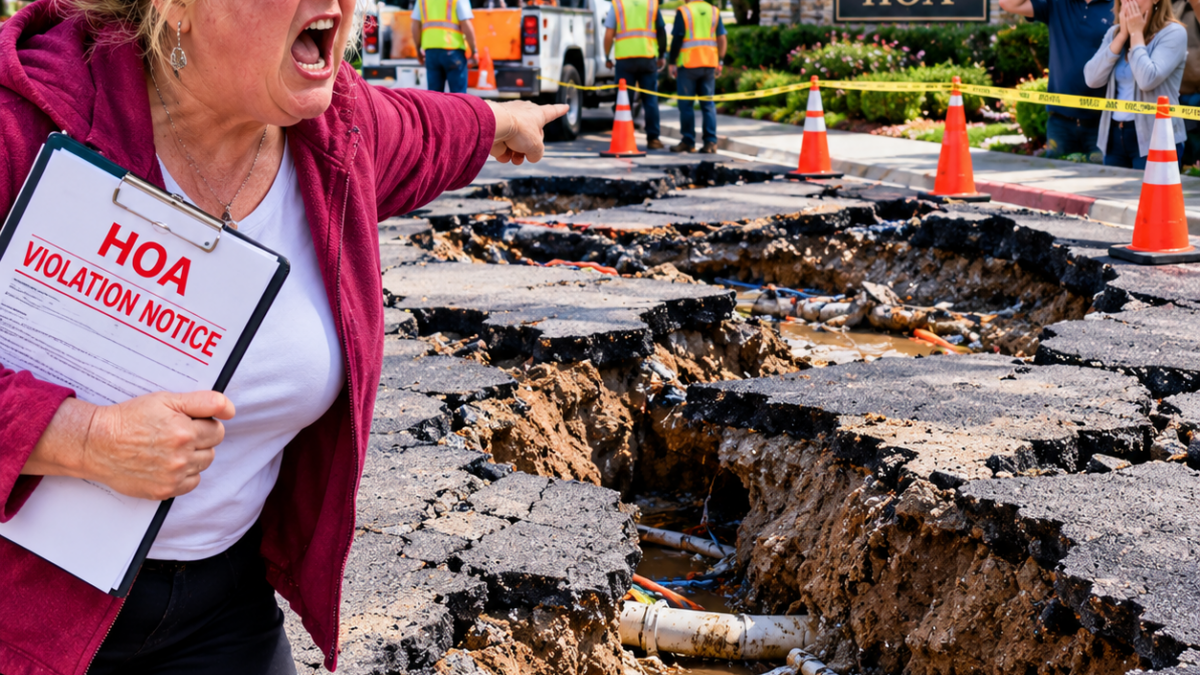
Brenda pointed at the pavement.
“Start.”
First bucket hit asphalt.
Steel teeth against blacktop.
Grinding.
Breaking.
Point one.
Water.
The bucket punched through.
A white column exploded upward.
Fifteen feet.
Mud.
Broken asphalt.
Spray.
Colton froze.
“Whoa!”
Two hundred feet away, Wade was already digging point two.
Orange conduit.
Snap.
Fiber dead.
Don’s internet went off before his upstairs camera stopped recording locally.
Wade pulled back.
Then moved toward point three.
I ran down the shoulder.
“STOP!”
Brenda stepped toward me.
“Stay away from the equipment!”
“They hit water!”
“Old line.”
“STOP THE CREW!”
She looked toward Wade.
Then said:
“Finish the other section.”
His bucket went down.
Metal.
Then the hiss.
High.
Violent.
Natural gas.
Mercaptan hit seconds later.
Rotten eggs.
Heavy.
Immediate.
Wade shut the excavator down and jumped from the cab.
Colton climbed out too.
Both backed away.
I was already calling 911 again.
“Gas line rupture. Active release. Ridgecrest Estates. Evacuate.”
Brenda stood beside the Mercedes.
Clipboard still in her hand.
Water blasting thirty yards away.
Gas screaming.
Fiber cable hanging.
She didn’t move.
Fire department came in eight minutes.
Lieutenant Dale Crawford took command.
Four houses evacuated.
Road perimeter.
No ignition sources.
Gas company arrived eleven minutes later and isolated the branch.
Six homes lost gas.
Firefighters traced the work.
Three dig sites.
Three damaged utilities.
No owner permission.
Crawford walked to Brenda.
“Who authorized excavation?”
She pointed at me.
“He owns the road.”
Crawford looked at me.
“Did you authorize it?”
“No.”
Brenda said:
“He’s been demanding repairs.”
I held up my phone.
“Recorded warning. Emails. 911 call before digging started. 811 request is in her name.”
Crawford’s face changed slightly.
Not dramatic.
Just professional attention sharpening.
He wrote Brenda’s full name.
That evening, she posted:
ROAD IMPROVEMENT UNDERWAY. MINOR HICCUP WITH OLD PIPE. EVERYTHING SHOULD RETURN TO NORMAL SOON.
Don sent me a screenshot.
“Minor hiccup.”
He had no internet.
No reliable phone.
No gas.
His water pressure was gone.
Forty-eight hours later, Ridgecrest was still in emergency mode.
Gas line had to be fully repaired and pressure-tested.
Water authority brought temporary supply.
Fiber crews began excavation and conduit replacement.
One resident worked remotely in hospital billing and drove to a Panera every morning to keep her job.
Older neighbors struggled with temporary utility arrangements.
And Brenda sent another email.
The HOA’s maintenance team had uncovered pre-existing deterioration.
The road owner’s refusal to permit proper maintenance was responsible.
My name.
In writing.
Three neighbors believed her.
Fourteen didn’t.
Because Don uploaded his video.
Eleven minutes and forty-three seconds.
No edits.
Flatbeds arriving.
Brenda directing.
Buckets dropping.
Water erupting.
Fiber breaking.
Gas release.
Most damaging of all:
My voice yelling to stop.
Then Brenda’s voice.
“Keep going. Finish the other two.”
I watched that section three times.
Loretta watched once.
“Save the original.”
“I have three copies.”
“Make four.”
Thursday morning, county inspection arrived.
Unauthorized excavation.
No permit.
Known utilities.
Private property.
Violation issued directly to Brenda because the corporate entity she cited was inactive and the authorization trail led to her.
Then the utility assessments arrived.
East Tennessee Natural Gas.
Emergency response.
Main replacement.
Testing.
$890,000.
Water authority.
Repair.
Contamination controls.
System flushing.
Temporary tanker service.
$1,060,000.
SouthPoint Communications.
New conduit.
Fiber replacement.
Resplice.
Service interruption costs.
$690,000.
Total:
$2,640,000.
I stared at the summary in Loretta’s office.
“Two point six million.”
“Two point six four.”
“You lawyers always make things worse.”
“Accuracy matters.”
Brenda called the HOA insurer.
Loretta had already reviewed the policy.
Unauthorized excavation on property not owned, leased, or maintained by the association was excluded.
My road met all three exclusions.
Not HOA-owned.
Not leased.
Not HOA-maintained.
Insurance denied coverage.
Six business days.
Don came over when he heard.
“What happens to two point six million with no insurance?”
I looked at Loretta.
She said:
“Litigation.”
That was the honest answer.
Not:
Brenda writes a check.
Not:
Every homeowner instantly gets billed.
Liability had to be determined.
Contractors.
Board members.
Brenda.
Anyone who authorized, participated, or ignored required procedures.
But everybody understood one thing.
The bill had not disappeared.
Brenda made one last attempt to redirect it.
Sheriff’s office.
She filed a report saying I had hired the excavation crew.
Directed the work.
Caused the damage.
The detective pulled my 6:54 a.m. 911 call.
Twelve minutes before digging.
Then Brenda’s 811 ticket.
My utility notices.
Emails.
Camera video.
Her allegation against me lasted less than forty-eight hours.
The new investigative file did not have my name as the subject.
Loretta filed my civil claims.
Trespass.
Property damage.
Interference with utility access.
Other state-law claims tied to the excavation.
County attorney reviewed the broader matter.
Then came the public commission hearing.
Ridgecrest Municipal Building.
Fluorescent lights.
Plastic chairs.
Usually twelve people arguing about speed humps.
That night:
Fifteen Ridgecrest residents.
Three utility representatives.
Fire Lieutenant Crawford.
Earl.
Don.
Loretta.
Local reporter.
Brenda arrived twelve minutes late.
Navy blazer.
Manila folder.
Gerald behind her.
She walked to the front as if she still controlled the room.
Commissioner Yates read the agenda.
Unauthorized excavation and utility damage at Ridgecrest Estates.
Brenda raised her hand.
“If I may.”
Yates nodded.
Brenda stood.
“The Ridgecrest Estates HOA undertook a necessary safety improvement on a deteriorating interior roadway.”
She looked toward me.
“The owner refused repeated requests to maintain it appropriately.”
I almost smiled.
I had twelve years of maintenance receipts.
She continued.
“Any subsurface failures were pre-existing.”
Commissioner Yates looked at me.
“Mr. Morrison?”
I stood.
“I’ll keep it short.”
I had a flash drive.
First image:
My deed.
Road ownership highlighted.
Second:
My final email.
No excavation authorized.
Third:
811 locate request.
Brenda Hollister.
Yellow.
Blue.
Orange.
“She knew the lines were there.”
Then Don’s video.
Eleven minutes.
Forty-three seconds.
Nobody moved.
Water exploded on screen.
Someone behind me whispered:
“Jesus.”
Fiber snapped.
Gas hissed.
The room heard Brenda:
“Keep going. Finish the other two.”
The reporter stopped writing.
Looked up.
Video ended.
I sat down.
Gas operations manager stood.
“Ms. Hollister’s name is on the locate request. Our line location was provided before excavation. Emergency response and repair totals approximately eight hundred ninety thousand dollars.”
Water authority chief engineer.
“One million sixty thousand.”
SouthPoint.
“Six hundred ninety thousand.”
Commissioner Yates added them.
“Two point six four million.”
Silence.
Loretta stood last.
“Three points.”
She held up one finger.
“The Ridgecrest Estates HOA corporate registration lapsed fourteen months before this excavation.”
Second.
“Eleven thousand dollars in resident funds were used for a legal campaign concerning private property that is not an HOA common area.”
Third.
“The association’s insurer denied coverage because the excavation was unauthorized and occurred on property outside association ownership and maintenance responsibility.”
Yates looked directly at Brenda.
“Did you authorize the excavation after receiving utility locations?”
Brenda stood.
Opened her mouth.
Closed it.
For maybe four seconds, the room contained nothing but fluorescent hum.
Finally:
“I was trying to improve the neighborhood.”
Yates removed her glasses.
Set them on the desk.
“Ma’am, you tore it apart.”
Don began clapping.
Slow.
Earl joined.
Then others.
Yates didn’t encourage it.
Didn’t stop it either.
When the room settled, she referred the matter for further investigation and ordered coordination with utility and county agencies.
Brenda gathered her folder.
Her hands shook.
Gerald was already near the door.
The reporter followed them outside.
Back in the room, Don leaned toward me.
“She never opened that folder.”
“No.”
“Wonder what was in it.”
“Probably another road resolution.”
He laughed.
Two months later, the utilities finished restoration.
New gas line section.
New water main.
New conduit.
New asphalt over every area disturbed.
I paid none of the utility-repair cost.
The evidence established I hadn’t authorized the work and had actively warned against it.
The first evening after paving, I walked the whole quarter mile.
Fresh blacktop.
Still warm.
That asphalt smell.
Point one.
Where water had shot fifteen feet high.
Gone.
Point two.
Fiber.
Gone.
Point three.
Gas.
Gone.
The surface looked seamless.
I stood in the middle.
Don walked up behind me.
“Nice road.”
“Was nice before.”
“Yeah.”
He kicked the shoulder lightly.
“More expensive now.”
“Definitely.”
The criminal side moved next.
Brenda ultimately faced charges tied to the utility damage and the danger created by the gas rupture.
Her case ended in a negotiated plea.
Probation.
Personal restitution.
And a permanent prohibition, as part of the resolution, from serving in an HOA leadership position again.
Gerald listed the house.
It sold below what comparable homes were getting.
They moved.
Nobody gathered to watch.
Civil litigation over the $2.64 million continued between utility companies, Brenda, individual board participants, and other responsible parties.
The three board members who had supported Brenda’s road resolution learned something painful.
Raising your hand because somebody tells you a vote is routine does not guarantee the consequences stay routine.
Two refinanced their homes amid the litigation.
Another sued Brenda, alleging she had misrepresented the legality and scope of the project.
I didn’t enjoy that.
People expect me to say I did.
I didn’t.
I had warned Brenda.
The other board members were adults, but I knew how she operated.
She made certainty feel contagious.
You sat in a room with her long enough and questioning her began to feel like creating trouble rather than preventing it.
That had been Ridgecrest’s problem from the beginning.
So we held an actual meeting.
Real notice.
Real quorum.
Twenty-two households.
Question:
Should the old HOA structure be restored and continued?
Vote:
Twenty-two to zero against.
Don counted.
Then looked up.
“First unanimous vote we’ve ever had.”
Someone said:
“And maybe the last.”
Fine with me.
We created something simpler.
Ridgecrest Road Maintenance Fund.
Voluntary.
$200 annually.
No president.
No fake seals.
No Calibri letters threatening liens.
Just a shared account for potholes, ditch clearing, and minor work residents agreed to fund.
I kept ownership of the road.
That never changed.
Eighteen households joined the fund in the first week.
Nobody was required to.
Nobody was punished for declining.
Funny how much cooperation you can get when people are asked instead of ordered.
Don hosted the first block party.
Right on the road.
Folding tables.
Coolers.
Earl brought a smoker and fourteen pounds of brisket.
Loretta brought coleslaw in a bowl so large it looked like equipment.
Around noon, every door seemed open.
Don stood at the head of the table.
Raised a beer.
“To the most expensive road in Tennessee.”
I lifted mine.
“To the most expensive HOA meeting that never should’ve happened.”
People laughed.
Then we ate.
That could have been enough.
But Earl had another idea.
“You know how many people don’t know what their deeds say?”
“Most?”
“Almost all.”
Loretta nodded.
“Accurate.”
So Earl and I started a free monthly workshop at the county library.
KNOW YOUR DEED.
I handled practical property boundaries.
Earl covered site plans and permits.
Loretta came when she could to explain legal documents without pretending a library workshop replaced an attorney.
We taught homeowners how to pull deeds.
Read plats.
Identify easements.
Check corporate registrations.
Understand what an HOA actually owns.
First session:
Forty-five sign-ups.
Third month:
Waiting list.
One Saturday, an elderly man brought a folded deed in an envelope.
“My HOA says they own the drainage strip behind my house.”
“Do they?”
“That’s why I’m here.”
We opened it.
Read.
They had an easement.
Not ownership.
He looked at me.
“Difference?”
“Big difference.”
I explained.
He nodded slowly.
Then:
“How much do I owe you?”
“Nothing.”
“Why?”
I thought about Brenda.
The excavators.
The yellow-blue-orange paint.
“Because somebody should’ve explained mine to everyone before it cost two and a half million dollars.”
Loretta corrected from the other end of the table.
“Two point six four.”
I looked at her.
“Thank you.”
“Accuracy matters.”
Some things never change.
The road settled into ordinary life again.
Winter rain.
Spring potholes.
Summer dust.
I still walked it after storms.
Still patched small cracks.
Still cleared drainage.
The new asphalt over the utility repairs held beautifully.
Sometimes I stopped at the old point-three location.
You could not tell where the gas main had ruptured.
That was comforting and unsettling at the same time.
Don once asked whether I wished I had stopped Brenda before the excavators arrived.
The question bothered me.
“Yes.”
He looked surprised.
“Even after everything?”
“Especially after everything.”
“But you warned everyone.”
“Still.”
“What were you supposed to do?”
“I don’t know.”
That was the truth.
I had notified utilities.
Called authorities.
Sent written warnings.
Documented.
But part of me hated that I knew she might dig and could not guarantee she would be stopped in time.
Gas ruptures are not lessons.
Water contamination is not a strategy.
People could have been hurt.
That fact stripped any satisfaction from the dramatic part.
The satisfying part came later.
The road restored.
Authority corrected.
Neighbors reading documents.
No one getting hurt.
If I tell the story like I cleverly let Brenda destroy herself, it makes me sound smarter and the truth uglier.
What really happened was simpler.
I saw danger coming.
I tried to build enough of a record that people with authority could react.
They didn’t reach us before the first bucket.
After that, the evidence mattered.
That distinction mattered to me.
It mattered to Loretta too.
One afternoon after the lawsuits began, she sat on my porch.
“You know what Brenda’s attorney will argue.”
“What?”
“That utilities should’ve shut down or physically prevented excavation after your warning.”
“They might.”
“Everybody will point at everybody.”
“Normal.”
“Very.”
I looked down the road.
“You ever get tired of property law?”
“Every Thursday.”
“What happens Friday?”
“I go fishing.”
“Fair.”
She smiled.
Then became serious.
“Kyle.”
“Yeah?”
“You did the right thing calling 911 before the dig.”
“I know.”
“No. Keep that.”
I looked at her.
“Because there are going to be days you’ll wonder whether you should’ve physically blocked the equipment.”
I had already wondered.
She knew.
“You don’t stand in front of an excavator.”
“I could’ve parked the truck.”
“And created another hazard.”
“I could have—”
“You notified the owner, utilities, authorities, and contractors. Then you called emergency services.”
She paused.
“Do not rewrite yourself into being responsible for another adult’s decision.”
That helped.
I kept it.
Ridgecrest changed after Brenda.
Not overnight.
Trust doesn’t come back because one person leaves.
For months, neighbors were awkward around each other.
Some had supported her.
Some had stayed silent.
Some had mocked me online.
A few apologized.
One didn’t.
His name was Richard.
He had written:
Sue him. HOA roads are community roads.
After everything, he avoided me.
Then his water heater failed.
Guess who he called.
My plumbing company.
I almost sent my employee.
Instead, I went.
Richard opened the door.
Saw me.
“Oh.”
“You called Morrison Plumbing.”
“Yeah.”
“You want me to leave?”
“No.”
I went inside.
Replaced the failed valve and expansion tank.
Two hours.
When I finished, he stood near the garage.
“Kyle.”
“Yeah?”
“I was wrong.”
“About the water heater?”
“About the road.”
I packed my wrench.
“Okay.”
“I said some things online.”
“I remember.”
His face tightened.
“I should’ve checked.”
“Yes.”
No easy absolution.
He nodded.
“I’m sorry.”
I looked at him.
“Thank you.”
That was enough.
He paid the invoice.
No discount.
Community has limits.
Don became my closest friend through all of it.
Funny, because for nine years before Brenda, we mostly waved.
He had owned the hardware store in town for thirty years.
His philosophy about people was simple.
“Everybody tells you who they are eventually. Most of us just don’t listen the first time.”
He said that at the road-maintenance meeting after somebody suggested formal officers.
“No officers.”
A resident laughed.
“Someone has to sign checks.”
“Two signatures.”
“Whose?”
“Kyle and me.”
“That makes you officers.”
“No.”
“What does it make you?”
“Two old idiots with a bank account.”
Motion carried.
The fund stayed simple.
Every expense emailed to participating households.
Receipt attached.
Balance reported quarterly.
No one minded.
People do not hate accountability.
They hate mystery.
Brenda had built her authority from mystery.
Emergency session.
Safety standard.
Implied easement.
Community jurisdiction.
Every phrase sounded official until somebody asked:
Where is that written?
That question became Ridgecrest’s favorite phrase.
A neighbor wanted speed bumps.
“Where does the authority come from?”
Someone wanted new entrance lighting.
“Who owns the land?”
A contractor wanted deposit money.
“Where’s the written bid?”
Earl loved it.
“You people are finally annoying in a productive way.”
The library workshop expanded.
We added a session:
WHAT IS AN EASEMENT?
Loretta taught it.
Standing room only.
She drew two rectangles on a whiteboard.
“Ownership is not the same as permission to use.”
A woman raised her hand.
“My HOA says their landscaper can enter my backyard because there’s a utility easement.”
Loretta asked:
“Is the landscaper a utility?”
The room laughed.
The woman blinked.
“Oh.”
Sometimes the best legal education is one obvious question nobody thought to ask.
One year after the road incident, Don held another block party.
Same spot.
Point two.
Where the fiber had snapped.
This time kids from visiting families drew chalk on the asphalt.
Ridgecrest itself had few children, but grandchildren showed up.
One little girl drew three lines.
Yellow.
Blue.
Orange.
I froze when I saw them.
She looked up.
“What?”
“Nothing.”
She held up the chalk.
“These are roads.”
I smiled.
“Better use for those colors.”
She went back to drawing.
Don noticed.
“You okay?”
“Yeah.”
He handed me a beer.
We sat.
After a while he said:
“You know what the funniest part is?”
“I doubt it.”
“Brenda wanted the road prettier.”
I looked at the new asphalt.
“Technically achieved.”
“Two point six million.”
“Loretta would say two point six four.”
“You invited her?”
“She’s over there eating potato salad.”
Don looked.
“Of course she is.”
The road became a joke eventually.
That was healthy.
“Most expensive pavement in Tennessee.”
“Federal-grade pothole repair.”
“Don’t scratch it, utility companies will send a bill.”
Humor means fear has moved out.
For months, that road had represented threat.
Then cost.
Then embarrassment.
Eventually it went back to being a road.
That was what I wanted.
My plumbing company grew during those years.
Not because of publicity.
I avoided interviews beyond one short local statement.
But people around the county recognized the name.
“You’re the road guy?”
“I’m a plumber.”
“The HOA road guy.”
“Unfortunately.”
Some hired me anyway.
One customer asked me while I was under his sink:
“What does two point six million in utility damage look like?”
“Like a really bad Tuesday.”
He laughed.
I didn’t.
Then I did.
Enough time had passed.
Gerald and Brenda faded from Ridgecrest conversation.
I heard occasional updates through litigation.
Nothing I chased.
The civil cases were messy.
Settlements.
Contribution claims.
Arguments about contractors.
Board authority.
Insurance.
What percentage belonged to whom.
That’s what large-dollar civil cases become.
Less cinematic.
More spreadsheets.
I stopped asking Loretta.
“If something affects you, I’ll tell you.”
“Deal.”
The DA outcome mattered because it closed my part.
Brenda accepted responsibility under the plea arrangement.
Probation.
Restitution.
No HOA leadership role.
Some people wanted prison.
I didn’t.
I wanted her unable to do it again.
I wanted the road fixed.
I wanted the liens and false claims gone.
I wanted my neighbors to understand how easily pretending can become expensive.
That happened.
Gerald’s departure was quieter.
He sold.
Moved.
Don asked whether we should send him the leftover gravel from Brenda’s old blockade.
“No.”
“Free delivery.”
“No.”
“You’re no fun.”
“I spent two days moving that gravel.”
“Exactly.”
We used it later to repair a drainage shoulder.
That felt better.
Nothing wasted.
Even bad decisions can become road base.
The original fake NO PARKING letters remained faintly visible for years.
Not the paint itself.
We had covered it.
But in certain summer light, you could almost see where Gerald had rolled the words.
One year, during maintenance, Earl asked:
“Want to grind that section?”
“No.”
“Why?”
“Doesn’t hurt anything.”
“You sentimental?”
“Absolutely not.”
Don overheard.
“He is.”
“I’m not.”
Earl smiled.
“Leave it.”
We did.
Maybe I was sentimental.
Not about Brenda.
About evidence.
A faint mark reminding me that property rights can look permanent right up until someone confident decides to test whether you understand them.
I understand mine now.
Better than I ever wanted to.
The library sessions taught me something else.
Most people don’t read deeds because deeds look hostile.
Legal descriptions.
Book numbers.
Easements.
Bearings.
Distances.
Exceptions.
People sign at closing because someone points to the line.
Then fifteen years later, a neighbor says:
“That strip is ours.”
And nobody knows.
I became the guy who tells them:
Go read.
Not because every HOA is wrong.
Often the HOA is right.
Sometimes an easement exists.
Sometimes maintenance obligations are shared.
Sometimes the homeowner arguing online simply didn’t read what they purchased.
Facts cut both directions.
That became part of the workshop.
One man got angry.
“You’re supposed to help homeowners.”
“I am.”
“My HOA says I can’t build a fence across this strip.”
Loretta read his deed.
“They’re right.”
His face fell.
“What?”
“Utility easement and access covenant.”
“But it’s my property.”
“Yes.”
“So I can build.”
“Ownership is subject to the easement.”
He looked betrayed.
“Whose side are you on?”
“The document’s.”
He left angry.
Came back two months later.
“Moved the fence.”
“Good.”
“Utility company needed access last week.”
Loretta smiled.
“Funny how that works.”
That was the difference between what Brenda did and legitimate authority.
Real authority survives being read.
Fake authority depends on nobody reading.
Years after the incident, the three utility colors still meant something to me.
Yellow.
Blue.
Orange.
Gas.
Water.
Communications.
People think infrastructure is invisible because it’s buried.
It isn’t invisible when it stops.
The week after Brenda’s excavation taught everyone that.
No gas.
Water tanker.
No reliable internet.
People who had never thought about a pipe suddenly knew exactly where it ran.
That memory changed how Ridgecrest handled maintenance.
Before any digging, somebody pulled plans.
811.
Written permission.
Contractor insurance.
Permit if needed.
Nobody rolled a bucket into dirt because a neighbor with a clipboard said so.
Earl joked that Ridgecrest had become the safest place in Tennessee to plant a mailbox.
Probably true.
One spring, county crews needed to replace a valve near the road entrance.
Supervisor called me.
“Mr. Morrison?”
“Yes.”
“We need temporary access.”
“Send me the plan.”
Pause.
“Plan?”
“Work area. Traffic control. Restoration.”
Another pause.
“Sure.”
He emailed it.
I reviewed.
Signed.
Work happened.
Nothing broke.
They patched the pavement.
The foreman said:
“You’re particular.”
“You heard the story?”
“Oh.”
He nodded.
“You’re the road guy.”
“Unfortunately.”
We both laughed.
That ordinary repair felt strangely satisfying.
Permission asked.
Permission given.
Utilities protected.
Work completed.
No war.
That’s what normal looks like.
Normal became precious.
Don’s health declined a few years later.
Nothing dramatic at first.
Heart trouble.
Then oxygen.
He hated the tubing.
“I look ninety.”
“You’re seventy-three.”
“Exactly. I have seventeen years before I’m allowed to look ninety.”
He still walked the road with me when he could.
Slower.
One evening we stopped at point two.
He leaned on the guardrail.
“Remember the geyser?”
“That was point one.”
“I’m old. Let me tell the story wrong.”
“Fine.”
He looked down the asphalt.
“You ever regret buying the road?”
I thought.
“Ask me after pothole season.”
He smiled.
Then:
“Seriously.”
“No.”
“Even after Brenda?”
“No.”
“Why?”
I looked toward my house.
Because that road had carried everything.
My trucks.
Neighbors.
Ambulances.
Utility crews.
Block parties.
Arguments.
Apologies.
It connected twenty-two houses whether we liked each other or not.
“No,” I said again.
Don nodded.
“Good.”
He died the following winter.
Heart failure.
His daughter asked whether we could hold a small gathering at Ridgecrest.
We put tables on the road.
Same place as the block parties.
Earl smoked brisket because Don would have complained if anybody served catered sandwiches.
Loretta brought that enormous bowl again.
People told stories.
Hardware store.
Bad beer.
His ridiculous comments.
Then his daughter handed me an envelope.
“He left this for you.”
Inside was a photocopy of the original emergency-meeting minutes Brenda had written.
Four attendees.
Fake road authority.
On the bottom, in Don’s handwriting:
KEEP THIS IN CASE SOMEBODY GETS STUPID AGAIN.
I laughed so hard I had to sit down.
Then cried later in my truck where nobody saw.
That paper is framed now.
Not Brenda’s letter.
Don’s note.
There are things you keep because they prove something happened.
Others because they prove somebody stood beside you while it happened.
Don did.
The Road Maintenance Fund renamed itself informally after him.
Nobody voted.
Someone wrote:
DON BECKETT ROAD FUND
on the spreadsheet.
It stuck.
His daughter contributes every year even though she sold his house.
“Dad would haunt me.”
Probably.
Earl eventually stopped teaching the library sessions.
Knees.
Then I did more of his material.
Loretta still appeared when fishing weather was bad.
The workshop continued.
One Saturday, a young couple brought their closing packet before buying.
Before.
That impressed me.
“We haven’t signed yet.”
“Good.”
“The subdivision says this road is private.”
“Who owns it?”
“That’s what we want to know.”
We traced the plat.
Shared ownership.
Recorded maintenance agreement.
Clear formula.
They looked relieved.
“So this is okay?”
“It’s understandable.”
“Same thing?”
“Better.”
They bought the house.
Six months later sent an email:
First pothole assessment came exactly like document said. Thanks.
That might be the best compliment I’ve ever received.
Predictable.
Clear.
No surprises.
Brenda’s style had been the opposite.
Surprise created leverage.
Emergency meeting.
New authority.
Legal threat.
Sudden gravel.
Excavator.
Everything designed to leave the other person responding.
I stopped living that way after her.
If something concerns my property, I read first.
Then act.
Not glamorous.
Effective.
My father would have appreciated that.
He died before the Brenda mess, but I heard his voice through most of it.
He had been a pipefitter.
Different kind of tradesman.
He believed every problem announced itself early.
“You hear a drip, don’t wait for the ceiling.”
He also believed authority should always have a source.
One time a foreman told his crew to move a pressurized line without a shutdown.
Dad asked:
“Who approved that?”
Foreman said:
“I did.”
Dad answered:
“That’s a name, not an answer.”
He refused until engineering signed off.
Got suspended two days.
Then company discovered the foreman’s plan violated procedure.
Dad returned.
No apology.
He told me later:
“Being difficult is expensive right up until being easy costs more.”
Brenda proved him right.
Four people in a room found it easier to raise their hands.
Two contractors found it easier to trust the woman signing the work order.
Residents found it easier not to challenge meeting notices.
An old board found it easier to let corporate registration lapse.
Every easy decision accumulated.
Then one Tuesday, easy became $2.64 million.
That number makes the headline.
It isn’t the part that matters most to me.
The important number is four.
Four people attended the meeting where Brenda claimed road authority.
Four out of twenty-two.
Eighteen percent.
The bylaws required sixty.
If one of those four had asked:
Do we have quorum?
Maybe no excavation.
If the contractors had asked:
Where is owner authorization?
Maybe no excavation.
If Fenwick had dug deeper into ownership before sending letters?
Maybe.
If I had understood sooner how determined Brenda was?
Maybe.
History is full of maybes.
You can drown in them.
So I stopped.
The road exists.
People are safe.
Lessons stayed.
That’s enough.
On the fifth anniversary of the excavation, nobody planned anything.
Good.
I was driving home around six.
Summer.
Sun low.
Freshly cut grass.
I reached the entrance and slowed.
A table sat in the middle of the road.
Earl.
Loretta.
Don’s daughter.
Half a dozen neighbors.
Beer.
Cake.
I pulled over.
“What is this?”
Earl lifted his cup.
“Annual infrastructure appreciation day.”
“That is not a thing.”
“It is now.”
Loretta pointed at the cake.
Yellow, blue, and orange icing.
I stared.
“You people need hobbies.”
Loretta said:
“I fish.”
“More.”
Someone handed me a beer.
On the cake:
WE CALLED 811.
I laughed despite myself.
We ate in the road.
Cars went around slowly.
Nobody fined them.
Near sunset, Don’s daughter stood.
No speech.
Just raised her drink.
“To asking first.”
Everybody lifted theirs.
That was the toast.
Not justice.
Not revenge.
Not two point six million.
Ask first.
Simple enough.
Afterward, I walked home alone.
The asphalt was warm under my boots.
I stopped at each old excavation point.
One.
Water.
Two.
Fiber.
Three.
Gas.
Nothing visible.
Utility repairs long buried.
No paint.
No stakes.
No scars.
I could hear air conditioners humming.
Water moving inside houses.
Internet carrying somebody’s movie.
Gas heating somebody’s shower even though the summer air was still warm.
Infrastructure doing what it does best.
Working quietly.
At my driveway, I turned around.
Quarter mile of black pavement.
My road.
Not because I won it.
Because it had always been mine.
That distinction was the entire story.
Brenda tried meetings.
Letters.
Lawyers.
Social pressure.
County filings.
Roadblocks.
Eventually excavators.
None of those changed the deed.
A vote cannot turn somebody else’s property into yours.
Confidence cannot create ownership.
A title cannot replace authority.
And once Brenda finally forced the road open in three places, she exposed more than gas, water, and fiber.
She exposed every weak document, every missing vote, every unsupported claim, and every person who had gone along because questioning her seemed inconvenient.
The utilities were repaired.
The asphalt was restored.
The old HOA disappeared.
The neighbors built something simpler in its place.
And once a month, in a county-library meeting room that smells like dry carpet and old books, I unfold a deed in front of somebody who has never really read theirs before.
I point to the legal description.
Then the easements.
Then the ownership line.
And I tell them the same thing I wish every homeowner in Ridgecrest had understood before Brenda ever hired an excavator:
“Start here.”
Because three painted lines once ran across my road.
Yellow.
Blue.
Orange.
Brenda saw them as marks telling her where her crew could dig.
I see them differently now.
They were warnings.
She had every one of them in front of her.
And she dug anyway.
[END OF STORY]

