PART 2: HOA Karen Spray-Painted My 100-Year-Old Barn Door Red to “Match the Rules”—Then the Lab Report Turned Her $8 Can of Paint Into a $392,000 Disaster
PART 2
“You think rules don’t apply to you because you wore a uniform.”
“This has nothing to do with my service.”
“It has everything to do with your attitude. You move out here, build whatever you want, ignore notices, refuse fines, challenge the board, and then act offended when someone finally makes you comply.”
I moved another step forward.
“You are at twenty seconds.”
Her face hardened.
“You don’t scare me.”
“I’m not trying to.”
“Good.”
“I’m telling you to leave.”
She pointed toward the barn one final time.
“Consider this a warning. The fines will continue until the property is fully compliant.”
Then she turned and waddled toward the golf cart she had parked near the edge of my drive.
I watched her climb in.
The motor whined.
She drove away without looking back.
I stood there until the golf cart disappeared behind the trees.
Then I turned toward the barn.
Sarah was standing in the doorway of the house.
She had one hand over her mouth.
Our six-year-old daughter, Lily, was behind her, still wearing pajamas.
“Daddy?”
I didn’t answer immediately.
Lily looked past me.
Her eyes widened.
“Why is Grandpa’s wood red?”
That almost broke me.
The barn had been the reason I fell in love with the property.
We had bought ten acres at the edge of Oak Creek Estates after years of living in places where I could always hear traffic, sirens, barking dogs, leaf blowers, helicopters, construction equipment, somebody’s television through a wall, somebody’s engine starting at two in the morning.
After EOD, noise had a different relationship with my nervous system.
People think combat veterans are always afraid of loud sounds.
That’s not exactly it.
Sometimes you simply become incapable of ignoring them.
Every unexpected bang asks your brain a question.
Every rumble gets categorized before you consciously realize you heard it.
For years after leaving the Army, part of me never stopped listening.
Sarah understood.
She had lived through deployments from the other side of the phone.
She knew why I wanted acreage.
Why I wanted trees.
Why I wanted distance.
Why silence had become something close to medicine.
Oak Creek Estates wasn’t my first choice because of the HOA.
But the property was unusual.
Most of the development consisted of suburban homes sitting on quarter-acre or half-acre lots, but our parcel was a surviving piece of an older farm swallowed by the development decades earlier.
Ten acres.
Creek.
Woods.
An old farmhouse.
And the barn.
The barn had been built in the 1920s using timber cut from the land itself.
Massive posts.
Hand-hewn beams.
Wooden pegs.
You could run your hand along the structural timbers and still feel the marks left by tools nearly a century ago.
When I first walked inside, sunlight poured through gaps in the old siding and caught dust floating in the air.
I could smell dry hay, earth, oak, rust, and age.
Sarah stood beside me while Lily ran across the floor.
I remember looking up at the rafters and thinking, I could breathe here.
That barn became my project.
Not because it needed to become something impressive.
Because I needed work that had no deadline.
Work that required patience.
Work where nothing exploded if I made a mistake.
I repaired the stone foundation.
Replaced rotten floorboards.
Stabilized the frame.
Rehung windows.
Repaired siding.
Reroofed it.
Inside, I started building a workshop where I planned to restore an old pickup with Lily when she got older.
The original main doors had disappeared sometime decades ago.
Someone had covered the opening with sheets of plywood.
I couldn’t leave it that way.
My father had stored a stack of old American chestnut lumber in his garage for years.
The wood had originally belonged to my grandfather.
According to Dad, my grandfather had salvaged it from a tree felled on family land in Pennsylvania before the chestnut blight transformed American forests forever.
He had intended to build a dining room table.
Life got in the way.
The lumber sat.
Then he died.
Dad kept it.
When Dad died, it came to me.
Most people would have seen dusty boards.
I saw my grandfather’s unfinished intention.
So I used them for the barn door.
For two months, I worked slowly.
No screws through the visible face.
No metal brackets.
Traditional mortise-and-tenon joints.
Hand fitting.
Hand sanding.
I could have finished the project in two weekends using modern methods.
I didn’t want to.
I wanted the work.
I wanted each joint to fit because I had made it fit.
Lily would sit on a stool beside me wearing pink safety glasses far too big for her face, asking questions every thirty seconds.
“What does that tool do?”
“Why is that wood darker?”
“Why can’t we use a nail?”
“Did Great-Grandpa touch this?”
That last question stayed with me.
“Yes,” I told her.
“So he touched the same wood I’m touching?”
“Yes.”
She smiled.
“Then he kind of knows me.”
That was what Karen had spray-painted.
Not lumber.
Not an “outbuilding door.”
A physical line running from my grandfather to my father to me to my daughter.
I had finished it with multiple coats of tung oil mixed with citrus solvent.
No stain.
No paint.
I wanted the grain visible.
When the door was finally mounted, it glowed golden brown against the weathered silver siding of the barn.
Sarah stood beside me with her arm around my waist.
Lily danced around yelling that it looked like a castle door.
For one of the first times since leaving the Army, I felt uncomplicated pride.
No adrenaline.
No fear.
No aftermath.
I had made something.
Then Karen noticed.
My relationship with Karen had started almost six months earlier over the mailbox.
The original farm mailbox was galvanized steel mounted on an old cedar post.
It wasn’t broken.
It wasn’t unsafe.
It didn’t lean.
It simply wasn’t black.
That alone was enough to bring Karen rolling up my gravel drive in her golf cart with a three-ring binder sitting beside her.
I was scraping paint from an upstairs window when I heard her call my name.
“Mr. Miller.”
I looked down.
“Yes?”
“Your mailbox is non-compliant.”
I thought I had misheard.
“My what?”
“Mailbox.”
She opened the binder with theatrical precision.
“Section four, subsection B, paragraph three. Mail receptacles must be black, post-mounted, and conform to the approved Charleston Classic specification.”
I stared at her.
“You’re telling me my mailbox has to be a specific model?”
“Yes.”
“Why?”
She looked at me as though I had asked why water was wet.
“Cohesion.”
I climbed down the ladder.
The cedar post had probably been on that farm longer than Oak Creek Estates had existed.
“My property is ten acres.”
“The covenant applies equally.”
“The nearest matching mailbox is half a mile away.”
“That is irrelevant.”
“It works.”
“That is also irrelevant.”
I should have pushed back.
Instead, I wanted peace.
I had just moved my family.
I didn’t want a feud.
So I replaced it.
The approved mailbox felt cheap compared with the old one.
Thin metal.
Decorative plastic trim.
Almost two hundred dollars after shipping.
Karen drove past the following afternoon, slowed her golf cart, inspected it, and gave me a short nod.
No thank-you.
No acknowledgment.
Just the look of someone confirming obedience.
I thought compliance would make her leave us alone.
That was my first mistake.
Karen didn’t interpret cooperation as goodwill.
She interpreted it as hierarchy.
She had given an order.
I obeyed.
In her mind, the relationship was established.
The next notice involved pasture grass.
Not lawn grass around the house.
Pasture grass fifty yards from the road.
She measured one section above four inches.
Then she objected to the stain on our porch swing.
Then she claimed the chicken enclosure needed architectural approval.
Then she complained about a utility trailer parked behind the barn where it wasn’t visible from the road.
Every issue came wrapped in the same vocabulary.
Aesthetic integrity.
Community standards.
Property values.
Uniform enforcement.
Each time I responded.
Each time the response produced another demand.
But the barn became her obsession.
I think she hated what it represented.
Oak Creek Estates had spent years removing irregularity.
Old fences were replaced.
Wild landscaping disappeared.
Mailboxes matched.
House colors came from approved palettes.
Karen didn’t simply prefer order.
She needed visible proof that her definition of order had won.
My barn stood beyond that logic.
Old.
Gray.
Uneven.
Beautiful.
Impossible to make look suburban without destroying what made it valuable.
When I installed the chestnut door, the first violation letter arrived within a week.
“Primary barn door finish not compliant with architectural color standards.”
I read the sentence three times.
Then I walked outside and looked at the door.
Natural chestnut.
Oiled.
Protected.
Perfect.
The notice demanded I paint it beige, taupe, or “Heritage Barn Red.”
Deadline: thirty days.
Fine after deadline: one hundred dollars per day.
I opened my copy of the covenants.
This time I didn’t assume Karen was right.
The approved color appendix referenced residences.
Siding.
Trim.
Garage doors.
Roofing.
Shutters.
The word barn didn’t appear.
Outbuildings were mentioned elsewhere, but only in language requiring them to be maintained and “harmonious” with the primary residence.
That word was doing a lot of work.
Harmonious.
To Karen, harmonious meant matching paint.
To me, harmonious meant a historic barn looking like a historic barn.
I wrote the board.
Not Karen personally.
The board.
I quoted the covenant.
Referenced the specific appendix.
Explained that the structure predated much of the surrounding development.
Explained that the natural finish was intentional.
Explained that painting antique chestnut would cause irreversible aesthetic harm.
I did not insult anyone.
I did not threaten.
I sent the letter certified.
Someone signed for it.
One week later I received another notice.
The board had reviewed my objection and rejected it.
The letter stated that the barn door remained non-compliant.
Current fine: seven hundred dollars.
A hundred per day.
I requested meeting minutes from the architectural committee session where the decision had supposedly been made.
No answer.
I filed an appeal using the procedure in the bylaws.
No hearing was scheduled.
The fines kept increasing.
Fourteen hundred.
Twenty-one hundred.
Twenty-eight hundred.
Thirty-five hundred.
Sarah began opening the mail before I got home from the barn.
One evening she stood in the kitchen holding a notice.
“They say forty-two hundred.”
“I know.”
“Can they put a lien on the house?”
“Not tomorrow.”
“That isn’t what I asked.”
I looked at her.
She wasn’t angry.
She was scared.
That changed the equation for me.
“I’m not going to let them take anything from us.”
“How?”
“By making them prove every step they’re taking.”
She exhaled.
“You keep saying they’re wrong.”
“They are.”
“But wrong people can still make your life miserable.”
That sentence was more accurate than any covenant.
I reached across the table and took the notice.
“You’re right.”
“So what are we doing?”
“We stop treating this like a disagreement.”
The next morning I bought a large binder, a scanner, document sleeves, external storage, and a stack of folders.
Every HOA letter went into the system.
Date.
Subject.
Claim.
Amount.
Response.
Delivery confirmation.
Photographs of the door were taken daily.
Every conversation was recorded when legally permissible.
Every email was saved.
Every certified letter was scanned.
I built a timeline.
Karen’s threats.
The notices.
My appeal.
The unanswered records requests.
The board’s silence.
Then I started looking backward.
If Karen had treated us this way, what had she done before we arrived?
Public meeting records told part of the story.
Archived community pages told more.
Old posts had vanished from the current forum, but cached and archived copies remained.
The Hendersons.
Birdbath violation.
Two years of letters.
Property sold.
The Garcias.
Children’s playset two inches too close to a setback.
Thousands in threatened penalties.
Playset removed.
George and Eleanor.
A rose garden.
The flowers had allegedly created an “overly vibrant visual disturbance.”
I remember reading that phrase at midnight and thinking I had to be misunderstanding it.
I wasn’t.
Karen had turned personal taste into policy.
And people had learned that resisting her was exhausting.
The next quarterly HOA meeting confirmed it.
Sarah came with me.
I brought the binder.
Karen sat at the front beside two board members, Barb and Gary.
She waited until “new business” before turning the meeting into a performance.
“Some residents,” she began, “appear to believe personal preference overrides the standards the rest of this community respects.”
Her eyes found me.
People looked over their shoulders.
Sarah’s hand tightened around mine.
Karen continued.
“No resident is above the rules. No background, profession, acreage, or personal opinion creates an exemption.”
There it was.
A public warning directed at me without using my name.
“The board will continue enforcement until all violations are corrected. Accumulating fines remain due.”
She paused.
Waiting.
She wanted me to react.
I didn’t.
I sat with my hands folded over the binder.
Her mouth tightened.
The meeting continued.
Afterward, an older man stopped near us.
I recognized him from property records.
George.
He leaned close.
“Don’t give in.”
I looked at him.
“She made my wife pull out flowers her mother planted.”
He gave my shoulder a squeeze.
“You’re not the only one.”
Then he walked away.
The next day I installed cameras.
One covered the driveway.
One covered the interior of the barn.
A third was mounted high in an oak tree with a clear view of the entire barn front.
Sarah watched from the ground.
“You really think she’ll come out here?”
“I think she’s running out of paperwork.”
“You think she’d actually touch the barn?”
“I hope I’m wrong.”
I wasn’t.
One week later, before sunrise, Buster went strangely quiet.
Our blue heeler normally considered every squirrel a national security concern.
Silence from him was unusual.
I woke without knowing exactly why.
The bedroom was gray with early light.
I slipped out of bed.
Walked toward the kitchen.
Looked through the window.
Red.
I knew immediately.
My stomach dropped.
I stepped onto the porch.
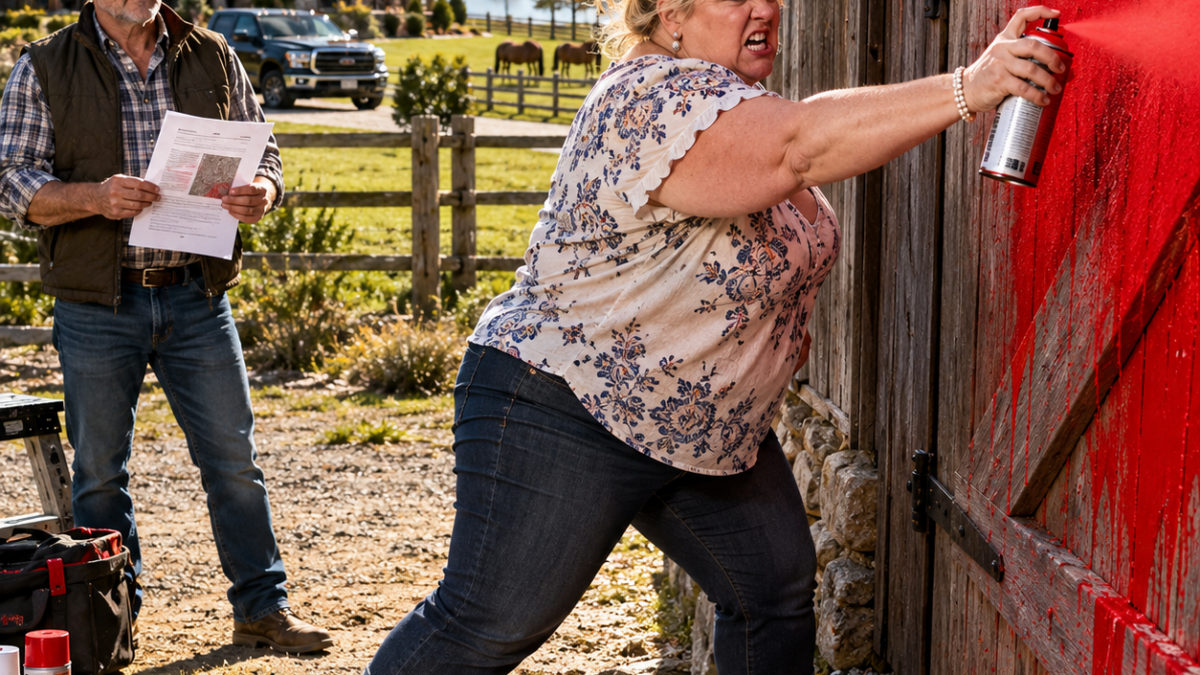
Karen was standing beside the door.
Paint can in hand.
Admiring it.
“That’s better.”
Everything after that became evidence.
Her voice.
Her explanation.
Her insult.
Her claim of authority.
Her departure.
The first thing I did after she left was tell Sarah and Lily not to touch the barn.
Then I opened the camera system.
The footage was perfect.
Karen’s golf cart entered at 5:43 a.m.
She parked.
Looked toward the house.
Removed the can.
Shook it.
Walked directly to the barn.
Started painting.
No ambiguity.
No obstructed face.
No angle problem.
No question of identity.
The camera captured her saying, “Let’s see him ignore this.”
Then it captured the entire confrontation with me.
Sarah stood behind my chair while I watched.
“You knew.”
“I suspected.”
“No, you knew enough to put that camera there.”
“I hoped I was being paranoid.”
Lily appeared at the doorway.
“Is the barn okay?”
Sarah went to her.
I called the sheriff.
Deputy Peterson arrived about an hour later.
He looked at the barn.
Looked at me.
“HOA disagreement?”
“Yes.”
He wrote something.
“I can take a vandalism report.”
“I’d appreciate that.”
“Do you know who did it?”
“Yes.”
“Did you see them?”
“Yes.”
“Any witnesses?”
“Yes.”
He looked up.
“Who?”
“Three cameras.”
That changed the conversation.
I brought him inside.
Sarah gave him coffee.
I played the video.
His expression went from routine patience to complete attention.
When Karen appeared with the spray can, he leaned toward the screen.
When she sprayed the door, he stopped writing.
When she said “That’s better,” he looked at me.
When she admitted she was enforcing HOA policy, he sat back.
“Well.”
I waited.
“That’s pretty clear.”
“That’s the act.”
I placed the binder on the table.
“This is the history.”
He opened it.
Started reading.
The first notice.
The appeal.
The fine schedule.
The ignored hearing request.
Archived complaints.
His eyebrows rose.
He read another page.
Then another.
“How long has this been going on?”
“Months for me. Years for other people.”
He closed the binder halfway.
“You organized all this?”
“Yes.”
“Why?”
“Because I learned a long time ago that memory is an argument. Records are evidence.”
He nodded.
“Don’t clean the door.”
“I won’t.”
“Don’t sand anything.”
“I won’t.”
“We’ll take photos and collect the video.”
“Good.”
When he left, I stood in front of the barn.
The paint had dried.
Some people would have immediately reached for stripper.
That would have been natural.
It would also have been a mistake.
American chestnut is porous.
Old-growth wood behaves differently from modern lumber.
The door had multiple coats of penetrating oil.
I had no idea what the solvents in the aerosol paint had done once they hit the surface.
So I called Marcus O’Malley.
We had gone through EOD training together.
Everyone called him Specs because he could talk about chemical composition until normal people began searching for exits.
After the Army he got a doctorate in chemistry and eventually ran a private forensic laboratory doing analytical work for litigation, insurance disputes, contamination cases, and product failures.
He answered on the third ring.
“Miller?”
“Specs.”
“Either you miss me or something exploded.”
“Neither.”
“That’s disappointing.”
“I need material analysis.”
“What kind?”
“Aerosol paint applied to antique chestnut.”
Silence.
Then his voice changed.
“Antique chestnut?”
“Pre-blight.”
“How sure are you?”
“Family history says late nineteenth or early twentieth century.”
“And somebody painted it?”
“Spray-painted.”
“On purpose?”
“Yes.”
He exhaled.
“You have terrible neighbors.”
“You have no idea.”
He instructed me how to collect small representative samples without contaminating them.
A few flakes.
A tiny hidden wood sliver from behind hardware.
Separate bags.
Gloves.
Labels.
Photographs.
Chain-of-custody notes.
“What do you need from the report?” he asked.
“Everything.”
“That’s not a scientific term.”
“Paint identification. Solvent profile. Penetration. Wood species. Approximate age if possible. Whether restoration is feasible. Replacement implications. I want something an attorney can use.”
“Litigation?”
“Yes.”
He sounded almost cheerful.
“You finally found a hobby more expensive than classic trucks.”
“Can you do it?”
“Oh, I’m doing it.”
Three days later George and Eleanor appeared on our porch carrying an apple pie.
Eleanor looked toward the barn.
Her eyes filled.
“That’s terrible.”
George said, “We heard the sheriff was here.”
“He was.”
“Was it her?”
I looked at him.
“You already know.”
His jaw hardened.
“Yeah.”
Eleanor held the pie toward Sarah.
“We wanted to bring something.”
Sarah accepted it.
“Thank you.”
George pulled a folder from under his arm.
“We also brought these.”
Inside were HOA notices.
Years of them.
Rose color.
Garden edging.
Decorative planters.
A bird feeder.
Eleanor looked embarrassed.
“She made me remove my mother’s rose bushes.”
“You don’t have to be embarrassed.”
“I let her.”
“No. You got tired.”
Her eyes lifted.
“Yes.”
George said, “If you sue, we’ll testify.”
The following evening the Garcias came by.
They brought emails.
Photographs.
Fine notices.
Their children had watched workers dismantle a play structure their parents had saved for months to buy.
“They cried for two days,” Mrs. Garcia said.
Her husband stared toward the barn.
“We thought we were the only family she treated that way.”
“You weren’t.”
Soon there were seven families meeting inside my workshop.
Documents covered the bench where I normally sharpened chisels.
Hendersons.
Garcias.
George and Eleanor.
Two other homeowners.
Sarah.
Me.
Every stack told the same story.
Karen found something subjective.
Karen escalated.
Karen threatened.
The board approved.
The homeowner eventually gave in.
One resident had spent nearly three thousand dollars replacing landscaping that wasn’t dying, dangerous, or illegal.
Karen simply didn’t like the species.
Another had received repeated notices because a visiting relative’s van had been parked overnight.
The board called it an unauthorized commercial vehicle.
We weren’t looking at one eccentric HOA president anymore.
We were looking at a system that had learned nobody would challenge it all the way.
That was when I contacted a veterans’ legal assistance organization.
Jessica Riley called me back the same day.
I liked her within two minutes.
Not because she was warm.
She wasn’t.
Jessica sounded like somebody who kept sharpened knives where other people kept office supplies.
“Start at the beginning,” she said.
I gave her the facts.
Not every emotion.
Not every insult.
Facts.
Mailbox.
Barn.
Door.
Letters.
Appeal.
Fines.
Meeting.
Cameras.
Vandalism.
Police report.
Other residents.
When I finished, she was quiet.
“How good is the video?”
“Perfect.”
“How good is your documentation?”
“I can give you dates for almost everything.”
“Witnesses?”
“Several.”
“Board knowledge?”
“Written notices and requests.”
“Damage value?”
“Pending.”
“What do you mean pending?”
“Forensic lab.”
Another pause.
“You sent a barn door to a forensic lab?”
“Samples.”
“What kind of wood?”
“American chestnut.”
She stopped.
“Old?”
“Likely cut before the blight.”
I heard something change in her breathing.
“Jack.”
“Yes?”
“Do not let anybody touch that door.”
“I know.”
“No stripping. No sanding. No cleaning.”
“Already told the family.”
“Good.”
She asked me to send the full file.
Later that night she called again.
“You weren’t exaggerating.”
“I try not to.”
“I have eighty-three pages of HOA correspondence here.”
“Some are duplicates.”
“I know. You labeled them.”
“Habit.”
“This board ignored a formal appeal.”
“Yes.”
“They continued daily fines.”
“Yes.”
“And then the president personally entered your property and physically altered the thing you were disputing.”
“Yes.”
Jessica laughed once.
Not because it was funny.
Because it was extraordinary.
“She thinks being HOA president is diplomatic immunity.”
“That seems to be the theory.”
“I want statements from the other residents. We’re going to build two tracks. Your direct property claim and the broader board misconduct.”
“What about the criminal case?”
“That belongs to the prosecutor. We don’t interfere. But a criminal investigation makes it much harder for them to pretend this was legitimate enforcement.”
She hesitated.
“With enough victims and the right evidence, there may be arguments about systematic coercive conduct. I’m not promising some television-style racketeering case. What I am saying is that the pattern increases pressure enormously.”
“Understood.”
“Now we wait for the science.”
The waiting was worse than I expected.
Every morning I walked past the barn and saw red.
Lily stopped asking when I would clean it.
I think she understood from our faces that the answer was complicated.
One afternoon she sat beside me on the porch steps.
“Can we make another one?”
“Another what?”
“Door.”
“Maybe.”
“From Grandpa’s wood?”
I looked at her.
“There isn’t any more.”
Her face fell.
“Oh.”
Then she leaned against my arm.
“That’s mean.”
Two words.
Six-year-old moral philosophy.
Perfectly sufficient.
“Yes,” I said.
“It was.”
Two weeks after sending the samples, a FedEx package arrived from Specs.
Heavy.
Spiral-bound report inside.
Fifty pages.
Photographs.
Graphs.
Microscopy.
Chemical data.
Material analysis.
Expert consultation summaries.
I sat at the kitchen table.
Sarah stood behind me.
The first section identified the aerosol coating.
Brand.
Product line.
Color.
Colonial Red.
Chemical characteristics matched the type of can visible in Karen’s hand.
That part was useful.
The next part was worse.
The solvent package included chemicals capable of carrying pigments and binders into porous material.
Microscopy showed penetration beneath the surface.
The paint wasn’t simply sitting on top of the finish.
It had migrated into the wood structure.
Specs compared contaminated and uncontaminated fibers.
The images made my stomach turn.
I turned the page.
Species analysis.
Castanea dentata.
American chestnut.
Then age assessment.
The sample was consistent with wood felled around the turn of the twentieth century, within a range placing it before the catastrophic chestnut blight devastated the species.
Sarah whispered, “So Grandpa was right.”
“Yes.”
The report explained what that meant.
Mature pre-blight American chestnut lumber was no longer ordinary commercial timber.
It survived primarily through reclaimed material.
Old barns.
Factories.
Mills.
Warehouses.
Structures dismantled after more than a century.
You could not simply call a lumberyard and order replacement boards with identical history, grain, dimensions, and provenance.
Then came restoration feasibility.
Chemical stripping would risk driving solvent deeper and extracting original oils.
Mechanical sanding would remove aged surface, tool character, patina, and material thickness.
Aggressive restoration could produce an object that looked cleaner while destroying the qualities that made the artifact historically significant.
The conclusion was blunt.
The original door could not be restored to its pre-vandalism condition.
I leaned back.
Sarah put a hand on my shoulder.
The next section contained replacement valuation.
Specs had consulted antique timber suppliers and specialized craftsmen.
Equivalent reclaimed pre-blight chestnut in the dimensions needed would be extremely difficult to source.
Material estimate: more than $150,000.
Specialized labor: roughly $80,000.
Finishing.
Shipping.
Hardware integration.
Installation.
Total estimated replacement cost:
$267,000.
I stared at the number.
Sarah walked around the table.
“That can’t be right.”
“It’s in the report.”
“For a door?”
“For that door.”
“She’s going to lose her mind.”
I didn’t feel victorious.
Not then.
I felt sick.
The door had never been worth $267,000 to me because I never intended to sell it.
Its value was emotional.
Family.
History.
Work.
The number only existed because someone had destroyed the thing and forced experts to calculate what it would take to recreate something almost impossible to recreate.
I sent the report to Jessica.
My phone rang ten minutes later.
She didn’t say hello.
“Two hundred sixty-seven thousand dollars?”
“That’s what they calculated.”
“Jack, this changes everything.”
“How?”
“Before this report, the other side could try to frame the damage as cosmetic vandalism. A few hundred dollars to strip and repaint. Now an expert is saying stripping may cause further damage, the wood is pre-blight chestnut, and replacement requires specialty historic material.”
She turned pages while talking.
“I’m looking at the microscopy.”
“Pretty ugly.”
“It’s beautiful.”
“I think we have different definitions.”
“I mean evidentiary value.”
She paused.
“Do you understand how arrogant Karen had to be to create this kind of liability over a paint color?”
“I’ve had several months to study the phenomenon.”
Jessica laughed.
Then became serious.
“We’re revising the civil demand.”
The property damage claim used the $267,000 replacement figure.
Additional damages were proposed for the documented campaign of harassment and its effect on our family.
Punitive damages were added because the conduct was intentional, repeated, and continued after written objections.
The total demand approached $392,000.
Jessica named Karen personally.
She also named the association based on the board’s repeated support, ignored appeals, threats, and failure to control its president.
When I saw the draft, I sat quietly for a long time.
“This could destroy her.”
Jessica answered immediately.
“She destroyed your property deliberately.”
“I know.”
“Then don’t confuse consequence with cruelty.”
“I’m not.”
“Good.”
She softened slightly.
“You’re not asking for something because you’re angry about red paint. We have expert documentation of the damage. We have months of harassment. We have other residents. We have video showing intent.”
“And the board?”
“They had opportunities to stop it.”
She closed the file.
“They chose not to.”
The demand letter went out.
Forty-eight-hour response deadline.
The HOA went silent.
No new fines.
No golf cart.
No emails.
Nothing.
That silence was almost more unsettling than Karen’s harassment.
For months she had been everywhere.
Then she disappeared.
Jessica interpreted it differently.
“They’re talking to insurance.”
“How do you know?”
“Because intelligent counsel reads a $392,000 demand supported by forensic evidence and stops sending stupid letters.”
“Karen has intelligent counsel?”
“The insurance carrier will.”
The quarterly HOA meeting was scheduled two weeks later.
Rumors spread.
By the night of the meeting, the clubhouse parking lot was full.
People stood along the walls.
Sarah and I sat near the back.
George and Eleanor took seats toward the front.
The Garcias sat across the aisle.
Karen entered wearing a purple pantsuit and carrying the covenant binder that had become almost part of her body.
She looked at the crowd and smiled.
She still didn’t understand why people were there.
Attention felt like power to her.
She took her seat at the head table.
Barb and Gary sat beside her.
Barb looked pale.
Gary kept checking his phone.
Karen struck the gavel.
“This meeting will come to order.”
The first twenty minutes were painfully normal.
Pool maintenance.
Mulch.
Common-area landscaping.
Budget percentages.
Seasonal lawn aeration.
Karen spoke as if nothing had happened.
Then the rear doors opened.
A tall man in a dark suit stepped inside holding a thick envelope.
The room quieted.
Karen stopped speaking.
“Excuse me,” she said sharply. “We are conducting a private association meeting.”
The man walked down the center aisle.
He stopped in front of the board table.
“Karen Peters?”
Her posture stiffened.
“Yes.”
He extended the envelope.
“You have been served.”
Somebody gasped.
Then someone else.
Karen stared at the packet.
The process server turned and walked out.
No drama.
No speech.
That made it worse.
The room waited.
Karen didn’t open it at first.
She looked at me.
I met her eyes.
Then she tore the envelope.
The first page came out.
Her gaze moved downward.
Stopped.
Moved back up.
Her lips parted.
“What is this?”
No one answered.
She read more.
Her face lost color.
Barb leaned over.
Gary moved closer.
I could see the exact moment they found the damages.
Barb recoiled.
Gary whispered something I couldn’t hear.
Karen slapped the page against the table.
“This is absurd!”
The room erupted in murmurs.
She looked directly at me.
“Two hundred sixty-seven thousand dollars for a door?”
I didn’t respond.
She raised her voice.
“Do you hear this? He wants over a quarter of a million dollars for a barn door!”
The rear doors opened again.
Jessica Riley walked in.
Charcoal suit.
Briefcase.
No hurry.
She came down the aisle.
“Not for a barn door.”
Karen glared.
Jessica stopped beside the first row.
“For the destruction of a unique structure fabricated from verified pre-blight American chestnut, supported by independent forensic analysis and replacement estimates from specialty suppliers and craftsmen.”
Karen pointed at her.
“Who are you?”
“Jessica Riley. Counsel for Mr. Miller.”
“You can’t come in here and threaten us.”
Jessica smiled without warmth.
“Mrs. Peters, my client has been threatened by this association for months. I sent a legal demand. Today you were served with a civil complaint.”
“This is extortion.”
“No.”
Jessica took a document from her briefcase.
“This is litigation.”
The distinction shut Karen up for several seconds.
Jessica turned toward the room.
“I understand many homeowners have questions.”
Karen slammed the gavel.
“You do not have the floor.”
George stood.
“I move that she be given the floor.”
Karen snapped, “Sit down.”
Eleanor stood too.
“I second it.”
Karen stared at her.
The woman whose roses Karen had ordered removed was standing upright in the first row, hands trembling but voice steady.
Gary leaned toward Karen.
“We should vote.”
Karen whispered something furious.
George said, “Call the vote.”
Hands went up.
Enough.
Karen’s jaw clenched.
“Five minutes.”
Jessica didn’t waste one second.
“This association is facing substantial potential liability arising from the intentional destruction of Mr. Miller’s property and the board’s enforcement activity surrounding that destruction.”
She held up the report.
“The damaged material has been independently identified as historic American chestnut. Expert analysis concluded that the aerosol solvents penetrated the wood and that conventional stripping or sanding would cause additional irreversible harm.”
People turned toward one another.
A voice called out, “How much?”
Jessica answered.
“The current replacement estimate is approximately $267,000.”
The room exploded.
Karen shouted over them.
“It’s wood!”
Jessica looked at her.
“That statement is going to be very useful.”
Laughter broke through the crowd.
Karen turned red.
Jessica continued.
“The property claim is not the only allegation. The complaint documents months of escalating fines, ignored appeals, disputed enforcement procedures, and other conduct. Additional homeowners have provided records describing similar patterns.”
The Garcias stood.
George and Eleanor remained standing.
Then another homeowner.
Then another.
Karen looked around.
Her power had always depended on people being alone.
Now they were visible.
Together.
Barb whispered, “How many people have talked to them?”
Karen ignored her.
Jessica said, “The total current civil demand approaches $392,000.”
Gary went white.
A speakerphone sitting near the treasurer’s paperwork suddenly came alive.
The insurance representative had apparently been listening remotely.
“Who authorized the physical alteration of the Miller property?”
Nobody answered.
The voice became sharper.
“Ms. Peters?”
Karen leaned toward the phone.
“I performed corrective maintenance consistent with the covenant.”
Jessica closed her eyes briefly.
Even she seemed unable to believe the answer.
The insurance representative said, “Did you personally enter the homeowner’s property and spray-paint the door?”
Karen hesitated.
“It was non-compliant.”
“That was not my question.”
“I was enforcing board policy.”
“Did the board authorize you to spray-paint private property?”
Barb spoke immediately.
“No.”
Karen turned.
Barb’s face was terrified.
“We authorized enforcement notices. We did not authorize that.”
“Barb!”
“I’m not taking responsibility for this.”
Gary raised both hands.
“I didn’t authorize it either.”
Karen stared at them.
For years those two had nodded through meetings.
Approved motions.
Backed decisions.
Now liability had entered the room and loyalty evaporated instantly.
“You cowards.”
Gary pushed his chair back.
“You didn’t tell us you were going to do that!”
“I did what needed to be done.”
“You committed vandalism!”
The room fell silent.
Karen looked at Gary as though he had struck her.
The insurance representative spoke again.
“Our policy contains exclusions related to intentional criminal acts. We need independent counsel immediately.”
Property values.
That was Karen’s religion.
For years she justified everything with those two words.
Flowers.
Mailboxes.
Playsets.
Grass.
Barn doors.
Everything was supposedly necessary to protect property values.
Now homeowners were sitting in the clubhouse hearing that their association could be exposed to hundreds of thousands of dollars because their president had personally spray-painted a man’s barn.
George stood fully.
“I move for an immediate vote of no confidence in Karen Peters as president.”
A wave went through the room.
Karen slammed the gavel.
“Out of order!”
Eleanor said, “Second.”
Karen pointed at her.
“You have no idea what you’re doing.”
Eleanor’s voice shook.
But it did not break.
“For the first time in years, I think I do.”
Someone clapped.
Then another.
Karen stood.
“You people are hysterical.”
George replied, “We were afraid.”
“That is not the same thing.”
Jessica stepped back.
This was no longer my lawsuit.
This was their moment.
Residents demanded procedure.
Gary pulled out the bylaws.
Karen tried to stop him.
Barb told her to sit down.
She refused.
Voices rose.
Someone called for order.
Ironically, it was George.
The motion was read.
A vote was organized under the association rules.
Karen paced behind the table like a trapped animal.
“You cannot remove me because of one disgruntled homeowner.”
The Garcias stood.
“Not one,” Mr. Garcia said.
The Hendersons raised their hands.
“Not one.”
George pointed toward Eleanor.
“Not one.”
Around the room, hands rose.
Karen looked at me.
“This is your fault.”
That was the first time I spoke.
“No.”
My voice carried across the room.
“This is the first thing here that isn’t.”
She stared at me.
I continued.
“I didn’t make you come onto my property.”
Her mouth tightened.
“I didn’t put the can in your hand.”
Silence.
“I didn’t make you ignore the appeal.”
More silence.
“I didn’t make you threaten neighbors.”
People watched her.
“I installed a camera.”
I paused.
“You did the rest.”
The vote passed overwhelmingly.
Karen Peters was removed as president.
For several seconds she seemed unable to process it.
The woman who had once driven through Oak Creek Estates like a tiny monarch inspecting her territory was suddenly standing beside a folding table with no title.
No gavel.
No automatic obedience.
She looked at Barb.
“You’re going to regret this.”
Barb shook her head.
“No.”
That seemed to hurt most.
Karen snatched her purse.
The lawsuit packet slid from the table.
Pages scattered across the carpet.
She didn’t pick them up.
She stormed toward the exit.
At the doors she turned.
“This community will fall apart without me.”
Nobody answered.
Then George said quietly, “Let’s find out.”
The doors slammed.
For years Karen had mistaken silence for respect.
That night she learned the difference.
The civil case accelerated quickly after that meeting.
The HOA’s insurer retained serious defense counsel.
The tone changed immediately.
No more threatening letters.
No more vague claims about rules.
Everything became numbers, dates, coverage, causation, exposure, and settlement risk.
Jessica loved that territory.
Their first offer was low.
She rejected it.
Second offer.
Rejected.
The defense argued that full replacement of the door represented an extreme valuation.
Jessica pointed to the forensic report.
They suggested restoration might be possible.
She pointed to the expert restoration opinions.
They questioned sentimental value.
Jessica said sentimental value wasn’t the primary basis of the $267,000 material-and-craft replacement estimate.
They tried to separate Karen from the HOA.
Jessica produced months of letters issued under association authority.
The association argued Karen had acted alone when she spray-painted the door.
Jessica agreed the intentional act was personal—and then asked why the board had ignored every warning leading up to it.
The insurer faced another problem.
Other homeowners were organizing.
If our case went into full discovery, records could become public.
Depositions could expose years of enforcement decisions.
More residents could file claims.
The lawsuit wasn’t just expensive.
It was contagious.
The settlement negotiations became serious.
Jessica called me after one session.
“They’re folding.”
“How much?”
“We’re not done.”
“I didn’t ask whether we were done.”
She laughed.
“You’re learning.”
The final agreement split responsibility among available coverage, association obligations, and Karen’s personal exposure for the intentional conduct.
The exact legal structure was complicated.
The result wasn’t.
Karen’s eight-dollar can of spray paint had triggered liability measured in hundreds of thousands.
The association’s insurance absorbed a significant portion of covered claims.
The community faced additional costs.
And the insurer pursued rights connected to amounts attributable to intentional conduct outside policy protection.
Homeowners were furious.
Not at me.
At Karen.
For years she had fined them in the name of protecting property values.
Now her obsession had created the largest financial problem Oak Creek Estates had ever faced.
The interim board elected George president.
He accepted reluctantly.
At his first meeting, he held up the old covenant binder.
“I don’t want this job long enough to become comfortable with it.”
People laughed.
“I mean that.”
Then he looked around.
“We are going to rewrite procedures so no president can enforce personal preferences as though they were law. Appeals will be heard. Minutes will be kept. Conflicts will be reviewed. Fines will have limits. And nobody is entering anyone else’s property to ‘correct’ anything.”
The room applauded.
Eleanor leaned toward Sarah.
“I like boring government.”
Sarah smiled.
“So do I.”
The new board reviewed old enforcement actions.
The Garcias were formally cleared.
Their playset went back up.
George rebuilt Eleanor’s rose bed.
Neighbors donated plants.
Someone found cuttings from one of the same rose varieties her mother had grown.
When they bloomed, Eleanor cried.
The Hendersons had already moved, but the new board sent them a written apology.
They framed it.
At least that’s what George told me.
Karen’s criminal case continued separately.
The video left little room for argument.
Eventually she accepted a plea that avoided jail but imposed criminal consequences, restitution-related obligations, and probationary conditions.
The woman who had once threatened people over mailbox color now had to answer to a court.
Then came the financial consequences.
Karen’s personal legal bills grew.
Insurance coverage was limited by the intentional nature of her act.
The civil settlement left her responsible for substantial exposure.
Her house went on the market.
The beige house.
The same one with peeling trim Karen had apparently never considered urgent enough to cite herself for.
I saw the FOR SALE sign while driving past one afternoon.
I expected satisfaction.
Instead I felt tired.
Sarah noticed.
“You okay?”
“Yeah.”
“You don’t look happy.”
“I thought I would.”
“About her moving?”
“About all of it.”
She looked out the passenger window.
“Maybe that’s good.”
“How?”
“Because if watching someone lose everything makes you happy, maybe you become a little like them.”
I thought about that.
“You always have to ruin my dramatic revenge moments.”
“That’s why you married me.”
“True.”
The settlement gave me the ability to replace the door.
But replacement wasn’t simple.
I didn’t want a modern door disguised as old.
I also didn’t want to erase the original completely.
Specs connected me with an artisan named Elias Vance in Vermont.
Elias specialized in historic timber.
He arrived three weeks later.
Thin man.
Gray beard.
Hands that looked permanently stained by wood and oil.
He stood in front of the barn for nearly five minutes without speaking.
Then he touched the damaged door.
Very gently.
His fingertips followed the grain beneath the red paint.
“What did she use?”
“Common enamel aerosol.”
He shook his head.
“On chestnut.”
“Yes.”
“Pre-blight.”
“Yes.”
He sighed.
“That hurts.”
“I know.”
He stepped back.
“Can’t restore it.”
“That’s what the report says.”
“The report is right.”
He looked closer.
“We could make it look cleaner. But restoration means returning integrity. If I have to remove the original surface to remove the paint, I’m just replacing one form of destruction with another.”
“So we build another.”
“Yes.”
“With what?”
Elias smiled slightly.
“That’s the expensive question.”
He located salvaged American chestnut from a nineteenth-century mill being dismantled in Pennsylvania.
The origin felt almost too perfect.
Pennsylvania.
Same state as my grandfather’s farm.
The beams were massive.
Old.
Dry.
Dense.
Scarred by previous use.
Elias sent photographs.
Lily studied them on my phone.
“Is that Grandpa’s tree?”
“No.”
“Cousin tree?”
I smiled.
“Maybe.”
Elias worked for three months.
Same proportions.
Same joint system.
Mortise and tenon.
Minimal visible hardware.
Hand-fitted components.
He asked if I wanted the original design exactly duplicated.
“No.”
“What changes?”
“One.”
I told him I wanted a piece of the original preserved.
Not hidden.
Not thrown away.
Preserved.
He examined the door again and found a section near an edge where contamination was lighter.
Using painstaking conservation methods, he removed enough surface pigment to expose some of the chestnut grain without pretending the damage had never happened.
The result was not perfect.
That was the point.
A small rectangular piece of the original became an inlay in the new door.
You could still see traces of red deep in the grain.
A scar.
The installation day became a neighborhood event.
I didn’t invite everybody.
George did.
By ten in the morning our yard had coolers, lawn chairs, children, dogs, lemonade, sandwiches, and three different homemade pies.
The Garcia kids ran between the barn and their parents.
Eleanor brought roses.
Barb showed up too.
That surprised me.
She had resigned from the board after Karen’s removal.
She stood awkwardly near the driveway holding a covered dish.
“I wasn’t sure if I should come.”
Sarah said, “You’re here.”
Barb looked toward me.
“I’m sorry.”
I knew what she meant.
Not the paint.
The months before.
The votes.
The silence.
“You should have stopped her.”
“I know.”
“That mattered.”
“I know.”
I let the silence sit.
Then I took the dish from her.
“What did you bring?”
“Potato salad.”
“Then you can stay.”
She laughed.
Then cried.
People are complicated.
Accountability does not require pretending they aren’t.
Elias and his apprentice lifted the new door.
The chestnut caught the sunlight.
Warm.
Golden.
Deep grain.
Lily stood beside me wearing those same oversized safety glasses even though nobody was cutting anything near her.
“Ready?” Elias asked.
I looked at Sarah.
She nodded.
“Ready.”
The door rose into place.
Hinges aligned.
Pins dropped.
Hardware tightened.
Then Elias stepped away.
The new door fit the barn as though it had always belonged there.
At eye level sat the framed piece of the original.
A small section.
Old wood.
Faint red trace.
Lily walked closer.
“Why did you leave the red?”
I crouched beside her.
“Because that part happened.”
“Isn’t red bad?”
“What Karen did was bad.”
“So why keep it?”
I thought for a moment.
“Because fixing something doesn’t always mean pretending it was never damaged.”
She stared at the inlay.
Then nodded like she fully understood.
Maybe she did.
That evening the neighbors left slowly.
George helped fold chairs.
Eleanor took leftover pie.
The Garcias gathered their children.
Barb hugged Sarah before leaving.
Elias packed his tools.
Eventually the property became quiet again.
The kind of quiet I had originally moved there to find.
Crickets.
Wind through trees.
A creek moving somewhere beyond the pasture.
Buster sleeping near the barn.
Lily laughing inside while she showed him something he absolutely did not care about.
Sarah stood beside me.
I wrapped my arm around her.
“Worth it?” she asked.
“The fight?”
“The move.”
I looked across the ten acres.
At the restored barn.
The farmhouse.
The garden.
The woods.
The door.
“Yes.”
She rested her head against my shoulder.
“Even with the HOA?”
I smiled.
“Ask me again in ten years.”
Months passed.
Oak Creek Estates changed.
Not dramatically.
That was the beautiful part.
The changes were boring.
Appeals happened.
Board votes were recorded.
Homeowners received explanations.
Warnings came before fines.
People could attend meetings without being publicly humiliated.
Children’s playsets existed.
Flowers were allowed to be colorful.
Mailboxes were still mostly black because apparently civilization did require some suffering.
George lasted one year as president.
Then refused reelection.
“Power has already damaged one person around here,” he said. “I’m not volunteering for experiments.”
A younger homeowner took over.
Committees rotated.
Rules were revised.
The sky did not fall.
Property values did not collapse.
The neighborhood did not descend into chaos because Eleanor grew red roses.
Karen’s name slowly stopped coming up.
That was another thing I learned.
People who rule through fear imagine everyone will always remember them.
Usually people are relieved to forget.
I saw Karen once after the house sale.
She was loading boxes into a U-Haul.
No golf cart.
No binder.
No HOA polo shirt.
Jeans.
Old sweatshirt.
She looked smaller somehow.
Not physically.
Socially.
Power had once filled the air around her.
Now she was just a woman moving boxes.
I had to drive past.
Our eyes met.
I considered stopping.
I didn’t.
There was nothing left to say.
She didn’t need another speech.
The court papers had spoken.
The insurance company had spoken.
The homeowners had spoken.
The vote had spoken.
The FOR SALE sign had spoken.
Some endings are better without dialogue.
That evening I went to the barn.
The new door glowed in the setting sun.
I touched the small inlaid piece of the old one.
There was still a red shadow in the grain.
For months I had hated that color.
Now I didn’t.
It reminded me of a line.
Karen believed rules gave her the right to cross mine.
She believed compliance mattered more than consent.
She believed authority made her judgment correct.
The red mark represented the moment those beliefs finally met resistance.
People later asked me how an eight-dollar can of paint could become a nearly four-hundred-thousand-dollar legal disaster.
The answer is simple.
The paint didn’t create the whole cost.
Arrogance did.
The paint was only the final act.
Karen had been given exits at every stage.
When I replaced the mailbox, she could have decided cooperation was enough.
She escalated.
When I questioned the barn rule, she could have discussed it.
She escalated.
When I submitted a formal appeal, the board could have heard it.
They ignored it.
When the fines became ridiculous, they could have stopped.
They didn’t.
When homeowners quietly complained, Karen could have reconsidered.
She humiliated them.
When I refused to paint the door, she could have gone through proper legal channels.
Instead she entered my property before sunrise with a spray can.
Then, standing beside the damage, she confessed because she was so certain she had done nothing wrong.
That was the real tragedy of Karen Peters.
She wasn’t destroyed by one enemy.
She was destroyed by being incapable of imagining she might be wrong.
Once that kind of person gets authority, every objection becomes disrespect.
Every disagreement becomes rebellion.
Every boundary becomes a challenge.
And every attempt at compromise looks like weakness.
I had seen versions of that mindset in places much more dangerous than an HOA.
The scale was different.
The instinct was the same.
Control becomes identity.
Then losing control feels like annihilation.
I had moved to Virginia because I was tired of conflict.
That irony wasn’t lost on me.
After twelve years of dealing with devices designed to explode, the last battle I expected to fight involved a golf cart, a mailbox specification, and barn paint.
But maybe that was why I handled it the way I did.
I never beat Karen by screaming louder.
I never threatened her.
Never damaged her property.
Never followed her.
Never tried to humiliate her online.
I documented.
I appealed.
I installed cameras.
I preserved evidence.
I called law enforcement when the line became criminal.
I got scientific analysis when the damage required expertise.
I hired counsel.
I let other residents speak for themselves.
The most effective thing I did was refuse to become the person she wanted to fight.
Karen wanted an angry veteran.
A hostile homeowner.
A man she could point to and call unstable.
Instead she got certified letters.
Timestamps.
Video.
Microscopy.
Material analysis.
Expert valuation.
Witnesses.
And eventually a courtroom file thick enough to make an insurance carrier panic.
That was the revenge.
Not seeing her house sold.
Not watching her lose the presidency.
Not the legal bills.
The revenge was forcing the story to be about what she actually did instead of what she claimed happened.
For years she controlled the narrative.
Eleanor’s roses weren’t sentimental.
They were non-compliant.
The Garcia children’s playset wasn’t harmless.
It was improperly located.
The Hendersons weren’t exhausted.
They were “resolved.”
My barn door wasn’t family history.
It was the wrong color.
Language had been her weapon.
Evidence took it away.
A photograph showed roses.
A family showed a dismantled playset.
Old meeting records showed complaints.
Camera footage showed trespass.
Chemistry showed penetration.
Wood science showed rarity.
Valuation showed loss.
And eventually even Karen couldn’t rename reality fast enough.
One summer evening almost a year after the new door went up, Lily and I were inside the barn.
She had grown taller.
Still asked too many questions.
Still wore the pink safety glasses.
We were building a small birdhouse.
She sanded one side badly.
I didn’t correct her.
She looked toward the door.
“Daddy?”
“Yeah?”
“Did the mean lady ever say sorry?”
“No.”
“Why?”
“I don’t know.”
“She knows she did it.”
“Yes.”
“She knows it was bad.”
“Probably.”
“Then why not say sorry?”
I set down the chisel.
Kids ask simple questions adults spend entire lives complicating.
“Sometimes saying sorry means admitting you weren’t the person you thought you were.”
She frowned.
“I don’t get it.”
“Good.”
“Why is that good?”
“Because you’re six.”
“I’m seven.”
“Even better.”
She rolled her eyes.
Sarah says she got that from me.
Lily went back to sanding.
After a moment she asked, “Do we hate her?”
“No.”
That answer came faster than I expected.
“Why?”
“Because she doesn’t live here anymore, and hate would mean she still gets space here.”
I tapped my chest.
Lily considered that.
“So we just don’t like her?”
I laughed.
“That works.”
When we finished the birdhouse, she wanted to hang it on the barn.
Right beside the new chestnut door.
We did.
No architectural approval.
No color review.
No committee.
A crooked little birdhouse painted blue and yellow by a seven-year-old.
A year earlier, that would have terrified half the neighborhood.
Now George walked past with Eleanor, looked at it, and said, “Property values are doomed.”
I laughed so hard I nearly dropped the drill.
Eleanor slapped his arm.
“It’s beautiful.”
Lily shouted, “See!”
George nodded solemnly.
“I withdraw my objection.”
That was Oak Creek after Karen.
Not lawless.
Not ugly.
Not chaotic.
Human.
The community discovered something Karen never understood.
Order does not require domination.
Standards do not require humiliation.
Neighbors can disagree without becoming enemies.
Rules can exist without becoming weapons.
And property values are not protected by making everybody afraid to live in their own homes.
Sometimes I wonder what would have happened if Karen had simply knocked on my door the week the barn door went up.
Not carrying a violation.
Not riding in like an inspector.
Just a neighbor.
“What kind of wood is that?”
I would have told her.
American chestnut.
My grandfather’s lumber.
My father stored it.
I built it with my daughter watching.
Maybe she would have touched the grain.
Maybe she would have understood.
Maybe not.
But she never asked.
She saw an unpainted door.
Then she saw disobedience.
That was all she allowed herself to see.
The forensic report sits in a file cabinet in my office now.
Fifty pages.
Charts.
Photos.
Technical language.
A document that turned the most emotional object on my property into chemistry, biology, microscopy, age ranges, replacement costs, and expert conclusions.
I keep the original HOA notices in the same drawer.
The first barn violation looks ridiculous now.
“Approved color palette.”
Such small words.
Such enormous consequences.
Beside them is a photograph taken on installation day.
Sarah.
Lily.
Me.
George.
Eleanor.
Garcias.
Elias.
New door behind us.
Everyone smiling.
That picture means more than the settlement.
More than the lawsuit.
More than Karen’s removal.
Because I never moved out there to win something.
I moved there to recover something.
Peace.
For a long time, I thought peace meant absence of conflict.
I was wrong.
Sometimes peace exists because a boundary has been defended.
Sometimes quiet is valuable because someone tried to take it and failed.
Sometimes home becomes home only after you decide you’re not going to be pushed out of it.
The barn is still my workshop.
The old truck project is finally underway.
Lily is old enough now to hand me the correct wrench about half the time.
Buster has gone gray around the muzzle.
Sarah’s garden is twice the size it used to be.
Eleanor’s roses grow along her entire front fence.
The Garcia kids have upgraded from their playset to a basketball hoop.
George complains about everything recreationally but governs nothing.
Oak Creek board meetings are dull.
People occasionally forget to attend them.
That may be the greatest sign of health a homeowners association can achieve.
And the barn door?
The new chestnut has darkened beautifully with age.
The tung oil deepened the grain.
Rain leaves temporary marks that disappear when it dries.
Sunlight catches the old saw patterns.
The inlaid piece from my grandfather’s wood remains at eye level.
You can still see faint red pigment buried in a few fibers.
I could ask Elias to remove more.
I won’t.
It belongs there now.
Not because Karen deserves a memorial.
She doesn’t.
Because scars tell the truth.
That piece of red says something happened here.
Someone crossed a line.
Someone believed power gave her permission.
Someone damaged something irreplaceable.
And people refused to pretend it was normal.
The scar also says the damage wasn’t the ending.
That matters more.
Karen wanted the barn door red because she thought matching colors proved control.
Instead, that red paint became the evidence that ended her control.
She thought she was correcting my property.
She exposed her own behavior.
She thought she was enforcing community standards.
She united the community against her.
She thought she was protecting property values.
She created a lawsuit approaching four hundred thousand dollars.
She thought she was teaching me what happened when someone defied the HOA.
Instead, Oak Creek learned what happens when an HOA forgets its limits.
The last time I stood in front of the door at sunset, I ran my thumb across that small red scar.
Behind me Lily was laughing because Buster had stolen one of her gloves.
Sarah was calling us in for dinner.
Somewhere down the road, George was running a lawn mower far later than Karen would ever have tolerated.
Eleanor’s flowers were glowing red, purple, yellow, and orange along her fence.
No one had approved the colors.
No one needed to.
I closed the barn.
The chestnut door settled into its frame with a deep wooden thud.
Locked it.
Turned toward the house.
That sound used to mean I had finished another day of work.
Now it meant something more.
It meant the barn was mine.
The land was ours.
The quiet belonged to no board president.
And the woman who once stood in my yard with a spray can, grinning because she thought she had finally forced me to obey, had learned the most expensive lesson of her life.
Rules are supposed to protect a community.
The moment someone uses them to invade another person’s home, punish disagreement, and justify destruction, they stop being rules.
They become weapons.
Karen chose that weapon.
She pulled the trigger herself.
All I did was preserve the evidence.
In the end, the scientific report didn’t ruin her.
The lawsuit didn’t ruin her.
The neighbors didn’t ruin her.
I didn’t ruin her.
Karen ruined Karen.
One red line at a time.
And when the dust finally settled, the barn was still standing.
The community was still standing.
My family was still there.
Her power wasn’t.
That was enough.
More than enough.
It was peace.
And this time, nobody was taking it from me.

