PART 2: HOA Karen Ordered Me to Tear Down My Wind Turbine—Then Learned I Was the Former Governor Who Signed the Charter Creating Her HOA
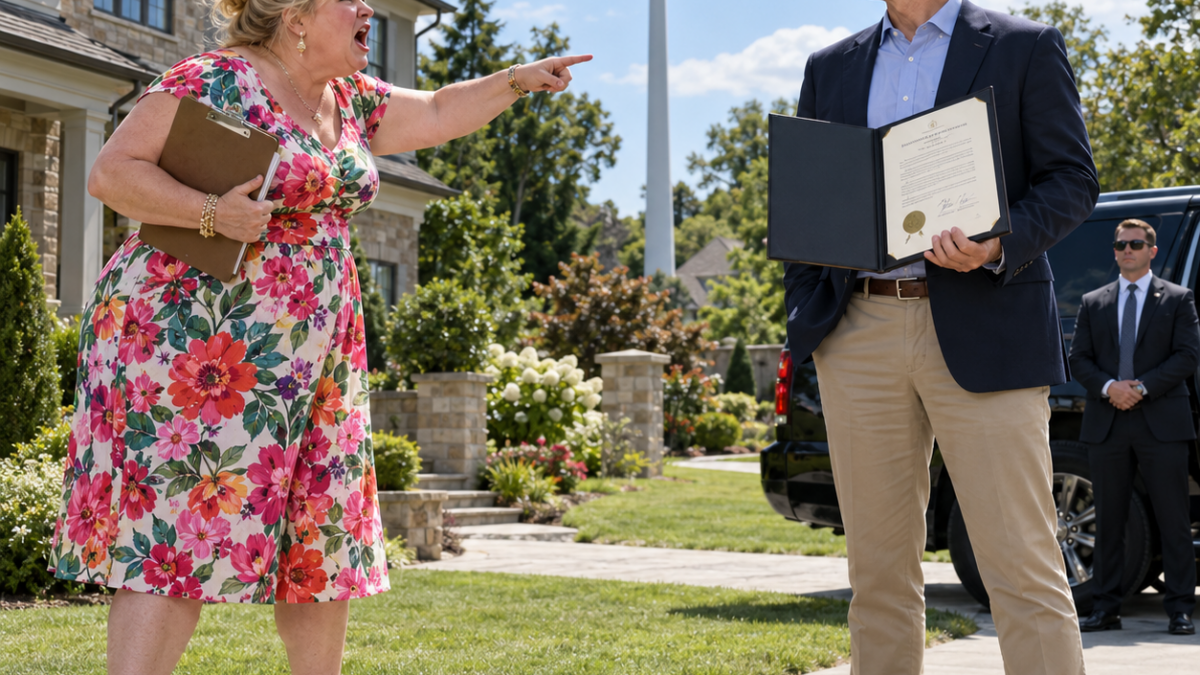
PART 2
Marcus knew from my voice that I wasn’t calling for nostalgia.
During my years in office, he had developed an almost supernatural ability to distinguish between the version of me who wanted advice, the version who wanted information, and the version who had already made up his mind and simply needed the battlefield mapped.
This was the third version.
“I’ll call you tomorrow,” he said.
“Don’t rush it.”
“That means rush it.”
“It means be accurate.”
“That definitely means rush it.”
I smiled after we hung up.
It was the first time Karen Miller had made me smile all week.
Then I turned back to the certified letter.
I read it one more time.
$200 per day.
The amount itself meant very little to me.
That was important to admit.
I could have written a check and forgotten about it.
I could have hired one of the largest law firms in the state and had three attorneys bury Karen under filings until she forgot what a wind turbine looked like.
But that would have solved only my problem.
And something about Karen’s confidence bothered me.
She had threatened a lien too easily.
She had said it as though she had delivered that threat many times before.
People who use power responsibly tend to explain it.
People who enjoy power tend to display it.
Karen had displayed hers.
So I decided not to fight like a former governor.
Not yet.
I would fight like a homeowner.
The following morning, I drafted a response myself.
No attorney letterhead.
No references to my old office.
No political favors.
Just facts.
I quoted Article Seven, Section Four, Subsection B exactly.
I explained that the wind turbine was a permanent energy installation rather than a temporary structure.
Then I attached the state statute protecting residential renewable-energy systems.
I did not write that I had signed it.
That wasn’t relevant to the legal question.
The law either applied or it didn’t.
My identity shouldn’t determine that.
The final paragraph was simple.
“Because the installation is permitted under county requirements and protected under applicable state law, I dispute the violation and associated fine in full. Please confirm in writing that enforcement activity has been suspended.”
Sarah read it over my shoulder.
“You’re being very polite.”
“I’m trying to be.”
“That means you’re angry.”
“You know me too well.”
She kissed my cheek.
“Yes.”
I mailed the letter certified.
Then I created a folder.
HOA—SERENITY MEADOWS.
I placed Karen’s letter inside.
A photocopy of my response went behind it.
Then the return receipt.
Sarah stood in the study doorway watching me.
“You haven’t made a file like that since we left the capital.”
“I’ve made plenty of files.”
“You know what I mean.”
I did.
There was a certain part of public life I had promised myself I would leave behind.
The planning.
The anticipation.
The habit of assuming every conflict contained a second conflict you had not yet discovered.
Politics does that to you.
So does the military.
You learn to look at what somebody is doing and ask what incentive makes that action rational from their point of view.
Karen’s behavior was irrational if her goal was merely protecting property values.
But if her goal was control, it made perfect sense.
Three days later, she answered me.
Another certified letter.
This one increased my balance to $600.
The wording was more aggressive.
“Your attempt to cite state statutes irrelevant to your contractual obligations does not excuse continued noncompliance.”
I read that sentence twice.
Then I handed the letter to Sarah.
She frowned.
“Can she really say state law is irrelevant?”
“She can say anything.”
“I mean legally.”
“No.”
Sarah handed it back.
“So now what?”
“Nothing.”
“Nothing?”
“I already answered.”
She studied me.
“You’re going to let her keep sending fines?”
“Yes.”
“Why?”
“Because every letter tells us more.”
Sarah folded her arms.
“You do realize most normal retired husbands take up golf.”
“I tried golf.”
“You hated golf.”
“Exactly.”
That evening, I installed another security camera covering the driveway.
Not because I thought Karen would do anything dangerous.
Because she had made documentation the center of the conflict.
So I would document better.
For the next ten days, the letters kept coming.
$1,000.
$1,400.
$1,800.
Some included photographs taken from the road.
One included a close-up image of the turbine that appeared to have been shot using a powerful zoom lens so it looked enormous.
Karen had written beneath it:
“Industrial visual impact.”
I laughed when I saw that.
The turbine was narrower than several mature trees on the property.
But she wasn’t building an honest argument.
She was building a story.
And stories can be more powerful than facts if nobody challenges them.
On Friday morning, Marcus arrived at my house carrying a thick envelope and two coffees.
He walked into my study like we had never stopped working together.
“You have a strange retirement.”
“So you keep telling me.”
He dropped the envelope on my desk.
“I think you’re going to enjoy this.”
“That usually means I won’t.”
He sat across from me.
“Serenity Meadows was created eleven years ago by Hartwell Development.”
“I know that.”
“Under Project Evergreen.”
I stopped.
The name brought back a flood of memories.
Project Evergreen had been one of the signature development initiatives of my first gubernatorial term.
We had wanted to encourage builders to create planned communities using more sustainable infrastructure.
Developers received streamlined zoning reviews and certain tax advantages if they incorporated environmental standards into their plans.
Rainwater management.
Green space.
Energy efficiency.
Renewable-energy accommodation.
I opened Marcus’s file.
There it was.
SERENITY MEADOWS—PROJECT EVERGREEN DEVELOPMENT CHARTER.
At the bottom of the certification page was my signature.
Jonathan Reed, Governor.
I leaned back.
“You’re kidding.”
Marcus grinned.
“I thought you’d appreciate the irony.”
I turned to the next page.
The governing language was even better.
One section expressly prohibited community covenants created under the program from unreasonably restricting state-approved residential renewable-energy technology.
I read it twice.
Then a third time.
The HOA had not simply misinterpreted one of its own rules.
The entire community had been chartered under a framework requiring accommodation of exactly the kind of system Karen was ordering me to remove.
Marcus leaned forward.
“Your turbine model is on the Department of Environmental Quality’s approved list too.”
“I checked that.”
“So legally?”
“She has nothing.”
“Politically?”
“I’m retired.”
Marcus laughed.
“You didn’t answer.”
I closed the folder.
“Tell me about Karen.”
His expression changed.
“She’s been president five years. Treasurer before that.”
“Complaints?”
“A lot.”
He slid another packet toward me.
Violation notices had almost tripled since Karen became president.
HOA legal expenses had risen sharply.
Several residents had complained publicly at meetings about selective enforcement.
One family had been fined repeatedly for a portable soccer goal.
Another had been ordered to tear out a professionally installed garden because two plant varieties weren’t listed on the approved landscape schedule.
“Any connection?” I asked.
Marcus nodded.
“Both households opposed Karen’s dues increase two years ago.”
I looked up.
“For what?”
“A new entrance monument.”
“How much?”
“Seventy-eight thousand dollars.”
“For a sign?”
“Granite, lighting, landscaping, decorative water feature.”
“Did it pass?”
“No.”
“And the fines started afterward?”
“Within weeks.”
I felt the conflict changing shape.
The turbine was no longer the important part.
Karen had assumed I would either obey or fight only for myself.
That might have been her first serious mistake.
Her second came Monday morning.
She showed up unannounced.
The camera caught her white SUV pulling onto the shoulder at 8:14.
I was drinking coffee with Sarah on the porch.
Karen walked toward us carrying the familiar clipboard.
“Mr. Reed.”
“Karen.”
She ignored Sarah.
“Your balance is now twenty-four hundred dollars.”
“I received the notices.”
“The board is prepared to escalate enforcement.”
“To what?”
“A compliance lien.”
“You mean a lien.”
“That’s what I said.”
“No, you said compliance lien.”
Her lips tightened.
“Don’t play word games with me.”
“I’m not.”
She moved closer.
“You seem to think your former position gives you immunity here.”
“It doesn’t.”
“Then remove the turbine.”
“No.”
The word was quiet.
That seemed to bother her more than shouting would have.
“I am giving you one final opportunity.”
“You’ve given me several final opportunities.”
Sarah hid a smile behind her coffee cup.
Karen noticed.
“This isn’t funny.”
Sarah finally spoke.
“No, it really isn’t.”
Karen turned toward her.
“This matter is between the association and the homeowner of record.”
“My name is on the deed.”
Karen blinked.
Sarah smiled pleasantly.
“So it’s between you and me too.”
I had loved that woman for almost forty years.
In that moment, I loved her a little more.
Karen turned back to me.
“You have been summoned to an Architectural Review Committee hearing.”
She handed me a document.
“Ten days from tonight.”
“I’ll be there.”
“You’ll have the opportunity to explain why you believe you’re above our community standards.”
“I’ve already explained why the turbine complies.”
“The committee disagrees.”
“Has the committee met?”
Karen paused.
“Informally.”
“So no.”
Her nostrils flared.
“This attitude is exactly why people are concerned.”
“Which people?”
“The community.”
“Names?”
“I’m not obligated to provide names.”
“Complaints?”
“Confidential.”
“Then I’ll wait for the hearing.”
Karen turned to leave.
I called after her.
“One question.”
She stopped.
“You’ve been president five years?”
She smiled proudly.
“Yes.”
“Do you enjoy it?”
The question surprised her.
“What kind of question is that?”
“A simple one.”
“I care about this community.”
“That wasn’t what I asked.”
For the first time, the expression on her face looked almost honest.
“I enjoy maintaining standards.”
Then she walked away.
That answer stayed with me.
That afternoon I called Elena Brooks.
Elena had served as my general counsel during my second term and had a mind sharp enough to make experienced legislators regret improvising around her.
She picked up on the second ring.
“I heard about your turbine.”
“Marcus talks too much.”
“He was laughing too hard not to share.”
“I need a legal review.”
“How serious?”
“HOA serious.”
She groaned.
“Civilization’s final frontier.”
I told her everything.
The fines.
The covenant language.
Project Evergreen.
The charter.
Karen’s claim that state law did not supersede HOA authority.
There was silence.
Then Elena said, “She actually put that in writing?”
“Yes.”
“Keep it.”
“I have it.”
“Of course you do.”
“I also want the HOA’s incorporation history, litigation history, meeting minutes, vendor disclosures, and financial procedures.”
“Now we’re getting somewhere.”
“I’m not asking you to sue.”
“Yet.”
“Correct.”
Elena paused.
“What do you think is happening?”
“I think the turbine is the visible part.”
“And underneath?”
“I don’t know.”
“That bothers you.”
“Yes.”
“Good. Send me everything.”
The next week changed everything.
Not because of anything Karen did.
Because I started walking.
Serenity Meadows covered nearly two hundred large lots spread over gently rolling land outside the capital.
Sarah and I had chosen it because it felt almost rural.
Wide roads.
Old trees preserved between newer homes.
Enough land that neighbors could see each other without living on top of each other.
I began taking evening walks after dinner.
At first, I simply said hello.
Then I listened.
Mr. Chen was the first person who really opened up.
He was outside removing the last section of a garden bed when I stopped.
The garden had been beautiful.
Even half dismantled, I could see the careful design.
“What happened?” I asked.
He sat back on his heels.
“HOA.”
I pretended not to know.
“What’s wrong with it?”
“Wrong flowers.”
I thought he was joking.
He wasn’t.
Two varieties had not appeared on the approved list.
“Were they invasive?”
“No.”
“Poisonous?”
“No.”
“Too tall?”
“No.”
“Then why remove them?”
Mr. Chen smiled without humor.
“Because Mrs. Miller said rules are rules.”
His wife came outside carrying iced tea.
“She hates us,” Mrs. Chen said.
“Honey.”
“She does.”
Mr. Chen looked embarrassed.
I sat on the low stone border.
“Why?”
Mrs. Chen answered.
“We opposed her entrance monument.”
There it was.
The same pattern Marcus had found.
At the Rodriguez house, the story was nearly identical.
Their son Mateo loved soccer.
A portable goal stood near the side yard.
Karen had fined them repeatedly because the structure remained outside overnight.
“I moved it every morning,” Mr. Rodriguez told me. “Finally I said no.”
“What happened?”
“She doubled the fine.”
“Why didn’t you appeal?”
“To who?”
That question mattered.
The appeals committee, it turned out, consisted largely of Karen’s allies.
By the time I reached David Harper’s house, the sun had almost disappeared.
David was a retired accountant in his late sixties.
He listened when I mentioned the turbine.
Then he asked me inside.
“I was treasurer for one year.”
I knew that from Marcus’s report.
“Why only one?”
“Karen.”
He made coffee.
We sat at his kitchen table.
“She doesn’t steal in the obvious way,” David said.
That sentence immediately got my attention.
“What does that mean?”
He looked toward the window as if Karen might somehow be standing outside.
“She pushes contracts through.”
“To whom?”
“Friends. Relatives. People she knows.”
“Examples?”
“The front entrance landscaping.”
“Her brother-in-law?”
David looked surprised.
“You know about that?”
“I’m learning.”
He nodded slowly.
“Ten thousand dollars. No competing bids.”
“For what work?”
“Work worth maybe seven.”
“That alone isn’t embezzlement.”
“No.”
“But?”
“HOA credit card.”
“What about it?”
“Restaurant charges. Office furniture. Electronics. Things she says are association expenses.”
“You objected?”
“I did.”
“What happened?”
He gave me a tired smile.
“She accused me of sabotaging the community.”
“Do you still have records?”
David didn’t answer immediately.
Then he stood.
He disappeared into another room.
When he came back, he carried a storage box.
“I kept copies.”
I looked at him.
“Why?”
“Because I knew someday somebody would ask the right question.”
We spent two hours going through the documents.
Nothing yet proved a crime.
That mattered.
I had spent too much of my life around public accusations to confuse suspicion with evidence.
But there was enough to justify scrutiny.
Large unitemized expenses.
No-bid contracts involving relatives.
Legal invoices with almost no description.
Restaurant charges on dates when no board meeting had occurred.
The biggest problem was procedural.
Under the bylaws, homeowners could force an independent financial audit if enough properties signed a petition.
“How many?” I asked.
“Ten percent.”
“About twenty homes.”
David nodded.
“You think you can get twenty?”
I looked down at the box of records.
“I think Karen already has.”
For the next several days, Sarah and I invited neighbors over.
Not for a secret rebellion.
For dinner.
That distinction mattered.
We had never hosted a proper housewarming because moving out of public life had taken more energy than either of us expected.
So we put folding tables on the patio.
Sarah made enough food for fifty people.
I handled the grill.
About forty residents came.
Some were curious about the former governor.
Most were curious about the turbine.
Children wandered toward the back fence to look at it.
Parents followed.
Almost every reaction was the same.
“That’s what she’s upset about?”
“It’s quieter than my air conditioner.”
“I can barely see it.”
One teenager asked how much electricity it produced.
For twenty minutes, I forgot about Karen entirely.
I explained how vertical-axis turbines worked.
How the blades captured changing wind directions without needing to swivel.
How the inverter synchronized output with the house.
How the battery system stored surplus power.
It felt good.
I had once given speeches to thousands of people about statewide energy policy.
Explaining the same idea to six neighbors beside a grill somehow felt more meaningful.
Later, after dessert, David brought up the audit.
Not me.
He stood beside the patio table holding a folder.
“I think homeowners should know something.”
Conversation quieted.
David explained his time as treasurer.
No accusations.
No dramatic language.
Just irregularities.
Then Sarah handed me the petition.
I looked at the neighbors.
“I want to be careful about this.”
I placed the petition on the table.
“This is not a declaration that anybody committed a crime. It is not revenge for my turbine. It is a request for an independent audit because this association belongs to everyone who pays into it.”
People watched silently.
“The rules give us the right to ask for transparency.”
Nobody moved.
Fear has weight.
You can feel it when a room full of people all want somebody else to be first.
Mr. Chen finally stood.
He walked toward the table.
He picked up the pen.
“I’m tired of being afraid of flowers,” he said.
Then he signed.
Mrs. Chen signed beneath him.
Rodriguez came next.
Then his wife.
David signed.
A woman named Patricia signed.
Then another couple.
And another.
By the end of the night, thirty-four properties had signed.
Fourteen more than necessary.
Sarah and I stood in the kitchen after everyone left.
She leaned against the counter.
“You know this isn’t about retirement anymore.”
“I know.”
“Are you okay with that?”
I looked toward the dark field.
The turbine turned slowly under the moonlight.
“I didn’t want another campaign.”
“This isn’t a campaign.”
“It feels like one.”
Sarah came closer.
“Then remember the difference.”
“What difference?”
“You’re not trying to win power.”
She took my hand.
“You’re trying to give it back.”
The audit petition was formally delivered the following morning.
Karen responded by email to the entire neighborhood.
The message was nearly three pages.
She accused “certain politically connected residents” of attempting to undermine community governance.
She called the audit request irresponsible.
She suggested the petition signers had been manipulated.
Then she invited the entire neighborhood to attend my Architectural Review Committee hearing.
I read the email in my study.
Sarah walked in halfway through.
“How bad?”
I turned the laptop toward her.
She read one paragraph.
“Oh.”
“That’s one word.”
“She sounds terrified.”
“Yes.”
The hearing was four days away.
That afternoon, Elena arrived.
We sat around the dining room table with David and Marcus.
Elena spread out the state documents.
“Legally, the turbine case is almost embarrassingly simple.”
“Meaning?”
“The HOA loses.”
“Good.”
“But you need to decide what tonight is about.”
“What do you mean?”
“If you walk into that hearing and reveal everything at once, you’re not merely defending the turbine.”
Marcus leaned back.
“You’re ending Karen’s presidency.”
David looked uncomfortable.
“Can we actually do that?”
“Not directly at the architectural hearing,” Elena said. “But politically? Yes.”
I frowned at Marcus.
“No campaign language.”
He held up both hands.
“I didn’t say anything.”
“You were thinking it.”
“I spent fourteen years getting paid to think it.”
Elena ignored us.
“Jonathan, we need discipline. You can show the charter. You can show the state law. You can show the audit petition. But unless we have verified financial evidence, do not accuse Karen of theft.”
“I wasn’t planning to.”
“Good.”
David pushed forward one invoice.
“What about the contract to her brother-in-law?”
“Question it. Don’t characterize it beyond what the documents establish.”
That was the right approach.
Facts first.
Always.
The night before the hearing, Sarah found me in the study rehearsing.
“You promised me you were retired.”
“I am.”
“You’re practicing lines.”
“I’m organizing documents.”
“You’ve been saying the same opening sentence for twelve minutes.”
I looked at her.
“Was it good?”
She laughed.
Then her face softened.
“John.”
“Yes?”
“Don’t become the governor tomorrow.”
I knew what she meant.
In office, every room had contained an invisible calculation.
What would the press think?
What would legislators say?
Who was watching?
Who was recording?
What would become the headline?
Sarah wanted the man she married to walk into that clubhouse.
Not the public figure.
“I won’t.”
“You sure?”
“No.”
She sat beside me.
“That’s more honest.”
I closed the folder.
“What if I enjoy it?”
“The fight?”
“Yes.”
Sarah thought for a moment.
“You probably will.”
“That worries me.”
“Then let it.”
I looked at her.
She squeezed my hand.
“The fact that it worries you is probably what keeps you from becoming Karen.”
The hearing started at seven.
By six-thirty, the clubhouse parking lot was full.
Karen had arranged the room like a courtroom.
Three committee members behind a long table.
Karen in the center.
Barb Ellis to her left.
Gary Foster to her right.
A single chair sat alone about ten feet in front of them.
My chair.
The audience seating had been filled with almost eighty homeowners.
Sarah and I entered together.
Conversations stopped.
Some people smiled.
Others stared.
A few clearly supported Karen.
That was fine.
I did not need unanimity.
I needed fairness.
Elena sat near the back with her laptop.
David sat with the Chens.
Rodriguez sat beside his wife.
I walked toward the lonely chair.
Then passed it.
I sat beside Sarah in the front row.
Karen watched every step.
“Mr. Reed.”
“Yes?”
“The respondent’s chair is there.”
“I can see it.”
“Please take your assigned seat.”
“I’m comfortable here.”
A murmur moved through the audience.
Karen’s face hardened.
“This proceeding has rules.”
“So does the association.”
That earned a few quiet laughs.
Karen slammed the gavel.
The hearing began.
She presented photographs.
The first image showed my turbine zoomed so tightly that it filled the projector screen.
From that angle, it looked enormous.
“There,” Karen said. “That is what Mr. Reed has forced this community to look at.”
Someone behind me whispered, “From where?”
Another person snorted.
Karen continued.
She cited Article Seven.
She described the turbine as an industrial installation.
She suggested it could reduce property values.
She claimed it undermined the visual character of the development.
Then she shifted toward me personally.
“Mr. Reed seems to believe his previous political position places him above community standards.”
I heard Sarah inhale beside me.
I touched her hand.
Let Karen talk.
She did.
For almost fifteen minutes.
Finally she leaned back.
“The committee is prepared to impose the maximum continuing fine and authorize lien proceedings.”
She looked directly at me.
“Before we vote, do you have anything to say?”
I stood.
“Yes.”
“Take the chair.”
“I’d rather use the lectern.”
“That lectern is for committee presentations.”
Elena’s voice came from the back.
“Section Nine, Paragraph Two gives any homeowner appearing before an association committee the right to present documents and other evidence reasonably necessary to the defense of the alleged violation.”
Every head turned.
Karen glared at Elena.
“And you are?”
“Elena Brooks. Counsel observing on behalf of Mr. Reed.”
Karen looked back at me.
“You brought a lawyer?”
“I brought documents.”
She hesitated.
Then snapped, “Five minutes.”
I walked to the lectern.
I inserted the USB drive into the clubhouse computer.
The projector changed.
The photograph of my turbine disappeared.
A scanned state document appeared.
PROJECT EVERGREEN—PLANNED GREEN COMMUNITY CHARTER.
The room became quiet.
“This,” I said, “is the document under which Serenity Meadows was originally approved.”
I highlighted a paragraph.
“The development received incentives under a statewide sustainable-community initiative.”
Karen interrupted.
“What does this have to do with your violation?”
“Everything.”
I clicked.
The relevant provision appeared enlarged.
“Participating communities may not unreasonably prohibit state-approved residential renewable-energy systems.”
People leaned forward.
I clicked again.
The Department of Environmental Quality listing appeared.
My turbine model.
Approved.
Another click.
The Homeowner Energy Sovereignty Act.
“This state statute protects residential renewable-energy installations meeting applicable safety and permitting requirements.”
Karen’s expression had changed.
Not fear yet.
Recognition.
She knew where this was going.
I looked at the audience.
“My system was professionally installed. It is county permitted. It meets state requirements. It sits on five acres, hundreds of feet from any neighboring house.”
Then I clicked back to Article Seven.
“Now let’s read the section I am accused of violating.”
I highlighted the heading.
TEMPORARY AND UNAUTHORIZED STRUCTURES.
Then the examples.
Trailers.
Temporary sheds.
Tents.
Construction shelters.
I turned toward Karen.
“A permanent wind-energy installation is not a temporary structure.”
Someone applauded.
Karen slammed the gavel.
“No interruptions.”
I waited.
Then I clicked again.
The original Project Evergreen signature page filled the screen.
At the bottom was my name.
JONATHAN REED, GOVERNOR.
A murmur rolled through the room.
Karen looked at the screen.
Then at me.
Her face drained.
I let the moment settle.
“I remember this program.”
My voice was quieter now.
“I signed this charter eleven years ago.”
Nobody moved.
“The legal framework that allowed Serenity Meadows to exist under Project Evergreen contains protections for the very type of renewable-energy system I installed.”
I turned toward Karen.
“So, with respect, President Miller, you are attempting to use this HOA’s authority to prohibit something the HOA’s own founding charter requires it to reasonably accommodate.”
Barb looked at Gary.
Gary stared at the table.
Karen recovered enough to speak.
“That doesn’t mean your particular structure is aesthetically appropriate.”
“No.”
I nodded.
“That is a separate argument.”
She seemed relieved.
Too soon.
“But you didn’t fine me under an aesthetic-review section.”
Her relief disappeared.
“You fined me under a provision regulating temporary structures.”
Silence.
“And after I provided the state law, you wrote that state statutes did not supersede HOA covenants.”
I put her letter on the screen.
Several homeowners gasped softly.
Karen looked trapped.
But I wasn’t finished.
I clicked to a simple graph David had prepared.
HOA LEGAL EXPENDITURES—FIVE-YEAR TREND.
The line rose sharply.
Karen stood.
“This is outside the scope of the hearing.”
“It may be.”
“Then remove it.”
I looked toward the audience.
“Thirty-four homeowners signed a formal petition requesting an independent audit.”
More murmurs.
David stood.
“We did.”
Mr. Chen rose too.
“So did we.”
Rodriguez lifted his hand.
“Me too.”
Karen slammed the gavel again.
“This is not a town hall.”
I turned toward her.
“No.”
I spoke calmly.
“It’s an HOA meeting attended by the people who pay for the HOA.”
Then I changed slides.
The landscaping contract appeared.
Ten thousand dollars.
Vendor relationship disclosed as belonging to Karen’s brother-in-law.
“I am not accusing anyone of theft.”
I looked deliberately toward Elena.
She gave the smallest nod.
“But homeowners have legitimate questions about related-party contracts, legal expenses, and enforcement practices.”
Mrs. Chen stood.
“My garden.”
Karen pointed at her.
“Sit down.”
Mrs. Chen did not.
“You made me destroy my garden after I opposed your dues increase.”
“That is false.”
“The notice came two weeks later.”
Karen’s face turned red.
Mr. Rodriguez stood.
“And you doubled my fine after I complained about my son’s soccer goal.”
“That was a repeat violation.”
“My neighbor has the same goal.”
Karen stared at him.
“You never fined him.”
Someone else rose.
Then another.
Stories began coming from all directions.
A fence.
A basketball hoop.
Holiday lights.
A mailbox.
A boat trailer.
Different violations.
Same pattern.
People who challenged Karen received scrutiny.
People close to her received flexibility.
The room was transforming.
Karen understood it before anyone else did.
This was no longer my hearing.
It was hers.
She slammed the gavel repeatedly.
“Order! Sit down! This committee will come to order!”
Nobody was shouting.
That was what made her panic look worse.
People were simply standing.
One after another.
Speaking clearly.
Explaining what had happened.
David finally raised his voice.
“Karen, the board has four days remaining to respond to the audit petition.”
She stared at him.
“Sit down.”
“No.”
The word echoed.
David had spent years afraid of her.
I saw it on his face even as he said it.
His hands trembled.
But he stayed standing.
“We followed the bylaws.”
Karen pointed at him.
“You resigned as treasurer.”
“Yes.”
“Because you couldn’t handle the job.”
David went pale.
I started to rise.
He lifted one hand toward me.
Don’t.
Then he looked at Karen.
“I resigned because you told me to approve expenses without documentation.”
The room went silent.
Karen’s face changed.
“That is a lie.”
“I kept the emails.”
Everything stopped.
Even Karen.
David swallowed.
“I kept every one.”
Karen looked at him as if she had never truly considered the possibility that somebody else might have records.
That may have been the precise moment she lost.
Not when I revealed the charter.
Not when I showed the law.
When David said he had kept the emails.
She turned toward Barb and Gary.
“We are voting.”
Barb looked terrified.
“Karen—”
“Now.”
She raised her hand.
“All in favor of finding the Reed property in violation and authorizing maximum enforcement.”
Her hand remained alone.
Barb looked at the audience.
Then at Elena.
Then at me.
“I abstain.”
Karen’s eyes widened.
“Excuse me?”
“I abstain.”
Gary immediately said, “Me too.”
Karen stared at them.
“You can’t both abstain.”
Gary cleared his throat.
“I just did.”
A ripple of laughter moved through the room.
Karen slammed the gavel.
“The motion carries one to zero.”
Elena stood.
“No.”
Karen’s head snapped around.
“With a three-member committee, the governing rules require a majority of seated members for affirmative action. One vote is not a majority.”
Karen’s mouth opened.
Barb looked down.
Gary suddenly became extremely interested in his shoes.
The motion had failed.
The first sound came from the back of the room.
One clap.
Then another.
Soon half the room was applauding.
I did not.
Neither did Sarah.
Karen looked directly at me.
Her face contained something beyond anger now.
Hatred.
“You planned this.”
I answered quietly.
“I prepared.”
“You came here to humiliate me.”
“No.”
“You used your political connections.”
“The charter is public.”
“You brought your governor friends.”
“I brought neighbors.”
She pointed toward Elena.
“And her?”
“My lawyer.”
“That’s exactly what I mean.”
I almost smiled.
“Karen, you threatened a lien on my home.”
She had no answer.
David spoke again.
“The audit petition.”
Karen grabbed her binder.
“The board will respond.”
“Within four days.”
“I know the rules.”
Mr. Chen said quietly, “That is what worries us.”
Karen left through the side door.
The meeting did not end.
For another hour, homeowners stayed.
We discussed procedure.
Not revenge.
Procedure.
That distinction became even more important because Karen’s next move was desperate.
And desperate people make expensive mistakes.
Two days later, David called me at 6:30 in the morning.
“John.”
“What happened?”
“She spent twenty-five thousand dollars.”
“On what?”
“A law firm.”
I sat up in bed.
Sarah stirred beside me.
“What law firm?”
“Bramwell, Tate and Dunn.”
I knew the name.
Aggressive commercial litigators.
Expensive.
Very expensive.
“For the HOA?”
“That’s what the charge says.”
“Board approval?”
“No.”
“Are you certain?”
“Yes.”
I got out of bed.
“Do not circulate that yet.”
“Why?”
“Because we verify first.”
“I have the credit-card record.”
“Verify board authorization.”
“John—”
“David.”
He stopped.
“We do this correctly.”
A pause.
“Okay.”
By noon, Elena had confirmed it.
No board vote.
No written authorization.
No emergency resolution.
Karen had used the association credit card to pay a $25,000 retainer.
The engagement letter, obtained later through proper board access, described the purpose as advice related to “claims against Jonathan Reed and other dissident homeowners.”
Sarah read that phrase and stared at me.
“Dissident homeowners?”
“I’ve been called worse.”
“It sounds like we live in a dictatorship.”
“That’s becoming the problem.”
The board had five voting members in addition to Karen.
Three were already uncomfortable.
Elena prepared a formal request demanding an emergency meeting.
The audit petition deadline was approaching.
Karen refused.
In writing.
Her email stated:
“As president, I determine when special meetings are necessary.”
Unfortunately for Karen, the bylaws said otherwise.
A majority of board members could call one when the president refused a properly supported petition.
Three members signed.
The emergency meeting was scheduled forty-eight hours later.
That afternoon, Karen came to my house.
No clipboard.
No binder.
Just Karen.
The driveway camera recorded everything.
She stood outside the gate.
I walked down.
“Can we talk?”
“That depends.”
“No recording.”
“I’m not turning off the security system.”
Her face tightened.
“Fine.”
I stayed on my side of the gate.
She looked tired.
For the first time since I had met her, she seemed unsure of the next sentence.
“This has gone too far.”
“I agree.”
Her eyes flashed.
“Then stop it.”
“I didn’t spend the association’s money on lawyers.”
“That firm is protecting the HOA.”
“From whom?”
“You.”
“I asked for an audit.”
“You threatened litigation.”
“After you threatened a lien.”
“Because you violated the rules.”
“Karen.”
I let the word sit.
“You know now that the turbine is legal.”
She looked away.
“That’s debatable.”
“No.”
Her jaw tightened.
“Even if it is, you’re destroying the association over one mistake.”
“One mistake?”
“Yes.”
“What about the Chens?”
“They violated landscaping standards.”
“Rodriguez?”
“Recreational equipment.”
“David?”
“He was incompetent.”
“Twenty-five thousand dollars?”
Her face changed.
There it was.
“You don’t know what you’re talking about.”
“The board didn’t approve it.”
Silence.
“You have no right to those records.”
“I didn’t obtain them.”
That frightened her more.
“Who did?”
“Board members.”
Karen stepped closer to the gate.
“You are turning everyone against me.”
“No.”
“You are.”
“I showed them documents.”
“You are using them.”
“For what?”
“To get revenge because I told you no.”
I almost laughed.
Instead, I felt sad.
Because she truly believed it.
To Karen, every conflict had to be about dominance.
If I wasn’t submitting, I must be trying to rule.
“There’s something you don’t understand,” I said.
“What?”
“I don’t want your job.”
Her expression faltered.
“I don’t want the HOA presidency. I don’t want your seat. I don’t want your office, your binder, your gavel, or your title.”
“Then what do you want?”
“Accountability.”
She stared at me.
“That’s a political word.”
“No.”
I shook my head.
“It’s an adult word.”
Her cheeks flushed.
I immediately regretted the sharpness.
But she had already turned away.
Before she reached her SUV, I called out.
“Karen.”
She stopped.
“You can still cooperate with the audit.”
She looked back.
“You think that saves me?”
“I think hiding records makes everything worse.”
Her eyes hardened.
“You have no idea what you’ve started.”
Then she left.
The special board meeting was standing room only.
Karen arrived last.
No one applauded.
No one booed.
The mood was different from the architectural hearing.
Less theatrical.
More serious.
David formally presented the audit motion.
One of the board members, Margaret Owens, seconded it.
Discussion lasted eleven minutes.
Then the vote.
Four in favor.
Zero opposed.
Karen refused to vote.
The audit was approved.
The applause was quiet.
Relieved.
Then Rodriguez stood.
He held another petition.
Recall.
Karen looked at me instantly.
I shook my head.
Not mine.
Rodriguez had organized it.
Seventy-two households had signed.
“I want a vote of no confidence,” he said.
Karen slammed her hand on the table.
“You are out of order.”
The acting chair consulted the bylaws.
“No,” he said. “He isn’t.”
The motion proceeded.
Board member after board member spoke.
Not cruelly.
That made it harder for Karen.
Margaret described the unauthorized legal retainer.
Gary Foster admitted he had repeatedly voted with Karen because he feared being targeted himself.
Barb Ellis apologized publicly for allowing hearings to become political punishments.
David described being pressured to sign expense approvals.
When it was Karen’s turn, she stood.
For a moment, I saw the version of her that had probably first won people’s trust.
She spoke clearly.
She talked about declining standards before her presidency.
Rising costs.
Residents who wanted services without paying for them.
The endless complaints.
The thankless work.
Some of what she said was probably true.
Leadership is often harder than critics imagine.
“You think this job made me powerful?” she said.
“It made me responsible for everything you people didn’t want to handle yourselves.”
The room was quiet.
“You wanted clean streets. You wanted maintained entrances. You wanted rules enforced against your neighbors but exceptions made for yourselves.”
A few people looked uncomfortable.
She had struck something real.
Then she pointed toward me.
“And then he moved in.”
I remained seated.
“A former governor with lawyers and political consultants and more money than most of us will see in our lifetimes.”
Her voice rose.
“He built whatever he wanted, and when I dared tell him no, he turned this entire neighborhood against me.”
Some people nodded.
Not many.
But some.
That mattered.
Karen looked around.
“You think he’s doing this for you?”
I could feel the old political instinct awakening.
The urge to stand.
Counter.
Control the room.
Sarah touched my knee.
Don’t.
So I stayed seated.
Karen continued.
“He misses power. That’s what this is. He couldn’t handle being ordinary.”
That one landed.
Because it was close enough to one of my own fears.
I had asked myself the same question.
Did I miss the fight?
Did I miss entering rooms where people listened when I spoke?
Did some part of me enjoy being Jonathan Reed, Governor, again?
Yes.
Probably.
Human motives are rarely pure.
But mixed motives did not change the documents.
When Karen finished, she sat down.
The acting chair looked toward me.
“Mr. Reed, do you want to respond?”
I stood slowly.
“Yes.”
The room waited.
“Karen is right about one thing.”
She looked surprised.
“I have advantages.”
I glanced around.
“I have money. I know lawyers. I know how state government works. I know how to read legislation. When she fined me, I had options many homeowners don’t have.”
Mrs. Chen watched me.
Rodriguez leaned forward.
“That is exactly why this stopped being only about my turbine.”
I turned toward Karen.
“If the same notice had gone to somebody working two jobs, somebody caring for an elderly parent, somebody afraid of legal bills, that person might have removed a perfectly lawful installation because fighting you seemed harder than surrendering.”
Nobody moved.
“I don’t want Karen’s power.”
I looked at the board.
“I want less concentrated power.”
Then I sat.
The recall motion passed.
Karen Miller was removed as president of the Serenity Meadows Homeowners Association.
Effective immediately.
No cheering.
Walter from the back row finally whispered, “Good.”
But mostly there was silence.
Karen remained seated for several seconds.
Then she stood.
She placed her HOA key ring on the table.
Next came the association credit card.
Then a small office key.
Finally the gavel.
She looked at me.
“I hope you enjoy what you wanted.”
“I told you.”
My voice was quiet.
“I didn’t want your chair.”
She walked out.
The door closed softly behind her.
That should have been the ending.
It wasn’t.
Because losing the presidency only revealed what the presidency had been hiding.
The independent auditors arrived the following Monday.
They requested five years of records.
Then seven.
Then every electronic backup the management company possessed.
David joined the new interim board as president.
His first act was rescinding my wind-turbine fines.
His second was suspending all unresolved penalties issued during Karen’s final six months until they could be reviewed.
His third was publishing the HOA’s current financial statements online.
Transparency changed the neighborhood almost overnight.
People discovered how much money had actually been spent on legal fees.
They saw the vendor payments.
The contracts.
The reimbursements.
Questions multiplied.
The auditors worked for six weeks.
Their report was more than two hundred pages.
I did not read it first.
David did.
Then Elena.
Then the full board.
When David called me, his voice sounded tired.
“It’s worse.”
“How much worse?”
“Over a hundred thousand.”
I closed my eyes.
The audit identified transactions requiring further investigation.
Some were clearly unsupported.
Others involved conflicts of interest.
There were payments to vendors that appeared not to exist at listed addresses.
Expensive electronics categorized as association office equipment but delivered to Karen’s home.
Travel expenses described as community-development research.
Restaurant charges.
Furniture.
The $25,000 law-firm retainer.
The most troubling transactions had gone through entities connected to people in Karen’s personal circle.
Again, we were careful.
An audit finding was not a criminal conviction.
So the board did what responsible organizations do.
They referred the records to the appropriate authorities and to independent counsel.
Then they stopped talking publicly.
That restraint frustrated some neighbors.
People wanted details.
They wanted punishment.
They wanted a villain.
I understood the impulse.
But justice becomes revenge the moment you decide the outcome before the process.
Months earlier, I might have enjoyed watching Karen panic.
Now I mostly felt tired.
One evening, Sarah and I sat beneath the porch lights while the turbine turned at the edge of the property.
“You won,” she said.
“Did I?”
“Yes.”
“Doesn’t feel like it.”
She smiled faintly.
“That’s because you’re older.”
“Thank you.”
“You know what I mean.”
I did.
When I was younger, victory felt like defeating somebody.
By sixty-three, victory increasingly felt like fixing whatever had made the fight necessary.
The neighborhood still needed fixing.
We rewrote the enforcement process.
No fine could be imposed without a written warning except for immediate safety hazards.
Homeowners received a reasonable correction period.
Appeals went to a rotating panel rather than permanent board loyalists.
Related-party contracts required disclosure and competitive bids.
Major expenditures required recorded votes.
Financial statements had to be posted quarterly.
Legal retainers above a threshold required full board approval.
The landscaping rules were simplified.
Mr. Chen replanted his garden.
We helped.
I spent a Saturday morning digging holes beside him.
“You know,” he said, “when you were governor, I didn’t vote for you.”
I looked at him.
“Should I leave?”
He laughed.
“No.”
“Good.”
He handed me another plant.
“My wife did.”
“Smart woman.”
“She reminds me frequently.”
We planted two of the species Karen had ordered removed.
They bloomed beautifully the following spring.
The Rodriguez soccer goal returned to the yard.
David joked that it should be declared a historic monument.
Mateo invited me to take a shot.
I missed badly.
He looked horrified.
“You were governor?”
“That had nothing to do with soccer.”
“I thought governors were good at stuff.”
“Mostly speeches.”
“That makes sense.”
Sarah laughed for ten minutes after I told her.
The legal investigation moved slowly.
That was another thing people misunderstand about accountability.
Real investigations are rarely dramatic.
Most of the work happens quietly.
Subpoenas.
Bank records.
Interviews.
Accounting schedules.
Lawyers requesting extensions.
Documents being compared against other documents.
Karen remained in her home during those months.
We crossed paths occasionally.
Neither of us spoke.
Then one morning, two investigators arrived at her house.
No flashing lights.
No crowd.
Just two vehicles.
By afternoon they were gone.
I refused every reporter who called.
The former governor angle made the story attractive.
FORMER GOVERNOR BATTLES HOA.
FORMER GOVERNOR’S WIND TURBINE EXPOSES FINANCIAL SCANDAL.
I hated those headlines.
They reduced nearly two hundred homeowners to background characters in my personal story.
The truth was more interesting.
Karen had lost because ordinary neighbors finally stopped facing her separately.
Months after the audit began, prosecutors filed financial charges based on a subset of transactions they believed they could prove beyond the required legal standard.
Not every questionable expense became a charge.
It shouldn’t have.
Some were governance failures.
Some were poorly documented.
Some were ethically troubling without necessarily being criminal.
But several vendor payments and the use of association money for personal purposes became the center of the case.
The $25,000 legal retainer caused additional civil complications because it had not been properly authorized.
The law firm eventually returned a substantial portion of the unused funds.
The HOA also pursued recovery of other money through civil proceedings.
Karen hired counsel.
For months, the neighborhood waited.
The strangest part was how quickly ordinary life resumed.
Children played.
Lawns were mowed.
Packages arrived.
People argued about dogs and parking and whose tree dropped leaves into whose pool.
Normal human friction.
But now nobody feared a $200 fine simply for disagreeing with the president.
One Sunday afternoon, David stopped at my house.
He carried a box.
“I found something.”
“What?”
He handed me an old Project Evergreen brochure.
On the cover was an artist’s rendering of Serenity Meadows before construction.
Solar panels.
Rain gardens.
Walking paths.
And in the background, almost ridiculously, a small residential wind turbine.
I stared at it.
David started laughing.
“You have to frame that.”
“I absolutely do.”
Sarah walked out.
“What is it?”
I showed her.
She looked at the turbine in the illustration.
Then at ours.
“You mean the neighborhood was literally advertised with one?”
“Yes.”
She shook her head.
“That woman nearly started a civil war over the brochure.”
We framed it.
It still hangs in my study.
The criminal matter eventually ended without a dramatic trial.
Karen reached a plea agreement on several financial charges.
She was ordered to pay restitution associated with the proven losses.
Additional civil recovery followed through the HOA’s case.
Her agreement also restricted her future involvement in similar fiduciary roles for a period determined by the court.
Barry, her husband, was not simply ignored.
Investigators examined his involvement too.
Some documents carried his signature.
He cooperated and accepted responsibility for transactions tied to his conduct.
That mattered to me.
It would have been easy to turn Karen into a cartoon villain and everyone around her into helpless victims.
Reality was messier.
People enabled her.
Some through fear.
Some through laziness.
Some because they benefited.
Systems rarely fail because of one person.
They fail because too many people decide confronting that person is somebody else’s responsibility.
Karen listed her house the following summer.
The white SUV disappeared first.
Then contractors came.
Then the FOR SALE sign.
One morning I was repairing a section of fence when I saw Karen walking up my driveway.
No clipboard.
No HOA badge.
No anger in her posture.
She stopped about ten feet away.
“Can we talk?”
I set down the drill.
“Yes.”
She looked older.
Not dramatically.
Just tired.
“I’m leaving Friday.”
“I saw the sign.”
“I suppose you’re happy.”
“No.”
She laughed bitterly.
“Still pretending.”
“I’m not pretending.”
“You got everything.”
“What did I get?”
“My position.”
“I don’t have your position.”
“My reputation.”
“I didn’t create the financial records.”
“My home.”
“I didn’t file your criminal case.”
“You started all of it.”
There it was.
The thing she needed to believe.
Because if I had destroyed her, then she was still only a victim of somebody more powerful.
If her own choices had destroyed her, she had to live with them.
I leaned against the fence.
“You started fining me because of a legal wind turbine.”
She looked away.
“You embarrassed me.”
“I corrected you.”
“In front of everyone.”
“At the hearing you scheduled.”
Her jaw tightened.
“I spent five years building that community.”
“I know.”
That answer surprised her.
“You know?”
“Yes.”
I had read old records by then.
Karen’s first year as president had been productive.
She negotiated better trash collection.
She had pushed the developer to repair drainage near three homes.
She organized landscaping volunteers.
She fought successfully for safer street lighting.
She had not begun as the woman who appeared in my driveway.
Maybe that was the saddest part.
“You did good things,” I said.
Karen’s eyes watered.
She blinked quickly.
“Nobody remembers.”
“I do.”
She looked at me.
“Then why?”
“Why what?”
“Why did you destroy me?”
I shook my head.
“Because eventually you decided doing good things entitled you to do whatever you wanted.”
Her face hardened again.
“You don’t understand what it was like.”
“Probably not.”
“Everybody complains. Nobody helps. Everybody wants exceptions.”
“I believe you.”
“You give somebody an exception and ten people accuse you of favoritism.”
“I believe that too.”
She stared at me, almost angry that I wasn’t arguing.
“So what was I supposed to do?”
“Build a fair process.”
“I had a process.”
“No.”
I looked toward the field.
“You had yourself.”
The turbine was spinning.
Slowly.
Silently.
Karen followed my gaze.
“I hated that thing from the second I saw it.”
“I know.”
“Do you know why?”
“Aesthetics?”
“No.”
She gave a small, exhausted laugh.
“Because you didn’t ask me.”
That was the most honest sentence she had ever spoken to me.
She continued.
“Everyone asked me. Fence colors. Patios. Roofs. Sheds. Gardens. Everybody came through the board.”
“The law didn’t require permission for the turbine.”
“I know that now.”
“You knew it after my first letter.”
She looked down.
“Yes.”
The answer surprised me even though I had suspected it.
“So why keep fining me?”
Her eyes filled.
“Because if I admitted I was wrong, everybody would challenge everything.”
There it was.
The entire tragedy reduced to one sentence.
She had confused credibility with infallibility.
Leadership with never backing down.
Authority with winning every argument.
“I was governor during recessions, storms, fires, legislative investigations, budget shutdown threats, protests, and one scandal involving a cabinet secretary that nearly consumed my second term.”
Karen looked at me.
“You know what people remember most when they ask about leadership?”
“What?”
“The times I admitted we got something wrong.”
She laughed bitterly.
“Easy for you. You already had power.”
“No.”
I shook my head.
“That’s exactly when it’s hardest.”
She looked again at the turbine.
“If I had canceled your first fine…”
“None of this would have happened because of me.”
“What about the audit?”
I considered that.
“Maybe eventually somebody else would have asked.”
“David?”
“Maybe.”
“Chen?”
“Maybe.”
“Or nobody.”
“Maybe.”
She breathed out slowly.
“So you did destroy me.”
“No.”
I stepped closer.
“I was the door that opened. What was behind it already existed.”
Karen wiped one cheek.
“I hate you.”
“I know.”
“You don’t hate me?”
“No.”
“Why?”
“Because I’d rather enjoy my retirement.”
For the first time since I had known her, Karen laughed.
A real laugh.
Small.
Broken.
But real.
Then she looked at me.
“I’m sorry about the turbine.”
It wasn’t enough to erase everything.
It didn’t restore the money.
It didn’t undo what she had done to the Chens, the Rodriguezes, David, or everyone else.
But an apology does not need to erase the past to matter.
“Thank you.”
She nodded.
Then turned.
I watched her walk back down the driveway.
Friday morning, the moving truck came.
Nobody celebrated.
David had made that clear.
“We are rebuilding a community,” he told everyone. “We are not becoming the thing we removed.”
Karen and Barry loaded their belongings.
Near noon, Karen stood beside the passenger door.
She looked across the road toward my property.
I was on the porch with Sarah.
Our eyes met.
I nodded once.
She nodded back.
Then she got into the truck.
It drove away.
The turbine kept turning.
The next year was the first genuinely peaceful year Sarah and I had experienced in decades.
But peace looked different than I had imagined.
I had thought peace meant isolation.
No staff.
No cameras.
No arguments.
No people needing something.
Instead, we found ourselves more involved with neighbors than ever.
The new board asked me to serve on an advisory committee rewriting the covenants.
I almost refused.
Sarah stopped me.
“You’re going to complain about the rules anyway.”
“I do not complain.”
“You annotate aggressively.”
“That’s different.”
So I agreed.
We spent four months rewriting sections that had not been updated in years.
The goal was not eliminating standards.
People had purchased homes in Serenity Meadows partly because they wanted a maintained community.
That was legitimate.
We kept rules protecting drainage systems.
Noise limits.
Unsafe structures.
Neglected properties that created real hazards.
But we removed vague language that could be stretched to punish whoever happened to annoy the board.
Renewable-energy installations received clear standards.
Solar.
Small-scale wind.
Geothermal systems.
Battery storage.
The exact principles the community had originally been created to encourage.
Appeals became transparent.
Board members with personal conflicts had to recuse themselves.
Financial audits became routine rather than revolutionary.
One Saturday, we held a neighborhood vote on the revised covenants.
More than one hundred households attended.
There were disagreements.
Real ones.
Some people wanted stricter limits on short-term rentals.
Others wanted fewer rules about recreational vehicles.
One argument over fence height lasted forty minutes.
I sat beside Sarah near the back.
She leaned toward me.
“Miss being governor?”
“Absolutely not.”
A man at the microphone shouted, “Three inches matters!”
I whispered, “Not even a little.”
She laughed so loudly people turned around.
The revised covenants passed.
Not unanimously.
That made me trust the result more.
Good governance is not unanimous happiness.
It is a fair process for living with disagreement.
Mr. Chen’s garden eventually won another local horticultural award.
The Rodriguez boy made his high-school soccer team.
David turned out to be an excellent HOA president precisely because he did not enjoy authority very much.
Whenever someone praised him, he looked uncomfortable.
That was promising.
At the end of his first year, he announced he would not seek another term.
People protested.
He refused.
“No permanent rulers,” he said.
Everyone laughed.
Then they elected Margaret Owens.
The woman who had once sat silently on Karen’s board became the first president under the rewritten rules.
Her opening statement lasted thirty seconds.
“I promise to make this office boring.”
She succeeded magnificently.
The turbine became almost invisible to everybody.
Not physically.
Emotionally.
It was simply there.
A piece of equipment.
Children sometimes asked about it.
New homeowners asked for tours.
One neighbor installed solar panels.
Another added geothermal heating.
A retired teacher put in a small battery system.
Serenity Meadows slowly became what Project Evergreen had originally intended.
Not a perfect community.
A learning one.
Two years after the fight, David knocked on our door carrying a rectangular object wrapped in brown paper.
“What did you buy?”
“Nothing.”
“Then why are you smiling?”
“Open it.”
Inside was a bronze plaque.
I read the inscription.
THE JONATHAN REED COMMUNITY INTEGRITY AWARD.
I stared at him.
“No.”
David laughed.
“Yes.”
“Absolutely not.”
“The board voted.”
“Then the board has too much power.”
Sarah appeared behind me.
“What is it?”
David showed her.
She read the inscription.
“Oh, I love it.”
“Of course you do.”
“It’s going in the clubhouse,” David said.
“Why?”
“Once a year, residents nominate somebody who demonstrated fairness, transparency, or civic courage.”
“Name it after someone else.”
“Too late.”
“I’m filing an appeal.”
“With whom?”
I paused.
David smiled.
“Exactly.”
The first recipient was not me.
Thank God.
It was Mrs. Chen.
She had organized a community program that helped elderly residents maintain yards when illness or mobility problems made it difficult.
The program began because of one conversation.
An eighty-two-year-old widow named Helen received a warning about overgrown grass.
Under the new system, the compliance volunteer knocked on her door before issuing any penalty.
Helen had fallen and fractured her wrist.
Within three hours, six neighbors were mowing, trimming, and repairing a broken gate.
No fine was ever issued.
At the annual meeting, Mrs. Chen explained why she created the volunteer program.
“We spent too many years asking, ‘What rule did they break?’ before asking, ‘Are they okay?’”
That sentence stayed with me.
She received the award.
I stood in the back of the clubhouse and applauded.
The plaque hung beside the doorway where Karen had once tried to publicly condemn my turbine.
Not as a monument to my victory.
As a reminder that systems reveal their values through what happens to the weakest person who encounters them.
Years passed.
The turbine kept spinning.
Its bearings were replaced once.
The inverter failed during a thunderstorm and cost more than I cared to admit.
Sarah used that occasion to remind me that tomatoes had never required firmware updates.
I told her tomatoes generated very little electricity.
She stopped speaking to me for almost twenty minutes.
We grew older.
Walter moved in with his daughter.
Mateo Rodriguez left for college.
The Chens became grandparents.
David began spending winters in Arizona.
Serenity Meadows changed, as neighborhoods do.
New people arrived who had never met Karen.
To them, the story sounded almost ridiculous.
A former governor.
A wind turbine.
A furious HOA president.
A hidden charter.
An audit.
A recall.
It became neighborhood folklore.
Some versions grew exaggerated.
One new resident asked me whether state police had arrested Karen during the board meeting.
“No.”
“Federal agents?”
“No.”
“National Guard?”
“No.”
He looked disappointed.
“It was mostly certified mail.”
“That’s less exciting.”
“Most democracy is.”
He walked away unconvinced.
I prefer the real story.
Because the real story was never that a powerful former governor crushed an HOA president.
That version misses everything.
If my old title had been the reason I won, then Karen would have been right about the system.
The truth was that my title mattered far less than the documents.
The charter.
The law.
The bylaws.
The audit rights.
The petition signatures.
David’s emails.
The board votes.
Mr. Chen standing up.
Rodriguez refusing to sit down.
Barb abstaining.
Gary finding enough courage to follow.
Sarah reminding me not to become the thing I was fighting.
That was the real story.
Power restrained by process.
And people learning that rules belong to everyone, not merely whoever carries the binder.
Sometimes, on cool autumn evenings, I still sit on the porch and watch the turbine.
The blades catch wind I cannot see.
They turn quietly.
Steadily.
No drama.
No applause.
They generate power precisely because they do not fight the wind.
They use it.
I spent much of my political life believing leadership meant standing against pressure.
Age taught me something else.
Sometimes leadership means designing something strong enough to let pressure move through it without breaking everything around it.
Serenity Meadows survived Karen because we eventually built that kind of system.
Transparent.
Limited.
Shared.
Human.
One evening, years after the original fight, Sarah brought two glasses of iced tea onto the porch.
She sat beside me.
“You ever think about taking it down?”
“The turbine?”
“Yes.”
I looked across the field.
“Why?”
“No reason.”
“You hate it?”
“No.”
She smiled.
“I just wanted to see your face.”
I laughed.
Then we sat quietly.
The neighborhood lights came on one by one.
Mr. Chen’s house.
Rodriguez’s.
Margaret’s.
Homes filled with ordinary people living ordinary lives.
No governor.
No president.
No subjects.
Just neighbors.
Sarah rested her head against my shoulder.
“This is what we wanted,” she said.
“What?”
“Serenity.”
I looked at the turbine.
Then at the homes beyond it.
“No.”
She lifted her head.
“No?”
“This is better.”
She waited.
“Serenity sounded like nobody bothering us.”
I took her hand.
“This is belonging.”
The wind strengthened.
The blades turned faster.
Somewhere down the road, a child laughed.
A dog barked.
A garage door rattled closed.
The sounds of people living close enough to inconvenience one another and caring enough to make that inconvenience bearable.
Karen had once told me she was protecting community standards.
For a long time, I had thought the lesson was that she misunderstood the standards.
Eventually I realized the deeper truth.
A community is not measured by how perfectly every lawn looks from the road.
It is measured by what happens when somebody struggles.
When somebody disagrees.
When somebody challenges authority.
When somebody says no.
Bad systems treat disagreement as disobedience.
Good systems leave room for correction.
Karen could never accept correction.
That was why a legal wind turbine became a threat to her entire identity.
I did not beat her because I had once been governor.
I beat her because the rules she claimed to own never belonged to her.
They belonged to all of us.
And once the neighborhood understood that, the rest became inevitable.
Her fines disappeared.
Her control disappeared.
The hidden spending was exposed.
The money was pursued.
The board was rebuilt.
The charter she ignored became the foundation of better rules.
And the supposedly illegal turbine remained exactly where it had been from the beginning.
At the far edge of my land.
Turning quietly in the wind.
Generating power.
Not because I was a former governor.
Not because I had lawyers.
Not because I knew important people.
Because it was lawful.
Because the process eventually worked.
And because enough ordinary homeowners finally decided that fear was a terrible way to run a neighborhood.
I once signed the charter that helped create Serenity Meadows.
Years later, I helped my neighbors rediscover what that charter was supposed to mean.
Not control.
Not uniformity.
Not obedience.
Responsibility.
Fairness.
Transparency.
A little humility.
And the understanding that authority is never supposed to make one person bigger.
It is supposed to make everyone safer.
That was the lesson Karen learned too late.
It was the lesson I nearly forgot after leaving office.
And it became the lesson Serenity Meadows never forgot again.
The turbine still spins today.
But when I look at it now, I don’t see the machine Karen tried to remove.
I see Mr. Chen signing his name.
David standing with shaking hands and refusing to sit down.
Rodriguez demanding to see the books.
Sarah beside me when I was tempted to turn a neighborhood dispute into a personal war.
I see a room full of people discovering that the person with the loudest voice was not necessarily the person with the most power.
Sometimes the real power belongs to whoever keeps the receipts.
Whoever reads the rule one more time.
Whoever asks the uncomfortable question.
Whoever stands beside the neighbor being singled out.
And whoever is willing to say, calmly and clearly:
“No.
That rule doesn’t say what you think it says.”
That was how a $200 fine became an audit.
How an audit became a reckoning.
How a reckoning became reform.
And how the ugliest fight of my retirement gave Sarah and me the peaceful home we had been searching for all along.



