PART 2: HOA Karen Ordered Me to Tear Down My Retaining Wall—Then Learned Her Own House Was Sitting on the Soil It Held Back
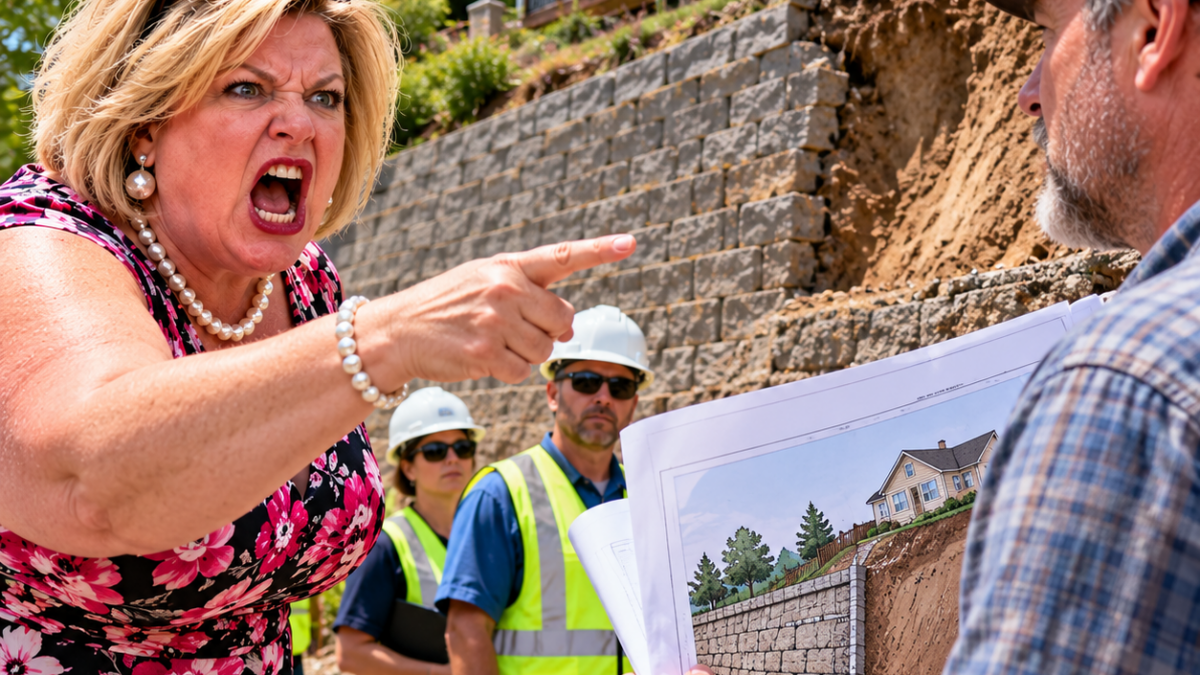
Karen gave me thirty days to tear down the twelve-foot retaining wall behind my house—or she promised the HOA would demolish it themselves and put a lien on my home for the cost.
What she didn’t understand was that the moment those stones came down, her backyard, her patio, and possibly half her house were coming down the hill right behind them.
“That ugly stack of rocks is coming down, Mr. Callahan.”
Karen Vance stood in the middle of my lawn like she owned it.
Arms folded.
Chin high.
A clipboard tucked against one hip.
Behind her, late-afternoon sunlight washed across the stone retaining wall that ran along the back of my property.
Nearly a hundred feet long.
Twelve feet high at the center.
Massive granite blocks fitted together layer by layer, darkened with age, moss growing through some of the joints.
To anyone who didn’t understand engineering, it probably looked old.
To Karen, it looked ugly.
To me, it looked like the only reason three houses weren’t sitting in my backyard.
Karen pointed at it.
“I’m serious. If you refuse to comply, the association will hire a contractor, remove it, bill you for the demolition, place a lien on your property, and proceed with whatever additional enforcement is necessary.”
I stared at her.
“You’re threatening to tear down that wall?”
“I’m not threatening anything.”
She lifted her clipboard.
“I’m informing you of the consequences of noncompliance.”
I looked past her toward the steep hill behind my lot.
At the top of that slope were three homes on Ridgeback Lane.
The Patels’ house.
Karen’s house.
Frank Miller’s house.
All three had large flat backyards carved into terrain that had never naturally been flat.
Karen apparently saw manicured grass.
A patio.
Flower beds.
A barbecue grill.
I saw fill material.
Slope loading.
Drainage.
Hydrostatic pressure.
Soil creep.
Gravity.
I had spent twenty years with the Army Corps of Engineers.
I had worked on construction sites where one bad assumption about soil could kill people.
I had seen foundations shift.
Roadbeds wash out.
Bridge approaches fail.
I had watched mountainsides move after days of rain.
And if there was one thing I respected after two decades around earthworks, it was gravity.
Gravity didn’t care about HOA bylaws.
I looked back at Karen.
“Do you know what that wall does?”
Her expression tightened.
“It ruins the appearance of the greenbelt.”
“No.”
She blinked.
“No?”
“No. That’s not what it does.”
She gave me the kind of smile people use when they think they’re dealing with someone slow.
“It is a nonconforming exterior structure.”
“It’s a gravity retaining wall.”
“It’s rocks.”
I almost laughed.
“Those rocks are holding up the hill behind you.”
She rolled her eyes.
“Oh, please.”
“I’m not joking.”
“Neither am I.”
I pointed toward Ridgeback Lane.
“Your house is up there.”
“I know where my house is, Mr. Callahan.”
“Your backyard is built on engineered fill.”
“Again, I know my own property.”
“Do you?”
Her eyes narrowed.
I continued.
“If that wall gets removed without a replacement stabilization system, the slope could move.”
Karen stared at me.
Then she laughed.
Not nervously.
Not uncertainly.
She laughed because she genuinely believed I was inventing the danger to avoid an HOA rule.
“You people always have an excuse.”
“You people?”
“Homeowners who think rules don’t apply to them.”
“My problem isn’t the rule.”
I pointed behind her.
“My problem is that you’re ordering me to remove a structural system you don’t understand.”
“It’s landscaping.”
“It isn’t.”
“The board says it is.”
“The board can call a bridge a flowerpot. That doesn’t make it one.”
Her face flushed.
“Be careful.”
“About what?”
“Your tone.”
I looked around.
She was standing on my property, threatening my house, and warning me about my tone.
That was Karen.
She had become president of the Oak Ridge Preserve Homeowners Association barely four months earlier.
Before that, the HOA had been boring.
Which is exactly what an HOA should be.
George Caldwell, the former president, was a retired accountant.
He liked balanced budgets.
Clear meeting minutes.
Working pool pumps.
Reasonable landscaping.
Then George moved closer to his grandchildren.
Karen ran for president.
Her campaign slogan might as well have been:
**YOUR NEIGHBOR IS PROBABLY BREAKING A RULE.**
Within weeks, letters started appearing.
Trash cans.
Basketball hoops.
Holiday decorations.
Garden hoses.
Paint colors.
Parking.
Mailboxes.
Grass height.
Then she discovered my wall.
I had lived there three years without a single complaint about it.
Suddenly, it was a crisis.
Karen looked back at the granite.
“The board has determined that the wall is inconsistent with the architectural character of the community.”
“Did an engineer determine that?”
“We don’t need an engineer to identify an aesthetic violation.”
“You do if you want to remove it.”
“We have authority under the governing documents.”
“Then put it in writing.”
“I will.”
“Good.”
She paused.
Maybe she expected an argument.
Begging.
Anger.
Instead, I said, “Do whatever you think you need to do, Karen.”
She smiled.
I continued.
“And I’ll do what I know I need to do.”
Her smile disappeared.
“What exactly does that mean?”
“You’ll find out.”
I turned toward the house.
“You’re dismissing me?”
“Yes.”
“Mr. Callahan—”
I kept walking.
“You cannot simply walk away from an HOA enforcement discussion.”
I opened my back door.
“Apparently I can.”
Then I went inside.
My wife, Sarah, was standing near the kitchen window.
She had heard almost everything.
Her face was pale.
“Jack.”
“I know.”
“She sounds serious.”
“She is.”
“What if they actually do it?”
I looked toward the wall.
Through the window, I could still see Karen standing on the lawn, furious that I had ended the conversation without her permission.
“They won’t.”
“You sound very sure.”
“I’m not sure.”
“That’s comforting.”
I walked into my office and opened the cabinet beside my desk.
Inside were closing documents.
Surveys.
Inspection records.
The original developer package.
I had insisted on getting everything when we bought the house.
Sarah used to tease me about it.
“You kept all that?”
“Every page.”
I carried the file to the kitchen table.
It landed with a heavy thud.
Sarah sat across from me.
“What are you looking for?”
“The reason I bought this house.”
She frowned.
“You bought it because I liked the kitchen.”
“You bought it because you liked the kitchen.”
“And the garden.”
“I bought it because of that wall.”
She stared at me.
“You bought our house because of rocks?”
“Engineered rocks.”
“Jack.”
I smiled.
Then opened the geotechnical report.
“There.”
I turned the binder toward her.
A highlighted note from the original plans.
**GRAVITY RETAINING WALL ESSENTIAL FOR SLOPE STABILIZATION AND SOIL RETENTION FOR LOTS 18, 19 AND 20. DO NOT REMOVE OR ALTER WITHOUT CONSULTING GEOTECHNICAL ENGINEER.**
Sarah read it twice.
Then looked toward the hill.
“Lot nineteen…”
“Karen.”
Her mouth opened slightly.
“The wall is holding up her house?”
“Her yard. Maybe parts of the house indirectly. Depends on the foundation location and how much slope movement occurs.”
“And the other two?”
“Same system.”
She leaned back.
“You need to tell her.”
“I did.”
“No, I mean really tell her.”
“She doesn’t want information.”
“What does she want?”
“Compliance.”
Sarah looked worried.
“What are you going to do?”
I closed the binder.
“I’m going to let her put everything in writing.”
“Why?”
“Because people like Karen are dangerous when they’re talking.”
I tapped the folder.
“They’re much more useful when they start signing things.”
Two days later, the certified letter arrived.
I signed for it at the door.
White envelope.
HOA logo.
Official-looking paper.
Sarah watched while I opened it.
**NOTICE OF VIOLATION AND DEMAND FOR CORRECTIVE ACTION**
The retaining wall was described as:
**An unapproved, nonconforming rock landscaping installation inconsistent with current architectural guidelines.**
Thirty days to remove it.
Failure to comply would result in fines.
If I still refused, the HOA reserved the right to arrange removal at my expense.
I read it twice.
Sarah asked, “Well?”
I handed it to her.
She read silently.
“They actually did it.”
“Yep.”
“Jack, this is insane.”
“Yep.”
“They’re calling it landscaping.”
“Yep.”
“You’re being way too calm.”
“Not really.”
I took the letter back.
“I’m furious.”
“You don’t look furious.”
“That’s because furious people make mistakes.”
The next morning, my home office became a command center.
Not because I thought I was at war.
But because the process was familiar.
When something goes wrong on a construction project, you don’t start by screaming.
You establish facts.
I drafted a letter.
Polite.
Professional.
No emotion.
Three requests.
First:
Please provide the date on which the allegedly unauthorized structure was constructed.
Second:
Please provide the corresponding architectural review application and denial establishing that the wall was installed without permission.
Third:
Please provide the professional engineering report confirming that the slope can remain stable after the wall is removed.
That third request was the point.
PART 2
I knew they didn’t have one.
Any licensed engineer who looked at that slope for five minutes would refuse to recommend demolition without extensive analysis.
I mailed the letter certified.
Return receipt.
Then I started building my own record.
The original grading plan showed a thirty-degree slope between my property and Ridgeback Lane.
The development plan clearly identified the wall.
Not decorative.
Not landscaping.
Structural.
I photographed every page.
Uploaded everything.
Named the cloud folder:
**PROJECT BEDROCK**
Then I went outside.
Camera.
Tape measure.
Notebook.
I documented the wall from end to end.
Massive lower stones.
Interlocking blocks.
Drainage outlets.
Slope angle.
Visible water staining.
A slight, even bow near the center.
That bow mattered.
A retaining wall under no pressure stays straight.
A retaining wall holding thousands of tons of soil tells you exactly how much work it is doing.
Then I climbed the public sidewalk along Ridgeback Lane.
From there, I photographed the three houses.
Karen’s in the middle.
Patels on one side.
Frank Miller on the other.
Their lawns ended close to the top of the slope.
The drop wasn’t obvious from their patios.
From below, it was.
A false sense of security.
That’s one of the dangerous things about engineered terrain.
When it works, people forget it’s engineered.
They think the land was always like that.
It wasn’t.
The developer had carved flat pads into a slope.
Those yards existed because somebody moved earth.
And earth remembers where gravity wants it to go.
I zoomed in on Karen’s patio.
Hairline cracks radiated from the back edge.
Small.
Not catastrophic.
But there.
I photographed them.
Dated everything.
Uploaded everything.
Ten days passed.
Then the HOA answered.
Not my questions.
Just another violation notice.
**$100 initial fine.**
Then:
**$50 PER DAY UNTIL CORRECTION.**
They ignored every request.
No installation date.
No ARC record.
No engineering report.
Sarah read the letter.
“Fifty dollars a day?”
“That’s what it says.”
“They can’t do that.”
“They can send paper saying they’re doing it.”
“That’s not the same.”
“Exactly.”
She looked at me.
“So what now?”
“Now I call Marcus.”
Marcus Thorne had served with me in the Corps.
Civil engineer.
MIT PhD.
Brilliant.
Sarcastic.
The kind of person you want in the room when a bridge starts making noises it shouldn’t.
I sent him the Project Bedrock folder.
Called him.
“I’ve got a situation.”
“That phrase always costs somebody money.”
“Take a look.”
He called back an hour later.
No hello.
No pleasantries.
“Are these people insane?”
I smiled.
“Which part?”
“The part where they want you to dismantle the primary earth retention system under three loaded residential pads.”
“So you agree it’s structural.”
“Jack, my toaster agrees it’s structural.”
I heard pages clicking on his end.
“The original plans literally call it essential.”
“Yep.”
“And the center is already showing deflection.”
“Yep.”
“Drainage outlets?”
“Functional, but old.”
“Any increased runoff from above?”
“Possibly. At least two patios have been extended since the original development.”
Marcus whistled.
“That could increase hydrostatic pressure.”
“I know.”
“And they want it removed.”
“Yes.”
“Without a replacement design.”
“Yes.”
“Without a geotechnical study.”
“Yes.”
There was a long pause.
Then:
“You pull that wall, you’re not getting dirt in your backyard.”
“What am I getting?”
“Their kitchens.”
I laughed.
He didn’t.
“I’m serious.”
“I know.”
“This could be catastrophic.”
“They’re fining me fifty dollars a day until I do it.”
Another pause.
Then Marcus said quietly:
“Save everything.”
“Already am.”
“Timeline.”
“Started.”
“Photographs.”
“Done.”
“Certified letters.”
“Done.”
He sighed.
“God, I miss working with you.”
“You miss my paperwork?”
“No one misses your paperwork.”
He became serious again.
“Jack, don’t let anyone touch that wall.”
“That’s the plan.”
The next step was talking to the people sitting on top of it.
I started with the Patels.
Mrs. Patel was outside chasing her toddler away from a tricycle rolling toward the driveway.
I introduced myself.
“We’ve waved before.”
“Yes. You’re down behind us.”
“That’s me.”
She smiled.
“Beautiful garden.”
“Sarah’s work.”
I hesitated.
“I wanted to ask you something about the slope.”
Her expression changed.
“The slope?”
“The HOA has ordered me to remove the large retaining wall below your backyard.”
She stared at me.
“The stone wall?”
“Yes.”
Her eyebrows pulled together.
“But… doesn’t that hold this up?”
She pointed toward her yard.
“That’s my understanding.”
“Why would they remove it?”
“They say it’s noncompliant landscaping.”
Her mouth opened.
“That makes no sense.”
“Did the developer explain anything about the wall when you bought the house?”
“No.”
She thought.
“We got a huge binder of documents.”
“Did you read everything?”
She gave me a tired-parent smile.
“We had a six-month-old baby and a mortgage closing. We signed where they told us.”
“Understandable.”
She looked toward Karen’s house.
“This is Karen?”
“HOA order.”
Mrs. Patel rolled her eyes.
“She sent us a violation over our basketball hoop.”
“When?”
“Last month.”
“What was wrong with it?”
“It was visible from the street.”
I looked at the hoop.
It was beside the driveway.
“Basketball hoops generally are.”
“That was basically what my husband said.”
I thanked her and left.
One household informed.
Then Frank Miller.
Frank was in his late seventies.
Widower.
Retired postal worker.
Loved roses.
Hated conflict.
He had lived there since the neighborhood was built.
I found him kneeling beside a flower bed.
“Frank?”
He looked up.
“Jack.”
We had spoken maybe three times in three years.
I mentioned the wall.
His hand stopped moving.
“The big stone one?”
“Karen wants it removed.”
His face changed.
“You don’t want trouble with her.”
That was the first thing he said.
Not:
*That sounds dangerous.*
Not:
*Why?*
Just:
*You don’t want trouble with her.*
“Why?”
“She’s relentless.”
“That’s not really my concern.”
“It will be.”
I crouched beside him.
“You were here during construction?”
“Since the first phase.”
“Do you remember the hill work?”
Frank glanced toward Karen’s house.
Then mine.
“Some.”
“The wall?”
His expression became guarded.
“What about it?”
“Was it always part of the plan?”
He hesitated.
“The developer had problems.”
“What kind?”
“Money.”
“That I know.”
“No.”
Frank shook his head.
“Ground problems.”
That got my attention.
“What ground problems?”
He lowered his voice.
“County inspector came out one day. He and McCloskey were arguing.”
“The developer?”
“Yes.”
“What about?”
“Soil.”
Frank looked uncomfortable.
“Something failed.”
“A test?”
“I think so.”
“Compaction?”
“I don’t know.”
“What happened next?”
“They started building that wall.”
I sat very still.
“Before that, was there no wall?”
“Just slope.”
“And after the argument?”
“Excavators. Stone trucks. Engineers.”
He nodded toward my yard.
“That thing went up fast.”
“Did McCloskey say anything?”
“He called it insurance.”
“Against what?”
Frank looked at the hill.
“Against all this moving.”
That was huge.
“Frank, do you have anything from the developer?”
He immediately shook his head.
“No.”
“Any letters?”
“No.”
“Inspection notes?”
“No.”
“Anything?”
“I don’t want involvement.”
“I’m not asking you to testify.”
“Please.”
His voice tightened.
“Don’t tell Karen I said anything.”
“Frank—”
“She makes people miserable.”
He stood.
“I just want to grow my roses.”
I watched him retreat toward the house.
Fear.
Again.
Karen’s power wasn’t respect.
It was exhaustion.
People didn’t obey because she was right.
They obeyed because fighting her ruined your week.
The fines reached five hundred dollars.
Then the lawyer letter came.
Thatcher, Smith and Klein.
Local firm.
Three pages.
Legal language.
Citations.
Lien threats.
Enforcement authority.
Sarah stood beside me while I read.
“How bad?”
“Actually?”
“Yes.”
“Good.”
She stared.
“Good?”
“They hired a lawyer.”
“That’s good?”
“It means their lawyer is now putting their position in writing too.”
“You are the strangest person I’ve ever married.”
“You married me voluntarily.”
“Still reviewing that decision.”
I smiled.
Then called Elena Diaz.
I found Elena through a veterans’ legal network.
Former JAG.
Property litigation background.
Her office was immaculate.
Not one paper out of place.
I spread my mess across her conference table.
Violation notices.
Photos.
Plans.
Certified-mail receipts.
Marcus’s preliminary comments.
The HOA lawyer’s letter.
Elena read everything.
Very slowly.
Finally, she leaned back.
“Let me make sure I understand.”
“Go ahead.”
“The HOA president lives on one of the three lots physically supported by this wall.”
“Yes.”
“She ordered you to remove the wall.”
“Yes.”
“Because it is ugly.”
“More or less.”
“She has no engineering report.”
“None provided.”
“No demolition plan.”
“No.”
“No replacement stabilization design.”
“No.”
“You asked for all three.”
“Yes.”
“They ignored you.”
“Yes.”
“And now they’re fining you daily and threatening a lien.”
“Yes.”
Elena smiled.
Not warmly.
“This is a gift.”
“That’s what Marcus said, but with more profanity.”
“Their attorney’s letter is boilerplate.”
“I thought so.”
“It assumes the wall is actually yours to remove.”
“Correct.”
“They haven’t investigated.”
“Apparently not.”
She tapped the developer plans.
“You have done more due diligence than their board and counsel combined.”
“What do we do?”
“Two tracks.”
She held up one finger.
“I respond formally.”
Second finger.
“You go digging.”
“Where?”
“County records.”
She wrote down a list.
“Planning. Zoning. Building permits. Inspection reports. Certificates of occupancy. Variances. Geotechnical submissions.”
She looked at me.
“And anything filed by McCloskey Development.”
“Frank says McCloskey had soil problems.”
“Then we find the paper trail.”
The county records office smelled exactly the way government archives always smell.
Old paper.
Dust.
Climate-controlled boredom.
I spent hours there.
Then more hours.
Permit files.
Planning minutes.
Developer correspondence.
Microfilm.
Scanned records.
Nothing.
Nothing.
Nothing.
Then I found:
**OAK RIDGE PRESERVE PHASE II — GEOTECHNICAL VARIANCE REQUESTS**
My heart rate changed.
The first letter was from the county engineer.
Routine soil density testing on lots eighteen, nineteen and twenty had failed.
Unacceptable compaction.
Potential long-term creep.
Subsidence risk.
The developer objected.
The county refused to budge.
Then came the sentence that changed everything:
**NO FURTHER CERTIFICATES OF OCCUPANCY FOR LOTS 18, 19 OR 20 WILL BE ISSUED UNTIL A REVISED PERMANENT SLOPE STABILIZATION PLAN IS SUBMITTED, APPROVED AND IMPLEMENTED.**
I sat back.
Lot nineteen.
Karen.
I kept reading.
McCloskey submitted a revised plan.
Massive gravity retaining wall.
Drainage.
Base preparation.
Structural calculations.
Then final county approval.
The occupancy permits for those homes were contingent on that wall being built and inspected.
Not optional.
Not decorative.
Required.
Karen wasn’t ordering me to remove landscaping.
She was ordering me to remove the structure the county required before allowing her house to be occupied.
I bought certified copies.
Every page.
Then searched McCloskey Development.
Bankruptcy.
Chapter 7.
Filed two months after the final home sale.
That explained the chaotic records transfer.
The HOA may never have understood what it inherited.
Or somebody later made sure it forgot.
I walked into Elena’s office with the certified file.
She read the first page.
Then the second.
Then looked at me.
“Jack.”
“I know.”
“No, I don’t think you do.”
She held up the county letter.
“This destroys their case.”
“Completely?”
“Completely.”
She flipped to the occupancy approval.
“They cannot credibly call this an unauthorized landscaping feature when the county conditioned the legal occupancy of three homes on its construction.”
I sat back.
“So we send it?”
“Not yet.”
I looked at her.
She smiled.
“We make them commit.”
“To what?”
“Their order.”
I understood.
“You want them to own it.”
“Exactly.”
Elena drafted the letter.
It began like surrender.
**After careful consideration of the association’s repeated demands and escalating penalties, and notwithstanding my continued disagreement with the association’s position, I am prepared to comply with the removal order.**
Karen would love that.
Then came the conditions.
Condition one:
HOA and individual board members sign a notarized hold-harmless and indemnification agreement accepting all liability resulting from demolition.
Soil movement.
Slope failure.
Foundation damage.
Patio collapse.
Structural damage.
Property-value loss.
Engineering remediation.
Reconstruction.
Lots eighteen, nineteen and twenty specifically named.
Translation:
**You ordered it. You own what happens.**
Condition two:
The HOA commissions an independent geotechnical assessment.
Licensed engineer.
Bonded firm.
Written certification that wall removal will not destabilize the slope.
Insurance documentation attached.
Only then would demolition proceed.
Then Elena added the sweetest line.
I had already obtained preliminary demolition pricing.
Approximately forty-five thousand dollars.
I would gladly forward the invoice to the HOA once they completed the safety requirements.
Sarah read the final draft at home.
“This is evil.”
“It’s cautious.”
“No.”
She pointed.
“This part where you offer to help them remove it after they accept liability?”
“Very cooperative.”
“You’re enjoying this.”
“I’m enjoying documentation.”
“That’s somehow worse.”
We sent copies to Karen.
Every board member.
The HOA office.
Thatcher, Smith and Klein.
Signature required.
Then we waited.
One week.
The answer came from their lawyers.
Two pages.
They called my conditions frivolous.
Self-serving.
An attempt to evade responsibility.
They rejected the hold-harmless agreement.
Ignored the engineering study.
Then came the sentence Elena wanted.
**If the structure is not removed within fifteen days, the association will exercise its right of self-help, contract for removal, and assess all costs, fines and legal fees against the property.**
I read it.
Then read it again.
Called Elena.
“They did it.”
“I know.”
“You already saw it?”
“Counsel emailed me a copy.”
“What now?”
Her voice was calm.
“We let them hire the executioner.”
Karen moved fast.
A notice appeared on the community board.
**REMEDIAL LANDSCAPING WORK**
Ace Demolition and Hauling.
Date scheduled.
Ten days.
Neighbors told me Karen was bragging.
She had “finally won.”
The “illegal wall” was coming down.
I had “learned my lesson.”
She had forced the difficult veteran to obey.
I said nothing.
Elena prepared one more letter.
Not for Karen.
For Ace Demolition.
The letter identified the job.
Then the risk.
Certified county records.
Structural designation.
Slope instability.
No geotechnical clearance.
No indemnification.
Three occupied homes directly upslope.
Then:
**Your company is hereby placed on notice that demolition of this structure without prior engineering verification presents a foreseeable risk of catastrophic slope failure and structural damage.**
And:
**Any damage resulting from physical removal will be pursued against the party performing that removal.**
We gave Ace access to Project Bedrock.
Blueprints.
Photos.
County records.
Everything.
Two days later, my phone rang.
“Jack Callahan?”
“Yes.”
“Stan Gable. Ace Demolition.”
His voice sounded furious.
Not at me.
“I got your attorney’s letter.”
“I assumed you would.”
“What the hell is going on?”
“Which part?”
“That wall.”
“Yes.”
“They told me it’s decorative.”
“It isn’t.”
“They told me you built it without approval.”
“I didn’t build it.”
“What?”
“It predates my ownership.”
Silence.
I continued.
“The county required it before issuing occupancy permits to the three homes above it.”
More silence.
Then:
“You’re serious.”
“Completely.”
“I looked at the files.”
“Good.”
“There’s a house directly above the centerline.”
“Karen.”
“The HOA president?”
“Yes.”
Stan swore.
“They didn’t tell me any of this.”
“I know.”
“They said you were being difficult.”
“I probably am.”
“No.”
He sighed.
“I mean they made it sound like some homeowner built a landscaping wall and refused to take it out.”
“That’s why my lawyer contacted you.”
“What happens if that slope fails?”
“Depends how much moves.”
“Worst case?”
“Major soil loss. Patios. Foundation exposure. Potential structural movement.”
“You’re telling me I could tear down this wall and drop three backyards down the hill.”
“I’m telling you the risk exists and nobody has produced an engineering study saying otherwise.”
Stan breathed out slowly.
“My insurance company would kill me.”
“Probably.”
“I’m not touching it.”
“Your choice.”
“No.”
His voice hardened.
“Not my choice. Basic sanity.”
He swore again.
“I’m calling the HOA.”
He hung up.
Less than an hour later, tires screeched outside.
Sarah looked through the curtain.
“Oh, boy.”
Karen’s SUV.
She slammed the door.
Stormed across our lawn.
Pounded on the front door.
“JACK!”
I didn’t move.
“JACK CALLAHAN!”
Sarah whispered, “Are you going to answer?”
“No.”
Karen pounded again.
“You sabotaged the contractor!”
I watched through the peephole.
Her face was purple.
“You threatened them!”
I remained silent.
“I will sue you!”
Nothing.
“You cannot interfere with an HOA contract!”
She continued for several minutes.
Neighbors appeared in windows.
The Patels watched from above.
Frank stood behind his screen door.
Karen had spent months looking powerful because she controlled the setting.
Now she was screaming at a closed door while half the neighborhood watched.
The first crack in the image.
Elena called that evening.
“Did Karen visit?”
“How did you know?”
“Her lawyer called.”
“What did they want?”
“To accuse us of tortious interference.”
“And?”
“I invited them to put the accusation in writing.”
I laughed.
“They didn’t?”
“No.”
Smartest decision they had made so far.
Then Elena said:
“I have another idea.”
“What?”
“Media.”
I groaned.
“No.”
“Jack.”
“No television.”
“You have a highly visual public-safety story.”
“I hate cameras.”
“Perfect. You’ll look authentic.”
“That is not persuasive.”
“Karen will talk.”
I paused.
That part was persuasive.
Elena knew a local investigative reporter named Cynthia Wu.
Cynthia reviewed Project Bedrock.
Her expression changed from professional interest to disbelief.
“So the HOA president’s own house is one of the properties the wall supports?”
“Yes.”
“And she’s demanding demolition?”
“Yes.”
“She hired a demolition company?”
“Yes.”
“And the company quit after learning what the wall actually does?”
“Yes.”
Cynthia leaned back.
“This is absurd.”
“That’s becoming a theme.”
She asked:
“Will you go on camera?”
“Briefly.”
“Will your attorney?”
Elena said, “Absolutely.”
Two days later, the news van arrived.
I did my interview first.
Calm.
No insults.
I explained the wall.
The plans.
The county records.
The risk.
Then Karen saw the camera.
She came down the hill.
Fast.
Cynthia almost smiled.
Karen approached.
“Are you here about the wall?”
Cynthia turned.
“We are.”
“Good. Someone needs to tell the truth.”
I glanced at Elena.
Elena whispered:
“Do not interrupt.”
Karen demanded an interview.
Cynthia gave her one.
That was the beauty of experienced reporters.
They don’t always need to attack.
Sometimes they just let people talk.
Karen talked.
And talked.
About community standards.
Property values.
Disrespectful homeowners.
Her responsibility as president.
The wall being ugly.
My refusal to comply.
My “intimidation” of contractors.
My “manipulation” of technical records.
Then Cynthia asked:
“Ms. Vance, are you aware that county records identify this retaining wall as a mandatory slope-stabilization structure required before occupancy permits were issued for lots eighteen, nineteen and twenty?”
Karen stopped.
“What?”
Cynthia held out the certified document.
“Lot nineteen is your property, correct?”
Karen stared at the paper.
“That’s…”
She looked at the camera.
Then me.
Then the document.
“That’s not possible.”
“The records are certified.”
“They could be old.”
“They are the original development approval.”
“That doesn’t mean—”
Cynthia continued.
“The county engineer stated the homes could not receive occupancy approval until this wall was built.”
Karen’s face changed.
For the first time, there was real fear.
“Those documents may not reflect current conditions.”
“Did the HOA commission a current engineering study?”
Silence.
“Ms. Vance?”
“We have architectural authority.”
“That wasn’t my question.”
Karen looked furious.
“No.”
“Did you obtain a structural assessment before ordering demolition?”
“No.”
“Did you inform the demolition contractor that the wall was listed as a slope-stabilization system?”
Karen’s eyes widened.
“That contractor broke his agreement.”
“Did you tell him?”
“He had all information necessary.”
Stan would have enjoyed that answer.
Then Cynthia asked:
“If the county required the wall because of unstable soil beneath your property, why is the HOA ordering it removed?”
Karen stared at her.
Then made the worst possible decision.
She attacked the documents.
“I believe these may be fake.”
Cynthia blinked.
“Certified county records?”
“I’m saying Mr. Callahan has been manipulating information since this started.”
That clip made the six o’clock broadcast.
The story was devastating.
My interview.
Plans.
County documents.
Animated slope graphic.
Three houses above.
Wall below.
Karen’s interview.
Her denial.
Her accusation that certified records might be fake.
Then Cynthia ended with Ace Demolition confirming they had withdrawn from the job after receiving safety information not supplied by the HOA.
My phone started ringing before the broadcast ended.
Neighbors.
People I barely knew.
“Jack, we saw the news.”
“We had no idea.”
“She did this without board approval?”
“She fined us last month too.”
“My husband is on the architectural committee. He says they never voted on your wall.”
That one mattered.
“What?”
“He says Karen called it fast-track enforcement.”
The next morning, a manila envelope appeared on my porch.
No return address.
Inside:
Printed emails.
Internal HOA communications.
Karen overruling committee members.
Karen pressuring the treasurer.
Karen directing aggressive legal action.
Karen calling residents “problem owners.”
Then I found one email that made my stomach tighten.
**Subject: Storage Cleanup**
Karen instructed the secretary to dispose of unnecessary old developer material.
One line specifically mentioned:
**Geotechnical and zoning variance files can be discarded. No current operational relevance.**
I read it three times.
Sarah looked over my shoulder.
“What?”
“She knew the files existed.”
“When?”
“After she joined the board.”
“And she destroyed them?”
“Looks like she ordered them destroyed.”
“Why?”
I looked toward the wall.
“Maybe she didn’t understand them.”
“Or?”
“Maybe she understood enough.”
That afternoon, Frank Miller came to my door.
He held an old yellow envelope.
His hand shook.
“I saw the news.”
“Come in.”
“No.”
He looked toward Karen’s house.
Then squared his shoulders.
“She can’t keep doing this.”
He handed me the envelope.
“My wife saved everything.”
Inside was a letter dated ten years earlier.
McCloskey Development.
Sent to original owners of lots eighteen, nineteen and twenty.
It described unforeseen soil conditions.
Construction of the structural retaining wall.
Then:
**The long-term integrity of your property is dependent upon continued inspection and maintenance of this earth-retention system. Responsibility for future maintenance will transfer to the Oak Ridge Preserve Homeowners Association as part of common-area infrastructure.**
I stopped breathing for a second.
Frank said, “Is that useful?”
I looked at him.
“Frank, this ends it.”
The wall wasn’t merely necessary.
It wasn’t even my infrastructure.
The developer intended HOA responsibility.
Karen had been ordering me to destroy something her own organization was supposed to maintain.
And her email indicated she had ordered the historical geotechnical files discarded.
I called Elena.
“We have everything.”
Wednesday night, the clubhouse was packed.
Every chair occupied.
Residents standing along walls.
The HOA board sat behind a folding table.
Karen in the center.
She looked different.
Still defiant.
But not comfortable.
Cynthia Wu and her cameraman stood near the back.
Sarah sat beside me.
Elena on my other side.
My binder rested on my lap.
Karen struck the gavel.
“This emergency meeting has been called to address misinformation currently circulating in the community.”
Someone shouted:
“What misinformation?”
Another:
“The wall holding your house up?”
Laughter.
Karen hit the gavel.
“This is not acceptable.”
Someone yelled:
“Neither is trying to drop our houses down a hill!”
Mr. Patel was standing near the aisle.
His face looked nothing like the calm man I had met weeks earlier.
Karen raised her voice.
“There are rules of order!”
I stood.
The room quieted.
I said:
“You’re right.”
Karen looked at me.
“There are rules.”
I picked up the binder.
“There are also facts.”
The projector came on.
First slide.
Original subdivision grading plan.
“For two months, I have attempted to discuss this structure factually with the board.”
Second slide.
Slope contours.
“They refused.”
Third.
Wall specifications.
“So tonight, I’m going to have that conversation with everyone.”
I walked them through it.
No drama.
No insults.
Terrain.
Slope.
Lots.
Load.
Drainage.
Original plans.
Then county correspondence.
Failed soil test.
The county refusing occupancy permits.
The revised stabilization plan.
Wall construction.
Final approval.
When I projected:
**NO CERTIFICATES OF OCCUPANCY UNTIL PERMANENT SLOPE STABILIZATION IS IMPLEMENTED**
the room changed.
Mr. Patel looked at his wife.
Frank looked at the floor.
Karen stared straight ahead.
I said:
“Lot eighteen is the Patel property.”
Click.
“Lot nineteen belongs to Karen Vance.”
Click.
“Lot twenty belongs to Frank Miller.”
I faced the room.
“This wall is not an aesthetic feature.”
Silence.
“It is the reason those houses were legally allowed to be occupied.”
Then I showed my letters.
My requests for an engineering report.
HOA refusal.
Fines.
Legal threats.
Demolition notice.
The rejected indemnification offer.
The letter threatening self-help demolition.
People murmured.
Then the developer letter Frank had saved.
I enlarged the sentence.
**RESPONSIBILITY FOR FUTURE MAINTENANCE WILL TRANSFER TO THE OAK RIDGE PRESERVE HOMEOWNERS ASSOCIATION AS COMMON-AREA INFRASTRUCTURE.**
Someone said:
“Oh my God.”
I looked at the board.
“For weeks, I have been fined for refusing to destroy infrastructure that your own organization is responsible for maintaining.”
Karen stood.
“That letter has not been authenticated.”
Frank rose slowly.
“My wife received it.”
Karen turned.
Frank held his copy.
“I’ve had it ten years.”
Karen opened her mouth.
Frank continued.
“You knew there were old files.”
Her face changed.
That was my cue.
Next slide.
Karen’s email.
**GEOTECHNICAL AND ZONING VARIANCE FILES CAN BE DISCARDED.**
Cold silence.
Not anger.
Something worse.
The room finally understood.
This wasn’t just ignorance.
Karen had ordered the destruction of the very historical records that could have prevented the entire conflict.
She stood.
“That is taken out of context.”
I said nothing.
“You don’t know how much obsolete material was in storage.”
Still nothing.
“We were reducing clutter.”
Mr. Patel shouted:
“You threw away the records telling us what holds up our houses?”
The room erupted.
Karen struck the gavel.
“Order!”
Nobody listened.
Elena stood.
She didn’t shout.
She didn’t need to.
“My name is Elena Diaz.”
The room slowly quieted.
“I represent Mr. Callahan.”
She walked toward the board.
“The documents displayed tonight consist of certified government records, authenticated correspondence, formal HOA notices, and internal communications.”
She placed her briefcase on the table.
“The evidence demonstrates potential gross negligence, breach of fiduciary duty, improper enforcement, destruction of organizational records, and conduct that placed multiple homeowners at foreseeable physical and financial risk.”
Board members looked at Karen.
Not me.
Karen.
Elena opened her briefcase.
Five envelopes.
She read the board members’ names.
One by one.
Then placed an envelope in front of each.
“This is notice of intent to pursue legal action.”
The treasurer went white.
Karen didn’t move.
Elena continued:
“We will seek recovery for legal expenses, harassment, improper assessment activity, and all damages resulting from attempted enforcement.”
She paused.
“We will also submit documentation to the appropriate state authorities for review of possible fraudulent conduct and destruction of records.”
Karen stared at the envelope.
Her hands trembled.
The board member beside her whispered:
“You told us the wall wasn’t structural.”
Karen turned sharply.
“I said the information we had—”
“You told us.”
Another board member interrupted.
“You said Jack built it himself.”
“I said it appeared—”
“You said there was no approval.”
The room was turning on her.
Fast.
Then Mr. Patel spoke.
His voice shook.
“You were willing to risk my children’s home because you didn’t like a wall?”
Karen looked at him.
“No one was at risk.”
I spoke for the first time in several minutes.
“Then sign the indemnification agreement.”
Silence.
Karen looked at me.
“Sign it.”
Her jaw tightened.
“If there’s no risk, accept responsibility.”
She said nothing.
“Commission the geotechnical study.”
Nothing.
“You refused both.”
The entire room watched.
“Why?”
She had no answer.
Her authority disappeared in that silence.
Not when Elena served papers.
Not when the emails appeared.
Right there.
Because everyone finally saw the difference between confidence and competence.
Karen had plenty of the first.
None of the second.
The meeting collapsed.
People shouted for resignations.
Board members demanded an executive session.
Karen tried to regain control.
Nobody listened.
The gavel became meaningless.
The next morning, I was invited to the offices of Thatcher, Smith and Klein.
The HOA’s attorneys.
The senior partner was there.
Four board members.
No Karen.
She had refused to attend.
The senior partner looked exhausted.
He closed the conference-room door.
“I’m going to be direct.”
Good.
“The association is in serious exposure.”
Nobody spoke.
“The directors-and-officers policy may not provide coverage for willful or grossly negligent conduct.”
One board member said:
“Meaning?”
“Meaning certain personal acts may not be insured.”
Panic.
Immediate.
The treasurer asked:
“What about the demolition order?”
“Rescind it.”
“Fines?”
“Rescind them.”
“Legal fees?”
“Stop them.”
He looked at the board.
“And you need a professional engineering assessment immediately.”
The first vote was unanimous.
Demand Karen’s resignation.
Second.
Rescind every fine and violation issued against me.
Third.
Record an official resolution recognizing the retaining wall as critical common infrastructure.
Fourth.
HOA accepts inspection, maintenance, and repair responsibility.
Everything Karen had spent months fighting was reversed in less than an hour.
The senior partner approached me afterward.
“Mr. Callahan.”
I looked at him.
He extended his hand.
“On behalf of the association, I apologize.”
I didn’t shake it.
He slowly lowered his hand.
“This situation was badly mishandled.”
“No.”
He waited.
“It was malicious.”
His jaw tightened.
“Your firm threatened to lien my home for refusing to carry out an order that could have damaged three others.”
He nodded once.
“That criticism is fair.”
“You didn’t investigate.”
“No.”
“You trusted Karen.”
“Yes.”
“That nearly became everybody’s problem.”
He exhaled.
“We will be reviewing our representation of the association.”
Translation:
Karen had become too expensive.
The neighborhood changed almost immediately.
People stopped avoiding me.
Then they started stopping by.
Thanking me.
Apologizing.
The Patels brought food.
Frank came down with roses for Sarah.
One afternoon he stood looking at the wall.
“I should’ve spoken sooner.”
“You spoke when it mattered.”
“I was afraid.”
“I know.”
He shook his head.
“That’s humiliating.”
“No.”
He looked at me.
“Fear isn’t humiliating. Staying silent forever would’ve been.”
He nodded.
Then looked back at the stones.
“Never thought I’d be grateful for a wall.”
“You should be.”
“Still ugly.”
I laughed.
“Now you sound like Karen.”
He laughed too.
Karen became a ghost in her own neighborhood.
People stopped waving.
Stopped inviting her.
Stopped listening.
Her husband, who had barely appeared during the entire fight, looked exhausted.
A month later:
**FOR SALE**
No one was surprised.
Then came the geotechnical engineer.
He called me.
“Mr. Callahan?”
“Yes.”
“I’ve been retained by Oak Ridge Preserve to assess the retaining system.”
“Good.”
“They apparently don’t have the original plans.”
I smiled.
“Interesting.”
“They said you might.”
“I might.”
Pause.
“Would you be willing to provide them?”
“Certainly.”
“Thank you.”
“For a consulting fee.”
Silence.
Then:
“Of course.”
The new board approved my invoice.
No argument.
They also agreed to pay Elena’s legal fees as part of settlement negotiations.
Then the engineering report came back.
It was worse than expected.
The wall was stable.
But under substantial stress.
Additional patios and drainage changes above had increased water loading.
Several drain outlets were partially obstructed.
Tieback reinforcement was recommended.
Additional drainage improvements.
Estimated cost:
More than eighty thousand dollars.
Sarah read the number.
“That’s painful.”
“It is.”
“Could it have been avoided?”
“Some of it.”
“If the HOA had maintained the wall?”
“Probably.”
She shook her head.
“So Karen wanted to spend forty-five thousand dollars demolishing something they now need to spend eighty thousand dollars reinforcing.”
“Basically.”
“Impressive.”
The HOA imposed a special assessment.
Nobody was happy.
But people understood why.
And unlike Karen’s fines, this money actually solved a problem.
Work began in early fall.
Drilling.
Steel tiebacks.
Drainage excavation.
New outlets.
Pressure relief.
Professional crews.
Engineering supervision.
For weeks, my backyard looked like a construction zone.
I loved it.
Every drill bit entering the wall meant somebody was finally treating it like infrastructure instead of decoration.
The Patels came down one afternoon with a cake.
Mr. Patel shook my hand.
“You saved our home.”
“That’s dramatic.”
“No.”
He pointed uphill.
“We were going to trust the HOA.”
“You trusted the organization.”
“We trusted Karen.”
“That was the problem.”
His wife said:
“We didn’t even know the wall existed when we bought the house.”
“Most people don’t inspect what’s holding up their backyard.”
Mr. Patel looked embarrassed.
“We should have.”
“You shouldn’t need to be an engineer to buy a house.”
I pointed toward the new drainage.
“That’s why institutions maintain records.”
Mrs. Patel gave a humorless laugh.
“Until someone throws them away.”
Exactly.
Frank changed too.
Once Karen left, he seemed ten years younger.
He started a gardening club.
Then joined an infrastructure committee.
He repainted one section of fencing without asking permission first.
Rebellion suited him.
The HOA elected a new president.
Architect.
Quiet.
Competent.
Board meetings became painfully transparent.
Published minutes.
Open votes.
Clear project budgets.
No surprise enforcement.
No unilateral decisions.
They formed an infrastructure advisory committee.
They asked me to chair it.
Sarah laughed when I told her.
“You hate HOAs.”
“I hate stupid HOAs.”
“So now you’re joining one.”
“Advisory.”
“Uh-huh.”
“No power.”
“Sure.”
“I’m serious.”
She kissed my cheek.
“Chairman Callahan.”
“Don’t.”
She smiled.
I accepted.
Not because I wanted authority.
Because somebody had to remember what the wall was for.
Karen and her husband finally sold their house.
Below what they had hoped.
The special assessment hurt.
The publicity hurt more.
I saw them on moving day.
Karen avoided looking at me.
Her husband didn’t.
As he climbed into the car, he gave me a small nod.
Not apology.
Not friendship.
Acknowledgment.
That was enough.
Weeks later, the county engineer sent me a letter.
Formal.
Official stationery.
It thanked me for preserving development records.
For resisting an unsafe demolition order.
For preventing a potentially catastrophic infrastructure failure.
It called my actions a public service.
I read it twice.
Then framed it.
Sarah found me hanging it in my office.
“Really?”
“What?”
“You framed it.”
“It’s from the county.”
“You have military commendations in a box.”
“This one is about a wall.”
“That somehow makes it more important?”
“Apparently.”
She shook her head.
“You’re impossible.”
Maybe.
But the letter mattered.
Not because I needed someone to tell me Karen was wrong.
I already knew that.
It mattered because the fight had never really been about me winning an argument.
Three households could have lost property.
People could have been hurt.
That is what Karen never understood.
There’s a difference between being wrong and being dangerous.
Wrong can be corrected.
Dangerous refuses correction.
Months passed.
The wall became quiet again.
Moss returned around the repaired areas.
The new drainage disappeared into landscaping.
The steel reinforcement was mostly invisible.
From a distance, it looked almost exactly as it had before Karen noticed it.
An old stone wall.
Nothing dramatic.
Nothing exciting.
Just granite doing its job.
One evening, Sarah and I sat in the backyard watching the sun drop behind Ridgeback Lane.
She looked at the wall.
“You know what’s funny?”
“What?”
“She was right about one thing.”
I looked at her suspiciously.
“What?”
“It is kind of ugly.”
I stared.
Sarah laughed.
“Don’t look at me like that.”
“I spent months defending this wall.”
“Structurally.”
“Aesthetically too.”
“No.”
She shook her head.
“Structurally magnificent. Aesthetically…”
She made a face.
I looked at the granite.
Moss.
Drainage outlets.
Massive blocks.
“It has character.”
“So does an aircraft carrier.”
“Aircraft carriers are beautiful.”
“You’ve proven my point.”
We sat in silence.
Then she said:
“Were you ever scared?”
I knew what she meant.
“Of losing?”
“No.”
She looked toward the hill.
“Of them actually doing it.”
I thought about Stan.
Ace Demolition.
Equipment arriving before we could stop it.
A worker removing the wrong stones.
Rain.
Slope movement.
Someone hurt.
“Yes.”
Sarah looked at me.
“You never said.”
“Wouldn’t help.”
“Would’ve helped me.”
I nodded.
“That’s fair.”
She waited.
I said:
“I was scared the entire time.”
“Even when you were acting like you had everything under control?”
“Especially then.”
She smiled faintly.
“That sounds more human.”
“I try to keep it hidden.”
“I’ve noticed.”
I looked at the wall again.
“What scared me wasn’t Karen.”
“What was it?”
“How easy it would’ve been for her to get someone hurt.”
Sarah didn’t speak.
“She had authority over people who assumed she knew what she was doing.”
I continued.
“That combination is dangerous.”
“Authority and ignorance?”
“Authority and certainty.”
That was the real lesson.
Karen wasn’t dangerous because she didn’t understand engineering.
Most people don’t.
She was dangerous because she didn’t know—and refused to admit she didn’t know.
When I told her the wall was structural, she laughed.
When I asked for an engineering report, she ignored me.
When I offered to comply if she accepted liability, she refused.
When I demanded a geotechnical assessment, she called it frivolous.
When the contractor learned the truth and withdrew, she blamed me.
When the county documents appeared, she called them fake.
At every stage, reality gave her an exit.
And every time, she chose ego.
That’s how small mistakes become catastrophes.
Not because nobody warned you.
Because you make warning itself an insult.
Karen thought every challenge to her decision was a challenge to her authority.
So instead of asking:
**Am I right?**
She asked:
**How dare you question me?**
That difference nearly cost three families their homes.
Years later, I still keep Project Bedrock.
Every file.
Every photograph.
Every letter.
The first violation notice.
The fifty-dollar daily fines.
Thatcher, Smith and Klein’s threat.
My indemnification proposal.
Their rejection.
Ace Demolition documentation.
The county records.
Frank’s letter.
Karen’s emails.
Engineering report.
Settlement documents.
County commendation.
Sarah once asked why I don’t delete the digital copies.
“Because storage is cheap.”
“That isn’t the reason.”
“No.”
“What is?”
I thought about it.
“Because people forget.”
Forget how close things came.
Forget how ridiculous something sounded before it became serious.
Forget how much damage one bad decision can cause.
Documentation remembers.
Paper remembers.
Dates remember.
Signatures remember.
Karen had relied on people getting tired.
Losing letters.
Giving up.
Not wanting confrontation.
What she never expected was someone who treated every threat as a project record.
Her first letter became evidence.
Her second became evidence.
Her lawyer’s letter became evidence.
Her demolition notice became evidence.
Her internal email became evidence.
She built the case against herself.
One piece at a time.
That’s why the moment I remember most isn’t the packed meeting.
It isn’t Elena dropping legal notices in front of the board.
It isn’t Karen’s house going up for sale.
It isn’t even the county letter.
It was the phone call from Stan.
“What the hell is going on?”
That was the moment Karen’s fantasy collided with professional reality.
A demolition contractor looked at the same information she had ignored.
His response wasn’t political.
Wasn’t emotional.
Wasn’t personal.
He said:
“I’m not touching that wall.”
Because he understood consequences.
Karen understood control.
That difference saved everything.
I sometimes wonder what would have happened if Ace hadn’t received Elena’s letter.
Imagine the excavator arriving.
Bucket against granite.
First block pulled.
Maybe nothing happens immediately.
That’s the dangerous part.
Slope failures aren’t always dramatic at first.
Movement begins.
Small cracks widen.
Drainage paths change.
Soil shifts.
A patio settles.
Foundation loads redistribute.
Then rain.
Heavy Texas rain.
Water enters disturbed fill.
Pressure increases.
The soil mass loses stability.
Suddenly gravity collects the debt.
That’s how disasters happen.
Not because one giant decision fails instantly.
Because somebody removes the thing that had been quietly preventing failure for years.
My wall was doing exactly that.
Quietly.
Every day.
Nobody thanked it.
Nobody thought about it.
That’s infrastructure.
Good infrastructure becomes invisible.
People notice it only when it fails.
Karen looked at something invisible in purpose and decided it was unnecessary.
That thinking isn’t unique to HOAs.
It happens everywhere.
Maintenance budgets get cut because nothing is broken.
Drainage is ignored because nothing flooded last year.
Retaining structures are neglected because they’ve stood for decades.
Safety systems are called expensive because they haven’t been needed yet.
Then someone removes the margin.
And suddenly everybody learns what the boring old thing was doing.
The new HOA learned.
Expensively.
Eighty thousand dollars plus legal fees.
Consulting.
Engineering.
Special assessment.
Media embarrassment.
Leadership collapse.
All because one president wanted a cleaner view.
At the first infrastructure committee meeting, I put the original development map on the table.
The new president, David, looked at it.
“Rule one?”
“Never throw anything away because it looks old.”
Everyone laughed.
I didn’t.
David stopped.
“You’re serious.”
“Completely.”
We digitized everything.
Plans.
Drainage maps.
Utility easements.
Retaining systems.
Stormwater routes.
Inspection records.
Then we created a maintenance schedule.
Not exciting.
No dramatic speeches.
Just competent governance.
The wall got annual inspection.
Drainage checks before storm season.
Slope monitoring.
Any homeowner modifying patios near the ridge had to submit drainage information.
Not because we wanted control.
Because water has to go somewhere.
People accepted the rules because someone explained why.
That was another lesson Karen missed.
People don’t hate rules.
They hate arbitrary rules.
Tell someone:
“Your basketball hoop offends community aesthetics,”
and they resent you.
Tell someone:
“Your new patio redirects water toward a loaded retaining wall protecting three homes,”
and suddenly drainage calculations seem reasonable.
Authority works better when people understand purpose.
Karen never cared about purpose.
Only compliance.
A year later, the special assessment was almost paid off.
The wall had passed inspection.
The community had recovered.
Frank won another prize for his roses.
The Patels’ kids drew chalk pictures across their driveway.
Nobody fined them.
Someone left a garden hose visible overnight.
Civilization survived.
One Saturday, David stopped by while I was in the backyard.
He looked up at Ridgeback Lane.
“Hard to believe all that happened over this.”
He touched one of the granite blocks.
“It’s a lot of wall.”
“It’s a lot of hill.”
“Karen really thought it was decoration?”
“She thought whatever supported her authority.”
David sighed.
“I read the old board minutes.”
“Sorry.”
“She was aggressive.”
“That’s one word.”
“Why didn’t people stop her sooner?”
“Because she rarely did enough to hurt everyone at once.”
He thought about that.
“The wall did.”
“Exactly.”
Before the wall, Karen’s battles were individual.
One homeowner.
One fine.
One door color.
One basketball hoop.
Each person felt isolated.
Then she threatened the wall.
Suddenly the Patels’ home was involved.
Frank’s property.
Karen’s own lot.
HOA liability.
Insurance.
Contractors.
Engineers.
Lawyers.
County officials.
Everybody had skin in the same fight.
Bullying works best when victims are isolated.
Karen accidentally unified the neighborhood against herself.
That may have been her greatest mistake.
Not the engineering.
Not the record destruction.
Not even the demolition order.
She made her abuse visible to everyone at the same time.
Once people saw the pattern, fear disappeared.
The packed clubhouse meeting proved it.
A hundred small frustrations finally found one target.
Garden hose.
Basketball hoop.
Paint.
Flowers.
Parking.
Wall.
Different issues.
Same behavior.
That was why the reaction felt explosive.
It had been accumulating for years.
The retaining wall just gave all that resentment gravity.
I never heard from Karen after she moved.
No apology.
No legal threat.
No Christmas card.
Fine by me.
Occasionally someone tells me they saw her in another part of the county.
I don’t care.
My interest in Karen ended when her authority over my life ended.
Revenge would mean continuing to organize my life around her.
I had better things to do.
Woodworking.
Fishing.
Sarah’s garden.
Infrastructure meetings I pretended not to enjoy.
Peace.
The thing I wanted when I retired.
One autumn afternoon, I stood by the wall after rain.
Water trickled cleanly from the new drainage outlets.
Exactly as designed.
No pressure buildup.
No soil movement.
No cracks progressing.
The granite was wet and dark.
Moss bright green.
I put my hand against one block.
Cold.
Solid.
Sarah came outside carrying coffee.
“You checking your girlfriend again?”
“What?”
“The wall.”
“Very funny.”
“You spend more time looking at that wall than you look at me.”
“It doesn’t criticize my hobbies.”
“It also doesn’t cook.”
“Fair.”
She handed me coffee.
We stood there together.
Above us, the Patels’ children were laughing somewhere in their yard.
A lawn mower started near Frank’s house.
Normal sounds.
Safe sounds.
Sarah leaned against me.
“You know,” she said, “Karen almost made us move.”
I looked at her.
“You never told me that.”
“I thought about it.”
“When?”
“After the lawyer letter.”
“Why?”
“I didn’t want our retirement to become a court case.”
I nodded.
“I understand.”
“I almost asked you to stop fighting.”
“But?”
She looked at the wall.
“Then I realized stopping meant tearing that down.”
“Yes.”
“And if you had agreed…”
She trailed off.
“Nothing might have happened.”
“That isn’t comforting.”
“I know.”
“Or everything might have.”
“Yes.”
Sarah shook her head.
“All because she didn’t like how rocks looked.”
“All because she needed to win.”
That was more accurate.
The wall was just the object.
The conflict became personal the moment I told Karen no.
That’s common with petty authority.
They stop enforcing rules.
They start defending ego.
Once that happens, the original issue becomes irrelevant.
Karen’s goal stopped being community aesthetics.
Her goal became making Jack Callahan obey.
That’s why my engineering arguments didn’t matter to her.
That’s why county plans didn’t matter.
That’s why liability didn’t matter.
Backing down would have meant admitting a homeowner could resist her.
So she kept escalating until the cost of not backing down destroyed her leadership.
And in the end, the wall she wanted gone stayed exactly where it was.
Stronger than before.
Reinforced.
Drained.
Inspected.
Maintained by the very HOA that had ordered its destruction.
There’s poetry in engineering sometimes.
Karen wanted the wall erased.
Instead, she made its importance permanent.
The HOA recorded it officially.
Added it to maintenance schedules.
Budgeted for it.
Created infrastructure policy because of it.
Long after Karen’s presidency became an embarrassing memory, the wall remained in the association records as critical infrastructure.
Every year, somebody inspects it.
Every year, somebody signs a report.
Every year, the board is reminded:
**DO NOT REMOVE OR ALTER WITHOUT GEOTECHNICAL REVIEW.**
Exactly what the original plan said.
That note had been there from the beginning.
Nobody needed a war.
Nobody needed lawyers.
Nobody needed television cameras.
Nobody needed demolition threats.
The answer had been sitting in the plans for ten years.
Karen’s whole disaster could have been avoided by reading one sentence.
That may be the most absurd part.
People imagine major conflicts require complex misunderstandings.
Not always.
Sometimes they require one person refusing to read.
The last time a new board member asked me about the wall, she said:
“So, Jack, what happens if we ever need to replace it?”
I appreciated the question.
Not:
*Can we remove it?*
But:
*How do we replace it safely?*
I answered:
“Engineer first.”
She wrote it down.
“Then?”
“Geotechnical analysis.”
“Then?”
“Temporary shoring plan.”
“Then?”
“Drainage design.”
“Then?”
“Replacement construction sequence.”
She looked overwhelmed.
“That much?”
I nodded toward the hill.
“You’re not replacing rocks.”
“You’re holding up land.”
She looked upward.
Karen’s old house had new owners.
Young family.
They had no idea how close their backyard had once come to becoming somebody else’s backyard.
The board member said:
“I get it.”
That was all I had ever wanted.
Not obedience.
Understanding.
Years later, the county commendation still hangs in my office.
Below it is a photograph.
Not of Karen.
Not the meeting.
Not the news broadcast.
The wall.
Reinforced.
Quiet.
Sunlight on the granite.
I chose that photo because the wall was never the villain.
It never needed defending from engineering.
It needed defending from ignorance.
And I suppose that’s what the entire fight became.
Not me against an HOA.
Not homeowner against board president.
Competence against arrogance.
Evidence against assumption.
Patience against intimidation.
Karen had the title.
I had the records.
She had the gavel.
I had the engineering.
She had the threat.
I had gravity.
Gravity won.
It always does.
That first afternoon still plays in my head sometimes.
Karen standing on my lawn.
Floral dress bright in the sun.
Clipboard against her chest.
“That ugly stack of rocks is coming down.”
I remember looking behind her.
At the hill.
At her house.
At the tons of earth between us.
And thinking:
*You have absolutely no idea what you’re asking for.*
Then:
“I’ll have it torn down myself and bill you for the privilege.”
She thought that was power.
Months later, that same HOA paid my lawyer.
Paid me as a consultant.
Paid engineers.
Paid contractors.
Paid for reinforcement.
Accepted perpetual maintenance responsibility.
And Karen sold the house sitting above the wall she had tried to destroy.
Sometimes justice is dramatic.
Sometimes a judge slams a gavel.
Sometimes police arrive.
Sometimes somebody gets dragged away in handcuffs.
That wasn’t our ending.
Our ending was better.
Professionals arrived with drills.
They anchored steel deep into the hillside.
They rebuilt drainage.
They made the wall safer.
Neighbors stood in their yards and watched.
Nobody complained about the noise.
Nobody complained about aesthetics.
Because now everybody understood what those stones meant.
Safety.
Stability.
Responsibility.
One evening after the crews finished, Mr. Patel walked down the hill.
He stood beside me.
Looked up at his house.
Then at the wall.
“I used to think my backyard was just ground.”
I smiled.
“Most people do.”
He shook his head.
“Now I look at it differently.”
“How?”
“Like something has to hold it there.”
I nodded.
“That’s engineering.”
He laughed.
“No. That’s terrifying.”
“Also engineering.”
He held out his hand.
“Thank you.”
I shook it.
Then he climbed back uphill.
I watched until he disappeared.
The wall stood behind me.
Solid.
I thought about everything Karen had done trying to make it disappear.
Threats.
Fines.
Lawyers.
Demolition.
Public accusations.
Destroyed records.
All because she believed leadership meant forcing people to submit.
She never understood that real leadership is almost the opposite.
It means being willing to change course when facts prove you wrong.
It means listening to expertise you don’t have.
It means protecting people even when the correct decision hurts your pride.
It means understanding that authority comes with responsibility.
Karen wanted authority without responsibility.
The wall made that impossible.
Because if she wanted to order demolition, she had to own what demolition could cause.
The moment Elena asked her to sign that indemnification agreement, Karen had a choice.
Take responsibility.
Or admit she wasn’t certain.
She chose neither.
That exposed everything.
Her courage existed only while someone else carried the risk.
She wanted me responsible for the wall.
Me responsible for demolition.
Me responsible for cost.
Me responsible for consequences.
She just wanted the power to order it.
That isn’t leadership.
It’s cowardice with a title.
The HOA learned.
The neighborhood learned.
I learned too.
I learned that retirement doesn’t always mean peace finds you automatically.
Sometimes you have to defend it.
But there are ways to fight without becoming what you’re fighting.
I could have screamed at Karen that first afternoon.
Would have felt good.
Would have accomplished nothing.
I could have insulted her online.
Started neighborhood gossip.
Threatened her.
Moved.
Paid the fine.
Destroyed the wall.
Instead, I asked for documents.
That boring decision changed everything.
Documents forced specificity.
Specificity exposed ignorance.
Ignorance led to investigation.
Investigation found the county records.
County records exposed the lie.
Then Karen’s own emails finished the job.
That is why, whenever somebody asks what the secret was, I don’t say:
“Get a better lawyer.”
Though Elena was excellent.
I don’t say:
“Call the media.”
Though Cynthia helped.
I don’t say:
“Fight harder.”
I say:
“Make them put it in writing.”
If someone is abusing authority, paper is dangerous to them.
Because paper has memory.
Karen denied knowing the wall mattered.
Her email showed she discarded geotechnical files.
The HOA denied responsibility.
Frank’s letter showed maintenance transferred to the HOA.
They called the wall unauthorized.
County records showed it was required.
They threatened demolition.
Their lawyer signed the threat.
They refused safety conditions.
Also in writing.
At the end, they couldn’t rewrite history.
History had receipts.
The HOA’s new board keeps excellent receipts now.
Probably too many.
David sends infrastructure committee packets so thick even I complain.
Sarah loves that.
“You created this.”
“I created competent governance.”
“You created forty-page meeting packets.”
“Same thing.”
She laughs.
Our life returned to what I wanted when I retired.
Quiet mornings.
Coffee.
Garden.
Projects.
Fishing when the weather cooperates.
No certified letters.
No fifty-dollar daily fines.
No demolition crews.
No Karen at the door.
Peace.
Not perfect.
Nothing is.
But stable.
Like the hill.
Like the wall.
One crisp evening, years after the fight, Sarah and I stood in the backyard while the sunset turned the granite gold.
The retaining wall cast a long shadow across the grass.
Above it, three homes sat peacefully on Ridgeback Lane.
Different owners in Karen’s old place now.
Kids playing.
Dog barking.
Smoke drifting from a barbecue.
Ordinary life.
Sarah slipped her hand into mine.
“Worth it?”
I knew exactly what she meant.
The stress.
Lawyers.
News.
Meetings.
Anger.
Fear.
I looked at the wall.
Then at the houses above.
“Yeah.”
She rested her head against my shoulder.
“So what happens if the HOA ever orders you to remove something again?”
“I ask for the engineering report.”
She laughed.
“No, seriously.”
“So am I.”
The sun disappeared behind the ridge.
For a moment, the stones looked almost black.
Quiet.
Unmoving.
Holding back thousands of tons of earth exactly as they had been designed to do.
Karen had looked at them and seen an eyesore.
I had looked at them and seen a system.
That difference changed everything.
She thought the wall was standing in her way.
She never realized it was the only thing standing between her backyard and mine.
And by the time she finally understood that, she had already signed the letters, hired the lawyers, ordered the demolition, exposed the missing records, alienated the neighborhood, and destroyed her own authority.
She wanted the wall gone.
Instead, the wall stayed.
Karen didn’t.
And there is something deeply satisfying about that.
Not because I enjoyed seeing another person humiliated.
Not because I wanted revenge.
But because when someone tries to use rules to force a dangerous decision, there ought to be consequences.
When expertise is ignored, there ought to be a record.
When authority is abused, somebody should eventually say:
Enough.
For us, “enough” wasn’t shouted.
It was written.
Certified.
Stamped.
Photographed.
Engineered.
Projected onto a screen in a packed clubhouse.
Then reinforced in steel.
Karen tried to win with intimidation.
We won with gravity.
And gravity never needed a clipboard.



