PART 2: HOA Karen Lost Her Favorite Shortcut When I Gated My 99 Acres—Then Her “14-Year Easement” Fell Apart in Court
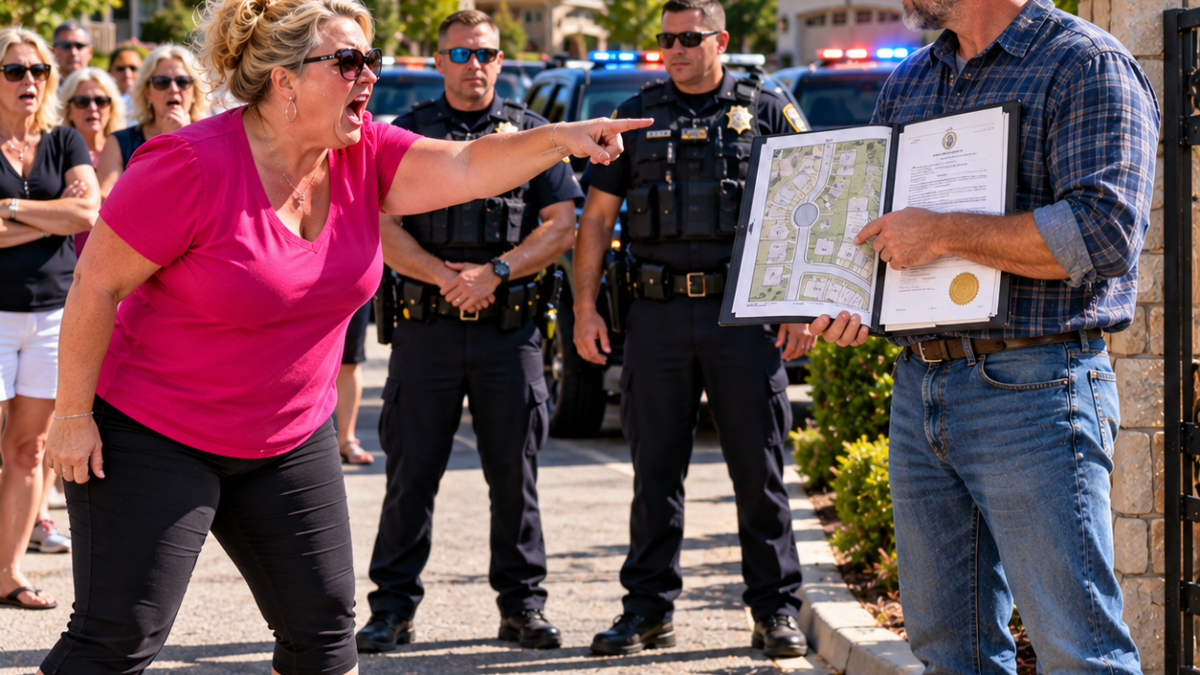
I bought ninety-nine acres outside an HOA, and six days later I locked a gate across a gravel road that three hundred twelve homeowners had quietly been using as their personal shortcut for fourteen years.
The woman who used that road every morning told me I had no right to close it, then helped push the HOA into threatening me with a lawsuit over land that had never belonged to them.
What none of them knew was that somewhere inside an old county file sat one forgotten page written years before I arrived—and once my attorney found it, their entire story about that road started coming apart.
My name is Ray Callaway.
I spent thirty-one years building and acquiring roads for the Tennessee Department of Transportation.
Not neighborhood streets.
State corridors.
Highway expansions.
Drainage systems.
Right-of-way acquisitions.
I spent a career learning that asphalt does not create ownership, tire tracks do not create ownership, and using somebody else’s land long enough does not automatically make it yours.
I retired in 2023.
My wife, Patricia, had died four years earlier, and the Knoxville house we had shared since 1998 had become unbearably quiet.
So I decided to buy working land.
Not a vacation property.
Land that needed something from me.
Timber to manage.
Fence to repair.
Pasture to bring back.
Something that would make me wake up with a list again.
That was how I found ninety-nine acres in Crestwood County.
Mixed hardwood.
Loblolly pine.
Creek-bottom pasture.
An old farmhouse that needed work.
The price was $287,000.
I walked the property before buying it.
That was when I noticed the road.
A maintained gravel track ran almost six-tenths of a mile straight across the middle of the acreage.
It began at Pinecrest Estates on the east side and ended at County Road 7 on the west.
The road was too well maintained to be abandoned.
Ditches cleared.
Gravel packed.
Brush cut back.
At the Pinecrest end, somebody had even installed a permanent steel gate.
So that evening I did what thirty-one years of road work had trained me to do.
I checked the records.
No easement.
No recorded right-of-way.
No county-road designation.
Nothing.
The title came back clean.
I bought the property.
Then, on my second morning living there, I stood beside that gravel track shortly after seven and watched a blue Honda CR-V drive out of Pinecrest Estates, cross my land, and turn onto County Road 7.
Then came a pickup.
Then a sedan.
Then another SUV.
Every one had a Pinecrest Estates sticker.
Four vehicles in less than forty minutes.
This wasn’t an occasional mistake.
It was a commuter route.
So on my sixth day, I installed gates.
Sixteen-foot galvanized farm gate at the County Road 7 end.
Another at the Pinecrest boundary.
Heavy locks.
No-trespassing signs placed correctly along the entire route.
The next morning, the blue Honda returned.
The driver was a woman named Donna Marsh.
She stepped out holding a travel mug and tried my lock twice.
Then she saw me.
“I think there’s a problem with this gate.”
“No problem,” I said. “It’s working.”
She stared at me.
“We use this road.”
“I noticed.”
“We’ve been using it for fourteen years.”
“It’s private property.”
“The previous owner never stopped us.”
“He also never granted you an easement.”
Her voice changed.
“Do you understand how many people rely on this shortcut?”
“Yes.”
“You can’t just close it.”
I looked at her.
“Tennessee requires twenty years for a prescriptive easement. You have fourteen.”
Her expression hardened.
“People are going to be very upset.”
“I understand.”
Three days later, the HOA hired an attorney.
A week after that, a certified demand arrived at my gate.
Four pages.
Fourteen years of continuous community use.
Prescriptive easement.
Remove my gates within twenty-one days or face litigation.
I read it twice.
On page two, beside the phrase “fourteen years,” I wrote one note:
20 required.
6 years short.
Then I called my property attorney, Lena Soto.
“The math already kills their claim,” she said.
“I know.”
“So what are you waiting for?”
“The county file.”
“Why?”
I looked out the window at the empty gravel road.
“Because that track is too organized to have no history.”
Three days later, Lena called me.
Her voice sounded different.
“Ray,” she said, “I found page seven.”
And then she began reading a letter dated August 19, 2009.
A letter written by the previous owner.
About this exact road.
About Pinecrest Estates.
About unauthorized use.
And by the time she reached the second paragraph, I knew Donna’s favorite shortcut had a much bigger problem than my locked gate.
PART 2
I stepped away from Harlan Webb and the stand of loblolly pine we had been inspecting.
The January wind was stronger on the ridge.
Below me, my ninety-nine acres spread toward County Road 7.
Hardwood slope.
Creek bottom.
Old pasture.
And cutting almost straight across the center, the gravel track Pinecrest Estates had treated like a public road for fourteen years.
Lena was still on the phone.
“Read it again,” I said.
“All of it?”
“The part about Pinecrest.”
She rustled papers.
Then she read.
The letter had been written by Curtis Eugene Hale, the man who owned my property from 2007 until his estate sold it to me.
In August 2009, Curtis had written directly to the Crestwood County Road Department after discovering two things.
First, a county road crew had mistakenly graded the first two hundred feet of his farm road because workers thought it was a county spur.
Second, residents from Pinecrest Estates had begun using that road as a shortcut.
Curtis corrected both assumptions in writing.
The road, he said, was his private farm road.
He had built it under an agricultural access permit in 2007 for timber-management purposes.
It was not a county road.
It was not a public right-of-way.
It was not open for public use.
And he had not authorized Pinecrest residents to drive across it.
Then he specifically asked the county to place his letter permanently in the road department’s records.
The county did.
A receipt stamp dated August 24, 2009, sat in the corner.
In the margin, the road director had written instructions to correct the department’s records, designate the route as private access, stop county maintenance, and preserve the letter in the file.
I listened without interrupting.
When Lena finished, I asked, “Where did you find it?”
“Road Department correspondence file. CR7 corridor. Page seven.”
“How long has it been there?”
“Since 2009.”
“Public record?”
“Yes.”
“Available to anyone who asked?”
“Yes.”
I looked down toward the track.
For fourteen years, Pinecrest homeowners had driven across it.
Some every morning.
Some every evening.
Donna claimed she had used it enough times to save hundreds of hours over the years.
The HOA had installed a gate at its end.
People had come to think of it as theirs because nobody physically stopped them.
Yet the first owner who discovered that use had formally written to the county in the very first year and said:
No.
Private.
Unauthorized.
Put it in the permanent record.
I asked Lena the question I already knew the answer to.
“What does this do to their prescriptive claim?”
“It destroys it twice.”
“Explain.”
“First, Tennessee requires twenty years. They have fourteen. That alone defeats the claim.”
“I know.”
“Second, they’re claiming fourteen years of uninterrupted adverse use. Curtis publicly asserted his ownership and rejected their use in year one.”
She paused.
“The clock didn’t just fail to reach twenty years, Ray. Their story about uninterrupted adverse use was broken at the beginning.”
I let the silence sit.
Then Harlan called from twenty yards away.
“Everything okay?”
I raised a finger.
One minute.
Lena continued.
“The road’s history is better documented than we expected. I also found the original agricultural access permit from 2007.”
“Permit number?”
“AGR-2007-114.”
“Purpose?”
“Private farm access for timber management.”
“And the county maintenance log?”
“March 2009, crew accidentally graded two hundred feet because they assumed it was a county spur. September 2009, correction entered. Private property access. No future maintenance.”
“So every independent record says the same thing.”
“Yes.”
“Deed?”
“No easement.”
“County road index?”
“Not listed.”
“Permit?”
“Private farm road.”
“Maintenance file?”
“Private.”
“Curtis letter?”
“Private, HOA use expressly unauthorized.”
I could hear satisfaction in her voice.
Not gloating.
Professional satisfaction.
The kind you feel when a messy problem suddenly aligns around clean evidence.
“What did the HOA attorney rely on?”
“Fourteen years of open use.”
“She didn’t check this file.”
“Apparently not.”
“Write the response.”
“I already started.”
“Use both grounds.”
“I will.”
“Twenty-year statute first.”
“Okay.”
“Curtis letter immediately after.”
Lena laughed softly.
“You want the second hit before they recover from the first one.”
“I spent thirty-one years presenting right-of-way cases to people who didn’t want to hear them.”
“So yes?”
“Yes.”
I looked again at my locked gate far below.
“Make sure they understand the document has been sitting in the county’s public file for fourteen years.”
“They will.”
“And attach certified copies.”
“I ordered them when I found it.”
That was why I hired Lena.
She didn’t wait for instructions she knew were coming.
We hung up.
Harlan walked over.
“What was that?”
“County records.”
“Good news?”
“Depends who you ask.”
He glanced toward Pinecrest.
“You going to let them keep using the road?”
“No.”
That answer came easily.
Not because I wanted revenge.
Because I had bought working property.
The road crossed the heart of it.
I planned timber operations.
Possibly cattle in the creek-bottom pasture.
Heavy equipment.
Gates.
Fire control.
Insurance.
I had no interest in several hundred strangers treating my farm road like an extension of their subdivision.
Harlan looked thoughtful.
“You know they’ve been using it forever.”
“Fourteen years.”
“That feels like forever to people.”
“Property law has numbers for a reason.”
He nodded.
“Fair enough.”
We went back to the pine assessment.
That was one thing I liked about land.
Human beings can spend hours turning a simple boundary into a philosophical crisis.
Trees don’t.
A loblolly pine is either where it is or it isn’t.
By four that afternoon, Harlan had marked several mature saw-log trees and estimated that a careful selective harvest could return somewhere between forty and fifty-five thousand dollars from that stand alone.
The hardwood might produce another twenty-five to thirty-five without damaging long-term value.
Those numbers mattered more to me than Donna Marsh’s commute.
I hadn’t bought ninety-nine acres to win a fight.
I had bought it because I wanted work.
After Patricia died, I had discovered something I never expected about retirement.
Quiet can become heavy.
When she was alive, quiet meant peace.
Afterward, it sounded like absence.
For years, I had driven home from TDOT projects and found her reading at the kitchen table or watering something she claimed I had forgotten to water.
She used to tease me that I couldn’t drive anywhere without evaluating culvert placement.
“Just look at the mountains, Ray.”
“I am.”
“No, you’re measuring drainage.”
“I can do both.”
She never believed me.
When I retired, people told me I was lucky.
No alarm clock.
No project schedules.
No right-of-way negotiations.
No contractors calling at six in the morning because a drainage pipe showed up twenty feet from where the plans said it should be.
But the Knoxville house had become too large.
Two coffee cups still sat in the cabinet where Patricia left them.
Her garden had gone half-wild because I never cared about flowers the way she did.
I needed a place that asked something from me.
That was why the ninety-nine acres mattered.
Fence posts didn’t care whether I was lonely.
Timber didn’t care if I missed her.
Pasture didn’t care how long I sat staring at an empty chair.
Land simply gave you a job.
So that was what I intended to do.
Work.
The HOA had other plans.
Lena sent me the draft response Wednesday afternoon.
Twelve pages.
I read it at the folding table inside my travel trailer.
Coffee beside me.
The HOA’s four-page demand on my left.
My field notebook on my right.
The first section was simple.
Tennessee prescriptive easement law.
Twenty years required.
HOA claimed fourteen.
Fourteen was not twenty.
No hardship exception.
No “close enough.”
No judicial rounding.
The second section was Curtis Hale’s letter.
Lena quoted the operative paragraphs.
Private farm road.
Not public.
HOA use unauthorized.
Permanent county record requested.
Then she explained why that mattered.
The HOA was attempting to characterize the road as though the community had openly used it against an owner who stood by silently for fourteen uninterrupted years.
But Curtis had not remained legally silent.
He had discovered the use in 2009 and placed a written assertion of his property rights in a government file that same year.
The county corrected its records because of it.
That wasn’t nothing.
That was an owner objecting in writing.
Third section.
County road-classification index.
No road.
Fourth.
2009 maintenance correction.
Private property.
Fifth.
2011 county aerial land-use notation.
Private agricultural access road.
Final section:
My gates were staying.
I read that sentence twice.
Then I called Lena.
“Four edits.”
“Only four?”
“Don’t sound disappointed.”
“What’s first?”
I gave her two wording changes.
Then asked her to insert the agricultural permit number.
“And the fourth?”
“Move the Curtis letter up.”
“How far?”
“Right behind the statutory period.”
She was quiet.
Then laughed.
“You really do want them off balance.”
“I want the sequence to be clear.”
“Twenty years required. They have fourteen.”
“Yes.”
“Then before they can argue fourteen is morally close enough, Curtis says they didn’t have the uninterrupted fourteen they think they had.”
“Exactly.”
“You should have been a lawyer.”
“I had an honest job.”
“Good night, Ray.”
“Good night, Lena.”
The final response went out Thursday.
Certified mail.
Email.
Copy to the HOA attorney, Beverly Hollis.
Copy to board president Gerald Fitch personally.
That last one mattered.
Gerald had not started this because he wanted a war.
From what I later learned, he had spent thirty years as an insurance adjuster.
He understood risk.
He also understood that Donna Marsh had enough social influence inside Pinecrest to make doing nothing politically difficult.
Donna had run community events for years.
Fourth of July.
Holiday parties.
Neighborhood committees.
She had influence without technically being president.
The first morning she found my gate, she posted to the community forum.
By noon, dozens of people were demanding action.
Gerald consulted Bev.
Bev told him the Tennessee requirement was twenty years.
Pinecrest had fourteen.
That should have ended it.
Donna said file anyway.
“Fourteen is close to twenty.”
That sentence, more than anything else, explained the problem.
Close.
Engineers don’t get to build bridges using “close.”
Surveyors don’t get to establish boundaries using “close.”
Statutes don’t become optional because six years feels inconvenient.
Gerald knew it.
Bev knew it.
Donna did not want to accept it.
So they sent the demand.
Then they received Lena’s response.
Bev read the statutory argument first.
No surprise.
She already knew that weakness.
Then she reached Exhibit A.
Curtis’s letter.
According to Gerald later, Bev called him after sitting with it for almost twenty minutes.
“How bad?” he asked.
Her answer was apparently honest.
“Very.”
She explained it.
The road had been private from its creation.
The county had accidentally touched it once.
Curtis corrected them.
Curtis expressly rejected Pinecrest’s use.
The record had been public since 2009.
The prescriptive argument had two fatal problems, not one.
Gerald called Donna.
He told her about the letter.
For a few seconds, she said nothing.
Then:
“He wrote a letter?”
“Yes.”
“To us?”
“No. To the county.”
“Then we weren’t notified.”
Gerald explained that it was a permanent public record and that Curtis had used it to correct the county’s own road status.
Donna asked the question that became her answer to everything.
“Find another argument.”
Gerald tried.
Tacking?
No.
A rotating group of HOA homeowners didn’t create the necessary privity to repair the missing statutory period.
Implied dedication?
No.
Curtis’s letter said the exact opposite of an intent to dedicate.
Estoppel?
No.
I had never represented to Pinecrest that they had a right to use the road.
Hardship?
Sympathetic.
Not law.
Gerald told her all of it.
Donna refused.
“There has to be something.”
“There isn’t.”
“Three hundred twelve households rely on that road.”
“They have the main entrance.”
“It adds time.”
“Seven minutes.”
“Seven minutes twice a day matters.”
Gerald, to his credit, finally said something nobody had said to her strongly enough.
“Donna, inconvenience does not create ownership.”
She was furious.
Meanwhile, the Pinecrest forum had turned into its own courtroom.
Some residents supported Donna.
Others started reading the law.
One man, Phil Garrett, posted:
Tennessee requires twenty years. We have fourteen. The math doesn’t work.
Donna replied that community reliance created a moral claim.
Phil answered:
Moral claims don’t win property disputes.
I never joined the forum.
People later seemed surprised by that.
Why would I?
My deed wasn’t there.
The agricultural permit wasn’t there.
The county road index wasn’t there.
Court would not decide ownership based on which forum post got the most thumbs-up.
Then, on a cold Tuesday morning, I found a three-page document folded through my gate.
A petition.
Eighty-seven signatures.
Donna Marsh’s name at the top as social committee chair.
The residents “respectfully demanded” immediate removal of my gates and restoration of access.
Fourteen years of use.
Community hardship.
Good-faith discussions.
I stood beside the gate reading every name.
Eighty-seven people.
That is a lot of signatures.
If I were deciding whether Pinecrest residents disliked my gate, the petition would have been strong evidence.
But it was not a deed.
It was not an easement.
It was not a statute.
It was not a court order.
So I did what I had done with every other document.
I filed it.
Date.
Time.
Method of delivery.
Number of signatures.
Then I went back to walking the northern fence.
Around eleven, I called Lena.
“What’s next?”
“They have until Thursday to decide whether they sue.”
“And if they don’t?”
“We wait two weeks, then file quiet title.”
“No.”
“No?”
“File first.”
She paused.
“You want affirmative relief now.”
“I want the record finished.”
“They may stop.”
“Donna won’t.”
“You’re probably right.”
“More important, I don’t want this starting again in five years.”
That was the real reason.
Suppose Pinecrest backed down temporarily.
Suppose I spent money repairing pasture and harvesting timber.
Suppose Gerald retired from the board.
Suppose Donna waited.
Suppose another president came along later.
There would still be a gravel road.
There would still be old HOA gate hardware at the eastern end.
There would still be fourteen years of historic use people could misremember as twenty.
I didn’t want my property carrying a permanent argument.
I wanted a permanent answer.
“File quiet title,” I said.
Lena understood.
“Monday.”
“Put Curtis’s letter near the front.”
“It’ll be Exhibit One.”
“Quote it in the complaint.”
“I was planning to.”
“I know.”
Monday at 9:15, Ray Callaway versus Pinecrest Estates Homeowners Association was filed in Crestwood County Circuit Court.
Quiet title.
Declaratory judgment.
Trespass.
The complaint asked the court to answer three basic questions.
Was my ninety-nine-acre parcel burdened by any HOA easement?
Were my gates lawful?
Did Pinecrest have any right to keep driving across my farm road?
I already knew the answers.
Court was how you made those answers survive everybody involved.
Lena built the case the way I would have built a highway acquisition file.
Origin first.
Curtis obtained agricultural permit AGR-2007-114.
Private east-west farm road.
Then title.
Clean.
Then county classification.
Not public.
Then 2009 grading mistake.
Then Curtis’s written correction.
Then county record correction.
Then Pinecrest use.
Then my purchase.
Then my gates.
Then their demand.
Then my response.
Chronology.
Evidence.
No speeches.
Pinecrest answered.
Bev did the best she could.
She argued that Curtis’s county letter was not direct notice to the HOA residents.
She argued that the letter’s location in a road-department correspondence file should matter because homeowners weren’t likely to search it.
She argued community reliance.
She did not invent facts.
I respected her for that.
A lawyer can only work with the record she is given.
The hearing was set for March 14.
Eight weeks.
Donna responded to the lawsuit the way she had responded to every document that contradicted her.
She changed arenas.
First, she filed a complaint with the county commissioner.
She argued the county had historically recognized the road because a road crew graded part of it in 2009.
She left out the second half.
The county corrected that error six months later because Curtis told them the road was private.
The county road director responded in three days.
Private road.
No county maintenance duty.
No jurisdiction.
That didn’t stop Donna.
She wrote a letter to the Crestwood County Gazette.
Four hundred words.
She called me an outsider.
Described the gate as an abuse of property rights.
Suggested I had bought land and immediately deprived an established community of access it had relied on for years.
A retired county attorney named Harmon Bell answered her publicly.
His response was shorter.
And devastating.
Private agricultural road.
Clean title.
Twenty-year requirement.
Fourteen years.
Curtis Hale letter.
Case closed.
Then came social media.
SAVE OUR SHORTCUT.
That was the Facebook group.
Ninety-four members in two days.
One hundred forty by the end of the week.
Photographs of my gates circulated.
People posted that I was selfish.
That I hated Pinecrest.
That I wanted to punish families.
That I had bought the property knowing the road existed.
That last one was true.
I did know it existed.
I also knew it had no easement.
A few people started calling the property “our road.”
That wording bothered me more than the insults.
Not because I wanted emotional ownership over gravel.
Because language matters.
“My shortcut” becomes “our road.”
“Our road” becomes “our right.”
“Our right” becomes a demand that the owner explain why he is taking something away.
Nothing had been taken away.
A tolerated convenience had ended.
Phil Garrett joined the Facebook group.
He posted Curtis Hale’s 2009 letter.
Not a summary.
The document.
Donna deleted it.
Phil reposted it with a screenshot proving the first post had been removed.
That one got thirty-four likes.
No argument followed.
There wasn’t much to say.
Harlan told me about all of this while we walked timber.
“You know there’s a Facebook group about you?”
“I heard.”
“Save Our Shortcut.”
“That’s catchy.”
“They’re calling you some things.”
“I assume ‘reasonable new landowner’ isn’t one.”
He laughed.
“No.”
I marked a damaged pine in my notebook.
“You going to respond?”
“No.”
“Not even once?”
“No.”
“Doesn’t it bother you?”
I thought about that.
“Yes.”
He waited.
“But I don’t need to answer everything that bothers me.”
That was something Patricia had tried to teach me for thirty years.
I was never very good at it when she was alive.
Apparently widowhood improved the lesson.
That evening, I emailed Lena one sentence.
Let the record speak.
The hearing arrived on March 14.
I woke at 4:45.
Not because I needed to.
Because thirty-one years of major project meetings had trained my body to wake early when something mattered.
I made coffee in the farmhouse.
The renovations had progressed enough that I had moved out of the travel trailer the month before.
The kitchen was still unfinished.
Cabinet doors mismatched.
One wall needed paint.
Patricia would have hated the temporary light fixture.
I could hear her.
Ray, you bought ninety-nine acres and somehow still live like a man camping in his own house.
I smiled despite myself.
Then the smile disappeared.
I missed her that morning.
Courtrooms never frightened me.
I had testified in condemnation cases.
Sat through depositions.
Negotiated with property owners who believed the state was stealing half their family farm.
I had been called worse things than Donna’s Facebook friends could invent.
But Patricia had always been the person I called afterward.
Win or lose.
Good project or disaster.
“Done,” I would say.
And she would ask:
“Did you behave?”
Usually I answered:
“Define behave.”
That morning there was nobody to call.
I put on a dark suit I had not worn since my retirement lunch.
Tied a plain blue tie.
Placed my field notebook in my coat pocket.
Lena had told me I wouldn’t need it.
I brought it anyway.
The courtroom held nine people when our case was called.
Gerald sat behind Bev with two board members.
Donna sat one row farther back.
Phil Garrett sat alone near the rear.
I did not turn around after noticing them.
Judge Patricia K. Wood entered at nine.
Seventeen years on the bench.
Lena had warned me:
“She reads everything.”
“Good.”
“She asks direct questions.”
“Better.”
The hearing began.
Lena stood.
For thirty-one minutes, she built the road’s history.
Not Pinecrest’s history.
The road’s.
Curtis Hale requested an agricultural access permit.
Purpose:
Timber management.
Private road across private parcel.
County crew mistakenly graded the first two hundred feet.
Curtis learned about it.
Curtis also learned Pinecrest residents had begun cutting through.
August 19.
Curtis wrote the county.
Lena lifted the certified exhibit.
Then read the important language into the record.
The road is private property.
It is not a public right-of-way.
Pinecrest use was not authorized.
The county received it.
The county corrected the maintenance records.
The letter remained permanently available.
Then Lena moved to Tennessee law.
Twenty years.
She paused.
“Pinecrest alleges fourteen.”
The judge looked down at her notes.
Lena continued.
“Even accepting every fact Pinecrest alleges regarding the duration of use, the claim fails.”
Simple.
No drama.
Then the second ground.
Even those fourteen years were not what Pinecrest portrayed.
The prior owner had formally rejected the use in the first year.
When Lena sat down at 9:41, I had written one thing on my yellow pad.
Clear.
Bev stood.
She did not waste time denying documents that could not be denied.
Instead, she argued reliance.
Fourteen years of use had become woven into daily life.
Hundreds of residents had structured commutes around it.
The road looked and functioned like community access.
Curtis had not personally confronted residents.
No gate.
No lawsuit.
No cease-and-desist letter delivered to the HOA.
The county correspondence, she argued, was not direct notice to every homeowner.
Then she called the twenty-year issue a “technical statutory shortfall.”
Judge Wood looked up.
I saw Lena notice too.
Judges have expressions for certain phrases.
“Technical statutory shortfall” was apparently one.
Bev finished the point.
The court should consider the community’s substantial reliance.
Judge Wood let her continue.
Then she asked about Curtis’s letter.
“Ms. Hollis, I want to understand your position.”
“Yes, Your Honor.”
“The owner wrote in August 2009 that the road was private.”
“Yes.”
“He stated it was not a public right-of-way.”
“Yes.”
“He stated Pinecrest use was unauthorized.”
“Yes.”
“He asked the county to permanently preserve that statement.”
“Yes.”
“And the county did.”
“Yes.”
Judge Wood looked at her.
“In what sense, then, do you characterize the later use as the kind of uninterrupted adverse use required to establish prescription?”
Bev answered carefully.
“The residents lacked actual notice of the county filing.”
“The filing was public.”
“Yes, Your Honor, but not located in the deed record.”
“It concerned road maintenance.”
“Yes.”
“So the owner put his objection in the agency record relevant to the road.”
“Yes.”
Judge Wood leaned back.
“And Pinecrest’s position is that because nobody from Pinecrest looked there, the owner’s assertion of his property right somehow stops having legal significance?”
Bev paused.
She was too good a lawyer to say yes directly.
“The position is that the owner’s lack of further enforcement bears on whether the use remained adverse and uninterrupted.”
Judge Wood glanced down.
“Does lack of litigation convert a written objection into consent?”
“No, Your Honor.”
“Does it erase the objection?”
“No.”
“Does it turn a private farm road into a public road?”
“No.”
Silence.
Bev tried the reliance argument again.
The judge listened.
Then called a fifteen-minute recess.
We stepped into the hallway.
Gerald walked past me.
He stopped.
“Mr. Callaway.”
“Mr. Fitch.”
He looked tired.
“I wish this had gone differently.”
“So do I.”
“I want you to know I tried to keep it legal.”
“I know.”
He seemed surprised.
“Bev told me the twenty-year problem before the first letter.”
I said nothing.
“I sent it anyway.”
“Why?”
His eyes moved toward the courtroom door.
“You’ve met Donna.”
“That isn’t an answer.”
“No.”
He sighed.
“Because thirty-four residents emailed me in one day. Because the forum was on fire. Because everybody wanted action. Because I thought maybe sending the letter would buy time to figure out another path.”
“You knew the claim was weak.”
“Yes.”
“Then you should have told them.”
“I know that now.”
“You knew it then.”
That landed.
He nodded.
“Yes.”
I wasn’t trying to humiliate him.
But leadership means sometimes telling people the answer they don’t want.
Gerald understood that better now.
He asked, “If the court rules for you, is there any chance you would open the road under a private agreement?”
“No.”
Immediate.
His face fell slightly.
“Why?”
“Because I’m managing timber.”
“We could limit hours.”
“No.”
“Pay maintenance.”
“No.”
“Ray—”
“The road cuts through the middle of my working property.”
He stopped.
I continued.
“Gerald, this isn’t about punishing Pinecrest. I bought land to use as land. I cannot run logging equipment, fencing, livestock, insurance, and public commuter traffic through the same corridor because your residents save seven minutes.”
He nodded.
“I understand.”
“Do you?”
“I do now.”
The bailiff called us back inside.
Judge Wood returned at 11:14.
Two handwritten pages in front of her.
She did not take long.
Quiet title granted.
My chest loosened, but I didn’t move.
Then she explained.
Ground one.
Tennessee required twenty years of continuous adverse use.
Pinecrest claimed fourteen.
Requirement not satisfied.
Dispositive by itself.
Then ground two.
Curtis Hale’s August 2009 letter was an affirmative public declaration that the road was private, no public right existed, and the subdivision’s use was unauthorized.
The filing occurred in the same year Pinecrest claimed its use began.
The public declaration interrupted any adverse-use period.
Pinecrest therefore could not prove uninterrupted adverse use.
No easement burdened my parcel.
Pinecrest had no legal right to the track.
My gates were lawfully installed.
The HOA was prohibited from using the road or its gate access points.
Costs awarded to me.
The clerk entered the order at 11:22.
That was it.
Not fireworks.
Not applause.
A few pages of paper.
Years of assumption ended by a judge reading records that had always existed.
Donna sat motionless.
I finally looked back at her.
For months, she had insisted fourteen years must count for something.
It did.
It counted as fourteen years.
Six short of twenty.
And even that fourteen had started with an owner writing NO in a county file.
Lena leaned toward me.
“It’s done.”
“Not yet.”
She knew what I meant.
“Recorder.”
“Yes.”
By 11:45 she had a certified order.
Then she drove straight to the county registrar.
The judgment was recorded against the relevant property records so future title searches would see it.
Permanent.
No easement.
Private road.
Court order.
When Lena called from the parking lot, I was already driving back toward my land.
“Recorded.”
“Instrument number?”
She read it.
I pulled over.
Opened my field notebook.
Wrote the number.
Date.
Time.
Then closed the book.
“Now it’s done.”
That evening Gerald posted to Pinecrest’s forum.
Short.
Professional.
The circuit court ruled for the property owner.
No easement existed.
Residents should use Pinecrest Drive.
The board would not pursue further legal action.
Some people were furious.
Some blamed Gerald.
Some blamed Bev.
Some blamed Donna.
Some still blamed me.
Phil posted one line.
The Curtis Hale letter was always there.
That was the whole story.
The Save Our Shortcut group died within forty-eight hours.
Last post:
A photograph of my locked gate.
No caption.
Four reactions.
No comments.
The world did not end.
Three hundred twelve households simply went back to the route they were always legally supposed to use.
Out through Pinecrest Drive.
Then to County Road 7.
The trip took about seven minutes longer.
That was the great hardship at the center of months of threats, legal bills, petitions, newspaper letters, county complaints, Facebook campaigns, and a circuit-court lawsuit.
Seven minutes.
I thought about that often.
Not mockingly.
Convenience is powerful.
People arrange their lives around it.
A shortcut taken every day can begin to feel like infrastructure.
Then expectation slowly hardens into entitlement.
Nobody wakes up one morning and decides to steal a private road.
They simply stop asking whether the road was theirs.
Donna resigned from the social committee six weeks later.
Personal reasons.
One paragraph.
No mention of the lawsuit.
No mention of the Gazette.
No mention of Save Our Shortcut.
No apology.
I didn’t need one.
By then, winter was loosening.
I walked the eastern fence line the morning after the order was recorded.
Frost still clung to the wire.
Two posts needed replacement.
A corner needed restraining.
I wrote both in my notebook.
At the eastern end of the farm road, the Pinecrest gate faced mine.
Their powder-coated steel on their property.
My galvanized gate on mine.
Between them stretched six-tenths of a mile of gravel.
Empty.
I stood there for a while.
Fourteen years of tires had compressed the edges.
You could see where SUVs used to accelerate after entering.
Grass had been pushed back.
Soil polished.
Small stones pressed into the surface.
But already, winter grass was creeping in.
That is one thing nature does better than people.
It doesn’t argue.
It reclaims.
Give grass enough time without tires and it returns.
Give a boundary enough documentation and eventually people stop crossing it.
I started walking west.
The full length.
No engines behind me.
No commuters.
No horns.
Just my boots on gravel.
I thought about Curtis Hale.
I never met him.
He had owned the land from Arizona.
Remote.
Filed his agricultural certifications.
Paid his taxes.
Managed the timber from a distance.
When he discovered the county had touched his road and Pinecrest was using it, he did one simple thing.
He wrote a letter.
Maybe he assumed that was enough.
Maybe he intended to follow up and never did.
Maybe he decided chasing subdivision residents from eighteen hundred miles away wasn’t worth the fight.
But he preserved the truth.
That mattered.
Fourteen years later, his one-page letter protected a man he would never meet.
Me.
That is why records matter.
They speak after memory gets lazy.
They speak after people move away.
They speak after boards change.
They speak after assumptions become tradition.
By the time I reached the County Road 7 gate, sunlight had burned most of the frost away.
I unlocked it.
Walked through.
Locked it again.
Then headed toward the farmhouse.
The travel trailer was gone.
Farmhouse repairs had reached the point where I could live inside without feeling like I was sharing the kitchen with a construction site.
Mostly.
Patricia would still have objected.
I sat on the porch.
From there, the ninety-nine acres felt much larger than the legal description.
Hardwood climbed the western slope.
Pine stood dark against the ridge.
The creek moved through the lower pasture.
The disputed track wasn’t even visible from where I sat.
That struck me.
For months, it had occupied so much mental space.
Yet from the porch, I couldn’t see it.
The conflict had felt larger than the property.
Now the property was larger again.
I made coffee.
Opened my field notebook.
Fence posts.
Wire.
Timber stand.
Creek-bank brush.
Pasture restoration.
Real work.
Then I found the court instrument number I had written the day before.
I looked at it.
Patricia would have said I was pleased with myself.
She would have been right.
Then she would have asked whether I enjoyed making Donna drive the long way.
That answer was harder.
A little.
I’m not going to pretend otherwise.
The first Sunday Donna stood at my gate with her travel mug and told me the neighborhood would be upset, I knew exactly what the law said.
Twenty years.
Not fourteen.
She looked at me as though my ownership was an inconvenience that should bend under community expectation.
When her campaign failed, there was satisfaction in that.
But revenge wasn’t the part that stayed with me.
The quiet did.
The empty road.
The restored boundary.
The ability to look across land I had paid for and know that nobody else could decide its use because it saved them seven minutes.
That was what mattered.
Spring came.
Harlan returned to mark the first selective timber harvest.
We cut carefully.
Mature loblolly.
A few hardwoods.
Enough to generate income without stripping the land.
Logging trucks used the farm road.
My farm road.
That was its original purpose.
Heavy tires rolled over the same gravel Pinecrest commuters once used.
But now every vehicle was there with permission.
Every contractor knew where the gate was.
Every key was controlled.
Every load had a reason.
The distinction felt almost absurdly simple.
Permission.
That was all Pinecrest had never possessed.
One afternoon Harlan stood beside the CR7 gate watching a timber truck leave.
“You know what’s funny?”
“What?”
“This road actually makes sense for logging.”
“That’s why Curtis built it.”
“And your neighbors thought it was built for them.”
“People tend to think the road they use was created for the reason they use it.”
He laughed.
“Sounds philosophical.”
“Don’t spread that around.”
We watched the truck disappear.
Then he asked, “You ever consider letting Pinecrest buy an easement now?”
“No.”
“Not even for stupid money?”
“No.”
“Why?”
I looked east.
“You sell an easement, you sell a piece of control permanently.”
“Everything has a price.”
“Not everything needs one.”
He shrugged.
“Fair.”
The first cattle arrived the following year.
Only a small herd.
I wanted to see whether the creek-bottom pasture could support what the soil maps suggested.
It could.
By then, I had rebuilt much of the fence.
The road became useful for moving feed.
Checking livestock.
Timber inspection.
Fire access.
Exactly the working-land role I had wanted.
And that was when the Pinecrest shortcut finally became ridiculous in hindsight.
If I had left it open, commuters would have been passing livestock gates.
Logging equipment.
Trailers.
Work crews.
During harvest, Pinecrest residents would have been driving directly into an active timber operation.
Closing it wasn’t just legally correct.
It was the only sensible management decision.
Gerald stopped by once.
Not through the shortcut.
He drove the legal route around to my CR7 entrance.
I saw his truck and walked down.
He remained outside the gate.
That small gesture told me a lot.
“You have a minute?”
“Sure.”
I unlocked the pedestrian chain but left the vehicle gate closed.
He smiled.
“Still serious about that gate.”
“It keeps working.”
He laughed.
“I came to give you something.”
He handed me an envelope.
Inside was a check.
Court costs.
Pinecrest had paid the judgment.
“You could’ve mailed it.”
“I wanted to talk.”
“Okay.”
He looked along the road.
There were tire marks from a recent logging truck.
“So you really are using it.”
“Every week.”
He nodded.
“I owe you an apology.”
“You already paid the costs.”
“That isn’t what I mean.”
I waited.
“I knew Bev didn’t think we had a winning case.”
“I know.”
“You know?”
“She told Lena enough.”
Gerald rubbed the back of his neck.
“I let community pressure make me do something I knew wasn’t sound.”
“That happens.”
“It shouldn’t.”
“No.”
“I should have told Donna no.”
“Yes.”
He laughed once.
“You don’t make apologies easy.”
“Would making it easy improve it?”
“No.”
“Then keep going.”
His smile disappeared.
“I’m sorry.”
This time I nodded.
“Accepted.”
He exhaled.
“I wish Curtis had just put up a gate in 2009.”
“So do I.”
“He probably could have prevented everything.”
“Maybe.”
Gerald looked at me.
“You don’t think so?”
“I’ve learned not to underestimate people’s ability to argue with gates.”
That made him laugh.
Before leaving, he said Pinecrest had changed its procedures.
Any future access claim had to include a full title review.
Any legal demand involving property rights had to be supported by written counsel analysis before the board voted.
Community petitions would be accepted.
They would not substitute for legal review.
“That last rule was inspired by Donna,” he said.
“I assumed.”
“She moved away.”
That surprised me.
“When?”
“Last month.”
“Because of this?”
“I don’t know.”
I meant it when I said I didn’t ask.
Donna was no longer my problem.
Gerald drove away.
I locked the gate behind him.
A year after the ruling, I found the old Save Our Shortcut photograph while searching for something unrelated online.
My galvanized gate.
NO TRESPASSING sign.
Bare winter trees.
Somebody had framed it to make the place look hostile.
The funny thing was that the same gate looked different to me now.
Behind it, green pasture.
New fence.
Managed timber.
The farmhouse roof repaired.
Cattle in the lower field.
It didn’t look hostile.
It looked like home.
Patricia never saw it.
That was the part that still hurt.
Sometimes I imagined what she would say.
She would love the creek.
Complain about ticks.
Insist the farmhouse kitchen needed more light.
Tell me the cattle smelled worse than I admitted.
And she would absolutely make fun of the fact that I retired from thirty-one years of right-of-way work only to buy land and immediately end up in a right-of-way lawsuit.
I could hear her laugh.
“You lasted six days, Ray.”
“What?”
“Six days before you turned retirement into work.”
“I put up a gate.”
“You filed a lawsuit.”
“They filed a demand.”
“You still found paperwork.”
“Paperwork found me.”
She would roll her eyes.
I missed that.
Grief doesn’t disappear because you win a property case.
But life can grow around it.
That is what the land did for me.
It gave the grief edges.
Fence line.
Creek bank.
Timber stand.
Pasture.
Gate.
Jobs I could finish.
Problems that had answers.
On the second anniversary of buying the property, I walked the track before sunrise.
Not because anything was wrong.
Because I still liked checking it.
The gravel had changed.
Grass grew along both margins now.
Parts of the old commuter wear had vanished.
Near the Pinecrest side, leaves collected where tires once kept the surface bare.
The HOA gate remained on their fence.
Mine remained on my side.
Neither offended me anymore.
At the center of the road, I stopped.
From there, neither end was visible clearly through the winter trees.
For fourteen years, hundreds of people had driven right through that exact spot and probably never once considered whose land lay beneath their tires.
That didn’t make them evil.
It made them human.
People rarely question a convenience that appears to cost them nothing.
The cost belongs to someone else.
Maintenance.
Liability.
Loss of control.
Risk.
But when you use something long enough, you stop seeing the owner.
That was the lesson Pinecrest had to learn.
And I had learned one too.
Being legally right doesn’t mean everyone who opposes you is malicious.
Gerald was wrong.
But afraid of losing community trust.
Bev sent a weak demand.
But warned her client it was weak.
Most Pinecrest residents wanted their shortcut back because their daily lives had adapted to it.
Even Donna, for all her stubbornness, probably began with something simple.
Seven minutes.
She had used that road for years.
She believed it was part of her routine.
Then suddenly a stranger bought land and put a lock in front of her.
From her side of the gate, I probably looked unreasonable.
Her mistake was not being unhappy.
Her mistake was deciding her unhappiness should override the deed.
Then deciding the law needed to change because the answer disappointed her.
Then moving from attorney to county commissioner to newspaper to Facebook when each record said the same thing.
That is where frustration becomes entitlement.
The facts stop being information.
They become obstacles.
Once that happens, there is no argument loud enough to solve the problem.
Only a record.
I resumed walking.
At the CR7 end, I checked the hinges.
Light surface rust.
Nothing concerning.
I opened the gate.
Closed it.
The latch dropped.
A clean metallic sound.
For years, I had helped Tennessee acquire right-of-way.
I had sat across from farmers who didn’t want to sell.
Widows who had lived in the same house fifty years.
Business owners who feared a new highway alignment would destroy what they built.
I learned early that right-of-way is never “just land.”
It is control.
Memory.
Use.
Security.
Sometimes livelihood.
The state had power private HOAs do not.
Even then, we had procedures.
Appraisals.
Notices.
Negotiation.
Recorded instruments.
Compensation.
Because roads crossing someone’s property are serious.
That was why Donna’s argument bothered me so much.
She wanted the benefit of a right-of-way without any of the process that makes a right-of-way legitimate.
No grant.
No compensation.
No statutory period.
No recorded easement.
Just:
We have used it.
Therefore it is ours.
That is not how property works.
And after thirty-one years of building roads, I was not going to pretend otherwise because an HOA social committee chair disliked her longer commute.
One spring afternoon, a young man from Pinecrest stopped at the CR7 gate.
He didn’t try the lock.
He stood outside.
I was repairing a nearby fence post.
“Mr. Callaway?”
“Yes?”
“My name’s Ethan. Pinecrest.”
I leaned on the post driver.
“What can I do for you?”
“I wanted to ask permission.”
Those words caught my attention.
“For what?”
“My son has a school project about forestry.”
I waited.
“He heard you’re doing selective timber management.”
“Who told him?”
“His teacher knows Harlan.”
That sounded plausible.
“He wants to see how it works.”
“How old?”
“Eleven.”
I looked uphill.
“When?”
“Whenever you’d be willing.”
I thought about the irony.
A Pinecrest resident standing at my locked gate.
Asking.
Not demanding.
“Saturday morning.”
His face brightened.
“Really?”
“Eight o’clock.”
“Can my wife come?”
“Yes.”
“Do we park outside?”
“I’ll open the gate.”
He smiled.
“Thank you.”
Saturday, I unlocked it at 7:55.
Ethan arrived with his wife and their son, Caleb.
We spent two hours walking the upper slope.
I showed Caleb how foresters mark trees.
How removing some mature timber can improve the remaining stand.
How access roads are placed to reduce erosion.
Why drainage ditches matter.
Why roads built for farm operations aren’t automatically public just because they connect two places.
That last one made Ethan laugh.
“I think we learned that part.”
Caleb didn’t understand the joke.
Good.
Children shouldn’t inherit every adult fight.
At the end, the boy asked if he could keep a small cross-section Harlan had cut from a damaged pine.
“Take it.”
He held it like treasure.
As they left, Ethan stopped.
“For what it’s worth, I signed Donna’s petition.”
I nodded.
“I figured.”
“You did?”
“Your name was on it.”
He looked embarrassed.
“I was angry.”
“I understand.”
“I never read the county documents.”
“Most people didn’t.”
“I should have.”
“Now you have.”
He glanced at the open gate.
“You know, there were people who said you hated us.”
“I don’t know you well enough to hate you.”
He laughed.
“Fair.”
Then he grew serious.
“Thanks for letting us come.”
“You asked.”
That was the whole difference.
After they drove away, I closed the gate.
I didn’t feel like I had surrendered anything.
Permission freely given does not weaken ownership.
It proves ownership.
I could say yes because I had the right to say no.
That distinction matters.
Over the years, Pinecrest and I settled into an ordinary neighboring relationship.
Which is exactly what I wanted.
Occasional calls.
Fence questions.
Storm damage.
Once, a Pinecrest board member contacted me because a fallen oak from my side landed partly against their perimeter fence.
I sent a crew.
No argument.
Another time, runoff from their slope started washing sediment toward my pasture.
Gerald’s successor hired a contractor to correct it.
No lawsuit.
No Facebook group.
No Gazette letters.
Neighbors solving problems.
Boring.
Perfect.
The court order remained in the records.
It rarely mattered.
That is the strange beauty of a good legal resolution.
The more successful it is, the less anyone has to talk about it.
New Pinecrest homeowners received title documents showing no western access across my land.
They used the main entrance.
Children who moved there years after the lawsuit had no idea a shortcut ever existed.
By then, grass had narrowed portions of the old track.
I maintained enough width for farm and timber vehicles.
Nothing more.
The road slowly returned to what Curtis built in 2007.
An agricultural access route.
One morning, years after everything ended, I found the certified copy of Curtis Hale’s letter while reorganizing my office.
Page seven.
One sheet.
The document that ended a fight involving 312 households.
I reread it.
There was nothing dramatic in Curtis’s language.
No anger.
No threat.
No insults toward Pinecrest.
Just:
This is my private farm road.
The use is unauthorized.
Please correct your records.
Simple.
I wondered whether he ever knew how important that letter became.
He had died before I bought the property.
Probably never imagined some retired TDOT engineer would one day sit in circuit court relying on words he typed in Phoenix fourteen years earlier.
That gave me a strange sense of responsibility.
Records aren’t only for you.
Sometimes you document something for the person who owns the land after you.
I made three copies.
One stayed in the legal file.
One went into the property-management binder.
One went into the fireproof safe with the deed and court order.
Then I wrote a note for whoever owns the ninety-nine acres after me.
CALLAWAY PROPERTY — WEST/EAST FARM TRACK.
PRIVATE AGRICULTURAL ACCESS ROAD.
NO PINECREST EASEMENT.
SEE RECORDED CIRCUIT COURT ORDER.
Instrument number.
Date.
Case number.
Then I added:
Do not rely on this note. Pull the record yourself.
Old habits.
Patricia would have laughed.
That evening, I sat on the porch.
The pasture below was green.
A few cattle moved near the creek.
The first selective timber harvest had opened small patches of sky on the ridge without ruining the shape of the woods.
The farmhouse no longer looked abandoned.
Neither did I.
That thought came unexpectedly.
For a long time after Patricia died, I felt like an absentee owner of my own life.
Bills paid.
House maintained.
Appointments kept.
Everything technically functioning.
Nothing actively inhabited.
The property changed that.
It gave me something to inhabit again.
The HOA fight was never the reason.
It was an obstacle at the beginning.
A noisy one.
But once it ended, the land kept doing what I bought it to do.
Making me useful.
Sunset moved through the trees.
A vehicle passed on County Road 7.
Then another.
No one turned onto my track.
Nobody stopped at my gate.
No one shouted.
No petition appeared between the bars.
The silence felt earned.
I walked down before dark and checked the latch.
Same galvanized gate.
Different lock than the original.
I had replaced the first one after a few years when the weather began stiffening the mechanism.
The NO TRESPASSING sign had faded.
I installed a new one.
Not because Pinecrest was trying anything.
Because boundaries work best when maintained before there is a dispute.
That applies to fences.
Records.
Relationships.
Everything.
I rested my hand on the gate.
The first week I owned the place, Donna stood on the other side with a travel mug and told me people were going to be upset.
She was right.
They were.
Then the HOA threatened litigation.
Then came the petition.
The commissioner complaint.
The newspaper.
The Facebook group.
Court.
For months, people treated that gate like the villain.
But the gate never did anything.
It stood where I installed it.
The argument happened around it.
The law didn’t care how angry anybody felt about the steel.
The gate marked where permission ended.
That is all a good gate should do.
I closed it.
The latch clicked.
And I thought about thirty-one years of road work.
Every legal road begins with something people rarely see.
A document.
A deed.
An easement.
A right-of-way acquisition.
A dedication.
A recorded agreement.
Some legal foundation that says:
Yes.
You may cross here.
Pinecrest had pavement in its subdivision.
It had signs.
It had 312 houses.
It had fourteen years of habits.
It had eighty-seven signatures.
It had a lawyer.
It had a social committee chair willing to fight.
What it never had was the one thing that mattered.
A right to cross my land.
And when Donna demanded that a judge treat fourteen years like twenty, the judge did not have to choose between me and an HOA.
She only had to read.
The deed said private.
The permit said private.
The road index said private.
The county maintenance correction said private.
Curtis Hale’s letter said private.
And finally the court order said private.
That was the revenge people expected to be dramatic.
It wasn’t.
Nobody’s house got taken.
Nobody went bankrupt.
Nobody was arrested.
I didn’t bulldoze the road.
I didn’t block emergency services.
I didn’t stand at the gate laughing at commuters.
They simply had to use the road they had always legally owned.
Seven extra minutes.
Donna lost her favorite shortcut.
I got my ninety-nine acres back.
And the old farm road became quiet enough that, some mornings, I could stand in the middle of it and hear the creek from the pasture below.
That was worth more to me than winning an argument.
Because I hadn’t bought this land to control anybody else.
I bought it after losing Patricia because I needed something real to take care of.
Trees.
Fence.
Pasture.
A farmhouse.
A piece of Tennessee ground with clear boundaries.
And in the end, that was all I defended.
Not pride.
Not revenge.
Not a gate.
The simple right to decide what happens on land that belongs to me.
Donna spent months trying to turn habit into ownership.
The county records had answered her fourteen years before I arrived.
Nobody bothered to read them.
I did.
And once the judge did too, there was nothing left to argue about.
The gate stayed locked.
The shortcut disappeared.
The land went back to work.
And so did I.

