PART 2: HOA Karen Kept Driving Through My Family Pasture—Then Her Tahoe Lost All Four Tires
PART 2
I replaced the sign the next morning.
This time I drove the post deeper.
Then I installed another one fifty yards away.
Two signs.
Large letters.
Reflective.
There was no reasonable way a driver could miss both.
Denise drove across the pasture again the next morning.
7:41 a.m.
The camera caught her perfectly.
She came back at 5:17 that afternoon.
Tuesday morning, same thing.
Wednesday.
Thursday.
Friday.
By the second week, I could practically set my watch by her.
The tracks became ruts.
Then the ruts became trenches.
Every time it rained, water collected inside them.
Every time it dried, the dirt hardened into sharp ridges.
My cattle stopped grazing around that corner.
Animals understand danger faster than people sometimes do.
They started bunching up toward the north fence instead, wearing down good grass while the southwest corner of my property became Denise Caldwell’s private shortcut.
I walked those ruts one evening after work.
My boots sank into the mud.
I stood there looking toward Ridgeline.
From where I was, I could see the second-story windows of houses glowing orange in the sunset.
Somewhere among them was Denise’s home.
Air conditioning.
Granite countertops.
Three-car garage.
And somehow she had convinced herself that my pasture was an inconvenience placed in her path.
I could hear Dad’s voice.
Don’t get angry before you get organized.
That was one of his rules.
He’d lived his whole life working around heavy equipment, cattle, welding rigs, and men who sometimes thought shouting made them right.
“Paper first,” he used to say. “Temper last.”
So I started keeping records.
Dates.
Times.
Camera images.
Vehicle descriptions.
Damage.
Everything.
I hoped I’d never need any of it.
Then one rainy morning, I heard a sound from across the pasture that I still remember.
Not because it was especially loud.
Because I knew instantly it was wrong.
One of the spring calves had stepped badly into one of the deep tire ruts.
By the time I reached her, she was struggling to stand.
I called the veterinarian.
He came out that morning.
The calf survived, but her front leg had been badly injured.
For the next several weeks, I watched that little animal limp toward the feed trough while the others moved normally around her.
That changed something in me.
A tire rut wasn’t just ugly anymore.
It wasn’t just disrespect.
It had hurt something that depended on me to keep the pasture safe.
The veterinary bill was more than a thousand dollars.
I paid it.
Then I photographed the damaged ground and the calf’s wrapped leg.
I printed everything.
I put copies of the photographs, the invoice, and a written demand to stop crossing my property into a certified envelope addressed to Denise Caldwell.
She signed for it.
Nothing changed.
The following Monday, the Tahoe crossed my pasture at 7:39 a.m.
I watched the video twice.
Then I called the sheriff’s office.
A deputy came out that Saturday.
Young guy.
Professional.
Calm.
He walked the damaged section with me.
He photographed the signs.
He looked at the ruts.
I showed him the trail-camera images.
“That’s her vehicle?” he asked.
“Yes.”
“You’ve told her directly to stop?”
“Yes.”
“In writing?”
I handed him the certified-mail receipt.
He nodded slowly.
“At least you’re documenting everything.”
“Can you make her stop?”
He hesitated.
And that hesitation told me I wasn’t going to like the answer.
He explained that a property dispute like this could get complicated quickly. He could document the complaint. Repeated entry after clear notice could become far more serious, but proving every piece of damage was another matter.
I looked across the field.
“So she can just keep doing this?”
“I didn’t say that.”
“It sure sounds like it.”
He closed his notebook.
“Mr. Turner, keep your signs up. Keep your footage. Keep every letter.”
I nodded.
“Paper fence.”
He looked at me.
“What?”
“My dad used to call documentation a paper fence.”
The deputy smiled slightly.
“Then keep building it.”
So I did.
I filed the complaint.
I sent another certified notice.
I saved another week of recordings.
Twelve days later, Denise answered.
Not with an apology.
With an HOA violation notice.
I found it in my mailbox after work.
Ridgeline Estates Homeowners Association.
Gold shield logo.
Formal formatting.
Bold heading.
**NOTICE OF NON-COMPLIANCE.**
I stood beside my mailbox and read it twice.
According to the letter, my agricultural fencing violated Ridgeline’s aesthetic standards.
The fine was listed as $150 per day until correction.
I actually looked over my shoulder toward my house as if somebody might be filming a prank.
My property wasn’t in Ridgeline.
Never had been.
My grandfather had bought it decades before Ridgeline existed.
I wasn’t an HOA member.
I had never signed an HOA covenant.
Yet there I was, holding a letter demanding money because my cattle fence offended a subdivision built sixty years after the fence line had been established.
I called the phone number printed at the bottom.
Denise answered.
“Ridgeline HOA.”
“This is Kyle Turner.”
Silence.
Then, “Yes?”
“I received your notice.”
“Good.”
“You understand my property isn’t in your association.”
“Your property affects our association.”
“That isn’t the same thing.”
“The board has authority over conditions that affect neighborhood values.”
“No. You don’t.”
“We disagree.”
I stared down at the paper.
“You’re fining me for a fence on land you don’t govern.”
“We’re giving you an opportunity to become compliant.”
“Compliant with what?”
“Community standards.”
“I’m not in your community.”
Her voice hardened.
“You’re adjacent to it.”
“That’s geography, Denise. Not ownership.”
She hung up.
I took the letter into my shop and pinned it to the wall beside my grandfather’s original deed.
That was when I stopped thinking of Denise as an irritating neighbor.
She had started manufacturing authority.
And manufactured authority becomes dangerous when enough people believe the letterhead.
Within a week, I learned she was circulating a petition.
She called it the Ridgeline Beautification Initiative.
It demanded that the county reconsider the agricultural designation of my property.
Thirty-four people signed it.
Thirty-four.
Most of them had never spoken to me.
Some probably couldn’t have picked me out of a lineup.
But Denise told them my cattle lowered their property values.
She told them the pasture smelled.
She told them the fencing was unsightly.
She told them rezoning the land would “protect the character of Ridgeline.”
Then she took the campaign online.
Screenshots eventually made their way to me.
“That cattle lot is destroying our home values.”
“Something needs to be done.”
“Why is livestock allowed so close to our homes?”
People piled on.
What bothered me wasn’t that everyone agreed with Denise.
They didn’t.
What bothered me was how few people asked the obvious question.
Who owns the land?
Instead, they discussed my pasture as though it were an abandoned lot waiting for their committee to decide its future.
Then new tire tracks appeared.
Not one vehicle anymore.
Three.
Denise had apparently told neighbors the pasture was some kind of shared access corridor.
I hired a licensed surveyor.
Eight hundred dollars to prove what my grandfather’s deed already told me.
He drove fresh stakes.
Marked the boundary.
Produced a stamped survey.
There was no HOA easement.
No shared corridor.
No access road.
No ambiguity.
I mailed copies to every HOA board member along with a cease-and-desist letter.
Four envelopes.
Four signatures.
I wanted every board member to know.
Not just Denise.
I thought that would finally embarrass them into stopping.
Instead, someone cut my fence.
I found the gap early Tuesday morning.
Two horizontal rails had been cut cleanly.
The opening was about wide enough for an SUV.
One of my older cows was standing near it.
Beyond her was the county road.
A pickup pulling a livestock trailer passed at highway speed.
For several seconds, I couldn’t move.
All I could picture was that cow stepping through the opening.
A vehicle swerving.
Somebody getting killed because a person wanted to save four minutes on a morning commute.
I patched the gap immediately.
Then I called the sheriff again.
The deputy returned.
He inspected the cuts.
This time his expression changed.
“This isn’t somebody accidentally driving onto your land.”
“No.”
“This was deliberate.”
“Yes.”
“You have footage?”
“Headlights. Bad angle.”
He looked toward my camera.
“You need another angle.”
“I already ordered two more cameras.”
He nodded.
“Good.”
That afternoon I sat on the tailgate of my truck looking at the temporary repair.
The wire holding the cut rails together looked like stitches.
For the first time, I felt tired.
Not angry.
Tired.
There is a particular kind of exhaustion that comes from having to prove repeatedly that something obviously yours actually belongs to you.
The deed wasn’t enough.
The fence wasn’t enough.
The signs weren’t enough.
The survey wasn’t enough.
The letters weren’t enough.
Denise had discovered that she didn’t need to win legally if she could simply make the fight exhausting enough for me to quit.
Two weeks later, she became HOA president.
Nobody ran against her.
The previous president resigned after months of conflict.
According to one neighbor, he said he’d rather spend his retirement doing unpaid dental work than attend another meeting with Denise Caldwell.
She won by default.
Her first major act as president was an “emergency access resolution.”
I eventually obtained a copy.
It declared that Ridgeline residents had the right to use “adjacent open land” for what she called community wellness and access purposes.
Adjacent open land.
That was me.
My grandfather’s pasture had been reduced to three words in an HOA resolution.
She didn’t mention my name.
Didn’t mention the survey.
Didn’t mention the deed.
She just wrote the language broadly enough for people to interpret it however she wanted.
Then one Saturday morning, I heard a dump truck.
I was working in my shop.
I killed the grinder and listened.
Backup alarm.
Diesel engine.
Then the unmistakable crash of gravel leaving a raised bed.
I walked outside.
A ten-wheel dump truck was sitting in my pasture.
A skid steer was spreading crushed limestone along Denise’s tire path.
For several seconds, I genuinely couldn’t process what I was seeing.
My cows had run to the far side of the field.
The injured calf followed them more slowly.
I crossed the pasture.
“Shut it down!”
The skid-steer operator stopped.
A man in an orange vest climbed out.
“You Kyle?”
“Yes.”
He looked confused.
“We were told this was HOA property.”
“You were told wrong.”
He pulled a work order from his truck.
Ridgeline Estates HOA.
Community trail improvement.
Authorized by President Denise Caldwell.
I took a photograph.
Then another.
“I’m not blaming you,” I said. “But you need to leave.”
His face went pale.
“You own this?”
“Every inch.”
He looked toward the fresh gravel.
Then back at the work order.
“Man.”
“That about covers it.”
They left.
But not before several tons of crushed limestone had been dumped across the ground.
Three days later, Denise installed a professionally made sign at the entrance.
**RIDGELINE COMMUNITY TRAIL — EST. 2024**
I stood there staring at it.
She had named my land.
That was the moment something shifted.
I pulled the sign out carefully.
I didn’t destroy it.
I locked it in my truck toolbox as evidence.
Then I drove to the county clerk.
I asked for every document connected to Ridgeline Estates.
Plat approvals.
Surveys.
Development agreements.
Drainage plans.
Everything.
The clerk brought me a box.
I spent hours reading paperwork that seemed designed to make human consciousness surrender.
Maps.
Engineering reports.
Signatures.
Environmental forms.
I almost gave up.
Then I found a folder marked:
**Adjacent Property Agreements — 2021.**
Inside was a document between the county and Ridgeline’s original developer.
I read one paragraph.
Then I read it again.
Then a third time.
As a condition of Ridgeline’s approval, properties bordering agricultural parcels were subject to a permanent restriction preventing residents, contractors, guests, or community agents from using those agricultural parcels for vehicle access.
I sat back in my chair.
Denise wasn’t just ignoring my signs.
She was violating an agreement tied directly to the subdivision.
Every Ridgeline homeowner had purchased their property subject to it.
Including Denise.
And the agreement gave the neighboring agricultural landowner the right to seek court relief.
I paid for copies.
When I got home, I spread them across my kitchen table.
That’s when I found the other document.
It wasn’t from the county.
It was inside a box Dad had kept.
A handwritten letter.
June 1961.
My grandfather’s handwriting.
Walt Turner had written to a county official after a developer attempted to build a road through the southern edge of the same pasture.
Granddad had refused.
The developer pushed.
Granddad hired a lawyer.
For almost a year, he fought.
Eventually, the proposed road was routed around his property.
I sat there with his old letter beside Ridgeline’s modern covenant.
More than sixty years separated them.
Same pasture.
Same problem.
Someone had looked at family land and decided the owner’s “no” was merely the beginning of negotiation.
I ran my fingers over Granddad’s signature.
Walt Turner.
The ink was faded.
But suddenly I could hear him.
He had been gone for years, but I remembered him leaning against the fence when I was eight years old.
“Kyle,” he’d told me, “a fence isn’t there because you hate the man on the other side.”
“Then why is it there?”
“So both men can stay friends.”
I hadn’t understood him then.
I did now.
Denise wasn’t fighting a fence.
She was fighting the idea that another person’s boundary had meaning.
That night, I called a property attorney named Reed Holloway.
He reviewed everything.
The survey.
The subdivision agreement.
The letters.
The police reports.
The camera footage.
The fake HOA fine.
The gravel.
When he finished, he removed his glasses.
“This woman has created a remarkable amount of evidence against herself.”
“Can we stop her?”
“Yes.”
“How fast?”
“Court fast.”
Meaning not fast.
He filed for an injunction.
But hearings take time.
Denise was still driving through my pasture every morning.
So I focused on protecting the ranch while the legal process moved.
I improved the fencing.
I added cameras.
I posted additional warnings.
I began reinforcing damaged sections of ground and old ranch infrastructure that vehicles had no business crossing in the first place.
I also spoke with my insurance carrier and my attorney before making any physical changes.
By that point, I wasn’t taking chances.
Everything was photographed.
Everything was documented.
Everything stayed on my property.
And every entrance remained clearly marked.
PRIVATE PROPERTY.
NO TRESPASSING.
RANCH IMPROVEMENTS AHEAD.
The details mattered less to me than the principle.
Nobody had permission to drive there.
Period.
Around the same time, I gained two allies.
The first was Earl Dawson.
Earl lived across the county road.
Sixty-eight years old.
Rancher.
Skin like saddle leather.
Talked about half as much as everybody else, which meant when he did speak, you listened.
I showed him Granddad’s letter.
Then I showed him the covenant.
Earl read both.
He folded the papers carefully.
“Your granddaddy’d be proud.”
Four words.
That almost broke me.
I looked away.
“I’m tired, Earl.”
“I know.”
“I’m spending money proving things everybody already knows.”
“I know.”
“Some days I feel like I’m fighting forty-six houses.”
Earl shook his head.
“No.”
I looked at him.
“You’re fighting one person. The others just haven’t decided whether they’re willing to stop her.”
He offered to mount one of his better cameras on his property facing my field.
Different angle.
Nobody entering my pasture would know it was there.
The second ally surprised me more.
Her name was Connie Bates.
She lived inside Ridgeline.
I’d spoken to her twice in my life.
Once at the county fair.
Once after her dog escaped and spent twenty happy minutes eating things in my pasture that no civilized dog should consider food.
I ran into her at the hardware store.
She noticed the fencing supplies in my cart.
“You still dealing with Denise?”
I laughed without humor.
“That’s one way to say it.”
She lowered her voice.
“She used HOA money for that gravel.”
“I figured.”
“Thirty-four hundred dollars.”
That got my attention.
“I voted against it,” Connie said. “She told me to sit down.”
From that day forward, Connie became a quiet source of information.
Meeting minutes.
Emails.
Financial records.
Screenshots.
She never made speeches.
Never tried to become a hero.
She just believed an HOA should take care of the subdivision it actually governed.
Which, I was learning, qualified as a revolutionary opinion.
Then Denise received the court papers.
Connie texted me that evening.
**She got served. Emergency board meeting tomorrow. She’s furious.**
At that meeting, Denise apparently called me unstable.
Dangerous.
Hostile.
She showed photographs of my cattle.
My fences.
My muddy pasture.
She described them as threats to children and property values.
Half the room applauded.
The next day she filed a complaint with the county alleging my ranch was creating dangerous runoff.
An inspector arrived Thursday.
I met him at the gate with a binder.
Water tests.
Agricultural paperwork.
Vaccination records.
Land-use documents.
He inspected the property.
Walked the drainage area.
Checked the cattle.
Then he wrote his conclusion.
No violation.
Before leaving, he handed my binder back.
“You’ve been expecting me.”
“I’ve been expecting everybody.”
He smiled.
“I can tell.”
Denise then went online.
She accused me of threatening neighborhood children with an “unregulated cattle operation.”
I didn’t answer.
That drove her crazier than anything I could have written.
Dad had taught me something else.
Never argue in a room where the other person controls the microphone.
So I stayed off Ridgeline’s Facebook page.
Connie saved screenshots.
I saved documents.
My lawyer saved everything.
Then one morning, I got the footage that changed the entire case.
A camera had recorded Denise arriving at my fence late at night with a man carrying power tools.
The video showed the man cutting my fence while Denise watched.
This time the angle was clear.
Her face.
His face.
The vehicle.
The plate.
Everything.
I stood in my shop before sunrise watching that recording.
My coffee went cold.
I watched it once.
Then again.
There was something uniquely unsettling about watching another person damage your property while you’re asleep.
The violation feels different.
During the day, you can argue.
You can intervene.
At night, you’re seeing proof that somebody waited for darkness because they understood perfectly well that what they were doing was wrong.
I copied the footage.
Backed it up.
Sent it to Holloway.
Then I repaired the fence.
Properly.
No temporary wire.
Steel.
Welded plate.
The kind of repair that said the argument was over.
A few days later, another HOA letter arrived.
This one demanded that I remove all livestock within fourteen days.
I read that sentence three times.
They wanted my cattle removed from agricultural land my family had owned since 1961.
Holloway responded for me.
His letter was short.
Professional.
Devastating.
Ridgeline Estates had no jurisdiction over the Turner property.
Any additional entry would be treated as unauthorized.
Any removal or interference with livestock would trigger immediate legal action.
The association had been formally notified.
Connie later told me what Denise said after reading it.
“He’ll fold. They always do.”
Three days later, Connie caught me at a gas station.
She didn’t even turn off her engine.
“Saturday,” she said.
“What?”
“Denise is bringing contractors Saturday morning.”
“For what?”
“She told people they’re clearing obstructions from the community trail.”
I stared at her.
“What obstructions?”
“Your fence.”
My hands tightened around the edge of my truck bed.
“And the cattle?”
Connie’s expression told me the answer before she spoke.
“She said they’d deal with them.”
For a second, all I saw was that injured calf.
Then the cut fence.
Then Granddad’s letter.
I thanked Connie.
I drove home.
And instead of getting angry, I made phone calls.
Sheriff’s office.
Attorney.
Insurance carrier.
I explained what I’d been told.
A report was made in advance.
My lawyer reminded me not to confront anyone unnecessarily.
“Let the documentation speak.”
That Friday evening, I checked my cameras.
Checked my fences.
Checked the cattle.
Then I walked to the southwest corner.
The old ruts were still visible beneath patches of recovering grass.
Six months of Denise driving there had changed the ground.
I stood in the fading light looking toward Ridgeline.
House lights began appearing one by one.
Families eating dinner.
Kids watching television.
Dogs being let into backyards.
Most of those people weren’t my enemy.
I understood that now.
A few had been careless.
Some had believed Denise.
Others had simply stayed silent.
But silence had allowed one person to pretend a private ranch belonged to forty-six houses.
I walked back toward the house.
The injured heifer followed me for twenty yards.
She still limped slightly.
I scratched her forehead.
“You’ve got terrible timing,” I told her.
She tried to chew my sleeve.
I laughed.
That laugh helped.
Saturday morning came cool and clear.
I was feeding cattle shortly after seven when I heard an engine.
I knew it immediately.
The Tahoe.
White.
Same route.
Same driver.
Denise entered through the familiar corner.
She passed a posted warning.
Then another.
I didn’t wave.
I didn’t approach.
She kept driving.
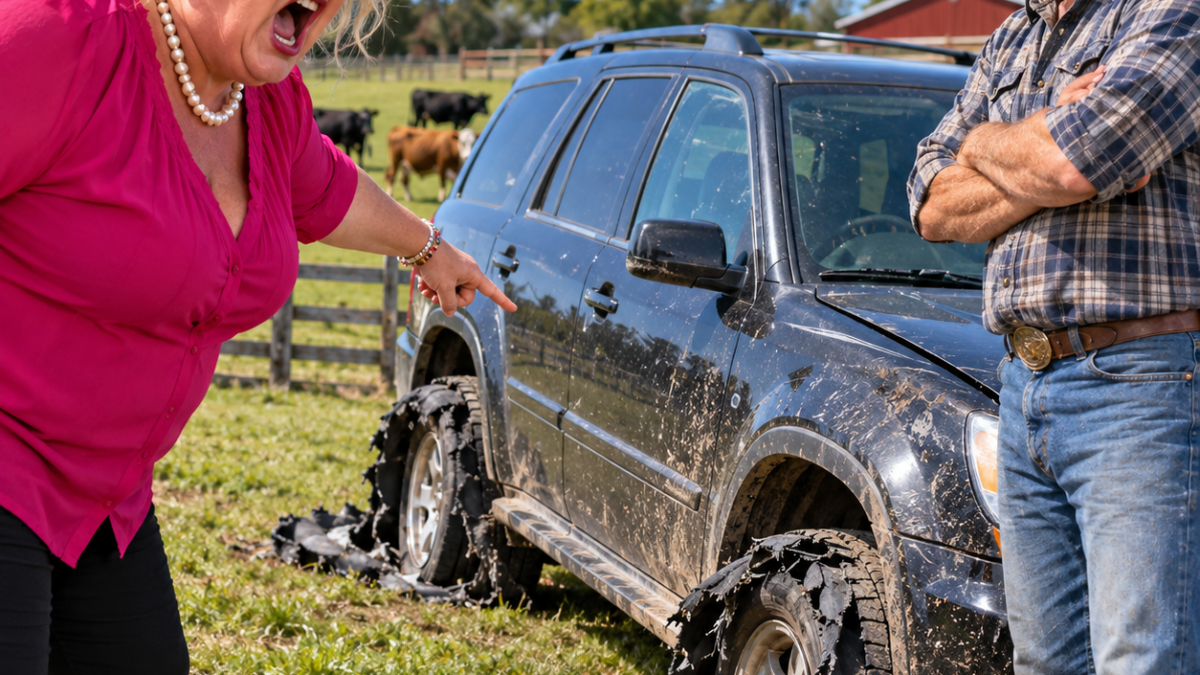
A few seconds later, the Tahoe struck one of the reinforced sections of damaged ranch ground where vehicles were never supposed to be.
The first tire failed.
The Tahoe lurched.
Instead of stopping immediately, Denise kept moving.
Another tire went.
Then another.
By the time the vehicle came to rest, all four tires had been ruined and the Tahoe was sitting helplessly in the middle of the pasture it had no permission to enter.
For a moment, everything went silent.
Even the cows seemed to stop chewing.
Then the driver’s door opened.
Denise climbed out.
She looked at the Tahoe.
Then at me.
Then back at the Tahoe.
Her face changed.
Shock.
Confusion.
Then fury.
“You!”
I set down the feed bucket.
“You did this!”
I didn’t raise my voice.
“You’re on my property, Denise.”
“You destroyed my car!”
“You drove onto posted private land.”
“You set this up!”
“You drove onto posted private land.”
She pulled out her phone.
“I am calling the police.”
“That would probably be best.”
That answer seemed to upset her even more.
She dialed.
“I want to report property damage!” she shouted into the phone. “My neighbor deliberately damaged my vehicle!”
I leaned against a fence post and waited.
Eleven minutes later, a patrol vehicle arrived.
Same deputy.
I almost felt sorry for him.
He parked on the county road and walked toward us.
He looked at the Tahoe.
Then Denise.
Then me.
Then the signs.
One eyebrow rose.
Denise rushed toward him.
“He sabotaged my vehicle!”
The deputy held up one hand.
“Ma’am, why is your vehicle in Mr. Turner’s pasture?”
“This is community access.”
“No, ma’am.”
“Yes, it is.”
“No.”
She pointed toward Ridgeline.
“The HOA established this as an access route.”
The deputy looked at me.
I said nothing.
He turned back to Denise.
“Ma’am, I’m familiar with this property. I’ve taken multiple reports here.”
“He put something in the ground!”
The deputy glanced toward the warnings posted at the entrance.
“Did you see the signs?”
“What signs?”
He pointed.
One was visible from where we stood.
Denise looked at it.
Her mouth tightened.
“Those don’t matter.”
The deputy exhaled slowly.
“Actually, they matter quite a bit.”
“This man has been harassing our community for months.”
I almost laughed.
The deputy didn’t.
“Mrs. Caldwell, I’ve personally reviewed reports where Mr. Turner asked your association to stop entering this land.”
“He can’t block community access.”
“Do you have a recorded easement?”
She didn’t answer.
“Do you own this parcel?”
Silence.
“Is the parcel part of Ridgeline Estates?”
Her jaw clenched.
“This is bigger than that.”
“No, ma’am. Right now it’s exactly that.”
He walked around the Tahoe.
Then he returned to his patrol car and began writing.
Denise followed him.
“What are you doing?”
“Documenting an unauthorized entry.”
“You should arrest him!”
“For what?”
“He ruined my car!”
“Your car is sitting inside property you’ve repeatedly been instructed not to enter.”
The three nearest Ridgeline homeowners had started walking toward the fence.
None crossed it.
That detail mattered to me.
For once, people were respecting the boundary.
Earl appeared across the road.
Phone in hand.
Recording.
By eight-fifteen, Denise was standing beside a disabled Tahoe while the same landowner she’d spent months portraying as unreasonable calmly fed cattle twenty yards away.
At nine, the contractor she’d hired arrived.
White work truck.
Two men inside.
The driver slowed.
Saw the patrol vehicle.
Saw Denise.
Saw the Tahoe.
Saw the signs.
Then he reversed.
Never even opened the door.
I have to admit, that was one of the most satisfying moments of the entire dispute.
A tow truck arrived later.
The Tahoe had to be loaded and removed.
Denise stood beside the road watching it go.
Before the deputy left, I handed him a folder.
Survey.
Certified letters.
Camera logs.
Photographs.
Covenant.
HOA notices.
Fence-damage footage.
The video of Denise arriving late at night while the fence was cut.
He looked through the first few pages.
Then looked at the thickness of the folder.
“Mr. Turner.”
“Yes?”
“I wish every property case came with records like this.”
“My grandfather believed in keeping paperwork.”
He tapped the folder.
“Your grandfather was a smart man.”
I watched him drive away.
Denise remained on the shoulder.
Her phone was nearly dead.
She called for a ride.
Nobody came immediately.
Eventually a rideshare car pulled up.
The driver lowered his window.
I couldn’t hear every word, but I heard him say:
“Bad morning?”
Denise got in.
The car left.
And suddenly the pasture was quiet again.
I picked up my feed bucket.
Earl walked over to the fence.
“You all right?”
“Yeah.”
He nodded toward the road.
“Expensive shortcut.”
I looked at him.
He kept a perfectly straight face for almost three seconds.
Then we both started laughing.
Not cruel laughter.
Relief.
Six months of tension had finally cracked.
I hadn’t won yet.
But for the first time, Denise had experienced what she’d spent months denying.
A boundary.
The court hearing came six weeks later.
I wore the only suit I owned.
Dark blue.
Bought for Dad’s funeral.
It still felt strange putting it on.
Holloway met me outside the courtroom.
Denise arrived with her own attorney.
She didn’t look at me.
The judge reviewed the property records.
The subdivision agreement.
The survey.
The correspondence.
The footage.
He asked Denise’s attorney whether the HOA disputed that my parcel was outside Ridgeline.
“No, Your Honor.”
Whether the association possessed an easement.
“No, Your Honor.”
Whether the development agreement restricted Ridgeline vehicle access across neighboring agricultural land.
A longer pause.
“No, Your Honor.”
The judge looked over his glasses.
“Then I’m struggling to understand why we’re here.”
Nobody answered.
The permanent order came quickly.
Ridgeline residents, guests, contractors, and agents were prohibited from entering my agricultural property without permission.
Simple.
Clear.
Exactly what I’d been saying since March.
Outside the courthouse, I stood on the steps holding the order.
Holloway adjusted his briefcase.
“You look disappointed.”
“I thought winning would feel bigger.”
He smiled.
“Most legal victories feel like paperwork.”
I looked down at the signed order.
“My grandfather fought almost a year for the same thing.”
“Then maybe this isn’t your victory.”
“What do you mean?”
“Maybe you’re just the latest person in your family who refused to move the line.”
That stayed with me.
The other consequences came later.
The fence damage.
Pasture damage.
Veterinary expense.
Unauthorized gravel work.
Legal costs.
The evidence was difficult to dispute.
Eventually, the financial settlement reached $14,500.
When the agreement was finalized, I didn’t feel triumphant.
Mostly I felt exhausted.
Money couldn’t erase the months.
Couldn’t make the calf’s leg perfect again.
Couldn’t remove the feeling I’d had every morning wondering what Denise would do next.
But it could repair what had been damaged.
And it could create something better.
Meanwhile, Ridgeline began dealing with Denise internally.
That’s where Connie stepped forward.
At the next HOA meeting, she brought financial records.
The gravel project.
The unauthorized sign.
Administrative expenses.
Money Denise had spent trying to turn my pasture into something the association didn’t own.
Connie laid everything out.
Receipts.
Invoices.
Meeting records.
Denise tried to interrupt.
Connie didn’t stop.
“I have the floor.”
“Connie—”
“I have the floor, Denise.”
According to people who attended, the room went silent.
Connie turned toward the homeowners.
“This isn’t about whether you like cattle.”
She pointed toward the records.
“This isn’t about whether you think Kyle’s fence is pretty. This is about whether your HOA president gets to spend your money on land we do not own.”
Someone in the back asked:
“Did the board approve all of this?”
Connie looked at Denise.
“No.”
Another homeowner spoke.
“Were we told the pasture was privately owned?”
“Yes.”
Denise stood.
“You’re simplifying this.”
Connie turned.
“No. I’m finally making it simple.”
Then she said the sentence people repeated to me for months afterward.
“We need an HOA that minds its own damn business.”
The vote to remove Denise was unanimous.
Even people who had supported her rezoning petition voted against her.
She was required to repay misused association funds.
She lost her position.
And for several years, she couldn’t serve on the board again.
Connie was elected president.
Her first official action was not dramatic.
No emergency resolution.
No fancy letter.
She simply sent me a note.
Kyle,
On behalf of Ridgeline Estates, I apologize for the unauthorized use of your property.
The association recognizes the Turner property boundary and will not claim access rights that do not exist.
I hope we can be better neighbors from here forward.
—Connie Bates
I read that letter twice.
Then I put it in the same file as all the others.
But not because I expected another fight.
Because Dad had taught me to keep records of good things too.
The total financial consequences for Denise grew as different bills, reimbursements, repairs, penalties, and the settlement were added together.
Her damaged Tahoe alone was expensive.
Then came the tow.
The HOA repayment.
County consequences related to the unauthorized work.
My settlement.
By the time everything was accounted for, the dispute had cost her close to thirty thousand dollars.
But that wasn’t what mattered most to me.
The money disappeared into repairs and bills.
Reputation changes.
Board positions change.
Cars get fixed.
What mattered was the pasture.
I rebuilt the entire eastern fence line.
Not just the damaged sections.
All of it.
New pipe.
Fresh welds.
Concrete at the main posts.
A proper steel gate.
When I finished, I mounted a simple reflective sign.
**TURNER RANCH
EST. 1961**
I stood there for a while after installing it.
Granddad would have called it too fancy.
Dad would have said the lettering wasn’t level even if it was.
I could hear both of them.
That was when I decided what to do with part of the settlement.
I took two thousand dollars and contacted the local Future Farmers of America chapter.
I established a small agricultural scholarship in Granddad’s name.
The Walt Turner Agricultural Scholarship.
It wasn’t huge.
It wasn’t going to pay for four years of college.
But it was enough to help somebody buy books, cover fees, or get through a semester.
The first recipient was seventeen.
She wanted to study animal science at Texas A&M.
At the county fair, I handed her the scholarship check beside a livestock barn where my grandfather had once shown cattle.
Her mother cried.
The girl cried.
I nearly did.
She shook my hand.
“Thank you, Mr. Turner.”
“Don’t thank me.”
She looked confused.
“Thank Walt.”
“Who’s Walt?”
“My grandfather.”
I pointed toward the pasture visible beyond the fairgrounds.
“He was stubborn enough to leave us something worth defending.”
That fall, Earl and I organized something else.
A pasture day.
Kids from Ridgeline were invited onto the ranch.
With permission this time.
Fourteen showed up.
Some had never stood close to a cow.
A few were terrified.
One boy kept asking whether cattle could smell fear.
“They mostly smell snacks,” Earl told him.
Another kid asked why fences mattered.
That question stopped me.
I crouched beside him.
“Because everything belongs somewhere.”
He frowned.
“What does that mean?”
“It means this pasture belongs to my family. Your backyard belongs to your family. The park belongs to everyone because that’s what it’s for. Boundaries help us know what we’re responsible for.”
“So fences keep people out?”
“Sometimes.”
I smiled.
“But good fences also tell people where they’re welcome when the gate is open.”
He seemed to think about that.
Then Doorknob walked over and began chewing on his jacket zipper.
The kid screamed.
Everybody laughed.
Even me.
Especially me.
By winter, the old tire tracks had almost disappeared.
Bermuda grass does that.
Give it sunlight.
Give it rain.
Stop driving over it.
It comes back.
I wish people healed that easily.
The young heifer who had been injured was nearly full grown.
She still favored the leg slightly.
Nothing dramatic.
Just enough that I noticed.
Every morning, she’d make her way toward the new fence and rub her back against the steel.
Clang.
Then another cow would join.
Clang.
Clang.
The Turner Ranch alarm clock.
One cold morning, I stood on the porch with coffee while the sun rose.
Fourteen acres stretched in front of me.
Not a kingdom.
Not a fortune.
Just land.
Grass.
Cattle.
A welding shop.
Fence lines.
Memories.
But people misunderstand land like that.
They look at fourteen acres and calculate development value.
Road access.
Tax revenue.
Home prices.
Buildable lots.
My grandfather looked at those same fourteen acres and saw something else.
Independence.
Dad saw responsibility.
I had spent most of my life seeing work.
That year, I finally understood what both of them had been trying to teach me.
Ownership isn’t just having your name on a deed.
It’s stewardship.
It’s keeping something long enough to pass it forward.
It’s knowing when to compromise and when compromise becomes surrender.
It’s repairing the fence even when you’re tired.
It’s saving every document.
It’s feeding an injured animal before feeding yourself.
It’s telling somebody “no” when saying “yes” would be easier.
And sometimes it’s understanding that revenge isn’t destroying the person who tried to hurt you.
The best revenge is making sure they failed.
Denise wanted my pasture turned into an access road.
It stayed pasture.
She wanted my cattle gone.
They stayed.
She wanted my fence removed.
I built a better one.
She tried to use HOA money and authority to make herself more powerful.
She lost both.
And the money I recovered from the fight helped send a young woman toward an agricultural degree in my grandfather’s name.
That felt better than anything I could have done out of anger.
Three months after everything ended, Denise sold her house.
I didn’t know until Connie mentioned it.
“She’s moving to Arlington,” she said.
“Hope she likes it.”
“Condo.”
I looked at her.
“Condo?”
Connie smiled.
“HOA.”
I stared at her for a second.
“You’re kidding.”
“No.”
We both laughed.
I never saw Denise again.
For a while, I expected I might.
I’d hear a white SUV on the county road and automatically look up.
Eventually I stopped.
The body takes longer than the mind to realize a fight is over.
Spring came.
The grass turned green.
The calf became a cow.
Ridgeline residents started waving when they passed.
Some apologized.
One man named Mark came by while I was replacing a gate hinge.
“I signed Denise’s petition,” he said.
I kept working.
“I know.”
His face reddened.
“I didn’t understand what she was doing.”
I tightened the bolt.
“Most people didn’t.”
“I should’ve asked.”
I looked at him.
“Yes.”
He seemed surprised I didn’t make it easier for him.
Then I set down the wrench.
“But you came over here now.”
He nodded.
“For what it’s worth, I’m sorry.”
I held out my hand.
He shook it.
That was enough.
Not everything needs a lawsuit.
Not every mistake needs punishment.
Sometimes people simply need the chance to admit they were wrong.
Denise had been given that chance many times.
At my front door conversation.
After the signs.
After the certified letters.
After the survey.
After the police report.
After the attorney’s warning.
After the covenant.
She hadn’t wanted resolution.
She wanted submission.
That was the difference.
The following summer, Connie asked if the HOA could organize another ranch visit.
I said yes.
This time more than thirty people came.
Parents too.
I showed them the old deed.
Not because I wanted sympathy.
Because history changes how people see land.
A beige subdivision can appear in months.
A pasture can carry generations.
One little girl asked whether my grandfather had built the fence.
“Part of it.”
“Is he still alive?”
“No, ma’am.”
“Then how does he know you kept it?”
I didn’t know how to answer that.
Kids ask questions adults spend entire lives avoiding.
I looked across the field.
The sun was dropping behind the shop.
My cattle were moving toward the trough.
Earl was explaining something to a group of teenagers.
The new Turner Ranch sign reflected the evening light.
Finally I said:
“I think he’d know.”
She accepted that answer.
So did I.
Later that evening, after everyone had left, I walked the fence alone.
I reached the southwest corner where Denise’s shortcut had once cut through the grass.
There was almost no sign of it anymore.
If you didn’t know where to look, you’d never guess SUVs had crossed there twice a day.
Never guess a dump truck had unloaded gravel.
Never guess lawyers had argued about it.
Never guess an HOA president had declared it a community trail.
Nature had erased the argument.
I crouched and ran my hand across the grass.
Granddad fought to keep a road off that land in 1961.
More than sixty years later, I had fought the same battle.
Someday somebody else would own it.
Maybe my children.
Maybe their children.
Maybe someone whose name wasn’t Turner.
Nothing lasts forever.
But while the responsibility was mine, I had done my job.
I stood.
Across the pasture, the cattle began moving.
One rubbed against the rail.
Clang.
Another followed.
Clang.
Clang.
I started walking home.
Halfway across the field, I turned around.
Fourteen acres.
That was all.
Fourteen acres and a line in the dirt.
But sometimes a line in the dirt is really a promise.
A promise to the people who came before you.
A promise to the people who come after you.
And a promise to yourself that when somebody decides your silence means permission, you’ll find your voice before they mistake kindness for surrender.
Denise Caldwell learned that lesson the expensive way.
I learned something better.
You don’t protect what matters by becoming crueler than the person trying to take it.
You protect it by staying steady.
By keeping records.
By knowing where the line actually is.
By letting truth outlast noise.
And by refusing to abandon something simply because the person pushing against you is louder.
The next morning, I walked out with my coffee before sunrise.
The air smelled like damp soil and Bermuda grass.
The heifer with the old injury limped gently toward the fence.
Doorknob followed.
The subdivision beyond the eastern boundary was quiet.
No engines crossed my pasture.
No new letters waited in my mailbox.
No one was cutting my fence.
For the first time in months, Turner Ranch sounded exactly the way it had when I was a kid.
Wind through grass.
Cattle breathing.
Boots on dirt.
Then—
Clang.
Clang.
Clang.
I smiled into my coffee.
Granddad’s pasture was still a pasture.
And that was enough.

