PART 2: HOA Karen Kept Destroying My Trash Cans—Then She Chose the Wrong Monday
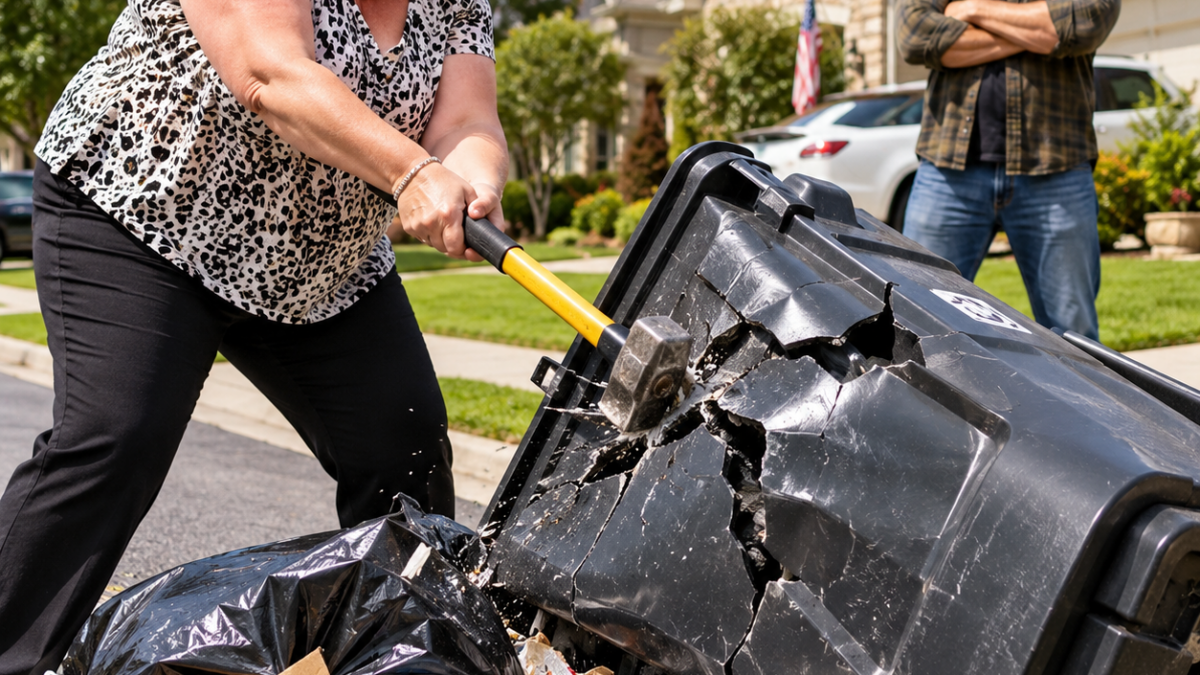
PART 2
I looked from Della to the phone and back again.
“What do you mean, she did it to you too?”
Della stepped inside and closed the door behind her.
Nora was at the kitchen table doing homework, so I lowered my voice.
“When I moved in,” Della said, “first year. Recycling bin.”
“How long?”
“Couple months.”
“She drove over it?”
“Mostly kicked it into the street.”
“Why didn’t you report her?”
Della gave me a tired look.
“To who?”
“The board.”
“She is the board.”
That sentence sat between us.
Simple.
Accurate.
Ridgeline technically had three board members.
Karen.
Vince Lowell.
Pam Dutton.
But everybody knew who ran it.
Vince handled landscaping approvals and spent meetings studying his shoes whenever homeowners argued.
Pam was treasurer, but Karen brought her the papers and Pam signed them.
I had thought that meant Karen was difficult.
Della was telling me something different.
Karen was protected by everybody else’s refusal to interfere.
“Can you send me the video?”
Della hesitated.
“You going to police?”
“Not yet.”
“Why not?”
“Because I have one clip.”
“That’s her car.”
“I know.”
“It shows what she did.”
“I know.”
She crossed her arms.
“You’re being weirdly calm.”
“I work facilities.”
“What does that mean?”
“It means when something keeps breaking, I stop guessing.”
She looked toward Nora.
Then back at me.
“I’ll send it.”
The file arrived before she got home.
I watched it three times.
5:18:11.
Escalade enters frame.
5:18:15.
Front tire contacts bin.
5:18:16.
Plastic folds.
5:18:20.
Rear tire finishes it.
5:18:27.
Escalade leaves.
No emergency.
No accident.
No swerving.
Karen had lined up with my trash can and driven over it.
That distinction mattered.
I saved the video.
Laptop.
External drive.
Cloud folder.
Then I opened the email chain with the HOA.
My original complaint.
Karen’s reply.
Please secure your containers.
I saved that too.
The next morning, I emailed Vince Lowell and Pam Dutton directly.
Not Karen.
Subject:
REQUEST FOR EMERGENCY BOARD REVIEW — PROPERTY DAMAGE BY BOARD OFFICER
I attached a still frame.
Not the whole video.
Clear enough to identify the Escalade.
Clear enough to show the bin beneath the tire.
My message was polite.
That part mattered to me.
I wrote:
I am requesting an emergency board meeting regarding repeated intentional damage to private property by a board officer. I have video evidence and supporting records. Please confirm a meeting date.
Vince answered privately.
I would rather not become involved. Karen handles enforcement. I only manage architectural and landscaping requests.
I read it twice.
Then typed:
This is not an enforcement issue. It concerns damage to a homeowner’s property by the board president.
I deleted that draft.
No point.
Pam didn’t answer.
Karen did.
Not to me.
To Della.
Two days later, Della walked across the lawn holding a violation letter.
“You’re going to love this.”
I opened it.
UNAUTHORIZED SURVEILLANCE DEVICE.
$100.
“Your Ring doorbell?”
“Yep.”
“Because it caught her?”
“Apparently.”
Karen had cited a section governing cameras aimed at common recreational areas.
Della’s camera faced her own porch.
The driveway edge appeared incidentally.
“This doesn’t apply.”
“I know.”
“You need to challenge it.”
Della laughed without humor.
“With Pam and Vince?”
I looked at the letter.
Karen wasn’t hiding anymore.
That was useful.
Not pleasant.
Useful.
I began understanding that there were two ways to deal with people like Karen.
The first was confrontation.
Fast.
Emotional.
Satisfying for about ten minutes.
The second was documentation.
Slow.
Boring.
Much harder for somebody else to rewrite later.
I chose boring.
At least at first.
Karen responded socially next.
The email went to all thirty-one Ridgeline homeowners.
REMINDER — WASTE CONTAINER STORAGE REQUIREMENTS.
No name.
No address.
Just Section 4.2 and a warning that “repeat offenders” could face accelerated fines and lien enforcement.
Everybody knew.
Within three days, two neighbors stopped me while I worked on the porch.
First was a man named Mark from the outer loop.
We had never spoken.
“Hey, Kyle.”
“Hey.”
He rubbed the back of his neck.
“Can you just keep the cans inside?”
“They’re allowed outside overnight before collection.”
“I know.”
“Then why?”
“Karen’s riding everybody.”
“Because of my cans?”
“She says you’re refusing compliance.”
“I’m complying.”
“I’m not trying to get in your business.”
“You came onto my property to tell me where to put my trash.”
His face tightened.
“Forget it.”
He left.
Next afternoon, a woman named Susan slowed while walking her dog.
“Kyle?”
“Yeah?”
“I just wish this would settle down.”
“What would you like me to do?”
She looked at the garage.
“Maybe put the cans inside?”
“My garage is full of renovation materials.”
“I understand.”
“And the HOA allows them outside before collection.”
“I know.”
“So why am I the person who has to change?”
She lowered her voice.
“We don’t want trouble.”
That was the first time I understood Karen’s real advantage.
She did not need neighbors to believe she was right.
She only needed them to believe resisting her was inconvenient.
If I made Karen angry, the whole block felt the vibration.
So they leaned on me.
Not because I caused the problem.
Because I seemed easier to move.
That hurt more than I expected.
I bought this house because I wanted Nora to have stability.
After my divorce, she had spent two years moving between apartments with me every other week and her mother’s place the rest.
I wanted one driveway.
One bedroom that stayed hers.
One neighborhood.
Instead, four months after buying, people were avoiding us because the HOA president had declared our garbage embarrassing.
Then Karen spoke to Nora.
That ended something in me.
It happened on a Wednesday.
Nora rode her bicycle to Della’s house to ask whether Della’s boys wanted to play.
On the way back, she passed Karen’s yard.
Karen stepped onto the sidewalk.
Blocked her.
Nora told me later Karen didn’t shout.
That almost made it worse.
She leaned toward an eleven-year-old and said:
“Tell your father those trash cans better be gone tomorrow.”
Nora tried to go around.
Karen stepped again.
“I’m tired of looking at them.”
Nora rode home fast enough that the bike fell against the porch railing when she jumped off.
She came into the kitchen shaking.
“Dad.”
I looked up from replacing a cabinet hinge.
“What happened?”
“That lady.”
“What lady?”
“Trash lady.”
That was what Nora had started calling Karen privately.
“What did she do?”
“She stopped me.”
I put the screwdriver down.
“What did she say?”
Nora told me.
I listened.
Then asked:
“Did she touch you?”
“No.”
“Did she threaten you?”
“She said you’re going to get in trouble.”
“You’re not in trouble.”
“Are we losing the house?”
That question went straight through me.
“No.”
“Because she keeps saying fines.”
“Listen to me.”
I pulled the chair beside mine.
“Nobody is taking this house.”
“Promise?”
“Yes.”
I hated making promises about things controlled partly by money and courts.
But she needed one.
So did I.
That night, after Nora went to bed, I called the county non-emergency line.
Not angry.
Not dramatic.
“I need to understand how to report repeated property damage.”
Dispatcher explained the process.
I had video.
Receipts.
Repeated incidents.
I needed dates.
Values.
Evidence.
Pattern.
That word mattered.
Pattern.
I opened Excel.
New spreadsheet.
PRESCOTT INCIDENT LOG.
Columns:
Date.
Time.
Incident.
Witness.
Photo or video.
Replacement cost.
Related HOA action.
I went backward.
Week one.
Week two.
Cut bungee cords.
Week three.
Kicking.
Week four.
First crushed bins.
Week five.
Second crushed bins.
Fines.
Della’s camera retaliation.
Nora confrontation.
Then I added links.
Receipts.
Screenshots.
Emails.
By midnight, what had felt like chaos looked different.
Rows.
Dates.
Amounts.
Patterns become harder to dismiss when they fit in columns.
The next morning, I installed a small camera beneath my porch eave.
Pointed only at my driveway.
No dramatic setup.
No announcement.
No sign saying SMILE, YOU’RE ON CAMERA.
I wanted facts.
Karen had been doing this because she assumed nobody would make her prove anything.
Now she was going to make the proof herself.
Gus Calloway helped me understand the second half.
Gus lived across the street.
Sixty-two.
Army veteran.
Retired county accountant.
Black coffee on his porch before sunrise.
He had seen Karen kick my cans before I had.
One evening, while I was sanding the porch railing, he walked over.
Sat on the bottom step.
Waited for me to turn off the sander.
“You’re keeping records?”
I looked at him.
“How do you know?”
“You have the face.”
“What face?”
“Man who discovered folders.”
I laughed.
“Yeah.”
Gus watched sawdust drift through the evening light.
Then said:
“You’re looking at the cans.”
“What should I look at?”
“The money.”
I stopped.
“What money?”
“HOA books.”
“Why?”
“Because Karen runs money the same way she runs rules.”
“That’s a serious accusation.”
“I’m not accusing.”
He took a drink.
“I asked for financials two years ago.”
“What happened?”
“She denied me.”
“Reason?”
“Board-only records.”
“Is that allowed?”
“No.”
Gus had already researched North Carolina planned-community law.
He knew homeowners had inspection rights.
He told me how he had asked wrong the first time.
Email.
Casual.
Easy for Karen to ignore.
This time, we sent a formal written request.
Certified.
Return receipt.
Addressed to Pam Dutton as treasurer.
Not Karen.
That choice mattered.
Pam frightened easily.
Gus believed fear could work in both directions.
“She might be scared of Karen,” he said, “but she may be more scared of signing a written refusal that violates state law.”
Eight business days later, a manila envelope appeared.
Financial statements.
Account ledgers.
Assessment histories.
Not everything.
Enough.
Gus came over after dinner.
Nora did homework at one end of the table while we worked at the other.
First suspicious item took thirty minutes.
My homeowner account.
CURB MAINTENANCE ASSESSMENT.
$150.
I opened the bylaws.
Search.
Nothing.
“Could be a board-created fee.”
Gus shook his head.
“Find authorization.”
Nothing.
Second:
EXTERIOR COMPLIANCE INSPECTION.
$200.
Only on my account.
Third.
Fourth.
Fifth.
Over eighteen months, five special line items appeared under my name.
Total:
$1,050.
Some predated the trash-can fight.
That surprised me.
Karen had been building charges almost from the moment I moved in.
I compared other owners.
No curb assessment.
No inspection fee.
Gus leaned back.
“She’s inventing charges.”
“Could be accounting labels.”
“Then show me the underlying assessment.”
We couldn’t.
Della came by.
Looked.
Then said:
“She charged me something last year.”
“What?”
“Neighborhood appearance review.”
“How much?”
“Hundred fifty.”
“Bring the statement.”
She did.
Different invented name.
Same pattern.
Gus rubbed both hands over his face.
“This is bigger than trash.”
That was the first moment I felt something besides anger.
I felt leverage.
Not because I wanted Karen ruined.
At that point, I wanted one thing.
I wanted her to stop.
But people who enjoy control rarely stop because you uncover one problem.
They stop when continuing becomes more expensive than stopping.
Karen wasn’t there yet.
We kept looking.
Della quietly spoke to two other homeowners.
She didn’t say:
Karen is stealing.
She asked:
“Do you have unusual HOA charges?”
Both did.
One hundred dollars.
Two hundred.
Odd names.
No matching bylaw.
No membership vote.
The amounts were small enough that people had paid rather than argue.
That was Karen’s entire system.
Nothing individually worth a lawyer.
Collectively, something else.
Gus filed a state complaint.
Not because we expected immediate rescue.
Because paper trails matter.
I learned that phrase from him.
Every time I wanted to confront Karen, Gus said:
“Paper trail.”
Every time Della wanted to post the video online:
“Paper trail.”
Every time somebody suggested we publicly accuse Karen of stealing:
“Not until we know.”
Gus was infuriating.
He was also right.
Wednesday nights became our planning nights.
Coffee.
Documents.
Della’s laptop.
My spreadsheet.
Gus’s reading glasses balanced low on his nose.
Nora thought we were organizing a neighborhood event.
I let her.
I didn’t want my daughter feeling like our kitchen had become a war room because a fifty-eight-year-old woman couldn’t leave trash cans alone.
Then I started thinking about Monday.
I knew Karen would come back.
She had crossed the driveway too many times.
She had crushed four bins.
Threatened Nora.
Fined Della.
Escalated every time somebody resisted.
I needed to stop vehicles from entering the part of my driveway where my cans sat.
Not trap anybody.
Protect property.
I work facilities maintenance.
We use protective posts all the time around loading areas, mechanical equipment, gas meters, and building entrances.
So I installed a lawful steel protective post on my own property at the edge of the driveway where no vehicle had any reason to travel.
I’m leaving out the construction details because what mattered wasn’t how it was installed.
What mattered was where.
My property.
Behind the usual position of the second trash bin.
Well clear of the public right-of-way.
Solid.
Visible if you approached normally.
Irrelevant unless you deliberately drove onto my driveway toward the cans.
I placed the bin in its ordinary position.
The post sat behind it.
I added a second camera from another angle.
Then I prepared paperwork.
Demand letter.
Every destroyed bin.
Every unauthorized charge.
Dates.
Amounts.
Restitution requested.
I prepared small-claims forms too.
Didn’t file.
Not yet.
I wanted the record complete.
Saturday night, Nora and I grilled burgers.
She sat on the porch.
I sat on the steps.
Karen’s porch light came on at nine.
Exactly like always.
Nora looked toward her house.
“Is trash lady going to come Monday?”
“I hope not.”
“What if she does?”
“Then we’ll deal with it.”
“Are you going to yell?”
“No.”
She looked disappointed.
“Why?”
“Yelling isn’t always useful.”
“What is?”
“Receipts.”
She laughed.
“Dad, that’s boring.”
“Boring is underrated.”
Sunday evening, Pam Dutton apparently told Karen she had released the records.
I learned Tuesday what happened.
Karen screamed at her in the community-center parking lot.
Twenty minutes.
“Traitor.”
“You’ll never sit on another board.”
Threats.
Pam called Della afterward crying.
But the envelope was already in my kitchen.
Karen could scream at Pam.
She couldn’t un-send the numbers.
Two nights later, Karen called an emergency board session.
Just three directors.
Closed door.
No homeowners.
No posted minutes.
Gus saw their cars.
The result arrived three days later.
EXPEDITED ENFORCEMENT RESOLUTION.
$650 outstanding.
Thirty days.
Failure to pay could result in lien action.
I sat at the kitchen table reading it while Nora did fractions.
Pencil scratching.
Refrigerator humming.
Normal house.
The house I bought because I wanted Nora to stop feeling temporary.
Karen was putting the word LIEN into my kitchen because I resisted her trash-can campaign.
That did something to me.
I folded the letter.
Added it to the file.
Not yet.
Karen then escalated against Della.
Formal notice.
Her Ring camera allegedly recorded children without consent.
Remove within seven days or $25 daily.
Della called.
“Kyle, I can’t pay twenty-five dollars every day.”
“Don’t remove it.”
“She’ll fine me.”
“Leave it.”
“How can you say that?”
“Because your camera is pointed at your property.”
“She says her grandchildren walk past.”
“People visible from a lawful camera angle don’t get veto power over the camera because they pass through frame.”
“What if she liens me too?”
“We’re almost done.”
“With what?”
I looked at the calendar.
“Just leave it up.”
Rod Prescott came to see me the next afternoon.
Karen’s husband.
Sixty.
Retired.
Quiet.
I had seen him maybe three times.
He stopped near the mailbox.
Hands in pockets.
“Kyle.”
“Rod.”
He looked toward the garage.
“Just put the cans inside.”
I didn’t answer immediately.
“And pay the fines,” he added.
“Do you think the fines are legitimate?”
His eyes dropped.
“That’s not really the point.”
“It’s exactly the point.”
“Karen isn’t going to stop.”
There was no threat in his voice.
That struck me.
It sounded like advice from a man who had surrendered a long time ago.
“It’s easier to go along.”
I watched him.
“Is it?”
His jaw tightened.
“Trust me.”
I realized something.
Rod wasn’t delivering Karen’s message because he agreed.
He was delivering it because somewhere in that marriage, compliance had become his survival strategy.
I felt sorry for him.
Not enough to surrender.
But enough that I stopped seeing him as the enemy.
“I appreciate you coming over.”
He nodded.
“Think about it.”
“I have.”
He walked back toward his house.
Head down.
Monday arrived.
5:12 a.m.
My phone vibrated.
Motion.
I opened the live feed from bed.
Karen.
Same windbreaker.
Same sneakers.
Hair pulled back.
Same confident walk.
Crossed the street.
Entered my driveway.
First can.
Kick.
Down.
Lid off.
Bag split.
She moved to the second.
Kicked.
Nothing.
The bin rocked.
Settled.
Karen stared.
Kicked again.
Harder.
Rocked.
Settled.
Third kick.
Same.
She grabbed the rim.
Pulled.
The protected position kept it from moving the way she expected.
She let go.
Stared.
Then walked home.
I breathed out.
Maybe that was it.
Maybe the physical resistance embarrassed her enough.
5:31.
Second alert.
I opened the feed.
White Escalade.
Headlights off.
Rolling slowly down the street.
My stomach dropped.
“No.”
She turned into my driveway.
Not accident.
Not backing.
She lined up.
The cameras caught it from both sides.
The SUV moved directly toward the bin.
Impact.
The sound was violent enough that I heard it upstairs through closed windows.
Plastic shattered.
The protective post stopped the vehicle.
The front end of the Escalade folded inward.
Not catastrophically.
Enough.
Grille broken.
Bumper crushed.
Fluid began leaking onto the driveway.
Karen sat behind the wheel.
Timestamp later showed eleven seconds.
She didn’t move.
Then door opened.
She stepped out.
Looked at the car.
Looked at the steel post.
Looked toward my house.
I stayed inside.
I wasn’t giving her an argument.
She got back in.
Reversed slowly.
Drove home.
A narrow trail of coolant marked the road behind her.
I sat on the edge of the bed staring at the phone.
My hands shook.
Not triumph.
Adrenaline.
I had expected another kick.
Maybe another bin destroyed by a tire.
I had not expected her to deliberately drive hard enough onto my property to damage her own vehicle.
That distinction mattered too.
I saved both camera feeds immediately.
Then made coffee.
At seven, I called non-emergency.
Deputy arrived.
I showed him everything.
Not just that morning.
Six weeks.
Della’s clip.
My cameras.
Receipts.
Spreadsheet.
Emails.
HOA fines.
The deputy watched silently.
Then:
“She does this every Monday?”
“Pretty much.”
“Why?”
“Trash cans.”
He looked at me.
“That’s it?”
“That’s it.”
He watched Karen drive onto the property again.
“Did you authorize her vehicle on your driveway?”
“No.”
“Did you place the post inside your property line?”
“Yes.”
“Any reason someone would drive into that area?”
“Only if they were deliberately aiming at the bins.”
He walked outside.
Measured visually.
Photographed.
Wrote.
I did not celebrate.
I answered questions.
That morning, the demand letter went certified.
Karen Prescott.
Personal address.
Not HOA.
I requested reimbursement for destroyed property and unauthorized charges.
Then I filed small claims.
Then I supplemented the state complaint with the financial documents.
By Wednesday, the neighborhood knew about Karen’s Cadillac.
Nobody knew the whole story.
Rod apparently told Gus at the mailbox.
Repair estimate:
About $6,200.
Front bumper.
Grille.
Cooling components.
Air-conditioning damage.
The insurance carrier denied the claim under the circumstances described in the source record as an intentional act.
That meant Karen had an expensive vehicle repair coming out of her own pocket.
Gus looked at me over coffee.
“How much was the post?”
“Not the point.”
“How much?”
“Less than one of the bins.”
He laughed.
Then stopped.
“You okay?”
“Yeah.”
“You don’t look happy.”
“I’m not.”
“Why?”
I looked across the street.
“Because she drove a Cadillac at a trash can at five-thirty in the morning.”
Gus nodded.
“That’s not normal.”
“No.”
That was the thing.
People later treated the vehicle damage like a punchline.
I understood why.
Karen destroyed my property repeatedly, then damaged her own vehicle doing it again.
There was irony.
But standing there in the quiet morning, it felt darker.
Somebody had become so comfortable crossing my boundary that when a kick didn’t work, she escalated to a two-ton SUV.
This was never really about garbage.
The annual HOA meeting was scheduled for the third Thursday in October.
Historically:
Eight people.
Ten on a good year.
Karen talked.
Everyone went home.
This year:
Twenty-eight homeowners.
Almost the entire neighborhood.
Karen noticed immediately.
She sat at the card table.
Vince on one side.
Pam on the other.
Pam looked exhausted.
Vince studied his agenda.
Karen wore the same professional expression she always used.
“Good evening.”
Nobody answered.
She started.
Landscaping.
Pool schedule.
Holiday lighting.
Common-area maintenance.
She talked like nothing had changed.
That was one of her gifts.
Normal performance.
Make the room accept her version simply because she delivered it in meeting language.
Then homeowner comments opened.
I stood.
“I’d like to discuss charges on my account.”
Karen didn’t look up.
“Individual fines are not discussed in open session.”
“These aren’t fines.”
She looked at me.
“What are they?”
“Assessments that don’t exist in the bylaws.”
The room shifted.
I held up a printed sheet.
Thirty copies.
Della passed them.
CURB MAINTENANCE ASSESSMENT.
EXTERIOR COMPLIANCE INSPECTION.
Other official-sounding line items.
$1,050 on my account.
No membership vote.
No matching authority we could find.
People read.
Whispers.
Karen’s jaw hardened.
“Those are internal accounting classifications.”
“Then show the authorization.”
“This is not the appropriate venue.”
Gus stood near the projector.
I said:
“I also have video.”
Karen’s chair moved slightly.
Not much.
Enough.
Gus connected the laptop.
First clip.
5:14 a.m.
Karen walking onto my driveway.
Kick.
Kick.
Leave.
Nobody spoke.
Second clip.
Escalade.
Crushed bins.
Plastic crack audible through Della’s camera.
Third.
Another week.
Fourth.
Then the final Monday.
Kick.
Kick.
Kick.
Pull.
Leave.
Escalade returns.
Turns.
Enters my driveway.
Impact.
Plastic breaks.
Vehicle stops.
Fluid spills.
Eleven seconds.
Reverse.
Gone.
The screen went black.
Twenty-eight homeowners sat in silence.
Karen stood so fast the chair legs scraped tile.
“That recording was obtained illegally.”
“No.”
“You filmed me without permission.”
“My cameras face my driveway.”
“You installed surveillance without board approval.”
“The HOA does not approve cameras mounted under my porch eave facing my own property.”
She pointed at the projector.
“I demand that be shut off.”
Gus stepped away from the laptop.
“It’s already off.”
“This meeting is adjourned.”
“No.”
The voice came from Pam.
Quiet.
Karen turned.
Pam looked terrified.
But she had spoken.
“What did you say?”
Pam swallowed.
“We haven’t voted to adjourn.”
Karen stared at her.
Then Gus spoke.
“I filed a state complaint regarding unauthorized assessments.”
Another murmur.
He continued.
“Kyle isn’t the only homeowner charged fees that do not appear in our bylaws.”
Della stood.
“I was.”
A man near the center stood.
“So was I.”
A woman by the window raised her hand.
“Me too.”
Karen looked from face to face.
“This is a coordinated personal attack.”
Pam’s voice cracked.
“I didn’t know.”
Karen turned.
“What?”
Pam stared at the table.
“I didn’t know about all of the charges.”
“You signed the financials.”
“I signed what you gave me.”
“You are the treasurer.”
“I know.”
“You approved them.”
“I didn’t understand what they were.”
Karen’s face went red.
“You’re blaming me now?”
Pam looked up.
For the first time, she held Karen’s eyes.
“I’m saying I should’ve checked.”
That mattered.
Not because Pam became heroic.
She didn’t.
She admitted she had been weak.
Sometimes that’s the first useful thing a bystander can do.
Vince said nothing.
Gus looked around.
“I move that Karen Prescott be removed from the board effective immediately, subject to the removal provisions in our governing documents and the vote being conducted tonight.”
Della:
“Second.”
Karen laughed.
“You cannot remove a sitting president in homeowner comments.”
Gus had anticipated that.
He held up the bylaws.
“Section 7.”
Karen’s expression changed.
He read the relevant removal language.
Quorum was present.
Notice issues had been handled through the annual meeting.
Members could act.
Karen reached for her purse.
“This is ridiculous.”
Gus said:
“Then vote against it.”
Ballots distributed.
Twenty-two for removal.
Three opposed.
Karen.
One proxy attributed to Rod.
One longtime friend.
Three abstained.
Karen looked at the tally.
No shouting.
No dramatic collapse.
She picked up her purse.
Walked between the chairs.
Out the side door.
That silence was more satisfying than cheering would have been.
People watched.
No one followed.
Outside, Sergeant Burris from the county sheriff’s office was near his cruiser.
The vandalism case had moved forward.
A summons had been issued.
Karen walked toward the rental vehicle she had been driving while the Escalade was repaired.
Burris stepped over.
“Mrs. Prescott?”
She stopped.
“I have paperwork for you.”
Inside, nobody moved.
Rod stood near the coffee table.
Not following his wife.
He stared at the closed side door.
Gus looked toward Pam and Vince.
“Well.”
Vince finally raised his head.
“I think I should resign.”
Nobody argued.
Karen’s court date came about six weeks later.
I attended because I was the complaining witness.
I brought records.
Receipts for destroyed bins.
Camera files.
Della’s footage.
Incident spreadsheet.
Replacement costs.
Photographs.
Karen arrived with an attorney.
Rod sat behind her.
The proceeding was much less dramatic than the HOA meeting.
Court usually is.
Evidence.
Questions.
Dates.
Karen’s attorney challenged intent.
Said some property damage might have been accidental.
The videos made that difficult.
Week after week.
Same driveway.
Same cans.
Then the final vehicle entry.
Karen eventually entered a no-contest plea to the criminal-mischief matter described in the source.
Twelve months supervised probation.
Restitution ordered.
Approximately $2,400 covering the property losses and related amounts recognized by the court.
No prison.
I didn’t want prison.
I wanted the record to say:
This happened.
You cannot repeatedly destroy a neighbor’s property because you dislike how his trash cans look.
The Escalade repair remained Karen’s responsibility after the insurance denial.
That bill hurt.
From what filtered through the neighborhood:
About $6,200.
A vehicle damaged because she drove it onto someone else’s property to strike a garbage bin.
The number became neighborhood folklore.
People joked.
I didn’t encourage it.
The small-claims case followed.
Different issue.
Money.
Fabricated HOA charges.
Karen’s side tried to characterize them as administrative assessments.
We presented bylaws.
Account statements.
No vote.
No uniform application.
No supporting resolution.
I had been singled out.
Other homeowners had similar charges with different names.
The court ordered repayment of the $1,050 attributed to the unsupported charges, plus allowable costs under the source outcome.
That was when Ridgeline stopped treating the accounting issue like a personal feud.
Money focuses people.
A full audit followed.
Five years.
Pam cooperated.
Vince resigned.
Karen’s access to board records ended.
What the audit found was less cinematic than crushed trash cans.
Small irregular assessments.
Inconsistent charges.
Weak approvals.
Poor documentation.
A culture where Karen created labels, Pam signed statements, and Vince assumed somebody else had checked.
No giant hidden mansion.
No offshore account.
The real scandal was smaller and more believable.
Nobody had been watching.
People paid because amounts were annoying rather than catastrophic.
Karen learned that if she kept each charge low enough, homeowners would rather write a check than spend a Saturday fighting.
That system worked until we compared statements.
The state HOA complaint concluded later.
Under the source outcome, Karen was barred from future HOA board service in North Carolina.
Whether you call that punishment or protection depends on whether you ever sat across from her at a board table.
I called it necessary.
Ridgeline held a special election.
Gus became interim president.
He hated it.
“I spent nine years avoiding this job.”
“Why take it now?”
“Because apparently avoidance is how we got Karen.”
Fair.
Della became secretary.
Pam stayed as treasurer temporarily.
That caused argument.
Some wanted her gone.
I understood.
She had signed.
Stayed silent.
Let Karen operate.
But Pam had also released the records when it mattered.
Cooperated with the audit.
Admitted responsibility publicly.
Gus asked me what I thought.
“Not my decision.”
“You’re allowed an opinion.”
“Then probation.”
He smiled.
“For treasurer?”
“Strict supervision.”
That was essentially what happened.
Dual review.
Monthly statements.
No single person creating charges.
Vince resigned and disappeared from neighborhood governance completely.
Nobody begged him back.
The first new-board action was to void unsupported fees.
Mine.
Della’s.
Two others.
Refunds.
The second:
Full audit.
Already underway.
Third:
Gus’s favorite.
OPEN BOOKS RESOLUTION.
HOA financial statements posted online for every homeowner.
No certified letter.
No formal request.
No waiting.
Log in.
Read.
Gus texted me after launch.
ELEVEN PEOPLE ARE LOOKING AT THE BUDGET RIGHT NOW.
I replied:
Call the police.
He sent back:
KAREN WOULD.
That made me laugh harder than it should have.
The trash-can problem ended instantly.
Not gradually.
Karen never touched them again.
Nobody did.
I used restitution money to buy two heavy-duty bins.
Locking lids.
Good wheels.
Nora helped choose them.
At school she had gotten a sheet of alphabet stickers.
She put bright green letters on the larger bin.
KICK-PROOF.
I looked at it.
“Nora.”
“What?”
“That’s unnecessary.”
“It’s funny.”
“It’s provocative.”
“To who?”
She had me there.
The protective post stayed.
I cleaned it.
Repainted it.
It stood at the edge of the driveway.
Short.
Black.
Nothing dramatic.
Gus started calling it the Turner Post.
I told him to stop.
He didn’t.
By summer, everyone called it that.
Fourth of July, somebody tied a small American flag to it.
Never found out who.
The house improved too.
Porch straightened.
New railing.
Garage door motor replaced.
Siding painted.
The tired house slowly woke up.
Nora noticed before I did.
One Saturday, we stood across the street looking at the front.
She said:
“It doesn’t look tired anymore.”
I looked.
She was right.
The porch no longer leaned.
Trim bright.
Flower bed Della helped plant.
Garage door quiet.
Truck in driveway because I was still not hiding it in the garage.
“It looks pretty good.”
Nora crossed her arms.
“Pretty good?”
“Excellent.”
“Better.”
There was something healing about that.
Karen had spent months making the house feel like a liability.
Every visible thing became something she could criticize.
Truck.
Cans.
Renovation.
Debris.
Camera.
By the end, the house felt like mine again.
Not because it became perfect.
Because I stopped seeing it through her eyes.
The most unexpected result was the tool library.
Ridgeline had surplus money sitting unused after the audit clarified reserves and legitimate obligations.
The board debated what to do.
Landscaping upgrades.
Pool furniture.
Entrance flowers.
Gus asked:
“What would actually help homeowners?”
Della said:
“Tools.”
Everybody looked at her.
She pointed at me.
“Kyle owns everything.”
“I do not.”
“You have four ladders.”
“Different heights.”
“Three drills.”
“Different purposes.”
“Two saws.”
“Different—”
Gus interrupted.
“Tool library.”
I hated how quickly people liked the idea.
HOA funded basic shared equipment.
Ladders.
Pressure washer.
Drills.
Saw.
Paint sprayer.
Hand tools.
Stud finder.
Wet/dry vacuum.
Nothing dangerous without check-out rules and manufacturer instructions.
Where to store it?
Community center had no secure room.
My garage did.
The same garage Karen had ordered me to hide my truck inside.
I volunteered one wall.
Gus built shelves.
Della made checkout sheets.
Nora designed the sign.
RIDGELINE TOOL LIBRARY.
Underneath, in smaller letters:
PLEASE RETURN THINGS OR KYLE GETS CRANKY.
“I did not approve that.”
Nora smiled.
“The board did.”
“Which board member?”
“All of them.”
Betrayal.
The first borrower was Mark.
The man who had told me to put the cans away so Karen would calm down.
He needed a ladder.
He stood in my garage looking awkward.
“Still okay if I borrow it?”
“That’s why it’s here.”
He picked up the ladder.
Then stopped.
“About before.”
I waited.
“I shouldn’t have told you to give in.”
“No.”
“I just didn’t want her after me.”
“I know.”
“That doesn’t make it right.”
“No.”
He nodded.
“Sorry.”
“Bring the ladder back Saturday.”
“I will.”
That was enough.
Susan borrowed the pressure washer a month later.
Same conversation in different words.
People apologized.
Not everyone.
Some never did.
That was fine.
I learned something through all of this.
An apology is nice.
Changed behavior is better.
Ridgeline meetings changed.
Attendance stayed higher.
Not twenty-eight every month.
Usually fifteen.
Still more than eight.
People asked questions.
Pam read numbers aloud.
Gus hated long agendas.
Della made everyone stick to time.
If a rule was proposed, somebody immediately asked:
“Where is that authority?”
If a fine came up:
“Was there notice?”
“Was there a hearing?”
“Was the rule actually violated?”
It made meetings slower.
Also safer.
Karen’s old supporters called it bureaucratic.
Gus answered:
“Taking people’s money should involve bureaucracy.”
I liked that.
Rod stayed in the house for a while.
Karen did too, technically, but we rarely saw her.
She stopped attending neighborhood events.
The Escalade came back repaired.
New bumper.
New grille.
Looked almost perfect.
One morning I saw Rod washing it.
He looked toward my driveway.
I waved.
He hesitated.
Then waved back.
Months later, he came over.
No message from Karen this time.
He stood beside the Turner Post.
“That the thing?”
“Yes.”
He touched the top lightly.
“Solid.”
“Yep.”
He looked at his house.
“She still says you set her up.”
I expected anger.
None.
“Do you think I did?”
Rod sighed.
“I think she drove into your driveway.”
I waited.
“She didn’t have to.”
“No.”
“She could’ve stopped.”
“Yes.”
He nodded.
“That’s what I told her.”
I looked at him.
“How did that go?”
He laughed once.
Bad laugh.
“About how you’d expect.”
We stood quietly.
Then he said:
“I’m sorry I came over that day telling you to pay.”
“You thought it would stop her.”
“I knew it wouldn’t.”
That surprised me.
“Then why?”
“Because it would stop the argument for that day.”
There it was.
Rod’s whole marriage in one sentence.
He looked embarrassed.
“I’ve done that a lot.”
“I figured.”
He nodded.
Then left.
I didn’t ask what happened between them afterward.
Not my business.
But by the next spring, Rod moved out.
Karen sold the house later.
No dramatic moving-day crowd.
Nobody stood around celebrating.
A real neighborhood doesn’t need somebody else’s departure as entertainment.
Her house went to a young couple with a toddler.
First week, the husband knocked on my garage.
“Are you Kyle?”
“Depends.”
He laughed.
“I heard you have tools.”
“Already?”
“Gus sent me.”
Of course.
He needed a stud finder.
I handed it over.
He looked toward Karen’s old house.
“Anything I should know about the HOA?”
“Read the bylaws.”
“That bad?”
“Actually, not anymore.”
He smiled.
“Good.”
That felt like closure.
Karen’s house became somebody else’s house.
No curse.
No mythology.
Just new people.
Exactly how it should be.
Nora got older.
Twelve.
Then thirteen.
The trash-can story became family comedy.
Whenever something broke, she said:
“Maybe Karen did it.”
Dishwasher stopped draining.
“Karen.”
Remote disappeared.
“Karen.”
Flat tire.
“Definitely Karen.”
I told her to stop.
She did not.
But I noticed something else.
She rode her bike past Karen’s former house again.
At first, she avoided that side of the loop.
Even after Karen stopped bothering us.
One day I saw her ride straight past.
No hesitation.
That mattered more than restitution.
My daughter had learned fear around one neighbor’s yard.
Then eventually unlearned it.
Children should not have to calculate adult power when riding bicycles.
That was the part I never forgave easily.
Not the cans.
Not the fines.
Nora.
Years later, she asked me:
“Why didn’t you yell at her?”
“When?”
“When she stopped me.”
“I wanted to.”
“Why didn’t you?”
I thought.
“Because I was afraid I’d make things harder for you.”
She considered that.
“You were scared?”
“Of course.”
“You didn’t look scared.”
“Adults lie with their faces.”
She laughed.
“Was the post revenge?”
That question was harder.
“I installed something to protect my property.”
“You knew she might hit it.”
“I knew nobody had any legitimate reason to drive into that part of the driveway.”
“That isn’t an answer.”
She was fourteen by then.
Too smart.
So I gave her the honest version.
“I expected Karen to keep trying.”
“And you wanted it to cost her.”
I looked at her.
“Yes.”
She nodded.
“Okay.”
“Not my best moment.”
“Worked.”
“That doesn’t automatically make something wise.”
She thought about that.
Then:
“Did you regret it?”
I looked toward the black post.
Sometimes.
Not because Karen’s bumper got damaged.
Because deliberate escalation can go places you don’t control.
What if someone else had been in the vehicle?
What if she had lost control?
What if a pedestrian had been nearby?
I had protected my property.
Legally, the post was on my land.
But I never told myself the outcome was risk-free.
“I regret that things got that far.”
Nora rolled her eyes.
“Dad answer.”
“It’s the real answer.”
She accepted it.
That became another lesson from the story.
Documentation was what actually beat Karen.
Not steel.
Not car damage.
Video.
Receipts.
Financial records.
Neighbors comparing experiences.
Pam finally speaking.
Twenty-two votes.
Court orders.
The dramatic Monday got attention.
The boring evidence changed Ridgeline.
Gus said something similar during our second year on the new board.
I had refused every request to run for office.
Absolutely not.
But I attended meetings.
He said:
“Everybody thinks Karen lost because of the Cadillac.”
“She kind of did.”
“No.”
He pointed at Pam’s financial report.
“She lost because we started reading.”
I nodded.
“Less exciting.”
“Better lesson.”
Gus loved lessons now that he was president.
“Careful.”
“What?”
“You’re becoming philosophical.”
He looked offended.
“I’m becoming seventy.”
“Same thing.”
Ridgeline’s finances stabilized.
No mystery charges.
Dues remained $300 for a while, then rose modestly after transparent vote because insurance and pool maintenance increased.
People grumbled.
Then voted yes anyway.
That fascinated me.
Under Karen, everyone hated surprise fees.
Under Gus, homeowners approved a legitimate increase because they could see where the money went.
Transparency did not make people cheap.
It made them willing.
The tool library expanded.
Socket sets.
Tile saw.
Post-hole digger.
Drain snake.
I objected to storing the drain snake beside my woodworking tools.
Della said:
“You’re a facilities guy.”
“That doesn’t mean I want sewer equipment next to my table saw.”
We built another shelf.
Nora updated the sign:
SEWER TOOLS — NOT NEAR DAD’S PRECIOUS WOOD STUFF.
I threatened eviction.
She knew I wouldn’t.
Every Monday morning, I still rolled the trash cans out.
Habit.
Sunday night after dinner.
One beside the black post.
One slightly ahead.
Collection truck around seven.
Never disturbed.
Sometimes I woke at five anyway.
For months after Karen stopped, my body remembered.
I would open my eyes.
Listen.
Nothing.
Go back to sleep.
That’s what repeated harassment does.
It teaches your nervous system a schedule.
Karen had turned Monday at 5:15 into a threat.
It took a while before Monday became Monday again.
Della understood.
Night-shift nurses understand strange schedules.
One morning she was coming home as I rolled cans out.
“You still wake up?”
“Sometimes.”
“Me too.”
“For what?”
“My camera notifications.”
She looked toward Karen’s old house.
“Every time it buzzes at night, I think it’s another violation.”
Karen was gone.
The habits stayed.
Then faded.
That is probably the most honest ending.
Not everything healed when she lost the vote.
People got better gradually.
Pam especially.
She became a surprisingly competent treasurer.
The first year she reviewed every invoice twice.
Sometimes three times.
She once called Gus at ten at night.
“Did you authorize eighty-seven dollars at the hardware store?”
Gus answered:
“Yes.”
“For what?”
“Shelf brackets.”
“Receipt?”
“Kyle has it.”
She called me.
“Receipt?”
“In my truck.”
“Send photo.”
I sent it.
Then texted:
Karen really traumatized you.
Pam replied:
GOOD.
I respected that.
She never again signed anything without reading.
Vince, from what I heard, joined no committees anywhere.
Also reasonable.
The state complaint produced training requirements and governance changes beyond Karen’s individual consequence.
Our new board adopted conflict-of-interest policy.
Expense approval rules.
Independent review for enforcement involving board members.
If Gus violated a rule, Della handled it.
If Della had a conflict, Pam stepped out.
Simple.
One year, Gus left his garbage bins visible two days after collection.
Della photographed them.
Sent him a warning.
He taped it to the community-center bulletin board.
Underneath he wrote:
NO ONE IS ABOVE TRASH LAW.
Ridiculous.
Effective.
Ridgeline gradually became the neighborhood I thought I bought.
People waved.
Actually talked.
Borrowed tools.
Helped with storm cleanup.
When a hurricane remnant dropped branches across the loop, twelve homeowners showed up with saws.
The tool library emptied in ten minutes.
Nobody waited for the HOA president to organize them.
That was important.
Community is not a board.
A board is paperwork.
Community is the guy across the street helping drag a limb off your roof.
Karen had confused governance with ownership of everyone’s behavior.
Gus understood the difference.
Maybe because he didn’t want the job.
The best HOA president we had was the one who counted days until he could stop being HOA president.
At the end of his second year, he announced:
“I’m done.”
Everyone objected.
He pointed.
“This is exactly how dictators start.”
Della became president.
Gus went back to coffee on the porch.
He looked happier immediately.
Della’s first meeting lasted thirty-eight minutes.
Karen’s meetings had run ninety.
Progress.
I finally renovated the last major part of the house.
Kitchen.
Nora picked the cabinet color.
I hated it.
She won.
During demolition, I found an old envelope behind a baseboard.
Previous owners.
Nothing exciting.
A grocery receipt from 1998.
Nora looked disappointed.
“I thought it would be treasure.”
“It is.”
“How?”
“Milk was two dollars.”
She stared.
“Adults are weird.”
We remodeled.
The house no longer looked like the cheapest place in Ridgeline.
But I never forgot being proud of it when it did.
Karen’s biggest mistake wasn’t insulting the house.
It was assuming price determined belonging.
I had paid less.
I drove an old truck.
My porch leaned.
Therefore, in her mind, I was temporary.
Someone to discipline until I either conformed or left.
She had done versions of it before.
Della.
Gus.
Others.
The audit and interviews revealed stories.
Recycling bins.
Flower pots.
Holiday lights.
Guest vehicles.
One elderly homeowner paid hundreds in fines because Karen didn’t like his wheelchair ramp color.
That one made me angry all over again.
The ramp met code.
He paid because he thought HOA authority was absolute.
We refunded him.
He tried to refuse.
“I already paid it.”
Della said:
“You never owed it.”
He cried.
Nobody knew what to do.
Gus handed him a tissue.
Then looked at me afterward.
“That’s why open books.”
“Yeah.”
The hardest lesson was realizing Karen didn’t create Ridgeline’s culture alone.
We helped.
Not deliberately.
By avoiding.
Vince looked away.
Pam signed.
Gus stopped requesting records after one denial.
Della moved her recycling.
Neighbors told me to hide the cans.
Everyone chose the easier day.
Karen accumulated those easier days into power.
That didn’t make us equally responsible.
It made us responsible for what we did next.
That mattered to me.
People love stories with one villain.
Life is usually a villain plus several tired people.
Ridgeline got healthier when tired people started saying no together.
Years later, I ran into Karen at a grocery store.
I almost didn’t recognize her.
Different hair.
No binder.
No HOA polo.
She saw me by produce.
We stopped.
Nora, sixteen by then, stood beside me.
Karen looked at her.
Then me.
“Hello, Kyle.”
“Karen.”
No tension in my voice.
I surprised myself.
She glanced at Nora.
“You’ve grown.”
Nora said:
“That happens.”
I almost choked.
Karen’s mouth tightened.
Then relaxed.
She looked at me.
“I heard you’re still running that tool thing.”
“Yeah.”
“Ridgeline always did waste money.”
There she was.
Same woman.
I smiled.
“Have a good day.”
She seemed disappointed.
Maybe she wanted a fight.
Maybe she wanted to prove she still mattered.
I walked away.
Nora whispered:
“You didn’t even mention the Cadillac.”
“No.”
“I would have.”
“You’re sixteen.”
“Exactly.”
We bought apples.
Went home.
That was better than any speech.
Karen no longer controlled my Monday.
No longer controlled my attention.
Eventually, that’s what winning became.
Not watching her lose.
Not counting dollars.
Not retelling the bumper story.
Having ordinary things become ordinary again.
Trash cans.
Bike rides.
Driveway.
Garage.
Budget meetings.
That is what power struggles steal first.
Ordinary life.
The criminal record and restitution were consequences.
The board vote was accountability.
But peace was quieter.
One summer, Gus got sick.
Heart issue.
Nothing immediately catastrophic.
He spent two weeks in hospital.
We mowed his lawn.
Della brought food.
Pam handled his mail.
I repaired his porch light.
When he came home, he looked around suspiciously.
“Who trimmed my hedge?”
“Mark.”
“Too short.”
“You’re welcome.”
“My mail?”
“Pam.”
“Did she open it?”
“No.”
“Good.”
He sat on the porch.
Looked across at the Turner Post.
“Still standing.”
“Unfortunately.”
“Outlast us both.”
“Probably.”
He took coffee.
Then said:
“You know Karen was useful.”
I stared.
“Medication side effect?”
“She taught everybody to pay attention.”
“Expensive teacher.”
“Best ones usually are.”
I didn’t agree.
Not exactly.
We didn’t need Karen.
But after her, people refused to return to sleep.
Maybe that’s what Gus meant.
He recovered.
Still drinks coffee at dawn.
Still watches everything.
Difference is, now he watches because he likes the street, not because he expects trouble.
A few years after the original incident, Ridgeline bought new standardized trash bins through the waste contractor.
Large.
Wheeled.
Blue lids.
Board discussed placement.
Everybody looked at me.
Della said:
“Kyle?”
“No.”
“We need homeowner input.”
“Ask literally anyone else.”
Gus laughed.
“Trash expert.”
“I’m leaving.”
Nora, home from school, shouted from the back row:
“KICK-PROOF!”
Meeting collapsed.
Some stories refuse to die.
The original green-sticker bin lasted years.
Eventually a wheel cracked.
Nora had left for college by then.
I texted her a photo.
END OF AN ERA.
She responded immediately.
SAVE THE STICKER.
So I did.
I peeled KICK-PROOF off.
Stuck it inside the garage tool cabinet.
Underneath the tool-library sign.
Tiny piece of history.
The black protective post remains.
Painted every few years.
No flag now.
No jokes most days.
New residents ask:
“What’s that for?”
I say:
“Vehicle protection.”
Technically true.
Gus tells the full story if he hears me.
His version gets more dramatic each year.
By 2030, Karen will apparently have driven eighty miles per hour with a flamethrower.
I correct him.
Nobody believes me.
That is neighbor privilege.
The house is worth more now.
Not why I stayed.
The porch is straight.
Garage organized.
Truck changed twice.
Nora’s room still contains boxes from college.
She claims she’s coming for them.
I don’t believe her.
Sometimes I stand in the driveway Sunday night rolling the bins to the curb.
The street is quiet.
Porch lights.
Crickets.
Someone’s television through an open window.
No heels.
No Escalade.
No camera alert I’m waiting for.
I set one bin near the post.
The other beside it.
Exactly where Section 4.2 always allowed.
Then I go inside.
That’s the image I keep when people ask what happened to Karen.
Not the courtroom.
Not the vote.
Not the damaged Cadillac.
Two garbage cans standing upright.
It sounds ridiculous.
After everything, that is what matters.
They stay where I put them.
No one crosses my driveway at five in the morning.
No one frightens my daughter because a rule exists only inside one person’s head.
No one sends me a bill for damage they caused themselves.
Ridgeline has rules.
We still enforce them.
Sometimes I get a letter.
Last year:
TREE BRANCH OBSTRUCTING SIDEWALK.
Della signed it.
I called her.
“Seriously?”
She said:
“Cut your branch, Kyle.”
“It’s barely over.”
“Measure it.”
I did.
She was right.
I cut it.
Then she texted:
See? Functional governance.
I replied:
I miss tyranny.
She sent a laughing emoji.
That’s how I know the neighborhood recovered.
Rules stopped feeling personal.
When someone corrected me, I didn’t wonder what punishment came next.
Authority could be boring again.
The way it should be.
Every once in a while I think back to the night Nora asked whether we were going to lose the house.
That memory still hurts.
She was eleven.
A crooked porch.
Boxes everywhere.
We had barely unpacked.
I wanted to give her permanence and accidentally moved her into somebody else’s little kingdom.
But she also watched what came after.
She watched Della speak.
Gus read.
Pam admit she was wrong.
Twenty-two homeowners vote.
She watched neighbors turn a hostile system into something useful.
She helped make the tool-library sign.
She stuck KICK-PROOF on a trash can.
Maybe that is not the childhood lesson I would have chosen.
But it isn’t the worst one.
One night before leaving for college, she sat with me on the porch.
Same steps Gus had sat on years earlier.
She looked at the post.
“Are you ever taking that out?”
“No.”
“Sentimental?”
“Practical.”
“Liar.”
I smiled.
“Maybe.”
She leaned against my shoulder.
“You know what I remember most?”
“Trash lady?”
“No.”
“What?”
“You telling me the house was ours.”
I went quiet.
“I was scared you were wrong.”
“So was I.”
She looked at me.
“You never said that.”
“You were eleven.”
“You could’ve.”
“No.”
“Why?”
“Parents are allowed some editing.”
She laughed.
Then:
“You kept it.”
“The house?”
“Yeah.”
I looked at the porch.
The siding.
The garage.
The driveway where coolant had once run in a green line.
“Yeah.”
We kept it.
That was the victory.
Not making Karen’s next hit expensive.
Not the $6,200 repair.
Not restitution.
Not removing her from office.
Those were consequences.
The real victory was that Karen spent months trying to make us feel temporary, and we became more rooted instead.
The garage she wanted empty became a place neighbors borrowed tools from.
The driveway she treated like hers became the place where people stopped pretending she had unlimited authority.
The daughter she frightened grew up believing a house could be defended without becoming cruel.
And every Monday morning, the cans went out.
They still do.
I roll them down before bed.
One beside the short black post.
One next to it.
Then I look at the crooked piece of old porch framing I kept mounted over my workbench from the original renovation.
Nora wrote something on it years ago in green marker.
OUR HOUSE WAS TIRED.
Underneath, much later, she added:
WE WOKE IT UP.
I never painted over that.
I never will.
[END OF STORY]

