PART 2: HOA Karen Invited 100 Strangers to My Private Cabin—Then I Locked the Gate and Her Lie Fell Apart in Front of Everyone
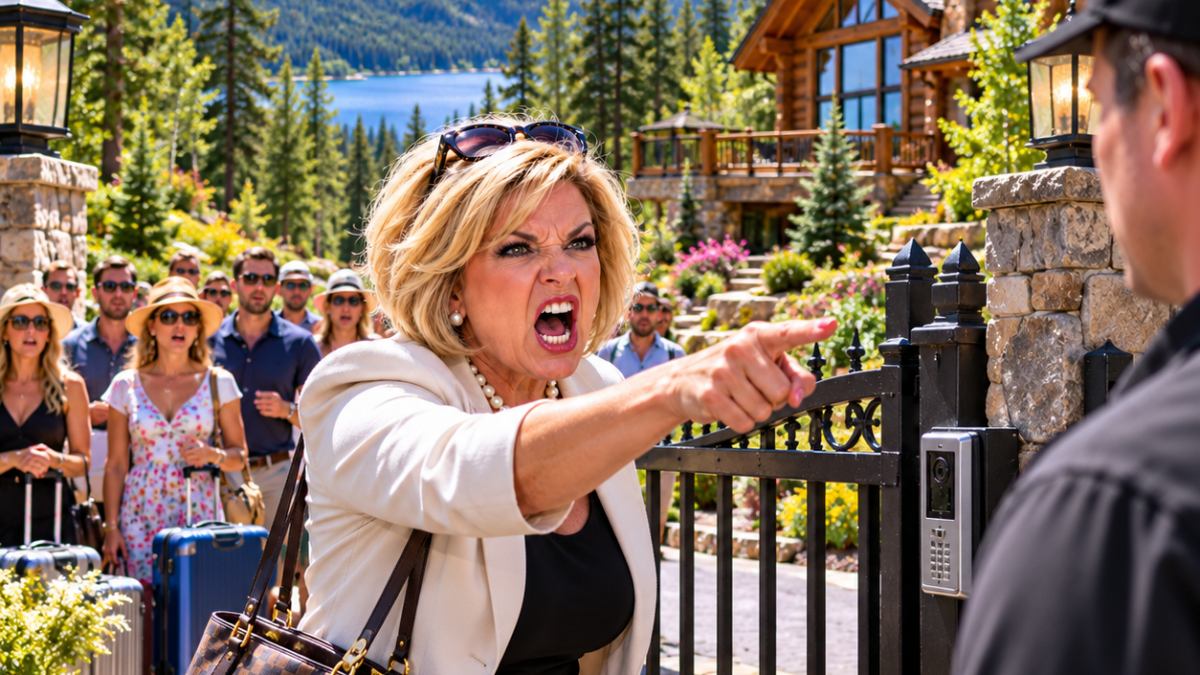
PART 2
For three or four seconds, nobody moved.
That silence was almost stranger than the shouting that came afterward. A minute earlier, engines had been idling, children had been talking, someone had music playing through an open car window, and Karen had been issuing instructions like she was directing a wedding reception. Now the only thing I could hear was the soft metallic click of my keys settling in my pocket.
Then Karen snapped.
“You open this gate right now.”
She grabbed the bars with both hands.
I stayed on my side.
“No.”
“Daniel, there are families here.”
“I can see that.”
“People drove all the way here because this property was reserved.”
“By whom?”
She stared at me.
I waited.
“By the HOA.”
“The HOA doesn’t own it.”
“You know exactly what I mean.”
“No, Karen. I know exactly what you’re trying not to say.”
More people were climbing out of their vehicles. The road wasn’t designed for ninety or a hundred guests, so the line of cars was already becoming ridiculous. Some drivers were attempting three-point turns. Others had parked on the shoulder. One man carried two bags of charcoal and looked from Karen to me as though he had arrived at the wrong address.
A woman holding a casserole dish stepped closer.
“Excuse me,” she called. “Is the retreat canceled?”
Before I could answer, Karen spun around.
“No. It is not canceled. We’re handling a temporary access issue.”
Temporary access issue.
That phrase told me everything.
Even with the gate locked in front of her, she was still pretending there was a version of this morning where my answer didn’t matter.
I leaned against one of the gateposts.
“There is no access issue,” I said. “This is private property. Nobody here was given permission by the owner.”
A murmur passed through the crowd.
Karen whipped around.
“Stop interfering.”
“With what?”
“With an officially scheduled HOA function.”
“You keep adding the word ‘official’ like it magically changes who owns the dirt under your shoes.”
Her face went scarlet.
A few phones came out.
I noticed that immediately.
Karen did too.
Until that moment, she had been angry. Once she saw people recording, she became terrified of looking angry.
Her shoulders lowered. Her expression softened so quickly it was almost impressive.
She turned toward the crowd and raised both hands.
“Everyone, please remain calm. Daniel and I are resolving a minor disagreement regarding historical community access.”
I laughed.
I couldn’t help it.
She glared through the bars.
“What exactly is funny?”
“A minor disagreement? You invited a hundred people to somebody else’s property.”
“It was not somebody else’s property when this community was originally established.”
“And five years ago that changed.”
The expression on her face shifted again.
Just for an instant.
It was enough.
She knew.
That mattered more to me than anything else she had said that morning.
Karen wasn’t standing there because she had innocently misunderstood an old map. Somewhere in the stack of papers she carried, or somewhere in the records available to the board, she knew my parcel had been removed from HOA jurisdiction when I bought it.
Maybe she had convinced herself the change didn’t count.
Maybe she assumed nobody would challenge her.
Maybe she simply believed that if enough people arrived at once, social pressure would accomplish what legal authority couldn’t.
Whatever her reasoning was, this had never been about confusion.
It was about leverage.
Karen stepped closer to the gate and lowered her voice.
“You have no idea what you’re doing to yourself.”
There it was.
Not an argument.
A threat.
I folded my arms.
“Explain it to me.”
“You still live next to this community.”
“Next to it.”
“Your road connects through our area.”
“My recorded access rights are not controlled by you.”
“People have long memories.”
“So do cameras.”
That stopped her.
I pointed toward the corner of the cabin roof, where one of my security cameras covered the main drive. Another camera watched the gate. Two more covered the side trails and lower field.
Her eyes followed my finger.
“You’re recording people without permission?”
“I’m recording my property.”
“You’d better be careful.”
“I am. That’s why the cameras are there.”
Behind Karen, somebody said, “Maybe we should just leave.”
She spun around.
“Nobody needs to leave.”
That was when I realized she was losing control not because of anything I was doing, but because the crowd was starting to ask the question she had desperately avoided.
If this really was HOA property, why was she arguing with the owner through a locked gate?
A gray-haired man near the front stepped forward.
“Karen, do we have something showing the reservation?”
“Yes.”
“Can we see it?”
Her fingers tightened around the clipboard.
“It’s an internal HOA matter.”
The man frowned.
“If we reserved the place, there should be something.”
“There is.”
“Then show us.”
Karen looked at me as if I had somehow planted him there.
I hadn’t.
That was the beautiful thing about facts. Once people started demanding them, I didn’t have to do much.
She pulled out a sheet of paper and held it up.
“This is the event schedule.”
The gray-haired man looked at it.
“That says ‘community retreat.’”
“Yes.”
“It doesn’t say the owner approved anything.”
Karen snapped the clipboard closed.
“We are not conducting a legal seminar on the side of a road.”
“No,” I said. “We’re conducting a property-rights seminar.”
Someone laughed.
Karen’s head jerked toward the sound.
I saw humiliation beginning to overtake anger, and that made her more dangerous, not less.
She pulled out her phone.
“Fine. I’m calling the sheriff.”
“Please do.”
She hesitated.
I smiled.
Her thumb moved.
“Gladly.”
She walked ten feet away and began talking so loudly I could hear half of it.
“Yes, officer, we have a property owner obstructing an HOA-approved gathering.”
Pause.
“No, we are not trespassing.”
Another pause.
“Because this is a designated community space.”
Longer pause.
Her voice dropped.
“No, I don’t have a court order.”
She turned away from us.
“I have association authority.”
I almost felt sorry for the dispatcher.
Almost.
While she made her call, I walked back toward the cabin.
“Where are you going?” Karen shouted.
“To get something.”
“You need to stay here.”
I stopped and looked over my shoulder.
“Karen, you’re standing outside my locked gate telling me where I’m allowed to walk on my own property. Listen to yourself.”
The crowd went quiet again.
This time she had no answer.
I returned to the cabin and opened the fireproof document box I kept in a cabinet. I didn’t normally carry property records around like ammunition, but experience with the HOA had taught me to keep important documents organized.
There was my deed.
The boundary survey.
The purchase documents.
And, most importantly, a clean copy of the 2020 amendment confirming that my cabin parcel was no longer subject to the HOA’s authority.
I photographed everything with my phone, then carried the folder back outside.
By then Karen had begun organizing people along the roadside as though sheer persistence might make me surrender. Tables were still in vehicles. Coolers sat in the dirt. Children were getting restless.
When she saw the folder in my hand, some of the confidence drained out of her face.
I didn’t wave it around.
I simply rested it against the inside of the gate.
Twenty minutes later, a sheriff’s cruiser rolled slowly up the road.
The effect on the crowd was immediate.
Conversations died.
People stepped away from the gate.
Karen straightened her shirt, tucked a loose strand of hair behind one ear, and hurried toward the deputy before he had even fully closed his door.
“There,” she said, pointing at me. “That’s the property owner.”
The deputy looked at me, then at Karen, then at the long line of vehicles.
“I gathered that.”
“We have an authorized community gathering scheduled here, and he has deliberately locked everybody out.”
The deputy glanced at the gate.
“Is the gate on his property?”
Karen blinked.
“That’s not the issue.”
“It seems fairly relevant.”
“It’s complicated.”
The deputy nodded once.
“Okay. Let’s make it uncomplicated.”
He approached the gate.
“Sir?”
I walked down.
“Afternoon.”
“Are you the owner?”
“Yes.”
“Do you have documentation?”
I lifted the folder.
“Right here.”
Karen cut in.
“He’s intentionally exploiting an administrative technicality. The cabin has always been understood as part of the community recreational area.”
The deputy looked at her.
“Ma’am, let me speak with him for a second.”
She stepped back, visibly offended.
I passed my documents through the bars.
The deputy read the deed first.
Then he unfolded the survey.
Then he reached the amendment.
For several minutes, nobody said much.
Karen tried twice.
“Officer—”
He raised one finger without looking up.
She stopped.
I watched his eyes move across the page.
When he finally looked up, there was no drama in his expression. No theatrical surprise. Just the calm look of a man who had discovered that the situation was much simpler than someone had claimed.
“This amendment is recorded?”
“Yes.”
“And this parcel here”—he tapped the survey—“is the cabin parcel?”
“Yes.”
“And it was removed from association jurisdiction in 2020?”
“Correct.”
Karen stepped forward.
“That does not eliminate historic community-use expectations.”
The deputy looked at her.
“Do you have an easement?”
She paused.
“A what?”
“A recorded easement granting association members access to the cabin or grounds.”
“The HOA has always—”
“That’s not what I asked.”
Her voice became thinner.
“There are provisions in the community documents.”
“Do those provisions apply to property outside the association?”
“They apply to shared amenities.”
He pointed toward my paperwork.
“According to this, this property isn’t a shared amenity.”
Karen looked at the crowd.
Then back at him.
“So you’re just going to let him ruin an event for a hundred families?”
The deputy handed the papers back to me.
“Ma’am, whether the event is ruined isn’t a law-enforcement question. Property ownership is.”
Her jaw tightened.
“We reserved this.”
“With whom?”
“The association.”
“The association doesn’t own it.”
Karen opened her mouth.
Nothing came out.
It was the first truly quiet moment I had ever seen from her.
The deputy turned to me.
“You’re within your rights to keep the gate closed. If anyone attempts to force entry or damage the gate, call us.”
“I will.”
Then he looked at the crowd.
“For everyone’s sake, I’d recommend finding another location.”
He walked back toward his cruiser.
Karen followed him.
“Officer, surely there is some kind of temporary public-access doctrine—”
He shook his head.
“Not that applies here.”
“You don’t understand the history.”
“I understand the deed.”
That sentence traveled through the crowd like electricity.
Someone near the back laughed.
Not loudly.
But Karen heard it.
And if she had been embarrassed before, now she looked as though she had been slapped.
The deputy drove away a few minutes later.
That should have been the end.
Any reasonable person would have apologized.
Any responsible board member would have helped redirect the guests, admitted a mistake, and made sure it never happened again.
Karen did none of those things.
Instead, she marched back to my gate.
“You think you won.”
I looked at her.
“This wasn’t supposed to be a contest.”
“You deliberately humiliated me.”
“No, Karen. You invited a hundred people to property you don’t own. I locked my gate. Those two things are not equal.”
“You could have let us use it for one afternoon.”
“You could have asked.”
“We shouldn’t have to.”
And there it was again.
The sentence underneath everything.
We shouldn’t have to ask.
I looked at the people standing behind her and wondered how many had heard it.
Judging by their faces, quite a few.
A younger couple began carrying their cooler back to their vehicle.
Then another family followed.
Once the first cars started leaving, the retreat collapsed quickly.
People who had been willing to wait through a disagreement were not willing to spend their Saturday standing on a gravel road after a sheriff had told them the location was private property.
Engines started.
Doors slammed.
A woman apologized to me through the gate.
“We genuinely thought this was approved.”
“I know.”
Karen heard me.
“You’re enjoying this.”
I shook my head.
“No. I’m angry that you put all these people in this position.”
“You’re angry?”
“Yes.”
“You got exactly what you wanted.”
“What I wanted was to drink my coffee.”
For once, several people laughed openly.
Karen stared at me.
Then she spun around and marched toward her vehicle.
I watched the road slowly empty until only tire marks and dust remained.
The entire confrontation had lasted less than two hours.
But when the final SUV disappeared around the bend, the property felt different.
I stood at the gate for a long time.
I should have felt victorious.
Instead, I felt invaded.
That was the part Karen never seemed capable of understanding. Ownership wasn’t just a line on a map. The cabin was where I came to escape noise, pressure, schedules, committees, and people telling me what I should do with property I had worked for.
She had turned that peace into a spectacle.
She had sent almost a hundred people toward my front door without telling me.
And after being corrected by law enforcement, she had blamed me for the embarrassment.
I went back to the porch.
My coffee was ice cold.
I drank it anyway.
For the rest of that Saturday, I checked the cameras more than usual.
Nothing happened.
Sunday was quiet too.
By Monday morning, I almost convinced myself Karen had finally understood the boundary.
Then I walked down to collect my mail and found three sheets of paper taped to the gate.
The first was headed:
**NOTICE OF VIOLATION.**
The second:
**INTENT TO ASSESS DAILY FINES — $500 PER DAY.**
The third had been printed in bold capital letters:
**DEMAND FOR REMEDIAL COMMUNITY ACCESS AND RESCHEDULED RETREAT WITHIN SEVEN DAYS.**
I stood beside the gate reading them twice.
Then a third time.
The language would have been intimidating if it weren’t so absurd.
According to the first letter, I had engaged in the “unauthorized exclusion of association members from historically designated common recreational grounds.”
According to the second, I would be fined five hundred dollars every day until I restored “reasonable community access.”
According to the third, the HOA expected me to provide my cabin for a makeup retreat.
Not requested.
Expected.
I took photographs of every page before removing them.
I scanned them at the cabin.
I saved copies.
Then I carried the originals to the wood stove.
Some people might call that dramatic.
Maybe it was.
But watching Karen’s manufactured authority curl black at the edges and disappear into flame felt strangely appropriate.
Still, I wasn’t careless.
The digital copies went into a folder with the deed, survey, amendment, security footage, and notes from Saturday’s confrontation.
I knew what Karen was trying to do.
Paper intimidation works because official-looking language makes ordinary people panic. Most homeowners see phrases like “notice of violation,” “daily fine,” and “failure to comply,” and they imagine liens, lawyers, courtrooms, and thousands of dollars disappearing from their bank accounts.
Karen counted on that fear.
She expected me to call her.
To bargain.
To ask whether maybe I could let the HOA use the field instead of the cabin.
To surrender something small so she could claim authority over the rest later.
I did none of those things.
The next morning I wrote to the entire HOA board.
I attached my purchase agreement.
My boundary survey.
The recorded 2020 amendment.
Photographs of Karen’s notices.
And a short explanation of what had happened on Saturday.
Then I ended the email with one paragraph:
**My property is not under HOA jurisdiction. Any further attempt to enter, fine, schedule events on, advertise, control, or otherwise assert authority over this parcel will be treated as harassment and, where applicable, trespass. Please govern yourselves accordingly.**
I read it once.
Then I sent it.
Three hours later, I received a reply from the HOA secretary.
It was much shorter.
**Daniel, we acknowledge that your property is exempt from HOA jurisdiction under the 2020 amendment. Karen has been advised to cease any further action concerning your parcel. We apologize for the confusion.**
I stared at the word *confusion*.
Confusion was forgetting a meeting time.
Confusion was putting the wrong address on a flyer.
Confusion was misreading a calendar.
This had been a hundred-person event, three threatening notices, and an argument with a sheriff after Karen had already been shown the boundary issue.
Still, the email mattered.
For the first time, the HOA board itself had put in writing that I was right.
I saved three copies.
One on my computer.
One in cloud storage.
One on an external drive.
Then I forwarded the email back to myself.
Overkill?
Maybe.
But by then I understood that Karen’s favorite weapon was pretending yesterday’s facts had never existed.
Now they existed in four places.
For several hours, everything remained quiet.
That evening I was making dinner when my phone buzzed.
A neighbor had sent me a screenshot from the HOA’s community Facebook page.
I opened it.
My stomach tightened.
A bright graphic showed picnic tables and cartoon trees.
Above it, cheerful blue lettering announced:
**COMMUNITY PICNIC RESCHEDULED!**
Below that:
**LOCATION: DANIEL’S RETREAT CABIN.**
I stared at the screen.
For a moment, I honestly wondered whether I had opened an old post.
I checked the timestamp.
Nine minutes earlier.
Karen had done it again.
Not only that—she had attached my name to the property, making the post look as if I had personally agreed.
The anger I felt Saturday returned, but this time it was colder.
More focused.
Saturday could have been explained away as arrogance.
This was intentional deception after written notice from her own board.
I took screenshots.
Then I opened the post itself.
People were already commenting.
“Glad this got worked out!”
“Can’t wait!”
“Should we bring extra chairs?”
“Is parking still in the lower field?”
Someone asked whether pets were allowed.
I wrote one comment.
**This information is false. The cabin and surrounding land are private property and are not available for any HOA event. No permission has been given. Anyone entering without permission will be trespassing.**
I hit post.
Within two minutes, somebody replied:
“What is happening?”
Another:
“Karen said the issue was resolved.”
Then:
“Wasn’t the sheriff out there Saturday?”
And another:
“Why are we being told to go back?”
I refreshed the page.
The post disappeared.
Not edited.
Deleted.
But screenshots don’t disappear.
I added mine to the folder.
Then my phone rang.
It was a neighbor named Susan.
“Daniel?”
“Yeah.”
“I’m sorry to bother you.”
“You’re fine.”
“I just wanted to check. You really didn’t approve Sunday?”
“No.”
She was silent.
“Karen told several of us you had agreed after talking to the board.”
“I haven’t spoken to her since Saturday.”
“Oh.”
That one syllable carried more than surprise.
It carried the moment somebody realizes they’ve been used.
Susan exhaled.
“I brought my grandchildren Saturday. I thought you were being difficult at first.”
“I understand.”
“No, I mean… I really did. Karen made it sound like you were trying to take a community lodge private.”
“That cabin hasn’t been community property since before I bought it.”
“I know that now.”
There was another pause.
“I’m sorry.”
I looked through the window toward the gate.
“You don’t owe me an apology. You were told something that wasn’t true.”
“Still.”
Her voice softened.
“She embarrassed all of us.”
That was the first moment I realized Karen’s problem was becoming bigger than me.
She had spent years presenting herself as the person who knew every rule, every boundary, every restriction, every meeting procedure.
Her power depended less on the actual HOA bylaws than on people believing she understood them better than they did.
Now she had made a mistake so public—and doubled down so aggressively—that people were beginning to question everything else.
That was something I could never have done by yelling.
Karen was dismantling her own authority one lie at a time.
Three nights later, at exactly 12:42 in the morning, my phone alarm went off.
Not the normal alarm.
The perimeter alert.
I woke instantly.
The cabin was black except for moonlight across the floor.
Another alert appeared.
**MOTION: FRONT GATE.**
Then:
**MOTION: DRIVEWAY PERIMETER.**
I grabbed my phone.
The live camera loaded.
A black SUV sat outside the gate.
Four figures moved around it.
For a second I thought somebody had broken down.
Then one person pulled folding chairs from the rear cargo area.
Another dragged out a bundled canopy.
I sat upright.
“You have got to be kidding me.”
I pulled on jeans, boots, and a jacket, grabbed my flashlight, and went outside.
The night air was cold enough to wake every nerve in my body.
Gravel crunched beneath my boots as I walked down the road.
The flashlight beam swept across the trees.
The people at the gate kept working.
One man was leaning a stack of folding chairs against my fence.
A woman held a clipboard.
Another person was trying to figure out where to place a folded canopy.
“Hey!”
All four froze.
My voice carried through the trees.
“This is private property. What are you doing?”
The woman with the clipboard looked genuinely startled.
“We’re setting up.”
“For what?”
“The picnic.”
“There is no picnic here.”
She looked at the man beside her.
“Karen told us this was approved.”
I kept walking until I was close enough for them to see my face.
“Karen lied to you.”
The man frowned.
“She said the board reached an agreement.”
“The board sent me written confirmation that this property is outside HOA jurisdiction.”
Nobody answered.
I aimed my flashlight toward the security camera.
“You’re being recorded. Take everything you brought, put it back in the vehicle, and leave.”
The woman’s expression changed from confusion to annoyance.
“We were told to have the canopy up by six.”
“You have thirty seconds to start packing.”
“Sir, we’re volunteers.”
“Then somebody volunteered you for trespassing.”
The man raised both hands.
“Come on. We don’t want trouble.”
“Neither do I.”
The woman still hesitated.
I took out my phone.
“Twenty seconds.”
That did it.
They moved.
Chairs clattered back into the SUV.
The canopy disappeared into the cargo area.
One person muttered something I couldn’t hear.
I didn’t care.
I filmed the entire departure.
When the SUV finally backed away from the gate, its headlights swept over the trees and briefly blinded me.
Then it turned.
The taillights vanished.
Silence returned.
I stood there in the dark, heart pounding.
Not because four people had frightened me.
Because of what their presence meant.
Karen had stopped relying on persuasion.
She was sending people to my property in the middle of the night.
Whether she intended them to cross the gate or simply stage equipment along it, I no longer cared.
The line had been crossed.
My phone buzzed.
Unknown number.
One message.
**You’re making this a bigger deal than it has to be. Don’t forget, you still live in this community.**
I read it twice.
Then I took a screenshot.
I didn’t reply.
I didn’t need Karen to admit it was her.
The timing said enough.
At one in the morning, I went back inside and made coffee.
Sleep wasn’t happening.
I sat at the kitchen table with my laptop and opened the county records website.
If Karen wanted paperwork, I was going to give her paperwork.
Real paperwork.
I downloaded the recorded amendment.
The parcel map.
Historical subdivision plans.
HOA minutes from the meeting in which the property separation had been recognized.
Relevant bylaws.
Correspondence.
I added the Facebook screenshots.
The threatening notices.
The midnight security footage.
The text message.
Then I created a chronological document detailing every contact.
Saturday morning: unauthorized event.
Sheriff response.
Monday: violation notices.
Tuesday: written HOA acknowledgment.
Facebook repost.
12:42 a.m.: unauthorized setup attempt.
Threatening message.
When I finished, the sun was beginning to turn the windows gray.
I looked at the folder.
Karen had been relying on chaos.
I had just turned the chaos into evidence.
At eight fifteen, I sent the package to the HOA’s legal contact and copied the board.
My email was only three sentences.
**Attached is documentation of continued attempts to assert control over my private property despite the board’s written acknowledgment that the parcel is exempt. Last night, individuals acting on Karen’s instructions arrived at 12:42 a.m. to stage equipment outside my gate, followed immediately by a threatening message. Any further incident will be referred directly to law enforcement and counsel.**
At ten thirty, my phone rang.
The caller ID showed Mark, the HOA president.
I had spoken to Mark a few times. He wasn’t perfect, but he generally struck me as a man who would rather repair a broken fence himself than spend three meetings arguing about whose committee should repair it.
That morning, he sounded exhausted.
“Daniel.”
“Mark.”
“Listen, I just went through what you sent.”
“All of it?”
“Unfortunately.”
I said nothing.
He sighed.
“Karen acted on her own.”
“She’s been using the HOA’s name.”
“I know.”
“She used it Saturday.”
“I know.”
“She used it in the notices.”
“I know.”
“She used it on Facebook.”
“Daniel, I know.”
His voice cracked with frustration.
I leaned back in my chair.
“So what are you going to do?”
“We’re holding an emergency meeting tonight.”
“For what?”
“To remove her as event coordinator.”
I let that settle.
Mark continued.
“The board did not authorize the second event post. We did not authorize anybody to go to your gate last night. Nobody approved that message. Nobody approved those violation notices either.”
“Then you have a bigger problem than a picnic.”
“I’m aware.”
“Are you?”
There was silence.
I wasn’t trying to insult him.
But I had spent days being told Karen’s actions were “confusion.” Now four people had appeared outside my property after midnight.
“I’m not asking your board for revenge,” I said. “I’m asking you to stop sending people onto my property.”
“We didn’t send them.”
“Karen used your authority to send them. If she can do that without consequence, the difference doesn’t matter much from where I’m sitting.”
Mark was quiet for a long time.
Then he said, “You’re right.”
That surprised me.
“I’m serious,” he continued. “We should have dealt with this harder after Saturday. We thought telling her to stand down would be enough.”
“It wasn’t.”
“No.”
He exhaled.
“I’m sorry.”
Unlike the secretary’s email, it didn’t sound like corporate language.
It sounded like a man realizing that avoiding conflict had allowed a worse conflict to grow.
“Just stop it,” I said.
“We will.”
“And tell Karen something else.”
“What?”
“If she sends anyone here again, I’m not calling you first.”
“I understand.”
“No. Make sure she understands. The next conversation happens with the sheriff.”
“I’ll tell her.”
That evening, around six thirty, cars began appearing at the community center down the road.
I could see portions of the parking lot from the edge of my property through the trees.
I didn’t attend.
I didn’t need to.
This wasn’t my HOA.
That was the entire point.
Still, curiosity kept me on the porch.
By seven, the parking area was packed.
At seven twelve, Karen’s car arrived.
Last.
She stepped out wearing a blazer, carrying the same clipboard she had brought to my cabin.
Even from a distance, I could tell she was tense.
The meeting lasted nearly two hours.
At one point, I heard raised voices through the trees.
Not words.
Just intensity.
Then cars began leaving.
My phone buzzed.
A message from Mark.
**Vote passed. Karen has been removed as event coordinator effective immediately. Board will issue written notice regarding your property tomorrow.**
I looked toward the community center.
Karen came out alone.
She stood beside her vehicle for nearly a minute before getting inside.
For the first time since this mess began, I felt something close to relief.
Not satisfaction.
Relief.
Because maybe losing the title she had abused would finally make her stop.
For about a week, it worked.
The road stayed quiet.
No notices appeared on my gate.
No event announcements used my address.
No midnight SUVs came creeping through the trees.
My camera alerts returned to deer, raccoons, delivery drivers, and the occasional neighbor turning around.
Peace returned slowly.
So did the whispers.
Some neighbors believed Karen had gone too far.
Others thought I had gone too far.
I heard through Susan that a few people were saying I could have avoided the whole mess by letting the HOA use my lawn for one day.
That argument fascinated me.
Nobody ever seemed to apply it to their own property.
Nobody said, “If somebody falsely advertised my house for a hundred-person gathering, I’d just let them in to avoid conflict.”
Compromise always sounds easy when the thing being surrendered belongs to someone else.
Still, I refused to become bitter toward everyone.
Several neighbors stopped by individually.
One man brought me a six-pack and stood outside the gate looking embarrassed.
“I was one of the people honking Saturday.”
“I remember.”
He winced.
“Yeah. Sorry about that.”
I unlocked the gate enough to talk.
“We thought Karen had rented the place.”
“I know.”
“She told us you were some investor who bought a community lodge and was trying to block residents from using it.”
I stared at him.
“Seriously?”
He nodded.
“That’s what she said.”
I almost laughed.
The cabin was one structure on a private parcel, not some resort lodge.
But the story made sense.
Karen needed me to be the villain before Saturday ever began.
If she told people the truth—*I invited you to a man’s private cabin without asking him*—nobody would have shown up.
So she changed the story.
“You don’t need to apologize,” I said.
“Still.”
He held up the beer.
“Peace offering?”
I smiled.
“I’ll take it.”
Those conversations mattered.
Not because I wanted people on my side.
I didn’t.
I wanted the truth to become boring.
I wanted my property status to be so clear that nobody could weaponize uncertainty again.
The board helped.
Three days after Karen lost her position, the HOA mailed a notice to residents clarifying that my cabin, access drive, lower field, and surrounding parcel were private property and not community amenities.
They also amended the event-planning procedure so that future locations required written confirmation of ownership or permission before public advertising.
That should have ended everything.
It almost did.
The problem was Karen.
People like Karen rarely experience consequences as information.
They experience them as humiliation.
And humiliation, when mixed with entitlement, can become obsession.
On the following Sunday morning, I was behind the shed stacking firewood when I heard tires on gravel.
I stopped.
Not my driveway.
The public roadside outside the gate.
I walked around the cabin.
Karen was standing there.
Two men were with her.
One held a professional-looking camera.
The other carried a folded banner.
I closed my eyes for half a second.
“Of course.”
Then I walked down.
Karen watched me approach.
She was smiling.
Not happily.
Strategically.
“Need something?” I asked.
“No.”
“Then why are you here?”
“We’re filming.”
I looked at the camera.
“Filming what?”
“A documentary.”
The cameraman adjusted something on his rig.
I looked back at Karen.
“A documentary.”
“About the disappearance of community spaces.”
I waited.
She continued.
“And how selfish private interests are eroding neighborhood traditions.”
I actually laughed.
“You cannot be serious.”
Her smile hardened.
“We’re doing a segment right here.”
“On my property?”
Karen pointed dramatically at the road beneath her feet.
“Public roadside.”
I glanced at the property line.
Technically, she was correct.
She was outside the gate.
For once.
I nodded.
“Fine.”
That answer seemed to disappoint her.
She had probably expected an argument.
Instead, I turned around.
“Where are you going?” she called.
“Home.”
The man with the banner unfolded it.
Huge letters appeared:
**BRING BACK OUR SPACE**
Our space.
I stopped.
For just a second.
Then I kept walking.
Behind me, Karen began speaking to the camera.
“For generations, residents of this neighborhood enjoyed access to common gathering areas like the cabin behind me…”
I almost turned around.
Almost.
But I had learned something over the previous two weeks.
Karen wanted confrontation.
Every time I argued with her, she got to edit the story into two angry neighbors fighting.
Facts were much more damaging.
So I went inside.
From my security monitor, I watched them work.
Karen repeated lines.
The cameraman stopped her.
She started again.
At one point, she pointed toward my cabin and said something with an expression of grave concern.
Then she repositioned the banner so the camera could capture it with my gate behind her.
That annoyed me more than I wanted to admit.
Not because she was criticizing me.
People can criticize whoever they like.
It was the continued claim.
**Our space.**
As if repeating ownership often enough could create it.
I opened the control panel for my gate system.
Two years earlier, when I installed the automatic gate and cameras, I had also wired a security horn. The horn was designed to alert me if somebody attempted to force the gate or entered certain restricted areas.
I stared at the switch.
Then I looked at the monitor.
Karen was beginning another take.
I flipped the breaker.
The horn exploded.
A brutal electronic blast tore through the quiet morning.
On the monitor, the cameraman jumped so hard the picture swung toward the sky.
The banner holder dropped one corner.
Karen nearly stumbled backward.
Birds burst from the trees.
I stepped onto the porch.
Karen spun toward me.
“What the hell is wrong with you?”
I called back.
“Security system.”
“Turn it off!”
I let it sound another few seconds.
Then I killed it.
The sudden silence felt enormous.
Karen pointed at me.
“That is harassment!”
“So is repeatedly using my property as the centerpiece of your campaign after being told to stop.”
“We’re on public land!”
“And my alarm is on private land.”
“You activated it intentionally.”
I smiled.
“You’re standing in front of a private security gate holding a banner demanding access to the property behind it. What did you expect, spa music?”
The cameraman tried not to laugh.
Karen noticed.
That made everything worse.
She turned on him.
“Keep recording.”
He raised the camera.
I took out my phone.
Karen saw it.
“What are you doing?”
“Calling the sheriff.”
Her face changed.
“We aren’t trespassing.”
“Then you can explain everything when they arrive.”
“For what?”
“For repeatedly targeting a private residence after your board ordered you to stop.”
“You don’t have grounds.”
“Maybe. Maybe not.”
I paused.
“But I’m done debating that with you.”
She looked toward her cameraman.
He didn’t seem nearly as committed to the documentary anymore.
The banner holder folded one side.
Karen noticed.
“Don’t pack that.”
The man hesitated.
“I really don’t want to deal with cops over this.”
“We’re doing nothing illegal.”
“Maybe,” he said. “But you said this was community property.”
Karen froze.
I heard every word.
The cameraman lowered his equipment.
“She told you that?”
Neither man answered me.
Karen stepped between us.
“This conversation is over.”
I nodded.
“Agreed.”
Then I glanced at my phone.
“You’ve got about two minutes before this gets even more embarrassing.”
That part was mostly bluff.
I hadn’t been told exactly how quickly anyone could arrive.
Karen didn’t know that.
She stared at me.
Then she looked at the banner.
At the camera.
At the road.
At my gate.
Whatever calculation she made, pride finally lost to self-preservation.
“Pack it up.”
The cameraman moved immediately.
The banner disappeared.
Tripod folded.
Equipment went into the back of the car.
No heroic documentary ending.
No speech.
No crowd.
No hundred supporters.
Just Karen and two increasingly uncomfortable men stuffing equipment into a vehicle while I watched from my porch.
Then came one final indignity.
Their car wouldn’t start.
The engine turned.
Stopped.
Turned again.
Stopped.
I bit the inside of my cheek so hard I nearly hurt myself.
Karen stared straight ahead through the windshield.
The third attempt produced a cough.
The fourth finally caught.
The vehicle sputtered down the road.
I stood there until it disappeared.
Then I went inside.
Two hours later, someone knocked.
I looked at the camera first.
Mark.
I opened the door.
He was holding an envelope.
“You look tired,” I said.
He gave me a humorless smile.
“You have no idea.”
I stepped onto the porch.
“What happened?”
He handed me the envelope.
“Official board notice.”
I opened it.
The language was precise this time.
No “confusion.”
No “misunderstanding.”
The HOA acknowledged that my property was privately owned and outside association authority. The board had voted unanimously to prohibit any HOA-sponsored event, communication, advertisement, claim of access, or official activity involving my property without my express written permission.
Then came the second paragraph.
Karen was suspended from all HOA activities for six months.
I read it twice.
“She knows?”
Mark nodded.
“She knows.”
“How did that conversation go?”
He stared toward the gate.
“Do you really need me to answer?”
I laughed despite myself.
“No.”
Mark put his hands in his pockets.
“I owe you an apology.”
“You already apologized.”
“Not properly.”
He looked uncomfortable.
That made me trust the apology more.
“When this started, I thought it was a personality conflict,” he said. “Karen can be… difficult.”
“That’s one word.”
“I figured if I told her to back off, she would.”
“She didn’t.”
“No.”
He looked down.
“We let her operate for too long because she handled things nobody else wanted to handle. Events. Complaints. Notices. Enforcement questions. She was organized. She showed up.”
“And people stopped asking what authority she actually had.”
“Exactly.”
Mark rubbed the back of his neck.
“Convenience turned into power.”
That sentence stayed with me.
Convenience turned into power.
It explained Karen better than any insult could.
Nobody had appointed her queen of the neighborhood.
They had simply allowed her to solve enough problems, write enough notices, organize enough events, and speak confidently enough that eventually her opinion began to sound like law.
Then one Saturday morning, she pushed one gate too far.
“I never wanted a war with the HOA,” I said.
“I know.”
“I wanted you people to leave my property alone.”
“I know that now.”
Mark looked toward the cabin.
“For what it’s worth, most of the board does too.”
“Most?”
He smiled.
“There’s always one.”
“Fair enough.”
He started toward the steps.
“Mark.”
He turned.
“Tell everybody something for me.”
“What?”
“The gate isn’t locked because I hate my neighbors.”
He waited.
“It’s locked because somebody kept teaching me I needed it locked.”
His expression changed.
“I’ll tell them.”
After he left, I carried the letter inside and put it with the rest of the documentation.
Then I walked back outside.
Late afternoon sunlight was coming through the trees, turning the gravel gold.
For weeks, that gate had felt like the front line of a battle I never asked for.
I walked down and put my hand on the iron.
The metal was warm from the sun.
I thought about the first morning.
Karen on my porch.
The clipboard.
A hundred guests.
The tables.
The coolers.
The certainty in her voice when she told me the HOA needed access to my home.
I remembered how small the first word had been.
No.
That was all.
No.
And somehow that word had triggered sheriffs, threatening notices, social-media lies, midnight setup crews, emergency board meetings, cameras, banners, and a six-month suspension.
For a while, I wondered whether I should have handled it differently.
Maybe I could have let the retreat happen and argued later.
Maybe I could have avoided embarrassing Karen in front of everyone.
Maybe I could have opened the gate for one afternoon.
But every time that thought surfaced, I came back to the same question.
What would she have learned?
If I had opened that gate after she arrived with a hundred people, she would have learned that permission wasn’t necessary.
She would have learned that enough social pressure could replace ownership.
She would have learned that if she created a big enough public spectacle, the private citizen on the other side would eventually surrender.
And the next time, she might have done it to someone who didn’t have organized paperwork.
Someone elderly.
Someone scared of legal language.
Someone who couldn’t afford an attorney.
Someone who believed a bold heading on HOA stationery was the same thing as law.
That was what changed the way I saw the entire mess.
The gate had protected my cabin.
But saying no had protected something more important.
A boundary only exists if somebody is willing to enforce it.
The following weeks were uneventful.
Beautifully uneventful.
No strange vehicles.
No clipboards.
No banners.
No overnight alerts.
People waved when they passed.
Some stopped to talk.
One Saturday, Susan walked up carrying a pie.
I raised an eyebrow.
“What’s this?”
“An apology.”
“You already apologized.”
“This one has apples.”
“That changes things.”
She laughed.
I opened the gate.
Not all the way.
Just enough for her to pass the pie through.
She looked at the chain.
“Still keeping it locked?”
“Depends on the day.”
“I don’t blame you.”
She glanced toward the cabin.
“You know, I never realized this wasn’t HOA property.”
“That was Karen’s advantage.”
“She said it so confidently.”
“That was Karen’s other advantage.”
Susan smiled sadly.
“I think a lot of people are embarrassed.”
“They shouldn’t be.”
“They believed her.”
“That’s different from being responsible for what she did.”
Susan nodded.
Then she looked down the road.
“She hasn’t been around much.”
I didn’t ask where Karen had gone.
I genuinely didn’t care.
That surprised me.
At the height of the fight, I had imagined satisfaction would come from watching her lose.
Watching the sheriff correct her.
Watching the board remove her.
Watching her documentary collapse.
Watching people finally understand.
But the real satisfaction came from something quieter.
Not seeing her at all.
Revenge, I realized, was overrated when compared with peace.
That didn’t mean I regretted fighting.
I didn’t.
But I didn’t need Karen miserable.
I needed Karen irrelevant to my property.
There was a difference.
A month later, I attended a small neighborhood cookout.
Not an HOA retreat.
Not an official event.
Just six or seven neighbors gathering in somebody’s backyard.
I almost didn’t go.
Then Susan reminded me that hiding at my cabin because of what Karen had done would give her too much influence over my life.
So I went.
People were surprisingly normal.
Nobody spent the evening discussing deed restrictions.
Nobody brought a clipboard.
Nobody tried to inspect my fence.
For most of the night, Karen’s name never came up.
Then, near sunset, the gray-haired man who had challenged her about the reservation that first Saturday walked over.
His name was Robert.
He handed me a soda.
“I’ve been meaning to ask you something.”
“Go ahead.”
“When did you know she knew?”
I understood exactly what he meant.
“Saturday.”
“Before the sheriff?”
“Yeah.”
“How?”
“The way she reacted when I mentioned the property had been removed from HOA jurisdiction.”
Robert nodded.
“I saw that too.”
“She didn’t ask what I meant.”
“Exactly.”
We stood quietly for a moment.
Then he said, “I checked the old board records.”
I looked at him.
“And?”
“She attended the 2020 meeting.”
That landed harder than I expected.
“You’re sure?”
“Her name is in the minutes.”
I thought about every time Karen had called the situation confusing.
Every time she had referred to historical access.
Every time she implied she simply disagreed with my interpretation.
She had been there.
She had known from the beginning.
I took a slow breath.
Robert studied my face.
“You okay?”
“Yeah.”
“You don’t look surprised.”
“I’m not.”
And I wasn’t.
Not really.
The revelation didn’t change the outcome.
It simply confirmed what her behavior had already told me.
She had counted on pressure beating paperwork.
It hadn’t.
Robert looked toward the other guests.
“You know what scared me about the whole thing?”
“What?”
“How easily we followed her.”
I waited.
“She said there was a retreat. We packed our cars.”
He shook his head.
“She said you were causing trouble. Most of us assumed you were causing trouble.”
“You eventually asked questions.”
“Eventually.”
He looked uncomfortable.
“Not soon enough.”
I understood why that bothered him.
Karen’s story had worked because it offered people an easy villain.
The stubborn landowner.
The selfish outsider.
The man stealing “community property.”
Nobody had needed to check anything.
They just needed to arrive angry.
I had stood behind my own gate watching strangers glare at me because someone with a clipboard told them I was the problem.
That memory stayed with me longer than Karen herself did.
“Next time,” Robert said, “I’m reading the paperwork.”
I smiled.
“Probably a good policy.”
Months passed.
The six-month suspension eventually became old news.
The HOA adopted new procedures.
Meeting minutes became easier for residents to access.
Event coordinators had to provide written location authorization.
Any property complaint involving uncertain jurisdiction had to be verified against county records before a notice could be issued.
Those changes weren’t dramatic.
Nobody cheered.
Nobody filmed them.
But they mattered more than all the shouting.
Karen had accidentally forced the HOA to become more careful.
That might have been the most satisfying consequence of all.
As for my cabin, it remained exactly what it had been before the chaos.
Mine.
The cedar siding still needed maintenance.
The porch still creaked near the far corner.
Leaves still collected against the lower fence every fall.
Deer still appeared in the field at dusk.
Rain still sounded better on the metal roof than almost anything else in the world.
The gate remained too.
Some mornings I left it open.
Some mornings I kept it closed.
But after Karen, I never again felt guilty about locking it.
One evening, long after the confrontation had faded into neighborhood history, I sat on the porch with another cup of coffee.
The sun was low.
The woods were quiet.
A vehicle slowed near the gate.
For a split second, my body reacted the way it had during those weeks.
I looked up.
It was a delivery driver.
He checked the address, placed a package beside the gate, took a photo, and drove away.
I laughed at myself.
Then I leaned back.
That was when I noticed something.
There was no anger left.
Karen’s threats didn’t replay in my head anymore.
The hundred cars had become a ridiculous memory.
The midnight SUV no longer made me tense.
Even the banner—**BRING BACK OUR SPACE**—seemed almost funny now.
Because the final answer had never been complicated.
It was never their space.
That simple truth had survived every trick Karen threw at it.
Her clipboard couldn’t change it.
Her HOA notices couldn’t change it.
A Facebook post couldn’t change it.
A hundred guests couldn’t change it.
A midnight setup crew couldn’t change it.
A camera and banner couldn’t change it.
And once everyone else finally understood that, Karen had nothing left.
No authority.
No audience.
No leverage.
Just the consequences of pretending another person’s property belonged to her.
I finished my coffee and walked down the drive.
At the gate, I checked the lock out of habit.
Secure.
Beyond it, the neighborhood road curved through the trees.
Everything was quiet.
Exactly the way I had wanted it from the beginning.
I remembered Karen standing in almost that exact spot months earlier, gripping the bars and shouting that I couldn’t lock the neighborhood out.
She had sounded absolutely certain.
That was Karen’s greatest weakness.
She confused certainty with truth.
The law didn’t.
The deed didn’t.
The sheriff didn’t.
And eventually, even her own HOA didn’t.
I rested my hand on the gate one final time.
Karen had arrived expecting a hundred-person retreat.
Instead, she gave the entire neighborhood a lesson in boundaries.
She had tried to turn my cabin into community property through sheer audacity.
She lost her position.
She lost the board’s support.
She lost the story she had been telling the neighbors.
And, most importantly, she lost the ability to make me doubt whether defending my own home was somehow rude.
That mattered.
Because sometimes the person crossing the line will accuse you of creating conflict the moment you stop them.
Sometimes they’ll say you’re selfish.
Sometimes they’ll say you’re embarrassing them.
Sometimes they’ll bring rules, threats, crowds, cameras, or people willing to repeat a story they haven’t verified.
But none of those things move the line.
The line stays where it is.
And on my property, that line ended at an iron gate.
Karen had brought nearly a hundred people to test it.
I had needed only one key to answer her.
The gate stayed locked.
The cabin stayed mine.
And after months of noise, threats, paperwork, and humiliation, the woods finally became quiet again.
This time, Karen stayed on the other side.

