PART 2: HOA Karen Dumped 20 Tons of Gravel Across My Only Road—Then the Federal DOT Asked Who Authorized It
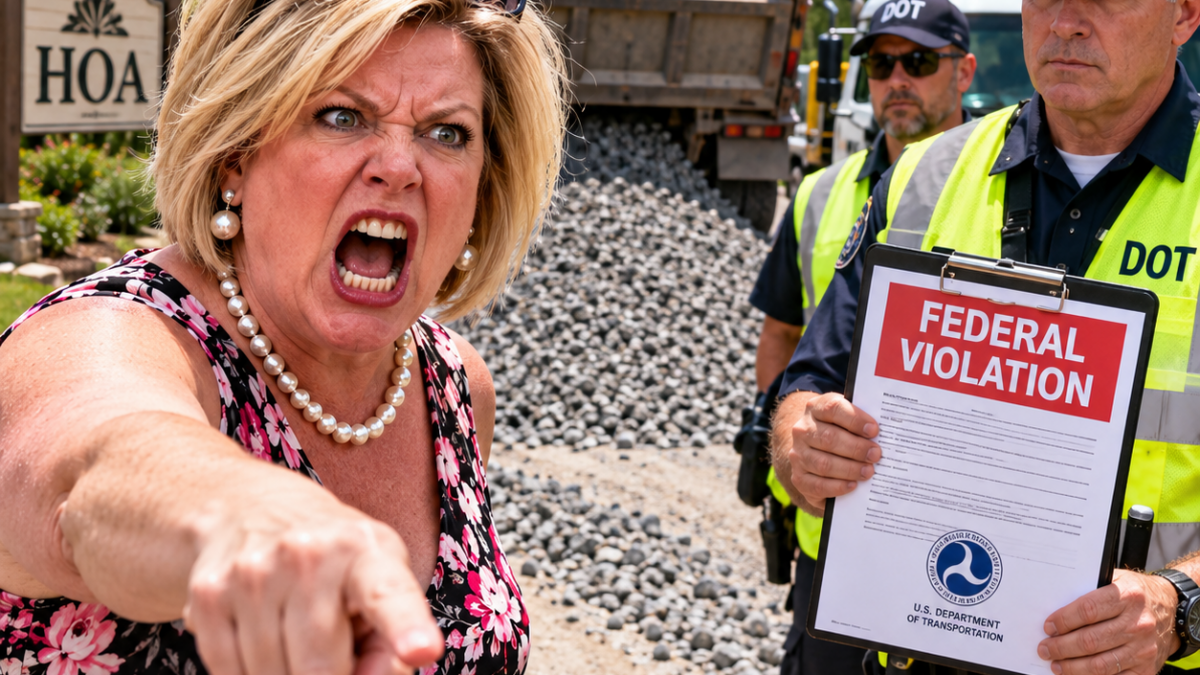
PART 2
Almost.
“I bought thirty acres of undeveloped land.”
“Adjacent to Oak Hollow.”
“Yes.”
“And yet you expect to use access that runs beside our community while ignoring our standards.”
“The access existed before most of those houses.”
“That doesn’t matter.”
“It will.”
She rolled her eyes.
“I have a pool committee meeting.”
Then she walked toward her white SUV.
Before opening the door, she looked back.
“If you move that gravel yourself, the HOA will consider it vandalism.”
I said nothing.
She smiled again.
Then drove away.
I waited until her SUV disappeared between the houses.
Only then did I pull out my phone.
My first instinct had been to call the company that delivered the gravel and demand they remove it.
My second instinct was better.
Document everything.
Evidence wins disputes.
Emotion doesn’t.
I switched on video.
“The date is August fourteenth. Time approximately two fifteen p.m. I’m standing at County Road 485 at the entrance to the recorded access easement serving my property.”
I slowly turned the camera.
“As shown, access is completely obstructed by approximately twenty tons of aggregate road-base material.”
I walked around the pile.
Wide shots.
Close-ups.
Tire marks.
Road edges.
Drainage direction.
The path toward the storm ditch.
I photographed everything from multiple angles.
Then I zoomed in on the fresh dump-truck tracks.
They came from Oak Hollow’s side.
I photographed those too.
When I finished, I had dozens of photos and nearly fifteen minutes of video.
Only then did I call the sheriff’s department.
Deputy Miller arrived around thirty minutes later.
Young guy.
Professional.
Polite.
He parked behind my truck and stared at the gravel.
“Well.”
“Pretty much.”
He stepped out.
“That’s your entrance?”
“Only one.”
He walked toward it.
“Who dumped this?”
“The Oak Hollow HOA.”
He looked toward the subdivision.
“On purpose?”
“The HOA president personally told me they reclaimed the easement.”
His eyebrows went up.
“She said that?”
“Almost word for word.”
I handed him a copy of my survey that I kept in the truck.
He studied it.
Then I showed him the deed.
The easement was unmistakable.
Fifty feet wide.
One thousand feet long.
Legally recorded.
He scratched his jaw.
“Yeah. They definitely can’t just block this.”
“Good.”
“But…”
There it was.
The word everyone hates hearing from government officials.
“But.”
He sighed.
“This is probably going to be treated as a civil property dispute.”
“She intentionally blocked my only access.”
“I understand.”
“She admitted it.”
“I understand.”
“If my house catches fire, what happens?”
He looked at the pile again.
“That complicates it.”
“It should.”
“I can put the emergency-access issue in my report.”
“Can you make her remove it?”
“Not tonight.”
I took a slow breath.
“What can you do?”
“I can speak to her. Tell her she needs to resolve it. But without a court order, I can’t bring equipment in and clear private property.”
“Whose private property?”
He raised a hand.
“I know.”
I nodded.
He wasn’t the enemy.
The system simply moved differently from the way people expected.
He gave me a report number.
“I’ll document everything.”
“Thank you.”
He looked at the gravel again.
“Honestly, sir, I’d call a property attorney.”
“I probably will.”
He started toward his cruiser.
Then stopped.
“For what it’s worth?”
“Yeah?”
“This is insane.”
“Glad we’re in agreement.”
He drove into Oak Hollow to speak with Karen.
I never learned exactly what she told him.
I didn’t need to.
Thirty minutes later, the gravel was still there.
That told me enough.
I pulled my laptop out of the truck.
Sat on the tailgate.
Connected to my phone.
And started writing.
No insults.
No anger.
No threats.
Just facts.
I drafted a formal cease-and-desist notice addressed to Karen Peterson and every member of the Oak Hollow HOA board.
I identified my property.
The recorded easement.
County recording information.
The date and time of obstruction.
The sheriff’s report number.
I attached photographs.
Survey pages.
Deed pages.
I demanded immediate restoration of access at HOA expense.
I also included notice that the association would be responsible for any damage to the roadbed caused by the gravel or its removal.
Then I stated that failure to comply could result in action for injunctive relief, damages, interference with property rights, and any additional claims supported by their continued conduct.
I emailed it.
Then I hired a process server.
Karen got her copy that evening.
I knew because at 8:12 p.m., my phone rang.
Unknown number.
I answered.
“Jack Warren?”
“Yes.”
“This is Karen Peterson.”
“I know.”
“How dare you send someone to my home.”
“He delivered a legal notice.”
“You could have emailed me.”
“I did.”
“This is intimidation.”
“No. It’s documentation.”
“You are harassing an HOA officer.”
“You blocked my road.”
“Our attorney will deal with you.”
“Great. Have your attorney call me.”
She went quiet.
I could almost hear her realizing she didn’t actually have an attorney involved yet.
Then she said, “If you think you’re going to scare this board, you’re mistaken.”
“Karen, I’m not trying to scare anybody.”
“What are you trying to do?”
“Get home.”
She hung up.
The next afternoon, an email arrived.
It came directly from Karen.
Not counsel.
Not the board.
Karen.
The opening sentence told me everything I needed to know.
**Dear Mr. Warren, the board has received your correspondence and rejects your unsupported claims.**
I kept reading.
According to Karen, the easement area had been “legally redesignated” as a community common area under Article 4, Section 2 of the Oak Hollow covenants.
The gravel had supposedly been installed as an erosion-control and beautification project.
The Architectural Review Committee had approved it.
And my favorite part:
**Any attempt by you or your agents to remove, relocate, or disturb the installation will be treated as vandalism of HOA property.**
Attached was an ARC approval form.
Three signatures.
One was Karen’s.
Two belonged to board members.
The form had been dated one week earlier.
I stared at it.
Then smiled.
She had just admitted everything.
Procurement.
Authorization.
Intent.
Placement.
She hadn’t denied dumping the gravel.
She had created a document to justify it.
That made the evidence stronger.
I saved the email.
Downloaded the attachment.
Saved the email headers.
Printed a copy.
Then added it to a folder on my laptop.
The folder was labeled:
**OAK HOLLOW — EVIDENCE**
At that point, I knew two things.
First, Karen wasn’t backing down.
Second, I needed to understand exactly how she had built enough power to believe this would work.
So I started digging.
County records.
HOA filings.
Subdivision plats.
Governing documents.
Board minutes.
I downloaded everything available.
Hundreds of pages.
Most people would rather chew aluminum foil than spend a weekend reading HOA meeting minutes.
I spent twenty-two years working with engineering specifications, contract language, drawings, maps, compliance documentation, and government procedure.
Dense paperwork didn’t intimidate me.
It relaxed me.
Paper doesn’t yell.
Paper doesn’t posture.
Paper just tells you what happened.
And Oak Hollow’s paperwork told a story.
Karen had started as board secretary.
Then treasurer.
Then vice president.
Then president.
As her authority increased, so did enforcement.
More citations.
More fines.
More complaints.
More architectural violations.
Meeting minutes became increasingly confrontational.
Residents challenged penalties.
Karen shut them down.
Residents questioned interpretations.
Karen claimed board discretion.
Residents objected to enforcement.
Karen threatened liens.
Then I found George Maxwell.
Two years earlier, George had painted his front door red.
That was apparently enough to trigger a constitutional crisis in Oak Hollow.
The HOA had three approved shades.
Colonial Brick.
Barnyard.
Desert Rose.
George’s door had been some other red.
The board fined him twenty-five hundred dollars.
Twenty-five hundred dollars.
For paint.
The minutes showed George disputing the fine.
He argued that the color differences were nearly impossible to distinguish.
Karen responded that the president and architectural committee had final authority to interpret the aesthetic guidelines.
The board upheld the penalty.
The minutes also referenced a lien if George refused payment.
I read that section twice.
Then I found his address.
The next morning, I parked on a public street and walked over.
His house looked exactly like every other house nearby.
Beige siding.
Clean driveway.
Trimmed lawn.
And a painfully boring off-white front door.
I knocked.
A man in his late sixties answered.
“Mr. Maxwell?”
“Yes?”
“My name is Jack Warren.”
Recognition hit him instantly.
“The land north of the subdivision?”
“That’s me.”
His expression changed.
“What do you want?”
“I think we have a common problem.”
He didn’t answer.
I said, “Karen Peterson.”
His eyes flicked toward the street.
Then behind him.
It was subtle.
Fear.
“I’m not interested.”
“I read the meeting minutes.”
His expression hardened.
“You shouldn’t be here.”
“I know about your door.”
He stepped halfway outside and lowered his voice.
“Leave.”
“George, she’s blocked the only access to my property.”
He froze.
“With what?”
“Twenty tons of gravel.”
He stared.
“She said the HOA reclaimed the easement.”
George shut his eyes briefly.
“Jesus.”
“I need information.”
“Then find it somewhere else.”
“She can’t retaliate against you through me.”
“You don’t know that woman.”
“I know enough.”
“No.”
His voice sharpened.
“You don’t.”
He looked toward the neighboring houses again.
“After I challenged that door fine, I had somebody photographing my yard every week.”
He pointed toward the driveway.
“That crack? Fine.”
He pointed at the side of the house.
“My satellite dish was supposedly two inches out of compliance.”
He looked toward the lawn.
“Grass quarter inch too high.”
He laughed without humor.
“My wife started getting anxiety every time a white SUV slowed in front of the house.”
“That was Karen?”
“Sometimes her. Sometimes her people.”
“Why didn’t you fight?”
“I did.”
His eyes hardened.
“For six months.”
He stepped closer.
“You know what fighting costs when you’re retired? Time. Lawyers. Stress. My wife begged me to stop.”
He pointed at the door.
“So I painted the damn thing.”
I understood.
Bullies rarely survive because they’re stronger than everyone else.
They survive because fighting them costs more than surrender.
I handed George my card.
“I’m not asking you to fight her today.”
“Then what?”
“Talk to me.”
He stared at the card.
“She crossed into my property rights. She’s created an emergency-access problem. She manufactured an HOA approval document. I’m building a real case.”
“You think you can beat her?”
“I think she already beat herself.”
Something changed in his expression.
Not confidence.
Hope.
Very small.
But real.
“My wife’s out shopping,” he said.
Then he opened the door wider.
“Come in.”
Three hours later, his dining table was covered in papers.
Violation letters.
Emails.
Paid fines.
Photographs.
Warnings.
Karen’s name appeared everywhere.
George had kept everything.
That was the good news.
The bad news was the scale.
He wasn’t the only one.
A widow had been threatened over landscaping.
A family had been cited over children’s outdoor toys.
One homeowner had sold after repeated enforcement battles.
Another had been fined over driveway staining.
Another over decorations.
Another over temporary parking.
George gave me names.
Numbers.
Dates.
Then, just before I left, he said something that got my attention.
“She knows people.”
“What people?”
“County planning.”
I stopped.
“Explain.”
“She plays bridge with somebody connected to the Planning Commission. I don’t know the exact relationship.”
“You think she gets information?”
“I know she gets information before anybody else.”
“Permits?”
“Applications. Land issues. Construction.”
He looked at me.
“She probably knew exactly what your easement was before she ever confronted you.”
That possibility changed things.
Karen hadn’t necessarily misunderstood.
She may have known.
I drove back toward the blocked road.
The gravel pile still sat there.
The sheriff had talked to her.
My legal notice had been delivered.
She had received the deed.
The survey.
The easement information.
And still, nothing moved.
I made one more call.
Dave and I had served together years earlier.
He had eventually left the military world, finished law school, and built a career around land-use disputes and property litigation.
We hadn’t talked in years.
He answered on the third ring.
“Jack Warren.”
“Dave.”
“You old bastard.”
“Good to hear your voice too.”
“What did you do?”
“Why do you assume I did something?”
“Because you haven’t called me in years and you’re calling during business hours.”
“Fair.”
He laughed.
“You in trouble?”
“I may have found an HOA president trying to annex my property one gravel truck at a time.”
There was silence.
Then:
“Start from the beginning.”
So I did.
The land.
The easement.
Karen.
The earlier letters.
The twenty tons of gravel.
The sheriff.
The cease-and-desist.
The ARC document.
George.
Everything.
Dave barely interrupted.
I could hear typing.
When I finished, he became serious.
“Send me everything.”
“I already have it organized.”
“Of course you do.”
“Folder structure too.”
He laughed once.
“Some things never change.”
I emailed the files.
Twenty minutes later, he called back.
“Jack.”
“Yeah?”
“You’ve already done most of the work.”
“That good?”
“That bad for them.”
He started listing potential claims.
Interference with access.
Harassment.
Trespass-related issues.
Fraud implications tied to the paperwork.
Potential title issues if Karen escalated further.
Then he stopped.
“But that’s all slow.”
“Exactly.”
“You could file for an injunction.”
“How long?”
“Depends.”
“Expensive?”
“Always.”
I leaned against my truck.
“So what gets movement?”
“Agencies.”
That word changed everything.
Dave continued.
“You said this is your only emergency access?”
“Yes.”
“Call the fire marshal.”
“I mentioned it to the deputy.”
“Deputies hear property dispute and think civil. Fire marshal hears emergency vehicles physically cannot reach a residence and thinks code violation.”
“Local leverage.”
“Exactly.”
I looked at the gravel.
“What else?”
“Where does runoff from that pile go?”
I followed the slope with my eyes.
“East. Drainage ditch.”
“Then?”
“Willow Creek.”
“Then?”
“Eventually into the larger river system.”
He paused.
“Uncontained aggregate?”
“Yes.”
“No erosion barrier?”
“None.”
“No permit?”
“Not that I’m aware of.”
“Call TCEQ.”
I smiled.
“Environmental.”
“Now you’re thinking.”
“What about federal?”
“Give me the original easement documents.”
I opened the chain-of-title folder.
“The easement traces back to a federal land grant from the fifties.”
“Send it.”
I did.
Then I waited.
Five minutes.
Ten.
My phone finally rang.
Dave didn’t say hello.
He said:
“Oh, Karen.”
I straightened.
“What?”
“You might have the hammer.”
“What did you find?”
“This right-of-way isn’t just an ordinary private easement.”
I waited.
“The original grant carries federal access language. It was created to remain open for access to interior parcels tied to infrastructure and development.”
“How strong?”
“Strong enough that I want DOT looking at it.”
I looked toward Oak Hollow.
The beige houses shimmered in the heat.
“Federal DOT?”
“Potentially Federal Highway Administration jurisdiction or at least federal enforcement interest tied to the grant conditions.”
“What does that mean for Karen?”
“It means her HOA common-area theory may have just wandered into a federal right-of-way problem.”
I smiled.
Dave continued.
“Don’t celebrate yet. We document first.”
“Always.”
“Fire marshal. State environmental agency. Then we prepare a formal federal complaint.”
“What about EPA?”
“Potentially, depending on runoff.”
I whistled.
Karen believed she had blocked one retired guy from reaching his land.
She had no idea how many agencies might care about the way she’d done it.
Dave gave me one final instruction.
“Stop arguing with her.”
“That won’t be difficult.”
“Don’t call the board.”
“Fine.”
“Don’t threaten.”
“Wasn’t planning to.”
“Let the paper do the talking.”
That was advice I understood.
The next morning, I called the county fire marshal.
Once I used the phrase **complete obstruction of the only emergency access route to a residential property**, the conversation became much shorter.
Fire Marshal Billups arrived less than two hours later.
He drove up.
Parked.
Stepped out.
Looked at the gravel.
And said:
“You’ve got to be kidding me.”
“Nope.”
He walked to the base of the pile.
“Who did this?”
“HOA.”
“Accident?”
“Intentional.”
He looked at me.
“Why?”
“Beautification.”
He slowly turned toward me.
“Beautification?”
“Official HOA-sanctioned project.”
Billups stared at the pile again.
Then swore.
He took his own photographs.
Measurements.
Notes.
I gave him the survey and sheriff’s report.
He read everything.
“This blocks ambulance access.”
“Yes.”
“Fire apparatus too.”
“Yes.”
“If something burns back there, we’re standing here watching it.”
“That was my concern.”
He shook his head.
“This is unacceptable.”
“What happens next?”
“Formal notice.”
He began writing.
“They get forty-eight hours.”
“And if they ignore it?”
“Daily fines.”
“How much?”
“Starts around a thousand a day depending on classification and enforcement.”
I raised an eyebrow.
“They’ve already ignored me and the sheriff.”
Billups gave me a hard smile.
“Then maybe they need a different kind of conversation.”
He completed his report.
Gave me a copy.
Then drove into Oak Hollow.
One domino.
The second was TCEQ.
It took more patience.
Phone menus.
Transfers.
Hold music.
Then finally a water-quality investigator named Sarah.
I explained the gravel.
Location.
Drainage.
Slope.
Storm ditch.
Willow Creek.
She asked whether erosion controls had been installed.
“No.”
“Silt fencing?”
“No.”
“Containment?”
“No.”
“Permit documentation?”
“HOA hasn’t provided any.”
She became more interested.
“Can you send photographs?”
“Immediately.”
I emailed them while we spoke.
She opened them.
“Oh.”
That one syllable told me enough.
“That’s a substantial pile.”
“Twenty tons.”
“And you’re saying they intentionally placed it there?”
“Yes.”
“We’ll open a case.”
“When can someone inspect?”
“Potentially next week.”
I wrote down the number she gave me.
The second domino.
Now I needed Oak Hollow residents to understand something.
Karen was not protecting their investment.
She was risking it.
That mattered.
I called George.
“I need five people.”
“Five?”
“Maybe six.”
“For what?”
“A meeting.”
His voice tightened.
“No public confrontation.”
“Private.”
“Karen finds out—”
“She eventually will.”
“Jack.”
“Listen to me. I’m not asking anyone to protest. I’m asking homeowners to understand the financial exposure.”
He went quiet.
“Fire marshal issued a violation.”
“How much?”
“Potentially a thousand dollars a day after the deadline.”
He swore softly.
“TCEQ opened a case.”
Longer silence.
“And Dave is preparing federal notifications.”
“What federal notifications?”
“DOT. Potentially EPA.”
“Jesus Christ.”
“Exactly.”
George agreed.
Thursday night I walked to his house after dark.
No drama.
No secret handshakes.
Just six nervous homeowners sitting in a living room.
A young couple.
A widow.
A CPA named Frank.
Another older man.
George.
And me.
I didn’t give a speech.
I spread documents across the coffee table.
My deed.
The survey.
The federal grant.
The sheriff’s report.
The fire marshal violation.
TCEQ case information.
Then I looked around the room.
“Karen keeps telling you she’s protecting Oak Hollow.”
Nobody spoke.
“I’m here to show you what her protection may cost.”
I walked them through it.
Slowly.
The easement.
The obstruction.
Emergency access.
Daily fines.
Environmental exposure.
Federal right-of-way.
Potential legal damages.
Then Frank, the CPA, leaned forward.
“Who pays?”
I looked at him.
“You tell me.”
He looked sick.
“The HOA.”
“Yes.”
“And if insurance denies some of it?”
“You tell me.”
He sat back.
“Special assessment.”
The young wife looked toward him.
“How much?”
“Nobody knows yet.”
Frank shook his head.
“But if federal penalties get involved, litigation, environmental monitoring…”
He stopped.
The widow whispered, “We could lose thousands.”
“Potentially.”
Her face went pale.
“Each?”
“Potentially.”
The room changed.
Until then, Karen’s behavior had been annoying.
Cruel.
Oppressive.
But private.
Now the consequences belonged to everybody.
I pointed at the documents.
“I don’t want your houses.”
I looked around.
“I don’t want revenge.”
Nobody interrupted.
“I want my road open.”
I paused.
“But Karen has turned that into something much bigger. You need to decide whether she gets to keep making legal decisions with your money.”
George leaned back.
“What do we do?”
“Document.”
He frowned.
“That’s it?”
“For now.”
I nodded toward the others.
“Every letter. Fine. Email. Threat. Photograph. Meeting notice. Scan it.”
Frank nodded.
“Build a pattern.”
“Exactly.”
The widow spoke quietly.
“I still have everything.”
“So do I,” the young husband said.
George gave a humorless laugh.
“I have a box.”
I smiled.
“Good.”
I stood.
“When the time comes, facts beat fear.”
That meeting changed Oak Hollow.
Karen didn’t know it yet.
To her, the gravel was still sitting there.
Which meant I had surrendered.
Her mistake was confusing silence with weakness.
A week later, I received certified mail.
I opened it in the post-office parking lot.
The first document was an invoice.
I stared at the total.
**$2,875.**
Twenty tons premium driveway gravel: $1,500.
Delivery and spreading: $500.
Community aesthetic improvement surcharge: $875.
I reread it.
She had billed me.
For the gravel.
That she had used to block me from my own property.
I started laughing.
A woman walking to her car looked at me strangely.
I didn’t care.
Karen had just created another written admission tying the HOA directly to the obstruction.
Then I saw the second document.
I stopped laughing.
**NOTICE OF LIEN.**
My thirty-acre property.
Oak Hollow HOA.
Amount due: invoice plus administrative charges.
Total slightly above three thousand dollars.
Signed:
Karen Peterson, President.
I stared at the page.
That was different.
A stupid letter was one thing.
A fake invoice was one thing.
A filed lien was another.
Karen had placed a financial claim against land that was not in her HOA.
I had no contract with Oak Hollow.
No covenant agreement.
No dues obligation.
Nothing.
I scanned both documents from my truck.
Sent them to Dave.
Subject:
**Phase Four.**
His response came almost immediately.
**CALL ME.**
I did.
He answered:
“Tell me she actually filed this.”
“Looks filed.”
“Recorder information?”
“On the document.”
I heard furious typing.
Then:
“Jack, this is huge.”
“How huge?”
“She has gone from arguing over access to asserting a legal debt against property her association has no contractual authority over.”
“I figured.”
“This gives us malicious-intent evidence.”
“Fraud?”
“Potentially more.”
“Slander of title?”
“Absolutely part of the discussion.”
He paused.
“Do nothing.”
“I wasn’t planning to pay.”
“I mean nothing. Don’t contact her.”
“Fine.”
“We send this to the district attorney’s office. We add it to DOT. We add it to every packet.”
I looked toward the distant entrance of my property.
Gravel still there.
“How long until the federal complaint?”
“Already drafted.”
“When does it go?”
“Now.”
Dave moved quickly.
Formal packets went to the appropriate federal transportation contacts.
Environmental materials went out.
The county got updated documentation.
The lien went to prosecutors.
The fire marshal’s forty-eight-hour compliance deadline expired.
Karen did nothing.
The gravel remained.
The county fines began accumulating.
George later told me Karen dismissed the fire marshal’s notice at an HOA meeting.
Apparently she called it “local-government overreach.”
That phrase made me smile.
The woman who had used an HOA rulebook to dictate driveway oil stains had suddenly developed concerns about overregulation.
TCEQ scheduled an inspection for Tuesday.
Then Dave called.
“Be at the road Tuesday morning.”
“What time?”
“Before ten.”
“Who’s coming?”
“TCEQ.”
“I know.”
“DOT is sending someone.”
I sat up.
“Federal?”
“Yes.”
“Who?”
“Federal Highway Administration side.”
I looked out the window.
“Anything else?”
“EPA may coordinate because of the runoff issue.”
I said nothing.
Dave laughed.
“You still there?”
“Yeah.”
“Fire marshal knows too.”
“All at once?”
“Looks that way.”
I rubbed my jaw.
“Karen know?”
“She’ll know when they arrive.”
Then George called Monday evening.
His voice was barely above a whisper.
“Jack.”
“What?”
“She has a ceremony.”
I thought I misheard.
“A what?”
“Tomorrow.”
“What kind?”
“Community beautification celebration.”
I closed my eyes.
“Where?”
“At the easement.”
I almost dropped the phone.
George continued.
“She bought donuts.”
“Donuts?”
“And coffee.”
I started laughing.
“There’s more.”
“Of course there is.”
“She had a sign made.”
“What sign?”
George paused.
Then said:
“Peterson Park.”
I stopped laughing.
Not because it wasn’t funny.
Because it was perfect.
“She’s naming it after herself?”
“Apparently.”
“The blocked easement.”
“Yes.”
“She is holding a dedication ceremony on the blocked federal right-of-way.”
“Yes.”
“At nine thirty tomorrow?”
“Yes.”
I looked at the clock.
Federal inspection at ten.
“George.”
“Yeah?”
“Do not stop her.”
“What?”
“Let her set up everything.”
“Jack—”
“Let her have the donuts.”
He slowly understood.
“Oh.”
“Exactly.”
Tuesday morning was brutally hot.
Even by Texas standards.
I parked my F-250 around a hundred yards down the county road.
Clear view.
No reason to interfere.
At 9:30, Karen’s white SUV arrived.
Two board members followed.
They unfolded a table.
Coffee.
Donuts.
Napkins.
Then the sign.
I could read it from my truck.
**PETERSON PARK**
**A COMMUNITY GREEN SPACE**
**OAK HOLLOW HOA**
Karen stood beside it wearing a floral pantsuit.
Clipboard in one hand.
Powdered donut in the other.
Maybe ten residents had come.
Most looked uncomfortable.
Karen did not.
She looked triumphant.
I couldn’t hear every word, but she gave some kind of speech.
Pointed toward the gravel.
Gestured toward my land.
I imagined phrases like *community improvement* and *protecting property values.*
At 9:58, the first official vehicle arrived.
White sedan.
Texas Commission on Environmental Quality insignia.
Sarah stepped out holding a tablet.
Karen stopped mid-sentence.
Sarah walked directly toward the gravel.
No greeting.
No interest in the donuts.
She began taking photographs.
Karen marched over.
“Excuse me.”
Sarah looked up.
“Yes?”
“This is a private community event.”
“Okay.”
“May I ask what you’re doing?”
“Site inspection.”
“For what?”
“Reported unpermitted discharge of aggregate material with potential watershed impact.”
Karen blinked.
“A what?”
Sarah returned to her tablet.
Karen looked toward the two board members.
Before she could recover, a county vehicle arrived.
Fire Marshal Billups got out.
Karen visibly deflated.
He didn’t bother with pleasantries.
“Peterson!”
She stiffened.
He walked toward her.
“The forty-eight-hour deadline expired four days ago.”
“This matter is under HOA review.”
“No, ma’am. It’s under county enforcement.”
She raised her clipboard.
“We have documentation establishing this as a community improvement.”
Billups pointed at the gravel.
“That’s an emergency-access obstruction.”
“We disagree.”
“I don’t care.”
Her eyes widened.
He continued.
“You’re at four thousand dollars in accrued penalties.”
Karen’s mouth dropped open.
“That is outrageous!”
“It’s going to five today.”
“This is harassment.”
“No.”
Billups stepped closer.
“This is math.”
One of the residents quietly moved away from the table.
Another followed.
Karen pointed toward me.
“He caused this.”
Billups barely glanced in my direction.
“You caused it when you ignored the violation notice.”
“This road belongs to the HOA.”
“No, it doesn’t.”
“Our covenants—”
“I don’t enforce your covenants.”
He pointed toward the pile.
“I enforce county fire code.”
Then the dark government vehicle arrived.
Quietly.
Almost anticlimactically.
It stopped behind Billups’s truck.
A woman in a dark blue suit stepped out.
Short gray hair.
Federal identification.
No clipboard.
No raised voice.
She didn’t need either.
Karen watched her approach.
Something about the woman’s demeanor made everyone stop talking.
She walked around the gravel once.
Looked at the drainage ditch.
Looked at Karen.
Then at the **PETERSON PARK** sign.
Finally:
“Are you Karen Peterson?”
Karen recovered enough to lift her chin.
“I am. President of the Oak Hollow Homeowners Association.”
The woman removed identification.
“Agent Harris. Federal Highway Administration, United States Department of Transportation.”
Karen’s expression changed.
Barely.
But I saw it.
“Department of Transportation?”
“Yes.”
“What is this regarding?”
Agent Harris opened a file.
“This right-of-way.”
Karen hugged her clipboard tighter.
“There seems to be some confusion. This area has been redesignated as HOA common property.”
Agent Harris looked at her.
“No.”
Just that.
One word.
Karen blinked.
“Excuse me?”
“It has not.”
Karen started to speak.
Agent Harris continued.
“We have reviewed the original grant documentation, county recording information, survey documents, deed history, and material submitted with the complaint.”
She pointed toward the road.
“This corridor is subject to federally protected access provisions.”
Karen’s face went blank.
Agent Harris opened the file.
“Your organization has intentionally obstructed it.”
“No. No, we improved it.”
“With twenty tons of aggregate material.”
“For erosion control.”
“Without preserving access.”
“It was being misused.”
“By the property owner?”
Karen hesitated.
“His property isn’t maintained in accordance with Oak Hollow standards.”
Agent Harris looked toward my land.
Then back at Karen.
“What does that have to do with this right-of-way?”
Karen’s confidence flickered.
“The HOA has responsibility for protecting property values.”
“Not relevant.”
“Our covenants—”
“Ms. Peterson.”
Agent Harris’s voice remained calm.
“Your HOA covenants do not override federal access provisions.”
The donut fell out of Karen’s hand.
Literally.
It landed powdered-side-down beside her shoe.
Nobody moved.
Karen looked at the gravel.
Then Agent Harris.
Then her board members.
“This must be some misunderstanding.”
“No.”
“We have legal authority.”
“Show me.”
Karen held up her clipboard.
“The Architectural Review Committee approved—”
“Your committee cannot extinguish a federally protected access interest.”
Karen stared.
Agent Harris continued.
“You do not own this easement.”
“The land underneath—”
“Not the question.”
“We control common areas.”
“This isn’t one.”
Karen’s lips moved.
Nothing came out.
That was when another vehicle pulled in.
Unmarked.
A man stepped out, showed identification, and joined Sarah.
EPA.
Karen saw the badge.
Her face went pale.
He walked toward the drainage side of the gravel.
Then asked:
“Who is responsible for placement?”
Karen didn’t answer immediately.
Agent Harris looked at her.
“Ms. Peterson?”
“The HOA.”
“Under whose authorization?”
“The board.”
“Who signed it?”
“I did.”
I almost felt sorry for her.
Almost.
The EPA representative pointed toward the ditch.
“Was an erosion-control plan prepared?”
Karen stared.
“What?”
“Stormwater controls.”
“This is gravel.”
“Yes.”
He looked toward the slope.
“Twenty tons of loose aggregate material directly adjacent to drainage.”
Karen’s voice became smaller.
“It was a beautification project.”
Sarah stepped in.
“Do you have a TCEQ authorization number?”
Karen looked at her.
“No.”
“Any containment?”
“No.”
“Silt fencing?”
“No.”
“Runoff-management plan?”
“No.”
The EPA agent nodded.
“Then we’ll document current conditions.”
Karen’s board members began stepping backward.
She noticed.
“Where are you going?”
Neither answered.
Fire Marshal Billups folded his arms.
“And you still owe the county.”
Karen turned.
“This is all excessive.”
“Your fines?”
“All of this!”
She pointed around wildly.
“TCEQ? Federal agents? EPA? Over gravel?”
Agent Harris looked at the pile.
“No, Ms. Peterson.”
She closed her file.
“Over what you did with the gravel.”
Karen’s chest rose and fell.
She pointed at me.
“This man has been hostile from the beginning.”
Agent Harris never looked my way.
“His behavior is not the subject of my investigation.”
“He refuses to maintain his property.”
“Not relevant.”
“He removed vegetation without architectural approval.”
“Not relevant.”
“He stores an old truck where residents can see it.”
“Not relevant.”
“He—”
Agent Harris cut her off.
“The federal government does not enforce Oak Hollow landscaping preferences.”
Silence.
George later told me several people watching from their windows actually cheered.
Karen kept pointing at me.
“He is doing this to punish me.”
“No.”
Agent Harris’s tone hardened slightly.
“This inspection exists because your association obstructed a protected access route after receiving written notice that you had no authority to do so.”
Karen lowered her hand.
“You can move the gravel.”
Agent Harris nodded.
“Yes.”
“We’ll do that.”
“Yes.”
“So then we’re finished.”
Agent Harris paused.
“No.”
Karen froze.
“We’re only beginning.”
The words hit harder than yelling ever could.
Agent Harris opened the file again.
“Our review will include the obstruction itself, the association’s claimed authority over the corridor, the documents used to justify that claim, and communications showing notice of the easement.”
Karen swallowed.
Agent Harris continued.
“We’ve also been provided information regarding a property lien filed by Oak Hollow HOA against Mr. Warren’s land.”
The color vanished from Karen’s face.
Her two board members looked at her.
One whispered:
“You filed what?”
Karen shot him a furious look.
Agent Harris said, “The county district attorney’s office is reviewing that matter.”
Karen’s voice dropped.
“That’s separate.”
“Possibly.”
“It has nothing to do with transportation.”
“The lien document contains statements about the blocked access project.”
Karen’s eyes widened.
She hadn’t thought of that.
Agent Harris’s voice remained emotionless.
“Investigators tend to share relevant evidence.”
That sentence destroyed what little composure Karen had left.
She looked toward her board members again.
They were no longer standing behind her.
They had moved several feet away.
Fire Marshal Billups said, “And I’m forwarding the continued obstruction for additional county review.”
Sarah added, “TCEQ will issue its findings separately.”
The EPA agent was photographing the drainage.
Karen looked from one agency to another.
Then at me.
For the first time since I’d met her, she looked afraid.
Not angry.
Not offended.
Afraid.
“This is a mistake.”
No one answered.
“A misunderstanding.”
Agent Harris said nothing.
Karen continued.
“We can fix this.”
“Yes,” Agent Harris said.
“We’ll move it.”
“Yes.”
“Today.”
“Yes.”
Karen seemed desperate for any sign that agreement would erase the rest.
Agent Harris didn’t give her one.
“The gravel will be removed immediately by a properly insured contractor.”
Karen nodded quickly.
“Yes.”
“Under supervision.”
“Yes.”
“The roadbed will be inspected for damage.”
“Fine.”
“Any damage caused by placement or removal will be repaired at association expense.”
Karen hesitated.
Then:
“Fine.”
Agent Harris held her gaze.
“And none of that terminates the investigation.”
Karen’s shoulders sagged.
Then came the final blow.
Agent Harris looked at the **PETERSON PARK** sign.
“Remove that.”
Karen followed her gaze.
For a second, I thought she might argue.
She didn’t.
One of the board members quietly picked up the sign.
The ceremony was over.
The donuts sat untouched.
The coffee cooled.
The plaque honoring Karen’s victory disappeared into an SUV.
And the woman who had declared my road HOA property stood surrounded by people whose rulebooks were considerably thicker than hers.
I got into my truck.
I didn’t walk over.
Didn’t gloat.
Didn’t say I told you so.
There was nothing left to say.
My work had been documentation.
Theirs was enforcement.
By that afternoon, a commercial excavation crew arrived.
They couldn’t simply shove the gravel aside.
Because the roadbed had to be protected, removal was slower and more expensive.
Smaller equipment.
Careful loading.
Inspection.
Documentation.
Supervision.
Everything Karen could have avoided by calling the original dump company and saying:
*We made a mistake. Come pick it up.*
George later told me the emergency removal cost the HOA close to three times what Karen had originally paid.
That night, I drove my truck onto my property for the first time in weeks.
I stopped halfway down the easement.
Turned off the engine.
And sat there.
Nothing dramatic.
Just silence.
Prairie grass moved in the evening wind.
Oak branches shifted.
Birds called somewhere beyond the tree line.
Home.
Karen had turned access to it into a battlefield.
Now the road was open.
But the story wasn’t finished.
The following evening, Oak Hollow held an emergency board meeting.
George called before it started.
“Jack, you coming?”
“No.”
“You should.”
“Why?”
“You caused this.”
“No. Karen caused it.”
Silence.
“I don’t belong to your HOA.”
“That hasn’t stopped her for months.”
I laughed.
“Handle your own government.”
He sighed.
“Fair.”
A few hours later, my phone began buzzing.
George.
Frank.
Then George again.
I finally answered.
“You alive?”
“You should have seen it.”
“What happened?”
“Packed room.”
“How packed?”
“Standing room.”
That was unusual.
Most HOA meetings attracted fewer people than a root canal.
George sounded energized.
“Frank did the numbers.”
“What numbers?”
“Potential exposure.”
“And?”
“He scared everyone half to death.”
I leaned back.
“County fines. Environmental penalties. Federal penalties. Legal fees. Removal costs. Your claim. The lien.”
He paused.
“High six figures depending on where everything lands.”
I whistled.
“Karen spoke?”
“Tried.”
“How’d that go?”
“Badly.”
People had brought violation letters.
Years of them.
The crimson door.
Plastic children’s slide.
Oil stain.
Flowers.
Trash cans.
Landscaping.
Parking.
Grass.
Paint.
Everything Karen had treated as isolated cases of disobedience suddenly became one visible pattern.
One homeowner stood.
Then another.
Then another.
Years of resentment spilled out.
Karen tried to defend herself.
She said standards protected home values.
Someone shouted that federal investigations did not protect home values.
She blamed me.
George reminded everyone I wasn’t even an HOA member.
She blamed the county.
Frank asked why she had ignored the fire marshal.
She blamed “political pressure.”
Someone asked why she had filed a lien on land the HOA didn’t control.
That one apparently changed the entire room.
A motion was made.
No confidence.
Removal as president.
Removal from the board.
George’s voice dropped.
“Almost unanimous.”
“What about her allies?”
“Abstained.”
“And?”
“Then resigned.”
In less than an hour, Karen’s little government disappeared.
Three years of accumulated authority.
Gone.
Not because I had defeated her politically.
Because the people who had given her authority finally withdrew it.
The regulatory investigations continued.
County.
State.
Federal.
The lien became the most serious personal problem for Karen.
Dave handled communication.
I stayed out of the prosecutorial side.
Months later, Karen resolved the criminal matter through a plea to a lesser offense rather than risk the greater exposure associated with the fraudulent filing.
The result was ugly.
Five years of probation.
A substantial fine.
A permanent record.
No jail.
But no easy escape either.
I didn’t celebrate.
Prison had never been my goal.
I had wanted my road back.
Karen had been given multiple opportunities to stop.
She refused every one.
Then came my claim.
Dave prepared a demand packet for the HOA’s insurance carrier.
It was almost embarrassing how thick it was.
Blocked access.
Temporary relocation expenses.
Legal costs.
Property interference.
The lien.
Title damage.
Harassment.
Documentation of intentional conduct.
Regulatory findings.
Every piece of paper Karen had created became another exhibit.
Dave called me after submitting it.
“They’re going to hate you.”
“Why?”
“Because you document everything.”
“That’s their problem.”
A few weeks later, the insurance company wanted to settle.
No courtroom.
No dramatic jury.
No surprise witnesses.
Just mathematics.
Their lawyers looked at the evidence and decided paying was cheaper than fighting.
The settlement covered every cost I’d incurred.
Then more.
Enough that I could finally begin the workshop I had planned before Karen turned my driveway into an HOA monument.
Oak Hollow wasn’t so lucky.
The association had deductibles.
Legal expenses.
Removal costs.
County penalties.
Environmental obligations.
TCEQ and EPA oversight resulted in remediation and monitoring requirements tied to the drainage area.
For the next three years, the association had to participate in watershed monitoring.
The “beautification project” kept costing them long after the gravel disappeared.
Karen had claimed she was protecting property values.
Instead, homeowners had to spend money cleaning up the consequences of her obsession with control.
A month later, a **FOR SALE** sign appeared in Karen’s yard.
I heard about it from George.
“She’s leaving.”
I didn’t believe him.
Then I drove past.
There it was.
Small.
Tasteful.
HOA-compliant.
I laughed.
There was something almost perfect about that sign.
Karen had spent years controlling every visible detail of other people’s homes.
Now the final sign in front of her own house had to follow the same regulations.
I never spoke to her again.
No final confrontation.
No dramatic apology.
No screaming from the driveway.
She sold the house.
Moved.
And Oak Hollow slowly became a normal neighborhood.
George joined the new board.
So did Frank.
That alone would have horrified the old regime.
One of the first things they did was review enforcement practices.
Fines were reduced.
Appeals became meaningful.
Board minutes became more transparent.
Homeowners stopped whispering when they talked about the association.
George repainted his front door.
Not red.
Cobalt blue.
Bright.
Defiant.
Absolutely impossible to miss.
The first time I saw it, I pulled over.
He stepped outside.
I pointed.
“Approved?”
He grinned.
“New color standards.”
“Convenient.”
“You like it?”
“Looks terrible.”
He laughed.
“Perfect.”
My workshop went up over the following months.
Concrete slab.
Steel frame.
Electrical.
Storage.
Work benches.
The building I had originally imagined when I bought the land finally started becoming real.
Every morning, I drove down that same access road.
No gravel mountain.
No HOA sign.
No checkpoint.
No permission slip.
Just my truck, the dirt road, and thirty acres that belonged to me.
Sometimes I’d remember the first afternoon.
Karen standing there.
Clipboard.
Pink lipstick.
Smug smile.
Telling me I should thank her.
She thought she understood power.
That was her fundamental mistake.
She believed power came from having a title.
**President.**
From controlling a committee.
From knowing the bylaws better than tired homeowners.
From threatening fines.
From liens.
From paperwork.
But Karen understood only small rules.
She never understood the hierarchy above them.
A homeowners association is not a sovereign government.
A board president is not law enforcement.
A neighborhood covenant does not erase a deed.
An architectural committee does not nullify county safety requirements.
And a landscaping preference definitely does not supersede federal access protections.
Karen had spent years using rules as weapons.
The moment somebody used rules as protection, she had no defense.
And the irony?
I warned her.
Before the fire marshal.
Before TCEQ.
Before DOT.
Before EPA.
Before the district attorney.
Before the federal agent.
Before the criminal case.
Before she lost the board.
Before she sold her house.
I gave her until five o’clock.
Move the gravel.
That was all.
She could have called the trucking company.
Paid a few hundred dollars.
Restored access.
Maybe written an angry email afterward.
Maybe complained at the next board meeting.
The entire thing could have ended that afternoon.
Instead, she laughed.
Then she put her decision in writing.
Then she ignored the sheriff.
Then she ignored my legal notice.
Then she ignored the fire marshal.
Then she billed me for the gravel.
Then she filed a lien.
At every stage, Karen didn’t merely refuse to retreat.
She escalated.
That is what destroyed her.
Not me.
Not George.
Not Dave.
Not even Agent Harris.
Karen destroyed herself.
The federal visit was simply the moment she finally saw what the rest of us already knew.
Her authority ended at the edge of her jurisdiction.
I still have the first HOA letter she ever sent me.
It’s in a file cabinet in the workshop.
I kept everything.
The letter accuses me of unauthorized vegetation modification.
That was when I cleared brush from my own access road.
I remember our first conversation clearly.
She had driven up in her immaculate white SUV while I was running the brush hog.
I shut the machine down.
She climbed out.
Clipboard already in hand.
“Are you the property owner?”
“Yes.”
“You can’t do this.”
I looked at the brush.
“Do what?”
“Remove vegetation without architectural approval.”
“Whose architectural approval?”
“Oak Hollow.”
“My property isn’t in Oak Hollow.”
She sighed.
“They all say that.”
That should’ve told me everything.
“All who?”
“Property owners who don’t understand how master-community covenants operate.”
I pulled up the survey on my phone.
Pointed at the subdivision boundary.
“My land is outside your plat.”
She barely looked.
“Adjacent properties are still subject to community aesthetic requirements.”
“No, they’re not.”
“You’ll receive formal notice.”
“I’ll look forward to it.”
Then I restarted the machine.
She stood there shouting something.
I couldn’t hear over the engine.
That was our beginning.
For months afterward, letters arrived.
Unauthorized brush removal.
Vehicle appearance.
Grass.
Equipment.
Supposed environmental violations.
Each one went into the Karen folder.
At first, I thought the situation was funny.
A harmless bureaucrat with delusions of grandeur.
I was wrong.
Power doesn’t have to be legitimate to hurt people.
It only has to be expensive to challenge.
George had learned that.
The widow had learned that.
The young family had learned that.
People paid because fighting cost money.
They repainted because appeals took time.
They complied because resistance brought inspections.
One small surrender at a time.
That is how Karen had built control.
She made peace more expensive than obedience.
Until she picked somebody who wasn’t part of her system.
I had nothing she could threaten.
No HOA membership.
No dues.
No covenant.
No board standing.
She couldn’t suspend my pool privileges.
Couldn’t fine my house.
Couldn’t deny an architectural application.
So she tried to manufacture control.
First with letters.
Then with gravel.
Then with a lien.
And once she crossed from annoying me into interfering with recorded property rights, her whole strategy stopped working.
Because outside Oak Hollow, Karen was just another citizen.
Her clipboard became cardboard.
Her title became words.
Her vote became irrelevant.
And the agencies she had spent years pretending didn’t matter suddenly had real jurisdiction.
The day Agent Harris arrived remains the clearest example.
Karen started that morning dedicating a park to herself.
Think about that.
She blocked another man’s only road.
Declared it community property.
Ordered a sign.
Named the area after herself.
Bought coffee and donuts.
Invited residents.
And stood beside the evidence celebrating.
Then the state environmental investigator arrived.
Then the fire marshal.
Then federal DOT.
Then EPA.
Within ten minutes, her ceremony became an inspection site.
Her sign disappeared.
Her gravel became evidence.
Her project became a violation.
And her clipboard hit the pavement when she learned prosecutors were examining the lien.
I’ve experienced a few dramatic reversals in my life.
That one ranks high.
But the moment I remember most happened later.
Maybe six months after everything ended.
I was in the workshop.
Rain had moved through the area overnight.
The morning was cool.
Unusual for Texas.
I was sorting tools when I heard a truck coming down the easement.
George.
He parked outside.
Climbed out holding two coffees.
“You busy?”
“Always.”
He handed me one.
We sat outside.
For a while, neither of us said much.
Then he looked toward Oak Hollow.
“Different place now.”
“How?”
“Quiet.”
“It was always quiet.”
“No.”
He shook his head.
“Not like this.”
I understood.
Before, Oak Hollow had been quiet because people were afraid to attract attention.
Now it was quiet because nothing was wrong.
Children left toys in front yards.
Cars remained in driveways.
People painted doors.
Someone planted flowers without submitting three pages of documentation.
The world didn’t end.
Property values didn’t collapse.
The subdivision didn’t descend into chaos.
George smiled.
“We had a board meeting Tuesday.”
“How many fines?”
“Two.”
“For what?”
“One homeowner hadn’t paid dues in months.”
“Fair.”
“And someone left construction debris in the street.”
“Also fair.”
“No grass measurements.”
“Civilization survives.”
He laughed.
Then his expression grew serious.
“I wish we’d stopped her sooner.”
I took a drink of coffee.
“You weren’t responsible for her.”
“No.”
“But we enabled her.”
I didn’t answer.
He continued.
“Every time she bullied somebody, the rest of us said, ‘Glad it’s not me.’”
He looked toward his blue front door in the distance.
“Then when it was us, everybody else said the same thing.”
“That’s how it works.”
“Until you.”
I shook my head.
“No.”
“You fought.”
“I was outside her system.”
“That made it easier.”
“Exactly.”
He thought about that.
Then nodded.
I said, “You people had mortgages, families, jobs. Fighting an HOA full-time isn’t practical.”
“Still.”
“George.”
He looked at me.
“You’re on the board now.”
“Yes.”
“Then don’t repeat it.”
He smiled.
“That’s the plan.”
We finished our coffee.
Before leaving, he stood and looked down the easement.
“You know what Karen’s biggest mistake was?”
I smiled.
“Only one?”
“Fair.”
He pointed toward the road.
“She thought blocking this made you powerless.”
“Instead?”
“It gave you something concrete.”
I laughed.
Literally.
Concrete would have been even worse.
“Gravel.”
“You know what I mean.”
He drove away.
I stood there looking down the road.
He was right.
Before the gravel, Karen’s harassment lived in gray areas.
Letters.
Threats.
Interpretations.
Arguments.
Annoying, but abstract.
The gravel changed everything.
Twenty tons.
Physical.
Measurable.
Photographable.
Impossible to explain away.
That was why documentation mattered.
People imagine dramatic justice comes from shouting louder than the person abusing them.
Usually it doesn’t.
Usually it comes from doing boring things correctly.
Take the photo.
Save the email.
Record the date.
Keep the envelope.
Download the deed.
Read the minutes.
Get the report number.
Request the inspection.
Follow the process.
Karen was emotional.
I was methodical.
She improvised.
I documented.
She claimed authority.
I asked for the source.
She invented a rule.
I produced a deed.
She filed a lien.
Dave produced statutes.
She created a park.
The federal government produced an agent.
That’s what won.
Not yelling.
Paper.
Years later, people may remember the federal confrontation because it was dramatic.
They’ll remember Karen’s donut falling.
They’ll remember Agent Harris saying HOA covenants don’t override federal access protections.
They’ll remember the EPA badge.
The fire marshal.
The sign.
The clipboard falling.
But those were outcomes.
The real fight was won before anyone arrived.
It was won when Karen’s email said the HOA had intentionally installed the gravel.
It was won when the sheriff created a report.
It was won when the fire marshal documented blocked emergency access.
It was won when TCEQ opened a case.
It was won when Dave found the federal history in the right-of-way.
It was won when Karen signed a lien against property she had no contractual authority over.
She built the case against herself one page at a time.
Today, the easement looks almost ordinary.
Fifty feet wide.
Dusty in summer.
Muddy around the edges after heavy rain.
Post oaks lean across parts of it.
Wild grass grows alongside the road.
Nothing about it says federal confrontation.
Nothing says HOA war.
Nothing says twenty tons of gravel once sat there.
But every time I drive through the entrance, I remember Karen standing in the middle of it.
“This is HOA property now.”
I remember her laugh.
I remember her telling me I would have to request a different access point.
I remember the absurd certainty in her voice.
And then I remember Agent Harris.
“Are you Karen Peterson?”
“Yes, I am.”
“President of the Oak Hollow Homeowners Association?”
“Yes.”
That little flash of pride.
Then:
“This right-of-way is not yours to reclaim.”
I remember the silence.
Karen’s entire world had been built around rules.
For once, she had encountered rules she couldn’t rewrite.
That was the lesson she never understood.
Rules are not power.
Rules define power.
And when you don’t understand where your authority ends, sooner or later you cross a boundary controlled by someone who does.
Karen crossed mine with a dump truck.
Twenty tons at a time.
She thought she was closing a road.
Instead, she opened a case.
Then another.
Then another.
County.
State.
Federal.
Environmental.
Criminal.
Civil.
By the time she realized the scale of what she’d done, Oak Hollow’s little “beautification project” had become the most expensive pile of gravel anyone in that community would ever see.
It cost removal.
Fines.
Lawyers.
Insurance.
Monitoring.
Board seats.
Karen’s reputation.
Eventually, Karen’s home.
All because she couldn’t accept one simple fact.
My property wasn’t hers.
My road wasn’t hers.
And neither was my permission.
The last time I saw the old **PETERSON PARK** sign, it was leaning against the wall inside the Oak Hollow maintenance shed.
George showed it to me during a neighborhood cookout.
“You want it?” he asked.
I laughed.
“Why would I want that?”
“Souvenir.”
“No thanks.”
Frank walked over.
“We were thinking of auctioning it.”
“For what?”
“Fundraiser.”
I shook my head.
“You people are vicious.”
George smiled.
“New board policy.”
“I’m sure.”
Someone eventually painted over it and reused the board for a community-yard-sale sign.
That might’ve been the most fitting ending possible.
Karen had named a piece of somebody else’s property after herself.
Oak Hollow erased her name and used the sign to sell secondhand furniture.
Life moved on.
That is how these stories usually end.
Not with dramatic music.
Not with fireworks.
People simply continue.
George’s door stays blue.
Children leave their bicycles out.
The pool still opens every summer.
The HOA still exists.
It even still issues legitimate violations when necessary.
Because the HOA itself had never been the real problem.
Unchecked authority was.
Oak Hollow didn’t need to destroy its association.
It needed an association that remembered whom it served.
My own life moved on too.
The workshop was completed.
I installed the equipment I’d planned.
Built storage along one wall.
Put a workbench under the north windows.
Some evenings I stay out there until sunset.
The land turns gold.
Shadows stretch across the prairie.
Oak Hollow disappears behind the trees.
And the easement lies open all the way to the county road.
Exactly as it was supposed to.
No gate.
No gravel.
No Karen.
One evening I found the original cease-and-desist letter while reorganizing files.
Twenty-four-hour deadline.
Immediate removal demanded.
Documentation attached.
Simple.
I remembered typing it on the tailgate of my truck while the road was still blocked.
At the time, I had no idea how big the fight would become.
I only knew one thing.
Karen expected rage.
She expected me to storm into Oak Hollow.
Threaten her.
Maybe move the gravel myself.
Maybe damage something.
Maybe give her evidence that I was dangerous.
Instead, I gave her paperwork.
That confused her.
People who rule through emotion don’t know what to do with discipline.
Every time she escalated, I became quieter.
Every threat created another file.
Every lie created another exhibit.
Every forged justification strengthened the record.
By the end, Karen had effectively prosecuted herself.
She thought the system belonged to whoever could manipulate it.
She was wrong.
Systems can be slow.
Frustrating.
Imperfect.
But when enough independent pieces align—records, inspections, agencies, evidence—the result becomes difficult to stop.
That is what she saw Tuesday morning.
Not Jack Warren getting revenge.
The system catching up.
And for someone who had spent years exploiting bureaucracy, there was a certain symmetry in watching bureaucracy finally turn toward her.
Sometimes I wonder what would’ve happened if she had apologized that first afternoon.
“Jack, we made a mistake.”
Maybe I would’ve been angry.
Probably.
Twenty tons of gravel is a substantial mistake.
But if she had removed it immediately?
Covered damage?
Acknowledged the easement?
It could have ended.
No federal inspection.
No criminal lien issue.
No residents organizing.
No removal vote.
No Peterson Park humiliation.
No sale sign.
But apologies require accepting a boundary.
Karen couldn’t do that.
She believed every concession weakened her.
So she chose escalation.
Again.
And again.
Until there was nowhere left to escalate.
That’s why, when people ask me how I beat the HOA, I correct them.
I didn’t beat Oak Hollow.
Oak Hollow eventually helped stop her.
And I didn’t beat Karen either.
Karen beat Karen.
I just kept the receipts.
The final invoice she sent me is still in my records.
Twenty tons premium driveway gravel.
Fifteen hundred dollars.
Delivery.
Five hundred.
Aesthetic surcharge.
Eight hundred seventy-five.
Sometimes I look at that number and laugh.
She expected me to pay $2,875 for the privilege of being blocked from my own land.
Then she tried to enforce it with a lien.
The arrogance is still difficult to comprehend.
But that invoice is useful.
It reminds me of something.
When someone overreaches, they often become careless because they assume resistance has ended.
Karen mistook the motionless gravel for victory.
She didn’t know that while she admired the pile, reports were being filed.
While she planned Peterson Park, investigators were scheduling visits.
While she prepared donuts, a federal complaint sat on someone’s desk.
While she ordered a sign bearing her name, Agent Harris was reading the original land records.
Karen believed she was controlling the visible battlefield.
She never saw everything moving beyond it.
That Tuesday morning, she finally did.
First TCEQ.
Then Billups.
Then DOT.
Then EPA.
Four different directions of authority converging on one absurd pile of gravel.
I didn’t need to tell her she had lost.
Her face said she knew.
The moment Agent Harris said **federally protected right-of-way**, Karen stopped looking at me.
That mattered.
For weeks, she had treated me as the problem.
Suddenly, I was irrelevant.
This wasn’t Karen versus Jack anymore.
It was Karen versus the documentation.
And documents don’t get intimidated.
They don’t care how long you’ve been HOA president.
They don’t care who sits on your architectural committee.
They don’t care how aggressively you tap a clipboard.
A deed is a deed.
A recorded easement is a recorded easement.
An official notice is an official notice.
A filed lien bears the signature of the person who filed it.
Karen had spent years believing paper gave her power.
In the end, paper gave everyone else proof.
That’s why the sight of her clipboard hitting the pavement stays with me.
Not because it was funny.
Though it was.
Because that clipboard had been her symbol.
She’d carried it the first day I met her.
Carried it while lecturing me about brush.
Carried it while photographing yards.
Carried it while measuring compliance.
Carried it while standing beside the gravel.
Carried it to Peterson Park.
Then Agent Harris mentioned the district attorney.
Karen’s fingers opened.
The clipboard fell.
For the first time, she had nothing written on it that mattered.
Everything that mattered was in somebody else’s file.
The federal file.
The TCEQ file.
The county file.
Dave’s file.
My file.
George’s shoebox.
Hundreds of pages documenting the difference between authority and abuse.
That’s how her empire ended.
Not with violence.
Not with a shouting match.
Not even with one dramatic ruling.
It collapsed under the combined weight of its own paperwork.
Now, whenever I hear somebody say, “It’s only an HOA,” I think of Oak Hollow.
Small organizations can cause enormous damage when nobody checks their boundaries.
But the opposite is also true.
Small acts of documentation can become enormous protection when somebody finally decides to challenge them.
Take the photograph.
Save the email.
Read the deed.
Know the boundary.
Because sometimes the difference between being bullied off your own property and watching a federal agent dismantle the bully’s argument is one folder full of evidence.
Karen dumped twenty tons of gravel across my road because she believed she controlled access to my land.
She ended up learning that the road had been protected longer than Oak Hollow had existed.
She billed me for obstructing it.
She filed a lien to force me to pay.
She threw herself a victory party on top of the evidence.
And then the Department of Transportation arrived.
The gravel disappeared that afternoon.
Karen disappeared from the board the next night.
Eventually, she disappeared from Oak Hollow altogether.
The road stayed.
Open.
Unimpeded.
Exactly where the deed said it belonged.
And every time my F-250 rolls down that thousand-foot stretch toward my thirty acres, I think of the sentence Karen said before all of this began.
**“This is HOA property now.”**
She was wrong.
And by the time everyone finished proving just how wrong she was, that pile of gravel had cost her almost everything she thought she controlled.



