PART 2: HOA Karen Called the Cops Because I Wouldn’t Let Her Son Drive My Truck—Then the Officers Realized I Was Their Police Chief
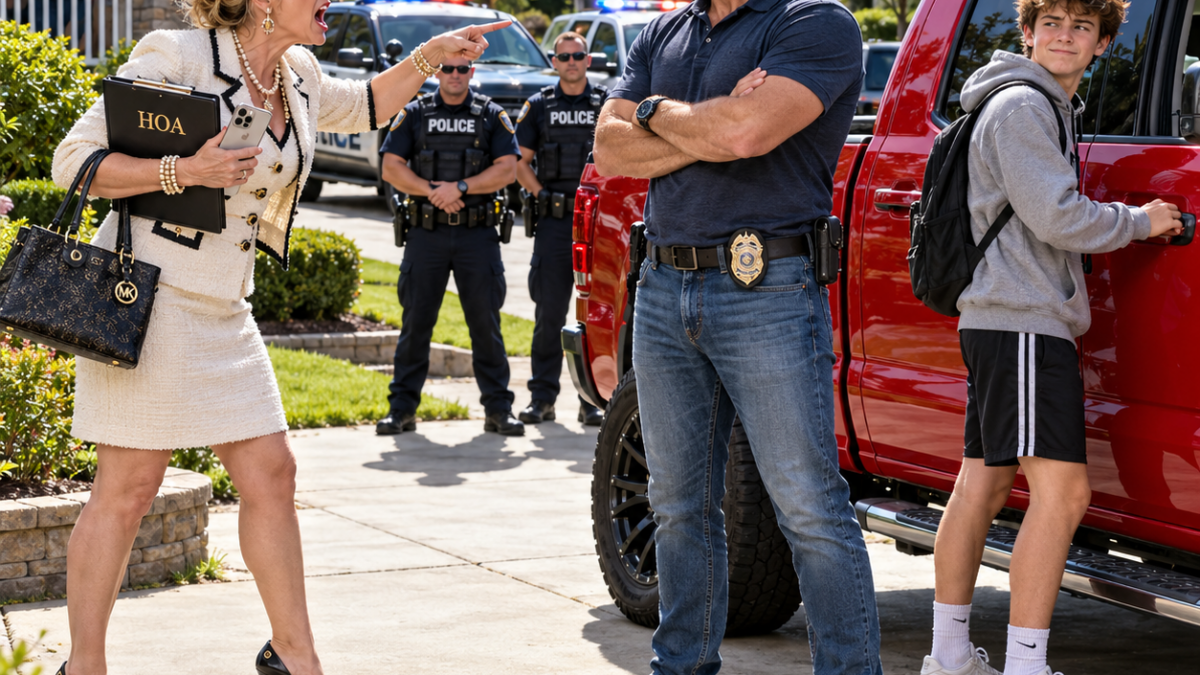
PART 2
I had spent most of my adult life learning how not to react too quickly.
That skill sounds simple until someone is standing in your driveway calling emergency services because you refused to lend her teenager a forty-thousand-dollar truck.
My first instinct was disbelief.
My second was irritation.
My third—and thankfully strongest—was training.
Stay calm.
Listen.
Don’t make the situation bigger than it already is.
Karen turned her back slightly while speaking to the dispatcher.
I could only hear pieces of the conversation.
“Yes, he’s refusing.”
“No, nobody is injured.”
“Yes, he’s right here.”
Then she lowered her voice.
“He’s being very intimidating.”
That got my attention.
“Karen.”
She held up one finger as if I were interrupting an important business meeting.
I almost laughed.
Instead, I remained where I was.
Her son stood near the truck, running his eyes over the wheels.
He seemed less embarrassed by the situation than I would have expected.
If anything, he looked entertained.
That bothered me more than Karen’s performance.
A teenager watching his mother call 911 because a neighbor said no should have been uncomfortable.
Instead, he looked like he expected the system to produce the answer he wanted.
I wondered how many times in his life that had already happened.
Karen ended the call.
“They’re coming.”
“I figured.”
Her expression changed slightly.
Perhaps she had expected surprise.
Or nervousness.
Or a hurried apology.
I gave her none of those things.
“You should probably reconsider before they arrive,” she said.
“Reconsider what?”
“Letting him take the truck around the block.”
“No.”
She stared.
“You’re really going to make this into a whole thing?”
I couldn’t believe the sentence.
“I’m not the one who called 911.”
“You forced me to.”
“No, Karen. I said one word.”
“What?”
“No.”
Her son snorted.
She shot him a quick look before turning back to me.
“You think because of your position you can treat people however you want.”
I had deliberately avoided mentioning my job.
Most people in the neighborhood knew what I did, but apparently Karen had either forgotten, didn’t care, or believed the fact somehow strengthened her argument.
“My position has nothing to do with this.”
“Exactly,” she said.
I blinked.
There was no logical path through that statement, so I didn’t attempt one.
She began pacing.
Then came the complaints.
My trash bin.
My truck occasionally parked in the driveway instead of the garage.
A package that had apparently sat on my porch for half a day.
A lawn service vehicle that had once blocked part of the curb.
The list became increasingly detached from the reason we were standing there.
I let her speak.
Every additional sentence made one thing clearer.
She wasn’t trying to solve a problem.
She was trying to establish dominance.
The sad part was that it had probably worked with other people.
Nobody wanted an HOA dispute.
Nobody wanted complaints.
Nobody wanted pictures of their house circulating through neighborhood messages.
So people gave in.
Not because Karen was right.
Because surrender was easier.
I understood that temptation.
I also understood what happens when unreasonable behavior is consistently rewarded.
It grows.
Five minutes passed.
A neighbor across the street stepped outside with a mug in his hand.
He looked toward us.
I gave him a small nod.
He stayed on his porch.
Then another front door opened farther down the block.
Karen noticed.
Her performance changed immediately.
Her voice became louder.
“I cannot believe you are behaving like this!”
I looked at her.
“Behaving like what?”
“You know exactly what you’re doing.”
“Yes. Standing in my driveway.”
Her son laughed again.
This time Karen ignored him.
“You think nobody can challenge you.”
“Karen, you asked to use my property. I declined.”
“Because you don’t respect this community.”
I looked around at the houses.
“That conclusion is doing a lot of work.”
She narrowed her eyes.
Then we heard sirens.
I closed my eyes for half a second.
Of course they had lights and sirens.
The dispatcher had apparently coded the call with enough concern that the responding units weren’t treating it as a casual neighborhood disagreement.
Two marked patrol cars turned onto our street.
Several more curtains moved.
Now people were openly stepping outside.
The first cruiser stopped near my driveway.
The second parked behind it.
I recognized both officers immediately.
Officer Ramirez stepped from the first vehicle.
Officer Collins exited the second.
Both were solid officers.
Professional.
Measured.
The kind of people I trusted to handle difficult situations without turning every encounter into a confrontation.
Ramirez looked toward Karen.
Then toward me.
His face changed.
Not dramatically.
He was too professional for that.
But I saw the exact second recognition hit him.
“Chief?”
Karen smiled triumphantly.
“Yes,” she said. “Exactly.”
Ramirez looked from her to me.
Collins came around the front of his cruiser and stopped beside him.
He also recognized me.
There was a long, strange pause.
I decided to make things easy.
“Morning, gentlemen.”
“Morning, Chief,” Ramirez said cautiously.
Karen rushed toward them.
“Finally. He refuses to let my son drive his truck.”
Silence.
Ramirez blinked.
Collins looked at Karen.
Then at the truck.
Then at her son.
Then back at Karen.
“I’m sorry,” Ramirez said. “Could you explain that again?”
“My son asked to drive his truck.”
She pointed directly at me.
“He said no.”
“Yes, ma’am.”
“And he won’t change his mind.”
Ramirez waited.
I could almost hear him searching for the missing part.
There wasn’t one.
Karen continued.
“I called because somebody needs to explain to him that he can’t behave this way just because he’s the police chief.”
Officer Collins shifted his weight.
“Ma’am, is this his truck?”
“Yes.”
“Is it registered to him?”
“I assume so.”
“Did he take anything from you?”
“No.”
“Threaten you?”
“He’s intimidating.”
Collins looked at me.
I hadn’t moved.
My hands were visible.
My coffee was sitting on the hood.
I probably looked more tired than intimidating.
Ramirez asked, “What exactly would you like us to do?”
Karen’s answer came without hesitation.
“Tell him to let my son drive it.”
That was the moment one of my neighbors across the street coughed loudly into his coffee.
I was fairly certain he was covering a laugh.
Ramirez maintained a completely neutral expression.
“Ma’am, we cannot order someone to let another person operate their privately owned vehicle.”
Karen looked genuinely shocked.
“But he’s refusing for no reason.”
“He doesn’t need a reason.”
“He’s the chief.”
“That doesn’t change ownership of his personal vehicle.”
She turned toward me.
I could see anger building.
Not because anything unfair had happened.
Because the authority she had summoned was refusing to validate her.
I finally spoke.
“Officers, there’s no criminal issue here. She asked if her son could drive my truck. I declined. That should have ended the conversation.”
Karen whipped around.
“Don’t speak for me.”
“I’m explaining my part.”
“You always do this.”
I frowned.
“Always do what?”
“Act like you’re above everybody.”
I almost responded.
Then I stopped myself.
This was exactly how unnecessary arguments started.
One person threw an accusation.
The other defended himself.
The first added another accusation.
Soon nobody remembered what began the conversation.
So I looked at Ramirez.
“I’d like this documented accurately. Beyond that, I don’t want special treatment.”
His expression relaxed slightly.
“Understood.”
Karen laughed sharply.
“Special treatment? You already have special treatment. They work for you.”
That was a fair concern in principle.
Not in substance, but in appearance.
So I made another decision.
“Ramirez, Collins, handle this exactly as you would if I were any other homeowner.”
“Yes, Chief.”
“And if you think there’s any conflict because of my position, have a supervisor who wasn’t involved review the report.”
Karen’s confidence flickered.
She hadn’t expected that.
People abusing authority usually avoid documentation.
I was requesting it.
“See?” I told her. “Nobody is hiding anything.”
“You’re controlling the entire situation.”
“No. I’m making sure there’s a record.”
Her son had been quiet for several minutes.
Then he walked toward the driver’s side of my truck.
At first, I assumed he was simply moving out of the way.
Then his hand reached for the door handle.
“Don’t.”
My voice wasn’t loud.
It didn’t need to be.
He stopped.
Karen immediately stepped between the officers and her son.
“He’s not doing anything.”
“He’s reaching for my vehicle after I told him he doesn’t have permission.”
“He only wants to look inside.”
“He can look through the window.”
The boy’s hand went toward the handle again.
I moved between him and the door.
Not touching him.
Not crowding him.
Simply occupying the space.
“No.”
He looked at me with an expression I had seen many times during my career.
It was the expression of somebody who had pushed small boundaries for so long that a firm one felt offensive.
“Seriously?” he said.
“Seriously.”
“It’s just a truck.”
“Then it shouldn’t matter that you can’t drive it.”
He looked toward his mother.
That was revealing.
Not toward the officers.
Not toward me.
Toward her.
Waiting for her to make the obstacle disappear.
Karen pointed at me.
“There! That tone. Did you hear that?”
Ramirez answered carefully.
“Yes, ma’am.”
“He’s threatening my son.”
“No,” Collins said. “He told your son not to enter his vehicle.”
“He stepped in front of him.”
“Because your son reached for the door.”
Her face flushed.
“This is unbelievable.”
For once, I agreed.
She started speaking faster.
About my job.
About the HOA.
About favoritism.
About supposed neighborhood rules.
About how she paid taxes.
About how police officers worked for residents.
None of it changed the central fact.
The truck belonged to me.
She didn’t get to use it.
Her son didn’t get to use it.
No badge, HOA rule, tax payment, neighborhood membership, or argument changed that.
Finally, I had enough.
Not anger.
Enough.
There’s a difference.
Anger wants to win.
Enough wants the situation to end.
I looked directly at Karen.
“This conversation is finished.”
She opened her mouth.
I continued before she could speak.
“You and your son came onto my property to ask for permission to use my vehicle. I said no. You then called emergency services. Officers came and explained the same thing. Your son has now reached for my truck twice after being told he does not have permission.”
I pointed gently toward the sidewalk.
“I am asking both of you to leave my property.”
For the first time all morning, Karen became completely silent.
Her son lowered his hand.
I kept my voice level.
“I am not asking as police chief. I am asking as the homeowner.”
That distinction mattered to me.
I didn’t want my badge involved.
I didn’t need it.
The title to my truck and the boundaries of my property were enough.
Karen looked at the officers.
Neither rescued her.
She looked at the neighbors.
Nobody stepped forward.
She looked at her son.
He stared at the pavement.
Then she looked back at me.
“This isn’t over.”
I hated that phrase.
Not because it frightened me.
Because I had heard versions of it from too many people who believed ordinary disagreement required retaliation.
“I hope it is,” I said.
She spun around and walked toward her house.
Her son followed.
Halfway down the sidewalk, she stopped.
Turned.
Raised her phone.
And photographed my driveway.
I didn’t react.
Then she continued home.
Ramirez waited until her front door closed before letting out a slow breath.
Collins looked at me.
“Chief.”
“Yes?”
“I have been dispatched to some unusual calls.”
“I know.”
“This is going in the top five.”
Despite myself, I laughed.
The tension finally broke.
But only for a moment.
I knew what came next.
Documentation.
Because the most dangerous part of a ridiculous dispute isn’t always the event itself.
Sometimes it’s the story people tell afterward.
“Write everything down,” I said.
Ramirez nodded.
“Everything?”
“Everything.”
“The request to drive the truck?”
“Yes.”
“The 911 call?”
“Yes.”
“The attempts to open the door?”
“Yes.”
He glanced toward Karen’s house.
“And her complaint about your trash cans?”
I smiled.
“You can probably summarize that.”
Collins laughed quietly.
Then I became serious again.
“I mean it. Don’t protect me because I’m chief. If I said something inappropriate, put it in the report. If you think I handled something wrong, put it in the report.”
Ramirez nodded.
“That’s not what happened.”
“I know. But the record should speak for itself.”
That principle had protected me throughout my career.
Memory gets emotional.
Rumors grow.
People exaggerate.
Documentation stays boring.
And boring can be beautiful.
The officers left about fifteen minutes later.
I stood in my driveway after the cruisers disappeared.
The neighborhood slowly returned to normal.
Or pretended to.
A lawn mower started two houses away.
Someone dragged a garbage bin toward a garage.
A dog barked.
For a few seconds, it almost felt like the morning had reset itself.
Then my phone buzzed.
A text from a neighbor.
**You okay?**
Another arrived immediately.
**What on earth was that?**
Then another.
**Check the neighborhood group.**
I didn’t want to.
That meant I definitely needed to.
I opened the HOA community page.
Karen had already posted.
The speed was impressive.
According to her version, a “local official” had used his position to intimidate a mother and her teenage son during a “simple neighborhood interaction.”
She didn’t initially mention the truck.
She didn’t mention that she had asked to borrow it.
She didn’t mention that I had said no before anyone raised their voice.
She didn’t mention calling 911 because of that refusal.
She definitely didn’t mention her son reaching for the door after being denied permission.
Instead, she wrote about “abuse of authority.”
“Unequal treatment.”
“A hostile environment.”
“Residents being silenced.”
Within minutes, comments appeared.
Some people had witnessed the incident.
Others had not.
The difference was obvious.
The neighbors who had actually seen what happened asked specific questions.
The people who hadn’t seen it reacted to Karen’s version.
**What did he do?**
**Why were police called?**
**Was anyone arrested?**
Karen replied vaguely.
**The matter is being handled.**
That phrase made me smile despite my irritation.
Nothing was being handled.
There was nothing to handle.
Then someone wrote:
**I was across the street. You called police because he wouldn’t let your son drive his pickup.**
The comment sat there for maybe thirty seconds before disappearing.
Karen deleted it.
Another neighbor reposted the same fact.
That disappeared too.
Then a third person posted:
**Why are comments from witnesses being removed?**
That one stayed.
Probably because deleting it would have looked worse.
My phone began buzzing faster.
Screenshots.
Questions.
Offers of support.
I put the phone facedown on the kitchen counter.
I wasn’t going to fight a social media battle.
That would have been satisfying for approximately five minutes and exhausting for several days.
Instead, I poured out the cold coffee I had forgotten in the driveway and made another cup.
Then I sat at my kitchen table with a legal pad.
At the top, I wrote:
**Sunday incident — personal record.**
I listed times as accurately as I could remember them.
When Karen approached.
When she asked about the truck.
When I refused.
When she called 911.
When the officers arrived.
What was said.
When her son reached toward the door.
When I asked them to leave.
Then I emailed myself the notes so they had a timestamp.
Again, boring.
Again, useful.
At the station the next morning, I expected jokes.
I underestimated my officers.
By 8:05 a.m., someone had placed a toy red pickup truck on my desk.
No note.
At 8:20, another appeared beside it.
At 8:45, my deputy chief walked into my office, closed the door, looked at the two toy trucks, and started laughing.
“I assume you’ve heard,” I said.
“Chief, by six last night, half the department had heard.”
“Wonderful.”
He sat down.
“Are you all right?”
“I’m fine.”
“I read the incident report.”
“Anything concern you?”
“Only that somebody thought 911 was an appropriate customer-service line for borrowing a vehicle.”
I leaned back.
“I don’t want this treated like a joke officially.”
His expression became serious.
“I know.”
“I also don’t want anyone retaliating against her, making comments, driving slowly past her house, anything like that.”
“Already told the shift commanders.”
“Good.”
That mattered.
I had authority over the officers who had responded.
That created a responsibility far beyond the original dispute.
I couldn’t control Karen.
I could control how my department behaved.
My deputy slid a copy of the report across the desk.
“You asked for independent review.”
“Yes.”
“I had the captain review it this morning. No policy concerns involving the responding officers. Nothing suggesting criminal conduct on your part. The call is closed.”
I read the summary.
Dry.
Factual.
Perfect.
Resident requested police assistance after homeowner declined permission for resident’s son to operate homeowner’s personal vehicle.
No threats observed.
No physical confrontation.
Parties separated without further incident.
That was reality reduced to four lines.
No dramatic adjectives.
No neighborhood politics.
No emotional interpretation.
Just facts.
“Thank you,” I said.
He started to leave.
Then paused.
“One more thing.”
“What?”
“The HOA sent a complaint to the city manager.”
Of course they had.
“Karen?”
“Her name is on it.”
I held out my hand.
He gave me a printed copy.
It was longer than the police report.
Much longer.
Karen accused me of using “the visible presence of subordinate officers” to intimidate her.
She claimed my refusal had become “hostile.”
She wrote that her son had been “publicly embarrassed.”
She suggested I had “weaponized my official position in a private neighborhood disagreement.”
That last line was serious.
Not because it was true.
Because allegations involving public officials deserve proper review.
I read the complaint twice.
Then set it down.
My deputy watched me.
“What are you going to do?”
“The same thing I’d want one of you to do.”
“Which is?”
“Cooperate.”
He nodded.
I called the city manager myself.
“I understand you received a complaint involving me.”
“We did.”
“I’d like it handled normally.”
There was a pause.
“You want formal review?”
“If that’s what policy requires.”
“You know this complaint came from a disagreement about your private truck, right?”
“Yes.”
Another pause.
“All right.”
“I’ll provide a written statement. The incident report already exists. The responding officers should be interviewed without me present.”
“That seems excessive.”
“Maybe.”
I looked through my office window at the hallway outside.
“But if I dismiss it because I think it’s ridiculous, I become part of the story she’s trying to tell.”
That was one lesson rank had taught me.
Power doesn’t only mean having the ability to act.
Sometimes power means deliberately refusing shortcuts.
I sent my written statement before lunch.
It was less than one page.
Karen asked if her teenage son could operate my privately owned truck.
I declined.
She contacted emergency services.
Officers responded.
No enforcement action was necessary.
Her son later approached the driver’s door after permission had already been denied.
I asked both individuals to leave my property.
At no point did I direct officers to take enforcement action against either person.
I requested independent review of the responding officers’ report because of my supervisory position.
That was it.
No insults.
No discussion of her reputation in the HOA.
No description of her personality.
Facts.
By Tuesday, Karen’s social media version had evolved.
Now she claimed her son had never actually asked to drive the truck.
He had supposedly only wanted to “see it.”
Unfortunately for that version, several neighbors had heard the original conversation.
One of them was Mark, the man across the street with the coffee mug.
He sent me a message.
**Do you need a witness statement?**
I hesitated.
I didn’t want the neighborhood choosing sides.
But a formal complaint now existed.
So I replied:
**Only if somebody conducting the review asks you. Please don’t argue online for me.**
His response came back.
**Fair. But for the record, I heard the entire thing.**
That evening, somebody knocked on my door.
It was Karen’s son.
Alone.
For a moment I considered not opening it.
Then I stepped onto the porch.
He kept his hands in the pockets of his hoodie.
The confidence from Sunday was gone.
“Can I talk to you?”
“Yes.”
He looked toward his house.
“My mom doesn’t know I’m here.”
“That’s between you and her.”
He nodded.
For several seconds, neither of us spoke.
Then he said, “I’m sorry.”
I hadn’t expected that.
“For what?”
“For reaching for the door.”
I waited.
“And for the whole thing.”
I studied him.
He looked uncomfortable.
Not afraid.
Embarrassed.
There’s a difference.
“Why did you reach for it after I said no?”
He kicked lightly at the edge of my walkway.
“I thought you’d give in.”
“Why?”
Another silence.
“Because people usually do.”
There it was.
Not defiance.
Not evil.
Something sadder.
Expectation.
He had learned that persistence could turn someone else’s no into his yes.
I leaned against the porch railing.
“You have your own car?”
“Yeah.”
“What do you drive?”
“Old Civic.”
“Good car.”
He made a face.
“It’s boring.”
“So was my first car.”
“What was it?”
“A sedan that made a strange noise whenever I turned left.”
He smiled.
I continued.
“I loved that car.”
“Why?”
“Because it was mine.”
He looked at the F-150 in the driveway.
“I really do like your truck.”
“I know.”
“I wasn’t going to damage it.”
“I don’t think you planned to.”
“Then why wouldn’t you let me drive it?”
That question mattered.
Not because I owed him an explanation.
Because he might actually be ready to hear one.
“Because you asked to use something that belongs to me, and I didn’t want you to use it.”
He looked confused.
“That’s it?”
“That’s enough.”
He stared at the pavement again.
“I guess.”
“No. Not ‘I guess.’ It needs to be enough.”
His expression tightened slightly.
I kept my tone calm.
“You’re going to hear no thousands of times in your life. From employers. Friends. Women you date. Banks. Coaches. Teachers. Neighbors. Maybe your own kids someday.”
He looked up.
“You don’t have to like it.”
I pointed toward my truck.
“But somebody else’s boundary isn’t an insult just because it disappoints you.”
He was silent for a while.
Then he nodded.
“Okay.”
I believed him more than I expected to.
Not because one conversation magically changed him.
Life rarely works like that.
But at least he was thinking.
Before leaving, he looked back at the truck.
“Still can’t drive it?”
I stared at him.
He grinned.
I laughed.
“Go home.”
“Yes, sir.”
That small exchange changed something for me.
Not about Karen.
About him.
Until then, I had viewed mother and son almost as a single problem.
But teenagers are unfinished people.
They imitate what works around them.
Sometimes they need to encounter a different model.
A boundary without humiliation.
Authority without cruelty.
No without hatred.
The next morning, the city manager called.
“The preliminary review found nothing improper.”
“I appreciate the update.”
“We’re closing it unless new information appears.”
“Fine.”
“There is something else you should know.”
I waited.
“Karen has requested an HOA hearing regarding your conduct.”
I closed my eyes.
“You’re joking.”
“I wish.”
“What exactly can an HOA hearing do about my refusal to lend someone a truck?”
“I have no idea.”
Neither did I.
That evening, an email arrived from the HOA board.
Karen had submitted a written complaint alleging that my conduct had caused a “community disturbance” and created an “intimidating atmosphere.”
The board was obligated under its rules to allow complaints to be presented at the next meeting.
I read the email twice.
Then checked the bylaws.
Technically, she was correct.
Any homeowner could raise a community concern.
Fine.
If Karen wanted a meeting, she could have a meeting.
But there was one thing I wasn’t going to do.
I wasn’t going to enter that room angry.
Anger would be useful to her.
So I prepared the same way I prepared for a difficult city council session.
I printed the incident report.
My written statement.
The city’s review finding.
The HOA complaint.
Then I put everything in a thin folder.
Nothing more.
No photos of Karen.
No collection of past complaints.
No neighborhood gossip.
I had enough.
The HOA meeting was Thursday at seven.
By 6:45, almost every chair in the community room was occupied.
I had attended HOA meetings before.
Usually twelve people came.
Maybe fifteen if someone wanted approval for a fence.
That night there were more than forty.
People stood along the back wall.
Apparently, the story had become neighborhood entertainment.
I hated that.
Karen did not.
She arrived carrying a thick binder.
Her son wasn’t with her.
She took a seat near the front.
I sat in the second row on the opposite side.
At seven, the board president called the meeting to order.
Routine matters came first.
Landscaping.
Pool maintenance.
A broken light near the mailboxes.
Nobody cared.
Everyone was waiting for Karen.
Finally, the president adjusted his glasses.
“Next item is a homeowner complaint regarding an incident Sunday morning.”
Karen raised her hand before he finished.
“I’d like to speak.”
“You’ll have an opportunity.”
She lowered her hand.
The president looked toward me.
“And because the complaint involves another homeowner, he will also have an opportunity to respond.”
I nodded.
Karen went first.
For nearly ten minutes, she described herself as a concerned mother who had tried to encourage “positive neighbor interaction.”
She said I had reacted coldly.
She said I had made her son feel unwelcome.
She said the arrival of officers had “amplified the imbalance of power.”
She repeatedly mentioned my position.
Interestingly, she barely mentioned the reason officers had arrived.
Finally, one board member interrupted.
“Karen, who called the police?”
She paused.
“I did.”
“Why?”
“Because the situation was escalating.”
“How?”
“He was refusing to cooperate.”
The board member frowned.
“Cooperate with what?”
Karen looked annoyed.
“My son wanted to experience the truck.”
A murmur moved through the room.
The president tapped his pen.
“Meaning drive it?”
“Briefly.”
“So you asked this homeowner to let your son drive his personal vehicle?”
“Yes.”
“And he said no?”
“He was very dismissive.”
“That wasn’t my question.”
The room became quiet.
Karen’s face tightened.
“Yes.”
“And then you called 911?”
“I felt the situation required intervention.”
The board member leaned back.
“For a denied request to borrow a truck?”
Karen opened her binder.
“There were other issues.”
She began talking about trash cans.
I almost felt sorry for her.
Not enough to rescue her from the consequences of her own complaint, but enough to recognize what was happening.
She had built the event into something so large in her mind that she could no longer retreat without feeling humiliated.
The president finally stopped her.
“We need to stay focused.”
She closed the binder sharply.
Then it was my turn.
I stood.
Every face turned toward me.
I could have made a speech.
I didn’t.
I held up the folder.
“Sunday morning, Karen asked whether her son could drive my truck. I declined. She called 911. Two officers responded. Her son later reached for my driver’s-side door after permission had been denied. I asked both of them to leave my property.”
I placed the incident report on the table.
“This is the responding officers’ report.”
Then the city review.
“Because I supervise the police department, I requested independent administrative review. That review found no improper conduct.”
Then I sat down.
The board president looked surprised.
“That’s all?”
“Yes.”
Karen stood again.
“That report was written by his own officers!”
I remained seated.
The president raised a hand.
“He said the matter was independently reviewed.”
“That’s still his department.”
A woman in the back of the room spoke.
“I saw the whole thing.”
Everyone turned.
It was Mrs. Douglas, who lived three houses down.
She was in her seventies and rarely attended HOA meetings.
Karen looked irritated.
The president asked, “Were you outside?”
“I was watering the plants on my porch.”
“What did you observe?”
Mrs. Douglas adjusted her glasses.
“I observed Karen asking to borrow a vehicle that didn’t belong to her.”
Someone laughed.
Mrs. Douglas looked around.
“I don’t think it’s funny.”
The room became quiet again.
She continued.
“I heard him say no several times. I heard Karen tell him he was being unreasonable. I heard her say she was calling police.”
Karen interrupted.
“You were too far away to hear everything.”
Mrs. Douglas turned toward her.
“Dear, your voice carries.”
That time, even the board president struggled not to smile.
Then Mark spoke.
“I was directly across the street.”
Another neighbor added that she had watched from her driveway.
One by one, the dramatic version Karen had posted online collapsed under ordinary eyewitness accounts.
Nobody shouted at her.
Nobody insulted her.
That made it worse.
Facts don’t give you anything to fight.
Karen tried to shift the issue again.
“This isn’t about whether he technically owned the truck.”
The board president blinked.
“I think ownership is fairly central to a dispute about who gets to drive it.”
A few people laughed.
Karen’s face reddened.
“This is about community spirit.”
That was when I finally stood again.
“May I respond to that?”
The president nodded.
I faced Karen, not the room.
“Community does matter.”
She crossed her arms.
“Community means helping each other. It means looking out for neighbors. It means respecting shared spaces.”
I paused.
“But community does not erase private boundaries.”
Nobody spoke.
“If your son’s car had broken down and you needed help getting him somewhere important, I probably would have helped.”
Karen looked surprised.
“If you needed groceries during an emergency, I would help.”
I pointed toward the windows and the houses beyond them.
“I believe most people here would.”
Then I looked back at her.
“But asking for help and demanding access are not the same thing.”
Her expression changed.
Just slightly.
“You asked for my truck. I said no. That should not have required police, an administrative complaint, an online campaign, and an HOA hearing.”
The president nodded slowly.
I continued.
“I am not asking the board to punish Karen.”
That got everyone’s attention.
Even Karen’s.
“I am asking the board to make one thing clear for every resident, including me: nobody is entitled to another homeowner’s personal property simply because we share an HOA.”
The president looked toward the other board members.
“That seems reasonable.”
One of them nodded.
Another leaned toward his microphone.
“I would go farther. Emergency services should not be used as leverage in ordinary neighborhood disagreements.”
Karen looked at him sharply.
He continued.
“That’s not a punishment. That’s common sense.”
For the first time since Sunday, I saw Karen without the performance.
No raised voice.
No dramatic gestures.
No phone held in the air.
She simply sat there.
And she looked tired.
The board voted to close the complaint with no violation against me.
Then, after a short discussion, they agreed to circulate a community reminder.
It would say that residents were expected to respect private property, avoid escalating personal disagreements, and reserve emergency calls for situations that reasonably required emergency assistance.
No names.
No public shaming.
No special rule written around Karen.
Just a standard that applied to everyone.
That was enough for me.
The meeting could have ended there.
But Karen stood.
Her voice was quieter.
“So everyone’s just taking his side.”
I looked at her.
“This doesn’t have to be about sides.”
She laughed bitterly.
“That’s easy for you to say.”
“No. It’s actually the whole point.”
She picked up her binder.
“You got exactly what you wanted.”
I shook my head.
“I wanted to drink coffee in my driveway.”
Several people laughed softly.
Even the board president smiled.
Karen didn’t.
She walked toward the exit.
As she passed me, she stopped.
For a second I expected another accusation.
Instead she said, “My son apologized to you, didn’t he?”
I hesitated.
That was between him and me.
“He and I talked.”
Her face tightened.
“He shouldn’t have gone over there.”
“He made his own choice.”
“He’s seventeen.”
“Exactly.”
She stared at me.
I lowered my voice so the room couldn’t hear.
“He did something mature.”
Something changed in her expression.
Not gratitude.
Not yet.
Maybe surprise.
“He apologized,” I continued. “I accepted it. I’m not holding anything against him.”
She looked toward the door.
“You think I raised him wrong.”
“I didn’t say that.”
“You think it.”
“I think every teenager has things left to learn.”
She looked back at me.
“And parents?”
I smiled slightly.
“All of us do.”
For a moment, I thought she might smile too.
She didn’t.
But she also didn’t argue.
She left.
I stayed behind to answer a couple of questions from neighbors.
Most were supportive.
A few wanted details.
I refused to turn the event into entertainment.
When Mark joked that I should install a steering-wheel lock just in case, I told him I already had the best anti-theft system available.
“What’s that?”
“I keep the keys.”
He laughed.
For the next week, the neighborhood was strangely peaceful.
Karen stopped posting about me.
The online thread disappeared.
The HOA sent its reminder.
The city closed its review formally.
At the station, the toy trucks on my desk multiplied to five before I finally threatened to assign whoever brought the next one to inventory duty.
They stopped at five.
Mostly.
Then, on Saturday morning, I walked outside and found an envelope under my windshield wiper.
For one second, my stomach tightened.
No return name.
No HOA logo.
Just my first name written on the front.
I opened it.
Inside was a short handwritten note.
It was from Karen’s son.
**Thanks for talking to me like a person instead of treating me like an idiot. I get why you said no now. Sorry again.**
Below that, he had added:
**My Civic still isn’t as cool as your truck.**
I laughed.
Then I folded the note and put it in my pocket.
That mattered more to me than winning an HOA meeting.
Because there had been a moment on Sunday when I could have humiliated that kid.
I had the position.
The audience.
The officers.
The knowledge.
I could have made him feel very small.
Maybe some people would have enjoyed watching it.
Maybe social media would have loved it.
But authority used for humiliation isn’t strength.
It’s insecurity wearing a uniform.
I had learned that lesson from someone else many years earlier.
Long before I became chief.
When I was twenty-two and fresh out of the academy, I worked under a sergeant named Harris.
He was the calmest man I had ever met.
Nothing seemed to shake him.
One night, I made a mistake during a traffic stop.
Not a catastrophic mistake.
Nobody was hurt.
But I became impatient with a driver who kept arguing.
I let irritation enter my voice.
Then I raised it.
Afterward, I expected Harris to tear into me.
Instead, he asked me to sit in the passenger seat of his cruiser.
He said, “You know what the easiest thing in the world is?”
I shook my head.
“Making someone feel powerless when you have authority.”
I never forgot that.
Then he said something that stayed with me for the rest of my career.
“The badge can make people obey you. It can’t make them respect you.”
I thought about Sergeant Harris while holding that teenager’s note.
There are moments when life returns lessons to you from years ago.
Sometimes they arrive in dramatic situations.
Sometimes they arrive under a windshield wiper.
I put the note in the center console of my truck.
Not as a trophy.
As a reminder.
The story still wasn’t quite finished.
Two weeks later, our neighborhood held its annual fall cleanup day.
Normally, volunteers gathered near the community center, picked up litter, trimmed common landscaping, and helped older residents with heavier yard work.
I almost skipped it.
After everything that had happened, spending Saturday morning beside HOA members sounded less relaxing than paperwork at the station.
But avoiding the event would have sent a message I didn’t want to send.
This was still my neighborhood.
Karen didn’t own it.
Neither did I.
So at eight in the morning, I pulled the F-150 into the community lot loaded with rakes, gloves, trash bags, bottled water, and several bags of mulch.
Mark saw the truck and grinned.
“You letting anybody else drive today?”
“Careful.”
He held up both hands.
“Just asking.”
People laughed.
The joke no longer bothered me.
Sometimes humor is how communities release tension.
Then I noticed Karen near the far end of the parking lot.
She was organizing bags.
Her son was beside her.
He saw me first.
He gave a small wave.
I waved back.
Karen noticed.
For a few seconds, we simply looked at each other across the lot.
Then she returned to her work.
That was fine.
We didn’t need a dramatic reconciliation.
Real life rarely provides them.
About an hour later, I was helping Mrs. Douglas move bags of soil toward her garden when I heard someone behind me.
“Need help?”
Karen’s son.
“Sure.”
We loaded two bags into the truck bed.
He paused near the tailgate.
Then looked toward the cab.
I raised an eyebrow.
He laughed.
“Relax. I learned.”
“Good.”
We carried the bags to Mrs. Douglas’s house.
On the walk back, he said something unexpected.
“I’m applying for a job.”
“Good.”
“Auto shop.”
“That fits.”
“My mom wants me to focus on college applications.”
“You can do both.”
“That’s what I said.”
I looked at him.
“How did that go?”
He smiled.
“Not great.”
I laughed.
He became serious.
“I’m saving for a better car.”
“Nothing wrong with the Civic.”
“I know.”
There was maturity in that answer that hadn’t been there two weeks earlier.
Maybe I was imagining it.
Maybe not.
When we returned to the community center, Karen was standing beside my truck.
My first reaction was almost comic.
Of all places.
Of all vehicles.
But she wasn’t touching it.
She was waiting.
Her son walked away to help someone else.
Karen looked at me.
“I heard about the note.”
I nodded.
“He told me.”
“He’s a good kid.”
“I know.”
That answer surprised her.
She looked toward him.
“I went too far.”
Four words.
Quiet.
Almost swallowed by the noise around us.
I didn’t make her repeat them.
“I appreciate you saying that.”
She folded her arms.
Not defensively.
More like she didn’t know what to do with her hands.
“I thought you were trying to embarrass me.”
“I wasn’t.”
“I know that now.”
I nodded.
She looked at the F-150.
“He really does like that truck.”
“I noticed.”
Then, unexpectedly, she smiled.
It wasn’t the tight smile she had worn before calling 911.
It was tired.
Human.
“He has been talking about trucks for six months.”
“That still doesn’t get him the keys.”
“I know.”
I looked at her.
The fact that she said those two words without anger mattered.
I could have ended the conversation there.
Instead, I made a decision.
“Come here.”
She frowned.
I lowered the tailgate.
Then I called her son.
He walked over.
“What?”
“You wanted to see the truck.”
His eyes widened.
Karen looked at me.
I held up one finger.
“See.”
The boy laughed.
“Not drive.”
“Correct.”
I opened the passenger door.
He looked inside.
Asked about the dashboard.
The engine.
The towing package.
The modifications.
We talked for ten minutes.
I even opened the hood.
He knew more about engines than I expected.
At one point, he reached toward the driver’s door.
Then stopped himself.
Looked at me.
“Can I sit in it?”
That might sound like a small question.
It wasn’t.
The first time, he had assumed.
Now he asked.
I smiled.
“Yes.”
He climbed into the driver’s seat.
Put his hands on the wheel.
Grinned like he was ten years old.
Karen stood beside me.
“Thank you.”
I watched him.
“See the difference?”
She knew exactly what I meant.
“He asked.”
“Yes.”
“And you still could’ve said no.”
“Yes.”
She nodded.
That was the lesson.
Not that asking politely guarantees a yes.
It doesn’t.
The lesson was that permission matters even when you desperately want the answer to be yes.
After a minute, her son climbed out.
“Thanks.”
“No problem.”
He handed me an imaginary key.
I pretended to take it.
“Smart.”
He laughed and walked away.
Karen remained.
“You know,” she said, “people are still talking about that Sunday.”
“They’ll eventually find something more interesting.”
“They’re calling it the truck incident.”
“Of course they are.”
She almost laughed.
Then her face became serious.
“I’m embarrassed.”
I could have said she should be.
I didn’t.
“Embarrassment passes.”
She looked at me.
“I made a fool of myself.”
“You made a bad decision.”
“There were several.”
“Also true.”
She laughed despite herself.
I continued.
“But you don’t have to turn one bad morning into your identity.”
That was something else Sergeant Harris had taught me.
Accountability should create a path forward.
Otherwise it becomes punishment for its own sake.
Karen nodded slowly.
“I deleted the posts.”
“I noticed.”
“I should’ve done it sooner.”
“Probably.”
“And the complaint.”
“That’s finished.”
She looked relieved.
“I thought you might use your position against me.”
“I never wanted to.”
“I probably would have, if I were you.”
“That’s exactly why people have to be careful with authority.”
Her expression changed again.
Maybe that sentence reached her.
Maybe not.
But we were finally speaking without trying to win.
The cleanup continued.
By noon, the common area looked better than it had in months.
As I loaded unused supplies into my truck, Mrs. Douglas walked over.
“I saw that,” she said.
“Saw what?”
“You let the boy sit in your truck.”
“He asked.”
She smiled.
“Good.”
Then she leaned closer.
“I still wouldn’t have.”
I laughed.
“Thank you, Mrs. Douglas.”
“You’re welcome.”
I drove home shortly afterward.
For the first time since the original incident, I parked the truck in my driveway without feeling like it had become a symbol of some neighborhood war.
It was just a truck again.
That felt good.
Months passed.
The story became one of those local legends that surfaced occasionally at parties or department gatherings.
New officers heard a version of it.
Neighbors exaggerated details.
One rumor claimed Karen had demanded the officers arrest me.
That never happened.
Another claimed she tried to take my keys from my hand.
Also false.
I corrected those stories whenever I heard them.
I didn’t need exaggeration.
The truth was strange enough.
Karen and I never became close friends.
That would have felt dishonest.
But we became neighbors.
Actual neighbors.
The kind who waved.
The kind who could speak without every conversation becoming a test of authority.
She still cared more about HOA rules than I did.
She still sent reminders about garbage bins.
But something changed in how she communicated.
The messages became less accusatory.
More often she asked before assuming.
I noticed.
I never mentioned it.
Her son got the job at the auto shop.
A few months later, he came by while I was changing a headlight bulb.
“You’re doing that wrong,” he said.
I turned slowly.
He grinned.
“Very brave opening sentence.”
He walked over.
“Want help?”
“Help?”
“Yes.”
Not, **Give me the tools.**
Not, **Move over.**
Not an assumption.
A question.
I handed him the wrench.
“Sure.”
He replaced the bulb in half the time it would have taken me.
Then he stood back proudly.
“You know,” I said, “I might let you work on this truck someday.”
His eyes widened.
“Seriously?”
“Work on it.”
I pointed at him.
“Not drive it.”
He laughed.
“I know.”
By spring, he had saved enough money to trade the Civic for an older used pickup.
Nothing fancy.
A little rust near one wheel well.
High mileage.
But mechanically sound.
One Saturday, he pulled into his driveway and immediately started washing it.
I stood across the street looking at him.
He caught me watching.
“What?”
“Nothing.”
“You’re judging the wash technique.”
“I absolutely am.”
He pointed the hose at me.
“Careful.”
I laughed.
Karen came outside carrying two drinks.
She handed one to him.
Then noticed me.
“Don’t encourage him.”
“I’m not doing anything.”
“He spent three hours cleaning that truck yesterday.”
“Good.”
She stared at my F-150.
“This is your fault.”
“Probably.”
Her son walked over to me.
“Want to drive it?”
I looked at him.
He grinned.
I knew exactly what he was doing.
“You sure?”
His grin disappeared for a second.
Apparently he hadn’t expected me to accept.
I folded my arms.
“You offered.”
He looked at his mother.
Karen started laughing.
“Go ahead,” she said. “You created this.”
He tossed me the keys.
I caught them.
Then I tossed them back.
“No thanks.”
His expression changed.
“Why not?”
I smiled.
“Because I don’t need to.”
He shook his head.
“You did that on purpose.”
“Absolutely.”
Karen laughed harder.
For a brief moment, standing between two driveways, the whole ridiculous story came full circle.
Nobody needed police.
Nobody needed an HOA complaint.
Nobody needed to win.
There were simply two neighbors joking about trucks.
And that was a much better ending than the one Sunday morning seemed determined to produce.
Years in law enforcement taught me that people often misunderstand strength.
They imagine strength as volume.
Control.
Dominance.
Having the final word.
Making the other person back down.
But some of the strongest moments in my career involved doing almost nothing.
Keeping my hands relaxed when someone wanted confrontation.
Lowering my voice when someone raised theirs.
Refusing to humiliate someone even when I had the opportunity.
Saying no without hatred.
Accepting an apology without demanding groveling.
Allowing someone to move forward after they admitted they were wrong.
Karen had wanted my refusal to become a battle over authority.
For a few days, it almost did.
But the real issue was much simpler.
My truck was mine.
Her son wanted something.
I said no.
Everything that followed came from the inability to accept that boundary.
The police report didn’t defeat her.
The city review didn’t defeat her.
The HOA meeting didn’t defeat her.
Because, in the end, I realized I didn’t actually want her defeated.
I wanted the behavior to stop.
There is an important difference.
Defeating someone gives you a temporary winner.
Changing a pattern gives everyone a better future.
The satisfying part wasn’t seeing Karen embarrassed at the HOA meeting.
It wasn’t watching witnesses contradict her.
It wasn’t receiving the city’s letter clearing my conduct.
Those things mattered because they protected the truth.
But they weren’t the part I remembered most.
I remembered her son standing on my porch and saying he was sorry.
I remembered him asking permission before sitting inside the truck.
I remembered Karen admitting she had gone too far.
And I remembered a rusty pickup pulling into the driveway across the street months later, driven by a teenager who had finally bought something of his own.
Maybe ownership taught him what my explanations couldn’t.
When you save your own money for something, care for it, repair it, worry about every scratch, and know exactly how much work it took to obtain, suddenly the words **“It’s mine, and I’d rather not lend it out”** sound completely reasonable.
One afternoon I saw him standing beside that old pickup talking to another teenager.
His friend pointed toward the driver’s seat.
Although I couldn’t hear the beginning of the conversation, I heard the ending.
“No,” Karen’s son said.
His friend kept talking.
He shook his head.
“I said no, man. I’m not comfortable with it.”
I stopped walking.
For a second, he didn’t notice me.
Then he did.
Our eyes met across the street.
I said nothing.
He looked at his truck.
Then at mine.
Then he smiled.
I smiled back.
That was enough.
That Sunday morning had started with a woman standing in my driveway believing a phone call could turn my no into a yes.
It ended months later with her son understanding that no didn’t require permission, justification, or approval from anyone else.
And somewhere between those two moments, all of us learned something.
Karen learned that authority—whether real, imagined, official, or social—doesn’t give anyone ownership over another person’s boundaries.
Her son learned that disappointment is not disrespect.
My neighbors learned that a dramatic accusation can sound convincing until the quiet facts arrive.
My officers were reminded that professionalism matters even during the most absurd calls.
And I learned something too.
I had spent years believing that being police chief meant I needed to know how to control difficult situations.
That morning reminded me that sometimes the best control is restraint.
I could have pulled rank.
I didn’t.
I could have humiliated Karen in front of the neighbors.
I didn’t.
I could have turned her son’s mistake into a lasting grudge.
I didn’t.
I could have used the HOA meeting as a stage for revenge.
Instead, I brought a thin folder filled with facts.
And the facts were enough.
That became my answer whenever officers later joked about the incident.
“Chief, what happened with the woman who called your own department on you?”
“She learned something.”
“What?”
“That my truck wasn’t community property.”
They would laugh.
Sometimes I laughed too.
But privately, I knew the story had become about much more than a Ford F-150.
It was about the dangerous little belief that some people develop when they hear yes too often.
The belief that wanting something creates a right to it.
It doesn’t.
You can ask.
You can hope.
You can negotiate when negotiation is appropriate.
You can even feel disappointed.
But sometimes another human being will simply say no.
And maturity begins with what you do next.
Karen had chosen escalation.
Her son had initially followed her example.
But eventually, both chose something better.
That mattered.
One Sunday the following summer, almost a year after the original incident, I was back where the whole mess began.
Driveway.
Coffee.
Morning sunlight.
Red F-150.
I heard footsteps.
I looked up.
Karen was walking past with her dog.
She stopped near the edge of the driveway.
For half a second, the memory made both of us smile.
“Morning,” she said.
“Morning.”
She nodded toward the truck.
“Still not letting my son drive it?”
I took a sip of coffee.
“Absolutely not.”
She laughed.
“Thought so.”
Then she continued walking.
No anger.
No phone.
No officers.
No audience.
Just a neighbor accepting an answer.
I looked at the truck.
The paint still gleamed.
There were a few more miles on it now.
A tiny scratch near the rear bumper.
A coffee stain in one cup holder that I had never completely removed.
It wasn’t perfect anymore.
Neither was the neighborhood.
Neither were the people living in it.
That was okay.
Communities don’t become peaceful because everyone agrees.
They become peaceful when people learn how to disagree without trying to destroy, dominate, shame, or control one another.
Sometimes that lesson begins in a city council chamber.
Sometimes it begins in a courtroom.
And sometimes, apparently, it begins in a suburban driveway because somebody wants the keys to a red Ford F-150.
I finished my coffee.
Put the mug down.
Climbed into the driver’s seat.
And before starting the engine, I noticed the old handwritten apology still tucked inside the center console.
I had forgotten it was there.
I unfolded it.
The paper was creased and faded.
**Thanks for talking to me like a person instead of treating me like an idiot. I get why you said no now. Sorry again.**
I read it once.
Then folded it carefully and put it back.
For years, I had received commendations.
Certificates.
Letters from city officials.
Awards that sat framed on office walls.
But that little note meant something different.
It reminded me that the goal of authority should never be to leave people smaller than you found them.
The best outcome is when everyone walks away understanding something they didn’t understand before.
I started the engine.
Across the street, Karen’s son was outside working on his own truck.
He heard mine start and looked over.
He raised one hand.
I raised mine.
Then he pointed at my F-150 and shouted, “Offer still open if you want to trade!”
I rolled down the window.
“Not a chance.”
He laughed.
“So that’s a no?”
“That’s a no.”
He nodded dramatically.
“See? I can handle those now.”
I shook my head, laughing as I backed out of the driveway.
And that, more than the police report, the HOA meeting, the city review, or Karen’s deleted social media posts, was the ending I wanted.
Nobody lost a home.
Nobody lost a career.
Nobody needed to be destroyed for the story to feel complete.
Karen faced the consequences of her behavior when her own complaint put the facts in front of the entire community.
Her son confronted a boundary he couldn’t push through and became more mature because of it.
I protected my property without abusing the power attached to my job.
And a neighborhood that had spent several days choosing sides eventually learned to laugh about the whole thing.
Karen had called the cops because I wouldn’t let her son drive my truck.
The officers arrived expecting a dispute.
Instead, they discovered the homeowner she wanted them to pressure was their own police chief.
But the real twist wasn’t my badge.
It was that I never needed it.
All I had needed from the beginning was one calm, lawful, completely ordinary word.
No.
And once everyone finally learned to respect that word, there was nothing left to fight about.

