PART 2: HOA Karen Called 911 on My Wife the Day She Returned From the USS Truman—Then One Officer Saw Her Rank
PART 2
Patricia measured lawns.
Literally.
I once saw her crouched beside the Johnsons’ front yard with a small metal ruler.
She fined the Andersons seventy-five dollars because their decorative garden gnome allegedly violated an exterior appearance rule.
The actual complaint, according to Mr. Anderson, involved the direction the gnome was facing.
Wrong direction.
Seventy-five dollars.
She cited the Gwyn family because their children’s bicycles had been visible from the street for more than thirty minutes.
She once spent two weeks arguing that a neighbor’s shutters were an unauthorized shade of beige.
Not blue.
Not bright red.
Beige.
The wrong beige.
Most residents had learned the same survival strategy I had.
Keep your head down.
Trim your grass.
Move the garbage cans quickly.
Don’t give Patricia a reason to learn your schedule.
I had been pretty successful.
Until my wife came home.
I was standing in the kitchen checking the pasta sauce when I heard shouting outside.
At first I ignored it.
People argued occasionally.
Then I heard a woman’s voice yell:
“DON’T MOVE!”
I froze.
The next voice was louder.
“I already called the police!”
I dropped the spoon.
Through the kitchen window, I saw a rental car parked in my driveway.
My chest tightened.
Alyssa.
She was standing beside the driver’s door.
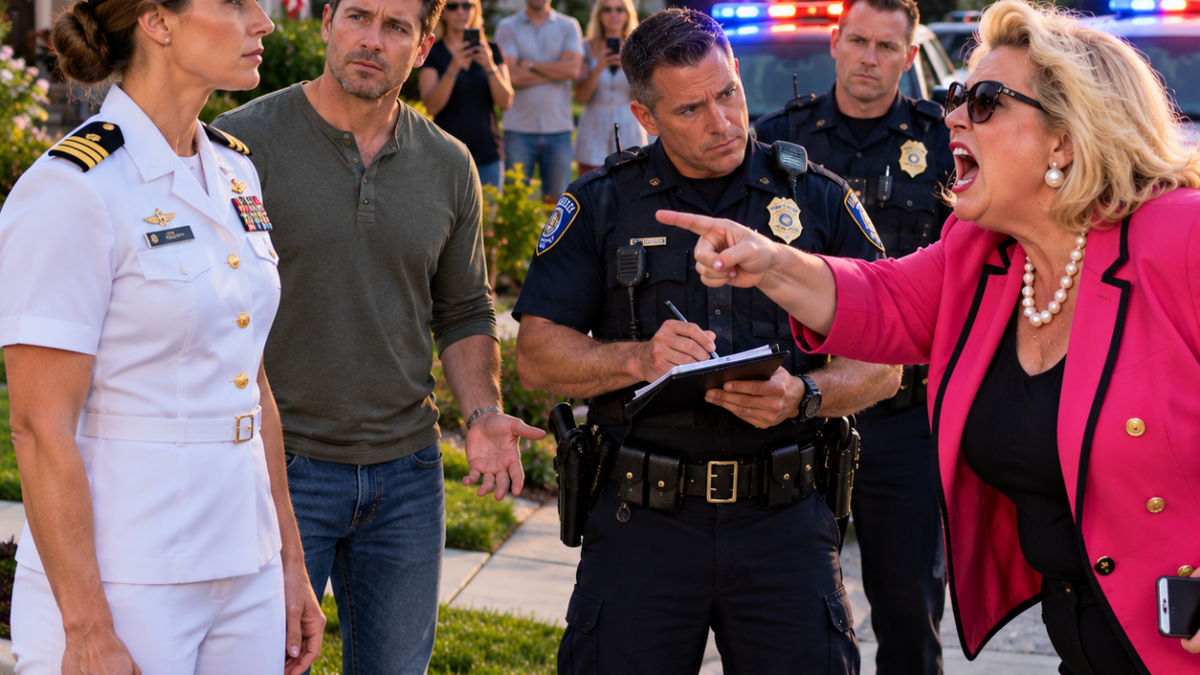
Still wearing her dress whites.
Even from inside the house, I recognized the posture immediately.
Straight back.
Shoulders controlled.
Hands visible.
Calm.
Across the street stood a woman I had seen countless times but had successfully avoided speaking to.
Patricia Garrison.
Her face was flushed crimson.
She had one hand wrapped around her phone and the other pointed directly at my wife.
I stepped toward the front door.
Then I heard the sirens.
“Oh, you’ve got to be kidding me.”
I ran outside just as two patrol cars turned onto our street.
Alyssa looked toward me.
For one second, her expression softened.
That was supposed to be our moment.
The first time we saw each other after eight months.
Instead of running into my arms, my wife gave me a small look that said:
Stay calm.
Three police officers stepped out.
Patricia rushed toward them before they had fully closed their doors.
“That’s her!”
One officer held out a hand.
“Ma’am, please stay back.”
“She just showed up!” Patricia shouted. “Nobody knows who she is!”
I stared at her.
“What?”
Patricia pointed at Alyssa.
“She claims she lives here.”
“She does live here,” I said.
Patricia turned toward me like I had just confessed to participating in an international conspiracy.
“You know this woman?”
I almost laughed.
“This woman is my wife.”
Patricia blinked.
Then, unbelievably, she doubled down.
“Well, she has been absent for months.”
“Yes.”
“Without properly notifying the board.”
I looked at Alyssa.
Alyssa looked at me.
Then she looked back at Patricia.
“I was deployed.”
Patricia’s eyes narrowed.
“So you say.”
That sentence changed the entire atmosphere.
One of the officers, whose badge read DANIELS, stepped between them.
“Let’s slow this down.”
His partner, Officer Newman, approached Alyssa.
“Ma’am, we received a report of a suspicious person possibly attempting to access a residence.”
Alyssa nodded.
“I understand.”
“Do you live at this address?”
“Yes, Officer.”
“How long?”
“Just over two years.”
“And you just arrived?”
“Yes.”
“From where?”
“Norfolk.”
Patricia interrupted.
“That’s what she says!”
Daniels turned.
“Ma’am, I need you to stop interrupting.”
“But I’m the HOA president.”
He stared at her.
For the first time in my life, I witnessed the phrase HOA president fail to impress someone.
Daniels simply said, “Okay.”
Patricia seemed offended by the lack of reverence.
She folded her arms.
“I have a responsibility to protect this community.”
“From my wife?” I asked.
“From suspicious activity.”
“She parked in her own driveway.”
“She was wearing a military uniform.”
Alyssa’s expression changed slightly.
Not anger.
Something colder.
“Correct.”
Patricia pointed again.
“And nobody was informed.”
I could feel my blood pressure climbing.
“Why would my wife need to inform you she’s coming home?”
Patricia turned toward me.
“Residents are required to notify the HOA regarding prolonged absences.”
“Show me the rule.”
“I don’t need to show you anything right now.”
“Yes, you do.”
“Sir,” Daniels said, “please let us handle this.”
I stopped.
Barely.
Officer Newman continued questioning Alyssa.
“Do you have identification?”
“Of course.”
Before she reached toward her purse, she looked at him.
“My wallet is inside my handbag on the passenger seat. May I retrieve it?”
Newman nodded.
“Slowly, please.”
“Understood.”
Alyssa moved exactly as instructed.
That was when Patricia said something that made half the people standing nearby gasp.
“Don’t let her reach into that car. That uniform could be fake.”
Alyssa stopped.
Officer Newman looked over his shoulder.
“What?”
Patricia’s voice grew louder.
“People buy military uniforms online all the time.”
For the first time, I saw Alyssa’s jaw tighten.
Patricia continued.
“This could be stolen valor.”
There it was.
The phrase landed hard.
My wife had been gone for eight months.
Eight months of missed birthdays.
Eight months of bad sleep.
Eight months of standing watches, managing operations, carrying responsibility for people under her command and working days that blurred into nights.
She had returned exhausted.
All she wanted was to walk into her own home.
Instead she was standing in our driveway while a woman with a clipboard accused her of pretending to serve.
I stepped forward.
“You need to stop talking.”
Patricia snapped toward me.
“Don’t threaten me.”
“That wasn’t a threat.”
“I’ll tell the officers you threatened me.”
“They’re standing right here.”
One neighbor laughed.
Patricia turned.
By then, people were coming outside.
Mrs. Chen stood two houses down with her arms folded.
The Andersons were near their mailbox.
Someone across the street had already started recording.
Patricia noticed.
Her posture became even more theatrical.
Good.
She had an audience now.
Officer Newman motioned toward Alyssa.
“Go ahead, ma’am.”
Alyssa slowly reached inside the rental car and retrieved her wallet.
Patricia couldn’t remain silent.
“I want that ID verified.”
Daniels stared at her.
“Ma’am.”
“I pay your salary.”
The entire street seemed to go quiet.
Officer Daniels took a slow breath.
Patricia apparently interpreted his restraint as encouragement.
“I said I pay your salary.”
“I heard you.”
“My taxes fund this department.”
“Yes, ma’am.”
“So you work for people like me.”
Daniels looked down at his notebook.
Then back at Patricia.
“Right now I am responding to a call you made. Please allow me to do my job.”
“I am helping you do your job.”
“No, ma’am.”
A few neighbors laughed again.
Patricia’s face darkened.
Officer Newman accepted Alyssa’s identification.
He glanced at it.
Then at her.
Then at it again.
Something in his expression changed.
He straightened.
Officer Daniels noticed.
“What is it?”
Newman handed him the ID.
Daniels read it.
His eyebrows rose.
Both officers looked at the rank insignia on Alyssa’s uniform.
The silence that followed was magnificent.
Patricia broke it.
“Well?”
Officer Daniels handed the ID back.
“Commander Thompson, I apologize for the confusion.”
Alyssa took it calmly.
“No apology necessary, Officer. You responded to a call.”
Patricia stared.
“Commander?”
Nobody answered her.
Officer Newman was still looking at Alyssa.
Then something even stranger happened.
His posture changed completely.
He stepped back.
Squared his shoulders.
And saluted.
“Former Navy, ma’am. Machinist’s Mate Second Class. Served aboard the Lincoln.”
For the first time since the patrol cars arrived, Alyssa smiled.
Not broadly.
Just enough.
She returned the salute.
“Good to meet you, Petty Officer.”
Newman lowered his hand.
“The honor’s mine, Commander.”
The reaction from the neighbors was immediate.
Whispers.
A few laughs.
Someone actually said, “Oh, wow.”
I looked at Patricia.
Her mouth was slightly open.
Five minutes earlier, she had been demanding my wife be arrested for stolen valor.
Now one of the responding officers—a Navy veteran himself—had saluted her in front of half the neighborhood.
Patricia recovered as quickly as a person like Patricia could.
“This proves nothing.”
Daniels slowly turned toward her.
“Excuse me?”
“I mean, obviously, if she’s verified, fine. But my call was still legitimate.”
“No, it wasn’t,” I said.
“I observed suspicious behavior.”
“My wife got out of a car.”
“After disappearing for eight months!”
Alyssa finally turned fully toward Patricia.
“I was not missing.”
“You were absent.”
“I was deployed.”
“You didn’t notify the board.”
Alyssa’s voice stayed perfectly calm.
“I wasn’t aware the United States Navy coordinated deployment schedules through the Cedar Heights homeowners association.”
Someone behind me choked back a laugh.
Patricia pointed toward the crowd.
“This is not funny!”
Officer Daniels stepped closer.
“Ma’am, did you tell dispatch this person was attempting to break into a home?”
Patricia hesitated.
“I said she was suspicious.”
“Did you tell dispatch she might be impersonating military personnel?”
“I said there were concerns.”
“Whose concerns?”
“Mine.”
“Did anyone else report her?”
Patricia looked around.
Nobody moved.
Mrs. Chen actually shook her head.
“No.”
Daniels continued.
“Did you see her attempt to enter a home that wasn’t hers?”
“She was standing in the driveway.”
“Did she threaten anyone?”
“No.”
“Did she damage property?”
“No.”
“Did she display a weapon?”
“No.”
“Was she trying to force entry into a house?”
“Well…”
“Ma’am.”
“No.”
Daniels closed his notebook.
“So what exactly was the emergency?”
Patricia’s face tightened.
“She didn’t belong here.”
The words came out before she realized how bad they sounded.
Alyssa looked directly at her.
“This is my home.”
Patricia corrected herself quickly.
“I mean, I did not recognize her.”
“That’s not the same thing.”
“I know every resident.”
“Apparently not.”
I almost smiled.
Patricia turned back toward Daniels.
“But you have to understand that I am responsible for neighborhood security.”
“You’re HOA president,” he said.
“Yes.”
“That’s not a law-enforcement position.”
Her expression suggested this information had never previously been presented to her.
“I coordinate neighborhood watch.”
“Neighborhood watch doesn’t mean calling 911 because you don’t recognize someone’s spouse.”
“I had reasonable suspicion.”
“Of what?”
Again, silence.
Patricia reached for the only weapon she had left.
Her phone.
“The bylaws.”
I nearly groaned.
She started scrolling.
“There is language about extended absences.”
Officer Newman glanced at Daniels.
Daniels looked tired.
Patricia continued furiously.
“Section fourteen regarding community notification procedures—”
Alyssa interrupted for the first time.
“Officer?”
Newman looked at her.
“Yes, ma’am?”
“I’ve been traveling most of the day. I’ve been away from home for eight months. If there’s no actual crime being reported, I’d like to go inside and see my husband.”
That one sentence took all the energy out of the scene.
Not because she raised her voice.
She didn’t.
That was Alyssa.
The angrier she got, the quieter she usually became.
She looked at Patricia.
“And unless your HOA bylaws outrank federal law, I don’t believe I require your authorization to come home.”
Patricia’s thumb stopped moving.
I heard someone behind me whisper:
“Damn.”
Officer Daniels nodded.
“You’re free to go, Commander.”
“Thank you.”
But Patricia wasn’t finished.
“You can’t just leave!”
Alyssa looked at her.
“Watch me.”
She stepped toward me.
Patricia raised her phone.
“I’ll bring this before the board!”
Alyssa stopped again.
For a moment I thought she would ignore her.
Then she turned.
Patricia lifted her chin.
“You have violated multiple community procedures.”
Alyssa stared at her.
After eight months at sea, after everything she had dealt with, this woman genuinely expected my wife to be afraid of an HOA hearing.
“Ma’am,” Alyssa said, “I’ve spent eight months dealing with actual threats to national security.”
Patricia’s lips tightened.
Alyssa glanced toward the clipboard tucked beneath Patricia’s arm.
“Your tape measure doesn’t scare me.”
Silence.
Perfect, beautiful silence.
Then somebody laughed.
Another person joined.
Even Officer Newman looked like he was fighting a smile.
Patricia went scarlet.
Daniels cleared his throat.
“We aren’t finished, ma’am.”
Patricia looked relieved for half a second.
Then she realized he was speaking to her.
“What?”
“Your call.”
“My call?”
“Yes.”
He pulled out his notepad.
“This was not an emergency.”
“I already explained—”
“Dispatch records the call.”
That shut her up.
Daniels continued.
“Misuse of emergency services is serious. Making knowingly false reports is also serious.”
“I didn’t knowingly—”
“And this is not the first questionable call we’ve received from this address.”
Patricia froze.
The neighborhood went quiet again.
Officer Newman looked toward Daniels.
Daniels asked, “Do you remember the suspicious-package calls?”
Newman nodded slowly.
Patricia immediately became defensive.
“Those packages were unattended.”
“They were Amazon deliveries.”
“They sat on porches for hours.”
“That isn’t a police emergency.”
“They could have contained anything.”
Daniels stared at her.
“They contained things people ordered.”
Someone behind us laughed.
Patricia whipped around.
“Who said that?”
Nobody answered.
Daniels began writing.
Patricia stepped closer.
“What are you doing?”
“I am issuing you a formal warning regarding misuse of emergency services.”
Her voice jumped an octave.
“You can’t do that.”
“I can.”
“I was protecting the neighborhood.”
“Calling 911 because a resident returned home is not protecting the neighborhood.”
“I didn’t know she was a resident.”
“You didn’t ask.”
“I tried.”
“No,” Alyssa said quietly. “You accused.”
Patricia turned toward her.
“I had every reason to be suspicious.”
“What reason?”
Patricia said nothing.
Alyssa waited.
The difference between them was almost uncomfortable to watch.
Patricia’s authority depended on noise.
On intimidation.
On convincing people that she knew rules they didn’t.
Alyssa didn’t need any of that.
She simply stood there.
Patricia finally looked away.
Officer Daniels tore the paper from his pad.
“Another incident involving a false emergency report may result in a citation or additional consequences.”
Patricia stared at the warning as though he had handed her a live grenade.
“Do you understand?”
“I understand my rights.”
“That wasn’t my question.”
Her jaw tightened.
“Yes.”
Daniels handed her the paper.
She accepted it with a trembling hand.
Then Officer Newman added, “And I’d strongly recommend not making unsupported accusations about military personnel.”
Patricia glared.
“Are you threatening me?”
“No, ma’am.”
“I know the police chief.”
Daniels nodded.
“Good.”
Patricia blinked.
“I’ll call him.”
“You’re welcome to.”
That was the moment she realized there would be no rescue coming.
No special authority.
No recognition of her imagined importance.
The officers had treated her exactly like what she was:
A citizen who had made a bad call.
Alyssa shook Newman’s hand before we went inside.
“Thank you for your service,” she said.
He laughed softly.
“Commander, I’m pretty sure I’m supposed to be saying that to you.”
“Works both ways.”
He asked briefly about the Truman.
She answered.
For thirty seconds they talked about ships, duty stations, deployments and Navy life while Patricia stood only a few feet away holding her warning.
It was almost poetic.
Then Mrs. Chen called from her yard.
“Welcome home, Commander!”
Alyssa looked over.
“Thank you!”
The Andersons joined in.
Then another neighbor.
“Welcome home!”
Someone started clapping.
It spread.
Not some huge parade.
Not some staged patriotic performance.
Just neighbors who suddenly seemed embarrassed that one of their own had been treated like a criminal for coming home.
Alyssa looked overwhelmed for the first time.
She squeezed my hand.
“Can we please go inside now?”
“Absolutely.”
We had almost reached the front door when Patricia spoke again.
“This isn’t over.”
I closed my eyes.
Of course it wasn’t.
Alyssa turned.
Patricia stood at the edge of our driveway.
“The board will hear about this.”
“I’m sure they will.”
“And your grass is over regulation height.”
I looked down.
Our grass looked completely normal.
Patricia pointed.
“I measured it last week.”
“You measured our grass while I was deployed?” Alyssa asked.
“I conduct routine inspections.”
Alyssa stared at her for several seconds.
Then she smiled.
Not warmly.
“Have a good afternoon, Patricia.”
It was the first time either of us had used her name.
We walked inside.
I closed the door.
Locked it.
Then turned around.
Alyssa was standing in the entryway.
For a second, neither of us said anything.
The shouting outside disappeared.
The officers.
Patricia.
The neighbors.
The ridiculousness.
All of it vanished.
I looked at my wife.
Really looked at her.
She looked older than she had eight months earlier.
Not dramatically.
Just tired around the eyes.
The kind of tired sleep couldn’t fix in one night.
“You’re home,” I said.
Her expression broke.
“I’m home.”
I crossed the room and wrapped my arms around her.
She held on hard.
Eight months collapsed into a few seconds.
When we finally separated, she looked toward the window.
“Is she always like that?”
“You’ve been gone too long.”
“That bad?”
“Worse.”
Alyssa dropped onto the couch.
She removed her cover and leaned her head back.
“Some homecoming.”
I sat beside her.
“At least nobody shot at you.”
She gave me a tired sideways look.
“Enemy fire is less unpredictable than suburban politics.”
I laughed.
So did she.
It was the first normal sound our house had heard in eight months.
Then I smelled something.
Alyssa sniffed.
“Is something burning?”
I jumped up.
“The pasta.”
Ten minutes later we were eating slightly scorched pasta while Alyssa told me pieces of the deployment she was allowed to talk about.
Nothing dramatic.
At least not by her standards.
Long hours.
Maintenance problems.
Port calls.
Exhaustion.
People doing their jobs.
She kept yawning.
I kept staring at her.
At some point she noticed.
“What?”
“Nothing.”
“You’re staring.”
“You were gone eight months. I’m allowed.”
She smiled.
“Fair.”
My phone buzzed.
Then hers.
Then mine again.
And again.
I looked down.
Three neighbors had texted me.
Then five.
Then eleven.
The Cedar Heights Facebook group was exploding.
That group had previously been the most boring place on the internet.
Typical posts included:
Whose trash can is still outside?
Reminder: holiday wreaths must be removed by January 8.
Unknown vehicle parked near mailbox cluster.
Patricia used it like a digital complaint desk.
That afternoon, it had turned into open rebellion.
Someone had uploaded a video.
I knew exactly which one before I pressed play.
Officer Newman saluting Alyssa.
The clip began a few seconds earlier, with Patricia saying:
“Real military personnel don’t just show up unannounced.”
Then Newman checked Alyssa’s identification.
Then the salute.
Then Patricia’s face.
Forty-seven reactions within the first hour.
Most were laughing emojis.
One neighbor commented:
Best thing I’ve seen in Cedar Heights since moving here.
Another wrote:
Welcome home, Commander Thompson.
Then Mr. Anderson added:
My garden gnome salutes you too.
I laughed so hard I almost dropped my phone.
Alyssa read the comment.
“Garden gnome?”
“You don’t want to know.”
“Yes, I absolutely want to know.”
So I explained.
The violation.
The seventy-five-dollar fine.
The directional controversy.
By the time I finished, Alyssa was staring at me like I had described life inside an absurdist novel.
“And everyone allowed this?”
“Allowed what?”
“All of it.”
I didn’t answer immediately.
Because that question was more complicated than it sounded.
Nobody liked Patricia.
But nobody wanted to become her project.
That was how she maintained power.
Not because the rules gave her unlimited authority.
Because fighting her was exhausting.
If you challenged one fine, she found three more things to inspect.
If you criticized her at a meeting, she suddenly discovered your mailbox was noncompliant.
Most people had jobs.
Kids.
Families.
Problems that mattered.
Nobody wanted to spend their evening arguing about whether a flowerpot was approved.
So they paid.
Complied.
Stayed quiet.
Alyssa understood instantly.
“She’s a bully.”
“Basically.”
“No.”
Her tone changed.
“Not basically. She is.”
I shrugged.
“Yeah.”
Alyssa looked at the neighborhood group again.
“Bullies survive because everybody thinks they’re the only person being bullied.”
That sentence stayed with me.
Because by sunset, Cedar Heights started discovering that Patricia had bullied almost everybody.
The Facebook comments became a confession booth.
The Johnsons posted pictures of the shutter citations.
The Gwyn family shared the bicycle warning.
Mrs. Chen mentioned three separate complaints Patricia had made about visiting relatives’ cars.
Mr. Ramirez uploaded a photograph of a violation notice involving wind chimes.
A wind chime.
The reason?
“Excessive intermittent metallic noise.”
Alyssa read it twice.
“That’s what a wind chime does.”
“Correct.”
“Why didn’t anyone remove her before?”
“Because everybody was dealing with her individually.”
Alyssa looked out the front window.
Patricia was marching down the sidewalk with her clipboard.
“Not anymore.”
Patricia spent the rest of that afternoon trying to reclaim control.
We watched part of it from the living-room window.
She went door to door.
At the Peterson house, she rang the bell.
Nobody answered.
She rang again.
Still nothing.
Their SUV was parked in the driveway.
Their television was clearly visible through the front window.
Patricia knocked.
Waited.
Knocked again.
Nothing.
Ten minutes.
The Petersons simply pretended they weren’t home.
I almost admired the dedication.
At the next house, somebody opened the door, listened to Patricia for approximately fifteen seconds, then slowly closed it.
At another house she was apparently refused entry entirely.
By dinner, Patricia had stopped trying to talk.
She started distributing letters.
Typed letters.
Official-looking letters.
She slid one beneath our front door.
I picked it up.
Alyssa read over my shoulder.
At the top:
CEDAR HEIGHTS HOMEOWNERS ASSOCIATION — EMERGENCY NOTICE
Then:
SUBJECT: HOSTILE ACTIONS AGAINST HOA AUTHORITY
Alyssa looked at me.
“Hostile actions?”
“It gets better.”
The letter announced an emergency meeting.
It accused unnamed residents of participating in what Patricia described as an “organized campaign to undermine lawful HOA governance.”
It referenced seventeen bylaws.
I looked several of them up.
They didn’t exist.
One section suggested that residents showing support for “outside parties” could face disciplinary review.
Alyssa tapped that sentence.
“Am I the outside party?”
“I think you’re the hostile military takeover.”
She stared at me.
I started laughing.
She tried not to.
Failed.
Then we reached the final paragraph.
Patricia questioned the legitimacy of Alyssa’s credentials and suggested the matter could warrant contact with Homeland Security.
Alyssa stopped laughing.
Her expression became flat.
“What?”
I reread it.
She took the letter.
“She’s putting this in writing?”
“Apparently.”
“After police already verified my identity?”
“Apparently.”
“That’s impressively stupid.”
My phone buzzed again.
Mr. Ramirez had posted his copy.
Then Mrs. Chen posted hers.
Within twenty minutes, residents were comparing letters and discovering slight variations.
Some had been threatened with fines.
Some with disciplinary hearings.
A few had language about “supporting unauthorized occupants.”
The neighborhood group became merciless.
But underneath the jokes, something else was happening.
People were angry.
Actually angry.
Not because Patricia had fined them.
They had lived with that.
They were angry because she had called police on someone returning from deployment, then refused to admit she had been wrong.
She had crossed a line everyone could understand.
Alyssa eventually went upstairs.
By 8:30 she was asleep.
Still half dressed.
I helped her get comfortable and closed the curtains.
Outside, Patricia’s campaign continued for another hour.
Then Cedar Heights finally went quiet.
At 7:30 the next morning, somebody knocked.
I assumed it was Patricia.
I opened the door prepared for war.
Instead, I found Dr. Harrison.
He was a retired pediatrician who had lived in Cedar Heights for years.
Soft-spoken.
Gray hair.
The kind of man who always waved when he drove past.
I knew he served on the HOA board, although I had never seen him behave like he enjoyed it.
Behind him stood four other board members.
Mrs. Foster, who owned a bakery downtown.
Mr. Ramirez, veteran of the wind-chime rebellion.
And two others I recognized from annual meetings.
Mrs. Foster was holding a cake.
“Is Commander Thompson awake?” Dr. Harrison asked.
I blinked.
“Yeah. Come in.”
Alyssa came downstairs a few minutes later wearing jeans and one of my old sweatshirts.
Mrs. Foster handed her the cake.
White icing.
Blue lettering.
WELCOME HOME, COMMANDER
Alyssa looked genuinely touched.
“You didn’t have to do this.”
Mrs. Foster shook her head.
“After yesterday, yes, we did.”
We gathered in the living room.
Dr. Harrison looked uncomfortable.
“First, Commander Thompson, on behalf of the board, I want to apologize.”
Alyssa held up a hand.
“You didn’t call the police.”
“No. But Patricia did so while acting as HOA president.”
He sighed.
“That makes it our responsibility.”
Mr. Ramirez muttered, “Unfortunately.”
Dr. Harrison continued.
“We convened an emergency board meeting at six this morning.”
I glanced at the clock.
“You’ve been awake since six?”
Mrs. Foster smiled.
“Some of us were awake much earlier.”
Dr. Harrison looked at Alyssa.
“We received complaints from residents all evening.”
“How many?” I asked.
He hesitated.
“Twenty-nine written complaints before midnight.”
I whistled.
“And more this morning.”
He folded his hands.
“We reviewed yesterday’s incident. We reviewed Patricia’s conduct afterward. We reviewed the letters she distributed.”
Mr. Ramirez pulled one from a folder.
“These were not authorized by the board.”
Alyssa nodded slowly.
“I assumed as much.”
“Several of the bylaws she cited don’t exist,” he added.
“I noticed.”
Dr. Harrison cleared his throat.
“The board voted unanimously.”
I felt something coming.
He looked almost relieved when he said it.
“Patricia Garrison has been removed as president of the Cedar Heights homeowners association, effective immediately.”
I stared at him.
Alyssa raised her eyebrows.
“Unanimously?”
“Every vote.”
Mr. Ramirez smiled.
“The first unanimous vote we’ve had in three years.”
Mrs. Foster corrected him.
“Four.”
“That makes it worse.”
Alyssa sat back.
“So that’s it?”
Dr. Harrison exchanged a glance with the others.
“Not exactly.”
He pulled out his phone.
“We also contacted the police department after learning yesterday wasn’t an isolated incident.”
I remembered Officer Daniels mentioning previous calls.
“How many?” I asked.
Dr. Harrison looked embarrassed.
“Thirty-seven.”
I thought I had misheard.
“Thirty-seven what?”
“911 reports.”
“In how long?”
“Eighteen months.”
Alyssa stared.
“You’re serious?”
Dr. Harrison nodded.
The list was almost unbelievable.
Patricia had reported suspicious activity during the Kumar family’s reunion because there were unfamiliar cars parked along the street.
She had suggested possible terrorist activity.
A lemonade stand run by neighborhood children had somehow become suspected drug dealing because teenagers were exchanging cash at the curb.
Mrs. Chen’s college-aged nephew had been reported for loitering.
Packages had been reported as suspicious objects.
A contractor measuring a roof had been described as a potential burglar.
A food-delivery driver had generated another call because his car remained parked “too long.”
I rubbed my forehead.
“How did we not know?”
“Most of the department responses were handled individually,” Dr. Harrison explained. “Different shifts. Different officers. Some calls were downgraded before anyone came out. But after yesterday, somebody looked at the history attached to her number.”
Mr. Ramirez shook his head.
“Thirty-seven.”
Mrs. Foster added, “The city issued a five-hundred-dollar penalty for misuse of emergency services.”
Alyssa looked surprised.
“That quickly?”
“The police already had the record. Yesterday apparently triggered the review.”
Dr. Harrison continued.
“They’re also evaluating whether some of the reports could constitute harassment or false reporting.”
Nobody celebrated that part.
Alyssa certainly didn’t.
She just nodded.
“That’s their decision.”
Exactly.
She hadn’t come home looking for revenge.
She didn’t want Patricia destroyed.
She had wanted to walk through her front door.
Everything that followed came from Patricia refusing to stop digging.
Dr. Harrison looked down.
“There is one more issue.”
I leaned forward.
“What?”
“The video.”
My stomach tightened.
“What about it?”
“It’s spreading outside the neighborhood.”
Apparently someone had reposted the clip.
Then somebody else.
It had reached local community pages.
Veterans groups.
Military family pages.
Patricia’s employer had seen it.
She worked for a local law firm.
A law firm that, according to Dr. Harrison, proudly displayed “Support Our Troops” decals in its front windows.
Mrs. Foster grimaced.
“I don’t think they appreciated seeing one of their employees screaming stolen valor at an active-duty commander.”
Alyssa frowned.
“Who sent it to them?”
Nobody answered.
Mr. Ramirez suddenly became extremely interested in the carpet.
“Ramirez,” I said.
He looked offended.
“I have no idea what you’re suggesting.”
Mrs. Foster laughed.
Dr. Harrison raised both hands.
“Whatever happens regarding her employment is not HOA business.”
Alyssa nodded.
“Good.”
She meant it.
“I don’t want people trying to ruin her life.”
Mrs. Foster looked at her.
“She called police on you.”
“I know.”
“She accused you of impersonating an officer.”
“I know.”
“She threatened to report you to Homeland Security.”
“I read the letter.”
Mrs. Foster stared.
Alyssa leaned forward.
“But accountability is different from revenge. Remove her from a position she abused. Fine her if she misused emergency services. Investigate false reports if the police believe that’s appropriate. Beyond that, I’m not interested.”
Dr. Harrison smiled faintly.
“Understood.”
That was my wife.
She could be furious without being vindictive.
Patricia never learned that distinction.
The board members stayed another twenty minutes.
We cut the cake.
Mr. Ramirez apologized approximately four times for allowing Patricia to dominate meetings.
Dr. Harrison promised a full audit of recent fines and citations.
That got my attention.
“All of them?”
“All discretionary citations issued under Patricia’s presidency.”
“How far back?”
“At least two years.”
Mrs. Foster said, “People shouldn’t have been paying penalties based on rules the board never approved.”
Mr. Ramirez smiled.
“The garden gnome is probably getting a refund.”
Alyssa nearly dropped her fork.
“You’re kidding.”
“No.”
“Please tell Mr. Anderson personally.”
“I intend to.”
After they left, Alyssa stood at the front door looking down the street.
Patricia’s house was quiet.
No clipboard.
No inspections.
No knocks.
Nothing.
“Think she’s learned anything?” I asked.
Alyssa shook her head.
“No.”
“You answered quickly.”
“People who learn from mistakes usually stop making the same one before reaching thirty-seven 911 calls.”
Fair point.
The next two days were bizarrely peaceful.
The neighborhood Facebook group became almost cheerful.
People discussed actual neighborhood things.
A lost dog.
A garage sale.
Someone needed a ladder.
Mrs. Chen offered extra tomatoes from her garden.
Without Patricia policing every conversation, Cedar Heights suddenly felt like a place where humans lived.
The board posted an official notice announcing a change in leadership.
No drama.
No accusations.
Just a short statement explaining that Patricia Garrison had been removed as president and that existing policies were under review.
Dozens of residents reacted.
The Andersons placed their garden gnome prominently beside their mailbox.
Facing the “wrong” direction.
Nobody fined them.
On the third morning, I heard a truck.
A big one.
I stepped outside.
Moving truck.
Patricia’s driveway.
I stared for a moment.
Alyssa appeared beside me holding coffee.
“Well.”
“Looks like she’s leaving.”
“Apparently.”
We never learned exactly what happened at the law firm.
I didn’t ask.
Rumors flew, naturally.
Somebody said she had been suspended.
Someone else said she had quit.
Another person claimed the partners had called her into a meeting less than an hour after receiving the video.
I had no idea which version was true.
I didn’t particularly care.
What I knew was what I could see.
Patricia was moving.
She stood in the driveway directing movers with all the intensity of a field commander overseeing an evacuation.
“Not that box!”
She pointed.
“That goes in the truck last!”
One mover looked at the label.
KITCHEN — MISC.
He shrugged.
Patricia spun toward another.
“Careful with that table!”
Half the neighborhood somehow discovered urgent yard work at exactly the same time.
Mr. Anderson was trimming a hedge that did not need trimming.
Mrs. Chen was watering plants that had already been watered.
Mr. Ramirez had been sweeping the same section of driveway for at least fifteen minutes.
Nobody admitted why they were outside.
Alyssa watched from our porch.
“This is subtle.”
“Very.”
“Does everyone own gardening equipment purely for surveillance purposes?”
“In Cedar Heights? Absolutely.”
Patricia noticed the spectators.
Of course she did.
She tried to maintain her usual posture.
Shoulders back.
Chin high.
Clipboard gone, but attitude intact.
For several hours, movers carried her belongings away.
Boxes.
Furniture.
Lamps.
A television.
A large framed print that nearly knocked one man off the porch.
By late afternoon, the house looked empty.
I assumed that would be the end.
I should have known better.
There was one final knock on our door.
Three sharp hits.
Not a neighborly knock.
A Patricia knock.
I opened it.
She stood there with an envelope.
Behind her, the moving truck’s rear door was closed.
Her car was packed.
Her face looked exhausted.
But her eyes still had that familiar determination.
“Patricia.”
She thrust the envelope toward me.
“This is for you.”
I didn’t take it immediately.
“What is it?”
“A final account notice.”
I actually laughed.
Her expression hardened.
“This isn’t funny.”
I accepted the envelope.
Inside was a printed bill.
I read the number twice.
$3,200.
“For what?”
“Accumulated grass-height violations.”
I looked at her.
She was serious.
“Grass.”
“Your property has repeatedly exceeded approved lawn standards.”
“For two years?”
“Yes.”
“And you’re billing me now?”
“The violations remain valid regardless of my position.”
I stared at the itemized list.
Dozens of alleged measurements.
Some exceeded the supposed limit by an eighth of an inch.
Others by a quarter.
There were dates I had been at work.
Dates it had rained.
Dates I couldn’t even remember.
Then Alyssa stepped beside me.
“What is it?”
I handed her the paper.
Patricia straightened slightly.
I recognized that look.
She thought she had found one last battlefield.
Alyssa read the document carefully.
All of it.
Patricia waited.
I waited.
A neighbor across the street slowed noticeably while pretending to check his mailbox.
Finally, Alyssa looked up.
“Patricia.”
“Yes?”
“You’re absolutely right.”
Patricia blinked.
So did I.
Alyssa pointed to the paper.
“According to your measurements, some of these entries exceed the listed standard by approximately one-eighth of an inch.”
Patricia’s shoulders lifted.
“Exactly.”
“Impressive record keeping.”
“Thank you.”
I looked at my wife.
I knew that tone.
Patricia did not.
Alyssa continued.
“There is one problem.”
Patricia’s smile faded.
“What?”
“You’re no longer HOA president.”
“That doesn’t invalidate prior violations.”
“And according to the notice the board delivered yesterday, all discretionary citations issued under your authority are under review.”
Patricia’s face tightened.
“These are not discretionary.”
Alyssa flipped the page over.
“They’re also not signed by the current board.”
“I was president when they were recorded.”
“You were removed for cause.”
“That doesn’t erase history.”
“No.”
Alyssa folded the document neatly.
Once.
Then again.
“But it does mean this piece of paper, delivered personally by a former HOA president without current board authorization, has no legal standing.”
Patricia stared at her.
“You don’t know HOA law.”
Alyssa smiled.
“Maybe not.”
She held up the folded bill.
“But I know the difference between official authority and someone pretending they still have it.”
That one landed.
Hard.
Patricia’s mouth opened.
Nothing came out.
Alyssa’s voice softened.
“I’ll keep this, though.”
Patricia narrowed her eyes.
“Why?”
“A souvenir.”
“A souvenir?”
“Of your dedicated service to the community.”
I turned away because if Patricia saw my face, I was going to make the situation worse.
For several seconds, she said nothing.
No threat.
No bylaw.
No complaint.
No reference to the police chief.
Nothing.
For once, Patricia Garrison had run out of words.
She turned.
Walked down our steps.
Crossed the lawn.
Reached her car.
Mr. Anderson happened to be standing beside his garden gnome.
Patricia looked at him.
Then at the gnome.
The gnome was facing directly toward her house.
Mr. Anderson lifted one hand.
“Safe travels.”
She climbed into the car.
The moving truck started.
Then something unexpected happened.
Mrs. Chen began clapping.
Just three slow claps at first.
Patricia froze inside her car.
Mr. Ramirez joined.
Then the Andersons.
Then the Johnsons.
Doors opened.
People stepped onto porches.
Neighbors who had spent years quietly paying ridiculous fines, hiding bicycles, changing paint colors, removing decorations and measuring grass came outside.
Ten people.
Twenty.
Thirty.
By the time Patricia backed out of her driveway, close to forty residents were standing along Cedar Heights applauding.
It wasn’t elegant.
It probably wasn’t mature.
But after years of being treated like inmates inside their own neighborhood, nobody seemed interested in maturity.
Patricia rolled down her window.
“You people are unbelievable!”
The applause got louder.
She shouted something else.
I couldn’t hear it over the clapping.
Her car accelerated toward the entrance.
The moving truck followed.
Then she disappeared around the corner.
That frustrated yell was the last sound I ever heard from Patricia Garrison.
The neighborhood stood quiet for a few seconds afterward.
Almost uncertain what to do.
Then Mr. Anderson picked up his garden gnome.
He rotated it approximately ninety degrees.
“Anybody know which direction is legal now?”
Everyone laughed.
Alyssa leaned against my shoulder.
“This place is insane.”
“You’re just figuring that out?”
“I’ve been busy.”
The following weeks changed Cedar Heights more than I expected.
Dr. Harrison temporarily took over HOA duties while the board organized a proper election.
The first thing they did was suspend enforcement of several vague appearance rules.
The second was audit Patricia’s fines.
Refunds started going out.
The Andersons got their seventy-five dollars back.
Mr. Ramirez’s wind-chime warning disappeared.
The Gwyn family received an apology over the bicycle citations.
The Johnsons were told their shutters were perfectly acceptable.
Nobody collapsed into lawlessness.
That was the funniest part.
The neighborhood did not fall apart.
Lawns were still maintained.
Garbage cans still disappeared from the curb.
Nobody painted their house fluorescent orange.
People simply stopped living in fear that a woman with a ruler would appear in their driveway.
The police department also followed up.
We were never involved beyond the original incident, and Alyssa preferred it that way.
Patricia’s history of calls was their issue now.
The city fine remained.
Any additional consequences belonged between Patricia and the authorities.
Alyssa never asked for updates.
She had more important things to do.
Mostly sleep.
For the first week home, she could fall asleep almost anywhere.
Couch.
Chair.
Once at the kitchen table while waiting for coffee.
She slowly adjusted to normal life.
No shipboard announcements.
No watch schedule.
No constant movement beneath her feet.
Some mornings I’d wake up and find her standing at the bedroom window before sunrise.
Just looking outside.
One morning I joined her.
“What are you thinking about?”
She shook her head.
“Nothing.”
“That doesn’t look like nothing.”
She smiled faintly.
“It’s quiet.”
“Too quiet?”
“Different quiet.”
I understood as much as I could.
Then she pointed outside.
“Your grass is getting long.”
I looked at her.
She managed to keep a straight face for about two seconds.
Then she laughed.
I threw a pillow at her.
A month after Patricia left, Cedar Heights held its first major HOA meeting under new leadership.
I went with Alyssa.
Mostly out of curiosity.
The community room was packed.
Normally, maybe fifteen residents attended.
That night, almost every chair was filled.
Dr. Harrison opened the meeting.
No lectures.
No threatening language.
No ruler.
The board proposed new rules for emergency reporting.
Basic stuff.
Neighborhood watch volunteers could document genuine concerns, but nobody acting on behalf of the HOA could represent themselves as law enforcement.
Police emergency lines were for emergencies.
Residents could not be sanctioned for failing to notify the association about travel, deployment, medical absence or other personal movement unless a specific legitimate property-management issue applied.
Then they discussed citations.
Every violation would require a clearly identified bylaw.
Residents would have a defined appeal process.
No invented rules.
No surprise fines.
No one-person enforcement crusades.
Someone near the back said, “Can we put the garden gnome rule in writing?”
The room erupted.
Mr. Anderson stood.
“I move that all garden gnomes be granted full constitutional protection.”
Even Dr. Harrison laughed.
Alyssa leaned toward me.
“This is what your meetings are like?”
“Now they are.”
Then Dr. Harrison became serious.
“There is one additional matter.”
He looked toward Alyssa.
She immediately stiffened.
I could tell she hated public recognition.
“Commander Thompson, would you stand?”
She whispered, “Absolutely not.”
Everyone turned.
I whispered back, “Too late.”
She stood reluctantly.
Dr. Harrison continued.
“I think yesterday’s board—and frankly, this entire neighborhood—learned something important from what happened the day Commander Thompson returned.”
The room quieted.
“We spent too long confusing enforcement with leadership.”
Nobody moved.
“Leadership doesn’t mean finding reasons to punish people.”
He looked around.
“It means protecting the community without forgetting the people who make up that community.”
Alyssa looked uncomfortable but listened.
“We failed at that.”
Dr. Harrison looked directly at her.
“And I’m sorry your homecoming had to expose it.”
Alyssa nodded.
Then someone asked her to speak.
She immediately said, “No.”
Everyone laughed.
Mrs. Chen called out, “Two sentences!”
Alyssa sighed.
“Fine.”
She faced the room.
The same posture she had used in the driveway.
Calm.
Composed.
“Rules aren’t the problem,” she said. “People need rules when they live together.”
Patricia would have loved that first sentence.
Then Alyssa continued.
“But rules should protect people. They shouldn’t become weapons for people who enjoy controlling them.”
Silence.
“That applies to a neighborhood, a workplace, a ship—pretty much anywhere.”
She looked around the room.
“And if one person is being treated unfairly, don’t assume it’s only happening to them.”
That was it.
Two sentences had become four.
Nobody complained.
The applause was quieter than the applause Patricia received while leaving.
But it meant more.
Afterward, neighbors stayed around talking.
Actually talking.
Not arguing over paint swatches.
Not discussing violation notices.
People introduced themselves.
I discovered that a man three houses away had lived there for six years and I had never learned his first name.
That’s what Patricia’s version of community had done.
She had turned neighbors into isolated property owners.
Everyone focused on protecting their own little patch of ground.
The moment she overreached badly enough, everyone finally looked up.
And they realized they had all been dealing with the same thing.
Months passed.
The story of Alyssa’s homecoming became neighborhood legend.
It got exaggerated, naturally.
In one version, Patricia tried to personally arrest Alyssa.
In another, five police officers saluted.
Someone claimed the police chief arrived.
None of that happened.
The truth was ridiculous enough.
Patricia saw an unfamiliar woman in Navy dress whites step out of a rental car.
She decided she had found a criminal.
She called 911.
She accused my wife of stolen valor.
Then one of the responding officers checked Alyssa’s identification, saw her rank and realized he was standing in front of an active-duty commander.
He had served in the Navy himself.
So he saluted.
Simple.
That salute didn’t destroy Patricia.
Her reaction did.
She could have apologized.
That’s the part people forget.
She could have said:
I made a mistake.
Five words.
She could have walked across the driveway and said:
Commander, I’m sorry. I didn’t recognize you. Welcome home.
Alyssa probably would have accepted it.
I know my wife.
She would not have liked Patricia.
But she would have accepted the apology.
Instead, Patricia argued.
Then threatened.
Then invented bylaws.
Then distributed letters.
Then questioned Alyssa’s credentials after police had verified them.
Then tried to rally the neighborhood.
Then delivered a $3,200 grass bill after being removed from office.
At every turn, she was handed an exit.
And at every turn, she chose a shovel.
That is what buried her.
One evening, nearly six months later, Alyssa and I were sitting on the porch.
The sun was going down.
Kids rode bicycles past our house.
Their bikes remained visible from the street for much longer than thirty minutes.
Nobody fined them.
Mrs. Chen was talking with the Johnsons.
Mr. Ramirez’s wind chimes moved in the breeze.
Somewhere nearby, somebody was mowing a lawn.
Alyssa looked across the street at Patricia’s old house.
A new family had moved in.
Young couple.
Two kids.
The previous week, they had installed a basketball hoop.
Technically, the old HOA rules required approval first.
The new board approved it within one day.
Alyssa took a sip of coffee.
“It’s nicer now.”
“What is?”
“The neighborhood.”
I nodded.
“It is.”
She smiled.
“So technically, Patricia improved Cedar Heights.”
I stared at her.
“Don’t ever say that where anyone can hear you.”
“I’m serious.”
“She terrorized people over grass.”
“Yes.”
“She called 911 because you came home.”
“Yes.”
“She accused you of stolen valor.”
“Yes.”
“She threatened Homeland Security.”
Alyssa laughed.
“I remember.”
“And you’re giving her credit?”
“No.”
She looked toward the street.
“I’m saying sometimes one person goes far enough that everyone else finally stops pretending the situation is normal.”
That was true.
For years, everybody had adapted.
That was the dangerous part.
People can adapt to almost anything if it happens gradually enough.
A ridiculous fine becomes an annoyance.
Then another.
Then another.
A fake rule becomes easier to obey than challenge.
A bully starts to look powerful because everyone quietly calculates that resistance isn’t worth the trouble.
Until the bully makes one mistake too big to ignore.
Patricia’s mistake wasn’t calling police.
Not entirely.
People make bad judgment calls.
Her real mistake was believing authority existed because she said it did.
She thought being HOA president meant every unfamiliar face required her approval.
She thought a board title allowed her to interrogate residents.
She thought the police would automatically treat her suspicion as fact.
She thought my wife would be intimidated because everyone else had been.
What she didn’t understand was that Alyssa had spent her entire adult career in institutions where authority came with accountability.
Rank meant responsibility.
Procedure mattered.
Chain of command mattered.
Evidence mattered.
You did not get to invent authority because you were angry.
And you definitely didn’t get to keep authority after abusing it.
That was why Patricia never knew how to handle her.
Patricia understood arguments.
Alyssa understood command.
Those were not the same thing.
I looked at my wife.
“Do you remember what you said to her?”
“When?”
“The grass.”
She frowned.
“I’ve said a lot of things about grass since coming home.”
“The first day.”
Her eyes brightened.
“The tape measure?”
“Yeah.”
She smiled.
“I stand by it.”
At that exact moment, Mr. Anderson came walking up the sidewalk.
He was carrying something.
His garden gnome.
He stopped at the bottom of our driveway.
“Commander.”
Alyssa looked suspicious.
“Yes?”
“I have a question.”
“Go ahead.”
He held up the gnome.
“Which direction should he face?”
Alyssa examined it with exaggerated seriousness.
“What’s the current regulation?”
“No regulation anymore.”
“Then whichever direction he wants.”
Mr. Anderson looked down at the ceramic figure.
“Freedom.”
“Freedom.”
He nodded solemnly.
Then he carried the gnome back home.
I laughed.
Alyssa shook her head.
“Your neighborhood is ridiculous.”
“Our neighborhood.”
She looked at me.
I hadn’t planned that wording.
Neither had she.
For eight months, home had been something Alyssa talked about from thousands of miles away.
A place represented by photographs, short calls and messages sent at strange hours.
Then she finally came back and found police cars waiting in the driveway.
Not exactly the reunion either of us imagined.
But somehow, that ugly afternoon changed the meaning of Cedar Heights.
Before that day, it had been a collection of manicured houses governed by a woman who measured community in inches of grass.
Afterward, it became a neighborhood.
People waved.
They talked.
They borrowed tools.
They watched each other’s houses.
Not because Patricia had organized them into some suspicious-person patrol.
Because they actually knew one another.
The best neighborhood watch turned out to be neighbors.
Not rulers.
Not clipboards.
Not seventeen invented bylaws.
Neighbors.
Alyssa eventually returned to duty.
The morning she left again wasn’t easy.
Not another eight-month deployment immediately, thankfully.
But military life doesn’t ask permission from spouses.
We stood in the driveway beside her car.
The same driveway.
I thought about the last time she had arrived there.
No patrol cars now.
No shouting.
No accusations.
Mrs. Chen waved from down the street.
Mr. Ramirez’s wind chime rang.
The Anderson gnome faced proudly toward the road.
Alyssa noticed it.
“He’s watching you.”
“I’m safer already.”
She hugged me.
“Take care of the house.”
“I will.”
“Keep the grass under control.”
“No promises.”
She stepped into the car.
Then paused.
“If some new HOA president calls 911 on you—”
“I’ll show them the lawn mower.”
She laughed.
Then she drove away.
I stood there until her car disappeared.
A few minutes later, I went inside.
On my desk was the folded paper Patricia had delivered on the day she moved.
The $3,200 grass bill.
Alyssa really had kept it.
At the top, in Patricia’s stiff official formatting, were the words:
FINAL NOTICE OF OUTSTANDING VIOLATIONS
Alyssa had written something beneath them in blue ink.
I hadn’t noticed before.
Just four words.
No legal standing. Souvenir.
I laughed alone in the room.
Then I folded it back up.
And put it in the drawer.
Patricia Garrison had tried to make my wife’s first day home about her authority.
Instead, it became the day everybody discovered how little authority she actually had.
She had called 911 expecting police officers to remove a suspicious stranger.
Instead, they confirmed that the “stranger” was Commander Alyssa Thompson, returning to her own home after eight months aboard the USS Truman.
She had accused my wife of buying her uniform online.
Instead, a former Navy sailor looked at Alyssa’s identification, recognized her rank and saluted her right there in the driveway.
She had threatened us with HOA discipline.
Instead, her own board unanimously removed her.
She had spent eighteen months calling authorities on neighbors.
Then her thirty-seven reports were reviewed and she ended up with a $500 penalty while police examined the rest.
She had spent years making residents afraid to challenge her.
Then nearly forty of those same residents stood outside and applauded as her moving truck pulled away.
And after all of that, she still tried one final time to claim control with a $3,200 bill over grass measurements.
That paper became the last symbol of everything Patricia never understood.
Authority isn’t a title you print at the top of a letter.
Respect isn’t something you can demand by shouting louder.
Leadership isn’t measuring your neighbors’ lawns and waiting for them to make mistakes.
And community isn’t created by forcing everyone to obey the person holding the clipboard.
Sometimes community begins the moment people finally stop being afraid of that person.
For me, though, the moment I remember most isn’t Patricia leaving.
It isn’t the board removing her.
It isn’t even the neighbors applauding.
It’s that driveway.
Alyssa standing there in her dress whites after eight months away.
Patricia shouting that she was a fraud.
Officer Newman studying the identification card.
Then that tiny shift in his posture.
His shoulders straightening.
His hand rising.
The salute.
Everything changed after that.
Patricia thought the uniform made Alyssa suspicious.
Newman knew what it represented.
And while Patricia stood there demanding proof that my wife belonged in Cedar Heights, one sailor recognized another and showed her the respect Patricia had refused to give.
Alyssa returned the salute.
Then she looked at me.
For the first time that afternoon, she wasn’t Commander Thompson.
She wasn’t a suspicious person.
She wasn’t an HOA problem.
She was simply my wife.
Home after eight months.
And finally, nobody was standing between her and our front door.



