PART 2: HOA Karen Called 911 After I Turned Down My Own Water—Then the Sheriff Learned Whose Ranch She Was Standing On
PART 2
I didn’t grow up planning to inherit the Hartley ranch.
When I was sixteen, I wanted out of Montana so badly that I used to stand beside our southern pasture, look toward the mountains, and imagine they were walls keeping me from the rest of the world.
I wanted salt water.
Cities.
Research boats.
A life where my boots weren’t permanently stained with mud and manure.
I studied environmental science in California and spent two years working for a conservation nonprofit near San Diego.
I loved it.
Then my mother called.
Cancer.
Stage three.
I came home believing I would stay for three months.
She died eight months later.
I never left.
My father was sixty-three by then.
Still strong.
Still stubborn.
Still capable of convincing himself he could repair a tractor alone at midnight in February.
But grief aged him.
So did the ranch.
One morning became two.
Two became a season.
Then a year.
Somewhere between calving in freezing weather, rebuilding fences, clearing irrigation channels, and waking before sunrise seven days a week, I stopped feeling trapped by the ranch.
I began feeling responsible for it.
There is a difference.
My grandfather Samuel Hartley bought those 180 acres in 1934 for about twelve hundred dollars.
Rocky ground.
Uneven pasture.
A small house.
Not much that would impress anyone.
Except water.
Half a mile from the southern boundary, hidden in a grove of cottonwoods, a natural spring pushed cold, clear water from the ground year-round.
Granddad immediately understood what it meant.
Montana ranches can survive bad soil.
They can survive brutal winters.
They can survive low cattle prices.
What they cannot survive without is water.
He established senior rights to the spring that same year.
March 15, 1934.
My father kept the certificate in a steel document box.
When I was a child, I thought it was just another yellow piece of old paper.
He treated it like the deed to the ranch.
“Land without water is dirt,” he once told me.
“And water without paperwork becomes somebody else’s water.”
Granddad developed the spring into a controlled creek that crossed about two miles of Hartley land before continuing south onto what was then the Peterson Ranch.
For decades there was never a dispute.
The Petersons had wells.
The creek passed through.
Our cattle drank upstream.
Their cattle drank downstream.
Everyone understood whose spring fed it.
Then Earl Peterson died.
His children sold the ranch.
In 1996, a developer named Richard Voss came to our door.
I was nineteen.
Home from college.
I remember him because he wore shoes nobody wore on ranches.
Glossy leather.
My father let him sit at the kitchen table.
Voss explained that his company wanted to build a luxury subdivision on the old Peterson property.
Eighty-five homes.
Clubhouse.
Golf amenities.
Landscaping.
They wanted some of our spring water.
Dad said no before Voss finished the pitch.
Voss changed tactics.
“We’re not asking to purchase your rights.”
“Good.”
“A limited-use agreement.”
Dad leaned back.
“How limited?”
“Fifteen gallons per minute. Irrigation and landscaping.”
“No household supply?”
“No.”
“No resale?”
“No.”
“No industrial use?”
“No.”
“No expansion without renegotiation?”
“Correct.”
Dad stared at him for a long time.
Then he said:
“If I catch you taking more, I shut it down.”
Voss smiled.
“Fair.”
Dad’s attorney wrote it properly.
Maximum fifteen gallons per minute.
Irrigation and landscaping only.
Conditional access.
No ownership transfer.
No permanent expansion.
Violation allowed enforcement.
Recorded in Gallatin County.
Then the development collapsed.
The company went bankrupt in 1998.
The Peterson Ranch sat mostly untouched for twenty-five years.
Dad died in 2018.
Heart attack.
No warning.
He fed the horses that evening, watched the weather forecast, went to bed, and never woke up.
I inherited the ranch.
The cattle.
The equipment.
Debt.
Memories.
And that old water certificate.
For six years nothing happened.
Then Cascade Communities bought the Peterson property.
Eighteen million dollars.
The signs went up.
PINE RIDGE ESTATES.
Luxury mountain living.
Eighty-five high-end homes.
Prices pushing toward seven figures and beyond.
The developer called me before construction began.
Lauren Greer.
Professional.
Polite.
She said their legal team had found the 1996 agreement.
“We intend to honor it.”
“Fifteen gallons.”
“Yes.”
“Irrigation and landscaping.”
“Yes.”
“No pools.”
“Understood.”
“No expanded draw.”
“Understood.”
“If the community needs more water, you develop another source.”
“Absolutely.”
I hung up believing that was the end of it.
It wasn’t.
Pine Ridge sold fast.
By spring, homes filled the old Peterson property.
Then came the decorative water.
Fountains.
Not little garden fountains.
Stone installations six feet high.
Artificial streams.
Koi ponds.
Swimming pools.
Waterfalls feeding hot tubs.
I first noticed the change in July.
The creek in my lower pasture looked wrong.
Water that normally reached halfway up my boots barely covered the rocks.
My cattle crowded deeper sections.
Mud formed where clean current used to move.
I checked the spring.
Still producing.
The loss happened downstream.
So I walked the property boundary.
Then followed the creek into Pine Ridge from the public side.
PVC taps.
Pumps.
Diversions.
Lines running toward homes.
One pipe filling a pool.
Another feeding a pond.
Automatic irrigation systems drawing every morning.
I counted.
Estimated.
Then hired someone to measure it properly.
The subdivision was taking around forty-two to forty-five gallons per minute at peak use.
Triple the contract.
That’s when I called Diane Morrison.
She had become HOA president several months earlier.
We met at a Bozeman coffee shop.
She arrived ten minutes late without apologizing.
Designer sunglasses.
Perfect hair.
Oat-milk vanilla latte.
I brought the agreement.
She barely looked at it.
“Your residents are exceeding the water limit.”
She smiled.
“We’re using the creek.”
“Three times the authorized flow.”
“We have eighty-five homes.”
“The contract doesn’t say fifteen gallons per minute per household.”
“I understand that.”
“Then you understand the problem.”
She stirred her drink.
“The development has evolved since 1996.”
“The agreement hasn’t.”
“You cannot expect a modern luxury community to operate on infrastructure designed thirty years ago.”
“Your infrastructure is not my responsibility.”
“We paid premium prices for these properties.”
“That’s between you and the developer.”
“The water features were part of the community design.”
“That’s between you and the developer.”
Her smile disappeared.
“You keep saying that.”
“Because it remains true.”
She leaned toward me.
“Ms. Hartley, eighty-five families depend on that water.”
“For drinking?”
She hesitated.
“No.”
“For household sanitation?”
“No.”
“For fire suppression?”
“We have separate systems.”
“So they depend on my creek for lawns, ponds, fountains, and pools.”
“It contributes to property values.”
I slid the agreement across the table.
“My cows depend on it to stay alive.”
She stared at me.
I continued.
“Fifteen gallons per minute. Reduce usage.”
“And if we don’t?”
“I enforce the contract.”
“How?”
“I restrict the flow.”
She laughed.
Not nervously.
Dismissively.
“You try turning off our water and you’ll have eighty-five lawsuits.”
I stood.
“Then tell your attorney to read page three before filing them.”
I mailed certified notice in September.
She signed for it.
Thirty days to comply.
No response.
Usage continued.
That was when I hired Steven Nakamura.
Steven specialized in Montana water disputes.
He had the calm manner of someone who had watched neighbors spend fifty thousand dollars arguing over a ditch three feet wide.
He reviewed everything.
The 1934 right.
The 1996 agreement.
My deed.
Flow measurements.
Photographs.
Certified correspondence.
Then he removed his glasses.
“Emma, why haven’t you enforced this already?”
“I don’t want to start a war.”
“The war started when they began taking unauthorized water.”
“I don’t want eighty-five homeowners blaming me.”
“They should blame whoever sold them a lifestyle dependent on water they didn’t own.”
“What would you do?”
“Flow-control valve.”
“Exactly fifteen gallons?”
“Exactly.”
“No shutoff?”
“You could argue for termination because of breach, but limiting them to the contractual amount makes your position cleaner.”
“How much?”
“Probably eighteen thousand installed properly.”
I thought about it.
“Do it.”
Robert Chen installed the system November 1.
He had worked on water infrastructure for twenty years.
The valve sat about ten feet inside my boundary.
Concrete housing.
Electronic meter.
Remote monitoring.
Tamper alert.
Password controls.
Before activation, flow downstream was forty-two gallons per minute.
Robert showed me the display.
“You ready?”
“Yes.”
He tapped the control.
Forty-two.
Thirty-seven.
Thirty.
Twenty-four.
Nineteen.
Sixteen.
Fifteen.
The number stopped.
Robert smiled.
“Exactly what the agreement says.”
I stared at the water moving beneath us.
Still flowing.
Still enough for legitimate irrigation if the HOA managed it carefully.
But no longer enough to pretend my spring was unlimited.
The next morning, my phone rang at 7:04.
Diane.
“What did you do?”
“Good morning.”
“Don’t do that.”
“Do what?”
“Act calm.”
“What do you need, Diane?”
“My koi pond is dropping.”
“Turn off your fountain.”
“My irrigation pressure is gone.”
“Schedule zones.”
“Residents are calling me.”
“Then explain the agreement.”
“You cannot reduce our water like this.”
“I didn’t reduce your legal water.”
“You reduced what we were receiving.”
“Exactly.”
“There are eighty-five homes.”
“I counted.”
“This is insane.”
“No. Forty-five gallons per minute was insane.”
“You’re punishing people.”
“I sent you a certified warning.”
“You don’t understand community management.”
“And you don’t understand ranch water.”
She shouted something else.
I hung up.
Then I screenshot the call log.
Saved it.
Date.
Time.
Steven’s rule:
Document everything.
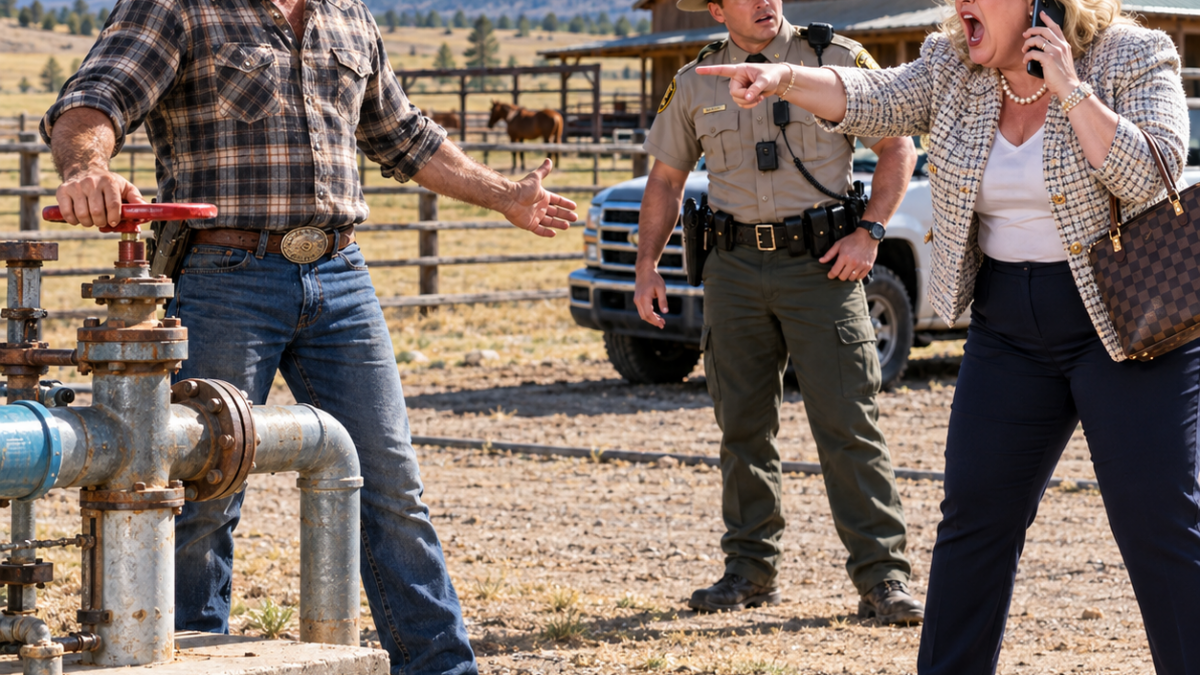
Two days later came the 911 scene at my gate.
Tom refused to arrest me.
He warned Diane.
I believed that humiliation might finally make her cautious.
Instead, it made her dangerous.
That night, Pine Ridge held an emergency HOA meeting.
A resident later sent me audio.
Diane told the room I had “drastically reduced the community water supply.”
Someone asked whether I had legal authority.
Diane answered:
“It doesn’t matter.”
That sentence eventually mattered very much.
Another resident asked about the 1996 contract.
“Outdated,” Diane said.
Someone mentioned drilling wells.
“Too expensive.”
Municipal connection?
“Unreasonable.”
Then Diane said:
“We’re suing her.”
People applauded.
Not everyone.
But enough.
Then came the line Steven replayed three times.
A resident asked:
“What if the lawsuit doesn’t work?”
Diane answered:
“Then we’ll take matters into our own hands.”
Steven called me.
“Save this in three places.”
“I already did.”
“Cloud?”
“Yes.”
“External drive?”
“Yes.”
“My office?”
“Sending now.”
“Good.”
“Is it that bad?”
“It could become important if she does something stupid.”
Eleven days later, she did.
I was riding Cisco along the southern fence when I heard diesel.
At first I assumed county road work.
Then I realized it was coming from my creek.
I turned Cisco downhill.
The sound became louder.
Hydraulic whine.
Engine rev.
Metal bucket striking earth.
I rounded a stand of cottonwoods.
And stopped.
A yellow backhoe was twenty feet inside my property.
Bucket deep in the ground.
Fresh earth piled beside a trench.
Thirty feet long.
Three feet wide.
Four feet deep.
Diane stood beside it.
Arms folded.
Watching.
I dismounted so quickly Cisco sidestepped.
“Diane!”
She turned.
Not surprised.
Not guilty.
Satisfied.
“What the hell are you doing?”
“Fixing the problem.”
The operator kept digging.
“Stop that machine.”
Diane didn’t move.
I looked at the trench.
Then the creek.
They were building a bypass around my valve.
I felt something cold move through my chest.
“You’re diverting the creek.”
“You left us no choice.”
“This is my property.”
“This is community water.”
“You are thirty feet inside my deed line with heavy equipment.”
“Your valve is interfering with our historic flow.”
“Historic?”
“We’ve received that water since the subdivision opened.”
“Two years.”
“Long enough.”
I pulled out my phone.
“Tell him to stop.”
“No.”
“If that trench breaches the creek bank, you’re going to dump sediment downstream.”
“That’s temporary.”
“You’re altering a watercourse without permits.”
“We are restoring access.”
“You don’t have access to restore.”
Her face tightened.
“You love saying no, don’t you?”
“What?”
“You ranch people. Everything is mine, mine, mine. My land. My cattle. My spring. Meanwhile eighty-five families built lives down there.”
“On property with a fifteen-gallon agreement.”
“You think that old paper matters more than people.”
“It protects the people who signed it too.”
She stepped closer.
“You’re selfish.”
I stared at her.
“My family preserved this creek for ninety years.”
“For cows.”
“For everything living in it.”
She laughed.
That laugh made my stomach tighten.
I called Tom.
“Emma?”
“Diane is on my property.”
Pause.
“With a backhoe.”
Longer pause.
“She’s digging a bypass around the valve.”
“I’m coming.”
“She has thirty feet open already.”
“Do not engage.”
“I’m standing here.”
“Keep recording.”
“I am.”
Twenty minutes later, two patrol vehicles came over the hill.
By then the backhoe operator had stopped.
Probably because he finally realized the shouting woman who hired him and the rancher filming him did not agree about property rights.
Tom stepped out.
He looked at the machine.
The trench.
Diane.
Then me.
His jaw tightened.
“Ms. Morrison.”
She walked toward him.
“Thank God. Maybe now you can make her restore our water.”
Tom pointed toward the trench.
“Did you authorize this?”
“Yes.”
“Do you have Emma’s permission?”
“I don’t need it.”
Tom stared at her.
“That wasn’t the question.”
“This is an easement matter.”
“Do you have written authorization to excavate on this ranch?”
“The HOA has rights.”
“Show me.”
“I don’t have the documents with me.”
The backhoe operator climbed down.
“Sheriff?”
Tom turned.
“Name?”
“Kyle Turner.”
“You own this machine?”
“Yes.”
“Who hired you?”
Kyle pointed at Diane.
“She did.”
“What were you told?”
“Drainage repair. HOA project. She said everything was permitted.”
Diane snapped:
“Stop talking.”
Kyle looked at her.
Then Tom.
“I didn’t know this was private property.”
“It is,” Tom said.
Kyle’s face went pale.
“Sir, if I’d known—”
“Shut the equipment down. You’ll give a statement.”
“Yes, sir.”
Diane stepped forward.
“He works for me.”
Tom looked at her.
“No. He works for an excavation company you hired.”
Then he turned toward the trench again.
“You entered private property after being told the owner controlled the water legally.”
“This is an emergency.”
“No.”
“Our subdivision needs water.”
“You are receiving water.”
“Not enough.”
“Then obtain more legally.”
“You’re siding with her again.”
“I am siding with documents again.”
Her face twisted.
“I’m the HOA president.”
Tom reached for his handcuffs.
“That is not a property deed.”
For the first time, Diane looked frightened.
“What are you doing?”
“Turn around.”
“You cannot be serious.”
“Turn around.”
“You’re arresting me?”
“For criminal trespass, property destruction, and unlawful diversion pending investigation.”
“This is unbelievable.”
“Hands behind your back.”
“I was protecting eighty-five families.”
“Hands.”
She looked at me.
Pure hatred.
“You did this.”
I shook my head.
“No, Diane.”
Tom cuffed her.
“You did.”
She started crying as he walked her toward the cruiser.
Not grief.
Rage.
Humiliation.
“This isn’t over!”
Tom opened the rear door.
“You think you won?”
He put her inside.
The door closed.
I should have felt triumphant.
Instead, I walked toward the trench.
The creek had turned brown.
Fine soil moved through the water.
The excavation cut into a section of gravel where the current widened and shallowed.
My heart dropped.
I knew that stretch.
I had seen fish holding there every fall.
Bull trout.
I crouched.
The gravel bed was torn open.
Bucket marks.
Mud.
Displaced stone.
The trench scar cut beside it.
“Oh, God.”
Tom came over.
“What?”
“This is spawning habitat.”
“For what?”
“Bull trout.”
His face changed.
“Protected?”
“Yes.”
“How protected?”
“Federal.”
He looked toward the cruiser.
Then back at the creek.
“Call Fish, Wildlife and Parks.”
I did.
Biologist Derek Chen arrived within an hour.
Waders.
Camera.
Clipboard.
He walked the creek slowly.
Took photographs.
Collected water.
Measured the trench.
Then stood beside me.
“This section is confirmed spawning habitat.”
“I know.”
“You’ve documented fish here?”
“Every year.”
“We have state survey records too.”
“How bad?”
He looked downstream.
“Bad.”
That word hurt more than numbers.
“This sediment will settle into the spawning gravel.”
“Can we flush it?”
“Not quickly. Restoration needs to be controlled. We don’t want to make it worse.”
“What happens to Diane?”
“That’s not my decision.”
“Federal involvement?”
“Yes.”
He crouched again.
“Emma, altering this section without environmental authorization is serious.”
I looked at the cruiser.
Diane sat in back.
Her face turned away.
She wanted more water for fountains.
She had torn apart a creek supporting a protected fish population to get it.
That was when the dispute stopped feeling like mine.
Two days later, Derek returned with Special Agent Maria Vasquez from the U.S. Fish and Wildlife Service.
Maria didn’t waste words.
She measured.
Photographed.
Bagged samples.
Asked questions.
Then we stood beside the damaged creek.
“Who directed excavation?”
“Diane Morrison.”
“Did she have your permission?”
“No.”
“Did you warn her beforehand not to interfere with your water controls?”
“Yes.”
“Written?”
“Yes.”
“Sheriff documentation?”
“Yes.”
“Water agreement?”
“Yes.”
“Send me everything.”
I nodded.
She looked at the bank.
“Did she know this was protected habitat?”
“I doubt it.”
Maria met my eyes.
“That may matter to certain issues, but it does not make excavating a regulated creek without authorization lawful.”
“What happens?”
“Investigation.”
“How long?”
“However long the evidence requires.”
“Could this become criminal?”
“Yes.”
I looked at the torn gravel.
“Good.”
Maria studied me.
“You’re angry.”
“Yes.”
“I need you to be careful about that.”
“I know.”
“Why?”
“Because I’m the victim and a witness.”
She nodded.
“Exactly.”
I took a breath.
“She called 911 trying to have me arrested. She sued me. Then she brought a backhoe onto the ranch.”
“I understand.”
“I’m not pretending I feel neutral.”
“You don’t need to.”
“What do you need?”
“Facts.”
I pointed toward my house.
“I have a filing cabinet full of them.”
That afternoon I sent everything.
The 1934 certificate.
The 1996 agreement.
The 2018 deed transfer.
Flow data.
Valve records.
Certified warning.
Coffee-shop notes.
Phone logs.
Meeting audio.
Sheriff’s reports.
Photos.
Video.
Kyle Turner’s information.
I never appreciated documentation more than I did that week.
Dad had been right.
Water without paperwork becomes somebody else’s water.
Diane posted bond on the state charges.
Then hired Douglas Crane.
Expensive.
Experienced.
Aggressive.
The HOA lawsuit against me continued even after her arrest.
Pine Ridge wanted an injunction forcing me to restore higher flow.
Steven filed our response.
The hearing happened before the federal criminal trial.
Diane sat behind her attorney.
I sat with Steven.
The HOA argued reliance.
Eighty-five families.
Property values.
Landscaping investment.
Developer representations.
Steven stood.
“Your Honor, none of those things modify the recorded agreement.”
He placed the 1996 contract before the judge.
“Maximum fifteen gallons per minute.”
Then my flow records.
“Current flow: fifteen gallons per minute.”
The judge looked at opposing counsel.
“So the defendant has not terminated access?”
“No, Your Honor, but—”
“She is providing the contracted quantity?”
“Yes.”
“And your association seeks what?”
“Historic operating flow.”
“What is the contractual basis for forty-plus gallons per minute?”
The attorney shifted.
“Course of use.”
“For approximately two years?”
“Yes.”
“Against a written maximum?”
“Yes, but—”
The judge shook her head.
“Request for preliminary injunction denied.”
Diane stared at me.
I didn’t smile.
Outside, reporters waited.
One asked:
“Ms. Hartley, are you happy?”
“No.”
“Why not?”
“My creek is damaged.”
“But you won.”
I looked back toward the courthouse.
“A judge agreeing that a contract says what it says isn’t what I wanted from this.”
“What do you want?”
“My creek back.”
I walked away.
Pine Ridge residents slowly began learning what they had actually purchased.
Cascade Communities had marketed “natural creek-fed amenities.”
Sales materials showed fountains.
Ponds.
Waterfalls.
Several residents said sales agents implied water availability was effectively unlimited for community features.
Nobody remembered receiving the 1996 agreement.
One resident named Michael Barrett called me.
He had been at the gate the day Diane tried to have me arrested.
“Emma?”
“Yes.”
“This is Mike Barrett.”
“I remember.”
“I owe you an apology.”
“You don’t need to.”
“I do.”
He paused.
“My wife and I bought because of the pond.”
“I’m sorry.”
“We thought the HOA had water rights.”
“They had access.”
“Fifteen gallons.”
“Yes.”
“For the entire development.”
“Yes.”
He sighed.
“That should’ve been disclosed.”
“I agree.”
“I was one of the people standing behind Diane when she demanded your arrest.”
“I know.”
“I feel like an idiot.”
“You believed your HOA president.”
“That’s not much of a defense.”
“It’s a human one.”
He became quiet.
Then:
“What happens to us?”
“You find another water source.”
“Municipal connection is expensive.”
“I know.”
“Wells?”
“Possible.”
“You won’t increase our allocation?”
“Not while my ranch needs the spring.”
“Ever?”
“I didn’t say ever.”
He sounded surprised.
“You’d negotiate?”
“If Pine Ridge approaches honestly and proves the ranch can sustain additional draw.”
“Diane said you hated us.”
“I don’t know most of you.”
That was the beginning of the community turning.
Not because I won them over.
Because facts arrived.
Federal investigators interviewed residents.
Kyle Turner cooperated fully.
His statement hurt Diane badly.
She had told him the job was approved.
Told him permits existed.
Told him the HOA possessed lawful authority.
He had texts.
Maria Vasquez obtained them.
One read:
Need bypass completed before court date. Once water is restored she won’t be able to put the genie back in the bottle.
Another:
Do not contact ranch owner. She is hostile and will interfere.
Steven read those lines and looked at me.
“Premeditation.”
“She knew.”
“She always knew.”
“Not about the fish.”
“No. About trespass.”
The state case strengthened.
The federal case strengthened.
Then prosecutors obtained audio from the HOA meeting.
“If the lawsuit doesn’t work, we’ll take matters into our own hands.”
The words sounded much worse in a courtroom than they had in a clubhouse.
By January, federal charges were filed relating to destruction of protected habitat.
The same week, Pine Ridge residents petitioned to remove Diane as HOA president.
The meeting lasted forty minutes.
She fought.
Blamed me.
Blamed the sheriff.
Blamed environmental regulators.
Blamed Cascade Communities.
Blamed “anti-development activists.”
Finally Mike Barrett stood.
“Diane, did the agreement say fifteen gallons?”
She glared at him.
“That agreement was obsolete.”
“That isn’t what I asked.”
The room quieted.
“Did it say fifteen?”
“Yes.”
“Did Emma provide fifteen?”
“Yes.”
“Then why did you tell us she shut off our water?”
Diane opened her mouth.
Nothing came.
Mike continued.
“Did you hire the backhoe?”
“Yes.”
“Did you have permission?”
“The HOA had—”
“Did you have Emma’s permission?”
“No.”
“Did you tell Kyle there were permits?”
Her attorney, sitting nearby, stood.
“Diane, don’t answer that.”
That ended the meeting emotionally before the vote happened.
The members removed her.
Seventy-one in favor.
Nine against.
Five abstained.
For the first time, Pine Ridge contacted me through a new board president.
Mike.
He came to my ranch.
No entourage.
No phone recording.
No threats.
He stood on my porch with his hands in his jacket pockets.
“We need to fix this.”
“Yes.”
“We’re suing Cascade Communities.”
“I heard.”
“They sold us amenities dependent on water the HOA never had.”
“That sounds accurate.”
“We’re exploring wells.”
“Smart.”
“Municipal connection too.”
“Expensive.”
“Very.”
He looked toward the pasture.
“I want to ask you something.”
“Go ahead.”
“When the creek recovers, would you consider negotiating additional seasonal irrigation?”
“Maybe.”
He blinked.
“That’s more than I expected.”
“You aren’t Diane.”
“No.”
“And I’m not trying to destroy Pine Ridge.”
“She told us you were.”
“I know.”
He looked embarrassed.
“We believed her.”
“I know.”
“Why are you not angrier at us?”
“I am.”
He almost laughed.
“That’s reassuring.”
I smiled.
“I’m angry you took three times the water. I’m angry people stood at my gate demanding my arrest. I’m angry someone dug into my creek.”
I looked toward the cottonwoods.
“But anger doesn’t create water.”
Mike nodded.
“Fair.”
“The spring produces what it produces. My ranch has senior rights. The creek has ecological needs. Whatever remains can be discussed honestly.”
“That’s all I’m asking.”
“Then we can talk when restoration is stable.”
He shook my hand.
The civil case I filed against Diane moved alongside the criminal matters.
Damage to property.
Restoration costs.
Attorney fees.
Loss of use.
She refused early settlement.
Her lawyer advised a deal.
She refused.
The federal prosecutor offered a plea arrangement.
She refused that too.
Every person around Diane seemed to understand the situation except Diane.
Douglas Crane eventually said during a hallway conversation Steven later told me about:
“My client believes motive is a defense.”
It wasn’t.
Federal trial began in March.
Missoula.
I hated every hour of it.
People imagine trials as dramatic confrontations.
Mostly they are waiting.
Wood benches.
Whispered conversations.
Lawyers carrying boxes.
Then sudden moments where your entire life is reduced to a question.
Assistant U.S. Attorney Rachel Delgado’s opening was simple.
“This case is about choices.”
She described the warnings.
The water contract.
The sheriff’s intervention.
The lawsuit.
Then the backhoe.
Douglas Crane presented Diane as a community leader facing an emergency.
Eighty-five families.
Water-dependent landscaping.
Property values.
A woman trying to solve a crisis.
Then Tom testified.
Rachel asked:
“Did Ms. Hartley completely terminate Pine Ridge’s water?”
“No.”
“How much was provided?”
“Fifteen gallons per minute.”
“Why that number?”
“The recorded agreement.”
“Did you explain that to Ms. Morrison?”
“Yes.”
“When?”
“At Emma’s ranch gate.”
“Did she accept it?”
“No.”
“What did she demand?”
“That I arrest Emma.”
“For?”
“Water theft.”
A few jurors glanced toward me.
Rachel continued.
“Was Emma Hartley stealing water?”
“No.”
“Whose senior rights controlled the spring?”
“Emma’s.”
“What did you tell Ms. Morrison?”
“That this was a civil contract matter and Emma appeared to be acting within her rights.”
“Did you later encounter Ms. Morrison on Emma’s property?”
“Yes.”
“What was she doing?”
“Supervising excavation of a bypass trench.”
“Had Emma given permission?”
“No.”
“What happened?”
“I arrested Ms. Morrison.”
Next came Derek Chen.
The photographs went on a screen.
That hurt.
Seeing the creek in person had been terrible.
Seeing it enlarged twenty feet wide was worse.
Mud.
Destroyed gravel.
Collapsed bank.
Rachel asked about recovery.
“Years.”
Bull trout reproduction.
Damaged.
Sediment.
Downstream effects.
Then Maria Vasquez.
She described the federal investigation.
Permits.
Protected habitat.
Statements.
Messages.
The backhoe contractor.
Then me.
I walked to the witness stand.
Swore the oath.
Sat.
Rachel approached.
“Ms. Hartley, how long has your family held the ranch?”
“Since 1934.”
“And the spring?”
“Same year.”
“What does the spring mean to your operation?”
“Everything.”
I tried to keep my voice steady.
“It waters livestock. Pasture. It supports the creek ecosystem. My grandfather organized the ranch around it.”
Rachel showed me the old certificate.
“Recognize this?”
“Yes.”
“What is it?”
“My grandfather’s water-rights certificate.”
Then the 1996 agreement.
“My father signed that.”
“Why?”
“To let the downstream property use a limited amount.”
“How much?”
“Fifteen gallons per minute.”
“For?”
“Irrigation and landscaping.”
“Did the agreement authorize swimming pools?”
“No.”
“Koi ponds?”
“No.”
“Decorative fountains?”
“No.”
“Forty-five gallons per minute?”
“No.”
“What did you do before installing the valve?”
“I met Diane.”
“Then?”
“Sent certified notice.”
“Then?”
“Hired an attorney.”
“Then?”
“Installed a meter-controlled valve set to fifteen.”
“Did you cut Pine Ridge off?”
“No.”
“Why not?”
“I didn’t want to.”
Rachel paused.
“You could have argued the violation allowed complete termination?”
“Yes.”
“Why didn’t you?”
“Because eighty-five households didn’t negotiate the original agreement. I wanted compliance, not punishment.”
The courtroom stayed quiet.
She walked toward the photographs.
“What did you feel when you saw the backhoe?”
“Angry.”
“Why?”
“She had already been told.”
My throat tightened.
“By me. By my attorney. By the agreement. By the sheriff.”
“What did you see after her arrest?”
I looked at the photograph.
“The spawning gravel.”
“What did that mean to you?”
“My father protected that creek.”
I stopped.
Rachel waited.
“My grandfather protected it before him.”
My voice cracked.
I hated that.
“I spent years working in conservation before coming home. I understood what had been destroyed the moment I saw the mud.”
“What did Ms. Morrison destroy?”
“More than dirt.”
That was all I could manage.
Crane cross-examined.
“Ms. Hartley, you disliked Pine Ridge before this dispute.”
“No.”
“You criticized wealthy outsiders moving into Montana.”
“Privately, probably.”
“You resented the development.”
“I didn’t care what they built on property they owned.”
“You deliberately installed a device knowing it would disrupt eighty-five homes.”
“I installed a device enforcing their contract.”
“You knew fountains would fail.”
“Yes.”
“Koi ponds would lose inflow.”
“Yes.”
“Pools could no longer be filled.”
“Yes.”
“And you did it anyway.”
“Yes.”
“Because you wanted to teach them a lesson?”
“No.”
“Because you wanted control.”
“Of my water?”
A few jurors smiled.
Crane frowned.
“Because you wanted control over Pine Ridge.”
“No.”
“You enjoyed watching their amenities fail.”
“No.”
“You didn’t feel satisfaction?”
“I felt relief when my creek began recovering.”
“Is that a yes?”
“No.”
He paced.
“Would you agree Ms. Morrison believed she was protecting her community?”
“I believe she said that.”
“That isn’t my question.”
“I cannot tell you what she believed.”
“She had eighty-five households calling her.”
“Probably.”
“Property values at risk.”
“Maybe.”
“Residents angry.”
“Yes.”
“She was under pressure.”
“Yes.”
“And you showed no flexibility.”
“I gave them everything the agreement required.”
He paused.
Then:
“You could have increased the water.”
“I could have sacrificed my ranch’s supply.”
“So you chose your cattle over eighty-five families.”
I looked directly at him.
“For swimming pools and fountains?”
He didn’t answer.
“No further questions.”
Diane testified in her own defense.
That was the mistake her attorney had probably begged her not to make.
Crane asked why she ordered the trench.
“To protect the community.”
Did she intend environmental harm?
“No.”
Did she know about bull trout?
“No.”
Did she believe Pine Ridge had water rights?
“Yes.”
She sounded convincing.
For perhaps ten minutes.
Then Rachel stood.
“Ms. Morrison, did you read the 1996 agreement?”
“I reviewed it.”
“Did it say fifteen gallons per minute?”
“Yes.”
“Did it say irrigation and landscaping?”
“Yes.”
“Did Emma Hartley warn you your community was taking approximately three times the limit?”
“She made accusations.”
“Did she warn you?”
“Yes.”
“Did she send certified notice?”
“Yes.”
“Did Sheriff Brennan tell you she held senior rights?”
“Yes.”
“Did he refuse to arrest her because she was complying with the agreement?”
“Yes.”
“Did the HOA then sue?”
“Yes.”
“While that case was pending, did you hire Kyle Turner?”
“Yes.”
“Did you tell him the work was permitted?”
Silence.
“Ms. Morrison?”
“My understanding was—”
“Did you tell him it was permitted?”
“Yes.”
“Was it?”
“I believed—”
“Yes or no.”
“No.”
“Did you have Emma Hartley’s permission?”
“No.”
“Did you instruct Mr. Turner not to contact her?”
Diane’s eyes moved toward Crane.
“Yes.”
“Did you send this message?”
Rachel displayed it.
Need bypass completed before court date. Once water is restored she won’t be able to put the genie back in the bottle.
Diane swallowed.
“Yes.”
“Does that sound like emergency environmental maintenance?”
“No.”
“Does it sound like you were deliberately bypassing Ms. Hartley’s control system before a court could rule?”
Crane objected.
Sustained.
Rachel changed wording.
“Why before the court date?”
“I wanted water restored quickly.”
“Why not wait for the judge?”
“Because residents were suffering.”
“From lack of drinking water?”
“No.”
“Lack of household sanitation?”
“No.”
“Fire protection?”
“No.”
“What were they lacking?”
Diane stared at her.
Rachel waited.
Finally:
“Normal community water features.”
“Fountains?”
“Yes.”
“Pools?”
“Yes.”
“Koi ponds?”
“Yes.”
Rachel took one step back.
“So after being told repeatedly that the contract allowed fifteen gallons per minute, you entered private property without permission, before the judge could rule, to restore extra water for pools, fountains, and ponds.”
Diane looked down.
“I was protecting my community.”
Rachel nodded.
“No further questions.”
The jury deliberated for four hours.
When the forewoman stood, Diane gripped the edge of the table.
Guilty.
The word sounded smaller than I expected.
Just two syllables.
Yet it seemed to change the entire room.
Diane closed her eyes.
Her husband bowed his head.
I sat still.
No celebration.
No smile.
Just exhaustion.
Sentencing came weeks later.
Crane asked for leniency.
First offense.
Grandmother.
Volunteer.
Community leadership.
A terrible error of judgment.
Rachel emphasized warnings.
Premeditation.
Trespass.
Environmental damage.
The judge allowed me to speak.
I stood.
My prepared statement was three pages.
I used less than one.
“Your Honor, Diane called 911 because I reduced her subdivision to water it was legally entitled to receive. She tried to turn my ownership into a crime.”
I looked toward Diane.
“She was warned repeatedly.”
My hands trembled slightly.
“She could have sued and waited. She could have negotiated. She could have drilled wells. She could have connected to another source.”
I swallowed.
“Instead, she brought a machine onto land my family has protected for ninety years and tore open a creek because she believed needing something gave her ownership of it.”
I looked at the judge.
“I’m not asking the court to punish her because she made me angry.”
I paused.
“I’m asking for accountability because the next person who thinks boundaries disappear when they become inconvenient needs to know they don’t.”
I sat.
The sentence was severe.
Eighteen months of incarceration under the combined consequences described in the case.
Supervised release.
Financial penalties.
Habitat-restoration obligations.
Restitution for my losses.
Permanent prohibition against entering my ranch.
Diane began crying.
“This is insane.”
The judge looked at her.
“You had multiple opportunities to stop.”
She shook her head.
“I was helping people.”
“You were told the lawful limits.”
“My community needed—”
“Ms. Morrison.”
His voice hardened.
“Need does not authorize trespass.”
Two marshals approached.
Her husband reached for her hand before they led her away.
That was the only moment I felt something like sorrow for her.
Not because the sentence was unfair.
Because all of it had been avoidable.
She could have answered my certified letter.
She could have called.
She could have said:
Emma, we have a problem. What can we do?
Instead, every no became an insult.
Every boundary became a challenge.
Every document became something she thought confidence could overpower.
And eventually she ran out of people willing to let confidence substitute for permission.
The HOA’s case against me collapsed.
Pine Ridge turned its attention toward Cascade Communities.
Residents alleged that the developer had misrepresented water access.
The dispute settled.
Money went back toward residents and infrastructure planning.
Some homeowners drilled wells.
Some removed fountains.
Several connected portions of the community to alternative water systems.
The giant ornamental fountain at the entrance stopped running.
For months it stood dry.
I expected seeing it that way to make me happy.
It didn’t.
It looked sad.
A monument to people buying promises nobody had secured.
Mike called me one afternoon.
“We’re thinking about removing it.”
“The entrance fountain?”
“Yes.”
“Probably wise.”
“Some residents want to keep it and recirculate captured water.”
“That could work.”
“Would you mind?”
I laughed.
“Mike, it’s your fountain.”
He went quiet.
“Diane made us think you hated everything about this place.”
“I hated you taking my water.”
“Fair distinction.”
The HOA eventually installed a closed-loop recirculating system.
No creek draw.
The fountain ran again.
I actually liked it better after that.
Not because it was prettier.
Because it finally belonged to the people using it in every meaningful sense.
They paid for its water.
They maintained it.
They weren’t taking anything from me.
Meanwhile, restoring my creek took more than money.
Contractors filled Diane’s trench.
Recontoured banks.
Removed deposited sediment where possible.
Placed clean spawning gravel.
Replanted native vegetation.
Installed erosion-control structures.
Biologists monitored temperature.
Flow.
Fish presence.
Every truck that came onto my ranch reminded me why it was there.
Some days that made me furious again.
Other days it made me tired.
I spent hours beside the restoration crews.
Derek finally said:
“Emma, you know you’re allowed to go home.”
“This is home.”
“I mean the house.”
“I know.”
He smiled.
“You’re going to inspect every rock, aren’t you?”
“Yes.”
“Your environmental-science degree is showing.”
“It finally feels useful.”
By spring, new vegetation appeared.
Tiny green shoots.
Willows beginning to establish.
Water cleared.
The bank looked artificial at first.
Too neat.
Restoration always does.
Nature had not yet had enough time to soften the human fingerprints.
One June morning, I saddled Cisco.
We rode south.
Sun just above the ridge.
The creek was cold and clear.
I dismounted near the repaired spawning section.
For a while, nothing moved.
Then a flash.
Silver.
Red.
A bull trout held in the current.
Then another.
Then a third.
I stood completely still.
Three fish.
That was all.
But after months of lawyers, deputies, reporters, contractors, biologists, court dates, and money, three fish nearly brought me to my knees.
I thought about Dad.
He used to bring me there when I was little.
We would sit on the bank.
He’d point beneath the current.
“See that shadow?”
I never saw it.
Then suddenly I would.
A fish appearing from water that looked empty seconds earlier.
“You have to stop looking at the surface,” he used to say.
I smiled when I remembered.
That described the whole fight.
On the surface, Diane’s story looked powerful.
Eighty-five homes.
A community.
Two years of use.
A rancher turning down water.
An HOA president defending residents.
Look deeper and the truth was different.
Senior rights.
Fifteen gallons.
Certified warning.
Unauthorized draw.
Trespass.
A trench.
Destroyed habitat.
The truth had always been under the surface.
You just had to look.
Pine Ridge changed after Diane.
The new board published water documents online.
Every homeowner could read the 1996 agreement.
They created a water committee.
Actual engineers joined.
Usage was metered.
Alternative sources were planned.
Mike occasionally called me for advice.
The first time, he sounded nervous.
“I know you’re not our consultant.”
“I appreciate that.”
“We’re considering a shared well.”
“Depth?”
He told me.
“Geology report?”
“Coming.”
“Recharge estimate?”
“Preliminary.”
“Don’t build infrastructure around best-case numbers.”
A pause.
“That sounds directed at our developer.”
“It is.”
He laughed.
Eventually Pine Ridge functioned without pretending my creek could supply unlimited luxury landscaping.
The fifteen gallons remained available under the existing agreement.
They used it carefully.
Mostly common irrigation.
A little landscaping.
No pool filling.
No koi ponds dependent on continuous creek water.
No fountains pulling from my spring.
The creek recovered.
My lower pasture recovered too.
Cattle began spreading instead of crowding around shrinking pools.
Mud disappeared.
Native grass returned along the bank.
One evening I stood beside the water with Steven.
He had driven out because the last civil documents needed signatures.
“We’re done,” he said.
“Completely?”
“As completely as lawyers ever say.”
“Meaning?”
“Someone can always find a new problem.”
“Comforting.”
He smiled.
“Diane’s restitution schedule is in place. Habitat obligations funded. Your civil settlement is finalized. Pine Ridge dismissed all remaining claims. Water agreement remains in effect.”
I signed.
Then I looked at him.
“How much did this entire disaster cost?”
“Whose side?”
“Everyone.”
He thought.
“More than anybody should have spent.”
“All over thirty gallons per minute they didn’t own.”
“Basically.”
“That’s insane.”
“No.”
I looked at him.
“No?”
“It’s common.”
“That’s worse.”
He closed the folder.
“Most expensive disputes aren’t really about the thing people say they’re about.”
“What was this about?”
“Diane being told no.”
That answer stayed with me.
Months later, a reporter contacted me for an anniversary story.
She wanted a dramatic final quote.
I declined twice.
She kept calling.
Finally, I agreed to ten minutes.
We met outside a café.
Her first question:
“Do you feel like you won?”
“No.”
“Why not?”
“My creek was damaged.”
“But Diane went to prison.”
“Yes.”
“You received restitution.”
“Yes.”
“The HOA admitted your rights.”
“Yes.”
“Your ranch is protected.”
“Yes.”
“So why isn’t that winning?”
I thought about it.
“Because winning would have been Diane reading the agreement in August and saying, ‘You’re right. We’ll reduce use.’”
The reporter stopped writing for a second.
“That wouldn’t be much of a story.”
“Exactly.”
She smiled.
“Do you hate her?”
“No.”
“Really?”
“I hated what she did.”
“That sounds carefully phrased.”
“It is.”
“What would you say if she were sitting here?”
I looked toward the street.
“I’d ask whether any fountain was worth eighteen months away from her family.”
The reporter wrote that down.
Then:
“Do you think she regrets it?”
“Yes.”
“Do you think she thinks she was wrong?”
That was harder.
“I don’t know.”
There is a difference between regretting consequences and understanding the choice.
I never spoke to Diane again.
I heard pieces.
Her husband sold their Pine Ridge house.
They moved after her release.
She resigned permanently from community involvement.
Her name became shorthand inside Pine Ridge for bad governance.
Residents would apparently say:
“Don’t Diane this.”
Meaning:
Don’t escalate something before reading the agreement.
I found that darkly funny.
My life became quieter.
That mattered more.
Fence repairs.
Calving.
Winter feed.
Irrigation.
Taxes.
The thousand small problems that make ranch work exhausting and comforting because they are real problems.
A broken gate does not manipulate you.
A frozen pipe does not call the sheriff and accuse you of stealing your own water.
A cow does not hire an attorney because she dislikes contractual limitations.
Usually.
On the anniversary of Dad’s death, I rode to the spring.
The cottonwoods were turning gold.
Water emerged from the ground the same way it had when Granddad found it.
Cold.
Clear.
Unimpressed by human conflict.
I brought the old certificate with me.
Not the original.
That stayed protected.
A copy.
March 15, 1934.
Samuel Hartley.
I ran my finger over his name.
Ninety years.
Granddad protected the spring because the ranch depended on it.
Dad protected the contract because he understood generosity needed boundaries.
I protected both because I had inherited not only the rights but the obligation.
That was what Diane never understood.
She thought ownership meant selfishness.
It doesn’t.
My father shared water.
Voluntarily.
For a future community that didn’t even exist yet.
Fifteen gallons per minute.
For decades if necessary.
That was generosity.
Taking forty-five because fifteen wasn’t luxurious enough was not community need.
It was entitlement wrapped in collective language.
And when I enforced the line, Diane treated the boundary itself as violence.
That happens more often than people admit.
Someone benefits from your patience long enough and begins believing patience is their right.
Then the first boundary feels like theft.
I sat beside the spring until late afternoon.
A hawk circled over the pasture.
Cisco grazed nearby.
Water moved south.
Toward Pine Ridge.
Fifteen gallons per minute available under agreement.
No anger in it.
No revenge.
Just water going where the paperwork said it could go.
Later that year, Pine Ridge invited me to a community meeting.
I almost declined.
Mike insisted.
“We’re not asking for anything.”
“That sounds suspicious.”
“We want to show you something.”
I drove down.
First time I had entered the clubhouse since everything happened.
Residents filled perhaps half the room.
No shouting.
No phones recording me.
Mike stood in front.
“Emma, we’ve approved a new water plan.”
He displayed a map.
Two wells.
Rain-capture systems for common landscaping.
Closed-loop fountains.
Drought-resistant planting.
Smart irrigation.
Connection reserve for municipal expansion.
“And the creek?” I asked.
“Fifteen gallons.”
A few people laughed.
Mike smiled.
“We finally learned that number.”
I looked at the map.
“This is good.”
“We hired engineers.”
“Even better.”
Then an older woman stood.
I recognized her from Diane’s first group at my gate.
She looked embarrassed.
“My name is Susan.”
“I remember.”
“I was there when Diane called the sheriff.”
“I know.”
“I thought you were cruel.”
“I know.”
“She told us you had shut everything off.”
“I know.”
Susan’s eyes filled slightly.
“My husband had just spent thirty thousand dollars on landscaping.”
“That’s a lot.”
“We thought the creek supply was permanent.”
“I’m sorry.”
“It wasn’t your fault.”
She looked down.
“I said some terrible things about you.”
I didn’t know what to say.
So I said the truth.
“I said some things about Pine Ridge too.”
That made her smile.
“Can we call it even?”
“No.”
Her face fell.
I continued.
“You didn’t dig the trench.”
She laughed through tears.
“Fair.”
Then she hugged me.
I wasn’t ready.
I stood stiffly for a second.
Then hugged her back.
After the meeting, Mike walked me outside.
The entrance fountain was running.
Closed loop.
Same water circulating.
I pointed.
“Looks good.”
“Uses less than one percent of what it used to.”
“That’s an improvement.”
He nodded.
“Do you ever think about turning off the fifteen entirely?”
“No.”
“After everything?”
“The agreement is valid.”
“You could probably terminate it for breach.”
“Probably.”
“Why don’t you?”
I looked toward the ranch ridge.
“Because my father made a promise.”
“Even though the people who inherited the agreement abused it?”
“The promise had limits.”
“And now we follow them.”
“Exactly.”
He was quiet.
“Diane would never understand that.”
“Maybe someday.”
“You’re optimistic.”
“I raise cattle. You have to be.”
Five years from now, maybe people in Pine Ridge will barely remember the fight.
Ten years, new families will move in.
They will receive a disclosure packet.
Inside it will be the water agreement.
Fifteen gallons per minute.
Irrigation and landscaping.
Conditional access.
They will probably skim it.
Someone may laugh at how specific it is.
Maybe they’ll wonder why the HOA lawyer insists every buyer initial that page separately.
They may never know the reason.
That is fine.
Good rules become boring after the disaster that created the need to respect them.
My ranch will still be here.
The spring will still rise beneath the cottonwoods.
The creek will still run through my pasture.
Bull trout will still hide beneath cold shadows if we are lucky and careful.
And somewhere downstream, a subdivision will have lawns, fountains, families, children, dogs, barbecues, arguments, elections, and everything else communities contain.
The difference is that nobody there will be able to say:
We didn’t know.
That matters.
Because Diane Morrison’s biggest mistake wasn’t calling 911.
It wasn’t demanding my arrest.
It wasn’t even hiring the backhoe.
Those were consequences of the real mistake.
She decided that needing something made it hers.
My water.
My land.
My compliance.
My silence.
She thought eighty-five households turned trespass into authority.
She thought the word “community” could make a private contract disappear.
She thought because her residents had more money invested in fountains than I had invested in an eighteen-thousand-dollar valve, their desire outweighed my rights.
She learned differently.
Painfully.
I wish she had learned earlier.
Before the trench.
Before the fish habitat.
Before the handcuffs.
Before court.
Before prison.
That would have been a better ending for everyone.
But I cannot rewrite what she chose.
I can only decide what I do with what remained.
I restored the creek.
Protected the spring.
Kept the agreement.
Worked with the new board.
And stopped measuring justice by how badly Diane’s life went.
That was important.
For a while, anger made me want to hear every consequence.
Every fine.
Every lost position.
Every legal bill.
Then one morning I realized I was spending more emotional energy watching Diane fall than watching my own creek recover.
That felt wrong.
So I stopped asking.
Instead, I watched water.
Clearer each month.
I watched willow roots catch.
Gravel settle.
Insects return.
Fish return.
Cattle spread along the pasture.
That became the justice I cared about.
One early June morning, exactly a year after the first restoration work finished, I rode Cisco to the repaired section.
The sun had barely cleared the mountains.
Mist hovered over the creek.
I dismounted.
Waited.
Then saw movement.
One bull trout.
Two.
Then a third.
Holding against the current.
Alive.
Home.
I crouched beside the bank.
For the first time since Diane’s backhoe cut into that ground, I cried.
Not because I had won.
Because something damaged had come back.
Dad would have understood that.
Granddad too.
The law could punish Diane.
The court could order restitution.
The sheriff could protect my property.
But none of them could make a fish return.
That took time.
Work.
Patience.
And a creek finally allowed to be a creek again.
I stayed there until the sun warmed my shoulders.
Then I stood, took Cisco’s reins, and looked downstream.
Toward Pine Ridge.
Water continued south.
Fifteen gallons per minute available to them.
Exactly as my father promised.
Exactly as the agreement required.
Not a drop stolen.
Not a drop surrendered.
A boundary respected.
Sometimes people ask whether I got revenge on Diane Morrison.
I don’t think revenge is what happened.
She called the sheriff because I enforced my own water rights.
The sheriff read the documents.
She sued.
A judge read the documents.
She trespassed.
The police saw the trench.
She destroyed protected habitat.
Federal investigators saw the evidence.
She went to trial.
A jury heard what she chose to do.
At every stage, somebody simply looked at the facts she kept trying to overpower.
That was enough.
The most satisfying part was never watching her lose.
It was discovering that I didn’t have to become like her to protect what was mine.
I never cut Pine Ridge off completely.
I never threatened families.
I never damaged their property.
I never sent machines onto their land.
I never needed to.
I had the certificate.
The agreement.
The deed.
And ninety years of a creek flowing exactly where my family had protected it.
Diane tried to turn my boundary into a crime.
In the end, the boundary remained.
The ranch remained.
The spring remained.
And on a cold Montana morning, three bull trout held steady in the current where her trench had once torn the creek apart.
That was enough for me.
More than enough.
Because my grandfather was right about water.
If you don’t protect it, somebody else eventually decides it belongs to them.
And my father was right about generosity.
Sharing something does not mean surrendering it.
Pine Ridge was welcome to the water it had been promised.
Fifteen gallons per minute.
No more.
No less.
The rest stayed where it had always belonged.
With the ranch.
With the creek.
And with the family that had been protecting both since 1934.
[END OF FULL STORY]

