PART 2: HOA Karen Bulldozed My Family Airstrip—Then the FAA Asked Who Destroyed a Registered Runway
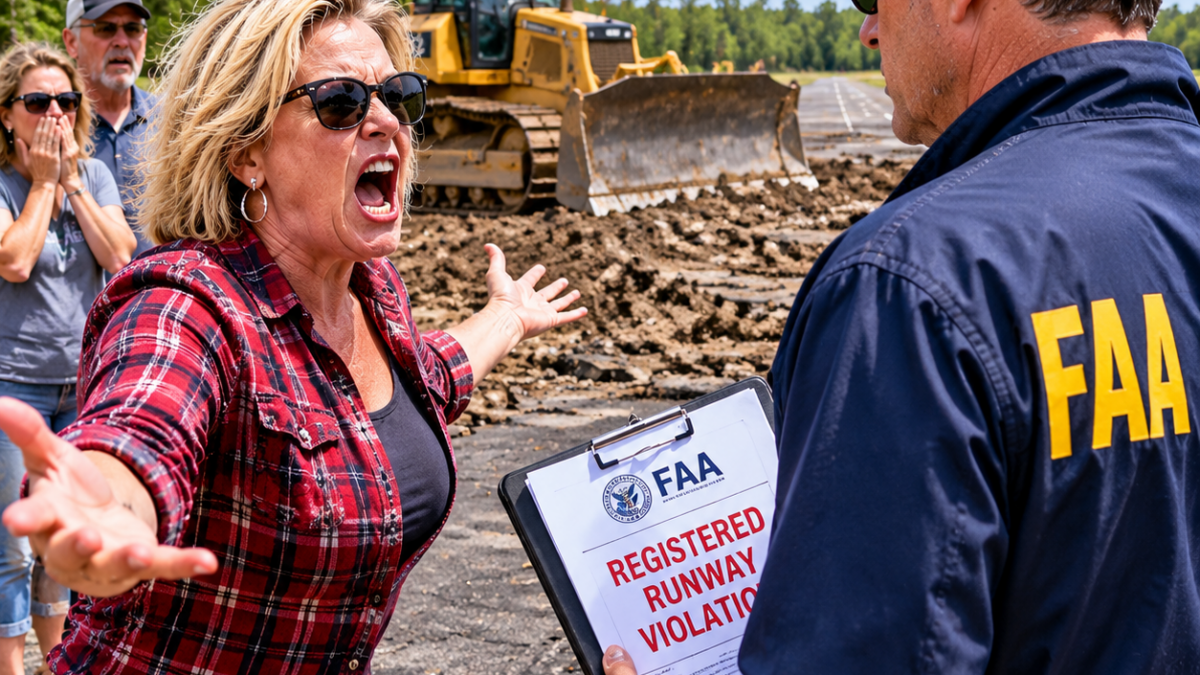
Karen bulldozed the runway my family had used for three generations, stood beside the wreckage with a smile, and told me she had done the neighborhood a favor.
She was still threatening to bill me for the demolition when the FAA opened a federal investigation and asked one very simple question: **Who authorized the destruction of a registered runway?**
“That ugly dirt patch was an eyesore and a hazard to the community.”
Karen Thompson folded her arms across her chest and looked over the ruined north pasture as if she had just completed a public-service project.
“I had it removed.”
For several seconds, I couldn’t answer.
Not because I didn’t hear her.
Because my mind was still trying to process what I was looking at.
Where my runway had been that morning, there was now a long scar of churned earth.
Deep bulldozer tracks cut across the field.
The carefully maintained turf had been ripped apart.
Sections of the base had been gouged open and pushed sideways into ragged piles.
The smooth two-thousand-foot strip that had existed on that land longer than Cypress Creek Estates had existed was gone.
A yellow bulldozer sat near the far end of the destruction, engine silent.
Its operator stood beside one enormous tire.
He looked like a man who had just realized he had accepted the wrong job.
Karen did not.
She looked proud.
The air smelled of diesel, raw earth, and crushed grass.
I stood there with my hands at my sides, trying very hard not to think about my grandfather.
Or my father.
Or the first time I had flown from that strip.
Karen mistook my silence for shock.
Maybe surrender.
She gave me a condescending smile.
“I understand change can be difficult, Sam, but eventually you’ll see this was necessary.”
I turned toward her slowly.
“Necessary.”
“Yes.”
She pointed toward the ruined runway.
“That thing was completely incompatible with the character of this community.”
“This community?”
“Cypress Creek.”
“My property is not in Cypress Creek.”
She sighed.
We had had this argument before.
Too many times.
“Your property directly borders our development.”
“That doesn’t make it part of your HOA.”
“It affects our homeowners.”
“So does the weather.”
Her eyes narrowed.
“I’m trying to have a civilized conversation.”
I looked at the bulldozer.
“Interesting time to start.”
Her face tightened.
Behind us, the operator shifted his weight.
Karen ignored him.
“We have received repeated concerns regarding safety.”
“From whom?”
“Residents.”
“Names?”
“I’m not obligated to disclose complaints.”
“What safety issue?”
“Children.”
“What about them?”
“What if one wandered onto the strip?”
I stared at her.
“You hired a bulldozer to illegally enter private property and destroy a runway because a hypothetical child might hypothetically trespass?”
She lifted her chin.
“You’re deliberately oversimplifying.”
“No, Karen. I’m trying to make what you did sound less insane than it actually is.”
Her cheeks reddened.
“There is no need for hostility.”
I looked across the damage again.
The runway had never been beautiful in the suburban sense.
There were no stone borders.
No decorative lamps.
No flowerbeds.
Just a long green strip cut straight through my north pasture.
But it had history.
My grandfather had bought the hundred-acre property when this valley was still mostly orchards and hayfields.
He built the original strip himself.
Nothing fancy.
Just two thousand feet of cleared, leveled grass.
He owned an old Cessna 170 and used it to check irrigation lines and fields.
Then my father came home from Vietnam.
Flying was one of the few things that made sense to him after the war.
He eventually bought a Piper Pawnee and started doing agricultural work.
Crop dusting.
Field surveys.
Occasional contract jobs.
That runway became his livelihood.
It was where he taught me to fly.
I could still remember being young enough that my feet barely reached the rudder pedals.
My father had laughed.
“Don’t worry about touching the pedals yet. Learn to feel what the airplane is telling you.”
The Pawnee’s engine had been the soundtrack of my childhood.
Flying eventually carried me into the Air Force.
Twenty-five years.
Training aircraft.
Transports.
Jobs that took me all over the world.
But no matter where I was stationed, that runway stayed home.
When I retired, I came back.
The old Pawnee was still in the hangar.
The land was still ours.
And the strip was still registered.
That last part mattered.
It wasn’t some improvised farm lane I occasionally landed on.
It was an FAA-registered private runway.
It had an identifier.
It appeared in aviation records.
Pilots could know it existed.
Emergency planners could know it existed.
It was legally documented.
Official.
And now Karen Thompson had hired a bulldozer to destroy it.
She pointed at the damage.
“The association had the authority to abate a nuisance.”
I looked at her.
“Which association?”
She blinked.
“Cypress Creek Estates.”
“Show me where I signed anything giving Cypress Creek Estates authority over my hundred acres.”
“You benefit from our community.”
I almost laughed.
“Excuse me?”
“Your property value has increased because of our development.”
“So?”
“That creates reciprocal obligations.”
“According to whom?”
“Our covenants.”
“Your covenants.”
“Yes.”
“For your homeowners.”
“They protect community standards.”
“Inside your community.”
“You can’t operate something this disruptive immediately beside a residential development and hide behind technical boundaries.”
“Technical boundaries?”
I looked toward the fence line.
“That technical boundary is called a property line.”
She started to speak.
I raised one hand.
“No.”
Her eyes widened.
“You’ve talked enough.”
“I beg your pardon?”
I stepped toward the bulldozer tracks.
My boots sank slightly into the torn ground.
The damage was worse up close.
The dozer hadn’t just removed grass.
It had churned the runway.
The compacted surface beneath the turf was broken.
Drainage characteristics had changed.
Ruts crossed areas where aircraft tires needed a predictable surface.
This wasn’t repairable with seed and patience.
It would require real reconstruction.
PART 2
Surveying.
Grading.
Compaction.
Probably soil analysis.
Maybe drainage work.
Karen followed me.
“You are being dramatic.”
I pulled out my phone.
She stopped.
“What are you doing?”
“Documenting.”
I took a wide photograph.
Runway.
Dozer.
Karen.
Operator.
Then another.
I walked to the edge of the damage.
Photographed track marks.
Gouged soil.
The path the bulldozer had used to enter.
The fence opening.
The property markers.
Everything.
Karen’s voice sharpened.
“You don’t have permission to photograph me.”
“You’re standing on my property.”
Her mouth closed.
The operator finally spoke.
“Sir?”
I turned.
He was probably in his forties.
Work boots.
Sunburned neck.
Company logo on his shirt.
He looked sick.
“Yeah?”
“I need to explain something.”
Karen snapped, “You don’t need to explain anything.”
He ignored her.
“She told us this was HOA common property.”
I looked at him.
“She did?”
He nodded.
“Authorized clearing job. Said the owner had already been notified. Said it was an abandoned landing strip and a liability issue.”
Karen stepped forward.
“That is not what I said.”
The operator looked at her.
“Ma’am, you gave us a work order.”
“Which accurately described the project.”
“You told my boss the HOA controlled this parcel.”
“The HOA has enforcement rights.”
I turned back to the operator.
“What’s your name?”
“Eric.”
“Last name?”
“Hollis.”
“Company?”
“Bradley Earthworks.”
“Your supervisor?”
“Mike Bradley.”
I wrote everything down.
Eric continued.
“Sir, we’re a legitimate outfit. We wouldn’t have come onto private property if we knew there was a dispute.”
“I believe you.”
Karen made an irritated sound.
I looked at the company identification on the dozer.
Photographed it.
Then I said to Eric:
“Don’t move anything else.”
“You don’t have to tell me twice.”
Karen stepped between us.
“This project was authorized.”
I finally turned fully toward her.
“Karen.”
“What?”
“I’m going to say this once.”
She stiffened.
“You are on my property without permission.”
“I am here in my capacity as—”
“You hired a contractor to come onto my land.”
“I had authority.”
“You destroyed a registered runway.”
“It was dirt.”
“It was an airfield.”
“Oh, don’t be ridiculous.”
“I am asking you to leave.”
She stared at me.
“You cannot order the president of the HOA off property adjacent to—”
“My property.”
Silence.
I pointed toward the boundary.
“Leave.”
Her expression changed.
Until that moment, I don’t think Karen had ever genuinely considered the possibility that her title stopped at the edge of Cypress Creek.
She seemed offended by the concept.
“This is not over.”
“No.”
I looked at the runway.
“It isn’t.”
She turned sharply and marched away.
At the fence line, she looked back.
“You’ll receive an invoice for the abatement work.”
I thought I’d misheard.
“You’re billing me?”
“The HOA paid for a problem you created.”
I stared at her.
Then said:
“Put that in writing.”
She smiled.
“I intend to.”
That was the first gift she gave me.
Karen walked back toward the subdivision.
I watched until she disappeared between the beige houses.
Then I made two calls.
The first was to the sheriff.
The second was to Tom.
Tom Reynolds had spent most of his career with the FAA before retiring.
Safety inspector.
Regulations guy.
The kind of man who could quote advisory circulars the way other people quote movie lines.
He answered with:
“Sam, if you’re calling to ask whether your Pawnee is older than you, the answer is yes.”
“Tom.”
He immediately heard something in my voice.
“What happened?”
“My runway is gone.”
Silence.
“What do you mean gone?”
“Bulldozed.”
Another pause.
“Storm?”
“No.”
“Construction accident?”
“No.”
“Then who the hell bulldozed a runway?”
“The HOA president next door.”
There was a long silence.
Then:
“I’m sorry. What?”
“I’ll explain later.”
“Is the strip registered?”
“Yes.”
“Still active in the system?”
“Yes.”
“Did you request closure?”
“No.”
“NOTAM?”
“No.”
“Nothing?”
“Nothing.”
His tone changed completely.
“Photograph everything.”
“Already doing it.”
“Do not attempt to use the strip.”
“I know.”
“Call the sheriff.”
“Done.”
“And Sam?”
“Yeah?”
“Send me the runway information.”
“Why?”
“Because somebody just interfered with a registered aviation facility.”
I looked toward the scar across the field.
“You think FAA will care?”
“I think you’re about to find out.”
The sheriff’s deputy arrived around forty minutes later.
Deputy Larson.
Young.
Professional.
He walked from one end of the damaged strip to the other.
When he came back, he took off his sunglasses.
“So I want to make sure I have this right.”
“Go ahead.”
“The president of the HOA over there hired a bulldozer.”
“Yes.”
“Sent it onto your property.”
“Yes.”
“To tear up this.”
“Yes.”
“Because she thought your airstrip was ugly.”
“Her word was eyesore.”
He looked over his shoulder.
“You actually land aircraft here?”
“Until this morning.”
“Registered?”
“FAA.”
He stared.
“Registered registered?”
I almost smiled.
“Yes.”
He wrote something.
“What’s the identifier?”
“9T4.”
He repeated it while writing.
Then:
“Did the HOA contact you beforehand?”
“Not about removing the runway.”
“Any letters?”
“Noise complaints over the years.”
“Anything telling you they were going to physically destroy it?”
“No.”
He interviewed Eric separately.
Then photographed the bulldozer.
Then drove into Cypress Creek to talk to Karen.
An hour later, he returned.
His expression told me how that conversation had gone.
“She admitted hiring them.”
“That was fast.”
“She says the board approved it.”
“Did she show you a vote?”
“She showed me paperwork.”
“What paperwork?”
“Some HOA work order. She says they gave you notices.”
“I never received one.”
“She says certified notices were sent.”
“Ask for signatures.”
He nodded.
“I did.”
“And?”
“She said their management company has records.”
Of course.
I folded my arms.
“What else?”
“She says your runway violates their nuisance provisions and they were entitled to correct it.”
“My property isn’t part of their HOA.”
“I told her that.”
“What did she say?”
Larson rubbed his forehead.
“She said boundaries don’t eliminate adverse impacts on neighboring homeowners.”
I laughed once.
He almost did too.
Then he became serious.
“This is going to have a civil component.”
“I know.”
“But entering your property and destroying something of this value could be criminal.”
“What level?”
“Depends on repair cost and what the DA thinks we can prove.”
“I’ll have estimates.”
“Good.”
I pointed toward the runway.
“There’s another issue.”
“What?”
“This isn’t just pasture damage.”
“I know.”
“It’s an active registered private airfield.”
He glanced at his notes.
“Right.”
“Which means it exists in federal aviation records.”
He looked at me.
“You think there’s federal jurisdiction?”
“My retired FAA friend thinks there may be.”
That got his attention.
He wrote another note.
“I’ll make sure that’s in the report.”
“Thank you.”
Before he left, he handed me a card.
Case number.
I looked at it.
Small piece of paper.
First page of the story.
That evening, I sat at the oak desk inside the office attached to my hangar.
The place normally calmed me.
Old logbooks.
Aviation manuals.
Tools.
Oil.
Fuel.
Photographs.
One picture of my grandfather standing beside the Cessna.
Another of my father leaning against the Pawnee.
I looked at both.
Then pulled a new three-ring binder from the cabinet.
I printed a label.
**KAREN FILE**
Case number went in first.
Then photographs.
Eric’s information.
Timeline.
FAA registration documents.
Property deed.
Survey.
Agricultural zoning.
Everything.
In the Air Force, documentation was not paperwork for paperwork’s sake.
It was memory.
Accountability.
Evidence.
Human memory shifts.
Paper doesn’t.
Three days later, Karen provided more paper.
Cream envelope.
Gold HOA logo.
Heavy stock.
She wanted it to look official.
Inside was a formal notice.
According to Cypress Creek Estates, I had refused to address an unsafe and visually offensive “dirt landing area.”
The HOA had therefore been “forced” to take corrective action.
I actually read that sentence twice.
Forced.
Karen had hired machinery to trespass onto my land and destroy my property, and in her version, she was the reluctant victim.
She cited three covenant provisions.
Community harmony.
Unsafe conditions.
Unsightly landscaping.
None applied to me.
Then I reached page two.
**INVOICE: $4,750**
Bulldozer rental.
Operator.
Transport.
Administration.
They wanted me to pay for the machine that destroyed my runway.
Below it:
**PAYMENT DUE WITHIN 30 DAYS. FAILURE TO PAY MAY RESULT IN ADDITIONAL FINES AND A LIEN AGAINST THE PROPERTY.**
I didn’t shout.
Didn’t throw anything.
I laughed.
Not because it was funny.
Because the arrogance had crossed into absurdity.
Then I put the letter into a plastic sleeve.
Karen File.
Sarah had died several years earlier, and living alone had changed how I handled anger.
There was nobody in the kitchen to listen while I paced.
Nobody to tell me I was becoming obsessive.
So I did what I had always done.
I worked.
I drafted my response.
No adjectives.
No insults.
Facts.
Date.
Time.
Identity of contractor.
Trespass.
Damage.
FAA runway identifier.
Separate deed.
Agricultural zoning.
Sheriff case number.
Then I attached evidence.
Deed.
Survey.
FAA registration.
Photos.
I addressed every covenant she cited.
Article Nine?
Doesn’t apply.
Community nuisance section?
Applies only to parcels within Cypress Creek.
Landscaping provision?
Same problem.
Then I addressed the invoice.
**I will not pay for the unauthorized destruction of my property.**
I had already contacted one aviation contractor.
His preliminary number was ugly.
Ninety-four thousand dollars.
The dozer had destroyed more than turf.
The runway base needed restoration.
Regrading.
Compaction.
Drainage correction.
Specialized turf installation.
Testing.
I wrote:
**My preliminary restoration estimate is $94,000. I expect the association to provide full restitution.**
Then:
**I also demand immediate withdrawal of the invoice and written retraction of the association’s false assertion that it has regulatory authority over my property.**
Final line:
**Consult legal counsel. Govern yourselves accordingly.**
Five identical packages.
Karen.
Four other board members.
Certified mail.
Return receipt.
I wanted all of them to know.
No one could later claim:
*Karen never told us.*
Two weeks passed.
Silence.
During that time, I brought out three aviation construction companies.
Their estimates made $94,000 look optimistic.
One came in just below it.
Another around $103,000.
The third:
$110,000 and change.
Every contractor said the same thing.
The damage went deeper than appearance.
A grass runway is not just grass.
Surface uniformity matters.
Drainage matters.
Compaction matters.
Soft spots matter.
A rut invisible from the air can destroy landing gear.
A poorly repaired section can turn a normal landing into a ground loop.
I added every estimate to the binder.
Then Tom called.
“You sitting down?”
“I can be.”
“I talked to someone still inside.”
“FAA?”
“Yes.”
“And?”
“They’re interested.”
“How interested?”
“Enforcement interested.”
I said nothing.
Tom continued.
“Private runway doesn’t mean meaningless runway.”
“I know.”
“It’s registered. It exists in the aviation information system. Pilots may use it as a reference point. In an emergency, it could matter.”
“That was my concern.”
“Unauthorized destruction without closure procedures creates a hazard.”
“So what happens?”
“I filed an initial report.”
“You what?”
“You called the right retired bureaucrat.”
I smiled.
He gave me the reference information.
I wrote everything down.
“What do they need?”
“Photos. Registration. Proof you didn’t close it. Damage details. Sheriff report.”
“I have all of it.”
“I know you do.”
He sighed.
“Sam, whoever authorized this made a very bad decision.”
“Karen doesn’t believe in bad decisions. Only disobedient homeowners.”
“That attitude usually improves when federal investigators introduce themselves.”
The HOA finally responded nearly a month after the bulldozing.
Another cream envelope.
They ignored my letter entirely.
No response to my deed.
No response to the FAA registration.
No response to the sheriff report.
No response to the restoration demand.
Instead:
**SECOND NOTICE — OUTSTANDING BALANCE**
$4,750 became $4,800 with a late fee.
Behind that was a notice of intent to file a lien.
Fifteen days.
Pay or the HOA would cloud title to my hundred-acre property over a bill for the bulldozer they had used to destroy my runway.
That was when I called Arthur Vance.
Arthur had practiced property law for forty years.
He was the sort of attorney people described with phrases like:
“Don’t get into a dispute with him unless you enjoy losing sleep.”
Tall.
Stooped.
Gray.
Quiet.
I carried the Karen File into his office.
Set it on his desk.
He looked at the label.
Then at me.
“What happened?”
“Start at the beginning.”
He did.
For almost an hour, Arthur barely spoke.
Sheriff report.
Photos.
FAA papers.
HOA letters.
My certified response.
Delivery receipts.
Contractor quotes.
Lien threat.
He read everything.
Then closed the binder.
“Mr. Miller.”
“Sam.”
“Sam.”
He removed his glasses.
“I have represented property owners for four decades.”
“Okay.”
“I have seen dishonest developers, corrupt boards, incompetent municipal officials, feuding families, fraudulent surveyors, and neighbors who were willing to spend fifty thousand dollars fighting over six inches of fence line.”
“Sounds peaceful.”
He ignored that.
“But this?”
He tapped the binder.
“This is special.”
“How bad?”
“For them?”
“Yes.”
“Potentially catastrophic.”
He opened the lien notice.
“They have no contractual relationship with your property.”
“Correct.”
“You never joined.”
“No.”
“Never signed covenants.”
“No.”
“Never paid dues.”
“No.”
“And yet they are threatening a lien based on their own cost of trespassing onto your land.”
“Yes.”
A small smile.
“Wonderful.”
“Wonderful?”
“Legally.”
He explained.
The property damage case was straightforward.
The contractor identified Karen.
Karen admitted ordering the work.
She billed me for it.
Intent was becoming very easy to prove.
Then the lien.
“If they file it,” Arthur said, “we add slander of title.”
“You want them to file it?”
He looked at me over his glasses.
“I’m not going to encourage anyone to commit an unlawful act.”
“Of course.”
“But you have already told them in writing that the debt is disputed, that their authority is nonexistent, and that the underlying conduct is the subject of a criminal complaint.”
“Yes.”
“If they knowingly file anyway, their intent becomes much harder to explain away.”
“So we wait.”
“We wait.”
“What about FAA?”
His smile disappeared.
“That is the part I would not want to be Karen for.”
“Tom says an investigator may be assigned.”
Arthur leaned back.
“Good.”
“Good?”
“The HOA’s lawyers will eventually try to turn this into a messy private-property dispute.”
He pointed toward my registration certificate.
“A federal aviation investigation makes that much harder.”
He closed the binder again.
“Our plan is simple.”
I waited.
“We prepare the civil complaint.”
“Now?”
“Draft only.”
“Okay.”
“We notify the HOA’s insurer.”
“That’ll get attention.”
“Immediately.”
“And the lien?”
“We let Karen make her choice.”
He handed the binder back.
“One more thing.”
“What?”
“Stop communicating with her directly.”
“That won’t hurt my feelings.”
“Everything through me.”
“Fine.”
“And continue documentation.”
“I was going to anyway.”
“I can see why.”
While Arthur worked, I started paying more attention to Cypress Creek.
For years, I had viewed the development mainly as background.
Beige houses.
Lawns.
Mailboxes.
People who sometimes complained about airplanes.
Now I started noticing details.
One backyard had a vegetable garden covered by an ugly brown tarp.
Why grow vegetables if you had to hide them?
A driveway had pale rectangles in the concrete where a basketball hoop once stood.
An older woman stood beside her mailbox with a tape measure.
I watched her measure a small decorative flag.
Then measure again.
I was walking on the public sidewalk.
“Afternoon.”
She startled.
“Oh.”
“That looks precise.”
She gave a nervous laugh.
“HOA.”
“What happened?”
“This flag.”
She pointed.
“Apparently the decorative portion can’t exceed eighteen inches.”
I looked at it.
“Dangerous stuff.”
She smiled despite herself.
“It was nineteen and a half.”
“National emergency.”
That made her laugh.
Then her expression changed.
“It isn’t funny when they start sending fines.”
“What was the fine?”
“Fifty dollars first.”
She sighed.
“Then they threatened another hundred.”
“For one and a half inches?”
“Yes.”
I introduced myself.
“Sam Miller.”
Recognition.
“The runway.”
“That’s me.”
Her eyes widened.
“I heard about that.”
“I’m sure.”
“My name’s Mary.”
We talked.
Garden gnomes.
She had once owned four.
Karen decided the colors were not approved.
Two hundred dollars in fines.
Mary removed them.
“Why not appeal?”
She looked embarrassed.
“It’s easier.”
That phrase again.
Easier.
Bullies survive on that word.
Mary lowered her voice.
“She puts liens on houses.”
“So I’ve heard.”
“She threatened George.”
“Who’s George?”
“Retired attorney. Lives on Willow Court.”
“What happened?”
“He asked questions at a budget meeting.”
“About what?”
“Where the money was going.”
“And?”
“Karen adjourned the meeting.”
Mary looked around.
“The next day George got a violation over his satellite dish.”
“How old was the dish?”
“Five years.”
I almost smiled.
Karen had a pattern.
I found George that evening.
George Bennett.
Seventies.
Sharp eyes.
Walls full of books.
When I introduced myself, he said:
“I know who you are.”
Then opened the door.
His dining table was covered with HOA documents.
Original covenants.
Amendments.
Budgets.
Meeting notices.
Spreadsheets.
“Been busy?” I asked.
“I’ve been angry.”
He pointed toward a chair.
“Sit.”
For two hours, George explained Karen.
She campaigned on property values.
Then gradually consolidated authority.
Meeting notices went out late.
Votes were scheduled at inconvenient times.
Procedural objections were ignored.
Fines increased.
Dues increased thirty percent in two years.
Amenities deteriorated.
Pool cloudy.
Clubhouse roof leaking.
Landscaping contracts more expensive.
Legal enforcement budget:
Over fifty thousand dollars.
George tapped a spreadsheet.
“She spends residents’ money threatening residents.”
“Where are the receipts?”
“Excellent question.”
“She won’t produce them?”
“Not in detail.”
“What does the treasurer say?”
“Frank?”
George snorted.
“Frank says whatever Karen says.”
I looked through the budgets.
“You think she’s stealing?”
“I think she’s hiding.”
“Different accusation.”
“I know.”
He leaned forward.
“But whether the money is stolen or wasted, homeowners have a right to know.”
“What’s the annual meeting?”
“Three weeks.”
“Elections?”
“Yes.”
George’s eyes sharpened.
“And membership petitions can force agenda items.”
“What percentage?”
“Ten.”
“What do you want?”
“Independent audit.”
“And?”
“Recall.”
I leaned back.
“Of Karen?”
“Entire board.”
I thought about it.
“This is your fight.”
“It became your fight when she destroyed your runway.”
“No.”
I shook my head.
“My runway is my fight. Your board is yours.”
George smiled.
“Good.”
“What?”
“That’s why I trust you.”
Over the next three weeks, George introduced me to homeowners.
Quietly.
No rallies.
No social media crusade.
Living rooms.
Kitchens.
Garages.
The basketball-hoop family.
Vegetable garden family.
Mary.
A couple fined because trash cans were visible thirteen minutes after the allowed window.
An older man cited because his porch light was too warm in color.
Each story sounded petty alone.
Together, they became a system.
Fear.
Fines.
Threats.
Liens.
People learned not to object.
I showed them parts of the Karen File.
The bulldozer invoice always got the same reaction.
“She billed you?”
“Yes.”
“For destroying your property?”
“Yes.”
Then the lien notice.
People stopped seeing Karen as invincible.
If she was willing to do something that insane to an outsider, maybe the authority she claimed over them wasn’t as absolute as they thought.
George drafted the petition.
Independent audit.
No-confidence vote.
Recall of board.
Needed ten percent.
We got enough signatures in forty-eight hours.
Then Karen made the decision Arthur had been waiting for.
She filed the lien.
County record.
$4,800.
Cypress Creek Estates HOA asserted I owed a debt for runway demolition.
Arthur called me.
“It’s recorded.”
“So now?”
“Now we file.”
The complaint named Karen personally and the association.
Trespass.
Property destruction.
Slander of title.
Damages.
Runway restoration.
Legal fees.
Punitive damages where permitted.
We used the highest current contractor estimate.
$110,000.
Arthur also sent the entire package to the HOA’s insurance carrier.
Not a threatening letter.
Worse.
A factual one.
Chronology.
Proof.
Invoice.
Certified notice to every board member.
Proof they received it.
Lien filed afterward anyway.
Intentional-act exclusions highlighted.
Arthur said:
“Insurance companies are exceptionally patient when policyholders are careless.”
“And when they’re deliberate?”
“They become philosophers about the meaning of coverage.”
The first explosion came a week before the annual meeting.
George called.
“Cynthia panicked.”
“Board member Cynthia?”
“Yes.”
“What happened?”
“Insurance letter.”
“What did it say?”
“They denied coverage on the runway claim.”
I stopped what I was doing.
“Completely?”
“Intentional acts.”
Arthur had predicted it.
George continued.
“And they’re canceling the directors-and-officers policy.”
“When?”
“Thirty days.”
“Why?”
“Pending litigation. Misrepresentation concerns. Malfeasance investigation.”
I sat down.
“What did Cynthia say about the bulldozer?”
George lowered his voice.
“Karen lied to them.”
“How?”
“Said the runway was abandoned.”
I closed my eyes.
“Go on.”
“Said it was on HOA-controlled common land.”
“Anything else?”
“Said you had received multiple removal notices and ignored them.”
“That’s false.”
“I know.”
“Did Cynthia vote?”
“Yes.”
“Based on Karen’s representation.”
“Yes.”
That changed the board dynamics.
Until then, they could claim collective decision-making.
Now Karen’s allies realized she had exposed them personally using lies.
Then the federal sedan arrived.
Dark government plates.
One man.
Dark suit.
Binder.
Badge.
He introduced himself as Agent Harris.
Federal Aviation Administration.
I invited him into the hangar office.
He looked at the Karen File.
“How long have you been keeping this?”
“Since the first day.”
He nodded.
“Good.”
I gave him the same instruction I’d given Arthur.
“Start at the beginning.”
He did.
Photographs.
Sheriff statement.
Eric’s information.
Work order.
Invoices.
FAA registration.
Property records.
Contractor quotes.
Certified notices.
Lien.
Agent Harris asked careful questions.
“Was this runway active?”
“Yes.”
“Last aircraft operation?”
I gave him the date.
“Any voluntary closure request filed?”
“No.”
“Any notice to FAA requesting deactivation?”
“No.”
“Any NOTAM issued before destruction?”
“No.”
“Had the HOA contacted FAA?”
“Not that I know.”
“Did the bulldozer operator understand this was an active aviation facility?”
“No. He says Karen called it abandoned.”
Harris wrote.
Then asked:
“Was runway 9T4 still listed in aviation data when the damage occurred?”
“Yes.”
He checked records.
Then looked up.
“Yes. It was.”
Something about the way he said that made the room feel colder.
“What does that mean for them?”
He closed his laptop.
“It means a pilot using current aviation information could have had reason to believe a usable landing facility existed here.”
“Even though it’s private?”
“Private affects permission to land under normal circumstances.”
He looked toward the ruined strip through the window.
“Emergency situations are different.”
I nodded.
“That’s what Tom said.”
Harris continued.
“If a pilot has an engine problem, weather issue, medical problem, whatever, and sees this as an available strip…”
He gestured toward the ruts.
“But physically it’s unusable.”
“Exactly.”
“That creates a safety hazard beyond your property loss.”
He toured the damage.
Measured.
Photographed.
Compared current conditions with older aerial imagery.
Then interviewed Eric and Bradley Earthworks.
Before leaving, Harris stopped beside his sedan.
“Mr. Miller.”
“Yes?”
“Your documentation is unusually good.”
“Twenty-five years in the Air Force.”
“That explains it.”
He opened his door.
“We’ll be speaking with every board member.”
“Karen too?”
“Last.”
“Why last?”
His face remained neutral.
“I prefer to know the answers before I ask questions.”
I almost laughed.
Then he added:
“We may refer findings to the United States Attorney’s Office.”
I watched the sedan disappear down the road.
The annual meeting was three days away.
By then, Cypress Creek was boiling.
Lawsuit.
Insurance cancellation.
Federal investigation.
Audit petition.
Recall petition.
Board members turning on Karen.
People who had once hidden their garden gnomes were suddenly discussing bylaws openly.
The clubhouse filled before the meeting even started.
George and I stood near the back.
Mary was beside us.
She looked nervous.
“You okay?”
“No.”
“Want to leave?”
“No.”
Good answer.
At the front sat five board members.
Four looked sick.
Karen looked furious.
Bright fuchsia suit.
Perfectly arranged papers.
Gavel.
She opened the meeting.
“We will be strictly following Robert’s Rules of Order.”
George whispered:
“She only likes rules when she controls them.”
Karen moved quickly through routine items.
Minutes.
Treasurer report.
Pool.
Landscaping.
She attempted to skip new business.
George stood.
“Point of order, Madam President.”
Karen’s eyes narrowed.
“State your point.”
“Article Seven, Section Two requires the board to place properly petitioned membership matters on the annual agenda.”
“The petition was defective.”
“It met the signature requirement.”
“No.”
George held up copies.
“Forty-two valid homeowner signatures. Requirement was thirty-one.”
Murmurs.
Karen said:
“The submission window had closed.”
George smiled.
“Bylaws say ten days. We submitted fourteen days before the meeting.”
The room got louder.
Karen hit the gavel.
“Order.”
Cynthia, the board member who had called George, spoke.
“Karen.”
Karen turned.
“We have to hear it.”
“You are out of order.”
“I’m on the board.”
“You’re still out of order.”
Cynthia swallowed.
“The insurance attorney said we need to follow governing documents exactly while litigation is pending.”
That sentence hurt Karen.
Everyone saw it.
She had spent years weaponizing procedure.
Now procedure trapped her.
“Fine.”
She added the items.
Independent audit.
Recall vote.
But before discussion began, Karen demanded the floor.
She stood.
Her voice trembled with controlled outrage.
“For years, I have volunteered countless hours to protect this community.”
No one interrupted yet.
“I have been insulted, harassed, and recently subjected to a malicious campaign by individuals who do not even live within Cypress Creek.”
Everyone knew she meant me.
She pointed toward the back.
“Mr. Miller has attempted to intimidate this board with lawsuits and federal agencies because we took reasonable action to protect children and property values.”
Someone shouted:
“You destroyed his runway!”
Karen banged the gavel.
“Yes.”
The room went still.
She seemed energized by the silence.
“I did.”
She looked around.
“And I would do it again.”
George turned to me.
I said nothing.
Karen continued.
“That dangerous landing strip had no place next to our homes.”
Mary whispered:
“Oh, God.”
Karen lifted a document.
“The action was legitimate.”
Her voice rose.
“Board-approved.”
She pointed toward the papers.
“I have the invoices proving exactly what we authorized.”
And that was when the clubhouse doors opened.
Two sheriff’s deputies entered.
Behind them:
Detective Murphy.
The room went silent.
Murphy looked toward the front table.
Karen’s voice stopped.
He walked down the center aisle.
Slowly.
No drama.
No raised voice.
He reached the board table.
“Karen Thompson?”
She stared at him.
“Yes?”
“My name is Detective Murphy with the county sheriff’s office.”
“I’m aware of who you are.”
He unfolded a document.
“I have a warrant for your arrest.”
For one second, nobody breathed.
Karen blinked.
“Excuse me?”
“Please stand.”
Her eyes widened.
“This is an HOA meeting.”
“Yes, ma’am.”
“I’m the president of this association.”
“Yes, ma’am.”
“What is the charge?”
“Felony destruction of property and conspiracy related to the Miller airfield incident.”
Her face drained.
“That is a civil matter.”
“No, ma’am.”
She looked toward the other board members.
No one moved.
Then Murphy glanced at the invoice in her hand.
“The document you were just referencing.”
Karen looked down.
“I believe we’ll need that.”
The room remained absolutely silent.
Karen’s hand shook.
Murphy continued.
“And I’ve been asked to advise you that federal aviation investigators have referred additional matters for review.”
Her voice became thin.
“Federal?”
“FAA.”
That did it.
Every ounce of confidence disappeared.
Karen had built her authority in a small world.
Covenants.
Violation notices.
Fines.
Meeting agendas.
Now two systems she could not intimidate had entered the room.
The deputies stepped forward.
“Ma’am, please stand.”
Karen did.
Slowly.
No screaming.
No kicking.
No grand speech.
Just shock.
One deputy placed the cuffs on her wrists.
The metallic click echoed through the room.
Mary covered her mouth.
George watched without expression.
Karen looked around at the residents.
People she had fined.
Threatened.
Silenced.
None came to help.
As the deputies led her down the aisle, she looked at me.
Our eyes met.
I didn’t smile.
Didn’t wave.
Didn’t say anything.
There was nothing left to say.
She had stood on my destroyed runway months earlier and told me:
**I had it removed.**
Now that admission existed in letters.
Invoices.
Witness statements.
Board records.
And apparently enough evidence for a warrant.
The doors closed behind her.
For several seconds, nobody spoke.
Then George walked toward the microphone.
“Well.”
A few nervous laughs.
He looked at the remaining board.
“I believe the recall motion is still pending.”
This time the laughter was louder.
Then came the vote.
Unanimous.
Remaining board removed.
Interim board elected.
George as president.
Cynthia declined any position.
The young father whose basketball hoop Karen had forced out joined.
Mary refused office but volunteered for a rules-review committee.
The first formal motion:
Acknowledge full HOA responsibility for the runway destruction.
Passed unanimously.
Second:
Rescind the invoice and lien.
Unanimous.
Third:
Authorize settlement negotiations with me and Arthur.
Unanimous.
Fourth:
Commission an independent financial audit.
That one received applause.
I walked home after midnight.
The runway was still ruined.
Karen being arrested didn’t fix dirt.
It didn’t bring back grass.
It didn’t undo months of stress.
But for the first time, I knew reconstruction could begin without someone actively trying to stop it.
Negotiations with the HOA went quickly.
Arthur enjoyed that part.
The association’s insurance had denied the intentional-act claim, so reserve funds and other resources had to be used.
The settlement covered the updated restoration price:
$112,000.
Legal fees.
Slander-of-title damages.
Additional settlement amount tied to the deliberate interference.
I didn’t become rich.
That wasn’t the point.
I became whole.
Or as close as money could make it.
The lien was removed.
Officially.
Recorded release.
The HOA issued a public apology.
The contractor started the following week.
Watching professionals rebuild the runway was almost therapeutic.
First, the ruined surface had to be stripped.
Bad material removed.
Ruts cut out.
Base corrected.
Drainage restored.
Then grading.
Laser levels.
Compaction tests.
More grading.
Then turf.
Strong aviation-grade grass designed to tolerate traffic and weather.
For weeks, trucks moved in and out.
Every evening, I walked the strip.
Measured progress.
Took photographs.
Not because I was building another case.
Because I wanted to watch the scar heal.
Cypress Creek changed too.
The audit revealed plenty of bad governance.
Not necessarily the criminal financial conspiracy some residents feared.
But waste.
Poor documentation.
Excessive legal spending.
Contracts renewed without proper review.
Enforcement money burned on petty disputes.
The new board changed procedures.
Old fines were reviewed.
Many were thrown out.
Mary’s gnomes came back.
All four.
Bright colors.
She intentionally placed them where Karen would once have hated them most.
The basketball hoop returned.
The tarp came off the vegetable garden.
George published full budgets.
Invoices available for inspection.
Board meetings became almost boring.
That was success.
Normal governance is supposed to be boring.
Karen’s criminal case moved separately.
The county prosecutor had what Arthur called a “beautifully stupid” piece of evidence.
Her invoice.
Karen had personally documented:
Who authorized the bulldozer.
Why.
What it cost.
And that the HOA wanted reimbursement.
The contractor testified.
Eric testified.
Board members testified that Karen had told them the runway was abandoned and located on HOA-controlled land.
My certified letters proved they had later been notified of the truth.
The lien proved they kept escalating anyway.
Karen eventually faced the local property-destruction case.
She was convicted.
The sentence was serious without being theatrical.
Five years’ probation.
Five hundred hours of community service.
Restitution obligations tied to what the HOA had paid.
Her financial position collapsed.
Cypress Creek had no interest in protecting her anymore.
Her house went on the market.
I drove past the sign once.
Only once.
I didn’t need to watch.
The federal case took longer.
Federal investigations usually do.
Agent Harris called occasionally.
Clarifications.
Dates.
Aircraft logs.
Runway-use history.
Maintenance records.
At one point he asked for photographs showing the runway before Cypress Creek was built.
I had plenty.
Grandfather.
Father.
Old aircraft.
Aerial photographs.
Historical registration records.
He built the timeline.
Years before subdivision.
Years before HOA.
Years before Karen.
That mattered.
Karen had portrayed the runway as a recent nuisance imposed on unsuspecting homeowners.
Reality was exactly opposite.
The development had been built beside the airstrip.
Its existence had been disclosed.
Residents bought knowing it was there.
The federal case eventually went before a grand jury.
Karen was indicted on a charge related to willfully damaging an aviation facility.
Arthur called when he heard.
“You expected that?”
“No.”
“You sound calm.”
“I’m tired.”
“That’s fair.”
“What happens?”
“She has federal counsel now.”
I looked toward the reconstructed runway.
“And?”
“Likely plea discussions.”
That’s exactly what happened.
The evidence was ugly.
She had admitted the action.
Paid for the bulldozer.
Created the invoice.
The contractor confirmed her instructions.
The FAA proved the strip was registered.
No closure process had happened.
No federal notification.
Nothing.
Karen eventually accepted a plea.
Felony.
Federal sentence:
A year and a day.
When I heard that, I sat quietly for a long time.
People assumed I would celebrate.
I didn’t.
Prison is serious.
I had never wanted her life destroyed.
I had wanted my runway left alone.
But actions have consequences that don’t ask what outcome you originally imagined.
Karen imagined a landscaping victory.
She created a federal case.
There was a lesson in that.
Eight months after the bulldozer tore through my field, I stood at the north end of the restored runway.
It was beautiful.
Green.
Smooth.
Straight.
Better drainage.
Better base.
Stronger turf.
The hangar door stood open.
The Pawnee waited inside.
George came walking across with two beers.
“You’re trespassing.”
He held up the bottles.
“I brought diplomatic credentials.”
“Accepted.”
He handed me one.
We stood there looking down the runway.
“Hard to believe,” he said.
“What?”
“That Karen looked at this and saw a problem.”
“She saw something she couldn’t control.”
“That was the problem.”
“Exactly.”
George took a drink.
“The neighborhood’s different.”
“Better?”
“People talk to each other now.”
“That usually helps.”
“They used to talk about each other.”
“Also common.”
He laughed.
“You know Mary’s gnomes?”
“What about them?”
“She added two.”
“Dangerous escalation.”
“Board is monitoring the situation.”
We both laughed.
The silence afterward was comfortable.
Then George asked:
“You ever think about her?”
I knew who he meant.
“Sometimes.”
“Angry?”
I considered it.
“No.”
“Nothing?”
“Mostly disbelief.”
“At what?”
“That somebody can be warned that many times and keep going.”
George nodded.
Karen had been given exits.
That was the part people missed when they heard the dramatic version.
They heard:
HOA bulldozed runway.
FAA arrived.
Karen arrested.
Federal prison.
It sounded sudden.
It wasn’t.
She had chances.
When she first complained about the runway, I explained my rights.
When she hired the bulldozer, she could have stopped before the machine entered my property.
Afterward, she could have admitted the mistake.
When the sheriff arrived, she could have called the contractor and insurer.
When she received my certified letter showing the FAA registration, she could have backed down.
She could have withdrawn the $4,750 invoice.
She could have dropped the lien threat.
After receiving proof from every board member’s certified package, she still escalated.
Then she filed the lien.
At each step, pride became more expensive.
That was her real downfall.
Not ignorance.
Ignorance can be corrected.
Pride refuses correction.
Karen didn’t need to know aviation law.
She needed enough judgment to call someone who did.
Instead, she assumed HOA authority was universal.
That because she could control mailbox flags, she could control an airfield.
Because she could fine garden gnomes, she could bulldoze a runway.
Because nervous homeowners usually complied, I would too.
She had spent years confusing nonresistance with legitimacy.
Then she met a boundary.
Literally.
My property line.
The boundary should have ended everything.
It didn’t.
So the next boundary became law.
County jurisdiction.
Property rights.
Criminal law.
Federal aviation regulation.
Insurance policy exclusions.
Every time Karen ignored one boundary, she collided with a bigger one.
By the end, the HOA rulebook she carried like a weapon looked very small.
George finished his beer.
“You flying today?”
“That’s the plan.”
“First takeoff?”
“Since restoration.”
He smiled.
“Your dad would’ve liked this.”
That caught me off guard.
I looked toward the Pawnee.
“Yeah.”
“He ever meet Karen?”
“No.”
“Lucky man.”
I laughed.
Then walked toward the hangar.
Preflight.
Fuel.
Oil.
Control surfaces.
Tires.
Everything methodical.
Everything familiar.
I climbed into the cockpit.
The seat still smelled like old upholstery and aviation.
I closed the canopy.
The engine came alive.
That sound.
Deep.
Mechanical.
Familiar.
For a second, I wasn’t a retired Air Force pilot in his sixties.
I was a kid beside my father.
“Feel what the airplane is telling you.”
I taxied slowly.
The new turf rolled beneath the tires.
Smooth.
Solid.
At the end of the runway, I turned.
Held the brakes.
Checked instruments.
Then advanced the throttle.
The Pawnee surged forward.
The engine roared.
Acceleration pressed me into the seat.
The grass blurred.
Forty.
Fifty.
More.
Then the rumbling softened.
The wheels lifted.
Air.
I climbed over the pasture.
Over the hangar.
Over the land my grandfather bought.
Then I banked gently toward Cypress Creek.
Not low.
Not dramatic.
Just enough to see it.
Rows of houses.
Pool.
Clubhouse.
Mary’s yard.
George’s place.
The neighborhood looked peaceful.
From the air, property lines disappeared.
So did HOA boundaries.
That was deceptive.
Boundaries matter even when you can’t see them.
Karen had learned that.
I turned west.
The valley opened below me.
Fields.
Roads.
Trees.
Sky.
The scar in the north pasture was gone.
I thought about the day the bulldozer arrived.
What if I had reacted differently?
What if I had screamed at Karen?
Grabbed Eric?
Tried to block the machine physically?
Threatened everyone?
Maybe the story would have become:
Angry pilot attacks HOA contractor.
Maybe Karen would have used my reaction to rewrite everything.
Instead, I took photographs.
That choice mattered.
Evidence is quieter than rage.
But it lasts longer.
The wide photo showing Karen beside the bulldozer mattered.
Eric’s statement mattered.
The sheriff case number mattered.
The invoice mattered.
My certified letters mattered.
The delivery receipts mattered.
The FAA certificate mattered.
The repair estimates mattered.
The lien mattered.
Karen’s own paper trail became the structure of the case.
She was used to paperwork frightening people.
Violations.
Invoices.
Threats.
Liens.
She never realized paperwork works in both directions.
When someone is abusing authority, documentation turns intimidation into evidence.
That was probably the biggest lesson I took from the whole thing.
Not every conflict needs escalation.
Most shouldn’t.
But when someone starts escalating against you, never make it easier for them by being sloppy.
Write dates.
Save envelopes.
Photograph damage.
Ask for authority in writing.
Request specific rules.
Keep receipts.
Keep copies.
Stay calm enough that, months later, a stranger can open your binder and understand exactly what happened.
Arthur didn’t need me to perform anger in his office.
Agent Harris didn’t need a dramatic speech.
Detective Murphy didn’t need to know how much the runway meant to my father.
The facts were enough.
And that’s important because facts travel farther than emotion.
My history with the runway mattered to me.
Its legal status mattered to the case.
Those are different things.
Karen destroyed something emotionally priceless.
The legal system couldn’t restore my grandfather’s footsteps.
Couldn’t replace the memory of my father teaching me to land there.
But it could recognize that the property had measurable value.
It could restore the physical runway.
Remove the fraudulent lien.
Punish intentional destruction.
That was enough.
I landed twenty minutes later.
Softly.
The Pawnee rolled across the new turf.
I taxied back toward the hangar.
George was standing outside.
He raised both arms.
“Well?”
I shut down.
Climbed out.
“Better than before.”
He smiled.
“Expensive grass.”
“Very.”
“Worth it?”
I looked down the runway.
“Yes.”
Over the next year, Cypress Creek became almost unrecognizable.
Not physically.
The houses stayed beige.
The lawns stayed manicured.
The pool was finally repaired.
The clubhouse roof was replaced.
But the culture changed.
George insisted that enforcement letters quote the exact governing provision.
No invented authority.
No vague threats.
Homeowners got real appeal hearings.
Board votes were published.
Financial statements were detailed.
Legal spending dropped dramatically.
That fifty-thousand-dollar enforcement fund disappeared.
Mary joined the landscaping committee.
Which was hilarious.
The woman Karen fined for nonconforming garden gnomes now helped write landscaping guidelines.
Her first proposal:
“Reasonable decorative individuality shall not constitute a violation.”
George called it the Gnome Amendment.
It passed.
The family with the basketball hoop became active too.
Not because they loved HOAs.
Because they understood what happened when everyone decent decided governance was somebody else’s problem.
That was another lesson.
People love to say:
“I don’t want drama.”
Usually reasonable.
But sometimes avoiding every disagreement doesn’t reduce drama.
It leaves the stage to the most unreasonable person.
Karen became powerful because reasonable people were busy.
Jobs.
Kids.
Retirement.
Life.
She had time.
Energy.
Obsession.
That combination filled the vacuum.
She attended every meeting.
Read every rule.
Volunteered for every committee.
Then gradually turned participation into control.
Nobody noticed the moment service became power.
By the time they did, people were afraid to challenge her.
George had challenged the budget.
She retaliated.
Mary gave up her gnomes.
Families hid gardens.
People removed basketball hoops.
Each surrender looked small.
Together, they built Karen’s throne.
My runway was the first thing too large to disappear quietly.
Two thousand feet.
Hundred-thousand-dollar damage.
FAA registration.
She couldn’t bully it out of existence without creating a visible consequence.
And once everyone saw she could be challenged, the whole structure collapsed.
One afternoon, almost two years later, Mary stopped by the hangar.
She brought cookies.
And a gnome.
I stared at it.
“What is that?”
“Gift.”
The gnome wore aviator goggles.
Leather cap.
Tiny scarf.
I laughed harder than I had in months.
“Where did you find this?”
“Internet.”
“This is terrible.”
“I know.”
She handed it to me.
“Put him by the hangar.”
“Why?”
“Runway security.”
I did.
He still stands there.
Technically, my property isn’t subject to Cypress Creek decorative standards.
Which makes it even better.
Arthur eventually retired.
At our last lunch, he asked:
“What happened to the binder?”
“Which binder?”
He stared.
“The binder.”
“Karen File?”
“Yes.”
“Office shelf.”
“Keep it.”
“I planned to.”
“Why?”
“Reminder.”
“Of Karen?”
“No.”
“Of what?”
“To take photographs.”
Arthur smiled.
“You were a nightmare client.”
“I barely called you.”
“Exactly. Clients either call every six minutes or disappear and build a case better than my associates.”
“I’ll take that as a compliment.”
“It wasn’t.”
But it was.
Agent Harris contacted me once after the federal case ended.
No official purpose.
Just a brief call.
“Runway operational?”
“Yes.”
“Good.”
“Still shows correctly?”
“Last time I checked.”
“Good.”
I thanked him.
He said:
“You’d be surprised how often people think private means unregulated.”
“Karen certainly did.”
“She learned.”
There was no satisfaction in his voice.
Federal enforcement isn’t supposed to be personal.
That was another difference between Karen and every legitimate authority involved.
Karen enjoyed punishment.
The deputy didn’t.
Arthur enjoyed winning, but not destruction.
Harris cared about aviation safety.
Murphy cared about evidence.
George cared about restoring the neighborhood.
Karen cared about obedience.
That difference is everything.
Real authority usually comes with limits.
Procedures.
Appeals.
Accountability.
Karen hated limits.
She loved rules only when they pointed outward.
The moment rules applied to her, she called them harassment.
The sheriff was harassment.
My demand letter was harassment.
The lawsuit was harassment.
The audit was harassment.
FAA was harassment.
Even the annual meeting petition was supposedly harassment.
She never saw a consequence as connected to her own decision.
That mindset made correction impossible.
Years have passed now.
The runway remains.
I don’t fly as often.
Age has ways of negotiating with you.
The Pawnee still flies.
So do I.
Just less.
Some mornings I walk the strip before breakfast.
Check for holes.
Soft areas.
Storm damage.
Animal burrows.
That habit existed before Karen.
It continued after her.
A runway is work.
That was another irony.
Karen called it an abandoned dirt patch.
If she had ever walked it with me, she would have understood how much maintenance went into keeping it usable.
Mowing height.
Drainage.
Surface inspection.
Compaction.
Markers.
Approach areas.
Nothing abandoned about it.
She just didn’t recognize labor that didn’t look like her version of landscaping.
One morning, a new homeowner from Cypress Creek approached the fence.
Young guy.
Maybe thirty.
He waved.
“Mr. Miller?”
“Sam.”
“I’m Evan. Just moved into number forty-two.”
“Welcome.”
He looked toward the runway.
“So this is the famous airstrip.”
I sighed.
“Still famous?”
“Oh, yes.”
“Great.”
He smiled.
“My realtor told us.”
“About the runway?”
“About Karen.”
“That seems unnecessary.”
“My wife thought it was hilarious.”
“Your wife sounds cruel.”
He laughed.
Then became serious.
“Can I ask something?”
“Sure.”
“Is the airplane noise bad?”
I looked at him.
He immediately said:
“I’m not complaining.”
“I didn’t think you were.”
“I just mean, we have a baby.”
“Understandable.”
I explained.
Flights were occasional.
Daylight mostly.
No daily commercial operation.
Agricultural work limited.
Normal noise expectations.
“If there’s ever a real problem,” I said, “come talk to me.”
He looked surprised.
“That simple?”
“That simple.”
He nodded.
“Thanks.”
Then looked toward the strip again.
“I heard the old HOA president tried to bulldoze this.”
“She succeeded.”
“Really?”
“For a while.”
“What did you do?”
“Paperwork.”
He laughed, thinking I was joking.
I wasn’t.
That conversation was exactly how the whole conflict could have started and ended years earlier.
Question.
Answer.
Mutual respect.
Neighbors do not have to agree about everything.
Aircraft make noise.
Pools make noise.
Lawn equipment makes noise.
Kids make noise.
Dogs make noise.
Life makes noise.
The answer isn’t pretending your preferences give you ownership over everyone around you.
The answer is boundaries and communication.
Karen wanted control.
Evan wanted information.
One creates war.
The other creates neighbors.
Sometimes, when I’m sitting outside the hangar, I look toward Cypress Creek.
I can still picture Karen walking toward me across the destroyed runway.
Smug.
Certain.
“That ugly dirt patch was an eyesore.”
Her first sentence.
She thought appearance gave her the moral high ground.
She had no idea what the runway was.
Not really.
To her, it was dirt.
To the FAA, it was aviation infrastructure.
To the sheriff, it was damaged property.
To the court, it was evidence.
To my father, it was work.
To my grandfather, opportunity.
To me?
Home.
That’s the danger of assuming something has no value because you don’t understand its value.
Karen saw grass and dirt.
She never bothered to ask why it was there.
She never checked records.
Never called FAA.
Never looked at the deed.
Never asked the contractor whether destroying an airfield might require something more than an HOA work order.
She decided first.
Then searched for justification.
Good decisions work the other way.
Facts first.
Decision second.
Karen reversed that order.
Repeatedly.
And every time reality contradicted her, she interpreted the contradiction as resistance.
The federal charge was eventually reduced through her plea, but the conviction remained.
A felony.
One year and one day.
Some people thought that was excessive.
Others thought it was perfect.
I stopped caring about opinions.
Sentencing was not my job.
I submitted evidence.
Testified when required.
Answered questions.
Then went home.
Justice becomes unhealthy when you need another person’s suffering to feel whole.
The runway made me whole.
Flying made me whole.
The rest belonged to the courts.
I never visited Karen.
Never wrote.
Never followed her release.
I heard through George that she moved away after serving her sentence.
Fine.
I hope she built a quieter life.
I also hope she never joins another HOA board.
Both can be true.
George remained president for several years before stepping down voluntarily.
His final meeting lasted forty minutes.
No shouting.
No police.
No federal agents.
He handed the gavel to a younger woman named Denise who had served two years as treasurer.
Afterward, he came by.
“You know what my proudest accomplishment was?”
“Removing Karen?”
“No.”
“Fixing the pool?”
“No.”
“Gnome Amendment?”
“Close.”
I waited.
“Nobody cares who the HOA president is anymore.”
I smiled.
“That is impressive.”
“Boring.”
“Exactly.”
He opened a beer.
“Boring is underrated.”
He was right.
Good systems are boring because they work.
Runways are similar.
A safe runway is boring.
Take off.
Land.
No surprise holes.
No dramatic ruts.
No bulldozers.
Everything predictable.
Karen created drama because predictability felt like powerlessness to her.
She needed to impose herself.
The restored runway was the opposite.
It did its job quietly.
Eventually, even the story became quieter.
At first, reporters called.
Local newspaper.
Radio.
Veterans groups.
Aviation newsletters.
Most wanted the same angle:
**Retired Air Force Pilot Defeats HOA Tyrant**
I hated that headline.
It wasn’t accurate.
I didn’t “defeat” Karen.
She made choices.
Then those choices met systems with consequences.
The HOA residents defeated the board through their own votes.
The courts handled the crimes.
FAA handled aviation.
Arthur handled civil law.
Contractors repaired the runway.
I just refused to surrender reality because one person was loud.
That doesn’t make me a hero.
It makes me stubborn.
Maybe disciplined.
Definitely good with binders.
The Karen File eventually grew to three binders.
The original label remains on the first.
Every few years, I consider throwing them away.
Then I remember what George once told me.
“Organizations forget faster than people.”
So I keep them.
Not as trophies.
Records.
The HOA keeps better records now too.
Including an official acknowledgment that my property lies entirely outside Cypress Creek jurisdiction.
That document was Denise’s idea.
She mailed me a copy.
I framed that one too.
Underneath, in handwriting, she added:
**Just in case.**
I laughed when I saw it.
One summer afternoon, I took a young pilot up in the Pawnee.
Son of an old friend.
He was learning.
Good hands.
Too much confidence.
Like most young pilots.
On final approach, he was slightly high.
I let him work.
He corrected.
A little too aggressively.
I said:
“Easy.”
We settled onto the grass.
Rolled out.
When we stopped, he exhaled.
“Not my best.”
“You landed.”
“That’s a low standard.”
“It’s the first standard.”
We taxied back.
He looked out.
“Is this the runway the HOA destroyed?”
“Yes.”
“Why?”
“They thought it was ugly.”
He stared at me.
“Seriously?”
“Seriously.”
“What happened?”
“Long story.”
“I heard somebody went to federal prison.”
“Eventually.”
He shook his head.
“All because of a runway.”
“No.”
He looked at me.
“All because somebody couldn’t hear the word no.”
That is the story in one sentence.
Not aviation.
Not HOAs.
Not bulldozers.
Boundaries.
Karen could not accept a boundary she did not control.
The property line.
The deed.
Federal registration.
Board procedure.
Insurance terms.
Criminal law.
Every boundary became an insult.
So she crossed them.
Until one finally closed behind her.
The day she was arrested, I remember the exact expression on her face when Detective Murphy said “FAA.”
That was the moment.
Not the cuffs.
Not the warrant.
FAA.
Because for the first time she understood the scale of the mistake.
She thought she had destroyed a nuisance.
The federal government saw the unauthorized destruction of a registered aviation facility.
Same bulldozer.
Same dirt.
Different jurisdiction.
That’s why jurisdiction matters.
Authority is never just about what you want done.
It’s about what you have the legal right to do.
Karen never understood that.
Her title answered:
**Who are you inside Cypress Creek?**
It never answered:
**What power do you have over Sam Miller’s hundred acres?**
The answer to the second question was:
None.
She bulldozed anyway.
I still have the $4,750 invoice.
Original.
Cream paper.
HOA logo.
Karen’s signature.
It is maybe my favorite document in the entire file.
Not because of the number.
Because it captures her mindset perfectly.
She destroyed my property.
Then billed me.
There are acts of arrogance so extreme they become evidence automatically.
Arthur once called it “the invoice from heaven.”
I asked why.
“Because no jury needs a legal education to understand it.”
He was right.
Show someone a photograph of a destroyed runway.
Then show them an invoice from the person who ordered the destruction demanding payment from the victim.
The story explains itself.
The lien did the same.
Karen believed filing it made her stronger.
It did the opposite.
It transformed an argument into a recorded claim.
And recorded claims are hard to deny.
She kept turning power plays into exhibits.
By the end, she had documented herself more thoroughly than I ever could.
That is why I never needed revenge.
Karen supplied it herself.
One final memory stays with me.
It wasn’t dramatic.
No law enforcement.
No courtroom.
Several months after restoration, I was mowing near the runway when a pickup stopped by the gate.
Eric Hollis.
The bulldozer operator.
He got out.
Looked uncomfortable.
“Mr. Miller.”
“Sam.”
He nodded toward the strip.
“Looks good.”
“It is.”
He kicked at the gravel near the gate.
“I wanted to say something.”
“You already cooperated.”
“I know.”
He looked toward the runway.
“I should’ve checked.”
“You were shown paperwork.”
“Still.”
“Eric.”
He looked at me.
“Did the property look like HOA common land to you?”
He grimaced.
“Not really.”
“Then why?”
He exhaled.
“Job was booked through the office. Work order looked legit. Boss said go.”
That was honest.
He continued.
“When you came walking over, I knew.”
“Knew what?”
“We’d screwed up.”
I nodded.
“My company almost got destroyed over it.”
“I know.”
“Insurance lawyers everywhere.”
“I know.”
He looked toward the hangar.
“I don’t do boundary jobs anymore without county parcel maps.”
I smiled.
“Then something useful came out of this.”
He laughed.
“I guess.”
We shook hands.
No anger.
Why would there be?
Eric made a mistake.
Then cooperated.
That distinction matters.
People make mistakes.
A decent system allows correction.
Karen’s tragedy was refusing correction.
Eric learned.
Cynthia learned.
The other board members learned.
Cypress Creek learned.
Karen kept escalating until learning was imposed from outside.
The older I get, the more I think that may be the entire difference between mistakes and disasters.
Mistakes become disasters when ego refuses new information.
My grandfather would probably laugh at how much attention his simple grass strip eventually received.
He built it with farm equipment.
No ceremony.
No politics.
Just wanted a place to fly.
My father expanded and maintained it because it supported work.
I registered and preserved it because aviation systems had grown more formal.
Then a suburban HOA president nearly turned it into national news because she didn’t like how it looked.
Life is strange.
The runway outlived all of them.
My grandfather.
My father.
Karen’s presidency.
The original HOA board.
It will probably outlive me too.
That’s okay.
Land is like that.
We think we own it permanently.
Mostly, we just take a turn caring for it.
My turn involved a bulldozer.
Three binders.
A lawsuit.
An FAA investigation.
And one very expensive lesson in property boundaries.
A few weeks ago, I flew at sunset.
Nothing special.
Just me and the Pawnee.
The light turned the fields gold.
Cypress Creek looked small from a thousand feet.
I banked west.
The runway below became a thin green line.
Two thousand feet.
Straight.
Clean.
Registered.
Restored.
Exactly where my grandfather put it.
I thought about Karen’s opening words.
**“That ugly dirt patch was an eyesore.”**
Maybe to her.
To me, it was history.
To a pilot in trouble, it might be safety.
To the FAA, it was a known aviation facility.
And to Karen, eventually, it became evidence.
She thought bulldozing the runway would make the problem disappear.
Instead, she created photographs.
A sheriff’s report.
A $110,000 damage claim.
A fraudulent lien.
An insurance denial.
A community revolt.
An arrest warrant.
A federal investigation.
A felony conviction.
And a prison sentence.
All from one decision she could have avoided by asking a single question:
**Do I actually have the authority to do this?**
She never asked.
The FAA eventually did.
And by the time they asked who had destroyed a registered runway, Karen had already signed her name to the answer.
I pushed the Pawnee’s nose slightly down and lined up with the field.
The runway grew larger through the windshield.
Green.
Smooth.
Waiting.
I reduced power.
Held the approach.
The wheels touched softly.
The airplane rolled home over the same ground my grandfather had flown from decades before Karen’s subdivision existed.
No bulldozer.
No violation notice.
No HOA president standing in the way.
Just grass beneath the tires and open sky behind me.
Karen once told me the runway had no place beside her neighborhood.
She had it backward.
Her neighborhood was built beside my runway.
The runway was there first.
It survived her.
And every time I take off from it, I’m reminded of something she learned far too late:
A title doesn’t erase a property line.
An HOA covenant doesn’t override federal aviation records.
And a person with a clipboard can call something “junk” all day long.
That doesn’t give them the right to destroy it.
Especially when the thing they’re destroying has an FAA number.



