PART 2: HOA Karen Broke Into My Garage to Steal the Deed—She Called the Sheriff, and It Was Me
PART 2
The easiest mistake people make when they realize someone is lying to them is confronting the lie too early.
They want the satisfaction of saying, “I know what you’re doing.”
I understood the impulse.
I felt it every time another envelope arrived with Lauren Chavez’s signature at the bottom.
But telling someone you know they’re lying accomplishes one thing better than almost anything else.
It teaches them where their story is weak.
So I kept quiet.
The morning after my first meeting with Lauren, I drafted a formal records request.
No anger.
No accusations.
Just a list.
Every invoice attributed to my account.
Every violation.
Every assessment.
Proof of mailing.
Board authorization for the charges.
The ledger showing how the alleged $2,400 balance had been calculated.
I sent it certified mail and kept copies of everything.
Then I waited.
Lauren didn’t answer.
Instead, Pinewood Heights suddenly developed an extraordinary interest in my curtains.
The first notice accused me of displaying window coverings inconsistent with neighborhood aesthetics.
The curtains were beige.
Plain beige.
The house across from mine had almost identical ones.
That household did not receive a fine.
Three days later, another notice arrived.
My potted rosemary plant constituted an “unauthorized exterior landscaping modification.”
Two days after that, I received a notice alleging that a section of my grass had exceeded the permitted height.
I measured it myself.
Two-point-eight inches.
The violation report claimed three-point-four.
It also said the violation had been observed at 10:16 on Tuesday morning.
I had been home at 10:16 Tuesday morning.
I knew because a plumber had been repairing a leak beneath my kitchen sink.
Nobody from the HOA had walked onto my lawn.
Nobody had even driven past slowly.
I checked the doorbell camera.
Nothing.
The violation had been fabricated from a desk.
That one went into the file too.
By the end of the second week, I had received twelve new notices.
I paid none of them.
I disputed each one in writing.
Same format every time.
Please provide the evidence supporting this violation and identify the authority under which the fine was assessed.
No answer.
Another fine.
It became almost mechanical.
Lauren applied pressure.
I created paper.
She increased pressure.
I created more paper.
The neighbors noticed.
Most still didn’t want to talk.
Christine did.
One Saturday morning, I found her kneeling beside a row of tomato plants, muttering at a caterpillar like it owed her money.
“You’re losing,” I told her.
She looked up.
“To a worm?”
“He seems committed.”
“So am I.”
She flicked it into a bucket.
Then she pointed at the empty chair beside her porch.
“Sit.”
I sat.
“More fines?” she asked.
“Twelve.”
Her mouth tightened.
“That fast?”
“Apparently my rosemary is threatening civilization.”
She actually laughed.
Then the laughter disappeared.
“That’s how it starts.”
“You already said that.”
“No.”
Christine wiped dirt from her hands.
“I told you three families left your house. I didn’t tell you what happened to them.”
I waited.
“The Hendersons were first.”
She stared toward my property.
“Good people. Mark and Beth. Two children. He repaired commercial air conditioners. She worked at the elementary school.”
“What happened?”
“Lauren cited them for everything. Basketball hoop. Fence stain. Their son’s bicycle. A work van.”
“How long?”
“Eight months.”
“Then Benson?”
Christine nodded.
“They sold for forty thousand less than what they had paid.”
“That much?”
“Benson resold the house four months later for almost seventy thousand more.”
I wrote the numbers down.
“Next family?”
“The Nguyens.”
“How long?”
“About ten months. They hired an attorney.”
“That help?”
“For a while.”
“What happened?”
“Legal fees.”
Christine sighed.
“You can be right and still go broke proving it.”
I knew that better than most people.
“The Porters?”
“Six months.”
“That’s who owned my house before me?”
She nodded.
“They left fast.”
“Do you have contact information?”
“No. But Mrs. Porter gave me something before they moved.”
Christine stood.
“Wait.”
She disappeared inside and returned with a small envelope.
Inside was an old Christmas card.
A return address in Oklahoma.
Rachel and Thomas Porter.
I copied it.
“Why keep this?”
“Rachel cried on my porch the day before they left.”
Christine looked toward my garage.
“She told me they felt like somebody wanted the house more than they did.”
That sentence stayed with me.
Somebody wanted the house.
“Did she say why?”
“No.”
“Anything unusual about the property?”
Christine hesitated.
“There’s one thing.”
“What?”
“Your lot is on the corner of the original subdivision plat.”
“So?”
“Years ago, there was talk about expanding the commercial entrance road behind the neighborhood.”
“Through my parcel?”
“Along the back of it.”
That was new.
“Who wanted it?”
“Benson Development was involved.”
There it was again.
Benson.
I thanked Christine and went home.
That afternoon I began searching public property records.
I started with my address.
Then the Hendersons.
Nguyens.
Porters.
Every recorded deed.
Every deed of trust.
Every lien.
Every release.
Every transfer involving Benson Development.
By midnight my dining room looked like a paper factory had exploded.
But a pattern was emerging.
Benson bought distressed properties.
Usually cash.
Usually below comparable sales.
Then the houses were cleaned up and resold quickly.
Nothing illegal about flipping houses.
The timing was the interesting part.
HOA pressure preceded the sale.
Benson appeared after the financial pressure became serious.
Then the violations disappeared as soon as Benson owned the property.
Coincidence can explain one.
Maybe two.
Five starts becoming a business model.
My written records request reached its deadline without a response.
Then Lauren escalated.
The certified envelope arrived on a Wednesday.
I knew what it was before I opened it.
NOTICE OF LIEN.
The amount was no longer $2,400.
It was $4,800.
I stood in my kitchen holding the document while the coffee maker hissed behind me.
Four thousand eight hundred dollars.
According to the HOA, the amount included delinquent assessments, violation penalties, administrative charges, collection costs, and legal preparation fees.
No itemized ledger.
No supporting invoices.
Just a number.
Attached to my title.
The second envelope arrived the same day.
Benson Development LLC.
I opened it slowly.
Dear Mr. Stewart,
We understand you may be experiencing difficulties related to your homeowners association and would like to offer a straightforward solution.
Cash purchase.
Fast closing.
No repairs.
No inspection contingency.
Their offer was almost eighty thousand dollars below what I had paid.
I put the lien notice on the left side of my kitchen table.
The purchase offer on the right.
Then I stepped back.
There it was.
Pressure.
Solution.
Same mailbox.
Same day.
I called a real-estate attorney named Timothy White.
I had found his name while researching HOA litigation.
He practiced forty-five minutes away.
When I described the situation over the phone, he said, “Bring every piece of paper.”
I did.
Timothy was in his early sixties, wore wire-rimmed glasses, and had the unnerving habit of becoming quieter when something interested him.
He read the lien twice.
Then my records request.
Then the delivery receipt.
Then the violation notices.
Finally, he took off his glasses.
“This is a mess.”
“For me or for them?”
“Yes.”
I almost smiled.
He pointed toward the lien.
“There are procedures an association has to follow before recording something like this. Notice. Accounting. Opportunity to dispute. The details depend on the governing documents and the nature of the charges, but I’m not seeing a clean path from two hundred twenty-five dollars in paid fines to four thousand eight hundred.”
“There isn’t one.”
“You know that.”
“Yes.”
“I need to prove it.”
“Exactly.”
I slid the Benson letter toward him.
He read it.
His eyebrows rose.
“Same day?”
“Same mail delivery.”
“That does not establish coordination.”
“I know.”
“But it’s interesting.”
“Very.”
He pushed the papers into neat piles.
“Most clients come in here wanting me to fire off the angriest letter I can write.”
“I don’t.”
“You want them to keep going.”
“For now.”
Timothy studied me.
“What do you do for a living, Mr. Stewart?”
I had intentionally avoided that part of the conversation.
“County work.”
He waited.
I smiled slightly.
“Law enforcement.”
“What kind?”
“Administrative.”
That wasn’t exactly a lie.
It simply wasn’t everything.
My job wasn’t relevant to the lien.
Not yet.
I wanted Timothy evaluating the facts without giving my title special weight.
He tapped the Benson letter.
“If these people are coordinating to manufacture debt and then profit from forced sales, you’re looking at something much bigger than an HOA dispute.”
“I agree.”
“What do you want me to do?”
“Challenge the lien enough to protect the house, but don’t reveal everything we’re researching.”
“You’re asking for a narrow shot.”
“Exactly.”
Timothy nodded.
“I like narrow shots.”
Within forty-eight hours he sent a formal demand challenging the lien and requesting every supporting record.
Lauren’s response was three paragraphs.
She denied wrongdoing.
Claimed all charges were properly assessed.
And said the HOA would “vigorously defend its rights.”
Still no ledger.
Still no invoices.
Still no proof.
That weekend, I searched corporate records.
Benson Development was registered to a man named Carl Benson.
Sixty-one.
Business address in Houston.
Several related entities.
Nothing immediately tied him to Lauren.
So I went deeper.
Recorded deeds from Benson’s Pinewood Heights purchases contained references to financing interests.
One name appeared more than once.
L. Chavez Family Trust.
I stared at the screen.
Then printed everything.
A separate public filing confirmed that the trust held a minority interest in Benson Development.
Fifteen percent.
Lauren Chavez wasn’t simply helping a developer.
Her family trust had an ownership interest in the developer buying houses from residents she pressured.
I sat in my home office at 1:17 in the morning with the printer humming beside me.
Five properties.
Manufactured-looking violations.
Distress.
Below-market sales.
Benson purchases.
Resales.
And Lauren’s trust profiting on the other side.
The pattern was no longer subtle.
But a pattern is not a conviction.
I needed intent.
That is when I made two decisions.
First, I upgraded the security system.
The obvious cameras remained.
I added smaller units covering the garage side door, back fence, driveway, and approach from the street.
Everything backed up automatically.
Second, I made a call I had hoped I would never need to make.
Madison County District Attorney’s Office.
The receptionist recognized my voice.
“Sheriff?”
“Yes.”
That was the first time Lauren Chavez entered the story knowing nothing about the single fact almost everyone at my office knew.
My full name was Gary Stewart.
And I was the elected sheriff of Madison County.
I had been in office less than two years.
Pinewood Heights sat on the far southern edge of the county, nearly forty minutes from headquarters.
Most residents had never met me.
I didn’t campaign door to door there.
Local television had covered my election, but not everybody watches local television, and without the uniform I looked like any other forty-eight-year-old man carrying too much coffee and not enough sleep.
When I moved into Pinewood Heights after my divorce, I didn’t announce my job.
I wanted neighbors.
Not constituents.
I certainly didn’t want to be “Sheriff Stewart” every time I rolled my trash can to the curb.
Lauren apparently never bothered to research me.
That had become useful.
But it also created a problem.
I was the alleged victim.
I could not turn the sheriff’s office into my private investigative team.
So when I met District Attorney Robert Harmon, I made that clear before I showed him a single document.
“This touches my property.”
Robert nodded.
“Understood.”
“I want no investigative role.”
“Good.”
“I don’t assign detectives. I don’t direct subpoenas. I don’t touch warrants.”
“Better.”
“If it becomes criminal, your office or an outside agency controls it.”
Robert leaned back.
“You think it’s criminal?”
I placed the lien on his desk.
Then the property transactions.
Then the corporate filings.
“I think it may become criminal.”
He read silently.
After ten minutes he said, “You have evidence of an ugly pattern. Not enough yet to prove an enterprise.”
“I know.”
“What are you asking me for?”
“Nothing yet.”
He looked up.
“Then why are you here?”
“So there’s a record that I disclosed the conflict before anything else happens.”
For the first time, Robert smiled.
“That’s why voters elected you.”
“Half of them.”
“Still counts.”
I left his office feeling lighter.
And more uneasy.
Because now there was no pretending this was just a neighborhood fight.
Someone had used legal-looking paperwork to put a false debt against my home.
Someone with a financial interest in distressed properties.
And that someone had started walking past my house after dark.
Christine was the first person to prove it.
She knocked on my door one evening.
“Come over.”
“What happened?”
“Just come.”
Her living room contained a four-camera security monitor.
“I installed these after my shed was broken into.”
She clicked through stored footage.
Timestamp.
11:47 p.m.
Lauren walked into frame.
No clipboard.
No companion.
Dark jacket.
Flashlight.
She crossed my front yard.
Stopped at my garage.
Tested the handle.
Looked through the window.
Then left.
Christine played another night.
Same thing.
Lauren.
Different time.
Same garage.
My stomach tightened.
“How long have you had these?”
“I noticed her two nights ago and went backward.”
I checked my own system.
The hidden garage camera had captured Lauren at 10:31 the previous night.
She stood less than six feet from the lens.
Tried the door.
Pressed her face near the window.
Waited.
Then walked away.
Three separate nights.
Lauren wasn’t inspecting.
She was casing the property.
“What’s in your garage?” Christine asked.
“Tools.”
“What else?”
“Boxes from the move.”
“Anything from the Porters?”
I stopped.
The Porters had left quickly.
The garage had contained several things I never bothered throwing away.
An old metal cabinet.
Some shelving.
A wooden workbench.
I had assumed the filing cabinet was empty except for junk.
I had never gone through every drawer.
Christine saw my expression.
“What?”
“I don’t know.”
I walked back home.
The cabinet sat behind a stack of moving boxes.
Top drawer.
Old appliance manuals.
Paint receipts.
Second drawer.
Tax forms from years ago.
Third drawer stuck halfway.
I pulled harder.
It opened with a metallic squeal.
Inside were three hanging folders.
PORTER — HOUSE.
HOA.
CLOSING.
I stood completely still.
The house folder contained copies of the original deed, survey records, title documents, and inspection reports.
The HOA folder was worse.
Violation notices.
Dispute letters.
Certified-mail receipts.
Almost the exact same pattern I was living through.
Then I found handwritten notes.
Rachel Porter had kept a timeline.
JUNE 4 — Lauren says balance is $1,900. No statement.
JUNE 12 — Benson called.
JUNE 16 — HOA threatens attorney.
JULY 2 — Carl B. says debt “can disappear” if sale closes.
My pulse accelerated.
Then, beneath those folders, I found a thin ledger book.
Several entries.
Dates.
Dollar amounts.
Initials.
LC.
CB.
KM.
I did not remove anything.
I photographed the drawer exactly as I found it.
Then I called Robert Harmon.
“You need to send someone.”
“What happened?”
“I found documents the former owner left in my garage.”
“What kind?”
“Potential evidence.”
“Don’t touch anything else.”
“I haven’t.”
An investigator from the DA’s office arrived that night.
He photographed everything.
But because ownership of the old documents was unclear, he advised leaving the originals temporarily secured while they contacted the Porters and determined how best to preserve them.
We made copies.
Digital copies went into evidence.
The original deed folder and ledger remained locked inside the cabinet.
Only a small number of people knew.
Me.
Robert.
The investigator.
Christine knew there were papers but not details.
And somewhere, somehow, Lauren apparently knew too.
The following Thursday, I attended my first HOA meeting.
I sat in the back.
Lauren ran the room like a courtroom where she had written all the laws herself.
Residents had two minutes.
At exactly two minutes, she cut them off.
A woman complained about selective fines.
Lauren told her enforcement was uniform.
A retired man questioned a forty-percent dues increase.
Lauren said, “If the cost of living here is no longer appropriate for your circumstances, perhaps you should consider alternatives.”
The man’s face went red.
Nobody defended him.
I understood why.
Every person in that room had watched what happened to people who became problems.
Lauren didn’t need to punish everyone.
She only needed enough examples.
Her husband Ronald sat beside her.
HOA treasurer.
Quiet.
Kevin Marsh sat on the other side.
Board secretary.
He barely looked up.
I wrote down names.
Votes.
Responses.
At 8:14, the meeting adjourned.
I reached my truck before Lauren called behind me.
“Mr. Stewart.”
I turned.
She approached alone.
“You were very quiet tonight.”
“I was listening.”
“Most new homeowners have opinions.”
“I have plenty.”
“But you didn’t share them.”
“No.”
She stopped ten feet away.
“I hope you’re considering the Benson offer.”
“Why?”
“It could save you considerable difficulty.”
“You don’t work for Benson.”
“No.”
“Then why do you care?”
Her eyes changed.
Tiny movement.
I almost missed it.
“I care about stability.”
“Whose?”
She smiled.
“The community’s.”
I let silence stretch.
People hate silence when they believe they’re supposed to control the conversation.
Lauren filled it.
“I’ve watched many residents come and go.”
“I heard.”
“The ones who cooperate generally have positive experiences.”
“And the ones who don’t?”
She stepped closer.
“They don’t usually stay long.”
“Is that a threat?”
“Of course not.”
“What is it?”
“An observation.”
Her smile widened.
“I know who belongs in Pinewood Heights.”
“And you decide that?”
“Someone has to protect standards.”
She turned.
Then looked back.
“Take the offer, Mr. Stewart.”
I said nothing.
She walked away.
My phone had recorded every word.
Legal where I was standing.
Timestamped.
Backed up automatically.
I sent a copy to Robert.
His response came three minutes later.
KEEP DOCUMENTING. DO NOT ENGAGE.
That became my rule.
Document.
Don’t engage.
Lauren violated it before I did.
Three nights later, at 11:22 p.m., my security app sent an alert while I was finishing reports at headquarters.
GARAGE SIDE ACCESS — MOTION.
I opened the feed.
Lauren.
She wore dark pants and a gray jacket.
Flashlight in one hand.
Something narrow and metallic in the other.
She walked directly to the side door.
Not searching.
Not hesitating.
Directly.
She worked on the lock.
Thirty seconds.
Forty.
Then the door opened.
My entire body went rigid.
Deputy Shawn Baker passed my office.
He saw my face.
“What happened?”
“Come here.”
He looked at the screen.
“Is that your house?”
“Yes.”
“Who is that?”
“HOA president.”
He stared at me.
“You’re kidding.”
“No.”
Lauren disappeared into the garage.
Shawn reached for his radio.
I stopped him.
“Not from here.”
“What?”
“If I dispatch units personally, her attorney gets to claim I used my office against her.”
“She’s inside your house.”
“I know.”
“What do you want?”
“You call it.”
Shawn understood.
He stepped into the hall.
Used the ordinary dispatch channel.
“Burglary in progress. Residential address.”
No special treatment.
No sheriff involved.
Nearest patrol unit responded.
I remained in my office.
Watching.
That was harder than driving home would have been.
Every instinct told me to leave.
My home.
My property.
My evidence.
But Robert had been clear.
If Lauren crossed a criminal line, the cleanest case was one where I was nowhere near the enforcement decision.
So I watched a four-inch screen while she searched my garage.
First shelves.
Then boxes.
Then the workbench.
She ignored expensive tools.
Ignored a battery charger.
Ignored a new pressure washer.
She wanted documents.
After eight minutes she reached the filing cabinet.
My pulse climbed.
She opened the first drawer.
Second.
Then the third.
She found the Porter file.
Her entire posture changed.
Faster now.
Urgent.
She pulled out the deed folder.
Flipped through it.
Then reached deeper.
The ledger.
She froze.
Even through the camera, I could see her reaction.
Recognition.
She knew exactly what she was holding.
She tucked both beneath her arm.
Turned toward the side door.
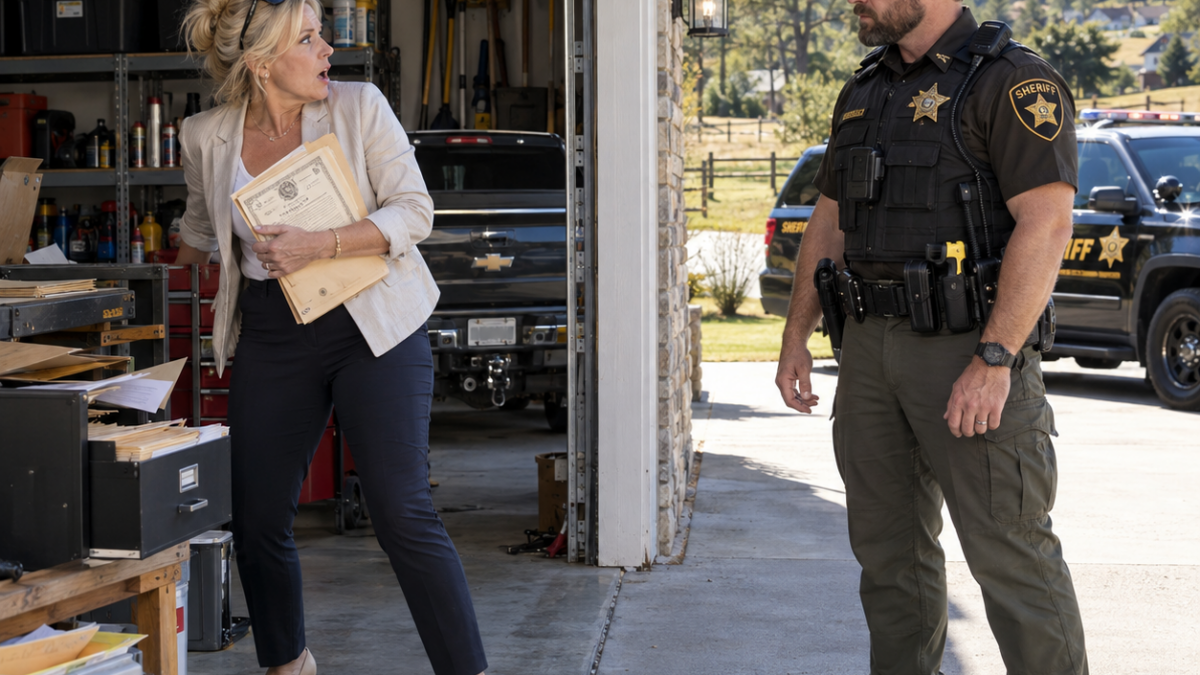
And walked directly into Deputy Maria Ruiz.
I couldn’t hear the first words.
The camera had no audio from that angle.
But I watched Lauren stop so suddenly the folder almost slipped from her hands.
Ruiz pointed toward the ground.
Lauren said something.
Ruiz answered.
Lauren gestured toward the HOA office.
Then toward my house.
Another patrol unit arrived.
Lauren grew animated.
Ruiz took the folder.
Lauren grabbed for it.
That ended the conversation.
Hands behind her back.
Cuffs.
My phone rang.
Shawn.
“They have her.”
“I see.”
“She says she was doing an HOA compliance inspection.”
“At eleven forty at night?”
“Apparently Pinewood has very dedicated management.”
Despite myself, I laughed.
Then stopped.
“Documents?”
“Recovered.”
“Don’t let anyone open the ledger except evidence personnel. DA already knows about it.”
“Copy.”
“What did she say?”
“Property was vacant.”
I looked around my office.
“I’ve lived there three months.”
“I know.”
Shawn paused.
“She also says she had reason to believe HOA records were being unlawfully stored on the property.”
That told me everything.
She knew.
The next morning, I sat across from District Attorney Robert Harmon.
The ledger lay inside an evidence sleeve.
So did the original deed folder Lauren had attempted to remove.
Robert read quietly.
I knew better than to interrupt him.
Forty minutes passed.
Then fifty.
Finally, he looked at me.
“Gary.”
“Yeah.”
“How long do you think this was operating?”
“At least five years based on the property transactions.”
He tapped the ledger.
“These entries go back farther.”
“How far?”
“Seven.”
I stared at him.
“What do they represent?”
“We don’t know yet.”
“You have a theory.”
“I do.”
“Say it.”
He leaned back.
“Payments.”
“To Lauren?”
“Possibly.”
The initials appeared repeatedly.
LC.
CB.
KM.
Amounts.
Dates.
Several lined up suspiciously close to property sales.
“If the Porter records are authentic,” Robert said, “they may establish that the previous owners documented direct pressure before Benson bought the house.”
“They’re authentic.”
“We prove that, not assume it.”
“Right.”
“And the lien against your property?”
“Timothy says it doesn’t comply with procedure.”
“Fraudulent recording potentially becomes significant if we establish knowledge and intent.”
He looked toward the evidence bag.
“Breaking into your garage to remove a deed file and ledger is not subtle.”
“No.”
“Why do you think she risked it?”
“She thought I was getting close.”
“Why?”
“Records request. Attorney. HOA meeting.”
“And maybe she learned the Porters left documents.”
I nodded.
Robert folded his hands.
“From this point forward, you’re completely out.”
“I already am.”
“I mean completely.”
“No interviews.”
“No interviews.”
“No subpoenas.”
“Agreed.”
“No directing your employees.”
“Agreed.”
“If one of your deputies needs to be interviewed, my investigators handle it.”
“Agreed.”
He studied me.
“You’re taking this better than most sheriffs would.”
“I’m taking it terribly.”
That made him smile.
“I just know what happens if I don’t.”
Lauren posted bond later that afternoon.
Her attorney immediately released a statement claiming the incident resulted from a misunderstanding involving HOA records.
A misunderstanding.
At eleven twenty-two at night.
With a manipulated lock.
Inside someone else’s garage.
Removing someone else’s deed file.
I printed the statement and added it to my personal copy of the file.
Not because it mattered legally.
Because I wanted to remember the confidence.
That night Lauren drove past my house at 11:14.
Slowly.
My camera caught her face turning toward the garage.
She didn’t stop.
Christine called thirty seconds later.
“Did you see her?”
“Yes.”
“Should I call somebody?”
“No.”
“You’re somebody.”
“Not for this.”
Christine went quiet.
Then she said, “You know, I’ve been meaning to ask what you actually do.”
I smiled.
“County employee.”
“That’s what you keep saying.”
“It’s accurate.”
“You’re hiding something.”
“I’m protecting a process.”
Christine sighed.
“Fine.”
Then she added, “But when this is over, I expect a very good story.”
She got one.
The DA’s investigators found Carl Benson’s prior fraud conviction.
They found shell entities.
They found the fifteen-percent Chavez family trust interest.
They obtained records showing Benson Development had bought seven properties under circumstances similar to mine.
Five in Pinewood Heights.
Two elsewhere.
They contacted the former homeowners.
That was where the case stopped being a stack of documents and became human.
Mark Henderson drove in from Louisiana.
He looked older than the photograph Christine had shown me.
His wife Beth came with him.
Robert’s investigator interviewed them.
I wasn’t present.
I read portions later when records became part of the court proceedings.
The Hendersons had received more than thirty violation notices in eight months.
Many unsupported.
Their son’s basketball hoop.
A work van.
Grass.
A fence.
Noise complaints while they were out of town.
Then a lien.
Then legal letters.
Mark had started losing sleep.
Beth developed panic attacks whenever the mail came.
Benson offered cash.
Low.
They rejected it.
The HOA announced additional collection action.
They accepted the second offer.
Their twelve-year-old son cried when they left because he thought his parents had done something wrong.
That detail sat with me for days.
Then came Rachel Porter.
She answered the investigator’s first call from Oklahoma.
When they told her the old garage file had been recovered, she started crying.
The ledger had belonged to her husband.
Thomas Porter had worked as a bookkeeper.
He noticed numbers.
He noticed that several HOA collection notices referenced payments to outside vendors.
He began tracking names.
Then he discovered Benson’s relationship with Lauren’s trust.
The Porters became frightened.
They intended to take everything to an attorney.
Before they could, Thomas lost his job.
Legal fees looked impossible.
The HOA’s threatened foreclosure date moved closer.
They sold.
In the chaos of moving, the garage filing cabinet was left behind.
Rachel thought the documents had gone with it.
Lauren apparently knew they existed.
Maybe one of the Porters had mentioned them during an argument.
Maybe Kevin Marsh knew.
Maybe Carl Benson did.
However she learned, Lauren had spent weeks trying to retrieve them before I found them.
The most important development came from Kevin.
Kevin Marsh had been on the HOA board for four years.
Quiet.
Nervous.
Always looking at the table.
After Lauren’s arrest, his attorney contacted Robert.
Kevin wanted immunity in exchange for cooperation.
Robert didn’t give him everything he wanted.
But he gave him enough.
Kevin started talking.
According to Kevin, Lauren maintained a list.
Properties considered “acquisition opportunities.”
Not HOA problems.
Acquisition opportunities.
Owners were scored.
Elderly.
Recently divorced.
Single income.
Job instability.
Out-of-state relatives.
New owners unfamiliar with local procedures.
People considered less likely to fight.
My name had appeared near the top because I lived alone, worked long hours, and had no visible family in the neighborhood.
They thought my divorce made me vulnerable.
That part hurt more than I expected.
The divorce had already made me question whether I was capable of building a home again.
My ex-wife, Megan, and I hadn’t ended explosively.
Sometimes that’s worse.
No betrayal.
No dramatic affair.
No screaming.
Just two people who slowly stopped being good for each other.
Twenty-one years reduced to polite conversations between attorneys.
When I bought the Pinewood Heights house, I told almost nobody how much I needed it to work.
I didn’t need a dream home.
I needed one room that didn’t contain shared memories.
One driveway that had never held both our cars.
One kitchen where silence felt new instead of empty.
Lauren saw the same facts and read weakness.
Alone.
Divorced.
Long hours.
Easy target.
She couldn’t have known how much that angered me.
But anger was exactly what I could not use.
Kevin described the system.
Violation notices were chosen strategically.
Some were technically arguable.
Others completely fabricated.
Once balances grew, collection letters followed.
Then liens.
Then Benson.
If the owner sold, the HOA often waived disputed charges as part of the closing.
That made the transaction easier.
Benson bought low.
Renovated quickly.
Resold.
Profits flowed through the company.
Lauren received money through her trust interest and, according to Kevin, separate payments.
Ronald Chavez, Lauren’s husband and HOA treasurer, approved account statements.
Kevin admitted he had signed meeting minutes he knew were incomplete.
“Why?” Robert asked him during one recorded interview.
Kevin’s answer would later be played in court.
“Because she showed me what happened to people who said no.”
That sentence explained Pinewood Heights better than any financial spreadsheet.
Lauren didn’t run the HOA through rules.
She ran it through examples.
The indictments were being prepared when Lauren came to my front door.
Nine days after her arrest.
Saturday.
3:08 p.m.
I was home sorting documents.
Doorbell camera alerted me before she knocked.
Lauren wore a navy blazer.
Pearl earrings.
Hair perfect.
She looked like she was heading to a board meeting rather than confronting the burglary victim whose property she had entered.
I opened the door.
She blinked.
“Mr. Stewart.”
“Mrs. Chavez.”
“We need to talk.”
“No, we don’t.”
Her expression hardened.
“You’ve taken this far enough.”
“I didn’t break into your garage.”
“My attorney says those charges are going away.”
“Talk to your attorney about that.”
“You set me up.”
“No.”
“You planted those records.”
“No.”
“You knew I would find them.”
I almost smiled at the admission buried inside that sentence.
She realized it too.
Her jaw tightened.
“I mean—”
“I know what you meant.”
She stepped closer.
“You think you’re clever.”
I stayed inside the threshold.
Doorbell recording.
Garage camera.
Front-yard camera.
Three angles.
Cloud backup.
Lauren continued.
“I have lived in this county for twenty-nine years.”
“Congratulations.”
“I know judges.”
I said nothing.
“Lawyers.”
Nothing.
“People in planning.”
Nothing.
“You moved here three months ago.”
Still nothing.
Silence did what it always did.
She filled it.
“I can make this very difficult for you.”
“There it is.”
Her eyes narrowed.
“What?”
“The part where you stop pretending this is about neighborhood standards.”
“You have been harassing me since I was arrested.”
“How?”
“Following me.”
“I haven’t.”
“Recording me.”
“You came onto my property.”
“Stalking HOA business.”
“I requested records tied to my own home.”
Her face reddened.
“You think rules don’t apply to you.”
I almost laughed.
That accusation was so perfect I couldn’t have written it better.
“Mrs. Chavez, leave my property.”
“I’m not finished.”
“I am.”
Then she pulled out her phone.
“Fine.”
She started dialing.
“I’m calling the sheriff.”
I looked at her.
For six weeks, I had wondered how long I could remain just Mr. Stewart.
Apparently three more seconds.
Lauren placed the phone to her ear.
“I’m going to report you for harassment.”
I said nothing.
The call connected.
“Yes. This is Lauren Chavez, president of Pinewood Heights Homeowners Association.”
Her voice changed immediately.
Polished.
Distressed.
Carefully controlled.
“I’m at a residence where a homeowner is threatening and harassing me. I need to speak to the sheriff.”
A pause.
She gave my address.
Another pause.
Longer.
I watched confusion move across her face.
“What?”
The dispatcher said something.
Lauren looked at me.
Then at the house number.
Then back at me.
“No, I’m asking for Sheriff Stewart.”
Another pause.
I heard the dispatcher faintly.
“Ma’am…”
Lauren’s face lost color.
Her eyes moved down.
My jacket had shifted.
The badge clipped at my belt was visible.
Not displayed.
Not raised.
Just there.
She stared at it.
Then at me.
“You’re…”
I let her finish.
She couldn’t.
I reached for my portable radio.
“Dispatch, Stewart.”
The answer came immediately.
“Go ahead, Sheriff.”
Lauren took one step backward.
I kept my voice calm.
“I’m at my residence with Lauren Chavez. She is currently on bond in a pending burglary matter connected to this address and has initiated unwanted contact. Send an uninvolved patrol unit for documentation.”
“Copy, Sheriff. Unit en route.”
Lauren lowered her phone.
Her mouth opened.
Closed.
I will remember her face for the rest of my life.
Not because it was funny.
Though part of it was.
Not because I enjoyed seeing her afraid.
Though I would be lying if I said there wasn’t satisfaction in it.
I remember it because for the first time Lauren understood what she had misunderstood about power.
She had believed power was appearance.
A title.
President.
A lien.
A letterhead.
A clipboard.
Connections.
The ability to make other people nervous.
But actual public authority comes with limits.
Procedure.
Conflict rules.
Evidence.
Accountability.
The very restrictions she had spent years avoiding.
“You’re the sheriff.”
“Yes.”
“Why didn’t you tell me?”
“You never asked.”
“You let me—”
“I let you what?”
Her voice rose.
“You let me treat you like an ordinary homeowner.”
That sentence almost made Christine fall off her porch across the street.
She had come outside when Lauren arrived and was watching.
I stared at Lauren.
“I am an ordinary homeowner.”
“You know what I mean.”
“I don’t think you do.”
Lauren pointed at me.
“This is entrapment.”
“No.”
“You used your position.”
“I recused myself.”
“You investigated me.”
“I looked up public records involving my own property.”
“You had me arrested.”
“No. Deputy Ruiz responded to a burglary call made through normal dispatch.”
“You knew I was there.”
“My private security system notified me that somebody was breaking into my garage.”
“This is abuse of office.”
“Then file a complaint.”
That stopped her.
Because I meant it.
“If you believe I misused my authority, file it.”
Her eyes darted toward the street.
A patrol car approached.
“You think I won’t?”
“I hope you do if you believe it.”
The cruiser stopped.
Deputy Ruiz wasn’t inside.
Good.
Two deputies who had no involvement stepped out.
Lauren suddenly looked less certain.
I stepped backward into the house.
One deputy approached her.
The other spoke to me.
I gave a brief statement.
No argument.
No instructions.
No arrest demand.
Just facts.
Lauren had come to my home.
I asked her to leave.
She refused.
She threatened consequences.
Then called dispatch.
The deputies documented everything.
Lauren was not arrested.
That was the correct decision.
She left under instruction not to contact me directly again.
Christine waited until the cruiser disappeared before crossing the street.
She stared at me.
I knew what was coming.
“You are the sheriff?”
“Yes.”
“The sheriff?”
“Yes.”
“The actual county sheriff?”
“There’s only one.”
Christine put both hands on her hips.
“I have been bringing banana bread to the sheriff for two months?”
“It was good banana bread.”
“You let me complain about the sheriff’s office response time.”
“That part was less enjoyable.”
She slapped my arm.
Then laughed so hard she started crying.
I laughed too.
For the first time since moving to Pinewood Heights, I stood in my driveway and felt something I hadn’t expected.
At home.
Not because Lauren had lost.
She hadn’t yet.
Because somebody beside me knew exactly who I was and wasn’t treating me differently.
Christine wiped her eyes.
“She called the sheriff on the sheriff.”
“Yes.”
“I’m going to enjoy this for years.”
“I assumed.”
The grand jury returned indictments three days earlier than expected.
Lauren Chavez.
Fraud.
Conspiracy.
Multiple counts connected to fraudulent liens and falsified HOA records.
Burglary charges from my garage.
Additional allegations involving property transactions.
Ronald Chavez faced charges tied to financial records he had approved as treasurer.
Carl Benson’s situation became much worse.
Investigators discovered transactions outside Madison County.
That brought federal authorities into the picture.
Wire transfers.
Interstate financial activity.
Multiple shell entities.
More victims.
Kevin Marsh continued cooperating.
The machine started coming apart.
Lauren resigned as HOA president through her attorney.
The announcement posted on the community website at 6:03 a.m.
By 6:17, Christine was at my door.
“Did you see?”
“Yes.”
“She resigned.”
“I saw.”
Christine looked almost disappointed by my calm.
“That’s all you have to say?”
“What would you like?”
“Fireworks.”
“At six in the morning?”
“Fine. Coffee first.”
We sat on my porch.
Neighbors walked by.
For months, they had lowered their eyes whenever Lauren was nearby.
That morning, people stopped.
One woman introduced herself.
A man from two streets over shook my hand.
Then another resident came over.
Then another.
It felt strange.
I hadn’t done anything heroic.
I had bought a house.
Received fraudulent fines.
Kept paperwork.
And refused to leave.
But fear creates distance between people.
When fear disappears, they often discover they were standing much closer than they realized.
The HOA called an emergency membership meeting.
I attended.
Not as sheriff.
Not in uniform.
As Gary Stewart, homeowner.
Ronald’s chair was empty.
Lauren’s chair was empty.
Kevin sat in the front row beside his attorney but was no longer serving.
An interim board member opened the meeting.
For the first time since I had moved there, residents were allowed to speak without being cut off at two minutes.
They had a lot to say.
Mrs. Delgado from Maple Court had received seventeen fines after complaining about drainage.
A young couple had been threatened with collections over a satellite dish that had been approved before they bought the house.
A widower named Samuel Pierce stood with a stack of letters.
Lauren had fined him repeatedly for his yard during the six months his wife was receiving chemotherapy.
His voice broke when he talked about it.
“I was at the hospital.”
The room went silent.
“I’d come home after midnight, sleep four hours, go back. Then I’d open the mailbox and there’d be another seventy-five dollars because the grass was too high.”
He looked at Lauren’s empty chair.
“My wife apologized to me from a hospital bed because she thought her cancer was costing us the house.”
Nobody knew what to say.
Neither did I.
That story stripped the case down to what mattered.
Not liens.
Not statutes.
Not corporate structures.
People.
Lauren had taken ordinary rules and converted them into fear at the worst moments of people’s lives.
There was no clever comeback that could make that right.
Christine spoke next.
She didn’t yell.
That made her more effective.
“We knew.”
People shifted.
“Maybe not everything. But we knew enough.”
She looked across the room.
“We watched families leave.”
Nobody moved.
“We watched Lauren humiliate people.”
A woman stared at the floor.
“We watched selective enforcement.”
Christine’s voice trembled.
“And most of us kept our mouths shut because silence was cheaper.”
She took a breath.
“I did too.”
I looked at her.
Christine had warned me.
Helped me.
Recorded Lauren.
But she was right.
For years before I arrived, she had been scared too.
“That ends now,” she said.
No applause.
Just silence.
The serious kind.
The kind that sometimes means people are actually listening.
The interim board voted to suspend all pending collection actions until an independent audit could be completed.
Every lien initiated during Lauren’s final three years was reviewed.
Several were legitimate.
Some were not.
That distinction mattered.
The new leadership did not simply erase everything because Lauren was corrupt.
Real reform isn’t replacing arbitrary enforcement with arbitrary forgiveness.
It meant going account by account.
Document by document.
Separating valid obligations from manufactured ones.
My lien was easy.
No supporting invoices.
Payments already documented.
Procedures ignored.
It was released.
The county recorder later sent formal confirmation that the title was clear.
I held that letter for a long time.
Then framed it.
Not because the paper was attractive.
It wasn’t.
Government correspondence rarely is.
I framed it because when I bought the house, I had told myself I didn’t care whether it became permanent.
If I hated Pinewood Heights, I could sell.
If work changed, I could leave.
If the divorce made staying there difficult, I could move again.
The lien changed that.
Somebody else had tried to decide whether I belonged in my own home.
The release letter meant that decision was mine again.
Trials take time.
Much more time than people expect.
Eight months passed before Lauren’s case reached a courtroom.
By then Pinewood Heights looked different.
Same houses.
Same sidewalks.
Same HOA sign.
But the atmosphere had changed.
The white picket fence around the HOA office came down.
The office was moved out of Lauren’s residence and into a rented room at the clubhouse.
Records became accessible.
Meetings were livestreamed.
Violation notices required photographs.
Appeals went before a committee containing homeowners who were not board members.
The rulebook didn’t disappear.
People still got fined.
One neighbor complained bitterly after leaving a broken boat trailer in his driveway for two months.
Christine, now interim president, listened politely.
Then upheld the violation.
“See?” she told me later. “I’m becoming evil.”
“You’ve been president eleven days.”
“Power corrupts quickly.”
I laughed.
She became permanent president the following month.
She hated the title.
Which was probably why people trusted her with it.
Lauren’s trial drew more attention than I wanted.
The “HOA president arrested after burglary” angle made local news.
Then reporters learned I was the homeowner.
The headline practically wrote itself.
HOA PRESIDENT CALLS SHERIFF ON HOMEOWNER—HOMEOWNER IS SHERIFF.
I declined almost every interview.
The story wasn’t about my badge.
That was simply the ironic part.
The prosecution’s case was about records.
The property sales.
The fake charges.
The timing of Benson offers.
The Chavez trust.
The Porter ledger.
Kevin’s testimony.
The garage footage.
Lauren’s own recorded words.
Her attorney attacked Kevin first.
Called him a liar seeking immunity.
Fair argument.
Kevin had participated.
Then the prosecution showed financial records that corroborated significant parts of his testimony.
Lauren’s attorney claimed the violation campaign represented aggressive but lawful HOA management.
Then former homeowners testified.
Beth Henderson sat less than twenty feet from Lauren.
She described packing her children’s rooms after accepting Benson’s offer.
Her son had asked, “Are we moving because I left my basketball hoop out?”
Beth started crying.
Several jurors did too.
Lauren looked down.
Rachel Porter testified about the deed file.
About Thomas’s ledger.
About the fear that drove them out.
The prosecutor asked why they left the paperwork in the garage.
“We didn’t mean to.”
She shook her head.
“We were moving in two days. My husband had chest pains from the stress. Everything was happening at once.”
“Did Mrs. Chavez know those documents existed?”
Rachel hesitated.
“I told her.”
The courtroom went still.
“When?”
“About a week before we sold.”
“What did you say?”
Rachel looked toward Lauren.
“I told her Thomas had documented everything and someday somebody would see what she was doing.”
That answered the question.
Lauren knew.
She knew the evidence might still exist.
And when I started asking for records, refusing the lien, investigating Benson, she panicked.
She went looking for the deed file.
The burglary footage played for the jury.
Lauren approaching the side door.
Working the lock.
Entering.
Searching.
Opening the cabinet.
Removing the documents.
No interpretation needed.
The video simply existed.
Then came the front-porch recording.
Lauren threatening me.
Claiming connections.
Dialing the sheriff.
The prosecutor stopped playback before the humorous part.
The case didn’t need a joke.
But Lauren’s attorney opened the door during cross-examination.
He suggested I had intentionally hidden my identity to provoke his client.
I answered honestly.
“I didn’t tell most neighbors what I did.”
“You deliberately allowed Mrs. Chavez to believe you were an ordinary citizen.”
“I am an ordinary citizen.”
“You know what I mean.”
“That’s what Mrs. Chavez said too.”
A few people in the courtroom laughed.
The judge immediately silenced them.
The attorney tried again.
“Did you ever tell her you were sheriff?”
“No.”
“Why?”
“Because she was my HOA president, not an applicant for a concealed-carry permit.”
Another objection.
Sustained.
I kept my face neutral.
He continued.
“You were aware Mrs. Chavez might act differently if she knew who you were.”
“Yes.”
“And you chose not to tell her.”
“Yes.”
“Why?”
I thought about the question.
Then answered.
“Because the law shouldn’t require a person to show a badge before someone treats his property rights honestly.”
The attorney stopped.
That was the truth.
If Lauren would only refrain from fraud because her target happened to be sheriff, then the problem was bigger than what she did to me.
The jury deliberated less than a day.
Guilty on the principal fraud counts.
Guilty on burglary.
Guilty on conspiracy-related charges supported by the evidence.
The exact sentences varied across defendants.
Lauren received a state prison term followed by supervised release and was barred from serving in HOA governance as part of the court orders and later civil settlements.
Ronald avoided prison but received probation, substantial financial penalties, and community service after his level of involvement was established.
Carl Benson’s federal case lasted longer.
His prior conviction did him no favors.
Neither did the multi-county transactions.
He was convicted on federal fraud and conspiracy charges and received a multi-year sentence.
Benson Development was dismantled.
Assets were frozen.
Then liquidated where permitted to fund restitution.
The money took even longer.
People imagine justice as a judge hitting a gavel.
Usually justice looks more like accountants arguing over spreadsheets eighteen months after everyone else has gone home.
Forensic teams traced sales.
Profits.
Trust distributions.
Renovation costs.
Loan payments.
Victim losses.
Seven families ultimately received compensation through a combination of restitution and civil settlements.
Not enough to return their lost years.
There is no line item for humiliation.
No formula for a child believing his basketball hoop caused his family to lose their house.
No interest rate that repays months of panic.
But money could restore something.
The Hendersons used part of theirs for their children’s education.
The Nguyens stayed where they had relocated.
Rachel and Thomas Porter surprised me.
They wanted to come back.
Not immediately.
But eventually.
The current owner of one of Benson’s former properties agreed to sell after receiving separate compensation through the settlement structure.
It wasn’t my house.
The Porters had lived in another Pinewood property before moving into mine briefly during the final stage of their ordeal, so they returned to a different home in the neighborhood.
On moving day, Rachel knocked on my door.
I recognized her from court.
She carried a cardboard box.
“I think this belongs here.”
Inside was an old metal file organizer.
Not the original documents.
Those remained evidence until they were released.
This was something Thomas had bought after they moved.
“What is it?”
“A replacement for the one we left.”
I smiled.
“You don’t owe me a filing cabinet.”
“No.”
She looked toward my garage.
“But I owe that garage an apology.”
We both laughed.
Then she became serious.
“Thank you.”
“I didn’t do much.”
“You stayed.”
That word hit me.
Stayed.
The three families before me had been forced to leave.
Lauren built her system on exhaustion.
She didn’t need to defeat people legally if she could make fighting cost more emotionally than losing the house.
I stayed.
Not because I was braver.
I had advantages they didn’t.
Legal knowledge through people around me.
Public-record experience.
A job that taught me documentation.
Colleagues who understood procedure.
And eventually, evidence they had unknowingly left behind.
I never forgot that.
If I had been a seventy-year-old widow on a fixed income, maybe Lauren’s first lien letter would have broken me too.
If I had two children and legal bills, maybe Benson’s low offer would have looked like freedom.
That realization changed how I thought about the victims.
It also changed how I ran my department.
We began training deputies to recognize civil disputes that might contain fraud patterns without pretending every HOA disagreement was criminal.
We established clearer referral procedures to the district attorney and consumer-protection resources.
Not because HOAs are inherently corrupt.
Most disputes are exactly what they appear to be.
Parking.
Fences.
Noise.
People disagreeing over rules they agreed to when buying property.
But authority can become camouflage.
And when somebody says, “We’re allowed to do this,” the next question should sometimes be, “Show me.”
Pinewood Heights adopted that philosophy too.
Christine’s first board resolution required independent legal review before any future lien could be recorded.
The second created a homeowner appeals panel.
The third required any board member with a financial interest in a contractor, developer, management company, or vendor to disclose it publicly and abstain from related votes.
The fourth was Christine’s favorite.
Every enforcement photograph had to include the date, time, address, and violation.
“No more measuring invisible grass,” she told me.
Months later, somebody actually measured my lawn.
Three-point-one inches.
The notice arrived with a photograph.
I walked next door holding it.
Christine was watering tomatoes.
“You fined the sheriff.”
“You’re an ordinary homeowner.”
I stared at her.
She smiled.
I started laughing.
So did she.
I paid the fine.
Worth every dollar.
Two years passed.
The garage side door still has the heavy deadbolt I installed after Lauren broke in.
The old filing cabinet remains.
I almost threw it away after the trial.
Couldn’t.
Too much happened because of three rusted drawers.
The original Porter documents were eventually returned to them.
My deed now lives in a fireproof safe.
Not because I’m afraid another HOA president is coming through the garage.
Because I finally learned that the boring pieces of paper people shove into cabinets often become the only proof that memory is right.
The framed lien-release letter hangs above my desk.
Megan, my ex-wife, saw it once when she came by to sign an unrelated insurance document.
She read it.
Then looked at me.
“You framed a county recording notice.”
“Yes.”
“That may be the most divorced-man thing you’ve ever done.”
I laughed harder than I expected.
She smiled.
It was good to discover that some endings eventually stop hurting.
“You okay here?” she asked.
I looked through the window.
Christine was arguing with a delivery driver about blocking a fire hydrant.
A kid rode past on a bicycle.
Two neighbors were talking beside a mailbox.
Ordinary Saturday.
“Yeah.”
I meant it.
“I think I am.”
The house I had bought because I needed somewhere with no history had accumulated plenty.
Some terrible.
Most good.
The Hendersons visited once during a community restitution event.
Their son was seventeen by then.
Almost grown.
He walked toward the small neighborhood court where another family had installed a basketball hoop.
I watched him stare at it.
Then he looked toward me.
“My parents told me the old board fined us because of mine.”
“They did.”
“I used to think it was my fault.”
I didn’t know what to say.
So I told him the truth.
“It wasn’t.”
He nodded.
“I know now.”
Sometimes that is as close to justice as life gives you.
Knowing now.
The final civil settlement involving the HOA required formal apologies to every verified family subjected to Lauren’s targeted enforcement campaign.
Christine insisted the letters be individually written.
Not boilerplate.
She spent weeks reviewing them.
When she finished, she showed me Rachel Porter’s before mailing it.
It said:
You were treated as a problem when you were a member of this community who deserved to be heard. The association cannot give you back the peace that was taken from your family, but we can acknowledge clearly that what happened was wrong.
I read it twice.
“That’s good.”
Christine folded the letter.
“It’s not enough.”
“No.”
“But it’s true.”
“Yes.”
She sealed the envelope.
For years, truth had been the one thing Pinewood Heights avoided because truth was inconvenient.
Truth required people to admit they were scared.
That they looked away.
That a board president had exploited their silence.
That respectable paperwork could still contain lies.
That a perfectly manicured neighborhood could hide something ugly behind every trimmed hedge.
Once people admitted that, the neighborhood became less perfect.
And much healthier.
Residents argued at meetings now.
A lot.
Christine complained constantly.
“You people wanted transparency,” she shouted during one particularly long budget discussion. “This is what transparency sounds like. Apparently it sounds like forty-seven opinions about mulch.”
People laughed.
Then kept arguing.
That was fine.
Nobody left the meeting afraid.
Nobody worried that disagreeing with the president would put a lien on their house.
Nobody received a Benson Development offer after speaking up.
The silence was gone.
I had mistaken that silence for peace when I first moved in.
Now I knew the difference.
Peace is not nobody complaining.
Peace is knowing you can complain without somebody trying to take your home.
On the third anniversary of my move to Pinewood Heights, I came home late.
11:03 p.m.
Almost the same hour I had once seen Lauren moving beside my garage with a flashlight.
I parked.
Killed the engine.
For a second, I stayed in the truck.
Old habit.
I looked toward the garage.
No figure.
No flashlight.
No one testing the lock.
Christine’s porch light was on next door.
A handwritten sign sat beside her tomato garden.
FREE TOMATOES. TAKE TWO. IF YOU TAKE SIX, I WILL KNOW.
I smiled.
Then I noticed somebody walking toward me.
A man I didn’t recognize.
Late thirties.
Carrying a cardboard box.
He stopped near the sidewalk.
“You Gary?”
“Yes.”
“I’m Daniel. Just moved in two streets over.”
“Welcome.”
He looked slightly embarrassed.
“Christine told me to talk to you.”
“That sounds dangerous.”
“She said you know how the HOA works.”
I looked toward Christine’s house.
Curtain moved.
She was absolutely watching.
“What happened?”
Daniel held up a letter.
“Parking warning.”
I read it.
Legitimate photograph.
Clear rule citation.
No fine yet.
Just notice.
“You parked across the sidewalk.”
“Yeah.”
“Then move your truck.”
He stared at me.
“That’s it?”
“That’s it.”
“I heard the old HOA was corrupt.”
“It was.”
“So this is okay?”
“Looks like it.”
He seemed almost disappointed.
“Christine said you fought them.”
“I fought fraudulent enforcement.”
“Not rules?”
“Rules are fine if they’re lawful, clear, and applied honestly.”
He nodded.
Then started to leave.
“Daniel.”
He turned.
“Keep every letter anyway.”
“Why?”
“Because good systems still depend on records.”
He smiled.
“Got it.”
He walked home.
Christine called from her porch.
“You told him to move the truck?”
“He was blocking the sidewalk.”
“Excellent.”
“You sent him over expecting me to argue with you?”
“Maybe.”
“Good night, Christine.”
“Good night, Sheriff.”
I walked toward my garage.
My hand touched the new lock.
I remembered Lauren standing on my porch with her phone pressed to her ear.
Calling the sheriff.
Calling authority like it was a weapon she could summon against anyone who challenged her.
Then realizing the person she wanted authority to punish was the same person standing in front of her.
People always loved that part of the story.
I understood why.
It was funny.
Poetic even.
But it wasn’t the part that mattered most.
Lauren Chavez did not lose because I was sheriff.
If anything, being sheriff forced me to be more careful.
I could not investigate her.
Could not command my deputies to target her.
Could not use my office to win a private dispute.
I had to step away and let evidence travel through people who did not answer to my anger.
She lost because she created records.
Fake fines.
A fraudulent lien.
Corporate filings.
Property sales.
Trust documents.
Threats.
A picked lock.
Security footage.
A stolen deed folder.
A handwritten ledger.
And eventually her own words.
She spent eight years believing power meant people were too frightened to ask questions.
The moment people started asking, her kingdom turned back into what it had always been.
A stack of paper.
And paper can be examined.
I opened the garage.
The light clicked on.
The old cabinet sat against the wall.
For a second I could almost see Lauren crouched in front of it, pulling open the third drawer, believing she was seconds away from removing the evidence that could destroy her.
She had no idea the documents had already been photographed.
No idea the district attorney had already been informed.
No idea her movements were being recorded.
No idea the homeowner she had chosen because he looked isolated had spent his career teaching people one simple rule.
When something doesn’t add up, document first.
React second.
I closed the garage door.
Locked it.
Then walked inside.
My home was quiet.
Not the frightened silence Pinewood Heights once lived under.
Real quiet.
The kind I had been looking for when I moved there after my divorce.
The kind you earn when nobody outside your door gets to decide whether you belong behind it.
Lauren tried to take my house because she thought being alone made me weak.
She tried to bury me in fines because three families before me had finally broken under the weight.
She filed a lien that should never have existed.
She partnered with people who turned desperation into profit.
And when she realized the records that could expose everything might still be sitting in my garage, she decided she was powerful enough to simply walk in and take them.
Then, standing on my porch after all of that, she reached for one last weapon.
She called the sheriff.
She just never imagined I would answer.
And the most satisfying part wasn’t watching her face when she saw the badge.
It was knowing the badge was never what beat her.
The truth did.


