PART 2: HOA Karen Blocked My Driveway to Force Me Into Her HOA—Then the Bank Came for the SUV She Used Against Me
PART 2
When I got home that evening, there was a bright white sheet of paper taped to my front door.
At first glance, it looked official.
HOA logo.
Bold heading.
Numbered violations.
A signature line at the bottom.
Then I read it.
**NOTICE OF COMMUNITY NONCOMPLIANCE**
I laughed.
Community noncompliance.
That was creative.
Violation number one:
**Grass exceeding approved neighborhood height.**
Number two:
**Trash receptacles visible from public roadway.**
Number three:
**Mailbox inconsistent with community aesthetic.**
And finally:
**Failure to demonstrate reasonable community participation.**
I read that one twice.
Then I took a photograph.
Karen had managed to invent a violation for not being sufficiently enthusiastic about an HOA I did not belong to.
I walked inside and pulled the folder containing my property documents.
I had created it months earlier after Karen first started sending me letters.
Deed.
Survey.
Title report.
County parcel map.
Copies of the recorded HOA boundaries.
A letter from a property attorney confirming that my parcel had never been annexed into the association.
I placed Karen’s notice on top.
Then I wrote the date.
That was it.
No angry Facebook post.
No confrontation.
No yelling across the street.
Just documentation.
The next morning, another notice appeared in my mailbox.
This one threatened fines.
I called the HOA management company.
The woman who answered sounded embarrassed before I even finished explaining.
“Sir, what is your address?”
I gave it.
Keyboard clicking.
Long pause.
Then:
“I don’t see your parcel in our member database.”
“Because I’m not a member.”
“I understand.”
“Your president keeps sending me violations.”
Another pause.
“Have you discussed this with her?”
“Repeatedly.”
“I’ll make a note.”
“Please make a very clear one.”
“Yes, sir.”
“And tell whoever handles your legal records to verify the HOA boundary.”
“I will.”
I expected that to end things.
It didn’t.
Karen was not a woman who interpreted administrative correction as a reason to stop.
She interpreted it as resistance.
Over the next week, I received three more notices.
One claimed my side fence was an unapproved color.
Another claimed I had failed to submit a landscaping plan.
The third demanded that I attend the next HOA meeting to “resolve outstanding membership responsibilities.”
Membership responsibilities.
I wasn’t a member.
It was like receiving invoices from a gym I had never joined because the manager thought my house was too close to the building.
I ignored the demands.
Then, on Thursday night, Karen’s SUV appeared in my driveway again.
This time I didn’t notice it immediately.
I was reading when the motion light outside turned on.
I looked through the window.
Silver SUV.
Diagonal.
Same position.
I checked the clock.
10:18 p.m.
Karen’s house was dark except for one upstairs window.
For a moment, I actually admired the commitment.
Then irritation replaced admiration.
I walked outside.
The SUV was empty.
Locked.
I walked to Karen’s house.
Rang the bell.
No answer.
Again.
Nothing.
I called her.
Straight to voicemail.
I texted:
**Your SUV is blocking my driveway. Move it immediately.**
Read.
No response.
Five minutes later:
**This is your second intentional obstruction. If it is not moved, I will have it removed.**
Read.
Still no response.
Then my phone rang.
Karen.
I answered.
“What?”
“Why are you harassing me at this hour?”
I almost laughed.
“Your SUV is across my driveway.”
“It’s temporary.”
“Move it.”
“I’m already in bed.”
“You parked it there ten minutes ago.”
Silence.
Then:
“We can discuss this tomorrow.”
“No.”
“You are obsessed with confrontation.”
That was impressive.
“You parked your vehicle across my property.”
“Across the entrance.”
“My driveway entrance.”
“You can still walk around it.”
“I need vehicle access.”
“It’s late.”
“That doesn’t matter.”
Karen sighed dramatically.
“I’m trying to make you understand something.”
“I understand perfectly.”
“What?”
“You think inconvenience gives you leverage.”
She went quiet.
I continued.
“It doesn’t.”
“You’ve benefited from our HOA for years.”
“Karen—”
“No, listen to me.”
“I’ve listened enough.”
“You refuse every opportunity to be part of this community.”
“I live here.”
“You know what I mean.”
“No.”
She raised her voice.
“Everyone else follows rules.”
“I follow city and county rules.”
“That’s not enough.”
“It is legally enough.”
Silence.
Then, softly:
“You always think you’re smarter than everyone.”
“No.”
“I think my deed is smarter than your clipboard.”
She hung up.
The SUV stayed.
I considered calling a regular tow company immediately.
Then I paused.
Something about the vehicle had bothered me for weeks.
Not because I cared what Karen drove.
But because her entire public image revolved around appearances.
New SUV.
New patio.
Constant renovations.
Fresh landscaping.
She spoke about “property standards” while living like the HOA presidency came with a corporate executive salary.
And HOA president was unpaid.
A few months earlier, during another property dispute, I had pulled public county records to confirm my parcel boundaries.
While searching, I had also seen publicly recorded documents related to several neighborhood properties.
Mortgages.
Refinancing documents.
Liens.
Nothing secret.
Nothing requiring access to someone’s private bank account.
Just recorded public filings.
Karen’s house had stood out.
Original mortgage.
Refinance.
Another refinance.
Home-equity line.
Then another recorded modification.
That didn’t mean she was broke.
Plenty of people refinance responsibly.
But it suggested something different from the image she projected.
So did the SUV.
The temporary plate when she first bought it had been replaced, but I remembered the dealer sticker.
Luxury trim.
Recent model.
Financed, most likely.
Still, none of that mattered to me.
At least not until she used that same SUV as a weapon against my property.
I did not have the ability to call a bank and order someone’s vehicle repossessed.
No ordinary neighbor does.
And if I had called a lender demanding private financial information, they would have told me absolutely nothing.
But I could call a towing company about a vehicle blocking my driveway.
So I did.
The dispatcher asked for the address.
Vehicle description.
Whether it was occupied.
Whether it was on public roadway or private access.
I explained everything.
Repeated obstruction.
Owner refusing to move.
The dispatcher said:
“We can send a driver to assess it.”
“Fine.”
About forty minutes later, headlights appeared.
A tow truck stopped near the entrance.
The driver climbed down.
He walked around Karen’s SUV.
Then he looked at me.
“You know the owner?”
“Yes.”
“You asked them to move it?”
“Twice tonight. Multiple times last week.”
“You have proof?”
I showed him the texts.
He nodded.
“Okay.”
Then he looked through the windshield.
His expression changed slightly.
“Interesting.”
“What?”
He leaned closer.
Then walked back to his truck and made a phone call.
I couldn’t hear most of it.
He gave the plate number.
Then the VIN.
Waited.
Then said:
“Yeah. Same one.”
I frowned.
When he returned, I asked:
“Problem?”
He hesitated.
“Different issue.”
“What kind?”
“Can’t discuss account details.”
Fair.
“But?”
He rubbed his chin.
“Our company also handles recovery work for lenders.”
That caught my attention.
“And?”
He looked at the SUV.
“This vehicle is already on an active recovery list.”
I stared at him.
“You mean repossession?”
He nodded once.
“I can’t tell you anything about the owner’s account. But yes, I’ve got authorization in our system.”
For a second, I honestly thought the universe was making fun of me.
Karen had intentionally parked the one vehicle she apparently should have been keeping hidden directly across someone else’s private driveway.
The driver asked:
“You want access cleared?”
“Yes.”
“All right.”
He returned to his truck.
I stood on my porch.
Coffee in hand.
Not because I had planned some grand revenge.
Because it was almost eleven at night and coffee had become the only thing keeping me from laughing too loudly.
The driver began positioning his equipment.
Metal clanked.
Hydraulics hummed.
The SUV lifted.
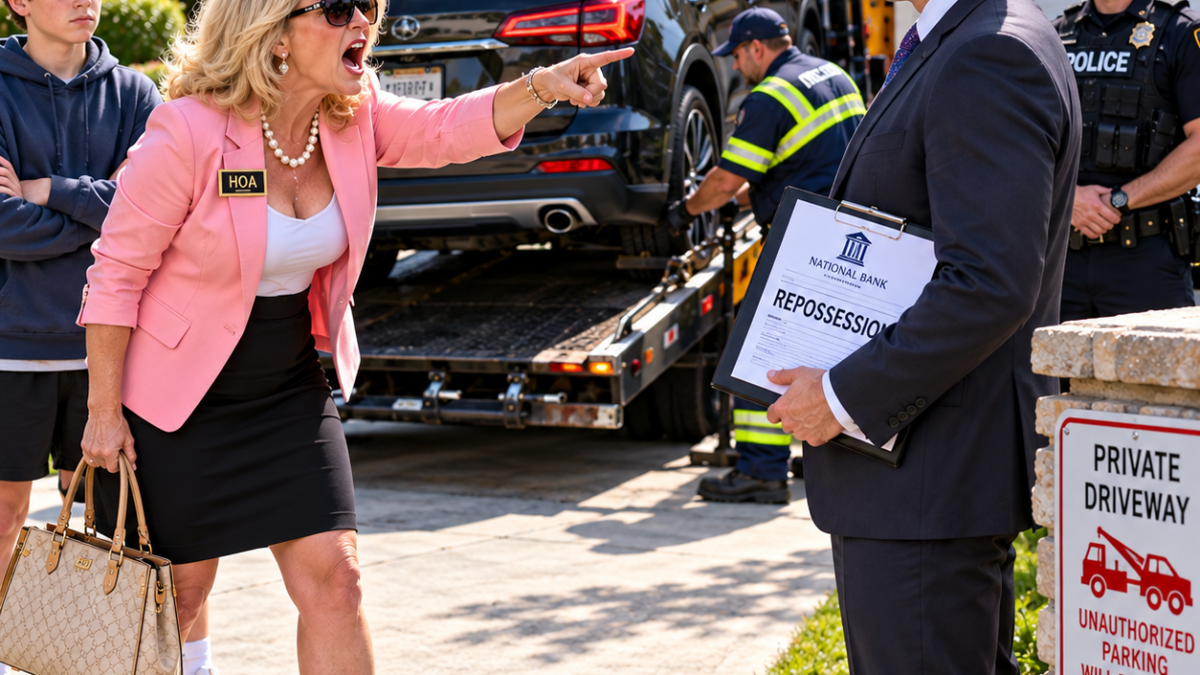
And right on schedule, Karen’s porch light came on.
Her front door flew open.
“What are you doing?”
She ran across the street wearing a robe and slippers.
The driver kept working.
“Stop!”
He looked up.
“Ma’am, stay clear of the equipment.”
“That’s my car!”
“Yes, ma’am.”
“Then put it down!”
He walked toward her holding paperwork.
“There’s an active recovery order on the vehicle.”
Her face changed so quickly I almost felt uncomfortable watching.
“What?”
“I need you to stay back while we load it.”
“No.”
She pointed at me.
“He called you!”
The driver answered:
“He did call about driveway obstruction.”
Karen whipped toward me.
“You did this.”
I leaned against the porch railing.
“I asked you to move your SUV.”
“You called my lender?”
“No.”
That was completely true.
“You somehow arranged this.”
“I called a towing company because your vehicle was blocking my driveway.”
She looked at the driver.
“You cannot take my car.”
He remained calm.
“Ma’am, this is between you and the lienholder.”
“I’m current.”
“I can’t discuss that here.”
“You’re making a mistake.”
“Then contact the lender using the number on your paperwork.”
Karen stared at me.
“You knew.”
“I knew your SUV was blocking my driveway.”
“You did this on purpose.”
“No.”
I lifted my coffee.
“You parked it there on purpose.”
That silenced her for half a second.
Then anger returned.
“You think this is funny?”
“No.”
It was a lie.
I definitely found parts of it funny.
But watching someone’s financial trouble become public wasn’t as satisfying as I had imagined revenge might be.
There was embarrassment on her face.
Real embarrassment.
And beneath it, fear.
The SUV wasn’t merely status.
She needed it.
People forget that sometimes.
A luxury vehicle can still be the thing somebody relies on to get to work, appointments, family responsibilities.
I did not enjoy that part.
But I also couldn’t ignore the fact that she had deliberately used it to trap me at home.
The tow driver secured the final chain.
Karen stepped toward him.
“Please.”
That single word was different from everything I had ever heard from her.
No authority.
No command.
Just desperation.
He looked sympathetic.
“I’m sorry, ma’am. I can’t release it without authorization.”
Her shoulders dropped.
“You don’t understand.”
“I understand this is unpleasant.”
She looked toward me again.
I expected another accusation.
Instead, she said quietly:
“You could have just called me again.”
I stared.
“I did.”
Her mouth opened.
Then closed.
The driver climbed into the truck.
The SUV lifted higher.
Karen stood barefoot at the edge of my driveway as the tow truck slowly pulled away.
The same driveway she had blocked twice.
No neighbors applauded.
No one came outside cheering.
A few curtains moved.
That was all.
The silver SUV disappeared around the corner.
Karen remained there.
Without the vehicle, without the sunglasses, without the clipboard, she suddenly looked less like the ruler of anything and more like a tired woman in a bathrobe who had made several very bad decisions.
I almost said something.
Then decided silence was better.
She turned and walked home.
The next morning, the neighborhood exploded.
Not publicly.
Quietly.
Texts.
Whispers.
Questions.
Frank called me.
“What happened last night?”
“Her SUV was blocking my driveway.”
“I know that part.”
“It got towed.”
“By who?”
“Tow company.”
“Why is everyone saying repo?”
“Because apparently the company had an existing recovery order.”
Long silence.
Then:
“You’re joking.”
“No.”
Frank started laughing.
I held the phone away from my ear.
“This is not that funny.”
“Yes, it is.”
“Frank.”
“She parked a repo target in your driveway to intimidate you.”
“When you say it like that…”
“How else do you say it?”
Fair point.
The story spread.
I did not help it.
Karen assumed I did.
Three days later, another HOA notice appeared.
Then another.
The tone had changed.
No more “community participation.”
Now the accusations were sharper.
**Improper exterior maintenance.**
**Unapproved refuse storage.**
**Visual impact inconsistent with neighborhood values.**
I sent each one to the management company with the same response:
**My parcel is not subject to the HOA covenants. Please confirm in writing that these notices have been withdrawn.**
Eventually, the management company replied.
A formal letter.
My parcel was outside the association.
No HOA fines could be imposed.
No enforcement authority existed over my property.
I printed five copies.
One went in my property file.
One to my attorney.
One to the county record folder.
One stayed by the front door.
The fifth I mailed certified to Karen.
She signed for it.
The notices stopped for nine days.
Then she left another one.
I stared at it.
This woman had lost the SUV she used to blockade my driveway and still could not stop.
That was when I stopped treating Karen as the only problem.
The HOA board was allowing her to behave this way.
Maybe passively.
Maybe because they didn’t know.
Maybe because everyone was afraid of challenging her.
But an organization that allows one person to repeatedly issue unauthorized legal-looking notices to a nonmember has a governance problem.
So I attended the next HOA meeting.
Karen looked genuinely shocked when I entered the clubhouse.
“You can’t vote,” she said.
“I know.”
“This meeting is for members.”
“Your agenda allows resident comments.”
“You aren’t an association resident.”
“I’m an adjacent property owner affected by association actions.”
She opened her mouth.
The vice president interrupted.
“He can speak during public comments.”
Karen glared at him.
Then at me.
I took a seat.
The meeting began.
Landscaping.
Pool maintenance.
Budget.
Parking.
Then public comments.
I stood.
“My name is Daniel Mercer.”
Karen shifted.
“I own the property at 1148 Oak Hollow Road.”
Several people knew the address.
I continued.
“My property predates this association and is not subject to its covenants.”
I placed the management company’s letter on the table.
“Your management company has confirmed that.”
Then the violation notices.
One by one.
“Despite this, your president has issued repeated notices against my property.”
Karen interrupted.
“They’re courtesy notices.”
I looked at her.
“They contain fine schedules.”
“They explain what would apply if you were a member.”
“I’m not.”
The vice president frowned.
“Karen, did management tell you to stop sending these?”
She stiffened.
“This is being taken out of context.”
I placed photographs of the SUV on the table.
“Twice, she intentionally parked her vehicle across my driveway and refused to move it unless I agreed to join the HOA.”
The room went very quiet.
Someone whispered:
“She did what?”
Karen stood.
“That is a lie.”
I took out my phone.
Opened the first video.
Security camera footage.
Karen’s SUV.
My driveway.
Audio from our conversation.
Her voice clearly saying:
**Maybe now you’ll start showing up to HOA meetings.**
Then:
**Not until you agree to join the HOA. Everyone else chips in. Why should you be exempt?**
I stopped the video.
Nobody spoke.
Karen’s face reddened.
“You recorded me without consent.”
“It’s my exterior security camera.”
“You were baiting me.”
“I was leaving for work.”
The vice president rubbed his forehead.
Another board member asked:
“Karen, why would you block his driveway?”
“I was trying to have a conversation.”
Frank, sitting in the back as an HOA member, laughed.
“Then knock on the door.”
Several people chuckled.
Karen snapped:
“This is not funny.”
The board member looked at her.
“No. It isn’t.”
That was the moment the room changed.
Not dramatically.
But power shifted.
Karen was accustomed to people debating whether her actions were necessary.
For the first time, the board was questioning whether she should have had the authority to take them at all.
I continued.
“I am not asking this HOA for money.”
Karen looked surprised.
“I am not asking you to punish anyone on my behalf.”
Even more surprise.
“I am asking for written confirmation that no board member, officer, agent, contractor, or management representative will attempt to enforce HOA rules against my parcel again.”
The vice president nodded.
“That seems reasonable.”
Karen laughed.
“Of course you think it’s reasonable.”
He turned toward her.
“Why wouldn’t it be?”
“Because he benefits from us.”
I almost smiled.
There it was again.
He answered:
“That doesn’t create legal membership.”
Karen looked around.
“I can’t believe this.”
A woman near the front raised her hand.
“I have a question.”
The vice president nodded.
She looked at Karen.
“Did you really park across his driveway?”
Karen’s jaw tightened.
“It was temporary.”
“That wasn’t the question.”
Another homeowner spoke.
“Did you tell him you wouldn’t move until he agreed to join?”
Karen stared.
“You heard the video.”
“Then why are we debating?”
The meeting unraveled from there.
Not because I attacked Karen.
Because other people finally started asking questions.
How many HOA notices had she personally initiated?
How often did management review them?
Could a board president direct towing without another officer’s approval?
Did the HOA have a written policy regarding adjacent nonmember properties?
Why had the association spent money mailing me notices when everyone now agreed I wasn’t under HOA jurisdiction?
One question led to another.
Then another.
Karen had spent years operating in the space created by nobody wanting to ask.
Once people started, her authority looked surprisingly fragile.
The board voted to suspend her ability to issue compliance notices independently pending review.
She stormed out before the meeting ended.
I went home.
For the first time in months, I believed the problem might actually be over.
Then came the letter.
Not from Karen.
From a law firm.
My stomach tightened when I saw the envelope.
I opened it.
The letter claimed I had engaged in “targeted harassment” against Karen by arranging the seizure of her SUV.
I laughed once.
Then stopped.
Because legal letters deserve serious attention even when the claim inside is ridiculous.
I called my attorney, Rachel.
She read it.
Then said:
“Did you contact her lender?”
“No.”
“Did you represent yourself as anyone authorized to request repossession?”
“No.”
“Did you provide private account information?”
“I don’t have private account information.”
“What did you do?”
“Called a towing company because the SUV was blocking my driveway.”
“And they had an existing recovery order?”
“That’s what the driver said.”
She paused.
“Good.”
“Good?”
“Meaning the facts are simple.”
She drafted a response.
No emotional language.
No threats.
Just dates.
Texts.
Video.
Tow call.
Statement from towing company confirming the lender recovery authorization predated my call.
That last piece destroyed Karen’s argument.
The SUV was not repossessed because I discovered some secret financial weakness and weaponized it.
It was already subject to recovery.
Karen simply parked it in the worst possible place at the worst possible time.
The law firm never contacted us again.
But the dispute had one unexpected side effect.
During the HOA’s internal review, the treasurer started going through years of financial records.
That was when the real trouble surfaced.
Not embezzlement.
Nothing that dramatic.
But sloppy spending.
Unapproved reimbursements.
Contractors hired without competitive bids.
Landscaping work approved near Karen’s section of the neighborhood while other common areas waited.
HOA funds paying for upgrades that were technically common-area improvements but seemed to benefit certain homes far more than others.
None of it proved Karen had stolen anything.
But it showed a pattern of governance built around one person making too many decisions without enough oversight.
Residents became furious.
Not because every dollar was improper.
Because nobody had been watching.
Karen had convinced everyone that questioning her meant opposing the neighborhood.
The board ordered an independent audit.
Karen called it a witch hunt.
The treasurer called it accounting.
I liked his term better.
While that review was happening, another document appeared in the county records.
A notice related to Karen’s mortgage.
Not because I went digging to destroy her.
By then half the neighborhood was monitoring public filings because rumors were flying.
The notice reflected serious delinquency.
A foreclosure process had begun.
I felt no joy when I learned.
That surprised me.
Months earlier, I might have.
Right after the driveway blockade.
Right after the fake notices.
Right after the legal threat.
But by then, Karen’s financial problems seemed less like poetic justice and more like something sad.
People like to imagine that arrogant people fall because the universe punishes arrogance.
Real life is messier.
Karen had overspent.
Refinanced.
Fallen behind.
Maybe she had personal expenses none of us knew about.
Maybe she had made bad decisions for years.
Maybe she had been terrified and using the HOA as the one part of her life she still felt able to control.
Understanding that did not excuse what she did.
But it changed the flavor of the victory.
I no longer wanted to see her lose everything.
I wanted her to leave me alone.
That was all.
One evening, about six weeks after the HOA meeting, someone knocked on my door.
Karen.
No sunglasses.
No clipboard.
Just Karen.
I opened the door but stayed inside.
“What do you want?”
She looked tired.
“I need to talk.”
“About?”
“The HOA.”
“I’m not joining.”
“I know.”
That surprised me.
She looked toward my driveway.
“Can we talk out here?”
I stepped onto the porch.
She stood several feet away.
For once, she respected the distance without being told.
“I resigned.”
I stared.
“From president?”
“Yes.”
“When?”
“This afternoon.”
I didn’t know what to say.
She continued.
“The board was going to vote.”
“So you resigned first.”
“Yes.”
There was no pride in it.
Just fact.
“What do you want from me?”
Her eyes moved toward the ground.
“I wanted you to know.”
“Okay.”
She nodded.
Then stayed.
Clearly that wasn’t all.
“My house is in trouble.”
I already knew.
I didn’t tell her.
“The mortgage.”
I nodded.
She looked at me sharply.
“You know?”
“Public notice.”
Of course.
She almost laughed.
“Everyone knows.”
“Probably.”
She looked back toward her house.
“I kept thinking I could fix it.”
I said nothing.
“Refinance.”
Her mouth twisted.
“Then refinance the refinance.”
Still nothing.
“The SUV was supposed to be temporary.”
“What was?”
“The payment problem.”
Ah.
She rubbed her hands together.
“I missed one payment. Then another. Then fees.”
She looked embarrassed.
“I thought I would catch up.”
“That happens.”
She looked at me.
“You don’t have to pretend to feel sorry for me.”
“I’m not pretending anything.”
“You hate me.”
“No.”
She seemed genuinely surprised.
“I don’t trust you.”
“That’s worse.”
“Maybe.”
I leaned against the porch post.
“But hate takes energy.”
For the first time, she smiled faintly.
“I suppose I’ve taken enough of that already.”
“Yes.”
Silence.
Then:
“I was wrong.”
Three words.
Simple.
I didn’t answer immediately.
She continued.
“Your house was never ours.”
“No.”
“I knew that.”
That surprised me more than the resignation.
“You knew?”
“I knew the legal boundary.”
“Then why keep sending notices?”
She looked away.
“Because I thought eventually you would get tired of fighting.”
There it was.
The truth.
Not misunderstanding.
Not community confusion.
Pressure.
“I thought if you joined, the boundary would stop looking like a hole in the neighborhood.”
“It wasn’t a hole.”
“To me it was.”
“Why?”
She exhaled.
“Because every time I drove past your house, I saw something I couldn’t control.”
That sentence explained more than anything else she had ever said.
I waited.
“The mailbox.”
She gave a weak laugh.
“The lawn.”
“Terrifying.”
She almost smiled.
“The trash cans.”
“Scandalous.”
“Stop.”
But she was smiling now.
Then the smile disappeared.
“I had everything slipping.”
Her voice lowered.
“The house.”
“The car.”
“My marriage ended two years ago.”
I hadn’t known that.
“He left most of the debt.”
That sounded oversimplified, but I wasn’t going to argue.
“My mother was sick.”
Another pause.
“My son needed help.”
Her eyes filled.
“And the HOA was the one place where people still listened when I spoke.”
There it was.
Control as anesthesia.
I suddenly saw the clipboard differently.
Not as a crown.
As a life raft.
A terrible one.
Because she had stayed afloat by pushing other people under.
“I’m sorry your life got difficult,” I said.
She nodded.
“But that didn’t give you the right to make mine difficult.”
“I know.”
“Blocking my driveway was not leadership.”
“I know.”
“Sending notices you knew had no authority was not leadership.”
“I know.”
“Threatening legal action because I wouldn’t join was not leadership.”
Her face tightened.
“I know.”
I nodded.
“Then maybe you finally understand why I wouldn’t give in.”
She looked at me.
“I do.”
We stood quietly.
Then she asked:
“Did you enjoy watching the SUV leave?”
I considered lying.
Then decided not to.
“A little.”
She laughed.
Actually laughed.
“I probably deserved that.”
“I didn’t arrange the repo.”
“I know that now.”
“The company already had the order.”
“I know.”
“Your lawyer got the documentation?”
She nodded.
“My lawyer told me.”
Then she shook her head.
“I spent two weeks convinced you had somehow called the bank and destroyed my life.”
“I’m not that powerful.”
“I thought you were vindictive.”
“I thought you were insane.”
She gave me a look.
“Fair.”
That was the first honest conversation we ever had.
It did not make us friends.
But it ended the war.
Karen’s house entered formal foreclosure proceedings several months later.
Again, I had nothing to do with it.
No phone call from me triggered it.
No secret leverage.
No revenge plan.
The lender followed a process that had already started because of missed obligations.
Karen tried to modify the loan.
For a while, it looked like she might succeed.
Then the deal failed.
A “For Sale” sign appeared.
Not a foreclosure auction.
Karen listed the house herself before things went further.
That was smarter.
She managed to sell.
The proceeds did not leave her wealthy, but they prevented the worst outcome.
The morning the moving truck arrived, I stood on my porch.
Coffee.
Of course.
Frank came over.
“So this is it.”
“Looks like it.”
“You happy?”
I thought about that.
“No.”
He looked surprised.
“Really?”
“I’m relieved.”
“That’s different.”
“Yes.”
We watched movers carry boxes.
Karen directed them.
But there was no barking.
No clipboard.
No sunglasses.
Just a tired woman trying to get through moving day.
At one point, she carried a small cardboard box herself.
She saw me.
Paused.
Then walked across the street.
Frank quietly disappeared.
Coward.
Karen stopped at the bottom of my porch.
“I’m leaving.”
“I figured.”
She looked at the box.
“Smaller place.”
“Probably easier.”
“That’s what I’m telling myself.”
“You’ll be okay.”
She laughed softly.
“You believe that?”
“Yes.”
“Why?”
“Because losing things isn’t the same as losing everything.”
She looked toward the house.
“I thought it was.”
“I know.”
She nodded.
Then held out an envelope.
“What’s this?”
“Open it later.”
I took it.
She looked at my driveway.
“You know, I still think your trash cans look terrible.”
I stared.
Then she smiled.
I laughed.
“There she is.”
“Some habits survive foreclosure.”
“You’re impossible.”
“Formerly impossible.”
She turned.
Then stopped.
“I am sorry.”
“I know.”
“No.”
She looked back.
“I mean for all of it.”
The driveway.
The notices.
The board.
The legal letter.
The months of trying to force me into something I never agreed to.
I nodded.
“I accept it.”
She looked relieved.
Then she walked away.
The moving truck left that afternoon.
A different family bought the house.
They were young.
Two kids.
A dog that barked at squirrels.
The husband introduced himself within three days.
The wife asked whether their house was part of the HOA.
“Yes,” I said.
She pointed toward mine.
“And yours?”
“No.”
“Lucky.”
I laughed.
“Depends who’s president.”
The new HOA president was Martin, the former treasurer.
His greatest talent was being boring.
No neighborhood patrols.
No dramatic notices.
No Facebook speeches about community standards.
He published budgets.
Scheduled landscaping.
Held meetings.
Went home.
Everybody loved him.
The board formally adopted a policy prohibiting any officer from contacting nonmember properties with enforcement notices.
They also required two board approvals for towing actions.
Financial spending above a certain amount required recorded votes.
The audit led to stronger controls.
Not because Karen had stolen money.
Because nobody wanted one person holding that much informal authority again.
That mattered.
A year after Karen moved, I found the envelope she had given me.
I had forgotten about it.
Inside was a handwritten letter.
Not long.
No excuses.
She wrote that she had spent years confusing control with responsibility.
She said every time someone obeyed quickly, she mistook compliance for respect.
When I refused to join the HOA, she felt personally challenged.
When I kept saying no, she escalated because she believed backing down would make her look weak.
Then came one line I read twice:
**I thought authority meant never hearing no. I understand now that real authority knows where it ends.**
I folded the letter.
Put it in the property file.
Right beside the first fake HOA notice.
Years passed.
My driveway stayed unobstructed.
Mostly.
Then, one autumn morning, I stepped outside and found a blue sedan parked partly across it.
I froze.
For half a second, my body remembered Karen before my brain caught up.
A teenager from the new family next door ran outside.
“Sorry!”
He held up both hands.
“My dad told me not to park there.”
I stared at him.
He looked terrified.
I started laughing.
“Move it.”
“Yes, sir.”
He ran to the car.
His mother came outside.
“Did he block you?”
“A little.”
“I’m so sorry.”
“It’s fine.”
She turned toward him.
“What have I told you?”
He shouted through the window:
“I know!”
I shook my head.
No clipboard.
No power struggle.
No HOA demand.
Just a mistake.
That was the difference.
Mistakes don’t become wars unless somebody needs them to.
Later that month, I saw Karen again.
At a grocery store across town.
She was pushing a cart.
No luxury SUV in the parking lot.
She drove an older compact car.
I noticed because she noticed me looking.
“Don’t say it.”
I smiled.
“I wasn’t going to.”
“It’s paid off.”
I laughed.
“Congratulations.”
“I mean it.”
“That’s actually smart.”
She looked almost proud.
“I learned.”
“What about the new place?”
“Townhouse.”
“HOA?”
She gave me a horrified look.
“Absolutely not.”
I laughed so loudly a woman nearby turned around.
Karen smiled.
Then we stood awkwardly.
Two people who once believed the other was an enemy.
Finally she asked:
“Your house still outside the HOA?”
“Still.”
“Mailbox still ugly?”
“Still.”
“Grass?”
“Reckless.”
She smiled.
“You know what’s strange?”
“What?”
“I don’t care anymore.”
“That is strange.”
She rolled her eyes.
Then her face became serious.
“My son told me something after I moved.”
“What?”
“He said he hated when I was president.”
That surprised me.
“Why?”
“He said every dinner became complaints about neighbors.”
She looked down at her cart.
“I thought I was protecting property values.”
“Maybe sometimes you were.”
“But I stopped protecting anything else.”
That was a hard sentence.
I didn’t try to soften it.
She continued.
“I lost a lot of years being angry at mailboxes.”
I nodded toward a cereal box in her cart.
“Could be worse.”
She smiled.
“How?”
“You could still be angry at them.”
That made her laugh.
We said goodbye.
I watched her leave.
For years, when I imagined how Karen’s story should end, I pictured dramatic defeat.
The SUV gone.
The house gone.
The HOA turning against her.
Everything she had used as proof of superiority stripped away.
And yes, those things happened in one form or another.
The SUV was repossessed because she had fallen behind.
She sold the house under foreclosure pressure.
She lost the presidency.
The board changed the rules that had allowed her to operate unchecked.
But looking back, those were not the most satisfying consequences.
The most satisfying thing was seeing her become ordinary.
Not humiliated.
Ordinary.
A woman with a smaller home.
A paid-off used car.
No clipboard.
No title.
No need to monitor everyone else’s lawn.
And somehow, she looked lighter.
That taught me something too.
When someone tries to control you, revenge feels tempting because you want them to feel the same helplessness they created in you.
Karen blocked my driveway.
For a few minutes, I wanted to block every road in her life.
Financially.
Socially.
Legally.
Anything that made her regret choosing me.
But if I had actually tried to manipulate her bank, interfere with her mortgage, or push her toward losing her home, I would have become part of something uglier than the original dispute.
Her debts were hers.
Her consequences were hers.
I didn’t need to create them.
I only needed to stop allowing her to create consequences for me.
That distinction saved me from becoming the villain in my own story.
I called a tow company because I needed my driveway cleared.
The fact that her lender had already authorized recovery was circumstance.
I brought evidence to the HOA because I wanted the fake notices stopped.
The fact that the board discovered deeper governance problems was consequence.
I documented harassment because I wanted boundaries.
The fact that Karen eventually lost power was accountability.
None of it required revenge disguised as justice.
The truth did enough.
That is the part people usually misunderstand when I tell this story.
They hear:
**Karen blocked my driveway, then lost her SUV.**
It sounds like perfect karma.
Then:
**She lost the house too.**
Even more satisfying.
But life does not operate like a revenge movie.
The car did not disappear because I made one magical phone call to a bank.
It disappeared because Karen already had a financial problem and then parked the vehicle somewhere that brought it directly into contact with a towing company authorized to recover it.
The house did not disappear because I tipped over some secret domino.
The foreclosure process had begun before I ever knew how serious her situation was.
That truth matters.
Because the real lesson isn’t:
Find your enemy’s weakness and destroy them.
The real lesson is:
Protect your boundaries, keep records, use legitimate processes, and let people own the consequences of their own choices.
That was how Karen lost.
Not because I destroyed her.
Because eventually I stopped letting her use me as something she could control.
There’s a difference.
Years later, Martin retired as HOA president.
The association held an election.
For once, plenty of people voted.
There were three candidates.
Each one talked about budgets, reserves, landscaping, road maintenance.
Boring things.
Healthy things.
Nobody campaigned on stricter enforcement.
Frank called me after the election.
“You should join now.”
I laughed.
“Why?”
“New board’s reasonable.”
“That makes me even less interested.”
“You could vote.”
“I enjoy not voting.”
“You could use the pool.”
“I have a sprinkler.”
He sighed.
“You’re impossible.”
“Karen said the same thing.”
That shut him up.
Then he laughed.
A month later, the HOA replaced all its mailboxes.
New color.
Dark bronze.
Almost identical to mine.
Frank walked over.
He pointed.
“You realize what happened?”
“What?”
“The HOA finally changed the neighborhood to match you.”
I stared at the new mailboxes.
Then started laughing.
Karen would have hated that.
Actually, maybe the new Karen would have found it funny.
I took a picture.
Sent it to her.
We had exchanged numbers at the grocery store.
My message:
**Thought you should see this.**
She replied five minutes later.
**I spent three years trying to fix your mailbox and they copied it after I left.**
Then:
**I hate all of you.**
Then a laughing emoji.
That was perhaps the final proof that the story had ended.
There was no anger left.
Just history.
A ridiculous chapter.
One that began with an SUV across a driveway.
One that nearly became a neighborhood war.
One that exposed everything wrong with an HOA led through ego instead of process.
And one that eventually left everybody better off.
Even Karen.
I still have security cameras.
I still keep my property records organized.
I still save important correspondence.
That experience cured me forever of assuming absurd problems disappear simply because they are absurd.
Sometimes absurd people send real letters.
Sometimes fake authority causes real inconvenience.
Sometimes a piece of printer paper with a logo becomes expensive if nobody challenges it.
But I also stopped seeing every HOA notice as a declaration of war.
The new board once sent me a letter accidentally.
It said:
**Friendly Reminder: Holiday Decorations Must Be Removed by January 15.**
I laughed.
Called Martin.
“You people are back.”
He sounded confused.
“What?”
“You’re trying to control me again.”
Long pause.
Then:
“Oh no.”
“I’m calling my attorney.”
“Daniel.”
“Too late.”
“You’re not in the HOA.”
“Exactly.”
He started laughing.
“Throw it away.”
“I’m framing it.”
“You’re impossible.”
Apparently that opinion survived administrations.
The next day, Martin brought me a bottle of wine and a corrected letter.
The corrected version said:
**Please disregard previous notice. Your property remains outside HOA jurisdiction. We apologize for the error.**
That is what healthy authority looks like.
Mistake.
Correction.
Apology.
Done.
No blockade.
No escalation.
No need to prove who was in charge.
Sometimes when I walk to the mailbox, I think about Karen’s old clipboard.
I wonder where it went.
Maybe packed in a box.
Maybe thrown away.
Maybe sitting in a drawer in her townhouse beside old HOA binders and faded violation notices.
I hope she kept one.
Not because I want her to relive the embarrassment.
Because reminders can be useful.
I kept hers.
The first notice she taped to my door is still in my property file.
**Lack of community spirit.**
That line remains my favorite.
Because in the end, Karen had completely misunderstood community.
Community isn’t uniformity.
It isn’t everyone painting mailboxes the same shade.
It isn’t everyone joining the same association.
It isn’t forcing participation through inconvenience.
Community is what happens when people respect one another’s boundaries while still showing up when it matters.
I never joined the HOA.
I still helped Frank replace his fence.
I drove Ruth to an appointment when her car broke down.
I helped organize a neighborhood storm cleanup.
I lent tools.
Watched pets.
Brought food when a neighbor lost his wife.
None of those things required dues.
None required a clipboard.
They required choice.
Karen had tried to force community.
That was why she never truly had it.
Later, when she lost the title and simply became a neighbor, she finally started understanding what it meant.
One Christmas, years after she moved away, a card arrived.
Return address was hers.
Inside was a photograph of her standing in front of the townhouse.
Small tree.
Simple porch.
Older compact car in the driveway.
On the back she had written:
**No HOA. No clipboard. No financed SUV. Surprisingly peaceful.**
Then beneath it:
**You were right.**
I laughed.
I showed Frank.
He shook his head.
“Never thought I’d see the day.”
“Me neither.”
He looked at the photograph.
“She looks happy.”
“She does.”
Frank handed it back.
“You going to write her?”
I did.
One sentence:
**Glad your driveway is clear.**
A week later she replied:
**Very funny.**
That became our final joke.
Clear driveway.
It sounds trivial.
Until somebody takes it from you.
That morning years ago, Karen probably thought the SUV was a small inconvenience.
A clever way to make a point.
Thirty minutes of pressure.
Nothing serious.
But the thing about boundaries is that small violations reveal large beliefs.
Blocking my driveway told me she believed her goal justified interfering with my life.
The fake violation notices told me she believed authority could be invented through repetition.
The HOA meeting showed that nobody had challenged her assumptions strongly enough.
Once challenged, they collapsed quickly.
That is why I no longer think of the SUV repossession as the moment I won.
The real victory happened earlier.
The first morning.
When Karen said:
“Maybe now you’ll start showing up to HOA meetings.”
And I said:
“Move your car.”
No explanation.
No negotiation.
No attempt to convince her that my reasons were good enough.
Just a boundary.
She escalated because she couldn’t accept it.
But the boundary remained.
The SUV eventually disappeared.
The notices eventually stopped.
The presidency eventually ended.
The house eventually sold.
But the word that did the real work was the same one I had been telling her from the beginning.
No.
No, I’m not joining.
No, you cannot enforce rules on my property.
No, you cannot block my driveway.
No, you cannot turn your preferences into my obligations.
No.
Clear.
Calm.
Final.
That does not make someone antisocial.
It makes consent meaningful.
And ironically, once Karen learned that, we became better neighbors than we had ever been while she was trying to force me into her definition of community.
If you want the satisfying part of the story, yes, there was one.
Karen used her silver SUV to trap me in my own driveway.
The next time she did it, the vehicle left on the back of a recovery truck because of a problem she had already created for herself.
She spent years acting as though her expensive house proved her superiority.
Eventually, financial reality forced her to sell it.
She wielded the HOA presidency like a crown.
The board took away the unchecked authority and she resigned.
Every symbol she had used to make herself feel untouchable disappeared.
But the best part came later.
She survived.
She adjusted.
She changed.
And eventually she discovered that life was quieter without the things she had spent so much energy defending.
That is a better ending than destruction.
Because anybody can lose.
Not everybody learns.
Karen did.
And so did I.
I learned that you can stand your ground without becoming obsessed with revenge.
You can protect yourself without trying to destroy the person who crossed you.
You can let consequences happen without manufacturing them.
And sometimes the most powerful thing you can do when somebody tries to drag you into their game is refuse to play by their rules.
My driveway is still there.
The concrete has a crack near the curb now.
I keep meaning to repair it.
My mailbox is still dark bronze.
The grass occasionally gets too long.
My trash cans remain visible beside the garage on pickup day.
And every time I leave for work without somebody’s SUV blocking me, I appreciate something I used to take completely for granted.
Access.
Choice.
Peace.
Mine.
That was all I had wanted from the beginning.
Karen spent months trying to convince me that living beside an HOA meant I owed her obedience.
In the end, she learned the opposite.
Good neighbors don’t own one another.
Good communities don’t need forced loyalty.
And real authority stops at the boundary where somebody else’s rights begin.
She blocked my driveway because she thought it would make me surrender.
Instead, it exposed everything she had built on pressure and appearances.
The SUV was the first thing to disappear.
The presidency followed.
The house came later.
But the most important thing Karen lost was the belief that everyone around her existed to be managed.
And strangely enough, once that belief was gone, she finally found the peaceful neighborhood life she had spent years trying to control.
Just somewhere else.
With no HOA.
And, as far as I know, a perfectly clear driveway.

