PART 2: HOA Hit Me With $48,000 in Fines for My Father’s Barn—Then One Forgotten Court File Destroyed Their Boundary Claim
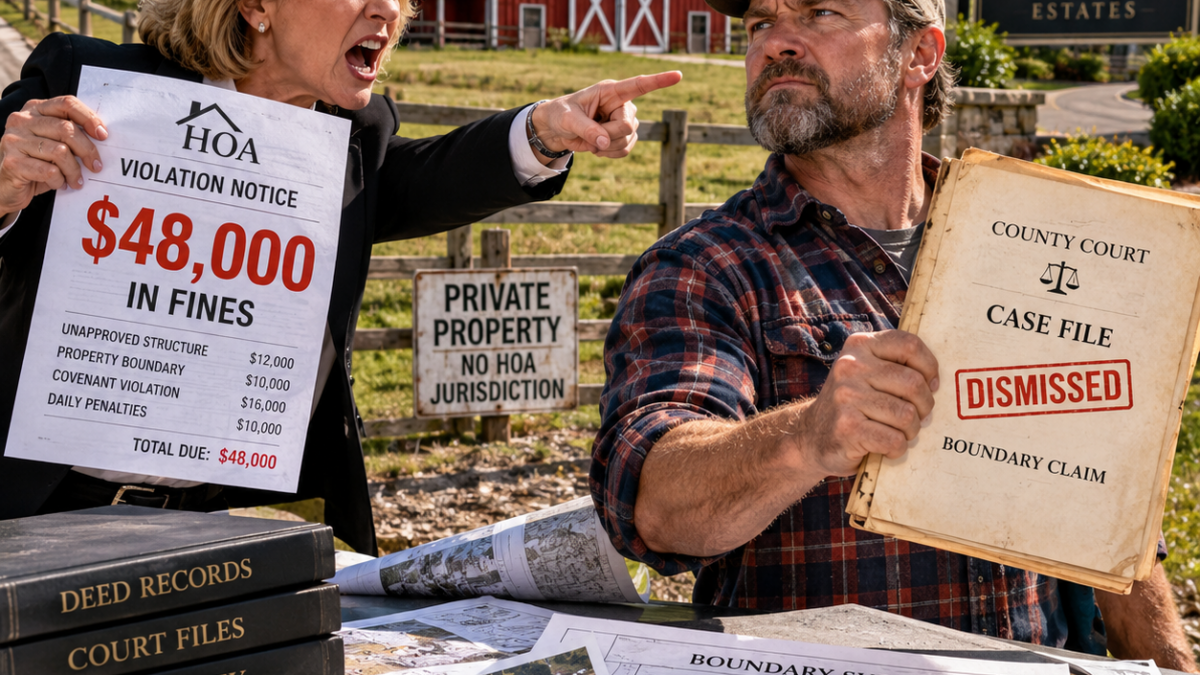
The HOA told me I owed $48,000 for a barn my father had rebuilt before their subdivision even existed.
They said their map was final, the fines would keep climbing, and my farm credit could remain frozen if I refused to bring the building under rules my family had never agreed to.
I thought the worst thing they could take from me was money—until an old note in my father’s deed box made me question everything I knew about our land.
My name is Caleb Morgan.
Morgan Farm had been in my family longer than anyone in the nearby West Ridge community had owned one of its matching stone-front houses.
The farm wasn’t impressive in the way new developments tried to be impressive.
There was no ornamental entrance.
No fountain.
No landscaped median.
Just pasture, fencing, a long gravel drive, an old farmhouse, and a red barn that had spent more than forty years being punished by rain, sun, wind, and winter.
My father, Thomas Morgan, had rebuilt the barn’s west wall himself.
He had replaced posts one at a time, cut braces in our workshop, and carved dates into the oak whenever he finished a major repair.
When I was a boy, I used to think those numbers were random.
Later I understood they were his way of leaving a record.
1979.
1986.
1993.
Pieces of a life written into wood.
So when I found the first HOA violation notice nailed beside the barn door, I genuinely assumed someone had made a mistake.
The paper carried the logo of the West Ridge Homeowners Association.
It cited exterior appearance standards.
Paint.
Siding condition.
Roofing.
Vegetation clearance.
The final paragraph warned that daily fines could begin if the violations were not corrected.
I read it twice.
Then I laughed.
Not because it was funny.
Because the idea seemed impossible.
Morgan Farm existed before West Ridge.
The barn existed before West Ridge.
My father had owned the same ground when the first development crews arrived to carve streets through the neighboring fields.
I took the notice inside, photographed it, and emailed the HOA.
I expected a simple response.
Wrong parcel.
Administrative error.
Our apologies.
Instead, I received an invitation to an enforcement hearing.
That was where I first met Vanessa Hale.
She sat across from me with a stack of board resolutions, a declaration binder, and a large color-coded map.
Vanessa was composed, articulate, and completely certain.
She slid the map across the table.
“Your barn sits inside the association boundary.”
I looked at the blue shading covering part of Morgan Farm.
“No, it doesn’t.”
“Our recorded map says otherwise.”
“My deed says otherwise.”
“Your property appears within our community boundary as currently recorded.”
I leaned forward.
“My father rebuilt that barn before your HOA existed.”
“History doesn’t automatically exempt a parcel from later recorded restrictions.”
“Then show me where my father agreed to those restrictions.”
Vanessa tapped the map.
“Your parcel is shown here.”
“That isn’t what I asked.”
She stared at me.
“Mr. Morgan, the board has an obligation to enforce its standards equally.”
“And I have an obligation not to surrender property rights because somebody colored my farm blue.”
The room became very quiet.
I wasn’t trying to be difficult.
If Vanessa could produce a deed, covenant, annexation document, signed agreement, or court order proving Morgan Farm had entered the HOA, I would read it.
But I wasn’t going to rebuild a barn my father had preserved for decades because an HOA map said I belonged to them.
The first fine arrived three days later.
$1,200.
Then another notice.
Then another.
The total reached $7,800.
I walked through the barn that evening, running my fingers across boards my father had fitted by hand.
And for the first time in years, I remembered something he used to say.
“The subdivision tried to reach this farm once.”
He never explained it.
I had always assumed he meant developers had tried to buy land.
But standing under that old roof with an HOA violation notice in my hand, the sentence suddenly felt different.
The next morning, I opened the metal deed cabinet in the tack room.
Buried beside my father’s deed was a penciled note in his handwriting.
Three words.
**West Ridge lawsuit.**
Underneath them was a court reference from 1998.
I stood there holding the paper while dust floated through the morning light.
My father had kept that note beside the deed for nearly three decades.
And I had never once asked him why.
PART 2
The first person I called was Laura Bennett.
Laura was a title attorney who had handled two commercial easement matters for a neighboring farm.
She wasn’t dramatic.
That was why I trusted her.
I told her about the HOA notices, Vanessa’s map, my deed, the old iron boundary marker behind the barn, and finally the handwritten reference my father had left in the cabinet.
She listened without interrupting.
Then she said something I didn’t particularly want to hear.
“Don’t assume you’ve already won.”
“My farm predates the subdivision.”
“That helps your story. It doesn’t decide title.”
“My father never joined an HOA.”
“Maybe.”
“He would have told me.”
“Maybe.”
I frowned at the phone.
“You’re supposed to be helping me.”
“I am helping you. That’s why I’m not telling you what you want to hear.”
I leaned against the barn door.
“What matters?”
“The chain of title. Recorded instruments. Any valid annexation. Plats. Court orders. Your father’s lawsuit if we can locate it.”
“And the age of the barn?”
“Emotionally? A lot. Legally? Less than you’d like.”
That hurt more than I expected.
To me, the barn was proof.
It stood there before West Ridge.
My father had worked on it before West Ridge.
I had childhood photographs showing open pasture where the subdivision now stood.
But Laura was telling me that history and jurisdiction were different questions.
“Send me everything,” she said.
I did.
My deed.
The HOA notices.
Vanessa’s map.
Tax records.
Old surveys.
Photographs of the iron marker twenty feet behind the barn.
And the note from 1998.
Laura began tracing the title backward.
Meanwhile, Vanessa kept sending fines.
The next notice pushed the balance above $11,000.
I called her.
“I have counsel reviewing the boundary.”
“That doesn’t suspend enforcement.”
“You still haven’t shown me a document signed by my father.”
“The governing declaration is recorded.”
“Recorded against what?”
“Our community.”
“That isn’t an answer.”
“Your parcel is shown within that community.”
“On your map.”
“Yes.”
“A map that conflicts with my deed.”
“Our counsel has reviewed the declaration.”
“Did your counsel review my father’s case?”
There was a pause.
“What case?”
That was the first time I heard uncertainty in Vanessa’s voice.
“Exactly.”
Then she recovered.
“An old lawsuit doesn’t automatically change a later recorded declaration.”
“You haven’t even read it.”
“If your attorney believes it’s relevant, she can submit it.”
“We’re trying to get it.”
“Until then, the balance continues.”
I hung up angry.
Not because she had disagreed with me.
Because she had said the word balance as though this were already settled.
Within another few weeks, the total reached $19,000.
Then $24,000.
Then more.
Laura kept finding pieces but not the one piece we needed.
The newer HOA records were surprisingly strong on first glance.
A later amendment existed.
Attached to it was a boundary map.
The map shaded Morgan Farm.
That was the document Vanessa had relied upon.
Laura spread it across her conference table.
“This is why they’re confident.”
“So they are right?”
“I didn’t say that.”
“You said it’s recorded.”
“It is.”
“Then what’s left?”
She placed my father’s deed beside it.
“The question isn’t whether this map exists. It obviously does.”
She tapped the blue-shaded area.
“The question is what gave whoever drafted this map the authority to place Morgan Farm inside the boundary.”
I leaned closer.
“There should be something?”
“If your parcel was validly annexed, yes.”
“A signature?”
“Possibly. A deed restriction. An annexation instrument. A legal description incorporated into a declaration. Something.”
“And you haven’t found it?”
“Not yet.”
That word bothered me.
Not yet.
Because every day Laura searched, Vanessa added money.
At $31,000, the dispute stopped feeling theoretical.
I tried renewing the farm’s operating credit line.
My banker, Doug, called me.
“Caleb, there’s a problem.”
“What kind?”
“A claim associated with the HOA dispute is showing up in the title review.”
“They don’t own my property.”
“I’m not saying they do.”
“Then renew the line.”
“I can’t clear it until underwriting gets comfortable with the title issue.”
“That line buys seed.”
“I know.”
“And pays for the barn roof.”
“I know.”
There had been a leak above the loft for months.
Nothing catastrophic.
But enough that I had planned to replace part of the roofing before the next heavy rainy season.
Without the credit line, I delayed it.
Then I sold something I had never intended to sell.
A feed chest.
My father built it when I was twelve.
Heavy pine.
Iron hinges.
Nothing valuable to anyone else.
But an antique dealer had offered good money for it once.
I called him.
When he loaded it into his van, I stood beside the tack-room door feeling ridiculous for caring so much about a box.
But after he drove away, the empty square against the wall looked larger than the chest ever had.
Laura came to the farm that afternoon.
She noticed immediately.
“What was there?”
“My father’s feed chest.”
“What happened?”
“I sold it.”
“For legal expenses?”
“Partly.”
She looked at me for a long moment.
“Document that.”
“I don’t want sympathy.”
“I’m not building sympathy. I’m documenting damages.”
“I just want them off my property.”
“I know.”
She looked toward the barn.
“Let’s go see the marker.”
Behind the barn, half hidden beneath grass and weeds, was an old iron pin.
My father had shown it to me when I was young.
“That,” he had said, “is where our line stays.”
At the time I thought he was simply teaching me where to fence.
Laura brought a surveyor named Mark Ellis.
Mark knelt beside the marker, checked coordinates, studied old county surveys, then walked the surrounding line with equipment.
Hours later, he met us beside his truck.
“This pin isn’t random.”
“What does it match?” Laura asked.
“An older county survey.”
I felt relief.
Then Mark raised a hand.
“Don’t celebrate yet.”
I was starting to hate professionals who said that.
He unfolded two maps.
“The physical marker aligns with the older county line.”
He pointed to Vanessa’s HOA map.
“This newer association map shifts the boundary.”
“How?”
“I don’t know.”
“Which one is right?”
“I need a recorded source explaining the shift.”
I turned to Laura.
“So the marker helps us.”
“Yes.”
“But doesn’t finish it.”
“Correct.”
The fines kept increasing.
By the time Vanessa issued the final demand, the balance had reached $48,000.
The letter gave me a deadline.
Pay.
Correct the violations.
Or face collection.
I carried that letter into the barn and laid it on my father’s old workbench.
Forty-eight thousand dollars.
For faded red siding.
Old roofing.
A barn that had stood exactly where it stood before the HOA even existed.
I thought about repainting it.
Not because Vanessa was right.
Because I was tired.
Tired of legal bills.
Tired of title searches.
Tired of waking up thinking about maps.
Tired of wondering whether my bank would permanently cut my credit.
Tired of feeling angry every time I looked at my father’s barn.
That was the worst part.
A place that had once made me think of him now reminded me of Vanessa.
I hated that.
Laura arrived before sunset.
She found me sitting on the tailgate of my truck.
“You look terrible.”
“Thank you.”
“You’re welcome.”
I handed her the latest letter.
She read it.
“Forty-eight.”
“Forty-eight.”
“Are you thinking about complying?”
I stared toward the barn.
“If I submit plans, what happens?”
“They’ll argue you’ve accepted their jurisdiction.”
“So I can’t fix anything without helping their case.”
“You can make necessary maintenance repairs as the lawful owner. But submitting an HOA architectural application would complicate our position.”
I shook my head.
“This is insane.”
“It is also why property law has so much paper.”
I almost laughed.
Then she took a folded printout from her bag.
“I found something.”
My chest tightened.
“The lawsuit?”
“Not the file yet.”
She pointed to a title reference.
“Your chain contains an old notation. Morgan versus West Ridge. Case number 98-CV-417.”
I stared at it.
“My father.”
“Yes.”
“What happened?”
“The index doesn’t say.”
“Can we get the file?”
“I’ve requested the archive box.”
“How long?”
“Hopefully tomorrow.”
I looked toward the barn again.
“What if he lost?”
Laura didn’t answer quickly enough.
That told me everything.
“If your father lost,” she said, “we deal with what the record says.”
For the first time since the dispute began, I felt genuinely afraid that Vanessa might be right.
Not because I trusted her map.
Because there was clearly a history nobody had ever explained to me.
Maybe my father had fought annexation.
Maybe he lost.
Maybe he accepted a settlement.
Maybe the farm had been brought into West Ridge in some way he never discussed.
All my confidence had come from believing he never would have agreed.
But my father had been gone for years.
He wasn’t there to answer.
The archive box arrived the next afternoon.
Laura called me.
“Come to my office.”
“What did you find?”
“Come here.”
That was all she would say.
I drove faster than I should have.
When I entered her conference room, a gray archive box sat on the table.
Beside it were copies of old pleadings, stamped exhibits, correspondence, and a thick certified order.
Laura pointed to the chair.
“Sit.”
“I’d rather stand.”
“Fine.”
She opened the first document.
“In 1998, the developer behind West Ridge planned its second phase.”
I nodded.
“The proposed map included a strip of Morgan Farm.”
“How much?”
“Including the area around your barn.”
I stared at her.
“So Dad sued them.”
“Not exactly at first. He objected during the closing and recording process. The dispute escalated.”
“Why?”
“Because the developer claimed its planned boundary included land your father said had never been conveyed.”
“That sounds like him.”
Laura smiled slightly.
“I thought you’d say that.”
She opened another document.
“The case ended in a settlement approved by the court.”
My stomach tightened.
“What kind of settlement?”
Instead of answering, she unfolded a certified survey.
It was old.
Black lines.
Typed legal descriptions.
Court stamp.
Laura placed Mark’s survey beside it.
Then my father’s deed.
Then Vanessa’s HOA map.
Three lines aligned.
One did not.
My voice came out quieter than I expected.
“Which line is the court line?”
Laura pointed.
“This one.”
It stopped before Morgan Farm.
Before the barn.
Before the iron marker.
I looked at her.
“Say it clearly.”
“Morgan Farm remained outside West Ridge.”
I didn’t speak.
“The order adopted this legal description and this survey.”
“So Dad won?”
“That’s not the way I’d phrase it.”
“Laura.”
She leaned back.
“Your father established that the subdivision boundary stopped before your property.”
I looked down at the court stamp.
For months I had been telling Vanessa that my father never joined her HOA.
Now I finally understood why.
He didn’t defeat their rules.
He proved their rules never reached Morgan Farm.
The iron pin behind the barn matched the court survey.
The county survey matched it.
My deed matched it.
The later HOA map was the outlier.
Laura traced the error.
Years after the settlement, someone prepared an amendment for West Ridge.
Whoever assembled the boundary exhibit copied from an older planning map.
That planning map had been drafted before my father’s court settlement.
It still showed the proposed line.
The line that never became legally effective against Morgan Farm.
Somebody copied it.
Then somebody else copied the copy.
Years passed.
The wrong map appeared in board packets.
Insurance records.
Association files.
Eventually, repetition transformed a planning error into something everyone treated like fact.
I sat there looking at my father’s signature on one of the filings.
For years, I had wondered why he kept that handwritten note.
Now I knew.
He hadn’t trusted memory.
He had kept the paper.
Laura said, “We send this immediately.”
“To Vanessa?”
“To everyone.”
She prepared a certified package containing the judgment, survey, legal description, title records, and a demand that enforcement stop.
I wanted to believe that would end it.
It should have.
It didn’t.
Vanessa’s response arrived through counsel.
A historic settlement, they argued, did not automatically invalidate later recorded governing documents.
Laura read the letter once.
Then a second time.
Then she looked at me.
“They’re missing the point.”
“Intentionally?”
“I don’t know yet.”
“What point?”
“A later map does not acquire property rights simply because it’s later.”
She drafted our response.
The question was straightforward.
What instrument had legally moved Morgan Farm into the HOA after the 1998 court order?
Was there a deed?
No.
Consent?
None found.
New court order?
None.
Signed annexation?
None.
A valid conveyance?
None.
There was a map.
A map copying an obsolete line.
Vanessa still refused to stop enforcement.
She called a closed board review.
The collection deadline remained active.
That afternoon, it rained.
Hard.
The barn roof I had postponed repairing finally gave up over part of the loft.
Water came through in steady drops.
Then streams.
I moved tools.
Feed sacks.
Old photographs.
A wooden saddle rack.
I covered everything I could with tarps.
Then I climbed into the loft and saw water darkening the original boards my father had planed himself.
For the first time in the dispute, I lost my temper.
Not at Vanessa.
Not even at the HOA.
At myself.
I should have fixed the roof.
I knew it.
But the credit line was frozen.
My legal bills were climbing.
Every financial decision had become tied to a property dispute that should never have existed.
Laura called while I was moving equipment.
I answered with water dripping from my sleeves.
“What’s that noise?”
“Rain.”
“You’re in the barn?”
“Yes.”
“The roof?”
“Yes.”
She was quiet.
“How bad?”
“Bad enough.”
“Photograph everything.”
“I don’t want another evidence lecture.”
“Caleb.”
I looked up at the leaking boards.
“What?”
“This matters.”
“My father’s loft is getting soaked because I’m spending money proving I own property I already own.”
“I know.”
“No, you don’t.”
The words came out harder than I intended.
Laura didn’t respond for several seconds.
Then she said quietly:
“You’re right. I don’t know what that feels like.”
I sat down on the loft stairs.
“I’m sorry.”
“Don’t apologize. Take pictures.”
I laughed despite myself.
“There she is.”
“Every board. Every damaged item. Every receipt.”
I did.
Three days later, we got the call that changed the case again.
Rachel Kim, the HOA treasurer, contacted Laura.
Rachel wasn’t calling as Vanessa’s enemy.
She was calling because something bothered her.
The HOA had an old title report.
Inside its schedule of exceptions was a reference to the Morgan litigation.
Case 98-CV-417.
The exact case we had found.
The HOA’s own historical title material pointed toward the court record.
Laura asked Rachel to send the page.
She did.
I was standing in Laura’s office when the email came through.
Laura printed it.
Placed it beside the court order.
Then looked at me.
“This is important.”
“How important?”
“They can argue they initially relied on the map in good faith.”
“Fine.”
“But their own title records identified the litigation affecting this boundary.”
“So they could have found it.”
“Yes.”
“Before fining me.”
“Yes.”
I felt the anger return.
Laura raised a hand.
“Careful.”
“I’ve been careful for months.”
“And you’ll continue being careful.”
“They had the case number.”
“Yes.”
“They had it.”
“Yes.”
“And Vanessa still wants collection.”
Laura nodded.
Rachel had warned us about that too.
The board was under pressure because of something I had only heard Vanessa mention vaguely before.
Insurance.
Wildfire exposure had become a serious issue along the edge of West Ridge.
The carrier was reviewing vegetation, structures, access, water supply, and fire mitigation.
The red barn had been flagged as an edge risk.
Not because anyone believed I was doing something intentionally dangerous.
Because the insurer had been given the same wrong HOA map.
The carrier believed West Ridge controlled the property.
Vanessa had apparently represented that the board could enforce improvements on every structure shown within its mapped boundary.
That mattered.
If Morgan Farm was actually outside the HOA, West Ridge would need a different solution.
Brush clearing on its own land.
Possibly a firebreak.
Hydrant improvements.
Other mitigation.
Money.
Money the HOA did not want to spend while renewal negotiations were underway.
Suddenly, Vanessa’s stubbornness made more sense.
Not more legal.
More understandable.
She wasn’t simply obsessed with my barn.
She was trying to protect hundreds of homeowners from an insurance problem.
That distinction mattered to me.
I didn’t want to turn her into some cartoon villain.
She had a legitimate problem.
She chose an illegitimate shortcut.
Laura put it better.
“Urgency explains conduct,” she told me. “It doesn’t create jurisdiction.”
That sentence became the heart of our case.
Vanessa eventually called me directly.
Her tone was different from earlier conversations.
Less confident.
More tired.
“Caleb, I need you to understand the position we’re in.”
“I understand it better now.”
“Our insurer wants edge risks addressed.”
“Then address the risks you control.”
“The barn is one of the structures they’ve identified.”
“Because you gave them the wrong map.”
“We gave them the association map we’ve relied on for years.”
“Which is wrong.”
“That has not been finally adjudicated in this dispute.”
“My father’s court order already adjudicated the boundary.”
“Our counsel believes the later declaration raises issues.”
“Then show me the instrument that moved the line.”
Silence.
I continued.
“If your firebreak costs money, build it.”
“We’re talking about major costs for hundreds of owners.”
“And you’re asking one farm to absorb those costs through authority you don’t have.”
“I’m not trying to take your property.”
“You’ve put forty-eight thousand dollars in fines against it.”
“We’re trying to enforce safety standards.”
“On land outside your association.”
“According to your interpretation.”
“According to a certified court survey.”
She exhaled.
“You make this sound simple.”
“The boundary is simple.”
“The consequences aren’t.”
“That isn’t my fault.”
Another silence.
Then Vanessa said something surprisingly honest.
“I have thirty days to protect insurance renewal for hundreds of families.”
For the first time, I heard fear instead of authority.
I softened slightly.
“I don’t want those families to lose coverage.”
“Then help us.”
“How?”
“Bring the barn into compliance voluntarily.”
I nearly laughed.
“Voluntarily under whose standards?”
“Caleb.”
“No. Because then this happens again. Next time it’s fencing. Or equipment. Or crops. Or trucks. You don’t solve a false boundary by asking the property owner to pretend it’s real.”
“We need time.”
“You had time.”
“That isn’t fair.”
I thought about my leaking roof.
My frozen credit line.
The empty space where my father’s feed chest had stood.
“Neither is forty-eight thousand dollars.”
She ended the call soon after.
A week later, the HOA recorded its collection claim.
My bank froze the credit line completely pending resolution.
Doug called again.
“I hate this.”
“Then release the line.”
“I can’t.”
“The court order is clear.”
“Our legal department sees an active recorded claim.”
“So a wrong lien works until I spend enough money proving it’s wrong?”
“That’s not how I would describe it.”
“That’s exactly how it feels.”
I ended the call more abruptly than he deserved.
Then I walked out to the barn.
For one week, Vanessa’s strategy appeared to work.
The claim existed.
The bank honored it.
The roofer I had scheduled took another job because I couldn’t confirm financing.
I patched the damaged section myself.
At fifty-two years old, standing on an old ladder with roofing material under one arm, I found myself thinking about my father.
He would have fixed it alone.
Not because he enjoyed suffering.
Because Thomas Morgan had believed that if you owned something, you took care of it.
I remembered him telling me as a teenager:
“People think owning land means nobody can tell you what to do.”
Then he’d laughed.
“What it really means is everything that goes wrong is yours.”
That memory hurt.
Because for the first time, something had gone wrong that wasn’t entirely mine.
Laura was no longer only defending against the fine.
She began requesting board minutes, insurance correspondence, the drafting history of the HOA map, and internal emails.
“We know the boundary,” I told her.
“I want to know why they kept pushing after they learned the boundary.”
“That matters?”
“A lot.”
The documents arrived gradually.
They told a more complicated story than I expected.
West Ridge’s insurer had indeed identified edge hazards.
The broker gave the association alternatives.
Reduce the mapped risks.
Or accept a major premium increase.
The red barn was on the list.
Vanessa told the broker the HOA could require changes to every mapped structure.
That statement let the board delay a more expensive mitigation plan on HOA-owned land.
Correcting the Morgan Farm boundary would expose the mistake.
Then West Ridge would have to find money.
Brush clearing.
Hydrant work.
Firebreak improvements.
Possible changes in access.
The board had delayed those decisions while expecting to force compliance on me.
Then we found the email.
Laura called me immediately.
“Come in.”
“You always say that right before my day gets worse.”
“This one may help.”
I drove over.
She had one page on the conference table.
It was an email sent by Vanessa after she received our certified court order.
After.
That word mattered.
The email read:
**Proceed with collection while counsel reviews. We cannot lose the insurance timeline.**
I read it twice.
Laura watched me.
“This is the line.”
“What line?”
“Before receiving the court file, Vanessa can argue honest reliance on a recorded map.”
“And after?”
“She had actual notice that the map might be legally wrong.”
“But counsel was still reviewing.”
“Yes.”
“So she can say she relied on counsel.”
“She can.”
“That sounds like a problem.”
“It isn’t necessarily fatal to us.”
“Why?”
“Because a prudent response to a certified judgment directly contradicting your map is usually to pause disputed collection while counsel determines jurisdiction.”
“She didn’t.”
“No.”
“She accelerated.”
“Yes.”
I looked at the email again.
**We cannot lose the insurance timeline.**
It didn’t sound sinister.
That made it more powerful.
It showed exactly what happened.
Vanessa had made a choice.
Not because she necessarily believed my father had lied.
Not because she wanted my barn personally.
Because her insurance deadline mattered more to her than pausing enforcement against a parcel whose status was now seriously disputed.
My property rights had become the cheaper option.
Laura assembled the case.
She called it four links.
Authority.
Boundary.
Notice.
Consequence.
Authority: the HOA needed a legal basis to regulate Morgan Farm.
Boundary: the certified 1998 court survey stopped West Ridge before my property.
Notice: Vanessa and the board received that court record before continuing collection.
Consequence: the lien clouded title, froze my credit, delayed repairs, and caused measurable financial harm.
We didn’t ask for some enormous fantasy payout.
I didn’t want that.
I wanted the fine gone.
The collection claim released.
The boundary corrected.
And my farm permanently removed from the HOA map.
Before the hearing, Laura asked me one question.
“What outcome would make you feel this is finished?”
I didn’t need to think.
“I want the wrong line erased.”
“Anything else?”
“The bank cleared.”
“Anything else?”
I looked out her office window.
“I want them to stop acting like my father’s barn belongs to them.”
She nodded.
“No revenge?”
I almost smiled.
“I’ve imagined a few things.”
“Normal.”
“But no. I don’t want West Ridge destroyed.”
“Good.”
“I want Vanessa to sit in a room while someone with actual authority tells her she never had authority over me.”
Laura smiled.
“That I can try to arrange.”
The hearing took place six months after the first notice appeared on my barn.
By then, the $48,000 fine had become the number everyone talked about.
But to me, it was no longer the most important thing.
The most important thing sat in Laura’s sealed exhibit folder.
My father’s court record.
I carried his deed.
Vanessa arrived with the association’s declaration binder, insurance letters, board resolutions, and the modern boundary map.
For months she had been telling me that map controlled everything.
Now both maps were about to sit in front of a judge.
Judge Elaine Porter entered shortly after nine.
The room wasn’t large.
It didn’t need to be.
The tension filled it.
Laura leaned toward me.
“Answer only what you’re asked.”
“I know.”
“Don’t argue from the table.”
“I know.”
“And don’t stare at Vanessa.”
“I wasn’t planning to.”
“You are currently staring at Vanessa.”
I turned toward the judge.
“Better.”
The HOA presented first.
Their lawyer explained the board’s reliance on recorded governing documents.
He emphasized that the association had used the same boundary map for years.
He spoke about wildfire risk.
Insurance renewal.
Equal enforcement.
The responsibility the board owed hundreds of residents.
He wasn’t wrong about those pressures.
Then Judge Porter asked a question.
“Counsel, identify the instrument that places Morgan Farm inside association jurisdiction.”
The attorney opened the declaration binder.
He presented the later amendment.
Then the attached map.
Vanessa sat straighter.
This was the document she had relied on from the beginning.
Laura stood.
“May I approach?”
The judge nodded.
Laura placed the certified 1998 order beside the HOA amendment.
Then the court survey.
Then my deed.
Then Mark Ellis’s survey.
She aligned the corners.
The difference was visible even from where I sat.
The old court line stopped before Morgan Farm.
The later association map crossed it.
Laura spoke calmly.
“The association’s map copied a planning line that predates the settlement in Morgan versus West Ridge.”
The HOA attorney objected to the characterization.
Judge Porter looked at the documents.
“Do you dispute the date?”
“No, Your Honor.”
“Do you dispute this is a certified court exhibit?”
“No.”
“Do you dispute the order adopts this boundary description?”
The attorney paused.
“No.”
Laura continued.
“The later association map reproduced an obsolete proposed line. We have found no deed, consent, annexation instrument, or subsequent court order moving Morgan Farm inside the association after the 1998 judgment.”
Judge Porter looked at the HOA attorney.
“Do you have such an instrument?”
He turned pages.
Vanessa leaned toward him.
He searched again.
The silence stretched.
Finally:
“No later deed instrument moving Morgan Farm has been identified, Your Honor.”
I felt something loosen in my chest.
Not victory.
Relief.
Judge Porter turned toward the maps.
“The association may enforce its governing documents against property legally within its jurisdiction.”
She pointed to the certified survey.
“But this record stops before Morgan Farm.”
The $48,000 balance suddenly looked like what I had been calling it for six months.
A number without authority behind it.
The HOA attorney shifted to the board’s good-faith reliance on its map.
Judge Porter listened.
Then Laura introduced the title report.
The HOA’s own historic report referencing case 98-CV-417.
Then our certified-delivery proof.
Then Vanessa’s email.
**Proceed with collection while counsel reviews. We cannot lose the insurance timeline.**
The judge read it.
Her expression didn’t change.
“Ms. Hale.”
Vanessa looked up.
“Yes, Your Honor?”
“When did you receive the certified Morgan order?”
Her attorney gave the date.
Judge Porter looked back at the email.
“And this instruction to proceed with collection came afterward?”
“Yes.”
Vanessa’s attorney stood.
“The board was operating under urgent insurance constraints.”
Judge Porter nodded.
“I understand that.”
That sentence surprised Vanessa.
The judge continued.
“Insurance concerns may explain urgency.”
Then she looked directly at the HOA table.
“They do not expand a property boundary.”
Nobody moved.
The attorney argued that West Ridge had hundreds of owners relying on the board to manage wildfire risk.
Judge Porter did not dismiss that responsibility.
She acknowledged it.
Then separated it from the title question.
The HOA could perform mitigation on property it controlled.
It could negotiate.
It could seek lawful easements.
It could change insurance plans.
It could budget for infrastructure.
What it could not do was solve an internal financial or insurance problem by exercising authority over property outside its jurisdiction.
Then the ruling came.
The $48,000 fine was invalidated.
The collection claim had to be released.
The HOA was ordered to correct the boundary representation affecting Morgan Farm.
The judge noted that initial reliance on the association’s map could explain the first enforcement action.
But continued collection after receipt of the certified court record was different.
“Good-faith reliance may explain an error,” Judge Porter said.
“It does not make an error permanent after contrary authority is placed directly before you.”
I stared at the table.
Six months.
Forty-eight thousand dollars.
Legal bills.
Frozen credit.
A leaking roof.
My father’s feed chest gone.
All of it ended with a judge comparing two lines on two pieces of paper.
Vanessa didn’t become a criminal.
No impossible judgment landed against West Ridge.
There was no dramatic punishment.
That wasn’t what I had asked for.
The fine disappeared.
The lien had to disappear.
The wrong boundary had to disappear.
That was enough.
Outside the courtroom, reporters weren’t waiting.
There was no television crew.
Just lawyers, homeowners, and people carrying folders.
Vanessa stood near the hallway wall speaking quietly with her attorney.
I started toward the exit.
Then she called my name.
“Caleb.”
Laura looked at me.
My choice.
I stopped.
Vanessa approached.
For the first time since this began, she wasn’t holding a binder.
“The judge accepted your boundary.”
“My father’s boundary.”
She nodded.
I waited.
She seemed to be searching for words.
Finally she said, “You understand why the board was concerned.”
“Yes.”
That surprised her.
“I never said the insurance problem wasn’t real.”
“We were facing a serious renewal issue.”
“I know.”
“If premiums had increased the way the broker projected, some owners would have struggled.”
“I believe that.”
She looked frustrated.
“Then you understand why we moved quickly.”
“No.”
Her face tightened.
“I understand why you felt pressure.”
“Isn’t that the same thing?”
“No.”
I pointed back toward the hearing room.
“You had a problem. You picked my property because your map made it cheaper than fixing the problem on your own land.”
“That wasn’t how we saw it.”
“Maybe not at first.”
She looked away.
I continued.
“But after you received the court order, you knew there was a serious chance your map was wrong.”
“Our counsel had questions.”
“Then pause collection.”
“We didn’t have time.”
“You had time to file against my farm.”
She said nothing.
“You had time to freeze my credit.”
“The bank made that decision.”
“Because of your claim.”
Vanessa folded her arms.
“I was trying to protect hundreds of people.”
“And I was one person.”
“That isn’t what I meant.”
“But that’s what happened.”
She opened her mouth.
Then closed it.
I wasn’t shouting.
I didn’t want to.
The anger had been burning for months.
Now that the judge had ruled, I suddenly felt tired of carrying it.
“Vanessa, if the HOA had come to me six months ago and said, ‘We have an insurance problem. Your barn is outside our boundary, but can we discuss voluntary fire mitigation?’ I probably would have listened.”
Her eyes moved toward me.
“You would have?”
“My family has lived beside those homes for decades. I don’t want a fire spreading into West Ridge any more than you do.”
“Then why fight the exterior work?”
“Because you didn’t ask.”
I let that sit.
“You fined me.”
She looked toward the floor.
“You claimed authority over my land.”
Nothing.
“You made me sell part of my family’s history to pay for lawyers.”
Her head lifted.
“I didn’t know about that.”
“You didn’t need to know.”
“What did you sell?”
“My father’s feed chest.”
That hit her differently.
Maybe because forty-eight thousand dollars was abstract.
A wooden chest wasn’t.
“I am sorry about that.”
It wasn’t the apology I wanted.
But it was the first one I had heard.
I nodded.
“Fix your map.”
“We will.”
“And build the fire plan where you actually have authority.”
She exhaled.
“We will.”
Then I walked away.
The lien release reached the county within days.
Doug called from the bank.
“We received the release.”
“And?”
“Title review is clearing the hold.”
“How long?”
“Not long.”
I didn’t say anything.
He added, “I’m sorry this dragged out.”
“So am I.”
Two days later, the credit line was restored.
I called the roofer.
“You still want the job?”
“Thought you’d never ask.”
He returned the following week.
We replaced the damaged roof section.
Some of my father’s original loft boards couldn’t be saved.
That hurt.
New lumber went in where old hand-planed boards had been.
I stood below while the crew worked.
For months, I had imagined that victory would feel satisfying.
Instead, standing inside that barn, I felt grief.
I had won.
But winning didn’t put the original boards back.
It didn’t return the feed chest.
It didn’t give me back the evenings I had spent reading HOA letters instead of eating dinner without thinking about legal descriptions.
That was something people rarely admit about disputes.
Even when you’re right, the fight still costs you.
The HOA commissioned a corrected boundary survey.
Fresh stakes appeared along the same line my father had defended in 1998.
The old iron marker remained where it had always been.
Mark Ellis came out when the final survey was recorded.
He stood beside the pin and smiled.
“Your father trusted good iron.”
“He trusted records more.”
“Smart man.”
I looked toward the barn.
“He never told me the whole story.”
“Maybe he thought he wouldn’t need to.”
That bothered me.
Then I realized something.
Dad had told me.
Just not with a long speech.
He kept the deed.
He kept the court reference.
He showed me the boundary marker.
He told me the subdivision had tried to reach the farm once.
That was his version of telling me.
I just hadn’t understood until I needed it.
West Ridge had its own work to do.
Once Morgan Farm came off the insurance map, the HOA could no longer claim the barn was a structure it controlled.
The board had to pursue the mitigation it had postponed.
Brush clearing.
A firebreak.
Hydrant improvements.
Vegetation management along the actual subdivision edge.
Those projects cost money.
There were unhappy homeowners.
Some asked why the board had not budgeted for them earlier.
That question led back to Vanessa.
Rachel Kim began pushing for stronger review procedures.
She wasn’t interested in revenge either.
She wanted better governance.
At one board meeting, according to a resident who later told me about it, Rachel placed two maps on the projector.
The obsolete one.
The corrected one.
She said:
“This dispute happened because we treated repetition as verification.”
That was exactly right.
The wrong line appeared in years of packets.
So people trusted it.
It appeared in insurance correspondence.
So people trusted it more.
It appeared in board enforcement records.
So it became institutional truth.
But copying an error doesn’t convert it into a fact.
The board adopted a rule requiring title verification before initiating major enforcement against any edge parcel where jurisdiction could reasonably be disputed.
They also required counsel to review source documents rather than relying only on association-generated maps.
I heard some residents jokingly call that the Morgan Rule.
I didn’t like the name.
The farm had already been dragged into enough HOA paperwork.
Vanessa remained on the board for a while.
That surprised me.
Some residents wanted her removed immediately.
Others believed she had made a serious mistake under real pressure rather than acted out of pure malice.
I stayed out of it.
That was their association.
Their vote.
Their decision.
What mattered to me was that she stopped claiming Morgan Farm.
A few months after the court ruling, she sent one letter.
Not an enforcement letter.
A personal one.
It was short.
She wrote that the board had completed the corrected boundary survey and that Morgan Farm was no longer represented as association property in West Ridge’s internal maps.
She acknowledged that continuing collection after receiving the 1998 order had worsened the dispute.
She did not admit everything Laura probably would have wanted her to admit.
But she did write one sentence I kept.
**The association should have separated its insurance urgency from the legal question of whether it had authority over your property.**
That was enough.
I put the letter in the deed cabinet.
Beside my father’s papers.
The irony wasn’t lost on me.
The dispute began because the HOA believed a newer map mattered more than an older court record.
It ended with me adding another document to the same family file.
Winter came.
The barn roof held.
The credit line remained open.
For the first time in months, I walked through the tack room without mentally calculating attorney fees.
The empty space where the feed chest had stood was still there.
I considered commissioning a replica.
I even called a carpenter.
Then I changed my mind.
A copy wouldn’t be my father’s.
So I built something myself.
Not a feed chest.
A records cabinet.
Oak.
Heavy hinges.
Nothing fancy.
I used some of the same tools my father had owned.
My cuts weren’t as clean as his.
My joints weren’t perfect.
But when I finished, I carried it into the tack room and placed it in the empty space.
Inside went the deed.
The 1998 court order.
The certified survey.
The HOA notices.
The $48,000 demand.
The lien release.
The corrected boundary map.
On the inside of the door, I carved a date.
Just like Dad had carved dates into the barn posts.
Then underneath it, I carved one sentence.
**KEEP THE PAPER.**
Laura visited a few weeks later.
She opened the cabinet.
“You built this?”
“Don’t inspect the joinery.”
“I was going to compliment it.”
“You’re a lawyer. I don’t trust compliments without disclaimers.”
She laughed.
Then she noticed the inscription.
“Keep the paper.”
“My father’s whole legal strategy, apparently.”
“It’s not a bad one.”
We walked outside.
Fresh survey stakes marked the edge of the farm.
Beyond them, West Ridge contractors were clearing brush for the new firebreak.
Laura pointed toward the equipment.
“There. That’s where their solution belonged.”
“On their land.”
“Exactly.”
I watched the workers for a while.
“Vanessa wasn’t wrong about the fire risk.”
“No.”
“She was wrong about where her authority ended.”
“Yes.”
“That feels important.”
“It is.”
I thought about how easy it would have been to tell the story differently.
HOA villain.
Farmer hero.
Courtroom defeat.
Revenge.
People like clean categories.
Real life isn’t always that generous.
Vanessa had hundreds of homeowners worried about insurance.
She had a map the HOA had trusted for years.
At the beginning, I could understand how she made the mistake.
What changed everything was what happened after the mistake was exposed.
When the certified order arrived, she had a choice.
Pause.
Investigate.
Recalculate.
Or keep pushing because slowing down was expensive.
She chose the second path.
That was the decision the judge cared about.
And, eventually, so did I.
The first notice on my barn had angered me.
The forty-eight-thousand-dollar demand frightened me.
The lien infuriated me.
But the part I remembered most was the email.
**Proceed with collection while counsel reviews. We cannot lose the insurance timeline.**
One sentence.
It told the whole story.
My rights had become inconvenient.
That was why paper mattered.
Not because paperwork is magical.
Because memory bends under pressure.
Organizations tell themselves stories.
“We’ve always used this map.”
“Our lawyer reviewed it.”
“The carrier depends on it.”
“The deadline is urgent.”
“Changing course would cost too much.”
One justification joins another.
Eventually nobody stops to ask the first question.
**Do we actually have the right to do this?**
My father asked that question in 1998.
I had to ask it again nearly thirty years later.
That frustrated me for a long time.
Why should the same boundary need defending twice?
Then Mark said something that changed how I thought about it.
He had come by to check one final monument after the corrected survey.
I asked him that exact question.
“Why did Dad have to fight this, and then I had to fight it again?”
Mark drove the survey rod into the soil.
“Because lines don’t defend themselves.”
I looked at him.
He shrugged.
“They sit on paper until someone needs them.”
That was true of more than property.
Rights don’t become obvious just because they’re old.
Records don’t protect anyone if nobody reads them.
A court order buried in an archive box is only as powerful as the moment someone brings it back into the light.
My father had done his part.
He had challenged the developer.
He had gotten the boundary recorded.
He had kept the paperwork.
My part was smaller.
I had to find it.
A year after the dispute ended, West Ridge invited neighboring landowners to a wildfire-preparation meeting.
I received the invitation.
Not a demand.
An invitation.
That difference made me smile.
I went.
The meeting was held in their community hall.
Vanessa was there, though Rachel conducted most of the discussion.
Maps were projected on the wall.
Correct maps.
Morgan Farm sat outside the boundary.
The new firebreak appeared on West Ridge land.
Hydrant upgrades were marked.
Vegetation zones were clearly identified.
Rachel discussed voluntary cooperation with neighboring properties.
Then she looked at me.
“Caleb has agreed to maintain additional clearance along part of his eastern fence.”
A few residents turned.
One man raised his hand.
“Is the HOA paying him?”
“No,” I said.
“Then why are you doing it?”
“Because reducing fire risk makes sense.”
Someone near the back asked:
“Then why didn’t you just do that before?”
The room became uncomfortable.
I looked toward Vanessa.
She looked down at her notes.
I could have embarrassed her.
I had the perfect opening.
Instead I answered honestly.
“Because before, nobody asked me.”
The room went quiet.
“That was the whole problem.”
Rachel nodded.
“We learned from that.”
After the meeting, an older woman approached me.
Her name was Ellen.
She lived in one of the houses closest to the farm.
“I owe you an apology.”
“For what?”
“I signed a petition.”
“What petition?”
“To make the board force you to fix the barn.”
I vaguely remembered hearing about resident complaints.
“You thought it was HOA property.”
“We were told it was.”
“Then you were working with the information you had.”
She shook her head.
“I never asked whether it was true.”
“That makes two hundred of us.”
She smiled.
Then her expression became serious.
“My husband has heart problems. We couldn’t afford a massive insurance increase.”
“I understand.”
“That’s why I supported Vanessa.”
“I understand that too.”
She looked toward the barn visible beyond the windows.
“I thought you didn’t care about our homes.”
“That wasn’t true.”
“I know that now.”
That conversation mattered to me more than I expected.
Because for months, West Ridge had existed in my mind as a board.
Vanessa.
Letters.
Fines.
Maps.
But the HOA wasn’t just paperwork.
It was Ellen worrying about insurance.
A family trying to protect a mortgage.
Retired homeowners afraid of being priced out.
People making decisions based on information they assumed was accurate.
That didn’t excuse what happened.
But it reminded me why I hadn’t wanted revenge against the whole community.
The best ending wasn’t West Ridge suffering.
It was West Ridge learning where it ended.
And Morgan Farm staying where it had always been.
Later that spring, I repainted the barn.
That surprises people when I tell the story.
After fighting an HOA over exterior standards, I voluntarily repainted the building.
But I didn’t do it because Vanessa demanded it.
I did it because the wood needed protection.
That distinction mattered.
I chose the same deep red my father had used.
I repaired trim.
Replaced damaged siding.
Cleared brush along the east fence.
Installed ember-resistant vent screening after consulting the county fire department.
None of those improvements felt like surrender.
Because they were my decisions.
Property ownership doesn’t mean refusing every good idea someone else has.
It means the right person gets to make the decision.
I saved the old west wall.
The one Dad rebuilt.
Some boards were too weathered to keep exposed, so I protected them behind the new exterior layer.
His carved dates remain inside.
1979.
1986.
1993.
I added another.
The year the boundary was corrected.
Not because I wanted to memorialize Vanessa.
Because it was another year the barn survived.
One afternoon, my nephew Tyler visited.
He was fourteen.
About the same age I had been when Dad first showed me the iron pin.
We were walking behind the barn when he kicked at the grass.
“What is that thing?”
“The property marker.”
“That rusty pin?”
“Yes.”
“Looks like garbage.”
I laughed.
“That’s what I thought when I was your age.”
“What does it do?”
“Nothing.”
He looked confused.
“Then why keep it?”
“It tells us where the line is.”
“Couldn’t you just use GPS?”
“Now? Sure.”
“So why does that matter?”
I looked toward West Ridge.
“Because sometimes people forget.”
He shrugged the way teenagers do when adults turn simple questions into lessons.
I pointed toward the pin.
“My dad showed me this when I was your age.”
“Grandpa?”
“Yes.”
“What did he say?”
I thought about it.
“He said, ‘This is where our line stays.’”
Tyler looked at the marker again.
“Was he right?”
I smiled.
“Eventually.”
There was something satisfying about that answer.
Not triumphant.
Steady.
The way Dad had been.
The legal case also changed how I ran the farm.
I organized every deed, easement, survey, lease, tax document, and boundary agreement digitally.
Then I kept certified paper copies.
I added a title review to every major business decision.
Friends teased me about it.
One neighbor called me “the man with six backups.”
I didn’t care.
One afternoon, a farmer named Ben came by with a letter from a utility company.
He wanted to know whether I understood the easement language.
“I’m not your lawyer.”
“I know.”
“Call Laura.”
“I will.”
“Then why are you showing me?”
“Because you read everything now.”
That made me laugh.
I read it.
Then told him exactly what Laura had taught me.
“Don’t assume you’re right just because the land feels like yours.”
He frowned.
“That’s encouraging.”
“And don’t assume they’re right because the letter looks official.”
“That sounds better.”
“Find the source document.”
He nodded.
“The paper.”
“The paper.”
That’s what remained with me.
Not the forty-eight thousand.
Not Vanessa.
Not even the hearing.
The source.
The first true record.
Everything else depended on it.
Years later, someone could open an HOA packet and see a colored map.
Official logo.
Clean lines.
Recorded amendment.
Board approval.
Insurance references.
All of it looked convincing.
But underneath those newer documents sat an older court order explaining that the line had already been settled.
The newer map didn’t become stronger merely because it was easier to find.
That was the quiet power of the case.
Truth hadn’t disappeared.
It had been buried under copies.
The court didn’t create my boundary that day.
It recognized the one already there.
That distinction brought me more peace than winning ever could.
I didn’t take the barn from the HOA.
It had never been theirs.
I didn’t take Morgan Farm back.
It had never left my family.
I didn’t defeat a valid $48,000 debt.
There had never been a valid basis for the debt.
I proved the first question had been answered long before Vanessa and I ever sat across from each other.
Where did West Ridge end?
Before the barn.
Before the iron marker.
Before Morgan Farm.
Exactly where my father had said.
A few years after the case, I found another piece of his history.
I was cleaning the farmhouse attic when I opened a cardboard box filled with receipts, old calendars, and photographs.
At the bottom was a picture from 1998.
My father stood beside the barn with a man I didn’t recognize.
Behind them, survey flags ran across the field.
Dad wasn’t smiling.
On the back, in his handwriting, were six words.
**They wanted the line. We kept it.**
I sat on the attic floor holding that photograph for a long time.
Suddenly the lawsuit felt less abstract.
My father had stood where I stood.
He had received letters.
Met lawyers.
Studied maps.
Worried about money.
Probably lost sleep.
Maybe my mother had asked him whether fighting was worth it.
Maybe he had questioned himself too.
I wished I had asked him about it while he was alive.
But regret doesn’t reopen conversations.
So I carried the photograph to the barn.
I placed it inside the oak records cabinet.
Beside the court order.
Then I understood why Dad never told the story like a great victory.
To him, keeping the farm outside West Ridge wasn’t revenge.
It was maintenance.
Like fixing a roof.
Replacing a fence.
Clearing a ditch.
Some responsibilities are physical.
Some are legal.
Both can be inherited.
The next West Ridge president was Rachel.
Vanessa chose not to run again.
I heard she remained in the neighborhood.
We occasionally saw each other on the county road.
We waved.
Nothing more.
There was no need for an enemy after the issue ended.
Rachel called me once during her first year as president.
“We’re updating our emergency access plan.”
“Okay.”
“One route comes close to your east pasture.”
“How close?”
She gave me the location.
“What do you need?”
“Possibly permission for emergency vehicles to turn around on a small section if the main road is blocked.”
I paused.
Then smiled.
“Are you asking?”
She laughed.
“Yes, Caleb. I am very specifically asking.”
“Send me the proposed easement.”
“We don’t actually need a permanent easement.”
“Then send me the written emergency-use agreement.”
“You really did learn from all this.”
“I paid enough tuition.”
Laura reviewed the agreement.
It was limited.
Clear.
Voluntary.
I signed it.
Rachel called afterward.
“Thank you.”
“No problem.”
“Some people are surprised you agreed.”
“Why?”
“Because of everything that happened.”
“That has nothing to do with emergency access.”
“You really separate things that cleanly?”
“I try.”
She became quiet.
Then said, “Vanessa struggled with that.”
“I know.”
Maybe that was the difference.
A boundary dispute didn’t have to become permanent war.
Someone could be wrong without becoming your lifelong enemy.
An institution could fail without every person inside it being bad.
And protecting your property didn’t require burning every bridge around it.
Sometimes the strongest revenge against bad authority is simply making the boundary impossible to ignore.
That’s what I did.
I didn’t threaten West Ridge.
I didn’t sabotage anything.
I didn’t humiliate homeowners.
I didn’t chase Vanessa after the ruling.
I put the correct documents on the record.
I forced the false claim to end.
I required the lien to be released.
I restored the credit the claim had disrupted.
I made sure the corrected line became the line everyone would use going forward.
And then I went back to farming.
That was enough.
One evening, years after the case, I stood inside the barn while rain hit the new roof.
No leaks.
The sound reminded me of the afternoon water had come through the loft.
Back then, I had stood under tarps feeling as though the HOA could reach into every part of my life.
Now the barn smelled of hay, oil, old wood, and rain.
Exactly the way it had when I was a boy.
I walked to the west wall.
Ran my hand across the oak post.
1979.
1986.
1993.
Then my date.
Four moments.
Four repairs.
Different problems.
Same structure.
I thought about my father’s six-word note on the photograph.
**They wanted the line. We kept it.**
He had kept it for me.
Then I kept it for whoever came after me.
That was the real ending.
Not Vanessa losing.
Not the $48,000 disappearing.
Not the HOA paying for the firebreak it should have planned from the beginning.
Not the judge correcting a map.
Those things mattered.
But the ending that stayed with me was simpler.
The barn remained red.
The iron pin remained in the ground.
The fresh survey followed the old boundary.
And Morgan Farm remained outside West Ridge, exactly where the court had placed it decades before.
Sometimes people ask whether I felt vindicated when Judge Porter ruled.
Of course I did.
But vindication is temporary.
Paper lasts longer.
Maps get copied.
Boards change.
Memories fade.
People move.
New presidents inherit old files.
Someone looks at a clean modern document and assumes it must be more accurate than an older one.
That’s how errors survive.
So I keep everything.
The first fine.
The final $48,000 demand.
My bank’s title hold.
The photograph of the leaking loft.
Vanessa’s email.
The lien release.
The corrected survey.
My father’s court order.
And his handwritten note.
Not because I want to remember the fight.
Because I never want the next person responsible for Morgan Farm to have to rediscover the truth from scratch.
One day, Tyler may own this place.
Maybe he won’t.
Maybe the farm will eventually pass to someone I haven’t met yet.
But whoever stands in this barn after me will be able to open that oak cabinet and understand exactly where the line is.
They won’t have to trust a story.
They won’t have to remember what I said.
They’ll have the record.
And if someone ever arrives with another colored map claiming the barn belongs somewhere it doesn’t, they’ll know what to do.
Start with the deed.
Find the source.
Read every page.
Check the boundary.
And never confuse confidence with authority.
That was the mistake Vanessa made.
She had a modern map.
A board vote.
An insurance deadline.
A declaration binder.
Lawyers.
Letters.
A $48,000 balance.
And eventually a recorded collection claim.
From the outside, that looked powerful.
I had an old barn.
A rusty iron pin.
My father’s handwritten note.
And a court file nobody had bothered to read in nearly thirty years.
From the outside, that didn’t look like much.
But authority doesn’t come from what looks stronger.
It comes from what the record actually supports.
My father understood that.
Laura understood it.
And finally, the court made West Ridge understand it too.
I never got the feed chest back.
Sometimes that still bothers me.
I have searched online.
Called the antique dealer once.
He had sold it to a collector out of state.
I could probably track it down if I really wanted to.
But I stopped.
My father’s history isn’t trapped inside one object.
It’s in the wall he rebuilt.
The post he carved.
The boundary he defended.
The papers he saved.
And the lesson he left me without ever sitting me down to explain it.
Maybe that was his final gift.
He taught me that protecting what belongs to you doesn’t always require a loud fight.
Sometimes it requires patience.
Sometimes it requires a lawyer.
Sometimes it requires opening a dusty cabinet and asking why one old piece of paper was important enough for your father to keep.
And sometimes, when someone places a $48,000 demand on the table and tells you their map is the final word, the most powerful thing you can do is place an older court record beside it and quietly ask:
**Then why does the law draw the line somewhere else?**
That question saved Morgan Farm.
It saved the barn.
It cleared my name.
And it ended a claim that should never have reached my property in the first place.
The HOA’s map is correct now.
Their insurance plan is built on land they actually control.
The barn still stands.
And every time I pass the iron marker behind it, I remember the one sentence my father never wrote down because he probably thought I already understood it:
You don’t have to destroy someone to defeat a bad decision.
You just have to make the truth harder to ignore than the mistake.

