PART 2: HOA Had My Ranch Hands Zip-Tied on My Own Road—Then Her Guards Found Out Who Their Boss Really Was
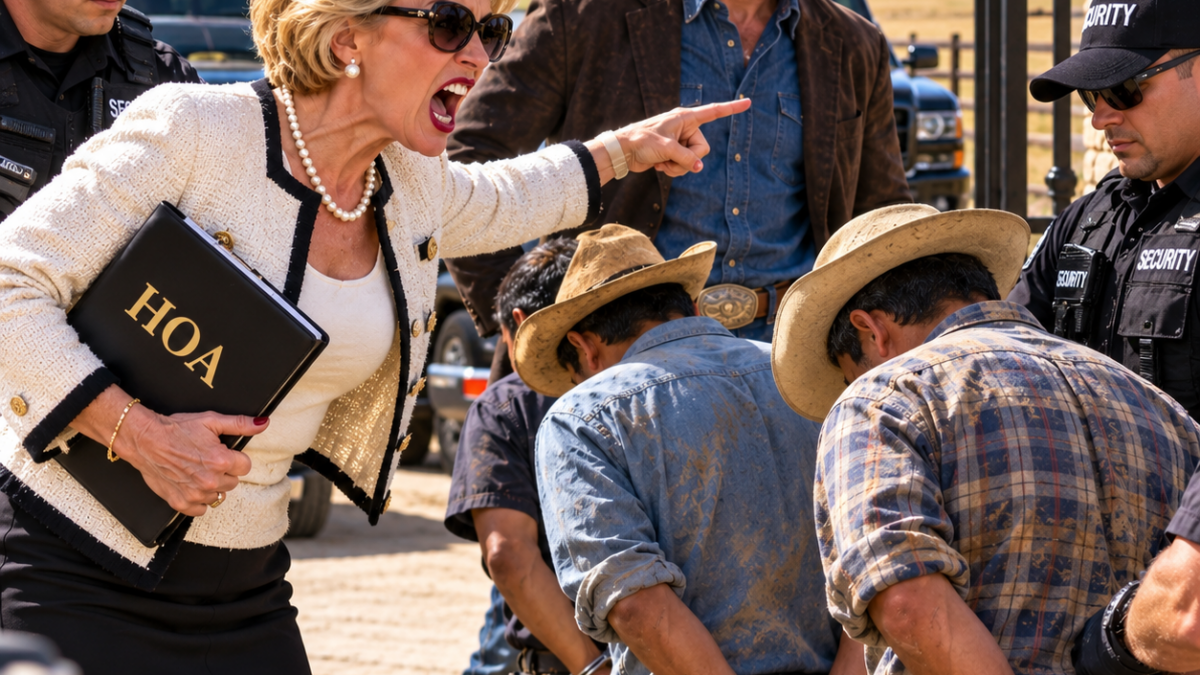
PART 2
I walked over and read the nearest one.
PHASE TWO—PRIVATE GATED ENTRY.
I figured it was a developer issue.
I went back to work.
Two weeks later, the certified letter arrived.
My wife was sitting at the kitchen island when I opened it.
Heavy cream paper.
Embossed HOA logo.
The kind of letter designed to look expensive enough that the person reading it feels nervous before reaching the first sentence.
I read it twice.
“What?” my wife asked.
“The HOA says ranch vehicles are using their roads without authorization.”
“Are they?”
“No.”
The letter ordered me to stop all commercial traffic through the easement within fourteen days.
It threatened towing, trespass complaints, vehicle impoundment, and civil penalties of up to ten thousand dollars per occurrence.
Vivian’s signature was at the bottom.
Under hers was another name.
Gerald Fitch.
Board Secretary.
His signature looked shaky.
My wife leaned over the counter.
“Can they do any of that?”
“Not if Texas property records still mean anything.”
I drove to the county clerk that afternoon.
The original easement took less than twenty minutes to find.
September 14, 1974.
My grandfather’s name.
The neighboring owner’s name.
Legal description.
Permanent right of ingress and egress.
I made certified copies.
Then I wrote Vivian the shortest letter I have ever sent anyone.
**Your road is subject to my recorded easement. Book 47, Page 312. Please have your attorney review it before contacting my employees or interfering with ranch traffic again.**
I almost added “Have a nice day.”
At the last second, I did.
Then there were two weeks of silence.
I made the mistake of thinking silence meant the problem had been solved.
At 6:15 one Monday morning, Hector called.
“Boss.”
Hector never wasted words before sunrise.
“What happened?”
“Two guys at the east gate.”
“Who?”
“Security.”
I sat up.
“What security?”
“They say Summit Ridge.”
I was dressed and in my truck in four minutes.
When I reached the east road, dawn was coming over the ridge.
A black Tahoe was parked sideways across the gravel.
Two men stood beside it.
Black tactical pants.
Black polos.
SECURITY embroidered over the chest.
Heavy belts loaded with flashlights, pepper spray, radios, and bundles of white plastic restraints.
The younger one was Kyle.
His name was stitched over his pocket.
He had a thick neck, sunburned cheeks, and one hand resting on his pepper spray like he expected a movie director to shout action.
The taller one wore mirrored sunglasses even though the sun was barely up.
Hector’s truck waited on our side.
He leaned against the fender.
“What’s going on?” I asked.
Kyle stepped forward.
“Summit Ridge private road. No commercial vehicles without HOA authorization.”
“This is a recorded easement.”
“That’s not what we were told.”
“I have the deed in my truck.”
“Miss Caldwell says it’s HOA property.”
“Miss Caldwell is wrong.”
He looked at the taller guard.
The taller guard looked at the Tahoe.
Nobody seemed to have been trained for the possibility that someone would answer confidently.
“Go ahead,” I said. “Call whoever you need.”
Kyle radioed somebody.
Four minutes passed.
A mockingbird started singing in the oak above us.
Finally the taller guard stepped aside.
Hector got into his truck.
As he passed Kyle, he tipped his hat.
It was not a thank-you.
That evening I opened a small fireproof safe in my bedroom.
Inside were a few legal papers, some family documents, a credential case, and a ninety-nine-cent blue notebook.
I took out the notebook.
Date.
Time.
Vehicle plate.
Names.
Exact words.
I wrote everything down.
The credential case stayed in the safe.
That distinction mattered to me.
A property dispute is a property dispute.
I had spent thirteen years serving as a Deputy United States Marshal in the Western District of Texas, but I was not about to pull a federal badge in an argument over an easement.
My authority at work did not magically make me right at home.
If Vivian was wrong, I wanted the deed to prove it.
Not my job title.
Three mornings later, Hector called again.
“Boss.”
“What now?”
“They chained it.”
I found a brand-new logging chain wrapped three times around our pipe gate.
A laminated sign hung from it.
**ROAD CLOSED BY ORDER OF SUMMIT RIDGE HOA. COMMERCIAL TRAFFIC PROHIBITED. VIOLATORS SUBJECT TO TOWING AND PROSECUTION.**
Pink border.
Laminated.
Vivian had gone to the trouble of laminating a sign before blocking a recorded easement.
Thirty head of cattle waited in the north pasture with feed running late.
I photographed the chain.
The lock.
The sign.
The scratches on my gate.
Then I cut the chain.
I put the lock in a paper bag.
The feed truck went through.
At 7:15, Vivian called the sheriff and reported destruction of HOA security infrastructure.
A deputy arrived less than an hour later.
He was a Hill Country officer who looked old enough to remember when Summit Ridge was still goats and cedar brush.
I showed him the easement.
Then the chain.
Then the gate.
He read the papers.
He walked the road.
Then he looked at me.
“Who put the chain up?”
“Vivian Caldwell.”
He closed the folder.
“The chain is the problem.”
“I figured.”
“Blocking a recorded easement isn’t something she gets to do because a board printed a sign.”
He drove to Summit Ridge.
Later he called.
“She wasn’t happy.”
“I didn’t expect her to be.”
“She says you’re running an illegal commercial corridor through a residential community.”
“I’m moving cattle on a road my grandfather had rights to before her subdivision existed.”
“I know.”
There was a pause.
“Keep your paperwork.”
“I plan to.”
Nine quiet days followed.
Then Vivian changed tactics.
She stopped complaining about the road.
She started complaining about my workers.
Four sheriff calls in two weeks.
Suspicious vehicles.
Unknown men.
Unfamiliar trucks operating before sunrise.
Potential perimeter threats.
I requested copies of every report.
The descriptions made me angry in a way the property letters had not.
The “unknown men” were Hector, Miguel, Luis, and Aaron.
Men who had families.
Men who paid taxes.
Men who coached baseball.
Men who worked early because livestock did not care about HOA-approved quiet hours.
Vivian never used a direct insult.
She was too polished for that.
Instead, she turned ordinary ranch work into suspicious behavior by changing the nouns.
A flatbed became an “unidentified commercial vehicle.”
A ranch hand became an “unknown male.”
A worker opening a gate became “perimeter activity.”
The deputy from the chain incident called after the fourth complaint.
“Mr. Reed, between you and me, I know what she’s doing.”
“I do too.”
“We still have to respond.”
“Then respond.”
“You sure?”
“Yes.”
“Why?”
“Because I want the reports.”
There was a short silence.
“All right.”
“Keep everything.”
“I already am.”
The situation changed on April 14.
I was in a federal courthouse hallway in Austin waiting to testify in a forfeiture hearing when Hector’s name appeared on my phone.
I almost ignored it.
Hector rarely called me during court hours unless something mattered.
I stepped away from the courtroom doors.
“Talk to me.”
His voice was flat.
Too flat.
“Boss, they took Miguel.”
“What do you mean took?”
“Those security boys.”
My hand tightened around the phone.
“What did they do?”
“They tied him.”
I walked straight toward the elevators.
The prosecutor called my name.
I kept walking.
That decision created problems at work later.
I knew it would.
But I also knew I would not stand inside a courthouse waiting to testify while a nineteen-year-old employee sat restrained beside a road I had told him he had every legal right to use.
The drive took about forty minutes.
I made it without radio.
Without air conditioning.
Both windows open.
I needed the noise.
When I reached the east road, the guards were gone.
Miguel sat on the shoulder.
Hector was crouched beside him holding a canteen to his mouth.
Miguel’s hands were behind his back.
White plastic restraints cut into his wrists.
His face had the strange empty look people get when they are trying very hard not to show fear.
I knelt beside him.
“You hurt anywhere?”
“No, sir.”
“Don’t call me sir right now.”
His mouth moved like he wanted to smile.
He couldn’t.
I photographed the restraints.
Then I cut them.
Deep red lines circled both wrists.
Miguel immediately rubbed his hands together.
His fingers trembled.
“What happened?”
He told me.
Kyle and the taller guard had blocked the Tahoe across the road.
They ordered him out.
Asked for identification.
Told him he was trespassing.
Miguel repeated what I had told every ranch hand.
“This is a recorded easement. Mr. Reed says we have legal access.”
Kyle ordered him to turn around.
Miguel did not resist.
They restrained him anyway.
They took his keys.
Then they made him sit beside the road.
“How long?”
Miguel looked at Hector.
“Maybe forty-five minutes before she came.”
“Vivian?”
He nodded.
“What did she do?”
Miguel stared at the dirt.
Hector answered.
“She got out of that Porsche.”
“And?”
“She looked at him.”
Hector stopped.
I had known the man twenty-two years.
I had watched him handle injured horses, dying cattle, wildfires, drought, and one tornado that took half the roof off our equipment barn.
I had never seen his eyes look like that.
“What did she say?”
Hector swallowed.
“She said, ‘Good. That’s how it’s done.’”
I looked at Miguel.
“Same words?”
He nodded.
“She didn’t ask if I was okay.”
That sentence was worse than anything else.
Not because I expected compassion from Vivian by that point.
Because Miguel sounded surprised that she had looked at him and seen nothing worth checking.
His mother came to the ranch that afternoon.
When she saw his wrists, she stopped in the doorway.
“What happened?”
Miguel tried to explain.
She barely heard him.
Her eyes found me.
“Who did this to my son?”
“I know who.”
“You told him that road was legal.”
“It is.”
“Then why was he on his knees?”
I had no answer that would help.
So I gave her the only promise I could.
“This ends.”
That night, I sat in my truck outside the barn.
Cattle moved quietly beyond the fence.
The mockingbirds were loud in the dark.
For the first time, I wanted to do something reckless.
I wanted to drive to Vivian’s house.
I wanted to put my credential case on her kitchen table and explain in very simple language how badly she had misjudged the situation.
Instead, I went inside.
Opened the safe.
Took out the blue notebook.
Turned to a clean page.
At the top, I wrote one word.
**CASE.**
Then I started over from the beginning.
I hired a licensed surveyor from San Marcos.
Thirty years of Hill Country boundary work.
He located the recorded easement.
Ran his equipment.
Checked monument references.
His measurements matched my grandfather’s 1974 description almost perfectly.
The road was where it had always been.
Then he found something else.
Three fresh post holes along the edge.
Concrete still curing.
“What are those?”
“Looks like somebody started preparing to set steel posts.”
“Across the easement?”
He nodded.
That meant Vivian was not simply threatening to restrict access.
Somebody was preparing to physically reshape it.
I installed cameras.
Four of them.
Two visible.
Mounted on fence posts.
Two hidden high in live oaks on my land.
Every camera pointed at the road.
I did not use federal resources.
No databases from work.
No government surveillance.
No favors from colleagues.
If this ended up in court, I wanted every piece of evidence clean.
Then I researched the security company using public records.
The name painted on the Tahoe did not match any licensed Texas security business I could find.
Kyle had no state security license.
Neither did Brent.
I checked twice.
Then I found the family connection.
Kyle’s mother had been born a Caldwell.
Vivian’s sister.
Kyle was her nephew.
That explained a great deal.
The part that changed the entire case came from the county planning office.
I asked to see the public file for Summit Ridge phase two.
The clerk handed me a folder.
Near the front was an application.
**PHASE TWO—GATED PRIVATE ENTRANCE.**
Applicant:
Vivian Caldwell.
Attached was an architectural rendering.
Stone columns.
Decorative wall.
Landscaped center island.
Wrought-iron gate.
Beautiful.
Expensive.
And running directly through the middle of the proposed entrance was my grandfather’s easement road.
Then I read the planning note.
**Existing access easement—Book 47, Page 312—to be released by owner.**
I read it again.
The county already knew about the easement.
The developer already knew.
Vivian already knew.
She needed the owner to release it.
Me.
The hearing date was May 15.
Suddenly everything fit.
The aesthetic complaint.
The certified letter.
The security guards.
The chain.
The sheriff calls.
Miguel in the dirt.
She was creating pressure.
If I stopped using the easement long enough, if operations became too difficult, if my ranch traffic moved to the fourteen-mile flood route, then she could walk into the phase-two hearing and argue the road was unnecessary or negotiate from a position of strength.
I stood at that planning counter for a long time.
I had been treating Vivian like a person who did not understand the deed.
She understood it perfectly.
She simply wanted it gone.
The next morning, I found her near the three post holes.
Kyle stood two steps behind her.
Vivian held her portfolio against her chest.
“Mr. Reed. I’d like to be reasonable.”
“Please do.”
“Your grandfather’s easement was created for a different era.”
“That is not how permanent easements work.”
“Everything has reasonable limits.”
“Then file in court.”
She took a breath.
“You’re sending twenty-foot trailers past families.”
“The subdivision was built around an existing ranch.”
“At five in the morning.”
“Cattle eat before your board meets.”
Kyle smirked.
I looked at him.
“Something funny?”
His smile disappeared.
Vivian stepped between us.
“Your grandfather had a right of way for a pickup truck and cattle.”
I nodded toward her portfolio.
“Is that what your lawyer told you?”
“It’s common sense.”
“Common sense doesn’t replace the recorded language.”
She tilted her head.
“This could be solved very simply.”
“How?”
“You release the easement. Summit Ridge pays for improvements to your alternate access.”
I laughed once.
“The alternate road floods.”
“We can discuss drainage.”
“I’m not releasing anything.”
Her eyes changed.
There it was.
Not annoyance.
Not concern about residents.
Fear.
I asked, “Does the planning commission know I haven’t signed the release?”
She did not answer.
Instead, her eyes moved past me.
Toward the two visible cameras.
She counted quietly.
“Two.”
Then she turned to Kyle.
“Take those down.”
I heard it clearly.
“So we’re doing that now?”
Vivian looked at me.
“They’re recording Summit Ridge residents without permission.”
“They’re on my land.”
“Remove them.”
“No.”
She walked away.
Kyle stayed behind for half a second.
Then followed her.
At 2:00 the next morning, my phone vibrated.
One camera had gone offline.
Then the second.
The cloud archive already had the footage.
Kyle wore a black hoodie.
He carried a tire iron.
First camera.
Two strikes.
Second camera.
Three.
Static.
He never looked up.
The hidden oak cameras watched everything.
By eight that morning, sheriff’s deputies were at my gate.
Not for Kyle.
For Hector.
Vivian had signed a sworn complaint alleging Hector threatened Kyle and shoved him during a confrontation on the easement.
Kyle was listed as the victim.
I read the complaint twice.
Hector stood beside me.
His face did not move.
“Boss?”
“Yeah?”
“I never touched him.”
“I know.”
“I didn’t even get out of the truck that day.”
“I know that too.”
He looked toward the deputies.
“I’ll go.”
“You don’t have to—”
“I’m not giving them another story.”
He went voluntarily.
At the sheriff’s office, Hector sat in a plain interview room with his hat in his hands.
For twenty-two years he had been the person I trusted most with the ranch.
Watching him sit behind glass because Vivian had decided paperwork was another weapon nearly broke my self-control.
I had evidence that could clear him immediately.
But handing it over meant Vivian would know how much I had recorded.
I hesitated for maybe ten seconds.
Then I gave the deputy the footage from the two visible cameras.
Hector never touched Kyle.
Never threatened him.
Never stepped aggressively toward him.
The allegation collapsed almost immediately.
The assistant district attorney reviewing the security incidents watched the video twice.
Then she took off her glasses.
“We have Kyle.”
“For what?”
“Several things potentially. Licensing. Detention. Property damage. False statements will depend on what can be proven.”
“And Vivian?”
She shook her head.
“That’s harder.”
“She ordered it.”
“Can you prove that?”
“Miguel heard her.”
“Hector heard her.”
“Yes.”
“She signed complaints.”
“Yes.”
“She hired her nephew.”
“Yes.”
The prosecutor leaned forward.
“But Kyle can say he misunderstood her. She can say she was reacting to something that already happened. Unless someone gives us direct evidence that she ordered unauthorized restraints, I have witnesses describing her conduct after the fact.”
I hated the distinction.
It was legally important.
It also meant Vivian had insulated herself.
Everything ran through Kyle.
And Kyle was family.
That night, I lost my temper in the horse barn.
Nobody was around except my wife.
I threw the blue notebook against the concrete floor.
It slid under a stall door.
I said several things I will not repeat.
My wife let me finish.
Then she said, “Feel better?”
“No.”
“Good.”
I looked at her.
“That means you still have enough sense to know this isn’t how you win.”
I crouched down, reached under the stall door, and picked up the notebook.
I opened it.
Vivian could deny a nephew.
She could deny motives.
She could deny intent.
What she could not deny was her own voice.
I just needed her to use it.
Three days later, Summit Ridge residents received an email.
Subject:
**PERIMETER SAFETY PROTOCOL.**
Beginning May 6, residents were instructed to report unfamiliar vehicles using the eastern access before 6:00 a.m.
Vivian had picked the date.
She had told me where the next confrontation would happen.
Then another person came to my gate.
Gerald Fitch.
Board secretary.
I recognized his signature before I recognized him.
He was in his sixties.
Thin.
Gray hair.
Cardigan despite the Texas heat.
He carried a green ledger against his chest.
“Mr. Reed?”
“Yes.”
“I need to talk to you.”
I looked behind him.
“You want to come inside?”
He glanced back toward Summit Ridge.
“Yes.”
On the porch, he refused coffee.
He refused a chair.
He kept holding the ledger.
“I keep the minutes,” he said.
“I know.”
“No. I mean I actually keep them.”
“All right.”
His hands were shaking.
“I need you to understand something.”
He opened the book.
“There was never a board vote to close your easement.”
I stared at him.
“What?”
“Not the letter. Not the chain. Not the security company. None of it.”
“But you signed the letter.”
His eyes dropped.
“She gave me a signature page.”
“Blank?”
He nodded.
“I signed it.”
“Why?”
“Because I was afraid of her.”
That answer surprised me.
Not because Vivian was intimidating.
Because Gerald looked ashamed to say it.
He turned several pages.
The first official meeting entry included a presentation from the developer’s attorney.
I read Gerald’s handwriting.
**Recorded permanent easement crossing eastern phase boundary. Book 47, Page 312. Association takes title subject to easement.**
Below it:
**President Caldwell recommends no action pending Phase Two planning.**
My fingers stopped on the page.
“She knew from the beginning.”
Gerald nodded.
“Before the first house closed.”
I felt more tired than angry.
Every conversation came back.
Every time she pretended the easement was my interpretation.
Every time she spoke as if I had surprised her with an old deed.
All theater.
“Why bring this to me now?”
Gerald looked toward the road.
“My house faces the east side.”
I waited.
“I saw the boy.”
“Miguel?”
He nodded.
“I saw him sitting there.”
His voice cracked.
“Then her car came. I heard her say ‘good.’”
Gerald closed his eyes.
“I can’t stop hearing it.”
For the first time since this began, someone from Summit Ridge looked genuinely broken by what had happened.
He pushed the green ledger toward me.
“Take it.”
“You understand this may become evidence.”
“Yes.”
“Your name may not stay private.”
“I know.”
“If a court needs your testimony—”
“I know.”
I did not lie to him.
He deserved that much.
May 6 was four days away.
I had a choice.
I could pull every ranch hand off the easement until the hearing.
Nobody else would get restrained.
Nobody would risk humiliation.
Vivian would get the road uncontested for another week and a half.
Or I could let her enforce the “protocol” she had just announced and document exactly how far she was willing to go.
I hated the second option.
I hated even considering it.
So I sat at my kitchen table with the people who would bear the risk.
Miguel.
His mother.
Hector.
Luis, another senior ranch hand.
My wife sat beside me.
I told them everything.
No tricks.
No heroic language.
“If we do this, the sheriff will be close. Cameras will record. Nobody resists. Nobody touches anybody. If they order you out, you move slowly. If they use restraints, you let them.”
Miguel’s mother stared at me.
“You’re asking my son to go back there.”
“Yes.”
“You promised me this would end.”
“I did.”
“And this is how?”
“I think so.”
She looked at Miguel.
He spoke before she could.
“I’m going.”
“No.”
“Mom.”
“You already did enough.”
“I want to see her say it.”
“That doesn’t mean you should.”
Miguel’s hands rested on the table.
The marks were gone.
“I keep thinking I did something wrong because I was scared.”
His mother’s face softened.
“You didn’t.”
“I know. But I want to know it when I’m standing there.”
I understood.
Hector put both hands flat on the table.
“Where do you want me?”
I looked at him.
“You sure?”
“No.”
That answer made everyone quiet.
Hector continued.
“But I’m going anyway.”
We made the plan.
Two sheriff’s cruisers would wait several minutes away.
The deputy from the chain incident knew the easement history.
The assistant district attorney knew what we were documenting.
I would stay nearby.
Four cameras would record.
After Kyle destroyed the visible pair, I had replaced everything high in the live oaks.
None were obvious from the road.
My badge stayed in its case.
This was not a federal operation.
It was not a sting run by my agency.
It was a private property conflict being documented while local authorities stood ready to respond.
That boundary mattered.
May 6 arrived clear.
At 5:30 a.m., three ranch hands left the compound in two trucks.
Hector drove the dually with the stock trailer.
Miguel rode in the flatbed behind him with Luis.
I parked a quarter mile away behind mesquite.
Engine off.
Windows down.
The credential case sat in the center console.
Four camera feeds glowed on my phone.
At 5:42, the black Tahoe moved into position.
Sideways.
Blocking the road.
Kyle stepped out.
Brent followed.
White plastic restraints hung from their belts.
Hector’s dually stopped.
Kyle approached the driver’s window.
“Turn around.”
Hector leaned toward the open window.
“Road’s open.”
“Not today.”
“It’s been open since 1974.”
“Summit Ridge security protocol.”
“Son, Summit Ridge can have a protocol for flowerpots and swimming pools. This road is an easement.”
Kyle’s face reddened.
“Get out of the truck.”
Hector opened the door.
Slowly.
Exactly as planned.
He climbed down.
Kyle pointed.
“Hands.”
Hector held them out.
Kyle put the restraint around his wrists.
In front.
I watched the plastic tighten on the screen.
My hand was already on my truck door.
Then Brent pulled Luis from the second vehicle.
Restraints.
Miguel stayed in the passenger seat with both hands on the dashboard.
Brent opened the door.
“You too.”
Miguel got out.
His shoulders looked stiff.
Kyle walked over.
For half a second I thought Miguel might panic.
Instead, he turned.
The restraints went behind his back.
They made all three men kneel beside the road.
Five minutes passed.
Then eight.
At ten minutes I almost ended it.
I did not care about the plan anymore.
I cared about Hector’s knees in the gravel.
Miguel’s hands behind his back.
Luis staring toward the ranch.
Then the Porsche appeared.
White body catching the first light.
It stopped behind the Tahoe.
Vivian stepped out wearing fuchsia pink.
Portfolio under one arm.
She walked toward my men.
Not hurried.
Not alarmed.
She looked at Hector.
Luis.
Miguel.
“All of them?” she asked.
Kyle nodded.
“All of them.”
“Good.”
My jaw tightened.
Then she looked at Kyle.
“Call the real police. Tell them we have three trespassers detained.”
That was enough.
I started the engine.
By the time I reached them, dust followed my truck like smoke.
I parked.
Stepped out.
Vivian watched me approach.
No badge.
Jeans.
Boots.
Work shirt.
Straw hat.
Exactly the man she believed she was dealing with.
She raised her eyebrows.
“Are these yours?”
I looked at the three men.
Then at her.
“Cut them loose.”
“They violated HOA security restrictions.”
“This is my easement.”
“We disagree.”
“No, Vivian. You know exactly what this is.”
Her expression barely moved.
“I know what you claim.”
I reached into my truck.
Not for the credential case.
For paper.
First, the phase-two application.
Her signature.
The line acknowledging Book 47, Page 312.
Second, Gerald’s green ledger.
I opened it to the first meeting.
“You knew before Summit Ridge opened.”
Vivian glanced at the papers.
“Anyone can carry copies.”
“Gerald’s handwriting isn’t a copy.”
For the first time, something moved behind her eyes.
Then she recovered.
“He gave you HOA records?”
“He gave me the truth.”
She laughed once.
“This is getting pathetic.”
I turned to Kyle.
“Did Vivian tell you to restrain anyone using this road?”
Kyle stared at the dirt.
“Answer him,” Vivian said.
Kyle looked at her.
Then at me.
“Nobody told me anything.”
Family.
Exactly what the prosecutor predicted.
I turned toward Brent.
His black polo was dark beneath the arms.
“Did she tell you?”
He looked at Vivian.
She snapped, “Do not answer him.”
Too late.
Brent’s face changed.
“She said anyone.”
Vivian’s head turned.
“Brent.”
“She told us no exceptions.”
“Shut your mouth.”
He flinched.
Then something gave way.
Maybe he understood how bad the morning looked.
Maybe he finally realized nobody had given him legal authority.
Maybe he was simply tired of carrying Vivian’s version of events.
“She told us to restrain whoever came through.”
Vivian stepped toward him.
“I said close the road.”
“You said restrain them.”
“Enough.”
Her voice cracked across the gravel.
I waited.
Then I asked, “So let’s make this simple. From this point forward, if my employees use the easement, what are your guards supposed to do?”
She should have stopped.
A lawyer would have stopped.
A cautious person would have stopped.
Vivian had spent months getting her way by sounding more certain than everybody around her.
She chose certainty again.
“Anyone who comes through that gate gets restrained.”
“Anyone?”
“No exceptions.”
Silence.
Vivian looked at me.
Then at Brent.
Then, slowly, up toward the trees.
She saw nothing.
The cameras were too high.
I heard engines.
Two sheriff’s cruisers turned onto the gravel.
No sirens.
No flashing lights.
They rolled to a stop.
The deputy from the chain incident got out first.
He took one look at my men.
Then at Vivian.
He walked over and cut Hector’s restraint.
Then Luis’s.
Then Miguel’s.
Vivian lifted her phone.
“I called law enforcement.”
“Yes, ma’am,” the deputy said.
“I need these trespassers removed.”
He looked at the three men.
Then at the road.
Then at her.
“You got law enforcement.”
Her smile flickered.
“What does that mean?”
The assistant district attorney stepped from an unmarked sedan.
Folder in hand.
Vivian’s face changed.
Not completely.
Just enough.
I walked to my truck.
Opened the center console.
Took out the black credential case.
Before I opened it, I looked at the deputy.
“This is not a federal action.”
“I know.”
“I’m here as the property owner.”
“Understood.”
Only then did I turn back to Vivian.
She was staring at the case.
I opened it.
Gold star.
Department of Justice seal.
Credentials.
“Deputy United States Marshal Dalton Reed.”
I kept my voice quiet.
“Western District of Texas.”
Nobody spoke.
Vivian stared at the badge.
Then at me.
Then back at the badge.
“You’re a rancher.”
“Yes.”
“That’s not—”
“I’m both.”
Her leather portfolio slipped from under her arm.
It hit the gravel on one corner.
Papers shifted inside.
For months, Vivian had treated my patience like weakness.
She had assumed I did not understand law because I chose not to threaten her with it.
That was her mistake.
Not that I carried a badge.
The badge did not create my property rights.
The easement did.
The badge did not make her security company unlicensed.
State records did.
The badge did not make her detention orders wrong.
Her own words did.
I closed the case.
“I did not show you this before local deputies arrived because my job does not give me special property rights.”
She said nothing.
“I gave you the deed.”
Silence.
“I gave you the book and page.”
Silence.
“I told you to go to court.”
Her face was pale.
“I asked you to cut these men loose.”
The assistant district attorney stepped forward.
“Ms. Caldwell.”
Vivian turned.
“I’d like to speak with you.”
“This is ridiculous.”
“Maybe. We can discuss that.”
“They were trespassing.”
The deputy looked at her.
“On a recorded easement you’ve already been shown.”
“You don’t understand the HOA’s position.”
“I understand enough to know three men were restrained by people whose licensing status is already under review.”
Vivian pointed at me.
“This was staged.”
I answered before anyone else could.
“No.”
“You sent them.”
“They work here.”
“You knew we would stop them.”
“I knew you told residents you planned to enforce a perimeter protocol.”
“This is entrapment.”
The assistant district attorney shook her head.
“Mr. Reed is not operating here under federal authority. Your own email announced the enforcement date.”
Vivian looked at the cameras she could not find.
“You recorded me.”
“On my property.”
Her breathing changed.
Kyle took one step backward.
The deputy noticed.
“Kyle. Stay where you are.”
That was the moment Vivian finally understood she was no longer directing the scene.
For months, every uniform had answered to her.
Every letter carried her title.
Every complaint began with her interpretation.
Now the uniforms standing on the road did not care that she was HOA president.
They cared about the deed.
The restraints.
The license records.
The video.
Gerald’s ledger.
And her words.
The legal process took months.
Real cases do.
They do not end because somebody produces a dramatic piece of paper beside a gate.
Statements had to be taken.
Recordings authenticated.
Licensing records certified.
Witnesses interviewed.
Gerald testified about the board minutes.
Miguel testified about April 14.
Hector testified about the false complaint.
Brent cooperated.
Kyle tried to protect Vivian for a while.
Then his attorney apparently explained the difference between loyalty and becoming the only person left holding the entire problem.
He changed his story.
The camera footage mattered most.
At trial, I sat behind the prosecution table and watched the May 6 recording play on a large monitor.
There we were.
Hector kneeling.
Miguel restrained.
Luis beside them.
Vivian in pink.
Her voice came through the speakers.
Clear.
Controlled.
“Anyone who comes through that gate gets restrained. No exceptions.”
No one in the courtroom moved.
The prosecutor let the silence sit.
Then she played Brent’s statement.
Then Gerald’s testimony.
Then the phase-two file acknowledging the easement.
Then Vivian’s own correspondence.
The defense tried to frame the situation as confusion over property rights.
That argument might have worked if Vivian had not known about Book 47, Page 312 from the beginning.
It might have worked if she had not signed the phase-two application acknowledging the easement needed to be released by me.
It might have worked if the board had actually voted.
It might have worked if she had hired licensed security officers.
It might have worked if Miguel had never been restrained the first time.
It might have worked if Kyle had not smashed cameras.
It might have worked if Hector had not been falsely accused.
One mistake can be confusion.
Ten coordinated decisions start to look like intent.
The jury deliberated a little over two hours.
Vivian was found guilty on the state charges submitted to them.
The sentence was not the dramatic prison ending people imagine when they hear this story.
She received five years of supervised probation, along with court-ordered restrictions that effectively ended her ability to serve in HOA leadership during that period and additional conditions resulting from the case.
Kyle and Brent resolved their cases separately.
Neither returned to security work.
The unlicensed operation disappeared almost overnight.
A civil settlement followed.
Sixty-seven thousand dollars was divided among Hector, Miguel, and Luis.
Miguel tried to tell me he did not want the money.
“You earned it the worst possible way,” I told him.
“I was just doing my job.”
“So were they.”
He looked confused.
I pointed toward the court papers.
“That’s why there are consequences.”
Summit Ridge scheduled a special HOA meeting one month later.
I almost did not attend.
Gerald asked me to.
So I sat in the back of the clubhouse in a folding chair.
Hat on my knee.
The room was packed.
For the first time, Vivian was not at the front.
Gerald stood there holding the green ledger.
His hands still shook.
His voice did not.
He opened to the first meeting.
Read the attorney’s warning about the easement.
Read Vivian’s recommendation to delay action until phase two.
Then he looked at the residents.
“I need to say something.”
The room was silent.
“I signed a letter I should not have signed.”
He swallowed.
“There was no vote to close the Reed easement.”
People shifted in their chairs.
“No vote to hire those men.”
Someone whispered something.
Gerald continued.
“No vote to chain the gate.”
Now nobody moved.
“No vote authorizing President Caldwell to threaten ranch workers with detention.”
A man in the front row asked, “Then why did every letter say by order of the board?”
Gerald’s face tightened.
“Because I let her put my signature under words I had not approved.”
That kind of honesty is difficult.
Especially in public.
I respected him for it.
The phase-two gated entrance proposal was withdrawn that night.
No release.
No road takeover.
No wrought-iron gate across my grandfather’s easement.
The new board hired an actual property attorney.
Two weeks later, its secretary came to the ranch.
She handed me a document.
Formal easement acknowledgment.
Book 47.
Page 312.
Permanent ingress and egress.
Metes and bounds.
Signed by the new HOA president.
At the bottom, somebody had typed:
**Have a nice day.**
I stared at it.
Then laughed.
“Whose idea was that?”
The secretary smiled.
“Gerald.”
I signed.
The next morning, Hector drove through the east road at 5:30.
Same truck.
Same stock trailer.
Same old hat.
Orange survey caps now marked the easement at regular intervals.
Steel monuments had been set where they could not quietly disappear.
Hector slowed beside me.
Rolled down the window.
“Morning, boss.”
“Morning.”
“No security?”
“Not today.”
“Shame.”
I laughed.
“Go feed cattle.”
He drove on.
Miguel was already in the north pasture.
One of our first-calf heifers was in trouble.
The calf was coming backward.
By the time I reached them, Miguel had his sleeves rolled up.
Hector stood behind him.
Silent.
Watching.
Miguel worked carefully.
No panic.
No wasted motion.
Twenty minutes later, the calf was breathing.
The heifer was exhausted but standing.
Miguel sat back in the grass.
Covered in dirt.
Smiling.
Hector crossed his arms.
“Not bad.”
Miguel looked at me.
“That good?”
I nodded.
“From Hector? That’s practically a standing ovation.”
Miguel laughed.
For the first time since April 14, he looked nineteen again.
That mattered more to me than Vivian’s verdict.
More than the settlement.
More than the new HOA board.
The road had always been about access.
But somewhere in the middle of the fight, it became about something else.
Whether people with polished titles and expensive letterhead could make ordinary working men feel like criminals simply because nobody stopped them quickly enough.
My badge never solved that.
The deed did not solve it alone.
The cameras did not solve it alone.
What solved it was patience long enough for Vivian to reveal exactly what she was willing to do when she thought nobody with power was watching.
The truth was, somebody was watching from the beginning.
Not because I was a marshal.
Because I was a landowner who kept records.
A rancher whose grandfather had filed the right piece of paper in 1974.
A boss who believed his employees deserved more than being told to accept humiliation because fighting back might be inconvenient.
I still keep the original blue notebook in the safe.
The pages are worn now.
Dates.
Times.
Plate numbers.
Names.
The chain incident.
Miguel.
The camera damage.
Gerald.
May 6.
My credential case sits beside it.
I think about those two objects sometimes.
The badge carries federal authority.
The notebook cost ninety-nine cents.
In the fight with Vivian Caldwell, the notebook mattered more.
Because authority is powerful.
But a record is patient.
A record waits.
It does not care who has the expensive car.
It does not care who has the title.
It does not care who sounds confident in a meeting.
It just sits there until the day everyone has to answer for what actually happened.
Summit Ridge is still beside us.
Most of the residents are good neighbors.
A few wave when ranch trucks pass.
Some do not.
That is fine.
The phase-two entrance was eventually redesigned on land that did not touch our easement.
It cost the developer more.
Nobody asked me to pay for it.
Vivian’s white Porsche disappeared a few months after the case ended.
I heard it had been sold.
I never checked.
I did not need a trophy.
I already had what I wanted.
At 5:30 most mornings, tires still crunch over the road my grandfather secured for our family more than half a century ago.
Feed trucks reach the north pasture.
Veterinarians reach sick cattle.
Stock trailers move when they need to move.
Nobody chains the gate.
Nobody waits beside it with plastic restraints.
Nobody calls Hector an unidentified male.
And nobody tells Miguel he is trespassing on a road he has every legal right to use.
Sometimes, just before sunrise, I stand near the east fence with coffee.
You can see Summit Ridge porch lights glowing through the live oaks.
You can hear cattle farther north.
Then Hector’s truck appears around the bend.
He raises two fingers from the steering wheel.
I raise mine back.
The truck passes the old boundary marker.
Book 47.
Page 312.
The paper Vivian had known about from the beginning.
The paper she thought pressure could erase.
The paper my grandfather signed before she ever imagined building a gate across his road.
And every morning that road stays open, it reminds me of something Vivian learned far too late:
You can intimidate people.
You can send letters.
You can hire men in black shirts and give them shiny badges.
You can even convince yourself that if you act powerful long enough, the law will eventually catch up to your version of the story.
But a permanent boundary does not move because somebody raises their voice.
And neither do I.
The weeks after the court case were quieter than I expected.
For months, every unfamiliar engine on the east road had made me look up. Every flash of headlights near the gate had made me wonder whether someone from Summit Ridge was coming to deliver another notice, another complaint, another invented rule wrapped in expensive stationery.
Then one morning I realized I had finished my coffee without looking toward the road once.
That was how peace returned.
Not dramatically.
Not all at once.
Just one ordinary morning at a time.
Hector noticed it before I did.
We were standing beside the equipment barn while Miguel loaded mineral tubs into the flatbed.
“You sleep better now?” Hector asked.
I looked at him.
“What makes you ask?”
“You stopped checking the gate cameras before sunrise.”
I smiled.
“Maybe I trust the gate again.”
Hector adjusted the brim of his hat.
“Gate was never the problem.”
“No.”
“People were.”
He climbed into the dually and shut the door.
That was about as philosophical as Hector ever got.
Miguel had changed too.
After the settlement, he put most of his share into a savings account for school.
I knew because his mother told my wife.
Miguel never mentioned the money.
What he did mention was veterinary school.
Constantly.
He started carrying a small notebook in his shirt pocket. Whenever the veterinarian came to the ranch, Miguel followed him like a shadow.
“How do you know when a calf needs intervention?”
“What does that swelling mean?”
“Why that medication instead of another one?”
Dr. Harris answered every question with the patience of a man who recognized himself twenty-five years earlier.
One afternoon, after they finished treating a cow with a difficult hoof infection, Harris walked over to me.
“That kid serious?”
“About veterinary medicine?”
He nodded.
“More serious than most people I know.”
“He’s been saving for school.”
Harris watched Miguel cleaning instruments near the truck.
“Tell him to call me when he starts applying.”
“For what?”
“Recommendation.”
I smiled.
“You tell him.”
Harris did.
Miguel stood completely still while the veterinarian spoke.
For once, he did not say “yes, sir” immediately.
His eyes filled first.
Then he looked down.
“Thank you.”
Harris slapped his shoulder.
“Earn it.”
That evening, I watched Miguel drive home along the same road where he had once sat restrained in the dirt.
There was something satisfying about that.
Not revenge.
Restoration.
Vivian and Kyle had tried to make him feel as though he did not belong there.
Now every morning he drove that road toward a future he had chosen for himself.
Summit Ridge changed after the special board meeting.
The first thing the new board did was almost embarrassingly simple.
They introduced themselves.
One Saturday morning, three board members drove out to Mesquite Creek Ranch.
No attorneys.
No security.
No laminated notices.
Gerald came too.
The new president was a woman named Rebecca Shaw.
She was probably in her early forties and had two kids in the local school district.
She held a folder, but unlike Vivian, she did not use it like a weapon.
“We wanted to start over,” she said.
I looked at Gerald.
He gave me a small nod.
Rebecca continued.
“We reviewed the covenants, the development documents, and the easement acknowledgment.”
“That’s a good start.”
She smiled carefully.
“We also reviewed every complaint the previous board filed against the ranch.”
“That must have taken a while.”
Gerald looked embarrassed.
Rebecca did not.
“Most of them should never have been made.”
“I know.”
“We formally withdrew the HOA’s objections.”
“All of them?”
“All of them related to ordinary ranch operations.”
That phrase mattered.
Ordinary ranch operations.
Feed trucks.
Stock trailers.
Early mornings.
Dust.
Cattle.
Everything that had existed long before Summit Ridge.
Rebecca handed me a single page.
It was not a demand.
It was a written acknowledgment that Summit Ridge recognized Mesquite Creek Ranch as an active agricultural operation predating the subdivision.
I read it.
Then looked at her.
“Who wrote this?”
“Our new attorney.”
“Good attorney?”
“Expensive.”
“Usually a promising sign.”
Gerald laughed.
Rebecca hesitated.
“There’s something else.”
I waited.
“We’re considering installing signs near the eastern section of the neighborhood.”
“What kind?”
“Something advising residents that the adjoining property is an operating ranch.”
I stared at her.
“That seems obvious.”
“You’d be surprised.”
“No.”
She laughed.
“Fair.”
Two months later, a sign appeared near the Summit Ridge entrance.
ACTIVE AGRICULTURAL PROPERTY ADJACENT. EXPECT FARM VEHICLES, LIVESTOCK ACTIVITY, DUST, AND EARLY-MORNING OPERATIONS.
Hector stopped his truck just long enough to read it.
Then he called me.
“Boss.”
“Yeah?”
“They put up a sign.”
“I heard.”
“Says ranches have cows.”
“That’s what lawyers are for.”
He hung up without laughing.
But I could picture his face.
The phase-two project took longer to untangle.
The developer had already spent money on engineering, marketing, and preliminary work.
The original gated entrance was dead.
That did not mean the developer stopped wanting access.
Their attorney contacted mine three times.
The first proposal asked for a partial release.
No.
The second offered money.
A lot of money.
Still no.
The third proposed moving the gate south while retaining limited emergency access across part of the easement.
My attorney asked me to consider it.
“Why?”
“Because unlike Vivian’s demand, this one actually protects your existing rights.”
I read the proposal.
Then I drove the road myself.
Twice.
I stopped near the proposed intersection and looked at where their redesigned entrance would sit.
It no longer blocked our path.
No gates across the easement.
No HOA control.
No restriction on ranch traffic.
They wanted only a carefully defined crossing agreement.
I called Hector.
“What do you think?”
“About what?”
I explained it.
There was a long silence.
Then he asked, “Does it slow my trailer down?”
“Maybe ten seconds.”
“Does anyone get to lock me out?”
“No.”
“Does anyone get to tell me when I can drive through?”
“No.”
“Then sounds like ten seconds.”
That was Hector.
Three days later, we agreed.
The difference was simple.
They asked.
They put the terms on paper.
They respected the easement.
It turned out I was not against development.
I was against theft disguised as administration.
There is a difference.
Gerald became an unexpected visitor at the ranch.
At first, he came because of board business.
Then he came because he liked the quiet.
My wife started giving him coffee.
He would sit on the porch, green ledger sometimes resting beside his chair.
One afternoon, I asked him why he still carried it.
“Habit.”
“You’re not secretary anymore.”
“No.”
“Then why keep it?”
He ran one hand over the cover.
“Because I spent too long letting other people decide what should go in it.”
I understood that.
Gerald had suffered in a quieter way than Miguel or Hector.
He had not been physically restrained.
He had not been publicly accused.
But Vivian had turned his fear into her signature machine.
He carried that shame.
One afternoon he said, “I should have stopped her sooner.”
“You should have.”
He looked at me, surprised.
Maybe he expected comfort.
I continued.
“But you eventually did.”
“That doesn’t erase the first part.”
“No.”
He stared across the pasture.
“So what do I do with that?”
“Remember it.”
He nodded slowly.
It was the same lesson I had been learning.
Consequences did not always need to destroy someone.
Sometimes they needed to make the next bad decision harder to repeat.
Kyle’s consequences followed him longer than he expected.
Without a security license and with the criminal case attached to his name, companies were not interested in hiring him for similar work.
I learned that from the deputy months later.
“Last I heard, he’s working warehouse nights.”
I shrugged.
“Work is work.”
“You don’t sound very satisfied.”
“What am I supposed to want?”
The deputy smiled.
“Most people want the villain miserable forever.”
“That sounds exhausting.”
Kyle had done serious things.
He had restrained people without lawful authority.
He had damaged cameras.
He had participated in false accusations.
He faced consequences.
That was enough.
I did not need him unemployed forever.
I needed him to understand that wearing black tactical pants did not turn intimidation into law.
Brent moved away from the county.
His cooperation reduced some of the consequences he faced.
Hector disliked that.
“He was there too.”
“I know.”
“He tied Luis.”
“I know.”
“He tied Miguel.”
“I know.”
“Then why does he get a deal?”
“Because he told the truth.”
Hector looked unhappy.
“That doesn’t undo what he did.”
“No.”
“So?”
I leaned against the fence.
“Sometimes the truth has to be worth something.”
Hector thought about it.
Then nodded once.
Not agreement.
Acceptance.
Vivian became harder to track.
After the case, she stopped appearing at neighborhood events.
Her name disappeared from the HOA website.
Then the Porsche was gone.
A year later, I heard she had moved.
I never asked where.
For a while, that surprised people.
“Don’t you want to know?”
No.
The version of Vivian that mattered to my life was finished.
She no longer controlled the board.
She no longer controlled the road.
She no longer had guards waiting at my gate.
Whatever she did next belonged to her.
The road belonged to us.
My work as a deputy marshal continued.
For months after everything ended, several people at the office teased me about becoming the most famous cattleman in the district.
One deputy left a laminated sign on my desk.
NO COMMERCIAL CATTLE TRAFFIC WITHOUT FEDERAL AUTHORIZATION.
I laughed harder than I expected.
Another colleague taped a pink border around it.
Even the prosecutor who had stared at my back when I walked out of court to help Miguel eventually forgave me.
Mostly.
“You still owe me for that hearing,” she said.
“I know.”
“You vanished.”
“My employee was restrained.”
“I know why.”
“I’m sorry.”
She looked at me.
“Would you do it again?”
I thought about lying.
“Yes.”
She shook her head.
“At least you’re consistent.”
Then she handed me another case file.
Life moved forward.
The badge remained part of who I was.
So did the ranch.
For years, people in Summit Ridge had assumed those identities could not exist together.
Vivian certainly had.
“You can’t be a marshal,” she had whispered.
“You’re a rancher.”
That sentence stayed with me.
Maybe because it revealed something bigger than her misunderstanding of me.
People like simple categories.
Rancher.
Federal officer.
HOA president.
Security guard.
Teenage ranch hand.
They see a title and assume the rest.
But Hector was not “an employee.”
He was a man who had carried my family through drought, injury, and bad cattle markets for twenty-two years.
Miguel was not “an unidentified male.”
He was a kid who wanted to heal animals.
Gerald was not simply “the secretary who signed.”
He was a frightened man who eventually decided fear was no longer enough reason to stay silent.
And I was not powerful because I carried a federal badge.
On that road, my most important identity was much older.
I was the grandson of the man whose name appeared on Book 47, Page 312.
That document never shouted.
Never threatened.
Never flashed lights.
It just existed.
Permanent.
Recorded.
Waiting for someone to bother reading it.
The following spring brought more rain than usual.
The low-water crossing on the fourteen-mile alternate route disappeared beneath muddy runoff for six straight days.
I stood beside the east road one morning while feed trucks rolled toward the north pasture.
Hector stopped beside me.
He looked west toward the flooded route.
“Imagine if we’d signed that release.”
I did.
Thirty head waiting on feed.
Pregnant heifers.
Vet access blocked.
Trailers rerouted through mud.
The thought made my stomach tighten.
“They knew about this crossing?” Hector asked.
“Vivian did.”
“And still wanted us to use it?”
“Yes.”
He stared down the easement.
“Some people don’t understand land.”
“No.”
“They think a line on a map is decoration.”
“That’s because they’ve never needed the line.”
He nodded.
Then drove on.
Miguel’s veterinary-school acceptance letter arrived that summer.
He brought it to the ranch in an envelope already torn open.
I was in the barn when he appeared.
“Boss.”
He still called me that.
“What happened?”
He held out the paper.
For a second, I thought something was wrong.
Then I saw his face.
I took the letter.
Read the first line.
Then slapped his shoulder.
“You did it.”
He laughed.
His eyes were wet.
“Dr. Harris wrote the recommendation.”
“I know.”
“You knew?”
“He asked me not to tell you.”
Miguel looked toward the cattle pens.
“I’m going to have to leave.”
“That’s usually how school works.”
“I mean the ranch.”
“Temporarily.”
“Four years is temporary?”
“When you’re my age.”
He smiled.
Then his expression changed.
“I don’t want Hector thinking I’m quitting.”
“Hector is going to complain no matter what.”
Sure enough, when Miguel told him, Hector stared at him for a long time.
“You coming back?”
“I want to.”
“As a doctor?”
“That’s the plan.”
Hector nodded.
“Good.”
That was it.
Miguel waited.
Hector turned away.
Then, without looking back, he said, “Don’t get stupid at college.”
Miguel grinned.
That was Hector’s version of saying he was proud.
On Miguel’s last full week before leaving for school, a heifer went into labor in the north pasture.
Complicated position.
Hector called him first.
Not Dr. Harris.
Miguel.
They worked together until the calf was delivered safely.
When I arrived, Miguel was sitting in the grass beside the exhausted cow.
His arms were dirty past the elbows.
Hector stood over him.
“You’ll do.”
Miguel looked up.
“What?”
“You’ll make a vet.”
I watched Miguel smile.
Two years earlier, he had knelt on that same ranch road with his wrists bound because someone had decided his uniform—a work shirt and dusty boots—made him suspicious.
Now the toughest man on Mesquite Creek Ranch was telling him he had chosen the right future.
That felt like the ending I wanted.
But life rarely ends exactly where a story should.
So the road continued.
Summit Ridge families came and went.
New people bought houses.
Some had no idea what happened with Vivian.
Others knew every detail.
Occasionally, a new resident complained about cattle noise or early trucks.
The new board sent them the disclosure.
Active ranch.
Predates subdivision.
Recorded easement.
End of conversation.
One resident once drove to my gate personally.
He was polite.
That helped.
“I work nights,” he told me. “The feed trucks wake me around five-thirty.”
“I’m sorry.”
“Can they come later?”
“Sometimes.”
“And other times?”
“Cattle decide.”
He laughed.
“I figured you’d say that.”
We found a compromise.
When practical, we delayed the loudest deliveries.
When not practical, ranch operations continued.
No threats.
No guards.
No lawsuits.
Amazing what can happen when two adults start with conversation instead of authority.
Three years after the case, the county resurfaced part of the public road leading to Summit Ridge.
During construction, traffic was temporarily rerouted near our easement.
Rebecca called before anything happened.
“We may need temporary crossing coordination.”
“For how long?”
“Three days.”
“What traffic?”
“Residents only. No heavy equipment.”
“Put it in writing.”
“You still love paper.”
“Paper behaves.”
She laughed.
The agreement was one page.
Clear beginning.
Clear ending.
No transfer of rights.
No permanent claim.
I signed.
Three days later, access ended exactly when it was supposed to.
That was what Vivian never understood.
I was never unreasonable about sharing.
I was unreasonable about surrendering.
There is a difference.
The green ledger eventually ended up with Gerald’s daughter.
He died four years after the case.
Quietly.
Heart condition.
His family held a small service at a church outside town.
I attended with my wife.
Rebecca was there.
So were several Summit Ridge residents.
Afterward, Gerald’s daughter approached me.
“My dad wanted you to have something.”
She handed me the green ledger.
I stared at it.
“I thought he wanted you to keep this.”
“He did.”
“Then you should.”
She shook her head.
“He said you’d understand why it mattered.”
I ran my fingers across the cover.
Inside were meeting minutes.
Routine votes.
Budgets.
Landscaping decisions.
And the entries that had eventually helped expose Vivian.
Gerald’s handwriting became shakier near the end.
On the last page he had written one sentence that was not part of any official meeting.
Minutes matter because power forgets what it said.
I stood in the church parking lot holding that book for a long time.
Then I put it in the safe beside my blue notebook.
Years passed.
Miguel finished veterinary school.
The day he returned to Mesquite Creek Ranch with “DVM” after his name, Hector pretended not to care.
Miguel stepped out of a pickup wearing clean boots and a clinic shirt.
Hector looked him up and down.
“You going to charge us city prices now?”
Miguel laughed.
“Double for you.”
“Then leave.”
Five minutes later, Hector was showing him a cow with a swollen joint.
Some relationships survive by refusing to become sentimental.
Mine with Hector was like that.
Mine with the road was different.
Every year, I walked the easement at least once alone.
Not because it needed inspection.
Because I remembered.
The place where the Tahoe had blocked traffic.
The spot where Miguel had sat.
The oak that held one of the hidden cameras.
The section where Kyle destroyed the visible pair.
The place where Vivian’s portfolio hit the gravel.
Eventually, weather softened all the marks.
Tire ruts disappeared.
Post holes filled.
Scratches on the gate rusted over.
But the orange survey markers stayed.
Book 47.
Page 312.
Permanent.
One morning, long after Vivian had left Summit Ridge, I found a young couple standing near the fence.
They had recently bought a house.
The husband waved.
“Mr. Reed?”
“That’s me.”
“We heard there was some big legal fight over this road years ago.”
“There was.”
“Did the HOA really try to take it?”
I looked down the gravel.
“That’s one way of saying it.”
His wife smiled.
“Our realtor told us the ranch has permanent access.”
“Good realtor.”
“She made us sign a disclosure that says trucks might come through before sunrise.”
“Very good realtor.”
The husband laughed.
“So you’re the marshal?”
I sighed.
“Somebody told you that too?”
“The neighbor.”
“I’m mostly retired now.”
He looked disappointed.
“You still carry a badge?”
“Not while fixing fence.”
His wife elbowed him.
“Stop interrogating the man.”
They walked home.
I stood there smiling.
Years earlier, people in those houses had been told my workers were threats.
Now new residents were warned about cattle trucks before they signed closing papers.
That was progress.
By the time I retired from federal service, the ranch had become the larger part of my life again.
My credential case came home for good.
I put it in the safe.
Next to the blue notebook.
Next to Gerald’s green ledger.
Three objects.
A badge.
A cheap notebook.
A board secretary’s record.
If someone had asked which one mattered most during the Summit Ridge fight, I would have chosen differently at different times.
The badge shocked Vivian.
The blue notebook preserved facts.
Gerald’s ledger proved intent.
But Book 47, Page 312 existed before all of them.
That was the foundation.
My grandfather never knew what would happen decades later.
He probably stood at the county office in 1974 irritated about the filing fee.
Maybe he worried about cattle.
Maybe he worried about rain.
Maybe he simply wanted a reliable road.
He could not have imagined a Porsche.
An HOA.
Fake security.
Hidden cameras.
A courtroom monitor.
He did one thing right.
He put the agreement in writing.
That paper protected men who had not even been born when he signed it.
Sometimes that is what land ownership really means.
Not possession.
Responsibility across time.
One evening after retirement, I drove to the north pasture.
Miguel—Dr. Alvarez now—was examining one of our older cows.
Hector had finally reduced his schedule, though nobody could convince him to retire completely.
He stood beside the fence watching Miguel work.
The sun was dropping over the limestone hills.
On my way back, I stopped at the east gate.
Summit Ridge lights were coming on through the trees.
A truck approached.
Hector.
He slowed beside me.
“You planning to stand there all night?”
“Maybe.”
“Why?”
I looked at the road.
“No reason.”
He followed my eyes.
Then nodded.
He understood.
Hector drove on.
Dust lifted behind the tires.
For a moment, the road looked exactly the way it had when my father was alive.
Exactly the way it had before Summit Ridge.
Exactly the way it had the morning Vivian thought she could change ownership through force.
Then the dust settled.
The road remained.
That was enough.

