PART 2: HOA Fined My Ranch $185 Every Day—Then Their Own Founding Papers Proved They Never Controlled a Single Acre
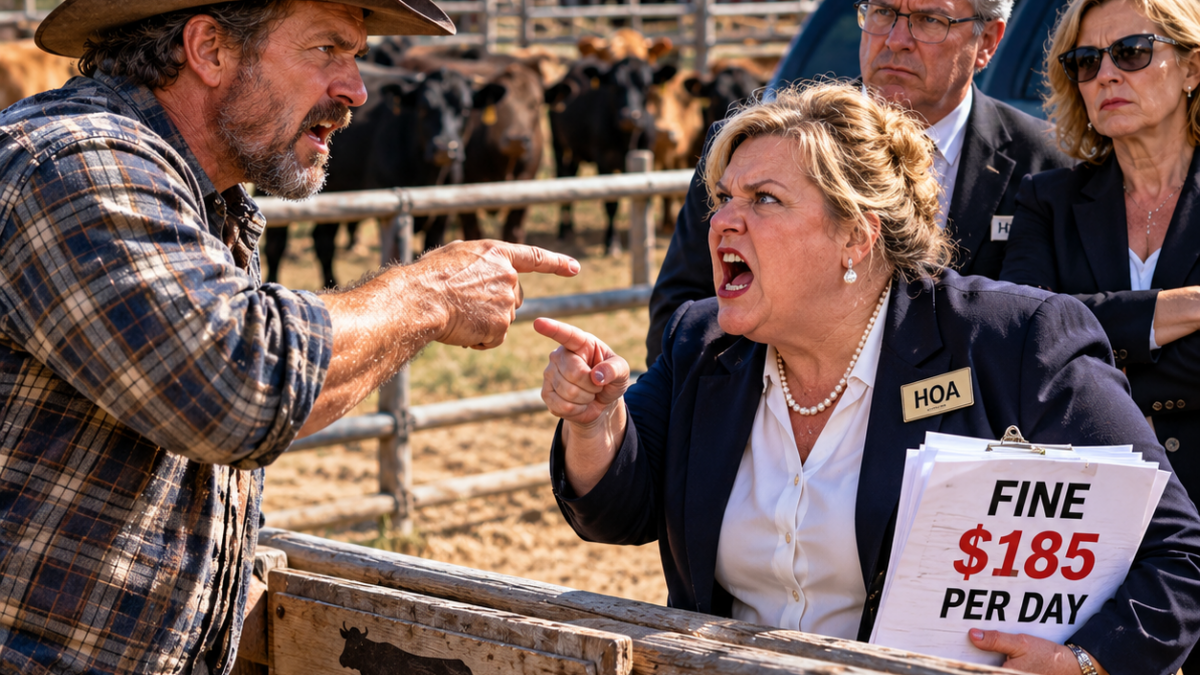
PART 2
The first certified letter had arrived three weeks earlier.
I remember the morning because I had just finished feeding the cattle when I saw the envelope on the kitchen counter.
Cedar Ridge logos had never meant much to me.
I wasn’t a member.
The subdivision had been built decades after my family bought the ranch.
Its streets wrapped around parts of my north and east boundaries, and over the years I had tried to be a decent neighbor.
People from Cedar Ridge sometimes walked near the fence line.
If someone asked whether their children could stop at our seasonal farm stand, I welcomed them.
If a maintenance truck needed to turn around near the ranch lane, I usually waved them through.
Once, after a storm, I let their landscapers use part of our gravel approach because a fallen tree blocked the subdivision entrance.
Those things were favors.
Neighborly permission.
Nothing more.
I opened the letter.
The first paragraph said Cedar Ridge had received complaints.
The second identified my “parcel” as noncompliant.
Then came the list.
Cattle visible from residential lots.
Hay stored outdoors.
Farm equipment visible from community streets.
Noise before permitted hours.
Fence design inconsistent with Cedar Ridge standards.
I read it twice.
Then I laughed.
Not because it was funny.
Because every item described a ranch.
I called the number on the letter.
A management employee answered.
“This is Ethan Cole. I received a violation notice.”
“Yes, Mr. Cole. I have your account.”
“My what?”
“Your Cedar Ridge property account.”
“I don’t have a Cedar Ridge property account.”
There was a pause.
“I’m showing your parcel in our database.”
“Your database isn’t my deed.”
“Sir, I can only tell you what our management system shows.”
“Then tell me the recorded declaration number that binds my ranch.”
“You’ll need to submit a written dispute.”
“I’m asking a simple question.”
“And I’m explaining the process.”
“Fine. I’ll submit it.”
Before ending the call, I asked one more thing.
“What happens while you review it?”
“The fine schedule remains available to the board.”
That afternoon I found the old deed packet.
My father had kept land records in a gray fireproof box beneath the desk in his office.
Deed.
Survey.
Tax documents.
Easements.
Old boundary notes.
I read everything I understood.
Nothing mentioned Cedar Ridge.
But land records can be complicated.
A deed doesn’t always tell you every recorded restriction in plain English.
So I called Laura Bennett.
Laura had represented me on two smaller property issues over the years.
She had an irritating habit of refusing to tell me I was right until she had checked every possible way I could be wrong.
That was exactly why I trusted her.
I drove to her office with the letter.
She read it.
Then she looked at me.
“You want me to tell you the HOA has no authority.”
“Yes.”
“I’m not going to.”
“Of course not.”
“I’m going to tell you what to collect.”
She took a legal pad.
“Your deed. Original Cedar Ridge declaration. Every amendment. Recorded subdivision plat. Any annexation documents. Any recorded easements near that gate.”
“I’ve got my deed.”
“Good.”
“And their map.”
She shook her head.
“Set the website map aside.”
“That’s what they’re relying on.”
“A map on a website can be evidence of what they think. It isn’t necessarily evidence of what legally burdens your land.”
“What matters?”
“Recorded instruments.”
“That’s what I’ve been asking them for.”
“Keep asking.”
I leaned back.
“If my ranch isn’t in the HOA, how could they have an account for it?”
“Bad data.”
“That simple?”
“Sometimes.”
“And sometimes?”
“Sometimes there is a recorded document an owner forgot about.”
I didn’t like that answer.
Laura knew.
“If Cedar Ridge has legitimate authority, we need to find it before you turn this into a war.”
“And if they don’t?”
“Then they need to correct it before they make the problem bigger.”
That sounded reasonable.
It would be the last reasonable opportunity Cedar Ridge gave itself for a while.
—
Mark Dalton met us at the north gate two mornings later.
He was a licensed surveyor with gray hair, a sunburned neck, and no interest whatsoever in HOA drama.
I liked him immediately.
He started with the brass cap I had photographed near Vanessa’s boots.
He cleaned the dirt around it.
Checked his notes.
Then walked the fence line.
“This monument matches the recorded field notes.”
“So the fence is right?”
“Very close. Old fences wander. Yours tracks the ranch boundary remarkably well.”
He set up his equipment.
For more than an hour, Mark barely talked.
Then Laura arrived with copies of Cedar Ridge’s original declaration.
She had sticky notes everywhere.
“Ethan.”
Something in her voice made me walk over.
“What?”
She handed me the document.
“Read this legal description.”
It was dense.
Bearings.
Distances.
Parcel references.
Then near the end was an exclusion.
I read it twice.
The declaration specifically carved out an agricultural tract.
The acreage matched my ranch to a tenth of an acre.
I looked at Laura.
“This is us.”
“It appears to be.”
“Appears?”
“I still want every later amendment.”
“Laura.”
“I know.”
“The document they’re using to fine me excludes my land.”
“The original declaration does.”
I looked toward Mark.
He was studying the plat.
“What about the subdivision line?”
He motioned me over.
“Your gate is outside it.”
“How far?”
“Enough.”
He showed me.
Cedar Ridge’s digital map shaded the ranch green as though it were part of the association.
The recorded plat stopped before my gate.
Two boundaries.
One convenient.
One legal.
I stared at them.
“How does a map get this wrong?”
Mark shrugged.
“Someone may have used parcel imagery.”
“What does that mean?”
“GIS layers are useful. They are not always title work. Sometimes people draw operational maps based on tax parcels, aerial imagery, management assumptions, or older data.”
“So because their computer colors my ranch green—”
“Doesn’t move a recorded boundary.”
Laura looked at me.
“Don’t get angry yet.”
“I’m already angry.”
“Then don’t get stupid.”
That made Mark laugh.
I didn’t.
Laura continued.
“We check amendments first. If there was later annexation with proper consent, we deal with it.”
“There wasn’t.”
“You don’t know that yet.”
For two days she searched.
There was no annexation.
No signed consent from my father.
No amendment pulling the ranch into Cedar Ridge.
No HOA easement over the gate.
No recorded inspection right.
No covenant imposing Cedar Ridge residential standards on my acreage.
The map was wrong.
The database was wrong.
The fines were wrong.
And I thought that would end it.
That was my mistake.
—
Laura wrote a short letter.
No threats.
No dramatic language.
It denied membership, disputed every fine, attached relevant recorded references, and asked Cedar Ridge to identify any instrument contradicting our conclusion.
The last paragraph requested that enforcement be suspended while the board corrected its records.
I read it.
“That’s it?”
“That’s it.”
“They’re charging me $185 a day.”
“Yes.”
“And we’re asking nicely?”
“We’re giving them the opportunity to treat this as a database error.”
“They already ignored me.”
“Give the whole board one clean chance.”
I agreed.
At the next Cedar Ridge meeting, I sat in the back.
Vanessa stood in front of a projector.
Behind her was the same green community map.
My ranch looked swallowed by Cedar Ridge.
She pointed toward it.
“This map has guided association operations for years.”
I raised my hand.
Vanessa looked annoyed.
“Mr. Cole, there will be homeowner comment later.”
“I’m not a homeowner in your association.”
A few people laughed.
She didn’t.
One director, Daniel Price, leaned toward his microphone.
“Let him ask.”
I stood.
“What is the recording number?”
Vanessa looked at me.
“We have already addressed your dispute.”
“No. You’ve shown a map.”
“The parcel has historically been included in our enforcement system.”
“What recorded document puts my ranch under your declaration?”
She shifted toward resident complaints.
“We have homeowners along the north edge who have repeatedly reported machinery noise, exposed equipment, hay storage, and livestock visibility.”
“I understand.”
“Those concerns affect their use and enjoyment.”
“I understand that too.”
“Then you understand why the board cannot ignore the boundary.”
“I understand why they want a clean view.”
The room went quiet.
“What I don’t understand is how wanting a clean view creates a covenant on my land.”
Daniel spoke again.
“Do we have counsel confirmation on the legal boundary?”
Vanessa answered, “Management has relied on this map for years.”
“That isn’t what he asked,” Daniel said.
I glanced at him.
He continued.
“Should we pause enforcement until counsel reviews the recorded description?”
Vanessa shook her head.
“We cannot suspend rules every time an owner objects.”
“I’m not asking you to suspend rules inside Cedar Ridge.”
I held up the declaration.
“I’m asking you to identify where they legally reach me.”
Vanessa’s eyes hardened.
“We will document the current conditions and continue our review.”
Laura, who had come with me, leaned close.
“What does that mean?”
I knew exactly what it meant.
Inspection.
—
Two mornings later, I was repairing a fence on the south field when my phone buzzed.
Motion alert.
North gate.
I opened the camera.
A contractor’s pickup had driven through.
I stared at the screen.
The truck moved past the gate.
Past the survey cap.
Onto the ranch lane.
Two men got out.
One photographed the cattle pens.
Another photographed my tractor.
Hay storage.
Fence.
Barn.
They weren’t confused.
They were conducting an HOA compliance inspection on land the HOA had already been told might be outside its authority.
I called Laura.
“They’re inside.”
“Who?”
“Inspectors.”
“Did you let them in?”
“No.”
“Did an employee?”
“No.”
“Save the video.”
“I’m going up there.”
“Ethan.”
“They’re on my ranch.”
“Do not start a confrontation if they’re leaving.”
“They’re taking pictures.”
“Save the video.”
I hated that answer.
But I stayed where I was.
Then I watched the truck leave.
As it turned, the rear corner swung too wide.
It caught the cedar brace beside the gate.
The old post split.
I heard the crack through the camera microphone.
I stopped breathing.
The truck paused.
A man got out.
Looked at the broken wood.
Got back inside.
Then drove away.
I was at the gate ten minutes later.
The brace had been there more than forty years.
The break exposed pale wood beneath the weathered gray surface.
I put my hand against it.
People sometimes think the most painful losses have to be valuable.
That cedar post wasn’t worth much money.
I could replace it in an hour.
Maybe less.
But my grandfather had planted that brace.
My father had leaned against it.
I had watched Grandpa sharpen the bottom with an axe before setting it.
I could buy cedar.
I couldn’t buy that one.
Laura arrived.
She photographed everything before letting me move the broken section.
“The truck did this?”
“Camera caught it.”
“Plate?”
“Clear.”
“Keep the wood.”
I looked at her.
“You’re serious?”
“Very.”
“It’s a broken fence brace.”
“It is physical damage during a disputed inspection after you challenged their access authority.”
I stared down the ranch lane.
“They crossed the gate to photograph violations that don’t apply.”
“Yes.”
“And damaged the gate doing it.”
“Yes.”
Laura looked toward the camera.
“This is no longer just a bad database.”
—
The next afternoon, Cedar Ridge emailed me the inspection report.
I opened the attachments.
Photograph one: cattle visible from subdivision-facing property.
Photograph two: hay stored outside.
Photograph three: tractor parked beside barn.
Photograph four: fence inconsistent with approved style.
They had captioned every image like evidence.
I called Laura.
“They actually sent me their pictures.”
“Good.”
“Good?”
“Look at the angles.”
I did.
“What about them?”
“Where was the photographer standing?”
I enlarged the first image.
Ranch lane.
Second.
Inside pasture approach.
Third.
Near equipment shed.
Fourth.
Beside the cattle pen.
All beyond the recorded subdivision boundary.
The photographs Cedar Ridge had created to prove my violations also documented exactly where its contractor had entered.
Laura said, “Their own exhibits place the inspector on your land.”
I laughed.
“That’s almost beautiful.”
“Don’t enjoy it too much.”
“You never let me enjoy anything.”
“I let you enjoy things after they’re over.”
We sent formal notice.
Cedar Ridge.
Vanessa.
Management.
The inspection company.
Any contractor acting for the association.
No HOA enforcement entry onto my ranch without lawful authority.
We made one distinction very clear.
I was not closing public roads.
I was not blocking emergency access.
I was not blocking utilities or recorded easements.
I was not banning neighbors.
I was withdrawing permission for Cedar Ridge officers, agents, inspectors, and contractors to enter private ranch property for HOA enforcement.
Then I changed the gate lock.
I installed another camera.
And I posted a simple sign.
**PRIVATE RANCH PROPERTY
NO HOA INSPECTION OR ENFORCEMENT ACCESS WITHOUT OWNER PERMISSION OR LAWFUL AUTHORITY**
The new hardware looked harsh beside Grandpa’s broken cedar brace.
That bothered me.
So I left the broken brace in place temporarily.
Maybe I needed the reminder.
—
Vanessa did not suspend the fines.
Another $185.
Then another.
Then another.
Every morning an automated balance grew on an account I had never agreed to open.
Laura told me not to pay.
“Not one dollar.”
“What if they add late fees?”
“Dispute them.”
“What if they send it to collections?”
“We deal with it.”
“What if they lien the ranch?”
“That creates a much larger problem for them if they lack authority.”
I looked at the running total.
“I hate seeing the number.”
“Good.”
“Good?”
“It means you’re paying attention.”
Cedar Ridge sent another inspector.
This time he stopped outside the locked gate.
He called me.
“Mr. Cole, I need access for a follow-up compliance inspection.”
“You have written notice that I don’t consent.”
“I understand there is a dispute.”
“Then why are you here?”
“The association requested documentation.”
“Document from the public side.”
“They want current conditions.”
“You are not coming through this gate.”
He sounded uncomfortable.
“Can I note that you refused access?”
“Yes.”
“Okay.”
“Also note that your company already received written notice that there is no recorded HOA inspection right over this ranch.”
“I’ll note the refusal.”
“Note both.”
He left.
I sent the call details to Laura.
That evening, Cedar Ridge emailed me.
**Refusal of inspection noted. Continued obstruction may constitute additional noncompliance.**
I stared at it.
The logic was almost perfect in its circularity.
They claimed authority.
I asked them to prove authority.
They couldn’t.
I stopped them from exercising the unproven authority.
Then they cited my refusal as evidence that I was violating the authority.
I forwarded it to Laura with one sentence.
**They’re never stopping voluntarily, are they?**
She called.
“I’m not ready to say never.”
“You say that because lawyers hate normal words.”
“I say it because I’m trying to keep you focused.”
“On what?”
“The record.”
—
Two days later, Vanessa came herself.
It was 9:12 in the morning.
I know because the camera timestamp became part of the case.
Her SUV stopped outside the north gate.
She got out.
Read the sign.
Walked to the pedestrian latch.
Opened it.
And stepped onto the ranch.
I was in the house.
I received the motion alert.
For a few seconds I just watched.
She walked several yards down the lane.
Looked toward the barn.
Raised her phone.
That was enough.
I called the sheriff’s office.
Not because I wanted Vanessa arrested.
I didn’t.
I wanted a neutral record.
Deputy Ruben Ortiz arrived about twenty minutes later.
I met him near the house.
I handed him the written notice.
Survey.
A copy of the deed.
Camera clip.
He read everything.
“Mr. Cole, I’m not resolving an HOA boundary case out here.”
“I don’t expect you to.”
“What do you want?”
“A record that she was told not to enter for HOA enforcement and crossed anyway.”
He nodded.
We walked toward the gate.
Vanessa stood near her SUV by then.
She looked furious when she saw the deputy.
“This is a civil boundary matter.”
Ortiz said, “I understand there is a civil dispute.”
“I’m here in my official capacity as president of Cedar Ridge.”
“I understand.”
“The HOA regulates this tract.”
“I’m not making a ruling on that today.”
“Then this is unnecessary.”
Ortiz remained calm.
“I have been shown written notice withdrawing HOA enforcement access to the property.”
“Our map includes the land.”
“I’m not deciding your map.”
“I have authority to inspect.”
“That is something counsel or a court can address.”
Vanessa crossed her arms.
“What exactly are you asking me to do?”
“Leave the private property for now.”
“Am I being accused of trespassing?”
“I’m documenting the notice and your presence. I am asking you to leave.”
“Am I under arrest?”
“No, ma’am.”
“Then I’ll leave voluntarily.”
She did.
Ortiz completed an incident report.
I read it later.
Plain.
Almost boring.
That was perfect.
Date.
Time.
Notice shown.
Parties identified.
Vanessa asked to leave.
Vanessa left.
No dramatic arrest.
No shouting.
No roadside judgment about title.
Just a record.
Laura read it the next morning.
“This is enough.”
“For what?”
“We’re done with letters.”
—
I didn’t want litigation.
People always say that after filing a lawsuit, but I mean it.
Ranch work doesn’t pause because your lawyer has a deadline.
Cattle still eat.
Hay still grows.
Equipment still breaks.
Rain still comes whether your deposition is Tuesday or Thursday.
Every hour spent reading HOA filings was an hour taken from something real.
Laura warned me.
“This will cost money even if you’re right.”
“I know.”
“Survey expenses.”
“I know.”
“Legal fees.”
“I know.”
“Time.”
“I know.”
“And a court may not give you everything you ask for.”
“What are we asking for?”
“Keep it narrow.”
That was important to me.
I didn’t want Cedar Ridge dissolved.
I didn’t want homeowners punished.
I didn’t want Vanessa’s house.
I wanted four things.
The fines gone.
The ranch formally recognized as outside Cedar Ridge.
The HOA stopped from unauthorized entry.
And the database corrected so I didn’t have to fight the same argument again in five years.
Laura filed for declaratory relief and an injunction.
Cedar Ridge responded that litigation was unnecessary because the board remained willing to discuss “reasonable compliance options.”
When Laura read that sentence aloud, I laughed.
“What compliance?”
“Exactly.”
“They’re offering to negotiate how I comply with rules we’re saying don’t apply.”
“Yes.”
“That’s not compromise.”
“No.”
“File it.”
She did.
—
The first hearing started with one question.
The judge looked toward Cedar Ridge’s attorney.
“What recorded instrument binds this ranch to the association?”
That was it.
No speech.
No drama.
One question.
Cedar Ridge introduced the community map.
Management account records.
Prior enforcement notes.
Parcel lists.
Historical databases.
Their attorney argued that the tract had been treated as part of Cedar Ridge’s enforcement area for years.
Laura stood.
“Your Honor, none of those records burden title.”
Then she laid out four things.
My deed.
The original Cedar Ridge declaration.
The recorded subdivision plat.
Mark Dalton’s survey.
Side by side.
The judge turned toward Cedar Ridge.
“Is there an annexation instrument?”
“No separate annexation has been located.”
“Owner consent?”
“Not in the form opposing counsel demands.”
I almost turned toward Laura.
She kept looking straight ahead.
The judge asked again.
“What document created covenant authority over Mr. Cole’s acreage?”
Cedar Ridge returned to the map.
That was the moment I knew they were in trouble.
Mark testified.
He explained the monument.
The fence.
The plat.
The GIS overlay.
On the courtroom screen, the two maps sat together.
Cedar Ridge’s green management layer swallowed the ranch.
The recorded subdivision boundary stopped before the north gate.
Mark pointed.
“The survey monuments correspond with the recorded plat.”
Laura asked, “Where is the cattle gate?”
“On the Cole tract.”
“Ranch lane?”
“Cole tract.”
“Cattle pens photographed by Cedar Ridge?”
“Cole tract.”
“Inspector route?”
“Cole tract.”
“Any portion of that route inside the recorded Cedar Ridge subdivision?”
“No.”
Then Laura said, “Let’s turn to Exhibit C.”
I felt my chest tighten.
She enlarged the legal description.
There it was.
The exclusion.
The agricultural tract.
The acreage matching the ranch.
Excluded from Cedar Ridge from the beginning.
The same document Vanessa had relied on to claim authority contained the language that defeated her claim.
Laura faced the judge.
“Mr. Cole did not discover a technical loophole after the fact. The founding declaration never included this tract.”
Cedar Ridge’s attorney argued that management had used the map in good faith.
The judge listened.
Homeowners had relied on consistent standards.
The board had believed the perimeter fell inside its jurisdiction.
Management systems treated it that way.
Those arguments explained how the error happened.
They did not move the boundary.
The judge said something I never forgot.
“A management map may guide operations. It does not amend a recorded legal description.”
Vanessa was sitting two rows ahead of me.
She didn’t turn around.
—
Then Laura used Cedar Ridge’s inspection photographs.
Image one appeared on the screen.
The photograph that was supposed to prove my cattle violated HOA standards.
Beside it, Mark’s survey.
The photographer had been standing on ranch property.
Image two.
Hay.
Photographer inside the ranch.
Image three.
Tractor.
Same result.
Image four.
Fence.
Same result.
Laura said, “These photographs were created to establish violations. They also establish the inspection route.”
Cedar Ridge’s attorney objected to the word “establish.”
The judge allowed the images for their documented locations subject to the survey testimony.
Then came the camera footage.
First entry.
Inspection truck through the gate.
Photos taken.
Cedar brace broken.
Then written notice.
Then the second attempted inspection.
Inspector stopped at the locked gate.
Then Vanessa.
She read the sign.
Opened the latch.
Crossed.
No one said anything while the video played.
The whole courtroom watched her do exactly what I had watched from my phone.
Vanessa later testified.
“I believed the association retained inspection authority.”
Laura asked, “After you received written notice disputing that authority?”
“Yes.”
“After counsel had been asked to review the boundary?”
“Yes.”
“After Director Price suggested enforcement be paused?”
“Yes.”
“I believed residents deserved consistent enforcement during the review.”
“Did resident concern create a recorded access right?”
“My understanding was that the property was part of the association.”
“Based on?”
“The management map and historical records.”
“Not a recorded annexation?”
“No.”
“Not an owner-signed covenant?”
“No.”
“Not an HOA access easement?”
“No.”
“Not the recorded plat?”
Vanessa hesitated.
“No.”
That was the first time I saw her confidence break.
Only briefly.
But it broke.
—
Discovery explained why she had kept pushing.
Residents along Cedar Ridge’s northern edge had complained repeatedly.
Some hated seeing tractors.
Some complained about machinery before sunrise.
Others believed livestock reduced the polished appearance buyers expected.
Then Laura found emails about the spring home-sale season.
Vanessa had promised several residents that the “north edge” would be brought into compliance before buyers began touring homes.
One email said:
**We need the perimeter cleaned up before spring inventory hits the market.**
Another:
**Owners expect Cedar Ridge standards to apply consistently along the entire visible boundary.**
There was no evidence Vanessa personally profited.
That mattered.
This wasn’t a story about secret money.
It was about pressure.
Complaints.
Home values.
Expectations.
A president who had made a promise before checking whether she had the authority to keep it.
When Laura asked her about the emails, Vanessa didn’t deny them.
“I was protecting homeowners who invested heavily in Cedar Ridge.”
I believed her.
That was the uncomfortable part.
Their concerns were real to them.
People had paid hundreds of thousands of dollars for homes marketed with controlled neighborhood standards.
They didn’t like waking up to a tractor.
They didn’t like looking across the boundary and seeing stacked hay.
They preferred uniform fencing.
I understood all of that.
But preference does not create ownership.
Aesthetic expectation does not rewrite a deed.
A promise made by an HOA president cannot annex neighboring land.
When it was my turn to testify, Laura asked:
“Did you understand residents had concerns?”
“Yes.”
“Did you tell them they were forbidden from raising those concerns?”
“No.”
“Would you have discussed reasonable neighbor issues?”
“Yes.”
“Then what was your objection?”
I looked toward Vanessa.
“My objection was being told that because people inside Cedar Ridge wanted my ranch to look like Cedar Ridge, my ranch had somehow become Cedar Ridge.”
Laura asked, “What did you want the board to do?”
“Ask first.”
“Ask what?”
“Whether they actually had authority.”
—
The temporary injunction came first.
Cedar Ridge officers, agents, inspectors, and contractors were prohibited from entering my ranch for HOA enforcement without lawful access.
The order was carefully written.
Emergency access remained untouched.
Public roads remained open.
Recorded utility easements remained valid.
Lawful rights unrelated to HOA enforcement remained valid.
Neighbors could still visit if I invited them.
Nobody was “banned from the ranch” in the dramatic way Vanessa later suggested.
The court simply drew a line.
HOA enforcement stopped at the recorded HOA boundary.
When Laura handed me the order outside court, I read the relevant paragraph twice.
“That’s it?”
“For now.”
“They can’t send inspectors through my gate?”
“Correct.”
“They can’t call the gate part of Cedar Ridge enforcement territory?”
“Not under the record currently before the court.”
“What about the fines?”
“Next.”
I looked at her.
“You really enjoy making me wait.”
“I enjoy winning things in the right order.”
—
The fines had continued long enough that the paper balance had become absurd.
One hundred eighty-five dollars.
Day after day.
An account that shouldn’t have existed claiming I owed money for cattle that shouldn’t have been regulated.
Every notice went into my file.
I never threw one away.
At first they made me furious.
Later they became useful.
Each additional notice showed that Cedar Ridge had kept enforcing after being asked to identify its authority.
Laura didn’t exaggerate that.
She didn’t claim every mistake became malicious simply because we disagreed.
But the timeline mattered.
First notice.
My objection.
Request for recorded authority.
Second notice.
Survey conflict.
Counsel review requested.
Board discussion.
Inspection anyway.
Unauthorized entry.
Property damage.
Formal notice withdrawing permission.
Attempted second inspection.
Vanessa’s entry.
Sheriff report.
Litigation.
That sequence made it harder to describe everything as one innocent clerical mistake.
A mistake can explain a first letter.
It does not automatically explain what somebody does after the mistake is brought to their attention.
—
One afternoon during the case, I walked out to Grandpa’s broken cedar brace.
I had left the damaged piece in my workshop.
A new brace needed to go in before winter.
I had already cut the replacement.
It was straighter.
Stronger.
Probably better than the old one.
I hated it.
My father would have called that foolish.
“It’s a post, Ethan.”
I could practically hear him.
“Wood rots. Replace it.”
But memory makes ordinary things unreasonable.
I set the new cedar beside the old hinge.
The color was too bright.
Fresh wood against steel darkened by decades.
I bolted it in place.
Then stood back.
My son, Caleb, had come to help.
He was twenty.
He looked at the old broken piece leaning against the fence.
“You keeping that?”
“Yes.”
“Why?”
“Grandpa put it there.”
“He also replaced fence posts all the time.”
“I know.”
Caleb smiled.
“You know he’d make fun of you.”
“Yes.”
“Still keeping it?”
“Yes.”
He handed me a wrench.
“Fair enough.”
We tightened the bolts together.
That helped.
Maybe the point wasn’t to preserve every old piece of wood forever.
Maybe it was to remember who had touched the land before us while still doing the work required now.
But every time I saw the fresh cedar, I remembered why the original one broke.
Someone entered after I had already asked the HOA to prove it belonged there.
That mattered.
—
Settlement discussions became serious after the injunction.
Cedar Ridge could no longer treat access as routine.
That changed everything.
Laura gave them a simple resolution.
Void every fine.
Confirm in writing that the ranch was not a Cedar Ridge member parcel.
Correct the community map.
Correct the management database.
Correct vendor lists.
Stop unauthorized HOA entry.
Reimburse documented expenses caused by the dispute.
Vanessa resisted the language about authority.
She wanted wording that described the problem as a management-data discrepancy.
Laura refused.
“A data discrepancy didn’t open the gate the second time.”
Cedar Ridge’s counsel asked for compromise.
Laura said, “The recorded boundary is not a compromise position.”
I sat quietly.
I had learned when not to speak.
Eventually, the final terms came together.
Cedar Ridge removed the ranch from enforcement.
Every open violation was voided.
Every $185 daily fine disappeared.
The account balance became zero because the account itself was never supposed to have been an HOA enforcement account.
Management corrected its GIS layer.
Vendors received corrected parcel lists.
Future inspectors were instructed that the ranch was outside Cedar Ridge jurisdiction absent some independent lawful access right.
And Cedar Ridge agreed to reimburse **$13,600** of my survey and legal expenses.
When Laura told me the number, I shrugged.
“You expected more?”
“No.”
“Less?”
“I don’t care.”
“That’s not true.”
“I care about the money because I had to spend it fixing their mistake.”
“Good.”
“But it isn’t the ending.”
“No.”
“The zero balance is.”
“That part feels good?”
I smiled.
“Very.”
—
The board reviewed Vanessa’s handling of the case.
That meeting was much quieter than the earlier ones.
No giant green map projected behind her.
No discussion about my tractor.
No complaints about visible hay.
The recorded plat was on the screen.
The correct one.
Daniel spoke first.
“When Mr. Cole challenged the boundary, I asked that enforcement pause.”
Vanessa answered, “And I believed pausing would undermine consistent enforcement based on the information management had provided.”
“Our counsel was reviewing it.”
“We had residents expecting action.”
“That does not answer why you crossed the gate after written notice.”
The room went still.
Vanessa looked tired.
“I believed I was entering association-regulated property.”
Daniel shook his head.
“The owner had given written notice. A survey conflict was documented. Counsel was involved. Even if you believed the map, why not wait?”
She didn’t have a satisfying answer.
Because sometimes there isn’t one.
Pressure explains decisions.
It doesn’t always justify them.
Three directors voted to replace Vanessa as president.
She remained on the board temporarily under the association’s rules, but she no longer controlled enforcement.
I didn’t celebrate.
Laura asked later whether I felt vindicated.
“I feel finished.”
“That’s better.”
“Yes.”
—
Vanessa asked to speak with me after the final status conference.
We stood outside the courthouse.
No cameras.
No crowd.
Just us.
She looked toward the parking lot.
“I still think residents’ complaints were legitimate.”
“I never said they weren’t legitimate complaints.”
She looked at me.
“You don’t?”
“If somebody hates hearing my tractor at five-thirty in the morning, they can hate it.”
“That impacts their quality of life.”
“I understand.”
“If exposed equipment affects resale appeal—”
“They can complain.”
“Then why did you fight us on everything?”
“I didn’t fight you on their feelings.”
I paused.
“I fought you on your authority.”
She looked away.
“We relied on the map.”
“I know.”
“It had been in the system for years.”
“I know.”
“Management treated your parcel as part of Cedar Ridge.”
“I know.”
“Then you make it sound as if I walked onto your ranch knowing I had no argument.”
“No.”
She looked surprised.
I continued.
“I think you believed the map.”
“I did.”
“I think you believed residents expected you to enforce it.”
“They did.”
“I think you convinced yourself that stopping to check would make you look weak.”
Her expression tightened.
“That’s not fair.”
“Maybe.”
I looked toward her.
“But I gave you the question at the beginning.”
“What question?”
“Show me the recorded document.”
She said nothing.
“You didn’t have to believe me.”
I continued.
“You just had to check.”
Her shoulders lowered.
After a while she said, “I should have paused after the survey issue.”
“Yes.”
“I definitely should not have crossed the gate after the notice.”
“No.”
“I thought backing down would tell every difficult owner that they could stop enforcement by hiring a surveyor.”
“I understand.”
“You always say that.”
“Because understanding why you did something doesn’t mean you had the right to do it.”
She nodded.
Then she asked, “Do you hate Cedar Ridge now?”
“No.”
“Me?”
I thought about it.
“No.”
Her eyes narrowed slightly.
“Really?”
“You broke my grandfather’s boundary without meaning to.”
“The contractor did.”
“I know.”
“And I didn’t damage the post.”
“I know.”
“But the whole thing happened because you kept pushing.”
“Yes.”
She took a breath.
“I’m sorry for that.”
I believed her.
“Thank you.”
Then I walked back to my truck.
I didn’t need anything else from her.
—
The next month, Cedar Ridge mailed me a formal confirmation.
The Cole Ranch was not subject to Cedar Ridge membership or architectural enforcement.
I took the letter to the north gate.
The new cedar brace was already starting to darken from weather.
The old hinge still squeaked because I had forgotten to grease it.
I laughed.
My father would have considered that a bigger offense than any HOA letter.
I brought out the grease gun.
Worked the hinge.
Opened the gate.
Closed it.
Smooth again.
Caleb drove up carrying fence supplies.
“You finally win your war?”
“It wasn’t a war.”
“Mom called it your HOA war for six months.”
“Your mother likes drama.”
“She married you.”
“Fair.”
He looked at the new brace.
“You still have Grandpa’s broken one?”
“In the workshop.”
“Of course you do.”
We spent the afternoon repairing fence farther west.
No lawyers.
No cameras.
No notices.
Just work.
That evening cattle moved through the north gate toward the hay field.
For the first time in months, I didn’t look toward the road expecting a white SUV.
The ranch felt like a ranch again.
Not evidence.
—
Cedar Ridge changed its enforcement procedure after my case.
Before a new parcel was added to the violation system, management had to verify the recorded basis for jurisdiction.
Not just GIS shading.
Not just a mailing address.
Not just historical database treatment.
Recorded authority.
I heard Daniel pushed hardest for that change.
Good.
That was more valuable than punishing anyone.
Because maps are easy to trust.
They look official.
A colored boundary on a screen can become truth in a meeting simply because no one asks where it came from.
That was what happened to me.
The green line looked precise.
People assumed somebody had verified it.
Management assumed prior management had verified it.
Board members assumed the database reflected legal documents.
Residents assumed if the HOA sent letters, it must have authority.
Each assumption stacked on top of the previous one until Vanessa stood at my grandfather’s gate confidently telling me the fines would continue every day.
All because nobody stopped and asked the most boring question in the room.
**What recorded document says that?**
—
Several Cedar Ridge neighbors apologized.
Not all of them.
I didn’t expect that.
One woman named Marjorie came to the farm stand.
She lived in a house overlooking our east pasture.
“I complained about your tractor once,” she admitted.
“What did it do to you?”
She laughed.
“Woke me at five forty-five.”
“That sounds like my tractor.”
“I was angry.”
“Fair.”
“You don’t mind?”
“I didn’t say I’d stop using it.”
She smiled.
“I know.”
She picked up a jar of honey.
“I didn’t realize your ranch wasn’t part of Cedar Ridge.”
“Most people didn’t.”
“I thought you were refusing rules everyone else had to follow.”
“That’s what you were told.”
She looked embarrassed.
“I voted for Vanessa.”
“Also your right.”
“Are you angry?”
“At you?”
“Yes.”
“No.”
“Why?”
“Because you complained about noise. You didn’t walk through my gate pretending your complaint gave you legal authority.”
She nodded.
Then she bought two jars instead of one.
I don’t know whether the second was guilt.
I didn’t ask.
—
Other residents remained angry.
One man told me the ranch “damaged the entrance experience” for Cedar Ridge.
I asked what that meant.
He said people buying expensive homes didn’t want to see farm equipment.
I looked at him.
“You bought a house beside a ranch.”
“The development was marketed as upscale.”
“The ranch was visible when you toured it.”
“That isn’t the point.”
“It’s exactly the point.”
He walked away irritated.
I didn’t chase him.
Property rights don’t guarantee that neighbors will like what you legally do.
They establish who gets to make certain decisions.
That distinction had become very important to me.
—
I kept Grandpa’s broken cedar brace.
It sits above the workbench now.
At first, I kept it because I was angry.
Later, the anger faded.
The wood didn’t.
Sometimes I run my hand over the split.
It reminds me how quickly permission can be mistaken for power.
For years I had let Cedar Ridge maintenance trucks turn around when they asked.
I had let residents walk near parts of the fence with permission.
I had tried to be generous.
Somewhere along the way, familiarity had become assumption.
Assumption had become a database entry.
The database entry became a green map.
The green map became an enforcement account.
The enforcement account became $185-a-day fines.
Then inspectors.
Then entry.
Then a broken post.
Then Vanessa standing inside my ranch telling a deputy she had official authority.
That entire chain started because nobody respected the difference between:
**He usually allows us.**
and
**We have a legal right.**
Those sentences are not the same.
They never were.
—
About a year after the case ended, I attended a Cedar Ridge meeting for an entirely unrelated reason.
They were planning drainage work near a culvert close to our eastern line.
Daniel was president by then.
He opened the meeting with survey drawings.
The first question he asked the engineer was:
“Show us the recorded boundary.”
I almost laughed.
The engineer pointed.
Then Daniel asked:
“Any easements?”
The engineer showed them.
“Any private parcels affected?”
“One.”
“Owner contacted?”
“Yes.”
“Written permission?”
“Yes.”
Simple.
Five minutes.
No conflict.
No court.
No $185 fines.
No sheriff.
No broken cedar post.
Afterward Daniel came over.
“You heard that?”
“I did.”
“I thought you might appreciate it.”
“I did.”
He smiled.
“Expensive lesson.”
“Yes.”
“Useful one.”
“Yes.”
Then he asked, “Can our drainage contractor turn around at your east gravel pad next week?”
I looked at him.
He waited.
He actually waited for my answer.
“Sure.”
“Thank you.”
“Send me the dates.”
“I will.”
That was how it should have worked from the beginning.
Ask.
Don’t assume.
—
Two years later, Vanessa stopped me at the grocery store.
I hadn’t seen her in months.
She looked relaxed.
No board folder.
No Cedar Ridge jacket.
Just groceries.
“Ethan.”
“Vanessa.”
“How’s the ranch?”
“Still offending upscale views.”
She laughed.
That surprised both of us.
“I deserved that.”
“Probably.”
She looked at the cart.
“You still running cattle on the north field?”
“Yes.”
“No complaints?”
“Plenty.”
She smiled.
Then became serious.
“I read the new enforcement policy.”
“Daniel showed me.”
“It’s better.”
“Yes.”
“I wish we had used it before your case.”
“So do I.”
She hesitated.
“You know what bothers me most?”
“The money?”
“No.”
“Losing the presidency?”
“No.”
“The sheriff?”
She shook her head.
“The first meeting.”
I remembered it.
The giant green map.
“What about it?”
“You asked for the recording number.”
“Yes.”
“I thought you were trying to embarrass me.”
“I wasn’t.”
“I know that now.”
She looked down.
“If I had simply said, ‘I don’t know; let’s check,’ none of the rest would have happened.”
There was nothing useful to add.
So I said the truth.
“Probably not.”
She nodded.
Then we went separate ways.
That conversation stayed with me.
Sometimes the sentence that prevents disaster is not complicated.
It’s just difficult for proud people to say.
**I don’t know. Let’s check.**
—
The $13,600 reimbursement covered only part of the actual disruption.
People see a number like that and assume it means someone “won money.”
They don’t see the hours.
Survey meetings.
Attorney calls.
Court dates.
Missed work.
Documents.
The emotional cost of watching a ranch become an argument.
Money can reimburse an invoice.
It cannot give you the morning back when you watched a contractor’s truck break something your grandfather had set in the ground.
That isn’t a complaint.
It is simply why I never thought of the settlement as profit.
The real win was the zero beside the fines.
The corrected boundary.
The words:
**Cole Ranch — Not Cedar Ridge Membership Property.**
That mattered.
—
Every spring, cattle still move through the north gate.
Hay still sits outdoors.
My tractor is still visible.
The fence still doesn’t match Cedar Ridge’s approved residential design.
Sometimes I start equipment before sunrise.
Nothing about the ranch changed to satisfy the HOA.
Because nothing about the ranch had been legally required to change.
That point made the ending satisfying in a way a bigger check never could have.
I didn’t beat Cedar Ridge by becoming louder than them.
I didn’t destroy the association.
I didn’t punish eighty families for one board’s mistake.
I didn’t block emergency access.
I didn’t close public roads.
I didn’t start harassing residents who walked by.
I made the institution respect the same boundary that had existed before it did.
That was enough.
—
One morning in late November, I drove up to the gate before daylight.
Frost covered the grass.
The cedar brace was silver at the edges now.
Not as dark as Grandpa’s old one.
But getting there.
I leaned against it while the cattle moved through.
Caleb came up behind me.
“You know someday that thing will look old too.”
“What?”
“The new brace.”
“I know.”
“You still hate it?”
“No.”
“Progress.”
“I still like the old one better.”
“That’s because you’re old.”
“I can rewrite your inheritance.”
He laughed.
The last cow moved through.
I closed the gate.
The hinge swung quietly.
I looked toward Cedar Ridge.
Lights came on in houses one by one.
People getting ready for work.
Making coffee.
Packing school lunches.
Ordinary lives.
For months, I had thought of the subdivision as the enemy.
That had been too simple.
Most residents had never read Exhibit C.
Most had never seen my deed.
Most believed the green map because it was the map their association showed them.
The real failure was institutional.
A convenient record was treated as legal truth.
Questions were treated as obstruction.
And after doubt became serious, pride kept enforcement moving.
That was the lesson.
—
I walked back to the barn and pulled Grandpa’s broken cedar piece from above the workbench.
The split from the inspector’s truck was still visible.
I had written the date on the back.
Not because I wanted my grandchildren to inherit my anger.
Because I wanted them to inherit the context.
Someday someone else may own this ranch.
Maybe Caleb.
Maybe his children.
Maybe someone our family has never met.
Boundaries can look permanent when you grow up with them.
They aren’t permanent unless people preserve the records that define them.
So I put copies of the deed, plat, survey, Cedar Ridge settlement, and Exhibit C in the fireproof box.
Beside Dad’s old papers.
Then I wrote a note.
**If anyone ever tells you a map gives them authority over this ranch, ask for the recorded instrument first.**
I almost stopped there.
Then I added:
**Be polite once.**
I smiled.
And underneath:
**After that, document everything.**
—
The next summer, Cedar Ridge held its annual picnic near the greenbelt.
Daniel invited neighboring landowners too.
I nearly didn’t go.
Caleb convinced me.
“You should.”
“Why?”
“Free barbecue.”
“That’s your legal analysis?”
“Yes.”
So we went.
Neighbors talked.
Children played near the creek.
Nobody inspected my truck.
Nobody handed me a violation.
Marjorie saw me and waved.
Daniel handed me a plate.
“See? Cedar Ridge can provide food without controlling your cattle.”
I looked at him.
“That better not be one of mine.”
He laughed.
“No. We bought it legally.”
“Strong improvement in policy.”
That was probably the closest the whole dispute ever came to a joke.
And it felt good.
Not because Cedar Ridge had suffered.
Because we could stand in the same place afterward without pretending nothing happened.
They had their community.
I had my ranch.
The line between us was clear.
That line didn’t prevent us from being neighbors.
It made being neighbors easier.
—
Years later, the thing I remember most isn’t Vanessa fastening the first violation to my gate.
It isn’t the judge.
It isn’t even the $185 daily fine.
It’s her boots beside that survey cap.
She stood inches from the answer.
The legal boundary was physically beneath us.
Yet the green map on her screen felt more real to her than the brass marker in the dirt.
That image taught me something.
Authority often looks strongest immediately before somebody asks where it actually comes from.
A logo looks official.
A notice looks official.
A database looks official.
A board vote looks official.
A map with a thick green line looks official.
Sometimes all of them are valid.
Sometimes they aren’t.
The only way to know is to trace the authority backward.
What created the rule?
What land does it burden?
Who agreed?
What was recorded?
Where does it stop?
Cedar Ridge eventually answered those questions.
Just much later than it should have.
—
The old phrase Vanessa kept using was simple:
**If the property is inside the community map, it is subject to Cedar Ridge rules.**
The ending turned out to be even simpler.
The map did not own an acre.
It could not move a survey monument.
It could not rewrite Exhibit C.
It could not create an easement.
It could not transform neighborly permission into inspection authority.
It could not turn cattle into an HOA violation on land that had never joined the HOA.
And it could not make $185 daily fines legitimate merely by sending them often enough.
The deed mattered.
The recorded declaration mattered.
The survey mattered.
The boundary had never moved.
Only Cedar Ridge’s understanding of it had.
—
The last time I replaced the grease on Grandpa’s hinge, the new cedar brace was nearly as weathered as the fence around it.
I looked at the broken original above my workbench before walking outside.
For years I had thought winning meant getting back what had been taken.
That wasn’t possible.
I couldn’t make the contractor unbreak Grandpa’s cedar.
I couldn’t recover every hour spent in Laura’s office.
I couldn’t erase the months when I saw every Cedar Ridge vehicle and wondered whether another inspector was coming.
What I could do was make sure the mistake stopped with me.
The ranch records were organized now.
Digital copies backed up.
Boundary maps current.
The gate marked.
Permissions documented when necessary.
Not because I had become hostile.
Because clarity is not hostility.
A private gate is not an insult.
Saying no is not aggression.
Asking someone to prove authority is not obstruction.
And being a good neighbor does not require surrendering the right to decide what happens on your own land.
I opened the gate.
The cattle moved slowly toward the north field.
Across the fence, Cedar Ridge looked exactly as it always had.
Clean streets.
Trim yards.
Large homes.
Nothing destroyed.
Nobody ruined.
Their HOA still existed.
Their rules still applied where their rules legally applied.
My ranch still operated as a ranch.
That was the ending I wanted.
Not revenge that burned everything down.
Accountability strong enough that nobody would make the same assumption again.
I closed the gate after the last cow.
The latch dropped.
The old hinge held.
And for the first time since Vanessa attached that bright violation notice to the steel, there was nothing hanging from it except morning frost.
No fine.
No warning.
No HOA seal.
Just my grandfather’s gate.
On my family’s ranch.
Exactly where the recorded boundary had said it was all along.

