PART 2: HOA Fined Me $3,600 for Plowing Their Only Road—So I Parked My Snowplow Until Their Own Rules Froze 86 Homes In
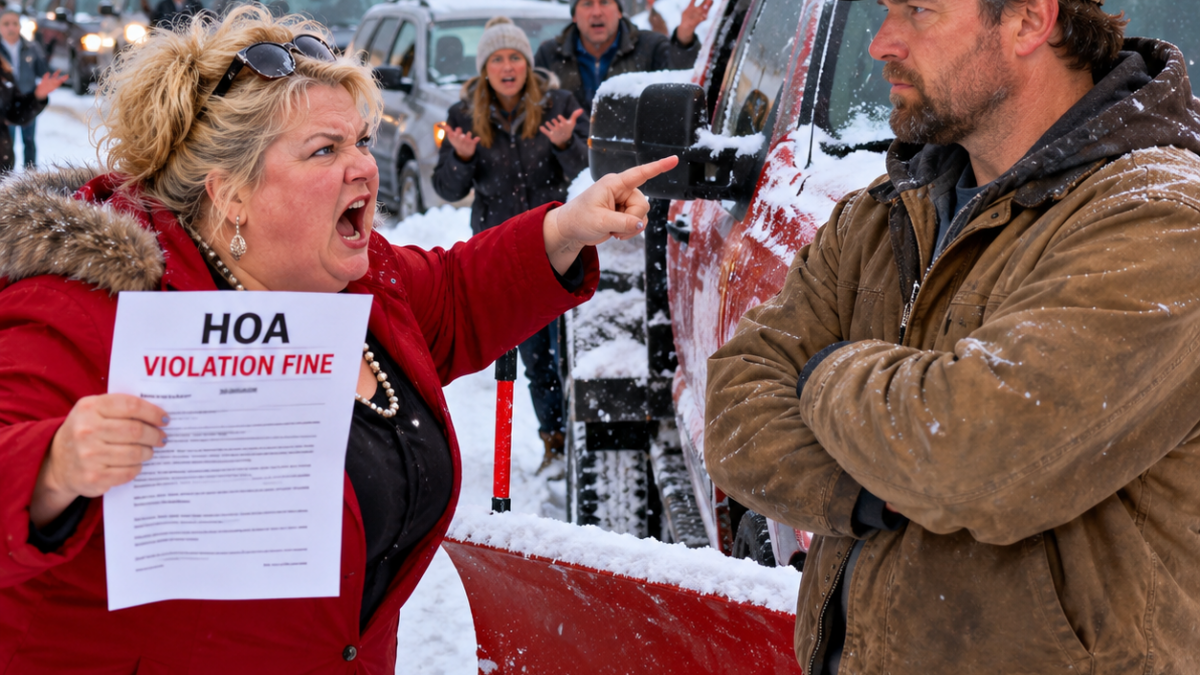
**The HOA fined me $3,600 for plowing the only road off our mountain.**
**So I did exactly what their new rule demanded: I parked the truck my family had used to keep that road open for thirty-eight winters.**
**Sixteen days later, the woman who wrote that fine came climbing my driveway on foot—and for the first time since I’d known her, she wasn’t carrying her clipboard.**
It started at 6:10 on the morning of November 18.
Snow was coming sideways across Ridge Loop, sticking to my windshield faster than the wipers could throw it away.
I had already cleared about a mile behind me.
Three miles remained ahead.
Ridge Loop wasn’t just another neighborhood street. It was a twelve-percent grade cut into the side of a mountain, and it was the only road connecting Summit Hollow’s eighty-six homes to the county road below.
One way in.
One way out.
That morning, my International 4900 was crawling uphill in low gear with ten feet of steel pushing snow toward the shoulder when headlights appeared through the storm.
An SUV stopped directly in front of my blade.
I hit the brakes.
The truck settled heavily.
Then Priscilla Vaughn stepped out.
President of the Summit Hollow Homeowners Association.
She walked straight into my headlights and raised one arm.
“Kill the engine.”
I lowered my window.
“Priscilla, I’m in the middle of—”
“Turn it off, Fletcher.”
I stared at her.
Then I shut the diesel down.
Without the engine, the mountain suddenly sounded enormous.
Wind.
Snow striking metal.
The faint ticking of the exhaust cooling.
Priscilla walked to my door carrying a clear plastic bag.
Inside it was an envelope.
Dry.
Perfectly dry.
Meaning she hadn’t written this notice because she found me plowing that morning.
She had prepared it before the storm.
She held it up.
“Violation notice.”
“For what?”
“Unauthorized equipment operating on association roadways.”
I took the envelope.
At the top was my name.
At the bottom was the number that made me read the page twice.
**$3,600.**
“Damage to association roadways caused by unauthorized snow-removal equipment.”
I looked from the paper to her.
“You’re fining me for plowing?”
“I’m fining you for damaging association property.”
“I’ve been clearing this road sixteen years.”
“That doesn’t give you authority.”
“My father did it twenty-two years before me.”
“That doesn’t give him authority either.”
I almost laughed.
Not because anything was funny.
Because she was standing on the only clear mile of road on the mountain telling the man who had cleared it that he wasn’t authorized to be there.
“You know this is the only road out.”
“I know exactly what Ridge Loop is.”
“Then why are we having this conversation in a snowstorm?”
“Because somebody has to protect association property.”
I held up the notice.
“From snowplows?”
“From unapproved equipment.”
Behind her, the road disappeared into white.
She pointed toward my truck.
“Finish today if you want. After tonight, keep that thing off association pavement.”
“And if it snows again?”
“The board will make arrangements.”
“What arrangements?”
“That’s board business.”
I looked at her SUV.
Then at the mile of black pavement behind me.
“You drove up on the section I just cleared.”
She didn’t answer.
“Priscilla.”
Her hand touched the driver’s door.
“You don’t get to decide what happens on our roads, Fletcher. You never did. People just let you think you did.”
Then she got into her SUV.
She turned around.
And she drove back down the mile I had cleared for her.
I sat alone in the cab with snow gathering against the windshield.
Thirty-eight winters.
My father had started plowing Summit Hollow in 1986.
I took over after his knees finally made climbing into the truck harder than the storm itself.
We had never had a real contract.
Never sent an invoice for labor.
Never demanded recognition.
The HOA reimbursed some diesel.
That was about it.
My father used to say, “People need the road more than we need to be thanked.”
So every storm, we showed up.
Ridge Loop first.
Then the side roads.
Then the cul-de-sacs.
And always, always, Ruth Aldridge’s driveway last.
Her husband had suffered from heart trouble when my father was alive, and Dad wanted that driveway to be the freshest cut on the mountain if an ambulance ever had to reach their house before sunrise.
Mr. Aldridge was gone now.
My father was gone too.
But Ruth was eighty-two and still lived in the same house.
The order remained written on a pine board hanging above my truck in the garage.
Eighty-six driveways.
Four-point-two miles.
One route.
One family.
Thirty-eight winters.
I looked again at Priscilla’s notice.
“Damage caused by unauthorized snow-removal equipment.”
Not possibly caused.
Not suspected.
Caused.
She had put that word in writing.
And sitting there with snow piling against my blade, I had no idea yet that one word was going to cost her far more than $3,600.
I restarted the truck.
Then I finished clearing every road in Summit Hollow.
Including hers.
PART 2
When I got home that afternoon, Nora was sitting at our kitchen table with a mug of coffee and a stack of bills.
My wife could tell what kind of day I’d had by how I closed the mudroom door.
I normally eased it shut because the frame had been crooked since the house settled.
That day, I let it bang.
She looked up.
“That good, huh?”
I tossed the plastic-covered violation notice onto the table.
She unfolded it.
Her eyes went immediately to the number.
“Three thousand six hundred dollars?”
“Apparently.”
“For what?”
“For snow removal.”
She read the entire page.
Then read it again.
“They can’t do this.”
“Maybe they can.”
She looked at me.
“You don’t believe that.”
“I don’t know what I believe.”
That was the truth.
I was forty-eight years old.
I could rebuild a diesel injection pump without looking at a manual.
I could tell you which bearing had failed in a transfer case from the sound it made under load.
I could weld, machine, rebuild, fabricate, and diagnose almost anything with threads, gears, oil, or wires.
But homeowners association law?
I knew nothing.
Priscilla knew that.
She had been board president for two terms.
She read bylaws.
She quoted sections.
She used words like “covenant enforcement,” “procedural compliance,” and “board authority” the way I used torque specifications.
I had never read our covenants from beginning to end.
Not once.
Nora had pointed that out before.
Now it mattered.
She turned the violation notice toward me.
“Twelve violations at three hundred dollars each.”
“Yeah.”
“How’d she get twelve?”
“Good question.”
I pulled the chair beside her.
The document listed twelve separate instances of damage.
Different road sections.
Different locations.
The same allegation.
My plow had damaged Ridge Loop.
I leaned back.
Something about the wording bothered me.
Not the amount.
Not yet.
The certainty.
Caused by.
I tapped the phrase.
“She says I caused it.”
Nora shrugged slightly.
“Isn’t that what the whole notice says?”
“Yes.”
“So?”
“I’ve been over that road hundreds of times.”
“You think you’d know?”
“I know I’d know.”
I stood.
“Where are you going?”
“To look at the road.”
“At night?”
“The marks won’t move.”
She sighed.
“You’re impossible.”
“I’m taking a flashlight.”
“That doesn’t make you less impossible.”
I kissed the top of her head, grabbed my coat, and left.
By nine that night, the earlier snow had turned to slush and begun refreezing along the shoulders.
I drove to the culvert near the upper section of Ridge Loop because that was where Priscilla’s photographs showed the worst damage.
I found the marks in less than five minutes.
They were ugly.
Two long gouged sections through the asphalt.
Chipped edges.
Chunks torn away.
At first glance, I understood why a board member might blame a plow.
Then I knelt beside the first gouge.
I put down a foam knee pad.
Set my flashlight on the pavement.
Pulled out a tape measure.
Twenty-six inches.
I measured again.
Twenty-six.
I sat back.
My plow blade was ten feet wide.
One continuous steel edge.
When a blade rides too low, it leaves a scrape.
A line.
Maybe several lines.
But it doesn’t carve a twenty-six-inch-wide path into asphalt.
I ran my fingers along the gouge.
There were ridges inside it.
Parallel tears.
Little repeating bars.
Dig.
Peel.
Dig.
Peel.
My heart rate changed.
I knew that pattern.
Tracks.
Steel tracks.
Specifically, the grousers under a tracked excavator turning on pavement.
I stood slowly.
Forty feet away was the culvert.
And suddenly I remembered July.
Renshaw Grading and Snow.
They had replaced that culvert over three days.
I remembered because Ridge Loop had been blocked, forcing me to take the longer fire-access route whenever I needed to get between my shop and the upper neighborhood.
My service truck got nine miles to the gallon.
I had been irritated enough to photograph the equipment and closure.
I hurried back to my truck.
Under the dome light, I scrolled through four months of photographs.
July 11.
July 12.
Then there it was.
A tracked excavator.
Parked sideways across Ridge Loop.
Forty feet from the damage.
Sunshine.
Dry pavement.
No snow.
I enlarged the image.
The tracks were steel.
My pulse kicked.
I called Nora.
She answered on the second ring.
“You fall down the mountain?”
“No.”
“Good.”
“I found something.”
She heard my voice change.
“What?”
“This wasn’t my plow.”
“You sure?”
“Very.”
“How sure?”
“I’d bet the truck.”
“That’s disturbingly sure.”
The next morning, I drove to the county road office.
A clerk pulled the culvert permit in about a minute.
Contractor of record:
Renshaw Grading and Snow.
Issued in July.
Public document.
I asked for a copy.
Then I went home.
Spread everything across the kitchen table.
Priscilla’s notice.
The July photographs.
The permit.
My measurements.
Nora stood beside me.
“So now what?”
“I request a hearing.”
“And they cancel the fine?”
“They should.”
“That isn’t what I asked.”
I looked at her.
She had a way of asking the second question while I was still answering the first.
“I don’t know.”
I wrote the appeal on November 22.
It wasn’t elegant.
Half typed.
Half handwritten.
I explained the measurements.
Explained how a plow scar differed from a track mark.
Attached photographs.
Included the county permit.
Requested that the entire $3,600 assessment be withdrawn.
Then while assembling Priscilla’s original packet beside mine, I noticed something.
Her photographs.
The ones she had shown the board.
Dry asphalt.
Brown leaves.
No snow.
I checked the date.
October.
The first snowfall that season had been November 14.
I stared at them.
Nora came over.
“What?”
I held up the picture.
“When did I supposedly damage the road?”
“With the snowplow?”
“Yeah.”
“November?”
I pointed.
“She photographed the damage in October.”
Nora frowned.
Then understood.
“Oh.”
“Exactly.”
She had documented the damage before the first snow.
Before my plow had touched Ridge Loop that season even once.
I laughed once.
Short.
Relieved.
For about four days, I actually believed that photograph ended the argument.
Then the management company sent me a letter.
Bellhaven Community Management.
Reference number.
Hearing date.
December 2.
My request had been accepted.
Then came the sentence that changed the shape of the whole thing.
**The assessment remains in effect pending board review.**
Not suspended.
Not frozen.
Still active.
The fine existed while I waited for the people who issued it to decide whether they had been wrong.
I sat at the kitchen table and read that sentence three times.
Nora watched me.
“What?”
“They’re keeping the fine active.”
“Can they?”
“Apparently they can do anything until somebody makes them stop.”
Two days later, I was driving uphill when I saw a white pickup beside the culvert.
A man wearing a canvas jacket was crouched over the damaged pavement.
Curtis Renshaw.
Owner of Renshaw Grading and Snow.
The same contractor whose excavator I had photographed there in July.
I pulled over.
He stood and smiled.
“Fletcher Dalton.”
“You know me?”
“Everybody knows the plow guy.”
I looked toward the gouges.
“What are you doing?”
“Association asked for an independent assessment.”
I almost laughed.
“Independent.”
He either missed the tone or ignored it.
“No hard feelings, Fletcher.”
“About what?”
“Any of this.”
He kicked lightly at the asphalt.
“Somebody’s got to run snow next season.”
That sentence followed me two miles up Ridge Loop.
Next season.
Nobody had told me I wasn’t plowing next season.
Nobody had told me there was another contractor.
Nobody had told me anything.
But Curtis said it casually, like the decision had already been made.
At my diesel shop the next afternoon, I was under a delivery truck replacing a starter when those two words came back again.
Somebody’s got to run it next season.
I slid out from under the truck.
Wiped my hands.
Called Everett Boone.
Everett was the HOA treasurer.
Sixty-one.
Accountant.
Quiet.
The kind of man who read every line before signing anything.
When I asked whether the association had discussed hiring a snow contractor, he went silent.
“Everett?”
“I don’t want to talk about this on the phone.”
That got my attention.
“Where?”
“Your shop.”
He arrived after dark.
Parked beside the building where nobody from Ridge Loop could see his car from the road.
He came through the side door carrying papers.
I looked at the stack.
“You’re sneaking into a mechanic shop.”
“I’m aware.”
“That worries me.”
“It should.”
He placed the documents on my toolbox.
“August board packet.”
I flipped through it.
Landscaping.
Insurance.
Reserve report.
Then page nineteen.
Snow Removal and Ice Control Proposal.
Renshaw Grading and Snow.
$68,000 per season.
Three-year term.
I stopped breathing for a second.
“When was this?”
“August twelfth.”
“August?”
“Yes.”
“Three months before my fine?”
“Yes.”
“Before the road-damage photographs?”
“Yes.”
I laid the pages in chronological order.
August 12.
Renshaw contract proposal.
October.
Priscilla documents road damage.
November.
First snow.
November 18.
She fines me.
I looked at Everett.
“The replacement contract came before the reason for replacing me.”
He didn’t answer.
“Everett.”
“I know.”
“Why Renshaw?”
He looked down at the toolbox.
Then back at me.
“Curtis Renshaw is Priscilla’s brother-in-law.”
I stared at him.
For several seconds, all I heard was the shop heater.
“Was that disclosed?”
“No.”
“Competitive bids?”
“No.”
“Did you object?”
“I asked whether we should obtain other quotes.”
“What happened?”
“She reminded me that financial records were confidential and that board officers serve at the pleasure of the board.”
“You’re treasurer.”
“I was reminded of that too.”
His voice cracked slightly on the last word.
Then he rubbed his forehead.
“My wife has been sick since spring.”
I knew that.
Everybody did.
“I’m sixty-one years old, Fletcher. I cannot spend two years fighting an HOA lawsuit.”
My first instinct had been anger.
It disappeared.
I nodded.
“You did what you could.”
“No.”
“Yes.”
“No, I kept quiet.”
“And now you’re here.”
He looked at me.
Then at the papers.
“I should have come sooner.”
Maybe he should have.
But people always think courage is obvious before it is required.
It isn’t.
Most of the time courage looks expensive.
Everett had a sick wife.
A mortgage.
A community that could make life miserable.
I wasn’t going to pretend his choice had been easy.
He pointed at the proposal.
“Don’t say where you got it.”
“I won’t.”
“You’ll use it?”
“Absolutely.”
He almost smiled.
I spent the next four days preparing for the December 2 meeting.
Three binders.
Tabs.
Photos.
Measurements.
County permit.
Priscilla’s October photographs.
My July photographs.
The August Renshaw proposal.
The $900 annual fuel reimbursement from the HOA budget.
That number mattered.
Because once I laid the two figures side by side, I understood the entire machine.
For thirty-eight years, snow removal had cost the association almost nothing.
My father and I did the labor.
The HOA reimbursed some fuel.
Nine hundred dollars annually.
Renshaw wanted sixty-eight thousand dollars per year.
For three years.
You cannot walk into a meeting of eighty-six homeowners and say:
“We’d like to replace the guy who clears your roads for $900 with the president’s brother-in-law at $68,000.”
That proposal dies immediately.
But change the story.
The old snowplow is damaging your road.
The old operator is a liability.
The association must act before expensive pavement is destroyed.
Suddenly $68,000 isn’t waste.
It’s protection.
The fine was never really about $3,600.
The fine was evidence.
It created a paper trail justifying the replacement.
That realization made me strangely calm.
I thought facts would fix everything.
Nora was less confident.
The night before the hearing, she watched me arrange the binders.
“What happens if they just vote anyway?”
“They won’t.”
“That’s not an answer.”
“They can’t look at all this and pretend it doesn’t exist.”
“They can vote.”
“Not honestly.”
She folded her arms.
“I didn’t say honestly.”
I should have listened harder.
At eleven that night, my phone lit up.
Association-wide email.
Subject:
PROTECTING OUR ROADS — WINTER OPERATIONS.
Priscilla had sent it to all eighty-six households.
She never used my name.
She didn’t need to.
She wrote about fiscal responsibility.
Road stewardship.
Long-term pavement damage.
Safety.
Deferred maintenance.
The board’s obligation to protect “the community’s largest shared asset.”
Then she encouraged every homeowner to attend the December 2 meeting.
I was supposed to have a hearing.
She turned it into a campaign.
The next evening, thirty-eight homeowners packed into the church fellowship hall at the bottom of the mountain.
The clubhouse seated only twenty.
Priscilla sat behind the head table.
Clipboard.
Binder.
Water bottle.
She opened by reading her email aloud.
By the time she finished, I wasn’t Fletcher Dalton, neighbor.
I was “Old Business, Item Four.”
When my name was called, I carried my binder forward.
I started with the gouges.
“Twenty-six inches wide.”
I passed photographs around.
“My blade is ten feet of continuous steel. If it contacts asphalt, it makes a long scrape. These marks have repeated transverse ridges.”
People leaned closer.
“That pattern comes from steel tracks.”
I placed the county permit on the table.
“Renshaw Grading and Snow performed the culvert replacement at this exact location in July.”
Priscilla remained still.
I placed my timestamped photograph next to it.
Tracked excavator.
Dry road.
Then I set down Priscilla’s own October picture.
“The first snowfall this season was November fourteenth.”
I pointed.
“This picture is from October.”
Nobody spoke.
“Meaning the damage the board says my snowplow caused was documented before there was snow for me to plow.”
A woman in the second row leaned forward.
I saw doubt move through the room.
For a moment, I thought I had won.
So I put down the final page.
“There’s also a proposal from Renshaw.”
Priscilla’s face changed.
Only slightly.
“Sixty-eight thousand dollars a season.”
The room shifted.
“Three-year term.”
I tapped the date.
“August twelfth.”
I looked directly at her.
“That proposal predates both the damage report and my violation.”
Priscilla glanced at the document.
Then she looked up.
Not angry.
Not defensive.
Calm.
“Where did you get that?”
I had prepared for denial.
I had prepared for arguments over dates.
I had prepared for her to say the bid was preliminary.
I had not prepared for that question.
“It’s an association board packet.”
“Where did you obtain it?”
“That isn’t relevant to whether it’s real.”
“It is an internal financial document.”
She turned toward the secretary.
“Documents improperly obtained are not admissible into the association record.”
I blinked.
“Are you saying it’s false?”
“I am saying it was improperly obtained.”
“Is the date false?”
“Mr. Dalton—”
“Is the number false?”
“The chair rules the document out of order.”
The secretary began typing.
That was it.
The most important document in my binder disappeared procedurally in thirty seconds.
Not because it was wrong.
Because she didn’t like the route it traveled before reaching the table.
Then Priscilla turned slightly.
“Before we continue, the board must determine how confidential financial records left its custody.”
My stomach dropped.
Everett sat in the third row.
Priscilla looked directly at him.
“Mr. Boone, did you provide this document to Mr. Dalton?”
Everett stood.
He could have lied.
He didn’t.
“Yes.”
Priscilla nodded.
“Thank you.”
The words sounded polite.
They weren’t.
A motion came immediately.
Seconded immediately.
Vote.
Everett Boone was removed as association treasurer.
He picked up his coat.
Walked toward the side door.
He never looked at me.
I wanted to stop him.
Apologize.
Anything.
But I knew any defense from me would only help Priscilla frame us as conspirators.
So I watched a decent man leave a warm church hall alone because he had shown me one page of paper.
That hurt worse than the fine.
Then Priscilla moved directly to new business.
Winter Operations Resolution.
Any snow-removal equipment operating on association roadways without express written authorization from the board would constitute a continuing covenant violation.
Penalty:
$150 per day.
The resolution passed four to zero.
Everett’s chair sat empty.
Then Bellhaven Management announced that if my existing $3,600 assessment remained unpaid after thirty days, lien proceedings could begin against my property.
January 1.
I sat beside Nora.
She didn’t say anything.
She didn’t need to.
I heard her question anyway.
What happens if they just vote anyway?
Now I knew.
They vote anyway.
Before Priscilla adjourned, I stood.
Everyone looked at me.
“I want one thing clarified for the minutes.”
Priscilla’s pen was already capped.
“What?”
“If it snows tomorrow morning and I take my truck onto Ridge Loop, I’m violating the resolution?”
She didn’t hesitate.
“Correct.”
The secretary typed.
I nodded.
“Thank you.”
On the drive home, Nora sat quietly for the first mile.
Finally she asked:
“What are you going to do?”
“I’ve been asking the wrong question.”
“What question?”
“Whether I’m allowed to plow.”
“And?”
“They answered it.”
She looked at me.
“So what’s the new question?”
I kept both hands on the wheel.
“If I’m not allowed to plow, who is responsible for doing it?”
She turned toward the dark window.
“That,” she said, “is a much better question.”
When we got home, I backed the International into the garage.
Lowered the blade.
Released the hydraulic pressure.
Shut the engine down.
Pulled the key.
The silence afterward felt permanent.
I took an old blue tarp from the shelf.
Covered the cab.
Worked it across the hood.
Then I stepped back.
Above the truck hung my father’s pine board.
He had written on it in carpenter’s pencil in 1986.
RIDGE LOOP FIRST.
SPURS.
CUL-DE-SACS.
86 DRIVEWAYS.
ALDRIDGE LAST.
I stood underneath it for a long time.
Then I turned off the garage light.
Three days later, I walked into the county road department.
The man behind the counter was Harold Prentiss.
Thirty-one years with the county.
Gray hair.
Reading glasses.
Coffee in a chipped mug.
“I’ve got a question.”
“That’s what we sell.”
“Who owns Summit Hollow’s roads?”
“The association.”
“Who is legally responsible for keeping them passable in winter?”
That made him stop.
He looked at me.
“Why?”
“Because the association just prohibited me from plowing them.”
His chair moved backward.
“Name?”
“Fletcher Dalton.”
He stared.
“The Fletcher Dalton?”
“I don’t know how many there are.”
He disappeared into a back room.
Returned carrying a thick folder.
SUMMIT HOLLOW — 1984.
He opened it.
The subdivision had received conditional approval.
One condition stood out.
The association was responsible for maintaining its private road network in perpetuity.
Including winter access.
The county had no obligation to send regular snow equipment nine hundred feet up a twelve-percent private grade serving eighty-six houses.
Harold flipped forward.
“And you certify every year.”
“I certify?”
“The association does.”
He found the latest form.
September.
Designated Winter Maintenance Provider:
FLETCHER DALTON.
Vehicle:
1994 INTERNATIONAL 4900.
VIN included.
I stared.
“Who filled this out?”
Harold turned the page.
Priscilla Vaughn.
President.
Her signature.
I almost laughed again.
In September, she personally certified to the county that I was Summit Hollow’s winter maintenance provider.
In November, she fined me for providing winter maintenance.
On December 2, she made my equipment illegal.
She hadn’t merely picked a fight with me.
She had removed the exact mechanism the association claimed to the county would keep eighty-six homes accessible.
Harold pushed his glasses up.
“You have a contract?”
“No.”
“Payment?”
“Fuel reimbursement.”
“Written designation?”
“Apparently that.”
I pointed at her form.
He nodded.
“What do you want to do?”
That was the moment.
I could have taken a copy straight to Priscilla.
Threatened her.
Negotiated.
Demanded the fine disappear.
But threats only work while both sides want something.
I no longer wanted to argue.
“I want to withdraw.”
Harold looked at me.
“As provider?”
“Yes.”
“You sure?”
“The HOA has formally prohibited my truck from operating on its roads.”
He thought about that.
Then nodded.
“We can file it.”
December 5.
Notice of Withdrawal.
One page.
I stated that I was no longer willing or able to serve as Summit Hollow’s designated winter maintenance provider because association rules now prohibited the use of my snow-removal equipment.
Stamped.
Received.
Copies sent to:
Summit Hollow HOA.
Priscilla Vaughn.
Bellhaven Community Management.
Then I printed eighty-six letters.
One for every household.
I did not accuse Priscilla of anything.
I didn’t mention Curtis.
Didn’t mention the $68,000 proposal.
Didn’t mention Everett.
I wrote only facts.
The board had adopted a resolution prohibiting my snow-removal equipment without express board authorization.
Therefore I would not plow Summit Hollow until that resolution was rescinded and proper authority restored.
Residents should make alternative arrangements.
At the bottom, I added one line.
If anyone had an urgent medical situation and needed assistance reaching the county road, my phone would remain on.
Then I copied Fire Chief Dwayne Corliss.
I wanted the emergency district to know the road had no confirmed snow-maintenance provider.
The final letter I delivered personally.
Ruth Aldridge opened her door wearing a cardigan.
She was eighty-two.
Her hair was white now, but otherwise she looked almost exactly as she had when I was a kid riding beside Dad in the plow truck.
“Fletcher.”
“Morning, Ruth.”
“You look serious.”
“I am.”
I explained everything.
She listened without interrupting.
When I finished, she looked toward the road.
“Did you get yourself in trouble because your father always plowed my driveway last?”
I had to look away.
“Ruth, this has nothing to do with you.”
“He was stubborn about that.”
“So am I.”
She smiled.
“You got that from him.”
“I know.”
“I suppose the truck is staying home?”
“Yes.”
“And if something happens?”
I pointed toward my shed.
“My four-wheeler has chains on all four tires.”
She frowned.
“That little thing?”
“That little thing will climb a tree.”
“Your father would hate that answer.”
“My father bought it.”
That made her laugh.
I left feeling better.
The feeling lasted until the next morning.
Priscilla sent another association-wide message.
She accused me of abandoning the community.
She said I had withdrawn a service I had never been formally authorized to provide.
She suggested I was using winter safety to pressure the board into canceling a legitimate assessment.
Every sentence had just enough truth around the edges to sound plausible.
By afternoon, the neighborhood page was a mess.
Some people defended me.
Others asked why one man should have the power to decide whether eighty-six families could reach work.
Someone wrote that I should “grow up and plow the road.”
Someone else said the board should seize my truck.
Another said the county should force me to work.
I didn’t answer.
Then somebody taped a handwritten note to my mailbox.
Two words.
I removed it.
Not fast enough.
Nora saw.
She stood at the kitchen sink afterward, back toward me.
Her shoulders moved once.
I went closer.
“Hey.”
“I’m fine.”
“No.”
She wiped her face.
“You know what bothers me?”
“What?”
“Your father did this for twenty-two years.”
I said nothing.
“You did it sixteen.”
“I know.”
“Christmas mornings. Three in the morning. When you were sick. When the truck broke. When nobody thanked you.”
She turned.
“And one email makes people forget all of it.”
That was the worst moment of the entire fight.
Not losing the meeting.
Not $3,600.
Not the threat of a lien.
Watching my wife cry because the family name my father spent decades attaching to service had been turned into something ugly in a single afternoon.
I wanted to answer every post.
I wanted to upload every document.
I wanted to show the whole mountain exactly what Priscilla had done.
Instead, I went to the garage.
Pinned the county-stamped withdrawal beside Dad’s pine board.
Then I stood there.
One board showed thirty-eight winters of service.
The other showed the exact date the HOA told me to stop.
I decided I would let both speak for themselves.
For eleven days, the sky stayed clear.
That helped Priscilla.
Cold weather.
No precipitation.
People went to work.
School buses ran.
Delivery vans came and went.
Every day without snow made the dispute feel less urgent.
Nobody hired a replacement.
That confused me.
If Renshaw was supposed to save Summit Hollow from my supposedly destructive plow, why wasn’t one of his trucks sitting ready at the bottom of Ridge Loop?
No contract appeared.
No equipment.
No salt stockpile.
Nothing.
The mountain simply waited.
On December 16, the weather service changed the forecast.
Eight inches became twelve.
Twelve became fourteen.
Then the storm stalled against the ridge.
By midnight we had more than a foot.
The northeast wind pushed drifts into every cut.
It snowed through the next morning.
By the time it ended, nineteen inches had fallen.
Then came the worst possible sequence.
A short warm period.
Surface melt.
Then a hard freeze.
Ridge Loop became layered snow and ice.
No plow had touched it.
By the middle of December 17, Summit Hollow was effectively sealed.
One man tried taking a Suburban down the grade.
He made it about two hundred yards.
At the switchback, the rear came around.
The SUV stopped sideways across both lanes.
Nobody could pass.
Cars behind him couldn’t safely reverse uphill.
The garbage truck turned around at the county road.
School service canceled.
Packages stopped.
People started walking.
That afternoon, Nora looked at me from the window.
“You going to do anything?”
“The truck?”
“Yes.”
“No.”
She looked at the garage.
“You’re sure?”
“No.”
That surprised her.
I rubbed my face.
“I hate this.”
“I know.”
“I could clear Ridge Loop in forty-five minutes.”
“I know.”
“I could have the whole mountain done before midnight.”
“I know.”
“But if I do, I violate the rule.”
“Yes.”
“And Priscilla gets to say I ignored a board order.”
“Yes.”
I paced.
“What if somebody needs help?”
“Then you help them.”
“Without the plow?”
She looked at me.
“You own more than one machine.”
At 2:07 the next morning, I woke without knowing why.
Then I heard the scanner.
I kept one in the mudroom because winter emergencies on the mountain were common enough that it helped me know when roads needed another pass.
At 4:09, a dispatch came through.
Ridge Loop.
Ruth Aldridge’s address.
Medical call.
I sat upright.
The emergency crew acknowledged.
A few minutes later:
“Dispatch, we’re at the base of Ridge Loop. Road is impassable.”
I was already pulling on jeans.
The dispatcher asked whether they could proceed.
“Negative.”
I reached for my boots.
My phone rang.
Ruth.
I answered.
“Ruth?”
Her voice was weak but clear.
“Fletcher.”
“I’m coming.”
I didn’t ask permission.
I didn’t call Priscilla.
I went to the garage.
Turned on the light.
There sat the International.
Under the blue tarp.
Ten-foot blade.
Four hundred horsepower.
Full fuel tank.
Ready.
All I had to do was pull the tarp.
Turn the key.
Forty-five minutes later, an ambulance could probably drive straight to Ruth’s porch.
My hand rested on the tarp.
Then I looked at the withdrawal notice.
At the board resolution.
At my father’s route.
I hated that decision.
I still hate remembering it.
But if I touched association pavement with that truck, Priscilla could say I had voluntarily resumed the role.
She could reinstate fines.
She could claim the emergency proved I recognized an ongoing obligation.
And the association might never fix the underlying problem.
I stepped away.
Opened the shed.
Rolled out my four-wheeler.
Chains on all four tires.
I took blankets.
A tow strap.
Flashlights.
Then I climbed Ridge Loop through the dark.
Eight miles an hour.
Sometimes less.
Snow came above the axles in the drifts.
I reached Ruth’s house.
She was sitting just inside the door.
“Your limousine’s here,” I told her.
She gave me the weakest smile I’d ever seen.
“This is a terrible limousine.”
“Budget cuts.”
I wrapped her in blankets.
Helped her onto the rear seat.
She gripped my arm.
We descended slowly.
Very slowly.
At 4:25, I delivered her to paramedics at the county road.
One of them looked at the four-wheeler.
“You brought her down on that?”
“Road’s closed.”
“We know.”
They loaded Ruth.
Before the doors shut, she reached out.
“Fletcher.”
“Yes?”
“Your father would have been proud.”
I couldn’t answer that.
The ambulance left.
I rode back uphill.
Put the four-wheeler away.
Closed the shed.
The plow truck remained untouched.
At nine that morning, Nora called from the kitchen.
“You need to see this.”
I looked outside.
A person was walking uphill.
Long coat.
Slowly.
No vehicle.
As she came closer, I recognized Priscilla.
She had parked below the blocked switchback and climbed the rest on foot.
When she reached my driveway, she was breathing hard.
Her boots were wet.
Her hair had escaped whatever careful arrangement she normally kept it in.
But the first thing I noticed was her hands.
Empty.
No clipboard.
I opened the door before she knocked.
“Mr. Dalton.”
“Priscilla.”
“I am authorizing you to plow Ridge Loop immediately.”
She still spoke like the president.
Even while trying to catch her breath.
“I’ll also recommend the assessment be set aside.”
“Recommend?”
“If the truck is on the road within the hour.”
I looked at her.
Then opened the garage.
Cold light filled the concrete floor.
I pulled the door upward.
The International sat under the blue tarp.
Exactly where it had been since December 2.
Dust on the hood.
No snow on the blade.
Priscilla stared.
“Get it out.”
“I can’t.”
“I just authorized it.”
“You did.”
“I’m president.”
“The resolution doesn’t say presidential authorization.”
Her expression changed.
“It says written authorization of the board.”
“Fletcher—”
“You wrote it.”
“This is an emergency.”
“I agree.”
“Then act like it.”
“I did.”
She looked at me.
“At four twenty-five this morning, I brought Ruth Aldridge down Ridge Loop on my four-wheeler and handed her directly to the ambulance.”
Some of the fight left her face.
I continued.
“The truck your board called unauthorized is exactly where you ordered it to stay.”
She stared at the tarp.
Then at me.
“You are willing to leave this community trapped over thirty-six hundred dollars.”
“No.”
“That’s exactly what you’re doing.”
“No, Priscilla. You keep making this about the money.”
“What else could it possibly be?”
“Your board formally prohibited me from operating this equipment.”
“You know we can fix that.”
“Then fix it.”
“I’m standing here telling you—”
“You are one person.”
“I am the president.”
“And on December second, in front of thirty-eight people, your board passed a rule requiring board authorization.”
She opened her mouth.
I raised one hand.
“Not president authorization. Board authorization.”
She went silent.
I kept my voice low.
“I asked you directly whether plowing would violate the rule.”
Her jaw tightened.
“You said yes.”
“That was under different circumstances.”
“Then hold a different vote.”
Snow blew between us through the open garage.
Finally she said:
“If these roads remain impassable tomorrow, the association will pursue you for abandoning your maintenance obligation.”
I almost smiled.
Not because it was funny.
Because that sentence gave me exactly what I needed.
For weeks, she had insisted I was an unauthorized volunteer.
Now, standing in my driveway, she was threatening to argue that I had a legal duty to maintain the roads.
She couldn’t have both.
I looked directly at her.
“Put that in writing.”
Her eyes narrowed.
Then she turned.
And walked back down the mountain.
The emergency HOA meeting was scheduled for the next evening.
December 19.
Six o’clock.
Same church hall.
This time, more than forty people attended.
And every person from Summit Hollow arrived the same way.
On foot.
Down Ridge Loop.
Flashlights.
Heavy boots.
Winter coats.
They walked past the Suburban still stuck sideways at the switchback.
Nobody needed pictures of the road.
They had just walked it.
The atmosphere was completely different from December 2.
No whispering about whether the damage was real.
No polite distance.
People were cold.
Tired.
Some had missed work.
Children had missed school.
Deliveries had stopped.
One family had needed medicine they couldn’t easily retrieve.
And everybody knew an ambulance had been unable to reach Ruth Aldridge.
Priscilla opened the meeting.
I’ll give her credit for one thing.
She never fell apart.
She had built an argument.
Three parts.
First:
The roadway damage was real, expensive, and documented. The board had acted responsibly based on evidence available at the time.
Second:
I had voluntarily withdrawn snow-removal services during winter.
Third:
I had always been a volunteer. There was no contract, no legal obligation from the association to me, and therefore no obligation from me to continue.
In another room, without paperwork, it might have worked.
But this time the paperwork was already in the room.
The acting secretary began by reading my November 22 hearing submission into the record.
The submission Priscilla’s board had never actually resolved.
County culvert permit.
July.
Contractor:
Renshaw Grading and Snow.
Photographs.
Twenty-six-inch track width.
Then Priscilla’s own October image.
A man in the back interrupted.
“Wait.”
Everybody turned.
He pointed.
“There’s no snow.”
The secretary stopped.
Priscilla answered immediately.
“The photographs were illustrative of long-term pavement deterioration.”
But the sentence died halfway across the room.
People understood.
The supposed snowplow damage existed before snow.
Then I stood.
“I want the December second minutes read.”
Priscilla looked at me.
“Which portion?”
“The final exchange before adjournment.”
The secretary found it.
He read my question.
“So if I plow tomorrow morning, I’m breaking the rules?”
Then he read Priscilla’s answer.
“Correct.”
One word.
Flat.
Recorded.
No emotion.
No argument.
That one word destroyed her second defense.
I hadn’t abandoned the road.
I had been told not to plow it.
Priscilla shifted.
“That resolution applied generally.”
Someone laughed.
One short sound.
Then silence.
She heard it.
Everybody did.
The church door opened.
Harold Prentiss walked in carrying the county folder.
I hadn’t known whether he would come.
Apparently the morning’s emergency call had changed things.
He walked to the table.
“County Roads Department.”
Priscilla sat straighter.
Harold placed the first document down.
The sound of paper on folding plastic was strangely loud.
“Annual compliance certification for Summit Hollow subdivision.”
He read the relevant box.
“Designated Winter Maintenance Provider: Fletcher Dalton.”
Then the vehicle.
“1994 International 4900.”
Then the signature.
“Priscilla Vaughn, Association President. Filed September.”
Nobody spoke.
Harold placed down a second document.
“Notice of withdrawal filed December fifth.”
My signature.
County stamp.
Copy receipt to Bellhaven.
Copy to association.
Copy to Priscilla.
Then he placed down a third.
“Notice of Non-Maintenance.”
Priscilla finally spoke.
“What does that mean?”
“It means Summit Hollow is presently out of compliance with the winter-maintenance condition attached to its subdivision approval.”
The room changed.
A homeowner asked:
“Can they do that?”
Harold answered without drama.
“The association certified Mr. Dalton as its provider in September. Then it adopted a resolution prohibiting his equipment. Mr. Dalton filed notice of withdrawal. No replacement provider was registered.”
Priscilla leaned toward him.
“We were evaluating alternatives.”
“Your road was impassable this morning.”
“We had an unusual storm.”
“Your road is required to be maintained in winter.”
He opened another page.
“County crews deployed two trucks and one grader to Ridge Loop after an emergency unit was unable to access a residence.”
Priscilla’s expression tightened.
Harold continued.
“The cost is being assessed to the association.”
“How much?”
“Forty-one thousand two hundred dollars.”
The reaction moved through the room like wind through leaves.
Someone whispered:
“Forty-one thousand?”
Harold nodded.
“Emergency mobilization, equipment, operators, materials, and private-road recovery.”
Priscilla looked down.
Then the church door opened again.
Fire Chief Dwayne Corliss entered.
He did not sit.
He carried a single report.
“I’ll be brief.”
He read four lines.
Unit dispatched at 4:09.
Unable to reach Ridge Loop residence.
Patient moved to county road by private citizen using personal equipment.
Transfer completed 4:25.
Then he closed the folder.
“That’s all.”
It was enough.
Priscilla’s three-part defense was gone.
But the worst was still coming.
Everett Boone stood in the third row.
He had no board seat anymore.
No title to protect.
No reason to be cautious.
“I’d like to speak.”
Priscilla’s head snapped toward him.
“This meeting has an agenda.”
A homeowner near the front said:
“Let him talk.”
Another:
“Let him talk.”
Priscilla looked at the room.
For the first time, she did not control it.
Everett walked forward.
He did not carry the confidential board packet.
He didn’t need to.
He spoke from memory.
“On August twelfth, the board received an unsolicited snow-removal proposal from Renshaw Grading and Snow.”
People turned toward him.
“Sixty-eight thousand dollars per season.”
A woman whispered something to her husband.
“Three-year term.”
Everett continued.
“There was no competitive solicitation.”
Priscilla interrupted.
“The proposal was never executed.”
Everett nodded.
“No.”
He paused.
“It had not been executed yet.”
The word yet landed hard.
Then he said:
“Curtis Renshaw is President Vaughn’s brother-in-law.”
This time the room didn’t murmur.
It went silent.
That was worse.
Forty people doing the same arithmetic.
$68,000.
Three years.
Family connection.
No disclosure.
Damage blamed on my cheap snowplowing.
Damage apparently created during Renshaw’s own summer construction work.
Priscilla’s face hardened.
“There was no signed contract.”
Everett looked at her.
“There was also no conflict disclosure.”
“That proposal was exploratory.”
“Then why was Fletcher’s $900 annual fuel reimbursement being compared against professional road-damage exposure in the October discussion?”
She stared.
Everett continued.
“I asked for additional bids.”
Nobody moved.
“I was told financial records were confidential and reminded my position served at the pleasure of the board.”
He glanced toward the door he had walked through seventeen days earlier after being removed.
“I understood the message.”
Priscilla started speaking.
Someone interrupted her.
A woman in the front row stood.
“I move that the December second winter operations resolution be rescinded immediately.”
“Second.”
Voice vote.
All in favor.
A wave of voices.
Opposed?
Nothing.
The resolution disappeared.
Another motion.
Void Fletcher Dalton’s $3,600 assessment.
Second.
Passed.
Withdraw lien referral.
Passed.
Suspend all discussion of outside snow-removal contracts pending an independent audit.
Passed.
Priscilla sat stiffly.
Then a man I had plowed out more times than I could count stood.
“I move that this membership declare no confidence in President Vaughn.”
The room went very still.
Priscilla lowered herself into her chair.
I didn’t say anything.
That mattered.
I could have given a speech.
I could have told everyone I warned them.
I could have looked at her and enjoyed the moment.
But my father taught me that when a machine finally tells you exactly which part failed, you stop hitting it with a hammer.
You fix the problem.
I put on my coat.
Nora followed.
Outside, she looked at me.
“You’re leaving?”
“They rescinded the rule.”
“Yes.”
“I have work.”
“You mean now?”
“Eighty-six houses.”
She smiled.
We walked uphill with everybody else.
At eight o’clock that night, I entered the garage.
Pulled off the blue tarp.
Folded it.
Placed it on the shelf.
Then I climbed into the International.
The cab smelled like cold vinyl and diesel.
I turned the key to heat the glow plugs.
Waited.
The dashboard lights glowed amber.
I touched the pine board above the windshield through the open door.
“Okay, Dad.”
Then I turned the key.
The engine fired on the first crank.
It always did.
I let it warm.
Raised the blade.
Backed into the night.
I started with Ridge Loop.
Not because anybody ordered me to.
Because Ridge Loop was still the only way out.
The county had opened one lane that morning, but drifting had already begun filling the edges.
I widened it.
Cleared intersections.
Cut turnouts.
Then the spurs.
Then the cul-de-sacs.
Doors opened as I passed.
Porch lights came on.
Nobody waved at first.
I didn’t need them to.
Around midnight, I reached Ruth Aldridge’s house.
Last.
Always last.
I widened her driveway.
Made enough room for an ambulance to turn.
Then I sat with the engine idling.
Her porch light clicked on.
I smiled.
The rest of the winter fight moved into paperwork.
On December 28, Summit Hollow held a removal vote.
Sixty-eight homeowners voted to remove Priscilla Vaughn.
Eleven voted against.
She didn’t attend.
By then attorneys were involved.
The county’s emergency snow-removal bill remained.
$41,200.
The association paid it.
Every household received a special assessment notice in January.
Nobody liked that.
I didn’t like it either.
That may sound strange.
People sometimes expect revenge stories to end with the other side writing a giant check while the person who was wronged smiles.
Reality is messier.
Some of those eighty-six families had defended Priscilla.
Some had insulted me.
But many had done nothing.
They had gone to work.
Raised children.
Paid dues.
Trusted the people sitting at the head table.
Now they had to pay for a failure they didn’t fully understand.
That wasn’t satisfying.
What came next was.
The new board ordered an independent audit.
It ran until March.
The auditor reconstructed the timeline.
August:
Renshaw submitted a $68,000-per-season proposal.
No competitive bidding.
No disclosed family connection.
July:
Renshaw’s tracked excavator had operated at the site of the later road damage.
October:
Priscilla presented photographs of that damage as evidence of deterioration attributed to unapproved snow removal.
November:
I was fined $3,600.
December:
The board prohibited my plow.
No replacement snow-maintenance contract had actually been executed.
No backup operator had been properly arranged.
The audit’s language was dry.
That made it devastating.
Undisclosed conflict of interest.
Insufficient procurement process.
Unsupported attribution of roadway damage.
Inadequate continuity planning for winter road maintenance.
The board submitted the audit to its insurance carrier.
The carrier declined to cover losses connected to undisclosed self-dealing.
I had to ask Nora what “self-dealing” meant in practical English.
She said:
“It means she tried to use the HOA to help family and now insurance doesn’t want the bill.”
“Why don’t lawyers just write that?”
“Then lawyers would lose their mystique.”
The association eventually reached a settlement with Priscilla.
She reimbursed $22,000.
She also agreed not to hold an association board position in the state for five years.
The October photographs caused a separate problem.
The new board turned the relevant records over to county authorities.
They compared dates.
September compliance certification naming me as winter provider.
October damage photographs.
November fine.
Then the evidence showing Renshaw’s tracked equipment at the site in July.
Priscilla eventually accepted a misdemeanor resolution involving falsification of association records.
Probation.
Community service.
Restitution.
No prison.
I always make that clear when people ask me about it.
I didn’t want prison.
I never wanted her life destroyed.
I wanted her to stop using paperwork as if the rest of us were just names underneath it.
Curtis Renshaw had consequences too.
The county removed Renshaw Grading and Snow from its approved bidder list for three years because of issues connected with the culvert work.
His company never received the Summit Hollow snow contract.
In April, Renshaw’s crew returned to Ridge Loop.
At their expense.
They repaired the two damaged sections.
I drove past while they were working.
Curtis saw me.
I slowed.
For one second, we looked at each other.
He raised one hand.
Not exactly a wave.
I raised mine.
Then kept driving.
That was enough.
The road did not need repaving.
It never had.
Two damaged stretches.
Both repaired.
The rest of Ridge Loop was fine.
Everett Boone was reinstated as treasurer in January.
Unanimous vote.
When he walked into the first meeting after reinstatement, people applauded.
Everett looked like he wanted the floor to open.
I sat beside Nora.
She leaned toward me.
“Accountants hate applause.”
“Apparently.”
Everett gave me a look.
I stopped smiling.
The new board’s first major task was snow operations.
They approached it differently.
Competitive quotes.
Insurance review.
Emergency planning.
Written obligations.
Then they came to me.
The proposal surprised me.
$52,000 per season.
Three years.
Association-paid liability coverage.
Fuel included.
I read it at my kitchen table.
Nora watched.
“Well?”
“No.”
She blinked.
“No?”
“No.”
“That’s fifty-two thousand dollars.”
“I can count.”
“You spent sixteen years doing it for fuel money.”
“I know.”
“Now they want to pay you fifty-two thousand.”
“I know.”
“And you’re saying no.”
“Yes.”
She stared.
“Sometimes I wonder why I married you.”
“You liked the truck.”
“I did not.”
“You absolutely did.”
“It smelled like diesel.”
“You called that charming.”
“I was twenty-six.”
I smiled.
Then became serious.
“I don’t want their money.”
“What do you want?”
“A signature.”
That was the whole lesson.
For thirty-eight winters, my family had operated on trust.
Trust works beautifully until the wrong person discovers there is nothing written beneath it.
I didn’t want to become another contractor who could be removed because the next board had a friend or relative with a plow.
I wanted the arrangement connected to the county obligation.
So I made a counterproposal.
One page.
Fletcher Dalton designated winter maintenance provider.
Association carries liability insurance.
Fuel reimbursed at actual invoice cost.
Either party may terminate with proper written notice.
And one clause I wrote myself.
Any association resolution, rule, covenant amendment, or policy affecting winter road operations must be reported to the county road office within five business days.
The board accepted it.
No argument.
Everett read the clause aloud at the meeting.
Then he read it again.
Everybody understood why.
If some future board decides the plow should disappear from Ridge Loop, the county will know before the next storm does.
That mattered more to me than $52,000.
Ruth Aldridge came home after three days in the hospital.
A week later, an envelope appeared in my mailbox.
Her handwriting.
A little shaky.
Inside was a small note.
Four words.
I won’t repeat them.
Some things belong to the person who wrote them and the person they were written for.
I clipped that note beneath my father’s pine board.
It is still there.
February brought one final good storm.
Nine inches.
Dry powder.
No wind.
The kind of snow my father used to call honest snow.
Nothing complicated.
No ice underneath.
No drifting.
Just work.
My alarm went off at four.
I dressed without waking Nora.
Walked into the garage.
Turned on the light.
The International waited underneath Dad’s board.
I checked fluids.
Walked around the tires.
Cleared the windshield.
Then climbed in.
Glow plugs.
Wait.
Key.
The diesel came alive.
I backed into darkness.
Beacon turning orange against the snow.
At the intersection with Ridge Loop, I lowered the blade.
The steel met the road.
Snow rolled to my right in a clean white wave.
I knew every curve.
Every drainage ditch.
Every place the road crowned slightly.
Every mailbox people had placed six inches too close to the edge.
Every driveway where someone would complain if I left a ridge.
I knew where the pavement narrowed near the culvert.
I knew where the wind packed snow across the switchback.
I knew where Dad used to stop and drink coffee from a green thermos while I sat in the passenger seat half asleep.
Ridge Loop first.
Because Ridge Loop is the only way anyone gets out.
Then the spurs.
I cleared the east spur.
Backed into two driveways where elderly residents couldn’t shovel.
Kept going.
Then the cul-de-sacs.
The mountain slowly woke around me.
Kitchen lights.
Bathroom lights.
Dogs appearing behind windows.
A man in pajamas raised a coffee mug when I passed.
Another homeowner stood beside his mailbox.
He lifted one hand.
I lifted mine.
We didn’t need to discuss December.
People think apologies always need words.
Sometimes they do.
Sometimes a pie appears on your workbench.
Sometimes somebody stops writing things on your mailbox.
Sometimes a man who doubted you stands outside before sunrise just to wave when your plow goes past.
People are complicated.
So is forgiveness.
I reached Ruth Aldridge’s road last.
Exactly the way my father had written it in 1986.
The driveway was already mostly covered by nine inches of clean snow.
I made the first pass.
Backed up.
Then made a second.
Wider.
Wider than necessary for a car.
Wide enough for an ambulance to turn around without backing into a snowbank.
I raised the blade near Ruth’s porch.
Stopped.
The beacon rotated.
Orange light swept across white snow.
Across the house.
Across Dad’s old route board in my memory.
For a few seconds, nothing happened.
Then Ruth’s porch light came on.
It always did.
She didn’t come outside.
I didn’t wave.
That wasn’t our routine.
I shut the truck off.
The diesel rattled once.
Then stopped.
The mountain went completely quiet.
Snow absorbed everything.
I sat there with my gloves on the steering wheel.
People later asked whether parking the truck in December had felt good.
Whether watching Priscilla walk up my driveway felt like revenge.
Whether I enjoyed seeing her removed.
Whether the audit felt satisfying.
Whether the $41,200 county bill made me smile.
The answer is no.
Not really.
Because for sixteen days, every time I looked at that parked truck, I knew exactly what it could do.
I knew one turn of a key could reopen that mountain.
And knowing that while neighbors were arguing about me was miserable.
When Ruth called, there was nothing satisfying about riding a four-wheeler through frozen snow because an ambulance couldn’t reach her.
I would rather have plowed.
I would rather none of it had happened.
That is the part stories about revenge usually leave out.
Winning feels different when the thing you were fighting over was something you never wanted to stop doing.
My father didn’t plow Summit Hollow because an HOA allowed him to.
He didn’t do it for a title.
He certainly didn’t do it for $900.
He did it because eighty-six driveways depended on one road.
And one road depended on somebody getting out of bed before everyone else.
When I took over, I thought I was inheriting a truck.
I wasn’t.
I was inheriting an order.
Ridge Loop first.
Spurs second.
Cul-de-sacs after that.
Aldridge last.
An order written on pine in carpenter’s pencil.
An order designed around one simple idea:
Make sure people can get home.
And make sure, if somebody needs help in the middle of the night, help can get to them.
Priscilla believed authority came from documents.
She wasn’t entirely wrong.
Documents mattered.
Her fine mattered.
Her meeting minutes mattered.
Her September certification mattered.
My withdrawal notice mattered.
The Renshaw proposal mattered.
The county records mattered.
What she misunderstood was that paper doesn’t only give power.
It also creates responsibility.
If you write that a man is unauthorized, you cannot later complain when he stops acting under authority you said he never had.
If you vote that his equipment is prohibited, you cannot blame him because the equipment stays parked.
If you certify him to the county as your winter-maintenance provider, you cannot quietly erase him without replacing the obligation he was satisfying.
And if you create a paper trail to control somebody, you had better be prepared for that same trail to lead back to you.
I never had to raise my voice.
I never had to threaten her.
I never had to damage anything.
I never had to take revenge with my hands.
All I had to do was follow her rule exactly.
She said the plow was unauthorized.
So I parked it.
She said the road was the association’s responsibility.
So I let the association be responsible.
She said procedures mattered.
So I filed the paperwork.
Then winter arrived.
Winter didn’t care who was president.
It didn’t read bylaws.
It didn’t attend meetings.
It didn’t care about confidential board packets or parliamentary procedure.
Nineteen inches fell.
A twelve-percent road froze.
And eighty-six families discovered what my father had understood back in 1986.
A snowplow is easy to criticize when the road is black.
It becomes much easier to appreciate when the mountain turns white.
That morning outside Ruth’s house, I started the engine again.
The heater blew warm air against the windshield.
I looked at her porch.
Then down the clean path behind me.
Four-point-two miles.
Eighty-six driveways.
Same mountain.
Same road.
Same truck.
The association was different now.
Everett had his treasurer’s seat back.
Priscilla was gone.
The contract her brother-in-law wanted was gone.
The false road-damage narrative was gone.
The fine was gone.
The lien threat was gone.
But none of those things felt like the real victory.
The real victory was sitting in front of Ruth Aldridge’s house before sunrise with the road behind me open.
Knowing that if an ambulance came up Ridge Loop that morning, it would make the turn.
Knowing no future HOA president could quietly outlaw the only winter-maintenance plan on the mountain without the county finding out.
Knowing my father’s little pine board had survived another administration.
I shifted into gear.
Before pulling away, I looked once more at Ruth’s porch light.
Then I smiled.
“Last one, Dad.”
I lowered the blade.
And drove home.

