PART 2: HOA Dug a Drainage Ditch Through My Yard—They Didn’t Know I Prosecuted Environmental Crimes for the County
PART 2
Sarah knew my face well enough to recognize when something had moved from irritating to serious.
“What does that mean?” she asked.
I didn’t answer immediately.
I zoomed farther into the county map.
The wooded land behind Eagle’s Landing wasn’t simply vacant county property. It formed part of the Elm Creek watershed protection corridor, a low-lying mixture of seasonal wetlands, floodplain forest, and preserved habitat that filtered runoff before it reached the creek.
I knew the area professionally.
I had reviewed complaints involving construction near it during my first months with the county environmental division.
“What exactly did Karen say the ditch was supposed to do?” Sarah asked.
“Drain water from uphill lots.”
“And where does the water go?”
I pointed at the map.
“Here.”
She stared at the green-shaded environmental overlay.
“Into that?”
“Potentially.”
Her expression changed.
“Is that illegal?”
“It can be.”
I closed the laptop.
“And before I say anything stronger than that, I need facts.”
That distinction mattered.
I was angry enough to want Karen prosecuted for breathing too loudly near my property.
Anger did not turn assumptions into evidence.
I had spent too many years building cases to forget that now.
Sarah reached across the table.
“Jack.”
I looked at her.
“Don’t let this become another deployment.”
The words landed harder than she intended.
She saw it immediately.
“I didn’t mean—”
“I know what you meant.”
For years, she had watched me disappear into cases.
Sometimes physically.
Sometimes only mentally.
I would be sitting at our kitchen table, but some part of me would still be in an office overseas, reviewing witness statements or trying to reconstruct the worst hour of somebody’s life.
I had promised civilian work would be different.
Predictable.
Local.
Home for dinner.
Our daughter would stop asking whether Dad had to leave again.
Now a trench crossed our backyard, and I could already feel that old machinery turning inside me.
“I’m not going anywhere,” I said.
Sarah looked through the window toward the ruined lawn.
“You already look like you are.”
I folded the map.
“This is our home.”
“I know.”
“That’s exactly why I can’t ignore it.”
She squeezed my hand.
“Then do it right.”
That was Sarah.
Not don’t fight.
Fight correctly.
The next morning, my first call was not to my office.
It was to Tom Casey.
Tom and I had served together in the JAG Corps. He had left five years before I did and built a civil litigation practice downtown.
He answered on the third ring.
“Corrigan. Please tell me you finally committed a misdemeanor. I’ve been waiting years to bill you.”
“My HOA excavated a drainage trench through my backyard.”
Silence.
Then: “I’m sorry, what?”
I gave him the short version.
Backhoe.
No permission.
No easement.
Destroyed lawn.
Memorial tree.
When I mentioned the hand-drawn drainage plan, he stopped me.
“Hand-drawn how?”
“The operator said it looked homemade.”
“On engineering paper?”
“No idea.”
“Approved by whom?”
“Apparently Karen Peters’ imagination.”
Tom groaned.
“Send me everything.”
“I want an emergency injunction if they try to return.”
“Absolutely.”
“I want full restoration.”
“Obviously.”
“Survey costs, arborist, landscaping, diminution if applicable.”
“Jack.”
“And I want the board members evaluated for individual liability if their conduct falls outside protected board activity.”
“Jack.”
“What?”
“You’ve been my client for ninety seconds.”
“Efficiency.”
“You’re terrifying when somebody damages your grass.”
“They broke Danny’s tree.”
Tom went quiet.
He had known Danny.
Not well.
But enough.
“All right,” he said. “Send the file.”
“I’m getting a survey.”
“Good.”
“And Tom?”
“Yeah?”
“I think the ditch may be directing concentrated stormwater toward protected wetlands.”
Another silence.
This one lasted longer.
“Professionally think?”
“Preliminarily.”
“Your jurisdiction?”
“My division handles environmental enforcement.”
“Then stop.”
I knew exactly what he meant.
“I haven’t opened a county matter.”
“Good. Don’t investigate your own property dispute wearing a prosecutor badge.”
“I know.”
“I’m serious.”
“So am I.”
“Document whatever you observe as a homeowner. Then disclose the conflict and hand it to your supervisor.”
“That was my plan.”
“Good.”
A pause.
“Because if this becomes what you think it might become, Karen has somehow managed to dig through your lawn and straight into three separate courtrooms.”
Despite myself, I smiled.
“Send me your engagement letter.”
“I’ll have my assistant email it.”
The surveyor arrived the next morning.
His name was Gus Rourke.
He was thin, sun-browned, and looked like he had spent forty years arguing with property boundaries on behalf of people who desperately wished maps said something different.
He walked the yard once before unloading his instruments.
“That the trench?”
“That’s it.”
He stared down the length of it.
“Bold.”
“That’s one word.”
“Where do they say the easement is?”
“Wherever they need it to be.”
He smiled.
“My favorite kind.”
For the next two hours, Gus and his assistant worked.
Tripod.
Transit.
Reference monuments.
County plat.
Measurements.
Flags appeared across the property with satisfying precision.
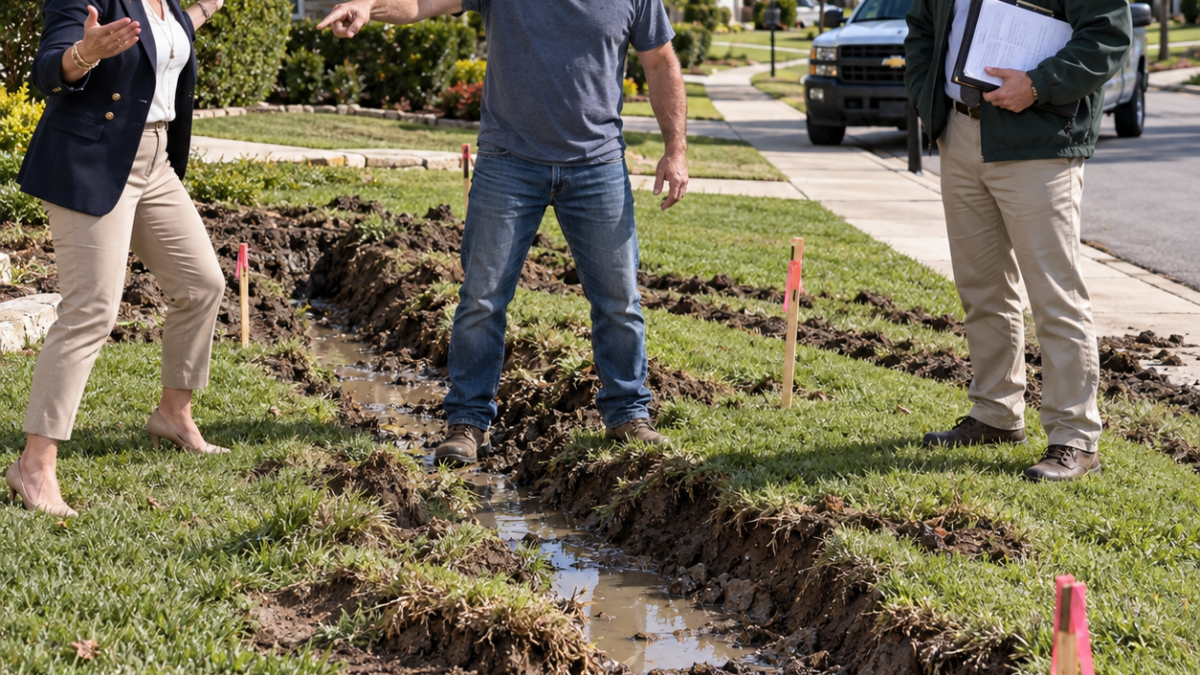
Pink stakes marked the actual boundary.
Blue marked the recorded drainage easement.
The illegal trench missed it by more than thirty feet at its closest point.
I was standing on the patio with coffee when Karen’s white SUV appeared.
Of course it did.
She stopped in front of my house and marched straight into the yard.
“Who authorized this?”
Gus looked through his instrument.
“Morning.”
“I asked who authorized this survey.”
“The owner.”
“This is HOA-managed property.”
That made Gus finally look at her.
“Ma’am, are you the county recorder?”
Karen frowned.
“No.”
“Licensed surveyor?”
“No.”
“Property owner?”
“The homeowners association has authority—”
“So that’s three noes.”
I nearly choked on my coffee.
Karen pointed toward the flags.
“You cannot simply put stakes wherever you want.”
“That would make surveying easier.”
Gus picked up the plat.
“These coordinates were recorded years before either of us showed up. I’m just finding them.”
Karen looked toward me.
“This changes nothing.”
“It changes the quality of the evidence,” I said.
She ignored me.
“Our easement gives us the right to correct drainage.”
Gus pointed toward the rear of my lot.
“Your recorded easement is back there.”
Then he pointed toward the trench.
“This is here.”
Karen’s face tightened.
“That map is outdated.”
“Then provide the recorded amended plat.”
“It was handled through the HOA.”
“Recorded where?”
She didn’t answer.
Gus handed her a preliminary sketch.
“You can show this to your attorney.”
Karen snatched it from him.
“This is harassment.”
Gus looked around my torn-up yard.
“Interesting choice of word.”
She stormed away.
That afternoon, his final report arrived.
It was everything Tom wanted.
Coordinates.
Measurements.
Photographs.
Recorded plat references.
A sworn professional conclusion that the excavation lay entirely within my private lot and outside the recorded drainage easement.
Tom called ten minutes after receiving it.
“This is excellent.”
“I thought you’d like it.”
“I’m drafting cease-and-desist letters now.”
“Send them to every board member.”
“Already planned.”
“Certified.”
“Jack.”
“Right.”
He laughed.
“You’re enjoying this.”
“No.”
“Yes, you are.”
I looked at the shattered maple.
“No,” I said again.
This time he believed me.
The civil letter went out that afternoon.
It demanded no further entry onto my property.
No construction.
No excavation.
No attempts to alter the drainage channel.
It demanded preservation of all board emails, contracts, drawings, invoices, meeting notes, and communications related to the project.
It also informed the HOA that we intended to seek damages for trespass and destruction of property.
Tom gave them ten days to propose restoration.
Meanwhile, I began doing what I was legally allowed to do.
Looking.
Not as prosecutor.
As resident.
I walked the neighborhood after dinner.
The drainage problem Karen claimed to be fixing was real.
Several uphill homes had standing water after hard rains.
But the pattern didn’t make sense until I reached Karen’s property.
She lived near the high point of the subdivision in the largest house on our street.
Her backyard had barely any exposed soil left.
A huge concrete patio occupied much of it.
Brick planters formed terraces.
A fountain sat in the center.
A broad driveway wrapped around the side.
Impervious surface everywhere.
Near the downhill corner of her property, I saw a four-inch pipe protruding beneath a retaining wall.
The soil below it was eroded.
I stood on the public sidewalk and photographed it.
A neighbor watering flowers looked over.
“Looking at Karen’s drain?”
I turned.
His name was Michael Reeves.
We had waved but never really spoken.
“You know about it?”
He laughed bitterly.
“Know about it? Every time we get a thunderstorm, half her backyard comes through that pipe.”
“Where does it go?”
“Into the Parkers’ yard. Then mine. Then George’s.”
“How long?”
“Couple years.”
“Did anyone complain?”
“Everybody.”
“What happened?”
He gave me a look.
“You’ve met Karen.”
That night, I pulled the subdivision’s approved grading plan from public county records.
I did not use internal investigative systems.
I didn’t need to.
The original plan showed each lot draining toward designated swales and common drainage infrastructure.
Karen’s retaining walls and hardscape modifications had substantially changed the way water moved across her lot.
Her pipe did not appear on the approved plan.
Then I looked at the proposed route of the HOA trench.
It began downhill from several affected yards, cut through George’s corner, crossed mine, and ended near the protected woodland.
It was not repairing the original system.
It was bypassing it.
Instead of fixing the modifications that caused the runoff problem, someone had decided to create a new channel and send the water somewhere else.
My backyard happened to be the shortest route.
The next morning, I went to my supervisor.
David Chen had prosecuted environmental violations for almost twenty years.
He had silver beginning at his temples, three coffee cups on his desk, and no patience for people who believed environmental law was optional.
I closed his office door.
“I need to disclose a personal conflict.”
He removed his glasses.
“That sounds promising.”
I placed a folder on his desk.
“My HOA excavated my property without permission.”
“That sounds less promising.”
“There may also be an environmental issue.”
I walked him through it carefully.
Only facts I had personally observed.
The trench location.
Its direction.
The publicly recorded wetland designation.
The unapproved-looking drainage alterations uphill.
The possibility that concentrated runoff could be directed toward the protected area.
I gave him copies of Gus’s survey, my photographs, Tom’s cease-and-desist, and the original subdivision plans.
When I finished, David leaned back.
“You have not used county authority to investigate this?”
“No.”
“Have you contacted environmental inspectors?”
“No.”
“Opened a file?”
“No.”
“Requested records in your official capacity?”
“No.”
“Good.”
He looked at the map.
“You’re out of this if we open anything.”
“I expected that.”
“You’ll be a complainant and witness.”
“Understood.”
He stared at the trench photographs.
“Who thought this was engineering?”
“Karen Peters.”
“That answer worries me.”
He picked up the phone.
“I’m sending this to compliance intake. They can decide whether an inspection is warranted without you touching it.”
“Thank you.”
“Don’t thank me. I haven’t decided whether your HOA is stupid or merely incompetent.”
He glanced again at the map.
“Although I have a working theory.”
I returned to my office.
Then I did something difficult.
Nothing.
I worked my assigned cases.
I reviewed discharge reports from an industrial facility.
I prepared a consent agreement involving illegal dumping.
I answered emails.
At noon, Sarah texted.
Any news?
I replied:
It’s with people who aren’t me. That’s where it belongs.
She sent back a heart.
For twenty-four hours, nothing happened.
Then Karen made the worst decision of her life.
I heard the cement truck before I saw it.
I was working from home that morning when the low rumble rolled down our street.
I looked through the front window.
A concrete mixer stopped outside my house.
A second truck followed carrying forms, rebar, and tools.
I walked outside.
The foreman met me near the curb.
“Mr. Corrigan?”
“Yes.”
“We’re lining the drainage channel.”
“No, you’re not.”
He sighed.
“I knew this was going to be one of those jobs.”
“Who hired you?”
“Eagle’s Landing HOA.”
“Did they tell you the property owner has issued a cease-and-desist?”
His face changed.
“No.”
I handed him a copy.
He read the first page.
“You have a lawyer?”
“Yes.”
“Survey?”
“Yes.”
“And the HOA still sent us?”
“Yes.”
He rubbed his forehead.
“I need to call my boss.”
Before he could, Karen arrived.
Her SUV stopped behind the cement truck.
She got out holding a letter.
“I suggest you move away from the work area,” she said.
I looked at the paper.
“What is that?”
“Our attorney’s response.”
“Did he advise you to continue construction?”
“He confirmed that the board has broad authority to protect common interests.”
“Did he specifically advise you to pour concrete on property the survey shows you do not own?”
Her eyes hardened.
“We are proceeding.”
The foreman stepped between us slightly.
“Ma’am, he gave me a cease-and-desist.”
“It’s baseless.”
“He says he owns the land.”
“The HOA has an easement.”
“He says the survey says you don’t.”
Karen waved the letter.
“Our counsel says otherwise.”
I held out my hand.
“May I see the letter?”
“No.”
That answered a different question.
I pulled out my phone.
Karen’s expression changed immediately.
“Oh, not this again.”
“Yes. This again.”
I began recording.
“Karen, you have been provided with a licensed survey establishing that this trench lies outside any recorded easement. My attorney has demanded that the HOA cease further work. You are now directing a contractor to install a permanent concrete drainage structure on my property without my consent. Is that correct?”
She stared at the camera.
“You’re twisting everything.”
“Then correct me.”
“The association has the authority to complete this project.”
“Are you ordering them to pour?”
“Yes.”
The foreman looked at her.
Then at me.
Then back at her.
“Lady…”
“Do it.”
He didn’t move.
Karen raised her voice.
“You have been paid.”
His jaw tightened.
“I’m calling my office.”
She stepped closer.
“If you walk off this job, I will sue your company for breach.”
That did it.
The foreman went to his truck.
I expected the job to stop.
It didn’t.
Twenty minutes later, he returned.
“My boss says the HOA accepted contractual responsibility for site authorization.”
I looked at him.
“And?”
“And he told me to proceed unless law enforcement or a court orders us otherwise.”
I felt disappointed in him.
But mostly I felt cold.
“All right.”
Karen smiled.
She thought I had surrendered.
Instead, I stepped backward.
“Proceed.”
Even she looked confused.
“What?”
“You heard me.”
I raised my phone.
“Do exactly what Karen instructed you to do.”
The first concrete slid down the chute.
Gray slurry filled the bottom of the trench.
Karen stood beside it with her arms folded.
I recorded everything.
Time.
Date.
Equipment.
Contractor.
Her direction.
The forms.
The rebar.
The concrete.
Every irreversible foot.
George appeared at his fence.
Mrs. Gable stood two houses down.
Other neighbors watched from windows.
Somebody asked me why I wasn’t calling the sheriff.
Because at that exact moment, the best thing Karen could do for every future proceeding was make her decision impossible to deny.
And she did.
For hours.
By late afternoon, my backyard contained a concrete flume wide enough to carry enormous volumes of stormwater.
It ended near the county woodland.
Karen walked over when the workers finished.
“Now perhaps you understand that threats don’t change the board’s responsibilities.”
I lowered my phone.
“Karen.”
“What?”
“You were served with a survey.”
“Yes.”
“A legal demand to stop.”
“Yes.”
“And you ordered this anyway.”
“I acted for the community.”
“I just wanted to hear you say it one more time.”
Her smile disappeared.
I went inside.
Thirty minutes later, my phone rang.
David Chen.
“Jack.”
“What happened?”
“An environmental compliance inspector drove past your subdivision after a complaint was screened this morning.”
My heartbeat changed.
“And?”
“He saw fresh concrete work.”
I looked outside.
“Karen finished the channel today.”
Silence.
“She what?”
“She poured it after receiving our civil cease-and-desist.”
David exhaled slowly.
“Do not touch anything.”
“I won’t.”
“Do not contact anyone as prosecutor.”
“I know.”
“An inspection team will handle it.”
“All right.”
“And Jack?”
“Yes?”
“You may want your lawyer available.”
“Already is.”
The county inspection took place the following morning.
I stayed home because inspectors needed access to my property.
I did not direct them.
I did not explain environmental law to them.
I answered factual questions and let them work.
They photographed the outlet.
Collected soil measurements.
Reviewed slope.
Examined the wetland buffer.
Tracked the drainage route uphill.
Then they reached Karen’s property.
She refused entry.
That lasted until she learned they could inspect relevant portions from public and common areas and seek appropriate administrative process for anything further.
By afternoon, they had enough to issue an immediate stop-work notice preventing any additional construction or connection of runoff to the channel.
The order was served on the HOA.
Karen called me within ten minutes.
I declined.
She called again.
And again.
Finally, Sarah picked up my phone.
“Don’t.”
I looked at her.
“You want to answer it?”
“No.”
“Then why—”
“I mean don’t let her drag you into whatever she wants now.”
The ringing stopped.
A text appeared.
YOU HAVE NO IDEA WHAT YOU’VE DONE TO THIS COMMUNITY.
Sarah read it.
Then she handed the phone back.
“She really believes that.”
“Yes.”
“That’s the frightening part.”
The county case moved away from me completely.
David assigned it to another prosecutor, Melissa Grant, who had no connection to Eagle’s Landing.
She interviewed me formally.
Tom attended.
Sitting on the witness side of the table felt strange.
Melissa was younger than I was, sharp, methodical, and unimpressed by drama.
“Mr. Corrigan, did you authorize excavation?”
“No.”
“Did you authorize concrete installation?”
“No.”
“Did the HOA provide you with a recorded easement?”
“No.”
“Did you personally initiate the county inspection?”
“I made a conflict disclosure to my supervisor and provided information as a complainant. Screening and enforcement decisions were handled independently.”
“Good.”
Tom leaned toward me afterward.
“You looked miserable.”
“I’m usually on the other side of that table.”
“You hated not being in control.”
“Yes.”
“That’s healthy.”
“Don’t push it.”
Two days later, the HOA and its board members received formal environmental notices requiring them to preserve the site, prevent discharge through the new channel, and cooperate with a technical evaluation.
Potential penalties were serious.
So was remediation.
The association would likely be responsible for removing the unpermitted structure and restoring affected property if the findings held.
The neighborhood learned about it almost instantly.
That was when George knocked on my garage.
He was sixty-eight and spent more time polishing his vintage motorcycle than riding it.
“I need to talk to you.”
“Come in.”
He stared at the floor.
“Part of that trench clipped my side yard.”
“I know.”
“I saw them do it.”
“Why didn’t you say anything?”
He gave a tired laugh.
“Because Karen has been president for ten years.”
“So?”
“So you haven’t lived here long enough.”
He told me about his brother’s RV.
Two hours parked at the curb.
Towed.
He told me about a fine over trash cans.
A warning over garage-door color.
Three inspection notices in one month after he challenged her at a meeting.
“She makes your life exhausting,” he said. “Eventually you pay just to make her stop.”
That sentence stayed with me.
Karen’s real power wasn’t the covenants.
It was fatigue.
She made resistance more expensive than surrender.
“She can’t retaliate against everyone forever,” I said.
George looked at me.
“No. But everyone thinks they’re alone.”
“Then maybe they shouldn’t be.”
The next person I spoke to was Mrs. Gable.
Her roses had flooded.
A storm had come through after the concrete channel was installed but before the county blocked its use.
Water collected badly near the unfinished lower end and spread into her garden.
She stood among soaked rose beds looking close to tears.
“My husband planted the first ones,” she said.
“How long ago?”
“Thirty-two years.”
I crouched beside one bush.
The ground was saturated.
“It never did this before?”
“Never.”
“Would you give a statement?”
She looked toward Karen’s house.
A few weeks earlier, she would have hesitated.
This time she didn’t.
“Yes.”
Then stories started finding me.
A family fined because a cedar swing set did not match the approved material.
A man ordered to move a flagpole.
A couple forced to repaint their house because their beige was not the right beige.
Parking violations.
Flower restrictions.
Trash-can threats.
Selective waivers.
Suddenly the trench seemed less like a bizarre one-time overreach.
It looked like the inevitable result of a decade without meaningful resistance.
Karen had spent years learning that nobody would stop her.
Why would she believe my property would be different?
George suggested a neighborhood meeting.
I agreed.
I expected fifteen people.
Thirty-six came.
Sarah moved chairs from the dining room.
People stood in the hallway.
Tom attended as my attorney.
I began with one rule.
“We deal in facts.”
A few people looked disappointed.
“No rumors. No threats. No inventing crimes because we dislike somebody. If we want accountability, we have to be better than what we’re challenging.”
Mrs. Gable nodded.
Mark Dalton, a former Marine whose flagpole had become an HOA controversy, folded his arms.
“Fine. Then show us the facts.”
So I did.
The survey.
The trench.
The recorded easement.
The cease-and-desist.
Video of Karen ordering the concrete pour.
The county stop-work notice.
The protected area map.
When I finished, nobody spoke for several seconds.
Then a woman near the back asked the question everyone cared about.
“What does this cost us?”
Tom answered.
“That depends on how the matter resolves. But restoration, engineering, professional fees, environmental compliance, and potential penalties could be substantial.”
A murmur spread.
George stood.
“And we’re paying because Karen decided to dig through Jack’s yard?”
“Ultimately,” I said, “the association is made of all of us. That’s why board accountability matters.”
Mark shook his head.
“No. I’m not paying for her ego without a fight.”
Others agreed.
Then George mentioned finances.
“The landscaping budget has never made sense.”
Several heads turned.
A woman named Denise said, “My husband says the same thing.”
Another resident raised his hand.
“Why did the entrance sign renovation cost almost forty thousand dollars?”
“Forty?” somebody repeated.
“It’s two stone columns.”
Questions came faster.
Clubhouse repairs.
Pool contracts.
Landscaping.
Consulting expenses.
For the first time, people stopped discussing isolated annoyances and started comparing information.
That was when Karen’s power truly began to crack.
Not when the county arrived.
Not when my lawyer wrote her.
When neighbors talked to each other.
We decided on three demands.
First, the board would cooperate fully with environmental remediation.
Second, homeowners would invoke the bylaws to seek removal of board members responsible for the project.
Third, the association’s finances would undergo an independent audit.
Karen called an emergency HOA meeting before we could call one ourselves.
Her flyer arrived on yellow paper.
It accused a “disgruntled new resident” of threatening the community with expensive litigation and government action.
She did not name me.
She didn’t need to.
Sarah read it in the kitchen.
“Disgruntled?”
“Apparently.”
“You were calmer than I was when they destroyed the tree.”
“Maybe that’s what upset her.”
Lily sat at the table coloring.
She looked up.
“Is the mean lady going to fix Danny’s tree?”
The room went quiet.
Sarah glanced at me.
I crouched beside our daughter.
“The tree we had is gone.”
Her face fell.
“But we’re going to plant another.”
“Same kind?”
“Same kind.”
“Big one?”
“As big as we can manage.”
She considered that.
“Can we put the stone back?”
“What stone?”
“The little one I painted.”
I had forgotten.
When we planted the first tree, Lily had painted a small flat rock blue and written a crooked D on it.
It disappeared during the excavation.
“We’ll find it if we can.”
She nodded.
That mattered more to her than fines, easements, or environmental law.
The HOA meeting was held Tuesday night.
The clubhouse capacity was about fifty.
More than a hundred showed up.
People stood outside the doors and along the pool deck.
Karen sat at the front with Harold, the treasurer, Brenda, the secretary, and another board member named Calvin Ross.
She wore a dark navy suit.
No tracksuit.
No golf cart persona.
This was Karen attempting stateswoman.
She struck the gavel.
“Order.”
Nobody stopped talking.
She struck it again.
“ORDER.”
Eventually the room quieted.
“As all of you know, the board acted responsibly to address a serious community drainage problem.”
Mark Dalton laughed loudly.
Karen glared.
“The project was based on our authority under the governing documents and intended to protect homeowners.”
George muttered, “Which homeowners?”
People laughed.
Karen raised her voice.
“Unfortunately, one resident has chosen to transform a minor property disagreement into litigation that threatens every family in Eagle’s Landing.”
She looked directly at me.
“The lawsuits and government fines we now face are not the board’s fault. They are the consequence of one individual’s refusal to cooperate for the greater good.”
Mark stood.
“That’s a lie.”
Karen slammed the gavel.
“You are out of order.”
“So is your ditch.”
Applause erupted.
“Sit down!”
“No.”
Mark held up our petition.
“We’re demanding your resignation.”
Karen froze.
The room became deafening.
Dozens of people began clapping.
Others shouted agreement.
Karen’s face reddened.
“This meeting has an agenda!”
George stood.
“So do homeowners.”
“You are not recognized.”
“I don’t need personal recognition from you to exercise rights under the bylaws.”
He opened a binder.
“Section Nine, paragraph four.”
Karen’s expression changed.
I watched Harold carefully.
He had gone pale.
George continued.
“A majority of the membership can remove directors under the procedure stated here.”
“We do not have a verified majority.”
Mark lifted the petition.
“We do.”
Karen turned toward Harold.
“Do something.”
He swallowed.
“Karen…”
“Verify the signatures.”
“Maybe we should hear them.”
Her head snapped toward him.
“What?”
“The county papers…”
“Those are intimidation.”
“My wife is terrified.”
The room quieted.
Karen stared at him as though he had betrayed her personally.
“We discussed this.”
“No. You discussed it.”
That sentence opened a door.
Brenda looked at Harold.
Calvin stared at the table.
Karen stood.
“You all approved the project.”
Harold shook his head.
“You told us legal had cleared it.”
“They did.”
“Then show us.”
Karen’s mouth opened.
Nothing came out.
I stood.
I didn’t want to.
But everyone looked toward me.
“I’m not here as a prosecutor tonight.”
Karen laughed bitterly.
“Convenient.”
“I’m here as Lot Seventy-Two.”
A few people smiled.
“The law is being handled by people who are not me because I disclosed my conflict.”
I held up the survey.
“This is a property dispute because the HOA entered land it did not own.”
Then I lifted the county notice.
“It is an environmental matter because the drainage project was constructed without required review and threatened protected resources.”
I pointed toward the audience.
“And it is a community governance problem because every person in this room may have to pay for decisions they were never told about.”
Karen shook her head.
“You’re manipulating them.”
“No.”
I looked toward Mrs. Gable.
“You flooded her roses.”
Then George.
“You crossed his lot.”
Then Mark.
“You threatened him over a flag.”
A young mother raised her hand.
“And my daughter’s swing set.”
Another voice:
“My roof color.”
Another:
“My RV.”
Another:
“My fence.”
The room changed.
Karen could fight one accusation at a time.
She couldn’t fight fifty lived experiences speaking at once.
She banged the gavel.
Nobody cared.
Mark raised the petition.
“We call the vote.”
Karen shouted, “This is an illegal coup!”
George replied, “No. It’s the bylaws.”
The irony was so perfect that even Tom smiled.
The vote began.
Karen Peters: removed.
Brenda: removed.
Calvin: removed.
Harold stood before his vote.
“I resign.”
Karen turned on him.
“You coward.”
He looked at her.
For the first time, his voice was steady.
“I should’ve stopped you.”
Then came the interim board.
Someone nominated me.
I declined immediately.
“I’m involved in active litigation and an enforcement matter. I cannot serve.”
Mark Dalton became interim president.
George joined him.
So did Mrs. Gable.
Their first motion authorized full cooperation with environmental regulators.
Second: obtain independent legal counsel.
Third: secure professional bids for removal and restoration of the illegal channel.
Fourth: commission a forensic financial audit.
Every motion passed.
Karen remained seated at the front table after the meeting ended.
People walked past her.
Not laughing.
Not gloating.
That made her defeat more complete.
She had always fed on reactions.
Now people simply moved on.
As I walked past, she whispered, “You destroyed this neighborhood.”
I stopped.
“No.”
I looked at the empty board seats.
“I think we’re finally meeting it.”
Then I went outside to my family.
Lily ran toward me.
“Did you win?”
I picked her up.
“No.”
She frowned.
“The neighborhood did.”
She considered this carefully.
“Can we plant Danny’s tree now?”
“Soon.”
That was the victory she cared about.
The new board moved fast.
They hired independent HOA counsel.
The lawyer’s first reaction to the survey and construction file was apparently unprintable.
Within days, Mark called.
“We’re accepting responsibility for restoration.”
“All of it?”
“All of it.”
“Concrete removal?”
“Yes.”
“Regrading?”
“Yes.”
“Sod?”
“Yes.”
“Arborist?”
“Yes.”
“Tree?”
He paused.
“We want to do something better with the tree.”
“What?”
“Let us replace it with a mature silver maple.”
I was silent.
“Jack?”
“I’m here.”
“Fifteen feet if the nursery can source one.”
I looked through the kitchen window at the broken stump still lying near the trench.
“Lily would like that.”
“We thought maybe the community could help plant it.”
That surprised me.
“I’ll ask Sarah.”
“Do that.”
The removal crew arrived the following week.
Different contractor.
Different attitude.
The superintendent met me first.
“We have the survey, engineering instructions, restoration plan, and written authorization from both owner and HOA.”
I smiled.
“Already an improvement.”
They cut the concrete into sections.
Diamond saws screamed through the channel.
Small excavators lifted slabs from the ground.
Neighbors came outside to watch.
Nobody cheered at first.
It felt too serious.
The concrete channel represented wasted money, destroyed trust, and weeks of stress.
Then the final section came free.
Mrs. Gable started clapping.
George joined.
Then everyone.
I did too.
Karen’s blinds remained closed.
The trench was backfilled with clean soil.
Engineers restored the intended grade.
A certified arborist examined the mature oaks.
One root system had been nicked but remained stable.
New sod went down.
Within two days, the scar across my yard had become difficult to see.
Then came the tree.
Sarah, Lily, and I went to the nursery.
Lily chose it.
Not me.
A fifteen-foot silver maple with a straight trunk and wide young canopy.
“This one,” she said immediately.
“How do you know?”
“It looks strong.”
That was enough.
Saturday morning, almost fifty neighbors gathered.
The nursery crew prepared the hole.
Mark and I helped guide the root ball.
George held the tree upright while soil went back.
Mrs. Gable brought water.
Then Lily appeared holding something behind her back.
“I found it.”
She opened her hand.
The blue stone.
Mud-stained.
Paint chipped.
But the crooked D was still visible.
“Where?”
“Mom found it by the fence.”
Sarah smiled.
“I cleaned it.”
My throat tightened.
Lily placed the stone at the base of the new maple.
“For Uncle Danny.”
I crouched beside her.
“He would’ve liked that.”
“Did he like trees?”
I laughed softly.
“He liked shade.”
She nodded as if this confirmed everything.
Mrs. Gable had also painted a small stone.
It said:
IN MEMORY — AND FOR NEW BEGINNINGS
We placed it beside Lily’s.
For the first time since the trench appeared, the backyard felt like ours again.
But while our land was healing, the audit was beginning.
The forensic accountant was Elena DeLuca.
She had the unnerving calm of someone who enjoyed finding numbers other people hoped were invisible.
Harold cooperated.
Completely.
Bank statements.
Invoices.
Contracts.
Checks.
Expense reports.
Electronic files.
Ten years of records.
Three weeks into the audit, Mark called an emergency closed session with counsel.
Because I was a plaintiff and witness, I did not participate in board decision-making.
But Tom received relevant disclosures through the litigation process, and law enforcement later interviewed me regarding particular contracts tied to the ditch.
The emerging picture was ugly.
Prestige Landscape Solutions had received unusually large payments.
Corporate records linked the company to a relative of Karen’s.
Invoices were vague.
Services often could not be matched to actual work.
There were unexplained transfers.
Inflated project costs.
Contractors who appeared repeatedly without competitive bidding.
The drainage project itself had been billed at an extraordinary price compared with market estimates.
When evidence suggesting financial crimes became substantial, the board’s attorney referred the matter to the appropriate authorities.
The trench had exposed something nobody expected.
Not simply Karen’s arrogance.
Money.
A lot of it.
The criminal investigation lasted months.
That was more realistic than the neighborhood wanted.
People expected police cars the next morning.
Real cases move differently.
Subpoenas.
Bank records.
Interviews.
Forensic accounting.
Attorney conferences.
Waiting.
Karen stopped attending community events.
Her white SUV rarely left the driveway.
The woman who once patrolled Eagle’s Landing daily became invisible.
Then a FOR SALE sign appeared.
Nobody celebrated publicly.
Dave—not the same Dave from my later life, but a neighbor two streets over—sent me a photo with the message:
End of an era.
I deleted it.
I didn’t need a trophy.
My civil case settled first.
The HOA’s insurers, the association, and individual defendants negotiated through counsel.
I recovered restoration-related losses, professional costs, fees as permitted, and additional damages reflecting the seriousness of the trespass and destruction.
The exact terms became confidential.
That was fine.
Money had never been why I fought.
Tom called after the final signatures.
“Congratulations.”
“For what?”
“You won.”
“My yard was already restored.”
“You’re impossible.”
“I know.”
He became quiet.
“Danny’s tree?”
“Growing.”
“Then I suppose that counts.”
The environmental enforcement matter resolved through a consent agreement with the new HOA leadership.
The association accepted responsibility for the unauthorized drainage work.
It paid a substantial penalty.
More importantly, it funded environmental monitoring and hired licensed engineers to redesign stormwater management correctly.
No more trench across private yards.
No dumping concentrated runoff toward protected land.
The solution used legal easements, common property, bioswales, infiltration areas, and properly designed drainage features.
Karen’s massive patio complicated everything.
The engineering report identified her property alterations as a major contributor to runoff problems in that portion of the subdivision.
By then, her house was under contract.
The buyers were given full disclosures.
They were a young couple named Aaron and Melissa with a toddler.
I met them shortly after closing.
Aaron came to my door.
“You’re Jack?”
“Depends why you’re asking.”
He laughed nervously.
“I bought the Peters house.”
“My condolences.”
That broke the tension.
“We know the story.”
“I’m sorry.”
“No, no. We knew before closing.”
He looked toward my backyard.
“The engineer says a lot of concrete has to come out.”
“Yes.”
“We’re doing it.”
“You don’t have to explain yourself to me.”
“I know. I just wanted you to know.”
A month later, jackhammers started behind Karen’s former house.
I was on the tire swing with Lily when we heard them.
Actually, she was on the swing.
I was pushing.
The sound echoed across the neighborhood.
Concrete breaking.
Sarah stepped onto the patio.
“What’s that?”
I listened.
Then I smiled.
“The drainage plan.”
Karen’s enormous patio was being partially removed.
Permeable landscaping replaced sections of it.
The illicit discharge pipe disappeared.
Rain gardens and controlled drainage replaced the hardscape that had sent water downhill for years.
The problem was finally being solved where it actually existed.
Not diverted through somebody else’s property.
Solved.
Lily swung forward.
“Higher!”
I pushed.
She laughed.
Behind her, the new maple moved in the breeze.
That sound mattered more than jackhammers.
Months later, the financial case reached its conclusion.
Authorities charged Karen with offenses arising from the misuse of association funds.
The audit and financial records formed the core of the case.
Harold cooperated.
So did contractors.
Faced with extensive documentary evidence, Karen eventually accepted a plea agreement.
She was ordered to pay restitution and received probation and a period of home confinement under the terms of the sentence.
She was also barred from serving in positions involving fiduciary control during the applicable restrictions imposed by the court and agreements.
People in the neighborhood wanted a dramatic ending.
Prison gates.
Handcuffs.
A judge yelling.
Life rarely gives you movie endings.
What Karen received was quieter.
She lost the position that had defined her.
She lost money.
She lost the trust of everyone around her.
She had to repay what evidence showed had been improperly taken.
And, perhaps worst of all for someone who had built her identity around control, she became irrelevant to Eagle’s Landing.
The neighborhood moved on.
Mark served as interim president for a year.
Then he stepped aside voluntarily.
That gesture alone told me how much things had changed.
Karen had treated office like ownership.
Mark treated it like a temporary responsibility.
The first truly competitive HOA election in years drew record participation.
Five candidates ran for three seats.
Homeowners received detailed budgets.
Meetings were posted publicly.
Major contracts required competitive bids.
Financial statements were available online.
The architectural rules were revised.
We still had standards.
Nobody wanted a junkyard next door.
But the absurd restrictions disappeared.
Nobody measured grass with a ruler.
A child’s playset did not require a theological debate over cedar.
Reasonable disability modifications received expedited review.
Appeals were heard by people who had not issued the original violation.
Conflict-of-interest rules were strengthened.
And every major drainage decision required qualified engineering review.
Tom once joked that Karen had accidentally created the most legally paranoid HOA in the county.
I told him I considered that a compliment.
The biggest change was not procedural.
It was social.
People talked.
Before the ditch, residents behaved like passengers on separate airplanes.
Same destination.
Same turbulence.
Nobody making eye contact.
Afterward, we knew one another.
Mrs. Gable taught Lily how to prune roses.
George started riding his motorcycle again because Mark convinced him that polishing a machine forever was a crime against engineering.
Neighborhood cookouts returned.
Children rode bikes through the cul-de-sac.
People challenged the board without whispering.
And board members sometimes lost votes without treating disagreement as betrayal.
One evening, about six months after the restoration, I sat on the patio with Sarah.
Lily was swinging from the oak.
The lawn had blended together so completely that you couldn’t see where the trench had been.
Danny’s new maple was taking root.
Its leaves moved softly above the blue stone.
Sarah handed me a beer.
“You got your quiet life.”
I looked around.
George was arguing with Mark over a grill two houses away.
Mrs. Gable was calling somebody because their dog had escaped.
Children were screaming through a sprinkler.
A lawn mower started.
“I’m not sure this qualifies.”
“You know what I mean.”
I did.
She leaned back.
“Do you regret buying here?”
I thought about the question.
“Yes.”
She laughed.
“That was fast.”
“I regretted it repeatedly.”
“And now?”
I watched Lily jump from the swing and run toward the maple.
“Ask me again in ten years.”
Sarah rested her head against my shoulder.
“You’re impossible.”
“I’ve heard.”
The following summer, the first major storm hit after the new drainage system was completed.
Rain hammered Eagle’s Landing for nearly two hours.
Old me—the man Karen had created—would have gone outside with measuring equipment.
I didn’t.
I stayed at the kitchen window with coffee.
Water moved through the new bioswales.
It slowed.
Spread.
Infiltrated.
Designed overflow traveled through legal drainage infrastructure.
Mrs. Gable’s roses remained above water.
George’s side yard stayed intact.
My lawn drained normally.
The wetland received no concentrated artificial blast from a concrete chute.
Just natural runoff filtered through the system as engineers intended.
Sarah walked beside me.
“Are you monitoring the rain?”
“No.”
“You’ve been standing there fifteen minutes.”
“I’m appreciating engineering.”
“That is the saddest sentence you’ve ever spoken.”
I put an arm around her.
“It’s beautiful.”
“It’s a ditch.”
“Bioswale.”
She left the room shaking her head.
A few weeks later, Mark asked whether I would attend the annual HOA meeting.
“Why?”
“Because people want you there.”
“That is never a good reason.”
“The board wants to dedicate something.”
That sounded dangerous.
“What?”
“Show up.”
I did.
Nearly eighty homeowners attended.
No emergency.
No scandal.
Just an annual meeting.
Budget.
Landscaping contracts.
Pool maintenance.
Normal boring governance.
It was glorious.
At the end, Mark walked outside with everyone.
Near the community entrance, workers had planted three native trees around a new rain garden.
A small plaque stood beside them.
I expected some reference to the drainage project.
Instead it read:
EAGLE’S LANDING COMMUNITY WATERSHED GARDEN
RESTORED BY THE RESIDENTS — FOR THE LAND WE SHARE AND THE NEIGHBORS WE PROTECT
No names.
No villains.
No heroes.
I liked that.
Mark stood beside me.
“We thought about putting Karen’s name on the old concrete chunks.”
“Glad you resisted.”
“George suggested selling them as souvenirs.”
“That sounds like George.”
He looked toward the rain garden.
“You know what bothered me most?”
“What?”
“That we all knew.”
“Knew what?”
“That something was wrong here.”
He gestured toward the houses.
“Maybe not the money. But the bullying. The retaliation. Everybody knew.”
I nodded.
“We just kept telling ourselves it wasn’t our problem until it was.”
“That’s how these things grow.”
Mark looked at me.
“Would you do it all again?”
I looked toward my house.
From where we stood, I could just see the top of Danny’s maple above the fence.
“I’d rather she had never touched my yard.”
“That’s not what I asked.”
“I know.”
I thought about Karen’s first words to me.
Your personal property line is irrelevant when the greater good is at stake.
She had been wrong about almost everything.
But the irony was that the fight eventually did become about the greater good.
Just not in the way she meant.
The greater good was not sacrificing one person’s rights because somebody with a title found it convenient.
It was creating systems where nobody’s rights depended on whether the person in charge liked them.
It was protecting shared resources without trampling private property.
It was managing money transparently.
It was letting neighbors disagree.
It was admitting mistakes before they became disasters.
And it was knowing that authority is not the right to be obeyed.
Authority is the obligation to deserve trust.
“Yes,” I finally told Mark.
“I’d do it again.”
That fall, Danny’s maple changed color for the first time.
Gold first.
Then orange along the edges.
Lily came running inside.
“Dad! Come look!”
I followed her outside.
She stood beneath the branches.
“Danny’s tree is changing.”
“That’s what maples do.”
“I know.”
She rolled her eyes with eight-year-old expertise.
“I mean it’s pretty.”
I looked up.
She was right.
Sunlight came through the leaves.
The trunk was stronger now.
Roots settled deep into restored soil.
Lily touched the blue stone.
“Do you think Uncle Danny knows?”
That question froze me.
Children ask enormous things casually.
I crouched beside her.
“I don’t know what people can see after they’re gone.”
She waited.
“But I know I remember him.”
“Me too.”
“You never met him.”
“You tell me stories.”
That nearly broke me.
For years, I had believed memory was something I carried privately.
A weight.
A duty.
A list of names.
But Lily had inherited Danny through stories.
She knew he hated powdered coffee.
She knew he sang terribly.
She knew he once mailed Sarah a stuffed camel because he said every Army family needed “desert livestock.”
She knew he had a daughter.
She knew he had been brave.
And now she knew his tree.
Maybe that was enough.
Sarah joined us.
She slipped her hand into mine.
For a while, the three of us stood under the maple.
No HOA.
No prosecutor.
No lawsuit.
Just a family beneath a tree.
That evening, I found the folder containing the original photographs.
The trench.
Concrete.
Karen’s face.
The broken sapling.
I hadn’t looked at them in months.
The anger was still there.
But it felt different.
Distant.
Useful only as evidence of what had happened.
Not something I needed to live inside.
I closed the folder.
Then I went outside and watched Lily chase fireflies.
Years later, people in Eagle’s Landing still tell the story.
Usually badly.
According to neighborhood legend, Karen dug a canal through my yard because she hated my tree.
Then I personally arrested her using a prosecutor badge.
Then the EPA descended from helicopters.
Then she went to prison for twenty years.
None of that happened.
The truth was less ridiculous and more important.
A homeowners association made an unauthorized decision.
Its president believed nobody would challenge her.
A contractor dug where he should not have dug.
A memorial tree was destroyed.
When confronted, the president escalated instead of admitting error.
That escalation exposed environmental problems.
Neighbors began comparing experiences.
Financial questions emerged.
An audit followed.
Evidence was referred to authorities.
Legal processes did what they are supposed to do when people document facts and insist that procedures matter.
Slowly.
Imperfectly.
But effectively.
I never personally prosecuted Karen.
That would have been improper.
I did something more valuable.
I stepped aside and let independent professionals examine what I had found.
For someone used to taking control, that was difficult.
But justice cannot depend on whether the victim happens to know the law.
It has to survive impartial review.
That lesson mattered to me as much as anything else.
One afternoon, years after the fight ended, George walked over while I was trimming around the maple.
“Remember the trench?”
“Unfortunately.”
“I was thinking.”
“That’s dangerous.”
He ignored me.
“You know why Karen lost?”
“I can think of several reasons.”
“She thought everyone was scared of her.”
“They were.”
“No.”
He shook his head.
“We were tired.”
I stopped trimming.
“There’s a difference.”
He was right.
Fear feels powerful.
Fatigue looks like surrender.
But tired people can wake up.
A neighbor can knock on a garage.
A widow can sign a statement.
A Marine can stand at a meeting.
A treasurer can decide he has had enough.
A hundred quiet people can become a majority.
Karen’s authority had looked enormous because everybody experienced it alone.
The moment we compared notes, it shrank.
That may be the part of the story I remember most clearly.
Not the concrete being cut out.
Not the legal settlement.
Not even Karen losing office.
The living room.
Thirty-six people.
Some sitting on stairs.
Some standing.
All suddenly realizing:
It wasn’t just me.
That sentence can change a community.
Years after the original trench, Eagle’s Landing was hit by another brutal storm.
Rain fell all night.
I woke before dawn and walked outside.
Old habits.
The new drainage system worked.
Water flowed through the bioswales.
The rain garden filled gradually.
No yards flooded.
The wetland remained protected.
I walked to Danny’s tree.
Water dripped from every leaf.
The trunk was thick enough now that I could no longer wrap one hand around it.
The blue stone remained at the base, faded almost gray.
Mrs. Gable’s stone sat beside it.
IN MEMORY — AND FOR NEW BEGINNINGS.
I thought about replacing them.
Then I decided not to.
Weather had worn them.
That was part of the story.
Sarah opened the back door.
“You coming in?”
“In a minute.”
“You’re getting soaked.”
“I know.”
She disappeared inside.
I put my palm against the maple.
I had come to Eagle’s Landing wanting peace.
For years, I thought peace meant nothing happening.
No deployment.
No courtrooms.
No conflict.
No phone ringing at midnight.
No names added to memory.
I was wrong.
Peace is not the absence of problems.
Peace is knowing problems do not own you.
It is knowing your family is safe.
Your home is yours.
Your neighbors will speak when something is wrong.
Your community can correct itself.
Your dead are remembered.
Your daughter can grow up beneath a tree planted in honor of a man she never met.
Karen had tried to turn my backyard into a drainage corridor.
Instead, she exposed everything that had been rotting beneath the surface of Eagle’s Landing.
The fear.
The financial secrecy.
The bad drainage.
The selective enforcement.
The belief that one person’s convenience mattered more than everybody else’s rights.
The trench was ugly.
But once it opened, nothing hidden stayed buried for long.
Years later, there is no sign of it.
The lawn is green.
The oak still holds Lily’s swing, though she is getting too old for it now.
Mrs. Gable’s roses bloom every spring.
George still complains about HOA meetings and attends every single one.
Mark refuses to run for president again no matter how often people ask.
The rain garden at the entrance is full of native flowers.
And Danny’s maple is taller than the roofline.
Sometimes new homeowners ask me why there are two old painted stones beneath it.
I tell them.
Not the whole story.
Not unless they want it.
I tell them about Danny.
About the sapling.
About the day it was destroyed.
About my daughter choosing the replacement.
Then, if they ask why a homeowners association would ever destroy somebody’s memorial tree to dig an unauthorized drainage ditch, I usually smile.
“That,” I say, “is a longer story.”
Because in the end, Karen’s punishment wasn’t the part that mattered most.
Yes, she lost her office.
Yes, she faced legal and financial consequences.
Yes, the money was traced and restitution ordered.
Yes, the concrete she poured across my yard was cut apart and hauled away.
But revenge alone would have left us exactly where we started—different people holding the same grudges.
What made the ending satisfying was what replaced her system.
Transparency replaced secrecy.
Engineering replaced improvisation.
Discussion replaced intimidation.
Neighbors replaced subjects.
And where a broken memorial tree once lay beside an illegal trench, a stronger tree now grows.
That is the part I keep.
Not Karen’s face when she lost the vote.
Not the legal notices.
Not the settlement check.
The tree.
Every spring it opens new leaves.
Every summer it throws a little more shade.
Every fall it burns gold in the afternoon sun.
And every winter it stands bare against the sky, looking fragile from a distance but holding its ground.
Just like memory.
Just like community.
Just like people who finally decide that being peaceful does not mean being powerless.
My name is Jack Corrigan.
I came to Eagle’s Landing because I wanted a quiet place to raise my daughter.
An HOA president dug a trench through my backyard and nearly convinced me I had made the worst decision of my life.
Instead, that trench exposed a decade of problems nobody had wanted to confront.
It forced neighbors to speak.
It forced leaders to answer questions.
It forced a broken system into daylight.
And after everything was investigated, removed, repaid, restored, and rebuilt, I finally received the thing I had wanted from the beginning.
Not victory.
Not revenge.
Not even vindication.
Peace.
The kind you can hear when your daughter is laughing beneath a maple tree, rain is draining exactly where it should, and nobody in the neighborhood believes their voice is too small to matter anymore.



