PART 2: HOA Demolished My House Over Fake Dues—Then the President Saw My FBI Badge and Went White
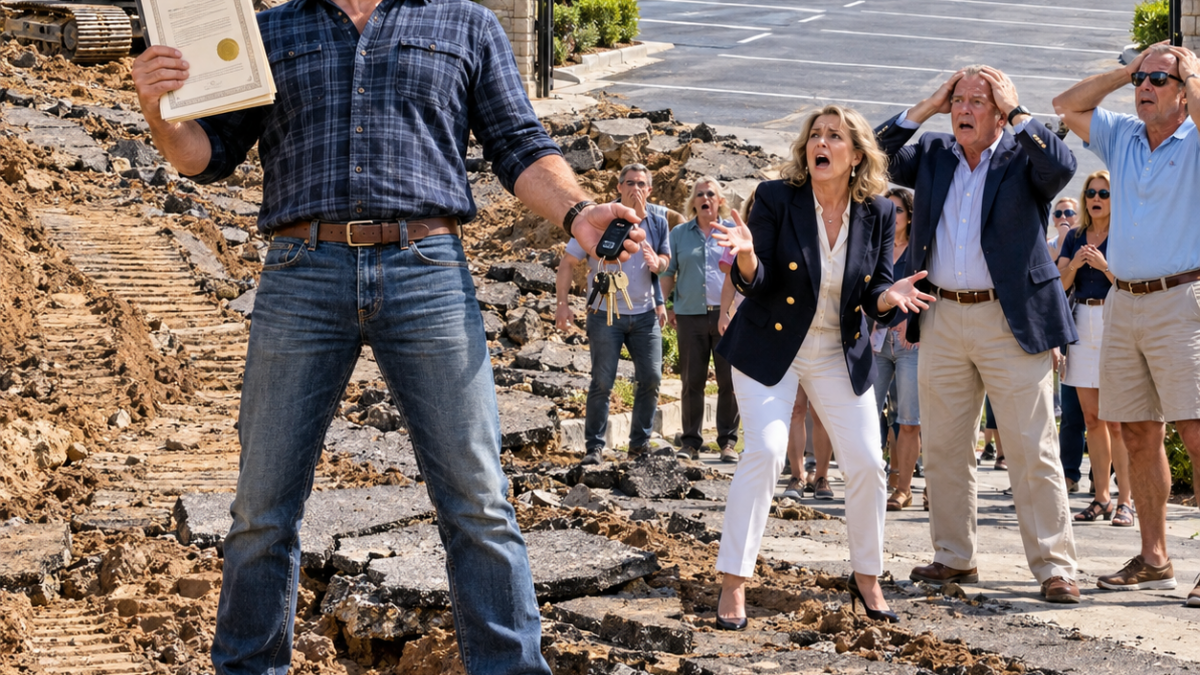
PART 2
The next morning, I was standing at the Douglas County offices before the doors opened.
I had slept maybe two hours.
Every time I closed my eyes, I saw the same thing: my father kneeling beside that porch railing with a cordless drill between his knees, laughing after he put that dent in the wood.
Then the image would change.
Bulldozer tracks.
Broken drywall.
The yellow demolition notice.
By seven-thirty, I had stopped trying to sleep.
I showered, dressed, took my laptop and a legal pad, and drove straight to county code enforcement.
I wasn’t there as an FBI agent.
Not yet.
I was there as a homeowner whose house had somehow been legally erased while he was working in another state.
At the records desk, I slid the demolition notice number toward the clerk.
“I need the complete permit file for this property.”
She typed for a moment.
“4738 Pinewood Drive?”
“Yes.”
She glanced at me.
“You’re the owner?”
“I was yesterday.”
Her expression changed.
Twenty minutes later, she returned carrying a file.
Permit number 2025-4482.
Applicant: Diane Merrick, President, Pinewood Estates Homeowners Association.
The stated reason for demolition read:
ABANDONED PROPERTY / DELINQUENT HOA ASSESSMENTS.
Amount allegedly owed:
$9,180.
I almost laughed.
Not because anything was funny.
Because numbers are supposed to mean something.
Mine did.
Thirty-six payments at eighty-five dollars each.
Her number looked official only because somebody had typed it into a government form.
I kept reading.
Three certified notices had supposedly been sent to me.
November.
December.
January.
All marked delivered.
I checked the addresses.
The first went to an apartment complex fifteen miles away where I had never lived.
The second went to the same street but a unit number that didn’t exist.
The third went to a commercial mailbox store in another town.
I looked up at the clerk.
“Who supplied these addresses?”
She checked the application.
“The applicant.”
“Diane Merrick?”
“Yes.”
“And nobody verified them against the property records?”
“The applicant certified that they were valid contact addresses for the owner.”
That single sentence told me almost everything.
Diane hadn’t merely made a mistake.
She had created a paper trail.
A false one.
The permit file also contained an HOA ledger.
My name was at the top.
Thirty-six months of supposed nonpayment appeared underneath.
Zero received.
Late fees.
Administrative penalties.
Collection costs.
Every line was false.
I opened my banking records beside the ledger.
January payment.
February payment.
March payment.
Every month.
Same HOA account.
Same automatic transfer.
Same confirmation.
I felt something settle inside me.
Yesterday I had been furious.
That morning I became methodical.
Anger makes people move quickly.
Evidence makes them dangerous.
I photographed the entire file and requested certified copies.
Before leaving, I asked one more question.
“Who performed the demolition?”
The clerk checked.
“Robert Merrick Construction.”
I stared at the name.
“Related to Diane Merrick?”
“I wouldn’t know.”
I did.
Robert Merrick was her husband.
The HOA president had supplied the allegedly delinquent account records, supplied the false notification addresses, obtained the demolition approval, and then awarded the demolition work to her husband’s company.
I drove directly to Diane’s house.
Her SUV was in the driveway.
I knocked.
She answered wearing expensive workout clothes, her blonde hair pulled back tightly.
For half a second, surprise crossed her face.
Then came the smile.
Not friendly.
Satisfied.
“Daniel,” she said. “I heard you were away.”
“You demolished my house.”
She folded her arms.
“The association acted pursuant to its authority. Your property was delinquent and abandoned.”
“I paid every assessment.”
“Our records disagree.”
“I have the bank records.”
“Then take it up with the management company.”
“You supplied fake addresses to the county.”
Her smile tightened.
“I don’t know what you’re talking about.”
“You claimed three notices were delivered to me. None were sent to an address connected to me.”
“That’s a county issue.”
“No. The addresses came from your application.”
For the first time, she stopped looking amused.
Only for a moment.
Then she recovered.
“If you believe there’s been an administrative error, file an appeal with the board.”
I looked at her.
“You demolished the structure. What exactly am I appealing? Whether you put it back?”
Her jaw moved.
“We followed the process.”
“You fabricated the process.”
“That is a serious accusation.”
“So is demolishing somebody’s house.”
She reached for the door.
“We’re finished.”
“Diane.”
She stopped.
I took my credentials from my jacket.
I didn’t shove them in her face.
I simply opened the case and held it where she could see.
Her eyes moved from the photograph to the seal, then to the words beneath my name.
FEDERAL BUREAU OF INVESTIGATION.
SPECIAL AGENT.
For the first time since I arrived, Diane Merrick had nothing to say.
“I’ve spent fifteen years investigating fraud,” I told her quietly. “Most of that in financial crimes.”
Her lips parted.
“You’re FBI?”
“Yes.”
The color left her face.
I closed the credentials.
“And the records you used to destroy my house don’t look like an administrative error.”
She stared at me.
I continued.
“They look intentional.”
“You’re threatening me.”
“No. I’m telling you what I found.”
“You can’t use the FBI because you’re angry about an HOA dispute.”
“You’re right.”
That answer seemed to confuse her.
I stepped back from the porch.
“So I’m going to handle the destruction of my home through my attorney. But if the evidence points somewhere else, I’ll make sure it goes to the people who are allowed to follow it.”
For the first time, she looked afraid.
Not terrified.
Not yet.
But afraid.
I turned and walked away.
Behind me, the door slammed hard enough to shake the glass.
The following morning, I met Sarah Kim.
Sarah had handled two real estate closings for me and had the temperament of somebody who viewed panic as a waste of billable time.
She spread the documents across a conference table.
My bank statements.
The HOA ledger.
The county application.
The false addresses.
The demolition contract issued to Robert’s company.
She read silently for almost fifteen minutes.
Then she leaned back.
“This is ugly.”
“How ugly?”
“If these documents are authentic, your HOA represented to the county that you were delinquent when you weren’t, represented that you were notified at addresses that weren’t yours, and used those representations to obtain authority that led to demolition of your home.”
“That’s my reading.”
“And the HOA president’s husband did the demolition.”
“Yes.”
Sarah exhaled.
“At minimum, we have a very serious civil case. Property destruction, fraud, misrepresentation, potentially several statutory claims depending on how the county process was used.”
“I want the financial records.”
She looked at me.
“For your account?”
“For the HOA.”
“All of them?”
“Six years.”
Her eyes narrowed.
“Why?”
“Because Diane didn’t just invent a balance. She created thirty-six months of fake accounting.”
Sarah tapped the ledger.
“You think this goes beyond you.”
“I think people who fabricate financial records rarely discover the habit on Tuesday morning.”
That almost made her smile.
“You want contracts, invoices, budgets, bank records, vendor lists?”
“Everything I’m legally entitled to as a member.”
Sarah nodded.
“That I can do.”
The request went out that afternoon.
The HOA resisted immediately.
Their attorney wrote that the documents were internal association materials and disclosure required board approval.
Sarah replied with the relevant Colorado records provisions and a deadline.
Ten business days.
Produce them or explain the refusal to a judge.
Two weeks later, four banker’s boxes arrived.
I carried them inside the small rental house where I was living temporarily and set them on the kitchen table.
For a while, I just looked at them.
The sensible thing would have been to let Sarah pursue the demolition case, let insurance adjusters calculate replacement value, and let another agency determine whether Diane had committed a criminal offense.
But I kept thinking about thirty-six fake entries.
Not one wrong month.
Not two.
Thirty-six.
That wasn’t sloppy bookkeeping.
Someone had deliberately erased every payment I had made.
So I opened the first box.
At midnight, I was still reading.
At two in the morning, I noticed Robert Merrick Construction.
Again.
And again.
And again.
Fence repair.
Landscaping.
Pool work.
Irrigation.
Clubhouse remodeling.
Parking lot maintenance.
Tree removal.
Roof repair.
Over six years, Robert’s company had received more than $1.3 million from a neighborhood of roughly 120 homes.
The number itself wasn’t proof of anything.
Maybe his company performed excellent work.
Maybe the HOA negotiated badly.
Maybe Robert was the only contractor available.
Fraud investigations are full of numbers that look suspicious until somebody explains them.
So I began trying to explain them.
I couldn’t.
There were no competing bids in the records.
Projects worth tens of thousands of dollars had been approved directly by Diane.
Invoices from Robert’s company were routinely paid within days.
I found an $87,000 pool resurfacing invoice.
Three months later, I found another.
Same project.
Same amount.
Nearly identical description.
I sat back.
One resurfacing job.
Two payments.
Then I found three vendor names I didn’t recognize.
Summit Landscaping Services.
Peak Property Management.
Ridgeline Maintenance Solutions.
Together, they had received almost $200,000.
Their invoices were vague.
“Seasonal property enhancement.”
“Management consulting.”
“Emergency maintenance.”
No detailed work orders.
No employee names.
No project documentation.
I searched public business registrations.
Nothing convincing.
I called the public phone numbers listed on two invoices.
One disconnected.
One belonged to a prepaid mobile number that no longer existed.
I kept digging.
I compared major projects to what actually existed in the neighborhood.
Robert’s company billed more than $40,000 to resurface the parking lot.
I drove over and walked it.
The asphalt was old enough to have cracks growing weeds.
There had been no recent resurfacing.
Another invoice claimed a complete eighteen-zone irrigation replacement.
Mike had served on the landscaping committee that year.
I called him.
“Do you remember the irrigation system being replaced?”
“Replaced? No. We had some broken valves fixed.”
“The whole system wasn’t replaced?”
“Definitely not.”
I looked at the invoice.
Thirty-one thousand dollars.
“How much did the repair cost?”
“No idea. Diane handled the contract.”
Of course she did.
The next day, I spoke with Sarah.
“I think the demolition is connected to a broader financial scheme.”
She went quiet.
“What did you find?”
“Enough that I don’t want to speculate casually.”
“Daniel.”
“Repeated contracts to Robert. Duplicate payments. Services billed that don’t appear to have been performed. Vendors I can’t verify.”
“How much?”
“At least several hundred thousand dollars looks questionable.”
Sarah stared at me.
“You need to tell your supervisor.”
“I know.”
“And you need distance from this if it becomes criminal. You’re a victim.”
“I know that too.”
I called Assistant Special Agent in Charge Tom Brennan that afternoon.
He listened without interrupting.
When I finished, he said, “The demolition itself is still primarily your personal matter.”
“Agreed.”
“And you’re emotionally involved.”
“Also agreed.”
“What makes the HOA finances federal?”
“Possibly interstate electronic transfers tied to fraudulent vendor invoices. I don’t know yet. That needs to be verified through proper process.”
That mattered.
I wasn’t going to use my badge as a shortcut because I was angry.
If Diane had committed a crime, I wanted a case that could survive the first defense attorney who called it revenge.
Tom understood immediately.
“Put together what you have,” he said. “No investigative databases on your own. No compulsory process. No interviews under color of authority. Give me the documents you lawfully obtained as a homeowner and through counsel.”
“Understood.”
“If there’s a federal nexus, someone who isn’t you will help determine it.”
That night, I began writing.
Not a revenge list.
An analysis.
Source document.
Date.
Vendor.
Invoice.
Amount.
Why it was questionable.
What corroboration existed.
What still needed verification.
By the end of the first week, my table had disappeared beneath paper.
I barely noticed the rental house around me.
Sometimes I would reach for something and remember it had been inside the demolished house.
My father’s old socket set.
Gone.
A shoebox of photographs.
Gone.
The coffee mug my mother gave me when I graduated from the academy.
Gone.
Insurance could put a dollar value on lumber.
It couldn’t reconstruct a room where somebody had once stood.
That was what made it hard.
Diane hadn’t simply damaged property.
She had made decisions about which pieces of my life were disposable without ever asking me.
And every time the anger rose, I forced myself back to the documents.
Facts.
Dates.
Numbers.
By the third week, the pattern was difficult to ignore.
Robert Merrick Construction appeared to be billing well above comparable rates.
Some jobs appeared to have been paid twice.
Others didn’t appear to have happened.
The three strange vendors looked increasingly like shell entities.
And there were payments leaving Colorado.
That was when the situation changed.
Tom called me into the field office.
Special Agent Laura Hernandez was waiting with him.
Laura had worked financial crimes for a decade and had a reputation for being difficult to impress.
Good.
I wanted somebody difficult to impress.
Tom nodded toward the forty-two-page report I had submitted.
“Laura reviewed your work.”
She looked at me.
“You’re conservative.”
“I tried to be.”
“You excluded anything that could have an innocent explanation.”
“Yes.”
“Good.”
She opened the report.
“Because what remains is bad.”
She pointed to several transfers.
“The HOA paid entities outside Colorado through electronic transfers. We need subpoenas to establish beneficial ownership, but if those entities are controlled by Merrick or her husband and the underlying invoices are fraudulent, we may have interstate wire fraud.”
“So we open?”
Tom raised a hand.
“We open a preliminary investigation, but Laura leads the investigative steps involving Diane and Robert.”
I nodded.
“No argument.”
“You can assist because you know the records, but Laura handles the conflict-sensitive work. Every significant step gets documented.”
“That’s exactly what I want.”
Tom looked at me carefully.
“Daniel, I know what happened to your house.”
I said nothing.
“I would be furious too. But if this case proceeds, the best thing you can do to Diane Merrick is give her absolutely nothing legitimate to complain about.”
“I understand.”
“No shortcuts.”
“None.”
Laura closed the report.
“Then let’s find out where the money went.”
Over the following weeks, the case stopped being mine.
That was important.
Subpoenas went through the proper channels.
Financial institutions produced records.
Witnesses were interviewed by agents without personal involvement in the demolition.
Independent contractors reviewed invoices.
Former HOA board members were contacted.
The evidence didn’t get weaker.
It got worse.
One former treasurer, Ellen Price, sat across from Laura and me in a conference room and twisted her wedding ring while she spoke.
“I questioned the contracts,” she said.
“When?”
“Several times. Mostly Robert’s.”
“What concerned you?”
“No bidding. Diane would present a project and tell us Robert had already agreed to handle it. When I asked for competing quotes, she said we were wasting time.”
“Did you approve the payments?”
“Some. Then I stopped signing.”
“What happened?”
“She made board meetings miserable. Accused me of obstructing maintenance. I resigned.”
“Why didn’t you report it?”
Ellen looked down.
“Because I didn’t know it was theft. I thought it was favoritism.”
That sentence stayed with me.
Most long-running fraud doesn’t survive because everybody is blind.
It survives because each witness sees only one piece.
A strange invoice.
A conflict of interest.
A lien that shouldn’t exist.
A contractor paid too much.
Nobody sees the entire picture.
Until somebody lays the pieces next to each other.
The bank records did exactly that.
Summit Landscaping Services had received $78,000.
The money led to an account controlled by Diane.
Peak Property Management had received $64,000.
The account led to Robert.
Ridgeline Maintenance Solutions led to DR Enterprises, a Wyoming entity connected to both of them.
That account received money electronically from Colorado.
Then the money moved toward personal expenses.
Mortgage payments.
Vehicles.
A vacation property in Scottsdale.
By then, the preliminary number was around $340,000 in clearly suspicious transactions.
Laura and I presented the evidence to Assistant U.S. Attorney Michael Osman.
He spent almost two hours challenging every assumption.
“Could the duplicate invoice be clerical?”
“Possible if the second payment had been reversed,” Laura said. “It wasn’t.”
“Could Summit be a legitimate sole proprietorship?”
“No documented services, no legitimate operating footprint, and funds moved directly into Diane’s personal account.”
“Inflated pricing isn’t automatically fraud.”
“Agreed,” I said. “That’s why the preliminary calculation excludes most pricing differentials unless supported by evidence the work was never performed or the invoice was intentionally duplicated.”
Michael looked at me.
“You know what the defense will say.”
“That I’m retaliating.”
“Yes.”
“I expect them to.”
“You were angry.”
“My house was demolished. Of course I was angry.”
“And that anger caused you to examine the records.”
“Yes.”
He leaned back.
“That fact doesn’t invalidate evidence, but we treat it seriously.”
“So do I.”
Michael looked toward Laura.
“You’re comfortable with the case?”
“Yes.”
“Independent of Agent Rivera?”
“Yes.”
He closed the file.
“Then we proceed.”
The grand jury process began.
Subpoenas expanded.
Computer evidence became relevant.
And eventually we had enough to seek search warrants.
Three locations.
Diane and Robert’s home.
Robert Merrick Construction.
The HOA office.
The warrants were signed in March.
Execution was scheduled for seven in the morning.
Laura insisted I remain out of Diane’s immediate sight during the initial contact.
I agreed.
I had imagined that moment more than once.
I would be lying if I said otherwise.
But imagination is one thing.
A federal search warrant is another.
At 7:00 a.m., six FBI vehicles rolled onto Pinewood Drive.
Neighbors’ curtains moved.
Porch lights clicked on.
Laura climbed the steps to Diane’s house and knocked hard.
“FBI. We have a search warrant.”
Movement behind the frosted glass.
The door opened.
Robert stood there in sweatpants holding a coffee mug.
His expression moved from irritation to confusion when he saw the agents.
“What is this?”
Laura displayed the warrant.
“Federal search warrant. Step outside, please.”
“For what?”
“Step outside.”
“Diane!”
He set the mug down.
Diane appeared moments later wearing a robe.
She saw the agents.
Then the warrant.
Her face tightened.
“What is this about?”
“A federal financial fraud investigation involving Pinewood Estates HOA.”
Diane looked from Laura to the agents behind her.
“This is ridiculous.”
Laura handed her the warrant.
Diane scanned the page.
Then she said my name.
“This is Daniel Rivera.”
I was standing behind two agents near the walkway.
Laura didn’t look at me.
Diane continued.
“He’s doing this because of his house.”
“That allegation does not change the warrant,” Laura said. “The warrant was reviewed and signed by a federal magistrate judge based on evidence presented in an affidavit.”
Diane shook the paper.
“This is retaliation.”
That was when I stepped forward.
Not because I needed a dramatic reveal.
Because the scene was secure, and Laura gave me a slight nod.
I walked into Diane’s line of sight.
Her eyes locked onto me.
I opened my credentials.
“Special Agent Daniel Rivera, FBI Financial Crimes.”
She went completely still.
I had shown her the badge before.
But seeing me alone on her porch and seeing me standing among a federal evidence team were two different things.
She looked at the agents.
Then at me.
Then back at the warrant.
Robert stared.
“You’re actually FBI?”
“Fifteen years.”
Diane’s mouth moved, but nothing came out.
I didn’t smile.
I didn’t enjoy how frightened she looked.
At least, not in the way I had once imagined I might.
I thought about the house.
The porch.
The tile in my pocket.
Then I thought about the other 119 families whose money had been moving through accounts they knew nothing about.
Laura spoke.
“Mr. and Mrs. Merrick, you are not under arrest at this time. You are required not to interfere with the search.”
Diane looked at me.
“How long?”
“What?”
“How long have you been doing this?”
“Looking at the finances?”
She nodded.
“Since you gave me a reason.”
Her eyes filled with anger.
“This is because we demolished your house.”
“No.”
My voice was quieter than hers.
“The demolition is why I looked.”
I pointed toward the warrant.
“What I found is why they’re here.”
Agents moved past us into the house.
Robert’s face turned red.
“You son of a—”
Laura stepped between us immediately.
“Mr. Merrick. Back up.”
He stopped.
“Do not interfere.”
For the next ninety minutes, Diane and Robert sat on their own front steps while agents carried their business records into government vehicles.
Computers.
Phones.
Boxes.
Financial files.
Neighbors gathered in driveways.
Nobody had gathered when my house came down because Diane had convinced them everything was legal.
Now they were watching something else that looked official.
The difference was that this time the paperwork was real.
Mike walked toward me from next door.
“Daniel?”
I held up a hand before he got too close.
“Active search. Stay back.”
“What is happening?”
“Financial fraud investigation.”
His eyes moved toward Diane.
“The HOA?”
“Yes.”
“How much?”
“At least several hundred thousand dollars suspected. The final amount isn’t established.”
Mike stared.
“You found that because they demolished your house?”
“I found it because somebody falsified my payment history.”
Behind him, Diane sat with her head in her hands.
I remembered the smile she had given me when I confronted her.
The confidence.
File an appeal.
Take it up with the county.
We’re done here.
An agent emerged carrying another box.
Diane lifted her head.
“You ruined us,” she said.
I looked at her.
“No.”
She stared at me.
“You did.”
“You made the records.”
She said nothing.
“You approved the contracts. You created the vendors. You moved the money. If the evidence proves what it appears to prove, Robert helped.”
Robert cursed under his breath.
I continued.
“I didn’t ruin you, Diane. I read what you wrote down.”
By nine-thirty, the residence search was complete.
At Robert Merrick Construction, another team seized business records and computers.
At the HOA clubhouse, agents collected years of financial files.
The next stage belonged to forensic accountants.
That was when the case became much larger than I expected.
Three weeks later, Senior Forensic Accountant Jennifer Walsh walked into a conference room carrying a report thick enough to make my original analysis look like a memo.
Laura and I sat across from her.
Jennifer connected her laptop to the screen.
“You estimated roughly $340,000 in questionable transactions.”
“Correct.”
“You were very conservative.”
“I didn’t want to overstate anything.”
“You didn’t.”
She opened a spreadsheet.
The first number on the screen was $1,347,000.
“Total HOA payments to Robert Merrick Construction during the six-year review period.”
She moved to the next column.
“After reconciling project records, market rates, work orders, site inspections, duplicate payments, and services that could not be substantiated, we identified approximately $667,000 attributable to inflated billing tied to fraudulent conduct, duplicate payments, and phantom services.”
Laura leaned forward.
“Six hundred sixty-seven thousand through Robert’s company alone?”
“Yes.”
Jennifer changed screens.
“Shell entities add another $195,000.”
I stared at the total.
“Eight hundred sixty-two thousand.”
“There’s more.”
She pulled up emails recovered from the seized devices.
One message concerned the pool resurfacing payment.
The language was simple.
Submit it again later.
Change the date.
They need money for Scottsdale.
I read it twice.
Another email discussed the parking lot.
Robert wrote that he did not intend to perform the resurfacing.
He proposed billing it anyway.
Diane approved it.
I sat back.
All those weeks, I had worked carefully to infer intent from transactions.
Diane and Robert had put it in writing.
Laura shook her head.
“They actually emailed this?”
“Repeatedly,” Jennifer said. “Seventeen communications materially corroborate intentional manipulation of invoices or payments.”
Then she showed us the wire transfers.
Twenty-three interstate transfers.
Colorado to accounts in Wyoming, Arizona, and Nevada.
Fraudulent invoices beneath them.
That established the federal nexus far more clearly than our preliminary analysis had.
But Jennifer still wasn’t finished.
She opened another folder.
“During the HOA records review, we found liens filed against six additional homeowners.”
I felt my stomach tighten.
“Legitimate?”
“Mostly no.”
She put six names on the screen.
Five homeowners had payment records inconsistent with Diane’s claimed delinquencies.
The sixth had a disputed balance but nothing close to the amount claimed.
Then came the part that changed the emotional center of the case for me.
Diane had attempted to purchase several of those properties after filing or threatening the liens.
One belonged to Thomas and Rachel Brennan.
The HOA claimed they owed $4,200.
Records showed they had paid.
Diane later offered to buy their house below market value if they wanted to “avoid prolonged collection problems.”
Thomas had spent thousands on an attorney to clear the lien.
Another homeowner had paid money simply because fighting the claim would have cost more.
Another had postponed a refinance for months.
I stared at their names.
For weeks, everybody had talked about my demolished house.
But I had been wrong to think my house was the beginning of Diane’s property scheme.
It wasn’t.
It was an escalation.
She had been using the authority of the HOA to create pressure against people who trusted that official-looking paperwork must contain some truth.
With me, she had gone further.
Far enough that the entire structure cracked open.
Jennifer displayed the final confirmed total.
$876,200.
Laura exhaled slowly.
I said nothing.
Jennifer looked at me.
“You okay?”
I thought about Diane telling me my house had been abandoned.
Then about Thomas Brennan spending six months trying to prove he didn’t owe money he had already paid.
“I thought this was personal,” I said.
Laura understood what I meant.
“It was bigger.”
“Yeah.”
Jennifer closed the report.
“A lot bigger.”
The grand jury returned indictments.
Diane Merrick faced eighteen counts of wire fraud, conspiracy, and false-statement charges tied to fraudulent government filings.
Robert faced twelve wire fraud counts and conspiracy.
Arrest warrants followed.
Because I was personally connected to the demolition, I did not participate in the arrests.
Laura and I observed from two blocks away shortly before six in the morning.
Four FBI vehicles stopped outside Diane’s house.
Agents approached.
Robert opened the door first.
Even from our position, I could see something different in the way he carried himself.
The arrogance was gone.
No red face.
No clenched fists.
He looked tired.
He turned when instructed.
An agent placed him in handcuffs.
Diane came out a minute later.
She was already dressed.
Jeans.
Sweater.
Sneakers.
Like someone who had been waiting for a knock she knew would come eventually.
She was handcuffed on the same porch where she had once told me to file an appeal over the disappearance of my home.
Neighbors emerged again.
Mike.
Susan Chen.
The Patels.
The Hendersons.
Nobody cheered.
That surprised me.
Maybe I had expected satisfaction.
Instead, there was mostly silence.
Because whatever Diane had done, those people had known her for years.
She had chaired neighborhood meetings.
Approved landscaping.
Organized holiday events.
Sent reminders about trash cans and fences.
Now federal agents were putting her into an SUV.
Fraud has a strange way of rewriting memories.
People start questioning every moment.
Was that fundraiser legitimate?
Was that repair necessary?
Was that assessment real?
Was that smile fake too?
The vehicles pulled away.
Laura looked at me.
“How do you feel?”
I considered the question.
“Not how I expected.”
“Meaning?”
“I thought I’d feel like I got something back.”
“Do you?”
I shook my head.
“My house is still gone.”
She nodded.
“That part doesn’t disappear because somebody gets arrested.”
“But other people won’t be next.”
“No.”
I looked at the empty street.
“That’ll have to be enough today.”
Diane and Robert were arraigned that afternoon.
They hired experienced federal defense lawyers.
Both were released on substantial bonds with monitoring and travel restrictions while the case moved toward trial.
The story hit local news almost immediately.
Former HOA president charged in federal fraud case.
Couple accused of stealing hundreds of thousands from homeowners.
Then the headline I hated:
HOA PRESIDENT WHO DEMOLISHED FBI AGENT’S HOUSE FACES FEDERAL CHARGES.
That was the story everybody wanted.
The irony.
The badge.
The revenge.
It was clean, simple, satisfying.
It was also incomplete.
There were 119 households.
Six additional homeowners targeted by false liens.
Years of stolen dues.
Deferred repairs.
Reserve funds that should have existed and didn’t.
My demolished house was dramatic.
Their theft was the real story.
Diane’s lawyer knew the public narrative could also help the defense.
In July, he filed a motion arguing the prosecution had been driven by personal retaliation.
The theory was predictable.
Daniel Rivera became angry.
Daniel Rivera searched for wrongdoing.
Daniel Rivera used federal resources to punish the woman who demolished his house.
The government answered with the evidence.
Interstate wires.
Bank records.
Shell entities.
Emails.
Independent witnesses.
Forensic accounting.
Grand jury review.
Judicially approved searches.
Other agents handling conflict-sensitive steps.
The judge denied the motion.
The case would go to trial.
September arrived faster than I expected.
On the first morning, I walked into federal court wearing a dark suit.
My badge stayed out of sight.
For that day, I wasn’t there as an agent.
I was there as a witness.
The gallery filled with residents from Pinewood Estates.
I saw Thomas Brennan.
Ellen Price.
Mike.
Sarah Mitchell, who had become interim HOA president after Diane resigned.
Reporters filled the back benches.
Diane entered with her attorney.
Our eyes met for less than a second.
She looked away.
Robert sat beside his lawyer.
The prosecutor, Michael Osman, stood for opening statements.
“This case,” he told the jury, “is about trust measured in dollars.”
Then he explained how 119 families had entrusted an elected HOA board with money meant for shared property, maintenance, reserves, and repairs.
He explained the vendor scheme.
The duplicate invoices.
The phantom work.
The shell companies.
The interstate transfers.
The false liens.
He did not spend much time on my house.
That mattered to me.
The defense followed.
Diane’s lawyer told the jury that HOA accounting was messy.
That volunteer boards made mistakes.
That contractors charged different prices.
That accounting records contained duplications.
That the government was transforming administrative errors and poor oversight into crimes because an FBI agent had become personally angry.
It was the strongest argument they had.
For several days, witnesses dismantled it.
Contractors testified about projects Robert supposedly performed.
HOA residents testified about work that never occurred.
The former treasurer described Diane’s insistence on awarding Robert contracts without bids.
Jennifer Walsh spent hours walking the jury through the flow of money.
Not emotion.
Money.
HOA account.
Fake vendor.
Personal account.
Mortgage payment.
HOA account.
Shell company.
Vacation property.
HOA account.
Robert’s invoice.
Duplicate invoice.
Second payment.
By the end of her testimony, the scheme no longer looked complicated.
That is one advantage of good financial analysis.
Fraud depends on confusion.
A spreadsheet can become a floodlight.
Then Thomas Brennan took the stand.
He was in his early sixties, with gray hair and a voice that shook slightly at first.
He described receiving notice that a lien had been filed against his home.
“I thought there had to be a mistake.”
The prosecutor asked, “Were you current on your assessments?”
“Every month.”
“What effect did the lien have?”
“We were refinancing. The lender stopped everything.”
“What did you do?”
“Hired a lawyer.”
“How much did that cost?”
“A little over thirty-five hundred dollars.”
“And how long did the dispute last?”
“Six months.”
The prosecutor showed him the letter Diane later sent offering to discuss purchasing his property.
Thomas read it.
His voice changed.
More anger.
Less fear.
“At the time I thought she was helping solve a problem.”
“And now?”
“Now I know she created the problem.”
That sentence hit harder than anything said about my house.
She created the problem.
Then offered herself as the solution.
On the eighth day of trial, I testified.
Michael started with my employment.
“Special Agent Rivera, how long have you served with the FBI?”
“Fifteen years.”
“Primary area?”
“Financial crimes.”
“How did you become involved with Pinewood Estates’ financial records?”
“My home was demolished while I was out of state.”
The courtroom went very still.
“What did the HOA claim?”
“That I had failed to pay assessments for three years and abandoned the property.”
“Was that true?”
“No.”
“Had you paid?”
“Every month by automatic transfer.”
“Did you receive the certified warnings described in the demolition application?”
“No.”
“What did you discover about the addresses used?”
“They were not addresses associated with me.”
“After discovering those discrepancies, what did you do?”
“Through counsel, I obtained association records available to me as a homeowner. I reviewed them and identified transactions I believed warranted further investigation. I reported the evidence through my supervisory chain.”
“Did you personally have authority to open a federal criminal case merely because your home was demolished?”
“No.”
“Did you personally issue subpoenas?”
“No.”
“Did you personally authorize search warrants?”
“No.”
“Who did?”
“Subpoenas were issued through lawful investigative and grand jury process. Search warrants were reviewed by prosecutors and approved by a federal magistrate judge.”
Michael nodded.
“What was the approximate amount you initially identified as potentially fraudulent?”
“Roughly $340,000 in transactions I considered sufficiently supported to flag.”
“And what did the independent forensic review ultimately confirm?”
“Approximately $876,200.”
Diane’s attorney rose for cross-examination.
He walked slowly toward me.
“Agent Rivera, you were angry when your house was demolished, correct?”
“Yes.”
“Extremely angry?”
“I don’t know how you quantify it, but yes.”
“You confronted Mrs. Merrick.”
“Yes.”
“You showed her your FBI credentials.”
“Yes.”
“You told her you investigate fraud.”
“Yes.”
“And then you spent weeks combing through HOA records looking for something to use against her.”
“I examined records because the records used against me were false.”
“That wasn’t my question.”
“I reviewed the records, yes.”
“Because you wanted revenge.”
“No.”
He turned toward the jury.
“Your house had been reduced to rubble.”
“Yes.”
“Your possessions destroyed.”
“Yes.”
“Your family memories destroyed.”
I paused.
“Yes.”
“And you want this jury to believe none of that influenced you?”
“It influenced why I looked.”
He stopped.
That wasn’t the answer he expected.
I continued before he could interrupt.
“It does not determine what was in the records.”
He frowned.
“You were emotionally invested.”
“Yes.”
“You wanted Mrs. Merrick punished.”
“I wanted the evidence evaluated.”
“That sounds very polished.”
“I’ve answered questions in court before.”
A few people shifted in the gallery.
He moved closer.
“Would this investigation exist if your house had not been demolished?”
“Probably not when it did.”
He raised his eyebrows.
“There it is.”
“No,” I said. “There’s the distinction.”
He looked annoyed.
“What distinction?”
“If Diane had not falsified my account, I would not have examined the HOA finances. But my anger did not create Summit Landscaping Services. It did not create twenty-three interstate transfers. It did not create duplicate invoices. It did not write emails discussing false billing. It did not deposit HOA money into personal accounts.”
He stared at me.
The prosecutor stood.
“Your Honor—”
The judge looked at Diane’s lawyer.
“Counsel asked the question. The witness may finish.”
I looked back at him.
“My house explains why I opened a box of records. It does not explain what Diane and Robert put inside them.”
For the first time during cross-examination, Diane looked down.
The most damaging evidence arrived later.
Emails.
One discussing the pool invoice.
Another discussing the parking lot project.
Another discussing money for the Scottsdale property.
The defense tried to portray them as jokes, shorthand, incomplete context.
But there are only so many ways to explain an email about billing for work you do not intend to perform.
Diane and Robert did not testify.
After eighteen trial days, the attorneys gave closing arguments.
Michael stood before the jury with no dramatic gestures.
“Mistakes happen,” he said. “A decimal goes in the wrong place. An invoice is entered twice. A check is sent to the wrong vendor. Those are mistakes.”
He turned toward the evidence screen.
“But mistakes do not create shell companies.”
Another image.
“Mistakes do not deposit association money into the president’s personal account.”
Another.
“Mistakes do not generate emails saying work will not be performed while directing that it be billed anyway.”
He paused.
“And mistakes do not repeat themselves for six years in ways that consistently enrich the same people.”
The jury deliberated for six hours.
I spent most of that time walking hallways.
Mike sat with me for part of it.
“You nervous?” he asked.
“Not exactly.”
“What then?”
“Tired.”
He nodded.
“I still remember that morning.”
“So do I.”
“I thought Diane was telling the truth.”
“I know.”
“I feel bad about that.”
“Why?”
“Because I watched them tear your house down.”
“You had a county inspector standing there and permits in front of you.”
“I could’ve called you more.”
“My phone was off in court.”
He looked down.
“She made everybody feel stupid.”
“No. She made fraudulent paperwork look official. There’s a difference.”
Before he could answer, the courtroom deputy called us back inside.
The jury had reached a verdict.
Diane stood beside her attorney.
Robert stood beside his.
I watched the foreperson.
Count one.
Guilty.
Count two.
Guilty.
Another.
Guilty.
Again.
Guilty.
Wire fraud.
Conspiracy.
False statements.
Diane was convicted on every count submitted to the jury.
Robert was convicted on every count submitted against him.
Diane’s face folded inward.
She started crying silently.
Robert stared at the table.
I expected a rush of triumph.
It didn’t come.
What came instead was a memory.
My father standing on that porch.
Drill in hand.
Laughing about the dent.
For nearly a year, I had imagined justice as something that would fill the space Diane created.
But nothing fills some spaces.
Justice doesn’t restore the exact thing that was lost.
It does something else.
It prevents the person responsible from pretending the loss never mattered.
Sentencing came in December.
The government asked the court to consider the scale of the fraud, duration of the scheme, abuse of trust, fabricated records, false property claims, and lack of meaningful acceptance of responsibility.
Victim statements were submitted.
Thomas Brennan described the months his family lived with uncertainty over their home.
Another resident described assessments increasing while essential repairs were deferred.
An elderly widow wrote that she had skipped vacations with her grandchildren because she believed the association genuinely needed repeated special assessments.
Then it was my turn.
I did not ask for the maximum sentence.
I did not ask the judge to punish Diane because my house was gone.
I stood at the lectern and looked at her.
“When my home was demolished, I lost property that can be priced and things that cannot. But this case became bigger than my property the moment we learned that other families had also been manipulated.”
The courtroom was quiet.
“An HOA exists because neighbors agree to trust one another with limited authority and shared money. Diane used that trust as camouflage.”
I glanced toward the residents seated behind the prosecution.
“People should not need an FBI agent living four houses away to know whether their dues are being stolen.”
Diane looked at the floor.
I finished.
“I want the court to impose whatever sentence it believes reflects the evidence and the law. More than that, I want the people she took from to recover what can still be recovered.”
I returned to my seat.
Judge Morrison spoke for a long time.
He discussed trust.
Financial harm.
Planning.
Duration.
Intent.
The deliberate use of entities designed to conceal where money was going.
The fabricated property records.
Then he sentenced Diane.
Ninety-six months.
Eight years in federal prison.
Three years of supervised release afterward.
Restitution.
Robert received sixty months.
Five years.
Restitution obligations were imposed as part of the judgment, including losses tied to the association and the destruction of my property as calculated through the case and related proceedings.
Diane cried.
Robert closed his eyes.
The judge finished.
The gavel came down.
Afterward, Laura found me in the hallway.
“How do you feel?”
I smiled faintly.
“You keep asking me that at major milestones.”
“And you keep giving bad answers.”
I thought for a moment.
“Finished.”
“That’s better.”
“Not happy.”
“You don’t have to be.”
“Not angry either.”
“Really?”
I looked through the courthouse windows.
“No. I think I used most of that up.”
Outside, reporters waited.
One shouted, “Agent Rivera, did you get revenge?”
I stopped.
There were microphones in front of me.
Cameras.
Exactly the kind of moment where one dramatic sentence could become tomorrow’s headline.
I thought about saying what people expected.
She demolished my house.
I demolished her freedom.
It was satisfying.
It was also wrong.
So I said something else.
“Diane and Robert Merrick were convicted because of documented financial crimes against their neighbors. A jury heard the evidence. A federal judge imposed the sentences. That’s the story.”
A reporter shouted, “What about your house?”
“I’m rebuilding.”
Then I walked away.
Rebuilding turned out to be harder than winning a case.
Courtrooms move according to rules.
Construction moves according to weather, materials, subcontractors, inspectors, deliveries, change orders, and at least three people insisting somebody else was supposed to order the windows.
I hired Summit Builders out of Boulder.
The name made Mike laugh.
“After Summit Landscaping?”
“No relation.”
“You checked?”
“Three times.”
For the first time in months, I laughed too.
The new design was larger than the old house.
About 1,800 square feet instead of 1,200.
I could have recreated the old floor plan.
I decided not to.
That surprised me.
At first, I had wanted everything restored exactly.
Same porch.
Same kitchen.
Same rooms.
Then one evening I stood on the bare foundation with the architect.
He asked, “Do you want your old house back, or do you want your next house?”
I didn’t answer immediately.
My old house contained memories.
But copying the dimensions wouldn’t resurrect them.
So I chose the next house.
Large windows facing west.
Open kitchen.
A small office.
A deeper front porch.
And one request that made the carpenter look confused.
“I need a dent in the left porch railing.”
“A dent?”
“Yes.”
“You want us to damage new lumber?”
“Just one.”
He stared at me.
“Can I ask why?”
“My father put one in the old railing.”
The carpenter’s expression softened.
“Show me where.”
When the railing went up, I took an old photograph from my phone and pointed.
“About there.”
He tapped the wood lightly with a hammer.
Once.
Twice.
A shallow imperfection appeared.
I ran my thumb over it.
For the first time since the demolition, something that had been lost felt present without being copied.
Insurance contributed part of the rebuilding cost.
Restitution recovered another substantial portion.
I covered the remaining amount.
Money came from the sale of assets tied to Diane and Robert.
The Scottsdale condo.
Business assets.
Vehicles.
Investments.
Their own house eventually went through foreclosure and was sold.
There was an irony in watching assets purchased or maintained with money taken from neighbors become part of the effort to repay those same neighbors.
But Pinewood Estates itself was changing too.
After Diane resigned, residents elected a new board.
Sarah Mitchell, a retired accountant, became president.
Her first priority was financial control.
No board member could vote on a contract involving a relative or company in which that member had an interest.
Contracts over $5,000 required multiple bids.
Bank reconciliations were reviewed by more than one person.
Financial statements were distributed regularly.
An independent accountant reviewed the books.
Meeting minutes became detailed enough that homeowners could understand major spending decisions.
Transparency made the meetings longer.
Nobody complained.
One afternoon, Sarah called me.
“We want you on the board.”
I laughed.
“No.”
“I haven’t told you the position.”
“Doesn’t matter.”
“Treasurer.”
I laughed harder.
“You want the guy whose house the HOA demolished to control the books?”
“I want the guy who noticed an $876,000 fraud to review the books.”
“I have a full-time job.”
“I know.”
“I deal with financial crimes all week.”
“I know.”
“And now you want me to come home and read HOA invoices.”
“Yes.”
“Sarah.”
“Daniel.”
I rubbed my forehead.
“For how long?”
“One term.”
“That’s how people get trapped.”
“Is that a yes?”
“It’s a regrettable maybe.”
She called it a yes.
Three months later, I was treasurer.
The first meeting was packed.
People expected drama.
There wasn’t any.
I displayed the bank balances.
Reserve position.
Outstanding obligations.
Restitution received.
Projects deferred.
Bids received.
Actual expenses.
Then I said something that should have been obvious but apparently felt revolutionary after six years of Diane.
“If anybody wants to see the supporting records, ask.”
The room stayed quiet for a moment.
Then Thomas Brennan started clapping.
Others joined him.
I held up my hands.
“Please don’t applaud basic accounting.”
That got the first real laugh the association had heard in a long time.
Over the next year, trust returned slowly.
Not because people forgot.
Because they could verify.
The swimming pool needed repairs.
Three bids were published.
Residents asked questions.
The board answered.
A fence project came in over budget.
We explained why before paying the final invoice.
When the landscaper changed pricing, we disclosed it.
Boring became beautiful.
No secret accounts.
No mysterious vendors.
No emergency assessments without documentation.
No liens used as leverage.
One Saturday, I was checking the progress on my new porch when a moving truck stopped four houses down.
Diane and Robert’s former home had been purchased by a young couple named Kevin and Michelle.
They had two children.
Kevin walked over while movers carried boxes inside.
“You’re Daniel?”
“Depends who’s asking.”
He smiled nervously.
“Kevin. We bought the Merrick place.”
I shook his hand.
“Welcome.”
He glanced toward my construction site.
“We heard what happened.”
“I figured.”
“My wife was worried you might hate the house.”
I looked toward the colonial.
“Why would I hate a house?”
“Because of who lived there.”
“Houses don’t file fake invoices.”
He laughed.
“Fair enough.”
I nodded toward his kids.
“They’ll like the park at the end of the street.”
“We were worried the neighborhood might be… I don’t know.”
“Cursed?”
He laughed again.
“Something like that.”
“It’s actually a good neighborhood.”
“That’s not what the internet says.”
“The internet likes bulldozers and handcuffs.”
“And you?”
“I like quiet.”
He looked at the construction.
“You haven’t had much of that.”
“No.”
“Maybe soon.”
He was right.
By November, the new house was finished.
The first night inside felt strange.
Too clean.
Too empty.
Fresh paint.
New floors.
No scuffs.
No history yet.
I sat alone in the living room with a takeout carton on the counter because half my kitchen boxes were still sealed.
For months, I had imagined this moment as a victory.
Instead, I felt sad.
Not devastated.
Just sad.
I walked onto the porch.
The neighborhood was quiet.
I touched the small dent in the railing.
“Looks all right, Dad,” I said.
There was nobody there to answer.
But I stayed outside for a while anyway.
A month later, we held the housewarming.
Mike arrived first carrying wine.
He walked through the front door and stopped.
“Okay.”
“What?”
“This is unfair.”
“What is?”
“Your demolished house was nicer than mine before, and now the replacement is definitely nicer.”
“The old place had a bathroom fan that sounded like a helicopter.”
“Character.”
“It had mold under the laundry room sink.”
“Historic character.”
Susan Chen came in behind him carrying cookies.
“Stop lying to him. The old house was ugly.”
I pointed at her.
“Thank you.”
“It was charming ugly.”
“Less helpful.”
By midafternoon, the house was full.
Sarah arrived with her husband.
Thomas and Rachel Brennan came.
Ellen Price came.
Kevin and Michelle brought their kids.
People wandered through the kitchen and onto the porch.
They noticed the railing dent.
I told the story.
My father.
The drill.
His refusal to repair the mistake.
Susan touched the mark gently.
“So you put it back.”
“Not the same railing.”
“No.”
“But the same story.”
That was exactly right.
Later, Sarah asked everyone for a moment.
I groaned.
“No speeches.”
“Too late.”
She raised her glass.
“On behalf of Pinewood Estates, I want to say something we should have said a long time ago.”
The room quieted.
“What happened to Daniel should never have happened. Fraudulent paperwork was treated like truth because it carried official signatures and association letterhead. We can’t change that.”
She looked around the room.
“But we changed what came afterward.”
Then she looked at me.
“You forced this community to see a problem most of us didn’t know existed.”
I shook my head.
“Diane forced it.”
“You opened the records.”
“So would anyone else.”
“No,” Thomas said from the other side of the room.
Everyone looked at him.
He continued.
“I didn’t.”
His wife touched his arm.
“When Diane filed the lien against us, I fought my own problem. I never asked who else had one.”
“You had enough to deal with,” I said.
“That’s my point. We all had pieces. You put the pieces together.”
For once, I didn’t argue.
Mike leaned against the kitchen island.
“You know the funniest part?”
“No,” I said. “But I assume you’re about to tell me.”
“Diane demolished your house because she said it was hurting property values.”
A few people laughed.
Mike gestured around.
“And now you built the nicest house on Pinewood Drive.”
Susan raised her glass.
“So technically, her property-improvement plan succeeded.”
The room burst into laughter.
I laughed with them.
It felt good.
Not cruel.
Not triumphant.
Just human.
Then Mike said, “I’ve got a toast.”
“That scares me.”
“To Daniel Rivera—the only man I know whose HOA demolished his house and accidentally triggered its own forensic audit.”
Everyone raised their glasses.
I shook my head.
“You people need better hobbies.”
When the laughter faded, Thomas lifted his glass.
“And to never trusting a spreadsheet just because Diane made it.”
More laughter.
As the party wound down, Sarah and I stood near the front window.
Across the street, porch lights had come on one by one.
“You ever think about her?” Sarah asked.
“Diane?”
She nodded.
“Sometimes.”
“Angry?”
“Not much anymore.”
“Really?”
“I spent a long time wanting her to understand what she took from me.”
“And now?”
“Now I don’t care whether she understands.”
Sarah considered that.
“That sounds peaceful.”
“It’s practical.”
She smiled.
“Of course that’s how an FBI accountant would describe peace.”
“I’m not an accountant.”
“You basically are now.”
“Take that back.”
She laughed.
Then her expression became serious.
“Restitution recovered another payment this week.”
“How much?”
She told me.
I nodded.
“Put the association portion back into reserves.”
“That’s the plan.”
“Keep homeowner refunds documented separately.”
“Already done.”
“You don’t need me anymore.”
“Oh, absolutely we do.”
“Damn.”
She laughed again and went to find her husband.
Near sunset, most people left.
Mike was one of the last.
He stood on the porch with me.
“You remember the picture I sent you?”
“Every pixel.”
“I almost didn’t send it.”
“Why?”
“I thought maybe you already knew.”
“I was in federal court.”
“I know.”
“You wrote, ‘What happened to your house?’”
“Not my most elegant message.”
“It got the point across.”
He looked toward the street.
“I still feel guilty.”
“We talked about this.”
“I know.”
“You didn’t demolish it.”
“I watched.”
“You watched a crew operating under a permit with a county inspector present.”
“I should’ve questioned it.”
“You did question it.”
“Not enough.”
I leaned against the railing.
“Mike, fraud works because it borrows credibility from legitimate systems. She had the HOA letterhead. She had the county permit. She had certified-mail tracking numbers. She had financial ledgers. She had a demolition contractor. Every layer made the lie look more true.”
He looked at me.
“Until you checked.”
“Until two records disagreed.”
“What records?”
“Her ledger said zero payments. My bank said thirty-six.”
“That’s it?”
“That’s where it started.”
He shook his head.
“Eight hundred seventy-six thousand dollars because two records didn’t match.”
“Pretty much.”
“That’s insane.”
“No.”
“What?”
“It’s accounting.”
He stared at me.
Then laughed.
“You need to stop being treasurer.”
“Agreed.”
He headed toward his house.
At the walkway, he turned.
“Daniel?”
“Yeah?”
“Nice railing.”
I touched the dent.
“The contractor thought I was crazy.”
“You are.”
“Go home, Mike.”
He walked away laughing.
When everyone was gone, I turned off the porch lights and walked back inside.
The house settled around me with all the unfamiliar sounds of new construction.
A soft click from the heating system.
Wood adjusting.
Refrigerator humming.
The silence no longer felt empty.
On a shelf beside the fireplace sat the piece of blue kitchen tile I had picked from the rubble the night I returned from Chicago.
I had almost thrown it away.
Instead, I mounted it inside a simple wooden frame.
Not because I wanted to remember Diane.
Because I wanted to remember the moment before everything changed.
One broken tile.
One false ledger.
One decision to look closer.
People sometimes asked whether destroying my house had been Diane’s worst mistake.
I never knew how to answer.
Her worst mistake was not choosing the wrong victim.
That gives me too much importance.
Her worst mistake had happened years earlier when she convinced herself nobody would ever verify what she was doing.
After the first inflated invoice cleared, nothing happened.
So she sent another.
After the first fake vendor got paid, nobody noticed.
So she created another.
After the first homeowner backed down from a questionable claim, she tried another.
Every time she escaped consequences, the next lie became easier.
That is how people begin believing authority belongs to them instead of to the position they temporarily occupy.
By the time Diane targeted me, she wasn’t cautious anymore.
She didn’t see a homeowner.
She saw an account number she could rewrite.
A property she could label abandoned.
A person she could bury beneath paperwork.
She had six years of experience telling people what the records supposedly said.
She never considered that one of them might make a living reading records more carefully than she wrote them.
Months after the housewarming, I received a letter forwarded through the U.S. Attorney’s Office.
It was from Diane.
I almost didn’t open it.
Laura happened to be in my office when it arrived.
“You going to read that?”
“No.”
“You’re staring at it.”
“I stare at suspicious envelopes professionally.”
“Open it or shred it.”
I opened it.
The letter was two pages.
Diane did not apologize immediately.
She wrote about prison.
About losing her home.
About Robert being housed elsewhere.
About her children refusing to speak to her.
About waking up every morning and remembering that eight years sounded abstract in a courtroom but felt different measured in birthdays.
Then, near the end, she wrote:
I know you believe I demolished your house because I thought you were powerless. Maybe you’re right. At the time I told myself I was protecting the neighborhood and enforcing rules. I know now that I had spent so long changing records to suit what I wanted that I stopped separating what was legal from what I could get away with.
I read that sentence again.
Laura watched me.
“Well?”
“She finally understands part of it.”
“Apology?”
“Sort of.”
“Do you feel better?”
“No.”
“Worse?”
“No.”
She shrugged.
“Progress.”
There was one final paragraph.
I am sorry about your father’s things. I heard from someone that some of his belongings were inside the house. I can’t undo that. I understand if you never forgive me.
I folded the letter.
Laura asked, “Are you going to respond?”
“I don’t know.”
I waited three weeks.
Then I did.
My response was four sentences.
Diane,
I received your letter.
What happened cannot be undone, but accountability matters because it prevents the same harm from continuing.
Use the time you have to understand the difference.
Daniel Rivera
I didn’t write that I forgave her.
I didn’t write that I hated her.
Both would have given the letter more emotional importance than it deserved.
I mailed it and went back to work.
Life became ordinary again.
That may have been the best ending of all.
The HOA stopped appearing in news stories.
Meetings became boring.
Quarterly audits came back clean.
Residents complained about normal things.
Dog waste.
Parking.
Pool hours.
A tree that somebody believed leaned three degrees too far toward his fence.
At one meeting, a homeowner argued for fifteen minutes about whether holiday lights should be allowed through February.
I sat beside Sarah trying not to laugh.
She whispered, “You miss federal fraud yet?”
“Desperately.”
“This is what success looks like.”
“What?”
“People fighting about Christmas lights instead of stolen money.”
She was right.
When institutions work, they are often boring.
No midnight schemes.
No bulldozers.
No federal warrants.
Just people disagreeing, documenting decisions, and going home.
My second term as treasurer came up for discussion the following spring.
Sarah called me.
“No.”
“You don’t know why I’m calling.”
“Yes, I do.”
“We want—”
“No.”
“Daniel.”
“One term became two.”
“The second one barely counts.”
“It absolutely counts.”
“Fine. Who do you recommend?”
That question I could answer.
“Thomas.”
“Brennan?”
“Yes.”
“He said he hates accounting.”
“So did I.”
“He’ll say no.”
“Call him three times.”
“That’s your strategy?”
“It worked on me.”
Thomas eventually agreed.
Before his first meeting as treasurer, I handed him a binder.
Vendor verification process.
Bank reconciliation procedure.
Conflict disclosures.
Bid thresholds.
Audit schedule.
Restitution tracking.
He flipped through it.
“This is insane.”
“This is why nobody steals eight hundred seventy-six thousand dollars.”
He stared at the binder.
“You’re still coming to meetings, right?”
“No.”
“Daniel.”
I smiled.
“One phone call if something catches fire.”
“Financially or literally?”
“Either.”
He held out his hand.
“Thank you.”
I shook it.
“You already paid me.”
“When?”
“When you testified.”
His expression changed.
“That didn’t feel like helping you.”
“It did.”
He nodded.
“All right.”
I walked home.
My house was four minutes away.
The evening sun reflected from the windows.
Kevin’s children were drawing on the sidewalk outside Diane’s former home.
Mike was mowing his lawn.
Susan waved from her porch.
Nothing looked dramatic.
Nothing looked viral.
It looked better than that.
It looked normal.
I walked up my steps and stopped beside the dent in the railing.
Every so often somebody still asked me the same question.
If I could go back to the morning before the demolition and stop it, would I?
Of course I would.
I would have saved the house.
Saved my father’s tools.
Saved the photographs.
Saved months of legal fights and construction dust and testimony.
But history doesn’t offer trades.
You don’t get to keep the lesson while removing the cost that taught it.
Diane made a decision.
Then I made one.
She decided paperwork could be used as a weapon because nobody checked closely enough.
I decided to check.
That was the entire story beneath all the headlines.
Not FBI versus HOA.
Not homeowner versus president.
Not revenge.
Verification versus deception.
For six years, deception won because nobody had the whole picture.
Then one morning, Diane tore down the wrong house for the wrong reason using the wrong numbers.
And the numbers finally met someone willing to follow them all the way to the end.
I unlocked my door.
Before stepping inside, I looked once toward the street where bulldozers had stood.
There were no tire tracks now.
No debris.
No yellow notice.
Grass covered the scars in the yard.
The old concrete had disappeared beneath the new foundation.
Inside, the framed blue tile caught the last light of the evening.
I touched the porch railing once.
Then I smiled.
Diane Merrick thought destroying my house would make a problem disappear.
Instead, it exposed an $876,200 fraud, ended a six-year scheme, forced a broken HOA to rebuild itself, returned money to families who had been lied to, and sent the two people responsible to federal prison.
She took my old house.
She did not take my home.
That was the part she never understood.
A house can be demolished in five hours.
A home is what you rebuild afterward.
And when I closed the door behind me that night, I knew I had finally stopped living in the rubble.

