PART 2: HOA Cops Took Over My Garage with 3 Trucks — I Locked the Door and Left Them Stuck for 3 Days
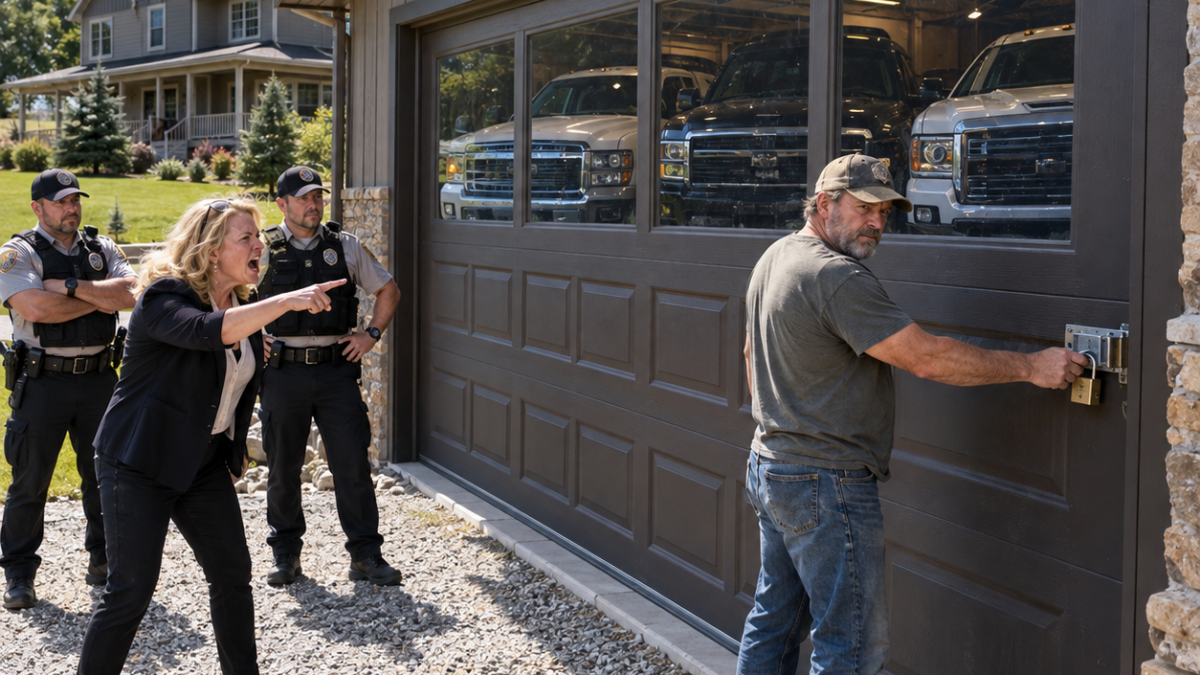
PART 2
The pounding started at 7:32 the next morning.
I hadn’t slept.
After activating the lockdown, I spent the remaining hours downloading every piece of footage from the old garage camera, copying files to an external hard drive, then copying those files again to cloud storage.
By sunrise, I had cataloged forty-seven separate nights when HOA security personnel had entered my garage.
Forty-seven.
The earliest recording was almost two years old.
Most visits happened between midnight and four in the morning. Sometimes they stayed two hours. Sometimes six. Trucks arrived carrying boxes and left without them. Other nights they arrived empty and departed loaded.
This wasn’t a patrol officer sneaking somewhere to take a coffee break.
It was an operation.
Then somebody began hammering on my front door.
“Jackson!”
I already knew the voice.
Ray Hoffman.
I opened the front door but remained inside.
He looked terrible.
Wrinkled uniform.
Bloodshot eyes.
Jaw clenched so tightly a muscle jumped near his ear.
Two guards stood behind him near the driveway.
The fourth was nowhere in sight.
“Open the garage.”
“Good morning, Ray.”
“This isn’t funny.”
“I agree.”
“You’ve got three patrol trucks locked inside.”
“My garage.”
“You’ve also interfered with four security officers performing official HOA duties.”
“My garage.”
His eyes narrowed.
“You want to keep repeating that?”
“Until you explain why you’ve been using it for almost two years.”
Something changed in his expression.
Barely.
But I saw it.
“You don’t know what you’re talking about.”
“I have forty-seven recordings.”
That landed.
He glanced toward the garage.
Then back at me.
“Those cameras violate employee privacy.”
That almost made me laugh.
“You’re claiming privacy inside my private garage?”
“We had authorization.”
“From whom?”
“The association.”
“The association doesn’t own my garage.”
“Your property falls inside our security-access zone.”
“Show me the recorded easement.”
His mouth tightened.
“This isn’t a courtroom.”
“Then get off my porch.”
He stepped closer.
“Open that door or I’m reporting you for unlawful confinement.”
That time I did smile.
“The side exit is unlocked.”
He said nothing.
“You walked out through it to get here.”
His face reddened.
“If your men want to leave, they can leave. What they can’t do is drive three vehicles through a door I have secured on my own building.”
“You’re playing a dangerous game.”
“No, Ray. I think somebody else has been playing one.”
I closed the door.
He stood outside another thirty seconds.
Then left.
At 9:45, Brenda Kesler arrived.
If Ray was anger, Brenda was control.
She had been Pinewood Estates HOA president for six consecutive terms. Fifty-eight years old, silver-blonde hair cut perfectly at the jaw, expensive cream blazer despite the Texas humidity, and the kind of smile that seemed designed by a committee.
Two board members followed her from a silver Mercedes.
I met them on the porch.
“Mr. Jackson,” Brenda said. “I understand we have a misunderstanding.”
“Three trucks inside my garage isn’t confusing.”
“I think it will become clearer once you understand the governing documents.”
She opened a leather portfolio.
That was when she showed me the paper.
SECURITY ACCESS AGREEMENT.
The document claimed that I had voluntarily granted Pinewood Estates security personnel continuing access to my detached garage for “community safety operations, equipment staging, and emergency logistical purposes.”
My address was correct.
My name was correct.
There was even a signature.
SCOTT JACKSON.
Dated March 15, 2021.
For a moment, all I heard was blood moving in my ears.
Brenda watched my face.
“As you can see, you authorized this arrangement shortly after moving into Pinewood.”
I looked at the signature again.
It resembled mine.
Enough to fool somebody who had seen my name on a closing document.
Not enough to fool me.
“I never signed this.”
“The document indicates otherwise.”
“I said I never signed it.”
She gave me a sympathetic smile.
“People forget paperwork, especially during a home purchase.”
“I didn’t buy the house in March.”
That smile weakened slightly.
“Regardless, the agreement exists.”
She flipped to another page.
“And Section 14.3 of the Pinewood governing documents permits security access to structures within designated community easement areas.”
“Is that easement in my deed?”
“It’s part of the community plan.”
“That isn’t what I asked.”
Her eyes hardened.
“Mr. Jackson, you currently have HOA property locked inside your structure and personnel whose access has been obstructed. Unless you remove the lockdown within twenty-four hours, the association will pursue legal action.”
One board member shifted uncomfortably.
Brenda continued.
“You will also begin accruing a $250 daily violation under Section 9.7.”
“For locking my garage?”
“For interfering with authorized association operations.”
I looked at the document once more.
March 15, 2021.
Something about the date bothered me.
Not just because I hadn’t signed it.
The date itself felt impossible.
Brenda handed me a photocopy.
“Twenty-four hours, Mr. Jackson.”
She turned and walked away.
I carried the document inside and placed it beneath the light over my kitchen table.
March 15, 2021.
I opened my digital calendar.
Scrolled backward.
March 2021.
Then my hand froze.
March 12.
MOM — HOSPITAL.
March 13.
FLIGHT TO SAN DIEGO.
March 14 through March 16.
MOM’S FUNERAL.
I sat down.
My mother had died March 12, 2021.
On March 15, the day I supposedly sat somewhere in Texas and signed Brenda’s security-access agreement, I had been two thousand miles away standing beside my mother’s casket in California.
They had forged my signature.
And whoever chose the date had accidentally picked one of the most thoroughly documented days of my life.
I opened an old email folder.
Flight confirmation.
Houston to San Diego, March 13.
Hotel receipt.
Three-night stay.
Rental-car agreement.
Funeral-home invoice bearing my actual signature.
My sister had hundreds of photographs.
I called her.
“Hey,” she answered. “Everything okay?”
“Do you still have Mom’s funeral pictures?”
There was a pause.
“Of course.”
“I need the originals.”
“Why?”
“I’ll explain later.”
“Scott.”
I closed my eyes.
“Somebody forged my signature on a document dated the day we buried her.”
Silence.
Then my sister’s voice changed.
“Send me where you want the files.”
Within thirty minutes, I had timestamped, geotagged photographs showing me at the memorial.
2:14 p.m.
San Diego, California.
The fake agreement was dead.
But now the question became much bigger.
Why would an HOA forge access to a resident’s garage?
I needed an attorney.
Diana Reyes joined a video call at 10:30.
She was in her mid-forties, dark hair pulled back, expression sharp enough that I stopped giving unnecessary details halfway through my explanation.
She listened.
Then said, “Start again from the first unauthorized entry you can prove.”
“Twenty-three months ago.”
Her eyebrows rose.
“How many?”
“Forty-seven recorded incidents.”
“Do they know you have the footage?”
“Ray does now.”
“What exactly did you lock?”
“The vehicle doors.”
“Can people leave?”
“Yes. Separate side exit. Unlocked.”
“Good.”
She made a note.
“Never describe them as trapped. They are not trapped. You secured your garage vehicle entrance. Maintain the emergency exit.”
“I understand.”
“Now show me your deed.”
I shared the PDF.
We reviewed the encumbrances.
Utility easement.
Drainage easement.
Exterior HOA covenant.
Nothing granting security personnel use of my garage.
Diana leaned toward her screen.
“Brenda’s easement argument appears unsupported by your deed.”
“So they invented it.”
“Potentially. Don’t get ahead of the evidence.”
“She forged my signature.”
“It certainly appears that somebody did.”
I appreciated the precision even though part of me wanted her as angry as I was.
“What do I do?”
“Preserve everything.”
“Done.”
“Preserve it somewhere they can’t access.”
“Cloud backup and external drive.”
“Good. Don’t alter the garage. Don’t touch their papers. Don’t search their trucks. Photograph only what is visible from areas where you are lawfully present.”
“And the door?”
“For now, leave the vehicle door secured if the emergency exit stays available. But understand they may involve law enforcement.”
“I’m counting on it.”
She frowned.
“Don’t count on drama. Count on documentation.”
That became the rule.
Documentation.
The next unexpected knock came from the back door.
Bradley Allen lived two houses down.
Sixty-seven.
Retired Houston police officer.
Quiet enough that I had probably exchanged fewer than twenty sentences with him in two years.
He stepped inside and looked toward the garage.
“I’ve been wondering when they’d get caught.”
That sentence stopped me.
“You knew?”
“I knew they were using your place.”
“And never told me?”
“I didn’t know you didn’t know.”
Fair.
“What do you know about Brenda?”
Bradley sat at my kitchen table.
“Three years ago she tried to get access to my garage.”
“For what?”
“Security storage.”
I stared at him.
“Same story?”
“She showed me an agreement.”
“You signed it?”
Bradley laughed.
“I told her if she entered my property without my consent, I’d call my old friends at HPD before she reached the driveway.”
“And?”
“She never came back.”
“Why me?”
Bradley looked around my house.
“You travel.”
“I work from home.”
“You also visit Dallas. I’ve seen you gone several weekends.”
My daughter Lily lived there with her mother.
“You don’t host neighborhood parties. You don’t attend board meetings. You keep to yourself.”
“So I looked easy.”
“You looked quiet.”
That hurt more.
Quiet.
That was all it took.
Bradley lowered his voice.
“I’ve seen their trucks here late before.”
“How late?”
“After midnight.”
“How often?”
“Enough that I assumed you leased the garage to them.”
I told him about the map.
The files.
The security agreement.
When I reached the forged date, he sat back.
“That’s not sloppy.”
“What?”
“Forging a resident’s signature is a big step.”
“I know.”
“No. I mean if they’re willing to take that step, whatever they’re doing inside that garage matters enough to justify the risk.”
I thought of Ray’s folders.
“What do you think it is?”
Bradley shook his head.
“Find out before you give them those trucks.”
That afternoon, I began reviewing footage systematically.
Date.
Arrival time.
Departure time.
Personnel.
Vehicles.
Objects carried in.
Objects carried out.
I created a spreadsheet.
Forty-seven rows.
Patterns emerged.
They almost always arrived after midnight.
They avoided Fridays and Saturdays when more residents stayed awake later.
They used my garage most heavily during the first week of each month.
And boxes moved through the space.
Boxes arrived full.
Sometimes left empty.
Sometimes the reverse.
At 5:42, while reviewing a recording from eight months earlier, I noticed a man who wasn’t HOA security.
Mid-forties.
Suit jacket.
No uniform.
He entered at 2:47 a.m., shook Ray Hoffman’s hand, and left twenty minutes later carrying a cardboard file box.
I froze the frame.
His face was clear.
I saved the image.
Then movement outside my kitchen window caught my attention.
A security guard stood beside my fence.
Not one of the four from the garage.
He was watching my house.
The moment he saw me looking, he turned away.
The next morning Brenda sent an email to all 412 Pinewood households.
URGENT RESIDENT SAFETY ALERT.
She didn’t call me dangerous.
She was smarter than that.
She wrote that an “ongoing access dispute” had caused security personnel to remain in an “uncertain situation.”
She expressed concern regarding my “recent behavior.”
She asked residents to exercise caution near my property.
It was beautifully written poison.
By ten-thirty, my next-door neighbor saw me retrieving mail and retreated into her house.
A car slowed as it passed.
A mother walking with her daughter crossed the street rather than walk in front of my driveway.
Twelve hours earlier, I was the quiet engineer nobody thought about.
Now I was a threat.
Brenda understood something I didn’t.
You don’t have to prove a man is dangerous.
You only have to make people wonder.
At noon, Lily called.
“Dad?”
Her voice sounded smaller than sixteen.
“Hey, sweetheart.”
“What happened?”
My stomach dropped.
“What did you hear?”
“People are posting stuff.”
Of course they were.
“About what?”
“That you locked four people in your garage.”
I closed my eyes.
“They can leave through a side door.”
“Then why aren’t they?”
“Because their trucks and equipment are inside.”
“Mom’s freaking out.”
“I’m okay.”
“Are police coming?”
“Probably.”
“Dad.”
“I’m okay.”
A pause.
“Did you really lock them in for three days?”
“It hasn’t been three days.”
“That’s not what I asked.”
Teenagers.
Even during a crisis.
“I locked the main vehicle door because they entered without permission. Nobody is physically trapped.”
“Is this going to affect me?”
That question broke something inside me.
My fight had reached my daughter.
Brenda’s email had done that.
“No.”
I said it with more certainty than I felt.
“I won’t let it.”
At 2:17, law enforcement arrived.
Deputy Martinez listened while I explained everything.
He inspected the garage from outside.
Then the side pedestrian exit.
He opened it.
Walked through.
Came back.
“So nobody is prevented from leaving.”
“No.”
“The trucks are prevented from leaving.”
“Yes.”
“You own the structure.”
“Yes.”
He reviewed the deed.
Then Brenda’s access agreement.
Then the California evidence.
His expression remained professional.
“This is complicated.”
“Are you ordering me to open it?”
“No.”
“What about trespass?”
“That will need investigation.”
Ray emerged through the side door during our conversation.
“There,” he said, pointing at me. “He’s interfering with HOA security operations.”
Martinez looked at him.
“You can leave.”
Ray stopped.
“What?”
“The door you just came through functions.”
“Our vehicles are inside.”
“That isn’t unlawful detention.”
Ray’s face darkened.
“This man is stealing HOA property.”
Martinez looked toward me.
“Do you intend to keep the vehicles permanently?”
“No. I intend to preserve the situation while I document unauthorized use of my property and consult counsel.”
Diana would have approved that sentence.
Martinez nodded.
“Then right now this appears primarily civil, with potential criminal issues requiring review.”
He looked at Ray.
“I suggest everyone stop escalating.”
Ray didn’t answer.
After the deputy left, Ray called me from inside.
“Scott.”
He sounded exhausted now.
Not threatening.
Almost reasonable.
“Open the door. We end it.”
“How?”
“You release the trucks. Brenda drops the fines.”
“And the neighborhood email?”
“She retracts it.”
“The forged agreement?”
Silence.
“Ray?”
“I don’t know anything about that.”
“The files on my workbench?”
“Internal security records.”
“Resident photographs?”
“Security.”
“The neighborhood map?”
“Security.”
“Why my garage?”
Another pause.
“Operational convenience.”
“For two years?”
He hung up.
I sat at my workbench inside the house.
Operational convenience.
No.
You don’t forge a signature because somewhere is convenient.
You forge a signature because you need a paper trail explaining why you were there.
I went back to the footage.
This time I stopped focusing on trucks.
I focused on paper.
Frame by frame.
At 1:12 a.m. on a recording from three months earlier, Ray placed a leather briefcase under the overhead light and opened it.
Folder tabs became visible.
HARRIS.
NGUYEN.
MORGAN.
ELLIS.
Names from Pinewood.
On top of one folder sat a business card.
The image was blurry.
I enlarged it.
Sharpened contrast.
DATA HARVEST MARKETING SOLUTIONS.
I searched the company.
What I found made my stomach turn.
Public regulatory records described prior complaints involving consumer information obtained without adequate consent documentation.
Names.
Addresses.
Vehicle data.
Behavioral information.
Residential-community records.
Diana called back after reviewing the screenshot.
“Do not assume the worst publicly.”
“What does this look like to you?”
“It looks concerning.”
“That’s lawyer language.”
“You hired a lawyer.”
“Fair.”
“If HOA security personnel are collecting resident information for a third party without authorization, that could create serious civil and regulatory exposure.”
“What do we need?”
“A connection.”
“I have a business card.”
“You need more.”
So I found more.
Bradley recognized the name Data Harvest.
Not because he had used it.
Because a former colleague had mentioned complaints involving similar businesses.
He made calls.
Three hours later, he returned.
“You’re going to like this less.”
“Go ahead.”
He handed me his phone.
Professional profile.
KEVIN MARSH.
Regional Sales Manager.
Data Harvest Marketing Solutions.
I read the biographical section.
Spouse: Patricia Kesler Marsh.
Kesler.
I looked at Bradley.
“Brenda?”
“Patricia is her sister.”
Kevin Marsh was Brenda Kesler’s brother-in-law.
Now the structure became visible.
Brenda controlled the HOA.
The HOA controlled the private security operation.
Security officers had access to resident information and daily movement patterns.
Ray used my isolated garage as an overnight command center.
And Brenda’s brother-in-law worked for a marketing company known for aggressive consumer-data acquisition.
Coincidence was becoming a very expensive explanation.
I returned to the old footage.
Found the unknown man from eight months earlier.
Compared his face with Kevin Marsh’s profile.
Same man.
2:47 a.m.
Inside my garage.
Twenty minutes later, leaving with a box.
I called Diana.
“I have Kevin Marsh on video.”
This time she didn’t answer immediately.
“When?”
“Eight months ago.”
“Taking material?”
“Carrying a box out.”
“Back it up.”
“Already did.”
“Again.”
I made another copy.
By the second night, the standoff had consumed Pinewood.
Some residents believed Brenda.
Some thought she was hiding something.
Others didn’t care about evidence.
They just wanted the patrol trucks back.
Meanwhile, the guards could leave whenever they wished.
Two did.
They went home to shower and returned later.
Ray stayed.
One other officer rotated with him.
Why?
The trucks.
The files.
The equipment.
Whatever remained inside was too valuable to abandon.
At one point, the interior camera captured Ray trying to pry the main garage door.
I watched him wedge a steel bar beneath the seal.
He strained.
The storm bolts held.
He tried another corner.
Nothing.
Finally he hurled the pry bar across the floor.
Then stood in the middle of my workshop breathing hard.
He could have walked out.
Instead he stayed beside those trucks like a man guarding a vault.
That told me more than any confession.
On the morning of day three, Diana began contacting state regulators.
Bradley quietly spoke with people he trusted.
I made one call of my own.
Andrea Price.
Investigative reporter.
She had written about HOA governance and consumer-data companies.
I gave her the outline.
“For two years HOA security has been using your garage?”
“Yes.”
“You have video?”
“Yes.”
“You have a forged access agreement?”
“Yes.”
“And the signature date is a date you can prove you were out of state?”
“At my mother’s funeral.”
Silence.
“That’s unusually specific.”
“I wish it weren’t.”
“What connects the HOA to Data Harvest?”
“Footage of their regional manager inside my garage. He’s the HOA president’s brother-in-law.”
Another pause.
“If the documents support what you’re saying, that could be significant.”
“There’s an HOA meeting tomorrow.”
“Public?”
“To residents.”
“I may come.”
“No promise?”
“No promise.”
Fair.
That evening, Ray tried the door again.
By then, the seventy-two-hour mark was approaching.
I had barely slept.
Coffee stopped helping.
My eyes hurt from staring at footage.
My daughter had stopped texting because, as she put it, “Mom says you’re in evidence mode.”
She wasn’t wrong.
Then my phone rang.
Unknown number.
“Mr. Jackson?”
“Yes.”
“My name is Kevin Marsh.”
My heart began hammering.
“Data Harvest?”
A pause.
“I think there may be some information circulating that lacks context.”
I started recording.
Texas permitted one-party recording in many circumstances, but Diana had already told me to preserve any call and let her review legality and use later.
“What context?”
“Your dispute with Pinewood security.”
“That’s HOA business. Why are you calling?”
“Because misunderstandings can damage relationships.”
“What relationships?”
“Business relationships.”
“Between Data Harvest and Pinewood?”
He ignored the question.
“I’d like to resolve this.”
“How?”
“Fifty thousand dollars.”
I actually thought I had misheard him.
“For what?”
“You open the garage. Return any documents or materials that do not belong to you. Delete recordings involving proprietary business activity. And agree not to discuss what you believe you saw.”
I gripped the phone.
“Why would a marketing company pay me fifty thousand dollars to settle an HOA garage dispute?”
Silence.
Then Kevin said something that changed everything.
“Because this isn’t only about a garage.”
I stared at the wall.
“What is it about?”
“Efficiency.”
“That means nothing.”
“Communities generate useful information. Residents benefit from tailored services. Providers benefit from accurate market intelligence.”
“Did residents consent?”
“Consent can be structured in many ways.”
“Did I consent?”
“You’re focusing on terminology.”
“I’m focusing on my garage.”
He sighed.
“Meet me.”
“Where?”
A coffee shop near Main Street.
Two o’clock.
I called Diana.
She listened to the recording.
“He offered fifty?”
“Yes.”
“He wants recordings destroyed?”
“Yes.”
“You are not accepting money.”
“I assumed.”
“You are not making threats.”
“Understood.”
“If you meet him, ask questions. Don’t accuse. Let him talk.”
Kevin arrived three minutes late in an expensive suit.
He sat down without coffee.
“Fifty thousand.”
“Still the offer?”
“Yes.”
“Authorized by whom?”
“People who understand the value of discretion.”
“Brenda?”
He smiled faintly.
“Scott, you don’t need every name.”
“Why was my garage used?”
“Convenience.”
“Why did you enter it at 2:47 in the morning eight months ago?”
That erased the smile.
“You’ve reviewed footage.”
“Answer the question.”
“I was meeting security personnel.”
“Why?”
“Business.”
“What business?”
“Information services.”
“What information?”
He leaned back.
“This is exactly why I offered to settle. You’re seeing fragments and constructing a story.”
“Then correct it.”
“The information involved is commercially sensitive.”
“Information about my neighbors?”
He didn’t answer.
“Vehicle schedules?”
Nothing.
“Names?”
His jaw tightened.
“Fifty thousand expires at six.”
“Why?”
“Because after six, other people start making decisions.”
“Is that a threat?”
“It’s clarity.”
He stood.
At the door he turned.
“You have a comfortable life, Mr. Jackson. Think carefully before turning one property dispute into something you can’t control.”
Then he left.
I sent the recording to Diana.
At 5:45 she called.
“Brenda canceled tomorrow’s resident open forum.”
“She can’t.”
“Correct.”
The HOA bylaws required a resident vote.
“She’s hoping nobody knows that.”
I looked at the printed bylaws beside my laptop.
For years Brenda had controlled Pinewood by quoting sections nobody else read.
That night, I read every section.
At 6:45 the next evening, more than two hundred residents packed into the community center.
Some came because of Brenda’s email.
Some because of rumors.
Some because neighbors had quietly told them something major was coming.
Bradley sat near the front.
Andrea Price sat in the back with a notebook.
I carried a laptop.
Brenda called the meeting to order at 7:02.
Budget.
Landscaping.
Speed bumps.
Maintenance.
Ordinary business delivered with extraordinary composure.
Ray Hoffman wasn’t there.
He was still spending most of his time protecting the trucks in my garage.
At 7:38, Brenda reached the final agenda item.
“Due to pending security concerns and legal matters, the board has decided to postpone tonight’s resident open forum.”
She started gathering papers.
I stood.
“Point of order.”
Two hundred heads turned.
Brenda looked at me.
“Mr. Jackson, sit down.”
“Section 8.4 requires a majority vote of residents present to cancel open forum.”
Her expression became rigid.
“This issue involves legal matters you are not qualified to address.”
“I’m not addressing them yet. I’m requesting the required vote.”
“Sit down.”
I stayed standing.
“Section 12.2 requires the chair to recognize procedural challenges from the floor.”
Bradley stood.
“I second the motion.”
Murmurs spread.
Brenda realized immediately what had happened.
For years, the bylaws had been her weapon.
Tonight somebody else had read them.
“Very well.”
She forced a smile.
“All in favor of proceeding with open forum?”
The response shook the room.
“Aye!”
The opposition was scattered.
Brenda stared at the crowd.
“The motion carries.”
Then at me.
“Ten minutes.”
I connected my laptop.
First image.
My garage.
Timestamp: 2:17 a.m.
Three Pinewood security trucks.
Four guards.
The room became quiet.
“This was recorded on my property,” I said.
Next clip.
Ray Hoffman spreading resident files across my workbench.
Another.
Boxes entering.
Another.
Laptops.
Another.
Kevin Marsh.
People began whispering.
Then I showed them the timeline.
FORTY-SEVEN UNAUTHORIZED ENTRIES.
Twenty-three months.
A woman near the front whispered, “Forty-seven?”
I showed Brenda’s security-access agreement.
“My supposed signature.”
Then the date.
March 15, 2021.
Then the funeral photograph.
Me.
My sister.
My mother’s casket.
San Diego.
Same date.
The room went absolutely silent.
I didn’t need to dramatize it.
“I did not sign that agreement.”
Brenda stood.
“This presentation contains unverified accusations.”
I clicked the next slide.
My flight receipt.
Hotel receipt.
Funeral-home record.
Timestamped photographs.
“My mother died March twelfth.”
Brenda’s face changed.
“I was in California from the thirteenth through the sixteenth.”
Nobody moved.
“My signature was placed on an HOA security-access agreement on the fifteenth.”
A resident shouted.
“Who signed it?”
I looked toward Brenda.
“That’s one of the questions I’m asking.”
Next slide.
Data Harvest Marketing Solutions.
Regulatory history.
Then Kevin Marsh’s profile.
Regional sales manager.
Then family relationship.
Patricia Kesler Marsh.
Brenda’s sister.
Whispers became voices.
I showed footage of Kevin entering my garage.
Then leaving with a box.
Then played the recording.
His voice filled the room.
“Fifty thousand dollars…”
Someone gasped.
“Delete recordings…”
Another person cursed.
“Your garage happened to be useful…”
Brenda stood so quickly her chair fell backward.
“This is fabricated!”
A woman shouted, “Is Kevin Marsh your brother-in-law?”
“My family is irrelevant.”
“That’s a yes!”
People started shouting.
“Did you authorize this?”
“Were they selling our information?”
“What did security collect?”
“Where are our records?”
“Why was my license plate in those files?”
That last question came from a man I didn’t know.
Then another resident stood.
“I saw my name on that screen.”
Brenda tried to regain control.
“This meeting is adjourned.”
“No!”
The response came from everywhere.
She reached for the gavel.
The side door opened.
Deputy Martinez entered with two officers.
The entire room changed.
He approached Brenda.
“Mrs. Kesler?”
She stared at him.
“We need you to accompany us to answer questions regarding a complaint involving unauthorized access to private property, suspected document falsification, and the handling of resident information.”
“This is outrageous.”
“You can come voluntarily.”
“I am in the middle of a board meeting.”
“Ma’am.”
His voice never rose.
“You can come voluntarily.”
Brenda looked around.
For six years, those residents had looked at her when they wanted permission.
Now they looked at her like they were seeing a stranger.
She picked up her purse.
When she passed me, she stopped.
“You have no idea what you’ve started.”
Her voice was barely audible.
“There are people involved you don’t understand.”
I met her eyes.
“Then they should probably start getting nervous.”
She walked out with Martinez.
The room exploded.
People shouting.
Demanding the board open financial records.
Demanding security contracts.
Demanding resignations.
Bradley climbed onto the stage.
“Everybody shut up!”
Retired police voice.
It worked.
“This isn’t a riot. We’re homeowners. We have bylaws. We follow them.”
That sentence mattered.
Because Brenda had spent years making procedure feel like the enemy.
Now procedure became how the neighborhood took itself back.
The remaining board members were asked to preserve records.
A motion passed demanding an outside audit.
Another suspended the private security patrol.
Another scheduled an emergency election.
All overwhelmingly approved.
I walked out at nearly eleven.
Andrea Price waited near the parking lot.
“I’d like to see your documents.”
I handed her Diana’s contact information.
“Everything goes through counsel.”
She nodded.
“Smart.”
“Learning.”
“How do you feel?”
I looked toward the community center.
Residents still stood in groups beneath the lights.
“I thought I’d feel better.”
“You exposed something huge.”
“I know.”
“Then what’s wrong?”
I thought about Lily.
My mother’s funeral.
My garage.
The neighbors who crossed the street.
“People trusted her.”
Andrea closed her notebook.
“That’s why stories like this matter.”
The investigation expanded during the next two weeks.
Ray Hoffman finally removed the trucks after investigators photographed and cataloged the garage contents.
I opened the main vehicle door under supervision.
He stood beside one truck while evidence technicians worked around him.
For the first time in three days, he looked small.
Not physically.
Just stripped of authority.
I watched him load nothing.
Officers had seized the boxes and electronics relevant to the investigation.
He looked at me.
“You happy?”
“No.”
“You wanted this.”
“I wanted my garage.”
“You could’ve just opened the door.”
“You could’ve never entered it.”
He laughed bitterly.
“You think Brenda made all this happen?”
“I think you’re going to tell investigators who did.”
That shut him up.
He eventually cooperated.
According to investigators, Ray admitted Pinewood security officers had been ordered to collect information during routine patrols.
License plates.
Vehicle patterns.
Visitor frequency.
Home occupancy schedules.
Information from HOA violation records.
Information from gate logs.
Some of it was legitimate security data.
The problem was where portions of it went afterward.
Data Harvest.
My garage had been used because it wasn’t HOA property.
That was the genius of it.
No association cameras.
No normal administrative staff.
No residents walking into an office unexpectedly.
An isolated detached garage belonging to a quiet engineer who rarely attended HOA meetings.
I had been their blind spot.
Except eventually the blind spot grew a camera.
The forged agreement was traced through board records.
Investigators found no legitimate meeting approving it.
No electronic record showing it had been sent to me before Brenda produced it.
Metadata suggested the version she showed me had been created long after the date printed on the page.
That revelation hurt in a strange way.
Whoever created it hadn’t merely forged my signature.
They had looked through my ownership records, copied my handwriting, chosen a date, and fabricated permission.
Then accidentally chose the day of Mom’s funeral.
My sister called when the first article was published.
Andrea’s headline referred to the garage footage, HOA data practices, and the forged access record.
“You saw it?” I asked.
“Every relative we have saw it.”
“Great.”
“Mom would be furious.”
I laughed.
“About the forgery?”
“No. About them parking trucks around your tools.”
That was exactly right.
Then my sister became quiet.
“Are you okay?”
“I think so.”
“Lily’s proud of you.”
“She told you?”
“She told everyone.”
My throat tightened.
The criminal cases didn’t become the dramatic courtroom battle I had imagined during those sleepless three days.
Real cases rarely do.
There were interviews.
Subpoenas.
Negotiations.
Plea discussions.
Lawyers speaking in conference rooms.
Months where almost nothing seemed to happen.
Brenda eventually accepted a plea agreement involving document falsification and her role in unauthorized operations connected to HOA property access and resident information.
The court imposed probation, financial penalties, and restrictions that effectively ended her ability to hold HOA leadership positions.
She sold her Pinewood home soon afterward.
Ray pleaded to reduced offenses after cooperating.
He lost his security license.
The other guards received far lighter treatment because investigators concluded they had largely followed orders and provided useful evidence.
Kevin Marsh’s problems became larger.
Data Harvest drew scrutiny beyond Pinewood.
Investigators began looking at other residential communities and similar arrangements.
I stopped following every development.
Diana advised me to separate my case from the larger investigation unless somebody needed testimony.
“That story may continue for years,” she said.
“I don’t want years.”
“Exactly.”
Pinewood held emergency elections six weeks after Brenda’s removal.
Nearly every old board member either resigned or declined to run again.
Bradley Allen somehow became interim president despite spending eight years complaining about HOA presidents.
I teased him.
“You’ve become what you hated.”
“I’m resigning the minute somebody competent volunteers.”
“You retired cops all say that.”
His first major decision eliminated the old security program.
The association hired a licensed, bonded company under a contract residents could actually read.
No hidden data-sharing provisions.
No private residential storage locations.
No overnight command centers.
No access to private structures without owner consent or lawful emergency authority.
His second decision was to issue a public apology to me.
I asked him not to.
He ignored me.
At the next community meeting, he stood where Brenda used to stand.
“What happened to Scott Jackson was not an individual misunderstanding,” Bradley said. “It was a governance failure. Residents trusted this association to respect boundaries it had no right to cross.”
I sat in the back.
Exactly where I wanted to be.
Then Bradley called my name.
I walked forward expecting him to ask about compensation or security recommendations.
Instead, he handed me the microphone.
I looked at the crowd.
Months earlier, some of these same people had crossed streets to avoid me.
Now they waited.
“I’m not here for a victory speech.”
A few people smiled.
“What happened in my garage wasn’t possible because one woman was uniquely powerful. It was possible because too many decisions happened where residents couldn’t see them.”
The room stayed quiet.
“Brenda used secrecy.”
I looked around.
“But secrecy only works when everybody else stays disconnected.”
I told them about Stephanie—
No.
That was another neighborhood.
I stopped myself and smiled.
“Sorry. Wrong name from a very long file.”
People laughed, breaking the tension.
Then I continued.
“Bradley knew Brenda had tried something similar with his garage. I didn’t know. Other residents had strange experiences. Bradley didn’t know those. People received questionable fines and handled them alone. Nobody compared notes.”
I raised the microphone slightly.
“That’s what has to change.”
I proposed an oversight committee.
Five homeowners.
Elected separately from the board.
Quarterly access to contracts and financial summaries.
Independent review of security operations.
Public disclosure of conflicts of interest.
No vendor controlled by an officer’s immediate family without competitive review and a recorded vote.
The proposal passed overwhelmingly.
Over the next six months, Pinewood became almost boring.
That was perfect.
Meetings were longer because residents actually attended.
Budgets were questioned.
Vendor contracts were discussed.
People complained.
Sometimes loudly.
Nothing stayed hidden simply because questioning it made somebody uncomfortable.
The oversight committee found two accounting mistakes in its first quarter.
Neither was fraud.
Both were corrected.
That, to me, was what functioning oversight looked like.
Not catching criminals every month.
Catching mistakes before someone could turn them into opportunities.
My relationship with the neighborhood changed too.
The woman who had crossed the street with her daughter brought cookies one afternoon.
“I owe you an apology.”
“You don’t.”
“I believed the email.”
“So did a lot of people.”
“I should’ve asked you.”
I shrugged.
“You had no reason to think the HOA president was lying.”
She looked toward the garage.
“I guess that’s the problem.”
“Yes.”
Another neighbor offered to help replace damaged electrical outlets the guards had overused.
Someone else helped repaint the interior.
Bradley insisted on installing an additional camera.
“You’re an electronics engineer,” I told him.
“No, you’re an electronics engineer.”
“Exactly.”
“And you forgot the first camera existed.”
He had me there.
The garage smelled different after they removed the trucks.
Diesel fumes clung to the concrete for weeks.
I hated going inside.
That surprised me.
It had always been my favorite part of the property.
My sanctuary after the divorce.
Then, for months, every time I opened the door, I saw Ray leaning over files.
I saw trucks.
I imagined strangers moving through the room while I slept.
So I stopped using it.
I worked from my kitchen.
Tools gathered dust.
Half-built circuits remained untouched.
Diana noticed when she visited to sign settlement documents.
“You’re avoiding the garage.”
“I’m busy.”
“You work ten feet from it.”
“I’m busy nearby.”
She looked at me.
“Scott.”
“I don’t like being in there.”
“There we go.”
“I’m an engineer. We don’t have to turn everything into therapy.”
“No, you just turn it into an unnecessary spreadsheet.”
Fair.
A week later, Lily came from Dallas.
She walked through the house, dropped her backpack in the guest room, then pointed toward the garage.
“Show me.”
“You’ve seen pictures.”
“I want to see it.”
We went outside.
I unlocked the door.
She stepped inside slowly.
“Three trucks fit in here?”
“Unfortunately.”
She looked at the workbench.
“Is this where the files were?”
“Yes.”
“The map?”
“Pegboard.”
She touched the edge of the bench.
Then looked at me.
“Why aren’t you using it?”
“Been busy.”
She gave me the exact look Diana had.
Apparently I had a type.
“What?”
“Dad.”
“Don’t.”
“You fought for this room.”
“I fought because it was mine.”
“So use it.”
Simple.
Infuriatingly simple.
The next morning, Lily dragged two folding chairs into the garage.
We ordered pizza.
I pulled out an abandoned electronics project.
A homemade weather station I had promised to finish a year earlier.
She knew nothing about soldering.
I taught her.
Her first joint looked terrible.
“That is criminal.”
She glared.
“You said mine was okay.”
“I lied because I love you.”
She laughed.
We spent six hours at that workbench.
By evening, wires covered the surface.
Music played.
Pizza boxes sat where Ray’s folders had once been.
The garage began feeling like mine again.
When Lily left Sunday afternoon, she hugged me beside the driveway.
“I’m proud of you.”
“For surviving your soldering?”
“For not giving up.”
I watched her mother’s car disappear around the corner before going back inside.
That was when I finally understood what I had almost lost.
Not three parking spaces.
Not electricity.
Not even privacy.
They had taken a place where I felt safe and turned it into somewhere I didn’t want to enter.
The legal settlement paid for locks.
Cameras.
Repairs.
Attorney fees.
It could not buy that feeling back.
Lily did more for that in one weekend than any check could.
I replaced the access system completely.
No HOA-compatible keypad.
No shared vendor codes.
Encrypted controller.
Independent network.
Every event logged to redundant storage.
Bradley saw the setup.
“This seems excessive.”
“You installed three locks on your lawnmower shed.”
“My mower is expensive.”
“My peace of mind is more expensive.”
He accepted that.
One year after the night this began, I woke at 3:17 a.m.
Exactly.
No diesel engines.
No lights.
Just the air conditioner turning on.
I lay there for a moment.
Then got up.
I walked to the garage.
Unlocked the side door.
Turned on the lights.
My workshop looked ordinary.
Tools.
Circuits.
Shelves.
Lily’s terrible first solder joint still sat on the weather-station board because I refused to fix it.
On the far wall hung one framed object.
Not Brenda’s fake agreement.
I destroyed my copy after the case closed.
Not a news clipping.
Not the HOA apology.
It was the old neighborhood map investigators returned after determining they no longer needed it.
All the colored pins had been removed.
I had considered throwing it away.
Instead, I reframed it.
Not as a trophy.
As a reminder.
Every pin had represented a house.
Every house contained people.
That was what Brenda and Kevin had forgotten.
They stopped seeing neighbors.
They saw records.
Market segments.
Vehicle patterns.
Data points.
Revenue.
Ray saw files.
Brenda saw votes.
Kevin saw customers.
But people are not lines in a spreadsheet simply because somebody learns how to collect information about them.
I should know.
I build spreadsheets for a living.
The difference between analysis and exploitation is consent, purpose, and accountability.
Those three things had disappeared from Pinewood.
We put them back.
Slowly.
Not perfectly.
But enough.
The garage door opened that morning without resistance.
I walked onto the driveway.
Pinewood was silent.
Streetlights.
Oak trees.
Rows of houses.
Ordinary suburbia.
Bradley’s porch light came on two houses away.
He stepped outside holding coffee.
“You up?”
“Obviously.”
“What happened?”
“Nothing.”
He looked suspicious.
“So why are you standing in your driveway at three-thirty?”
“Anniversary.”
He understood immediately.
He walked over.
We stood beside the garage.
“You ever regret locking it?”
I thought about that.
The question sounded easy.
It wasn’t.
Locking the vehicle door had given me time.
But it also intensified everything.
Brenda’s smear campaign.
Lily’s fear.
The neighborhood chaos.
Police.
Lawyers.
Months of fallout.
Would a different decision have produced the same evidence with less damage?
Maybe.
There was no way to know.
“I regret that I ever needed to.”
Bradley nodded.
“Good answer.”
“What would you have done?”
“At your age?”
“Yes.”
“Something dumber.”
I laughed.
“That’s reassuring.”
“You did one important thing right.”
“What?”
“You kept the exit open.”
That detail had mattered from the first hour.
I had secured property.
Not people.
The distinction kept me from turning righteous anger into its own wrongdoing.
That mattered more to me with time.
Because there had been moments—especially after Brenda dragged Lily into the fallout—when I wanted revenge.
Real revenge.
I wanted to humiliate Brenda.
Destroy Ray.
Bankrupt Kevin.
Make every person involved feel what I felt.
Fear.
Violation.
Powerlessness.
But anger is terrible at identifying the correct target.
One of the younger guards later wrote me a letter.
His name was Miguel Alvarez.
Twenty-six.
Married.
New baby.
Ray had told him the garage belonged to the HOA under an access arrangement.
Miguel believed him.
He carried boxes because his supervisor told him to.
He spent part of those three days sitting beside a truck he thought he was legally responsible for.
When investigators explained the broader situation, he cooperated immediately.
His letter said:
Mr. Jackson,
I’m sorry I entered your garage.
I should have asked more questions.
I believed that because my boss told me something was authorized, it was authorized.
I understand now that following an order does not remove responsibility for where I put my own feet.
I hope you can accept my apology.
I did.
Because accountability without mercy becomes another form of arrogance.
Ray knew more.
Brenda knew much more.
Kevin knew exactly what Data Harvest wanted.
Miguel knew almost nothing.
Treating them identically would have felt simple.
It wouldn’t have been just.
That lesson surprised me.
I had spent the first week seeing everybody in a security uniform as the same enemy.
They weren’t.
Systems hide individual responsibility by making everyone look like a uniform.
The same way bad leaders hide behind a title.
HOA President.
Security Captain.
Regional Manager.
Titles sound larger than people.
But eventually a person signs the document.
A person orders the trespass.
A person accepts the money.
A person chooses not to ask questions.
And a person chooses whether to speak when the truth becomes uncomfortable.
Sixteen months after the scandal, Pinewood held another election.
Bradley finally got his wish.
He resigned.
His replacement was a woman named Carla Nguyen, a pediatric nurse with zero patience for procedural games and an almost frightening obsession with publishing meeting minutes on time.
At her first meeting, she made an announcement.
“All board emails concerning official business will be retained in association records.”
Someone groaned.
Carla stared over her glasses.
“If writing it down makes you uncomfortable, don’t do it.”
I liked her immediately.
The oversight committee continued.
Vendor bids were published.
Residents could see security policies.
Conflict disclosures were mandatory.
The association wasn’t magically good now.
People still argued about trash cans.
Fence colors.
Pool rules.
Parking.
Human beings remained human beings.
But power was visible.
That changed everything.
Andrea’s investigative series won an award.
She invited me to an event.
I declined.
“You’re part of the story.”
“I’ve been part of enough story.”
She laughed.
“Fair.”
The larger Data Harvest investigation continued beyond anything I could influence.
Other communities came forward.
Some allegations matched ours.
Some didn’t.
Some HOA boards appeared innocent.
Others discovered vendor relationships nobody had scrutinized.
I learned not to treat every rumor as proof simply because my own suspicions had turned out right.
That would have been another trap.
Evidence had saved me.
I owed evidence the respect of not replacing it with paranoia.
Then the messages began.
Arizona.
Florida.
Georgia.
Colorado.
Homeowners who had read Andrea’s articles.
Most asked the same question.
Where do I start?
At first, I tried responding individually.
Then there were too many.
So I created a simple checklist.
Not legal advice.
Just habits.
Read your deed.
Read your governing documents.
Ask where authority comes from.
Request records in writing.
Save emails.
Photograph notices.
Verify signatures.
Check dates.
Don’t assume official-looking paper is accurate.
Don’t assume suspicious-looking paper is fake.
Verify.
And most importantly:
Don’t let anger decide your first move.
That last line came from experience.
Because anger wanted me outside at 3:17 in the morning shouting at four guards.
Anger wanted confrontation.
Anger wanted instant justice.
Patience gave me forty-seven recordings.
A forged agreement.
An alibi.
A corporate connection.
A recorded offer.
And eventually the truth.
Years later, people still occasionally call my story “the three-day garage siege.”
I hate that phrase.
There was no siege.
There were men who could leave whenever they wanted and trucks they refused to abandon.
There was a homeowner trying to understand why his property had become somebody else’s secret workplace.
There was a neighborhood discovering that the people who spoke most loudly about safety had been ignoring the most basic boundary of all.
Permission.
The real story wasn’t that I locked a door.
It was that someone else had quietly opened that door forty-seven times because they believed I would never notice.
One evening, almost two years after everything ended, Lily visited again.
She was eighteen now.
College applications everywhere.
She stood in the garage holding the old weather station.
“You kept this?”
“Of course.”
“My soldering was horrible.”
“Historically significant.”
She looked at the framed Pinewood map.
“Do you still think about it?”
“Sometimes.”
“The night?”
“Less than before.”
“Brenda?”
“Almost never.”
“Ray?”
“No.”
She pointed toward the map.
“Then why keep that?”
I thought for a moment.
“Because it reminds me to pay attention.”
“To the HOA?”
“To anything that gets powerful while everybody else is busy.”
She nodded slowly.
Then looked around the garage.
“You know what I remember?”
“What?”
“You making me learn to solder in here.”
“That was rehabilitation.”
“That was child labor.”
“You were sixteen.”
“Exactly.”
She set the weather station down.
Then smiled.
“It doesn’t feel like their garage anymore.”
That sentence stopped me.
Their garage.
I hadn’t realized some part of her had thought of it that way too.
“No,” I said.
“It doesn’t.”
Later that night, after she went inside, I stayed at the workbench.
The side door was open.
Warm Texas air drifted through the screen.
Somewhere down the street, someone laughed.
A lawn sprinkler clicked.
Normal sounds.
Good sounds.
I looked at the three empty vehicle bays.
For seventy-two hours, those spaces had held the trucks of men who believed access equaled ownership.
It didn’t.
Access is permission.
Authority is permission backed by law or agreement.
Leadership is permission granted by people who can take it away.
Brenda forgot that.
Ray forgot that.
Kevin never cared.
Pinewood learned it the hard way.
So did I.
I once believed security meant stronger locks.
Now I know better.
Security also means knowing who can authorize entry.
Knowing what records exist.
Knowing where your data goes.
Knowing who oversees the people claiming to protect you.
Knowing your neighbors well enough that when something strange happens, you compare notes instead of retreating behind closed doors.
The garage door remains one of the strongest on the block.
Hurricane bolts.
Encrypted controls.
Three cameras.
Automatic alerts.
But the thing that protects me most now is simpler.
If a Pinewood security truck stopped in my driveway at three in the morning today, Bradley would see it.
Carla would hear about it.
Half the neighborhood would be texting before the driver reached the porch.
Not because we became paranoid.
Because we stopped being isolated.
That may be the best ending I could have asked for.
Brenda wanted a neighborhood where information traveled upward to her but never sideways between residents.
That was how she stayed powerful.
I wanted my garage back.
Instead, we got something larger.
People started talking to each other.
Asking questions.
Reading documents.
Showing up.
That didn’t make Pinewood perfect.
It made secrecy expensive.
One Saturday morning, I finally removed the last physical trace of the operation.
A small label underneath my workbench.
I had discovered it months earlier.
PES UNIT 3.
Probably Pinewood Estates Security.
I had left it there without really knowing why.
Maybe I needed proof that what happened had been real.
That morning, I took a scraper and peeled it away.
The adhesive resisted.
I worked slowly.
When it finally came free, a clean rectangle remained against years of dust.
Lily happened to be visiting.
She watched from the doorway.
“That from them?”
“Yeah.”
“You keeping it?”
I looked at the label.
Two years earlier, I would have bagged it as evidence.
A year earlier, maybe as a trophy.
Now?
I dropped it into the trash.
“No.”
She smiled.
“Good.”
Then she pointed toward the empty workbench.
“What are we building?”
I looked around my garage.
My garage.
Three bays.
My tools.
My lights.
My daughter.
Nothing secret.
Nothing hidden.
Nothing stolen.
“I’ve been thinking about rebuilding that old amplifier.”
“Does that involve soldering?”
“Unfortunately.”
“I’m better now.”
“We’ll see.”
She rolled her eyes.
We spent the afternoon working.
Around sunset, Bradley stopped by carrying beer for me and soda for Lily.
Carla arrived twenty minutes later because she needed my opinion on a proposed camera policy.
I told her HOA business was banned from my garage.
She laughed.
Then sat down anyway.
For a second, I looked around.
A retired cop.
The new HOA president.
My daughter.
All standing in the same garage that had once been used to collect information about people without their knowledge.
Nobody whispered.
Nobody locked files away when somebody approached.
Carla put the entire draft policy on my workbench.
“Tell me what’s wrong with it.”
I read the first paragraph.
“Everything.”
She groaned.
Bradley laughed.
Lily opened another soda.
And suddenly I realized this was the moment I had actually been waiting for.
Not Brenda’s arrest.
Not the guilty pleas.
Not watching those white security trucks finally roll out of my garage after seventy-two hours.
This.
The room was mine enough that I could invite people into it.
That is different from keeping everyone out.
For a long time after the trespasses, I confused control with safety.
I wanted every door locked.
Every camera recording.
Every visitor verified.
Then I understood what my garage had been before Brenda’s operation.
A place where I built things.
Not a bunker.
So I kept the security.
But I opened the door more often.
Neighborhood kids came over for robotics projects.
Bradley stored absolutely nothing there because I threatened to charge him three years of back rent if he tried.
Lily worked on college engineering assignments whenever she visited.
Sometimes I left the garage open while washing my car.
That would have been impossible immediately after the scandal.
Healing is strange.
Sometimes it’s dramatic.
Sometimes it’s standing in your driveway realizing the open door behind you no longer makes your heart race.
The night all of this started, four men believed they had more authority inside my property than I did.
Three trucks filled my garage.
A neighborhood map covered my wall.
Files with my neighbors’ names covered my bench.
Someone had changed the access code to my own door.
And the people responsible were so confident that when I challenged them, they didn’t apologize.
They produced a forged agreement and threatened to fine me.
That confidence was what destroyed them.
If they had apologized that morning, removed the trucks, and disappeared, maybe I would have filed a trespass report and moved on.
Instead Brenda showed me a forged signature.
Ray defended the files.
Kevin offered fifty thousand dollars.
Every attempt to protect the secret created another piece of evidence.
By the end, they weren’t fighting me.
They were fighting their own paper trail.
The same thing they thought made them powerful.
That lesson stayed with me.
When people misuse authority, they usually leave records because authority needs paperwork to look legitimate.
Letters.
Votes.
Invoices.
Contracts.
Access logs.
Emails.
Policies.
Signatures.
Don’t be intimidated by paper.
Read it.
Check it.
Compare dates.
Ask who signed.
Ask who benefits.
Ask whether the authority being claimed actually exists.
Sometimes the most important fact in a three-year conspiracy is something as simple as:
I couldn’t have signed that document.
I was burying my mother.
I still hate that memory.
I hate that Brenda’s forgery attached itself to one of the worst days of my life.
But there is another way I think about it now.
My mother spent my childhood telling me to keep receipts.
For everything.
Appliances.
Taxes.
School paperwork.
“You never know when somebody will say you didn’t pay for something,” she used to say.
At the time, I thought she was obsessive.
Decades later, her funeral receipts helped destroy a forged document.
I can almost hear her laughing at the irony.
Mom got the last word after all.
Every year on March 15, I visit her grave when I can.
The first anniversary after the case ended, I stood there and told her the whole story.
Out loud.
Probably looked insane.
I told her about the trucks.
The forged signature.
The garage.
Lily.
The HOA meeting.
Everything.
Then I said, “They picked your funeral day.”
Wind moved through the cemetery trees.
Nothing mystical happened.
No sign.
No voice.
Just memory.
But I remembered something Mom said whenever I complained that life wasn’t fair.
“Fair doesn’t happen by itself.”
I used to hate that sentence.
Now I understand it.
Fairness requires somebody to notice when the numbers don’t add up.
Somebody to speak.
Somebody to keep a copy.
Somebody to challenge the vote.
Somebody to lock the door—not to punish people, but to stop a violation long enough for everyone else to see it.
Three days sounded ridiculous when this began.
Seventy-two hours.
Three HOA trucks sitting behind my garage door.
But those seventy-two hours changed Pinewood Estates because they created time.
Time for me to review footage.
Time for Brenda to reveal the forged agreement.
Time for Ray to expose his desperation.
Time for residents to begin questioning the story.
Time for Kevin to panic and offer money.
Time for a meeting nobody could quietly cancel.
If I had acted purely on anger at 3:17 that first morning, maybe none of that would have surfaced.
I might have gotten the trucks out.
I might even have gotten an apology.
But the system would have remained.
Someone else’s garage would have become convenient.
Someone else’s data would have moved through boxes.
Someone else would have received a threatening HOA letter signed by somebody who assumed no one would check.
Instead, the system broke.
Not because I was stronger.
Not because I had more money.
Certainly not because I understood HOA politics.
It broke because I had evidence and refused to surrender it for convenience.
Years later, I can finally say the garage feels completely mine again.
Not because the bolts are stronger.
Because the fear is gone.
Sometimes at night, I hear a truck on the road and wake up.
Old reflex.
I check the camera.
Usually delivery driver.
Neighbor.
Bradley coming home late.
Once it was a raccoon large enough to trigger the vehicle sensor, which I considered personally insulting to my engineering skills.
Then I go back to sleep.
That is victory too.
Being able to sleep while a garage exists twenty feet from your bedroom.
The kind of ordinary peace you don’t appreciate until somebody turns your private space into their secret.
I still have the lockdown button on my phone.
The interface changed after a software update.
Different icon.
Same function.
I almost never use it.
But every time I see it, I remember the exact sound those bolts made at 3:17 in the morning.
THUNK.
Inside, Ray looked toward the door.
The men stopped talking.
For the first time in nearly two years, the operation in my garage stopped because the actual owner had finally noticed.
They had entered my property forty-seven times.
Changed my access code.
Forged my signature.
Threatened fines.
Turned neighbors against me.
Tried to buy my silence.
None of it changed one simple fact.
The garage belonged to me.
The evidence belonged to the truth.
And the neighborhood belonged to the people who lived there—not the handful of people who had learned how to control everyone by convincing them that authority should never be questioned.
That’s why I never call what happened revenge anymore.
Revenge would have ended with those trucks locked behind steel.
This ended differently.
The trucks left.
The criminals lost their positions.
The residents changed the rules.
My daughter came back into the garage.
My neighbors learned one another’s names.
And the door I once locked because strangers had abused my trust?
Most afternoons now, it’s open.
Because protecting your home isn’t only about knowing when to close a door.
Sometimes it’s finally feeling safe enough to open it again.


