PART 2: HOA Chained Shut My Christmas Tree Farm—Then the President Personally Owed $150,000
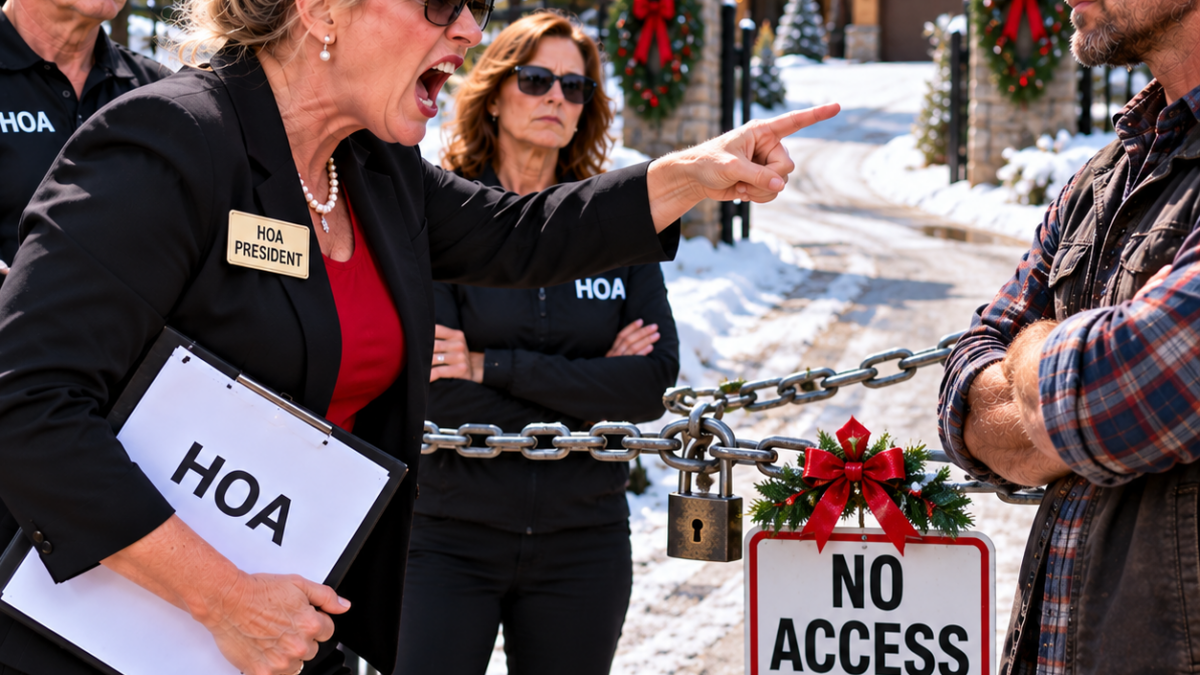
PART 2
I did not cut the chain.
That surprised Vanessa.
I think she expected me to lose my temper.
Frankly, part of me wanted to.
I had bolt cutters in the farm shop.
I had equipment powerful enough to pull the entire arch out of the ground.
But electrical cables ran through the structure.
The steel posts were fixed in concrete.
Christmas lights were wrapped around the frame.
And if I damaged anything, the story would immediately change.
The HOA would stop talking about why its gate stood on my property.
Instead, everyone would talk about the angry Christmas tree farmer who destroyed a community holiday display.
So I recorded.
The chain.
The padlock.
The yellow survey cap.
The footings.
The overhead beam.
The clear width.
The clear height.
The permit number.
The contractor vehicles.
My father’s damaged sign.
Vanessa watched.
“You’re making this much bigger than it needs to be.”
“No.”
I photographed the survey marker again.
“I’m making sure nobody gets to pretend this happened differently later.”
She shook her head.
“You could simply coordinate deliveries.”
“Coordinate with whom?”
“Our event team.”
“My Christmas tree farm has been operating here for decades.”
“I understand.”
“No, you don’t.”
I pointed up the hill.
“I have fir trees already cut for paid wholesale orders.”
“We can open the chain during service windows.”
“The chain isn’t the only problem.”
I pointed at the crossbeam.
“My larger trucks won’t clear that.”
“They should.”
“They won’t.”
“The contractor used standard clearance.”
“Standard for what?”
She had no answer.
I looked at Mason.
He avoided my eyes.
That told me something too.
The next morning, I received an official notice from Silver Pines.
My driveway was described as an “area serving the community.”
I read the phrase twice.
Serving the community.
That was carefully chosen language.
Not owned by.
Not deeded to.
Not part of common property.
Serving the community.
I called Vanessa.
“You changed the wording.”
“What are you talking about?”
“This letter doesn’t say you own my entrance.”
“Our covenants allow us to manage community circulation.”
“Inside Silver Pines.”
“The road serves the development.”
“So?”
“So the association has responsibilities.”
“Then show me the recorded document giving you the right to lock my farm gate.”
“You keep reducing this to ownership.”
“It is ownership.”
“It’s access management.”
“To my land.”
She became irritated.
“Ethan, we are less than a week from opening night.”
“And I am less than a week from the busiest Christmas shipping period of the year.”
“We both have schedules.”
“One of us built across the other person’s driveway.”
She hung up.
That afternoon, my largest scheduled collection arrived.
The driver stopped on the county shoulder.
He got out and stared at the arch.
“You serious?”
“I wish I wasn’t.”
“My truck’s not going through that.”
“I know.”
“You got another road?”
“No.”
That question hurt every time someone asked.
Pine Hollow had one truck entrance.
There were narrow farm tracks internally, but nothing else that connected safely to the county road for wholesale trailers.
We improvised.
My employees carried bundles downhill.
We used a smaller truck to shuttle loads.
The rented forklift remained trapped inside the farm.
Every transfer cost time.
Every hour mattered.
Christmas trees are not ordinary inventory.
A retailer needs trees before customers finish shopping.
A truck arriving two weeks after Christmas is not late.
It is worthless.
By noon, I had three red circles on my delivery schedule.
Three loads I had missed.
Vanessa arrived while my employees were carrying bundled trees by hand.
“We can open the chain after rehearsal.”
I stared at her.
“What time?”
“Seven thirty.”
“The buyer’s truck leaves at four.”
“Then use a smaller vehicle.”
“For sixty-two acres of wholesale production?”
“Ethan, I’m trying to offer solutions.”
“No.”
I pointed at the steel gate.
“You’re offering me ways to work around the problem you created.”
She stiffened.
“You refuse to cooperate.”
“My trucks followed this road before your neighborhood existed.”
“Things change.”
“Property lines usually don’t.”
That evening, I hired Claire Dawson.
Claire was a surveyor with a reputation for being painfully exact.
Exactly what I needed.
She arrived the following morning with instruments, plat copies, deed references, and an expression that told me she had no interest in neighborhood politics.
I showed her the yellow cap.
She crouched.
“This is a control monument.”
“For my parcel?”
“Possibly tied to the subdivision plat. I need bearings before I tell you anything useful.”
I liked that answer.
Not dramatic.
Not convenient.
Useful.
She measured the concrete footings.
Then the old farm boundary.
Then the drainage ditch.
Then the road.
Vanessa drove by twice.
On the third pass, she stopped.
“Another survey?”
“The first survey wasn’t mine.”
“Our engineers already reviewed this.”
Claire did not look up.
“May I see their coordinates?”
Vanessa hesitated.
“The contractor has the final placement.”
“Then I’d like the placement drawing.”
“You can request it through management.”
Claire returned to her instrument.
“Fine.”
No argument.
No ego.
Just measurement.
By the end of the day, Claire had one preliminary conclusion.
“The HOA does appear to have some maintenance interest near the drainage ditch.”
Vanessa smiled when she heard that.
I did not.
Claire continued.
“That is not the same as ownership.”
Vanessa’s smile disappeared.
“We never claimed ownership.”
“You chained my driveway.”
“That is event management.”
Claire raised one eyebrow.
I almost laughed.
She told me she needed the original recorded exhibit before making a final call.
That same day, I hired Sarah Whitmore.
Sarah was a property attorney who specialized in easements, land access, and commercial-loss disputes.
She arrived at Pine Hollow wearing boots instead of heels.
That alone made me trust her slightly more.
She looked at the arch.
Then at my tree rows.
Then at the delivery schedule.
“How much have you lost?”
“I don’t know yet.”
“Good.”
That surprised me.
“Good?”
“I don’t want guesses.”
She opened a notebook.
“I want actual contracts.”
“Okay.”
“Canceled appointments.”
“Okay.”
“Extra labor.”
“Okay.”
“Vehicle rental.”
“Okay.”
“Hauling.”
“Yes.”
“Saved expenses too.”
“What do you mean?”
“If you don’t deliver an order, you may avoid some costs. Lost revenue is not automatically lost profit.”
“You’re trying to make my claim smaller?”
“I’m trying to make it defensible.”
That shut me up.
Sarah continued.
“Separate losses before any court order from losses afterward.”
“Why?”
“Because dates matter.”
I didn’t understand how much they would matter until later.
I showed her Dad’s cedar sign.
The split had widened.
One carved letter was partly damaged.
Sarah touched the edge carefully.
“You can repair it.”
“Not really.”
“The wood can be repaired.”
“The carving can’t.”
She nodded.
“We’ll document it.”
Then she said something that helped me more than she knew.
“Not every important loss needs to be the largest number.”
I looked at the sign.
“Good.”
Because the sign mattered more to me than most invoices.
Sarah called Owen Brooks, the county fire-access officer.
Owen came without taking anyone’s side.
That mattered.
He measured the opening.
Eleven feet.
Then height.
Barely eleven.
He compared both against the farm’s approved emergency-access plan.
“This is inadequate.”
Vanessa folded her arms.
“The chain can be opened.”
Owen pointed upward.
“Opening a chain does not raise that crossbeam.”
“The structure is temporary.”
“The concrete footings are not temporary in any practical emergency.”
“It’s seasonal.”
“Fire apparatus does not become narrower because it’s December.”
I almost smiled.
Owen wrote a notice.
He was careful.
The notice did not decide who owned the land.
It simply documented that the structure obstructed the approved access corridor.
Vanessa called an emergency board meeting.
Sarah sent formal notice to the HOA attorney.
Survey issue.
Emergency clearance.
Business obstruction.
No consent.
Opportunity to remove voluntarily.
The board still refused.
Vanessa called me that night.
“You’re turning a holiday event into litigation.”
“No.”
“I’m asking you to cooperate.”
“I offered a banner.”
“That was never enough.”
“That’s not my problem.”
“You know how many families have volunteered?”
“I know how many retailers are waiting for trees.”
“Children are expecting this festival.”
“My employees are expecting paychecks.”
“That is unfair.”
I almost lost my temper.
“Unfair?”
I looked through the office window toward the glowing arch.
“You chained my only truck entrance during Christmas tree season.”
“We offered delivery windows.”
“You don’t get to create the obstruction and then call your schedule the compromise.”
She went silent.
Then:
“I am not canceling Christmas because one neighboring business refuses to cooperate.”
“Christmas was here before your arch.”
I hung up.
Later that evening, Mason called me.
Not from the job site.
From his shop.
“I think you need to see something.”
Sarah met us at her office.
Mason arrived carrying two rolled drawings.
He spread them across the conference table.
The first was the original permitted festival design.
I immediately saw the difference.
The arch sat entirely on Silver Pines common property.
Far from my truck entrance.
“That’s what the city approved?” I asked.
“Yes.”
Mason unrolled the second plan.
Field revision.
Both posts moved.
Now the structure sat beside my road.
Near the yellow control marker.
“Who ordered the change?”
He pointed at the signature block.
Vanessa Hale.
Sarah leaned closer.
“What was the reason?”
“Visibility.”
“From the highway?”
“Yes.”
Mason rubbed the back of his neck.
“The first location was behind landscaping. She said people wouldn’t see it.”
“Did you warn her about the property line?”
“I told her I wasn’t sure.”
“Before concrete?”
“Yes.”
“Did you ask for landowner consent?”
“Yes.”
He pulled out an email.
**Please provide confirmation of adjacent landowner consent before revised placement.**
Vanessa’s response was short.
**Consent handled. Proceed.**
Sarah looked at me.
“Did you ever consent?”
“No.”
“In writing?”
“No.”
“Verbally?”
“No.”
Mason looked sick.
“I relied on her assurance.”
Sarah said:
“That is why we document.”
Claire arrived later with the final boundary comparison.
She placed the 2004 plat beside Mason’s revised drawing.
The maintenance easement was real.
But narrow.
It reached the drainage ditch.
Then stopped.
The concrete footings stood beyond it.
Inside Pine Hollow.
Both.
I stared at the overlay.
“So they can maintain the ditch.”
“Yes,” Claire said.
“But not build over my road.”
“No.”
“Not lock it.”
“No.”
“Not use the maintenance right as festival property.”
“No.”
Sarah took a breath.
“Now we have the exact difference.”
That difference became everything.
The city had permitted an arch on HOA land.
The contractor built a different arch.
The maintenance easement did not cover it.
I had never consented.
Fire access was obstructed.
My deliveries were being delayed.
And Vanessa had personally authorized the field change after Mason questioned the boundary.
Sarah filed for temporary relief.
The hearing came quickly because Christmas was approaching and the obstruction was ongoing.
The judge reviewed photographs.
Permit drawings.
Survey.
Fire report.
Emails.
The court issued a preliminary order.
The obstructing structure had to be removed.
The road restored.
Deadline stated clearly.
For the first time in days, I felt my shoulders relax.
“It’s over,” I told Sarah.
She looked at me.
“No.”
“What?”
“We have an order.”
“That means they remove it.”
“That is what should happen.”
“You sound worried.”
“I’ve learned not to celebrate compliance before compliance.”
She was right.
Mason offered to dismantle the arch before sunrise.
He had workers.
A crane.
Rigging.
Electrical crew.
Everything.
Vanessa stopped him.
I could hardly believe it.
She told the board she wanted to discuss an appeal.
There was no filed appeal.
No stay.
The order remained effective.
I drove to the gate.
“Vanessa.”
She was checking festival lights.
“The court told you to remove this.”
“Our attorney is reviewing options.”
“Did the judge suspend the order?”
“No.”
“Did your attorney file an appeal?”
“Not yet.”
“Mason has the crew ready.”
“We are not dismantling months of community work hours before opening.”
I stared at her.
“Why?”
“Because families are already traveling.”
“That has nothing to do with the order.”
“It matters to me.”
“The court gave you a deadline.”
“The dispute is not finished.”
“The order is clear.”
She turned toward the illuminated arch.
“I will not let this unfinished fight erase what this neighborhood built together.”
That night, camera footage showed Vanessa personally checking the chain.
The deadline passed.
The next morning, my largest wholesaler canceled.
Not delayed.
Canceled.
The manager called me.
“Ethan, I’m sorry.”
“Give me one more day.”
“We don’t have one.”
“I can shuttle the load.”
“Our retail floor is empty.”
“I understand.”
“We found another farm.”
That sentence hurt more than I expected.
Once a retailer replaces you during Christmas week, that business is gone.
Maybe for the season.
Maybe longer.
I sat in the farm office after the call.
Dad’s old paintbrush hung above the desk.
The Christmas schedule lay open.
I drew a red line through the wholesaler’s order.
Then another.
I didn’t get angry.
I got quiet.
That was worse.
We rented a loading yard miles away.
Smaller trucks shuttled trees from Pine Hollow.
Employees worked longer.
We paid extra fuel.
Extra labor.
Extra rent.
Some orders survived.
Others didn’t.
Sarah kept telling me:
“Save every receipt.”
I did.
“Separate costs after service of the order.”
I did.
“Subtract what you saved.”
I did.
“If a canceled load would have lost money anyway, don’t claim it.”
I didn’t.
She was building something Vanessa could not dismiss as emotional exaggeration.
Then the cedar sign broke completely.
Workers moving festival supplies dragged it against one concrete footing.
The old board split.
Part of the carved farm name snapped.
I ran down.
“Don’t touch it again.”
A volunteer stepped back immediately.
“I’m sorry.”
“This isn’t your fault.”
I gathered the pieces.
Vanessa came over.
“We can replace the sign.”
“No.”
“We’ll pay for a professional reproduction.”
“You can reproduce letters.”
I held one cedar fragment.
“You cannot reproduce the knife marks my father made thirty-seven winters ago.”
She looked uncomfortable.
“For once, stop turning everything into money.”
Her face changed.
“That’s unfair.”
“Is it?”
I put the pieces into my truck.
That evening, Silver Pines opened its festival.
The arch glowed.
Music played.
Families took photographs.
Children walked under the star.
Neighbors drank cider.
Vanessa gave a speech.
I watched from a distance.
For a few crowded hours, she looked like she had won.
The court order existed.
The chain remained.
My truck still could not pass.
The festival was beautiful.
That was what made the whole situation so strange.
Nothing about the celebration itself was ugly.
The lights were beautiful.
The volunteers had worked hard.
The families had done nothing wrong.
Christmas was never the enemy.
The problem was the belief that a good event made the method acceptable.
My phone rang during Vanessa’s speech.
Another buyer.
Another canceled order.
I walked back to the farm.
Sarah met me the following morning.
She spread documents across my office table.
“We’re moving for enforcement.”
“What are we asking for?”
“Only what we can prove.”
I showed her contracts.
She grouped them by date.
Pre-order losses.
Post-order losses.
Shuttle costs.
Loading yard.
Extra labor.
Transport.
Canceled wholesaler orders.
Avoided expenses.
Net margin.
Sarah crossed out one number.
“Why?”
“You saved freight on this canceled load.”
“It still cost me the sale.”
“Yes. But the court needs net loss.”
She crossed out another.
“This order had too little margin.”
“You’re deleting my own damages.”
“I’m protecting the claim.”
I understood.
By December 20, the post-order ledger was clean.
No guesses.
No wishful gross sales.
Just actual numbers.
Owen returned.
The chain was open when he arrived.
Vanessa had apparently decided that looked better.
Owen measured the opening.
Then pointed up.
“The road is still obstructed.”
Someone from Silver Pines said:
“But the chain is open.”
“The truck cannot fit under the beam.”
Silence.
“This structure itself is the obstruction.”
Claire confirmed neither footing had moved.
Mason provided sworn testimony.
He had booked removal equipment.
Vanessa personally canceled it.
He produced the message.
**Do not return for dismantling. Festival structure remains through closing.**
Sarah attached it to the enforcement request.
Then another set of records emerged.
The sponsor agreement.
That finally explained why Vanessa had become willing to defy even a court order.
Silver Pines had accepted sponsor funding tied to its entrance display and fixed festival opening schedule.
The money had already been earmarked for culvert repairs.
If the entrance display disappeared before launch, a repayment provision could be triggered.
Moving the arch threatened the reserve.
Vanessa had promised the board those drainage repairs would happen without another assessment.
The puzzle made sense.
Not legally.
Humanly.
She had started with a community problem.
A festival.
Sponsor funding.
Needed culvert work.
Residents already tired of assessments.
Then the original arch location turned out to be poor for marketing.
She moved it.
Mason raised a boundary concern.
Instead of pausing, she convinced herself the nearby maintenance easement was broad enough.
Then the concrete was poured.
Then my deliveries became inconvenient to her schedule.
Then the court order arrived.
By then, removing the arch threatened the sponsor deal.
Every decision made the next one harder to reverse.
That is how people trap themselves.
Vanessa told me later:
“I thought we could settle the access paperwork after the event.”
I replied:
“You cannot borrow somebody else’s road and legalize it afterward because your sponsor already paid.”
“I was trying to get culverts repaired.”
“I know.”
“You know?”
“Yes.”
“Then why do you keep acting like I did this for myself?”
“I don’t.”
I looked at her.
“That doesn’t make the gate legal.”
The court eventually authorized supervised removal.
Mason came back.
This time, nobody stopped him.
Electricians isolated the power.
Workers disconnected lights.
The star came down first.
Then the crossbeam.
A crane lifted it slowly.
For a second, it hung above the entrance.
The same beam that had stopped my trucks for the most important part of the season.
Then it swung away.
Workers cut the steel posts.
Broke out concrete.
Removed the chain.
A broad trailer finally drove through.
The sound of tires on gravel was completely ordinary.
That nearly broke me.
I had spent weeks fighting for something that should have been so normal nobody noticed it.
A truck entering a farm through its own driveway.
I didn’t cheer.
Didn’t wave.
Didn’t make a speech.
I simply watched it pass.
Mason came over.
“We’re taking the arch.”
“Fine.”
“What about these?”
He pointed to the cedar fragments.
“Leave them.”
“You sure?”
“Yes.”
I gathered them myself.
Removal stopped the continuing damage.
It could not reopen Christmas week.
Retailers had already found replacement suppliers.
The canceled orders did not magically return.
The trees we cut for those customers were still there.
Some could be sold locally.
Some discounted.
Some became loss.
The enforcement hearing came in late January.
Christmas decorations across town were already coming down.
Silver Pines’ festival had ended.
But the financial consequences remained.
Judge Margaret Ellis reviewed the record.
Sarah had requested $150,000.
That number sounded dramatic.
The court did not accept it simply because we asked.
Each category had to survive scrutiny.
Lost net profit after the order.
$76,000.
Not gross canceled contracts.
Not hypothetical sales.
Net profit after subtracting avoided costs.
Extra hauling, loading-yard rental, shuttle transportation, and additional labor.
$29,000.
Reasonable legal and expert costs tied specifically to enforcing the order Vanessa refused to obey.
$45,000.
Total:
$150,000.
Vanessa stood with counsel.
She looked exhausted.
Judge Ellis allowed her to explain.
“I acted for residents who trusted me to deliver the festival.”
The judge listened.
“I did not receive any personal financial benefit.”
No one claimed she had.
“We had sponsor obligations.”
The judge nodded.
“Understood.”
“The sponsor funded culvert work our community needed.”
Again, the judge listened.
“I believed access could be resolved after opening night.”
That sentence hung in the courtroom.
Judge Ellis looked at her.
“The issue before me is not whether the festival benefited the neighborhood.”
Vanessa said nothing.
“It is whether you complied with an enforceable order after receiving it.”
Sarah showed the order.
Service.
Removal schedule.
Mason’s available crew.
Vanessa’s cancellation.
Video of the chain.
Owen’s clearance report.
Claire’s survey.
Everything dated.
Judge Ellis continued.
“Public purpose does not permit private disregard of a court directive.”
Vanessa looked down.
The judge went category by category.
Some of Sarah’s supporting calculations were questioned.
Some refined.
No exaggerated numbers survived.
That was exactly what Sarah wanted.
Then the final total came.
One hundred fifty thousand dollars.
Personally assessed against Vanessa as compensatory civil sanctions tied to the proven consequences of noncompliance.
Not because she decorated for Christmas.
Not because the judge disliked the HOA.
Not because a festival permit transferred land.
Because she had received an order requiring removal, had the ability to comply, canceled available removal work, kept the obstruction in place, and measurable losses followed.
I should have felt victorious.
Instead, I thought about the Christmas season.
I would have traded the judgment for those lost weeks.
Money could compensate for part of what happened.
It could not put my trees back onto retail floors before Christmas.
It could not give my employees those calmer days.
It could not restore my father’s cedar sign.
Outside court, a reporter asked:
“Do you feel like you got revenge?”
I shook my head.
“No.”
“Why not?”
“Because revenge would mean I wanted this outcome.”
“Didn’t you?”
“I wanted my road open.”
“What about the money?”
“It covers proven loss.”
“And Vanessa?”
I looked toward the courthouse doors.
“She made the decision after the order. The court decided what that decision cost.”
Then I left.
Vanessa resigned from the presidency.
Not in a dramatic meeting.
No shouting.
No crowd celebrating.
She sent the board a written notice.
She stayed long enough to help transfer records.
The culvert repairs still mattered.
The sponsor issue still had to be resolved.
The neighborhood still needed to function.
Before stepping down, she told the board:
“Keeping the gateway after the court order was my decision.”
That sentence mattered.
No blaming volunteers.
No blaming Mason.
No blaming residents.
No blaming Christmas.
Silver Pines changed its approval process.
Any future contractor work near private parcels required survey verification.
Recorded authority.
Landowner consent where necessary.
No field relocation of permanent structures without updated approval.
No officer could unilaterally change a site plan involving a boundary.
The following Christmas, Silver Pines held its festival again.
I know some people expected me to oppose it.
I didn’t.
Why would I?
The new entrance arch stood entirely on HOA common property.
Set back from Pine Hollow.
Clear of my road.
Surveyed.
Permitted.
Visible enough.
Families came.
Lights went up.
Children took photographs.
The world survived.
One afternoon, a board member stopped at the farm.
“We’re testing traffic flow Saturday.”
“Okay.”
“We may have visitors stop here accidentally.”
“That happens every year.”
“We’ll put a volunteer at the turn.”
“Good idea.”
He hesitated.
“Are we okay?”
“With what?”
“The festival.”
I looked toward the new arch.
“It’s on your land.”
“Yes.”
“Then celebrate.”
He smiled.
That was the entire issue.
I was never against Christmas.
I was against someone deciding Christmas made my driveway theirs.
Pine Hollow recovered slowly.
Wholesale buyers are creatures of habit.
Lose one retailer during peak season and another farm may keep that account.
Some came back the following year.
Some didn’t.
I rebuilt.
That is farming.
You rebuild after storms.
Bad seasons.
Equipment failures.
Market changes.
Legal fights.
The farm had survived worse than Silver Pines.
What hurt longer was the cedar sign.
I took the broken pieces into the workshop.
A carpenter friend helped stabilize what remained.
We could have made a perfect reproduction.
Computer-cut letters.
Fresh cedar.
Beautiful finish.
I didn’t want perfect.
I saved every original fragment we could.
One letter was missing part of its carved edge.
We left it that way.
Emma, my daughter, asked:
“Why not make it look new?”
“Because it isn’t new.”
“Would Grandpa care?”
“He’d probably tell me to stop being sentimental and get back to work.”
She laughed.
“So you are being sentimental.”
“Absolutely.”
We mounted the repaired sign inside the farm office.
Not outside.
Too fragile.
Above it, Dad’s old paintbrush.
I placed the judgment paperwork in a file cabinet.
The cedar went on the wall.
That showed my priorities.
By early February, the driveway had been repaired.
Fresh gravel covered the footing holes.
Drainage restored.
The turning lane cleared.
Claire installed a clear boundary pin near the entrance.
Small.
Yellow.
Easy to miss.
I stood beside it while a new farm sign went up.
Mason was there.
He had volunteered to help set the sign.
“Inside the surveyed line?” I asked.
He laughed.
“I measured it twice.”
“Make it three.”
“You’ve become difficult.”
“I was difficult before.”
“That’s true.”
We set the sign.
No arch.
No chain.
Just Pine Hollow Farm.
Months later, Vanessa came by.
She called first.
That mattered.
“Can I stop at the office?”
“Sure.”
She arrived without an HOA vehicle.
No clipboard.
No board packet.
Just herself.
I made coffee.
For a while, neither of us mentioned the case.
Finally she looked at Dad’s sign.
“You repaired it.”
“Stabilized it.”
She stood closer.
“The letters are uneven.”
“He carved them.”
“I know.”
“You noticed?”
“I noticed after.”
That answer carried more weight than she probably realized.
After.
After the gate.
After the order.
After the hearing.
After $150,000.
She looked at me.
“I’m sorry.”
“You’ve said that.”
“Not for the sign.”
I waited.
“For treating it like something replaceable.”
I nodded.
“Thank you.”
She looked relieved and sad at the same time.
“I still believe the culvert repairs were important.”
“They were.”
“The sponsor money mattered.”
“I know.”
“The festival mattered.”
“I know.”
“Then what should I have done?”
“Stopped.”
“When?”
“The first time Mason asked for proof of consent.”
She looked down.
“That early?”
“Yes.”
“But then we would have missed the schedule.”
“Maybe.”
“And risked the sponsor funding.”
“Maybe.”
“And possibly needed another assessment.”
“Maybe.”
She looked frustrated.
“You make that sound easy.”
“It wasn’t.”
“Then why say it?”
“Because difficult choices do not become easier by using someone else’s property without permission.”
She sat quietly.
“That’s the part I kept refusing to hear.”
“Yes.”
“I thought leadership meant finding a way.”
“Sometimes leadership means telling people the plan can’t happen the way they want.”
She smiled slightly.
“You’d make a terrible HOA president.”
“Correct.”
We both laughed.
That conversation was the first time I stopped seeing Vanessa only as the woman who chained my driveway.
She had made a serious decision.
Then another worse decision.
But she had not started out wanting to damage my farm.
She got trapped inside a promise.
Sponsor money.
Culvert repairs.
Festival deadline.
Residents.
Public expectations.
Then pride.
Once the arch was built, she saw removing it as failure.
Once the court order arrived, she saw compliance as surrender.
That second mistake cost far more than the first.
Pride often does.
The following December, Pine Hollow had its strongest retail season in years.
Not because of the lawsuit.
Because we worked.
New wholesale accounts.
Better scheduling.
Direct customer weekends.
One Saturday, Silver Pines volunteers came to buy discounted trees for a charity drive.
I gave them the same discount I offered local churches.
One volunteer looked surprised.
“After everything?”
“After what?”
“The HOA.”
“You didn’t chain my gate.”
“No.”
“Then why would I charge you for something you didn’t do?”
She smiled.
“We weren’t sure you liked us.”
“I like customers.”
She laughed.
The volunteers loaded trees.
Children picked smaller ones.
Someone drank hot cider by the barn.
For a moment, Pine Hollow and Silver Pines were exactly what they should have been.
Neighbors.
No boundary war.
No court order.
No chain.
Just people in December.
That mattered to me.
The easiest way to become like the person who hurt you is to start treating everyone around them as guilty too.
I refused.
Silver Pines was not Vanessa.
The volunteers were not the board.
The children at the festival were certainly not responsible.
I would not turn my anger into somebody else’s punishment.
A year after the judgment, Sarah visited the farm.
She looked at the entrance.
“No chain.”
“No lawsuit.”
“No emergency hearing.”
“You seem bored.”
“Very.”
“Good.”
We walked toward the office.
I showed her the repaired cedar sign.
She smiled.
“That’s better than a new one.”
“I think so.”
“Still angry?”
“Not much.”
“At Vanessa?”
“Sometimes.”
“At yourself?”
I looked at her.
“How did you know?”
“You’re predictable.”
“For what?”
“For wondering whether you could have prevented more.”
I sat on the edge of the desk.
“Could I?”
“Probably not everything.”
“If I had filed sooner?”
“Maybe the temporary order comes sooner.”
“If I had blocked construction?”
“Then they might accuse you of interfering with their contractors.”
“If I had cut the chain?”
“Bad idea.”
“I know.”
“If I had…”
Sarah stopped me.
“Ethan.”
“What?”
“You did what evidence allowed when evidence allowed it.”
I was quiet.
She continued.
“You don’t get to rewrite real life like a cleaner story afterward.”
That stayed with me.
In stories, people always make the perfect decision at the perfect time.
Real people don’t.
We learn.
We measure.
We find documents.
We hesitate.
We get angry.
We make partial decisions.
Sometimes we win too late to recover everything.
That doesn’t mean the fight failed.
Pine Hollow still has one main truck entrance.
The same one.
The road is wider now because we regraded the shoulders.
Fire access meets clearance.
The boundary cap remains visible.
The HOA arch is nowhere near it.
Every December, trucks roll through before sunrise.
Sometimes I stand in the office doorway and listen to diesel engines climbing the grade.
That sound became comforting.
Not because trucks are beautiful.
Because for a few weeks, I had to fight for the right to hear them.
The final lesson came several years later.
Silver Pines planned drainage work near Pine Hollow.
A new HOA president emailed me.
**Our contractor may need temporary access approximately six feet beyond the maintenance easement for equipment positioning. Would you be willing to review a temporary license?**
I stared at the email.
Then laughed.
Emma was in the office.
“What?”
“Nothing.”
“Dad.”
I turned the monitor toward her.
She read it.
“That’s all?”
“That’s all.”
“Why are you smiling?”
“Because this is what should have happened the first time.”
I met the contractor.
We marked the temporary area.
Sarah reviewed a one-page license.
They paid a modest access fee.
Work lasted two days.
Crew restored the gravel.
Done.
No drama.
No court.
No $150,000.
No damaged sign.
Just permission.
That tiny transaction proved something enormous.
Respect is cheaper.
Almost always.
The original arch cost money to build.
Then money to remove.
The blocked deliveries cost money.
The loading yard cost money.
Experts cost money.
Lawyers cost money.
The judgment cost money.
The damaged business relationships cost money.
All because someone thought asking permission would threaten a deadline.
A one-page agreement could have prevented almost everything.
Sometimes the simplest lesson is the most expensive.
Years passed.
My father’s old paintbrush finally lost more bristles.
I still refused to throw it away.
The cedar sign darkened slightly on the office wall.
Emma once suggested putting a small plaque beneath it.
“What would it say?”
She thought.
“Pine Hollow Farm. Original sign, 1989.”
“No.”
“Why?”
“Too formal.”
“How about: Grandpa made this.”
I smiled.
“That’s better.”
We never added the plaque.
The sign didn’t need explanation.
Neither did the road anymore.
Everyone who mattered knew whose land began where.
Silver Pines had its entrance.
Pine Hollow had mine.
The drainage easement remained what it had always been.
Limited.
Specific.
Useful.
No one needed to stretch it.
Vanessa eventually paid the judgment through arrangements handled by counsel.
I never followed the details closely.
People assumed I did.
They expected me to enjoy every financial consequence.
I didn’t.
The court had already answered the question that mattered.
She was responsible for the proven harm caused after refusing to obey the order.
That was enough.
I didn’t need to watch her struggle.
I didn’t need rumors.
Didn’t need humiliation.
When someone asked whether losing $150,000 had “taught her a lesson,” I answered:
“I hope the paperwork taught everyone a lesson before the money had to.”
Because the $150,000 was not some magical punishment.
It had parts.
$76,000 in lost net profit.
$29,000 in real hauling, labor, and rented-space expenses.
$45,000 in reasonable enforcement costs.
Dates.
Receipts.
Invoices.
Contracts.
No fantasy number.
That is what made it powerful.
The consequence matched the record.
Not anger.
I think my father would have respected that.
He believed numbers should come from somewhere.
He hated estimates made “because they sounded right.”
If he had been alive, he probably would have sat in the courtroom complaining quietly about lawyer fees.
Then gone home and repaired the gate himself.
I wish he had been there.
But if he had, the cedar sign probably never would have been lying beside that concrete footing in the first place.
He would have stood beside it all day.
Stubborn old man.
Maybe that’s where I got it.
Every December, I repaint the new outdoor farm sign.
Not Dad’s original.
That stays inside.
But the replacement outside gets fresh paint before the first trees leave.
I use a modern brush.
Dad’s old one stays hanging above the ledger.
The first year after the case, I considered using it.
Then stopped.
Some tools have done enough work.
They deserve to rest.
The weekend before Christmas, I sometimes walk to the county road after the last truck leaves.
Silver Pines lights glow in the distance.
Their festival arch stands on their own common land.
Pine Hollow’s entrance stands open.
Two celebrations.
Two properties.
No conflict.
Sometimes music drifts across the pines.
I like hearing it.
That surprises people.
They think I must hate the Silver Pines Christmas Festival.
I don’t.
I never did.
Christmas had nothing to do with the problem.
A festival can be wonderful.
A sponsor can support important repairs.
A board can want to help families.
A president can have good intentions.
None of those things create a deed.
None suspend a survey.
None erase a fire-access requirement.
And none replace an owner’s consent.
That is the entire story.
The arch was not wrong because it had lights.
It was wrong because it stood where it had no right to stand.
The chain was not wrong because Silver Pines wanted traffic control.
It was wrong because it locked the only entrance to a working farm.
Vanessa was not held personally responsible because she wanted families to have Christmas.
She was held responsible because after a court ordered the obstruction removed, she knowingly kept it there and measurable losses followed.
Simple facts.
Complicated consequences.
The final time Vanessa visited Pine Hollow, it was December again.
She bought a tree.
I recognized her car immediately.
She walked through the rows alone.
Eventually she chose a seven-foot Fraser fir.
“Good shape,” I said.
“You’re trying to upsell me.”
“You already picked it.”
“Then I have excellent taste.”
We loaded it.
At the register, she looked at the cedar sign inside the office.
“Still there.”
“Always.”
She paid.
Then hesitated.
“Ethan?”
“Yeah?”
“The new festival entrance works fine.”
“I know.”
“It’s actually easier for traffic.”
I smiled.
“Don’t tell me that.”
She laughed.
“I know.”
Then she became serious.
“I spent years thinking moving the arch would destroy the event.”
“It didn’t.”
“No.”
“The neighborhood still celebrates.”
“Yes.”
“The culverts got repaired eventually.”
“Yes.”
She looked toward the farm entrance.
“I wish I had believed there was another solution.”
“There usually is.”
“I know that now.”
That was enough.
She took the tree home.
I went back to work.
No grand reconciliation.
No speech.
Just two people who had learned different things from the same expensive winter.
Christmas Eve came quietly.
The wholesale rush was over.
Most fields were dark.
A few remaining trees stood near the retail barn.
Emma came by with food.
We closed early.
Before going inside, I walked to the entrance one last time.
Fresh gravel.
Boundary marker.
Clear sky.
No chain.
I remembered the arch swallowing the road.
Vanessa telling me to arrange another route.
The trucks turning around.
The court order.
Mason’s crane.
Dad’s broken sign.
For years, I thought the satisfying ending would be watching someone else lose.
It wasn’t.
The satisfying ending was standing there and realizing nobody was fighting anymore.
My road was open.
Silver Pines had its festival.
The farm survived.
The rules were clear.
Dad’s sign was safe inside.
The people who came after us would have better records than we did.
That was enough.
I locked the farm office.
Dad’s old paintbrush hung above the repaired cedar sign.
Outside, Christmas lights from Silver Pines shimmered through the trees.
I could hear children somewhere in the distance.
I smiled.
Then I drove home through the entrance that had belonged to Pine Hollow all along.
No volunteer stopped me.
No president told me to use another road.
No chain blocked the gravel.
Just my headlights, the winter trees, and the clean tracks of trucks that had come and gone all season.
Christmas was never the enemy.
The problem had always been confusing celebration with permission.
And after one costly winter, Silver Pines finally learned the difference.

