PART 2: HOA Built Warehouses Beside My Private Runway—Then the FAA Showed Up at Their Ribbon Cutting
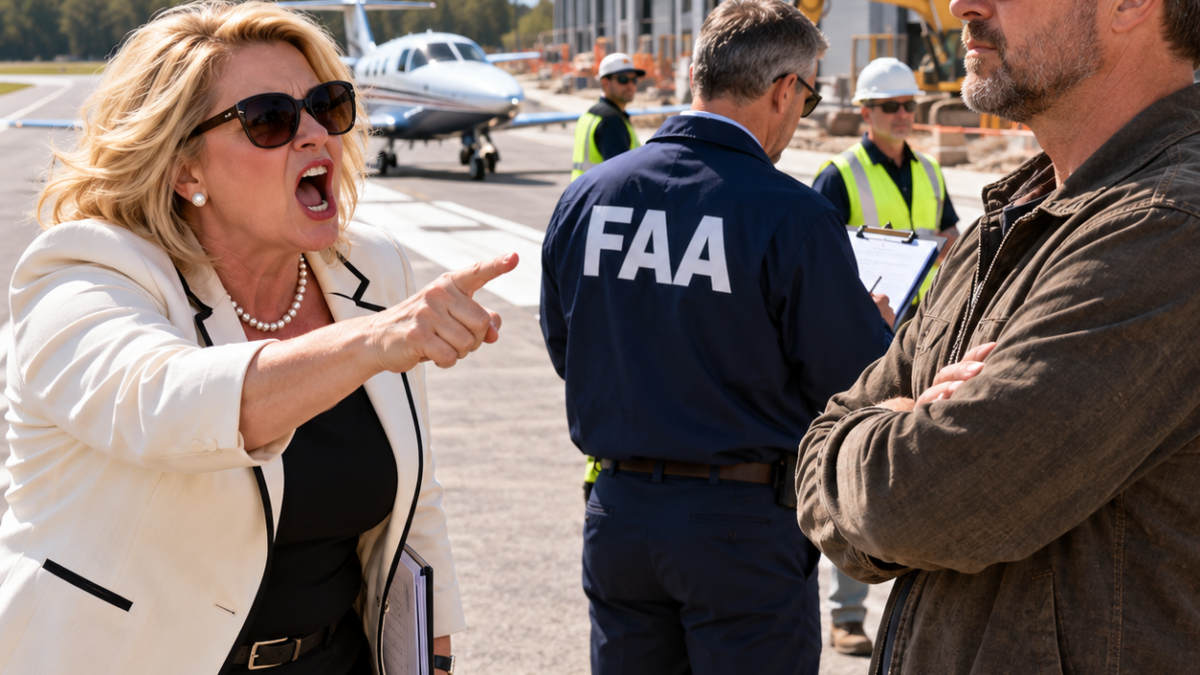
**The first time I saw the new roofline beside my runway, I thought my eyes were lying to me.**
**By the time my tires touched the concrete my father had poured with his own hands in 1961, the wind rolling off that wall had already told me somebody had made a very expensive mistake.**
**What I didn’t know was that the woman waiting at my fence had already decided exactly how much of my life she was willing to erase.**
I was on short final when the building appeared where open sky had always been.
For more than thirty years, I had flown that approach so many times I could have described every fence post with my eyes closed. The hayfield. The north fence. The old cottonwood leaning slightly west. Then the concrete threshold my father poured when Cedar Hollow was nothing but farmland and an idea.
That afternoon, none of it looked right.
Four enormous warehouse buildings stood along the north side of the property, their fresh steel siding catching the late sun. Loading docks faced toward my runway. Construction equipment crowded the ground between them. One of the buildings sat so close to my approach path that the roof seemed to rise directly into my windshield.
I pushed the throttle forward and climbed.
My airplane shuddered as disturbed air rolled off the new structure and lifted one wing.
“Come on,” I muttered, correcting hard.
I went around.
On the second attempt, I stayed higher and came in steeper than I should have needed to. The wheels finally touched down near the faded line my father had painted decades earlier.
I taxied toward my hangar with my jaw locked so tightly it hurt.
Meredith Vance was waiting at the fence.
She stood perfectly still in a navy jacket with a sheet of paper in one hand, as if she had been expecting me.
I shut down.
The propeller slowed.
Before I could climb out, she called, “You’re done landing here.”
For a second, I thought I had misheard her.
I removed my headset. “Excuse me?”
She raised the paper.
“The board voted. This area is association property, and the new development has been approved.”
I looked past her at the warehouse wall.
“That building is inside my approach corridor.”
“The county issued permits.”
“That isn’t what I asked.”
She gave me the expression she used at HOA meetings when somebody questioned her numbers.
“Bradley, this neighborhood has twenty-four families. Twenty-four families have been paying to maintain a private airstrip so one retired airline pilot can enjoy his hobby.”
I stepped down from the airplane.
“My hobby?”
“You know what I mean.”
“No, Meredith. I don’t think I do.”
A concrete truck rumbled behind her.
I pointed toward the runway.
“My father built that strip. I own it.”
“You own a parcel of land.”
“I own the runway.”
“The association has rights here.”
“The homeowners have permission to use it. That doesn’t make it association property.”
Her expression tightened.
She lifted the paper again.
“The board has made its decision. You have until Friday to relocate your aircraft. After that, violations and fines will begin.”
For several seconds, neither of us spoke.
The windsock snapped once above us.
My father had installed that pole before half the houses in Cedar Hollow existed. When the wind shifted north, the pipe made a dull knocking sound that had followed me through most of my life.
Knock.
Pause.
Knock.
I looked at Meredith.
“Who signed the permit application?”
Her eyes changed.
Only slightly.
But I saw it.
“That’s association business.”
“I’m a member of the association.”
“You can submit a records request.”
“Who certified the site?”
“Bradley, I’m not standing here debating paperwork with you.”
Then she turned away.
I watched her walk toward the construction entrance while another truck rolled onto the property.
She had given me until Friday.
She had threatened fines.
And most importantly, she had put everything in writing.
At the time, I thought that piece of paper was just arrogance.
Nine weeks later, it would become one of the reasons two federal vehicles drove up the same access road she had insisted I had no right to control.
But that afternoon, I knew none of that.
All I knew was that somebody had built four warehouses beside the runway my father had spent half his life protecting.
And the woman responsible was absolutely certain I couldn’t stop her.
PART 2
My name is Bradley Caldwell.
I flew commercially for twenty-six years before turning in the uniform.
Retirement lasted exactly eleven months.
I discovered quickly that I didn’t miss airline schedules, crowded terminals, or hotel rooms that all smelled the same.
I missed flying when it mattered.
So I began working nights and weekends for Blue Wing Medical Transport.
We served small communities scattered across our part of the state, places with clinics but no major hospital. When somebody needed to reach specialized care quickly, a nurse called dispatch.
If weather allowed, I went.
Caldwell Field made that possible.
The runway wasn’t long or glamorous.
Three thousand two hundred feet of concrete, one windsock, a row of small hangars, and no tower.
But location mattered.
From Sunrise Bend or Marlow County, an hour and a half by road could become twenty-something minutes in the air.
That difference mattered to families.
It mattered to nurses.
It mattered to me.
My father understood usefulness before anybody in Cedar Hollow understood property values.
In 1961, he bought the entire piece of ground when it was mostly hay.
He borrowed a bulldozer.
He cleared the strip himself.
When he poured the threshold, he scratched his initials into one corner with a nail.
B.C.
Benjamin Caldwell.
I was a boy when he first showed them to me.
“Concrete remembers,” he told me.
I laughed.
He tapped the slab with his boot.
“People forget. Paper gets lost. Concrete remembers.”
For years, I thought that was just something fathers said because they wanted their sons to listen.
Later, he divided the surrounding land into twenty-four residential parcels.
Most included hangar access.
He called the development Cedar Hollow Air Park.
The homeowners received the right to use the runway.
But my father never transferred ownership of the runway itself.
He was careful about that.
Very careful.
The residents bought homes.
They received access.
They did not buy the strip.
When my father passed the property to me, the runway came with it.
For decades, nobody cared.
Then Meredith Vance arrived.
She bought the least expensive house in Cedar Hollow four years before the warehouse project began.
It was one of the few lots without a private hangar.
She didn’t fly.
She sold commercial real estate.
Within a year, she was attending every HOA meeting.
Within two, she was president.
That happened mostly because nobody else wanted the position.
Cedar Hollow had aged.
Several original owners were in their seventies.
Some had stopped flying.
A few had sold their aircraft.
Meetings had become short, sleepy affairs involving road repairs, landscaping, mailbox standards, and arguments over whose dog had been loose near the hangars.
Meredith changed the atmosphere.
She arrived with presentations.
Spreadsheets.
Projected budgets.
Development language.
Revenue forecasts.
At first, people liked it.
She seemed energetic.
Competent.
She spoke in complete sentences when everyone else was trying to get home before dinner.
The problem was that Meredith never described the runway as a runway.
She called it “the amenity.”
The first time I heard her say that, I corrected her.
“It’s an airport.”
She smiled.
“Technically.”
“No. Literally.”
A few people chuckled.
She didn’t.
By the following year, she had begun questioning maintenance expenses.
Why should homeowners who no longer flew contribute toward mowing?
Why should association funds support runway-edge repairs?
Why should twenty-four households carry what she called “legacy aviation costs”?
I reminded her that homeowners had access rights because that was how the development had been created.
She answered with the same sentence every time.
“Communities evolve.”
Then came the Tuesday meeting that changed everything.
I walked into the community room and saw a large architectural rendering on an easel.
Meredith had placed it beside the folding chairs before anyone arrived.
Eleven acres of open association land sat along Cedar Hollow’s northern boundary.
On the rendering, that open ground had disappeared.
In its place were four rectangular warehouse buildings.
Copperline Logistics.
She presented the proposal like a gift.
Lease income for the association.
Lower dues.
New pavement.
Improved drainage.
A permanent commercial revenue stream.
“Right now,” she told the room, “twenty-four households are effectively supporting one privately owned runway.”
I looked around.
Nobody met my eyes.
That was the brilliance of her framing.
She wasn’t taking anything from them.
She was promising to save them money.
An older homeowner named Frank raised his hand.
“What about airplanes?”
Meredith nodded sympathetically.
“The runway itself is becoming the greater liability.”
I almost admired how smoothly she said it.
The warehouses were being built next to an airport, yet somehow the airport was the problem.
I stood.
“What did the site review say about the approach corridor?”
Meredith didn’t hesitate.
“The county approved the plans.”
“That’s not my question.”
“The county handles construction permitting.”
“The county doesn’t control aviation clearance.”
She tilted her head.
“Bradley, the county does not need your permission to issue a permit on association property.”
“Neither does gravity.”
A few people looked up.
I continued.
“If you put a structure into an approach path, a building permit doesn’t make it safe.”
Her smile disappeared.
“The professionals have handled the professionals’ work.”
I asked to see the aviation review.
She said there wasn’t one in the meeting packet.
I asked whether one existed.
She told me I was out of order.
The vote passed ten to two, with two abstentions.
Arlene Doyle did not vote.
That mattered later.
Arlene had been association secretary for twenty years.
She was seventy-two, small, sharp-eyed, and better at record keeping than most lawyers I had met.
She sat at the end of the table with the old leather-bound ledger closed in front of her.
When the meeting ended, everybody else began stacking chairs.
Arlene picked up the ledger.
She looked at me.
Held my eyes for several seconds.
Then left.
Meredith caught me in the parking lot.
“Bradley.”
I stopped.
She carried a thin folder.
“This doesn’t need to become ugly.”
She handed me one page.
At the top were the words:
ACKNOWLEDGMENT OF DECOMMISSIONING.
My name appeared underneath.
All it needed was my signature.
“What is this?”
“Administrative housekeeping.”
“You want me to close my runway.”
“I want the records to match the direction of the community.”
“The runway isn’t community property.”
She sighed.
“Sign it, and your private access drive remains exactly where it is. We’ll also waive any pending compliance issues.”
I stared at her.
“I don’t have pending compliance issues.”
“You will.”
The parking lot suddenly felt colder.
“What exactly changes if I sign this?”
“Nothing practical.”
“Then why do you need my signature?”
She didn’t answer.
That silence bothered me more than any argument could have.
I handed the form back.
“No.”
She slipped it into the folder.
“You’re making this harder than necessary.”
“No, Meredith. I think I’m making you prove what you’re trying to do.”
She walked away.
That night, I climbed a ladder inside my hangar and pulled down an old metal box my father had kept in the rafters.
It contained documents older than I was.
Deeds.
Surveys.
Tax receipts.
Fuel invoices.
Handwritten notes.
Near the bottom was the original Cedar Hollow plat.
I spread it across my workbench under a hanging light.
There it was.
The runway parcel had its own legal description.
Separate property.
Separate title.
Then I found the original declaration my father had recorded when he sold the first residential lot.
One sentence mattered.
Homeowners held a license to use the landing strip.
Title remained with the Caldwell parcel.
I read it four times.
Then I laughed.
Not because anything was funny.
Because after an evening of listening to Meredith speak as though history could be changed by committee vote, my father’s handwriting and recorded paperwork had done what he always intended them to do.
The runway was mine.
The next morning, I made copies and walked into the association office.
Meredith was behind a corner desk.
A little flag stood beside her computer.
I placed the deed and plat in front of her.
“Recorded documents.”
She picked them up.
She read them.
For four seconds, nothing moved on her face.
Then she slid them back.
“This establishes that you own the ground.”
“Yes.”
“It doesn’t give you authority over association land.”
“It establishes the runway.”
“On your parcel.”
“And the approach is part of operating it safely.”
She leaned back.
“You do not own the sky, Bradley.”
“No. Neither do you.”
Her eyes hardened.
I asked to see the warehouse permit file.
She told me to submit a written request.
“There’s a form.”
That became her favorite weapon.
Not law.
Process.
If I asked a question, there was a form.
If I wanted records, ten business days.
If I objected to construction, the next board meeting.
If I wanted to appeal a fine, thirty days.
Meanwhile, steel went up every morning.
Building B rose first.
It was the closest to my northern approach.
The crew erected the frame in four days.
At night, a crane boom rested high enough to cut across the path I had used for decades.
No warning light.
No obstruction marker.
Nothing but reflective tape tied near the end.
I stood at the runway threshold one evening, looking north.
The windsock pole knocked softly behind me.
I counted the crane sections because counting kept me from doing something stupid.
Friday came.
I did not move my airplane.
On Monday, a certified letter arrived.
Two hundred fifty dollars per day.
Violation of Section 14.
“Operation of aircraft generating noise outside permitted hours.”
I pulled the association rules from a drawer.
Section 14 concerned trash containers.
I called Arlene.
She was quiet for several seconds.
“They changed it.”
“When?”
“October.”
“I was at the October meeting.”
“It was in the consent packet.”
“Was it discussed?”
“No.”
“Did anybody vote specifically on runway restrictions?”
“They voted to approve the packet.”
I closed my eyes.
“Arlene.”
Another pause.
“Bradley, I’m not on that board anymore in any way that matters.”
Then she hung up.
Two days later, my gate code stopped working.
I entered four digits.
Error.
Again.
Error.
A third time.
Error.
My airplane sat forty feet away behind a locked gate.
I owned the hangar.
I owned the runway.
And four numbers controlled by the HOA had effectively separated me from both.
The fuel truck arrived Thursday.
Its driver couldn’t enter.
He called me.
I called the association office.
Nobody answered.
After an hour, he left.
Friday night Blue Wing called.
A patient in Sunrise Bend needed an urgent transfer.
I checked my fuel.
Not enough reserve.
I could reach Sunrise Bend.
I could not safely complete the full mission.
“I can’t take it,” I told dispatch.
The coordinator went silent.
“Weather?”
“No.”
“Mechanical?”
“No.”
“What is it?”
I looked through my kitchen window toward the dark hangar.
“Access problem.”
I had refused very few flights in twenty-six years.
Weather.
Ice.
Unsafe winds.
Mechanical concerns.
That was the first one I had ever refused because an HOA president had changed a gate code.
Monday morning, I called the county building department.
Hal Grayson answered.
He had the voice of a man who had spent thirty years explaining setbacks and drainage plans.
I asked about Copperline.
He pulled the file.
“Permits are valid,” he said. “Structural, site, drainage, everything.”
“What about aviation review?”
Silence.
Then paper moving.
“Wouldn’t be one.”
“Why?”
“The applicant certified there was no active public or private airport within two miles.”
I gripped the phone tighter.
“Hal.”
“Yes?”
“My runway is about four hundred feet from Building B.”
The papers stopped moving.
“Well.”
That one word changed everything.
“Who signed the certification?”
“I can’t release names from the file over the phone.”
“How do I get it?”
“Public records request.”
“How long?”
“About ten business days.”
Of course.
Another form.
Another clock.
That night I walked down to the threshold.
The warehouse structure blocked part of the stars.
The crane still had no warning light.
I stood beneath my father’s windsock and wondered whether paperwork could move faster than steel.
Two mornings later, somebody knocked on my hangar door.
Arlene Doyle stood outside holding a banker’s box.
I reached for it.
She turned away.
“I can carry my own box.”
She walked inside and placed it on the workbench.
“What is this?”
“Copies.”
“Of what?”
“Twenty years.”
She removed the lid.
“Meredith asked for the originals after she became president. She never asked whether I had copies.”
I stared at her.
Arlene pointed.
“Second folder.”
It was labeled:
NORTH RESERVE — RECORDED.
Inside was a document with a county recorder’s stamp.
I read the title twice.
Avigation easement.
The document burdened the association’s eleven northern acres.
In plain English, it meant that years earlier the owners of that land had accepted a permanent restriction protecting the runway’s approach corridor.
Nothing could be built high enough to interfere with aircraft operating along the protected path.
It wasn’t an HOA rule.
It wasn’t a guideline.
It was recorded against the land.
I flipped to the acknowledgment page.
My stomach tightened.
Three years earlier, the association had received an updated recorded copy.
The acknowledgment was signed by the association secretary acting for the board.
Meredith Vance.
Her handwriting.
Her familiar looping V.
“She knew,” I said.
Arlene stared at the wall.
“She signed for it.”
“She knew.”
“That isn’t necessarily the same thing.”
I looked at her.
She finally met my eyes.
“Which may be worse.”
She lifted her purse.
“There was also a closed session last spring.”
“About what?”
“I don’t know.”
“You were secretary.”
“I was excluded.”
“That’s allowed?”
“Depends what they claimed they were discussing.”
“Do the minutes say?”
“They say when the meeting started and when it ended.”
“That’s it?”
“That’s it.”
She turned toward the door.
Then she stopped.
“Bradley.”
“Yes?”
“I’ve watched Meredith for four years.”
Her voice lowered.
“She rarely does anything unless there is something in it for her.”
The public records envelope arrived the following Tuesday.
I opened it beside the mailbox.
The certification form was two pages.
Halfway down was a checkbox.
NO ACTIVE PUBLIC OR PRIVATE AIRPORT WITHIN TWO MILES.
Checked.
Underneath was the applicant’s signature.
Meredith Vance.
Cedar Hollow Air Park Homeowners Association.
Then came the notary block.
Meredith’s commission.
Meredith’s stamp.
Meredith’s signature.
I sat on my truck tailgate.
Cars passed.
Someone waved.
I waved back automatically.
Then I noticed the date.
Eleven days.
That certification had been signed eleven days after Meredith had tried to get me to sign the decommissioning form.
First, she asked me to officially close the runway.
I refused.
Eleven days later, she certified that the runway did not exist as an active airport.
A mistake can happen once.
A sequence is harder to explain.
I called Gwen Rasmussen.
Gwen practiced aviation law out of a converted old house in Boise.
There was a framed Cessna print in the waiting room and airplane parts on a bookshelf.
I placed three documents on her desk.
The plat.
The easement.
The site certification.
She read them in silence.
Then she removed her glasses.
“Bradley, do you understand what this is?”
“She lied to the county.”
“That’s part of it.”
She tapped the easement.
“This is a property right. The association took that land subject to this restriction. A board vote does not erase it.”
Then she tapped the certification.
“This worries me more.”
“Why?”
“Because construction near an active runway can trigger federal airspace review. Height. Location. Lighting. Hazard evaluation.”
“They didn’t file anything.”
“I checked before you arrived.”
She looked directly at me.
“There is no federal obstruction filing for Copperline.”
“So they skipped it?”
“More accurately, the process was never triggered because the local application said there was no airport nearby.”
I leaned back.
“The airport they were looking at from the meeting room.”
“Yes.”
“The airport named in the subdivision.”
“Yes.”
“The airport Meredith tried to convince me to close eleven days earlier.”
Gwen nodded.
“Yes.”
I filed an obstruction complaint that night.
I included photographs.
Coordinates.
Registration records.
Measurements.
The easement.
Everything I could document without exaggeration.
Gwen sent a letter to the HOA.
Within days, board members started calling.
None asked whether I was okay.
They asked whether they might be personally liable.
That told me a lot.
Meredith called a special meeting.
She stood in front of the community room holding the easement.
“This,” she announced, “is a decades-old document that nobody has enforced.”
Someone asked whether it remained valid.
Meredith smiled.
“Everything seems valid until lawyers start interpreting it.”
I nearly laughed.
Then she said something strange.
“The federal complaint will close once the registration issue is cleaned up.”
Registration issue?
My airport registration was current.
I had renewed it myself.
There was no issue.
Nine days later, I learned what she meant.
I was changing oil in the hangar when my phone rang.
A federal regional office.
The man gave me a case number.
“Mr. Caldwell, we’re returning your obstruction complaint without action.”
“Why?”
“The airport at those coordinates is listed as closed.”
For a moment, I thought I had misunderstood him.
“Closed?”
“Yes, sir.”
“I operated from it Tuesday.”
“I understand.”
“No. I don’t think you do. Caldwell Field has been active since 1961.”
“I’m working from the official record.”
I opened the airport directory on my phone.
My mouth went dry.
Caldwell Field.
Closed.
Effective two weeks earlier.
I requested the closure document.
Three days later, it arrived.
REQUEST TO CLOSE PRIVATE-USE FACILITY.
Owner:
Bradley Caldwell.
Signature:
Bradley Caldwell.
Except it wasn’t my signature.
Not even close.
I stared at my name written by someone else.
The letters were too upright.
My B doesn’t look like that.
My C has a long lower curve.
Whoever signed it had imitated a name, not a hand.
But the government clerk processing the form had no reason to know that.
A properly completed form arrived.
It was processed.
One page had erased a runway that had existed for more than sixty years.
That same week, the association placed an $18,400 lien against my house for accumulated fines and legal fees.
Then my hangar insurance carrier called.
The underwriter apologized.
The official federal record showed the facility closed.
Their policy covered aircraft based at an active field.
Mine was no longer one.
At least on paper.
Then Blue Wing removed Caldwell Field from its medical pickup list.
The coordinator called me personally.
“I tried.”
“I know.”
“Legal won’t dispatch to a closed facility.”
“It isn’t closed.”
“I believe you.”
“That doesn’t help.”
“No.”
Two medical transfers that week had to use the county airport forty miles away.
Families spent extra time on the road.
That hurt more than the fines.
Then Meredith sent me a handwritten note.
Association letterhead.
Four lines.
She congratulated me on “formalizing the status” of my property.
She hoped we could now put the disagreement behind us.
She invited me to the Copperline ribbon cutting.
I read it twice.
Then I placed it beside the closure form bearing the false signature.
She wasn’t threatening me anymore.
She was thanking me for something I had never done.
That was colder.
Rumors spread fast.
By the end of the week, neighbors believed I had voluntarily closed the runway and then become angry about the warehouses afterward.
At the feed store, a man I had known twenty years asked me why I had changed my mind.
“I didn’t.”
He looked uncomfortable.
“The papers say you did.”
“The papers are wrong.”
He nodded politely.
I knew that nod.
People use it when they think you’re lying but don’t want an argument.
For the first time in my life, I felt like a stranger in the place my father had built.
I met Gwen again.
She listened.
Then she said something I didn’t want to hear.
“We can prove the signature isn’t yours.”
“How long?”
“Potentially a year. Maybe longer.”
“The buildings will be operating by then.”
“Yes.”
“So I win later.”
“Yes.”
“And lose now.”
She hesitated.
“For a runway, winning late can be the same as losing.”
That night, I sat alone in the hangar.
I left the lights off.
My airplane was a dark shape against the open door.
I kept thinking about the warehouses.
Building heights.
Permits.
Easements.
Zoning.
Then sometime after midnight, I realized I was fighting the wrong thing.
The warehouses hadn’t stopped my medical flights.
The closure form had.
The warehouses hadn’t canceled my insurance.
The closure form had.
The warehouses hadn’t convinced my neighbors I had abandoned the airport.
The closure form had.
Everything rested on one page.
So I stopped trying to prove the buildings were wrong.
I decided to prove who had pressed “submit.”
Federal systems keep records.
Not just documents.
Metadata.
Submission time.
Account information.
Contact details.
I requested everything associated with the closure filing.
Nine days later, I got it.
The filer had used the association office email.
The callback number belonged to Meredith Vance.
I knew because that same number appeared at the bottom of every violation notice she had sent me.
The filing had been submitted Tuesday at 4:19 p.m.
I imagined her sitting behind that corner desk with the little flag beside the monitor.
Typing my name.
Entering my airport information.
Checking the boxes.
Submitting a request on behalf of an owner who had explicitly refused to sign.
She hadn’t even hidden her contact information.
That was the remarkable part.
She didn’t think she needed to.
Arlene came back two days later.
This time she had only six lines of minutes.
Closed session.
Motion.
Second.
Vote.
The board authorized the president to “handle decommissioning paperwork for the airstrip as needed.”
I looked at Arlene.
“They approved this?”
“They approved paperwork.”
“They gave her permission to close my runway?”
“No.”
“How do you know?”
“Because I know half the people who voted. If she had asked, ‘May I sign Bradley Caldwell’s name on a federal owner filing?’ not one of them would have raised a hand.”
Then Arlene took out an envelope.
“There’s something else.”
Inside was a side agreement from Copperline.
One page.
Meredith Vance would receive a personal consulting fee for site facilitation.
Ninety-five thousand dollars.
Payable after successful resolution of the “approach corridor issue.”
For a long moment, the only sound in the hangar was the refrigerator compressor clicking on.
Ninety-five thousand dollars.
I looked at Arlene.
“Did the board know?”
“I didn’t.”
“That wasn’t my question.”
She shook her head.
“I don’t believe they did.”
Suddenly the whole fight had a number attached to it.
Gwen built the closure challenge.
We submitted signature samples from decades of legitimate documents.
Mortgage records.
Pilot paperwork.
Tax filings.
My logbooks.
Fuel invoices.
Photographs.
Medical flight records.
Everything showing continuous operation.
The evidence was almost absurd.
You cannot convincingly claim an airport has been abandoned while fuel trucks are still delivering aviation fuel to it.
Nineteen days later, Caldwell Field returned to active status.
Continuous history.
No break.
The closure filing had been voided as unauthorized.
I stood in my kitchen staring at the screen.
For the first time in weeks, I felt air come all the way into my lungs.
Then I called the federal office.
“So the obstruction complaint reopens?”
The answer was complicated.
Restoring the airport was one process.
Evaluating already-built structures was another.
The normal review could take months.
“Months?”
“Yes, sir.”
“Those structures are already there.”
“I understand.”
“One of them is in the approach.”
“I understand.”
“Then what happens?”
The man paused.
“If there is an immediate safety concern documented by an operating pilot, that can trigger a different response.”
I understood what he meant.
The system could review drawings slowly.
But if a structure created a credible immediate hazard, that was different.
I hung up.
I wished that knowledge made me feel better.
It didn’t.
Meredith moved the ribbon cutting forward.
Copperline received temporary occupancy permission for Building B.
Night operations began.
Forklifts moved behind the loading docks.
Trucks came and went.
The strangest thing was how dark the building remained from the runway side.
No obstruction lights.
No red markers.
Nothing above the roofline.
One evening, the site superintendent walked toward my fence.
His name was Dale Ostrander.
He was in his fifties, broad-shouldered, usually carrying coffee.
Unlike Meredith, Dale had never treated me as an enemy.
He held up his phone.
“I asked about obstruction lights.”
“When?”
“Before we finished the roof.”
“What happened?”
“She rejected the change order.”
“Who?”
He gave me a look.
“You know who.”
He turned the screen toward me.
Meredith’s email was short.
Lighting not required.
No active airport at this location according to federal records.
Do not add unapproved cost to project scope.
I looked at Dale.
“You kept this?”
“I keep everything.”
“Why?”
“Twenty-two years in construction.”
He put the phone back in his pocket.
“Paper remembers.”
I smiled despite myself.
“My father used to say that about concrete.”
Three nights before the ribbon cutting, Blue Wing called at 11:10.
Caldwell Field had been restored to their system.
A sixty-eight-year-old woman in Sunrise Bend needed a rapid transfer.
Her daughter would accompany her.
By road, the trip could take around ninety minutes.
By air, a fraction of that.
I looked at the weather.
Clear.
Calm.
I fueled.
I went.
The flight to Sunrise Bend was routine.
We loaded the patient carefully.
Her daughter sat beside her.
I kept the cabin quiet.
On the return, I approached Caldwell from the north.
I had flown that route thousands of times.
The pattern was part muscle memory.
Fence.
Field.
Threshold.
That night, something was wrong.
For a second I couldn’t understand what my eyes were seeing.
The stars vanished.
Not gradually.
A block of darkness replaced them.
Building B had almost no light on the runway-facing wall.
The loading dock lights pointed the opposite direction.
Against a dark field, the structure didn’t look like a building.
It looked like a hole cut out of the night.
I saw it late.
Too late for comfort.
Power.
Climb.
The airplane responded.
We cleared the roof.
The patient’s daughter gasped behind me.
I didn’t speak.
I climbed away.
I did not attempt a second landing.
We continued to the county airport forty miles east.
The patient reached the hospital safely.
That was what mattered.
But after everybody left the airplane, I stayed in the pilot seat.
Two in the morning.
Engine cooling.
Hands resting flat on my knees.
I waited until the shaking stopped.
Then I downloaded the flight data.
Altitude.
Ground track.
Vertical profile.
Distance to the structure.
Numbers.
Not feelings.
Not accusations.
Numbers.
At six that morning, I filed a safety report.
I attached the flight data.
I attached Dale’s email showing Meredith had rejected the lighting request.
I attached the restored airport registration showing Caldwell Field continuously active since 1961.
At four that afternoon, a woman called.
“Mr. Caldwell?”
“Yes.”
“Will you be on site tomorrow morning?”
“Yes.”
“Please remain clear of the north approach until further notice.”
“Who is this?”
But the call had already ended.
The next morning was the Copperline ribbon cutting.
They set the podium up with its back toward my runway.
I remember that better than almost anything.
Rows of chairs.
A red ribbon.
Oversized ceremonial scissors.
Board members.
Homeowners.
Copperline executives.
A county representative.
A local newspaper reporter.
Meredith wore navy.
Her hair was freshly styled.
I stood at the edge of the gravel holding one thin folder.
Gwen had given me two instructions.
Be there.
Do not argue.
Meredith began her speech.
“Four years ago, Cedar Hollow was a hobby community with a mowing budget.”
People laughed.
People I had known for decades.
“Today, we have a permanent revenue source. Dues will fall. Roads have been improved. Property values are stronger.”
Applause.
Then she added, “And a personal disagreement that consumed far too much of this board’s time has finally been resolved.”
She didn’t look at me.
She didn’t need to.
Everyone else did.
Someone handed her the scissors.
That was when two vehicles came up the access road.
A dark SUV.
A sedan.
They moved slowly across the gravel.
Two people stepped out.
A man in a windbreaker with an agency seal.
A woman carrying a folder.
The crowd quieted before either of them spoke.
The man approached Meredith.
“Are you the association president?”
“Yes.”
“Owen Barrett, Flight Standards. This is Ruth Merrick, Airspace.”
He handed her a document.
“We’re here under an emergency inspection order covering these structures and the adjacent airport.”
Nobody spoke.
Meredith read the first lines.
“There’s been a mistake.”
Barrett nodded.
“That’s what inspections determine.”
“The county approved this site.”
Ruth Merrick answered.
“The county may authorize construction on land. It does not control federal airspace.”
Meredith stiffened.
“There is no active airport here.”
Barrett opened his folder.
“Yes, ma’am. There is.”
He turned a current record toward her.
Caldwell Field.
Active.
Continuous registration dating to 1961.
Meredith stared at it.
“There was a closure.”
“There was an unauthorized closure request. It was voided.”
Her voice became sharper.
“The board authorized me to handle decommissioning.”
Barrett’s expression did not change.
“Are you the owner?”
“The association—”
“Are you Bradley Caldwell?”
“No.”
“Did Mr. Caldwell authorize you to sign his name?”
Silence.
Now people were watching differently.
Not watching me.
Watching her.
Meredith tried to recover.
“If there was an error in administrative paperwork, I can correct it.”
That was my moment.
I walked forward.
I did not make a speech.
I handed Ruth my folder.
Submission metadata.
Contact number.
Notary record.
The Copperline side letter.
She read the first page.
Then looked at Meredith.
“The callback number listed on the federal closure filing ends in 7742.”
A phone began ringing.
Third row.
Meredith’s jacket pocket.
Nobody moved.
It rang again.
And again.
Then stopped.
Ruth looked down at the paper.
“That is the number on this submission.”
Meredith’s face changed color.
“The association office uses my contact information.”
Ruth turned another page.
“The county certification also contains your signature, your notary stamp, and your commission number.”
“That was an administrative convenience.”
Still nobody spoke.
Ruth read the side agreement next.
She handed it to Barrett.
He took his time.
“Ninety-five thousand dollars.”
Two board members turned toward each other.
Barrett continued.
“Payable personally to Meredith Vance upon resolution of the approach corridor issue.”
He looked at her.
“Was this arrangement disclosed to your board?”
Meredith’s mouth opened.
Closed.
Then she found another defense.
“Nobody told me those buildings required obstruction lights.”
I heard someone behind me exhale.
Dale Ostrander stepped forward.
He was wearing a clean button-down shirt instead of his construction vest.
“Ma’am.”
Meredith turned.
Dale held up his phone.
“I did.”
He gave the phone to Barrett.
Barrett read the email once.
Then again.
“You were offered an obstruction-lighting package?”
Meredith said nothing.
“And you rejected it in writing because the federal record showed no airport.”
Still nothing.
Barrett looked at the closure metadata in Ruth’s hand.
“The same federal record created by the closure filing sent from your contact information.”
The ribbon snapped in the wind.
Nobody applauded now.
Ruth and Barrett walked toward Building B.
They measured.
Checked drawings.
Compared distances.
The crowd remained standing around the unused chairs.
Building B’s rooftop equipment reached approximately fifty-two feet.
At that distance from the runway, the protected corridor allowed thirty-five.
Building C also penetrated the protected area.
Barrett returned carrying a printed notice and a roll of tape.
He walked to the main loading door of Building B.
The same door decorated with the red ribbon.
He taped the notice at eye level.
OPERATIONS SUSPENDED PENDING INSPECTION.
The Copperline regional director immediately stepped away and called someone.
“Hold all inbound.”
He listened.
Then said, loud enough for half the crowd to hear:
“I want the full site file today.”
Hal Grayson from the county walked toward Barrett.
They spoke briefly.
Hal wrote something in a notebook.
Then drove away.
By late morning, Building B’s temporary occupancy approval had been pulled pending further review.
The crowd began leaving.
No shouting.
No dramatic confrontation.
That surprised me.
People simply folded programs.
Picked up purses.
Walked to their cars.
Two board members who had called me about personal liability slipped away without speaking to Meredith.
She remained beside the podium.
Still holding the oversized scissors.
Nobody asked for them back.
Nobody needed to.
That image stayed with me.
For weeks, Meredith had behaved as if authority came from speaking the loudest and holding the paperwork.
Now she stood beside a ribbon nobody could cut, holding ceremonial scissors for a ceremony that no longer existed.
An hour later, Ruth found me near my hangar.
“How long have you been operating with these structures present?”
“Nine weeks.”
She wrote it down.
“Any other unstable approaches?”
“Several uncomfortable ones.”
“And the night report?”
“That was the closest.”
She looked toward Building B.
“I’m going to need your logbook entries from the beginning of construction.”
“You can have them.”
The inspection lasted eleven days.
Eleven days of measurements.
Records requests.
Emails.
Plans.
Permits.
Construction documents.
Flight logs.
Association minutes.
The findings eventually filled dozens of pages.
Two buildings penetrated the protected approach corridor.
No federal obstruction filing had been submitted before construction.
No appropriate warning lights had been installed.
The contractor had specifically raised the lighting issue.
The request had been declined.
The airport had been represented locally as nonexistent despite operating continuously.
The recorded avigation easement had been ignored.
And the closure filing had been submitted without my authorization.
For months, Meredith had called every objection I raised “procedural.”
In the end, procedure was exactly what buried her position.
Dates mattered.
Signatures mattered.
Email headers mattered.
Recorded easements mattered.
My father’s old documents mattered.
Dale’s habit of saving correspondence mattered.
Arlene’s habit of keeping copies mattered.
And one Tuesday-afternoon federal submission mattered most of all.
The final corrective order came later.
Building B did not have to disappear completely, but the rooftop equipment and upper parapet had to be reduced below the protected corridor.
Building C could not be corrected economically.
It came down.
The association had sponsored the project.
The association carried the cost.
Copperline terminated its lease and pursued damages related to the failed site representations and lost operations.
Between reconstruction, demolition, restoration, professional fees, and contractual damages, Cedar Hollow’s loss climbed into the millions.
Roughly $2.4 million.
There were twenty-four households.
The association imposed a special assessment spread across six years.
Every property owner received one.
Including Meredith.
I admit I looked at her assessment longer than necessary when it appeared in discovery.
Not because I wanted her ruined.
By then I had moved past wanting anything from her personally.
But there was something almost poetic about it.
She had told me twenty-four families shouldn’t subsidize my “hobby.”
Now all twenty-four families were paying for the consequences of a warehouse project she had pushed through by pretending that hobby didn’t exist.
The civil case moved faster after the inspection report.
Gwen had expected arguments.
There were fewer than she thought.
The court enforced the recorded aviation easement.
The board’s attempts to treat my runway as association property were rejected.
The lien against my house disappeared.
So did the fines.
Section 14—the rule that had somehow evolved from trash-container language into aircraft restrictions—was struck from the association rules.
My damages were calculated.
Loss of use.
Insurance consequences.
Lost medical transport work.
Legal costs.
Related expenses.
The judgment in my favor totaled $610,000.
When Gwen called with the final number, I sat quietly.
“Aren’t you going to say anything?” she asked.
“What am I supposed to say?”
“You won.”
I looked through my office window toward the runway.
“No.”
There was a pause.
“You didn’t?”
“The runway won.”
She laughed softly.
“That may be the most pilot thing you’ve ever said.”
The association refused to protect Meredith from personal consequences related to the unauthorized federal filing.
Their attorney’s position was straightforward.
A board could authorize a president to handle administrative paperwork.
It could not authorize her to sign another property owner’s name.
The closed-session minutes didn’t say that.
No legitimate board resolution could make that acceptable.
The personal consulting agreement created another problem.
Several board members said under oath they had not known about it.
Copperline confirmed the payment was supposed to be contingent on successful resolution of the aviation issue.
Since the issue had not been resolved in Copperline’s favor, the $95,000 payment was never made.
Meredith’s professional problems continued.
The federal matter concluded later that year.
She accepted responsibility for false information submitted to a federal agency and for the unauthorized owner signature on the airport filing.
She received a sixteen-month sentence along with restitution obligations.
Her real estate license was lost.
Her notary commission was revoked.
Arlene later told me the notary commission bothered Meredith more than almost anything else.
I believed it.
Meredith had always loved documents.
She loved stamps.
She loved signatures.
She loved being the person who could say, “There’s a form.”
In the end, forms became the one thing she could no longer control.
She sold her Cedar Hollow house.
A young couple bought it.
They had a dog.
They planted tomatoes beside the garage.
The first time I saw them, the husband waved from across the road.
I waved back.
They had nothing to do with what happened before them.
That mattered to me.
One mistake Cedar Hollow had made was turning disagreement into identity.
I didn’t want to keep doing that after Meredith was gone.
The association held an emergency election.
Arlene became secretary again.
At the first meeting, she walked in carrying the same old ledger.
People laughed when they saw it.
For once, the laughter felt good.
The board removed the rewritten Section 14 restrictions.
They established a requirement that recorded property documents be reviewed before major development votes.
They also changed disclosure rules for board members with personal financial interests.
Nobody publicly apologized to me.
That may surprise people.
After everything that happened, I never received a formal letter saying:
Bradley, we were wrong.
Several neighbors avoided me for weeks.
Then slowly things changed.
A wave on the road.
A conversation at the mailbox.
One man came to the hangar carrying a pie.
He set it on my workbench.
“What’s this for?” I asked.
He shrugged.
“My wife made two.”
“You have one pie dish?”
He looked embarrassed.
“Something like that.”
I let him leave without making him say it.
The pie was apple.
It was good.
That was enough.
Four months after the inspection order, Caldwell Field reopened without restrictions.
The work on Building B happened first.
A crane removed the rooftop equipment.
Crews reduced the parapet.
For days, concrete saws echoed across the field.
Then Building C came down.
I watched the first wall disappear from a distance.
I expected to feel victorious.
Instead, I felt tired.
That surprised me.
For months, I had imagined what it would feel like to see the approach restored.
I thought I would feel satisfaction.
Maybe even revenge.
But watching an excavator dismantle a structure is not satisfying when you know twenty-four families are paying for the mistake.
Some of those people had voted yes because they trusted their board.
Some hadn’t understood what they were voting on.
Some were afraid to speak.
Some simply wanted lower dues.
That didn’t make them innocent of every decision.
But it made the story more complicated than heroes and villains.
My father had taught me that land lasts longer than arguments.
I began to understand what he meant.
One afternoon Arlene joined me at the threshold.
Building C was gone.
The land had been graded.
Hay seed had been spread over the disturbed soil.
She looked north.
“Looks strange.”
“Looks familiar.”
She smiled.
“You know what I mean.”
I crouched and brushed dirt off the corner of the threshold.
My father’s initials appeared.
B.C.
Arlene stared at them.
“I’ve lived here thirty-eight years. I never knew those were there.”
“Most people don’t.”
“How long have they been visible?”
“Since 1961.”
She laughed.
“Of course.”
“What?”
“Meredith spent four years telling everybody the runway was obsolete.”
Arlene pointed at the initials.
“And that little piece of concrete outlasted her entire presidency.”
I smiled.
“Concrete remembers.”
The required warning lights went up on the remaining warehouse buildings.
Red.
Synchronized.
Visible from miles away at night.
The association paid the electric bill.
The first evening I saw them operating, I stood outside the hangar longer than I needed to.
Blink.
Dark.
Blink.
Dark.
For months, those buildings had represented someone else’s attempt to erase my runway.
Now the lights did the opposite.
Every flash acknowledged it.
There is an active airport here.
Aircraft operate here.
The approach exists.
The runway exists.
History exists.
You cannot make it disappear because a checkbox would be more convenient.
Blue Wing restored Caldwell Field to its normal pickup list on a Thursday.
That same night, my phone rang.
11:18 p.m.
Dispatch.
A sixty-one-year-old man in Sunrise Bend was struggling to breathe.
The nurse on the call had already done the math.
Around ninety minutes by road.
A little over twenty by air.
“Can you take it?”
I looked toward the hangar.
“Yes.”
I dressed.
Walked outside.
The air was cold.
My flashlight beam crossed the old concrete.
Before every night flight, I had a ritual.
I walked to the threshold.
Checked the wind.
Looked down the approach.
That night, the windsock pole knocked against its sleeve.
Wind from the north.
I crouched.
Brushed grit away with my thumb.
B.C.
Two letters.
Still there.
I placed my palm on the concrete.
For a moment, I was a boy again.
My father beside me.
Dust on his boots.
His hand resting on my shoulder.
“You protect what matters,” he once told me.
I used to think he meant land.
Later I thought he meant airplanes.
Standing there that night, I finally understood.
He meant usefulness.
A runway was concrete until someone needed it.
A hangar was a building until an airplane had to leave at midnight.
Property rights were paperwork until someone tried to take away what those rights protected.
And a father’s initials were just marks in concrete until his son needed reminding that he wasn’t fighting only for himself.
I stood.
Looked north.
Where Building C had once blocked the approach, I could see the hayfield.
Then the fence.
Then open sky.
Building B remained off to one side, cut down below the protected limit.
Its red obstruction lights blinked together with the lights on Buildings A and D.
Blink.
Dark.
Blink.
Dark.
For the first time, I didn’t hate seeing them.
They were proof that the system had finally acknowledged reality.
I walked back to the airplane.
Preflight.
Fuel.
Controls.
Lights.
Engine.
The familiar vibration came through the seat.
I taxied to the end of the runway.
Paused.
Then pushed the throttle forward.
The airplane accelerated over concrete my father had poured sixty-five years earlier.
For one second, my landing light crossed his initials.
Then the tires lifted.
The runway dropped behind me.
Twenty-two minutes later, I landed near a hospital ramp.
The medical crew was waiting.
We completed the transfer.
The patient’s wife stepped out last.
She looked exhausted.
Before walking toward the ambulance, she reached back and squeezed my forearm.
“Thank you.”
That was all.
She didn’t know my name.
She didn’t know about Meredith.
She didn’t know about the HOA meetings.
She didn’t know about Copperline.
She didn’t know about the lien, the forged filing, the midnight records requests, the emergency inspection, or the red ribbon that was never cut.
She didn’t know that an entire warehouse had been removed so an approach corridor could exist again.
She didn’t know that twenty-four households were paying assessments because somebody had decided paperwork could erase sixty years of history.
She simply knew that when her husband needed to get to a hospital faster than a car could take him, there had been an airplane.
And there had been a runway.
I watched her follow the medical crew inside.
Then I returned to the cockpit.
For months, I had imagined revenge as watching Meredith lose.
Her presidency.
Her deal.
Her money.
Her licenses.
Her home in Cedar Hollow.
But sitting alone on that hospital ramp, I realized none of those things were what made the ending satisfying.
The real answer was much quieter.
The runway was still there.
My father’s initials were still there.
The medical flights were still leaving at night.
And every time those warehouse warning lights blinked beside the approach, the association paid a few cents to announce something Meredith had once tried very hard to deny.
Caldwell Field existed.
It had always existed.
And long after her paperwork disappeared into a courthouse archive, airplanes would still be lifting off from the concrete my father poured by hand.
That was enough for me.
More than enough.

