PART 2: HOA Built a Road Through My Protected Wetland—Nine Days Later, the Ground Took It Back
PART 2
The diesel engine reached me before the excavator did.
It was still early enough that the sun had barely cleared the trees, and I was standing in my kitchen waiting for coffee when that low mechanical rumble rolled through the property.
Heavy equipment has a sound you feel before you fully hear it.
I froze with one hand resting on the counter.
For three weeks, I had been hoping the certified letters had forced somebody on the Ridgerest board to reconsider.
Both letters had been delivered.
Both had been signed for.
Neither had been answered.
For a few days, I convinced myself the silence might mean their attorney was reviewing the matter.
Then another week passed.
Nothing.
Now I knew exactly what the silence meant.
They had decided I wasn’t worth answering.
I grabbed my phone and went through the back door so quickly that I stepped onto the porch in my socks.
“Damn it.”
I ran back inside, shoved my feet into my boots without loosening the laces, and returned outside.
A yellow excavator was turning off the access road toward Cobble Creek.
Behind it came a flatbed carrying equipment and several workers.
Then came the first load of gravel.
I started recording.
Diana had drilled the procedure into me.
Keep the phone horizontal.
Keep landmarks in the frame.
Show enough surrounding terrain that nobody can later claim the footage came from somewhere else.
Record continuously whenever possible.
Capture timestamps.
Do not argue with the workers.
Do not interfere.
Do not give anyone an excuse to make me the story.
So I stood on my own property and watched.
At 7:44 a.m., the excavator bucket came down.
I can still remember the sound.
The steel teeth bit into soil that had spent decades holding sedges, roots, groundwater, insects, frogs, birds, and everything else that lived between the creek and the tree line.
The operator wasn’t malicious.
That was almost the worst part.
To him it was another Wednesday morning.
He lowered the bucket.
The earth opened.
He lifted a load of dark wet soil, rotated the machine, and dropped it into a pile.
I looked down at my phone.
The red recording symbol was still glowing.
My hands were shaking.
I texted Diana.
They started.
She appeared eight minutes later carrying a camera.
She didn’t waste time asking how I felt.
She walked directly to the fence.
“Get the wide footage,” she said.
“What are you getting?”
“The things they won’t notice until somebody who understands this site sees them.”
She crouched and photographed exposed roots.
Then groundwater seeping sideways into the excavation.
Then the wetland soil profile.
Then the sediment plume beginning to cloud the creek downstream.
She photographed methodically, almost coldly.
I knew her well enough to understand that she was furious.
Diana’s anger simply became precise.
By nine o’clock, the excavator had opened a twelve-foot-wide corridor.
By midmorning, the first gravel truck backed toward it.
The tailgate lifted.
Stone poured out.
The sound was deafening.
I watched gray commercial gravel cascade directly onto the dark wetland subsoil.
Diana took picture after picture.
“That’s it,” she said.
“What?”
“The fill placement. Get the point where it reaches the water.”
I moved closer to my fence.
The gravel spread beneath the equipment.
Water moved around it.
What had been a living, saturated surface that morning was slowly disappearing beneath compacted stone.
“Gerald knows about the letter,” I said.
Diana never lowered her camera.
“He signed for it.”
“He knows what this is.”
“Knowing and understanding aren’t always the same thing.”
“You think he doesn’t understand?”
“I think it doesn’t matter anymore.”
She finally looked at me.
“Marcus, don’t spend your energy trying to decide whether he’s arrogant, careless, or ignorant. Document what he does. Motives become arguments. Evidence stays evidence.”
That sentence changed how I handled everything afterward.
Around two that afternoon, a white pickup slowed on the road.
I knew it immediately.
Gerald Coats.
President of Ridgerest HOA.
Fourteen years in the neighborhood.
A man who had chaired so many community meetings that somewhere along the way he seemed to have confused running an association with owning everything inside sight of it.
His truck slowed almost to a stop.
For one moment, I thought he might get out.
He didn’t.
He stared toward the construction.
There was no alarm on his face.
No hesitation.
No confusion.
He looked satisfied.
The crew was working efficiently.
The road was becoming real.
His plan was happening.
I raised my phone slightly and kept recording.
Gerald’s truck remained there for several seconds.
Then he drove away.
I looked at the timestamp.
2:04 p.m.
On the legal pad beside me, I wrote:
Gerald Coats — site observation — approximately 2:00 p.m. — construction ongoing — no contact made.
Diana glanced at the note.
“Good.”
That was all she said.
By 4:30, the crew left.
Forty feet of gravel sat across the wetland.
The road wasn’t completely finished, but legally, Diana told me, that no longer mattered.
Fill had been placed.
The wetland had been disturbed.
The evidence existed.
We spent that evening at my kitchen table.
My phone contained more than three hours of footage.
Diana’s camera held forty-one useful photographs.
She reviewed every one.
“Seventeen.”
I looked up from my laptop.
“What?”
“Image seventeen. Mark it.”
I opened it.
The photograph showed the gravel contacting the saturated soil near the drainage corridor.
“Why that one?”
“You can see the wetland profile beneath the fill.”
She clicked to another.
“Twenty-three. Downstream displacement.”
Another.
“Thirty-six. Direct contact with the channel.”
She kept going.
By the time we finished, six photographs had become the core of the complaint.
I drafted the narrative while Diana edited my language whenever I started sounding emotional.
I wrote:
They knowingly destroyed my wetland.
She shook her head.
“No.”
“But that’s what they did.”
“You can’t prove what they knew when the bucket hit the ground.”
“They signed for my letter.”
“Then write that.”
I deleted the sentence.
She dictated slowly.
“Written objection delivered by certified mail three weeks before construction. Return receipt signed. No response received before commencement of work.”
I looked at her.
“That sounds worse.”
“Because it’s stronger.”
That was Diana’s world.
Facts didn’t need decoration.
At 9:47 that night, I submitted my complaint to the Army Corps of Engineers.
Eleven pages.
Forty-one photographs attached.
Coordinates.
Dates.
Times.
The 2017 Cobble Creek designation.
The road notice.
The certified-mail documentation.
The construction sequence.
Everything.
Diana filed her parallel state report shortly after eleven.
When she finally closed her laptop, I leaned back in the chair.
“So now?”
“Now we wait.”
I hated that answer.
I had spent the entire day doing something.
Filming.
Writing.
Photographing.
Filing.
Waiting felt like surrender.
Diana must have seen it on my face.
“Marcus.”
“What?”
“The system doesn’t move because you refresh the screen.”
“I know.”
“No, you know it intellectually. That’s different.”
I rubbed both hands across my face.
“The road is still out there.”
“Yes.”
“And tomorrow it’ll still be there.”
“Probably.”
“And Gerald will think he won.”
She shrugged.
“Let him.”
I stared at her.
“You’re serious?”
“Very.”
She closed the folder in front of her.
“People make mistakes when they think the story is already over.”
The next morning, I checked the federal complaint portal before I made coffee.
Received.
That was all.
No inspector.
No action.
No scheduled visit.
Just a reference number.
I checked again after breakfast.
Nothing.
Diana called around eight-thirty.
“The state portal is the same.”
“How long?”
“Could be weeks.”
I looked through my kitchen window at the wetland.
The new strip of gravel looked almost obscene against the dark earth.
“Weeks?”
“Sometimes longer.”
“So they can just leave it?”
“Until somebody gets assigned.”
I didn’t answer.
Diana softened slightly.
“Your complaint has a high-sensitivity jurisdictional site attached to it. That matters.”
“How much?”
“I can’t promise.”
I hated that answer too.
But she was right not to promise.
For the next few days, I photographed the road every afternoon.
Nothing dramatic happened.
The road sat there.
The creek flowed beside it.
Gerald remained president.
And the bureaucracy appeared completely silent.
On the third afternoon, Diana found me at my kitchen table with the portal open.
“How many times today?”
I pretended not to understand.
She pointed at the screen.
“How many times have you refreshed that?”
“Maybe five.”
“Marcus.”
“Eight.”
She pulled out a chair.
“The silence doesn’t mean nobody is working.”
“It feels like nobody’s working.”
“That’s because you’ve never been on the other side.”
She had.
For twenty-two years, she had been one of the people inside systems like this.
She explained how complaints moved.
Jurisdiction checks.
Permit searches.
File assignments.
Historical surveys.
Internal review.
None of it appeared publicly in real time.
“The machinery moves where you can’t see it,” she said.
I closed the laptop.
For once, I listened.
On the fifth day after construction, Gerald sent a community-wide email.
The subject line was cheerful.
Cobble Creek Access Road — Phase One Update
I read it standing at my kitchen counter.
According to Gerald, phase one had been “successfully completed.”
The new access road would improve maintenance operations.
Planning for phase two would begin in spring.
The message read like a victory announcement.
No mention of my objection.
No mention of permits.
No mention of the federal complaint.
No mention of the state complaint.
No mention of the wetland designation.
Gerald was already discussing another extension.
For a few minutes, that email angered me more than the construction itself.
I forwarded it to Diana.
She called immediately.
“Don’t respond.”
“I wasn’t going to.”
“You were absolutely going to.”
I looked at the reply window already open on my laptop.
She laughed once.
“Close it.”
“He’s talking about phase two.”
“I know.”
“He’s making it sound like this whole thing was approved.”
“I know.”
“And everybody reading this—”
“Marcus.”
I stopped.
“Close the email.”
I closed it.
Within an hour, three neighbors forwarded Gerald’s message to me.
None added anything.
The fourth did.
His name was Paul.
He had moved into Ridgerest two years earlier with his wife and their young child.
I knew him casually.
We waved.
We had spoken twice at community meetings.
That was about it.
His message said:
I’ve been watching what’s happening behind your property. Gerald’s email doesn’t make sense. What’s actually going on?
I called him.
Paul listened while I explained everything.
The original notice.
The missing permit.
Diana’s assessment.
My certified letters.
The construction.
The complaints.
When I finished, he stayed quiet for a moment.
“So the road isn’t legal?”
“As far as the filings show, no permit exists.”
“And Gerald knew you objected before they built it?”
“Yes.”
“You have proof?”
“Signed certified-mail receipts.”
Another pause.
“What can I do?”
That question surprised me.
I had spent weeks feeling like Diana and I were standing alone on one side of a fence watching something everybody else had accepted.
“Nothing yet,” I told him.
“Nothing?”
“Just pay attention.”
“To what?”
“To what they say when this stops being something Gerald can explain in an email.”
Paul understood.
“When that meeting happens, call me.”
“I will.”
What I didn’t know then was that someone already had my federal complaint.
The Cobble Creek designation carried a high-sensitivity flag.
When my filing entered the Army Corps system, the location triggered a jurisdiction check.
That check led directly to the 2017 records Diana had referenced.
The records were clear.
The eastern buffer was regulated.
The permit search was even clearer.
There wasn’t one.
No individual permit.
No nationwide permit notification.
No pre-construction filing.
No emergency authorization.
Nothing.
My complaint landed on Agent Reyes’s desk.
She reviewed the photographs.
Then the metadata.
Then the jurisdiction file.
Then the permit history.
Then Diana’s annotations.
She marked the case for field inspection.
I learned all of this later.
At the time, all I knew was that on day six an email appeared in my inbox confirming an inspector had been assigned.
I read it twice.
Then a third time.
I forwarded it to Diana.
Her response came almost immediately.
It worked.
I walked outside.
The road still looked solid.
Gray gravel.
Flat surface.
Sharp edges.
For the first time since construction, I didn’t feel angry looking at it.
I felt patient.
On day seven, rain started.
Not violent rain.
Steady rain.
The kind that commits itself to the landscape.
By ten that night, the radar showed the storm sitting over the watershed.
I stood at the window listening to water strike the roof.
The wetland was already saturated under normal conditions.
Now every exposed surface was drinking rain.
The excavator had stripped vegetation from the corridor.
The road fill had compressed the ground.
Subsurface pathways that had once allowed water to move naturally beneath the soil had been interrupted by forty feet of compacted material.
The wetland had nowhere convenient to send what the storm was giving it.
Diana called.
“You looking at the radar?”
“Yes.”
“Don’t go out tonight.”
“I wasn’t planning to.”
“You were thinking about it.”
“Maybe.”
“Photograph it tomorrow.”
Rain continued through the night.
By the next afternoon, I could see a depression in the road.
At first it was subtle.
A long shallow dip.
I took pictures.
By three o’clock, the depression had deepened.
By evening, water stretched across the entire width.
I called Diana.
She stood beside me at the fence for several minutes without speaking.
Finally, I asked, “Is that bad?”
“For the road?”
“Yes.”
She gave me the closest thing to a smile I’d seen all week.
“Oh, yes.”
“What exactly is happening?”
“The base is losing bearing capacity.”
“In English?”
“The ground underneath it is turning back into what it always was.”
Water pooled higher.
The gravel sagged.
We went inside before dark.
Sometime after midnight, the pressure beneath the road reached whatever threshold the structure could no longer tolerate.
I didn’t witness the exact moment.
There was no explosion.
No dramatic crash that woke the neighborhood.
Wetlands don’t need an audience.
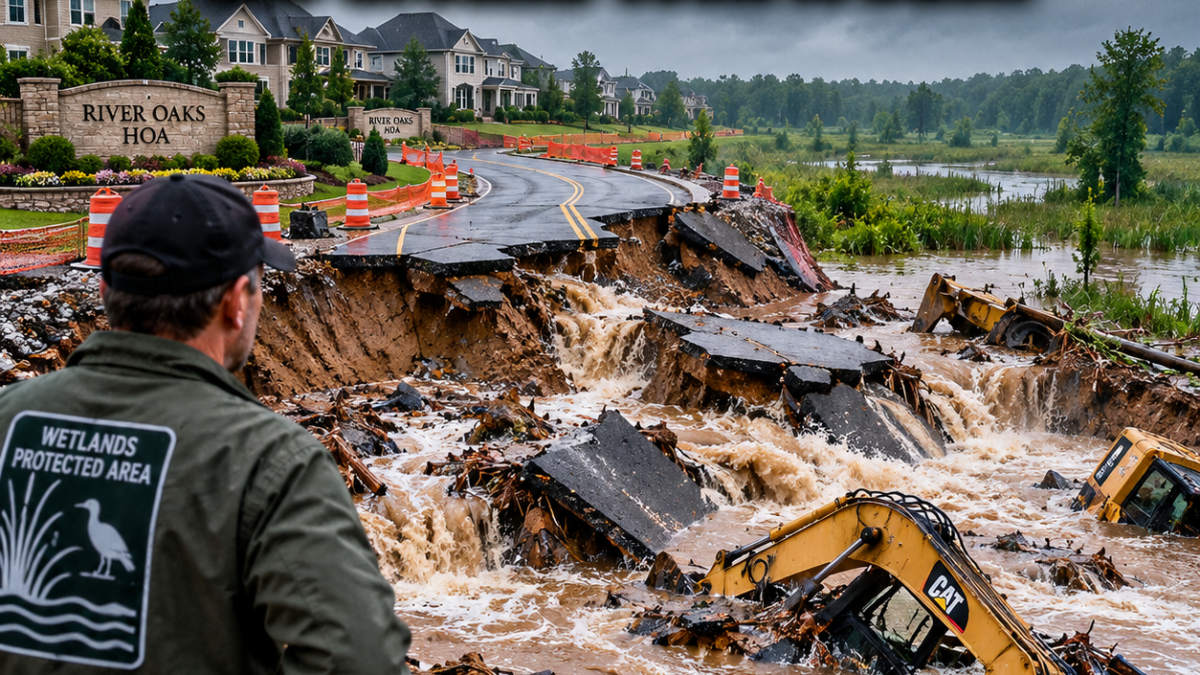
The centerline fractured.
The base material sank.
Water entered the openings.
Twenty feet dropped first.
Then more.
By dawn, the failure had traveled through the entire forty-foot corridor.
At 6:14 a.m., I stepped outside.
And the road was gone.
I sent Diana one message.
You need to come see this.
She replied forty seconds later.
On my way.
She arrived wearing boots and a coat thrown over what looked like pajamas.
For once, the former environmental compliance officer didn’t immediately reach for her camera.
She stood beside me.
“Oh my God.”
“That’s basically what I said.”
We stared.
The wetland had not magically erased every cubic yard of gravel.
A lot of the fill was still beneath the water.
But the road itself—the confident straight strip Gerald had announced as “successfully completed”—no longer existed as a usable road.
Diana finally pulled out her camera.
“This is extraordinary.”
“Good extraordinary?”
“For the evidence?”
She looked almost amazed.
“Very.”
The collapse had exposed the interior.
Layers that an inspector otherwise might have needed excavation to document were now visible in cross-section.
Gravel.
Compacted base.
Wetland subsoil.
Water pathways.
Fracture.
Everything.
I opened my folder and looked at the email confirming Agent Reyes’s visit.
“She’ll be here in two days.”
Diana looked across the water.
“She won’t need much imagination.”
Two days later, at 8:45 a.m., a dark green government vehicle pulled onto the access road.
Agent Reyes stepped out wearing waterproof field gear.
She carried a camera bag, field kit, clipboard, and site map.
We shook hands.
“Marcus Webb?”
“Yes.”
She looked beyond me immediately.
“That the site?”
“Yes.”
She opened the gate herself.
I followed.
When she reached the collapsed corridor, she stopped.
For almost a minute, she said nothing.
She had reviewed my photographs from construction.
Those pictures showed the violation from above.
Now the collapse showed it from inside.
She set down her field kit.
Then she went to work.
Agent Reyes moved slowly along the corridor.
Every six or eight feet she stopped.
Photographed.
Measured.
Examined.
Sampled.
The dark organic wetland soil sat visibly beneath the road material.
At several points she pushed a sampling tool down through the exposed layers and removed columns of material.
Each container was labeled.
Coordinates.
Depth.
Sample number.
She photographed each location twice.
One wide.
One close.
No hurry.
No wasted movement.
Watching her work, I remembered Diana’s words.
Thorough means fewer openings later.
Agent Reyes photographed the fracture.
Then the subsidence zone.
Then the place where fill material had entered the creek.
Then sediment farther downstream.
She had been working almost an hour when she returned to me.
“Walk with me.”
We followed the northern edge.
“When did excavation begin?”
I gave her the date and time.
“How many active construction days?”
I told her.
“Any sediment control?”
“No.”
“Silt fencing?”
“No.”
“Drainage diversion?”
“Not that I observed.”
“Any HOA board members present during active construction?”
I remembered the white truck.
“The president drove past the first afternoon.”
She continued walking.
“Did he stop?”
“Slowed almost to a stop.”
“Did he appear to observe the work?”
“Yes.”
“Can you establish the time?”
“Yes.”
“How?”
“I filmed him.”
Agent Reyes stopped.
“You have video?”
“Timestamped. His truck is identifiable.”
“What time?”
“2:04 p.m.”
She wrote it down.
Then underlined something.
We kept walking.
“Did you communicate your objections before construction?”
“Yes.”
“How?”
“Certified mail.”
“When?”
“Three weeks before they started.”
“Delivered?”
“Yes.”
“Proof of delivery?”
“Yes.”
“Response?”
“None.”
She stopped again.
“Both the board president and management?”
“Yes.”
Another note.
Another underline.
Then she asked to see my folder.
I handed it over.
She read the HOA notice.
My objection.
The signed receipts.
The jurisdiction records.
Then she reached Diana’s four-page assessment.
Agent Reyes slowed down.
She read one section.
Turned back.
Read it again.
Then studied photograph seventeen.
“Who wrote these annotations?”
“My neighbor. Diana.”
“Background?”
“Twenty-two years in state environmental compliance.”
“She worked this jurisdiction?”
“She reviewed the 2017 Cobble Creek designation.”
Agent Reyes glanced across the collapse.
“She identified the drainage corridor correctly.”
I don’t know why that sentence hit me so hard.
Maybe because for months everything had felt like a fight between two versions of reality.
Gerald’s version said the HOA had approved a useful road.
Our version said they had buried gravel in a regulated wetland without authorization.
Now a federal field inspector was standing in the mud looking at the same evidence Diana and I had been staring at for weeks.
Reality no longer depended on which version sounded more confident at a board meeting.
Agent Reyes continued through my folder.
She reached the certified receipt.
“They signed for this?”
“Yes.”
“Three weeks before construction?”
“Yes.”
She closed the folder.
“You filmed every construction day?”
“Every active day I could observe. About three hours total.”
She nodded.
Nothing dramatic.
No congratulations.
No speech about justice.
She simply returned to work.
Diana arrived around eleven-thirty.
She stood with me behind the fence while Reyes finished the perimeter.
“She is thorough,” Diana whispered.
“You keep saying that’s good.”
“It is.”
“Why?”
“Because when somebody’s attorney looks for gaps, there won’t be many.”
At 12:50, Agent Reyes packed her equipment.
Then she walked toward us holding two sheets of paper.
She handed them to me.
I looked at the header.
NOTICE OF VIOLATION
United States Army Corps of Engineers.
Unauthorized discharge of fill material.
Cobble Creek buffer corridor.
Ridgerest Homeowners Association.
I read the first page.
Then read it again.
The order required removal of the unauthorized material.
Restoration of the natural hydrology.
Reopening of disrupted drainage pathways.
Replanting of native wetland vegetation.
A completion report.
Ninety days.
The preliminary restoration estimate was forty-seven thousand dollars.
I looked up.
Agent Reyes was already walking toward her vehicle.
“You’ll receive the formal copy by certified mail,” she said.
“The HOA too?”
“Simultaneously.”
She drove away.
For several seconds, I just stood there.
Diana read over my shoulder.
“Forty-seven thousand.”
“That’s what it says.”
She looked toward the collapsed road.
“Gerald built a forty-seven-thousand-dollar mistake.”
A laugh escaped me before I could stop it.
Not because the situation was funny.
Because after four months of watching a man behave as if rules were suggestions for people with less authority than him, the precision of that number felt almost surreal.
Forty-seven thousand dollars.
Ninety days.
Mandatory restoration.
All printed in black letters on two pages.
I sat on my porch step.
Diana sat beside me.
The wetland stretched behind us.
A great blue heron stood downstream in the shallow water.
It had appeared several mornings during the dispute.
The bird did not know Gerald.
It did not know me.
It did not know what an HOA was.
For some reason, that comforted me.
That evening, Paul called.
“I heard a federal vehicle was there.”
“It was.”
“What happened?”
I told him.
When I reached the forty-seven-thousand-dollar figure, he whistled quietly.
“So Gerald’s personally paying?”
“No.”
“Oh.”
“The violation is against the association.”
“So all of us?”
“At this stage, the HOA is responsible.”
Paul groaned.
“That means homeowners are going to be furious.”
“They should understand what happened first.”
“Does Gerald?”
“He will.”
The certified notice arrived at the management office the next morning.
By noon, Gerald had called an emergency board meeting.
Seven o’clock.
Paul texted me.
You going?
I considered it.
Then I remembered Diana’s advice from the beginning.
Build the record.
Don’t become the spectacle.
No. You should.
He replied:
I will.
I stayed home.
Later, Paul told me exactly what happened.
Gerald opened the emergency meeting with an eleven-minute speech.
He called the situation a regulatory misunderstanding.
He said federal officials had taken an unnecessarily aggressive interpretation.
He suggested my complaint had transformed something that could have been handled as a community matter into a federal dispute.
For eleven minutes, he tried to make the enforcement action sound like something that had happened to the HOA.
Then the association’s attorney joined by phone.
Her name was Carol.
She had represented Ridgerest for years.
The board secretary confirmed she was speaking on the record.
Carol explained that the association faced at least forty-seven thousand dollars in restoration liability.
Potentially more once contractors performed their assessment.
She explained that continued noncompliance could increase exposure.
She explained that the state complaint remained separate from the federal process.
Then she explained something Gerald had carefully avoided.
The road had been built in a federally designated wetland without the required review.
According to Paul, nobody interrupted her.
Carol paused.
Then she said the sentence that ended Gerald’s control over the meeting.
“I was not consulted before this project began.”
Five words.
That was all.
Paul said the room changed.
Board members who had been staring at their documents stopped looking at Gerald.
One stared at the wall.
Another began flipping through the violation notice.
Gerald tried to recover.
He blamed the complaint.
A board member answered him.
“The complaint didn’t create the violation.”
Another added, “Building the road did.”
Gerald shifted strategies.
The project had served a legitimate purpose, he argued.
Maintenance access had been a real need.
The board had discussed it for two years.
The goal was sound.
Susan, one of the quieter board members, finally looked up.
“Gerald, we needed access to the utility corridor. We didn’t need a forty-seven-thousand-dollar federal violation.”
Nobody argued with her.
Raymond, another member, asked the attorney what would happen if they fought the order.
Her answer was brutal in its simplicity.
Legal fees.
Continuing exposure.
No strong factual basis for contesting the wetland designation.
More time.
More money.
More risk.
Then Raymond asked the question Gerald had probably hoped nobody would ask.
“What happens to us personally if the board keeps fighting this?”
Carol told them that what they did next mattered.
Cooperate.
Restore.
Contain the damage.
Or keep resisting and potentially expand it.
At 9:15 p.m., the board voted.
Seven votes to comply.
Including Gerald.
Paul texted me before he left the room.
Unanimous. They’re restoring it. Gerald voted yes.
I stared at those words for a long time.
Then I walked outside.
The night was cold.
Water moved quietly through Cobble Creek.
For months, I had imagined revenge in human terms.
I had imagined confronting Gerald at a board meeting.
Sliding the certified-mail receipt across a table.
Watching him try to explain his way out.
Maybe hearing neighbors finally tell him what they thought.
But standing there beside the wetland, I understood something.
I didn’t need a dramatic confrontation.
I had already given him three weeks to avoid what happened.
I had written the warning.
He ignored it.
I documented the construction.
He continued it.
I filed the complaint.
He announced phase two.
Then the wetland collapsed his road before the inspector even arrived.
My revenge was not destroying anything Gerald owned.
It was refusing to rescue him from the consequences of what he had chosen to do.
Eleven days after the emergency meeting, Ridgerest’s board met again.
One agenda item.
Removal of Gerald Coats as president.
The motion cited the unauthorized project.
No legal review.
No permit compliance.
No consultation with association counsel.
Federal enforcement.
Mandatory restoration.
Minimum forty-seven-thousand-dollar liability.
Paul attended.
This time I waited by Cobble Creek.
I didn’t need to hear Gerald speak.
I had heard enough from him through four months of notices, silence, emails, and decisions.
The sun had already dropped behind the trees when my phone vibrated.
Paul.
It’s done. 6–1.
I knew who the one vote was.
Gerald had voted for himself.
I smiled.
Not because he had lost a title.
Because for four months, Gerald had acted as though authority meant never having to hear the word no.
Now six members of his own board had said it at once.
The restoration crew arrived the following week.
This time, the equipment came with permits.
Plans.
Environmental controls.
Qualified contractors.
People who understood they were not simply moving dirt.
They removed the unauthorized fill carefully.
Every cubic yard that had been dumped into the corridor came back out.
They reopened the subsurface drainage paths.
They restored elevations.
They stabilized disturbed areas.
Then native vegetation went back into the ground.
Sedges.
Rushes.
Wetland plants selected for the buffer.
The work took weeks.
I photographed some of it.
Not because I still needed evidence.
Habit, maybe.
Or closure.
One afternoon, Diana walked over while I was standing near the fence.
“You can put the phone away now,” she said.
“I know.”
“You’re still taking pictures.”
“I know.”
She stood beside me.
The restoration workers were planting near the northern end of the former road.
For months that corridor had been the center of everything.
Anger.
Evidence.
Arguments.
Waiting.
Now it looked like what it had always been supposed to look like.
Wet.
Uneven.
Alive.
I slipped the phone into my pocket.
“Better?”
“Much.”
We watched for a while.
I eventually asked her something that had bothered me.
“Did you know the road would collapse?”
“No.”
“You warned about hydrostatic pressure.”
“I knew it was badly designed for that site. That’s different from predicting exactly what would happen.”
“Nine days.”
She shook her head.
“I’ve seen wetlands reclaim small disturbances over months. Years, sometimes.”
“But not this.”
“Not like this.”
A worker removed one of the last visible piles of contaminated gravel.
I looked toward the creek.
“So Gerald really managed to build a road the wetland rejected faster than the federal government did.”
Diana gave me a sideways look.
“Don’t get poetic on me now.”
I laughed.
“Four months with you and I’m still not allowed one metaphor?”
“You can have one.”
“Generous.”
“But remember what actually happened.”
“I know.”
She pointed toward the restored corridor.
“Water table rose. Bearing capacity failed. Hydrostatic pressure followed the disrupted drainage route. The fill fractured and subsided.”
“So the scientific version is less fun.”
“The scientific version is why Gerald couldn’t argue with it.”
That was Diana.
And she was right.
Months later, there was almost no obvious sign that a road had ever crossed Cobble Creek.
The vegetation returned unevenly at first.
Then more densely.
Rainwater moved through the corridor instead of collecting against compacted gravel.
Birds came back to the shallows.
The cattails never seemed particularly impressed by the entire affair.
Neither did the heron.
I kept the manila folder.
It’s still thicker than it needs to be.
The original HOA notice remains in the front.
Three paragraphs.
A twelve-foot road.
Forty feet through the buffer.
Construction in three weeks.
Every time I look at it, I’m struck by how small it is.
One sheet of paper started everything.
Not because the notice had power.
Because the people who wrote it believed it did.
They believed an HOA vote could transform a regulated wetland into a road corridor simply because seven people sat around a table and approved the idea.
They believed notifying residents was the same as receiving authorization.
They believed silence after my objection would make my objection disappear.
They believed once the road was built, the argument would be over.
They were wrong every time.
But the lesson I carried away from those months wasn’t that bureaucracies always save the day.
They don’t.
It wasn’t that nature magically defeats bad decisions.
Usually it doesn’t happen that neatly either.
And it wasn’t that every arrogant person eventually gets what he deserves.
Life is not that reliable.
What saved Cobble Creek was a combination of things.
Diana knew what the notice meant.
I listened to her.
I sent the objection before construction started.
I kept the receipt.
I filmed instead of shouting.
I photographed instead of trespassing onto the worksite.
I filed the complaint instead of threatening to file one.
I waited when waiting felt useless.
Paul asked questions when Gerald’s version stopped making sense.
The inspector did her job thoroughly.
The HOA attorney told the board the truth.
Six board members eventually stopped protecting a bad decision.
And water did what water had been doing through that ground long before any of us arrived.
It moved.
Gerald had tried to force a straight line across a landscape built around movement.
For nine days, his road looked permanent.
On the tenth morning, I stood where it had been.
That image stays with me more than the board vote.
More than the forty-seven-thousand-dollar figure.
More than the violation notice.
More than Paul’s message telling me Gerald was finished.
I remember standing there at 6:14 in the morning with cold coffee on the fence post.
Mist over Cobble Creek.
Dark water where gray gravel had been.
Fragments of road base sticking from the mud.
Cattails coming through openings.
And complete silence.
There was no victory music.
No cheering neighbors.
No shouting match.
Just water.
For four months, Gerald and I had occupied completely different realities.
His reality was built from board votes, community notices, construction schedules, and the assumption that nobody would force him to answer a question he didn’t want to answer.
Mine became simpler.
Is there a permit?
No.
Is this wetland regulated?
Yes.
Did I notify them?
Yes.
Can I prove it?
Yes.
Did they build anyway?
Yes.
Once I learned to stay inside those facts, Gerald’s personality stopped mattering.
His confidence stopped mattering.
His emails stopped mattering.
Even his title stopped mattering.
Evidence is wonderfully indifferent to status.
The last time I saw Gerald near Cobble Creek, restoration was almost finished.
He was driving the same white pickup.
He slowed.
Not as dramatically as he had on the first construction day.
Just enough that I noticed.
For a second, I wondered whether he would roll down the window.
Maybe apologize.
Maybe blame me one last time.
Maybe tell me how much the whole thing had cost.
He did none of those things.
He looked toward the restored wetland.
Then toward me.
I stood by the fence.
Neither of us waved.
Then he drove away.
That was enough.
I didn’t need an apology from a man who had been given three weeks of warning and chose an excavator instead.
I didn’t need him to admit I had been right.
The site itself answered that question.
The paperwork answered it.
The restoration order answered it.
His own board answered it six to one.
What I wanted was the wetland back.
And eventually, I got it.
The following spring, I walked down to Cobble Creek after several days of rain.
A year earlier, seeing heavy rain had made me think about flooded gravel, collapsing base material, regulators, and cameras.
That morning, I carried nothing.
No folder.
No phone held up for documentation.
Just coffee.
Water moved through the restored corridor without pooling.
Young vegetation bent with the current.
The ground looked messy in the healthy way wetlands are messy.
No straight lines.
No compacted stone.
No tire tracks.
No artificial corridor pretending water could be ordered around.
A heron lifted from downstream and crossed above the creek.
I watched until it disappeared behind the trees.
Diana called from her yard.
“You checking the drainage?”
I raised my coffee.
“Just looking.”
“That sounds suspiciously peaceful.”
“I’m trying something new.”
She laughed.
I looked once more toward the place where Gerald’s road had existed for nine days.
For a while, I’d thought my satisfaction would come from seeing him removed.
It didn’t.
That felt necessary, but not satisfying.
The satisfaction came from this.
Nothing.
Nothing where the road had been.
No scar wide enough to dominate the landscape.
No monument to the fight.
No sign declaring who won.
Just wetland.
That’s the part Gerald never understood.
The land didn’t need me to conquer him.
It needed me to pay attention long enough to protect the process that allowed it to recover.
I had spent four months building a file because I believed paper would eventually force accountability.
And it did.
But before the paperwork reached its conclusion, the water table rose beneath forty feet of gravel and exposed the truth in a way no argument ever could.
The road Gerald called “successfully completed” lasted nine days.
The wetland had been there long before him.
It is still there now.
And every time rain moves through Cobble Creek exactly where that road once stood, I remember the morning I walked outside expecting another day of waiting and found the landscape had already delivered its own answer.
The restoration crews arrived the following Monday just after sunrise.
This time, the sound of diesel engines didn’t send anger through me.
I still heard the machines before I saw them.
For one strange second, standing at my kitchen window with coffee in my hand, my body reacted the way it had on the morning Gerald’s crew first came through.
My shoulders tightened.
My stomach turned.
I reached automatically for my phone.
Then I saw the trucks.
Environmental restoration company logos on the doors.
Orange erosion-control fencing stacked in the beds.
Bundles of native plants.
Survey stakes.
And, clipped visibly inside the windshield of the lead truck, the permits Gerald should have made sure existed before the first excavator ever touched Cobble Creek.
I almost laughed.
Four months earlier, a crew had entered the wetland because an HOA board told them to.
Now another crew had arrived because federal regulators told the HOA to repair what it had done.
Diana crossed her yard in boots and an old green jacket.
She stopped beside me at the fence.
“You’re filming again?”
“Habit.”
She looked at my phone.
“You planning to build another eleven-page complaint?”
“Hopefully not.”
“Then put it away for five minutes and watch.”
I lowered the phone.
The crew supervisor introduced himself as Nathan.
Unlike the first construction foreman, he carried a binder thick enough to qualify as furniture.
Before equipment moved anywhere near the wetland, he walked the corridor with an environmental consultant.
They checked the marked jurisdictional boundary.
They confirmed the creek edge.
They identified equipment access points.
They installed sediment controls.
They placed protective mats over sections where machinery needed to cross soft ground.
Every movement was deliberate.
I found myself staring.
This was what Gerald could have done.
Not necessarily this exact restoration work, but the process.
The planning.
The review.
The willingness to ask a simple question before changing land that didn’t behave like ordinary ground.
Could we legally do this?
Instead, Gerald had acted first and assumed the world would accommodate him afterward.
Nathan stopped near us.
“Mr. Webb?”
“Marcus.”
He shook my hand.
“We’ll begin removing loose material today. Deeper extraction probably starts tomorrow once we’ve stabilized the access point.”
“How long?”
“Two and a half to three weeks if the weather cooperates.”
“And all the gravel comes out?”
“All unauthorized fill identified in the order.”
He opened his binder and showed me the site plan.
Red markings covered the corridor.
“Then we restore the hydrology. That part matters more than making it look pretty.”
Diana nodded.
“Good answer.”
Nathan glanced at her.
“Environmental background?”
“Retired compliance.”
He smiled slightly.
“Then you know exactly why I’m saying it.”
“I do.”
The road had collapsed dramatically, but removing the visible gravel wasn’t enough.
The weight of the fill had compressed soil.
Equipment had disturbed root layers.
Drainage pathways had been interrupted.
Sediment had moved downstream.
Restoration meant rebuilding function, not merely cleaning up the mess until a photograph looked acceptable.
For three days, the crews removed material.
Bucket by bucket.
Load by load.
The first time I watched gravel being lifted back out of the wetland, I felt something I hadn’t expected.
Relief.
Not triumph.
Relief.
That difference mattered.
For months, my attention had been fixed on Gerald.
What he had ignored.
What he had authorized.
What he had claimed.
What he had cost everyone.
But watching that first bucket rise from the collapsed corridor, I realized the real story had never been Gerald.
It was this place.
Cobble Creek.
The wetland.
The narrow strip of land that had spent years quietly moving water through soil, absorbing rainfall, holding habitat, feeding the creek, doing work nobody noticed because functioning landscapes rarely announce themselves.
Gerald noticed it only when he wanted to cross it.
I noticed it fully only when someone threatened it.
That bothered me.
I had lived beside Cobble Creek for eleven years.
I had watched herons.
Heard frogs in spring.
Seen deer tracks near the cattails.
Complained about mosquitoes.
Walked the fence after storms.
But until the HOA notice arrived, I had never understood how much was happening beneath my feet.
The water table.
The subsurface flow.
The root structure.
The connections between the wetland and the creek.
I had treated the land as scenery.
Gerald treated it as an obstacle.
Diana understood it as a system.
By the end, I finally did too.
On the fourth restoration day, Paul came over with his daughter.
She couldn’t have been more than five.
Pink jacket.
Purple boots.
The serious expression children wear when adults tell them they are about to see something important.
Paul pointed toward the workers.
“They’re fixing the road?”
His daughter asked.
“Not exactly,” Paul said.
She looked confused.
I crouched so we were closer to eye level.
“They’re taking the road away.”
“Why?”
“Because it wasn’t supposed to be there.”
She thought about that.
“Why did somebody put it there?”
Paul and I looked at each other.
There are questions children ask that adults spend entire board meetings avoiding.
“Some people thought they could,” I said.
She accepted that answer faster than any adult in Ridgerest had.
Then she pointed toward the creek.
“Will the frogs come back?”
I smiled.
“I think they never completely left.”
That afternoon, Paul stayed after his wife took their daughter home.
We leaned against the fence watching another truck leave loaded with gravel.
“You know what everybody’s talking about now?” he asked.
“The special assessment?”
“Besides that.”
The HOA had not yet decided exactly how the restoration costs would be absorbed.
Insurance coverage was uncertain.
Some expenses were eligible.
Others were not.
The board had reserves, but not enough to make a forty-seven-thousand-dollar problem disappear without consequences.
Residents were angry.
Some were angry with Gerald.
Some with the board.
A few, predictably, were angry with me.
Not many.
But enough.
One anonymous note had appeared in my mailbox three days after Gerald’s removal.
Hope you’re happy. We all get to pay because you couldn’t let this go.
No signature.
No return address.
I had stared at it for maybe thirty seconds.
Then I showed Diana.
She read it.
Folded it once.
Handed it back.
“Keep it.”
“For what?”
“Because six months from now you’ll be tempted to forget how stupid people can sound when consequences arrive.”
I kept it.
Paul had heard similar complaints.
“Some people still say if you hadn’t reported it, none of this would have happened.”
I looked toward the wetland.
“The road collapsed.”
“I know.”
“They’re pretending an unpermitted road disappearing into two feet of water would have somehow become a success story if I hadn’t emailed the government.”
“I know.”
“What are people actually talking about?”
Paul smiled.
“The bylaws.”
I turned toward him.
“What about them?”
“Board review committee.”
That was new.
After Gerald’s removal, several residents had demanded changes to how capital projects were approved.
Not because the bylaws explicitly permitted illegal work.
They didn’t.
The problem had been concentrated decision-making and weak review.
Gerald had controlled meeting agendas.
He had pushed the project as operational maintenance.
Board members had relied too heavily on his assurances.
No independent environmental review.
No attorney review.
No permit checklist.
No requirement that the board receive written confirmation of regulatory compliance before approving land-disturbance work.
Now homeowners wanted those gaps closed.
Paul had volunteered for the committee.
“We’re proposing mandatory counsel review for projects above a certain dollar amount.”
“Good.”
“And environmental review for anything touching streams, drainage corridors, wetlands, easements, or protected areas.”
“Very good.”
“And permits have to be physically attached to the board packet before construction authorization.”
I looked at him.
“Diana help you write that?”
“Maybe.”
I laughed.
“Thought so.”
Paul lowered his voice.
“There is one more thing.”
“What?”
“Public document access.”
That surprised me.
He explained.
Under Gerald, residents received summaries.
Not always the underlying materials.
Project discussions might happen in committee before appearing on a board agenda.
Legal review could be described rather than circulated.
Paul wanted major project documentation available to homeowners before votes.
Not everything.
Attorney-client communications still required confidentiality.
But permits?
Engineering studies?
Site plans?
Environmental reports?
Those should be visible.
“Gerald’s biggest advantage,” Paul said, “was that most of us assumed someone else had checked.”
I looked at the workers.
“That’s exactly what I assumed at first.”
“And if Diana hadn’t lived next door?”
That question stayed with me.
If Diana hadn’t recognized the jurisdiction.
If I had read the HOA notice and shrugged.
If nobody had asked for a permit number.
The road might still have collapsed.
Probably would have.
But the aftermath could have been very different.
Without photographs from the first day.
Without certified letters.
Without the technical record.
Without complaints filed while the violation was active.
The HOA might have tried to call the collapse storm damage.
A contractor problem.
An unforeseen soil failure.
Anything except what it actually was.
An unauthorized road built where basic review would have shown it didn’t belong.
“Make the documents public,” I said.
Paul nodded.
“We will.”
A week later, I attended my first HOA meeting since the emergency session.
The community room was packed.
Not because people suddenly cared about wetlands.
Money creates attendance more effectively than ecology.
Residents wanted to know what the restoration would cost.
Whether dues would increase.
Whether insurance would cover any of it.
Whether board members could be held personally responsible.
Whether Gerald could be forced to reimburse the association.
Whether the contractor had liability.
Whether the management company had failed.
Every question carried frustration.
Some carried fear.
Susan was serving as interim president.
She opened the meeting differently than Gerald had.
No speech.
No attempt to control the story.
She placed the violation order on the projector.
Page one.
Then page two.
Then the restoration contract.
Then the legal summary.
Then the insurance correspondence.
“Before we take questions,” she said, “everyone needs to see the same documents.”
That sentence alone told me Ridgerest had changed.
The restoration contract had come in higher than the initial estimate.
Not catastrophically higher.
But enough to sting.
Additional sediment work downstream.
Plant establishment monitoring.
Follow-up inspection.
The wetland could be restored physically in weeks, but the HOA remained responsible for ensuring the vegetation established successfully.
Diana had explained that to me already.
“You don’t plant forty plugs and declare victory,” she’d said. “You monitor survival. You replace failures. Restoration has performance standards.”
The final projected cost now sat a little above fifty thousand dollars.
A murmur moved through the room.
Susan waited.
Then Carol, the association attorney, explained the options.
Reserve funds would absorb much of it.
Insurance discussions were ongoing.
The board did not expect a catastrophic special assessment, but smaller financial consequences remained possible.
A man three rows ahead of me raised his hand.
“I want to know why the homeowner who reported this couldn’t have come to the board first.”
I recognized him.
Frank.
We had exchanged maybe ten words in eleven years.
Susan looked toward me.
I stayed seated.
Carol answered instead.
“He did.”
Frank shifted.
“What?”
“The board received a written objection approximately three weeks before construction.”
The projector changed.
My letter appeared.
My name.
The statute citation.
The request for permit confirmation.
Then the certified-mail receipt.
Gerald’s signature wasn’t on the receipt personally, but delivery to the board’s address was undeniable.
A second receipt showed delivery to management.
Carol continued.
“The association was placed on notice before construction.”
Nobody spoke.
Frank looked at the screen.
“Well, why didn’t we know?”
Susan answered.
“That is one of the governance failures we are correcting.”
A woman near the aisle raised her hand.
“Did the board vote without seeing this letter?”
Susan hesitated.
Then answered.
“Some board members were not provided the full correspondence before construction proceeded.”
The room changed.
I could feel it.
That was the moment residents understood this wasn’t simply a bad vote.
Information had not traveled properly.
Maybe because Gerald failed to circulate it.
Maybe because management failed.
Maybe because procedures allowed too much discretion.
Carol chose her language carefully.
The internal review was ongoing.
But the practical result was clear.
A resident had warned them.
The warning went nowhere.
Someone behind me whispered, “You’ve got to be kidding.”
Frank didn’t ask another question.
Then another resident stood.
A woman named Teresa.
She lived near the entrance.
“I was one of the people blaming Marcus.”
Every head turned.
Including mine.
She looked toward me.
“I said it last week in the grocery store. I said if he hadn’t complained, we wouldn’t be paying for this.”
I didn’t know what to say.
She continued.
“I was wrong.”
The room went very still.
“The road wasn’t legal. He warned the board. They built it anyway. That’s not on him.”
She sat down.
No applause.
I’m glad there wasn’t.
It wasn’t a movie.
It was better than applause.
It was acknowledgment.
After the meeting, Teresa found me in the parking lot.
“I meant what I said.”
“I know.”
“I was angry.”
“So was I.”
“My husband was laid off last month. When I heard fifty thousand dollars, all I could think was assessment.”
I nodded.
That changed the shape of her anger in my mind.
Not excused it.
But explained it.
“People get scared when money shows up unexpectedly,” I said.
She looked embarrassed.
“I still shouldn’t have blamed you.”
“No.”
She nodded.
Fair enough.
Then she surprised me.
“Thank you for sending the letter before they built it.”
I looked back at the community building.
“I wish they’d answered it.”
“So do I.”
That was enough.
Restoration reached its final stage near the end of the third week.
The last major gravel loads left.
Workers reshaped disturbed areas.
They reopened the drainage corridor.
Native sedge and rush plugs went into the wet soil.
The place looked raw.
Restored land doesn’t instantly look untouched.
That was another thing I’d learned.
There were visible patches.
Exposed soil.
Temporary erosion controls.
New plants spaced unnaturally evenly.
Machine tracks in approved access areas.
But water moved differently.
That was the important part.
After the first substantial rain, Diana and I walked out together.
She carried a walking stick.
I carried coffee.
No cameras.
At least not initially.
Water entered the restored corridor.
For months, I had watched it pile against compacted fill.
Now it slipped through low channels.
Spread.
Slowed.
Disappeared beneath vegetation.
Reappeared closer to the creek.
Diana pointed.
“See that?”
“Yes.”
“That’s what we’re looking for.”
“The water?”
“The movement.”
I watched.
No dramatic current.
No roaring stream.
Just inches of shallow water quietly following gradients I would never have noticed before.
“It doesn’t look like much.”
“Exactly.”
She smiled.
“Good infrastructure often looks boring.”
I laughed.
“You’re calling a wetland infrastructure?”
“Of course.”
“It doesn’t send invoices.”
“Neither does gravity.”
We walked another twenty yards.
Young sedges bent under the water.
A frog jumped from somewhere near my boot.
I almost stepped backward.
Diana laughed at me.
“Defender of wetlands terrified by frog.”
“I wasn’t terrified.”
“You made a noise.”
“I was surprised.”
“It was high-pitched.”
“Never happened.”
We kept walking.
For the first time since October, the conversation felt normal.
Not complaints.
Not violations.
Not Gerald.
Just neighbors.
That might have been the moment I finally understood the cost the conflict had taken on both of us.
Diana was retired.
She had earned mornings where her biggest decision should have been whether to drink coffee on her porch or take a walk.
Instead, because she recognized one missing permit, she had spent months reviewing photographs, correcting my language, checking filings, reading hydrology maps, and standing in cold rain beside a road she never asked anyone to build.
“Hey,” I said.
She looked over.
“What?”
“Thank you.”
“For the frog?”
“For everything.”
She stopped.
Then shrugged.
“You would’ve figured it out.”
“No.”
“You would have found somebody.”
“Maybe after construction.”
“Still.”
I shook my head.
“I would’ve started by yelling at Gerald.”
“That I believe.”
“And probably made things worse.”
“Also believable.”
I looked toward Cobble Creek.
“You knew from the first minute what mattered.”
“Experience.”
“Twenty-two years.”
“Twenty-two years of watching people make the same category of mistake.”
“What category?”
She didn’t answer immediately.
Then she said, “Thinking paperwork creates reality.”
I raised an eyebrow.
“You’re the one who made me document everything.”
“Documentation records reality. That’s different.”
She pointed toward the creek.
“A permit doesn’t create the wetland. A map doesn’t create hydrology. A statute doesn’t make water flow.”
I listened.
“Those tools force people to respect conditions that already exist.”
She looked toward the restored corridor.
“Gerald thought the board vote created permission. It didn’t. The notice didn’t. The gravel didn’t. He confused a decision with authority.”
That was Gerald’s mistake in one sentence.
He had confused deciding something with having the authority to do it.
A month later, Ridgerest adopted its new project-review policy.
Paul sent me the final version.
Capital projects affecting regulated land now required documented legal review.
Permit verification.
Environmental screening where appropriate.
Recorded board findings.
Resident access to nonprivileged project materials.
No contractor could mobilize until compliance documents were logged.
The policy wasn’t dramatic.
Nobody outside Ridgerest would ever care.
But I cared.
Because the next person might not have Diana living next door.
The next questionable project might not fail spectacularly in nine days.
The next resident might not know which agency to call.
Good policy shouldn’t depend on one person understanding the system.
That became Paul’s argument.
And eventually, the board agreed.
Gerald didn’t attend that meeting.
I hadn’t seen him since his removal.
Then, one afternoon in early spring, his white pickup appeared on the access road.
I was replacing a loose fence rail.
The truck slowed.
I recognized it before I saw his face.
He stopped.
For several seconds, neither of us moved.
Then his window came down.
“Marcus.”
“Gerald.”
He looked older.
Not dramatically.
Just tired.
His confidence had always filled space before he entered it.
That was gone.
He looked toward Cobble Creek.
The restoration plantings had survived winter.
New green shoots were visible.
“You got what you wanted.”
The sentence irritated me immediately.
I put down the hammer.
“No.”
He looked at me.
“No?”
“I wanted you to stop before construction.”
His jaw tightened.
“You know what I mean.”
“I do. That’s why I’m correcting it.”
He turned toward the windshield.
For a second I thought he would drive away.
Then he said, “The whole neighborhood thinks I’m some kind of criminal.”
“I don’t.”
That caught him off guard.
I continued.
“I think you made a decision you weren’t authorized to make, ignored a warning, and kept going because you assumed nothing would stop you.”
His face hardened.
“That sounds better?”
“It’s what happened.”
“You cost this association more than fifty thousand dollars.”
There it was.
The old version.
Not as loud.
But still alive.
I walked closer to the truck.
“No, Gerald.”
He looked directly at me.
“The road cost the association fifty thousand dollars.”
“If you hadn’t filed—”
“It collapsed.”
He stopped.
I pointed toward the wetland.
“Even without my complaint, your road disappeared in nine days.”
“It was an extreme storm.”
“It was a wetland.”
“You always have an answer.”
“No. I have photographs.”
His eyes narrowed.
I regretted the sharpness as soon as I said it.
Not because it was untrue.
Because I realized I didn’t want the argument anymore.
Gerald looked tired.
I was tired too.
“I didn’t come here to fight,” he said.
“Then why did you stop?”
He looked toward the water again.
“I don’t know.”
For the first time since all of this began, Gerald sounded like a person rather than a position.
He rested both hands on the steering wheel.
“You know why I wanted that road?”
“Maintenance access.”
“That’s what was in the documents.”
“What was the real reason?”
He took a long breath.
“Two winters ago, we lost almost nine hours reaching the rear utility junction after a line failed. Had to bring equipment around from the north entrance. People were furious. I told them I’d fix it.”
That was new.
“The access problem was real,” I said.
“Yes.”
“I never said it wasn’t.”
“I thought if we sent this through environmental review, we’d spend eighteen months studying forty feet of dirt.”
“Maybe.”
“And maybe they’d say no.”
“Yes.”
He laughed bitterly.
“Exactly.”
There it was.
Not ignorance.
Not completely.
Impatience.
He had known enough to suspect review could stop the project.
So he treated review as the problem.
“I thought I was cutting through bureaucracy,” he said.
“You were cutting through a wetland.”
He looked at me.
Neither of us smiled.
Then, unexpectedly, Gerald did.
Just slightly.
“Diana teach you that line?”
“No.”
“She would’ve said it better.”
“Yes.”
He nodded.
The tension loosened.
Only a little.
“I should’ve sent the letter to Carol.”
I didn’t answer.
“I should’ve stopped construction when your objection came.”
Still nothing.
“I thought you were trying to block everything because it touched your property.”
“It wasn’t about my property.”
“I know that now.”
Those were the closest words to an apology I expected to receive.
Maybe the closest Gerald knew how to give.
I didn’t force more.
“There’s another route to the utility corridor,” I said.
He nodded.
“The new board approved engineering last month.”
“With permits?”
Gerald gave me a tired look.
“All of them.”
I smiled.
“Then maybe something good came out of this.”
“Easy for you to say.”
“No. It wasn’t.”
He considered that.
Then he put the truck in gear.
Before leaving, he looked at the wetland one final time.
“You know what bothered me most?”
“What?”
“The road disappearing.”
I waited.
“I could’ve argued with the Corps. I could’ve argued with you. I could’ve argued with Carol.”
His eyes moved toward Cobble Creek.
“Couldn’t argue with that.”
Then he drove away.
I stood beside the fence long after his truck disappeared.
Later, I told Diana about the conversation.
She listened from her porch.
When I finished, she asked one question.
“Did he apologize?”
“Sort of.”
“That’s not an answer.”
“He admitted he should have stopped.”
“Closer.”
“He admitted he should’ve consulted counsel.”
“Closer.”
“He said he couldn’t argue with the road collapsing.”
Diana sipped her coffee.
“I’ll take it.”
Spring changed Cobble Creek quickly.
The restoration plantings thickened.
Cattails returned around the disturbed edge.
Small tracks appeared in the mud.
Bird calls became constant at sunrise.
The temporary erosion fencing came down after final inspection.
The Army Corps accepted the restoration progress report subject to monitoring.
The state matter closed after compliance conditions were satisfied.
Not instantly.
Not dramatically.
Just another letter in my mailbox.
This time, I carried it inside without anger.
I opened my manila folder.
The folder had become absurdly thick.
At the front sat the original HOA notice.
Behind it, my objection.
Certified receipts.
Photographs.
Complaints.
Inspector correspondence.
Violation notice.
Restoration reports.
I added the closure letter at the back.
Then I closed the folder.
Four months of conflict reduced to several inches of paper.
I stored it in the bottom drawer of my desk.
Not because I expected another fight.
Because Diana had taught me that records matter.
But I didn’t want the folder sitting on the kitchen table anymore.
That part mattered too.
You can document a battle so carefully that eventually you forget to stop living inside it.
One Saturday morning, Paul came over with his daughter again.
She ran to the fence.
“The frogs are back!”
I looked at Paul.
He shrugged.
“She checks.”
We walked down toward the creek.
Her purple boots were covered in mud within thirty seconds.
Paul apologized.
“To who?”
“My wife.”
“Fair.”
His daughter crouched near the bank.
“There’s one!”
A small frog disappeared into the grass.
She jumped up.
“I told you.”
“You did.”
She looked toward the restored corridor.
“Where was the road?”
That question stopped me.
I pointed.
“Right through there.”
She stared.
“Where?”
“Exactly.”
Paul smiled.
That became my favorite answer.
Where was the road?
Exactly.
The best ending wasn’t a scar everyone could point to forever.
It was the fact that a child who came there months later couldn’t tell where forty feet of gravel had once crossed the wetland.
No monument.
No sign.
No plaque with Gerald’s name.
No plaque with mine.
No permanent battlefield.
Just functioning ground.
Sometimes restoration succeeds by making the conflict difficult to see.
By summer, neighbors stopped talking about Gerald.
HOA meetings returned to boring things.
Pool repairs.
Landscaping contracts.
Trash collection.
Streetlights.
It was wonderful.
Paul became a board member.
He complained about how much reading came with the job.
I reminded him whose idea transparency had been.
He told me to shut up.
Diana started traveling again.
The first postcard she sent came from Maine.
On the back she wrote:
No HOA road projects yet. Will advise.
I laughed hard enough that I had to sit down.
Life moved.
That was the real ending.
Not Gerald losing a title.
Not the federal notice.
Not the forty-seven-thousand-dollar mistake.
Life moving beyond all of it.
One evening in late August, almost a year after the original notice arrived, I carried a chair down near Cobble Creek.
The sun was low.
Golden light passed through the trees.
Insects moved over the water.
The heron stood downstream.
Maybe the same bird.
Maybe not.
I liked pretending it was.
I sat there without a camera.
Without my folder.
Without checking email.
Without expecting anybody to arrive with machinery.
Water moved through the restored corridor.
Quietly.
Persistently.
Exactly where the road had been.
For months, I had called what happened revenge.
Maybe part of me needed that word while I was angry.
But sitting there almost a year later, it didn’t feel like revenge.
Revenge keeps you connected to the person who hurt you.
This felt like release.
Gerald had wanted a road.
I had wanted him stopped.
The regulators wanted compliance.
The board wanted the financial bleeding contained.
Diana wanted the record correct.
Paul wanted transparency.
Everybody had wanted something.
The wetland needed only one thing.
To be allowed to function.
And once people finally stopped forcing their plans onto it, that’s exactly what it did.
Rain fell.
Water moved.
Plants grew.
Frogs returned.
Birds fed.
Soil held what it was supposed to hold.
Nothing about that was dramatic anymore.
That was why it felt complete.
I thought about the morning of the collapse.
6:14 a.m.
Rubber boots.
Coffee in my left hand.
Fog.
Water where gravel had been.
The shock of seeing something supposedly permanent erased overnight.
At the time, I thought that was the ending.
Then I thought the violation notice was the ending.
Then Gerald’s removal.
Then restoration.
Then the new HOA rules.
But endings rarely arrive as one clean moment.
Sometimes they arrive in layers.
The road disappeared first.
Then Gerald’s authority.
Then the violation.
Then the gravel.
Then the anger.
That last one took the longest.
I sat beside Cobble Creek until the light began fading.
When I finally stood, I looked once more toward the corridor.
I could barely trace the line anymore.
A year earlier, Gerald had looked at that ground and seen forty feet standing between him and a utility road.
Diana had looked at it and seen protected hydrology.
The Army Corps saw jurisdiction.
I had eventually learned to see all of those things.
But that evening, I saw something simpler.
Home.
I walked back toward my house.
Behind me, Cobble Creek continued moving through the wetland without needing a vote, a construction notice, a board president, or permission from anyone.
And somewhere beneath the sedges, beneath the returning roots, beneath water following pathways older than Ridgerest itself, the last evidence of Gerald’s road was disappearing.
Not because I had destroyed it.
Not because I had won some grand battle.
Because we finally stopped trying to make that ground become something it was never meant to be.
That was enough.
More than enough.
The HOA road lasted nine days.
Cobble Creek was still there.
And this time, everyone knew better than to challenge it.

