PART 2: HOA Built a Luxury Floating Restaurant on My Private Lake — They Didn’t Know I Controlled the Water
\
PART 2
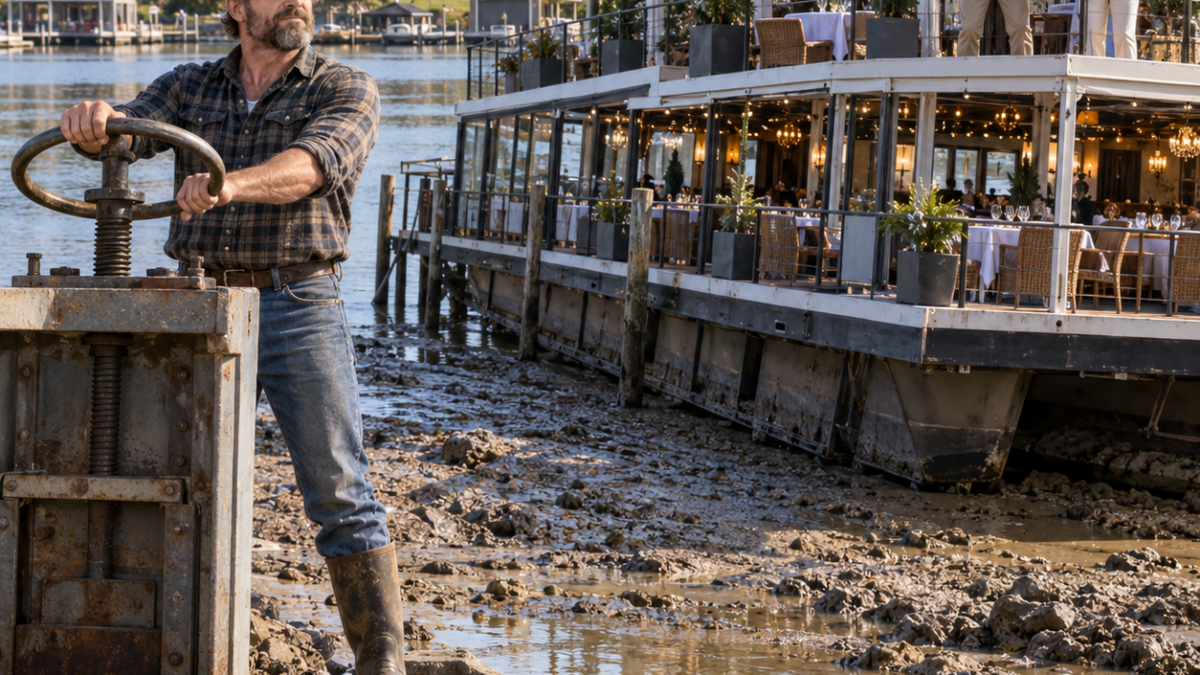
I stood beside the valve after the twenty-second rotation with one hand still resting on the iron wheel.
Silence is strange when you are accustomed to hearing moving water.
For fourteen years, that pipe had produced a low continuous rush beneath the berm, a sound so ordinary that most days I barely registered it.
Now there was nothing.
The gate was seated.
The inlet was closed.
The water behind me remained where my family’s permit said it could remain.
I checked the reservoir staff gauge.
9.2 feet.
Normal operating pool.
Then I took photographs.
Valve open position before closure.
Valve during travel.
Valve fully closed.
Handwheel position.
GPS coordinates.
Staff gauge.
Downstream pipe.
Every image timestamped.
Every image geotagged.
People sometimes mistake documentation for paranoia.
Usually those people have never spent much time in court.
I had.
Not as a criminal defendant or plaintiff, but as an engineer and expert witness.
I had watched million-dollar disputes turn on handwritten maintenance records.
I had watched confident executives suddenly become uncertain when somebody produced a dated photograph contradicting three paragraphs of sworn testimony.
I had watched people insist that something “had always been that way” until an old permit proved otherwise.
Paper has no temper.
Measurements don’t care who is angry.
I opened my field notebook.
November 17, 2025.
12:19 p.m.
Valve closed.
Twenty-two rotations.
Gate seated.
No bypass flow audible.
Reservoir level 9.2 feet.
Community lake depth at closure estimated 9.1 feet.
I initialed the entry.
Then I drove home.
Nothing dramatic happened that afternoon.
That is the part stories usually leave out.
No sirens arrived.
No HOA officers stormed my ranch.
Nobody banged on my door.
Harbor View’s lake did not suddenly vanish like somebody had pulled a bathtub plug.
Hydrology doesn’t work for dramatic timing.
The lake was broad.
It had stored volume.
Ground seepage continued.
Rainfall contributed a little.
Evaporation removed some.
Without the daily inflow from my reservoir, however, the equation had changed permanently.
The lake would find a lower equilibrium.
I had calculated that equilibrium years earlier.
I knew approximately how fast it would happen.
The HOA didn’t.
One week later, I returned to the eastern berm with binoculars.
Their dock marker stood at the outboard edge of the community dock.
The HOA had installed it themselves years earlier.
Simple graduated markings.
Clear enough that I could read them from my observation point.
8.3 feet.
Eight inches gone.
The floating restaurant looked normal.
String lights still hung above the deck.
The pontoons still floated comfortably.
People were eating lunch.
From the shore, probably nobody noticed.
I took photographs.
Logged the number.
Went home.
Week two.
7.5 feet.
Sixteen inches total.
The shoreline had begun pulling back.
Mud appeared in narrow strips along the shallow southern edge.
The platform still operated.
But through binoculars I could see the change.
The anchor lines sat at a different angle.
The pontoons rode closer to the lake bottom.
The dock connection had begun adjusting downward.
I wrote everything down.
December 1.
Dock marker: 7.5 feet.
Platform stable.
Freeboard reduced.
Anchor catenary altered.
Photos attached.
A few days later my neighbor Dale called.
Dale Pritchard ran cattle north of me.
He had no involvement in the dispute, but his wife followed half the county’s social media pages and Harbor View residents had started talking.
“You doing something to that lake?”
“Why?”
“People are posting pictures. They say it’s dropping.”
“It is.”
“Know why?”
“Yes.”
There was a pause.
Dale knew me well enough not to ask questions I wasn’t volunteering answers to.
“You going to tell me?”
“When it affects your property.”
He laughed.
“Fair enough.”
Before hanging up, he read me a post from the Harbor View community forum.
One resident had photographed the depth marker.
The caption asked:
Is the lake lower than normal? This marker has never been this low in sixteen years.
Diane Hollis had responded as HOA president.
The board is aware of the water level and investigating. Harbor View Lake has always been a stable feature of our community.
That phrase interested me.
Always been stable.
It had been stable because my valve had always been open.
Diane didn’t know that yet.
Or if the HOA’s lawyer had told her, she had not fully accepted what it meant.
The third Monday I returned to the berm.
6.9 feet.
The restaurant required six feet to remain operational without grounding the pontoons.
At the current rate, the margin was disappearing fast.
I photographed their marker.
Their platform.
Their shoreline.
Then I drove home and updated my maintenance log.
4:17 that afternoon, my phone rang.
Unknown number.
“Emmett Voss.”
A woman’s voice answered.
Controlled.
Professional.
Tight.
“Mr. Voss, this is Diane Hollis. I’m president of Harbor View Estates Homeowners Association.”
“I know who you are.”
That seemed to surprise her.
“Our community lake has lost nearly two feet of water.”
“I know.”
There was a pause.
“The restaurant is beginning to be affected.”
I waited.
“I need to ask you directly whether you’ve done something to our lake.”
The wording bothered me.
Our lake.
Not because Harbor View didn’t own the ground beneath their lake.
They did.
Not because residents had no legitimate emotional connection to it.
They did.
But water and land are not always the same legal thing.
And that distinction was exactly why we were here.
“I closed my valve.”
Silence.
“What valve?”
“The twenty-four-inch drainage pipe crossing the eastern boundary berm.”
Another pause.
“What are you talking about?”
“That pipe connects my reservoir to your lake. The inlet is eleven feet inside my property. I installed a sluice gate on it in 2011. It’s been open for fourteen years.”
Her voice changed.
Not much.
Enough.
“You’re saying you’ve been controlling our lake?”
“No. I’m saying I’ve been allowing my reservoir water to flow into it.”
“You can’t cut us off.”
“I already did.”
“The pipe is protected by an easement.”
“No valid easement exists.”
“We have it recorded.”
“You have a recorded document with no grantor signature.”
“That is not what our attorney told us.”
“Then ask him whether I signed it.”
Silence.
I continued.
“Ask him whether my father signed it. Ask him whether any record owner of this ranch ever conveyed that right.”
“You allowed the flow for fourteen years.”
“Yes.”
“That establishes use.”
“It establishes that the valve remained open.”
“Mr. Voss, you’re splitting hairs while people’s investment is at risk.”
“No, Ms. Hollis. I’m distinguishing permission from ownership.”
Her breathing became audible through the phone.
“We spent three hundred forty thousand dollars on that restaurant.”
“I know.”
“The platform requires this water.”
“I know.”
“You can’t destroy a community asset because you’re angry about paperwork.”
That was the first time my voice hardened.
“Do not mistake documentation for paperwork.”
She stopped.
“My father filed WR-1968-041 in September 1968. That permit is older than every residential water claim in this county by at least nineteen years. The water entering your lake comes from the reservoir covered by that permit.”
“Your lawyer’s letter is making claims we dispute.”
“You rejected the letter.”
“The board rejected unreasonable demands.”
“You voted four to one against negotiating.”
“How do you know the vote?”
“Your counsel’s response stated it.”
Another silence.
Then Diane said, “Open the valve while this is litigated.”
“No.”
“You cannot hold our community hostage.”
“I filed the action before I closed the valve.”
She stopped again.
“What action?”
“Water-rights enforcement and quiet title.”
“You sued us?”
“My attorney filed three weeks ago. Your counsel should already have service.”
Her composure slipped completely.
“You filed a lawsuit and then turned off the water?”
“I exercised control over my permitted water after your board rejected the opportunity to negotiate that control.”
“This is insane.”
“No. It’s documented.”
I heard something strike a surface on her end.
Maybe a pen.
Maybe a hand.
“The restaurant employs people.”
“I know.”
“Residents paid special assessments.”
“I know.”
“We opened less than two months ago.”
“I know.”
Her voice rose.
“Then how can you just sit there saying you know?”
Because I had watched them build it.
That was the answer I almost gave.
Because for months I had stood at my berm watching trucks arrive while nobody from Harbor View walked the extra two hundred yards west to ask one basic question.
Where does the water come from?
Because they had hired architects.
Contractors.
Electricians.
Kitchen specialists.
Marine installers.
Permit consultants.
Yet apparently nobody had hired a title examiner capable of looking at the document supposedly granting their water supply and noticing that the owner of the land had never signed it.
Because Diane had publicly stood beneath string lights and promised sixteen years of stewardship over a resource whose legal origin she had never investigated.
But I didn’t say any of that.
I gave her the number.
“The dock marker is at 6.9 feet.”
She became quiet.
“Your platform requires six.”
Nothing.
“At current drawdown, you have roughly one to two weeks before operations become unsafe.”
“You’ve calculated this?”
“I’ve been a water systems engineer since 1977.”
The silence on the line changed again.
“You’re an engineer?”
“Retired.”
She exhaled.
Long and slow.
“This isn’t over.”
“No.”
I looked at the maintenance log.
“It’s in court.”
I ended the call.
Then I wrote it down.
Date.
Time.
Caller.
Summary.
Statements made.
Duration.
Initials.
The next move came faster than I expected.
Diane filed an emergency complaint with the State Water Resources Board.
She did it herself.
Not through the HOA’s litigation attorney.
Clara called me the afternoon she learned about it.
“She wants an emergency order forcing you to reopen.”
“What basis?”
“She says you’re unlawfully interfering with an established water use and putting a $340,000 community asset at imminent risk.”
“What does the agency do?”
“Pulls the permit.”
That was why Clara sounded almost amused.
“They’ll start with WR-1968-041?”
“They have to.”
“And after they read it?”
“They’ll inspect.”
“Then?”
“If the investigator knows his job, he’ll see the valve is on your property, the permit is senior, and Harbor View has no recorded water right.”
I looked through the kitchen window toward the meadow.
“What happens to her complaint?”
“It dies.”
The investigator called Friday.
Roy Sutter.
Twenty-one years with the State Water Resources Board.
He wanted to inspect the eastern berm Tuesday at nine.
I met him at the ranch gate ten minutes early.
Roy looked like most competent field investigators I had worked with in engineering.
No theatrical authority.
No assumptions.
Boots dirty enough to prove he had been outside before.
Clipboard.
Agency jacket.
Permit already printed.
That last part mattered.
People who show up to investigate water rights without reading the permit first are tourists.
Roy wasn’t.
We drove to the berm.
He inspected the valve.
Measured its distance to the property boundary.
Eleven feet west.
My side.
He photographed the assembly.
Then the closed inlet.
Then the downstream end of the pipe.
Then the reservoir staff gauge.
9.4 feet.
Normal pool.
He wrote for several minutes.
“Valve installed when?”
“March 14, 2011.”
“Documentation?”
“Maintenance log.”
“You have it?”
“At the house.”
“Continuous?”
“Quarterly inspections.”
He nodded.
“Did you ever give the HOA written authorization to use your water?”
“No.”
“Verbal?”
“No.”
“Any supply contract?”
“No.”
“Compensation?”
“No.”
Roy flipped a page.
“I found the 2008 easement.”
“I assumed you would.”
“Grantor line is blank.”
“Yes.”
“You didn’t sign?”
“No.”
“Didn’t authorize somebody else?”
“No.”
He wrote again.
Then he looked across the berm toward Harbor View.
The restaurant was visible from where we stood.
The winter light made it look smaller.
Less luxurious.
String lights meant very little at nine in the morning.
“That’s the platform?”
“Yes.”
“How much?”
“Three hundred forty thousand according to their own board announcement.”
Roy whistled quietly.
Not professionally.
Humanly.
Then he caught himself.
“That’s outside my scope.”
“Yes.”
We walked back toward his vehicle.
Before leaving, he stopped.
“Mr. Voss, I can’t issue the formal finding today.”
“I understand.”
“But based on the permit record and what I observed, I don’t anticipate finding that your closure violates the water code.”
“Understood.”
“The valve is on your property. Your reservoir remains within permitted operation. The downstream HOA hasn’t identified a water right senior or junior to yours because it hasn’t identified a water right at all.”
“That matches my understanding.”
He looked at me.
“You’ve done this before.”
“Thirty-four years engineering water systems.”
“That explains the log.”
He drove away.
Twelve days later, the state posted its finding.
Complaint dismissed.
WR-1968-041 valid.
Senior appropriation confirmed.
Valve closure lawful.
No water-code violation.
And tucked into the second page was one sentence that mattered almost as much as the first.
The defective 2008 easement had been referred to the state title-records office for review.
Diane had gone to the state hoping to force my hand.
Instead, she had invited another government office to examine the exact document her board should have examined before spending $340,000.
That afternoon, I drove to the berm.
6.1 feet.
The restaurant’s operating minimum was six.
One tenth of a foot remained.
I stood in the cold holding binoculars.
The platform looked tired now.
The pontoons rode close to the bottom.
The gangway sat at an awkward angle.
The shoreline had retreated enough that landscaping installed to frame the lake now ended several feet before the water began.
The string lights were still there.
But the illusion was gone.
Water had always made the place look permanent.
Without the water, it looked like what it really was.
A structure dependent on a condition.
And conditions are dangerous things to mistake for rights.
Harbor View closed the restaurant shortly afterward.
The HOA called it a temporary operational suspension.
Residents called it other things.
Dale kept me informed even though I never asked.
One forum thread had more than three hundred comments.
Some residents blamed me.
Some blamed Diane.
Some blamed the developer.
Several demanded to know why a $340,000 capital project had been approved without confirming the water source.
That was the question that mattered.
Eventually somebody posted the 2008 easement.
Then somebody else noticed the blank signature line.
After that, the tone changed.
A resident named Gerald Foss began asking questions publicly.
Gerald was a retired banker.
He had served on the HOA board.
I recognized his name because meeting minutes revealed he had been the single dissenting vote when Diane pushed the board to reject my original demand.
Four to one.
Gerald had been the one.
He wrote:
Before this board spends another dollar on litigation, residents deserve a complete accounting of what title due diligence was performed before construction.
Diane replied that counsel had advised the HOA it possessed enforceable rights.
Gerald responded:
Which counsel? Before or after construction?
That question sat unanswered for most of a day.
Then the thread disappeared.
The board said it had been closed because litigation was active.
February arrived.
The lake stabilized near its lower natural level.
The restaurant no longer floated at operational depth.
It didn’t sink.
I want to be clear about that.
Nobody’s investment vanished beneath the water.
There was no catastrophic collapse.
The pontoons settled until their operating clearance disappeared.
The platform became unusable as designed.
Which, from a legal perspective, was worse in a quieter way.
It remained visible every day.
A $340,000 reminder.
The consolidated hearing was scheduled for late February.
Water court and district court.
Same permit.
Same pipe.
Same easement.
Same facts.
Clara arrived with three binders.
I brought one thing.
My maintenance log.
Judge Patricia Orwell entered at nine.
Small courtroom.
Wood paneling.
Fluorescent light.
Diane sat behind the HOA’s lawyers.
She looked older than she had in the photos from opening night.
I don’t mean physically aged.
Pressure changes posture.
She sat very straight.
Hands folded.
Nothing moving.
The HOA’s attorney, Richard Aldous, had brought a water-rights consultant.
Clara had warned me what their arguments would be.
Fourteen years of use.
Implied rights.
Reliance.
Equitable estoppel.
Natural drainage.
Terms designed to make an unauthorized condition sound too old and too established to disturb.
Judge Orwell asked one question before Clara even started.
“Counsel, the 1994 beneficial-use amendment adding recreational impoundment to WR-1968-041—is that classification currently active?”
“Yes, Your Honor.”
“Continuous?”
“Yes.”
“Most recent state review?”
“2024.”
The judge made a note.
“Proceed.”
Clara started with 1968.
Not the restaurant.
Not Diane.
Not the special assessment.
The permit.
She placed it beneath the document camera.
WR-1968-041.
Priority date.
September 12.
Then she walked the court through everything.
My father filing it.
The reservoir.
The beneficial uses.
The later recreational classification.
The state reviews.
The continuing good standing.
Then came the easement.
Two pages.
Recorded in 2008.
She enlarged the signature block.
“Your Honor, this is the line on which the record owner of the burdened parcel was required to execute this conveyance.”
Blank.
Nothing.
Not a forged signature.
Not a disputed signature.
No signature.
“The developer recorded an instrument purporting to obtain a right from a man who never granted it.”
Aldous objected to characterization.
The judge overruled.
Clara moved to the 2011 valve installation.
She showed my handwritten log.
Date.
Specification.
Hydraulic capacity.
Valve position.
Inspection schedule.
Then the quarterly entries.
Year after year.
Then November 17, 2025.
Valve closure.
Twenty-two rotations.
She looked toward the bench.
“A party intending to surrender control of a water right does not install and maintain a gate controlling that water.”
Then she put up the HOA’s own $340,000 announcement.
Their own words.
Their own number.
Their own photographs.
The restaurant.
The lights.
The tables.
The “stewardship” speech.
“The HOA invested $340,000 in a floating restaurant requiring a minimum six-foot water depth.”
Then she put up the map.
“The source of that depth was not an HOA well.”
Another exhibit.
“Not a municipal supply.”
Another.
“Not a state water permit.”
Then the pipe.
“It was Mr. Voss’s reservoir.”
Clara sat down forty minutes later.
Aldous stood.
He argued the HOA had relied on the recorded easement.
Clara didn’t dispute that it had been recorded.
She disputed that it had ever conveyed anything.
He argued fourteen years created expectations.
Clara agreed expectations existed.
She disputed that expectations became water rights.
He argued the community lake had functioned as a natural drainage feature.
Clara reminded the court the water entered through a twenty-four-inch controlled pipe fed from a permitted impoundment.
Finally he argued my delay was unfair.
That I had watched Harbor View use the lake.
That I had waited while families relied on it.
That I had waited while the restaurant was built.
That was the argument I expected would bother the judge most.
It bothered me too.
Because there was truth inside it.
I had waited.
Deliberately.
I had watched.
Deliberately.
I had chosen not to litigate while the community’s use remained relatively harmless.
Then I had acted when the HOA turned informal use into a $340,000 permanent commercial investment accompanied by public claims of future stewardship.
Clara addressed it directly.
“Mr. Voss’s delay did not create the HOA’s risk.”
She pointed toward the easement.
“That risk existed on the day this unsigned instrument was recorded.”
Then the restaurant permit.
“The HOA’s failure to investigate before spending $340,000 created the present exposure.”
Then my maintenance log.
“And Mr. Voss’s conduct during the fourteen-year period is inconsistent with abandonment. He installed the valve. Maintained the valve. Documented the water. Preserved the permit. Reserved control.”
Aldous’s consultant testified about cases in which long-standing use supported implied rights.
Clara cross-examined him.
“Was the first case in a prior-appropriation state?”
“No.”
“Second?”
“No.”
“Did either involve a senior appropriator with an active state permit?”
“Not precisely.”
“Did either involve a documented control valve installed during the use period?”
“No.”
“Has either case been adopted by this state’s water courts?”
“No.”
“Thank you.”
The judge had only one question for Aldous.
It was the question that ended the case before the ruling technically began.
“Does Harbor View Estates Homeowners Association hold a recorded state water right for this lake?”
Aldous shifted.
“Your Honor, our position is that the drainage easement combined with—”
“I asked whether the HOA holds a recorded water right.”
He stopped.
“No.”
Judge Orwell wrote something.
“Thank you.”
Twenty minutes later, she ruled.
WR-1968-041 was valid.
Senior.
Active.
The valve closure was lawful.
The 2008 drainage easement was void for failure of execution.
No grantor signature.
No conveyance.
No valid easement.
The court ordered the defective instrument stricken from the county title record.
Then she addressed the HOA’s theories one after another.
Implied right?
Rejected.
Riparian argument?
Rejected.
Laches?
Rejected.
Estoppel?
Rejected.
Four legal arguments.
Four dead ends.
Then came the part Diane had probably feared most.
Judge Orwell looked toward both tables.
“The court finds that Harbor View Estates made a $340,000 capital investment in a structure dependent upon a water supply whose legal basis the association did not confirm.”
Nobody moved.
“A basic title examination would have revealed the execution defect in the drainage easement.”
Still nothing.
“It would also have revealed the absence of a water right held by the association and the existence of a senior appropriation held by the neighboring parcel.”
Diane stared forward.
The judge continued.
“The court will not order Mr. Voss to reopen the valve.”
I heard somebody behind Diane exhale.
“The parties will have ninety days to negotiate and record a lawful water-supply easement providing fair compensation for the prior unauthorized use and the ongoing supply right.”
She paused.
“If no agreement is recorded within ninety days, Harbor View Estates will remove the floating restaurant from the lake at association expense within thirty additional days.”
That was it.
Not fireworks.
Not shouting.
Not television drama.
A judge reading from notes.
But those few sentences changed everything.
The HOA had two choices.
Pay for the water rights it should have negotiated before construction.
Or remove its $340,000 restaurant.
Clara leaned toward me.
“Ninety days.”
“They won’t need ninety.”
“You sound sure.”
I looked toward Gerald Foss in the gallery.
He had attended the hearing.
Unlike Diane, he was taking notes.
“The one who voted no is waiting.”
Clara followed my eyes.
“What are you saying?”
“Diane will resign.”
“You know that?”
“No.”
I closed the maintenance log.
“But if Gerald was the one dissenting vote, he understood this before the others did.”
Seven days later, Diane resigned.
One paragraph.
Effective immediately.
Personal reasons.
Thank you for the opportunity to serve.
No mention of the lawsuit.
No mention of the valve.
No mention of the court.
No mention of $340,000 sitting unusable on a low lake.
Residents filled the forum with comments until the new interim president disabled replies.
His name?
Gerald Foss.
Two days later, Clara called me.
“I’ve got Gerald on the line.”
“Put him through.”
His voice was calm.
“Mr. Voss, I want to resolve this.”
“Good.”
“I voted against rejecting your demand.”
“I know.”
“That wasn’t supposed to be public.”
“Minutes are public.”
He sighed.
“Of course they are.”
I smiled.
“What do you need?”
“The agreement we should have had eighteen years ago.”
“Meaning?”
“Recorded supply easement.”
“Compensation?”
“Original figure.”
“One hundred eighteen thousand?”
“Yes.”
He was silent.
“That includes the fourteen-year unauthorized use.”
“Yes.”
“And ongoing access?”
“The easement terms will define the supply right. Maintenance cost shared according to the agreement.”
Gerald was quiet again.
Then he said something no HOA officer had said to me during the entire dispute.
“That seems fair.”
I didn’t answer immediately.
Not because I disagreed.
Because sometimes the right words arrive so late that hearing them feels strange.
“I think so.”
“Then let’s do it.”
The new board voted three days later.
Four in favor.
No opposition.
One abstention.
Clara negotiated the language with their new counsel.
The instrument was boring.
That was exactly what I wanted.
Boring legal documents are underrated.
Defined parties.
Defined parcels.
Defined pipe.
Defined supply right.
Defined maintenance obligations.
Defined compensation.
Defined access.
Defined termination provisions.
Signatures.
Notary.
Recording instructions.
No speeches.
No assumptions.
No “always.”
No “community stewardship.”
Everything that mattered fit into numbered paragraphs.
The HOA wired $118,000 into Clara’s trust account on execution day.
Three days later, the water-supply easement appeared in the county deed record.
March 18, 2026.
Eighteen years after the original developer installed the drainage pipe.
Seventeen years after somebody recorded an easement I had never signed.
For the first time, the record told the truth.
The next morning, I woke before sunrise.
I made coffee.
Didn’t drink much.
Then I drove to the berm.
The meadow was beginning to show spring green.
Cold air.
Still sky.
The reservoir sat behind the berm at winter pool.
I walked to the valve.
For 112 days it had remained closed.
I put the wrench on the wheel.
And turned counterclockwise.
One.
Two.
Three.
The gate rose.
At six turns I heard the first movement.
Water finding space.
At ten, the sound strengthened.
By fifteen, the twenty-four-inch pipe was alive again.
Twenty.
Twenty-one.
Twenty-two.
Full open.
I stood beside it listening.
Same sound as before.
Completely different meaning.
Before November, the water had crossed that boundary because I had tolerated it.
Now it crossed because a valid recorded agreement said it could.
That difference was invisible.
Legally, it was everything.
I took a photograph.
Opened the field notebook.
March 19, 2026.
Valve opened.
Twenty-two rotations.
Flow restored.
Reservoir 9.1 feet.
Easement recorded March 18.
Compensation paid.
Maintenance agreement recorded.
Then I wrote one final line.
Easement recorded.
Valve open.
Water rights confirmed.
Matter recorded.
I initialed it.
Closed the notebook.
And went home.
It took roughly three weeks for Harbor View’s lake to return to normal operating level.
The depth marker climbed in reverse.
Six feet.
Six and a half.
Seven.
Eight.
Nine.
Mud disappeared beneath water.
The gangway leveled.
The pontoons lifted.
Anchor lines regained their old geometry.
By the third week of April, the floating restaurant sat exactly where it had on opening night.
Same kitchen.
Same sixty seats.
Same lights.
Same platform.
But not the same legal foundation.
The HOA reopened it on a Saturday.
Dale called that night.
“You going over?”
“No.”
“They’ve got music.”
“I can hear it.”
“You angry?”
“No.”
He was quiet.
“You sure?”
I looked out the kitchen window toward the berm.
I couldn’t see the restaurant from the house.
Only the dark outline of meadow.
“Dale, I never wanted the restaurant.”
“You wanted it gone?”
“No.”
“I don’t follow.”
“I wanted them to pay attention to whose water was holding it up.”
He laughed.
“That’s about the most engineer answer you’ve ever given me.”
Maybe it was.
The restaurant had never offended me.
People eating dinner over a lake wasn’t the problem.
Families enjoying a waterfront wasn’t the problem.
The lights weren’t the problem.
The platform wasn’t the problem.
The problem was the sentence Diane had spoken on opening night.
Our lake.
Our stewardship.
Sixteen more years.
Spoken as though permanence could be declared from a microphone.
My father would have understood why that bothered me.
He didn’t have an engineering degree.
Didn’t own a computer.
Wouldn’t have known what geotagging meant.
But he knew what water meant.
He knew that before you depend on something, you secure the right to it.
When he bought this ranch in 1968, money was tight.
The fencing alone could have waited.
The barn could have waited.
Equipment could have waited.
The water permit could not.
He drove to the state office and filed the paperwork before the first fence post.
I remember asking him about that years later.
I was maybe twenty.
Already studying engineering.
“Why’d you do the water first?”
He looked at me like the answer was embarrassingly obvious.
“Because fences keep cattle in.”
Then he pointed toward the reservoir.
“That keeps the ranch alive.”
He died long before Harbor View existed.
Long before anybody called the water east of our berm a community amenity.
Long before string lights reflected off it.
But the priority date he secured outlived him.
September 12, 1968.
His name survived in the appropriation chain.
His decision protected something he would never see.
That meant more to me than the $118,000.
Much more.
I used part of that money to repair the old north pasture irrigation line.
Another portion went into a reserve account for future reservoir infrastructure.
And I donated a smaller portion to the county agricultural scholarship fund in my father’s name.
Clara asked why.
“Because he filed the permit.”
She smiled.
“He’d probably say he was just doing his job.”
“He would.”
“Those are usually the people worth naming things after.”
The Harbor View board changed after Diane left.
Gerald became president permanently at the next election.
The first time he came to my ranch, he called ahead.
That detail mattered.
“Mr. Voss, Gerald Foss.”
“I know.”
“I’d like to inspect the inlet with you so the board understands the maintenance agreement.”
“When?”
“Whenever convenient.”
We met the following Thursday.
I walked him to the berm.
He stood beside the valve.
For somebody who had spent months hearing about it, he seemed surprised by how ordinary it looked.
“That thing caused all this?”
“No.”
He looked at me.
“What did?”
“The assumption that nobody needed to look at this thing.”
He laughed.
“Fair.”
I explained the valve.
The collar.
The gate.
The flow.
The maintenance schedule.
The twenty-two rotations.
He listened carefully.
Then he asked, “What happens if it fails?”
“We repair it.”
“Cost split?”
“According to the recorded agreement.”
“Who controls closure?”
“I do for permit compliance, maintenance, emergencies, drought management, and protected senior use. Routine supply commitments are governed by the easement.”
He nodded.
“No surprises.”
“That’s the purpose of written agreements.”
We walked the berm.
From there, the restaurant was visible.
Gerald looked at it.
“You know, I voted against the rejection because I spent thirty-five years in banking.”
“What did banking have to do with water?”
“Nothing.”
He pointed toward the lake.
“But spending $340,000 on something dependent on an asset nobody could prove we controlled sounded exactly like making a loan without checking collateral.”
“Why didn’t the others listen?”
“Diane believed the recorded easement settled it.”
“And you?”
“I looked at the signature page.”
That made me smile.
“You’re the first person over there who did.”
He shrugged.
“Apparently.”
We stopped at the boundary.
Gerald looked back toward Harbor View.
“People blame her.”
“Some probably should.”
“Do you?”
I considered the question.
“I blame the decision.”
“That’s diplomatic.”
“No. It’s accurate.”
He waited.
“Diane didn’t install that pipe.”
“No.”
“She didn’t record the defective easement.”
“No.”
“She inherited a bad document.”
“Yes.”
“But she chose not to investigate when Clara told her exactly what was wrong.”
Gerald nodded.
“That part was hers.”
“Yes.”
“And rejecting the settlement?”
“Hers and three others.”
“Fair.”
He kicked lightly at the dirt.
“She believed giving in would make the board look weak.”
I looked at him.
“There it is.”
“What?”
“The expensive sentence.”
He laughed.
“Yeah.”
Strength has always been badly misunderstood.
I had worked around dams, water boards, municipalities, contractors, engineers, county officials, ranchers, developers, and attorneys for most of my life.
The strongest people weren’t the ones who never changed position.
They were the ones who could change it before reality changed it for them.
Diane could have taken Clara’s first demand to the board and said:
We have a title defect.
We need to fix it.
The HOA would have paid money.
Signed an easement.
Recorded the document.
The restaurant never would have closed.
The lake never would have dropped.
The state complaint never would have happened.
The lawsuit never would have happened.
She might still have been president.
Instead, she treated negotiation as surrender.
Reality negotiated for her.
At 6.1 feet.
At the courtroom.
At the resignation letter.
I took no pleasure in that part.
Satisfaction?
Yes.
I’d be lying if I said otherwise.
There is satisfaction in seeing documents respected after people dismiss them.
There is satisfaction in watching a boundary become real to somebody who treated it like an inconvenience.
There is satisfaction in hearing a judge say aloud what you have known for years.
But watching 180 households panic over an investment they thought was secure wasn’t satisfying.
Most residents hadn’t made the legal mistake.
They had trusted a board.
They paid an assessment.
They believed the lake was stable because it had been stable for sixteen years.
That trust deserved better.
One resident proved that to me the following summer.
I was repairing fence near the eastern boundary when a woman approached from the Harbor View walking trail.
She stopped well short of the line.
“Mr. Voss?”
“Yes.”
“My name’s Rachel Mercer.”
I waited.
“My husband and I live in Harbor View.”
“All right.”
“Our daughter got married at the restaurant last month.”
I wasn’t sure where this was going.
“It was beautiful,” she said.
“Glad to hear it.”
“She wanted that place before all this happened. We thought the wedding was going to be canceled when the lake dropped.”
“I imagine that was stressful.”
“It was.”
She looked toward the restaurant.
Then at me.
“I was angry at you.”
I nodded.
“A lot of us were.”
“I understand.”
“No, I mean really angry.”
“I gathered there was some of that.”
She smiled awkwardly.
“Then Gerald held a meeting after the judgment.”
I leaned on the fence post.
“He showed us the easement.”
“The old one?”
“Yes.”
“Blank signature?”
“Yes.”
“And the permit?”
“Yes.”
I nodded.
Rachel took a breath.
“I wanted to tell you I’m sorry.”
“You don’t owe me anything.”
“I spent three months telling people you were some rich rancher trying to destroy our neighborhood.”
“I’m not particularly rich.”
That made her laugh.
“Gerald said the same thing.”
“He shouldn’t discuss my finances.”
“He didn’t. He said, ‘If Emmett wanted easy money, he would have sued us fourteen years ago.’”
I looked toward the lake.
Gerald was probably right.
Rachel continued.
“He explained you could have shut the water off anytime after installing the valve.”
“Subject to my permit obligations, yes.”
“But you didn’t.”
“No.”
“Why?”
That question had become the heart of the whole story.
Why wait?
Why allow them fourteen years?
Why not force the issue earlier?
I looked over the fence at Harbor View.
Families were walking around the lake.
A couple pushed a stroller.
Two teenagers sat on the dock.
The restaurant’s lunch crowd had started arriving.
“Because for fourteen years, your lake wasn’t hurting me.”
She frowned.
“Then why the restaurant?”
“Because once the HOA invested $340,000 in permanent infrastructure dependent on my water, the problem stopped being temporary.”
“You thought they’d claim the water permanently.”
“They already were.”
“The stewardship speech?”
I looked at her.
“You heard about that?”
“Everybody did after the lawsuit.”
“Yes.”
Rachel nodded slowly.
“My daughter had sixty people at her wedding.”
“Same capacity as the restaurant permit.”
She smiled.
“You really do know everything about that platform.”
“I read documents.”
“She danced with her father under those string lights.”
Something changed in her voice.
Softened.
“I kept thinking about how angry I had been when the lake dropped.”
She looked at me.
“And then I realized that if the board had won, they would have been saying your father’s water belonged to us because we’d used it long enough.”
I said nothing.
“When I framed it that way, it felt different.”
“It is different.”
“I wanted you to know the restaurant means something good to people now.”
“I’m glad.”
“And I wanted you to know some of us understand why you did it.”
I nodded.
“That matters.”
She turned to leave.
Then stopped.
“Gerald says the HOA pays you now.”
“The HOA pays for a legal water-supply right.”
“Same difference.”
“No.”
She laughed.
“Engineer?”
“Water owner.”
She walked away smiling.
That conversation stayed with me.
Because Rachel reminded me that property disputes often become stories about villains because villains are easier to understand than systems.
The residents weren’t villains.
The restaurant wasn’t evil.
The HOA itself wasn’t inherently wrong.
Even Diane wasn’t a cartoon monster.
She made a bad decision.
Then defended it too long.
The danger was never that Harbor View enjoyed the lake.
The danger was that enjoyment had quietly become assumption, and assumption had hardened into entitlement.
Fourteen years is long enough for people to forget where something came from.
Every morning they woke up, the lake was there.
Every summer it held water.
Every winter it held water.
The dock stayed usable.
The shoreline stayed green.
Kids grew up believing that nine-foot depth was part of the landscape.
It felt natural.
But “natural” can be one of the most expensive words in property law.
The water wasn’t magically appearing.
Approximately 174,000 gallons per day entered through one controlled pipe.
That pipe began on my ranch.
That ranch held the permit.
That permit had a priority date.
The condition looked permanent because the infrastructure behind it worked quietly.
That is true of more things than water.
People rarely think about what keeps something functioning until it stops.
Roads.
Power.
Drainage.
Irrigation.
Sewage.
Water.
Trust.
And sometimes the person everybody gets angry at for “breaking” the system is simply the person who finally forces everyone to acknowledge how the system worked in the first place.
The next winter was wet.
Really wet.
Both tributaries ran strong.
The reservoir stayed high.
Harbor View stayed high.
The new agreement required annual coordination between my maintenance schedule and the HOA’s facilities manager.
For the first time in sixteen years, somebody from Harbor View called before my valve inspection.
His name was Marcus Bell.
“Mr. Voss, I’m scheduling our lake maintenance around your inlet inspection.”
“Thursday morning.”
“Expected interruption?”
“Forty-five minutes.”
“Any measurable lake impact?”
“No.”
“Do you want somebody from our side present?”
“You can send whoever handles the pipe agreement.”
Marcus arrived Thursday with Gerald.
I closed the valve.
Twenty-two turns.
Inspected the gate.
Checked the seals.
Lubricated the stem.
Verified the collar.
Opened it again.
Twenty-two turns.
Gerald watched.
“So that’s it?”
“That’s it.”
“Fourteen years of legal chaos over forty-four turns.”
“Twenty-two each direction.”
“You know what I mean.”
“I do.”
Marcus laughed.
Gerald didn’t.
He was looking at the handwheel.
“I keep thinking about Diane’s call to you.”
“What about it?”
“She said you couldn’t shut off our water.”
“Yes.”
Gerald looked toward the community lake.
“She didn’t understand the sentence.”
“What sentence?”
“‘Our water.’”
I nodded.
“No.”
“She thought because it was in our lake, it was ours.”
“That’s why water rights have permits.”
Gerald looked back at me.
“I’m glad we fixed it.”
“So am I.”
That evening, I opened one of my father’s old notebooks.
Not the formal maintenance logs.
A smaller ranch notebook.
Feed counts.
Fence repairs.
Weather.
Calving dates.
Fuel.
He had kept it in 1968.
September 12 had one short entry.
Filed state water papers.
Nothing else.
No celebration.
No paragraph about protecting future generations.
No prediction that fifty-seven years later his son would sit in court while lawyers argued over that filing.
Just:
Filed state water papers.
My father had probably driven home afterward and repaired fence.
Maybe checked cattle.
Maybe eaten dinner without telling anybody how important the day had been.
That’s how foundational decisions often look when they’re made.
Ordinary.
Their importance only becomes visible later.
I ran my thumb over his handwriting.
For years, I had thought of the lawsuit as my fight.
My valve.
My permit.
My evidence.
My case.
Sitting there with his notebook, I realized that wasn’t completely true.
The fight had begun before I was old enough to understand water law.
My father protected the ranch by doing one careful thing before doing everything else.
He secured the water.
All I had done was refuse to let somebody erase that decision through neglect.
That perspective changed the way I felt about the ending.
The $118,000 wasn’t revenge.
Diane’s resignation wasn’t revenge.
The state dismissal wasn’t revenge.
The court judgment wasn’t revenge.
The falling lake?
Maybe that looked like revenge from Harbor View.
But even that was simply consequence expressed through physics.
Close inflow.
Evaporation continues.
Seepage continues.
Water level falls.
The most satisfying part came later.
A year after the agreement, I went into the county recorder’s office for my annual property review.
Old habit.
Same building.
Same fluorescent lights.
Same rows of public terminals.
I searched my parcel.
The 1968 permit reference appeared.
The ranch deed.
The later filings.
Then the water-supply easement.
2026-WS-0041.
Executed.
Signed.
Notarized.
Recorded against both parcels.
I opened the old 2008 instrument.
A note now appeared beside it.
VOID BY COURT ORDER.
Cross-reference to the judgment.
For seventeen years, that defective paper had sat in the public record pretending a right existed.
Now the record corrected itself.
That’s what I wanted.
Not for everybody to remember my version.
Memory is unreliable.
People move.
Boards change.
Presidents resign.
Attorneys retire.
Developers dissolve.
Residents sell.
Stories get exaggerated.
Documents stay.
Twenty years from now, Harbor View could elect a new board that has never heard my name.
The ranch might belong to my niece.
Gerald might be gone.
Clara might be retired.
Somebody might decide to renovate the restaurant again.
Spend another $500,000.
Add a second platform.
Whatever.
Before doing it, a title search will show exactly what they need to know.
Where the water comes from.
Who holds the senior right.
What the HOA’s supply easement allows.
Who maintains the pipe.
Who controls the valve.
What happens during drought.
What compensation structure applies.
Nobody has to guess.
Nobody has to trust a speech.
Nobody has to call me.
That is a satisfying ending.
But life gave me one more.
Two years after the lawsuit began, Harbor View invited me to dinner.
Gerald called.
“It’s not an HOA meeting.”
“Good.”
“It’s the restaurant anniversary.”
“Whose anniversary?”
He laughed.
“The reopening.”
“I don’t do speeches.”
“You don’t have to.”
“Then why me?”
“Because Rachel Mercer suggested it.”
I knew better than to ask.
I went.
First time I had ever entered Harbor View’s floating restaurant.
The platform felt larger from the deck than it looked from my berm.
Sixty seats.
Commercial kitchen humming.
Water dark beneath the rail.
String lights overhead.
Exactly as I had watched from two hundred yards away.
Rachel met me near the entrance.
“You came.”
“Apparently.”
Her husband shook my hand.
Her daughter—the one who had married there—was with them.
She hugged Rachel, then smiled at me.
“My mom says you’re the reason we still have this place.”
“That is not how she described me the first time.”
Rachel covered her face.
“Oh God.”
Her daughter laughed.
“She told me.”
We sat near the rail.
The lake marker was visible from the table.
Nine feet.
Exactly.
Gerald eventually tapped a glass.
I stared at him.
“You said no speeches.”
“Not yours.”
He faced the residents.
“I want to say something about why we’re here.”
The room quieted.
“A few years ago, this association made a major investment before confirming something basic.”
I looked down.
“We treated long use as ownership.”
Diane wasn’t there.
I was glad.
This wasn’t about humiliating her.
Gerald continued.
“We learned an expensive lesson.”
A few people laughed.
“Today Harbor View’s water supply is legally secured, properly recorded, professionally maintained, and transparent to every resident.”
He gestured toward me.
“Mr. Voss didn’t give us the lake.”
I appreciated that sentence immediately.
“He required us to respect where the water came from.”
The room stayed quiet.
“And after we did that, he reopened the valve.”
People applauded.
I didn’t particularly enjoy being applauded.
Never had.
But I looked around.
These were not the angry forum posts.
Not usernames.
Not “the HOA.”
Families.
Retirees.
Young couples.
People who had bought homes believing what their paperwork told them.
Their problem had been corrected.
My right had been recognized.
The restaurant floated.
My reservoir remained protected.
That was balance.
After dinner, I walked to the outer deck alone.
The lights reflected in the water.
The same lights I had watched on opening night.
The dock marker stood nearby.
Nine feet.
I leaned on the rail.
Rachel came out.
“Different view from here?”
“Very.”
“You like it?”
I looked across the dark water toward my ranch.
Couldn’t see the valve.
Couldn’t see the pipe.
Couldn’t see the permit.
That was the irony.
Everything holding this place up was invisible.
“I do.”
She smiled.
“I knew you would.”
“Don’t get carried away.”
She laughed and went inside.
I stayed.
Somewhere across the lake, beneath the berm, water moved through twenty-four inches of pipe at roughly 174,000 gallons per day.
Legally.
Documented.
Agreed.
Paid for.
The restaurant floated because it had six feet of operating clearance.
It had six feet because the lake stayed around nine.
The lake stayed around nine because the reservoir supplied it.
The reservoir supplied it because the valve was open.
The valve was open because a valid easement now justified keeping it open.
Every link mattered.
People saw string lights.
I saw the chain.
And maybe that is what thirty-four years of engineering does to a man.
You stop believing in magic.
You see systems.
Inputs.
Outputs.
Loads.
Flows.
Dependencies.
Failure points.
Documentation.
The HOA had believed the lake was simply part of Harbor View.
I knew it was the final output of a system beginning miles uphill and legally anchored by one date in 1968.
The night air cooled.
I heard the restaurant behind me.
Silverware.
Conversation.
Somebody laughing.
Nothing about those sounds bothered me.
They sounded better than the silence of the grounded platform had.
Because now every one of those sounds existed without taking anything from my family that hadn’t been properly negotiated.
That distinction is the whole story.
People sometimes ask whether I would close the valve again.
Usually they ask with a grin, expecting some dramatic answer.
My answer disappoints them.
“If the agreement requires it.”
Drought.
Emergency maintenance.
Permit compliance.
Infrastructure failure.
Senior-use protection.
The agreement covers all of it.
I no longer need revenge.
I have a contract.
That is better.
Contracts are what civilized people create after learning what assumptions cost.
Diane moved from Harbor View the following year.
I heard that from Gerald.
We never spoke after court.
I never wanted to.
I don’t know whether she still believes I targeted her.
Maybe.
I don’t know whether she regrets the restaurant.
Probably not.
It became a successful amenity once the legal problem was fixed.
I hope she eventually understood that I wasn’t angry because she built something beautiful.
I was angry because she treated somebody else’s right as an inconvenience beneath her project.
There is a difference.
The last time I saw her, she was standing outside the courthouse after the judgment.
Clara and I had reached the steps.
Diane stood alone near the parking lot.
For a second our eyes met.
She looked tired.
Not defeated.
Tired.
I could have walked past.
Instead I stopped.
She looked surprised.
“I suppose you’re happy.”
Her voice held no anger.
Mostly exhaustion.
“I think the court got it right.”
“That’s not what I asked.”
I considered that.
“I’m relieved.”
She looked back toward the courthouse.
“Gerald told me to settle.”
“I know.”
“He told me before the vote.”
“I assumed.”
“I thought if we paid you, every resident would say I’d wasted fourteen years of fees on water we should have owned.”
I said nothing.
“So I rejected it.”
“Four to one.”
She nodded.
“And now?”
“Now they’ll pay more.”
“Probably.”
She laughed once.
No humor.
“I thought leadership meant not backing down.”
“That can be part of it.”
She looked at me.
“But?”
“Knowing when the facts changed is another part.”
Her jaw tightened slightly.
“The facts didn’t change.”
“No.”
I looked toward the courthouse.
“That’s the problem.”
She understood.
The facts had been there all along.
Blank signature.
1968 permit.
Valve.
Property line.
Water source.
Nothing had changed except her willingness to acknowledge them.
She looked at me.
“I really did think the lake belonged to us.”
“I know.”
“Sixteen years.”
“I know.”
“My children learned to fish there.”
“That doesn’t become meaningless because the water right belongs somewhere else.”
She seemed surprised.
“You believe that?”
“Yes.”
I pointed east, toward Harbor View.
“The lake can matter to your community and still depend on my water.”
She looked at me for a long time.
“Those things can both be true?”
“Most property disputes would be easier if people understood that.”
Her eyes watered.
Not dramatically.
Just enough that she looked away.
“I ruined this.”
“No.”
She looked back.
“You made the wrong decision.”
“That’s generous.”
“No. Precise.”
She nodded.
“Always the engineer.”
“Usually.”
Then she walked toward her car.
I never saw her again.
For a long time afterward, that conversation bothered me more than the lawsuit.
Because anger simplifies people.
It had been easy to think of Diane as the woman under string lights claiming stewardship over my water.
Harder to see her as a mother whose children had grown up beside that lake.
Both were true.
She had emotional ownership.
I had legal ownership of the supply.
Her mistake was believing one erased the other.
That mistake cost everyone.
I think about my father whenever I walk the berm now.
The headwall he built is still there.
Original concrete.
Repointed once.
Outlet replaced.
Valve newer.
But his geometry still holds.
He shaped that berm with a rented scraper in 1971.
No GPS.
No laser grade control.
Just stakes, levels, extension-office soil data, and patience.
Fifty-plus years later, the structure still performs.
Good work lasts.
Good records last longer.
His permit lasted.
My logs lasted.
The corrected easement will last.
Harbor View’s restaurant will probably be replaced someday.
Pontoons corrode.
Decking wears.
Kitchen equipment becomes obsolete.
String lights change.
Buildings feel permanent because they are large.
Rights often feel temporary because they are paper.
Usually the opposite is true.
The platform may last thirty years.
September 12, 1968 will remain the priority date long after that.
One spring morning, I took my niece Emily to the outlet.
She will probably inherit the ranch.
Not tomorrow.
Hopefully not for a long time.
But property planning is another thing you do before you need it.
She is a veterinarian.
Knows animals better than hydrology.
But she grew up here.
I pointed at the valve.
“Twenty-two turns.”
“I know.”
“Full travel.”
“I know.”
“Inspection interval?”
“Quarterly.”
“Permit?”
She sighed.
“WR-1968-041.”
“Priority?”
“September 12, 1968.”
“Easement?”
“2026-WS-0041.”
“Maintenance allocation?”
“Do you want percentages?”
“Yes.”
She laughed.
“You’re impossible.”
“Water doesn’t care.”
“I know, Uncle Emmett.”
I handed her the wrench.
“Close it.”
She stared at me.
“Why?”
“Inspection.”
“You’re making me do it?”
“One day this is yours.”
She put both hands on the wheel.
“One.”
The gate moved.
“Two.”
Slow.
“Three.”
By twenty-two the pipe went quiet.
Emily looked at the still inlet.
“That sound disappearing is creepy.”
“You get used to it.”
We inspected the seals.
Checked the guides.
Recorded the condition.
Then she reopened it.
Twenty-two turns.
The flow returned.
She watched the water enter the pipe.
“So Harbor View knows we’re doing this?”
“They received the maintenance notice Tuesday.”
“And they agreed?”
“They don’t need to agree to scheduled maintenance, but they acknowledged.”
“Because it’s in the easement.”
“Yes.”
She smiled.
“Paper.”
“Paper.”
She looked east.
“Is that why you fought them?”
I thought about the question.
“No.”
“Then why?”
“Because someday I wanted you to stand here and not have to.”
She stopped smiling.
I pointed toward the reservoir.
“My father handled the permit so I wouldn’t have to fight for the original right.”
Then toward the valve.
“I handled the easement so you won’t have to fight about the pipe.”
She looked at the water.
“That sounds almost sentimental.”
“Don’t spread it around.”
She hugged me.
I tolerated it.
Mostly.
That moment gave the story its ending for me.
Not the judge.
Not Diane resigning.
Not the compensation.
Not even the restaurant reopening.
My niece standing at the valve with the correct recorded documents already in place.
That is what property stewardship means.
Not possessing something until you die.
Leaving it clearer than you found it.
My father gave me a senior water permit.
I inherited a defective easement problem.
Emily will inherit neither problem.
Just a reservoir.
A valid permit.
A legal supply agreement.
And a twenty-two-turn valve.
Years from now, Harbor View residents may not know any of this history.
They may eat dinner under those lights and assume the lake has simply always been there.
That’s fine.
They don’t need to know my name.
They don’t need to tell the story correctly.
They don’t need to know about Clara.
Judge Orwell.
Roy Sutter.
Diane.
Gerald.
The four-to-one vote.
The emergency complaint.
The 6.1-foot marker.
They only need their board to follow the recorded agreement.
That’s the beauty of doing something properly.
It stops requiring memory.
One autumn evening, I returned to the berm at sunset.
The reservoir was still.
East Fork and West Fork met in the basin.
On the far side, Harbor View’s restaurant lights came on.
Tiny points across the water.
I remembered opening night years earlier.
Diane’s speech.
$340,000.
Sixteen years of stewardship.
My anger.
The demand letter.
The rejection.
The first clockwise turn of the valve.
One.
Two.
Three.
I remembered watching the depth marker fall.
8.3.
7.5.
6.9.
6.1.
I remembered her voice on the phone.
“You can’t do this.”
I remembered Judge Orwell asking one simple question.
“Does the HOA hold a recorded water right?”
No.
I remembered the sound of the valve reopening 112 days later.
I remembered Rachel telling me about her daughter’s wedding.
Gerald standing beside the berm.
Emily counting rotations.
All of it existed now in a sequence that felt inevitable.
At the time, none of it had.
I took out my field notebook.
Old habit.
The day’s reservoir reading was already there.
9.0 feet.
Valve open.
Flow normal.
No deficiencies.
I added one line.
Harbor View lake normal operating level. Restaurant open. No issues.
Then I laughed.
After everything, that was the best entry of all.
No issues.
Three words.
It had taken eighteen years, two attorneys, a state investigation, a court order, a board resignation, a $118,000 payment, and one hundred twelve days of a closed valve to get there.
But there it was.
No issues.
I closed the notebook.
The sunset faded.
Restaurant lights reflected across water my father had protected in 1968.
Water moving through a pipe I had controlled since 2011.
Water supplying a community that finally had a legal right to receive it.
Everybody ended up with what they needed.
Harbor View kept the lake.
Residents kept the restaurant.
The HOA gained certainty.
My family received compensation.
My ranch kept its senior water right.
And the county record finally told the truth.
People who hear the story usually focus on the dramatic part.
“They spent $340,000 and you shut the valve?”
Yes.
“They really didn’t know?”
They could have known.
“Did you enjoy watching the lake drop?”
No.
“Would you do it again?”
If the facts were the same, yes.
Because sometimes allowing a bad assumption to continue is kinder in the short term and crueler in the long term.
If I had reopened the valve because Diane demanded it, nothing would have been solved.
The defective easement would still be there.
The HOA would still believe it owned the supply.
Future boards might expand the restaurant.
Build more shoreline structures.
Increase dependence.
Eventually the dispute would return with even more money at risk.
Closing the valve forced reality into the open while the problem was still solvable.
That mattered.
And yes, there was something satisfying about the HOA’s own depth marker documenting every consequence.
They installed it.
Their numbers.
Their lake.
Their measurement.
8.3.
7.5.
6.9.
6.1.
No argument.
No speech.
No spin.
Water falling past painted marks on a post.
Physics doesn’t attend HOA meetings.
Neither does gravity care about board votes.
The lake could not remain full because Diane believed it should.
The restaurant could not float because seventy-four percent of residents approved a special assessment.
A $340,000 budget could buy pontoons.
Commercial refrigeration.
Furniture.
Lanterns.
A kitchen.
A celebration.
It could not buy a water right they never negotiated.
That lesson probably cost Harbor View more than $118,000 once attorneys and closure losses were added.
But it bought certainty.
And certainty has value.
Today, when I walk to the valve, there is a small stainless tag mounted on the concrete collar.
Gerald had it installed after the agreement.
It carries the easement number.
2026-WS-0041.
Nothing else.
No HOA logo.
No warning.
No dramatic language.
Just the instrument number.
I like that.
One side of the tag represents Harbor View’s lawful supply.
The concrete beneath it remains on my family’s land.
The valve remains mine to operate under the agreement and senior permit.
Simple.
Clear.
Nobody has to wonder.
When my father filed his water permit in 1968, he couldn’t have imagined any of this.
A luxury floating restaurant.
HOA message boards.
Digital permits.
GPS photographs.
Online court filings.
None of it.
But the principle survived every technological change.
Know what you own.
Know what you use.
Know what you depend on.
And if your future depends on somebody else’s property, don’t build first and investigate later.
Ask.
Negotiate.
Put it in writing.
Then build whatever you want.
The last time I ate at the restaurant, I chose a table beside the water.
A young server poured my coffee.
She couldn’t have been more than twenty.
“Beautiful lake, isn’t it?”
I looked toward the depth marker.
Nine feet.
“Yes.”
“You live around here?”
“West.”
“Harbor View?”
“No.”
She pointed vaguely beyond the lake.
“Ranches?”
“One of them.”
She smiled.
“Must be nice having this view nearby.”
“It is.”
She walked away.
No idea who I was.
Perfect.
I drank my coffee.
Watched the platform move slightly with the water.
Listened to families talking.
The restaurant was doing well.
The lake was full.
The valve was open.
My permit was intact.
My father’s work still held.
Nobody was angry.
Nobody was calling lawyers.
Nobody was counting down inches.
And nobody at that table needed to know that a few years earlier this entire platform had been eight days away from losing operational depth.
That’s what a resolved dispute should look like.
Boring.
Stable.
Forgotten by almost everyone.
Protected by documents.
I finished the coffee and walked back across the dock.
At the shore, I stopped beside the marker.
Nine feet.
I touched the post once.
Then continued toward my truck.
The HOA had once installed that marker to monitor what they believed was their lake.
For one winter, it became the most honest witness in the entire dispute.
Now it was just a depth marker again.
That felt right.
I drove west.
Past the subdivision entrance.
Past the boundary.
Through my ranch gate.
The reservoir waited beyond the meadow exactly where it had been when I was a boy.
I parked near the outlet and walked the final stretch.
The valve hummed softly with water moving through the pipe.
I placed my hand on the wheel.
Not to close it.
Just because I could feel the vibration.
The water was moving east.
Same direction it had moved for decades.
But now nobody on either side of the property line had to pretend about why.
The HOA had built a luxury restaurant on water they assumed would always be there.
I didn’t destroy it.
I made them secure the right that should have existed before the first pontoon ever touched the lake.
They paid what fourteen years of unauthorized use was worth.
The false easement disappeared from the record.
A valid easement replaced it.
Their president who refused to negotiate stepped down.
The restaurant reopened.
The lake recovered.
My family’s permit remained untouched.
And someday, when I’m gone, my niece won’t have to stand in court explaining why water that began on our land somehow became somebody else’s simply because they got used to receiving it.
That is the part that satisfies me most.
Not watching their lake fall.
Not hearing Diane panic.
Not seeing a judge rule in my favor.
Knowing the next generation won’t have to repeat the argument.
My father protected the water before driving his first fence post.
I protected the record before handing the ranch forward.
And between those two decisions sits a valve that takes exactly twenty-two rotations to close.
I know.
I counted every one.
And Harbor View will never forget what those twenty-two turns taught them:
A beautiful view can feel permanent.
A community can love something for decades.
A board can vote unanimously.
A developer can record a document.
Hundreds of thousands of dollars can be spent.
But none of those things can create a property right that was never granted.
The lake is full today.
The restaurant lights still shine across it at night.
And the water still comes from my reservoir.
The difference is that now, finally, everyone knows it.

