PART 2: HOA Built a Fence 30 Feet Onto My Land—Then Learned I Was the County Surveyor Who Drew the Line
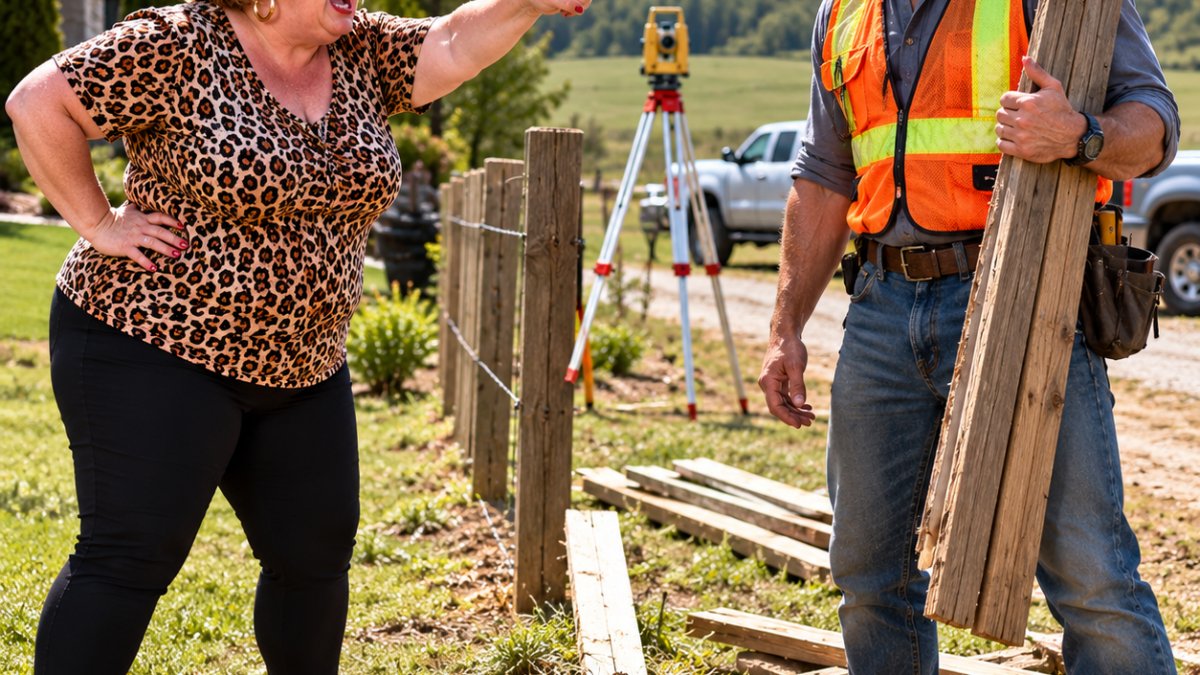
PART 2
I did not sleep much that night.
Not because I doubted the boundary.
I didn’t.
I had spent most of my adult life measuring things people argued about.
Distance.
Elevation.
Ownership.
Rights-of-way.
Drainage corridors.
Easements.
Property lines were rarely as dramatic as television made them sound. Most disputes came down to old records, physical monuments, mathematical reconstruction, and patience.
Facts had a way of surviving people’s opinions.
What kept me awake was the oak.
At two in the morning, I gave up pretending I was going to sleep and walked barefoot into the kitchen.
Moonlight came through the windows.
From there I could see the shadow of the water oak against the backyard.
Sarah used to paint under that tree.
She would sit on an old folding stool with her hair tied back, squinting at a canvas as though the landscape had personally offended her and she intended to correct it.
I could still hear her voice.
“Jack, trees aren’t straight.”
“I know that.”
“Then stop making them look like utility poles.”
“I draw maps, not landscapes.”
“Exactly my point.”
I smiled in the dark.
Then I saw the white fence.
Even at night it caught enough moonlight to stand out.
It cut directly through the view.
Something inside me hardened.
Sarah had been gone four years.
Cancer took six months to do what twenty years of military deployments, missed anniversaries, bad postings, and long separations had failed to do.
Separate us.
After she died, people kept telling me I needed to “move forward.”
I hated that phrase.
Forward suggested leaving something behind.
I wasn’t interested in leaving Sarah behind.
So I learned something else.
You could carry grief with you without letting it steer.
The land helped.
The workshop helped more.
I built it from a drawing Sarah had left in her sketchbook.
Every beam.
Every window.
Even the double doors facing the oak.
She had written one sentence beneath the sketch.
JACK’S PLACE TO MAKE THINGS WHEN HE FINALLY STOPS PRETENDING HE’S RETIRED.
That building wasn’t worth much compared with a house.
To me, it was priceless.
And now Karen Brewer had issued herself authority over part of it.
I made coffee.
At 5:40, I was dressed.
At 6:15, I was in my truck.
By seven, I was walking through the county records office.
Eleanor Pierce, our county clerk, was already at her desk.
She was seventy if she was a day, wore glasses on a chain around her neck, and remembered parcel numbers the way normal people remembered birthdays.
She looked over the top of her monitor.
“You’re early.”
“So are you.”
“I’m old. Sleeping is inefficient.”
I laughed.
She pointed toward the cup in my hand.
“Coffee?”
“Already got some.”
“That wasn’t an offer. Mine’s empty.”
Ten minutes later, armed with two coffees, I told her what I needed.
“Creekwood Estates subdivision plat.”
Her eyebrows rose.
“That place.”
“You know it?”
“Everybody in records knows it.”
“That bad?”
She leaned closer.
“Last month their president called because she wanted to know whether the county could force somebody outside the subdivision to repaint a shed.”
I closed my eyes.
“Karen Brewer?”
“You’ve met.”
“Oh, I’ve met.”
Eleanor typed.
“Parcel?”
“Creekwood common tract along the northern boundary of parcel 7B.”
She stopped typing.
“Seven B is yours.”
“Yes.”
Now she looked interested.
“What happened?”
“They built a fence.”
“How far?”
“Approximately thirty feet.”
“Inside your property?”
“Yes.”
She removed her glasses.
“Oh.”
That “oh” contained the enthusiasm of a woman who had spent forty years watching paperwork punish arrogance.
She brought up the subdivision plat.
I printed the digital copy, then pulled the recorded full-size sheet.
Creekwood Estates covered what had once been nearly one hundred acres of farmland behind my parcel.
The developer had carved it into residential lots, roads, stormwater areas, and common property.
The northern common tract bordered my land.
At first glance, the drawing looked routine.
Bearings.
Distances.
Lot numbers.
Curve tables.
Certificates.
I moved toward the certification notes.
Then I saw it.
A note near the corner.
Existing iron pin at NE corner not recovered. Boundary established from secondary evidence pending monument verification.
I read it twice.
Then a third time.
Eleanor watched my face.
“That important?”
“Very.”
The surveyor of record was Daniel Peterson.
I knew Daniel.
Not well.
Young guy.
Competent.
Fast.
Worked for a large private engineering firm that handled subdivisions.
People liked to criticize younger surveyors for relying too heavily on GPS and digital mapping, but that wasn’t fair. Good modern equipment, properly used, was extremely accurate.
The issue here wasn’t equipment.
It was evidence.
Daniel had been unable to recover one of the controlling monuments.
Rather than pretend otherwise, he had documented the limitation.
That was exactly what a professional should do.
The problem was what someone else had done with his preliminary line.
I checked the date.
Six months earlier.
Then the construction records.
The fence had been installed only weeks ago.
I sat back.
Karen had told me their line was a fact.
Their own recorded document said part of that line still required verification.
Eleanor shook her head.
“You’re smiling.”
“I am not.”
“You surveyors always smile when somebody gives you a bad map.”
“It isn’t a bad map.”
“Then why are you smiling?”
“Because somebody didn’t read it.”
I ordered certified copies.
Then I pulled my own plat.
Parcel 7B.
Five acres.
Original parent tract created decades earlier.
The historical calls aligned with the boundary reconstruction I had completed before building the workshop.
My survey had recovered the western iron monument.
The eastern monument had been buried too deeply for easy recovery during the first field visit, so I had reconstructed its expected position using multiple controlling references and follow-up work.
I knew within inches where it should be.
But inches weren’t what Karen had taken.
She had taken thirty feet.
That wasn’t survey noise.
That wasn’t rounding.
That wasn’t somebody standing on the wrong side of a line thickness on paper.
Thirty feet was a room.
A road.
A backyard.
Thirty feet was deliberate construction based on bad assumptions.
I spent the morning building a file.
Certified copy of my deed.
Certified copy of my plat.
Creekwood’s recorded plat.
Photographs.
Measurements.
Tax parcel records.
Subdivision approval documents.
Then I wrote Karen a formal notice.
No threats.
No insults.
Just facts.
- I owned parcel 7B.
- The newly installed Creekwood Estates fence appeared to encroach approximately thirty feet onto parcel 7B.
- The installation damaged a retaining wall and interfered with access to my workshop and oak.
- My recorded boundary survey established the property line.
- Creekwood’s own plat contained an express note stating the relevant monument had not been recovered and that the boundary relied on secondary evidence pending verification.
- I requested that the HOA cease all activity in the disputed area and provide a written removal and restoration plan within seven days.
I called Dave Miller before delivering it.
Dave and I had served together years earlier.
He had been a JAG attorney.
After leaving the Army, he built a civil practice focused on land disputes, veterans, and local-government issues.
He answered on the third ring.
“Jack Reed.”
“Dave.”
“You owe me lunch.”
“I bought last time.”
“You bought diner meatloaf. That does not legally constitute lunch.”
“I have an HOA problem.”
Silence.
Then:
“Tell me everything.”
I did.
When I finished, Dave sighed.
“Are you sure retirement isn’t an elaborate practical joke?”
“Pretty sure.”
“Do not remove the fence yourself.”
“I know.”
“Do not threaten to remove it.”
“I may have implied something.”
“Jack.”
“I said she had seven days to give me a reason not to remove it.”
“That qualifies.”
“She deserved worse.”
“I’m your lawyer. I’m professionally obligated to tell you that whether someone deserves worse is rarely admissible.”
I smiled.
“I’ve drafted a notice.”
“Send it to me first.”
I emailed it.
Five minutes later he called back.
“Good.”
“That’s high praise.”
“It’s boring.”
“Even higher praise.”
“Deliver it certified.”
“I was thinking personally.”
“Why?”
“I want to see her reaction.”
“That is not a legal reason.”
“No.”
“But?”
“But I’m delivering it personally.”
Dave groaned.
“Take a witness.”
I didn’t.
That was my first mistake.
Karen lived in the largest house in Creekwood.
Two stories.
Three-car garage.
Landscaping so symmetrical it looked computer-generated.
I rang the bell.
A tiny white dog began barking from inside.
Karen opened the door.
She looked surprised.
Then pleased.
“Mr. Reed. Have you come to apologize?”
“No.”
I handed her the envelope.
“This is formal notice concerning the fence.”
She opened it immediately.
I watched her read.
At first, nothing changed.
Then her eyes slowed around the paragraph describing the survey note.
She read it again.
For one second, uncertainty appeared.
Then anger covered it.
“This means nothing.”
“It means your recorded plat identifies an unresolved monument.”
“Our attorneys approved the fence.”
“Then give them the letter.”
She looked at the certified copy of my plat.
“This is your drawing.”
“It is a recorded professional survey.”
“You made it yourself.”
“Yes.”
“So you’re hardly unbiased.”
“Measurements aren’t improved by pretending I didn’t make them.”
Her face darkened.
“Our subdivision was professionally surveyed.”
“So was my property.”
She stared at me.
I stared back.
Then Karen smiled.
Not pleasantly.
She tore the letter in half.
Then she folded the pieces and tore them again.
The little pieces fell onto the porch.
“Your notice has been received.”
I glanced down.
“Apparently.”
She stepped inside.
For a moment I thought she was finished.
Then she returned holding another envelope.
She shoved it toward me.
“What is this?”
“Your violation.”
I opened it.
Creekwood Estates Homeowners Association.
Notice of violation.
Unauthorized landscaping and retaining structure on common property.
Initial fine: $100.
Continuing fine: $50 per day.
I looked up.
“Karen, I am not a member of Creekwood Estates.”
“You are occupying HOA common property.”
“My wall predates your subdivision.”
“Not according to our boundary.”
“You just tore up evidence showing your boundary is questionable.”
“I tore up harassment.”
I laughed.
I couldn’t help it.
That made her angrier.
“You think this is funny?”
“No. I think you’re making decisions you haven’t thought through.”
“You’ll pay the fine.”
“I won’t.”
“We can place a lien.”
“You can’t.”
“Our lawyers will decide that.”
“No, Karen. A court will.”
Her face went rigid.
“You need to understand something, Mr. Reed. Creekwood Estates has resources. We have attorneys. We have insurance. We have hundreds of homeowners paying dues.”
“And I have a property line.”
She slammed the door.
The dog continued barking.
I stood on the porch looking at the fine.
Then I called Dave.
“She issued me an HOA fine.”
“You’re not in the HOA.”
“I know.”
“For something on your property?”
“Yes.”
There was a pause.
Then Dave laughed.
Not a little laugh.
A full, delighted attorney laugh.
“Oh, Jack.”
“What?”
“Don’t respond.”
“Excuse me?”
“Don’t respond to another thing directly.”
“She threatened a lien.”
“Wonderful.”
“I wouldn’t use that word.”
“I would. Let her keep writing.”
“Dave—”
“You’ve already put her on notice. We preserve proof that she received it. From now on, every escalation after notice makes the record cleaner.”
“So I sit here while she threatens my land?”
“No. You document while she threatens your land.”
“And the fence?”
“Stays for now.”
I looked toward the rear acreage.
“I hate that.”
“I know.”
“Sarah planned that ground.”
His tone changed immediately.
Dave had known Sarah.
He had attended her funeral.
“I know that too.”
There was a long silence.
Then he said, “Jack, if you rip it down now, she makes you the angry landowner who destroyed association property during a boundary dispute.”
“And if I wait?”
“We prove she knowingly ignored uncertainty, attempted to exercise HOA jurisdiction over a non-member, threatened structures that predate her subdivision, and maybe tried to encumber property she has no authority over.”
“Maybe?”
“Give her time.”
I hated the advice.
Which meant it was probably good.
So I waited.
And Karen did exactly what Dave predicted.
Seven days later, another certified envelope arrived.
The original $100 fine had become $350 with administrative penalties.
Four days after that came a new notice.
This one stopped me cold.
UNAUTHORIZED SECONDARY STRUCTURE WITHIN HOA COMMON AREA.
They meant my workshop.
Karen claimed the rear portion of the building encroached into Creekwood common land.
The notice demanded removal within thirty days.
If I failed, the HOA reserved the right to hire contractors and recover the demolition cost through legal action and liens.
I read the letter twice.
Then I carried it into the workshop.
Late afternoon light came through the doors.
Sawdust hung in the air.
On the workbench sat a half-finished rocking horse I had been building.
Sarah had once drawn one almost exactly like it.
She said someday we might have grandchildren running through the house.
We never had children.
Life had gone another direction.
The rocking horse wasn’t for anyone in particular.
I had started it because some projects don’t need a reason.
I ran my hand along the smooth maple neck.
Then I looked through the doorway at the fence.
A white panel blocked part of the oak.
“Demolish my workshop,” I whispered.
That was the first time I felt real rage.
Not annoyance.
Not indignation.
Rage.
The Army teaches you that anger can be useful for about ten seconds.
After that it begins making decisions for you.
So I stood there until the feeling passed.
Then I scanned the letter and sent it to Dave.
His reply arrived one minute later.
Perfect.
I called him.
“Stop saying perfect.”
“Do you know what she just did?”
“Threatened my workshop.”
“She put in writing that she intends to destroy a structure on land she has already been told isn’t hers.”
“Which is still my workshop.”
“And which we are going to protect.”
I breathed out.
“What’s next?”
“Discovery.”
“We haven’t sued.”
“Not yet. But we can demand preservation and production in anticipation of litigation. Their lawyer will understand what’s coming.”
That afternoon Dave sent the HOA a formal evidence-preservation notice and document demand.
Survey materials.
Emails.
Contracts.
Board minutes.
Invoices.
Text messages.
Communications with the fence contractor.
Communications with their surveyor.
Anything referencing me, parcel 7B, the northern boundary, the fence, my wall, or my workshop.
Karen could tear up my letter.
She could not make those documents stop existing.
While Dave worked that angle, I started walking.
Not inside Creekwood.
Around it.
Creekwood had been carved into old rural parcels.
Several properties bordering the development weren’t HOA members.
The first belonged to Mrs. Evelyn Gable.
She was eighty-two and had lived on ten acres for more than fifty years.
I found her trimming roses beside a pale blue garden shed.
“Mrs. Gable?”
She looked up.
“Jack Reed.”
“You know me?”
“You make enough noise in that workshop.”
“Sorry.”
“I didn’t say I minded.”
I smiled.
“I wanted to ask you something about Creekwood.”
Her expression changed immediately.
“That woman.”
“Karen?”
“She sent me another letter yesterday.”
“Another?”
Mrs. Gable disappeared into the house and returned with a stack.
First violation: bird feeder attracting undesirable wildlife.
I read it.
“What wildlife?”
“Cardinals.”
I looked at her.
She shrugged.
“Apparently they don’t meet architectural standards.”
Second violation: compost pile visible from an HOA walking trail.
The compost pile sat entirely on Mrs. Gable’s land.
Third violation: garden shed painted an unapproved color.
I looked at the shed.
Blue.
Faded.
Probably painted twenty years before Creekwood existed.
“You’re not part of the HOA.”
“I told her that.”
“What did she say?”
“That properties affecting Creekwood’s visual environment were subject to community standards.”
“That isn’t how property law works.”
“I figured.”
“Have you paid anything?”
“No.”
“Good.”
She lowered her voice.
“But she threatened a lien.”
There it was again.
Fear.
Not because Karen necessarily had the legal power.
Because Karen had paper, letterhead, attorneys, and enough confidence to make an eighty-two-year-old widow wonder whether she might lose something.
I hated that.
I took copies.
Then I visited the Millers.
Not related to Dave.
Young couple.
Three children.
Their boys had a treehouse.
Karen had declared it an unsafe unapproved structure visible from Creekwood.
It had been built by the children’s grandfather twenty years before the subdivision existed.
Then the Patels.
They ran a small organic farm.
Karen had sent complaints about chicken odors and agricultural activity “incompatible with community standards.”
Their farm predated Creekwood by three generations.
I went home carrying copies of eight violation letters issued to people who were not members of Creekwood Estates.
I laid them across my kitchen table.
Then I called Dave.
“This isn’t about my fence.”
“No,” he said quietly.
“It never was.”
Karen wasn’t just defending a mistaken boundary.
She was expanding her authority by intimidation.
If somebody complied, the next demand came easier.
A bird feeder.
A shed.
Chickens.
A treehouse.
A retaining wall.
Thirty feet of somebody else’s land.
Power rarely arrives all at once.
It advances one tolerated step at a time.
So I called each neighbor.
“Keep everything.”
Mrs. Gable asked, “Are we fighting her?”
“Not yet.”
“What are we doing?”
“Measuring.”
She laughed.
“Of course a surveyor would say that.”
That night I took my field equipment to the back acreage.
I knew where the original monuments should be.
The western pin came first.
Six inches beneath pine straw and soil.
Old iron.
Exactly where expected.
The eastern monument was harder.
That was the one Daniel Peterson’s crew had not recovered.
I pulled historical field notes.
The original survey referenced two witness trees.
One was gone.
The other—an old oak farther east—still existed.
I reconstructed the bearing.
Measured.
Checked against deed calls.
Then ran a magnetic locator over the predicted area.
Nothing.
I moved six inches.
Nothing.
Another foot.
The machine chirped.
Then screamed.
My heart started pounding.
I scraped away the topsoil.
Still nothing.
Six inches.
Ten.
Fourteen.
Clay.
Construction runoff had buried the grade.
At almost two feet, my shovel struck metal.
I stopped.
Used my hands.
Rust.
Round iron.
The original monument.
I sat back on my heels.
Seventy years.
Storms.
Construction.
Developers.
A subdivision.
A fence.
And that piece of iron had stayed exactly where somebody put it decades before Karen Brewer ever heard the words “homeowners association.”
I did not move it.
I photographed it.
Measured it.
Logged it.
Tied it into my GPS observations.
Then I drove nearly invisible control spikes along the true line at fifty-foot intervals.
Flush with the ground.
No flags.
No bright paint.
Not yet.
The truth was there.
Karen just couldn’t see it.
Over the next two weeks, she grew louder.
I grew quieter.
At the Creekwood monthly meeting, she apparently spent twenty minutes discussing the dangerous neighboring properties threatening community standards.
Mrs. Gable’s niece lived inside Creekwood and attended.
She called me afterward.
“She talked about you.”
“By name?”
“No. ‘The uncooperative northern landowner.’”
“That’s catchy.”
“She says the HOA acquired a thirty-foot buffer.”
My grip tightened around the phone.
“Acquired how?”
“She didn’t say.”
“What else?”
“She said they’re planning a walking trail there.”
That stunned me.
“A walking trail?”
“Yes.”
On my land.
Beside Sarah’s oak.
Through the area in front of my workshop.
Karen wasn’t merely defending the fence now.
She was building a narrative to make the theft look legitimate.
But that meeting also produced something I hadn’t expected.
A man named Mark Ellis stood up and asked to see the survey.
Mark was a civil engineer.
New resident.
Mid-thirties.
Two sons.
He asked a simple question.
“What document establishes the thirty-foot buffer?”
Karen reportedly became defensive.
Then Mark asked for board minutes approving the $20,000 fence expenditure.
She claimed it had been an emergency security action approved verbally.
Mark asked whether the bylaws allowed expenditures over $5,000 without a recorded vote.
Karen ended the discussion.
The next afternoon, my phone rang.
“Mr. Reed?”
“Yes?”
“My name is Mark Ellis. I live in Creekwood.”
“I know who you are.”
He hesitated.
“You do?”
“Word travels.”
He laughed.
“Fair enough. I think something is wrong with that fence.”
“I agree.”
“Karen wouldn’t show us a survey.”
“Because the survey doesn’t say what she thinks it says.”
There was a pause.
“Would you be willing to show me?”
“Yes.”
Mark came over that evening.
I spread both plats across my kitchen table.
He studied them for ten minutes.
Then pointed to Daniel’s note.
“She built a permanent fence after this?”
“Yes.”
“This says monument not recovered.”
“Yes.”
“And she’s claiming thirty feet based on the preliminary line?”
“Yes.”
He leaned back.
“That’s insane.”
“That’s one word.”
“Did the board know?”
“I don’t know.”
“I’m going to find out.”
“Be careful.”
“Why?”
“Because the moment Karen realizes you’re asking questions she can’t answer, you become part of the problem.”
He smiled.
“I’m an engineer. Being part of the problem is how people describe us when we ask for documentation.”
I liked him immediately.
A week later, Dave called.
“Document production arrived.”
“How bad?”
“Physically? Terrible.”
“What?”
“They dumped everything.”
I met him at his office Saturday morning.
The conference table was buried beneath paper.
Hundreds of pages.
Invoices mixed with email chains.
Meeting agendas.
Vendor correspondence.
Fence specifications.
Old landscaping bids that had nothing to do with our dispute.
“Classic document dump,” Dave said.
“They’re hoping we miss something.”
I took off my jacket.
“Then they’re going to be disappointed.”
“Coffee?”
“Make a pot.”
For six hours, I sorted.
Chronological stacks.
Survey.
Board governance.
Fence contract.
Communications.
My property.
Outside-neighbor enforcement.
Around three in the afternoon, I found Daniel Peterson’s invoice.
PRELIMINARY BOUNDARY STAKEOUT.
Not final boundary verification.
I held it up.
“Dave.”
He read it.
“That helps.”
“It gets better.”
Behind it was an email.
From Daniel to Karen.
I read slowly.
He explained that his crew had not recovered the northeast monument controlling the Reed boundary.
The preliminary fence line relied partly on an old fence visible in aerial photography.
He strongly recommended a full monument-recovery and boundary survey before any permanent construction.
Timestamp: 8:42 a.m.
Karen replied at 8:52.
Ten minutes.
Daniel,
No need for further investigation. The line you marked is adequate for the board’s purposes. Please close the survey work and send the final invoice.
I read it again.
Dave leaned over my shoulder.
“Well.”
“She knew.”
“She knew there was uncertainty.”
“She was warned.”
“Yes.”
“She told me their survey was definitive.”
“Yes.”
“And she built anyway.”
“Yes.”
My anger didn’t rise this time.
It settled.
Cold.
Precise.
The way it felt when a confusing situation suddenly became clear.
I kept digging.
Meeting minutes.
No recorded vote authorizing the exact fence line.
No approved thirty-foot buffer acquisition.
No legal conveyance.
No easement.
No purchase.
No condemnation.
Nothing.
One agenda simply read:
North perimeter security fence — update.
Karen had apparently turned an “update” into authority to spend more than twenty thousand dollars.
Then I found the fence contract.
The contractor had protected himself.
OWNER RESPONSIBLE FOR ACCURACY AND LEGALITY OF MARKED FENCE ALIGNMENT.
Karen’s signature sat beneath it.
Dave whistled.
“She accepted placement responsibility.”
“On behalf of the HOA.”
“Without documented board authorization.”
I found another email.
One board member, Arthur Willis, had asked Karen whether the boundary needed to be confirmed.
Her response:
Surveyor already handled it. No further board action required.
Another.
Brenda, the secretary:
Do we need a formal vote because the fence exceeds our discretionary spending limit?
Karen:
Emergency security improvement. President has authority.
Dave sat back.
“Okay.”
“What?”
“Now we move.”
He picked up the phone.
“Monday morning, we send formal notice of claim.”
“I want to verify the monument publicly.”
He looked at me.
“Jack.”
“I already recovered it.”
“You what?”
“Did not disturb it.”
He stared.
“You found the missing iron.”
“Yes.”
“Where?”
“Thirty feet north of their fence.”
Dave started laughing.
“What?”
“Nothing.”
“Dave.”
“You have a flair for drama you pretend not to possess.”
“I want the boundary professionally clarified.”
“You’re the county surveyor.”
“Yes.”
“And the landowner.”
“Yes.”
“That conflict gets handled carefully.”
“I know.”
We spent an hour discussing process.
I would not use county authority to decide my private legal claim.
But the discrepancy in recorded mapping, the disputed subdivision common boundary, and the recovered monument could be documented through appropriate county procedures with independent crew verification and full transparency.
Every measurement would be reviewable.
No shortcuts.
No private manipulation.
If Karen wanted to argue, she would have the same data everyone else had.
By Monday, I had initiated the clarification process.
Another county surveyor reviewed the file.
My field notes were checked.
Daniel Peterson was contacted.
To his credit, Daniel responded immediately.
He didn’t hide.
He confirmed the preliminary nature of his work.
He confirmed he had advised further monument recovery.
He also agreed to be present if needed.
That mattered to me.
Professionals make provisional judgments all the time.
The ethical line isn’t uncertainty.
It’s pretending uncertainty doesn’t exist.
Saturday morning was selected for field verification.
At 9:45, two county trucks arrived near the disputed boundary.
I wore my county vest.
Tom Avery, one of our most experienced field technicians, unloaded the total station.
Chris Morgan, a young apprentice, carried the GPS rover and locator.
Mark stood in his backyard inside Creekwood.
He gave me a small nod.
People noticed the trucks immediately.
By ten, six residents were watching.
By 10:15, there were twenty.
Phones appeared.
Karen arrived at 10:18.
Pink sweatpants.
White T-shirt.
Sunglasses.
Fury.
“What is going on?”
Tom kept working.
I turned.
“Morning.”
“Don’t ‘morning’ me. Why are county vehicles on HOA property?”
“We’re verifying the recorded boundary.”
“You have no authority.”
I held out the paperwork.
She snatched it.
Her eyes moved rapidly.
“This is retaliation.”
“No.”
“You’re using your government job to intimidate me.”
“Every measurement today is being independently logged and reviewed.”
“This is harassment.”
“Karen, the subdivision plat itself documents uncertainty in this boundary.”
“Our lawyers disagree.”
“With the note on your own map?”
She shoved the paper back at me.
“You are not digging on HOA property.”
I nodded toward the public access area.
“We’re locating an existing monument.”
“I will call police.”
“You may.”
She pulled out her phone.
I turned away.
“Tom, run the west control.”
We worked.
Backsight.
Check.
Coordinate verification.
Historical reference.
Traverse closure.
The crowd grew.
Karen spoke loudly into her phone, announcing that county employees were trespassing.
No police arrived.
Perhaps dispatch had already checked the work order.
Perhaps somebody told her this was a civil boundary matter.
I didn’t ask.
Twenty minutes later, Tom carried the magnetic locator toward the predicted eastern corner.
I already knew what he would hear.
But I said nothing.
He swept left.
Nothing.
Right.
A faint chirp.
Again.
Stronger.
Chris moved beside him.
Tom centered the signal.
“Here.”
Chris dug carefully.
Four inches.
Eight.
Twelve.
Karen crossed her arms.
“This is ridiculous.”
Nobody answered.
Sixteen inches.
Eighteen.
The shovel clicked.
A metal-on-metal sound.
Every surveyor knows that sound.
Chris stopped.
He used a hand trowel.
Then his fingers.
A rusted half-inch iron pin emerged from the Georgia clay.
Tom looked at me.
I did not smile.
Not yet.
He cleaned around it.
Checked dimensions.
Then read the coordinate.
It matched.
Not approximately.
It matched the reconstructed position.
The crowd had gone quiet.
I looked toward Karen.
She stared at the iron.
“That isn’t real.”
Mark actually laughed.
Karen snapped around.
“What?”
“You think he planted a seventy-year-old iron monument two feet underground?”
Her face flushed.
“I don’t know what he did.”
I spoke before Mark could respond.
“Let’s finish the work.”
Chris set temporary visible markers along the verified line.
Every ten feet, orange survey paint marked the grass.
One.
Two.
Three.
Four.
The true line appeared.
And the farther it extended, the worse Karen’s fence looked.
Thirty feet.
Not three.
Not six inches.
Thirty.
The orange marks ran behind the fence across what Creekwood had started treating as common space.
Past newly planted ornamental trees.
Along the edge of the proposed walking path.
Clear of my workshop.
Clear of my retaining wall.
Clear of Sarah’s oak.
Exactly where I had said.
Karen’s face went pale.
“This can’t be right.”
I waited.
“Our surveyor—”
“Your surveyor told you his line was preliminary.”
Her eyes snapped toward me.
“You don’t know what he told me.”
Dave had advised me not to reveal the email until the verification was complete.
It was complete.
I pulled a copy from my field folder.
“I do.”
Karen stared.
I held it out.
She read Daniel’s warning.
Then her own reply.
Her mouth opened.
Closed.
The crowd shifted.
Mark stepped closer.
“What is that?”
Karen lowered the page.
I handed Mark another copy.
He read it aloud.
Not theatrically.
Just clearly.
By the time he reached the sentence recommending full monument recovery before permanent construction, homeowners were murmuring.
Then he read Karen’s response.
No need for further investigation.
The line you marked is adequate for the board’s purposes.
Somebody behind us said, “You’ve got to be kidding.”
Another voice:
“She knew?”
Karen looked around.
“This email is being taken out of context.”
“How?” Mark asked.
“The surveyor marked the line.”
“He told you not to build permanently on it.”
“I was acting for community security.”
“You spent twenty thousand dollars.”
“That’s board business.”
“I am a homeowner.”
“So am I,” another man said.
A woman stepped forward.
“So am I.”
Karen looked at me.
“This is what you wanted.”
“No.”
“You wanted to humiliate me.”
“No.”
“You staged this!”
I pointed toward the iron monument.
“That was buried decades before either of us got here.”
She looked like she wanted to scream.
Instead she said, “Our attorney will challenge this.”
“That’s your right.”
Dave arrived from the road.
Perfect timing.
Gray suit.
Leather folder.
Calm expression.
Karen saw him.
“Who are you?”
“David Miller. Counsel for Mr. Reed.”
She stiffened.
Dave handed her an envelope.
“This is a formal demand based on the verified encroachment and the documentary record already produced by the association.”
Karen didn’t take it.
Dave held it there.
Eventually she did.
“What does it say?”
“Fourteen days to remove the fence from Mr. Reed’s property and restore the damaged area.”
The residents listened.
“Reimbursement of legal and professional expenses.”
Karen’s jaw tightened.
“Compensation for documented property damage and loss of use.”
Someone whistled softly.
“And written retraction of false statements claiming Mr. Reed occupied or damaged Creekwood property.”
Karen looked at me.
“This will bankrupt the association.”
Dave replied before I could.
“That depends on your insurance, governance, and how your board chooses to resolve it.”
“It wasn’t my decision alone.”
Mark spoke from behind her.
“Actually, Karen, that’s something we need to discuss.”
Her face changed.
The other two board members had arrived.
Arthur Willis stood near the back of the crowd looking sick.
Brenda Keller had both hands over her mouth.
Mark turned to them.
“Did either of you vote on the fence alignment?”
Arthur looked at Karen.
Then at the homeowners.
“No.”
Karen spun.
“Arthur!”
He flinched.
“I supported the security fence.”
“You approved it!”
“I approved discussing a fence. I never saw that email.”
Brenda nodded.
“Neither did I.”
Karen’s voice rose.
“You both knew what we were doing.”
Brenda shook her head.
“You told us the boundary had been verified.”
The murmuring became anger.
A homeowner shouted:
“Whose money paid for this?”
Another:
“How much will it cost to remove?”
Another:
“Are we getting assessed because of this?”
Karen shouted over everyone.
“Stop! This is exactly what he wants!”
She pointed at me.
“This man has manipulated all of you!”
I looked at Mrs. Gable standing at the edge of my property.
She had walked over with a cane.
Karen saw her.
“And she isn’t even part of this HOA!”
Mrs. Gable smiled sweetly.
“Neither is Jack, dear. That hasn’t stopped you from sending us bills.”
A few people laughed.
Karen looked around for control.
It was gone.
Power based on certainty collapses quickly when people see uncertainty underneath it.
Mark raised his voice.
“We need an emergency membership meeting.”
Several homeowners agreed immediately.
Arthur nodded.
“Yes.”
Karen stared at him.
“You don’t have authority to call one without me.”
Arthur’s face was gray, but he stood straighter.
“Then we’ll follow the petition procedure.”
The crowd answered before Karen could.
“We’ll sign.”
“So will I.”
“Me too.”
Within twenty minutes, the survey was finished.
The equipment was packed.
But nobody left.
Homeowners clustered in groups talking about board records, insurance, costs, and Karen’s email.
She stood by the fence alone.
I approached only because I needed to retrieve a temporary marker near her.
She looked at me.
Her voice was low.
“You destroyed me.”
I stopped.
“No.”
“You knew all along.”
“I knew my line.”
“You could have told me who you were.”
“I told you the fence was on my land.”
“You didn’t tell me you’re the county surveyor.”
“Would that have made my property rights more important?”
She said nothing.
“That was the problem, Karen.”
“What?”
“You didn’t think you needed to listen unless the person standing in front of you had more power than you.”
For the first time since we met, she had no answer.
I walked away.
The emergency meeting took place Tuesday night.
Dave advised me not to attend.
“Why?”
“Because this is their governance problem now.”
“I started it.”
“No. Karen started it.”
“I want to see what happens.”
“I know.”
“And?”
“And sitting there gives her someone to blame. If you’re absent, she has to answer her own homeowners.”
He was right.
Again.
I hated that.
So Tuesday night, I stayed home.
At 7:15, I walked into the workshop.
At 7:32, Mark texted.
PACKED.
At 7:41:
KAREN TRYING TO CONTROL AGENDA.
At 7:46:
NOT WORKING.
Then nothing for half an hour.
I tried not to stare at my phone.
I worked on the rocking horse.
Sanded the curved runners.
Checked the joints.
At 8:19, the phone rang.
Mark.
I answered.
“Well?”
He was breathing hard.
“You wouldn’t believe this.”
“Try me.”
He told me.
The clubhouse had exceeded capacity.
Homeowners filled every chair and lined the walls.
Arthur opened the meeting because residents challenged Karen’s ability to preside over a proceeding concerning her own conduct.
Mark presented documents on a projector.
First, Daniel’s email warning.
Then Karen’s reply.
Then the fence contract making Creekwood responsible for placement.
Then the meeting minutes showing no recorded authorization of the final alignment.
Then the bylaws requiring formal approval for expenditures beyond the president’s discretionary limit.
Then Dave’s demand letter.
A slide estimated likely costs.
Fence removal.
Land restoration.
Legal fees.
Potential damages.
Professional fees.
Possible increased insurance premiums.
The room exploded.
Karen blamed Daniel.
Mark showed the email.
She blamed the fence contractor.
Mark showed the liability clause.
She blamed Arthur and Brenda.
They publicly stated she had never provided the boundary warning.
She blamed me.
Then Mark displayed my original written notice.
The one Karen had torn up.
I had photographed it before delivery and sent an identical certified copy afterward.
The homeowners saw that she had received explicit warning before escalating.
That ended it.
A retired accountant named George Bennett stood.
He made a motion of no confidence.
Then another homeowner amended it.
Removal as president and recall from the board.
The room voted.
Mark paused on the phone.
“How bad?”
I asked.
“For her?”
“Yes.”
“Four people voted to keep her.”
“How many there?”
“Over a hundred and eighty.”
I set the sandpaper down.
“So it’s done.”
“Not quite.”
“What now?”
“We just elected Arthur acting president.”
“That poor man.”
Mark laughed.
“And they elected me to Karen’s vacant seat.”
“Congratulations.”
“Don’t congratulate me.”
“You asked questions at one meeting. That’s how this happens.”
“There’s more.”
“What?”
“The new board voted to accept Dave’s settlement framework.”
That surprised me.
“All of it?”
“Removal. Restoration. Fees. Damages subject to final accounting. Retraction.”
I sat on the workshop stool.
For weeks, I had imagined feeling victorious.
Instead, I felt tired.
Mark’s voice softened.
“You okay?”
“Yeah.”
“You don’t sound happy.”
I looked at Sarah’s oak through the fence.
“I will be when that thing is gone.”
The next morning Arthur called.
His voice trembled.
“Mr. Reed, this is Arthur Willis.”
“Morning, Arthur.”
“I wanted to apologize personally.”
“You don’t have to.”
“Yes, I do.”
He took a breath.
“I should have asked questions earlier.”
I understood that kind of guilt.
“Karen didn’t build twenty thousand dollars’ worth of fence with her own hands.”
“No.”
“But I signed checks.”
“That doesn’t mean you knew the line was wrong.”
“I knew she didn’t like being questioned.”
That was different.
Arthur continued.
“I told myself it was easier to let her handle things.”
A lot of bad systems depend on exactly that sentence.
“Arthur, fix it now.”
“We will.”
“When?”
“Fence removal crew Monday.”
“Tell them to protect the oak.”
“I already did.”
“And the retaining wall.”
“We’ll restore it.”
“Good.”
“We’re also rescinding the fines against you.”
“You can’t rescind something you never had authority to issue.”
He laughed nervously.
“Dave said you’d say that.”
“Dave’s getting irritatingly good at predicting me.”
Arthur became quiet.
“There’s something else.”
“What?”
“We reviewed the other letters Karen sent outside Creekwood.”
Mrs. Gable.
The Millers.
Patels.
My jaw tightened.
“And?”
“They’re being formally withdrawn. Every one.”
“Good.”
“We’re sending apologies.”
“Better.”
“Jack?”
“Yes?”
“I’m sorry.”
This time I accepted it.
“Thank you.”
Monday morning came bright and warm.
I took the day off.
At 7:30, the fence crew arrived.
Same company that had installed it.
The foreman walked toward my porch.
He removed his cap.
“Mr. Reed?”
“That’s me.”
“Name’s Luis.”
I recognized him from the installation days, though we had never spoken.
“We’re here to remove everything south of the verified line.”
“That’s all of it.”
He winced.
“Yes, sir.”
I pointed toward the oak.
“Protect the roots.”
“We will.”
“The retaining wall was damaged here.”
“We have masons coming tomorrow.”
He nodded toward the fence.
“For what it’s worth, we build where we’re told.”
“I know.”
“We asked the association whether the line had been cleared.”
“I know that too.”
His shoulders relaxed.
“I appreciate that.”
“You didn’t create the problem, Luis.”
He put his hat back on.
“We’ll make it right.”
The first panel came down at 8:03.
The sound was strangely satisfying.
Metal fastener.
Vinyl section lifting.
Post hardware clanking into a bucket.
Then another.
And another.
By nine, a gap had opened.
Sunlight reached the grass that had been trapped behind the fence.
Mrs. Gable arrived carrying apple pie.
“Breakfast.”
“Pie isn’t breakfast.”
“At my age, anything I eat before noon is breakfast.”
The Millers came with their boys.
One handed me a drawing.
It showed a stick man beside an enormous orange survey tripod.
Behind him, a white fence was falling over.
At the top he had written:
MR JACK FOUND THE REAL LINE.
I swallowed harder than I expected.
“Thank you.”
“Mom says you saved our treehouse.”
“I didn’t save it. It was never theirs to regulate.”
The boy considered that.
“So you saved it.”
“Okay.”
The Patels arrived with eggs.
Mark came with coffee.
By noon, the backyard looked less like a work site and more like an accidental neighborhood picnic.
I didn’t mind.
Then the crew reached the oak.
Everything became quiet.
Two posts had been sunk near the drip line.
One panel cut directly across the view from my workshop.
Luis came over.
“We’re going slow here.”
“Thank you.”
They removed the panel.
Then worked the first post loose.
The concrete footing resisted.
Rather than yank it with machinery and risk roots, they dug around it.
Hand tools.
Slow pressure.
More digging.
Finally the post lifted.
The second came out forty minutes later.
And then the oak was free.
I stood in the workshop doorway.
The view Sarah had drawn years earlier was open again.
Tree.
Field.
Sky.
Nothing white cutting through it.
Mark came beside me.
“You okay?”
I couldn’t answer immediately.
He followed my eyes.
“Sarah?”
I had told him about her.
“Yeah.”
He nodded and stepped away.
Good man.
I walked to the oak.
Put my hand against the bark.
Ridiculous thing to do, maybe.
But grief makes rituals out of simple gestures.
“I kept it,” I whispered.
The words cracked.
Mrs. Gable heard.
She came beside me.
“Kept what?”
I looked toward the workshop.
“The plan.”
She said nothing.
I appreciated that.
Some people try to repair grief with sentences.
The best people know when not to.
By late afternoon, every section of fence was gone from my property.
Only holes remained.
The damaged earth looked ugly.
But temporary.
Scars.
Not walls.
Luis walked over.
“We’re finished.”
I shook his hand.
“Good work.”
“The landscaping crew will backfill tomorrow.”
“Thanks.”
He looked toward the crowd.
“You’ve got a lot of neighbors.”
I almost corrected him.
Mrs. Gable, the Millers, and Patels were neighbors.
Mark lived in Creekwood.
The others belonged to the subdivision Karen had tried to put on the opposite side of a wall.
But Luis was right.
They were all neighbors now.
“Looks like it,” I said.
Three days later, Arthur and Mark came to my kitchen.
Arthur carried an envelope.
Mark carried a folder.
The envelope contained the settlement check.
Legal costs.
Professional expenses.
Retaining-wall repair.
Land restoration.
Compensation for interference with the workshop.
Not life-changing money.
Enough to make the principle unmistakable.
The folder contained the association’s formal retraction.
It had been mailed to every Creekwood homeowner.
The letter admitted the fence had been constructed on an unverified preliminary alignment.
It acknowledged that I had no obligation to Creekwood’s covenants.
It withdrew every violation issued against me.
It apologized for statements characterizing my workshop and retaining wall as unauthorized structures on association property.
It also announced governance reforms.
No expenditure over the bylaws’ threshold without recorded vote.
No enforcement against non-members absent a clear legal basis reviewed by counsel.
No permanent boundary construction without verified survey.
Conflict-of-interest procedures.
Records access.
Member petition rights.
I read it twice.
“Good.”
Arthur looked relieved.
“There’s one issue left.”
“What?”
“The boundary.”
I looked at him.
“We know where it is.”
“Yes. We want to build the replacement fence on the correct line.”
I said nothing.
Mark glanced at Arthur.
Arthur continued.
“We’d like to hire you or another surveyor to stake it properly.”
I looked through the kitchen window.
The old oak.
The newly open land.
A fence would solve the legal problem.
But not the human one.
“No.”
Arthur blinked.
“You don’t want us to fence it?”
“I don’t think another six-foot wall is what anybody needs.”
“The residents may want security.”
“Then build something sensible where necessary. But not along the whole boundary.”
Mark leaned forward.
“What are you thinking?”
I walked them outside.
The orange paint marks were fading.
I stood on the true line.
“What if we mark it with trees?”
Arthur looked confused.
“Trees?”
“Red maples.”
Mark smiled.
I continued.
“Twenty-five feet apart. Enough to show the boundary clearly. They grow tall. Good fall color. Shade eventually.”
Arthur looked along the line.
“That would be beautiful.”
“That was Sarah’s idea.”
I hadn’t meant to say it.
But there it was.
Mark turned toward me.
“She planned trees here?”
“Not exactly here. She wanted maples closer to the garden.”
I looked toward the oak.
“But I think she’d approve.”
Arthur said quietly, “The HOA should pay.”
I shook my head.
“You’ve already paid the settlement.”
“Then let us split it.”
I considered.
“No.”
“Jack—”
“I don’t want another transaction.”
“What do you want?”
“Neighbors.”
Mark smiled.
Arthur’s eyes watered.
He turned away and pretended to examine the boundary.
“All right,” he said.
“Trees.”
I used part of the settlement to order twenty-five mature red maples.
When the nursery truck arrived, I expected to spend several weekends planting.
Instead, thirty people showed up Saturday morning.
Mrs. Gable brought lemonade.
The Miller boys carried hand tools that were mostly too large for them.
The Patels brought mulch.
Mark arrived with his two sons.
Arthur showed up wearing loafers.
I stared at his shoes.
“You planning to supervise?”
“I was told there would be refreshments.”
“Go home and get boots.”
He did.
We planted the first maple near the western monument.
I explained to Mark’s oldest son why we weren’t putting the trunk directly over the iron pin.
“Because the roots could disturb it?”
“Exactly.”
“Then how do people know where the boundary is?”
“Records. Monuments. Measurements. Trees are visual markers, not legal monuments.”
He nodded seriously.
His little brother asked, “Can a tree go to court?”
Mark said, “Only if it’s an expert witness.”
The boy looked genuinely concerned.
I laughed harder than I had in months.
By sunset, the line of maples stretched across the back acreage.
Small now.
Thin trunks.
Green leaves.
But alive.
No vinyl.
No concrete wall.
When the last tree was watered, everybody stood back.
Mrs. Gable wiped dirt from her hands.
“Much prettier than Karen’s fence.”
“Low bar.”
“Still counts.”
Mark’s sons ran along the line.
Children from Creekwood joined them.
Nobody stopped at the boundary.
They knew where it was.
They simply didn’t fear it.
That mattered.
Karen’s house went up for sale two weeks later.
I learned from Mark.
“She listed yesterday.”
“How do you feel?”
“I don’t know.”
“That’s not very satisfying.”
“Life usually isn’t.”
He sat beside me on the porch.
“She blames you.”
“I’m aware.”
“Some people say the assessment and legal costs ruined her reputation.”
“She made the decisions.”
“Still.”
I looked toward Creekwood.
“I don’t need her ruined.”
Mark seemed surprised.
“After what she did?”
“I needed my land back.”
“And Mrs. Gable?”
“I needed Karen to stop.”
“The workshop?”
“Protected.”
“The HOA?”
“Fixed, hopefully.”
He nodded slowly.
“So that’s enough?”
“It has to be.”
Revenge is dangerous because it keeps the person who hurt you at the center of your life.
I had already given Karen more space in my head than she deserved.
I wasn’t giving her the rest.
But life wasn’t finished with the story.
Two weeks before her house sold, Karen came to my property.
Alone.
No clipboard.
No HOA polo shirt.
No entourage.
I was sanding the rocking horse.
She stopped outside the workshop.
“Mr. Reed.”
I looked up.
“Karen.”
For a moment neither of us spoke.
She seemed smaller.
Not physically.
Something in her posture.
Power had once entered a room before she did.
Now she looked like someone arriving without armor.
“I came to tell you I’m leaving.”
“I heard.”
“I’m moving to my sister’s.”
I set down the sandpaper.
“What do you need?”
Her face tightened.
“You always do that.”
“Do what?”
“Talk like everything is a procedure.”
“I like procedures.”
“You humiliated me.”
I breathed out slowly.
“We’ve covered this.”
“No, we haven’t.”
She stepped inside.
I almost told her to leave.
Then I saw her looking at the rocking horse.
“My father made me one of those.”
That surprised me.
“When I was five.”
I waited.
“He was a carpenter.”
“So was mine.”
She touched nothing.
“He’d hate what happened.”
“Probably.”
Karen looked toward the maple trees.
“They’re nice.”
“Thank you.”
“Better than the fence.”
I almost smiled.
She did.
Barely.
Then it vanished.
“I thought I was protecting the neighborhood.”
“Maybe at first.”
Her eyes narrowed.
“You don’t believe me.”
“I believe you liked being needed.”
She flinched.
“That isn’t the same thing.”
“No.”
“Do you know what it was like before I became president?”
“No.”
“Nobody volunteered. People complained about everything. Trash. Pool. Landscaping. Cars. Noise. Nobody wanted to make decisions.”
“So you did.”
“Yes.”
“And eventually you stopped asking.”
She stared at the floor.
“That happens faster than people think.”
I believed her.
Power doesn’t always begin with evil.
Sometimes it begins with competence.
The person willing to solve the first problem becomes the person everyone sends the second problem to.
Then the third.
Eventually, if nobody checks them, they start believing they are the solution to every problem.
Karen looked up.
“I shouldn’t have built the fence.”
“No.”
“I should have ordered the survey.”
“Yes.”
“I shouldn’t have fined you.”
“No.”
“The workshop letter was…”
She stopped.
“What?”
“Stupid.”
I smiled.
“It was.”
That irritated her.
Then, unexpectedly, she laughed.
Just once.
“I hated you.”
“I noticed.”
“I still don’t particularly like you.”
“That makes two of us.”
Another tiny smile.
Then she looked toward the oak.
“Your wife?”
I had never told Karen directly.
“Sarah.”
“She planted it?”
“No. Tree’s older than both of us.”
“Why does everybody keep acting like the tree is sacred?”
I looked at the branches.
“She painted there.”
Karen followed my gaze.
“She died?”
“Cancer.”
Her face changed.
“When?”
“Four years ago.”
“I didn’t know.”
“You didn’t ask.”
The words landed.
Not cruelly.
But hard.
Karen closed her eyes for a moment.
“No,” she said. “I didn’t.”
I waited.
“I called your workshop dilapidated at a meeting.”
“I heard.”
“It’s not.”
“I know.”
“I said it because I needed people to think you were unreasonable.”
“I know.”
She looked embarrassed.
“I don’t know why I’m telling you this.”
“Maybe because you’re leaving.”
“Maybe.”
Then she did something I never expected.
“I’m sorry.”
Not a dramatic apology.
Not tears.
Not begging.
Two words.
Quiet.
I could have punished her.
Could have listed everything.
Mrs. Gable.
The Millers.
The Patels.
Sarah’s oak.
Twenty thousand dollars.
The threats.
The lien.
The workshop.
Instead, I said, “You hurt a lot of people.”
“I know.”
“Apologize to them too.”
She nodded.
Then she turned.
At the workshop door, she stopped.
“Mr. Reed?”
“Yes?”
“You could’ve destroyed me worse than you did.”
“I wasn’t trying to destroy you.”
She looked back.
“What were you trying to do?”
I thought about it.
“Make the line visible.”
She almost laughed.
“Of course.”
Then she left.
I never saw Karen Brewer again.
But before moving, she sent Mrs. Gable a handwritten apology.
Mrs. Gable showed me.
“She spelled ‘cardinal’ wrong,” she said.
“That your main takeaway?”
“No.”
“What is?”
She folded the letter carefully.
“That people can be foolish for a long time before they become brave for five minutes.”
I thought that was one of the smartest things anybody said during the entire mess.
Creekwood changed after Karen.
Not overnight.
Systems have habits too.
Arthur struggled as acting president because he was afraid of making mistakes.
Mark became the person who asked inconvenient questions.
The board began publishing minutes promptly.
Major contracts went out for bids.
Residents could inspect financial records electronically.
Violation letters changed tone.
First notice became conversation whenever possible.
The HOA formally acknowledged in its rules that bordering non-member parcels were outside its covenant jurisdiction.
Mrs. Gable’s bird feeder remained.
Her cardinals remained equally unapproved.
The Millers’ treehouse remained.
The Patels’ chickens remained fragrant.
Nobody died.
Property values did not collapse.
Civilization survived.
Six months later, Creekwood invited me to a meeting.
I almost declined.
Mark insisted.
When I entered the clubhouse, people applauded.
I hated it.
Mark knew I hated it.
Which was probably why he enjoyed it.
Arthur presented me with a small plaque.
FOR INTEGRITY, PATIENCE, AND SERVICE TO THE COMMUNITY.
I looked at him.
“I’m not in your community.”
Someone shouted from the back:
“You are now!”
Laughter.
I stood at the podium.
I had given military briefings to generals.
Survey presentations to county commissioners.
Testimony in court.
This speech felt harder.
“I don’t have much to say.”
Mark called out, “Good.”
More laughter.
I waited.
Then looked around.
“A year ago, some of us thought boundaries were the problem.”
Quiet.
“They aren’t.”
I held up one of my old field notebooks.
“A good boundary tells people where responsibility changes. It protects both sides.”
I looked toward Mrs. Gable, who had been invited.
“The trouble starts when somebody decides a boundary means one side matters more.”
People listened.
“Karen’s fence was wrong because it was in the wrong place. But the bigger problem was the idea behind it—that authority could cross a line simply because nobody stopped it.”
Arthur looked down.
Mark nodded.
“Good neighbors need boundaries. They also need gates. Conversations. Questions. Records. Enough humility to admit when they may be wrong.”
I thought of Sarah.
“She used to tell me every landscape looked better if I stopped trying to make every line straight.”
People smiled.
“I still think straight lines have their uses.”
More laughter.
“But she was right about one thing.”
I looked through the clubhouse windows toward the distant maples.
“Not every boundary needs to become a wall.”
That was my entire speech.
The plaque eventually ended up in the workshop.
I put it beside Sarah’s sketchbook.
The rocking horse went to Mark’s younger son on his sixth birthday.
When I delivered it, the boy climbed on immediately and nearly tipped himself over backward.
Mark caught him.
“Maybe you should’ve surveyed the center of gravity.”
“Maybe your son should stop treating furniture like cavalry equipment.”
The boy yelled, “Faster!”
I laughed.
Driving home, I passed the maple line.
They had grown noticeably.
Not tall yet.
But established.
That fall, the leaves turned red.
Brilliant red.
Sarah would have loved them.
One evening I carried her sketchbook outside and sat beneath the water oak.
The page showing the workshop was worn soft around the edges.
I turned to the garden plan.
Flowers.
Stone path.
Maples.
Notes in Sarah’s handwriting.
At the bottom she had written:
Leave room for things to grow.
I stared at that sentence for a long time.
For years I thought she meant plants.
Maybe she did.
But grief changes the meanings of old words.
I had spent four years preserving the property as though protecting memory required keeping everything the same.
Karen’s fence threatened that.
So I fought.
And I was right to fight.
But after the fence came down, something unexpected happened.
The land didn’t go back to what it had been.
It became something new.
Twenty-five maples.
Children from Creekwood helping with mulch.
Mrs. Gable bringing pie.
Mark stopping by the workshop.
Arthur waving from the road.
People who once lived behind a wall now walking past and talking.
Sarah’s dream had survived.
Just not frozen in place.
The following spring, I finally planted her garden.
I used the original sketch.
Mostly.
I moved two beds because drainage had changed.
Added native flowers Mrs. Gable recommended.
Mark’s sons helped lay the stone path.
The Miller kids painted small wooden markers.
The Patels supplied compost.
When we finished, Mrs. Gable stood beside me.
“You know what this needs?”
“What?”
“A bird feeder.”
I looked at her.
She smiled.
“Undesirable wildlife.”
We installed one the next morning.
Cardinals arrived within two days.
I considered sending Karen a photograph.
I didn’t.
Some victories don’t need an audience.
Years of survey work taught me that lines matter because people need certainty.
But the Creekwood fight taught me something measurements alone couldn’t.
Certainty without humility becomes arrogance.
Rules without judgment become weapons.
Authority without accountability becomes trespass long before anybody puts up a fence.
Karen had stood on my land and told me my property line was an opinion.
In the end, a rusted iron pin proved otherwise.
But that piece of iron did more than settle thirty feet.
It exposed a much larger boundary Karen had forgotten.
The one between leadership and control.
Between enforcing rules and inventing power.
Between being trusted and believing you are untouchable.
One Sunday morning, about a year after the fence came down, I sat in Sarah’s rocking chair on the porch.
Coffee in hand.
Sunlight on the field.
The water oak cast a broad shadow across the grass.
Beyond it, the maple trees formed a young green line.
Mark and his boys were walking on the Creekwood side.
The younger one saw me.
“Mr. Jack!”
“Morning.”
He pointed at the maples.
“Dad says those trees are the property line.”
“Pretty close.”
“Can I cross it?”
Mark immediately said, “Ask first.”
I smiled.
“Come on over.”
Both boys ran between the trees.
No gate.
No fence.
Just permission.
The younger one ran into the workshop and climbed onto the stool.
“What are you building?”
“A bench.”
“For who?”
“Haven’t decided.”
“Can it be mine?”
“No.”
“Why?”
“Because you already took my rocking horse.”
He grinned.
“That’s mine forever.”
“Apparently.”
Mark leaned against the doorway.
“You ever miss the fence?”
I looked at him.
“Not once.”
“The board voted last night.”
“Should I be worried?”
“We’re making the tree line part of the landscape plan.”
“Meaning?”
“The HOA will maintain its side. You’re responsible for yours.”
“Reasonable.”
“And nobody can replace it with a privacy fence without membership approval and a verified survey.”
I smiled.
“Learned something?”
“Painfully.”
His younger son picked up a tape measure.
“What does this do?”
I showed him.
We measured the workbench.
Then the door.
Then his height.
He insisted on measuring the dog even though I didn’t own one.
Eventually he ran outside to find something else.
Mark watched him.
“You know, he wants to be a surveyor now.”
“Poor kid.”
“He thinks you dig up treasure.”
“Sometimes we do.”
We both looked toward the eastern monument.
Still protected.
Still recorded.
Still quietly doing its job.
That old pin might have been the least impressive object in Georgia.
Half-inch iron.
Rusty.
Buried.
Worth almost nothing.
Yet it had outlasted developers, boards, arguments, fences, and egos.
There was something comforting about that.
Truth doesn’t always look impressive.
Sometimes it’s just a piece of metal in the dirt waiting for somebody patient enough to find it.
A few weeks later, I received an envelope with no return address.
Inside was a photograph.
Karen Brewer.
Standing beside a small house somewhere I didn’t recognize.
No HOA clubhouse.
No golf cart.
No clipboard.
On the back she had written:
Mr. Reed,
I planted a maple.
I checked the property line first.
—Karen
I stared at it.
Then laughed so loudly Mrs. Gable later called to ask whether I was all right.
I put the photograph in a drawer.
Not beside Sarah’s things.
Not beside the plaque.
Just a drawer.
Because Karen was not the center of the story anymore.
She never should have been.
The story belonged to the land.
To Sarah.
To the oak.
To neighbors who learned that official-looking letters aren’t the same thing as lawful authority.
To homeowners who learned that electing someone doesn’t mean surrendering responsibility.
To Arthur, who learned silence can become consent.
To Mark, who asked one simple question about a survey.
To Mrs. Gable, who refused to give up her bird feeder.
And maybe a little to me.
A widower who thought he was defending thirty feet of Georgia dirt and discovered he was really defending the life he had built with someone he still loved.
That land had been Sarah’s dream before it became my refuge.
Karen’s fence hurt because it felt like one more thing being taken after I had already lost too much.
When the fence came down, I thought the satisfaction would come from watching Karen lose.
It didn’t.
The moment I remember most wasn’t her removal from the board.
It wasn’t the homeowner revolt.
It wasn’t Dave’s demand letter.
It wasn’t even the discovery of the iron pin.
It was the moment the crew removed the last panel beside the water oak.
Sunlight came through.
The tree was whole in my view again.
For one second, with the workshop doors open and the leaves moving in the Georgia breeze, I could almost imagine Sarah beneath it.
Paintbrush in hand.
Squinting at me.
Telling me the line was too straight.
That was enough.
I had my land.
I had my workshop.
I had the oak.
And I had something I hadn’t expected to find after all that fighting.
Neighbors.
Real ones.
The kind who respected a line without needing a wall.
Years later, the maples would grow tall enough for their branches to meet in places.
Every fall they would turn red across the back of the property.
People walking through Creekwood would stop to photograph them.
Children would collect the leaves.
Mrs. Gable joked that the trees had probably increased Creekwood’s property values more than Karen’s $20,000 fence ever could.
She was probably right.
But I never cared about the value.
I cared that something living stood where something hostile once had.
Something that marked the truth without hiding the people on the other side.
Sometimes the best revenge isn’t making your enemy suffer.
Sometimes it’s restoring what they tried to damage so completely that their mistake becomes the foundation for something better.
Karen built a wall.
We planted trees.
Karen sent threats.
We kept records.
Karen tried to expand her authority.
Her own residents rewrote the rules.
Karen told me my boundary was an opinion.
We dug two feet into Georgia clay and found the truth waiting exactly where it had always been.
And whenever someone asks me about the white fence that once cut across my land, I don’t tell them the best part was removing it.
The best part came afterward.
A summer evening.
Fireflies rising over the field.
Children laughing somewhere beyond the maples.
My workshop doors open.
Sarah’s garden blooming beneath the oak.
No shouting.
No certified letters.
No fence.
Just a line on the ground, respected by everyone who lived on either side of it.
After a lifetime spent measuring boundaries, that was the first one that ever felt like peace.


