PART 2: HOA Built 99 Lakefront Homes on My Family’s Land—So I Closed Their Only Road and Let the Rain Finish What Their Fraud Started
PART 2
James did not tell me to confront the HOA.
That is one of the reasons I trusted him.
People who know property law understand that anger is useful only after the documents are in order.
“Send me everything David has,” he said.
“Tonight?”
“Now.”
I looked at David.
“He’ll send it.”
“I want the 2003 survey, every road instrument, the full trust chain, corporate records on the developer, and the surveyor’s licensing history.”
“You think the surveyor matters?”
“If somebody moved 340 acres with a monument, the surveyor always matters.”
I ended the call.
David stayed another hour.
We walked the original boundary.
The real line was not mysterious.
That was what made everything so disturbing.
There was no river that had shifted.
No vague nineteenth-century description using a dead oak tree as a reference.
The Holloway land had been surveyed repeatedly.
The 1967 monument matched the deed.
A later 1989 resurvey matched it again.
The false marker had been installed decades later.
Somebody had not misunderstood the line.
Somebody had replaced it.
As the sun dropped, the houses across the lake began lighting up.
Porch lights.
Kitchen windows.
Dock lights.
The sort of peaceful lakefront scene people paid enormous money to own.
And I remember thinking:
Those families have no idea.
That mattered.
I was angry, but I was not angry at the people inside those houses.
They had bought homes.
Taken mortgages.
Paid taxes.
Raised children.
Some had lived there almost twenty years.
They were not the people who moved the monument.
They were the people who trusted the paperwork.
I understood that distinction from the first night.
I would need to remember it many times before the case ended.
James called four days later.
Friday morning.
I was at my kitchen table with my great-grandmother’s deed abstract beside my coffee.
“Start with the title,” I told him.
“It’s clean.”
“How clean?”
“Unbroken from April 7, 1938 through today.”
I closed my eyes briefly.
“Independent confirmation?”
“Two days of title examination.”
“And?”
“Same answer.”
“So the 340 acres never left the Holloway chain.”
“Never.”
“The 2003 survey?”
“Created a cloud. Did not convey ownership.”
“Meaning?”
“You have always owned it.”
I ran my thumb along the edge of Ruth’s deed abstract.
That was the first moment I allowed myself to feel anger completely.
Not suspicion.
Not uncertainty.
Anger.
Because Ruth Holloway had spent her life protecting something Preston Wear had apparently decided could be transferred with a dishonest line on a map.
James continued.
“The surveyor was Carl Hobbs.”
“Know him?”
“I do now.”
“What did you find?”
“His Tennessee license was revoked in 2006.”
I sat very still.
“For what?”
“Fraudulent boundary work.”
The room seemed to shrink.
“How close to this?”
“Almost identical.”
James explained.
Three other counties.
Developer clients.
Parcel dimensions manipulated.
Adjoining land absorbed.
Recorded surveys used to benefit development projects.
His license had eventually been revoked because the pattern became impossible to ignore.
“And he signed Preston Wear’s survey?”
“Yes.”
“Three years before losing his license.”
“Yes.”
“So this wasn’t an inexperienced surveyor making a mistake.”
“I wouldn’t characterize his intent until litigation develops, but the pattern is extremely damaging for anyone defending the survey.”
“Preston Wear?”
James shuffled papers.
“Wear Development LLC formed in 1999. Preston Wear sole member. They purchased 180 legitimate acres east of your boundary in 2001.”
“That part is theirs.”
“Yes. No dispute.”
“What happened next?”
“2003 survey absorbed approximately 340 Holloway acres into the development description.”
“And then?”
“The road easement was recorded.”
“Tell me about that.”
James paused.
“I’ve seen bad easements. This one is almost absurd.”
“How?”
“Grantor: Wear Development LLC.”
“And grantee?”
“Wear Development LLC.”
I almost laughed, but nothing about it was funny.
“You can’t grant yourself an easement.”
“Not in the way this document tries to do it, especially when you don’t own the burdened land in the first place.”
“So legally?”
“Void from inception.”
“Completely?”
“Completely.”
“And the road has been using that document for twenty years.”
“Yes.”
“How many houses?”
“Ninety-nine.”
“Sales?”
“I pulled deeds.”
He paused.
“Approximately $48.2 million in original gross sales.”
I looked out the window.
Forty-eight million dollars.
Collected from families purchasing houses built partly on my family’s land.
“And Preston?”
“Company dissolved in 2009.”
“Where is he?”
“Sarasota.”
“Of course.”
“He owns waterfront property.”
That almost made me smile.
Of course the man who stole lakefront on paper bought himself lakefront somewhere else.
“Current value of the ninety-nine houses?”
“Roughly sixty-one million combined.”
I let that number sit.
“Title insurance?”
“Three major carriers.”
“Every homeowner?”
“Effectively.”
“So when we file—”
“They will all be notified.”
“Meaning three insurers are about to discover they guaranteed title based on Carl Hobbs’s fraudulent survey.”
“Yes.”
“James?”
“Yes?”
“My problem is the land.”
“I know.”
“The title insurers can handle their own policies.”
“They will.”
“What do we do first?”
“Offer the HOA a meeting.”
I frowned.
“Why?”
“Because ninety-nine innocent households are sitting in the middle.”
That was the right answer.
James drafted the notice.
Four pages.
No threats.
No dramatic language.
The Holloway Family Land Trust held fee-simple title.
The 2003 boundary survey appeared fraudulent.
The road easement appeared legally void.
The trust requested immediate negotiations toward a practical resolution.
Most importantly, it said directly that we understood the homeowners had purchased in good faith.
We were willing to discuss an arrangement protecting their homes while recognizing the trust’s ownership.
That letter went out June 19.
The HOA signed for it June 21.
Their response came one week later.
Two paragraphs.
Claims denied.
Community rights would be vigorously defended.
No meeting.
No request for evidence.
No proposal.
Then James called.
“Check their Facebook group.”
I opened it.
That was how I met Deb Sinclair.
Not in person.
On a screen.
She was HOA president.
Former marketing executive.
Good camera presence.
Good instincts for emotion.
And absolutely no interest in explaining Carl Hobbs.
Her post began:
“Our community needs to know what’s happening.”
It described my legal notice as a land grab.
Ninety-nine families being threatened.
Homes at risk.
Children.
Property values.
A photograph of Lakeshore Drive appeared beneath it.
Bicycles visible in one driveway.
Caption:
THIS IS WHAT THEY WANT TO TAKE FROM US.
The post had exploded.
Hundreds of reactions.
Hundreds of comments.
Shares everywhere.
A local television station had already interviewed Deb.
I watched the clip.
She stood outside her lakefront home.
Beautiful water behind her.
“Those are ninety-nine families,” she said.
“Ninety-nine families who bought homes legally and are now being told someone can take everything from them.”
I turned off the video.
Then called James.
“She went public.”
“I warned you.”
“File.”
“The quiet-title action?”
“Yes.”
“Now?”
“Now.”
“And media?”
“Tell them the truth.”
“What specifically?”
“Everything Deb left out.”
The 1938 deed.
Ruth Holloway.
The unbroken title.
The 1967 monument.
Carl Hobbs.
His revoked license.
The 2003 fraudulent survey.
Preston Wear.
Forty-eight million dollars.
Florida.
The self-granted easement.
And one more thing.
“Make it clear I’m not trying to evict ninety-nine families.”
“That’s important.”
“It’s also true.”
James filed July 2.
Forty-eight pages.
Quiet title.
Declaration that the road easement was void.
Trespass damages for unauthorized road use.
Our public statement went out the same day.
By July 8, an opinion piece under my name ran in the county newspaper.
It ended with the sentence I repeated dozens of times over the next year:
The Holloway Family Land Trust is not the party that put ninety-nine families in this position.
Preston Wear is.
Something changed after that.
Not everything.
People were still afraid.
They should have been.
Imagine discovering the most valuable thing you own sits on land controlled by somebody else’s deed.
Fear does not make people irrational automatically.
Sometimes fear makes people ask better questions.
Who was Preston Wear?
Why had nobody heard Carl Hobbs’s name?
Why was his license revoked?
Why did the HOA keep calling it a land grab when the Holloway deed predated Lakeshore Commons by sixty-five years?
Deb responded with video.
Then more video.
TikTok.
Facebook.
Television.
Standing on decks.
Standing beside the entrance road.
Sometimes with families.
Once with children.
Always the same theme.
Someone is trying to take our homes.
She was good at it.
One video reached hundreds of thousands of people.
For several days I became a villain to people who had never seen the deed.
Reporters called.
Politicians called.
Strangers found my number.
James told me:
“Do not fight her on social media.”
“I wasn’t planning to.”
“She wants you emotional.”
“She’ll be waiting a long time.”
That was true.
I had been a civil engineer for thirty years.
Concrete does not become stronger because you yell at it.
Neither does a boundary.
The HOA filed its formal defenses at the end of July.
Adverse possession.
Community necessity.
Equitable estoppel.
James had predicted all three.
“They’re delay arguments,” he said.
“Any dangerous?”
“Not on these facts.”
“Then why file them?”
“Pressure.”
“Media?”
“Time. Expense. Sympathy. They want you tired enough to accept their version of reality.”
I looked across Holloway Lake.
“Ruth held this land from 1938 until she died.”
“Yes.”
“I can probably hold out through an HOA motion.”
James laughed.
August passed.
September arrived.
The lawsuit crawled.
Deb posted.
The road remained open.
Every day, ninety-nine households continued using Lakeshore Drive.
Every day, vehicles traveled 2.1 miles across the Holloway trust under an easement our records showed had never legally existed.
I became increasingly uncomfortable with that.
Not because I wanted revenge.
Because continuing unchanged made the fraud look normal.
One morning, I called James.
“If they fight everything, how long?”
“Could be eighteen months.”
“Appeal?”
“Longer.”
“And the road stays open the entire time?”
“Unless you legally close it.”
I paused.
“What does closing require?”
James became silent.
He knew what I was asking.
“Thirty days written notice.”
“To whom?”
“HOA. Affected parties through their association. County emergency services separately.”
“Emergency vehicles?”
“Must maintain emergency provision.”
“We can.”
“Yes.”
“Draft it.”
“Marge.”
“They’ve had three months.”
“I know.”
“Have they asked to negotiate?”
“No.”
“Have they requested a meeting?”
“No.”
“Have they offered an easement payment?”
“No.”
“Have they acknowledged Preston Wear’s fraud?”
“No.”
“How many videos?”
“Too many.”
“Draft it.”
The notice went out September 15.
Thirty days.
Permanent easement negotiations remained available every day of the notice period.
Emergency services received gate access procedures.
I expected the HOA to call James the next morning.
They didn’t.
They filed two more motions.
Deb made fourteen more posts.
A state representative sent me a letter encouraging compassion toward innocent families.
I answered respectfully.
I had compassion.
That was why I had offered a negotiated easement before filing anything.
Compassion did not require pretending my deed was invalid.
October 16 arrived.
Day thirty-one.
I woke before sunrise.
Made coffee.
Drove to Lakeshore Drive.
The gate had been fabricated in Crossville.
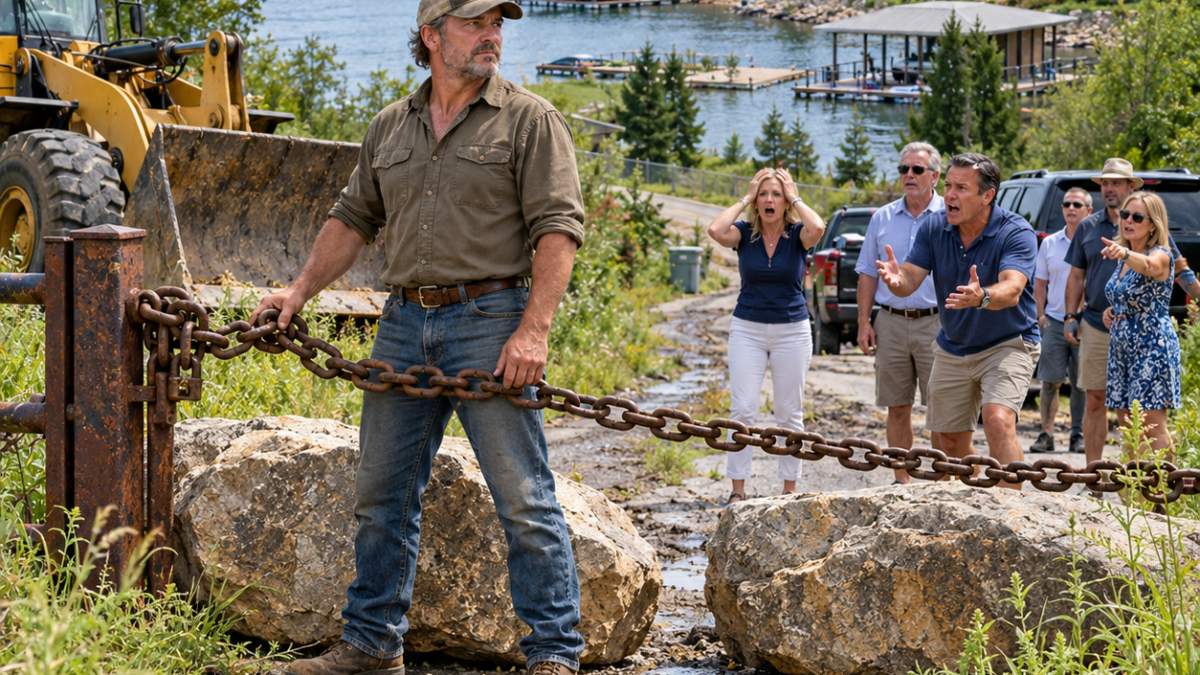
Sixteen feet wide.
Galvanized steel.
Heavy ranch hardware.
David had helped set two six-inch posts in concrete three days earlier, exactly where the public highway ended and Holloway Trust property began.
I swung the gate closed.
It moved slowly.
Metal hinge against steel post.
Then stopped.
I locked it once.
Heavy padlock.
Then chain.
Second lock.
Separate key.
Signs on both posts.
HOLLOWAY FAMILY LAND TRUST
PRIVATE PROPERTY
NO TRESPASSING
I stepped back.
Ninety-nine homes were on the other end.
I did not feel triumphant.
I felt the weight of what I had done.
Then I reminded myself of what I had not done.
I had not forged the survey.
I had not sold those houses.
I had not invented the easement.
I had not ignored four months of meeting requests.
I had not forced their HOA president to choose videos over negotiation.
I took a photograph.
8:47 a.m.
Logged.
Then drove home.
My phone began ringing before 9:30.
I did not answer unknown numbers.
The road stayed closed.
There was one thing Deb never understood about Lakeshore Drive.
I had been maintaining it.
Not the HOA.
Me.
When I took over active trust management in 2019, I walked every corridor and creek crossing.
The road had three problem areas.
Crossing One used an aging corrugated steel culvert under a gravel section.
It had corrosion.
Sediment buildup.
A joint beginning to separate.
I cleaned it.
Patched it.
Planned full replacement for 2024.
Crossing Two needed headwall work.
Crossing Three was worse.
Undersized drainage.
Seasonal overflow.
Shoulder erosion.
Every wet year, I managed it.
Why?
Because the road sat on trust property.
Land management means maintenance.
But once I closed an access corridor being operated under a void easement, my legal and financial obligation to subsidize that trespass ended.
I did not destroy anything.
That point matters.
I did not dig up the road.
I did not pull culverts.
I did not block drainage.
I simply stopped paying to maintain infrastructure serving people who refused to negotiate a valid right to use it.
November 7 brought rain.
Slow.
Steady.
Tennessee fall rain.
Four inches plus over roughly a day and a half.
David called November 10.
“Crossing One is gone.”
I drove out.
The road had washed open.
Not cracked.
Not muddy.
Gone.
The old culvert had backed up.
Water pressure built.
Fill failed.
A hole roughly two feet deep stretched across the lane.
Pipe exposed below.
Road impassable.
I photographed it.
Trust maintenance log:
Culvert failure. No repair scheduled pending easement resolution.
Then November 24 brought another storm.
Smaller.
But Crossing Three had always been vulnerable.
The undersized culvert backed up.
Water overtopped.
Shoulder gave way.
Second washout.
Now even if somebody cut my locks, Lakeshore Drive could not carry a normal vehicle through both crossings.
That was when Deb finally called me.
November 26.
“Ms. Holloway.”
Not Marge.
Not “land grab.”
Ms. Holloway.
“Ms. Sinclair.”
“The road has washed out.”
“I know.”
“Two places.”
“I know.”
“Families cannot use it.”
“I understand.”
“You need to repair it.”
“No.”
Silence.
“You closed it.”
“Yes.”
“You stopped maintenance.”
“Yes.”
“You allowed this.”
“No.”
Her voice sharpened.
“Excuse me?”
“I did not damage the road.”
“You knew the culverts would fail.”
“I knew they required maintenance.”
“And you stopped.”
“I stopped subsidizing infrastructure operated under a void easement.”
“You’re letting nature destroy our access.”
“Nature is exposing deferred infrastructure problems I had been managing at trust expense.”
“People have children.”
“I know.”
“Jobs.”
“I know.”
“Medical needs.”
“Emergency services were notified before closure and were given gate access.”
“Ambulances can’t cross a washout.”
“That is why your HOA needs a legitimate maintenance and access agreement.”
“You are unbelievable.”
I waited.
Then Deb finally said the sentence I had been waiting months to hear.
“What do you want?”
No camera.
No audience.
No social-media framing.
Just a question.
“A meeting.”
Silence.
“At James Okafor’s office. Your attorney. You. Whoever has authority to negotiate. A permanent recorded easement. A proper agreement for the homes. Compensation to the trust. Then we repair the road.”
“You want money.”
“I want legal documents.”
“Money too.”
“Yes.”
“You’re holding the road hostage.”
“No. Preston Wear created a development without valid access. I offered to fix that in June.”
Deb said nothing.
“I have asked for the same thing for five months.”
“I’ll speak to counsel.”
“Good.”
She hung up.
The next morning, James called.
“You’ve got company.”
“What happened?”
“Three title-insurance attorneys contacted me.”
I sat down.
“All of them?”
“All three carriers.”
The quiet-title action had triggered claims from the homeowners.
Meridian Title.
Continental Land Title.
First American.
Their lawyers had reviewed everything.
The Holloway chain.
Carl Hobbs.
The false survey.
The void easement.
The licensing revocation.
Their conclusion was not complicated.
We were going to win.
“Meridian wants a global settlement,” James said.
“What does that mean?”
“Protect the homeowners through real recorded rights instead of defending fraudulent title.”
“How?”
“Ground leases on the 340 acres. Permanent road easement. Title policies rewritten around legitimate interests.”
“And the insurers pay?”
“They have obligations to the homeowners. They also have subrogation claims against Preston Wear.”
I leaned back.
“They’re going after Florida.”
“Yes.”
“Good.”
“Marge.”
“Yes?”
“Three title insurers are staring at more than sixty million dollars in exposure.”
“I know.”
“They are highly motivated.”
“Then tell them I’ll negotiate.”
“Conditions?”
“The fraudulent survey still gets expunged.”
“Absolutely.”
“Court confirms Holloway ownership.”
“Yes.”
“No settlement pretending Wear ever owned it.”
“Understood.”
“Then everything after that is negotiable.”
That was the beginning of the end.
Not Deb.
Not the HOA.
The title companies.
They understood the legal problem in a way public relations never could.
Their job was not to win applause.
Their job was to make insured title real.
The summary-judgment hearing was January 14, 2024.
The courtroom was full.
Residents.
Lawyers.
Title insurers.
Deb beside HOA counsel.
James beside me.
Judge Patricia Odum listened to the HOA’s defenses.
Adverse possession.
Community necessity.
Equitable estoppel.
Then she dismantled them one at a time.
A fraudulent survey does not convey title.
The Holloway title never disappeared.
The HOA’s hardship was real, she said, but it had been created by Preston Wear’s fraud, not by our deed.
The trust had never represented anything to the ninety-nine homeowners.
We did not know our rights were being violated.
You cannot waive a violation you do not know exists.
Then she signed the order.
The 2003 survey:
Fraudulent.
Void.
Expunged.
The road easement:
Void from inception.
The Holloway Family Land Trust:
Sole fee-simple owner of all 1,100 acres.
Including the 340 acres.
Including Lakeshore Drive.
Eighty-five years.
Confirmed.
I did not cry immediately.
I thought I would.
Instead, I stared at the judge’s signature.
Then I remembered Ruth.
A Black woman buying 1,100 Tennessee acres in 1938.
People telling her it would never remain hers.
Yet there I was eighty-five years later in a county courtroom watching a judge confirm that it had.
James leaned over.
“You okay?”
“Yes.”
“You sure?”
“No.”
That was when my eyes filled.
Not because I had taken land back.
Because legally, it had never left us.
Preston Wear had only convinced everyone else that it had.
James filed against him in Florida in February.
Preston was seventy-four.
Waterfront home on Little Sarasota Bay.
Investment accounts.
Marina ownership.
Years of distance between himself and Tennessee.
Distance did not help.
The Tennessee order already existed.
The fraud was established.
The title insurers were coming too.
His attorney called James two days after service.
“My client wants to discuss resolution.”
James later told me his response was:
“He should have wanted that in 2003.”
Negotiations lasted weeks.
Wear’s assets were nowhere near sixty-one million dollars.
But pressure came from multiple directions.
Our fraud action.
Title-insurance subrogation.
Unjust enrichment.
The court order.
Eventually he sold the Sarasota home.
Sold investment assets.
Sold his marina interest under pressure.
His old commercial insurance contributed as well.
Final settlement:
$4.8 million.
Not the value of the damage.
Not the value of ninety-nine homes.
But enough to make the ending real.
Wear moved out of his waterfront home into a rental.
I did not celebrate that.
I thought about the ninety-nine families he had sold to.
He had spent twenty years letting them believe his paperwork protected them.
When the lie finally collapsed, he was already seventy-four and living two states away.
They were the ones who had lived above the trap.
That was why the settlement with the title insurers mattered more to me than Preston’s personal fall.
By April, we had a framework.
First:
Lakeshore Drive received a legitimate recorded easement.
Thirty-year term with renewal rights.
Annual fee based on comparable Cumberland County access transactions.
$18,400 per year.
Not extortion.
Not punishment.
Fair market value.
Second:
The ninety-nine homeowners received ground leases for the Holloway acreage beneath their homes.
Long term.
Fifty years.
Renewable.
Individual agreements.
Plain-language summaries.
Properly recorded.
Title insured.
For the first time since the houses were built, the people living there had documents based on truth.
Third:
A restoration fund repaired Lakeshore Drive.
The two failed culverts were replaced.
Not patched.
Replaced.
Properly sized drainage.
Concrete headwalls.
Compacted fill.
Crossing Two repaired too.
The title insurers helped fund the resolution under their policy obligations and recovery rights.
The community voted.
Ninety-four yes.
Five no.
Deb was one of the five.
That told me everything I needed to know.
Even after the court order.
Even after the survey was expunged.
Even after the title insurers admitted the legal position could not be defended.
She still believed agreement meant surrender.
Some people do not know how to stop fighting after the reason for the fight disappears.
The residents did.
Ninety-four of them chose certainty.
That was courage too.
The settlement papers were signed April 15.
Recorded April 17.
New title policies issued by April 22.
Road crews arrived May 6.
I visited the work twice.
Civil engineering never leaves your blood.
The contractor had excavated Crossing One completely.
New pipe.
Better diameter.
Headwall.
Proper grade.
Crossing Three received the same treatment.
Crossing Two got stabilization and sediment work.
By May 19, the road was better than it had been before I closed it.
The irony did not escape me.
Twenty years of illegal use ended with a stronger legal road.
May 20, I drove to the gate.
The same gate Deb had called cruel.
The same gate people online had called vindictive.
I unlocked it.
Removed the crossbar.
Capped the hinges.
Left the posts.
The road remained open.
Not because I lost.
Because the easement was finally real.
That gate had never been my revenge.
It had been punctuation.
A physical period at the end of twenty years of pretending.
When the paperwork became legitimate, its purpose ended.
Howard Bell called me the next week.
He was the newly elected HOA president.
Deb had received eight votes.
Howard received ninety-one.
“Ms. Holloway?”
“Yes.”
“I want to apologize.”
“For what?”
“How this community handled the first year.”
“You weren’t president.”
“I’m president now.”
“That’s different.”
“I know. But somebody needs to say it.”
I waited.
“You offered a meeting last June.”
“Yes.”
“We should’ve taken it.”
“Yes.”
“We let Deb convince us negotiation meant admitting defeat.”
“That happens.”
“We understand the ground leases.”
“Good.”
“We understand the trust owns the land.”
“Good.”
“We understand the road easement.”
“Very good.”
He laughed nervously.
“We intend to honor everything.”
“That is all I ever wanted.”
That was true.
I never wanted ninety-nine homes abandoned.
I never wanted families ruined.
I wanted Ruth Holloway’s deed acknowledged.
I wanted the fraud removed.
I wanted future buyers to know what they were buying.
I wanted access to be documented instead of stolen by paperwork.
That was all.
The final financial accounting was large enough to make headlines again.
Preston Wear settlement:
$4.8 million.
Direct Holloway trust recovery from that settlement:
$2.1 million.
Additional trust compensation through the broader title-insurance resolution brought total direct compensation to approximately $4.2 million.
But money was not what I remembered.
Money spends.
Records remain.
April 17, the Cumberland County Register of Deeds officially marked the Wear survey fraudulent and expunged by court order.
Then the 1938 Holloway deed remained where it had always been.
That image meant more to me than any settlement check.
Old deed.
New annotation.
Fraud removed.
Truth unchanged.
My granddaughter Zoe came in June.
Seventeen.
Already telling everyone she wanted to study law.
We walked the eastern shoreline.
The lake was full from spring rain.
Green trees.
Warm sun.
Across the water, Lakeshore Commons looked peaceful.
Same ninety-nine houses.
Same docks.
Same decks.
Nothing had disappeared.
Zoe walked beside me quietly for almost ten minutes.
Then asked:
“Grandma?”
“Yes?”
“Did you feel bad closing the road?”
I knew somebody would eventually ask me that honestly.
Not accusing.
Not defending.
Just asking.
“Yes.”
She looked surprised.
“You did?”
“Of course.”
“But you knew you were right.”
“Being right doesn’t mean other people don’t experience consequences.”
She considered that.
“Then why close it?”
“Because leaving everything unchanged would have allowed the fraud to become normal.”
“But those families didn’t commit the fraud.”
“No.”
“So why make them suffer?”
I stopped walking.
Turned toward the lake.
“Because they deserved better than a lie too.”
Zoe frowned slightly.
I continued.
“Imagine I left the road open. Imagine I never forced the issue. Another ten years pass. Twenty. Homes sell again. New mortgages. New families. More title policies based on a false survey.”
She nodded slowly.
“What happens when somebody finds it then?”
“Worse.”
“Much worse.”
We walked again.
“The gate hurt.”
“Yes.”
“The washouts hurt.”
“Yes.”
“But they forced everyone to fix it.”
“They forced everyone to acknowledge it.”
She looked across the lake.
“Deb said you wanted to steal their homes.”
“Deb understood the fear.”
“What does that mean?”
“The fear was real.”
“But she lied?”
“She was wrong about what I was doing.”
I thought about the distinction.
“She mistook enforcement for aggression.”
Zoe looked at me.
“That sounds like something lawyers say.”
“It sounds like something landowners learn.”
She smiled.
Then she asked:
“What did Ruth see here?”
That question stopped me.
Not because I hadn’t thought about it.
Because I had.
Many times.
Tennessee.
Ruth standing near that lake when much of the land was rough timber and pasture.
No luxury homes.
No marina.
No paved entrance.
No title insurance.
No social media.
Just acreage.
Water.
A deed.
And enough courage to believe ownership could survive the world around her.
“What did she see?” Zoe repeated.
I looked across the lake.
“Something worth holding.”
She was quiet.
Then nodded.
The summer passed.
Lakeshore Commons settled into its new reality.
People paid their ground leases.
The road operated normally.
Howard’s HOA spent less time fighting me and more time managing the things an HOA should actually manage.
Stormwater.
Common landscaping.
Docks.
Road coordination.
Insurance.
Deb disappeared from the board.
I saw her once at a county meeting.
She looked at me.
I nodded.
She nodded back.
No confrontation.
That was enough.
I never needed her apology.
I needed her signature off decisions affecting my property.
I got that.
Preston Wear never returned to Tennessee, as far as I know.
I did not want to see him.
There would have been no satisfying speech.
What could I say?
You stole twenty years of certainty from ninety-nine families and tried to steal 340 acres from mine.
The court had already said everything necessary.
The deed said the rest.
One year after the judgment, David Quan came back to survey the boat launch.
The thing that had started all of it.
I almost laughed when his truck pulled in.
“You ready to finally build this thing?” he asked.
“I’m afraid of what you’ll find.”
“No extra monuments today.”
“Check anyway.”
He did.
Same true line.
Same brass cap.
The false monument had been removed from legal significance.
Not physically forgotten.
We preserved it.
I wanted it kept as evidence of what paper fraud looks like when someone eventually walks the land.
David marked the boat-ramp footprint.
I stood beside him.
“Crazy,” he said.
“What?”
“You called me for a twelve-foot concrete ramp.”
“And found a sixty-million-dollar title disaster.”
“That’s about right.”
“Next time I’ll build nothing.”
He laughed.
We built the launch that summer.
Simple.
Concrete.
Gravel turnaround.
Small dock.
Exactly what I wanted in the first place.
Zoe helped the first day we put a boat in.
My younger grandson forgot to tie the stern line correctly.
Boat drifted six feet.
Everyone yelled.
Normal family chaos.
That meant more than people understand.
For almost a year, Holloway Lake had become a lawsuit.
A boundary.
A headline.
A viral video backdrop.
A valuation.
A court exhibit.
The boat launch turned it back into water.
Family.
Summer.
Fishing.
Ruth would have liked that more than any settlement number.
One evening after everyone left, I sat at the new dock alone.
The eastern shore was quiet.
Across the lake, lights came on at Lakeshore Commons.
Those homes no longer looked like an invasion to me.
They looked like homes.
They had always been homes to the families living there.
Now the legal documents finally matched that human reality.
The ground belonged to the Holloway trust.
The structures belonged to the homeowners under legitimate lease arrangements.
The road operated through a legitimate easement.
Title insurers had issued policies that actually described what existed.
Everyone knew where they stood.
That is what property law is supposed to do when it works.
Not create winners and losers.
Create certainty.
It took twenty years of fraud and ten months of litigation to get there.
But we got there.
People online still told the story differently.
Some said:
Woman shuts road to ninety-nine homes and nature destroys it.
Others:
HOA loses $61 million land battle.
Others:
Black family wins back stolen Tennessee lakefront.
Some stories called me ruthless.
Others heroic.
I was neither.
I was the trustee responsible for 1,100 acres.
That responsibility did not disappear because enforcement became uncomfortable.
Ruth had held the land through a time when people probably expected her not to.
My grandfather held it.
My father held it.
Then it came to me.
The job was not to own it emotionally.
The job was to leave it intact.
That included making hard decisions.
Sometimes stewardship looks like planting timber.
Sometimes repairing a culvert.
Sometimes paying taxes.
Sometimes saying no.
And once, it looked like closing a steel gate across a road that should never have existed without permission.
Years later, the gate posts are still there.
No crossbar.
No chain.
Just two steel posts beside Lakeshore Drive.
Most people driving through probably don’t know why.
New homeowners certainly won’t.
Their closing papers explain the ground lease.
The road easement appears in the title search.
Everything is boring now.
Good.
Property rights should be boring.
Boring means somebody checked.
Boring means the instrument was recorded.
Boring means the lender knows.
The buyer knows.
The owner knows.
The county knows.
Boring means nobody wakes up twenty years later and discovers an entire neighborhood sitting on a lie.
Once every few months, Howard calls.
Usually something ordinary.
Road inspection.
Drainage.
Tree trimming near the easement boundary.
He asks first.
That still stands out.
“Ms. Holloway, we need contractor access next week.”
“What for?”
“Shoulder stabilization near Crossing Two.”
“Send James the plan.”
“Already did.”
“Then you’re fine.”
Simple.
No videos.
No reporters.
No accusations.
Documentation.
Permission.
Work.
That is what should have happened from the beginning.
Zoe eventually started college.
Pre-law track.
The family jokes that Lakeshore Commons recruited her.
Maybe it did.
She keeps a photocopy of Ruth’s 1938 deed above her desk.
I gave it to her graduation summer.
She called me one evening.
“Grandma?”
“Yes?”
“I’m taking property law next semester.”
“Good.”
“They’re going to hate me.”
“Why?”
“I have opinions.”
“That’s what professors are for.”
She laughed.
Then:
“I keep thinking about what you said.”
“What?”
“Something worth holding.”
I went quiet.
“That wasn’t really about the land, was it?”
I looked toward Holloway Lake through my kitchen window.
“No.”
“What was it about?”
“Responsibility.”
“How?”
“Anything worth having becomes something worth protecting. Land. Family. Truth. Reputation. Rights.”
“Even when protecting it hurts?”
“Especially then.”
Zoe said nothing for a moment.
Then:
“I think I understand.”
“You’re nineteen.”
“I know.”
“You don’t.”
She laughed.
“Thanks.”
“You’ll understand later.”
After we hung up, I went outside.
Sunset over the lake.
The same water Ruth had seen.
The same land her deed described.
Homes across the far shore.
Everything calmer than it had been during that year of litigation.
And I thought about the gate again.
People assume the most dramatic moment was the day I closed it.
It wasn’t.
The most dramatic moment happened months earlier.
David Quan standing beside two monuments.
One true.
One false.
That was the whole story in miniature.
Truth does not always look more powerful.
The false monument had been used by developers.
Banks.
Insurers.
Buyers.
Survey records.
Road permits.
Construction crews.
For twenty years, almost every institution around it behaved as if it were real.
The true monument just sat there.
Old.
Quiet.
Brass cap.
Correct.
It did not become less true because nobody was looking.
That lesson changed how I thought about everything.
Falsehood can accumulate infrastructure.
It can collect signatures.
Money.
Homes.
Roads.
Insurance policies.
Social-media followers.
Government stamps.
Time.
Twenty years, in our case.
And still be false.
Truth can sit in weeds for decades waiting for somebody with the right instrument to find it.
David found it.
James defended it.
Judge Odum recognized it.
The title insurers finally documented it.
I enforced it.
The homeowners learned to live with it.
And Ruth’s deed survived it.
That is why I do not regret the gate.
I regret that Preston Wear made the gate necessary.
I regret the fear ninety-nine families lived through.
I regret the months of public anger.
I regret the rain damage.
I regret every dollar spent on lawyers that could have been avoided if the developer had bought the land honestly in 2003.
But I do not regret drawing the line.
Because once a line becomes negotiable simply because enough money was built on the wrong side of it, ownership stops meaning anything.
That would have dishonored Ruth more than any lawsuit ever could.
People called what I did revenge.
Maybe from the outside it looked like revenge.
The HOA ignored me.
I closed the road.
Rain washed it out.
The developer lost his waterfront house.
Deb lost her presidency.
The homeowners had to sign ground leases.
It looks cinematic when listed that way.
Living through it felt different.
Most days were paperwork.
Calls.
Surveys.
Waiting.
Legal briefs.
Maintenance logs.
Emails.
Reading motions at midnight.
Explaining the same facts repeatedly.
The emotional moments were short.
The work was long.
Real accountability usually is.
The final result satisfied me because nobody had to disappear for me to keep what was mine.
The ninety-nine homes stayed.
Families stayed.
The road reopened.
The lake stayed peaceful.
My trust kept ownership.
The fraudulent survey disappeared.
Preston Wear paid.
The insurers did their job.
The HOA changed leadership.
The road got better.
That was the ending I wanted.
Not destruction.
Correction.
One summer evening, I took the boat out alone.
Passed the new ramp.
Crossed toward the center of Holloway Lake.
From there I could see both shores.
The old Holloway house west.
Lakeshore Commons east.
Ninety-nine homes tucked into trees.
No legal document visible from the water.
That struck me.
You cannot see title from a boat.
You cannot see an easement.
You cannot see a fraudulent survey.
You cannot see eighty-five years of recorded ownership.
You see houses.
Trees.
Docks.
Water.
Maybe that is why people forget property rights are invisible until somebody needs them.
I shut off the engine.
Let the boat drift.
Water tapped the hull.
The sun dropped behind the ridge.
For the first time in a long time, the entire lake looked like one place again.
Not disputed acreage.
Not 340 acres.
Not sixty-one million dollars.
Just Holloway Lake.
I thought about Ruth.
What would she have said?
Family stories described her as practical.
Not sentimental.
She probably would have asked why it took us twenty years to notice.
Then she would have asked whether the taxes were paid.
Then whether the road was fixed correctly.
I smiled.
Yes, Ruth.
Taxes paid.
Road fixed.
Deed clean.
Land still ours.
That was enough.
A few years after the case, somebody from a legal-history organization contacted James about interviewing me.
They were studying long-term consequences of fraudulent development surveys.
I declined at first.
Then Zoe convinced me.
“Grandma, this is literally why records matter.”
“So they can read the case.”
“People learn from people.”
“You sound like a lawyer already.”
“Thank you.”
“That wasn’t a compliment.”
I eventually agreed.
The interviewer asked:
“What gave you the courage to close the road?”
I thought about the question.
“Courage had very little to do with it.”
“What did?”
“Certainty.”
“Explain.”
“I had the deed.”
“The court hadn’t ruled yet.”
“No.”
“So weren’t you afraid you could be wrong?”
“Of course.”
“What made you proceed?”
“David’s survey. James’s title research. Carl Hobbs’s disciplinary history. The easement document. Eighty-five years of title.”
I paused.
“I didn’t wake up one morning angry and close a road. I spent months verifying that the road had no legal right to be there.”
“So documentation gave you courage.”
“No.”
“What did it give you?”
“Ground.”
She looked confused.
“Ground?”
“A place to stand.”
That answer became the title of their article.
I disliked the attention.
But the phrase stayed with me.
Because that is what Ruth’s deed had done for every generation.
Given us a place to stand.
When the developer’s map said something else.
When the HOA said something else.
When social media said something else.
When people told Ruth in 1938 she had no business owning that much Tennessee land.
The deed gave us ground.
Literal ground.
And legal ground.
The Holloway Family Land Trust still owns all 1,100 acres.
The ninety-nine homes still stand under long-term leases.
Lakeshore Drive remains open under its recorded easement.
The annual easement payment arrives.
Ground rents arrive.
We maintain the land.
The HOA maintains obligations assigned under the agreement.
Every few years, attorneys review the documents.
That is probably the least viral ending imaginable.
Good.
I have had enough viral endings.
I prefer boring ones.
A clean title.
A working road.
A healthy lake.
Grandchildren using the boat ramp.
And two old gate posts beside Lakeshore Drive, standing where a locked steel gate once forced an entire community to finally ask the question they should have asked before the first foundation was poured.
Who owns this land?
The answer had been the same since April 7, 1938.
Ruth Holloway did.
Then her family did.
Then the trust did.
Preston Wear never did.
His survey could not change that.
His forty-eight million dollars could not change that.
Ninety-nine houses could not change that.
Twenty years could not change that.
Deb Sinclair’s videos could not change that.
A developer can build a road over a deed.
He can build houses over a deed.
He can sell those houses.
Banks can lend against them.
Insurers can insure them.
Families can live there for decades.
But none of those things turn a lie into ownership.
Eventually, somebody walks the boundary.
Eventually, somebody finds the old monument.
Eventually, the line comes back.
David found mine.
James defended it.
I closed the road.
Nature handled the culverts.
A judge removed the fraud.
And when everything was finished, I did not take ninety-nine homes away from ninety-nine families.
I gave them something Preston Wear never bothered to give them.
A legal way to stay.
That is the part of the story I care about most.
Not the gate.
Not the washed-out road.
Not the Florida settlement.
Not Deb losing ninety-one to eight.
The ending.
Families kept their homes.
My family kept its land.
And for the first time in twenty years, everybody around Holloway Lake finally knew exactly what belonged to whom.
That was not revenge.
That was the boundary being put back where Ruth Holloway left it.
And after eighty-five years, the line was still there.
[EXPANDED ENDING — 3000 WORDS]
The first thing I did after the settlement papers were recorded was not deposit a check.
I drove to the county Register of Deeds office.
James told me I did not need to go personally. The filings were electronic. The court order had already been processed. The title insurers had copies. The lawyers had copies. The Holloway Family Land Trust had certified copies waiting in his office.
None of that mattered.
I wanted to see the record myself.
Eighty-six years earlier, Ruth Holloway had walked into a government office in Tennessee and recorded a deed saying 1,100 acres belonged to her. In 2003, Preston Wear had walked into the same legal system with a fraudulent survey and convinced enough people that 340 of those acres belonged to him.
Now I wanted to see which document survived.
The clerk knew who I was before I introduced myself.
The case had been impossible to avoid in Cumberland County.
“Ms. Holloway?”
“Yes.”
She disappeared into the back and returned with the certified record.
There it was.
The 2003 Wear Development boundary survey.
Annotated.
Fraudulent.
Void.
Expunged pursuant to court order.
Then she showed me the Holloway title chain.
April 7, 1938.
Ruth Holloway.
Still there.
I put my fingertips against the counter and stared at the page longer than necessary.
The clerk finally asked, “Are you okay?”
I nodded.
“I’m fine.”
But my throat had tightened.
People talk about winning lawsuits as though the satisfying part is seeing the other side lose.
That was never the part I wanted.
The satisfying part was seeing that the truth had not required rewriting.
Ruth’s deed didn’t need to be improved.
It didn’t need some modern document to make it legitimate.
It only needed the fraudulent document removed from on top of it.
The truth had been sitting underneath the lie for twenty years.
I walked outside holding the certified copies against my chest.
James was leaning against his car.
“I thought you said you had another meeting.”
“I did.”
“You skipped it?”
“Moved it.”
“Why?”
He looked at the papers in my hand.
“Thought you might want company.”
I handed him the copy of Ruth’s deed.
He read the date.
Then looked at me.
“April 7, 1938.”
“I know.”
“Still doing its job.”
That nearly broke me.
I laughed instead.
“Eighty-six years later.”
James handed it back carefully.
“Good documents age well.”
“So do stubborn women.”
“That too.”
We stood in the parking lot without speaking for a while.
Then James said, “The insurers want to finalize the road-restoration schedule.”
“Let’s do it.”
The excavation contractor arrived May 6.
I was there before them.
Of course I was.
Thirty years as a civil engineer does not disappear because you retire.
Crossing One had deteriorated badly during the months the road remained unused. The November washout had widened. Water had worked at the exposed fill all winter, and portions of the old corrugated pipe sat twisted below the former road grade.
The contractor’s superintendent, Calvin Ross, climbed out of his truck and studied the failure.
“You weren’t kidding.”
“I rarely do about drainage.”
He smiled.
“Forty-eight-inch replacement?”
“Check the watershed calculation.”
“We did.”
“And?”
“Forty-eight gives us margin.”
“Headwalls?”
“Concrete both ends.”
“Compaction?”
“Ninety-five percent minimum.”
Calvin stared at me.
“Your lawyer warned me you were an engineer.”
“My lawyer is a gossip.”
“He said you’d inspect the work.”
“He knows me.”
For two weeks, Lakeshore Drive became a construction project.
Not the emotional symbol it had been during Deb’s campaign.
Just infrastructure.
Machines.
Pipe.
Gravel.
Survey stakes.
Concrete.
Crossing One came out completely.
The old undersized, corroded system was hauled away.
A properly sized culvert went in.
Headwalls were poured.
Road fill compacted in lifts.
Crossing Three received the same treatment.
Crossing Two, which had not completely failed, was stabilized before it could.
Watching that road rebuilt affected me in a way I had not expected.
For twenty years, the road had existed through fraud.
Then I closed it.
Then rain exposed every weakness I had been quietly maintaining.
Now it was being rebuilt under documents everyone understood.
The physical road looked almost identical afterward.
The legal road was completely different.
That distinction mattered.
On May 19, Calvin called.
“We’re done.”
I drove the entire 2.1 miles.
Slowly.
Crossing One.
Solid.
Crossing Two.
Stabilized.
Crossing Three.
Better drainage than it had ever had.
At the entrance to Lakeshore Commons, a few residents watched me from their yards.
Nobody shouted.
Nobody filmed.
One man raised a hand.
I raised mine back.
The next morning, May 20, I returned to the gate.
David Quan met me there.
“You sure?”
“Yes.”
The sixteen-foot steel gate had become famous by then.
News crews had filmed it.
Deb had stood beside it in at least three videos.
Online strangers had called it cruel, courageous, illegal, brilliant, racist, justified, vindictive, necessary, and everything in between.
To me, it was steel on hinges.
I removed the locks.
Then the chain.
David helped me detach the crossbar.
We lifted it away.
The two posts remained.
“What are you doing with those?” he asked.
“Leaving them.”
“Symbolic?”
“Useful.”
He laughed.
“Engineer answer.”
“Exactly.”
The posts had been set correctly.
Good concrete footing.
No reason to waste good work.
I capped the hinges.
Then stood in the center of the open road.
A car approached from Lakeshore Commons.
The driver slowed.
Older woman.
I recognized her from the courthouse gallery but did not know her name.
She stopped beside me and lowered the window.
“Is it open?”
“Yes.”
“For good?”
“The easement is recorded.”
Her face changed.
Relief.
Not celebration.
Relief.
“Thank you.”
“You’re welcome.”
She hesitated.
“Ms. Holloway?”
“Yes?”
“I’m sorry.”
“You didn’t do anything to me.”
“I believed some things that weren’t true.”
I looked at her.
“We all believe paperwork until someone gives us a reason to inspect it.”
She nodded.
Then drove through.
That was the first ordinary vehicle to use Lakeshore Drive under a legitimate recorded right since the development was built.
No applause.
No cameras.
Just a woman driving home.
Perfect.
Howard Bell called me several days later.
He had defeated Deb Sinclair ninety-one votes to eight.
The number reached me before his phone call because Cumberland County gossip moved faster than fiber internet.
“Ms. Holloway?”
“Yes.”
“This is Howard Bell.”
“I know who you are.”
“That saves an introduction.”
“Congratulations.”
He sighed.
“I’m not sure that’s the right word.”
“It rarely is with HOA presidencies.”
That made him laugh.
Then he became serious.
“I want to apologize on behalf of the association.”
“You don’t owe me Deb’s apology.”
“I’m not giving you Deb’s.”
I waited.
“I’m giving you ours.”
That interested me.
Howard continued.
“You offered us a meeting in June. You offered documentation. You offered to negotiate access before filing. The board chose to fight first and investigate second.”
“Yes.”
“That was wrong.”
“Yes.”
“We let fear become strategy.”
I said nothing.
“That cost everyone.”
“Yes.”
“We understand the settlement now. The land is yours. The ground leases are real. The road easement is real. We intend to follow them.”
“That’s all the trust requires.”
“I also want future board members to know what happened.”
“How?”
“We’re creating a permanent property-record file. Deeds, surveys, easements, lease obligations, maintenance agreements.”
“Good.”
“No board president gets to rely on a twenty-year-old assumption again.”
“Very good.”
Howard paused.
“One more thing.”
“Yes?”
“We want to rename the lake.”
I frowned.
“The lake already has a name.”
“I know.”
“Holloway Lake.”
“Yes.”
“Then why would you rename it?”
“Not rename it. Correct our signs.”
I understood.
For years, Lakeshore Commons promotional material had called the water Lakeshore Lake.
Developer branding.
Another assumption.
Howard said, “County maps identify it as Holloway Lake. The original Holloway records identify it as Holloway Lake. The community entrance map will too.”
I sat down.
That simple act touched me more than the election result.
“Thank you.”
“I should be thanking you.”
“For making you change signs?”
“For giving ninety-nine families a way to stay.”
I looked through my kitchen window toward the lake.
“Tell them they gave themselves that by voting for the settlement.”
“You built the framework.”
“James and the title insurers did.”
“You know what I mean.”
I did.
Still, I corrected him.
“I defended the land. Protecting the families was everyone else’s responsibility too.”
Howard said, “Fair enough.”
That became the tone of our relationship.
Direct.
Boring.
Healthy.
The financial settlement came in stages.
People loved those numbers when the story circulated online.
$4.8 million from Preston Wear and related insurance sources.
$2.1 million directly to the Holloway Family Land Trust from that recovery.
Additional compensation through the title-insurance resolution.
Roughly $4.2 million in total direct trust compensation.
Those figures sounded enormous.
But compensation is not the same as profit.
Lawyers.
Surveys.
Title analysis.
Engineering.
Lost time.
Twenty years of road use.
Clouded ownership.
Maintenance performed on infrastructure supporting parties who technically lacked legal access.
And nothing could quantify what Ruth’s land had meant to four generations.
Still, the settlement mattered.
It transformed violation into obligation.
The road would now produce annual easement fees.
$18,400 a year.
The ninety-nine ground leases would generate income for the trust.
That money would not become my personal reward.
The trust existed beyond me.
I created a maintenance reserve.
Lake conservation.
Boundary surveys.
Timber management.
Legal review.
Future infrastructure.
And one new line item.
Ruth Holloway Land Stewardship Scholarship.
James looked at me when he saw the draft.
“What’s this?”
“Scholarship.”
“I gathered.”
“For students from Cumberland County studying surveying, civil engineering, property law, land management.”
He smiled.
“Carl Hobbs Memorial Scholarship?”
“Don’t tempt me.”
“Might be educational.”
“Ruth’s name.”
“Better.”
The first scholarship went to a nineteen-year-old woman studying civil engineering at Tennessee Tech.
Her father worked construction.
Her mother was a home-health nurse.
She wrote in her application that she wanted to work on rural drainage systems because small infrastructure failures were often ignored until they became disasters.
I laughed when I read that.
Zoe said, “You have to pick her.”
“I know.”
The check carried Ruth’s name.
That felt right.
Preston Wear’s money, converted into education protecting the kind of land systems his fraud had exploited.
That was better revenge than humiliation.
Deb Sinclair disappeared from public view slowly.
After receiving eight votes in the HOA election, she stopped posting videos.
Her last public statement said she remained proud of defending homeowners during an unprecedented threat to their community.
I read it once.
Then closed the page.
I could have responded.
Could have listed everything again.
The 1938 deed.
The fraudulent survey.
The court order.
The ninety-four-to-five settlement vote.
But there was nothing left to prove.
Deb had built her entire strategy around controlling the story.
The deed had outlived the story.
That was enough.
Several months later, I saw her at a county planning meeting.
She was standing near the back wall.
I walked past.
She said, “Margaret.”
I stopped.
“Deb.”
Neither of us smiled.
She looked older.
Maybe I did too.
“I suppose you got everything you wanted.”
“No.”
That surprised her.
“What didn’t you get?”
“Ten months of my life back.”
She looked away.
Then said, “Those families were terrified.”
“I know.”
“I was trying to protect them.”
“I know.”
“You don’t believe me.”
“I believe you believed that.”
Her face tightened.
“That sounds condescending.”
“It isn’t.”
I thought carefully before continuing.
“You saw fear and decided fighting me was the only way to protect them. You never tested whether negotiation might protect them better.”
She did not answer.
“I asked for a meeting in June.”
“I remember.”
“You refused.”
“The lawyers—”
“You were president.”
She swallowed.
“You could have called.”
Silence.
Finally:
“I thought meeting you would legitimize the claim.”
“The deed legitimized the claim.”
That landed.
She looked toward the meeting-room doors.
“I was wrong about that.”
It was not a full apology.
I did not need one.
“Yes,” I said. “You were.”
Then I walked away.
That was the last private conversation we ever had.
Life on Holloway Lake became ordinary again.
The boat launch finally happened.
The project that had started everything.
David came back with his equipment.
Before beginning, he jokingly scanned the shoreline.
“No surprise monuments today.”
“Keep looking.”
He laughed.
The ramp took less than a week.
Concrete.
Gravel turnaround.
Small floating dock.
Nothing luxurious.
My grandchildren thought it was the greatest engineering achievement in Tennessee history.
The first Saturday, Zoe came with her younger cousins.
Somebody forgot a rope.
Somebody dropped a fishing tackle box.
My grandson Eli nearly backed the trailer into the wrong angle.
I stood by the ramp trying not to become the engineer nobody had asked for.
Zoe noticed.
“You’re twitching.”
“I am not.”
“You want to tell him the approach angle is wrong.”
“It is wrong.”
“Grandma.”
“He’s going to scrape the trailer.”
“He’s learning.”
“He could learn at the correct angle.”
She laughed.
Eli finally got the boat into the water.
No damage.
Barely.
Then we spent the afternoon fishing.
No lawyers.
No reporters.
No easements.
Just family.
At sunset, Zoe sat beside me on the dock.
Her feet hung over the edge.
Across the water, the ninety-nine homes glowed among trees.
“Does it bother you seeing them?”
“No.”
“Really?”
“They’re homes.”
“But they’re on your land.”
“Our trust land.”
“You know what I mean.”
“Yes.”
I looked at the far shore.
“Before the settlement, they looked like evidence.”
“And now?”
“Neighbors.”
That was the difference legitimate agreements made.
The houses had not physically moved.
The land had not changed.
But uncertainty had.
Each family now had a ground lease.
Each document defined rights.
Each title policy reflected reality.
When those houses sold, buyers would know exactly what they were purchasing.
No hidden monument.
No fraudulent survey.
No developer fiction waiting twenty years to explode.
Zoe said, “I think that’s what I like about law.”
“You haven’t even started law school.”
“I know.”
“What do you like?”
“When it works, it makes invisible things clear.”
I looked at her.
“That’s not bad.”
“For nineteen?”
“For anybody.”
She smiled.
A year later, she called from college.
“Grandma, property law is ridiculous.”
“You wanted this.”
“Do you know how many ways people can fight over one driveway?”
“Yes.”
“I think your case broke my brain.”
“Why?”
“Because everyone always asks who deserved the land emotionally. That’s not the question.”
“What’s the question?”
“Who held title. What rights were actually granted. What documents existed.”
“Good.”
“But then equity still matters.”
“Also good.”
“You sound proud.”
“I’m waiting for you to become unbearable.”
“Too late.”
We both laughed.
Then she grew serious.
“Our professor said long possession can create expectations even when paperwork is bad.”
“True.”
“So were you ever afraid the court would prioritize ninety-nine families over Ruth’s deed?”
“Yes.”
That answer surprised her.
“You were?”
“Every day.”
“You never acted afraid.”
“That’s different.”
“What did you do with it?”
“Verified.”
She was quiet.
“Fear doesn’t disappear because your case is strong. You just keep checking the ground under your feet.”
That became something she wrote down.
Years later, she told me she still had it.
The Holloway Trust changed after the case.
Not ownership.
Governance.
I added requirements for independent boundary reviews every ten years.
Annual easement audits.
Digital copies of every recorded instrument.
Physical copies stored separately.
Zoe joked that I had become paranoid.
Maybe.
But I had learned what one false monument could do when institutions stopped checking.
I also recorded oral family histories about Ruth.
Not legal documents.
Stories.
My grandfather’s memories.
My father’s notes.
The stories about banks denying Ruth.
The story of the first winter.
The old timber sale that kept taxes paid during a difficult year.
I wanted future Holloways to understand the land was not valuable only because lakefront prices had risen.
It was valuable because somebody had held it when holding it was difficult.
That distinction mattered.
The new HOA leadership became surprisingly cooperative.
Howard called before projects.
Asked before survey crews entered trust property.
Submitted maintenance plans.
When a contractor needed temporary access beyond the road easement to repair drainage, the HOA requested a written license.
James almost sounded disappointed when he reviewed it.
“This is annoyingly competent.”
“I know.”
“Clear dates. Insurance certificate. Restoration obligation.”
“Terrible.”
“Where’s the drama?”
“Hopefully Florida.”
Howard also started an annual orientation for new Lakeshore Commons homeowners.
One year, he invited me.
I refused.
“Absolutely not.”
“Why?”
“I don’t want to become the ghost story.”
“You kind of are.”
“No.”
“People should understand the ground lease.”
“Your attorney can explain it.”
“They want to meet the trust manager.”
“They can email me.”
“Margaret.”
“Howard.”
“You’re stubborn.”
“That’s why you have a road.”
He finally convinced Zoe instead.
She was in law school by then.
Perfect.
She returned afterward amused.
“They were scared of me.”
“You enjoyed that too much.”
“One man asked whether you’d ever close the road again.”
“What did you say?”
“That as long as everyone honors the easement, you have no reason to.”
“Correct.”
“Then I told them you still own a gate.”
“Zoe.”
“Kidding.”
She wasn’t kidding.
The old crossbar remained stored in one of my barns.
Not because I expected to reinstall it.
I simply do not throw away good steel.
Years passed.
The road became routine.
Annual fee paid.
Leases renewed properly.
The lake remained healthy.
Boat ramp weathered.
Grandchildren grew.
The title dispute became something newer residents barely knew.
That was success.
If people fifty years from now could use Lakeshore Drive without knowing how close everything came to collapsing, the documents were doing their job.
The two gate posts remained beside the entrance.
One afternoon, I found Howard there with a county contractor.
He waved.
“Drainage inspection.”
“I see that.”
Contractor pointed toward one post.
“Always wondered what these were for.”
Howard looked at me.
I looked at Howard.
“Old boundary issue,” I said.
Howard smiled.
“That’s one way to put it.”
The contractor shrugged.
Then went back to measuring ditch grade.
I liked that.
A crisis that once reached television and hundreds of thousands of social-media views had become:
Old boundary issue.
That is what time does when the underlying problem actually gets fixed.
Preston Wear died years later.
James sent me the obituary.
I did not read the whole thing.
Businessman.
Father.
Grandfather.
Marina investor.
Florida resident.
Nothing about Carl Hobbs.
Nothing about 340 acres.
Nothing about ninety-nine homes.
Obituaries are not court records.
I folded it.
Then threw it away.
Zoe asked whether I felt anything.
“Not much.”
“No anger?”
“No.”
“Forgiveness?”
“I don’t know.”
She waited.
“Preston’s part of the story ended when the documents were corrected.”
“That simple?”
“No. But that complete.”
His fraud mattered.
His life did not need to remain inside mine forever.
The Holloway land had survived him.
That was enough.
One summer evening, long after the case stopped appearing in searches unless somebody knew what to look for, I took the boat toward the middle of Holloway Lake.
Zoe was visiting.
Now older.
Law degree almost finished.
We shut the engine off and drifted.
She looked at both shores.
“Grandma?”
“Yes?”
“Which part do you think Ruth would care about most?”
“The court order?”
“No.”
“The settlement?”
“No.”
“Getting the land confirmed?”
“She already knew it was hers.”
Zoe smiled.
“Then what?”
I pointed toward the western shore.
The old dock.
Then the eastern shore.
The new boat ramp.
Then Lakeshore Commons.
Then the road disappearing through the trees.
“She’d care that it stayed useful.”
Zoe thought.
“That’s very Ruth.”
“You never met her.”
“I know.”
“Then how do you know?”
“Because it sounds like you.”
That caught me off guard.
I looked down at the water.
Ownership is strange.
Legally, it can last generations.
Emotionally, nobody owns land forever.
You manage it for your turn.
Then someone else gets their turn.
Ruth’s turn began in 1938.
My grandfather had his.
My father had his.
Now mine.
Someday Zoe or another Holloway would manage those leases, inspect that road, pay those taxes, monitor that lake.
My job was to hand them something understandable.
Not a disputed boundary.
Not a fraudulent map.
Not a story everyone had to remember correctly.
Documents.
Clear ones.
That was the real victory.
I told Zoe:
“When this comes to you, don’t protect it because you’re angry about what happened.”
“Why?”
“Anger expires.”
“What lasts?”
“Responsibility.”
She looked at the water.
“Something worth holding.”
I smiled.
“You remember.”
“I remember everything.”
“Dangerous trait for a lawyer.”
“Useful one.”
The sun lowered.
Lights began appearing along Lakeshore Commons.
Homes still there.
Families still there.
Holloway ownership still there.
Everything that supposedly could not coexist had found a way to coexist once fraud was removed from the equation.
That is why I still reject the word revenge when people describe what happened.
Revenge would have been wanting ninety-nine families removed because Preston Wear cheated mine.
I never wanted that.
Revenge would have been letting their road remain destroyed after they accepted the truth.
I repaired it through the settlement.
Revenge would have been trying to bankrupt every homeowner.
I gave them leases.
Revenge would have been keeping the gate shut after legitimate access existed.
I removed it.
What I wanted was accountability.
Accountability put Ruth’s line back.
Accountability made Preston pay.
Accountability removed Deb from a position she had used to prolong the problem.
Accountability forced insurers to fulfill promises.
Accountability gave homeowners documents worth trusting.
Accountability repaired culverts properly.
And accountability made sure the next generation would never have to discover two monuments and wonder which history was real.
I sometimes visit the original 1967 boundary pin.
It remains where David found it.
Iron.
Brass cap.
Weathered.
Unimpressive.
Nearby, we preserved the location of the false monument in the legal file.
I did not need to turn it into a monument to fraud.
The county records already told that story.
The real pin told a better one.
It sat there through 2003.
Through construction.
Through ninety-nine home sales.
Through twenty years of mortgages.
Through Deb’s videos.
Through the lawsuit.
Through the gate.
Through the storms.
Through the court ruling.
Never moved.
Truth can be like that.
Quiet enough to overlook.
Strong enough to wait.
The false line had money behind it.
A developer.
A licensed surveyor’s seal.
County filings.
Road construction.
Millions in home sales.
Title insurance.
Twenty years of habit.
The true line had one old brass cap and an eighty-five-year deed.
And when someone finally checked carefully, that was enough.
One morning, not long ago, I drove past Lakeshore Drive.
The old gate posts stood open.
A school bus came out.
Three cars went in.
A contractor truck waited to turn.
Nobody noticed me.
Nobody needed to.
I parked farther down at the boat launch.
Zoe’s younger cousins were bringing their own children now.
Another generation.
One little girl ran down the dock wearing a life jacket too large for her.
“Great-Aunt Marge!”
I corrected her.
“Walk.”
She slowed for exactly three seconds.
Then ran again.
I laughed.
Across the lake, the ninety-nine homes stood under summer trees.
I thought about how close everyone came to losing something.
My family could have lost control of 340 acres simply because the fraud was old and complicated.
The homeowners could have lost enormous value if nobody found a legal structure that respected both ownership and occupancy.
The road could have remained disputed.
The lake could have become permanently associated with litigation.
Instead, the ending was almost absurdly normal.
Children.
Boats.
Road traffic.
Lease payments.
Drainage inspections.
County records.
A lake reflecting Tennessee sky.
That was the ending I had fought for, even before I knew it.
Not emptiness where the homes stood.
Certainty beneath them.
Not an abandoned road swallowed by weeds.
A repaired road crossing my property with permission.
Not a developer’s lie.
A family deed.
Sometimes justice is dramatic for one moment.
A judge signs an order.
A gate closes.
A road washes out.
A man in Florida sells his waterfront house.
Those moments make headlines.
But the proof that justice worked comes afterward.
When nobody needs headlines anymore.
When families go home.
When the road stays open.
When the land stays protected.
When the next survey finds one boundary monument exactly where it belongs.
That is the future I care about.
And every time I pass those two empty gate posts beside Lakeshore Drive, I remember the morning I closed that road.
I remember the weight of the chain.
The two padlocks.
The signs.
The silence after the steel gate settled into place.
People thought that was the moment I took control.
It wasn’t.
Ruth Holloway had already done that on April 7, 1938.
All I did was refuse to let anyone forget it.
[END OF FULL STORY]

