PART 2: HOA BUILT 109 LUXURY CABINS ON MY PRIVATE LAKE WHILE I WAS GONE—SO I OPENED THE DAM GATES AND LET THEIR $12M RESORT LOSE ITS LAKE
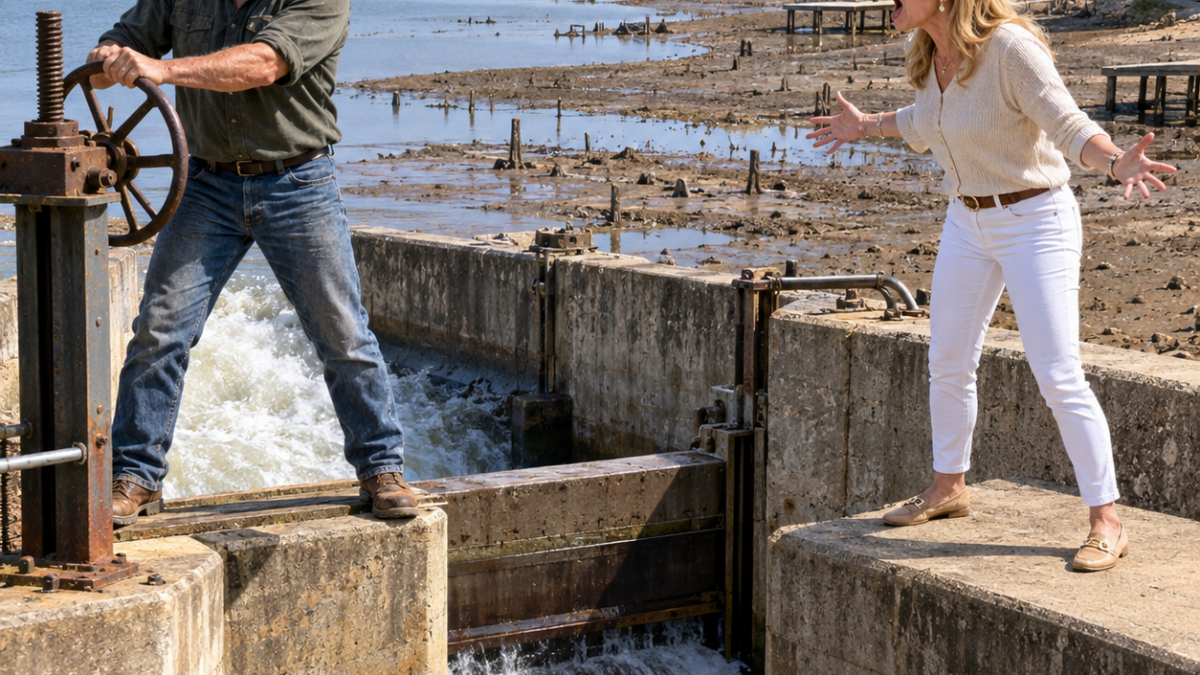
I came home after eight months away and found 109 luxury vacation cabins glittering along a shoreline I had never sold, leased, or shared.
The man behind them looked me in the eye, laughed at my deed, and promised his HOA could bury me in court for years.
What he did not know was that the one thing his entire twelve-million-dollar resort depended on had belonged to my family since 1962.
My name is James Whitmore, and on July 18, 2024, I drove back into the Colorado mountains expecting silence.
For eight months, I had been in Portland helping my daughter Emma after the birth of her first child. Her husband had been deployed overseas, and she had needed someone who could make bottles at two in the morning, hold a crying baby while she slept, and remind her that exhaustion did not mean she was failing.
When her husband came home, I packed my truck and headed back to Lake Whitmore.
That lake was the closest thing my family had to an heirloom. My grandfather bought the valley in 1958 and built a sixty-foot concrete dam four years later. Three mountain creeks filled the basin behind it, creating eight hundred acres of cold, clear water. My father inherited it, then I did.
I had spent sixteen years paying the taxes, maintaining the dam, stocking fish, clearing deadfall, and protecting the shoreline from exactly the kind of development my grandfather never wanted.
So when I stepped onto my deck that afternoon and raised my binoculars toward the eastern shore, my brain refused to understand what my eyes were showing me.
Cabins.
Rows of them.
Cedar siding. Black metal roofs. Huge windows facing the water. Wraparound decks. A paved lot. A welcome center. Floating docks. Families carrying coolers toward the beach.
I drove around the perimeter road and counted every building.
One hundred and nine.
A polished sign near the entrance read: MOUNTAIN VISTA LAKEFRONT RENTALS — LUXURY CABIN GETAWAYS — $400 TO $600 PER NIGHT.
A young woman behind the welcome desk smiled when I walked in.
“Checking in?”
“No,” I said. “I’m James Whitmore.”
She waited.
“I own this lake.”
Her smile disappeared.
Within ten minutes, I had the name I needed: Garrett Peton, president of the Mountain Vista Estates HOA.
I called my attorney, David Chen, and told him to bring the deed, the latest survey, and every county record tied to my eastern boundary.
Two hours later, the documents were spread across my kitchen table.
There was no gray area.
My property extended two hundred feet beyond the eastern shoreline.
Every cabin sat inside it.
Some crossed the line by twenty feet. Others by eighty. The welcome center, docks, utility trenches, roads—none of it belonged to the HOA.
David stared at the survey.
“James, this is trespass on a commercial scale.”
I felt something colder than anger settle into me.
“Let’s hear him say it.”
We drove to the HOA clubhouse that evening.
Garrett Peton looked exactly like a man who had never heard the word no and believed that was evidence of intelligence. Early fifties. Expensive suit. Perfect office. Framed development awards on the wall.
He shook my hand and smiled.
I placed the survey on his desk.
“You built 109 cabins on my land.”
He barely looked at it.
“Mr. Whitmore, the lake is a public recreational resource, and that shoreline was treated as county land when we developed it.”
“It is deeded to me.”
“We have permits.”
“You do not have my permission.”
His smile thinned.
“We invested twelve million dollars. We have owners, contracts, bookings, and legal counsel. We are not tearing down a successful resort because one man walked in with an old survey.”
David leaned forward.
“It is not an old survey. It is the recorded boundary.”
Garrett leaned back and folded his hands.
“Then litigate.”
I stared at him.
He smiled again.
“We have 240 homeowners paying dues, Mr. Whitmore. We can fight for years.”
That was the moment I understood his plan.
He did not need to prove he owned my land.
He only needed to make defending it so expensive and exhausting that I finally surrendered.
I rolled up the survey, stood, and looked at David.
“Let’s go.”
Outside, he caught my arm.
“We can file tomorrow.”
“I know.”
“You’ll win.”
“I know.”
“Then what are you thinking?”
Across the trees, I could see a strip of blue water shining in the evening light.
I had spent thirty-five years as a civil engineer.
I knew exactly why that water was there.
And for the first time since I came home, I knew exactly what I was going to do next.
PART 2
That night, I sat alone on my deck long after the mountains had swallowed the last daylight.
The eastern shore glowed with little squares of warm light.
One hundred and nine cabins.
From where I sat, they almost looked beautiful.
That made me angrier.
Not because the buildings themselves were ugly. They weren’t. Whoever designed them knew exactly what wealthy vacationers wanted—cedar, glass, decks, fireplaces, polished stone, views.
What bothered me was how comfortable everybody seemed.
Music drifted across the water.
Someone laughed.
A boat crossed the lake with navigation lights blinking red and green.
People were grilling dinner on land my grandfather had walked before there was a lake.
And none of them knew.
I didn’t blame the vacationers.
Most had probably booked online after seeing photographs of mountains reflected in clear water.
I didn’t even blame the young woman at the welcome center.
She looked like an employee doing a job.
But Garrett Peton knew enough to know better.
A twelve-million-dollar development did not appear by accident.
Someone had approved surveys.
Someone had arranged construction financing.
Someone had sold cabins to investors.
Someone had marketed my shoreline as if it belonged to the HOA.
And when I had walked into Garrett’s office with a recorded survey, he hadn’t looked surprised.
That bothered me more than anything.
He had looked annoyed.
Like the real problem wasn’t that his organization had built on my property.
The problem was that I had come home.
At 10:17 that night, my phone rang.
It was Emma.
“You make it home okay?”
“Yeah.”
“How’s the lake?”
I looked across the water.
“Complicated.”
She laughed softly.
“Dad, it’s a lake. How complicated can it be?”
I didn’t answer.
“Dad?”
“Someone built cabins.”
“On the lake?”
“On my land.”
Silence.
“How many?”
“One hundred and nine.”
Another silence, much longer this time.
“One hundred and nine cabins?”
“Plus a welcome center, docks, roads and utilities.”
“What?”
“Apparently I’m in the hospitality business now. Nobody bothered to tell me.”
She didn’t laugh.
“Are you okay?”
That question caught me off guard.
People had asked me if I was angry.
David had asked what I wanted to do.
Nobody had asked if I was okay.
I looked at the black outline of the mountains.
“I don’t know yet.”
“Call the police.”
“This isn’t that simple.”
“Then sue them.”
“That part is simple.”
“So do it.”
I rubbed my forehead.
“Garrett wants that.”
“Who’s Garrett?”
“The HOA president.”
I explained the meeting.
When I told her he’d said his association could fight for years, Emma went quiet.
Finally she said, “He thinks you’ll get tired.”
“Yes.”
“Will you?”
“No.”
That answer came immediately.
She knew me well enough to hear what was underneath it.
“Dad, don’t do something crazy.”
I almost smiled.
“Define crazy.”
“Anything that starts with you saying you’ve been an engineer for thirty-five years.”
I laughed for the first time that day.
Then she said something quieter.
“Grandpa loved that place.”
“I know.”
“So did Mom.”
My smile disappeared.
Emma’s mother, Linda, had been gone eleven years.
Cancer.
Forty-eight years old.
Too young.
The lake had carried almost every important memory of our marriage.
Emma learning to swim near the north dock.
Linda reading on the porch.
Christmas mornings with snow stacked against the windows.
My father teaching Emma to fish.
My grandfather’s old toolbox still sitting in the dam control house.
This wasn’t merely acreage on a deed.
But Garrett had made one mistake that people like him often make.
He had mistaken sentimental attachment for weakness.
“I’m going to handle it,” I said.
“Legally?”
“Yes.”
“Dad.”
“Legally, Emma.”
“Okay.”
After we hung up, I walked inside and pulled an old three-ring binder from the bottom drawer of my desk.
WHITMORE DAM.
Inspection reports.
Gate maintenance logs.
Structural assessments.
Flow calculations.
Photographs going back decades.
My grandfather had built the dam in 1962 because the basin was ideal for water storage. Three streams entered the valley from the north and west, converged near the southern end, then continued downstream through a narrow canyon.
Before the dam, there had been no lake.
Just marsh, creek channels, meadow and seasonal flooding.
The sixty-foot structure changed everything.
When the gates remained closed, water accumulated.
When they opened, the reservoir released.
Simple physics.
The lake was not permanent geography.
It was a management decision.
I pulled out the latest engineering inspection.
The concrete was sound.
The spillways were clear.
The gates had been rebuilt eight years earlier.
The dam was capable of a full controlled drawdown for inspection.
I already knew that.
But I wanted another engineer to tell me.
At 7:30 the next morning, I called Martin Cross.
Martin and I had worked together for twenty years before I retired. He had inspected Whitmore Dam with me in 2019.
He answered on the fourth ring.
“James Whitmore. Haven’t heard from you in forever.”
“Morning, Martin.”
“How’s retirement?”
“Someone built a resort on my property.”
He laughed.
Then stopped.
“You’re serious.”
“One hundred and nine cabins.”
“What the hell?”
“Long story.”
“You calling because you want an engineer or because you want someone to help hide a body?”
“Engineer.”
“Less interesting, but go ahead.”
I described the cabins, Garrett, the survey and the eastern shoreline.
Then I asked the question I’d been carrying since leaving the HOA office.
“If the gates were opened for a maintenance drawdown, how long until the eastern shoreline lost functional lake access?”
Martin didn’t answer immediately.
I heard keyboard clicks.
“How low?”
“Comprehensive inspection level.”
“Full drawdown?”
“Yes.”
More clicking.
“Normal August inflow?”
“Assume it.”
“Four to six weeks to lose most storage. Probably significant shoreline recession inside ten days.”
“And downstream?”
“Within the dam’s designed discharge capacity, assuming nothing unusual.”
“Structural concerns?”
“Not if you follow the drawdown protocol.”
“What about keeping it low?”
“For inspection?”
“And possible sediment work.”
“Months, if necessary.”
I leaned back.
“That’s what I thought.”
Martin became quiet.
“James.”
“Yeah?”
“Tell me you’re not draining eight hundred acres of water because some HOA president pissed you off.”
“No.”
“Good.”
“I’m considering draining eight hundred acres because someone built 109 commercial structures on my property and refuses to remove them.”
“That is not the reassuring distinction you think it is.”
I smiled.
Then he sighed.
“You own the dam?”
“Yes.”
“Water rights unchanged?”
“Yes.”
“Downstream minimum flows maintained?”
“Yes.”
“Private reservoir?”
“Yes.”
“Then technically the system was designed to allow exactly that kind of drawdown. But document everything. And don’t make this emotional in writing.”
“It isn’t emotional.”
“James, I’ve known you twenty-six years.”
“Then you know I’m good at paperwork.”
That made him laugh.
“Unfortunately, yes.”
After the call, I drove to the dam.
The control house sat at the center of the concrete structure, weathered gray against dark water.
My grandfather had brought me there for the first time when I was nine.
I could still remember his hand on my shoulder.
Never fight water, Jimmy.
Work with it.
Water always finds where it needs to go.
At nine, I thought he was teaching me about dams.
It took me most of my life to understand he had been teaching me about patience.
Inside the control house, everything smelled the same as it had when I was a boy—grease, concrete, cold metal.
The main gate wheel stood in the middle of the room.
I rested my hand on it.
Then I didn’t turn it.
Not yet.
Revenge feels simple when it’s only an idea.
Actions have consequences.
I knew cabins would lose value.
Bookings would collapse.
Investors could lose money.
Employees might lose jobs.
And there were ecological consequences to lowering a reservoir too quickly if the process wasn’t managed properly.
So I spent the next twelve days making sure Garrett could never truthfully say I had acted recklessly.
David sent a formal cease-and-desist letter demanding that the HOA stop commercial operations and begin removal negotiations.
Garrett’s attorney responded three days later.
The response was twelve pages of expensive language explaining why Garrett intended to do nothing.
They disputed my boundary.
They claimed public access rights.
They mentioned adverse possession despite being nowhere near the required period.
They reserved the right to seek damages if I interfered with the resort.
That last paragraph made David swear.
He called me immediately.
“They’re threatening you now.”
“I read it.”
“They’re basically saying if you interfere with their illegal operation on your land, they’ll sue you.”
“Sounds familiar.”
“James, I want to file.”
“You will.”
“When?”
“When I’m ready.”
There was a pause.
“What have you done?”
“Nothing illegal.”
“That wasn’t my question.”
I told him.
Silence.
Then he said, “You’re serious.”
“Yes.”
“You’re going to drain the lake.”
“For inspection and maintenance.”
“James.”
“That’s the documented purpose.”
“And the fact that it destroys the economic value of the cabins?”
“An unfortunate consequence of their decision to build a lake-dependent business beside a privately controlled reservoir.”
David made a sound halfway between a laugh and a groan.
“I went to law school for three years, and somehow my career has led me to representing a man who plans to remove a lake.”
“I prefer ‘adjust reservoir elevation.’”
“That phrase will look excellent in court.”
“I thought you’d appreciate it.”
He became serious.
“Can you do it safely?”
“Yes.”
“Legally?”
“Yes.”
“County notification?”
“Already preparing it.”
“Environmental concerns?”
“Addressed.”
“Then if you’re asking whether the law requires you to keep your reservoir full so trespassers can advertise waterfront cabins…”
He paused.
“It doesn’t.”
“That’s what I needed.”
“Garrett is going to lose his mind.”
“He had an opportunity to talk.”
“And if he offers to negotiate tomorrow?”
“I’ll listen.”
“Good.”
I almost meant it.
On July 31, I sent Garrett one final written proposal.
Remove the cabins from my property.
Suspend new bookings.
Enter mediation over site restoration and compensation for unauthorized commercial use.
I gave him forty-eight hours to respond.
He responded in forty minutes.
His email contained six sentences.
The fifth said:
Mountain Vista Estates will not be intimidated by baseless threats concerning property the HOA has lawfully developed and operated.
The sixth said:
Any attempt to interfere with lake access or resort operations will result in immediate legal action.
I printed it.
Then I put it in the binder.
At 5:40 the next morning, August 1, I walked down to the dam.
The sky was beginning to turn gray behind the mountains.
There was frostlike dew on the grass despite the summer heat that would come later.
I unlocked the control house.
Before touching anything, I photographed the instruments.
I documented reservoir elevation.
Upstream level.
Downstream flow.
Gate positions.
Weather.
Time.
Then I called the county water management office.
I told them I was beginning a scheduled private dam maintenance drawdown and expected the reservoir to remain substantially lowered for an extended structural inspection.
The clerk took the information.
No alarm.
No emergency.
No argument.
This dam had been operated privately for more than sixty years.
I hung up.
For a moment, I stood in silence.
Then I placed both hands on the steel wheel.
And turned.
The gears resisted at first.
Then moved.
One rotation.
Another.
Another.
The gate indicators began to change.
Far beneath me, water started flowing through the lower outlet.
Nothing exploded.
There was no giant wall of water.
No Hollywood moment.
Just controlled flow.
Steady.
Relentless.
I opened the gates to the approved drawdown position, locked the mechanism and photographed everything again.
Then I walked outside.
The lake still looked exactly the same.
That was almost funny.
Garrett had no idea.
At 6:22 a.m., his resort was still worth millions of dollars.
Families were probably asleep in those expensive beds.
Coffee machines would soon start.
Children would run toward docks.
Boats would be uncovered.
And beneath all of it, almost too slowly to see, the water was leaving.
I went home.
Made eggs.
Drank coffee.
And waited.
For three days, nothing happened.
At least nothing anybody noticed.
I could see the difference because I knew the reference marks.
Six inches.
Then another six.
By the fourth day, floating docks were beginning to sit strangely against their anchor systems.
By the fifth, a band of wet rock had appeared along the shore.
On day six, I drove around the lake.
People were noticing.
A man stood at the end of a dock staring down at the water.
A woman was taking pictures of the expanding beach.
Two maintenance workers were trying to adjust dock ramps.
I parked near the welcome center.
The same young woman from my first visit recognized me.
She came outside.
“Mr. Whitmore?”
“Morning.”
“Do you know what’s happening to the lake?”
“Yes.”
Her expression tightened.
“What?”
“Dam maintenance.”
“The water has dropped almost three feet.”
“That sounds about right.”
She stared at me.
“How long is this going to continue?”
“Several months at least.”
Her face drained of color.
“We’re fully booked.”
I looked at the rows of cabins.
“That sounds like something you should discuss with Mr. Peton.”
She folded her arms.
“He told us the lake level was controlled by the county.”
“No.”
“He said it was a public reservoir.”
“No.”
“He said you were just a nearby landowner causing trouble.”
I looked at her.
“What did he tell you about who owns the ground under this building?”
She didn’t answer.
That told me enough.
I got back into my truck.
My phone rang before I reached home.
Garrett.
I let it ring twice.
Then answered.
“James.”
“What the hell are you doing?”
“Good morning, Garrett.”
“The lake is dropping.”
“I noticed.”
“Is the dam damaged?”
“No.”
“Then why is the water disappearing?”
“Maintenance drawdown.”
Silence.
Then his voice changed.
“You opened the gates.”
“Yes.”
“You’re draining the lake.”
“Yes.”
“Close them.”
“No.”
His breathing became audible through the phone.
“We have guests.”
“I know.”
“We have boats.”
“I know.”
“We have bookings through October.”
“That sounds inconvenient.”
“You cannot do this.”
“It’s my dam.”
“This is retaliation.”
“It’s maintenance.”
“Don’t play games with me.”
“I’m not.”
He lowered his voice.
“You think this is funny?”
“No.”
“You are deliberately sabotaging a business worth millions of dollars.”
“Your business is sitting on my land.”
“We dispute that.”
“You can dispute gravity too. It won’t change anything.”
He swore.
Then said, “My attorneys will get an emergency injunction.”
“Tell them David Chen represents me.”
“You’re going to regret this.”
“Garrett?”
“What?”
“I asked you to remove the cabins.”
“You’re insane.”
“And you said we could fight for years.”
I looked through the window at the lake.
“I’m prepared to.”
I hung up.
By day ten, Mountain Vista stopped accepting new reservations.
By day fourteen, the lake had fallen roughly eight feet.
The photographs were astonishing.
Docks that had floated beside deep water now rested on mud.
Boat ramps ended thirty yards from the shoreline.
Rocks nobody had seen in decades appeared in the sun.
Vacationers began posting photographs online.
David called me one afternoon laughing.
“You’re famous.”
“I don’t want to be famous.”
“Too late. Somebody posted a video titled ‘Our Lake Disappeared During Our Vacation.’”
“Wonderful.”
“The comments are worse.”
“I don’t care.”
“You should care a little. Garrett’s already shaping the narrative.”
That evening, I saw it.
Garrett had issued a statement accusing me of “deliberate environmental and economic sabotage.”
According to him, Mountain Vista Estates was a responsible community blindsided by an “unreasonable neighboring property owner.”
Not one sentence mentioned that the cabins were on my deeded land.
Not one sentence mentioned my cease-and-desist.
Not one sentence mentioned his refusal to conduct a title review.
I forwarded the statement to David.
He replied with two words.
Good evidence.
Three days later, Garrett came to my house.
I heard the Range Rover before I saw it.
He drove too fast up the gravel road and stopped hard enough to throw dust across my porch.
I was sitting outside with coffee.
He got out and marched toward me.
His expensive suit was gone.
Jeans.
White shirt with the sleeves rolled.
His face looked different.
For the first time, he didn’t look polished.
He looked frightened.
“What did you do?”
I looked over my mug.
“I thought we covered this.”
“We have lost four hundred thousand dollars in cancellations.”
“Then you should stop advertising lakefront access.”
“Our owners are panicking.”
“Then explain the title problem.”
“There is no title problem.”
I set my coffee down.
“Garrett, we’re past that.”
“No, we’re not.”
He stepped closer.
“You close those gates today.”
“No.”
“I will have a court order by the end of the week.”
“Then bring it.”
“You think you’re protected because you own the dam?”
“I know I’m protected because I own the dam.”
His jaw worked.
“This is economic warfare.”
“No.”
I stood.
“This is what happens when your entire business model depends on something you don’t own.”
“We invested twelve million dollars.”
“You keep saying that as though spending more money makes trespassing more legal.”
“You’re destroying innocent people.”
That sentence landed harder than he expected.
Because he was right about one thing.
There were innocent people involved.
Not him.
But others.
I had seen families on those decks.
I had seen staff at the welcome center.
I knew cabin investors existed.
I kept my voice level.
“Then give them their money back.”
His eyes narrowed.
“What?”
“If they’re innocent, refund them.”
“You don’t understand how this works.”
“I understand perfectly. You sold people investments tied to property you didn’t own.”
“We own the structures.”
“You don’t own the ground.”
“We had approvals.”
“Not from me.”
He stared at me.
Then the anger returned.
“You won’t get away with this.”
“I don’t need to get away with anything.”
“You will close the gates.”
“No.”
“How long?”
“Until the inspection is complete.”
“And how long is that?”
“Twelve to eighteen months is possible.”
His face went pale.
“You cannot keep this lake empty for eighteen months.”
“I can keep my reservoir at whatever safe operating level maintenance requires.”
“What do you want?”
There it was.
The first useful question he’d asked.
“Remove every structure from my land.”
“No.”
“Then we’re done.”
“James, that’s twenty million dollars in investor property.”
“Not my problem.”
“Those cabins cannot just be moved.”
“Then demolish them.”
His expression hardened.
“You want to destroy everything.”
“I want my land back.”
He pointed toward the shrinking lake.
“You’ll regret this.”
Maybe I would.
But I didn’t blink.
“You know the road out.”
He left.
By the end of August, Lake Whitmore barely resembled the place I had inherited.
The water had retreated hundreds of feet in some areas.
Three old creek channels reappeared like veins across the basin.
The eastern shore became a broad expanse of cracked mud, stone and pale sediment.
The 109 cabins looked absurd.
Beautiful buildings overlooking nothing.
One afternoon I launched my drone.
From four hundred feet, the truth was impossible to hide.
Cabin.
Cabin.
Cabin.
Deck.
Deck.
Deck.
Dock.
Mud.
The footage spread online.
Then television stations picked it up.
LOCAL LANDOWNER DRAINS PRIVATE RESERVOIR AMID HOA PROPERTY DISPUTE.
Some people called me a hero.
Some called me vindictive.
One radio host called me “the Colorado lake guy.”
I hated all of it.
Emma called.
“You’re on television in Portland.”
“I know.”
“My coworkers think you’re either a genius or a psychopath.”
“Good range.”
“Dad.”
“I’m okay.”
“Are you?”
I looked over the exposed valley.
“No.”
That surprised both of us.
I continued.
“I don’t like seeing it empty.”
“Then refill it.”
“I can’t.”
“You can.”
“Not while those buildings are there.”
“Why?”
“Because if I back down now, Garrett learns that all he has to do is create enough innocent victims around his bad decision and I’ll surrender.”
Emma was quiet.
Then she said, “That sounds like Grandpa.”
“What does?”
“The part where you turn stubbornness into a moral philosophy.”
I laughed.
She didn’t.
“Just don’t become Garrett while you’re trying to beat Garrett.”
That stayed with me.
A few weeks later, twenty cabin owners arrived at my house.
I knew they were coming because David had warned me.
A caravan of SUVs and pickups came up the road on September 15.
I walked outside before anyone could knock.
A man in his forties approached first.
“James Whitmore?”
“Yes.”
“My name is Eric Daniels. Cabin fifty-two.”
I nodded.
Behind him stood men and women ranging from maybe thirty to seventy.
Some looked angry.
Some looked frightened.
One woman was already crying.
Eric pointed toward the empty basin.
“You destroyed our investments.”
“No. Your HOA sold you cabins on my property.”
“You drained the lake.”
“Yes.”
“You did it knowing what would happen.”
“Yes.”
His face flushed.
“My wife and I put two hundred and ten thousand dollars into that cabin.”
I waited.
“We borrowed against our house.”
“I’m sorry.”
“Sorry?”
His voice cracked.
“You’re sorry?”
“I am.”
“Then put the water back.”
“No.”
A woman stepped forward.
She was in her late fifties, silver streaks through dark hair.
“My name is Patricia Moreno.”
I recognized the name from a letter David had received from a cabin-owner group.
“My husband died three years ago,” she said. “That cabin was my retirement plan.”
The anger in the group softened around her.
“I put one hundred ninety-five thousand dollars into it.”
She wiped her eyes.
“They told me it was safe. They said lakefront property only goes up. They showed me revenue projections. They said I’d have enough income to stay in my house.”
I didn’t know what to say.
The lake seemed very large between us even without water.
Finally I said, “Did Garrett show you a deed for the land?”
She shook her head.
“I have ownership documents for the cabin.”
“For the structure.”
“Yes.”
“Not the ground beneath it.”
“No.”
“Did anyone tell you the shoreline belonged to me?”
“No.”
“Then Garrett lied to you.”
Eric stepped forward again.
“That doesn’t change what you did.”
“No.”
I looked at every face.
“It doesn’t.”
That surprised them.
I continued.
“I opened the dam gates knowing your cabins would lose their lake access. I’m not pretending otherwise. But ask yourselves why I had that power in the first place.”
No one answered.
“Because the lake is mine. The dam is mine. And the land under your cabins is mine.”
I pointed toward the eastern shore.
“I didn’t enter your property. Garrett entered mine.”
Patricia’s voice trembled.
“We didn’t know.”
“I believe you.”
“Then why punish us?”
That question hurt more than Garrett’s threats.
“I’m not trying to punish you.”
“It feels exactly like punishment.”
“I know.”
I paused.
“But if somebody sells you my truck without telling me, and I take my truck back, I understand that you’ve lost money. I understand that you were deceived. But I don’t have to give up my truck to make the fraud easier for you.”
Eric shook his head.
“A cabin isn’t a truck.”
“No. It’s much more expensive. Which is why someone should have verified the land before selling it.”
Patricia looked toward the dry shoreline.
“If the HOA removes them, will you refill the lake?”
“Yes.”
“Immediately?”
“When my property is restored and the dam inspection is finished.”
Garrett had told them I intended to keep the lake dry forever.
I could see it on their faces.
Eric frowned.
“He said you’d never refill it.”
“Garrett says many things.”
Patricia turned toward the others.
That was the first crack.
Not in the dam.
In Garrett’s story.
Before leaving, Patricia stopped beside me.
“I don’t like what you’re doing.”
“I understand.”
“But if he lied…”
She looked toward the road.
“I want to know.”
“You should.”
The next morning, David called.
“Congratulations.”
“For what?”
“You just created Garrett’s worst nightmare.”
“I had twenty angry people at my house. It didn’t feel like a victory.”
“Patricia Moreno hired independent counsel last night. Five others joined her.”
I leaned against the kitchen counter.
“So?”
“So they’re requesting title records, construction records, board minutes, investor disclosures and every document Garrett used to claim the resort property belonged to the HOA.”
I understood.
“They’re turning on him.”
“They’re verifying him.”
“Same difference.”
“No, James. Important difference.”
David’s tone sharpened.
“Remember Emma’s warning. Don’t turn everyone into an enemy.”
He was right.
Three days later, Patricia sent me an email.
Two sentences.
Mr. Whitmore, our attorney confirmed your deed appears valid. Garrett never disclosed any competing ownership claim to us.
Then:
I still wish you had chosen another way, but I now understand why you refused to surrender your land.
I read it twice.
The injunction hearing was September 20.
By then Lake Whitmore had been drawn down almost completely.
Only shallow pools and the three original creek channels remained.
Walking into Douglas County District Court, I had the strange sensation of entering somebody else’s story.
Reporters crowded the hallway.
Cameras waited outside.
Garrett arrived with three lawyers.
I arrived with David.
Garrett wouldn’t look at me.
Judge Margaret Carlson took the bench shortly after nine.
Garrett’s lead attorney, Marcus Westfield, was exactly what twelve million dollars buys when twelve million dollars is in trouble.
Calm.
Articulate.
Immaculate suit.
He framed the dispute carefully.
He didn’t spend much time on ownership.
Instead, he talked about harm.
Hundreds of cancelled reservations.
Employees without work.
Cabin investors facing catastrophic losses.
A tourism business destroyed.
An ecosystem allegedly threatened.
Then he showed an aerial photograph of the empty reservoir.
“Your Honor, the defendant has taken a functioning eight-hundred-acre lake and intentionally reduced it to mud in order to gain leverage in a private property dispute.”
Judge Carlson looked at him.
“Does your client own the dam?”
“No, Your Honor.”
“Does your client own the reservoir basin?”
“We dispute the precise boundary.”
“Does your client hold any deeded right requiring Mr. Whitmore to maintain a specific reservoir elevation?”
Westfield hesitated.
“Not a deeded right in those terms.”
“Then what exactly are you asking me to order?”
“That the defendant restore normal water levels while the underlying property matter is litigated.”
Judge Carlson glanced toward David.
“Mr. Chen?”
David stood.
“My client owns the dam.”
He held up a document.
“He owns the reservoir property.”
Another document.
“He owns the eastern shoreline on which every one of the plaintiff’s 109 cabins is constructed.”
Another.
“He demanded removal.”
Another.
“The plaintiff refused and threatened years of litigation.”
He set the papers down.
“Now the plaintiff wants this court to order my client to operate his private property in a manner that preserves the profitability of structures that are themselves trespassing.”
Westfield rose.
“The cabins were constructed in good faith.”
David looked at him.
“Good faith doesn’t move a boundary line.”
“Your Honor—”
Judge Carlson raised a hand.
She reviewed the exhibits for several minutes.
The courtroom became completely silent.
Then she spoke.
“I am not ruling today on every issue that may ultimately be litigated.”
My chest tightened.
“However, for purposes of emergency injunctive relief, the plaintiff has not demonstrated a right requiring Mr. Whitmore to maintain Lake Whitmore at a specific elevation.”
Garrett stared straight ahead.
Judge Carlson continued.
“The evidence presently before this court indicates that Mr. Whitmore owns the dam and possesses substantial documented ownership claims over the land on which the cabins were constructed.”
Westfield stood.
“Your Honor—”
“Sit down, counsel.”
He sat.
“The economic consequences may be severe. But economic dependence upon another person’s property does not automatically create a legal entitlement to continued use of that property.”
She looked directly at Garrett’s table.
“The motion for preliminary injunction is denied.”
The gavel came down.
I didn’t smile.
Garrett turned toward me.
His face told me everything.
He had believed the court would rescue him from the consequences of his own leverage game.
It hadn’t.
Outside, reporters shouted questions.
“Mr. Whitmore, are you going to refill the lake?”
“Mr. Whitmore, do you feel responsible for the investors?”
“Mr. Whitmore, was draining the lake revenge?”
I kept walking.
Garrett wasn’t so disciplined.
He stopped.
“This isn’t over!”
Every microphone turned toward him.
“We will prove that Mr. Whitmore deliberately destroyed millions of dollars in private investment.”
I stopped.
David whispered, “Don’t.”
I almost listened.
Then I turned.
Not toward the reporters.
Toward Garrett.
“You can prove something much easier.”
He stared at me.
“Prove you own the ground under your cabins.”
Silence.
Then I walked away.
That sentence made every evening news broadcast.
Our counterclaim was filed the next morning.
Trespass.
Unauthorized commercial use.
Restoration costs.
Damages.
Demand for removal of every structure.
Two and a half million dollars.
And then Garrett’s problems multiplied.
Patricia’s attorney obtained sales documents for the cabins.
The investor materials repeatedly used phrases like “secure lakefront ownership,” “permanent lake access” and “HOA-controlled recreational shoreline.”
But there was no deed conveying the land.
No easement from me.
No agreement with my family.
No title insurance covering ownership of the underlying property.
Nothing.
Seventy-three cabin owners joined a class action.
Garrett called me in early October.
His voice had changed.
No shouting.
No threats.
“James, we should talk.”
“I tried that in July.”
“I mean seriously.”
“So did I.”
“Can we meet?”
“With attorneys?”
“No.”
“Then no.”
He exhaled.
“I’m trying to solve this.”
“You had a solution.”
“Demolishing 109 cabins is not a solution.”
“It is if they’re on my land.”
“What if we lease the land?”
That was new.
“How much?”
“We’d need to negotiate.”
“Of course.”
“Long-term ground lease. Thirty years. Revenue share. You become a partner.”
“No.”
“You haven’t heard the numbers.”
“I don’t need to.”
“Why?”
I looked at the mountains beyond my window.
“Because I don’t want a resort.”
“Everyone has a number.”
“My grandfather didn’t build this lake to maximize revenue.”
“Your grandfather is dead.”
The words came out before Garrett could stop them.
The silence afterward felt physical.
When he spoke again, his voice was smaller.
“That came out wrong.”
“Yes.”
“James—”
“I’ll see you in court.”
I ended the call.
The main trial began November 18, 2024.
Four days.
Eight witnesses for Garrett.
Engineers.
Investors.
Financial experts.
Garrett himself.
When he took the stand, he told the court that Mountain Vista had acted in good faith.
“We believed the shoreline was available for development.”
David rose for cross-examination.
“Mr. Peton, did you conduct a formal title search before spending twelve million dollars?”
Garrett shifted.
“We reviewed county information.”
“Yes or no?”
“No.”
“Did you commission a boundary survey?”
“We used county GIS data.”
“Yes or no?”
“No.”
“Did you contact the man whose surname appears on the lake, dam and property records?”
“No.”
A few people in the gallery shifted.
David displayed my recorded survey.
“This document was publicly available before construction.”
Garrett looked at it.
“Apparently.”
“Apparently?”
“Yes.”
“It shows Mr. Whitmore’s property extending beyond the eastern shore.”
“Yes.”
“Across the exact land where your cabins stand.”
Garrett’s attorney objected.
Judge Carlson overruled.
David continued.
“You sold individual cabin investments for as much as two hundred twenty thousand dollars?”
“Yes.”
“You promised lakefront rental revenue?”
“We provided projections.”
“You told investors the shoreline was under HOA control?”
“We believed it was.”
“But you never obtained title to it.”
“No.”
“Never obtained an easement.”
“No.”
“Never obtained Mr. Whitmore’s permission.”
“No.”
“Never paid him.”
“No.”
“And when he presented you with the recorded survey, you refused to stop operating.”
Garrett looked toward me.
“Yes.”
“Why?”
His answer was quiet.
“Because we had too much invested.”
David nodded.
“Nothing further.”
That sentence destroyed him more effectively than anything I could have said.
Because we had too much invested.
Garrett had finally admitted the truth.
He hadn’t refused because he believed the land was his.
He refused because admitting the mistake was too expensive.
The next witness was a water-rights consultant.
Marcus Westfield tried to establish that the public had developed expectations around Lake Whitmore as a recreational resource.
David asked one question that mattered.
“Does James Whitmore own the dam?”
“Yes.”
“Is there an agreement requiring him to maintain the reservoir at a particular recreational elevation for Mountain Vista?”
“No.”
“Can private dams be drawn down for maintenance?”
“Yes.”
“Thank you.”
Then Patricia Moreno testified.
I hated that day.
She sat less than thirty feet from me and described her husband’s death.
The insurance money.
The retirement account.
The fear of growing old without enough income.
How a Mountain Vista sales representative had shown her photographs of the lake at sunset and spreadsheets projecting eighteen percent annual returns.
“I thought I was buying security,” she said.
Her voice broke.
“I wasn’t trying to get rich.”
Nobody moved.
“I wanted something that would pay the property taxes on my home after I retired.”
Westfield asked what losing the cabin had done to her.
“Everything I saved is tied up in something I can’t use and can’t sell.”
She cried quietly.
For the first time since opening the dam gates, I wondered whether I could live with winning.
Then David cross-examined her.
Gently.
“Ms. Moreno, did Mr. Whitmore sell you the cabin?”
“No.”
“Did he make any promises about rental revenue?”
“No.”
“Did he tell you the shoreline belonged to Mountain Vista?”
“No.”
“Who did?”
“The HOA.”
“Did Mr. Whitmore receive any of your purchase money?”
“No.”
“Did anyone tell you before purchase that the cabin was located on his recorded property?”
“No.”
David paused.
“Had you known that, would you have invested?”
Patricia looked at Garrett.
“No.”
David sat down.
No victory.
No satisfaction.
Just truth.
That night I called Emma.
“I met one of the investors again.”
“Patricia?”
“You’ve been reading the news.”
“Of course I have.”
“She testified.”
“How was it?”
“Awful.”
“Do you regret draining the lake?”
I looked out the window.
“I regret that she got hurt.”
“That wasn’t what I asked.”
“I know.”
A long silence passed.
Then I said, “If I refill it because I feel guilty about Patricia, Garrett keeps the cabins.”
“Probably.”
“And then what?”
“You tell me.”
“He gets rewarded for creating victims.”
“Yes.”
“And the next person does the same.”
“Maybe.”
“I can’t do that.”
“Then don’t.”
I rubbed my eyes.
“But don’t tell yourself nobody innocent got hurt.”
“I won’t.”
That distinction mattered.
I could defend what I had done without pretending it was painless.
On the third day of trial, I took the stand.
Marcus Westfield approached me slowly.
“Mr. Whitmore, you inherited Lake Whitmore in 2008?”
“Yes.”
“And before August 2024, had you ever fully drained it?”
“No.”
“So the first complete drawdown in more than sixteen years occurred immediately after your dispute with Mountain Vista.”
“Yes.”
“You want this court to believe that’s coincidence?”
“No.”
He paused.
That wasn’t the answer he’d expected.
“No?”
“No.”
“Then you admit this was retaliation.”
“I said the cabins affected my decision.”
“You drained the lake because of the cabins.”
“I accelerated a full maintenance drawdown because I discovered 109 unauthorized commercial structures on my property.”
Westfield smiled.
“Very carefully phrased.”
“Very accurate.”
“You knew draining the reservoir would destroy Mountain Vista’s rental business.”
“I knew their lake access would disappear.”
“You wanted that.”
“I wanted the trespass to stop.”
“You could have sued.”
“I did.”
“You could have negotiated.”
“I tried.”
“You could have accepted compensation.”
“I didn’t want a resort.”
“So instead you chose what some might call the nuclear option.”
David objected.
Judge Carlson sustained.
Westfield continued.
“You understood investors could lose millions.”
“I understood Garrett sold investments that depended on land and water he did not own.”
“That’s not what I asked.”
“Yes. I understood.”
“You knew employees could lose jobs.”
“Yes.”
“You knew families had bookings.”
“Yes.”
“And you opened the gates anyway.”
“Yes.”
He turned toward the jury box out of habit even though the matter was being tried to the judge, then corrected himself.
“Why?”
The courtroom went completely still.
“Because ownership has to mean something.”
Westfield frowned.
I continued.
“My family paid for that land. My grandfather built the dam. My father maintained it. I maintained it. I paid the taxes. I accepted the liability. I paid for repairs. I protected the watershed.”
I pointed toward Garrett.
“He paid me nothing.”
Westfield started to interrupt.
I kept going until the judge raised her hand.
“He built 109 cabins on land he never bought. He sold them. He rented them. He kept the revenue. When I came home and showed him the survey, he didn’t apologize. He didn’t stop. He told me he had enough money to keep me in court for years.”
I looked at Garrett.
“So yes. I opened my dam.”
Westfield’s voice sharpened.
“Out of spite.”
“No.”
“Revenge?”
“No.”
“What would you call it?”
I thought of my grandfather.
“Leverage.”
A murmur moved through the gallery.
Judge Carlson called for quiet.
Westfield stared at me.
“You wanted to make his investment worthless.”
“I wanted to make trespassing less profitable than leaving.”
That ended his momentum.
When David questioned me, he kept it simple.
“Who owns the dam?”
“I do.”
“Who owns the shoreline under the cabins?”
“I do.”
“Did you authorize construction?”
“No.”
“Did you authorize commercial use?”
“No.”
“Did you ask Mountain Vista to leave?”
“Yes.”
“Did they?”
“No.”
“Did they continue making money from your property after receiving notice?”
“Yes.”
“Did you damage any cabin?”
“No.”
“Did you enter or vandalize any structure?”
“No.”
“What did you do?”
“Operated my dam.”
David sat down.
Closing arguments came the next day.
Westfield was good.
He called my actions disproportionate.
Vindictive.
Economically destructive.
He said the law should not allow a property owner to weaponize a lawful right for an unlawful purpose.
Then David stood.
He didn’t raise his voice.
He didn’t need to.
“Mountain Vista wants this case to begin on August 1, when Mr. Whitmore opened his dam.”
He walked toward the evidence table.
“But the case begins before that.”
He lifted the survey.
“It begins when Mountain Vista constructed 109 buildings on land it did not own.”
Another document.
“It continues when those structures were sold to investors.”
Another.
“When the cabins were rented commercially.”
Another.
“When Mr. Whitmore demanded removal.”
Another.
“And when Garrett Peton responded by telling the actual property owner to litigate because his HOA had enough money to fight for years.”
David looked toward the judge.
“Mr. Whitmore did not invent this conflict by lowering his reservoir.”
He placed the documents down.
“He simply stopped subsidizing it.”
Two weeks passed before the ruling.
Those were the longest two weeks of my life.
On December 3, 2024, I was making coffee when David called.
I answered immediately.
“Tell me.”
“We won.”
I closed my eyes.
“All of it?”
“All of it.”
He was almost laughing.
“Garrett’s forty-million-dollar damages claim is denied. Court recognizes your ownership. Their structures constitute trespass.”
I sat down.
“And removal?”
“One hundred twenty days.”
I didn’t speak.
“James?”
“All 109?”
“All 109.”
My throat tightened.
“And our damages?”
“Two and a half million.”
I stared through the window at the empty basin.
David continued.
“The written opinion is brutal. Judge says they can’t establish a commercial enterprise on another person’s land and then demand that the rightful owner preserve conditions necessary to make the trespass profitable.”
I let out a breath I felt like I’d been holding since July.
Then David said, “James, it’s over.”
But it wasn’t.
Not really.
Garrett had lost to me.
Now he had to face everyone else.
Within a week, the cabin-owner lawsuit expanded.
Seventy-three investors.
Fourteen million dollars in refund claims.
Fraud.
Misrepresentation.
Breach of fiduciary duty.
Negligent disclosure.
The HOA’s insurer refused to cover intentional fraud claims.
Garrett’s board started turning on him.
On December 18, he resigned.
Four days later, Mountain Vista Estates filed for bankruptcy protection.
I learned about it from David.
He called in the evening.
“Garrett’s out.”
“Out?”
“Resigned.”
“And the HOA?”
“Bankruptcy.”
I sat quietly.
I had expected satisfaction.
Instead I felt tired.
“So what happens to the homeowners?”
“Special assessments probably.”
“They didn’t build the cabins.”
“The board did it in their name.”
“That isn’t the same thing.”
“No.”
We sat silently on the phone.
Finally David said, “Winning doesn’t make every consequence fair.”
“No.”
“But backing down wouldn’t have made Garrett’s conduct fair either.”
“I know.”
On December 30, Garrett’s attorney requested settlement talks.
This time I agreed.
We met in David’s office.
Garrett came in looking ten years older.
No expensive suit.
No confident smile.
He sat across from me at a polished conference table.
For several seconds, nobody spoke.
Then Garrett said, “I was wrong.”
David glanced at me.
I said nothing.
Garrett swallowed.
“About the boundary.”
Still nothing.
“And about how I handled you.”
I folded my hands.
“Why are you here?”
His attorney stepped in.
“The HOA proposes full cabin removal in exchange for resolving the judgment at one point five million rather than two point five.”
I looked at him.
“No.”
Garrett’s shoulders fell.
“James—”
“Three million.”
His attorney blinked.
“The judgment is two point five.”
“Three million.”
“Why would we pay above the judgment?”
“Because the judgment doesn’t require me to refill Lake Whitmore on your schedule.”
Nobody spoke.
I continued.
“Three million. All 109 cabins removed. Foundations removed. Roads removed. Utilities removed. Docks removed. Complete grading and native reseeding. Independent environmental inspection.”
Garrett stared at me.
“And the lake?”
“When my property is restored and the environmental report is clean, I close the gates.”
His lawyer leaned toward him.
They whispered.
Then Garrett looked at me.
“Two million.”
“Three.”
“Two point two.”
“Three.”
“James, we’re bankrupt.”
“You told me you had deep pockets.”
He flinched.
I regretted saying it almost immediately.
Not because it wasn’t true.
Because I realized I no longer needed to humiliate him.
I had already won.
So I added, more quietly, “I’m not negotiating to hurt you, Garrett. I’m negotiating to make sure I never pay to clean up what you built.”
He looked at the table.
After a long silence, he said, “Give us three days.”
Three days later, they accepted.
The settlement was signed January 8, 2025.
Three million dollars.
Complete removal.
Complete restoration.
Environmental clearance.
Only then would Lake Whitmore return.
The first $1.5 million arrived in February.
Demolition began six days later.
I was there when the first excavator rolled onto the eastern shore.
The irony wasn’t lost on me.
Less than a year earlier, construction equipment had been used to claim my land.
Now heavier equipment had come to give it back.
Ray Hutchins, the demolition foreman, walked over.
“You Whitmore?”
“Yes.”
He looked toward the cabins.
“All of them?”
“All 109.”
He whistled.
“I’ve demolished burned houses, condemned motels, old factories. Never a brand-new resort.”
“There’s a first time for everything.”
He studied me.
“You happy?”
I looked at the first cabin.
“No.”
That answer surprised him.
“Thought you’d be celebrating.”
“I’ll celebrate when the land looks like land again.”
At seven thirty, the excavator’s hydraulic claw bit into the welcome center roof.
Metal twisted.
Glass shattered inward.
A wall collapsed.
The polished sign that had once advertised $500-a-night lakefront vacations disappeared beneath broken cedar and drywall.
I expected triumph.
Instead I remembered the young woman behind the desk asking if I was checking in.
I wondered where she worked now.
The first three cabins came down that day.
Twenty were gone by the end of February.
Sixty by the end of March.
Each week I visited.
Each week there was less resort.
Some cabin owners came to watch.
Most stayed away.
One morning in April, I found Patricia Moreno standing beyond the safety fence.
She wore jeans, boots and a blue coat.
Cabin seventy-one was still standing.
Her cabin.
I walked toward her.
“You okay?”
She laughed without humor.
“No.”
We watched an excavator load broken concrete into a truck.
“They’re doing mine today.”
I didn’t know what to say.
“I wanted to see it once more,” she said.
“You don’t have to stay.”
“Yes, I do.”
Her cabin was small compared with some others.
Eight hundred square feet.
Cedar siding.
Stone fireplace.
A deck that now overlooked dirt.
Patricia stared at it.
“My husband and I talked about buying a little place in the mountains before he got sick.”
I listened.
“He never saw this one.”
She wiped her eyes.
“I bought it after he died. I thought maybe it was something we would have done together.”
“I’m sorry.”
She nodded.
“I blamed you.”
“I know.”
“For months.”
“I know.”
She looked at me.
“Part of me still does.”
I didn’t defend myself.
She continued.
“But then our attorney found the board emails.”
“What emails?”
“Garrett knew.”
I felt something tighten inside me.
“Knew what?”
“He was warned about your property line before construction.”
I stared at her.
“A consultant raised the issue. Said the GIS map wasn’t reliable enough. Recommended a title survey.”
“What did Garrett do?”
“He wrote that delaying construction could cost the project financing.”
Her mouth trembled.
“So they proceeded.”
I looked at the cabins.
Garrett hadn’t merely been careless.
He’d gambled.
With my property.
With investors’ money.
With his homeowners.
Patricia whispered, “He knew there might be a problem, and he didn’t tell us.”
Then the excavator moved toward cabin seventy-one.
The operator paused.
Patricia nodded toward Ray.
“I’m ready.”
The claw closed around the roof.
Wood cracked.
Patricia cried silently.
I stood beside her.
I didn’t touch her because I didn’t know if she wanted that.
After half the cabin was gone, she said, “I hope you refill the lake.”
“I will.”
“Good.”
She turned to leave.
Then stopped.
“Don’t ever let anybody build here again.”
“I won’t.”
That was the first time one of the cabin owners had said something that sounded like forgiveness.
Maybe it wasn’t forgiveness.
Maybe it didn’t need to be.
The environmental inspection began April 22.
Soil.
Septic areas.
Fuel contamination.
Construction debris.
Water-quality risks.
The report came back clean aside from ordinary compaction and disturbed vegetation.
Native reseeding was recommended.
By May 6, the final cabin was demolished.
Number 109.
Ray called me that evening.
“Come down.”
I drove over.
Where rows of luxury rentals had stood, there was open earth.
No welcome center.
No docks.
No paved parking.
No decks.
No utility posts.
Just graded soil, equipment tracks and the mountains beyond.
Ray stood beside his truck.
“That’s all of them.”
I looked around.
“One hundred and nine.”
“One hundred and nine.”
“You ever want to see another cabin?”
He laughed.
“Not for a while.”
The crews spent another week reseeding.
Native grasses.
Wildflowers.
A few erosion-control plantings.
Then the equipment disappeared.
The final $1.5 million arrived May 12.
On May 15, I walked to the dam alone.
I hadn’t closed the gates in nine months.
The valley looked naked.
Three creeks wound through the old basin.
Young vegetation had already begun appearing across portions of exposed ground.
I unlocked the control house.
My grandfather’s toolbox still sat against the wall.
For some reason, I opened it.
Inside were wrenches, old gloves, a grease pencil and a faded photograph.
My grandfather beside the dam in 1962.
He was thirty-eight.
Younger than Emma was now.
The reservoir behind him was only beginning to fill.
On the back, in his handwriting, were four words.
TAKE CARE OF IT.
I sat on the workbench for a long time.
For months, I had told everyone this fight was about property rights.
It was.
But sitting there with that photograph, I understood something else.
Ownership wasn’t only the right to say no.
It was the obligation to protect something long enough for the next generation to inherit it.
I had protected the land.
Now it was time to restore the water.
I placed the photograph back in the toolbox.
Then I went to the gate wheel.
My hands closed around cold steel.
I turned.
Slowly.
The gears engaged.
The outlet flow diminished.
Rotation after rotation, the gates moved toward closed.
When the indicator reached its final position, I locked it.
Then I stepped outside.
At first, nothing dramatic happened.
The creeks kept flowing into the basin.
But now the water stayed.
A small pool began forming near the dam.
I called Martin.
“It’s done.”
“You closed them?”
“Just now.”
“How’s it feel?”
I watched sunlight move across the concrete.
“Like putting something back where it belongs.”
He estimated six to eight months before the reservoir fully returned.
Spring runoff helped.
By June, water covered the lowest creek channels.
By July, the separate pools joined.
By August, I could kayak again.
By October, the lake looked familiar.
Not full.
But alive.
Waterfowl returned first.
Then the shoreline grasses thickened.
Fish-restocking work began.
The eastern shore turned green.
Where cabin seventy-one had stood, wildflowers appeared.
I took a photograph and sent it to Patricia.
No message.
She replied ten minutes later.
Beautiful.
That was all.
December 1, 2025, Lake Whitmore reached normal operating level.
Eight hundred acres.
Clear mountain water.
The first morning it was full, I stood on my dock before sunrise.
Mist floated above the surface.
No construction noise.
No rental boats.
No music from vacation decks.
Just water touching wood.
A bald eagle crossed the lake.
I launched my boat.
The engine started on the second turn.
I moved slowly toward the center.
When I reached the eastern shore, I shut it off.
Silence returned immediately.
I drifted over the place where cabins had once stood above the waterline.
From the lake, almost nothing remained.
Grass.
Aspens.
Wildflowers.
Forest.
Somebody who arrived today would never know that a multimillion-dollar resort had occupied the shore eighteen months earlier.
My phone buzzed.
David.
FINAL SETTLEMENT MATTERS CLOSED. CONGRATULATIONS.
I smiled.
Then he sent another message.
YOU OWE ME A FISHING TRIP.
I replied:
YOU BILL BY THE HOUR?
His answer came immediately.
FOR YOU? ABSOLUTELY.
I laughed so loudly it echoed over the water.
A week later, Mike Henderson found me fishing near the north side.
Mike owned acreage beyond my boundary and had watched the entire battle from a safe distance.
He pulled his boat beside mine.
“Lake looks good.”
“Better every day.”
He cast his line.
We fished quietly for several minutes.
Then he asked the question everybody eventually asked.
“Was it worth it?”
I looked across the water.
Eighteen months earlier, I would have answered immediately.
Damn right.
Now I took my time.
“Getting the land back?”
“Yeah.”
“Yes.”
“Draining the whole lake?”
I watched my line drift.
“I don’t know if ‘worth it’ is the right way to measure it.”
Mike looked surprised.
“You won.”
“I did.”
“Three million dollars.”
“Most of that disappeared into attorneys, engineering, restoration and taxes.”
“Garrett lost everything.”
“That wasn’t the part I wanted.”
Mike raised an eyebrow.
“Come on, James.”
“I wanted him off my property.”
“And?”
“And I wanted him to understand he couldn’t bully me.”
Mike smiled.
“There it is.”
I smiled too.
“Maybe a little.”
“What happened to him?”
“Personal bankruptcy.”
“I heard Nevada.”
“Yeah. Working for a real estate company.”
“From HOA king to employee.”
“He’ll survive.”
“And Mountain Vista?”
“Restructured. New board. New management.”
“Those special assessments were brutal.”
Eight thousand dollars per household.
People who had never bought cabins still paid for the board’s mistake.
Some sold their homes.
Others stayed and voted in new leadership.
The new board sent me a letter acknowledging my boundary and promising never to access my property without written permission.
I framed it.
Not because it was sentimental.
Because I enjoy documentation.
Mike laughed when I told him.
Then he became serious.
“And the cabin owners?”
“That part isn’t funny.”
“No.”
“Most recovered only a fraction.”
“Patricia?”
“She got something through the bankruptcy settlement. Not enough.”
“That’s rough.”
“It is.”
Mike watched me.
“You feel guilty?”
I thought about cabin seventy-one collapsing.
“Sometimes.”
“But you’d still do it?”
There was the real question.
I reeled in slowly.
“If I went back to the day I walked into Garrett’s office?”
“Yes.”
“I’d give him the same chance.”
“And when he refused?”
“I’d open the gates again.”
Mike nodded.
“Then I guess you have your answer.”
A trout hit my line.
The rod bent hard.
For the next minute, there were no lawyers, HOAs, lawsuits or property lines.
Just a fish fighting beneath clear water.
I brought it alongside the boat.
A brown trout.
Beautiful.
Maybe fourteen inches.
I removed the hook and held it in the water until it kicked free.
It disappeared beneath the surface.
Mike smiled.
“Healthy fish.”
“Healthy lake.”
The sun moved lower behind the ridge.
We fished another hour.
Then Mike started his engine.
“Good seeing you, James.”
“You too.”
He headed north.
I stayed.
By sunset, the lake had turned copper.
My boat drifted without an engine.
I thought about Garrett.
Not the bankrupt man in Nevada.
The Garrett I had met that first day.
Perfect suit.
Perfect office.
Dismissive smile.
Then litigate.
We can fight for years.
He had believed power meant possessing more money, more lawyers, more homeowners and more confidence than the person sitting across from him.
But power is strange.
Sometimes the person with the deepest pockets isn’t the person holding the leverage.
Sometimes leverage is an old deed.
Sometimes it’s a boundary survey.
Sometimes it’s one steel wheel inside a sixty-year-old control house.
And sometimes the most powerful thing you can do is simply stop providing something another person wrongly assumed they were entitled to.
I started the boat and headed home.
The eastern shore passed on my left.
Dark green grass covered the restored land.
Young aspens moved in the wind.
There were no lights.
No decks.
No welcome center.
No signs promising luxury lakefront vacations.
When I reached my dock, I tied the boat and climbed the path to my cabin.
The porch light was on.
Inside, I made dinner.
Later, I poured a small glass of whiskey and went outside.
Stars filled the sky.
The lake reflected them.
For the first time in more than a year, I wasn’t waiting for a phone call from an attorney.
I wasn’t checking reservoir levels for litigation.
I wasn’t photographing trespassing structures.
I wasn’t wondering what Garrett would do next.
There was nothing left to do.
The lawsuit was finished.
The settlement was paid.
The cabins were gone.
The land was restored.
The lake was full.
My phone buzzed.
Emma had sent a photograph.
My grandson was standing beside a tiny toy fishing rod she’d bought him.
Under the picture she wrote:
NEXT SUMMER. GRANDPA’S LAKE.
I stared at those words.
Grandpa’s Lake.
Not because I needed my name on it.
Not because I wanted to keep everyone else away.
Because suddenly I remembered myself at nine years old, standing inside the dam control house with my grandfather’s hand on my shoulder.
Never fight water, Jimmy.
Work with it.
Water always finds where it needs to go.
I looked across the dark surface.
Maybe people do too.
Garrett’s greed had found its end.
Patricia’s anger had found the person who had actually deceived her.
The HOA had found new leadership.
The damaged shoreline had found grass again.
And after eighteen months of noise, lawyers, excavators, television cameras and threats, I had found my way back to the thing I had been defending in the first place.
Peace.
The next summer, Emma came to Colorado with her husband and my grandson.
He was barely old enough to understand fishing.
He wore a life jacket almost bigger than he was.
We walked down to the dock before breakfast.
Emma stopped halfway.
The eastern shoreline was bright with wildflowers.
“You really can’t tell,” she said.
“Tell what?”
“That anything happened.”
I knew what she meant.
Nature had erased the sharp edges.
The construction scars had softened.
Aspen seedlings were already chest-high in several places.
Birds nested where parking spaces used to be.
She looked at me.
“Do you ever think about it?”
“Every day.”
“Garrett?”
“Not him.”
“Then what?”
“The people who got hurt.”
She nodded.
“That’s probably good.”
“Why?”
“Because people who never think about the damage they cause are how this started.”
I looked at her.
“When did you get smarter than me?”
“Around twelve.”
“That early?”
“Probably ten.”
My grandson tugged my hand.
“Fish, Grandpa.”
I lifted him into the boat.
Emma climbed in behind us.
We crossed the lake slowly.
When we reached the eastern side, my grandson pointed toward the shore.
“Flowers.”
“Lots of them.”
He smiled.
I stopped the boat where cabin forty-seven had once stood nearby.
At least according to the old resort map.
Emma noticed.
“This was one of them?”
“Right around here.”
She looked toward the water.
“Feels strange.”
“A little.”
My grandson dropped his line badly enough that the bobber landed three feet from the boat.
He shouted like he’d cast halfway across Colorado.
“Perfect,” I told him.
Emma laughed.
Ten minutes later, the bobber moved.
His eyes became huge.
“Grandpa!”
I helped him lift the rod.
A small rainbow trout flashed beneath the surface.
Together we brought it beside the boat.
He stared at it like we’d discovered a dragon.
“Can we keep it?”
“Not this one.”
“Why?”
“Too little.”
He looked disappointed.
I removed the hook.
“Sometimes the right thing to do when something belongs somewhere is put it back.”
Emma looked at me.
I knew exactly what she was thinking.
I lowered the trout into the water.
My grandson touched its tail.
The fish vanished.
He laughed.
And standing there with my daughter and grandson on a lake my grandfather had created more than sixty years earlier, the whole fight finally made sense to me.
I hadn’t drained Lake Whitmore because I hated Garrett.
I hadn’t spent months in court because I wanted money.
And I hadn’t watched 109 cabins disappear because destruction gave me pleasure.
I did it because some things become vulnerable when people assume nobody will defend them.
A shoreline.
A family property.
A retirement account.
A promise.
A boundary.
Trust.
Garrett Peton had looked at an undeveloped piece of land and seen unused profit.
My grandfather had looked at the same valley and seen something worth preserving.
I knew which man I wanted my grandson to remember.
By noon, we had caught four fish and kept none.
Emma leaned back against the seat while her son fell asleep against her.
“Dad?”
“Yeah?”
“You know what I remember most about this whole thing?”
“What?”
“Not the dam.”
“Really?”
“Not Garrett either.”
“What then?”
“The first phone call.”
I smiled.
“When you told me someone built cabins.”
“You said you didn’t know if you were okay.”
“I remember.”
“You almost never say that.”
I looked toward the eastern shore.
“I wasn’t okay.”
“Are you now?”
The question was simple.
This time, so was the answer.
“Yes.”
She smiled.
“Good.”
I started the engine.
We headed toward home.
The mountains rose around us.
The lake stretched wide and blue beneath the summer sky.
Behind us, there was no trace of Mountain Vista Lakefront Rentals.
No $12 million resort.
No 109 cabins.
No docks.
No parking lots.
No sign charging strangers six hundred dollars a night to stay on land they had been told belonged to somebody else.
There was only water, forest and wild shoreline.
Exactly what had been there before Garrett Peton decided ownership was an inconvenience he could outspend.
He had once told me his HOA could fight for years.
He was right about one thing.
They could fight.
What he failed to understand was that while he controlled the lawyers, the sales contracts and the resort company, he never controlled the one thing holding his entire plan together.
The lake.
My grandfather built the dam in 1962.
My father protected it.
I inherited it.
And one day, if she wants it, Emma will inherit it from me.
Maybe after her, that little boy sleeping in the back of my boat will inherit it too.
If that happens, I hope he understands the lesson better than Garrett did.
Owning something doesn’t give you permission to abuse it.
Money doesn’t erase boundaries.
Confidence doesn’t replace a deed.
And building something expensive on land you don’t own doesn’t magically make the land yours.
When I reached the dock, I carried my grandson up the hill without waking him.
Emma followed.
At the porch, she stopped and looked over the lake one more time.
“It really is beautiful.”
“Yeah.”
“Grandpa would be happy.”
I looked toward the dam far beyond the southern bend.
“I think so.”
That evening we grilled dinner on the deck.
My grandson woke up hungry and spent twenty minutes explaining the enormous fish he’d almost caught.
With every retelling, it grew larger.
By dessert, it was apparently the size of my boat.
Emma caught me looking toward the eastern shore.
“Still checking?”
“Habit.”
“For cabins?”
I smiled.
“Boundary lines.”
She shook her head.
Some habits never leave.
But there was nothing there.
No trespass.
No conflict.
No threat.
Just land.
My land.
And for once, saying those words didn’t feel angry.
They felt peaceful.
That was the part Garrett never understood.
I never needed his resort destroyed.
I needed him to leave.
I gave him that choice before the first gate moved.
He chose the fight.
He chose the lawsuits.
He chose to gamble his HOA, his reputation and other people’s money on the assumption that I would eventually become too tired to defend what was mine.
He lost that gamble.
The water came back.
The cabins didn’t.
And that was exactly how the story needed to end.

