PART 2: HOA Broke Into My Warehouse—Then U.S. Marshals Asked Why Their Commander Was Being Detained
PART 2
The woman behind the records counter was named Delia Prescott.
She had worked for Black Ridge County long enough that she rarely looked surprised by anything buried in a property file.
When I pointed to the notation beside the clubhouse parcel, she adjusted her glasses and turned her monitor toward herself.
“Crest View Reserve?” she asked.
“Yes.”
She typed for a few seconds.
Then her expression changed.
Not dramatically.
Just enough for me to notice.
“What exactly are you looking for?”
“I came in about Lot 17B,” I said. “But I saw the notation on their clubhouse parcel.”
Delia looked back at the screen.
“Tax certificate redemption pending.”
“How much?”
She clicked through two more windows.
When she gave me the figure, I thought I had heard her wrong.
“Could you repeat that?”
“One hundred forty-three thousand, eight hundred seventy dollars and sixty-two cents.”
I leaned back.
The original dispute, she explained, had started years earlier.
Crest View had converted part of its clubhouse into a paid event venue. That change affected the tax treatment the HOA had previously relied upon.
The county issued an adjusted bill.
Lenora disputed it.
There was nothing unusual about appealing a tax decision. Property owners did it every day.
What was unusual was what Lenora did next.
Instead of paying the amount while the appeal moved through the system, she withheld the payment.
Then the appeal failed.
By then, penalties had started accumulating.
Interest followed.
Administrative charges.
Publication expenses.
Notice fees.
The original debt, roughly eighty-six thousand dollars, kept growing.
Eventually, the county followed the statutory process and sold the tax certificate.
The redemption period began.
And now it was about to end.
“When?” I asked.
Delia gave me the date.
For several seconds I just stared at her.
“That’s the same day as the Lot 17B auction.”
“Yes.”
“What time?”
“Four o’clock.”
I looked at the calendar on my phone.
Then I looked back at the file.
“Has the association been notified?”
Delia gave me the kind of look county employees develop after years of hearing people claim they never received letters.
She pulled the notice history.
“Certified mail.”
She tapped the page.
“Another certified notice.”
Another.
A published notice.
An in-person delivery.
Then her finger stopped.
“This one was signed for.”
“By who?”
She turned the document toward me.
I recognized the name immediately.
Lenora Wickham.
I said nothing.
I just stared at her signature.
That detail mattered.
Not because I wanted anything bad to happen to Crest View.
At that point, I still assumed the HOA would simply pay the obligation.
They had money.
Everybody in town knew Crest View collected substantial dues. Their landscaping alone probably cost more each year than some small businesses made.
“How does somebody let eighty-six thousand become almost one hundred forty-four?” I asked.
Delia folded her hands.
“It happens more often than you’d think. People assume filing an appeal freezes everything. Sometimes it doesn’t. And sometimes people know it doesn’t, but they convince themselves they’ll solve it later.”
“Can they still solve this?”
“Until four o’clock on the redemption date, assuming all statutory conditions remain as shown here.”
“And after four?”
She didn’t answer immediately.
“That becomes a much more serious conversation.”
I thanked her and left.
Sitting in my truck, I called my attorney, Everett Boone.
Everett was fifty-seven, calm almost to the point of irritation, and had spent years teaching me one rule that saved me more money than any clever business strategy:
Never interfere with another person’s legal obligation when you don’t need to.
I told him what I had found.
There was silence on the line.
Finally he said, “Do nothing.”
“I wasn’t planning to do anything.”
“Good. Don’t warn them. Don’t threaten them. Don’t mention the certificate. Don’t use it as leverage in the auction.”
“I wouldn’t.”
“I’m saying it because if this turns ugly later, you want clean hands.”
I looked through my windshield toward the distant roofs of Crest View.
“So I just bid on Lot 17B like I normally would?”
“You decide what the parcel is worth to your company. Bid to that number. Then stop.”
That was exactly what I intended to do.
I had calculated Lot 17B carefully.
The direct access to County Route 18 had real value.
Fuel savings had value.
Reduced equipment wear had value.
Time had value.
But emotion did not.
My original limit was $310,000.
I wrote the number on the inside cover of my auction folder.
310,000.
That was my guardrail.
What I didn’t know was that inside Crest View, someone else was trying desperately to establish a guardrail of his own.
His name was Tobias Kemp.
Tobias was sixty-one, the HOA treasurer, and a retired corporate accountant.
He had been looking at the same two obligations I had discovered.
The difference was that they were his responsibility.
According to what came out later, Tobias had spent weeks warning Lenora.
At one closed board session, he placed the clubhouse obligation in front of her.
“We need to reserve at least one hundred fifty thousand dollars before the auction,” he said.
Lenora barely looked at the paper.
“Lot 17B is the priority.”
“The clubhouse is not discretionary.”
“We’re not losing the clubhouse.”
“The redemption deadline is the same day as the auction.”
“We can request an extension.”
“Have you received written confirmation that the county will grant one?”
“No.”
“Then we don’t have an extension.”
Lenora pushed the file back toward him.
“You’re creating panic over something we’ll handle afterward.”
Tobias stared at her.
“There is no afterward, Lenora. That’s what I’m trying to tell you.”
She ignored him.
The association had roughly $552,000 in reserves.
Lenora wanted authority to spend up to $450,000 acquiring Lot 17B.
Tobias did the arithmetic.
If she pushed the bid too high, Crest View would no longer have enough liquid money to save its own clubhouse.
He warned her again.
Then he warned the board.
Lenora responded by arguing that I probably wouldn’t bid above four hundred thousand.
She even suggested they could obtain short-term financing if necessary.
Tobias checked.
There was no approved loan.
There had been a casual conversation with a bank employee.
Nothing more.
Still, five board members voted in favor of moving forward.
Two voted against it.
Then Lenora raised her practical authorization to $475,000 to account for closing expenses and auction fees.
Tobias asked her to identify the source of the money in writing.
She wrote two words:
Reserve fund.
Then she signed her name.
That signature would become almost as important as the one on the tax notice.
Meanwhile, Lenora’s public campaign against me became louder.
She told residents I wanted Lot 17B so I could run heavy trucks beside their homes.
She suggested I intended to buy it and hold the HOA hostage.
She said I resented Crest View.
None of those things were true.
I wanted a road.
That was it.
But a road doesn’t stir up a crowd.
An enemy does.
Soon a banner appeared inside the clubhouse.
OUR LAND. OUR FUTURE.
The irony was hard to miss.
It wasn’t their land.
Not yet.
A petition circulated demanding that the county prohibit “outside bidders.”
There was no legal basis for the request.
The county rejected it.
Lenora never bothered telling the residents who had signed it.
Then she invited a local radio personality to tour the clubhouse and talk about the Grand Commons project as though construction were practically guaranteed.
I listened to part of the segment from the cab of one of my trucks.
The host described an event lawn.
A pavilion.
Parking.
Community gatherings.
I turned the radio off.
Because I had already reviewed Lot 17B’s easements.
And Lenora’s drawings had a serious problem.
A large drainage easement and utility corridor crossed almost forty percent of the property.
The area she wanted for the centerpiece of her Grand Commons project was exactly where some of the restrictions were strongest.
I didn’t know whether Lenora had failed to check them or had checked and ignored them.
Either way, it wasn’t my problem.
I wasn’t buying the property to build an event center.
I needed trucks to cross it.
Those were two completely different uses.
And that difference would eventually cost Crest View dearly.
The night before the auction, Everett stopped by my office.
He found me sitting at my desk with the parcel map unfolded in front of me.
“You still at three-ten?” he asked.
“Yes.”
He pointed at me.
“Remember that tomorrow.”
“I will.”
“Auctions make reasonable people stupid.”
“I know.”
“No, you know it intellectually. Tomorrow you’ll have somebody staring at you after every bid. You’ll hear people whispering. You’ll start thinking another ten thousand is nothing.”
I smiled.
“That sounds oddly specific.”
“I’ve represented people after auctions.”
He tapped my folder.
“Buy land. Don’t buy pride.”
Those four words stayed with me.
Buy land. Don’t buy pride.
Across town that same evening, Lenora sent an email to the HOA board.
I saw it months later during discovery.
The subject line was:
TOMORROW WE FINISH THIS.
Her message was brief.
By tomorrow afternoon, she wrote, Lot 17B would belong to Crest View, and the community would finally prove that one neighboring landowner could not stand in the way of their future.
Tobias replied:
Please reconsider the clubhouse lien before the auction. There will not be time afterward.
Lenora never responded.
The auction started at ten the next morning.
Black Ridge County held it inside a beige civic hall that looked like it had been designed specifically to make every human emotion seem inappropriate.
Metal chairs.
Fluorescent lights.
A county seal behind the podium.
Coffee that tasted like it had been brewed the previous tax year.
I arrived alone.
Everett came separately and sat several rows away.
Then the Crest View delegation entered.
Lenora had brought Mallorie Vance, the HOA vice president, three board members, a real-estate adviser, and a photographer from the neighborhood newsletter.
A photographer.
That told me almost everything I needed to know.
They were not only planning to buy land.
They were planning to document my defeat.
Lenora wore a tailored navy blazer.
She saw me sitting near the back and smiled.
Not friendly.
Confident.
She leaned toward one of the board members and whispered something.
The man looked at me.
Then both of them laughed.
I opened my folder.
Inside was my number.
$310,000.
Everett caught my eye from across the room.
I could almost hear him.
Buy land. Don’t buy pride.
Several parcels sold before Lot 17B.
I barely listened.
When the auctioneer finally announced the parcel number, I straightened in my chair.
“Lot seventeen-B. Eleven point four acres. Opening bid one hundred eighteen thousand dollars.”
A developer near the aisle raised his card.
Another investor answered.
Then I entered.
Lenora entered immediately after me.
The bids moved quickly.
One forty.
One sixty.
One eighty-five.
Two hundred.
At that level, four bidders remained.
By two hundred fifty thousand, there were three.
At two seventy, only Lenora and I were left.
She turned around after every one of her bids.
Not all the way.
Just enough to see whether I was still there.
Two eighty-five.
I raised.
Three hundred.
She raised.
Three twenty-five.
I hesitated.
The room became quieter.
I looked at the map.
The land was valuable to me.
More valuable than to most people in the room.
My original ceiling was three-ten.
I raised to three-forty.
Somewhere behind Lenora, someone whispered, “He’s nervous.”
Lenora lifted her card.
“Three sixty.”
The auctioneer repeated it.
I could feel Everett looking at me.
Three sixty was above my plan.
But the access had long-term value.
I did the arithmetic one last time.
“Three eighty-five.”
Lenora didn’t hesitate.
“Four hundred.”
A few Crest View residents clapped before the auctioneer reminded them to remain quiet.
I looked down at my bidder card.
Four hundred thousand dollars.
At that number, the parcel no longer made financial sense.
Then I remembered the clubhouse file.
The deadline.
Four o’clock.
The reserve balance.
I understood something important.
Lenora wasn’t bidding against the value of the land anymore.
She was bidding against me.
That meant I had already lost the auction I intended to participate in.
But it also meant she was participating in a completely different auction inside her own head.
One where the prize was proving that Grant Calder could be beaten.
I made one final bid.
“Four hundred five thousand.”
I don’t know why I went five thousand higher.
Maybe I wanted to test whether Lenora still had any restraint.
She didn’t.
Her paddle rose instantly.
“Four twenty.”
Even the auctioneer paused.
“Four hundred twenty thousand dollars.”
Nobody moved.
I could have raised again.
I didn’t.
I placed my bidder card on my folder.
The auctioneer looked toward me.
“Four hundred twenty thousand. Going once.”
Lenora stared at me.
“Going twice.”
I lowered my eyes.
“Sold.”
His gavel struck.
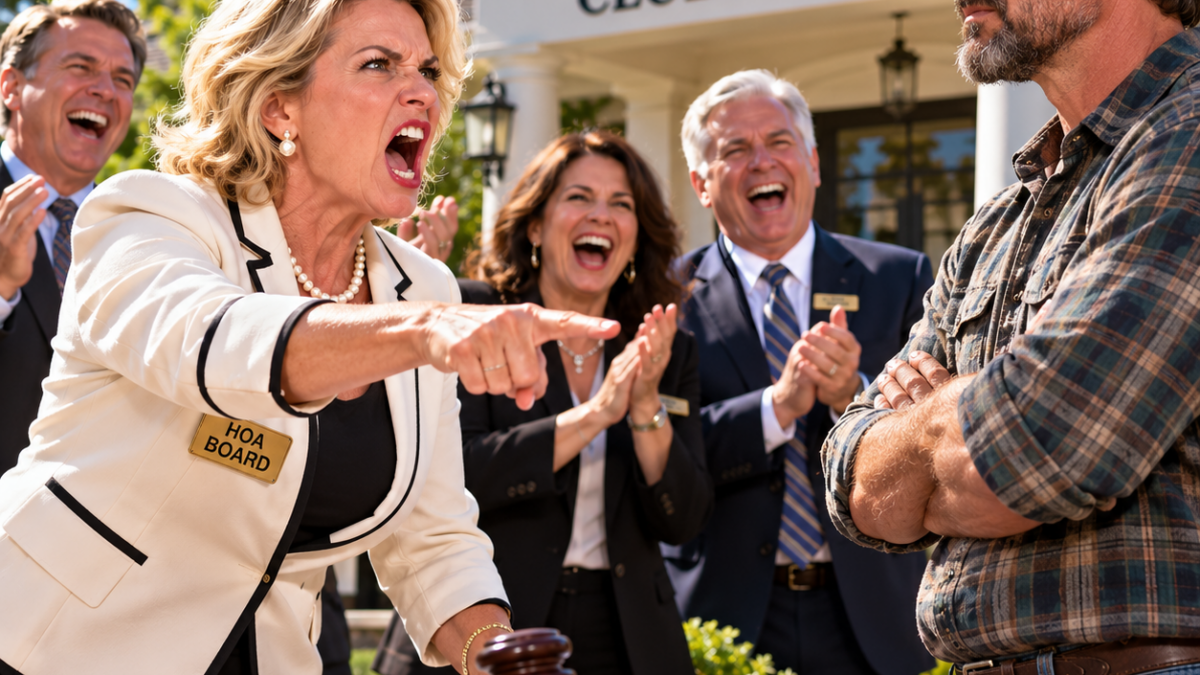
The Crest View group exploded.
Applause.
Laughter.
Mallorie hugged Lenora.
One man shouted, “We got him!”
The photographer started taking pictures.
Lenora lifted her paddle above her head.
Then she turned toward me.
There are moments in life when a person gives you a perfect opportunity to say something cruel.
The older I get, the more I believe those are usually the moments when saying less matters most.
Lenora walked toward the aisle.
“Looks like Crest View wanted it more.”
I closed my folder.
“You certainly paid more.”
Her smile tightened.
I stood.
She probably expected anger.
Maybe an accusation.
Maybe a warning.
Instead, I walked outside.
Everett caught up with me near my truck.
“You went past three-ten.”
“I know.”
“By ninety-five thousand.”
“I noticed.”
He studied my face.
“You all right?”
“I lost the parcel.”
“For now.”
I looked at him.
He shrugged.
“County records don’t care who applauds.”
I understood what he meant.
But even then, I didn’t know just how strange the next six hours would become.
Because the winning bid wasn’t the final cost.
Buyer premiums, recording expenses, and mandatory fees pushed Crest View’s actual cash requirement to approximately $438,600.
That money came from the reserve fund.
When Tobias updated the account, the available balance was about $113,000.
The clubhouse redemption amount was more than $143,000.
The HOA was short over thirty thousand dollars.
And the clock read 10:47 a.m.
Four o’clock was getting closer.
At first, Lenora apparently treated the shortfall like an inconvenience.
“We need thirty thousand,” she told Tobias. “That’s nothing.”
Tobias stared at her.
“Thirty thousand dollars in five hours is not nothing.”
“We have more than one hundred thousand in the account.”
“And we owe one hundred forty-three thousand.”
“Move money from operations.”
“We can’t.”
“Then use another reserve category.”
“Some of those funds are already committed.”
“To what?”
“Insurance. Roof work. Water-system maintenance. Existing contracts.”
Lenora’s voice rose.
“You’re the treasurer. Find the money.”
“I have been trying to protect the money for six weeks.”
That ended the conversation for about thirty seconds.
Then Lenora called the bank.
She asked about the short-term loan she had mentioned to the board.
There was no approved loan.
No formal application ready for closing.
No emergency line of credit waiting.
And no lender was prepared to underwrite a rushed loan secured by a clubhouse already in a tax-deed process and a parcel the HOA had not even finished recording.
Her next idea was an emergency assessment against homeowners.
Tobias had to explain the bylaws.
Notice.
Meeting.
Vote.
Collection period.
They had hours, not weeks.
By early afternoon, the mood inside the Crest View office had changed completely.
The photographer’s pictures from the auction hadn’t even been uploaded to the newsletter yet.
The celebration was already over.
Mallorie finally asked the question she later told me she wished she had asked days earlier.
“Why didn’t you tell us the clubhouse deadline was today?”
Lenora looked at her.
“I told you there was a tax issue.”
“You told us it was manageable.”
“It was.”
Mallorie stared at her.
“Was it?”
Lenora called the county.
She demanded a forty-eight-hour extension.
Delia Prescott answered.
Lenora argued.
Then threatened to involve attorneys.
Delia calmly read the notice history.
Certified mail.
Certified mail.
Published notice.
Personal delivery.
Finally, she read the signature from the last receipt.
“Lenora Wickham.”
There was nowhere left to hide.
Sometime after two o’clock, my phone rang.
I was back at my office.
The caller ID showed a number from Crest View.
I almost ignored it.
Instead, I answered.
“Grant Calder.”
Silence.
Then Lenora’s voice.
“Grant.”
“Lenora.”
“We need to discuss something.”
I leaned back in my chair.
“Okay.”
“We’re dealing with a temporary liquidity issue.”
I said nothing.
She continued.
“The association needs a short-term bridge. Forty thousand dollars. Forty-eight hours.”
I looked through my office window toward the distant subdivision.
“You’re asking me for a loan?”
“A business arrangement.”
“Why me?”
“You have access to capital.”
“I’m sure several Crest View residents do too.”
“We’ve already explored options.”
That meant they had already said no.
“What are you offering?”
“We can reconsider some of the ongoing disputes between your company and Crest View.”
I almost laughed.
“What disputes?”
“The truck visibility. Dust. Signage.”
“Your association has no jurisdiction over my property.”
Silence.
“So you’re offering to stop enforcing rules you have no right to enforce in exchange for forty thousand dollars?”
“That isn’t what I said.”
“It sounded close.”
Her tone hardened.
“You know exactly what position we’re in.”
“I know you bought Lot 17B.”
“Grant.”
“I didn’t tell you to bid four hundred twenty thousand dollars.”
“We don’t need a lecture.”
“Then why did you call?”
Another long pause.
Finally she said, “Will you lend the association the money?”
“No.”
She inhaled sharply.
“You’re really going to do this?”
“Do what?”
“Stand by while an entire neighborhood loses its clubhouse over thirty thousand dollars?”
That was the first moment I became angry.
Not because she insulted me.
Because she was already rewriting the story.
“You signed the tax notice, Lenora.”
She said nothing.
“You were warned by your treasurer. You spent the reserve anyway. You outbid me by fifteen thousand dollars after I stopped at four-oh-five, and your total acquisition cost was even higher.”
“That auction has nothing to do with this.”
“It has everything to do with your cash balance.”
Her voice dropped.
“You could fix this.”
“No. You could have prevented it.”
She hung up.
At 3:37, the HOA was still short.
Lenora asked board members to advance personal money.
Nobody agreed.
At 3:59, Tobias stood at the county counter with a cashier’s check that did not equal the amount required.
Delia looked at the clock.
Four o’clock arrived.
The redemption period expired.
That should have been the end of the day’s disaster.
Instead, it was only the beginning.
The next morning, Everett called me before eight.
“Check the county recording portal.”
I opened my laptop.
A new notation appeared beside the Crest View clubhouse parcel.
TAX DEED ISSUANCE APPROVED.
The clubhouse was worth well over $1.3 million.
The debt had been roughly $143,000.
I stared at the screen.
“That’s brutal.”
Everett agreed.
“But lawful, assuming the file is as complete as Delia says.”
“What happens next?”
“The certificate holder moves through the final deed process.”
I paused.
Then asked something I should have asked earlier.
“Who owns the certificate?”
“I assumed you checked.”
“No.”
I returned to the county records portal.
The certificate holder was listed under an LLC.
Black Ridge Land Recovery LLC.
I stared at the name.
Then I stood so quickly my chair rolled backward into the filing cabinet.
Everett heard the sound through the phone.
“What?”
“Everett.”
“What?”
“I own Black Ridge Land Recovery.”
Now it was his turn to go silent.
Two years earlier, I had purchased a bundle of tax certificates from a retiring investor.
It wasn’t a major part of my business.
It was passive.
Boring.
The kind of investment where documents went into a cabinet and sometimes stayed there for years.
I pulled the old purchase records.
There it was.
The Crest View clubhouse certificate had been inside that bundle.
I had acquired it nearly two years before the current dispute over Lot 17B.
Long before Lenora started sending me notices.
Long before the auction.
Long before anyone could plausibly claim I had bought it to retaliate against Crest View.
I sat down.
“You’ve got to be kidding me.”
Everett said, “Don’t call anyone.”
“I wasn’t going to.”
“Don’t send an email. Don’t make a joke. Don’t tell an employee. Don’t say anything that could be turned into evidence of intent.”
“I didn’t even know I owned the certificate until thirty seconds ago.”
“Exactly. Keep it that clean.”
That afternoon, Lenora learned the same thing.
I don’t know who told her.
Possibly the county.
Possibly an attorney.
My phone rang.
This time, she didn’t pretend to be polite.
“You set us up.”
“No.”
“You bought the lien on our clubhouse.”
“Two years before Lot 17B was scheduled for auction.”
“You knew.”
“I discovered it this morning.”
“I don’t believe you.”
“That’s what records are for.”
“This was retaliation.”
“Again, check the purchase date.”
“You stood there yesterday knowing what would happen.”
That wasn’t entirely false.
I knew there was a risk.
But I had not caused the risk.
More importantly, Lenora had known too.
“You signed the notice,” I said.
She became quiet.
“Your signature is on the county file.”
“You could have warned us.”
“So could Tobias.”
Another silence.
“And from what I understand,” I continued, “he did.”
She changed tactics.
“We’re filing for an emergency injunction.”
“Okay.”
“You think that’s funny?”
“No.”
“We’ll prove this was deliberate.”
“Then bring the financial records.”
That sentence ended the call.
Later, Everett told me it was probably the most important thing I said during the entire dispute.
Because Lenora did bring the financial records.
And those records destroyed the story she wanted to tell.
The HOA’s attorneys filed for emergency relief.
Their arguments were predictable.
Insufficient notice.
Disproportionate consequences.
Procedural concerns.
Conflict of interest.
Retaliation.
They tried to frame me as a landowner who had somehow engineered a tax problem so I could seize a community asset.
The timeline made that theory almost impossible.
The county produced the notices.
Every one.
Certified-mail receipts.
Publication records.
Appeal records.
Payment histories.
Delivery confirmations.
Lenora’s signature.
Then Everett subpoenaed the HOA’s internal communications.
That was when everything changed.
Tobias turned over an email he had sent six weeks before the auction.
It said, in plain language, that spending more than approximately $390,000 on Lot 17B could leave Crest View unable to redeem the clubhouse tax lien.
Lenora had responded:
Acquiring Lot 17B is the priority. The tax matter can be resolved afterward.
There was another email.
Tobias recommended that the lien amount be disclosed to homeowners before they were asked to support the land purchase.
Lenora replied that the number should not appear in the member packet because it would create “unnecessary alarm.”
That phrase became infamous inside Crest View.
Unnecessary alarm.
The clubhouse was approaching a final redemption deadline.
The president knew.
The treasurer knew.
The residents paying the bills did not.
Once those emails surfaced, the legal battle stopped being primarily about me.
It became about Lenora.
Mallorie called an emergency meeting.
For the first time, homeowners learned the full sequence.
The debt.
The notices.
The deadline.
The reserve balance.
Tobias’s warnings.
The $438,600 total cost of Lot 17B.
The shortage.
The missed deadline.
I wasn’t there, but several people later described the meeting to me.
Apparently it began with shouting.
Then accusations.
Then something worse for Lenora.
Silence.
People who had trusted her simply sat there realizing that the victory they had applauded had been financed with money needed to protect something worth far more.
Lenora tried to blame Tobias.
He came prepared.
He placed copies of his warnings on the table.
Three written notices.
Meeting minutes.
Emails.
A record of every objection.
Mallorie picked up one page.
“You told us Grant was trying to force us into overpaying.”
Lenora answered, “He knew what the land meant to the community.”
“What did it mean?”
“The Grand Commons.”
That brought them to the second disaster.
The easements.
The new board hired an independent surveyor to review Lot 17B.
His report was devastating.
Nearly forty percent of the parcel was affected by drainage and utility restrictions.
More importantly, the section Lenora’s glossy renderings showed as the primary event area overlapped heavily with those restrictions.
The beautiful pavilion?
Problematic.
The event lawn?
Partially constrained.
Some of the parking configuration?
Not viable as presented.
The project that had been used to emotionally justify spending almost half a million dollars had never been properly vetted.
One board member reportedly slid the survey across the table and asked:
“Are you telling me we paid four hundred thirty-eight thousand dollars for land we can’t even use the way you promised?”
Lenora tried explaining that designs could change.
The man interrupted.
“With the money we needed to save the clubhouse?”
Nobody applauded her that night.
A few days later, the emergency injunction hearing took place.
The courtroom wasn’t dramatic.
No giant jury box.
No marble staircase.
It was a small hearing room with wood paneling and fluorescent lights, much like the auction room.
But nearly every seat was filled.
Crest View residents had come to watch.
Lenora arrived early.
She wore another tailored suit.
Her attorney organized binders across the table.
I sat beside Everett.
Before the judge entered, Everett leaned toward me.
“Remember what we discussed.”
“Answer exactly what’s asked.”
“And?”
“Don’t celebrate.”
“Especially that.”
The judge entered.
Everybody stood.
The HOA’s attorney began by describing the clubhouse as the heart of Crest View Reserve.
A gathering place.
A community asset.
A building worth more than a million dollars placed at risk by a tax dispute representing only a fraction of its value.
That part was true.
Then he argued that such a severe result warranted intervention.
The judge asked a simple question.
“Did the association receive notice?”
The county attorney stood.
“Yes, Your Honor.”
“How many times?”
She began listing them.
Certified notices.
Published notices.
Delivery records.
Then she submitted the signed receipt.
The judge examined it.
“Whose signature is this?”
Lenora’s attorney hesitated.
“My client’s.”
The judge looked at him.
“So the president of the association personally acknowledged receipt?”
“Yes.”
“And the association’s treasurer separately warned the board?”
Another document.
“Yes.”
“And the board nevertheless authorized the expenditure on Lot 17B?”
“Yes, but—”
“And the successful purchase occurred hours before the redemption deadline?”
“Yes.”
The HOA attorney shifted to proportionality.
He argued that losing a $1.3 million clubhouse over a $143,000 obligation produced an extreme result.
The judge listened carefully.
Then he said something I never forgot.
A court could not simply erase a lawful statutory process because one party regretted a financial decision after the deadline.
Then my bidding came under scrutiny.
The HOA implied that I had intentionally forced them to overspend.
Everett handed the auction log to the clerk.
The sequence was read into the record.
I had entered the auction with a private valuation.
I bid.
Lenora bid.
I raised.
She raised.
Eventually, I stopped.
No side agreement.
No fake bidder.
No hidden manipulation.
No promise.
No coercion.
Just an open county auction.
The judge asked me directly:
“Mr. Calder, did you continue bidding after the property exceeded what you believed it was worth?”
“I went above my original planned ceiling, Your Honor.”
“How far?”
“My original limit was three hundred ten thousand.”
“And your final bid?”
“Four hundred five thousand.”
“Why stop there?”
“Because by then I believed continuing would be financially irrational.”
“And Ms. Wickham’s winning bid?”
“Four hundred twenty thousand.”
“Did you ask her to make that bid?”
“No.”
“Did you communicate with her during bidding?”
“No.”
“Did you tell anyone from Crest View that you intended to exhaust their reserve fund?”
“No.”
“Did you know at that time that your own LLC held the tax certificate?”
“I knew the clubhouse had a tax-certificate problem. I did not realize the certificate was in an old portfolio owned by my LLC until I checked the holder the following morning.”
The HOA attorney stood.
“Mr. Calder expects this court to believe he coincidentally purchased the tax certificate connected to the clubhouse?”
Everett was already on his feet.
“Purchase records show the certificate was acquired as part of a larger bundle almost two years before the events at issue.”
The judge looked at the dates.
That was the end of the trap theory.
Not emotionally.
Lenora still believed it.
But legally, the timeline was clear.
The judge denied the injunction.
No fraud.
No procedural failure sufficient to stop the process.
No evidence that I had manufactured the lien.
No evidence that I had caused the missed deadline.
The courthouse hallway was crowded afterward.
I wanted to leave.
Lenora didn’t.
She stepped directly in front of me.
“You took our clubhouse over twenty-seven thousand dollars.”
People nearby stopped talking.
Everett touched my arm lightly, a reminder not to engage.
But I answered.
Quietly.
“No, Lenora.”
Her face tightened.
“You spent that twenty-seven thousand dollars trying to beat me.”
For once, she had nothing to say.
I walked away.
I thought that would end her leadership.
It didn’t.
Not immediately.
Lenora returned to Crest View and announced that the homeowners would need to “correct the mistake.”
Her proposed solution was astonishing.
A special assessment of roughly $4,800 per household.
Sell Lot 17B.
Continue fighting me in court.
Then somehow use whatever remained to repurchase the clubhouse.
The emergency meeting had to be held in a rented hotel conference room because the clubhouse itself was already tied up in the ownership-transfer process.
There was a strange poetry to that.
Lenora stood in front of residents in a rented room asking them for thousands of dollars each to repair a crisis created partly because she had spent their reserve fund trying to prove she could defeat me.
Tobias presented the numbers.
He didn’t dramatize them.
Accountants rarely need to.
“Four hundred thirty-eight thousand six hundred dollars,” he said, “was spent acquiring Lot 17B.”
He changed slides.
“One hundred forty-three thousand eight hundred seventy dollars and sixty-two cents was required to redeem the clubhouse lien.”
Another slide.
“Legal expenses are continuing.”
Another.
“The clubhouse has an estimated value exceeding one point three million dollars.”
Another.
“Independent review indicates Lot 17B has materially lower development utility than represented in the Grand Commons proposal.”
Then Tobias stopped.
“This is where we are.”
A woman near the front raised her hand.
“My husband and I moved here because we thought this association was financially stable.”
Nobody answered.
Another homeowner stood.
“You told us Grant Calder was the threat.”
He pointed toward Lenora.
“You never told us about the lien.”
Lenora tried to defend herself.
“We were protecting the community’s long-term interests.”
“By hiding a six-figure debt?”
“I didn’t hide it.”
Tobias looked down at his documents.
Mallorie didn’t.
“Yes, you did.”
That surprised everyone.
For years, Mallorie had been Lenora’s closest ally.
She had stood beside her at events.
She had hugged her after the auction.
Now she stood with a printed email in her hand.
“You instructed Tobias not to put the lien amount in the homeowner packet.”
Lenora stared at her.
“I was trying to avoid panic.”
“You were trying to avoid opposition.”
That landed differently.
Because it was coming from someone who had defended her.
Mallorie continued.
“I cheered at that auction.”
Her voice broke slightly.
“I stood there and cheered because I trusted what you told us.”
The room became quiet.
“I thought we were protecting Crest View. I thought Grant was trying to take something from us.”
She looked down.
“We were the ones gambling with something we already owned.”
That was probably the moment Lenora lost the room.
Mallorie made a formal motion to remove her as president.
A second board member supported it.
The vote proceeded.
One by one.
Yes.
Yes.
Yes.
Yes.
Yes.
Yes.
Lenora cast the only vote against her own removal.
Six to one.
A year earlier, that would have been unimaginable.
Weeks earlier, the same people had stood behind her while she held an auction paddle over her head.
Now nobody followed her out of the hotel conference room.
The HOA began rebuilding under new leadership.
Their first problem was Lot 17B.
They needed liquidity.
They listed the parcel for sale.
Lenora had paid $420,000 at auction.
With costs, Crest View’s actual investment was around $438,600.
They hoped another developer would see value.
Weeks passed.
Offers came in.
None approached what Crest View had paid.
The highest serious offer was about $226,000.
That was when I called Mallorie.
By then, she was helping lead the reorganized board.
“I heard you received an offer.”
There was a pause.
“Two twenty-six.”
“I’ll offer two thirty-five.”
Another pause.
“You’re serious?”
“Yes.”
“You bid four-oh-five at auction.”
“I did.”
“And now you’re offering two thirty-five.”
“The circumstances changed.”
“Meaning we’re desperate.”
“Meaning the market has spoken.”
She didn’t argue.
I wasn’t trying to humiliate them.
Two hundred thirty-five thousand was still more than their best outside offer.
But I wasn’t going to reimburse them for Lenora’s mistake.
Mallorie said she needed a board vote.
“I’d expect nothing less.”
Two days later, she called back.
They accepted.
When Everett placed the purchase agreement on my desk, I stared at the number.
$235,000.
The same land Lenora had paid $420,000 to keep away from me was finally mine for almost two hundred thousand dollars less.
But there was no joy in knowing ordinary homeowners had absorbed the difference.
That’s the part people miss when they hear stories like this.
They want a villain.
They want a winner.
They want the satisfying moment when the person who caused the problem faces consequences.
I understood that.
I won’t pretend I felt sorry for Lenora.
She had knowingly sent me meaningless violation notices.
She had turned me into a convenient enemy.
She had hidden a major obligation from people who trusted her.
She had ignored Tobias.
She had overpaid for land because beating me became more important than protecting the association.
But Lenora wasn’t the only person living in Crest View.
There were retirees there.
Young families.
People who had never attended a board meeting.
People who had believed the newsletters because most people reasonably assume a financial statement from their HOA isn’t hiding a six-figure crisis.
They hadn’t bid against me.
They hadn’t ignored the tax notices.
They shouldn’t lose a community building forever just so I could enjoy revenge.
By then, however, the tax-deed process had completed.
Black Ridge Land Recovery LLC became the legal owner of the clubhouse parcel.
Which meant that in the span of a few months, I ended up owning two things I had never expected to own together.
Lot 17B.
And the Crest View clubhouse.
Everett placed both files on my desk.
“You realize how ridiculous this looks.”
“I do.”
“You went to an auction trying to buy eleven acres.”
“I know.”
“You lost.”
“Yes.”
“And somehow ended up with the eleven acres plus their clubhouse.”
“Yes.”
He smiled.
“You might want to stop going to auctions.”
I laughed for the first time in weeks.
Then I asked him a more serious question.
“What would be fair?”
“For who?”
“The residents.”
Everett leaned back.
“Legally or morally?”
“Both.”
“Legally, you own the building.”
“I know.”
“You could terminate their use, subject to whatever occupancy and contractual obligations remain.”
“I don’t want that.”
“Then lease it back.”
That became the solution.
I met with Mallorie, Tobias, and two new board members.
Not at the clubhouse.
Not yet.
We met in my office.
Mallorie looked exhausted.
The confidence she used to carry beside Lenora had changed into something quieter.
“I owe you an apology,” she said.
“You don’t owe me anything.”
“Yes, I do.”
I waited.
“I believed things about you that weren’t true.”
“You believed your president.”
“I repeated some of them.”
I nodded.
“That part you can own.”
She did.
“I should have asked more questions.”
Tobias looked at her.
“So should half the neighborhood.”
Then he looked at me.
“What are you planning to do with the clubhouse?”
“Keep it.”
Mallorie’s shoulders sank slightly.
“But,” I continued, “I’m willing to lease the meeting space back to Crest View.”
Both of them looked surprised.
“For how long?” Tobias asked.
“We can start with a commercial term that gives the association time to rebuild.”
“Market rent?”
“Fair market rent.”
Mallorie nodded slowly.
“And your conditions?”
I had three.
First, all violation notices Crest View had issued against my property would be formally rescinded.
Not quietly abandoned.
Rescinded in writing.
Second, the association would acknowledge that my property, including Lot 17B, was outside its jurisdiction and would make no future attempt to regulate my company’s lawful operations.
Third, nobody would try to use the clubhouse lease as leverage to revive old claims.
Tobias read the proposed terms.
“These are reasonable.”
Mallorie looked at me.
“You could ask for much more.”
“I could.”
“Why aren’t you?”
“Because I had a dispute with Lenora. Not with two hundred families.”
She looked away for a moment.
That meeting was the first time the situation felt finished.
Not won.
Finished.
There is a difference.
A few weeks later, Crest View officially rescinded every notice Lenora had sent me.
I kept copies anyway.
Old habit.
My crews began preparing a simple access route across Lot 17B.
Nothing dramatic.
No giant industrial complex.
No revenge structure.
No wall.
Just the practical connection to County Route 18 I had wanted from the beginning.
The first morning one of my dump trucks used the new route, I happened to be standing beside the yard entrance.
The driver, Miguel, slowed and rolled down his window.
“You know how much time this saves?”
“About twelve minutes each way depending on traffic.”
He laughed.
“You calculated it?”
“Years ago.”
He pointed toward Crest View.
“All that mess for twelve minutes?”
“Multiply twelve minutes by enough trucks for enough years.”
“Still seems crazy.”
He was right.
It was crazy.
The association had spent hundreds of thousands of dollars trying to stop me from building an access route that barely affected them.
The new road didn’t run through Crest View.
It didn’t send trucks down residential streets.
It didn’t violate their property.
It simply connected my commercial land to the county road.
The terrible future Lenora had warned residents about never arrived.
What did arrive was an audit.
The homeowners demanded one.
Independent accountants reviewed the association’s finances.
The insurer opened its own examination into whether Lenora’s decisions involved failures of fiduciary oversight or concealment of known financial risk.
I stayed out of it.
That mattered to me.
I didn’t file a personal lawsuit against her.
I didn’t send investigators after her.
I didn’t stand outside the neighborhood talking to reporters.
I had what I needed.
The rest belonged to the people who had trusted her.
Some of Lenora’s strongest board supporters resigned.
The HOA newsletter changed almost overnight.
Gone were the glossy promotional spreads about Grand Commons.
In their place appeared reserve balances.
Pending obligations.
Contract summaries.
Legal expenses.
For the first time, residents could see where large amounts of their money were going.
Tobias introduced a new policy requiring every proposed expenditure above $50,000 to be cross-checked against outstanding legal, tax, insurance, infrastructure, and contractual obligations before the board could vote.
Residents gave it a nickname.
The Lenora Clause.
Even Tobias laughed when he told me.
I asked whether Lenora knew.
“Oh, she knows.”
“How?”
“Someone said it at a meeting.”
“That seems unnecessarily personal.”
“After what we went through, Grant, people needed something to laugh about.”
Fair enough.
The old Grand Commons renderings disappeared from the clubhouse.
So did the banner.
OUR LAND. OUR FUTURE.
For a while, the empty hooks remained on the wall where it had hung.
Eventually someone put up a financial transparency notice in the same spot.
That seemed appropriate.
The clubhouse sign changed too.
Because the property no longer belonged to Crest View, the old ownership sign couldn’t remain.
My property manager asked what I wanted the replacement to say.
I considered several names.
Nothing clever.
Nothing insulting.
Eventually we installed a simple sign:
CALDER PROPERTY SERVICES
PRIVATE PROPERTY
Below it, in smaller lettering:
CREST VIEW COMMUNITY FACILITY — AUTHORIZED USE
No mention of Lenora.
No joke.
No victory slogan.
Nothing that would punish residents for a fight most of them never fully understood.
I learned later that Lenora drove past it one afternoon.
A neighbor saw her car stopped across the street.
She sat there for several minutes.
I wasn’t there.
I’m glad I wasn’t.
There would have been nothing worth saying.
For nearly a decade, that clubhouse had been the center of her authority.
Board meetings.
Holiday events.
Resident forums.
Newsletter photographs.
Every major speech Lenora gave seemed to happen behind that podium.
She had treated the building almost like proof that she mattered.
Then, in one extraordinary chain of decisions, she used the money that could have protected it to win a public contest against a man who never considered himself her opponent.
And that was the saddest part.
I hadn’t been trying to defeat Lenora.
Not at the beginning.
I wanted a road.
She wanted a victory.
Those aren’t the same thing.
About three months after the lease arrangement began, Tobias came to my office.
He carried a folder.
I recognized it immediately.
The final recorded deed for Lot 17B.
He placed it on my desk.
“Thought you’d want the certified copy.”
“I already have one.”
“I know.”
“Then why bring it?”
He smiled.
“I wanted an excuse to ask you something.”
“Go ahead.”
He sat across from me.
“At the auction, when she bid four-twenty…”
I waited.
“You didn’t look angry.”
“I was annoyed.”
“No. I watched you. Everybody else thought you had been humiliated.”
“I had.”
“You didn’t act like it.”
I turned the deed around.
“What was I supposed to do?”
“I don’t know. Argue. Bid again. Storm out.”
“I did walk out.”
“Calmly.”
I smiled.
“Tobias, by that point I knew the numbers.”
He nodded.
“But did you know you’d end up with the clubhouse?”
“No.”
“That part really was an accident?”
“Completely.”
He laughed.
“I still have trouble believing that.”
“So do I.”
He glanced at the old tax-lien file sitting on a shelf.
“Then why were you so calm?”
That question stayed with me for a moment.
I pulled out the auction record.
I put it beside the lien file.
“One of the first lessons I learned in business,” I said, “is that winning a bid isn’t the same thing as winning.”
Tobias nodded.
“I wish we’d understood that earlier.”
“You did.”
He looked at me.
“You tried to tell them.”
For the first time, his smile disappeared.
“I could have done more.”
“You voted against it.”
“I could have gone to the homeowners.”
“And violated a closed-session obligation?”
“Maybe.”
“Maybe you’d have been removed.”
“Maybe.”
“Tobias, if you spend your life rewriting every bad decision after you know the outcome, you’ll eventually convince yourself you were responsible for things you didn’t control.”
He stared at the folder.
“You sound like Everett.”
“That’s insulting.”
He laughed again.
Before leaving, Tobias stopped at the door.
“For what it’s worth, the neighborhood doesn’t hate you.”
“I didn’t know they hated me before.”
“Some did.”
“That’s comforting.”
“Lenora made you sound like some kind of industrial warlord.”
I looked out at my equipment yard.
One excavator had a hydraulic leak.
Two dump trucks needed tires.
Someone had left a pallet of drainage pipe directly where I had told them not to put it.
“Very glamorous empire.”
Tobias laughed and left.
The following year was quieter.
Crest View rebuilt its reserve fund slowly.
No dramatic projects.
No glossy promises.
They repaired roofs.
Reviewed insurance.
Replaced part of the irrigation system.
Published quarterly statements.
Attendance at board meetings actually increased.
People asked questions.
Sometimes uncomfortable ones.
Mallorie didn’t discourage them.
That was probably the biggest change.
At one meeting, a resident apparently apologized for challenging a proposed expenditure.
Mallorie told him:
“Never apologize for asking where your own money is going.”
I heard about that later.
It made me respect her.
People can participate in a bad decision and still learn from it.
That matters.
Lenora eventually listed her house.
She moved out of Crest View within the year.
I didn’t know where she went.
I didn’t ask.
A young family bought the property.
They had no connection to the dispute.
One Saturday morning, I happened to meet the husband at a hardware store.
He recognized my company logo.
“You’re Calder?”
“Yes.”
“We bought the Wickham house.”
I wasn’t sure what he expected me to say.
“Hope you like the neighborhood.”
He laughed.
“We’ve heard some stories.”
“I imagine.”
“Were they true?”
“Depends which stories.”
“Heard there was some crazy land auction.”
“That part’s true.”
“Heard you stole the clubhouse.”
“That part isn’t.”
He looked embarrassed.
“Sorry.”
“No problem.”
“I guess every neighborhood has history.”
“Usually.”
He glanced at the lumber in my cart.
“Well, for what it’s worth, my kids love it there.”
I smiled.
“Good.”
And I meant it.
That was another thing Lenora never seemed to understand.
A neighborhood isn’t its board.
An HOA isn’t one president.
A community isn’t the loudest person standing at the microphone.
It’s the people walking dogs after dinner.
Kids riding bikes.
Retired couples tending flowers.
Families arguing over where to put the Christmas decorations.
People who probably couldn’t identify Lot 17B on a map and never wanted to.
Those people had already paid enough for Lenora’s decisions.
They didn’t need me reminding them forever.
So I didn’t.
I never gave the radio interview someone requested.
I turned down a local newspaper reporter.
When one real-estate blog contacted Everett asking whether I wanted to tell “the incredible story of the HOA that lost everything trying to beat its neighbor,” I said no.
Crest View hadn’t lost everything.
That kind of headline would have been satisfying.
It also would have been false.
They lost money.
A lot of it.
They lost ownership of their clubhouse.
They lost trust.
But they still had a neighborhood.
They still had one another.
And under better leadership, they were rebuilding.
As for Lenora, the consequences were enough.
She lost the presidency she had treated like a throne.
She lost the trust of people who had once cheered her name.
Her signature was attached to documents that made it impossible to blame ignorance.
Her own emails showed that she had been warned.
And the project she had risked everything to acquire turned out to be far less useful than she promised.
I didn’t need anything worse to happen to her.
I didn’t need her ruined.
I didn’t need her humiliated forever.
I just needed her to stop trying to control property that wasn’t hers.
She did.
Years later, the access road across Lot 17B became so ordinary that new employees assumed it had always existed.
That’s how most big conflicts end.
Not with music.
Not with applause.
With normal life returning.
Trucks came and went.
Grass grew beside the road.
Crest View residents held holiday events in the clubhouse under the lease.
The reserve fund recovered.
People stopped talking about the Grand Commons.
Eventually even the phrase “tax lien” stopped making half the board visibly uncomfortable.
But every now and then someone who had lived through that year would tell the story.
Usually the auction version.
They remembered Lenora lifting the paddle.
The applause.
Me folding my card.
The photographer capturing the moment.
That photograph actually survived.
Tobias showed me a copy once.
Lenora stood in the center.
Paddle raised.
Mallorie beside her.
Board members smiling.
I appeared in the far background, half turned toward the exit.
“You want this?” Tobias asked.
“No.”
“You sure?”
“Very.”
“It’s kind of historic.”
“It’s a photograph of somebody buying eleven acres.”
“For four hundred twenty thousand dollars.”
“Still land.”
He shook his head.
“You are incapable of enjoying this properly.”
Maybe he was right.
But photographs freeze moments.
Numbers tell longer stories.
In that photograph, Lenora had won.
There is no debate about that.
The auctioneer accepted her bid.
The gavel came down.
Crest View legally acquired Lot 17B.
The board really did cheer.
I really did lose.
If the story ended five minutes later, Lenora would have been the winner.
But life rarely ends when applause does.
By sunset, the math had caught up.
The money spent on that victory was money the HOA desperately needed somewhere else.
The following morning, the legal process moved forward.
Within weeks, residents learned what had been hidden.
The court refused to rescue the board from its own documented choices.
Lenora lost her position.
Crest View eventually sold me Lot 17B for $235,000.
And the clubhouse she had once used as the center of her authority became property controlled by my company.
The outcome wasn’t satisfying because she suffered.
It was satisfying because, eventually, the facts mattered.
The notices mattered.
The dates mattered.
Tobias’s warnings mattered.
The signatures mattered.
The auction record mattered.
The easements mattered.
The numbers mattered.
And for a man who built his life reading paperwork nobody else wanted to read, there was something strangely fitting about that.
I still keep the original Crest View file.
It’s thicker now.
The first pages are Lenora’s old violation notices.
Noise.
Dust.
Fencing.
Visible trucks.
Rules she never had authority to enforce.
Behind those are the Lot 17B maps.
The auction record.
The tax-certificate documents.
The court order.
The purchase agreement where Crest View later sold me the parcel.
And finally, the lease allowing the association to continue using the clubhouse.
Sometimes a new employee sees the folder and asks why I keep so much old paper.
My answer is always the same.
“Because paper remembers what people forget.”
People remember how something felt.
Paper remembers what happened.
Lenora remembered beating me.
The auction record remembered what she paid.
She remembered the clubhouse as hers.
The tax file remembered the deadline.
She remembered being unfairly surprised.
The certified receipt remembered her signature.
She remembered me as the reason Crest View lost control of the building.
Her emails remembered Tobias warning her weeks in advance.
That’s why I never needed to argue with her much.
I had learned long before that when somebody is fighting the facts, you don’t always need a louder voice.
Sometimes you just need a better file.
And if there is one thing that entire experience taught me, it is this:
Pride is expensive when you spend other people’s money on it.
Winning in public can be meaningless if you’re losing something more valuable in private.
And revenge doesn’t always require destroying the person who came after you.
Sometimes the most satisfying ending is simply refusing to rescue them from the consequences they knowingly chose—then treating everyone else more fairly than they ever treated you.
The last time I saw Lenora was accidental.
Nearly a year after she moved, I stopped at a gas station off County Route 18.
I was filling my truck when a dark SUV pulled up at the opposite pump.
She stepped out.
For a second, neither of us moved.
She looked older.
Not dramatically.
Just tired.
She recognized me.
I nodded once.
“Lenora.”
“Grant.”
That could have been the entire conversation.
Part of me hoped it would be.
Then she looked toward the road.
“I heard the association is still using the clubhouse.”
“Yes.”
“You leased it back.”
“Yes.”
She seemed genuinely confused.
“Why?”
I put the fuel nozzle back into the pump.
“Why what?”
“Why let them stay?”
“They needed a meeting space.”
“You could have shut it down.”
“I could have.”
“You could have made them regret everything.”
I looked at her.
“I didn’t have a problem with them.”
Her expression changed.
“You had a problem with me.”
“At the end, yes.”
She looked away.
“I really thought you were trying to undermine us.”
“No. I was trying to buy a road.”
She gave a small laugh.
It wasn’t happy.
“All that over a road.”
“All that over an auction.”
She nodded.
For several seconds we stood there listening to traffic.
Then she said something I never expected.
“I should have listened to Tobias.”
I didn’t answer immediately.
“Yes.”
“I should have told the residents.”
“Yes.”
“And I shouldn’t have bid four-twenty.”
That almost made me smile.
“No.”
She looked at me.
“You could pretend to disagree with at least one thing.”
“I don’t think that would help.”
For the first time since I had known her, Lenora laughed at herself.
Quietly.
Then her expression became serious again.
“I hated you for a long time.”
“I figured.”
“Do you hate me?”
“No.”
She looked surprised.
“I was angry.”
“That’s different?”
“Very.”
“How?”
“Anger ends when the problem ends.”
She absorbed that.
“And hate?”
“Hate needs maintenance.”
I picked up my receipt.
“I’ve got enough equipment to maintain.”
That earned another tiny laugh.
She opened her SUV door.
Before getting in, she looked back at me.
“Did you know that day?”
“At the auction?”
“Yes.”
“Know what?”
“That you were going to end up winning.”
I thought about Tobias asking me almost the same question.
“No.”
She frowned.
“But you walked away like you did.”
“I knew one thing.”
“What?”
“You were paying more for the land than I was willing to pay.”
“That was enough?”
“For me, yes.”
She stood there another moment.
Then nodded.
“Take care, Grant.”
“You too.”
She drove away.
That was our final conversation.
No screaming.
No threats.
No dramatic confession.
No crowd watching.
Just two people at a gas station, years removed from a fight that once seemed enormous.
And oddly, that felt like the right ending.
Because the real lesson was never that I was smarter than Lenora.
I made mistakes too.
I exceeded my original auction ceiling.
I allowed irritation to pull me from $310,000 to $405,000.
Another fifteen thousand dollars of stubbornness and I might have been the one who overpaid.
The difference was that I eventually stopped.
Lenora didn’t.
There is no shame in wanting to win.
There is danger in needing to.
The HOA board learned that painfully.
So did Lenora.
And I learned something of my own.
Walking away is not always surrender.
Sometimes it is discipline.
Sometimes it is the decision that protects you from paying tomorrow’s price for today’s pride.
And sometimes, while everyone else is cheering because they think you lost, the smartest thing you can do is close your folder, walk through the door, and let the numbers finish the argument.
Lenora won the auction.
Nobody could ever take that moment from her.
But when everything was finally settled, I owned the access route I originally wanted.
My company owned the clubhouse her board had risked.
Crest View had new leadership.
The homeowners had stronger financial protections.
Tobias finally had policies that made it harder for any future president to hide an obligation.
Mallorie became the kind of board leader who welcomed uncomfortable questions instead of silencing them.
Even Lenora eventually seemed to understand where the disaster had truly begun.
Not with me.
Not with the tax certificate.
Not with the county.
Not even with the auction.
It began the moment winning became more important to her than protecting what she already had.
That’s why, whenever I pass the clubhouse now, I don’t think about revenge.
I think about that auction room.
The applause.
The raised paddle.
The smiles.
And the folder closing in my hands.
Because the loudest moment in the entire story turned out to be the least important one.
The important moment came quietly.
It came when I decided not to raise my bidder card again.
Sometimes the decision that looks like defeat in front of everyone else is the one that saves you.
And sometimes the person celebrating your loss simply hasn’t seen the final numbers yet.

