PART 2: HOA Blocked My Only Driveway for Weeks—Then Their Brand-New Gate Ended Up on My Land
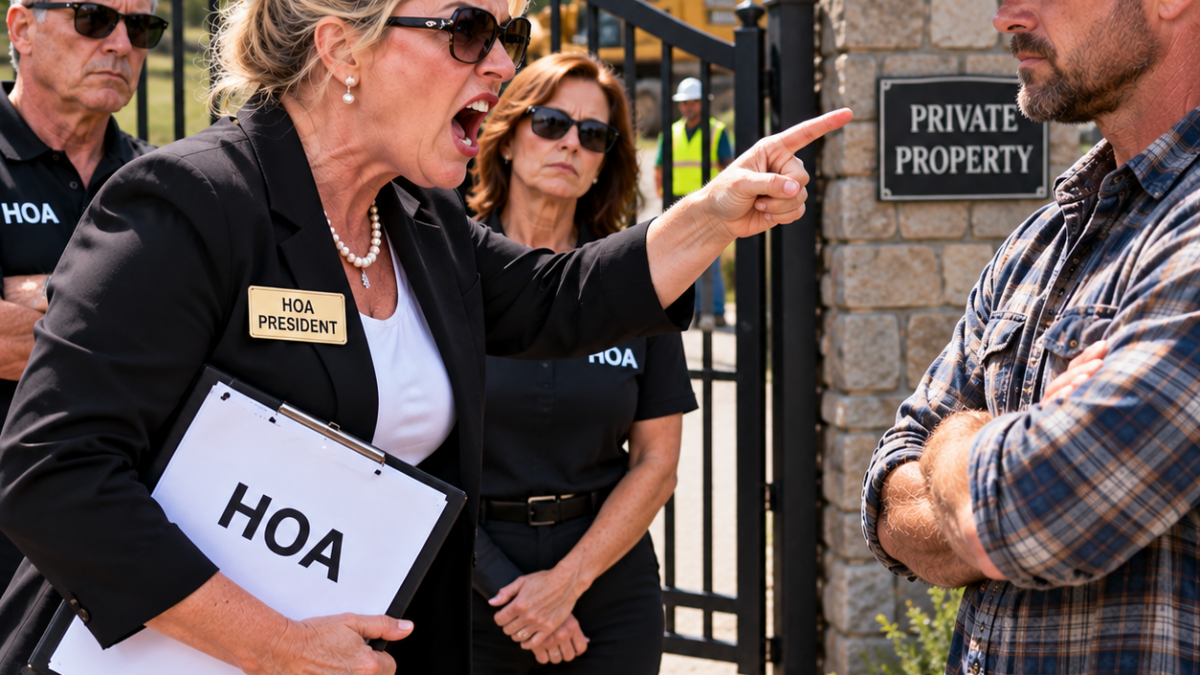
PART 2
I called Laura Bennett the next morning.
Laura was a property attorney known for access disputes, boundary conflicts, and the kind of easement language normal people only discover when someone decides to push it too far.
I brought her everything.
My deed.
Parcel map.
The HOA letters.
The purchase offer.
Videos of the blocked driveway.
Photographs of the signs.
The email where Vanessa said the HOA controlled “all roadway access serving the development.”
Laura read quietly.
Then she pushed the papers back toward me.
“Don’t celebrate yet.”
“I’m not celebrating.”
“You look like you think you caught them.”
“They offered to buy the exact strip they keep claiming to control.”
“That’s useful.”
“Useful?”
“Yes.”
“Not decisive?”
“No.”
I leaned back.
“What am I missing?”
“The road.”
“What about it?”
“You keep saying it’s yours.”
“It crosses my parcel.”
“That does not necessarily mean nobody else has rights.”
“I know there may be an easement.”
“Good.”
She tapped the deed.
“Your job is not to prove Vanessa is annoying.”
“That part is already proven.”
Laura almost smiled.
“Your job is to learn exactly what crosses your property and exactly what it allows.”
“So we survey first?”
“We survey and pull every recorded instrument.”
She called Owen Price.
Owen had been surveying land in the county for more than twenty years.
He showed up with equipment, field notes, old coordinate references, and the patience of a man who had watched neighbors argue over six inches of soil.
We started near the west boundary.
He found the old pins.
One was buried under several inches of dirt.
The other sat near the sandstone drainage edge my father and I had rebuilt when I was seventeen.
That edge mattered to me.
Not because sandstone was rare.
Because my father had laid those stones by hand.
I could still remember him kneeling in the mud, teaching me how to slope the apron so stormwater stayed out of the yard.
“Water always wins,” he told me.
“You don’t stop it. You show it where to go.”
I had repeated that advice in my own construction work for years.
Now the HOA was treating the same edge like spare ground.
Owen finished his first set of measurements.
“How much of the road is inside my parcel?”
“At the widest point?”
“Yes.”
“About thirty feet, including the shoulder near the apron.”
I looked toward Silver Creek.
“That much?”
“Yes.”
Vanessa arrived while we were still marking.
“A survey doesn’t cancel established access.”
I looked at her.
“I didn’t say it did.”
“You’re staking a community road like you intend to close it.”
“I’m staking my boundary.”
“The residents behind you have used this route for years.”
“Then there should be a recorded right.”
“There is.”
“Send it to Laura.”
Vanessa smiled thinly.
“I don’t need your permission to provide legal records to our counsel.”
“Then provide them to yours.”
She drove off.
Owen watched her leave.
“Friendly.”
“You should see her emails.”
He went back to work.
Two days later, Laura called me.
“We found it.”
“The easement?”
“Yes.”
“Good or bad?”
“Both.”
I drove to her office.
She laid a copy of the old access grant on the table.
“This is not a public road dedication.”
“I figured.”
“It is a private easement.”
“For Silver Creek?”
“Not exactly.”
She pointed to the language.
“It benefits specific parcels behind your property.”
I read the clause.
Residential ingress and egress.
That was clear.
“So the homeowners can cross.”
“Yes.”
“And I can’t block them.”
“Correct.”
I sat back.
“So Vanessa wins.”
Laura shook her head.
“Stop thinking like this is one winner and one loser.”
“She has an access right.”
“She has some access rights.”
“What’s the difference?”
“The scope.”
She turned the page.
“Read the grant again.”
I did.
Residential ingress.
Residential egress.
Nothing about commercial staging.
Nothing about development construction.
Nothing about gate installation.
Nothing about road widening.
Nothing about material storage.
Nothing about sales traffic.
It also named specific benefited parcels.
Not every future lot someone might build.
I looked up.
“That’s why you said both.”
“Yes.”
“They can drive home.”
“Yes.”
“They can leave.”
“Yes.”
“But they can’t automatically turn the road into a construction entrance.”
“Correct.”
“Or put a gate on my property.”
“Not based on what I’m seeing.”
For the first time, I understood why documenting the difference mattered.
I could not pretend the easement didn’t exist.
If I blocked the residents entirely, I would damage my own case.
Vanessa could portray me as the unreasonable property owner trying to strand a neighborhood.
So I did the opposite.
I left every lawful residential trip alone.
Cars went through.
Residents went to work.
Parents took children to school.
Nobody was stopped.
I documented only the expansion.
Dump trucks.
Excavators.
Concrete deliveries.
Landscaping trailers.
Construction vehicles.
Sales traffic.
One Saturday, a white sales van crossed my property six times during an open house.
Six.
I logged every trip.
Vanessa emailed:
**Construction activity supports the residential use of the community and is therefore consistent with access operations.**
Laura read the message.
“Save it.”
“I save everything.”
“Good.”
“What do you think?”
“I think she’s trying to turn residential access into a much broader concept.”
“Can she?”
“That’s what a neutral decision maker may have to answer.”
The answer to Vanessa’s persistence came from a county planning packet.
Laura found it while reviewing Silver Creek’s Phase Two expansion.
The concept plan showed dozens of future homes.
Their traffic flowed toward my driveway.
The map labeled the area beside my property as:
**COMMUNITY MAIN ENTRANCE**
I stared at it.
“They designed Phase Two around this.”
“Yes.”
“They assumed they’d control my strip.”
“Yes.”
“Before buying it.”
“That appears to be what happened.”
A second route existed farther east.
But it crossed wet ground.
Using it required more grading.
A longer drainage structure.
Additional engineering.
More money.
More time.
My narrow strip was cheaper.
Suddenly, the low purchase offer made sense.
The HOA did not just want convenience.
It needed certainty.
Its new project financing assumed dependable access.
I called Vanessa.
“You planned Phase Two around my driveway.”
“The plan reflects existing circulation.”
“You’re feeding new development traffic through a residential easement.”
“The easement serves the community.”
“No. It serves identified parcels.”
“That language is decades old.”
“So is the right you keep claiming.”
“Neighborhoods evolve.”
“Property grants don’t expand because construction costs go up.”
She went quiet.
Then:
“The purchase offer solves all of this.”
There it was.
“Does it?”
“Yes.”
“You block my driveway repeatedly.”
“We manage traffic.”
“You put signs on my land.”
“They support operations.”
“You tell contractors they can use my apron.”
“They’re servicing the development.”
“Then you offer to buy the strip at a discount and say accepting will end the friction.”
“No one is pressuring you.”
I almost laughed.
“No?”
“No.”
“Then stop blocking my driveway while negotiations are open.”
“That is unrelated.”
“Put that in writing.”
She did.
That afternoon she sent the email that became one of the most important pieces of the entire case.
**Silver Creek HOA controls all roadway access serving the development and will proceed accordingly.**
I forwarded it to Laura.
Her response contained three words.
**Keep that email.**
Owen returned to survey the proposed gate location.
By then, the HOA had circulated renderings for a new controlled entrance.
Steel swing arm.
Camera.
Keypad.
Wider vehicle lane.
Landscape walls.
According to their site plan, it was all community property.
According to Owen’s stakes, it was not.
He marked the western footing.
“Inside your line.”
“How far?”
“Several feet.”
Then the eastern footing.
“Also inside.”
I stared at the layout.
“So most of the structure is mine?”
“The ground beneath it, yes.”
Vanessa showed up with the project manager.
“Your stakes conflict with the approved site plan.”
Owen shrugged.
“Then the site plan should be checked against the recorded boundary.”
“The county approved the project.”
Laura, who had come to document the location, stepped forward.
“A site plan is not a deed.”
Vanessa looked at her.
“Our counsel is aware of Mr. Mercer’s position.”
“Good.”
Laura photographed the stakes.
“Then if construction continues, everyone will know the boundary was disputed before concrete went into the ground.”
That sentence should have stopped the project.
It didn’t.
Two mornings later, I heard a concrete saw.
I was still drinking coffee.
I stepped outside and saw white spray paint beside the driveway.
Two square footing marks.
A crew was unloading an auger.
I walked down with my phone recording.
“Who authorized drilling here?”
The foreman held up a laminated plan.
“Silver Creek HOA.”
“May I see that?”
He hesitated.
Then handed it over.
The map shaded my strip the same color as HOA common property.
I photographed the entire page.
Revision date.
Approval block.
Project title.
Everything.
Vanessa arrived within fifteen minutes.
“You had weeks to cooperate.”
“Cooperate with what?”
“The entrance project.”
“You mean the gate you’re putting on my land.”
“The approved plan places it within association access.”
“No.”
I pointed at Owen’s stakes.
“The recorded boundary places it inside my parcel.”
“Our site plan controls the construction.”
“That is not how title works.”
“Daniel, this entrance serves hundreds of people.”
“So move it onto land you control.”
“That would require redesign.”
“Then redesign.”
She stared at me.
“You’re willing to delay an entire project over several feet?”
“No.”
I looked toward the crew.
“You’re willing to take several feet because redesign costs money.”
Her face hardened.
Laura arrived before the auger bit touched soil.
She handed the foreman a copy of Owen’s survey and my written objection.
“We are formally putting you on notice.”
The crew stopped.
The foreman called his project manager.
We waited.
Ten minutes.
Twenty.
Then he came back.
“We’ve been told to proceed.”
Laura looked at him.
“By whom?”
“Project management.”
“After receiving the boundary survey?”
“Yes.”
Vanessa folded her arms.
“Counsel knows there is a dispute. The board cannot freeze the entire project.”
That was the exact moment the case changed.
Before that, Vanessa could argue error.
Outdated map.
Conflicting survey.
Misunderstanding.
Now everyone had notice.
They proceeded anyway.
I did not stand in front of the machine.
I did not touch the auger.
I did not threaten anyone.
I stepped back and filmed.
The auger entered the soil.
The first footing trench cut beside my father’s sandstone drainage edge.
Then an excavator bucket caught one of the flat stones.
I heard it crack.
The sound was small.
Almost nothing against the engine noise.
But I felt it.
The operator tossed the broken piece beside the trench.
I walked over.
“That stone was part of the drainage edge I warned you about.”
The foreman looked uncomfortable.
“We can replace it.”
“No.”
I picked up one fractured piece.
“You can put another stone there.”
“What’s the difference?”
“My father put this one there.”
He stopped talking.
I photographed the damage.
Then put the broken piece into the toolbox in my truck.
By afternoon, concrete surrounded two steel posts.
The next day brought conduit.
Camera wiring.
A keypad.
Lane markings.
The gate rose higher.
Every hour it stood there made Vanessa more confident.
Every hour it stood there gave me more evidence.
Laura kept digging through the original easement file.
Then she found a paragraph we had overlooked.
It did not cancel the easement.
It did something more precise.
It allowed the burdened property owner to seek limits if use expanded materially beyond the easement’s residential purpose.
Laura called me immediately.
“This is important.”
“Good important?”
“Yes.”
“How good?”
“You have an easement you must respect.”
“I know.”
“But the grant anticipates overburden.”
“Meaning?”
“Meaning the original document itself recognizes there are limits.”
I sat in my office.
“So construction staging matters.”
“Yes.”
“The gate.”
“Yes.”
“Phase Two traffic.”
“Yes.”
“Commercial deliveries.”
“Yes.”
“And narrowing my driveway.”
“Yes.”
I looked out the window.
The new steel gate cast a shadow across the apron.
“Then file.”
“Not yet.”
“Why?”
“I want the financing records.”
I sighed.
“You enjoy making me wait.”
“I enjoy filing strong cases.”
“What are you looking for?”
“Why they’re willing to take this risk.”
She found it.
The Phase Two loan documents treated the entrance through my property as secured, dependable access.
Not uncertain access.
Not limited residential ingress.
Secured project access.
The lender had apparently assumed the road problem had been solved.
A redesign using the eastern route would increase costs and potentially delay draws.
Suddenly, Vanessa’s behavior became understandable.
Not justified.
Understandable.
She was dealing with residents complaining about construction traffic.
A development schedule.
A lender deadline.
A more expensive alternate route.
And the possibility that additional costs could produce another assessment.
When I confronted her, she didn’t deny it.
“I’m trying to keep heavy construction vehicles out of occupied streets.”
“I understand.”
“And avoid an assessment.”
“I understand that too.”
“Then why are you acting like I’m some villain?”
“I’m not.”
“You clearly are.”
“No.”
I looked at her.
“I understand the problem.”
She waited.
“Your problem still doesn’t give you my land.”
She looked away.
That was the difference between us.
Vanessa believed a sufficiently important community need could stretch the meaning of an old easement.
I believed important needs required better agreements.
Laura filed for relief.
Trespass.
Easement overburden.
Interference with use of my driveway.
Property damage.
Improper construction beyond the grant.
We did not ask the court to erase residential access.
That was critical.
Existing homeowners could still pass.
I had never prevented them.
The claim targeted only the additional burden.
Owen returned and restaked the property line in bright markers.
By then, almost the entire new gate structure stood inside my recorded parcel.
County Inspector Mark Ellis arrived.
He compared the approved plan.
Then Owen’s stakes.
Then the construction.
“This permit set does not match the boundary marked in the field.”
Vanessa became angry.
“You cannot shut down a neighborhood entrance because one owner disputes a survey.”
Mark held up one hand.
“I’m not deciding ownership.”
“Then you have no basis—”
“I’m stopping work that conflicts with the plan under review.”
The gate went dark.
That afternoon I placed a temporary barrier across only the widened construction lane.
Not the residential passage.
Cars still passed through the lawful easement.
Residents came and went.
But dump trucks stopped.
Concrete deliveries stopped.
Sales tours turned around.
Phase Two construction slowed.
Vanessa called law enforcement when one contractor refused to cross my barrier.
A deputy arrived.
He looked at my deed.
Owen’s survey.
The stakes.
The recorded easement.
Laura’s notice.
Then the barrier.
“Residents can still get through?”
“Yes.”
“You’re blocking only the added lane?”
“Yes.”
He looked at Vanessa.
“This appears to be a civil boundary dispute.”
“The HOA controls the road.”
He looked again at the easement.
“This grant does not show the expanded lane.”
No arrest.
No dramatic confrontation.
No one was dragged away.
The deputy left.
And somehow that was worse for Vanessa.
Because she could not turn me into the problem.
The HOA’s own attorney finally compared the financing package with the easement language.
The mismatch was obvious.
The lender had been promised access broader than the recorded instrument granted.
Funding paused.
The lender requested a revised access plan.
That triggered an emergency HOA board meeting.
For the first time, Vanessa was not controlling the questions.
Board members wanted to know who approved the gate revision after receiving Owen’s survey.
One member asked:
“Did counsel tell us the boundary was confirmed?”
Silence.
Another asked:
“Were we advised to wait?”
The minutes from an earlier meeting answered that.
Counsel had recommended boundary confirmation before permanent construction.
Vanessa had chosen to proceed.
Why?
Schedule.
Traffic management.
Financing.
Cost.
She said:
“I chose the route that protected the project and kept construction vehicles out of occupied streets.”
It was not a malicious explanation.
That mattered.
I didn’t want to turn her into a cartoon villain.
She was a board president facing a difficult problem.
She made a dangerous mistake.
She decided my property rights were the easiest problem to ignore.
By evening, the gate was shut off.
The next step was court.
Judge Evelyn Hart handled the hearing.
Laura warned me before we walked in.
“Do not act like the easement is fake.”
“I won’t.”
“Do not say the road is entirely yours to close.”
“I won’t.”
“Do not make this about Vanessa.”
“I won’t.”
“What is this about?”
“The scope.”
“Good.”
The HOA’s attorney began with history.
Residents had used the road for years.
The route served real homes.
The community depended on it.
The development needed controlled access.
Construction traffic needed management.
Judge Hart listened.
Then Laura stood.
“We are not asking to erase residential access.”
The judge looked toward me.
“Mr. Mercer agrees the easement exists?”
“Yes, Your Honor.”
“And existing benefited residents may continue lawful ingress and egress?”
“Yes.”
The HOA attorney looked slightly disappointed.
A large part of his emotional argument disappeared.
Laura continued.
“The issue is what happened after the association converted residential passage into development staging and placed permanent gate infrastructure outside the easement footprint.”
Owen testified.
He showed the recovered monuments.
The property line.
The old grant.
The new gate.
Nearly all of the structure stood within my parcel.
Then came the traffic logs.
Dump trucks.
Material deliveries.
Sales vehicles.
Excavators.
Temporary staging.
Judge Hart looked at the easement.
“Residential ingress and egress.”
“Yes.”
She looked at the HOA attorney.
“Where is construction staging granted?”
He argued that supporting residential development was reasonably connected to the benefited use.
Judge Hart asked:
“Existing residences or future expansion?”
The room went quiet.
He answered carefully.
“Both.”
“Show me where future phases are included.”
He couldn’t.
Then came Vanessa’s email.
**Silver Creek HOA controls all roadway access serving the development and will proceed accordingly.**
The judge read it.
Then the boundary notice.
Then the date the concrete was poured.
“You had the survey before permanent installation?”
Vanessa answered.
“Yes.”
“Did you know Mr. Mercer objected?”
“Yes.”
“Did you know his attorney had provided the boundary materials to the contractor?”
“Yes.”
“Why proceed?”
“We believed the association’s historic access rights were broad enough, and stopping construction would have significantly disrupted Phase Two.”
Judge Hart nodded.
“So you proceeded because delay was expensive.”
Vanessa hesitated.
“That is part of it.”
“Expense does not define the scope of an easement.”
“No, Your Honor.”
Then the cracked sandstone came up.
Laura did not dramatize it.
She didn’t need to.
Photograph before construction.
Photograph after.
A piece removed.
Drainage edge altered.
I testified briefly.
“My father and I built that edge together.”
Judge Hart looked at me.
“Are you asking for sentimental damages?”
“No.”
“What are you asking for?”
“For the drainage to be restored properly, and for the court to recognize that the HOA had notice before disturbing it.”
That answer mattered.
I was not asking a court to price a memory.
I was asking the record to show what happened.
The judge ruled that the easement was valid.
That was no surprise.
Existing residential passage remained.
But she also ruled that the grant was limited by its purpose.
The HOA could not use my strip for Phase Two staging.
It could not occupy additional land for the widened lane.
It could not keep the gate hardware on my parcel without a separate agreement.
It could not treat the easement as ownership.
The order left lawful residential ingress and egress intact.
It rejected the added burden.
The HOA had two choices.
Redesign Phase Two around the alternate route.
Or negotiate.
After the hearing, Vanessa stood outside with her attorney.
I walked past.
She called my name.
“Daniel.”
I stopped.
“You got the ruling.”
“Yes.”
“You know redesign will cost the neighborhood.”
“I know.”
“Then negotiate.”
“I’m willing.”
She seemed surprised.
“You are?”
“Yes.”
“For the strip?”
“Possibly.”
Her shoulders lowered slightly.
“Then we can solve this.”
“After you remove the gate.”
Her expression changed.
“Daniel.”
“You built it after notice.”
“Removing it just to rebuild something later is wasteful.”
“No.”
I pointed toward the project entrance.
“Leaving it there tells everyone you can take first and negotiate later.”
“That isn’t what happened.”
“It is exactly what happened.”
“You know the project needs access.”
“Then the project can buy access.”
She looked tired.
“What do you want?”
“Restore my driveway.”
“Then?”
“Then you can make an offer.”
“That’s just punishment.”
“No.”
I looked at her.
“It’s the order things should have happened in the first place.”
Permission.
Then construction.
Not construction.
Then pressure.
The lender settled the question.
It would not fund unresolved access.
The HOA accepted removal.
I stood beside the driveway the morning contractors came back.
This time they were not building.
They cut through the steel posts.
Lifted the gate sections.
Removed the camera equipment.
Pulled conduit.
Broke out the concrete.
A structure Vanessa once told me proved who controlled the road disappeared piece by piece.
I felt less satisfaction than I expected.
Mostly relief.
For weeks, every time I looked outside, that gate had felt like a declaration.
Someone else had decided my property was negotiable because their deadline mattered more.
Now the declaration was gone.
Workers rebuilt the apron.
They reset the drainage.
Owen checked the finished grade.
Water flowed correctly again.
But the sandstone edge could not be made exactly what it was.
A replacement stone went where the broken one had been.
It looked good.
Better than good.
Nobody else would have noticed.
I noticed every morning.
The original fragment stayed in my workshop.
Not displayed.
Not framed.
Just on a shelf.
A reminder.
Some damage can be repaired without becoming original again.
The final survey pin sat beside the driveway.
Tiny metal cap.
Easy to miss.
That little pin had more authority than every glossy HOA map Vanessa ever brought me.
The board meeting after the gate removal changed Silver Creek.
I didn’t attend.
Laura did not need me there.
The minutes came later.
Board members questioned why permanent construction had continued after formal boundary notice.
Why the site plan showed my parcel as common property.
Why the financing documents treated disputed access as secured.
Why Vanessa ignored counsel’s earlier recommendation to verify the line.
The board reorganized.
Vanessa lost the presidency.
She stayed involved long enough to complete transition work, but the title was gone.
When someone told me, they expected a reaction.
“You must feel vindicated.”
I thought about it.
“Not really.”
“No?”
“The gate is gone.”
“Isn’t that vindication?”
“That’s correction.”
They looked confused.
I understood why.
People like stories where the person who pushes too far gets dramatically punished.
But I did not need Vanessa ruined.
I needed the behavior stopped.
There is a difference.
A few weeks later, the HOA returned.
This time there was no SUV across my driveway.
No cones.
No security guard.
No sign.
No contractor.
Two board members came with their new attorney.
They called first.
Asked for a meeting.
Then arrived on time.
We sat at my kitchen table.
Their attorney placed a folder in front of me.
“Proposal for a new easement.”
I opened it.
Defined width.
Defined purpose.
Existing homes.
Future Phase Two traffic.
Construction period.
Maintenance obligations.
Drainage protection.
Gate location.
Compensation.
Market appraisal.
Indemnity.
No vague phrase like “community access.”
Everything had a meaning.
I looked up.
“This is very different.”
One board member nodded.
“It needed to be.”
“What changed?”
He smiled tiredly.
“We learned what a deed is.”
I laughed despite myself.
The offer was not insulting.
It was market-based.
Negotiable.
The HOA wanted a broader access right because the alternate route remained expensive.
That was fine.
They were allowed to want it.
Wanting is not owning.
Negotiation is what happens between those two things.
I did not accept immediately.
I hired my own appraiser.
Laura reviewed every word.
Owen marked the proposed strip.
We adjusted the gate location completely off my driveway apron.
We protected the drainage.
Construction staging had time limits.
Phase Two traffic had defined limits.
The HOA would pay.
Not because I had trapped them.
Because rights have value.
Vanessa called me once during that process.
She was no longer president.
The conversation felt strange.
“I heard you’re negotiating.”
“Yes.”
“So you were never actually opposed to the entrance.”
“No.”
She was silent.
“Then what was all of that for?”
I almost laughed.
“You still don’t understand?”
“I understand you believed the board exceeded its rights.”
“That was all of it.”
“But now you may give them the right.”
“Yes.”
“For money.”
“For an agreement.”
“What’s the difference?”
“Everything.”
I sat back.
“If someone walks into your house and takes your chair, that’s one thing.”
She didn’t respond.
“If they ask whether you want to sell the chair, that’s another.”
“That’s not a perfect analogy.”
“No.”
“But you understand it.”
Silence.
Then:
“I thought stopping the project would hurt three hundred families.”
“I know.”
“I thought you were being rigid.”
“I know.”
“And maybe I thought if the gate was already built, you’d eventually accept it.”
That was the first time she had said it plainly.
I looked toward the survey pin.
“There.”
“What?”
“That was the mistake.”
She didn’t argue.
After a moment she said:
“I should have stopped when the survey came in.”
“Yes.”
“I should have negotiated before construction.”
“Yes.”
“I’m sorry about the stone.”
That surprised me more than anything else.
“You remember that?”
“Yes.”
“I assumed you thought it was irrelevant.”
“I did.”
“And now?”
She exhaled.
“I understand that because something has low replacement cost doesn’t mean it has low value.”
For the first time, I believed she understood what had happened beyond the legal case.
“Thank you.”
“That’s all?”
“That’s enough.”
We ended the call.
Months later, Phase Two restarted.
Not through an assumed right.
Through an agreement.
The new entrance was built farther from my driveway.
The gate stood on land properly covered by the new easement.
Not an inch outside it.
Owen checked the footing locations before concrete.
I was there.
So was the HOA’s engineer.
No one seemed offended by verification anymore.
That amused me.
The process Vanessa once described as obstruction took less than an hour.
Measure.
Confirm.
Sign.
Build.
No court.
No deputy.
No angry emails.
No driveway blockages.
No one pretending a site plan was a deed.
The lender released funds.
Construction resumed.
And because the easement clearly defined Phase Two use, nobody had to argue about whether a cement truck counted as residential ingress.
It didn’t need to.
The right now existed.
I was paid fairly.
Silver Creek got certainty.
Residents got the entrance.
The project moved forward.
My driveway stayed open.
That was the solution available from the beginning.
All it required was permission.
One evening, after the new gate had been operational for several weeks, I stood beside the sandstone edge with a garden hose.
A storm earlier that day had sent runoff down the road.
The drainage worked exactly as my father designed it.
Water followed the shallow line away from the driveway.
Past the replacement stone.
Toward the ditch.
My daughter Claire came outside.
She was nineteen by then, home from college for the weekend.
“What are you staring at?”
“Water.”
“Exciting.”
“You’d be surprised.”
She looked at the drainage.
“That the part Grandpa built?”
“Yeah.”
“Which stone did they break?”
I pointed.
“That one.”
She stared.
“Looks the same.”
“It isn’t.”
She looked at me.
“I mean, it looks fine.”
“It is fine.”
“So why do you keep the broken piece?”
I looked toward the workshop.
“You know about that?”
“Mom told me.”
I smiled.
“Of course she did.”
Claire sat on the low wall.
“Is it like a trophy?”
“No.”
“Evidence?”
“Not anymore.”
“Then why?”
I thought about it.
“Because I almost let myself believe something had to be expensive before I was allowed to care about losing it.”
She frowned.
“That sounds depressing.”
“Maybe.”
“The gate thing really bothered you, didn’t it?”
“More than I expected.”
“Because they were on your land?”
“Partly.”
“What was the rest?”
I looked down the road.
Cars moved quietly through the legal residential easement.
Nobody stopped them.
Nobody should.
“It was the way they kept acting like asking me would somehow make their project weaker.”
Claire waited.
“They had a real problem. Instead of negotiating, they treated my permission like an inconvenience.”
She nodded slowly.
“So the lawsuit was about respect.”
“Property law is a very expensive way to learn manners.”
She laughed.
“That sounds like Grandpa.”
“Probably where I got it.”
We sat there as evening settled over the road.
The whole case had changed the way I thought about boundaries.
Before Silver Creek, I thought boundaries were lines separating people.
My property.
Your property.
My responsibility.
Yours.
Afterward, I realized good boundaries often make cooperation possible.
The old easement worked because it was clear.
Residents had a right to cross.
I had a duty not to interfere with that right.
No resentment needed.
The problem came when people stopped respecting the limits that made the arrangement fair.
Vanessa saw the existing access and treated it like expandable authority.
First service signs.
Then contractors.
Then blocked driveway.
Then construction traffic.
Then a low purchase offer.
Then a wider lane.
Then a gate.
No single step looked enormous by itself.
Together they became something the old easement never contemplated.
That was why Laura kept using the word **overburden**.
At first, it sounded technical.
Eventually, I understood how accurate it was.
They did not erase the original right.
They loaded more and more onto it until the burden became something else.
That is how many property disputes happen.
Not with someone showing up and saying:
“I’m taking your land.”
It starts with:
“It’s only temporary.”
“It serves the community.”
“It has always been used this way.”
“The board approved it.”
“The contractor already scheduled the work.”
“The deadline is tomorrow.”
“The site plan shows it.”
“Everyone benefits.”
Every sentence sounds reasonable.
Until someone asks:
“What does the recorded right actually say?”
That question saved me.
Not anger.
Not threats.
Not confrontation.
Documentation.
When the first truck blocked me, I wanted to lose my temper.
When I missed the grading estimate, I wanted to park equipment across the road and make everyone else suffer the inconvenience I was experiencing.
Laura stopped me.
“Do not interfere with lawful access.”
At the time, that felt unfair.
Why should I have to be disciplined while Vanessa kept pushing?
Later, I understood.
Restraint gave the court a clean problem.
Residents could pass.
Construction traffic could not assume unlimited rights.
My driveway remained mine.
The HOA’s expansion became easy to see.
If I had blocked everyone, the dispute would have turned into two parties misbehaving.
Instead, the record showed one side using the easement as written and one side stretching it.
That distinction carried the case.
I kept the videos after everything ended.
Not all of them.
Most were eventually archived.
But I saved a few.
The first cones.
The truck blocking the apron.
Vanessa’s SUV at 7:12.
The survey stakes.
The auger beginning the footing.
The cracked stone.
The gate test.
Then the removal.
Sometimes I watch the first video and barely recognize how calm I sound.
“Move the SUV, Vanessa.”
She answers:
“This access is under HOA control now.”
At the time, that sentence made me furious.
Now it almost makes me sad.
Because she believed it.
That is the danger.
People imagine overreach requires dishonesty.
Sometimes it does.
Other times, the person crossing the line genuinely believes the importance of their goal gives them authority.
Vanessa wanted to prevent construction trucks from clogging occupied streets.
Reasonable.
She wanted to avoid a costly alternate route.
Reasonable.
She wanted to keep Phase Two financing on schedule.
Reasonable.
She wanted to limit another assessment.
Reasonable.
None of those things gave her title.
A good objective does not create a property right.
That principle became part of Silver Creek’s new board policy.
I know because they sent me a copy.
Before any capital project used privately burdened land, the association had to verify:
The current deed.
The underlying easement.
The precise benefited parcels.
The purpose.
The width.
Any expansion.
And written consent where needed.
A board member joked later:
“We call it the Mercer Rule.”
I said:
“Please don’t.”
He laughed.
“Too late.”
I didn’t want my name on anything.
What mattered was the next person.
The next homeowner with an old access road.
The next contractor handed a misleading plan.
The next board president facing a deadline.
Maybe someone would stop before pouring concrete.
That was enough.
Vanessa moved out of leadership quietly.
She was not driven from the neighborhood.
I did not want her ostracized.
She had friends there.
Years of volunteer work.
People who respected things she had accomplished before this dispute.
That was fine with me.
A person can make a serious mistake without every previous good act becoming meaningless.
The lesson loses something if the ending requires turning one human being into a monster.
Vanessa was not a monster.
She was a person under pressure who convinced herself that procedure could catch up after construction.
It couldn’t.
She built first.
The law made her go backward.
Remove.
Restore.
Negotiate.
Rebuild properly.
That was the consequence.
And frankly, it was enough.
About a year after the case, I was working beside the driveway when Vanessa drove through the new legal gate.
She stopped.
Rolled down the window.
“Still recording everything?”
I smiled.
“Not everything.”
“Progress.”
“You asking before stopping?”
She laughed.
“More progress.”
We both looked toward the old driveway.
No cones.
No signs.
No SUV.
The survey pin still sat near the edge.
“You kept the pin visible,” she said.
“Yes.”
“I notice it every time.”
“Good.”
She shook her head.
“I knew you’d say that.”
Then she drove on.
That might have been the most satisfying moment of the entire story.
Not because I had power over her.
Because nobody needed power anymore.
The rules were clear.
The gate was where it belonged.
The easement said what everyone could do.
The driveway stayed open.
Normal life had returned.
That was all I had wanted.
The next spring, heavy rain came through.
Water rushed down the road.
I stood outside longer than necessary, watching the drainage edge.
The replacement stone held.
The old stones held.
The water followed the path my father and I laid all those years ago.
I could almost hear him complaining about how poorly I used a shovel.
He would have hated the whole HOA dispute.
Not because he disliked neighborhoods.
He didn’t.
Because he believed in plain agreements.
“Say what you mean.”
“Mark the line.”
“Keep your word.”
Very simple principles.
We complicated them with plans, financing, legal opinions, email chains, traffic studies, and construction schedules.
Eventually, the court brought everything back to something simple.
The easement was real.
The easement was limited.
My property was still my property.
The HOA could not make the right larger just because a larger right was useful.
I still keep the broken sandstone fragment.
Claire says I’m sentimental.
She’s right.
One day I may put it back into the edge somewhere.
Not because it would perform a structural function.
Because it belongs there.
Or maybe I’ll leave it in the workshop for whoever owns this place after me.
A reminder that lines on paper matter because real people live around them.
The strip Vanessa wanted was never large.
Thirty feet at the widest point.
A narrow shoulder.
A driveway apron.
From an aerial map, almost nothing.
But small pieces of land can control enormous decisions.
That strip affected traffic.
Development cost.
Lender risk.
Construction timing.
Three hundred homes.
My business.
My daily access.
My family history.
That is why property rights can seem irrational until you look closely.
People say:
“It’s only a few feet.”
Sometimes those few feet are the entire issue.
The HOA eventually got broader access.
But only after paying for it.
Only after defining it.
Only after protecting my driveway.
Only after removing the gate it had installed without permission.
That sequence matters.
Some residents told me the final agreement proved the lawsuit had been unnecessary.
“If you were willing to sell access anyway, why not do it at the beginning?”
I always gave the same answer.
“I was willing at the beginning.”
What I was not willing to do was negotiate while my driveway was being used as leverage.
There is no fair bargain when one side is already taking the thing it wants.
Remove the pressure.
Restore the boundary.
Then negotiate.
That was why I insisted the gate come down first.
Not vengeance.
Reset.
Once we were both standing on lawful ground, we could make a deal.
And we did.
The Phase Two homes were eventually completed.
Families moved in.
Children rode bikes.
Moving trucks came through under the new agreement.
I didn’t resent them.
Why would I?
They had nothing to do with the dispute.
Most of them never knew the history.
They just knew there was a gate at the entrance and a ranch beside it.
Sometimes that anonymity felt strange.
A huge conflict in my life became invisible infrastructure in theirs.
Maybe that is the healthiest outcome.
Good legal agreements should disappear into everyday life.
Nobody thinks about the easement now because it works.
No one needs to argue about width.
The survey controls.
No one needs to argue about gate location.
The agreement controls.
No one needs to argue about construction traffic.
Phase Two is finished.
No one blocks my driveway.
Ever.
That last part became an unwritten rule as much as a written one.
A contractor once parked partly across the apron after the new development opened.
He was unloading landscaping equipment.
Before I could walk outside, a Silver Creek board member came over and told him to move immediately.
The contractor apologized.
I said:
“It’s fine.”
The board member looked at me.
“No.”
“What?”
“It’s not fine.”
He pointed at the driveway.
“That stays open.”
I smiled.
“You read the file.”
“Everyone on the board reads the file.”
That made my day.
Because the real victory was not that Silver Creek became afraid of me.
It was that the board learned to respect something it once treated as negotiable after the fact.
Years later, the original survey pin still stands beside the apron.
People miss it.
It is not dramatic.
No plaque.
No sign.
No warning.
A small metal cap.
But every time I walk past it, I remember the morning Vanessa told me I needed another entrance.
I remember the gate standing behind her.
I remember raising my phone and asking her to put her claim in writing.
At the time, I thought the story was about who controlled the road.
It wasn’t.
It was about the difference between use and ownership.
Between access and control.
Between convenience and consent.
Between a plan and a deed.
Between pressure and agreement.
Vanessa spent weeks trying to prove the HOA controlled my driveway.
In the end, the gate itself proved the opposite.
Because once the boundary was actually measured, nearly the whole structure stood where the HOA had no right to place it.
The steel was removed.
The concrete was removed.
The camera was removed.
The road stayed.
The residential easement stayed.
The neighborhood stayed.
My driveway stayed.
That is the part people sometimes miss in stories like this.
Winning did not mean everyone else lost.
Silver Creek residents kept their lawful access.
The HOA eventually got the broader access it genuinely needed.
The developer finished Phase Two.
I received fair compensation.
My driveway remained protected.
The new gate ended up exactly where a valid agreement allowed it.
Everyone got something workable.
The only thing that disappeared was the assumption that the HOA could decide first and ask later.
And that was the one thing that needed to disappear.
When my father and I built that sandstone drainage edge, he told me something else I remembered only after all of this was over.
We were finishing late.
I was tired.
One stone would not sit properly.
I told him:
“No one will notice.”
He handed it back to me.
“You will.”
At seventeen, I thought he was being difficult.
Years later, looking at the replacement stone beside my driveway, I understood.
Boundaries are like that.
Maybe nobody else notices when one is moved a little.
Maybe the board calls it practical.
Maybe a contractor calls it an adjustment.
Maybe a site plan simply shades over it.
Maybe everyone else saves time.
But the person who lives there notices.
And if the line matters, noticing is enough.
I never needed Silver Creek to fear me.
I needed them to notice the line.
Today, they do.
The driveway stays open.
The water follows the old sandstone path.
The lawful residential cars pass without trouble.
The Phase Two gate operates from land covered by the agreement.
And every time I back my truck out before sunrise, nothing is sitting sideways across my apron.
No cones.
No barriers.
No HOA SUV.
Just an open road.
Exactly the way it should have been from the start.
The strange thing about getting exactly what I had fought for was how ordinary the next morning felt.
I woke before sunrise, made coffee, pulled on my work boots, and walked outside expecting some part of me to feel different.
For weeks, my driveway had been the center of everything.
Arguments.
Cameras.
Survey stakes.
Contractors.
Lawyers.
HOA vehicles.
Construction equipment.
Now there was nothing.
Just cold morning air.
My pickup.
The faint glow of Silver Creek’s streetlights farther down the road.
And an empty apron leading from my house to the roadway.
I stood there holding my coffee and realized I had forgotten how good an empty driveway could look.
Nobody was parked across it.
Nobody had placed cones there.
No temporary sign claimed service access.
No guard was waiting to tell me about an entrance that did not exist.
The new legal gate farther down the road was quiet.
It had been built only after the new easement was signed, surveyed, measured, priced, and approved.
It stood exactly where everyone agreed it could stand.
That was the part I appreciated most.
Not that Silver Creek had a gate.
Not that I had been paid.
Not that Phase Two had eventually continued.
It was the fact that every inch of the new project had begun with permission.
For months, Vanessa had treated permission like an obstacle.
Now permission was part of the foundation.
I took a slow drink of coffee and looked at the small survey pin near the sandstone edge.
That pin had outlasted the arguments.
Maybe it always would.
A week later, Laura called.
“I need you to sign the final satisfaction documents.”
“I thought we were finished.”
“We are. This is the paperwork confirming the repair reimbursements and closing out the remaining civil claim.”
“Anything surprising?”
“No.”
“That’s disappointing.”
She laughed.
“You have developed unhealthy expectations about property litigation.”
“I blame you.”
“Sign the documents, Daniel.”
I drove to her office after lunch.
There were only six pages.
Compared with the mountains of paper we had gone through, six pages felt almost insulting.
I signed where she pointed.
Then sat back.
“That’s it?”
“That’s it.”
“No hearing?”
“No.”
“No emergency board meeting?”
“No.”
“No one claims my driveway belongs to them?”
“Not today.”
I smiled.
Laura closed the folder.
“You know what I liked most about your case?”
“The videos?”
“No.”
“The survey?”
“No.”
“The email?”
“That was good.”
“Then what?”
“You didn’t overreach back.”
I looked at her.
She continued.
“A lot of people get angry when someone pushes past a boundary. Then they decide they’re entitled to push just as hard in the opposite direction. You didn’t.”
“I wanted to.”
“I know.”
“How?”
“Because everyone wants to.”
She leaned back.
“But you kept the residential easement open. That mattered.”
“I wasn’t going to trap people who had nothing to do with the board.”
“Exactly.”
“What would’ve happened if I had closed the road entirely?”
“Vanessa would have gotten the story she wanted.”
“What story?”
“Angry property owner blocks neighborhood access. Families stranded. Emergency concern. HOA forced to intervene.”
I nodded slowly.
“And instead?”
“Instead, the judge saw something cleaner.”
“The HOA expanded a limited right.”
“Yes.”
“And I objected only to the expansion.”
“Yes.”
Laura smiled.
“That’s why restraint is expensive emotionally but useful legally.”
I looked toward the folder.
“So now what?”
“Now you go back to your life.”
That answer sounded wonderful.
For a while, I did exactly that.
Work picked up.
I had delayed several grading jobs during the dispute, and autumn weather was closing in.
My days became ordinary again.
Equipment.
Estimates.
Fuel receipts.
Customers.
Mud on my boots.
The things I had once complained about felt almost comforting.
Then one Saturday morning, I heard a knock at the workshop.
Tom Avery stood outside.
He was one of the Silver Creek board members who had questioned Vanessa toward the end.
“Busy?”
“Depends.”
“That sounds dangerous.”
“What do you need?”
He held up a folder.
I stared at it.
“No.”
He laughed.
“It’s not a property claim.”
“Then why is it in a folder?”
“We’re replacing some drainage near the new gate.”
I folded my arms.
“And?”
“The contractor wants to stage one small excavator near your side for about two hours.”
“You’re asking?”
“That’s why I’m here.”
I waited.
Tom shifted.
“You’re enjoying this.”
“A little.”
He sighed.
“Daniel, may our contractor temporarily place one excavator on your side of the easement Tuesday between approximately eight and ten in the morning while they replace the culvert?”
I pretended to think.
“No.”
His face fell.
Then I smiled.
“I’m kidding.”
“You’re a terrible person.”
“Put down ground mats.”
“We will.”
“No fuel storage.”
“Fine.”
“And if they block my apron, they move immediately.”
“Agreed.”
“Then yes.”
He opened the folder.
“We drafted a temporary-access permission.”
I stared at him.
“You drafted one?”
“We’re learning.”
I read it.
One page.
Specific date.
Specific purpose.
Defined location.
Restoration obligation.
No creation of permanent rights.
I signed.
Tom took the paper back.
“That took four minutes.”
“Terrible, isn’t it?”
He laughed.
“Vanessa would hate this conversation.”
“Why?”
“Because it was easy.”
That sentence stayed with me.
Most of the disaster had happened because Vanessa believed asking would make the HOA vulnerable.
But asking had made everything easier.
Tuesday morning, the excavator arrived.
The operator parked exactly where the temporary permission allowed.
By 9:47, the work was finished.
At 9:55, the machine was gone.
No conflict.
No lawyer.
No camera footage needed.
No hard feelings.
That tiny event gave me more satisfaction than the court ruling.
Because it proved what I had said from the beginning.
Cooperation was never the problem.
Assumption was.
Winter came early that year.
One December morning, snow covered the survey pin completely.
I walked outside with a broom and cleared the driveway.
Without really thinking about it, I brushed snow away from the pin too.
Claire had come home the night before.
She stood in the doorway wrapped in a blanket.
“You know normal people don’t shovel survey markers.”
“Normal people haven’t paid Owen Price’s invoices.”
She laughed.
“You’re obsessed.”
“I prefer educated.”
“That’s what obsessed people say.”
She brought me coffee.
We stood beside the sandstone edge.
The new gate lights glowed through the snow farther down the road.
Claire looked toward it.
“Does it still bother you?”
“What?”
“The gate.”
I considered the question.
“No.”
“Really?”
“Really.”
“But it’s basically what they wanted.”
“No.”
She looked confused.
“Same road. Same neighborhood. Same Phase Two.”
“Different right.”
“Explain.”
I pointed down the road.
“The first gate was built because they believed wanting it badly enough made it theirs.”
“And the second?”
“The second exists because we made an agreement.”
“So visually it doesn’t matter.”
“Legally and morally, it matters completely.”
She looked at the snow.
“That feels like something only a property lawyer would say.”
“Laura has ruined me.”
We laughed.
Then Claire asked:
“Do you regret selling the broader easement?”
“No.”
“Not even a little?”
“No.”
“Why?”
“Because I never wanted to stop the neighborhood from functioning.”
“Then why fight so hard?”
I pointed at our driveway.
“Because if I had accepted what they did, I would have taught the next board that pressure works.”
She became quiet.
“That’s the part people don’t see.”
“No.”
“They think it was about land.”
“It was about land.”
“You know what I mean.”
I did.
The thirty-foot strip had become a question bigger than its size.
If I accepted permanent infrastructure simply because removing it would be inconvenient, then the construction itself would have become leverage.
Build first.
Make removal expensive.
Call resistance unreasonable.
Offer a small payment afterward.
That model only works if the owner gives in.
I couldn’t let it work.
Not because I believed every inch of land should be defended against every compromise.
But because compromise has to be voluntary.
That spring, the HOA held another election.
Tom called me afterward.
“Thought you might want to know.”
“What?”
“Vanessa didn’t run.”
“I figured she wouldn’t.”
“She spoke at the meeting.”
“About me?”
“Not exactly.”
“What did she say?”
Tom hesitated.
“She said the board had made serious mistakes in the access dispute and that future leadership needed to distinguish between community need and legal authority.”
I didn’t answer.
“You there?”
“Yeah.”
“I thought you’d want to hear that.”
“I appreciate it.”
“She didn’t blame you.”
“That’s good.”
“She actually said something about your records.”
“Oh no.”
Tom laughed.
“She said you forced the association to become more disciplined.”
“I’m sure she enjoyed saying that.”
“Probably not.”
After we hung up, I sat in my truck for several minutes.
There had been a time when I wanted Vanessa to admit she was wrong.
I imagined it would feel like some dramatic final victory.
By the time it happened, I no longer needed it.
Maybe that was why the news felt peaceful instead of triumphant.
A year passed.
Then another.
The development matured.
Phase Two stopped looking like a construction zone and started looking like a neighborhood.
Young trees appeared along sidewalks.
Fresh lawns lost their perfect shape.
Garages filled with bicycles and storage bins.
Children waited for school buses near the entrance.
All the things people do after contractors leave and a place becomes home.
Most new residents had no idea their main entrance had once been the center of a property dispute.
One morning, a man from Phase Two stopped while I was checking my mailbox.
“You Daniel Mercer?”
I immediately became suspicious.
“Why?”
He laughed.
“Nothing bad.”
“That’s exactly what people say before something bad.”
“My name’s Aaron. I live on Willow Bend.”
“Okay.”
“I heard you’re the reason the entrance got moved.”
“That depends on who told you.”
“My neighbor.”
“What did he say?”
“That the HOA built the first gate on your land and you made them tear it down.”
“That’s the short version.”
Aaron looked toward my driveway.
“I thought you shut down the road.”
“No.”
“Seriously?”
“Existing residents kept crossing the whole time.”
He frowned.
“That’s not how I heard it.”
“I’m shocked.”
He laughed.
“People said you almost killed Phase Two.”
“Phase Two is behind you.”
“Fair point.”
“What do you actually want to know?”
He hesitated.
“My wife and I bought one of the houses because the development brochure promised controlled access. I guess I wanted to know whether you hate us for benefiting from the new easement.”
That question surprised me.
“No.”
“Really?”
“You didn’t build a gate on my driveway.”
“No.”
“You didn’t send me a lowball offer.”
“No.”
“You didn’t block my truck.”
“No.”
“Then why would I hate you?”
He shrugged.
“Neighborhood politics.”
“Life’s too short.”
He nodded.
“Thanks.”
As he turned away, I said:
“Aaron?”
“Yeah?”
“If anyone tells you I tried to close the residential road, ask them to show you when.”
He smiled.
“You still have the video, don’t you?”
“All of it.”
He laughed and walked away.
That exchange reminded me of something else the case had changed.
Documentation does not just protect you in court.
It protects your own memory.
Conflict distorts things.
People retell events.
Small facts disappear.
Motives get assigned.
Arguments become cleaner than they ever were.
Video freezes reality.
At 7:12, Vanessa’s SUV blocked my driveway.
That was true.
No interpretation required.
The gate footings were inside Owen’s staked line.
True.
The contractor received notice before drilling.
True.
Residents remained able to pass.
True.
Those facts kept the story from becoming whatever anyone needed it to become later.
I began using the same discipline in business.
Not obsessively.
But better.
Written change orders.
Photographs before grading.
Marked utility routes.
Customer approvals.
One employee joked:
“Silver Creek traumatized you into becoming organized.”
He wasn’t entirely wrong.
A few years later, my mother decided to sell her house.
While helping clean the garage, I found one of my father’s old toolboxes.
Inside were rusty drill bits, nails, a level, two broken tape measures, and a small notebook.
I almost threw the notebook into a box without opening it.
Then I recognized his handwriting.
Measurements.
Material lists.
Drainage notes.
On one page was a crude sketch of my driveway.
The sandstone edge.
The slope.
The water path.
And beside it, in his handwriting:
Keep west edge clear. Access must never block drainage.
I sat down on the garage floor.
My father had been dead years.
Yet there he was again.
Not in some profound letter.
Not in a speech.
A construction note.
Practical.
Plain.
Completely him.
I ran my thumb across the page.
For weeks after the HOA broke that sandstone, I had wondered whether I was being foolish for caring.
Maybe it was just a stone.
Maybe everyone else was right.
Maybe memory had made it more important than it deserved to be.
That notebook settled something in me.
The edge mattered to him too.
Not sentimentally.
Functionally.
He built it carefully because the water path mattered.
The HOA crew had not just broken a random decoration.
They damaged part of a drainage system he had intentionally built.
I brought the notebook home.
Claire looked through it.
“You’re definitely framing this.”
“No.”
“You framed my kindergarten drawing.”
“That was art.”
“It was a purple horse.”
“Masterpiece.”
She laughed.
Then pointed at the driveway sketch.
“You should put this in the workshop with the broken stone.”
So I did.
Not as a monument to the dispute.
As a reminder of what existed before the dispute.
That difference became important.
I didn’t want the HOA case to become the defining story of the property.
My father had lived there before Silver Creek.
I had grown up there.
Claire had grown up there.
We had birthdays.
Storms.
Workdays.
Arguments.
Christmas mornings.
Dogs buried under the maple tree.
Broken equipment repaired at midnight.
Hundreds of ordinary memories.
Vanessa deserved one chapter.
Not the whole book.
Years later, she came by once more.
No HOA business.
She called first.
“I have something that belongs to you.”
“What?”
“You’ll see.”
She arrived carrying a rolled sheet.
It was one of the old site plans.
The one that shaded my strip as HOA common property.
“I found it while clearing files.”
I unrolled it across the workshop table.
There it was.
The mistake that had started so much.
My parcel colored as though it belonged to Silver Creek.
“Why give it to me?”
“Because the association has the corrected digital version.”
“You could shred this.”
“I thought you might want it.”
I looked at her.
“Why?”
She smiled slightly.
“You keep evidence.”
“Apparently my reputation has spread.”
She noticed the broken sandstone piece on the shelf.
Beside it was my father’s notebook.
“You still have that.”
“Yes.”
“I’m sorry about it.”
“You already told me.”
“I know.”
She looked at the old plan.
“I spent a long time blaming the survey.”
“The survey didn’t build the gate.”
“No.”
“Neither did the map by itself.”
“No.”
She nodded.
“I thought if I admitted the map was wrong, every decision after it would look reckless.”
“Some of them were.”
“I know.”
There was no anger in the conversation anymore.
That surprised me.
Maybe enough time had passed.
Maybe consequences had already taken everything useful from resentment.
She traced the shaded strip with one finger.
“I kept thinking leadership meant having answers.”
“What do you think now?”
“That sometimes leadership means stopping the project and admitting you don’t know.”
“That would’ve saved us both money.”
She laughed.
“Yes.”
Before leaving, she said:
“For what it’s worth, the new board is better.”
“I know.”
“They question everything.”
“I’ve noticed.”
“They blame you.”
“I can live with that.”
She smiled and left.
I kept the old map.
Claire was horrified.
“You have become a museum of HOA mistakes.”
“I prefer archive.”
“Same thing.”
But the old map belonged with the rest.
The wrong plan.
The correct survey.
The broken stone.
My father’s notebook.
Not trophies.
Context.
One day, perhaps someone else would own the property.
Maybe Claire.
Maybe not.
Whoever it was, I wanted them to understand why that driveway looked the way it did.
Why the drainage edge mattered.
Why the easement lines were specific.
Why agreements were written carefully.
Land carries stories whether buyers know them or not.
Better to leave the stories organized.
The final surprise came almost five years after the first cones appeared.
Silver Creek needed to replace the keypad at the new gate.
Tom was no longer on the board.
A younger president named Sarah Kim called me.
“Mr. Mercer, the technician may need to stand about two feet outside the easement boundary while accessing the rear panel.”
“How long?”
“Twenty minutes.”
“When?”
“Thursday morning.”
“Any equipment?”
“Just a ladder.”
I waited.
Sarah said:
“We prepared a temporary permission form.”
I started laughing.
“Did I say something wrong?”
“No.”
“I’m sorry?”
“You’re doing everything right.”
“Oh.”
“Send it.”
The form arrived by email.
One page.
Twenty minutes.
Two feet.
Specific technician.
No permanent right created.
I signed electronically.
Thursday morning, the technician came.
Twenty-two minutes later, Sarah emailed.
Work complete. Thank you for the temporary access.
I looked at the message and thought about everything it had taken to reach such an ordinary moment.
A few cones.
Blocked trucks.
A purchase offer.
Old records.
Survey monuments.
Concrete.
A cracked stone.
Court.
Removal.
Negotiation.
Years of changed habits.
All so someone could eventually understand that stepping two feet onto another person’s property required one simple thing.
Ask.
Sometimes people imagine justice as a giant ending.
A courtroom erupts.
The villain loses everything.
The hero walks away victorious.
Real life is quieter.
Justice was my driveway being empty at sunrise.
It was a technician asking before placing a ladder.
It was a board president reading the easement before approving work.
It was residents passing without interference under rights they genuinely held.
It was the new gate standing precisely where the agreement said it should.
It was water moving through the drainage line my father built.
It was Claire knowing why the sandstone mattered.
It was Vanessa finally understanding that pressure was not permission.
And it was me learning something too.
Winning does not always mean keeping everyone away.
Sometimes winning means defining the terms under which people can come closer.
The HOA needed access.
I needed control over my property.
Those things were never incompatible.
The incompatibility existed only when one side tried to skip consent.
That morning, I walked to the end of the driveway.
The metal survey pin was scratched and weathered.
I brushed dirt from its cap with my boot.
A Silver Creek resident drove past and waved.
I waved back.
Behind him, the gate opened automatically.
His car passed.
The gate closed.
No argument.
No camera in my hand.
No need to record.
I looked at the sandstone edge.
One replacement stone still stood out slightly from the older ones if you knew where to look.
Most people never noticed.
I always did.
And I thought about my father.
“No one will notice,” I had told him when I was seventeen.
“You will,” he had answered.
He had been talking about a stone.
Years later, I learned he had also been talking about boundaries.
Some things matter even when nobody else notices.
And sometimes protecting them is exactly what teaches everyone else to notice too.
I climbed into my truck and backed out.
The driveway was completely clear.
No cones.
No barriers.
No black HOA SUV.
No one telling me to find another entrance.
Just morning sunlight stretching across the road and that small survey pin catching a little of it beside the sandstone.
I turned toward work.
Behind me, Silver Creek went on with its day.
So did I.
And that, more than any court order or board vote, was how I knew the fight was finally over.

